


oSIST prEN 196-13:2026
(Main)Methods of testing cement - Part 13: Effective alkali content
General Information
- Abstract
This document specifies the apparatus and procedure for determining the effective alkali content of cements and other hydraulic binders. The method determines the effective alkali content after 28 days of hydration by extracting pore water from cement stone and determining the concentration of sodium and potassium (method A) or hydroxyl ions in the solution (method B).
- Status
- Not Published
- Public Enquiry End Date
- 22-Oct-2026
- Technical Committee
- CAA - Mineral binders and masonry
- Current Stage
- 4020 - Public enquire (PE) (Adopted Project)
- Start Date
- 06-Aug-2026
- Due Date
- 24-Dec-2026

Overview
oSIST prEN 196-13:2026: Methods of Testing Cement – Part 13: Effective Alkali Content is a draft European Standard developed by the European Committee for Standardization (CEN) under technical committee CEN/TC 51. This document outlines standardized methods for determining the effective alkali content in cements and other hydraulic binders after 28 days of hydration. The effective alkali content is measured by extracting pore water from cement stone and analyzing the concentration of sodium and potassium ions (Method A), or alternatively, the hydroxyl ion concentration (Method B).
Controlling alkali levels in cement is critical for ensuring concrete durability, managing potential reactions, and maintaining quality in construction materials. This standard provides reliable, repeatable, and reproducible methods essential for product compliance and research.
Key Topics
- Scope of Measurement: The standard specifies the apparatus, reagents, and detailed procedures required to test effective alkali content.
- Test Methods:
- Method A: Measurement of sodium and potassium ion concentrations, usually via flame photometric detection or ion chromatography, in accordance with EN 196-2 or EN 14911.
- Method B: Determination of hydroxyl ion concentration by titration, with conversion to an equivalent sodium content.
- Sample Preparation: Detailed instructions for mixing cement with water, curing, extracting pore water, and preventing carbonation during sample handling.
- Calibration and Calculation: Guidelines for preparing calibration solutions, constructing calibration curves, and precise calculation methods for effective sodium oxide equivalent.
- Reporting Requirements: Specifies the information to be included in the test report, such as cement origin, methods used, ion concentrations, and any deviations from the procedure.
- Precision: Establishes repeatability (2% relative standard deviation) and reproducibility (5% relative standard deviation) criteria for test results.
Applications
The methods described in oSIST prEN 196-13:2026 are highly relevant for:
- Cement Manufacturers: Ensuring product quality and compliance with regulatory and market requirements by controlling alkali content.
- Quality Control Laboratories: Standardized procedures enhance consistency in testing and enable comparison of results across different labs and manufacturers.
- Construction and Civil Engineering: Understanding effective alkali content helps prevent alkali-silica reactions in concrete, which can cause expansion and cracking in structures.
- Research Institutions: Provides a reliable test framework for studies on cement chemistry and the effect of alkalis on concrete properties.
- Purchasers and Specifiers: Assists in specifying cement products suitable for particular applications where alkali content is critical.
Related Standards
For a comprehensive approach to the chemical analysis and testing of cement, the following standards should be considered alongside oSIST prEN 196-13:2026:
- EN 196-2: Methods of testing cement – Part 2: Chemical analysis of cement
- EN 14911: Water quality – Determination of dissolved lithium, sodium, ammonium, potassium, manganese, calcium, magnesium, strontium, and barium using ion chromatography
- EN 196-7: Methods of testing cement – Part 7: Methods of taking and preparing samples of cement
These related documents provide additional protocols for chemical analysis, sample handling, and ion determination, supporting a broad and rigorous quality management system in cement and concrete production.
Keywords: oSIST prEN 196-13:2026, effective alkali content, cement testing, sodium, potassium, hydroxyl ions, hydraulic binders, CEN, EN 196-2, EN 14911, cement quality, alkali-silica reaction, standard methods, construction materials.
Get Certified
Connect with accredited certification bodies for this standard

DIBt (Deutsches Institut für Bautechnik)
German Institute for Building Technology.
DIN CERTCO
DIN Group product certification.

Aboma Certification B.V.
Specialized in construction, metal, and transport sectors.
Sponsored listings
Frequently Asked Questions
oSIST prEN 196-13:2026 is a draft published by the Slovenian Institute for Standardization (SIST). Its full title is "Methods of testing cement - Part 13: Effective alkali content". This standard covers: This document specifies the apparatus and procedure for determining the effective alkali content of cements and other hydraulic binders. The method determines the effective alkali content after 28 days of hydration by extracting pore water from cement stone and determining the concentration of sodium and potassium (method A) or hydroxyl ions in the solution (method B).
This document specifies the apparatus and procedure for determining the effective alkali content of cements and other hydraulic binders. The method determines the effective alkali content after 28 days of hydration by extracting pore water from cement stone and determining the concentration of sodium and potassium (method A) or hydroxyl ions in the solution (method B).
oSIST prEN 196-13:2026 is classified under the following ICS (International Classification for Standards) categories: 91.100.10 - Cement. Gypsum. Lime. Mortar. The ICS classification helps identify the subject area and facilitates finding related standards.
oSIST prEN 196-13:2026 is available in PDF format for immediate download after purchase. The document can be added to your cart and obtained through the secure checkout process. Digital delivery ensures instant access to the complete standard document.
Standards Content (Sample)
SLOVENSKI STANDARD
01-oktober-2026
Metode preskušanja cementa - 13. del: Učinkovita vsebnost alkalij
Methods of testing cement - Part 13: Effective alkali content
Prüfverfahren für Zement – Teil 13: Effektiver Alkaligehalt
Méthodes d'essais des ciments - Partie 13 : Teneur en alcalins effectifs
Ta slovenski standard je istoveten z: prEN 196-13
ICS:
91.100.10 Cement. Mavec. Apno. Malta Cement. Gypsum. Lime.
Mortar
2003-01.Slovenski inštitut za standardizacijo. Razmnoževanje celote ali delov tega standarda ni dovoljeno.
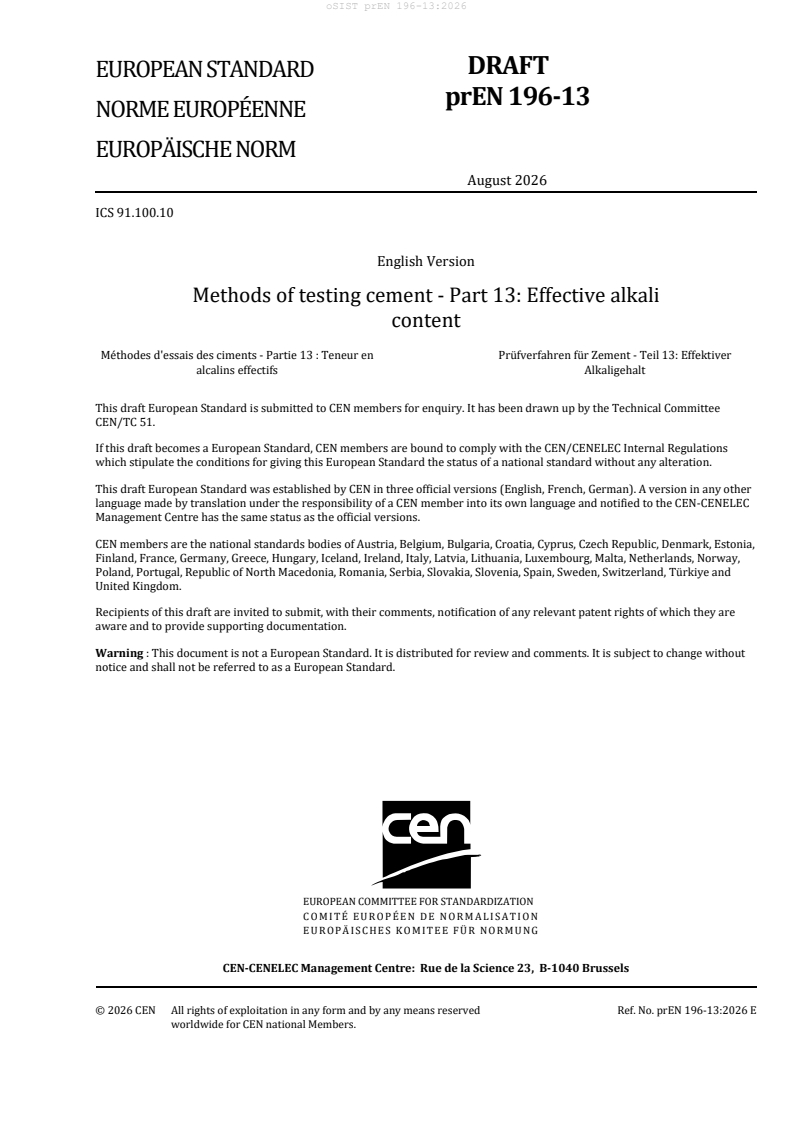
DRAFT
EUROPEAN STANDARD
NORME EUROPÉENNE
EUROPÄISCHE NORM
August 2026
ICS 91.100.10
English Version
Methods of testing cement - Part 13: Effective alkali
content
Méthodes d'essais des ciments - Partie 13 : Teneur en Prüfverfahren für Zement - Teil 13: Effektiver
alcalins effectifs Alkaligehalt
This draft European Standard is submitted to CEN members for enquiry. It has been drawn up by the Technical Committee
CEN/TC 51.
If this draft becomes a European Standard, CEN members are bound to comply with the CEN/CENELEC Internal Regulations
which stipulate the conditions for giving this European Standard the status of a national standard without any alteration.
This draft European Standard was established by CEN in three official versions (English, French, German). A version in any other
language made by translation under the responsibility of a CEN member into its own language and notified to the CEN-CENELEC
Management Centre has the same status as the official versions.
CEN members are the national standards bodies of Austria, Belgium, Bulgaria, Croatia, Cyprus, Czech Republic, Denmark, Estonia,
Finland, France, Germany, Greece, Hungary, Iceland, Ireland, Italy, Latvia, Lithuania, Luxembourg, Malta, Netherlands, Norway,
Poland, Portugal, Republic of North Macedonia, Romania, Serbia, Slovakia, Slovenia, Spain, Sweden, Switzerland, Türkiye and
United Kingdom.
Recipients of this draft are invited to submit, with their comments, notification of any relevant patent rights of which they are
aware and to provide supporting documentation.
Warning : This document is not a European Standard. It is distributed for review and comments. It is subject to change without
notice and shall not be referred to as a European Standard.
EUROPEAN COMMITTEE FOR STANDARDIZATION
COMITÉ EUROPÉEN DE NORMALISATION
EUROPÄISCHES KOMITEE FÜR NORMUNG
CEN-CENELEC Management Centre: Rue de la Science 23, B-1040 Brussels
© 2026 CEN All rights of exploitation in any form and by any means reserved Ref. No. prEN 196-13:2026 E
worldwide for CEN national Members.
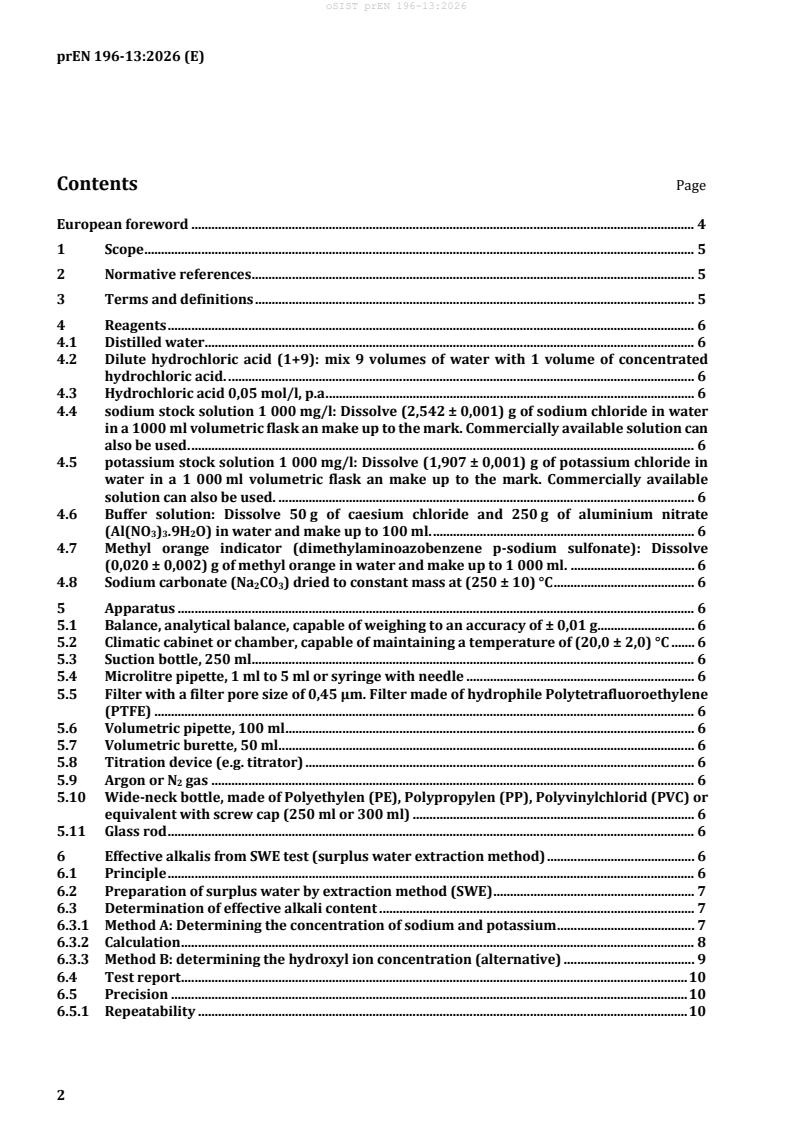
Contents Page
European foreword . 4
1 Scope . 5
2 Normative references . 5
3 Terms and definitions . 5
4 Reagents . 6
4.1 Distilled water . 6
4.2 Dilute hydrochloric acid (1+9): mix 9 volumes of water with 1 volume of concentrated
hydrochloric acid. . 6
4.3 Hydrochloric acid 0,05 mol/l, p.a . 6
4.4 sodium stock solution 1 000 mg/l: Dissolve (2,542 ± 0,001) g of sodium chloride in water
in a 1000 ml volumetric flask an make up to the mark. Commercially available solution can
also be used. . 6
4.5 potassium stock solution 1 000 mg/l: Dissolve (1,907 ± 0,001) g of potassium chloride in
water in a 1 000 ml volumetric flask an make up to the mark. Commercially available
solution can also be used. . 6
4.6 Buffer solution: Dissolve 50 g of caesium chloride and 250 g of aluminium nitrate
(Al(NO ) .9H O) in water and make up to 100 ml. . 6
3 3 2
4.7 Methyl orange indicator (dimethylaminoazobenzene p-sodium sulfonate): Dissolve
(0,020 ± 0,002) g of methyl orange in water and make up to 1 000 ml. . 6
4.8 Sodium carbonate (Na CO ) dried to constant mass at (250 ± 10) °C . 6
2 3
5 Apparatus . 6
5.1 Balance, analytical balance, capable of weighing to an accuracy of ± 0,01 g. 6
5.2 Climatic cabinet or chamber, capable of maintaining a temperature of (20,0 ± 2,0) °C . 6
5.3 Suction bottle, 250 ml . 6
5.4 Microlitre pipette, 1 ml to 5 ml or syringe with needle . 6
5.5 Filter with a filter pore size of 0,45 µm. Filter made of hydrophile Polytetrafluoroethylene
(PTFE) . 6
5.6 Volumetric pipette, 100 ml . 6
5.7 Volumetric burette, 50 ml . 6
5.8 Titration device (e.g. titrator) . 6
5.9 Argon or N gas . 6
5.10 Wide-neck bottle, made of Polyethylen (PE), Polypropylen (PP), Polyvinylchlorid (PVC) or
equivalent with screw cap (250 ml or 300 ml) . 6
5.11 Glass rod . 6
6 Effective alkalis from SWE test (surplus water extraction method) . 6
6.1 Principle . 6
6.2 Preparation of surplus water by extraction method (SWE) . 7
6.3 Determination of effective alkali content . 7
6.3.1 Method A: Determining the concentration of sodium and potassium . 7
6.3.2 Calculation . 8
6.3.3 Method B: determining the hydroxyl ion concentration (alternative) . 9
6.4 Test report . 10
6.5 Precision . 10
6.5.1 Repeatability . 10
6.5.2 Reproducibility . 10
Bibliography . 11
EN 196-13:2026 (E)
European foreword
This document (prEN 196-13:2026) has been prepared by Technical Committee CEN/TC 51 “Cement and
building limes”, the secretariat of which is held by NBN.
This document is currently submitted to the CEN Enquiry.
1 Scope
This document specifies the apparatus and procedure for determining the effective alkali content of
cements and other hydraulic binders. The method determines the effective alkali content after 28 days of
hydration by extracting pore water from cement stone and determining the concentration of sodium and
potassium (method A) or hydroxyl ions in the solution (method B).
2 Normative references
The following documents are referred to in the text in such a way that some or all their content constitutes
requirements of this document. For dated references, only the edition cited applies. For undated
references, the latest edition of the referenced document (including any amendments) applies.
EN 196-2, Methods of testing cement — Part 2: Che
...