


SIST-TS CEN/TS 1317-7:2024
(Main)Road restraint systems -Part 7: Performance characterisation and test methods for terminals of safety barriers
Road restraint systems -Part 7: Performance characterisation and test methods for terminals of safety barriers
This document specifies requirements, test/assessment methods and acceptance criteria for safety barrier terminals to be used in a
permanent or temporary manner on roads and in vehicle circulation areas.
The present document should be read in conjunction with EN 1317-1:2010 and EN 1317-2 2:2010 and EN 1317-5:2007+A2:2012.
Rückhaltesysteme an Straßen - Leistungsklassen, Abnahmekriterien für Anprallprüfungen und Prüfverfahren für Anfangs-und Endkonstruktionen von Schutzeinrichtungen
Dieses Dokument legt Anforderungen, Prüf /Bewertungsverfahren und Abnahmekriterien für Anfangs- und Endkonstruktionen von Schutzeinrichtungen fest, die dauerhaft oder vorübergehend auf Straßen und in Verkehrsbereichen für Fahrzeuge eingesetzt werden.
Dispositifs de retenue routiers Caractérisation des performances et méthodes dessai pour les extrémités de file de barrières de sécurité
Ce document spécifie les exigences, les méthodes d’essai/d’évaluation et les critères d’acceptation pour les extrémités de file de barrières de sécurité à usage permanent ou temporaire sur les routes et dans les zones de circulation des véhicules.
Le présent document doit être lu conjointement avec l'EN 1317-1:2010 et l'EN 1317-2 2:2010 et l'EN 1317-5:2007+A2:2012.
Oprema cest - 7. del: Ugotavljanje lastnosti in preskusne metode za zaključnice varnostnih ograj
Ta dokument določa zahteve, preskusne metode in metode ocenjevanja ter kriterije sprejemljivosti za zaključnice in prehodne elemente varnostnih ograj, ki se stalno ali začasno uporabljajo na cestah in v prometnih območjih.
Dokument je priporočljivo brati skupaj s standardi EN 1317-1:2010, EN 1317-2-2:2010 in EN 1317-5:2007+A2:2012.
General Information
- Status
- Published
- Publication Date
- 13-Dec-2023
- Technical Committee
- OCE - Road equipment
- Current Stage
- 6060 - National Implementation/Publication (Adopted Project)
- Start Date
- 07-Dec-2023
- Due Date
- 11-Feb-2024
- Completion Date
- 14-Dec-2023
Relations
- Effective Date
- 01-Jan-2024
Overview
CEN/TS 1317-7:2023 - "Road restraint systems - Part 7: Performance characterisation and test methods for terminals of safety barriers" - defines how to assess and classify the beginning and end treatments (terminals) of roadside safety barriers. The Technical Specification specifies requirements, test and assessment methods, and acceptance criteria for terminals used permanently or temporarily on roads and in vehicle circulation areas. It is a provisional CEN/TS (approved Sept 2023) and is intended to be read together with related EN 1317 parts and CEN/TR 1317-10.
Key topics and technical requirements
- Scope and terminology: clear definitions for terminal types (e.g., single-sided (ST), double-sided (DT), turned down terminals), datum point, structural length (Ls) and total length (Lt).
- Performance characterisation: classification of restraint and direction categories, specific impact points and defined ranges of terminals for testing.
- Impact test methods: detailed procedures for approach tests, impact speeds and approach angles, allowed deviations, vehicle instrumentation, photographic coverage and test-site requirements.
- Acceptance criteria: measurable criteria for terminal behaviour, test vehicle behaviour, vehicle deformation and a Severity Index. Notable limits from the specification include:
- Energy Absorbing Terminal (EAT) criterion linked to the vehicle crossing the exit line at speeds ≥ 11 km/h.
- A 6.0 m limit on total permanent displacement on the departure side (as revised in this edition).
- Anchorage capacity: methods to measure and assess terminal anchorage (static calculation guidance and measurement procedures are provided).
- Annexes: normative test report template and informative guidance (objectives of impact tests, determination of impact/exit boxes, anchorage assessment).
Practical applications and users
This Technical Specification is intended for:
- Manufacturers and designers of road restraint systems and safety barrier terminals - to design terminals that meet defined performance classes.
- Testing laboratories and certification bodies - to conduct and report impact tests in line with the standardized methods.
- Road authorities, infrastructure engineers and specifiers - to select, procure and approve terminal designs for permanent and temporary installations.
- Consultants and contractors - for installation, verification and maintenance planning, and for interpreting anchorage and displacement limits.
Using CEN/TS 1317-7 supports safer roadside design, consistent product evaluation, and compliance with European road restraint performance expectations.
Related standards
- EN 1317-1:2010 - Terminology and general criteria for test methods
- EN 1317-2:2010 - Performance classes and impact test acceptance criteria for safety barriers
- EN 1317-5:2007+A2:2012
- EN 16303:2020 - Virtual testing validation and verification (referenced for use of simulation)
- CEN/TR 1317-10 - Complementary guidance
Keywords: CEN/TS 1317-7:2023, road restraint systems, safety barrier terminals, performance characterisation, test methods, impact tests, anchorage capacity, EN 1317.


Frequently Asked Questions
SIST-TS CEN/TS 1317-7:2024 is a technical specification published by the Slovenian Institute for Standardization (SIST). Its full title is "Road restraint systems -Part 7: Performance characterisation and test methods for terminals of safety barriers". This standard covers: This document specifies requirements, test/assessment methods and acceptance criteria for safety barrier terminals to be used in a permanent or temporary manner on roads and in vehicle circulation areas. The present document should be read in conjunction with EN 1317-1:2010 and EN 1317-2 2:2010 and EN 1317-5:2007+A2:2012.
This document specifies requirements, test/assessment methods and acceptance criteria for safety barrier terminals to be used in a permanent or temporary manner on roads and in vehicle circulation areas. The present document should be read in conjunction with EN 1317-1:2010 and EN 1317-2 2:2010 and EN 1317-5:2007+A2:2012.
SIST-TS CEN/TS 1317-7:2024 is classified under the following ICS (International Classification for Standards) categories: 13.200 - Accident and disaster control; 93.080.30 - Road equipment and installations. The ICS classification helps identify the subject area and facilitates finding related standards.
SIST-TS CEN/TS 1317-7:2024 has the following relationships with other standards: It is inter standard links to SIST ENV 1317-4:2002. Understanding these relationships helps ensure you are using the most current and applicable version of the standard.
SIST-TS CEN/TS 1317-7:2024 is associated with the following European legislation: EU Directives/Regulations: 2024-01-0765; Standardization Mandates: M/111. When a standard is cited in the Official Journal of the European Union, products manufactured in conformity with it benefit from a presumption of conformity with the essential requirements of the corresponding EU directive or regulation.
SIST-TS CEN/TS 1317-7:2024 is available in PDF format for immediate download after purchase. The document can be added to your cart and obtained through the secure checkout process. Digital delivery ensures instant access to the complete standard document.
Standards Content (Sample)
SLOVENSKI STANDARD
01-januar-2024
Nadomešča:
SIST ENV 1317-4:2002
Oprema cest - 7. del: Ugotavljanje lastnosti in preskusne metode za zaključnice
varnostnih ograj
Road restraint systems -Part 7: Performance characterisation and test methods for
terminals of safety barriers
Rückhaltesysteme an Straßen - Leistungsklassen, Abnahmekriterien für
Anprallprüfungen und Prüfverfahren für Anfangs-und Endkonstruktionen von
Schutzeinrichtungen
Dispositifs de retenue routiers Caractérisation des performances et méthodes dessai
pour les extrémités de file de barrières de sécurité
Ta slovenski standard je istoveten z: CEN/TS 1317-7:2023
ICS:
13.200 Preprečevanje nesreč in Accident and disaster control
katastrof
93.080.30 Cestna oprema in pomožne Road equipment and
naprave installations
2003-01.Slovenski inštitut za standardizacijo. Razmnoževanje celote ali delov tega standarda ni dovoljeno.
CEN/TS 1317-7
TECHNICAL SPECIFICATION
SPÉCIFICATION TECHNIQUE
November 2023
TECHNISCHE SPEZIFIKATION
ICS 93.080.30 Supersedes ENV 1317-4:2001
English Version
Road restraint systems -Part 7: Performance
characterisation and test methods for terminals of safety
barriers
Dispositifs de retenue routiers - Caractérisation des Rückhaltesysteme an Straßen - Leistungsklassen,
performances et méthodes d'essai pour les extrémités Abnahmekriterien für Anprallprüfungen und
de file de barrières de sécurité Prüfverfahren für Anfangs-und Endkonstruktionen von
Schutzeinrichtungen
This Technical Specification (CEN/TS) was approved by CEN on 4 September 2023 for provisional application.
The period of validity of this CEN/TS is limited initially to three years. After two years the members of CEN will be requested to
submit their comments, particularly on the question whether the CEN/TS can be converted into a European Standard.
CEN members are required to announce the existence of this CEN/TS in the same way as for an EN and to make the CEN/TS
available promptly at national level in an appropriate form. It is permissible to keep conflicting national standards in force (in
parallel to the CEN/TS) until the final decision about the possible conversion of the CEN/TS into an EN is reached.
CEN members are the national standards bodies of Austria, Belgium, Bulgaria, Croatia, Cyprus, Czech Republic, Denmark, Estonia,
Finland, France, Germany, Greece, Hungary, Iceland, Ireland, Italy, Latvia, Lithuania, Luxembourg, Malta, Netherlands, Norway,
Poland, Portugal, Republic of North Macedonia, Romania, Serbia, Slovakia, Slovenia, Spain, Sweden, Switzerland, Türkiye and
United Kingdom.
EUROPEAN COMMITTEE FOR STANDARDIZATION
COMITÉ EUROPÉEN DE NORMALISATION
EUROPÄISCHES KOMITEE FÜR NORMUNG
CEN-CENELEC Management Centre: Rue de la Science 23, B-1040 Brussels
© 2023 CEN All rights of exploitation in any form and by any means reserved Ref. No. CEN/TS 1317-7:2023 E
worldwide for CEN national Members.
CEN/TS 1317-7 :2023 (E)
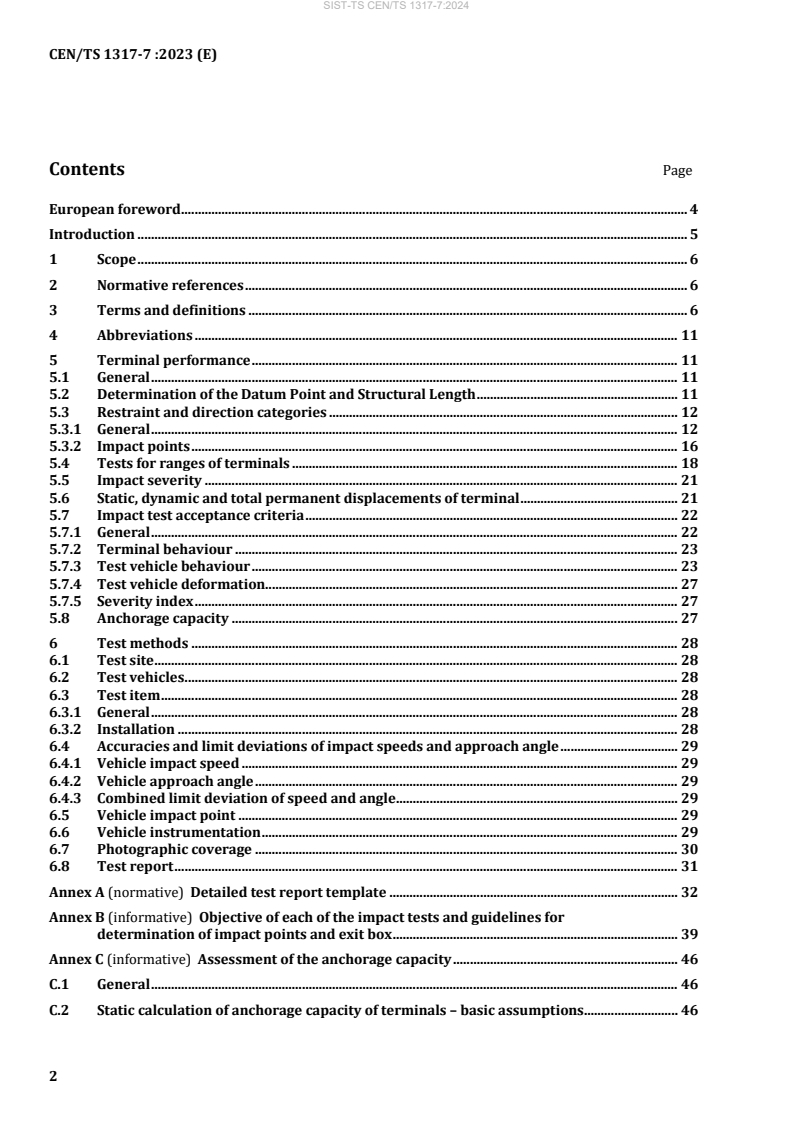
Contents Page
European foreword . 4
Introduction . 5
1 Scope . 6
2 Normative references . 6
3 Terms and definitions . 6
4 Abbreviations . 11
5 Terminal performance . 11
5.1 General . 11
5.2 Determination of the Datum Point and Structural Length . 11
5.3 Restraint and direction categories . 12
5.3.1 General . 12
5.3.2 Impact points . 16
5.4 Tests for ranges of terminals . 18
5.5 Impact severity . 21
5.6 Static, dynamic and total permanent displacements of terminal . 21
5.7 Impact test acceptance criteria . 22
5.7.1 General . 22
5.7.2 Terminal behaviour . 23
5.7.3 Test vehicle behaviour . 23
5.7.4 Test vehicle deformation. 27
5.7.5 Severity index . 27
5.8 Anchorage capacity . 27
6 Test methods . 28
6.1 Test site . 28
6.2 Test vehicles . 28
6.3 Test item . 28
6.3.1 General . 28
6.3.2 Installation . 28
6.4 Accuracies and limit deviations of impact speeds and approach angle . 29
6.4.1 Vehicle impact speed . 29
6.4.2 Vehicle approach angle . 29
6.4.3 Combined limit deviation of speed and angle . 29
6.5 Vehicle impact point . 29
6.6 Vehicle instrumentation . 29
6.7 Photographic coverage . 30
6.8 Test report . 31
Annex A (normative) Detailed test report template . 32
Annex B (informative) Objective of each of the impact tests and guidelines for
determination of impact points and exit box . 39
Annex C (informative) Assessment of the anchorage capacity . 46
C.1 General . 46
C.2 Static calculation of anchorage capacity of terminals – basic assumptions . 46
CEN/TS 1317-7 :2023 (E)
C.2.1 General . 46
C.2.2 Anchorage by friction . 46
C.2.3 Anchorage by anchors in pavement . 46
C.2.4 Anchorage of devices (e.g. posts) driven through or in pavement . 46
C.2.5 Anchorage of devices (e.g. posts) driven in soil . 46
C.2.6 Anchorages not covered by C.2.2 to C.2.4 . 48
C.3 Measurement of anchorage capacity of terminals . 48
Bibliography . 49
CEN/TS 1317-7 :2023 (E)
European foreword
This document (CEN/TS 1317-7 :2023) has been prepared by Technical Committee CEN/TC 226 “Road
equipment”, the secretariat of which is held by AFNOR.
Attention is drawn to the possibility that some of the elements of this document may be the subject of
patent rights. CEN shall not be held responsible for identifying any or all such patent rights.
This document supersedes ENV 1317-4:2001.
This document does not (and cannot) replace ENV 1317-4:2001 in isolation, only with CEN/TR 1317-10
and CEN/TS 1317-9.
In comparison with the edition, the following technical modifications have been made:
— terminal with performances on both sides defined in 3.3 (double-sided terminals)
— structural beginning of a terminal defined in 3.5 (datum point)
— structural length of a terminal defined in 3.7
— energy absorbing terminal defined in 3.10
— non-energy absorbing terminal defined in 3.11
— determination of the axial force to the barrier determined in 5.1
— methods for the determination of the Datum Point and the Structural Length are given in 5.2
— more restraint categories and different names are given for terminals in Table 1
— more vehicle impact tests are defined in Table 3
— the term “ranges of terminals” supersedes “system type tested terminals” in 5.4
— limit of 6.0m to the total permanent displacement of terminal on the departure side in Table 8
— for the terminal behaviour, consideration of totally detached parts of the terminal with mass greater
than 2.0 kg in 5.7.2
— for the test vehicle behaviour, the wheel of a vehicle is not considered crossing one of the lines of the
redirection zone, if the velocity of the centre of mass of the vehicle, at the moment of encroaching the
line, is less than 11 km/h and advise for the measurement of exit speed are given in 5.7.3
— definition of new terminal energy absorption categories are given in Table 10
— the anchorage capacity of the terminal is measured in 5.8
— different layout of cameras for different approaches are given in 6.7
— objective of the impact tests and guidelines for determination of impact points and exit box is detailed
in informative Annex B
— the assessment of the anchorage capacity is detailed in the informative Annex C
This document is to be read in conjunction with EN 1317-1:2010 and EN 1317-2:2010 and
EN 1317-5:2007+A2:2012 and CEN/TR 1317-10.
Any feedback and questions on this document should be directed to the users’ national standards body.
A complete listing of these bodies can be found on the CEN website.
CEN/TS 1317-7 :2023 (E)
Introduction
The design purpose of safety barriers installed on roads is to contain errant vehicles that either leave the
carriageway or are likely to encroach into the path of oncoming vehicles. EN 1317-2:2010 deals with the
impact performance of a safety barrier to which a terminal may be attached.
Terminals, which are defined as the beginning and/or end treatment of a safety barrier, are required to
have specified impact performances without introducing additional hazards for passenger cars.
The description of a terminal conforming to this document incorporates the relevant categories and
restraint categories of the product.
Turned down terminals are particular end-treatments that have, historically, been designed to ‘anchor’
and ‘end’ sections of safety barrier. Turned down terminals consisting of modified components of the
barrier do not generally offer a significant level of energy absorbing capacity but can be tested according
to this technical specification if required.
NOTE Some National Road Authorities have in the past years developed national rules that, when satisfied,
allow the use of such systems within their national jurisdiction without the need of further testing.
In this document reference is made to the use of virtual testing according to EN 16303:2020. Therefore
it may be necessary to arrange further rules for the use of virtual testing.
CEN/TS 1317-7 :2023 (E)
1 Scope
This document specifies requirements, test/assessment methods and acceptance criteria for safety
barrier terminals to be used in a permanent or temporary manner on roads and in vehicle circulation
areas.
2 Normative references
The following documents are referred to in the text in such a way that some or all of their content
constitutes requirements of this document. For dated references, only the edition cited applies. For
undated references, the latest edition of the referenced document (including any amendments) applies.
EN 1317-1:2010, Road restraint systems - Part 1: Terminology and general criteria for test methods
EN 1317-2:2010, Road restraint systems - Part 2: Performance classes, impact test acceptance criteria and
test methods for safety barriers including vehicle parapets
EN 16303:2020, Road restraint systems - Validation and verification process for the use of virtual testing in
crash testing against vehicle restraint system
3 Terms and definitions
For the purposes of this document, the following terms and definitions apply.
ISO and IEC maintain terminological databases for use in standardization at the following addresses:
• IEC Electropedia: available at https://www.electropedia.org/
• ISO Online browsing platform: available at https://www.iso.org/obp
3.1
terminal
treatment of the beginning and/or end of a safety barrier to reduce hazards for passenger cars that would
result from the use of an un-treated beginning or end of the barrier (or other construction)
Note 1 to entry: Usually a terminal provides anchorage for the barrier system.
Note 2 to entry: A terminal may include a length of connecting barrier if it is required as part of the working
mechanism of the terminal
Note 3 to entry: The performance of a terminal in general is dependent on the barrier connected.
3.2
ST
single sided terminal
terminal which has a performance under impact determined in accordance with the present document
on one side
3.3
DT
double-sided terminal
terminal which has performance in accordance with this European Standard, on both sides
CEN/TS 1317-7 :2023 (E)
3.4
turned down terminal
end treatment or terminal consisting mainly of a longitudinal element lowered continuously close to the
ground
Note 1 to entry Historically, turned down terminals have been designed to ‘anchor’ and ‘end’ sections of
safety barrier in addition to providing better safety at the beginning of barriers.”
Note 2 to entry: Turned down terminals consisting of modified components of the barrier do not generally offer
a significant level of energy absorbing capacity but can be tested according to this technical specification if required
by national rules.
3.5
datum point
structural beginning of a terminal i.e. the first point at which the terminal offers significant resistance to
a frontal impact
3.6
total length of a terminal
Lt
total length of the terminal including structural and non-structural components including the length of
connecting barrier required as part of the working mechanism of the terminal
3.7
structural length of a terminal
Ls
longitudinal distance from the terminal datum point to the end of the terminal including the length of
connecting barrier required as part of the working mechanism of the terminal
Note 1 to entry: The structural length as well as the total length of a terminal is measured in the direction of the
traffic side of the barrier. Both lengths are shown diagrammatically in Figure 3.
3.8
length of attached barrier
Lb
length Lb of a barrier meeting the requirements of EN 1317-1 and EN 1317-2 and fixed to a terminal for
the crash test including connections
3.9
length of terminal deformation
Ld
maximum dynamic longitudinal displacement of the terminal datum point after Approach 1 test
3.10
energy absorbing terminal
EAT
terminal which in the test Approach 1 (or 2 for T50, T80/3, T80/2 and T80/1) does not allow the most
forward point of the test vehicle to cross the vehicle exit line R (see Figure 7) at a speed higher or equal
to 11 km/h
CEN/TS 1317-7 :2023 (E)
3.11
non-energy absorbing terminal
NEAT
terminal which in the test Approach 1 (or 2 for T50, T80/3, T80/2 and T80/1) allows the most forward
point of the test vehicle to cross the vehicle exit line R (see Figure 7) at a speed higher or equal to 11
km/h
3.12
range of terminals
multiple performance product that can be assembled to form different models from the same set of
components, to obtain performances in different categories, with the same working mechanism for the
system and for its components
3.13
wheel track
distance between the centres of tyre contact of the two wheels of an axle, projected on to the YZ plane
Note 1 to entry: See Figure 1.
Figure 1 — Example of wheel track
3.14
centre of tyre contact
P centre of tyre contact
Note 1 to entry: See Figure 2
CEN/TS 1317-7 :2023 (E)
Key
A wheel spin axis
G ground plane
M wheel mid plane
R projection of A on G
P centre of tyre contact
Figure 2 — Centre of tyre contact
3.15
critical impact point
CIP
impact point identified to reasonably represent the worst case performance under test conditions
3.16
uni-directional terminal – approach
UTA
terminal designed and tested to perform at the approach end of a barrier only
3.17
uni-directional terminal – departure
UTD
terminal designed and tested to perform at the departure end of a barrier only
3.18
bi-directional terminal
BDT
terminal designed and tested to perform at either the approach end or the departure end of a barrier
CEN/TS 1317-7 :2023 (E)
Key
1 side view
2 plan view
3 minimum length of connecting barrier required as part of the working mechanism of the terminal
4 datum point
5 energy absorbing element
Figure 3 — Diagram of a Terminal
CEN/TS 1317-7 :2023 (E)
4 Abbreviations
For the purposes of this document, the following abbreviations apply.
ASI Acceleration severity index
ATD Anthropomorphic Test Device
BDT Bi-directional terminal
CIP Critical Impact Point
DT Double sided terminal
EAT Energy Absorbing Terminal
Lb Length of barrier connected to a terminal
Ld Length of terminal deformation
Ls Structural length of a terminal
Lt Total length of a terminal
NEAT Non-energy Absorbing Terminal
ST Single sided terminal
THIV Theoretical head impact velocity
UTA Uni-directional terminal approach
UTD Uni-directional terminal departure
VCDI Vehicle cockpit deformation index
For the purposes of this document, test vehicle mass codes are
1 900 kg,
2 1 300 kg,
3 1 500 kg.
5 Terminal performance
5.1 General
Axial forces to the barrier should be measured or evidence should be given by static calculation or by
virtual testing using models according to EN 16303:2020, if it is intended to use the terminal with
different barriers, unless the terminal does not transfer any load to the connecting barrier.
5.2 Determination of the Datum Point and Structural Length
The structural length of the terminal (Ls) should be determined by the test house, after the Approach 1
test has been performed if this approach is required (or, after that of Approach 2 if no Approach 1 test is
required) before the other required tests are performed. Some designs of terminal might incorporate a
non-structural beginning (nose) which offers no significant influence (for example resistance) to an
impact. The first point at which the terminal offers significant influence (for example resistance) to an
impact with Approach 1 is defined as the datum point. For restraint categories T50 and T80/1/2/3, this
information can be derived from Approach 2.
The datum point should be chosen by the test house according to the definition given in 3.5 and identified
as described above and justified in the test report. If the datum point cannot be chosen directly from the
CEN/TS 1317-7 :2023 (E)
design of the terminal or the manufacturer does not agree to the chosen datum point the datum point
should be determined by the test house on the basis of the results of the Approach 1 test if this approach
is required (or, on that of Approach 2 if no Approach 1 test is required).For energy absorbing terminals
the datum point is the foremost point of the test item where the test vehicle hast lost 5 % of the nominal
impact speed.
For turned down terminals, the terminal datum point should be defined as the first point 200 mm above
ground level.
NOTE The speed of the test vehicle could be derived from the vehicle instrumentation or from high speed video
and the corresponding vehicle position from high speed video or another suitable method can be used.
If a part of the barrier overlaps with the terminal or is required to deform in a controlled manner as part
of the normal functioning of the terminal, then this length of the barrier should be included in Ls. For
turned down terminals the length of the terminal should be the longitudinal length from the beginning of
the terminal to the first point of the barrier with unchanged design (including full height of the barrier).
The total length of the terminal (Lt) should conform to the design specification. For tests, the terminal
should be installed with the terminal manufacturer’s minimum specified length of safety barrier (Lb) so
as to demonstrate the full performance of the terminal but not shorter than 20 m. For tests that were
carried out in accordance with ENV 1317-4:2001 before this document was published, a shorter length
is acceptable, provided the full performance of the terminal is demonstrated. The same barrier type
should be used within all of the testing for a particular terminal product.
5.3 Restraint and direction categories
5.3.1 General
Terminals should be tested in accordance with Table 1 and Table 3. The restraint categories given in
Table 1 are classified according to an increasing containment capacity.
A successfully tested installation at a given restraint category, should be considered as having met
conditions of lower restraint categories with the same direction category (see Table 2).
The impact test configurations are specified in Table 3.
NOTE 1 Some of the performances of terminals are common to crash cushions. Accordingly, some of the tests
specified for terminals in the present document have the same impact conditions specified in EN 1317-3:2010 for
crash cushions. Nevertheless, some other tests are different. The main differences between terminals and crash
cushions are:
• for terminals:
o a terminal is designed to be installed at the beginning and/or at the end of a barrier whereas a
crash cushion is intended to avoid or attenuate vehicle impacts with different types of obstacle,
o a terminal should be joined to a barrier, with a smooth alignment with no risk of snagging or
pocketing,
o in general a terminal is designed to provide an anchorage to the barrier and to have adequate
reaction to the axial tensile force from the barrier under impact.
The above three points might also apply to crash cushions connected to a barrier.
• for crash cushions:
o a crash cushion can be connected to the obstacle that it protects,
o a crash cushion is always energy absorbing while a terminal can be NEAT.
CEN/TS 1317-7 :2023 (E)
Table 1 — Required tests for terminals according to restraint category and direction category
Restraint Direction
Test
Category Category
T50 UTA TT2.1.50
T80/3 UTA TT2.1.80
UTA TT2.1.80 TT4.2.80
T80/2 BDT
UTD
TT5.1.80
UTA TT2.1.80 TT4.2.80
T80/1 BDT
UTD TT5.1.80 TT6.2.80
UTA TT1.2.80 TT2.1.80 TT3.2.80 TT4.2.80
T80 BDT
UTD TT5.1.80 TT6.2.80
UTA TT1.2.100 TT2.1.100 TT4.2.100
T100/1 BDT
UTD TT5.1.100
UTA TT1.2.100 TT2.1.100 TT3.2.100 TT4.2.100
T100 BDT
UTD TT5.1.100 TT6.2.100
UTA TT1.3.110 TT2.1.100 TT4.3.110
T110/1 BDT
UTD
TT5.1.100
UTA TT1.3.110 TT2.1.100 TT3.3.110 TT4.3.110
T110 BDT
UTD TT5.1.100 TT6.3.110
NOTE 2:
• the tests for category T80/3 are the same as the tests of ENV 1317-4:2001 class P1
• the tests for category T80/2 are the same as the tests of ENV 1317-4:2001 class P2
• the tests for category T100/1 are the same as the tests of ENV 1317-4:2001 class P3
• the tests for category T110/1 are the same as the tests of ENV 1317-4:2001 class P4
CEN/TS 1317-7 :2023 (E)
Table 2 — Restraint categories including other restraint categories
Restraint category assessed
Lower
restraint
T80/2 T80/1 T80 T100/1 T100 T110/1 T110
categories
considered to
be assessed
T50 UTA x x x - x x - x x - x x - x x - x x - x x - x
T80/3 UTA - x x - x x - x x - x x - x x - x x - x x - x
UTA - - x - x x - x x - x x - x x - x x - x x - x
T80/2 UTD - - - x x - x x - x x - x x - x x - x x - x x
BDT - - - - x - - x - - x - - x - - x - - x - - x
UTA - - - - - x - x x - x x - x x - x x - x x - x
T80/1 UTD - - - - - - x x - x x - - - - x x - - - - x x
BDT - - - - - - - x - - x - - - - - x - - - - - x
UTA - - - - - - - - x - x - - - x - x - - - x - x
T80 UTD - - - - - - - - - x x - - - - x x - - - - x x
BDT - - - - - - - - - - x - - - - - x - - - - - x
UTA - - - - - - - - - - - x - x x - x x - x x - x
T100/
UTD - - - - - - - - - - - - x x - x x - x x - x x
BDT - - - - - - - - - - - - x - - x - - x - - x
UTA - - - - - - - - - - - - - - x - x - - - x - x
T100 UTD - - - - - - - - - - - - - - - x x - - - - x x
BDT - - - - - - - - - - - - - - - - x - - - - - x
UTA - - - - - - - - - - - - - - - - - x - x x - x
T110/
UTD - - - - - - - - - - - - - - - - - - x x - x x
BDT - - - - - - - - - - - - - - - - - - - x - - x
UTA - - - - - - - - - - - - - - - - - - - - x - x
T110 UTD - - - - - - - - - - - - - - - - - - - - - x x
BDT - - - - - - - - - - - - - - - - - - - - - x
UTA T50
UTA T80/3
UTA
UTD
BDT
UTA
UTD
BDT
UTA
UTD
BDT
UTA
UTD
BDT
UTA
UTD
BDT
UTA
UTD
BDT
UTA
UTD
BDT
CEN/TS 1317-7 :2023 (E)
Table 3 — Vehicle impact test configurations
Test
s
Approach Vehicl
reference e Velocity
Approach
a
Test code
mass km/h
(see
kg
Figure 4)
TT1.2.80 frontal, 0°, head centred 1 1 80
TT1.2.100 frontal, 0°, head centred 1 1 100
TT1.3.110 frontal, 0°, head centred 1 1 110
b
TT2.1.50 frontal, 0°, offset by ¼ of the 2 900 50
vehicle width to the traffic side
b
TT2.1.80 frontal, 0°, offset by ¼ of the 2 900 80
vehicle width to the traffic side
b
TT2.1.100 frontal, 0°, offset by ¼ of the 2 900 100
vehicle width to the traffic side
TT3.2.80 head (centre) at 15° 3 1 80
TT3.2.100 head (centre) at 15° 3 1 100
TT3.3.110 head (centre) at 15° 3 1 110
TT4.2.80 side, 15° 2/3 Ls 4 1 80
TT4.2.100 side, 15° 2/3 Ls 4 1 100
TT4.3.110 side, 15° 2/3 Ls 4 1 110
b
TT5.1.80 side, 165° 1/2 Ls 5 900 80
b
TT5.1.100 side, 165° 1/2 Ls 5 900 100
TT6.2.80 side, 165° at the critical impact 6 1 80
point 300
TT6.2.100 side, 165° at the critical impact 6 1 100
point 300
TT6.3.110 side, 165° at the critical impact 6 1 110
point 500
a
Test code notation is as follows:
TT12100
Test of Test vehicle
Approach Impact speed Terminal mass
b
For this test condition, the ATD required by EN 1317-1 should be located at the more distant location from the
centre line of the terminal. For tests that were carried out in accordance with ENV 1317-4:2001 before the present
document was published, a different location of the ATD is acceptable.
The vehicle width should be the maximum width of the vehicle at its widest point, excluding any side
mirrors.
CEN/TS 1317-7 :2023 (E)
Category T80/3 should only be used for the testing of non-energy absorbing terminals. Category T80/3
offers a lower level of safety than categories T80/2, TB80/1 and TB80.
5.3.2 Impact points
The CIP should be chosen along 5 m section of the connecting safety barrier as presented in the Figure 4.
The initial vehicle impact in all tests should generally be at the points indicated in Figure 4.
The impact points should be identified as shown in Figure 4 unless these do not demonstrate the worst-
case testing conditions of the terminal, in terms of the performance of the terminal to be determined
according to Clause 5 (e.g. restraint category, total permanent displacement zone, impact severity
category) and should include any sensitive feature of the design, following the guidelines set out in
Annex B. If the test house chooses an impact point other than those outlined below, in order to ensure
worst-case conditions, then this choice should be justified in the test report.
The impact points on a terminal should be determined considering only its structural parts.
a) Approach 1: Frontal, 0° centre of terminal head
b) Approach 2: Frontal, offset by ¼ of the vehicle width to the traffic side
c) Approach 3: 15° vehicle centreline on centre of terminal head
CEN/TS 1317-7 :2023 (E)
d) Approach 4: 15° vehicle impact at 2/3 LS on terminal traffic side
e) Approach 5: 165° vehicle impact at ½ LS on terminal traffic side
f) Approach 6: 165° vehicle impact on barrier before connection to terminal, at critical impact
point
Key
1 centre line of terminal
2 datum point
3 minimum length of connecting barrier required as part of the working mechanism of the terminal
W width of the vehicle excluding the wing mirrors
Figure 4 — Vehicle approach paths
Approaches 4 and 5 should be run after determination of Ls on the basis of the terminal behaviour from
Approach 1 test or, in the case of categories T80/1 or 2, from the Approach 2 test.
CEN/TS 1317-7 :2023 (E)
Approach 5 will not be run for a terminal which is not parallel to the line of the original traffic face of the
barrier if the angle β of the vehicle path to the traffic face of the terminal is less than 5°, at the relevant
impact point and from this point to the head of the terminal (Figure 5).
Terminals should be classified as either single sided (ST) or double sided (DT) systems. This classification
should be reported within the test report.
In the case of non-symmetrical double sided terminals, tests for Approaches 2, 3, 4, and 5 required for
the corresponding restraint and direction categories should be carried out on both sides of the terminal.
Figure 5 — Terminal configuration not requiring an Approach 5 test (if β<5°)
5.4 Tests for ranges of terminals
A group of terminal products of comparable design covering a range of restraint categories can be derived
from a parent terminal, once the latter has been successfully tested to the present document and
providing that all products in this range (parent and derived terminals):
a) are assembled from the same set of components;
b) have the same root product name;
c) have the same working mechanism for the complete product system and for its constituent
components.
The group, specified by the drawings of all the models, may be tested as a range, i.e. a product with
multiple performance possibilities. If the tests specified by the group test matrix are passed, the terminal
should be accepted as a multiple performance product range, i.e. each member is accepted in the relevant
restraint category.
The parent terminal should be of direction category BDT. The parent terminal should belong to the
highest restraint category of the range.
If the highest restraint category of the range is to be increased, the test matrix of Table 1 should be fully
completed for the parent terminal, taking into account any tests which may have already been completed.
CEN/TS 1317-7 :2023 (E)
The test matrix for child terminals, that is to say terminals in a range of products other than the parent,
should be as shown in Tables 4, 5, 6, 7, 8, 9, 10 and 6d depending on the highest restraint category of the
range.
NOTE A range of terminals could for example be built in the following way:
In this example the parent terminal named “Term(10)” consists of 10 energy-absorbing components and is
classified as T110 BDT.
A child terminal, named “Term(9)” could be constructed for example by reducing the length of “Term(10)” and
reducing the number of energy absorbing-components to 9. Apart from that, “Term(9)” is identical to “Term(10)”.
“Term(9)” could be classified for example as T80 BDT according to Table 4a if “Term(9)” passes the tests TT1.2.80,
TT3.1.80 and TT4.2.80. If no more child terminals are added to the range of terminals this is given by: “Term(10)”
– T110 BDT and “Term(9)” – T80 BDT.
Note that in this example “Term(10)” could also be used un-modified as a T100 BDT – terminal or any lower
restraint category according to Table 2.
Table 4 — Test matrix for child terminals with parent terminal T110 BDT
Restraint Category of range of Tests
terminals
T110/1 BDT TT1.3.110
TT2.1.100
T100 BDT TT1.2.100
TT3.2.100
TT4.2.100
T100/1 BDT TT1.2.100
T80 BDT TT1.2.80
TT3.2.80
TT4.2.80
T80/1 BDT TT2.1.80
T80/2 BDT TT2.1.80
T80/3 UTA TT2.1.80
T50 UTA TT2.1.50
Table 5 —Test matrix for child terminals with parent terminal T110/1 BDT
Restraint Category of range of Tests
terminals
T100/1 BDT TT1.2.100
T80/2 BDT TT2.1.80
T80/3 UTA TT2.1.80
T50 UTA TT2.1.50
CEN/TS 1317-7 :2023 (E)
Table 6 — Test matrix for child terminals with parent terminal T100 BDT
Restraint Category of range of Tests
terminals
T100/1 BDT TT1.2.100
T80 BDT TT1.2.80
TT3.2.80
TT4.2.80
T80/1 BDT TT2.1.80
T80/2 BDT TT2.1.80
T80/3 UTA TT2.1.80
T50 UTA TT2.1.50
Table 7 — Test matrix for child terminals with parent terminal T100/1 BDT
Restraint Category of range of Tests
terminals
T80/2 BDT TT2.1.80
T80/3 UTA TT2.1.80
T50 UTA TT2.1.50
Table 8 Test matrix for child terminals with parent terminal T80 BDT
Restraint Category of range of Tests
terminals
T80/1 BDT TT2.1.80
T80/2 BDT TT2.1.80
T80/3 UTA TT2.1.80
T50 UTA TT2.1.50
Table 9 — Test matrix for child terminals with parent terminal T80/1 BDT
Restraint Category of range of Tests
terminals
T80/2 BDT TT2.1.80
T80/3 UTA TT2.1.80
T50 UTA TT2.1.50
Table 10 Test matrix for child terminals with parent terminal T80/2 BDT
Restraint Category of range Tests
of terminals
T80/3 UTA TT2.1.80
T50 UTA TT2.1.50
CEN/TS 1317-7 :2023 (E)
If the terminal connection-transition is modified, this modification should be assessed in accordance with
CEN/TR 1317-10.
5.5 Impact severity
The vehicle occupant impact severity assessment indices, ASI and THIV, should be evaluated. ASI and
THIV should conform to the requirements of Table 7 for the tests indicated in Table 1 and 3.
These indices are defined in EN 1317-1.
Two severity categories are determined in Table 11 as a function of the values of ASI and THIV.
Table 11 — Terminals: Vehicle impact severity categories
Impact severity
Index values
categories
A ASI ≤ 1,0 and THIV ≤ 44 km/h in Approach 1, 2 and 3
THIV ≤ 33 km/h in Approach 4, 5 and 6
B ASI ≤ 1,4 and THIV ≤ 44 km/h in Approach 1, 2 and 3
THIV ≤ 33 km/h in Approach 4, 5 and 6
NOTE 1 Impact severity category A affords a greater level of safety for the occupants of an errant vehicle than category B.
NOTE 2 The limit value for THIV is higher in Approach 1, 2 and 3 because experience has shown that higher values can be
tolerated by occupants in frontal impacts (also because of better passive safety in this direction). Such a difference in human
tolerance between frontal and lateral impacts is already considered in the ASI parameter, which therefore does not need to
be changed.
5.6 Static, dynamic and total permanent displacements of terminal
The dynamic and the static lateral displacement of the terminal test installation including the attached
barrier and the static displacement of any detached part of the terminal should be measured. The
measurements should be taken separately for the traffic and the departure sides (Figure 6).
The dynamic displacement is the maximum lateral distance, during the test, between the foremost point
of the undeformed traffic side of the test installation including terminal and barrier and the maximum
dynamic position of any part of the terminal or barrier on the departure side.
The static displacement is measured in the same way as the dynamic displacement but not less than 10
min and no more than two hours after the impact.
The static displacement of the detached parts is measured in the same way as the static displacement of
the terminal but with reference to any detached part of the terminal with a mass greater than or equal to
2,0 kg instead of reference to the deformed terminal.
The total permanent displacement is given by the maximum of the static displacement of the terminal
and the static displacements of detached parts.
The dynamic and the static displacement of the terminal, the static displacement of the detached parts
and the total permanent displacement should be recorded in the test report, separately for the traffic and
the departure side.
For tests that were carried out in accordance with ENV 1317-4:2001 before this document was published,
the total permanent lateral displacement determined according to the ENV 1317-4:2001 is acceptable.
NOTE Terminals can be made with materials that slowly recover towards their original shape following a test.
The minimum time of 10 min after the test is allowed for any self restoring motion. The maximum time of two hours
is prescribed to prevent any change of the final configuration from external factors.
To meet a category S or T, the total permanent displacement of the terminal, under all the tests required
by its restraint categories, should remain within distances S and T from the traffic side of the barrier, as
shown in Table 12. The distances S and T are shown in Figure 6.
CEN/TS 1317-7 :2023 (E)
Table 12 — Total permanent displacement zones for terminals
Category codes Displacement
m
S code
S 0,5 ≤ 0,5
S 1,5 ≤ 1,5
S 3,0 ≤ 3,0
T code
T 0,5 ≤ 0,5
T 1,0 ≤ 1,0
T 2,0 ≤ 2,0
T 3,5 ≤ 3,5
T 6,0 ≤ 6.0
Key
1 Approach side
2 Departure side
3 Minimum length of connecting barrier required as part of the working mechanism of the terminal
4 Barrier
5 Terminal
Figure 6 — Terminal total permanent displacement zones
5.7 Impact test acceptance criteria
5.7.1 General
In order to consider that a terminal has performed acceptably in a test and to determine product
performance on the basis of all test required by the present document for the specified performance
categories, the following impact acceptance criteria should be met.
CEN/TS 1317-7 :2023 (E)
5.7.2 Terminal behaviour
No element of the terminal test installation (including barrier) should penetrate the passenger
compartment of the vehicle. Any penetration or deformation of the passenger compartment should be
recorded in the test report.
Although any deformation of the passenger compartment should be reported, the present document does
not currently provide a method to assess the resulting risk of injury to vehicle occupants. The level of
deformation considered to be acceptable should be determined at a national level.
All totally detached parts of the terminal with a mass greater than or equal to 2,0 kg should be included
in the determination of the displacement classification (see 5.6).
For approaches 4, 5 and 6 there should be no complete breakage of any of the principal longitudinal
elements of either the terminal or the connected safety barrier system.
Anchorages and fixings should perform to the terminal design specifications and other specified
requirements as listed in the test report.
5.7.3 Test vehicle behaviour
5.7.3.1 General
The vehicle should not roll over (including rollover of the vehicle onto its side) during or after impact.
The post-impact trajectory of the test vehicle should be reported by means of the redirection zone shown
in Figures 7,8 and 9 and in Table 13.
Key
1 Approach s
...
SLOVENSKI STANDARD
01-januar-2024
Nadomešča:
SIST ENV 1317-4:2002
Oprema cest - 7. del: Ugotavljanje zmogljivosti in preskusne metode za zaključnice
in prehodne elemente varnostnih ograj
Road restraint systems -Part 7: Performance characterisation and test methods for
terminals of safety barriers
Rückhaltesysteme an Straßen - Leistungsklassen, Abnahmekriterien für
Anprallprüfungen und Prüfverfahren für Anfangs-und Endkonstruktionen von
Schutzeinrichtungen
Dispositifs de retenue routiers Caractérisation des performances et méthodes dessai
pour les extrémités de file de barrières de sécurité
Ta slovenski standard je istoveten z: CEN/TS 1317-7:2023
ICS:
13.200 Preprečevanje nesreč in Accident and disaster control
katastrof
93.080.30 Cestna oprema in pomožne Road equipment and
naprave installations
2003-01.Slovenski inštitut za standardizacijo. Razmnoževanje celote ali delov tega standarda ni dovoljeno.
CEN/TS 1317-7
TECHNICAL SPECIFICATION
SPÉCIFICATION TECHNIQUE
November 2023
TECHNISCHE SPEZIFIKATION
ICS 93.080.30 Supersedes ENV 1317-4:2001
English Version
Road restraint systems -Part 7: Performance
characterisation and test methods for terminals of safety
barriers
Dispositifs de retenue routiers - Caractérisation des Rückhaltesysteme an Straßen - Leistungsklassen,
performances et méthodes d'essai pour les extrémités Abnahmekriterien für Anprallprüfungen und
de file de barrières de sécurité Prüfverfahren für Anfangs-und Endkonstruktionen von
Schutzeinrichtungen
This Technical Specification (CEN/TS) was approved by CEN on 4 September 2023 for provisional application.
The period of validity of this CEN/TS is limited initially to three years. After two years the members of CEN will be requested to
submit their comments, particularly on the question whether the CEN/TS can be converted into a European Standard.
CEN members are required to announce the existence of this CEN/TS in the same way as for an EN and to make the CEN/TS
available promptly at national level in an appropriate form. It is permissible to keep conflicting national standards in force (in
parallel to the CEN/TS) until the final decision about the possible conversion of the CEN/TS into an EN is reached.
CEN members are the national standards bodies of Austria, Belgium, Bulgaria, Croatia, Cyprus, Czech Republic, Denmark, Estonia,
Finland, France, Germany, Greece, Hungary, Iceland, Ireland, Italy, Latvia, Lithuania, Luxembourg, Malta, Netherlands, Norway,
Poland, Portugal, Republic of North Macedonia, Romania, Serbia, Slovakia, Slovenia, Spain, Sweden, Switzerland, Türkiye and
United Kingdom.
EUROPEAN COMMITTEE FOR STANDARDIZATION
COMITÉ EUROPÉEN DE NORMALISATION
EUROPÄISCHES KOMITEE FÜR NORMUNG
CEN-CENELEC Management Centre: Rue de la Science 23, B-1040 Brussels
© 2023 CEN All rights of exploitation in any form and by any means reserved Ref. No. CEN/TS 1317-7:2023 E
worldwide for CEN national Members.
CEN/TS 1317-7 :2023 (E)
Contents Page
European foreword . 4
Introduction . 5
1 Scope . 6
2 Normative references . 6
3 Terms and definitions . 6
4 Abbreviations . 11
5 Terminal performance . 11
5.1 General . 11
5.2 Determination of the Datum Point and Structural Length . 11
5.3 Restraint and direction categories . 12
5.3.1 General . 12
5.3.2 Impact points . 16
5.4 Tests for ranges of terminals . 18
5.5 Impact severity . 21
5.6 Static, dynamic and total permanent displacements of terminal . 21
5.7 Impact test acceptance criteria . 22
5.7.1 General . 22
5.7.2 Terminal behaviour . 23
5.7.3 Test vehicle behaviour . 23
5.7.4 Test vehicle deformation. 27
5.7.5 Severity index . 27
5.8 Anchorage capacity . 27
6 Test methods . 28
6.1 Test site . 28
6.2 Test vehicles . 28
6.3 Test item . 28
6.3.1 General . 28
6.3.2 Installation . 28
6.4 Accuracies and limit deviations of impact speeds and approach angle . 29
6.4.1 Vehicle impact speed . 29
6.4.2 Vehicle approach angle . 29
6.4.3 Combined limit deviation of speed and angle . 29
6.5 Vehicle impact point . 29
6.6 Vehicle instrumentation . 29
6.7 Photographic coverage . 30
6.8 Test report . 31
Annex A (normative) Detailed test report template . 32
Annex B (informative) Objective of each of the impact tests and guidelines for
determination of impact points and exit box . 39
Annex C (informative) Assessment of the anchorage capacity . 46
C.1 General . 46
C.2 Static calculation of anchorage capacity of terminals – basic assumptions . 46
CEN/TS 1317-7 :2023 (E)
C.2.1 General . 46
C.2.2 Anchorage by friction . 46
C.2.3 Anchorage by anchors in pavement . 46
C.2.4 Anchorage of devices (e.g. posts) driven through or in pavement . 46
C.2.5 Anchorage of devices (e.g. posts) driven in soil . 46
C.2.6 Anchorages not covered by C.2.2 to C.2.4 . 48
C.3 Measurement of anchorage capacity of terminals . 48
Bibliography . 49
CEN/TS 1317-7 :2023 (E)
European foreword
This document (CEN/TS 1317-7 :2023) has been prepared by Technical Committee CEN/TC 226 “Road
equipment”, the secretariat of which is held by AFNOR.
Attention is drawn to the possibility that some of the elements of this document may be the subject of
patent rights. CEN shall not be held responsible for identifying any or all such patent rights.
This document supersedes ENV 1317-4:2001.
This document does not (and cannot) replace ENV 1317-4:2001 in isolation, only with CEN/TR 1317-10
and CEN/TS 1317-9.
In comparison with the edition, the following technical modifications have been made:
— terminal with performances on both sides defined in 3.3 (double-sided terminals)
— structural beginning of a terminal defined in 3.5 (datum point)
— structural length of a terminal defined in 3.7
— energy absorbing terminal defined in 3.10
— non-energy absorbing terminal defined in 3.11
— determination of the axial force to the barrier determined in 5.1
— methods for the determination of the Datum Point and the Structural Length are given in 5.2
— more restraint categories and different names are given for terminals in Table 1
— more vehicle impact tests are defined in Table 3
— the term “ranges of terminals” supersedes “system type tested terminals” in 5.4
— limit of 6.0m to the total permanent displacement of terminal on the departure side in Table 8
— for the terminal behaviour, consideration of totally detached parts of the terminal with mass greater
than 2.0 kg in 5.7.2
— for the test vehicle behaviour, the wheel of a vehicle is not considered crossing one of the lines of the
redirection zone, if the velocity of the centre of mass of the vehicle, at the moment of encroaching the
line, is less than 11 km/h and advise for the measurement of exit speed are given in 5.7.3
— definition of new terminal energy absorption categories are given in Table 10
— the anchorage capacity of the terminal is measured in 5.8
— different layout of cameras for different approaches are given in 6.7
— objective of the impact tests and guidelines for determination of impact points and exit box is detailed
in informative Annex B
— the assessment of the anchorage capacity is detailed in the informative Annex C
This document is to be read in conjunction with EN 1317-1:2010 and EN 1317-2:2010 and
EN 1317-5:2007+A2:2012 and CEN/TR 1317-10.
Any feedback and questions on this document should be directed to the users’ national standards body.
A complete listing of these bodies can be found on the CEN website.
CEN/TS 1317-7 :2023 (E)
Introduction
The design purpose of safety barriers installed on roads is to contain errant vehicles that either leave the
carriageway or are likely to encroach into the path of oncoming vehicles. EN 1317-2:2010 deals with the
impact performance of a safety barrier to which a terminal may be attached.
Terminals, which are defined as the beginning and/or end treatment of a safety barrier, are required to
have specified impact performances without introducing additional hazards for passenger cars.
The description of a terminal conforming to this document incorporates the relevant categories and
restraint categories of the product.
Turned down terminals are particular end-treatments that have, historically, been designed to ‘anchor’
and ‘end’ sections of safety barrier. Turned down terminals consisting of modified components of the
barrier do not generally offer a significant level of energy absorbing capacity but can be tested according
to this technical specification if required.
NOTE Some National Road Authorities have in the past years developed national rules that, when satisfied,
allow the use of such systems within their national jurisdiction without the need of further testing.
In this document reference is made to the use of virtual testing according to EN 16303:2020. Therefore
it may be necessary to arrange further rules for the use of virtual testing.
CEN/TS 1317-7 :2023 (E)
1 Scope
This document specifies requirements, test/assessment methods and acceptance criteria for safety
barrier terminals to be used in a permanent or temporary manner on roads and in vehicle circulation
areas.
2 Normative references
The following documents are referred to in the text in such a way that some or all of their content
constitutes requirements of this document. For dated references, only the edition cited applies. For
undated references, the latest edition of the referenced document (including any amendments) applies.
EN 1317-1:2010, Road restraint systems - Part 1: Terminology and general criteria for test methods
EN 1317-2:2010, Road restraint systems - Part 2: Performance classes, impact test acceptance criteria and
test methods for safety barriers including vehicle parapets
EN 16303:2020, Road restraint systems - Validation and verification process for the use of virtual testing in
crash testing against vehicle restraint system
3 Terms and definitions
For the purposes of this document, the following terms and definitions apply.
ISO and IEC maintain terminological databases for use in standardization at the following addresses:
• IEC Electropedia: available at https://www.electropedia.org/
• ISO Online browsing platform: available at https://www.iso.org/obp
3.1
terminal
treatment of the beginning and/or end of a safety barrier to reduce hazards for passenger cars that would
result from the use of an un-treated beginning or end of the barrier (or other construction)
Note 1 to entry: Usually a terminal provides anchorage for the barrier system.
Note 2 to entry: A terminal may include a length of connecting barrier if it is required as part of the working
mechanism of the terminal
Note 3 to entry: The performance of a terminal in general is dependent on the barrier connected.
3.2
ST
single sided terminal
terminal which has a performance under impact determined in accordance with the present document
on one side
3.3
DT
double-sided terminal
terminal which has performance in accordance with this European Standard, on both sides
CEN/TS 1317-7 :2023 (E)
3.4
turned down terminal
end treatment or terminal consisting mainly of a longitudinal element lowered continuously close to the
ground
Note 1 to entry Historically, turned down terminals have been designed to ‘anchor’ and ‘end’ sections of
safety barrier in addition to providing better safety at the beginning of barriers.”
Note 2 to entry: Turned down terminals consisting of modified components of the barrier do not generally offer
a significant level of energy absorbing capacity but can be tested according to this technical specification if required
by national rules.
3.5
datum point
structural beginning of a terminal i.e. the first point at which the terminal offers significant resistance to
a frontal impact
3.6
total length of a terminal
Lt
total length of the terminal including structural and non-structural components including the length of
connecting barrier required as part of the working mechanism of the terminal
3.7
structural length of a terminal
Ls
longitudinal distance from the terminal datum point to the end of the terminal including the length of
connecting barrier required as part of the working mechanism of the terminal
Note 1 to entry: The structural length as well as the total length of a terminal is measured in the direction of the
traffic side of the barrier. Both lengths are shown diagrammatically in Figure 3.
3.8
length of attached barrier
Lb
length Lb of a barrier meeting the requirements of EN 1317-1 and EN 1317-2 and fixed to a terminal for
the crash test including connections
3.9
length of terminal deformation
Ld
maximum dynamic longitudinal displacement of the terminal datum point after Approach 1 test
3.10
energy absorbing terminal
EAT
terminal which in the test Approach 1 (or 2 for T50, T80/3, T80/2 and T80/1) does not allow the most
forward point of the test vehicle to cross the vehicle exit line R (see Figure 7) at a speed higher or equal
to 11 km/h
CEN/TS 1317-7 :2023 (E)
3.11
non-energy absorbing terminal
NEAT
terminal which in the test Approach 1 (or 2 for T50, T80/3, T80/2 and T80/1) allows the most forward
point of the test vehicle to cross the vehicle exit line R (see Figure 7) at a speed higher or equal to 11
km/h
3.12
range of terminals
multiple performance product that can be assembled to form different models from the same set of
components, to obtain performances in different categories, with the same working mechanism for the
system and for its components
3.13
wheel track
distance between the centres of tyre contact of the two wheels of an axle, projected on to the YZ plane
Note 1 to entry: See Figure 1.
Figure 1 — Example of wheel track
3.14
centre of tyre contact
P centre of tyre contact
Note 1 to entry: See Figure 2
CEN/TS 1317-7 :2023 (E)
Key
A wheel spin axis
G ground plane
M wheel mid plane
R projection of A on G
P centre of tyre contact
Figure 2 — Centre of tyre contact
3.15
critical impact point
CIP
impact point identified to reasonably represent the worst case performance under test conditions
3.16
uni-directional terminal – approach
UTA
terminal designed and tested to perform at the approach end of a barrier only
3.17
uni-directional terminal – departure
UTD
terminal designed and tested to perform at the departure end of a barrier only
3.18
bi-directional terminal
BDT
terminal designed and tested to perform at either the approach end or the departure end of a barrier
CEN/TS 1317-7 :2023 (E)
Key
1 side view
2 plan view
3 minimum length of connecting barrier required as part of the working mechanism of the terminal
4 datum point
5 energy absorbing element
Figure 3 — Diagram of a Terminal
CEN/TS 1317-7 :2023 (E)
4 Abbreviations
For the purposes of this document, the following abbreviations apply.
ASI Acceleration severity index
ATD Anthropomorphic Test Device
BDT Bi-directional terminal
CIP Critical Impact Point
DT Double sided terminal
EAT Energy Absorbing Terminal
Lb Length of barrier connected to a terminal
Ld Length of terminal deformation
Ls Structural length of a terminal
Lt Total length of a terminal
NEAT Non-energy Absorbing Terminal
ST Single sided terminal
THIV Theoretical head impact velocity
UTA Uni-directional terminal approach
UTD Uni-directional terminal departure
VCDI Vehicle cockpit deformation index
For the purposes of this document, test vehicle mass codes are
1 900 kg,
2 1 300 kg,
3 1 500 kg.
5 Terminal performance
5.1 General
Axial forces to the barrier should be measured or evidence should be given by static calculation or by
virtual testing using models according to EN 16303:2020, if it is intended to use the terminal with
different barriers, unless the terminal does not transfer any load to the connecting barrier.
5.2 Determination of the Datum Point and Structural Length
The structural length of the terminal (Ls) should be determined by the test house, after the Approach 1
test has been performed if this approach is required (or, after that of Approach 2 if no Approach 1 test is
required) before the other required tests are performed. Some designs of terminal might incorporate a
non-structural beginning (nose) which offers no significant influence (for example resistance) to an
impact. The first point at which the terminal offers significant influence (for example resistance) to an
impact with Approach 1 is defined as the datum point. For restraint categories T50 and T80/1/2/3, this
information can be derived from Approach 2.
The datum point should be chosen by the test house according to the definition given in 3.5 and identified
as described above and justified in the test report. If the datum point cannot be chosen directly from the
CEN/TS 1317-7 :2023 (E)
design of the terminal or the manufacturer does not agree to the chosen datum point the datum point
should be determined by the test house on the basis of the results of the Approach 1 test if this approach
is required (or, on that of Approach 2 if no Approach 1 test is required).For energy absorbing terminals
the datum point is the foremost point of the test item where the test vehicle hast lost 5 % of the nominal
impact speed.
For turned down terminals, the terminal datum point should be defined as the first point 200 mm above
ground level.
NOTE The speed of the test vehicle could be derived from the vehicle instrumentation or from high speed video
and the corresponding vehicle position from high speed video or another suitable method can be used.
If a part of the barrier overlaps with the terminal or is required to deform in a controlled manner as part
of the normal functioning of the terminal, then this length of the barrier should be included in Ls. For
turned down terminals the length of the terminal should be the longitudinal length from the beginning of
the terminal to the first point of the barrier with unchanged design (including full height of the barrier).
The total length of the terminal (Lt) should conform to the design specification. For tests, the terminal
should be installed with the terminal manufacturer’s minimum specified length of safety barrier (Lb) so
as to demonstrate the full performance of the terminal but not shorter than 20 m. For tests that were
carried out in accordance with ENV 1317-4:2001 before this document was published, a shorter length
is acceptable, provided the full performance of the terminal is demonstrated. The same barrier type
should be used within all of the testing for a particular terminal product.
5.3 Restraint and direction categories
5.3.1 General
Terminals should be tested in accordance with Table 1 and Table 3. The restraint categories given in
Table 1 are classified according to an increasing containment capacity.
A successfully tested installation at a given restraint category, should be considered as having met
conditions of lower restraint categories with the same direction category (see Table 2).
The impact test configurations are specified in Table 3.
NOTE 1 Some of the performances of terminals are common to crash cushions. Accordingly, some of the tests
specified for terminals in the present document have the same impact conditions specified in EN 1317-3:2010 for
crash cushions. Nevertheless, some other tests are different. The main differences between terminals and crash
cushions are:
• for terminals:
o a terminal is designed to be installed at the beginning and/or at the end of a barrier whereas a
crash cushion is intended to avoid or attenuate vehicle impacts with different types of obstacle,
o a terminal should be joined to a barrier, with a smooth alignment with no risk of snagging or
pocketing,
o in general a terminal is designed to provide an anchorage to the barrier and to have adequate
reaction to the axial tensile force from the barrier under impact.
The above three points might also apply to crash cushions connected to a barrier.
• for crash cushions:
o a crash cushion can be connected to the obstacle that it protects,
o a crash cushion is always energy absorbing while a terminal can be NEAT.
CEN/TS 1317-7 :2023 (E)
Table 1 — Required tests for terminals according to restraint category and direction category
Restraint Direction
Test
Category Category
T50 UTA TT2.1.50
T80/3 UTA TT2.1.80
UTA TT2.1.80 TT4.2.80
T80/2 BDT
UTD
TT5.1.80
UTA TT2.1.80 TT4.2.80
T80/1 BDT
UTD TT5.1.80 TT6.2.80
UTA TT1.2.80 TT2.1.80 TT3.2.80 TT4.2.80
T80 BDT
UTD TT5.1.80 TT6.2.80
UTA TT1.2.100 TT2.1.100 TT4.2.100
T100/1 BDT
UTD TT5.1.100
UTA TT1.2.100 TT2.1.100 TT3.2.100 TT4.2.100
T100 BDT
UTD TT5.1.100 TT6.2.100
UTA TT1.3.110 TT2.1.100 TT4.3.110
T110/1 BDT
UTD
TT5.1.100
UTA TT1.3.110 TT2.1.100 TT3.3.110 TT4.3.110
T110 BDT
UTD TT5.1.100 TT6.3.110
NOTE 2:
• the tests for category T80/3 are the same as the tests of ENV 1317-4:2001 class P1
• the tests for category T80/2 are the same as the tests of ENV 1317-4:2001 class P2
• the tests for category T100/1 are the same as the tests of ENV 1317-4:2001 class P3
• the tests for category T110/1 are the same as the tests of ENV 1317-4:2001 class P4
CEN/TS 1317-7 :2023 (E)
Table 2 — Restraint categories including other restraint categories
Restraint category assessed
Lower
restraint
T80/2 T80/1 T80 T100/1 T100 T110/1 T110
categories
considered to
be assessed
T50 UTA x x x - x x - x x - x x - x x - x x - x x - x
T80/3 UTA - x x - x x - x x - x x - x x - x x - x x - x
UTA - - x - x x - x x - x x - x x - x x - x x - x
T80/2 UTD - - - x x - x x - x x - x x - x x - x x - x x
BDT - - - - x - - x - - x - - x - - x - - x - - x
UTA - - - - - x - x x - x x - x x - x x - x x - x
T80/1 UTD - - - - - - x x - x x - - - - x x - - - - x x
BDT - - - - - - - x - - x - - - - - x - - - - - x
UTA - - - - - - - - x - x - - - x - x - - - x - x
T80 UTD - - - - - - - - - x x - - - - x x - - - - x x
BDT - - - - - - - - - - x - - - - - x - - - - - x
UTA - - - - - - - - - - - x - x x - x x - x x - x
T100/
UTD - - - - - - - - - - - - x x - x x - x x - x x
BDT - - - - - - - - - - - - x - - x - - x - - x
UTA - - - - - - - - - - - - - - x - x - - - x - x
T100 UTD - - - - - - - - - - - - - - - x x - - - - x x
BDT - - - - - - - - - - - - - - - - x - - - - - x
UTA - - - - - - - - - - - - - - - - - x - x x - x
T110/
UTD - - - - - - - - - - - - - - - - - - x x - x x
BDT - - - - - - - - - - - - - - - - - - - x - - x
UTA - - - - - - - - - - - - - - - - - - - - x - x
T110 UTD - - - - - - - - - - - - - - - - - - - - - x x
BDT - - - - - - - - - - - - - - - - - - - - - x
UTA T50
UTA T80/3
UTA
UTD
BDT
UTA
UTD
BDT
UTA
UTD
BDT
UTA
UTD
BDT
UTA
UTD
BDT
UTA
UTD
BDT
UTA
UTD
BDT
CEN/TS 1317-7 :2023 (E)
Table 3 — Vehicle impact test configurations
Test
s
Approach Vehicl
reference e Velocity
Approach
a
Test code
mass km/h
(see
kg
Figure 4)
TT1.2.80 frontal, 0°, head centred 1 1 80
TT1.2.100 frontal, 0°, head centred 1 1 100
TT1.3.110 frontal, 0°, head centred 1 1 110
b
TT2.1.50 frontal, 0°, offset by ¼ of the 2 900 50
vehicle width to the traffic side
b
TT2.1.80 frontal, 0°, offset by ¼ of the 2 900 80
vehicle width to the traffic side
b
TT2.1.100 frontal, 0°, offset by ¼ of the 2 900 100
vehicle width to the traffic side
TT3.2.80 head (centre) at 15° 3 1 80
TT3.2.100 head (centre) at 15° 3 1 100
TT3.3.110 head (centre) at 15° 3 1 110
TT4.2.80 side, 15° 2/3 Ls 4 1 80
TT4.2.100 side, 15° 2/3 Ls 4 1 100
TT4.3.110 side, 15° 2/3 Ls 4 1 110
b
TT5.1.80 side, 165° 1/2 Ls 5 900 80
b
TT5.1.100 side, 165° 1/2 Ls 5 900 100
TT6.2.80 side, 165° at the critical impact 6 1 80
point 300
TT6.2.100 side, 165° at the critical impact 6 1 100
point 300
TT6.3.110 side, 165° at the critical impact 6 1 110
point 500
a
Test code notation is as follows:
TT12100
Test of Test vehicle
Approach Impact speed Terminal mass
b
For this test condition, the ATD required by EN 1317-1 should be located at the more distant location from the
centre line of the terminal. For tests that were carried out in accordance with ENV 1317-4:2001 before the present
document was published, a different location of the ATD is acceptable.
The vehicle width should be the maximum width of the vehicle at its widest point, excluding any side
mirrors.
CEN/TS 1317-7 :2023 (E)
Category T80/3 should only be used for the testing of non-energy absorbing terminals. Category T80/3
offers a lower level of safety than categories T80/2, TB80/1 and TB80.
5.3.2 Impact points
The CIP should be chosen along 5 m section of the connecting safety barrier as presented in the Figure 4.
The initial vehicle impact in all tests should generally be at the points indicated in Figure 4.
The impact points should be identified as shown in Figure 4 unless these do not demonstrate the worst-
case testing conditions of the terminal, in terms of the performance of the terminal to be determined
according to Clause 5 (e.g. restraint category, total permanent displacement zone, impact severity
category) and should include any sensitive feature of the design, following the guidelines set out in
Annex B. If the test house chooses an impact point other than those outlined below, in order to ensure
worst-case conditions, then this choice should be justified in the test report.
The impact points on a terminal should be determined considering only its structural parts.
a) Approach 1: Frontal, 0° centre of terminal head
b) Approach 2: Frontal, offset by ¼ of the vehicle width to the traffic side
c) Approach 3: 15° vehicle centreline on centre of terminal head
CEN/TS 1317-7 :2023 (E)
d) Approach 4: 15° vehicle impact at 2/3 LS on terminal traffic side
e) Approach 5: 165° vehicle impact at ½ LS on terminal traffic side
f) Approach 6: 165° vehicle impact on barrier before connection to terminal, at critical impact
point
Key
1 centre line of terminal
2 datum point
3 minimum length of connecting barrier required as part of the working mechanism of the terminal
W width of the vehicle excluding the wing mirrors
Figure 4 — Vehicle approach paths
Approaches 4 and 5 should be run after determination of Ls on the basis of the terminal behaviour from
Approach 1 test or, in the case of categories T80/1 or 2, from the Approach 2 test.
CEN/TS 1317-7 :2023 (E)
Approach 5 will not be run for a terminal which is not parallel to the line of the original traffic face of the
barrier if the angle β of the vehicle path to the traffic face of the terminal is less than 5°, at the relevant
impact point and from this point to the head of the terminal (Figure 5).
Terminals should be classified as either single sided (ST) or double sided (DT) systems. This classification
should be reported within the test report.
In the case of non-symmetrical double sided terminals, tests for Approaches 2, 3, 4, and 5 required for
the corresponding restraint and direction categories should be carried out on both sides of the terminal.
Figure 5 — Terminal configuration not requiring an Approach 5 test (if β<5°)
5.4 Tests for ranges of terminals
A group of terminal products of comparable design covering a range of restraint categories can be derived
from a parent terminal, once the latter has been successfully tested to the present document and
providing that all products in this range (parent and derived terminals):
a) are assembled from the same set of components;
b) have the same root product name;
c) have the same working mechanism for the complete product system and for its constituent
components.
The group, specified by the drawings of all the models, may be tested as a range, i.e. a product with
multiple performance possibilities. If the tests specified by the group test matrix are passed, the terminal
should be accepted as a multiple performance product range, i.e. each member is accepted in the relevant
restraint category.
The parent terminal should be of direction category BDT. The parent terminal should belong to the
highest restraint category of the range.
If the highest restraint category of the range is to be increased, the test matrix of Table 1 should be fully
completed for the parent terminal, taking into account any tests which may have already been completed.
CEN/TS 1317-7 :2023 (E)
The test matrix for child terminals, that is to say terminals in a range of products other than the parent,
should be as shown in Tables 4, 5, 6, 7, 8, 9, 10 and 6d depending on the highest restraint category of the
range.
NOTE A range of terminals could for example be built in the following way:
In this example the parent terminal named “Term(10)” consists of 10 energy-absorbing components and is
classified as T110 BDT.
A child terminal, named “Term(9)” could be constructed for example by reducing the length of “Term(10)” and
reducing the number of energy absorbing-components to 9. Apart from that, “Term(9)” is identical to “Term(10)”.
“Term(9)” could be classified for example as T80 BDT according to Table 4a if “Term(9)” passes the tests TT1.2.80,
TT3.1.80 and TT4.2.80. If no more child terminals are added to the range of terminals this is given by: “Term(10)”
– T110 BDT and “Term(9)” – T80 BDT.
Note that in this example “Term(10)” could also be used un-modified as a T100 BDT – terminal or any lower
restraint category according to Table 2.
Table 4 — Test matrix for child terminals with parent terminal T110 BDT
Restraint Category of range of Tests
terminals
T110/1 BDT TT1.3.110
TT2.1.100
T100 BDT TT1.2.100
TT3.2.100
TT4.2.100
T100/1 BDT TT1.2.100
T80 BDT TT1.2.80
TT3.2.80
TT4.2.80
T80/1 BDT TT2.1.80
T80/2 BDT TT2.1.80
T80/3 UTA TT2.1.80
T50 UTA TT2.1.50
Table 5 —Test matrix for child terminals with parent terminal T110/1 BDT
Restraint Category of range of Tests
terminals
T100/1 BDT TT1.2.100
T80/2 BDT TT2.1.80
T80/3 UTA TT2.1.80
T50 UTA TT2.1.50
CEN/TS 1317-7 :2023 (E)
Table 6 — Test matrix for child terminals with parent terminal T100 BDT
Restraint Category of range of Tests
terminals
T100/1 BDT TT1.2.100
T80 BDT TT1.2.80
TT3.2.80
TT4.2.80
T80/1 BDT TT2.1.80
T80/2 BDT TT2.1.80
T80/3 UTA TT2.1.80
T50 UTA TT2.1.50
Table 7 — Test matrix for child terminals with parent terminal T100/1 BDT
Restraint Category of range of Tests
terminals
T80/2 BDT TT2.1.80
T80/3 UTA TT2.1.80
T50 UTA TT2.1.50
Table 8 Test matrix for child terminals with parent terminal T80 BDT
Restraint Category of range of Tests
terminals
T80/1 BDT TT2.1.80
T80/2 BDT TT2.1.80
T80/3 UTA TT2.1.80
T50 UTA TT2.1.50
Table 9 — Test matrix for child terminals with parent terminal T80/1 BDT
Restraint Category of range of Tests
terminals
T80/2 BDT TT2.1.80
T80/3 UTA TT2.1.80
T50 UTA TT2.1.50
Table 10 Test matrix for child terminals with parent terminal T80/2 BDT
Restraint Category of range Tests
of terminals
T80/3 UTA TT2.1.80
T50 UTA TT2.1.50
CEN/TS 1317-7 :2023 (E)
If the terminal connection-transition is modified, this modification should be assessed in accordance with
CEN/TR 1317-10.
5.5 Impact severity
The vehicle occupant impact severity assessment indices, ASI and THIV, should be evaluated. ASI and
THIV should conform to the requirements of Table 7 for the tests indicated in Table 1 and 3.
These indices are defined in EN 1317-1.
Two severity categories are determined in Table 11 as a function of the values of ASI and THIV.
Table 11 — Terminals: Vehicle impact severity categories
Impact severity
Index values
categories
A ASI ≤ 1,0 and THIV ≤ 44 km/h in Approach 1, 2 and 3
THIV ≤ 33 km/h in Approach 4, 5 and 6
B ASI ≤ 1,4 and THIV ≤ 44 km/h in Approach 1, 2 and 3
THIV ≤ 33 km/h in Approach 4, 5 and 6
NOTE 1 Impact severity category A affords a greater level of safety for the occupants of an errant vehicle than category B.
NOTE 2 The limit value for THIV is higher in Approach 1, 2 and 3 because experience has shown that higher values can be
tolerated by occupants in frontal impacts (also because of better passive safety in this direction). Such a difference in human
tolerance between frontal and lateral impacts is already considered in the ASI parameter, which therefore does not need to
be changed.
5.6 Static, dynamic and total permanent displacements of terminal
The dynamic and the static lateral displacement of the terminal test installation including the attached
barrier and the static displacement of any detached part of the terminal should be measured. The
measurements should be taken separately for the traffic and the departure sides (Figure 6).
The dynamic displacement is the maximum lateral distance, during the test, between the foremost point
of the undeformed traffic side of the test installation including terminal and barrier and the maximum
dynamic position of any part of the terminal or barrier on the departure side.
The static displacement is measured in the same way as the dynamic displacement but not less than 10
min and no more than two hours after the impact.
The static displacement of the detached parts is measured in the same way as the static displacement of
the terminal but with reference to any detached part of the terminal with a mass greater than or equal to
2,0 kg instead of reference to the deformed terminal.
The total permanent displacement is given by the maximum of the static displacement of the terminal
and the static displacements of detached parts.
The dynamic and the static displacement of the terminal, the static displacement of the detached parts
and the total permanent displacement should be recorded in the test report, separately for the traffic and
the departure side.
For tests that were carried out in accordance with ENV 1317-4:2001 before this document was published,
the total permanent lateral displacement determined according to the ENV 1317-4:2001 is acceptable.
NOTE Terminals can be made with materials that slowly recover towards their original shape following a test.
The minimum time of 10 min after the test is allowed for any self restoring motion. The maximum time of two hours
is prescribed to prevent any change of the final configuration from external factors.
To meet a category S or T, the total permanent displacement of the terminal, under all the tests required
by its restraint categories, should remain within distances S and T from the traffic side of the barrier, as
shown in Table 12. The distances S and T are shown in Figure 6.
CEN/TS 1317-7 :2023 (E)
Table 12 — Total permanent displacement zones for terminals
Category codes Displacement
m
S code
S 0,5 ≤ 0,5
S 1,5 ≤ 1,5
S 3,0 ≤ 3,0
T code
T 0,5 ≤ 0,5
T 1,0 ≤ 1,0
T 2,0 ≤ 2,0
T 3,5 ≤ 3,5
T 6,0 ≤ 6.0
Key
1 Approach side
2 Departure side
3 Minimum length of connecting barrier required as part of the working mechanism of the terminal
4 Barrier
5 Terminal
Figure 6 — Terminal total permanent displacement zones
5.7 Impact test acceptance criteria
5.7.1 General
In order to consider that a terminal has performed acceptably in a test and to determine product
performance on the basis of all test required by the present document for the specified performance
categories, the following impact acceptance criteria should be met.
CEN/TS 1317-7 :2023 (E)
5.7.2 Terminal behaviour
No element of the terminal test installation (including barrier) should penetrate the passenger
compartment of the vehicle. Any penetration or deformation of the passenger compartment should be
recorded in the test report.
Although any deformation of the passenger compartment should be reported, the present document does
not currently provide a method to assess the resulting risk of injury to vehicle occupants. The level of
deformation considered to be acceptable should be determined at a national level.
All totally detached parts of the terminal with a mass greater than or equal to 2,0 kg should be included
in the determination of the displacement classification (see 5.6).
For approaches 4, 5 and 6 there should be no complete breakage of any of the principal longitudinal
elements of either the terminal or the connected safety barrier system.
Anchorages and fixings should perform to the terminal design specifications and other specified
requirements as listed in the test report.
5.7.3 Test vehicle behaviour
5.7.3.1 General
The vehicle should not roll over (including rollover of the vehicle onto its side) during or after impact.
The post-impact trajectory of the test vehicle should be reported by means of the redirection zone shown
in Figures 7,8 and 9 and in Table
...
Questions, Comments and Discussion
Ask us and Technical Secretary will try to provide an answer. You can facilitate discussion about the standard in here.
Loading comments...