


SIST EN 1-2:2025
(Main)Residential liquid fuel burning appliances - Part 2: Flued oil stoves with vaporizing burners
Residential liquid fuel burning appliances - Part 2: Flued oil stoves with vaporizing burners
This document is applicable to oil stoves. These appliances have one or more vaporizing burners and a nominal heating capacity of not more than 15 kW and are equipped either with a draught regulator or a combustion air limiter.
The intended use of the appliances is space heating in residential buildings.
This document is also applicable to appliances with fan assisted vaporizing burners.
According to the type of fuels used in the country of destination, the appliances are supplied for use with either:
- fuel oil with a maximum kinematic viscosity of 6,0 mm²/s at 20 °C;
- or kerosene with a flash point of not less than 40 °C.
This document is not applicable for:
- built-in appliances;
- appliances equipped with an atomizing burner;
- appliances incorporating a boiler or connected to a water system.
This document specifies procedures for assessment and verification of constancy of performance (AVCP) of characteristics of flued oil stoves with vaporizing burners.
Häusliche Feuerstätten für flüssige Brennstoffe - Teil 2: Ölöfen mit Verdampfungsbrenner und Schornsteinanschluss
Dieses Dokument ist anwendbar für Ölöfen. Diese Geräte haben einen oder mehrere Verdampfungsbrenner und eine Nennwärmeleistung von nicht mehr als 15 kW und sind entweder mit einem Zugbegrenzer oder einem Verbrennungsluftbegrenzer ausgestattet.
Der Verwendungszweck der Geräte ist die Raumheizung in Wohngebäuden.
Dieses Dokument ist auch anwendbar für Geräte mit gebläseunterstützten Verdampfungsbrennern.
Je nach der Art der im Bestimmungsland verwendeten Brennstoffe werden die Geräte entweder für den Betrieb mit:
Heizöl mit einer maximalen kinematischen Viskosität von 6,0 mm2/s bei 20 °C;
oder Kerosin mit einem Flammpunkt von mindestens 40 °C
Dieses Dokument ist nicht anwendbar für:
Einbaugeräte;
Geräte, die mit einem Zerstäubungsbrenner ausgestattet sind;
Geräte, die einen Heizkessel enthalten oder an ein Wassersystem angeschlossen sind.
Dieses Dokument legt Verfahren für die Bewertung und Überprüfung der Leistungsbeständigkeit (AVCP) der Merkmale von Ölöfen mit Verdampfungsbrennern.
Equipement de chauffage domestique à combustible liquide - Partie 2 : Poêles à huile avec brûleurs à vaporisation et conduit de cheminée
Le présent document s’applique aux poêles à fioul. Ces appareils comportent un ou plusieurs brûleurs à vaporisation, présentent une puissance thermique nominale ne dépassant pas 15 kW et sont équipés d’un limiteur de tirage ou d’un limiteur d’air de combustion.
L’usage prévu des appareils est le chauffage des locaux dans les bâtiments résidentiels.
Le présent document s’applique également aux appareils à brûleurs à vaporisation avec ventilateur.
Selon le type de combustibles utilisés dans le pays de destination, les poêles sont livrés pour une utilisation avec :
- du fioul ayant une viscosité cinématique maximale de 6,0 mm2/s à 20 °C ;
- du kérosène ayant un point d’inflammation d’au moins 40 °C.
Le présent document ne s’applique pas :
- aux appareils encastrés ;
- aux appareils munis d’un brûleur à pulvérisation ;
- aux appareils intégrant un bouilleur ou raccordés à un circuit hydraulique.
Le présent document spécifie des modes opératoires pour l’évaluation et la vérification de la constance des performances (EVCP) des caractéristiques des poêles à fioul avec brûleurs à vaporisation et conduit de cheminée.
Grelne naprave na tekoča goriva za stanovanjske stavbe - 2. del: Peči za ogrevanje na tekoča goriva z uparjalnimi gorilniki in priključkom na dimnik
Ta dokument se uporablja za peči za ogrevanje na tekoča goriva. Te naprave imajo enega ali več uparjalnih gorilnikov in nazivno toplotno kapaciteto največ 15 kW ter so opremljene z regulatorjem vleka ali omejevalnikom zgorevalnega zraka. Naprave so namenjene ogrevanju prostorov v stanovanjskih stavbah. Ta dokument se uporablja tudi za naprave z uparjalnimi gorilniki in ventilatorjem. Glede na vrsto goriva, ki se uporablja v namembni državi, so naprave dobavljene za uporabo z naslednjim: – kurilno olje z največjo kinematično viskoznostjo 6,0 mm²/s pri 20 °C; – kerozin s plameniščem najmanj 40 °C. Ta dokument se ne uporablja za: – vgradne naprave; – naprave, opremljene z razprševalnim gorilnikom; – naprave, ki imajo vgrajen kotel ali so priključene na vodovodni sistem. Ta dokument določa postopke za ocenjevanje in preverjanje nespremenljivosti lastnosti (AVCP) peči za ogrevanje na tekoča goriva z uparjalnimi gorilniki in priključkom na dimnik.
General Information
- Status
- Published
- Public Enquiry End Date
- 29-Sep-2023
- Publication Date
- 09-Jun-2025
- Technical Committee
- OGS - Heating for buildings
- Current Stage
- 6060 - National Implementation/Publication (Adopted Project)
- Start Date
- 04-Jun-2025
- Due Date
- 09-Aug-2025
- Completion Date
- 10-Jun-2025
Relations
- Effective Date
- 01-Jul-2025
- Effective Date
- 01-Jul-2025
Overview
EN 1-2:2025 (CEN) - "Residential liquid fuel burning appliances - Part 2: Flued oil stoves with vaporizing burners" defines requirements and test procedures for flued oil stoves intended for space heating in residential buildings. It applies to stoves with one or more vaporizing burners, with nominal heat output up to 15 kW, fitted with a draught regulator or combustion air limiter. The standard covers both natural-draught and fan‑assisted vaporizing burners and specifies fuels: fuel oil (kinematic viscosity ≤ 6.0 mm²/s at 20 °C) or kerosene (flash point ≥ 40 °C). Exclusions: built‑in appliances, atomizing burners, and appliances incorporating or connected to a water system.
Key topics and technical requirements
- Safety & clearances: Minimum distances to combustible materials and protective insulation requirements.
- Emissions testing: Carbon monoxide (CO), nitrogen oxides (NOx), organic gaseous compounds (OGC) and smoke number at nominal and part‑load conditions.
- Example threshold: NOx ≤ 120 mg/kWh (at 13 % O2) for closed‑fronted liquid fuel local space heaters.
- Flue performance: Flue gas outlet temperatures, minimum flue draught, and flue gas mass flow at nominal and part load.
- Energy performance: Space and (if present) water heat outputs, efficiencies at nominal and part load, seasonal space heating efficiency, energy efficiency classification and labelling.
- Electrical consumption: Power use at nominal, part load and standby (if applicable).
- Durability & serviceability: Materials and construction, temperature rise of fuel storage and operating components, cleanability of heating surfaces and flueways.
- Environmental sustainability: Requirements and company‑level data, aligned with product environmental declarations.
- Assessment & conformity: Procedures for Assessment and Verification of Constancy of Performance (AVCP) including factory production control (FPC), initial inspection and ongoing verification.
Applications
- Provides the conformity and test framework for:
- Product design and type testing of flued oil stoves with vaporizing burners
- Declaration of performance and CE marking processes where applicable
- Lab testing, certification and compliance assessment for manufacturers and notified bodies
- Useful for product developers, test laboratories, certification bodies, HVAC designers, and regulatory authorities ensuring safety, emission limits, and energy labelling for residential fuel‑burning appliances.
Who should use this standard
- Stove and burner manufacturers
- Testing and certification bodies
- Compliance officers and regulatory agencies
- Installers and system designers specifying compliant residential heating appliances
Related standards
- EN 1-1:2025 - Part 1: General requirements and test methods (normative reference)
- EN 15804 - Environmental product declarations (EPD) core rules
- EN 16510-1:2022 - Residential solid fuel burning appliances (related methodology)
- EU Regulations referenced for energy labelling and emission thresholds
Keywords: EN 1-2:2025, flued oil stoves, vaporizing burners, residential liquid fuel burning appliances, AVCP, NOx, CO, seasonal space heating efficiency, CEN.

Frequently Asked Questions
SIST EN 1-2:2025 is a standard published by the Slovenian Institute for Standardization (SIST). Its full title is "Residential liquid fuel burning appliances - Part 2: Flued oil stoves with vaporizing burners". This standard covers: This document is applicable to oil stoves. These appliances have one or more vaporizing burners and a nominal heating capacity of not more than 15 kW and are equipped either with a draught regulator or a combustion air limiter. The intended use of the appliances is space heating in residential buildings. This document is also applicable to appliances with fan assisted vaporizing burners. According to the type of fuels used in the country of destination, the appliances are supplied for use with either: - fuel oil with a maximum kinematic viscosity of 6,0 mm²/s at 20 °C; - or kerosene with a flash point of not less than 40 °C. This document is not applicable for: - built-in appliances; - appliances equipped with an atomizing burner; - appliances incorporating a boiler or connected to a water system. This document specifies procedures for assessment and verification of constancy of performance (AVCP) of characteristics of flued oil stoves with vaporizing burners.
This document is applicable to oil stoves. These appliances have one or more vaporizing burners and a nominal heating capacity of not more than 15 kW and are equipped either with a draught regulator or a combustion air limiter. The intended use of the appliances is space heating in residential buildings. This document is also applicable to appliances with fan assisted vaporizing burners. According to the type of fuels used in the country of destination, the appliances are supplied for use with either: - fuel oil with a maximum kinematic viscosity of 6,0 mm²/s at 20 °C; - or kerosene with a flash point of not less than 40 °C. This document is not applicable for: - built-in appliances; - appliances equipped with an atomizing burner; - appliances incorporating a boiler or connected to a water system. This document specifies procedures for assessment and verification of constancy of performance (AVCP) of characteristics of flued oil stoves with vaporizing burners.
SIST EN 1-2:2025 is classified under the following ICS (International Classification for Standards) categories: 97.100.40 - Liquid fuel heaters. The ICS classification helps identify the subject area and facilitates finding related standards.
SIST EN 1-2:2025 has the following relationships with other standards: It is inter standard links to SIST EN 1:2000, SIST EN 1:2000/A1:2007. Understanding these relationships helps ensure you are using the most current and applicable version of the standard.
SIST EN 1-2:2025 is associated with the following European legislation: EU Directives/Regulations: 305/2011; Standardization Mandates: M/577, M/577 AMD 1. When a standard is cited in the Official Journal of the European Union, products manufactured in conformity with it benefit from a presumption of conformity with the essential requirements of the corresponding EU directive or regulation.
SIST EN 1-2:2025 is available in PDF format for immediate download after purchase. The document can be added to your cart and obtained through the secure checkout process. Digital delivery ensures instant access to the complete standard document.
Standards Content (Sample)
SLOVENSKI STANDARD
01-julij-2025
Nadomešča:
SIST EN 1:2000
SIST EN 1:2000/A1:2007
Grelne naprave na tekoča goriva za stanovanjske stavbe - 2. del: Peči za ogrevanje
na tekoča goriva z uparjalnimi gorilniki in priključkom na dimnik
Residential liquid fuel burning appliances - Part 2: Flued oil stoves with vaporizing
burners
Häusliche Feuerstätten für flüssige Brennstoffe - Teil 2: Ölöfen mit
Verdampfungsbrenner und Schornsteinanschluss
Equipement de chauffage domestique à combustible liquide - Partie 2 : Poêles à huile
avec brûleurs à vaporisation et conduit de cheminée
Ta slovenski standard je istoveten z: EN 1-2:2025
ICS:
97.100.40 Grelniki na tekoče gorivo Liquid fuel heaters
2003-01.Slovenski inštitut za standardizacijo. Razmnoževanje celote ali delov tega standarda ni dovoljeno.
EN 1-2
EUROPEAN STANDARD
NORME EUROPÉENNE
May 2025
EUROPÄISCHE NORM
ICS 97.100.40 Supersedes EN 1:1998
English Version
Residential liquid fuel burning appliances - Part 2: Flued
oil stoves with vaporizing burners
Appareils de chauffage domestiques à combustible Häusliche Feuerstätten für flüssige Brennstoffe - Teil 2:
liquide - Partie 2 : Poêles à fioul avec brûleurs à Ölöfen mit Verdampfungsbrenner und
vaporisation et conduit de cheminée Schornsteinanschluss
This European Standard was approved by CEN on 18 May 2025.
CEN members are bound to comply with the CEN/CENELEC Internal Regulations which stipulate the conditions for giving this
European Standard the status of a national standard without any alteration. Up-to-date lists and bibliographical references
concerning such national standards may be obtained on application to the CEN-CENELEC Management Centre or to any CEN
member.
This European Standard exists in three official versions (English, French, German). A version in any other language made by
translation under the responsibility of a CEN member into its own language and notified to the CEN-CENELEC Management
Centre has the same status as the official versions.
CEN members are the national standards bodies of Austria, Belgium, Bulgaria, Croatia, Cyprus, Czech Republic, Denmark, Estonia,
Finland, France, Germany, Greece, Hungary, Iceland, Ireland, Italy, Latvia, Lithuania, Luxembourg, Malta, Netherlands, Norway,
Poland, Portugal, Republic of North Macedonia, Romania, Serbia, Slovakia, Slovenia, Spain, Sweden, Switzerland, Türkiye and
United Kingdom.
EUROPEAN COMMITTEE FOR STANDARDIZATION
COMITÉ EUROPÉEN DE NORMALISATION
EUROPÄISCHES KOMITEE FÜR NORMUNG
CEN-CENELEC Management Centre: Rue de la Science 23, B-1040 Brussels
© 2025 CEN All rights of exploitation in any form and by any means reserved Ref. No. EN 1-2:2025 E
worldwide for CEN national Members.
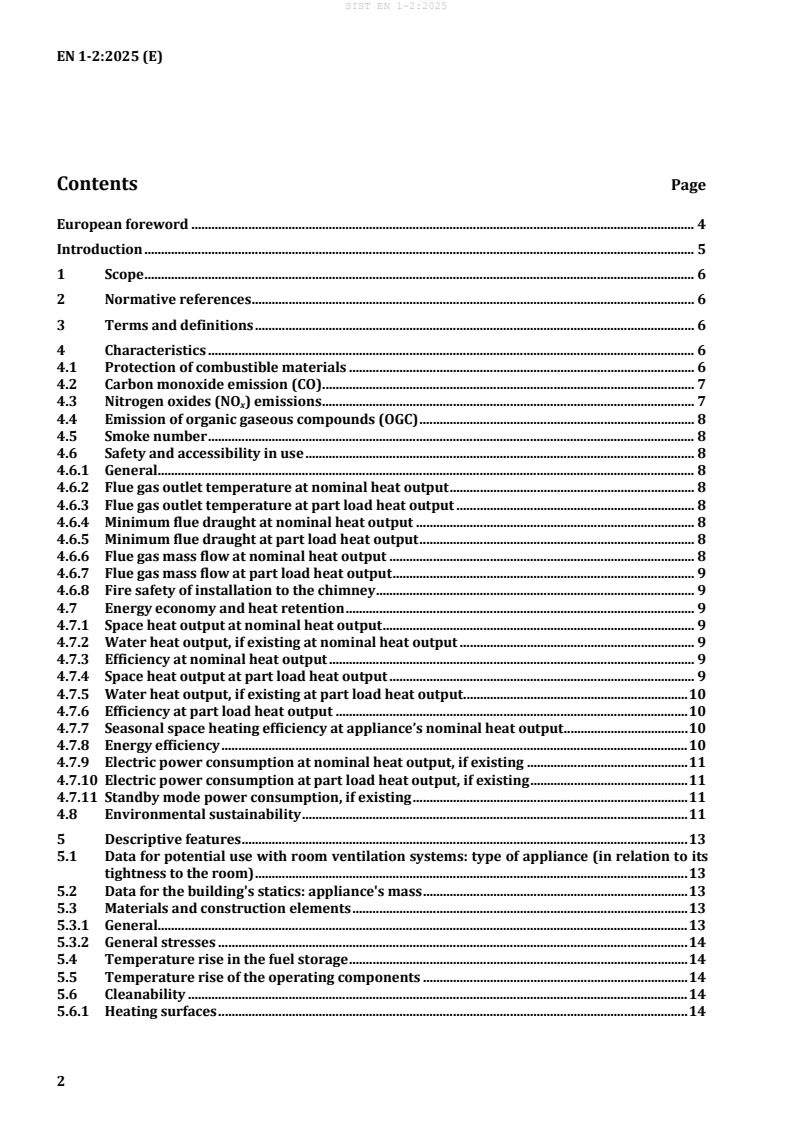
Contents Page
European foreword . 4
Introduction . 5
1 Scope . 6
2 Normative references . 6
3 Terms and definitions . 6
4 Characteristics . 6
4.1 Protection of combustible materials . 6
4.2 Carbon monoxide emission (CO) . 7
) emissions . 7
4.3 Nitrogen oxides (NOx
4.4 Emission of organic gaseous compounds (OGC) . 8
4.5 Smoke number . 8
4.6 Safety and accessibility in use . 8
4.6.1 General. 8
4.6.2 Flue gas outlet temperature at nominal heat output . 8
4.6.3 Flue gas outlet temperature at part load heat output . 8
4.6.4 Minimum flue draught at nominal heat output . 8
4.6.5 Minimum flue draught at part load heat output . 8
4.6.6 Flue gas mass flow at nominal heat output . 8
4.6.7 Flue gas mass flow at part load heat output . 9
4.6.8 Fire safety of installation to the chimney . 9
4.7 Energy economy and heat retention . 9
4.7.1 Space heat output at nominal heat output . 9
4.7.2 Water heat output, if existing at nominal heat output . 9
4.7.3 Efficiency at nominal heat output . 9
4.7.4 Space heat output at part load heat output . 9
4.7.5 Water heat output, if existing at part load heat output . 10
4.7.6 Efficiency at part load heat output . 10
4.7.7 Seasonal space heating efficiency at appliance’s nominal heat output . 10
4.7.8 Energy efficiency . 10
4.7.9 Electric power consumption at nominal heat output, if existing . 11
4.7.10 Electric power consumption at part load heat output, if existing . 11
4.7.11 Standby mode power consumption, if existing . 11
4.8 Environmental sustainability . 11
5 Descriptive features . 13
5.1 Data for potential use with room ventilation systems: type of appliance (in relation to its
tightness to the room) . 13
5.2 Data for the building's statics: appliance's mass . 13
5.3 Materials and construction elements . 13
5.3.1 General. 13
5.3.2 General stresses . 14
5.4 Temperature rise in the fuel storage . 14
5.5 Temperature rise of the operating components . 14
5.6 Cleanability . 14
5.6.1 Heating surfaces . 14
5.6.2 Flueways . 14
6 Assessment and verification of constancy of performance - AVCP . 14
6.1 General . 14
6.2 Assessment of performance . 14
6.2.1 General . 14
6.2.2 Test samples, testing and assessment criteria. 15
6.3 Verification of constancy of performance. 16
6.3.1 Factory production control (FPC) . 16
6.3.2 Initial inspection of factory to validate environmental sustainability company specific data
............................................................................................................................................................................. 19
6.3.3 Environmental sustainability assessment validation . 19
Annex ZA (informative) Relationship of this European Standard with Regulation (EU) No.
305/2011 . 20
European foreword
This document (EN 1-2:2025) has been prepared by Technical Committee CEN/TC 46 “Fireplaces for
liquid fuels”, the secretariat of which is held by DIN.
This European Standard shall be given the status of a national standard, either by publication of an
identical text or by endorsement, at the latest by November 2025, and conflicting national standards shall
be withdrawn at the latest by February 2027.
Attention is drawn to the possibility that some of the elements of this document may be the subject of
patent rights. CEN shall not be held responsible for identifying any or all such patent rights.
This document supersedes EN 1:1998 and EN 1:1998/A1:2007.
In relation to EN 1:1998 and EN 1:1998/A1:2007, the following technical changes have been made:
— completely revised according to the requirements of M/577;
— energy efficiency and energy class labelling and seasonal space heating efficiency added;
— requirements for environmental sustainability added.
This document has been prepared under a standardization request addressed to CEN by the European
Commission. The Standing Committee of the EFTA States subsequently approves these requests for its
Member States.
For the relationship with EU Legislation, see informative Annex ZA, which is an integral part of this
document.
The structure of EN 1, Residential liquid fuel burning appliances, is as follows:
— Part 1: General requirements and test methods;
— Part 2: Flued oil stoves with vaporizing burners;
— Part 3: Flued oil stoves with vaporizing burners and boiler;
— Part 4: Flued ethanol stoves.
Any feedback and questions on this document should be directed to the users’ national standards body.
A complete listing of these bodies can be found on the CEN website.
According to the CEN-CENELEC Internal Regulations, the national standards organisations of the
following countries are bound to implement this European Standard: Austria, Belgium, Bulgaria, Croatia,
Cyprus, Czech Republic, Denmark, Estonia, Finland, France, Germany, Greece, Hungary, Iceland, Ireland,
Italy, Latvia, Lithuania, Luxembourg, Malta, Netherlands, Norway, Poland, Portugal, Republic of North
Macedonia, Romania, Serbia, Slovakia, Slovenia, Spain, Sweden, Switzerland, Türkiye and the United
Kingdom.
Introduction
The energy efficiency classification is aligned with Commission Regulation (EU) 2015/1186, Annex II.
Upon the revision of Regulation 2015/1186, the standard should be updated to reflect the new
classification.
The threshold level for NOx emissions and the threshold level for the seasonal space heating energy
efficiency are aligned with Commission Regulation (EU) 2024/1103, Annex II. Upon the revision of
Regulation 2024/1103, the standard should be updated to reflect the new classification.
1 Scope
This document is applicable to oil stoves. These appliances have one or more vaporizing burners and a
nominal heating capacity of not more than 15 kW and are equipped either with a draught regulator or a
combustion air limiter.
The intended use of the appliances is space heating in residential buildings.
This document is also applicable to appliances with fan assisted vaporizing burners.
According to the type of fuels used in the country of destination, the appliances are supplied for use with
either:
— fuel oil with a maximum kinematic viscosity of 6,0 mm /s at 20 °C;
— or kerosene with a flash point of not less than 40 °C.
This document does not apply to:
— built-in appliances;
— appliances equipped with an atomizing burner;
— appliances incorporating a boiler or connected to a water system.
This document specifies procedures for assessment and verification of constancy of performance (AVCP)
of characteristics of flued oil stoves with vaporizing burners.
2 Normative references
The following documents are referred to in the text in such a way that some or all of their content
constitutes requirements of this document. For dated references, only the edition cited applies.
EN 1-1:2025, Residential liquid fuel burning appliances — Part 1: General requirements and test methods
EN 15804:2012+A2:2019, Sustainability of construction works — Environmental product declarations —
Core rules for the product category of construction products
EN 16510-1:2022, Residential solid fuel burning appliances — Part 1: General requirements and test
methods
3 Terms and definitions
For the purposes of this document, the terms and definitions given in EN 1-1:2025 apply.
ISO and IEC maintain terminology databases for use in standardization at the following addresses:
— ISO Online browsing platform: available at https://www.iso.org/obp
— IEC Electropedia: available at https://www.electropedia.org/
4 Characteristics
4.1 Protection of combustible materials
The performance of the appliance in relation to protection of combustible materials shall be determined
in accordance with EN 1-1:2025, 5.9.
When tested in accordance with EN 1-1:2025, A.7.3, the protection measure(s) as specified according to
Table 1 shall be given as minimum distance to combustible materials and if appropriate as material type
and thickness of protective insulation material.
The protection measures as specified shall be given in [mm] as an integer.
Table 1 — Protection of combustible materials
Protection measure Declared clearance distance to Protective
combustible material or thickness insulation material
of protective insulation material if any
[mm]
Minimum distance to -
combustibles – floor
Minimum distance to -
combustibles – walls
(side/rear)
Protective insulation
material (s)
4.2 Carbon monoxide emission (CO)
The performance of the appliance in relation to carbon monoxide emission at nominal heat output and at
part load heat output (if part load is specified) shall be determined in accordance with EN 1-1:2025,
5.13.3.
The CO value if specified at nominal heat output and at part load heat output (if part load is specified)
shall be given in [mg/MJ] as an integer.
4.3 Nitrogen oxides (NO ) emissions
x
The performance of the appliance in relation to nitrogen oxides emissions at nominal heat output and at
part load heat output (if part load is specified) shall be determined in accordance with EN 1-1:2025,
5.13.4.
The NO value if specified at nominal heat output and at part load heat output (if part load is specified)
x
shall be given in [mg/kWh ] as an integer.
input
emissions at nominal heat output shall not
When tested in accordance with EN 1-1:2025, A.7.3.1 the NOx
exceed the threshold level as given in Table 2.
Table 2 — Threshold levels for NO emission (expressed as NO )
x 2
Appliance type Threshold level at 13 % O
120 mg/kWh
closed fronted liquid fuel local space heaters
input
NOTE 1 mg/MJ corresponds to 3,6 mg/kWh.
4.4 Emission of organic gaseous compounds (OGC)
The performance of the appliance in relation to organic gaseous compounds emission at nominal heat
output and at part load heat output (if part load is specified) shall be determined in accordance with
EN 1-1:2025, 5.13.5.
The OGC value if specified at nominal heat output and at part load heat output (if part load is specified)
shall be given in [mg/MJ] as an integer.
4.5 Smoke number
The performance of the appliance in relation to the smoke number at nominal heat output and at part
load heat output (if part load is specified) shall be determined in accordance with EN 1-1:2025, 5.13.2.
The smoke number if specified at nominal heat output and at part load heat output (if part load is
specified) shall be given as an integer.
4.6 Safety and accessibility in use
4.6.1 General
The data for the installation to a chimney are to be evaluated at nominal heat output. Specific data are to
be evaluated at safety test heat output. Additional data are to be evaluated at part load heat output, if part
load is specified.
4.6.2 Flue gas outlet temperature at nominal heat output
The performance of the appliance in relation to flue gas outlet temperature at nominal heat output shall
be determined in accordance with EN 1-1:2025, 5.7.
The value of the flue gas outlet temperature for the installation of the appliance to a chimney if specified
shall be given in [°C] as an integer.
4.6.3 Flue gas outlet temperature at part load heat output
The performance of the appliance in relation to flue gas outlet temperature at part load heat output (if
part load is specified) shall be determined in accordance with EN 1-1:2025, 5.7.
The value of the flue gas outlet temperature at part load heat output (if part load is specified) for the
installation of the appliance to a chimney if specified shall be given in [°C] as an integer.
4.6.4 Minimum flue draught at nominal heat output
The performance of the appliance in relation to the minimum flue draught at nominal heat output shall
be determined in accordance with EN 1-1:2025, 5.14.
The value of the minimum flue draught if specified at nominal heat output for the installation of the
appliance to a chimney shall be given in [Pa] as an integer.
4.6.5 Minimum flue draught at part load heat output
The performance of the appliance in relation to the minimum flue draught at part load heat output (if
part load is specified) shall be determined in accordance with EN 1-1:2025, 5.14.
The minimum value of the flue draught if specified at part load heat output (if part load is specified) for
the installation of the appliance to a chimney shall be given in [Pa] as an integer
4.6.6 Flue gas mass flow at nominal heat output
The performance of the appliance in relation to the flue gas mass flow at nominal heat output shall be
determined in accordance with EN 1-1:2025, 5.15.
The flue gas mass flow value if specified at nominal heat output for the installation of the appliance to a
chimney shall be given in [g/s] with 1 decimal.
4.6.7 Flue gas mass flow at part load heat output
The performance of the appliance in relation to the flue gas mass flow at part load heat output (if part
load is specified) shall be determined in accordance with EN 1-1:2025, 5.15.
The flue gas mass flow value if specified at part load heat output (if part load is specified) for the
installation of the appliance to a chimney shall be given in [g/s] with 1 decimal.
4.6.8 Fire safety of installation to the chimney
The performance of the appliance in relation to the flue gas temperature (mean value) at safety test shall
be determined in accordance with EN 1-1:2025, A.7.3.1.
4.7 Energy economy and heat retention
4.7.1 Space heat output at nominal heat output
The performance of the appliance in relation to space heat output at nominal heat output shall be
determined in accordance with EN 1-1:2025, 5.16.
The space heat output of the appliance if specified at nominal heat output shall be given in [kW] with 1
decimal.
For the proper performance of the appliance the following shall be considered as well for those essential
characteristics and descriptive features assessed during the nominal heat output test EN 1-1:2025,
A.7.3.1.
Additional devices, such as filters, oil regulators, safety devices, fans for the supply of combustion air, fuel
lines, storage tanks, oil level indicators, drip trays, flue gas outlet components, draught regulators and
combustion air limiters and automatic burners for the safety or function of the appliance may be present.
Some of these devices are optional, but if present their influence on the performance of the appliance
shall be checked according to EN 1-1:2025, 4.4, 4.5, 4.7, 4.8, 4.9, 4.10, 4.11, 4.12, 4.13, 4.15 and 4.18.
4.7.2 Water heat output, if existing at nominal heat output
The performance of the appliance in relation to water heat output if existing at nominal heat output is
according to the scope not applicable as this document does not apply to appliances with water-bearing
parts or connection to a water system.
4.7.3 Efficiency at nominal heat output
The performance of the appliance in relation to efficiency at nominal heat output shall be determined in
accordance with EN 1-1:2025, 5.5.
The efficiency of the appliance if specified at nominal heat output shall be given in [%] as an integer.
4.7.4 Space heat output at part load heat output
The performance of the appliance in relation to space heat output at part load heat output (if part load is
specified) shall be determined in accordance with EN 1-1:2025, 5.16.
The space heat output of the appliance if specified at part load heat output (if part load is specified) shall
be given in [kW] with 1 decimal.
For the proper performance of the appliance the following shall be considered as well for those essential
characteristics and descriptive features assessed during the part load heat output test EN 1-1:2025,
A.7.3.2.
Additional devices, such as filters, oil regulators, safety devices, fans for the supply of combustion air, fuel
lines, storage tanks, oil level indicators, drip trays, flue gas outlet components, draught regulators and
combustion air limiters and automatic burners for the safety or function of the appliance may be present.
Some of these devices are optional, but if present their influence on the performance of the appliance
shall be checked according to EN 1-1:2025, 4.4, 4.5, 4.7, 4.8, 4.9, 4.10, 4.11, 4.12, 4.13, 4.15 and 4.18.
4.7.5 Water heat output, if existing at part load heat output
The performance of the appliance in relation to water heat output if existing at part load heat output is
according to the scope not applicable as this document does not apply to appliances with water-bearing
parts or connection to a water system.
4.7.6 Efficiency at part load heat output
The performance of the appliance in relation to efficiency at part load heat output (if part load is specified)
shall be determined in accordance with EN 1-1:2025, 5.5.
The efficiency of the appliance if specified at part load heat output (if part load is specified) shall be given
in [%] as an integer.
4.7.7 Seasonal space heating efficiency at appliance’s nominal heat output
The performance of the appliance in relation to seasonal space heating efficiency at nominal heat output
shall be determined in accordance with EN 1-1:2025, 5.5.2.
The seasonal space heating efficiency of the appliance if specified at nominal heat output shall be given
in [%] with one decimal.
When tested in accordance with EN 1-1:2025, 5.5.2 the seasonal space heating efficiency at nominal heat
output shall not underrun the threshold levels as given in Table 3.
Table 3 — Threshold level of seasonal space heating energy efficiency
Appliance type Threshold level
closed fronted liquid fuel local space heaters 63,6 %
4.7.8 Energy efficiency
The performance of the appliance in relation to energy efficiency classification shall be determined in
accordance with EN 1-1:2025, 5.5.3 and 5.5.4.
The energy efficiency classification of the appliance if specified shall be determined according to Table 4.
Table 4 — Energy efficiency classification based on the energy efficiency index (EEI)
Energy efficiency class Energy efficiency index (EEI)
A++ EEI ≥ 130
A+ 107 ≤ EEI < 130
A 88 ≤ EEI < 107
B 82 ≤ EEI < 88
C 77 ≤ EEI < 82
D 72 ≤ EEI < 77
E 62 ≤ EEI < 72
F 42 ≤ EEI < 62
G EEI < 42
4.7.9 Electric power consumption at nominal heat output, if existing
The performance of the appliance in relation to electric power consumption at nominal heat output shall
be determined in accordance with EN 1-1:2025, 5.12.
The electric power consumption of the appliance if specified at nominal heat output shall be given in [kW]
with 3 decimals.
4.7.10 Electric power consumption at part load heat output, if existing
The performance of the appliance in relation to electric power consumption at part load heat output (if
part load is specified) shall be determined in accordance with EN 1-1:2025, 5.12.
The electric power consumption of the appliance if specified at part load heat output (if part load is
specified) shall be given in [kW] with 3 decimals.
4.7.11 Standby mode power consumption, if existing
The performance of the appliance in relation to standby mode power consumption at standby mode
(where appropriate) shall be determined in accordance with EN 1-1:2025, 5.12.
The standby mode power consumption of the appliance if specified shall be given in [kW] with 3 decimals
4.8 Environmental sustainability
All relevant elements of the performance related to the whole life cycle of the appliance shall be identified
and enumerated on the basis on the information modules of EN 15804:2012+A2:2019.
The necessary environmental sustainability information shall be determined to enable the life cycle
analysis of the appliance concerned and the declaration of its performance in relation to the essential
characteristic environmental sustainability. This shall comprise in particular the definition of the
scenarios required for this complete period, including the reference service life, where appropriate.
The performance of the appliance in relation to the environmental sustainability shall be determined in
accordance with EN 1-1:2025, Clause 7.
The environmental sustainability elements are given in Table 5.
Table 5 — Elements for the environmental sustainability
Environmental sustainability elements to be given in
Global Warming Potential total (GWP-total) kg CO equivalent
Global Warming Potential (GWP-fossil) kg CO equivalent
Global Warming Potential (GWP-biogenic) kg CO equivalent
Global Warming Potential land use and land use change (GWP-luluc) kg CO equivalent
Depletion potential of the stratospheric ozone layer (ODP) kg CFC 11 equivalent
Acidification potential, Accumulated Exceedance (AP) +
mol H equivalent
Eutrophication potential, Fract
...
Questions, Comments and Discussion
Ask us and Technical Secretary will try to provide an answer. You can facilitate discussion about the standard in here.
Loading comments...