


SIST EN 16072:2025
(Main)Intelligent transport systems - ESafety - Pan-European eCall operating requirements
Intelligent transport systems - ESafety - Pan-European eCall operating requirements
The objective of implementing the pan-European in-vehicle emergency call system (eCall) is to automate the notification of a traffic accident, wherever in Europe, with the same technical standards and the same quality of services objectives by using ‘Public Land Mobile Networks’(PLMN), which supports the European pre-assigned emergency destination address (see normative references) and to provide a means of manually triggering the notification of an incident.
This document specifies the general operating requirements and intrinsic procedures for in-vehicle emergency call (eCall) services in order to transfer an emergency message from a vehicle to a Public Safety Answering Point (PSAP) in the event of a crash or emergency, via an eCall communication session and to establish a voice channel between the in-vehicle equipment and the PSAP.
Private third party in-vehicle emergency supporting services can also provide a similar eCall function by other means. The provision of such services are defined in EN 16102, and are outside the scope of this document.
The communications protocols and methods for the transmission of the MSD are not specified in this document.
This document specifies the operating requirements for an eCall service. An important part of the eCall service is a Minimum Set of Data (MSD). The operating requirements for the MSD are determined in this document, but the form and data content of the MSD is not defined herein. A common European MSD is determined in EN 15722.
This document does not specify whether eCall is provided using embedded equipment or other means (for example in the case of aftermarket equipment).
Intelligente Verkehrssysteme - eSicherheit - Betriebsanforderungen für den gesamteuropäischen eCall
Das Ziel der Implementierung des gesamteuropäischen fahrzeuginternen Notrufsystems (eCall) besteht darin, die Benachrichtigung über den Eintritt eines Verkehrsunfallereignisses europaweit mit denselben technischen Standards und denselben Dienstgütezielen durch Nutzung eines „Mobilfunknetzes“ (en: Public Land Mobile Network, PLMN) zu automatisieren, welches die europäische zuvor zugeordnete Notzieladresse (siehe Normative Verweisungen) unterstützt, und darin, ein Hilfsmittel für die manuelle Auslösung der Benachrichtigung über den Eintritt eines Notfalls zur Verfügung zu stellen.
Dieses Dokument legt die allgemeinen Betriebsanforderungen und intrinsischen Verfahren für fahrzeuginterne Notruf-Dienste (eCall) mit dem Ziel fest, im Falle eines Unfalls oder eines sonstigen Notfalls über eine eCall-Kommunikationssitzung einen Notruf vom Fahrzeug an eine Notrufzentrale (PSAP) zu übermitteln und eine Sprachverbindung zwischen der fahrzeuginternen Einrichtung und der PSAP herzustellen.
Von Dritten bereitgestellte, private fahrzeugseitige Dienste zur Unterstützung in Notfällen können eine ähnliche eCall-Funktion auch mit anderen Mitteln zur Verfügung stellen. Derartige Dienste sind in EN 16102 festgelegt und nicht Gegenstand des vorliegenden Dokumentes.
Die Kommunikationsprotokolle und die Verfahren für die Übertragung der eCall-Nachricht sind in diesem Dokument nicht festgelegt.
Dieses Dokument legt die Betriebsanforderungen für eCall-Dienste fest. Ein wichtiger Bestandteil des eCall-Dienstes ist der minimale Datensatz (en: Minimum Set of Data, MSD). In diesem Dokument sind die Betriebsanforderungen für den MSD, nicht aber seine Form und sein Dateninhalt festgelegt. Ein gemeinsamer Europäischer MSD ist in EN 15722 festgelegt.
Dieses Dokument legt nicht fest, ob eCall in Einrichtungen integriert ist oder mit anderen Mitteln zur Verfügung gestellt wird (z. B. im Falle von Nachrüsteinrichtungen).
Systèmes de transport intelligents - eSafety - Exigences opérationnelles du service eCall paneuropéen
L’implémentation du système embarqué d’appel d’urgence paneuropéen (eCall) a pour objectif d’automatiser la notification d’un accident routier, quel que soit le lieu de cet accident en Europe, avec les mêmes critères techniques et les mêmes objectifs de qualité de service en utilisant un réseau mobile terrestre public appelé PLMN qui prend en charge l’adresse européenne pré-affectée de destination des appels d’urgence (voir références normatives), et de fournir un moyen de déclenchement manuel de la notification d’un incident.
Le présent document définit les exigences générales de fonctionnement et les procédures inhérentes aux services d’appel d’urgence embarqués (eCall) afin de transmettre un message d’urgence d’un véhicule à un « centre de réception des appels d’urgence » (PSAP) en cas d’accident ou d’urgence, par le biais d’une session de communication d’appel d’urgence et d’établir un appel vocal entre l’équipement à bord du véhicule et le PSAP.
Les services d’urgence embarqués de fournisseurs privés peuvent également exercer une fonction d’appel d’urgence similaire par d’autres moyens. Les dispositions applicables à ces types de services sont définies dans la norme EN 16102, et ne relèvent pas du domaine d’application du présent document.
Le présent document ne spécifie ni les protocoles de communication ni les moyens de transmission du MSD.
Le présent document précise les exigences de fonctionnement d’un service eCall. Une part importante du service eCall est constituée par un ensemble minimal de données (MSD). Les exigences de fonctionnement du MSD sont déterminées dans le présent document, mais la forme et le contenu des données du MSD n’y sont pas définis. Un MSD européen commun est déterminé dans l’EN 15722.
Le présent document ne spécifie pas si l’eCall est fourni à l’aide d’un équipement intégré ou d’autres moyens (par exemple en cas d’équipement de seconde monte).
Inteligentni transportni sistemi - e-Varnost - Zahteve za delovanje vseevropskega elektronskega klica v sili
Cilj uvedbe vseevropskega sistema za klic v sili (e-Klic) je avtomatizirati obveščanje ob prometni nesreči, kjer koli v Evropi, z enakimi tehničnimi standardi in enakimi cilji glede kakovosti storitev z uporabo »javnih kopenskih mobilnih omrežij« (PLMN), ki podpirajo evropske vnaprej dodeljene ciljne naslove za nujne primere (glej normativne sklice), ter zagotoviti način za ročno pošiljanje obvestila ob prometni nesreči. Ta dokument določa splošne zahteve za delovanje in notranje postopke za storitve elektronskih klicev v sili (e-Klic) za prenos sporočila klica v sili od vozila do centra za obveščanje (PSAP), če pride do trka ali nujnega primera, prek komunikacijske seje v okviru elektronskega klica v sili, in za vzpostavitev glasovnega kanala med opremo v vozilu in centrom za obveščanje. Zasebne storitve tretjih oseb za nujne primere v vozilih lahko prav tako zagotovijo podobno funkcijo elektronskega klica v sili z drugimi sredstvi. Zagotavljanje takih storitev je opredeljeno v standardu EN 16102 in ne spada na področje uporabe tega dokumenta. Komunikacijski protokoli in metode za prenos minimalnega nabora podatkov (MSD) niso določeni v tem dokumentu. Ta dokument določa zahteve za delovanje storitve elektronskega klica v sili. Pomemben del storitve elektronskega klica v sili je minimalni nabor podatkov. V tem dokumentu so določene operativne zahteve za minimalni nabor podatkov, ne pa tudi oblika in vsebina teh podatkov. V standardu EN 15722 je opredeljen skupen evropski minimalni nabor podatkov. Ta dokument ne določa, ali se elektronski klic v sili zagotavlja z uporabo vgrajene opreme ali na druge načine (npr. v primeru opreme za naknadno vgradnjo).
General Information
- Status
- Published
- Public Enquiry End Date
- 22-Jul-2024
- Publication Date
- 12-May-2025
- Technical Committee
- ITC - Information technology
- Current Stage
- 6060 - National Implementation/Publication (Adopted Project)
- Start Date
- 17-Apr-2025
- Due Date
- 22-Jun-2025
- Completion Date
- 13-May-2025
Relations
- Effective Date
- 01-Jun-2025
Overview
EN 16072:2025 - Intelligent transport systems - ESafety - Pan‑European eCall operating requirements - defines the operating requirements for the pan‑European in‑vehicle emergency call (eCall) service. Its objective is to automate notification of road accidents across Europe using Public Land Mobile Networks (PLMN) and a European pre‑assigned emergency destination address, enabling transfer of emergency information from a vehicle to a Public Safety Answering Point (PSAP) and establishment of a voice channel. The standard applies to automatic and manual eCall triggering, post‑crash behaviour, and end‑to‑end service operation but does not prescribe MSD transport protocols or whether equipment is embedded or aftermarket.
Key Topics
- Scope & service chain: Defines actors (vehicle, network, PSAP, service providers), privacy requirements and overall eCall architecture.
- High‑level functional requirements: eCall operation sequences, linguistic aspects, in‑vehicle system responsibilities and conformance principles.
- Minimum Set of Data (MSD): Operating requirements for the MSD are specified (what is required operationally), while the content and format of a common European MSD are referenced in EN 15722.
- Routing & prioritization: Rules for eCall routing to the correct PSAP, use of eCall flags, roaming considerations and prioritisation over other calls.
- Triggering & HMI: Requirements for automatic and manual triggering strategies, occupant alerts, manual termination and human–machine interface expectations.
- Location & direction: Use, provision and accuracy considerations of location and heading data to support PSAP response.
- Performance & end‑to‑end criteria: Transport, wireless network and PSAP performance expectations, time‑sensitive transmission and voice‑establishment requirements.
- Security & resilience: Defences against hoax calls, denial‑of‑service and malicious attacks; end‑of‑life management.
- Testing & conformance: Conformance requirements for in‑vehicle equipment, networks, PSAPs and interoperability testing.
Applications
EN 16072:2025 is intended for practical deployment and operation of pan‑European eCall services. Typical users include:
- Vehicle manufacturers and telematics suppliers implementing in‑vehicle systems compliant with eCall operation requirements.
- Mobile network operators (PLMN) ensuring network routing, roaming and prioritization support.
- PSAP operators and public authorities setting up or validating emergency call handling processes.
- System integrators, test laboratories and regulators responsible for conformance, interoperability testing and certification.
- Fleet operators and aftermarket providers evaluating service compatibility (note: private third‑party eCall services are covered by EN 16102).
Related Standards
- EN 15722 - common European MSD form and data content.
- EN 16102 - private third‑party in‑vehicle emergency supporting services.
- Other ITS and national PSAP standards and UNECE vehicle category requirements referenced within EN 16072:2025.
Keywords: EN 16072:2025, eCall, pan‑European eCall, intelligent transport systems, ESafety, MSD, PSAP, PLMN, eCall operating requirements.

Frequently Asked Questions
SIST EN 16072:2025 is a standard published by the Slovenian Institute for Standardization (SIST). Its full title is "Intelligent transport systems - ESafety - Pan-European eCall operating requirements". This standard covers: The objective of implementing the pan-European in-vehicle emergency call system (eCall) is to automate the notification of a traffic accident, wherever in Europe, with the same technical standards and the same quality of services objectives by using ‘Public Land Mobile Networks’(PLMN), which supports the European pre-assigned emergency destination address (see normative references) and to provide a means of manually triggering the notification of an incident. This document specifies the general operating requirements and intrinsic procedures for in-vehicle emergency call (eCall) services in order to transfer an emergency message from a vehicle to a Public Safety Answering Point (PSAP) in the event of a crash or emergency, via an eCall communication session and to establish a voice channel between the in-vehicle equipment and the PSAP. Private third party in-vehicle emergency supporting services can also provide a similar eCall function by other means. The provision of such services are defined in EN 16102, and are outside the scope of this document. The communications protocols and methods for the transmission of the MSD are not specified in this document. This document specifies the operating requirements for an eCall service. An important part of the eCall service is a Minimum Set of Data (MSD). The operating requirements for the MSD are determined in this document, but the form and data content of the MSD is not defined herein. A common European MSD is determined in EN 15722. This document does not specify whether eCall is provided using embedded equipment or other means (for example in the case of aftermarket equipment).
The objective of implementing the pan-European in-vehicle emergency call system (eCall) is to automate the notification of a traffic accident, wherever in Europe, with the same technical standards and the same quality of services objectives by using ‘Public Land Mobile Networks’(PLMN), which supports the European pre-assigned emergency destination address (see normative references) and to provide a means of manually triggering the notification of an incident. This document specifies the general operating requirements and intrinsic procedures for in-vehicle emergency call (eCall) services in order to transfer an emergency message from a vehicle to a Public Safety Answering Point (PSAP) in the event of a crash or emergency, via an eCall communication session and to establish a voice channel between the in-vehicle equipment and the PSAP. Private third party in-vehicle emergency supporting services can also provide a similar eCall function by other means. The provision of such services are defined in EN 16102, and are outside the scope of this document. The communications protocols and methods for the transmission of the MSD are not specified in this document. This document specifies the operating requirements for an eCall service. An important part of the eCall service is a Minimum Set of Data (MSD). The operating requirements for the MSD are determined in this document, but the form and data content of the MSD is not defined herein. A common European MSD is determined in EN 15722. This document does not specify whether eCall is provided using embedded equipment or other means (for example in the case of aftermarket equipment).
SIST EN 16072:2025 is classified under the following ICS (International Classification for Standards) categories: 03.220.20 - Road transport; 13.200 - Accident and disaster control; 35.240.60 - IT applications in transport. The ICS classification helps identify the subject area and facilitates finding related standards.
SIST EN 16072:2025 has the following relationships with other standards: It is inter standard links to SIST EN 16072:2023. Understanding these relationships helps ensure you are using the most current and applicable version of the standard.
SIST EN 16072:2025 is associated with the following European legislation: EU Directives/Regulations: 2010/40/EU. When a standard is cited in the Official Journal of the European Union, products manufactured in conformity with it benefit from a presumption of conformity with the essential requirements of the corresponding EU directive or regulation.
SIST EN 16072:2025 is available in PDF format for immediate download after purchase. The document can be added to your cart and obtained through the secure checkout process. Digital delivery ensures instant access to the complete standard document.
Standards Content (Sample)
SLOVENSKI STANDARD
01-junij-2025
Nadomešča:
SIST EN 16072:2023
Inteligentni transportni sistemi - e-Varnost - Zahteve za delovanje vseevropskega
elektronskega klica v sili
Intelligent transport systems - ESafety - Pan-European eCall operating requirements
Intelligente Verkehrssysteme - eSicherheit - Betriebsanforderungen für den
gesamteuropäischen eCall
Systèmes de transport intelligents - eSafety - Exigences opérationnelles du service eCall
paneuropéen
Ta slovenski standard je istoveten z: EN 16072:2025
ICS:
03.220.20 Cestni transport Road transport
13.200 Preprečevanje nesreč in Accident and disaster control
katastrof
35.240.60 Uporabniške rešitve IT v IT applications in transport
prometu
2003-01.Slovenski inštitut za standardizacijo. Razmnoževanje celote ali delov tega standarda ni dovoljeno.
EN 16072
EUROPEAN STANDARD
NORME EUROPÉENNE
April 2025
EUROPÄISCHE NORM
ICS 03.220.20; 35.240.60 Supersedes EN 16072:2022
English Version
Intelligent transport systems - ESafety - Pan-European
eCall operating requirements
Systèmes de transport intelligents - eSafety - Exigences Intelligente Verkehrssysteme - eSicherheit -
opérationnelles du service eCall paneuropéen Betriebsanforderungen für den gesamteuropäischen
eCall
This European Standard was approved by CEN on 7 March 2025.
CEN members are bound to comply with the CEN/CENELEC Internal Regulations which stipulate the conditions for giving this
European Standard the status of a national standard without any alteration. Up-to-date lists and bibliographical references
concerning such national standards may be obtained on application to the CEN-CENELEC Management Centre or to any CEN
member.
This European Standard exists in three official versions (English, French, German). A version in any other language made by
translation under the responsibility of a CEN member into its own language and notified to the CEN-CENELEC Management
Centre has the same status as the official versions.
CEN members are the national standards bodies of Austria, Belgium, Bulgaria, Croatia, Cyprus, Czech Republic, Denmark, Estonia,
Finland, France, Germany, Greece, Hungary, Iceland, Ireland, Italy, Latvia, Lithuania, Luxembourg, Malta, Netherlands, Norway,
Poland, Portugal, Republic of North Macedonia, Romania, Serbia, Slovakia, Slovenia, Spain, Sweden, Switzerland, Türkiye and
United Kingdom.
EUROPEAN COMMITTEE FOR STANDARDIZATION
COMITÉ EUROPÉEN DE NORMALISATION
EUROPÄISCHES KOMITEE FÜR NORMUNG
CEN-CENELEC Management Centre: Rue de la Science 23, B-1040 Brussels
© 2025 CEN All rights of exploitation in any form and by any means reserved Ref. No. EN 16072:2025 E
worldwide for CEN national Members.
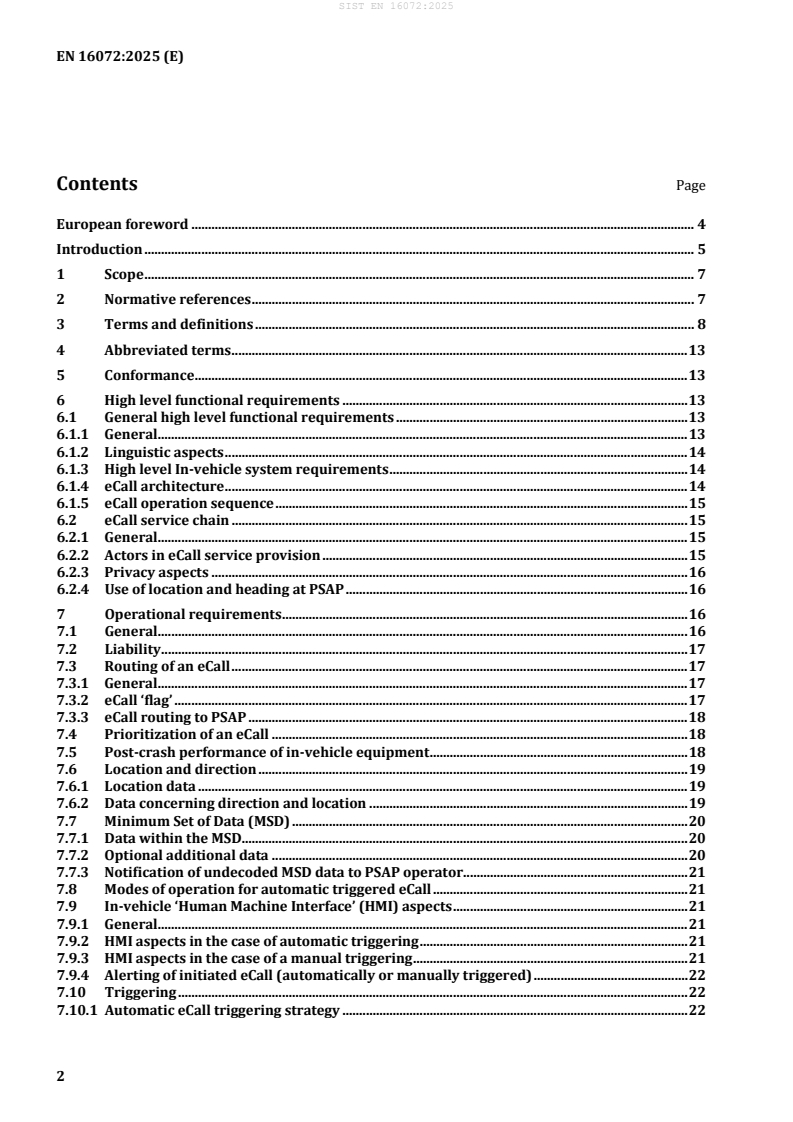
Contents Page
European foreword . 4
Introduction . 5
1 Scope . 7
2 Normative references . 7
3 Terms and definitions . 8
4 Abbreviated terms . 13
5 Conformance . 13
6 High level functional requirements . 13
6.1 General high level functional requirements . 13
6.1.1 General . 13
6.1.2 Linguistic aspects . 14
6.1.3 High level In-vehicle system requirements . 14
6.1.4 eCall architecture . 14
6.1.5 eCall operation sequence . 15
6.2 eCall service chain . 15
6.2.1 General . 15
6.2.2 Actors in eCall service provision . 15
6.2.3 Privacy aspects . 16
6.2.4 Use of location and heading at PSAP . 16
7 Operational requirements . 16
7.1 General . 16
7.2 Liability . 17
7.3 Routing of an eCall . 17
7.3.1 General . 17
7.3.2 eCall ‘flag’ . 17
7.3.3 eCall routing to PSAP . 18
7.4 Prioritization of an eCall . 18
7.5 Post-crash performance of in-vehicle equipment . 18
7.6 Location and direction . 19
7.6.1 Location data . 19
7.6.2 Data concerning direction and location . 19
7.7 Minimum Set of Data (MSD) . 20
7.7.1 Data within the MSD . 20
7.7.2 Optional additional data . 20
7.7.3 Notification of undecoded MSD data to PSAP operator . 21
7.8 Modes of operation for automatic triggered eCall . 21
7.9 In-vehicle ‘Human Machine Interface’ (HMI) aspects . 21
7.9.1 General . 21
7.9.2 HMI aspects in the case of automatic triggering . 21
7.9.3 HMI aspects in the case of a manual triggering . 21
7.9.4 Alerting of initiated eCall (automatically or manually triggered) . 22
7.10 Triggering . 22
7.10.1 Automatic eCall triggering strategy . 22
7.10.2 Manual eCall triggering strategy . 22
7.10.3 Manual termination of eCall by vehicle occupants before trigger confirmation . 22
7.11 Termination of an in progress eCall . 23
7.12 Requirements to physical layer . 23
7.12.1 Transport protocol . 23
7.12.2 Performance requirements - time required to transmit data . 23
7.12.3 End-to-end performance criteria . 23
7.12.4 Performance criteria – Wireless network . 24
7.12.5 Performance criteria – PSAP . 24
7.13 Establish voice channel . 25
7.13.1 General . 25
7.13.2 Service area issues . 25
7.13.3 Roaming requirements for service . 25
7.14 Acknowledgement of eCall . 25
7.15 Continuing availability . 25
7.16 PSAP response . 25
7.17 eCall termination . 25
7.17.1 General . 25
7.17.2 IVS redial . 26
7.17.3 PSAP call-back . 26
7.17.4 Record transaction . 26
8 Defences against attack . 27
8.1 Call line security . 27
8.2 Hoax calls . 27
8.3 False generation of eCalls . 27
8.4 End of life management . 27
8.5 Denial of service attack . 28
8.6 Malicious attack on PSAP . 28
9 Different and additional requirements for specific UNECE vehicle categories . 28
10 Test and conformance requirements . 28
10.1 General . 28
10.2 In-vehicle equipment conformance . 29
10.3 Network conformance . 29
10.4 PSAP conformance . 29
10.5 Interoperability conformance . 29
11 Marking, labelling and packaging . 29
Bibliography . 30
European foreword
This document (EN 16072:2025) has been prepared by Technical Committee CEN/TC 278 “Intelligent
transport systems”, the secretariat of which is held by NEN.
This European Standard shall be given the status of a national standard, either by publication of an
identical text or by endorsement, at the latest by October 2025, and conflicting national standards shall
be withdrawn at the latest by October 2025.
Attention is drawn to the possibility that some of the elements of this document may be the subject of
patent rights. CEN shall not be held responsible for identifying any or all such patent rights.
This document supersedes EN 16072:2022.
— updated Clauses 2, 3, 4, 5, 9 and Bibliography;
— corrected parts of subclauses 7.17.2 and 7.17.3;
— updated subclauses 6.1.1, 6.1.5, 7.2, 7.3.1, 7.3.2, 7.3.3, 7.5, 7.7.2, 7.7.3, 7.11, 7.12.2, 7.12.3.3, 7.12.5,
7.13.1, 7.17.1, 7.17.3, 7.17.4, 8.3, 8.5, 10.1, 10.2, 10.3, 10.4 and 10.5;
— added clarification or reworded text to improve readability.
Any feedback and questions on this document should be directed to the users’ national standards body.
A complete listing of these bodies can be found on the CEN website.
According to the CEN-CENELEC Internal Regulations, the national standards organisations of the
following countries are bound to implement this European Standard: Austria, Belgium, Bulgaria, Croatia,
Cyprus, Czech Republic, Denmark, Estonia, Finland, France, Germany, Greece, Hungary, Iceland, Ireland,
Italy, Latvia, Lithuania, Luxembourg, Malta, Netherlands, Norway, Poland, Portugal, Republic of North
Macedonia, Romania, Serbia, Slovakia, Slovenia, Spain, Sweden, Switzerland, Türkiye and the United
Kingdom.
Introduction
The scale of death and injury on roads in Europe needs to be fully comprehended to understand the need
for ‘Emergency Call’ (eCall). In 2008 there were 38 900 fatalities in EU-27. The figure for 2009 is around
34 500 fatalities. The trend 2001 to 2008 is around 5 % reduction annually. Road accident injuries are in
the region of 1,7 million (2008). Roads remain unsafe and further efforts are needed. The pan-European
in-vehicle emergency call, eCall, is estimated to have the potential to save up to 2 500 fatalities annually
in the EU when fully deployed and furthermore to reduce the severity of injuries, to bring significant
savings to the society in and to reduce human suffering.
Emergency calls made from vehicles or mobile telephones using wireless technologies can assist with the
objectives of significantly reducing road deaths and injuries, but drivers often have poor (imprecise)
location- awareness, especially on interurban roads or abroad. Additionally, in many situations, the car
occupants may not be in a position to call using a normal mobile phone.
The situation is worse for those travelling abroad: A high (and increasing) number of vehicles travelling
outside their home country is thus also contributing to the need for automated emergency call system in
vehicles. In EU there are over 100 million trips to another EU country per year (EU-15). 65 % people feel
less protected while abroad and most do not know which number to call in an emergency (in some
countries over 60 %). Language problems are pertinent and may render proper communication difficult.
Yet, in the most crucial cases, the victim(s) may not be able to call because they have been
injured/trapped, do not know the local number to call and in many cases, particularly in rural situations
and late at night, there may be no witnesses, who happen to have a mobile phone and a sense of
community.
eCall, in the context of ‘Road Traffic and Transport Telematics’ (otherwise known as ‘Intelligent
Transport Systems’ or ‘ITS’), can be described as an ‘automatic or user instigated system to provide
notification to Public Safety Answering Points (PSAP), by means of wireless communications, that a
vehicle has crashed, and to provide coordinates, a defined Minimum Set of Data, and where possible a
voice link to the PSAP’.
The objective of implementing the pan-European in-vehicle emergency call system (eCall) is to automate
the notification of a traffic accident, wherever in the European Union and associated countries, with the
same technical standards and the same quality of services objectives of other emergency (TS12 or IMS
equivalent) services.
Definition of the Minimum Set of Data, the communications media and means of transferring the data are
not specified in this document.
This document specifies the generic operational requirements for the provision of an eCall service. The
practical provision and operation of eCall service and equipment is dependent on the communications
medium being available throughout the lifetime of equipment installed in vehicles.
NOTE The term PSAP, which is most widely used in the eCall documentation, European Commission
documents, etc., equates to the term emergency call response centre.
The European Committee for Standardization (CEN) draws attention to the fact that it is claimed that
compliance with this document may involve the use of patents concerning eCall given in this document.
The patents held may refer to the implementation of eCall in general using the network access device
referenced (but not defined) in this document, but do not specifically directly refer to any of the
application specification clauses defined herein.
CEN takes no position concerning the evidence, validity and scope of these patent rights.
The holders of these patent rights have assured CEN that they are willing to negotiate licences under
reasonable and non-discriminatory terms and conditions with applicants throughout the world. In this
respect, the statements of the holders of these patent rights are registered with CEN.
Information may be obtained from:
Mr. Thomas R. Rouse
VP QTL Patent Counsel QUALCOMM Incorporated
5775 Morehouse Drive
San Diego, California 92121
Phone: +1-858-587-1121
Fax: +1-858-658-2503
Email: trouse@qualcomm.com
URL: www.qualcomm.com
Mr. Thomas W. Davis Jr. General Council AIRBIQUITY Incorporated
1011 Western Avenue, Suite 600
Seattle, Washington 98104
USA
Phone: +1.206.219.2700
Fax: +1.206.842.9259
Toll-Free: +1.888.334.7741
Email: tdavis@airbiquity.com
URL: www.airbiquity.com
Attention is drawn to the possibility that some of the elements of this document may be the subject of
patent rights other than those identified above. CEN shall not be held responsible for identifying any or
all such patent rights.
1 Scope
The objective of implementing the pan-European in-vehicle emergency call system (eCall) is to automate
the notification of a traffic accident, wherever in Europe, with the same technical standards and the same
quality of services objectives by using ‘Public Land Mobile Networks’(PLMN), which supports the
European pre-assigned emergency destination address (see normative references) and to provide a
means of manually triggering the notification of an incident.
This document specifies the general operating requirements and intrinsic procedures for in-vehicle
emergency call (eCall) services in order to transfer an emergency message from a vehicle to a Public
Safety Answering Point (PSAP) in the event of a crash or emergency, via an eCall communication session
and to establish a voice channel between the in-vehicle equipment and the PSAP.
Private third party in-vehicle emergency supporting services can also provide a similar eCall function by
other means. The provision of such services are defined in EN 16102, and are outside the scope of this
document.
The communications protocols and methods for the transmission of the MSD are not specified in this
document.
This document specifies the operating requirements for an eCall service. An important part of the eCall
service is a Minimum Set of Data (MSD). The operating requirements for the MSD are determined in this
document, but the form and data content of the MSD is not defined herein. A common European MSD is
determined in EN 15722.
This document does not specify whether eCall is provided using embedded equipment or other means
(for example in the case of aftermarket equipment).
2 Normative references
The following documents are referred to in the text in such a way that some or all of their content
constitutes requirements of this document. For dated references, only the edition cited applies. For
undated references, the latest edition of the referenced document (including any amendments) applies.
EN 15722, Intelligent transport systems — ESafety — ECall minimum set of data
EN 16062, Intelligent transport systems — ESafety — eCall high level application requirements (HLAP)
using GSM/UMTS circuit switched networks
EN 17184, Intelligent transport systems — eSafety — eCall High level application protocols (HLAP) using
IP Multimedia Subsystem (IMS) over packet switched networks
EN ISO 24978, Intelligent transport systems — ITS Safety and emergency messages using any available
wireless media — Data registry procedures (ISO 24978)
IETF RFC 8147, Next-Generation Pan-European eCall
ETSI TS 133 203, Digital cellular telecommunications system (Phase 2+) (GSM); Universal Mobile
Telecommunications System (UMTS); LTE; 3G security; Access security for IP-based services
(3GPP TS 33.203)
3 Terms and definitions
For the purposes of this document, the following terms and definitions apply.
ISO and IEC maintain terminology databases for use in standardization at the following addresses:
— ISO Online browsing platform: available at https://www.iso.org/obp
— IEC Electropedia: available at https://www.electropedia.org
3.1
single European emergency call number supporting Teleservice 12
3.2
E112
emergency communications service using the single European emergency call number, 112, which is
enhanced with location information of the calling user
3.3
cellular network
wireless communications network consisting of multiple adjacent access points (cells) with the capability
of homogeneous transfer of a communications session instance to an adjacent cell without significant
interruption to the session
3.4
data
representations of static or dynamic objects in a formalized manner suitable for communication,
interpretation, or processing by humans or by machines
3.5
data concept
any of a group of data structures (i.e., object class, property, value domain, data elements, message,
interface dialogue, association) referring to abstractions or things in the natural world that can be
identified with explicit boundaries and meaning and whose properties and behaviour all follow the same
rules
3.6
data element
single unit of information of interest about some (entity) class of interest considered to be indivisible in
a particular context
Note 1 to entry: A unit of information of interest can be a fact, proposition, observation, etc. Examples of an (entity)
class of interest are persons, places, processes, properties, concepts, states and events.
3.7
eCall
emergency call generated either automatically via activation of in-vehicle sensors or manually by the
vehicle occupants
Note 1 to entry: When activated, it provides notification and relevant location information to the most appropriate
Public Safety Answering Point, by means of mobile wireless communications networks, carries a defined standardized
Minimum Set of Data (MSD) notifying that there has been an incident that requires response from the emergency
services, and establishes an audio channel between the occupants of the vehicle and the most appropriate Public
Safety Answering Point.
3.8
eCall generator
occupant of a vehicle or equipment within a vehicle that has cause to trigger an eCall transaction by
automatic or manual means
3.9
eCall identifier
one of two information element bits (flags) included in the emergency call set-up message that may be
used by the mobile network to filter and route automatically and manually initiated eCalls to a designated
PSAP
3.10
eCall in-vehicle system
in-vehicle equipment together with the means to trigger, manage and effect the eCall transaction
3.11
eCall service
capability of in-vehicle equipment to be an eCall generator, triggering of an eCall transaction, intent of a
PSAP to be an eCall responder and provision of that response
3.12
eCall transaction
establishment of a mobile wireless communications session across a public wireless communications
network and the transmission of a Minimum Set of Data from a vehicle to a Public Safety Answering Point
and the establishment of a voice channel between the vehicle and the PSAP
3.13
eCall trigger
signal emanating from within the vehicle to the eCall in-vehicle equipment which requests to start an eCall
transaction
3.14
emergency call response centre
term used in ITS Implementation Directive to mean ‘Public Safety Answering Point’ (PSAP)
3.15
geographic information service/system
GIS
system or service that provides spatial data, management, retrieval, analysis, and visualization functions
designed to capture, store, manipulate, analyse, manage, and present all types of geographical data
3.16
identifier
any label, symbol or token that names or identifies an entity or a collection of data or the means of
designating or referring to a specific instance of a data concept
3.17
engine control activated
vehicle status where vehicle functions are available following first action taken by a driver to make the
vehicle operate
Note 1 to entry: This is typically initiated by pressing the start/stop button, the turning of a key in an ignition
sequence or other methods of vehicle activation as specified by vehicle manufacturer.
3.18
engine control deactivated
vehicle status where vehicle functions and related systems are shut down following action taken by the
driver
Note 1 to entry: This action is typically initiated by pressing the start/stop button, turning the ignition key to an
‘off’ position, or other method of deactivation as specified by the vehicle manufacturer. Related systems may take a
few seconds to shut down before ‘ignition –off’ is achieved.
3.19
in-vehicle equipment
see eCall in-vehicle system
Note 1 to entry: within the context of this document ‘in-vehicle equipment’ refers only to ‘in-vehicle equipment’ for
the purposes of eCall (eCall in-vehicle equipment), sometimes referred to as eCall in-vehicle system or IVS, and does
not refer to any other in-vehicle equipment provided for purposes other than eCall.
3.20
in-vehicle equipment provider
provider of eCall in-vehicle equipment which is given access to the relevant Minimum Set of Data by the
vehicle manufacturer, or which is providing the relevant Minimum Set of Data in order to effect the eCall
service
Note 1 to entry: The in-vehicle equipment provider can be the vehicle manufacturer or the provider of aftermarket
equipment.
3.21
in-vehicle system
in-vehicle equipment together with the means to trigger, manage and effect the eCall transaction
Note 1 to entry: see eCall in-vehicle system.
3.22
Minimum Set of Data
MSD
standardized data concept comprising data elements of relevant vehicle generated data essential for the
performance of the eCall service
3.23
mobile telecommunication network operator
MNO
provider of a mobile wireless communications network that supports TS12 or IMS equivalent emergency
services
3.24
mobile wireless communications network
wireless communications network with homogeneous handover between network access points
3.25
most appropriate PSAP
PSAP defined beforehand by the responsible authorities (Member State) to cover emergency calls from a
certain area or for emergency calls of a certain type
Note 1 to entry: See also PSAP.
Note 2 to entry: A number of different instantiations of PSAP service are supported within this document. A PSAP
can be a Public Authority or a private service provider operating under the control of a Public Authority.
3.26
network access device
NAD
device providing communications to a mobile wireless communications network with homogeneous
handover between network access points
3.27
network access point
beacon, antenna or similar source of signal propagation and receipt together with equipment to manage
communication sessions with users operating within the operating reach of the network access point and
provide connectivity for the users within the operating reach of the single access point to a wider
communications network
Note 1 to entry: A network access point may or may not provide homogeneous or heterogeneous handover to
another network access point.
3.28
pan-European eCall
eCall sent directly using the emergency call facility in the mobile network as defined by ETSI to work
throughout European Union Member States (in the case of GSM/UMTS circuit switched networks:
Teleservice 12)
3.29
prime medium
wireless medium defined in an ETSI standard to be suitable for transmission of an eCall transaction
3.30
public mobile wireless communications network
mobile wireless communications network with access to a public telecommunications network
3.31
Public Safety Answering Point
PSAP
physical location where emergency calls are first received under the responsibility of a public authority
or a private organization recognized by the national government, working on behalf of the responsible
authorities
Note 1 to entry: See also ‘most appropriate’ PSAP.
Note 2 to entry: A number of different instantiations of PSAP service are supported within this document.
3.32
reference point
reference point location provided by the data contained in the ‘vehicleLocation’ field of the MSD, defined
in EN 15722
3.33
service provider
physical and functional component responsible for providing telematics based services to its subscribers
3.34
teleservice
teleservices supported by a PLMN that supports Teleservice 12 are described by a number of attributes
which are intended to be largely independent
Note 1 to entry: Teleservices are grouped into five categories:
— high layer attributes;
— low layer attributes (describing the Bearer capabilities which support the Teleservice);
— information transfer attributes;
— access attributes;
— general attributes; examples include including fax-on-demand, voice mail computer telephone
integration and emergency services support; in the case of GSM/UMTS circuit switched networks circuit
switched networks.
3.35
Teleservice 12
emergency service supported by PLMNs
3.36
vehicle manufacturer
entity which first assembles the vehicle and provides eCall equipment as part of its specification and
subsequently sells the vehicle directly or via an agent
3.37
vehicle occupant(s)
person(s) inside the vehicle, including the driver
3.38
wireless communications network
network operating using an air-interface capable of bi-directional transfer of data and or voice
Note 1 to entry: There are different types of wireless communications such as PAN, LAN, cellular network, etc.
4 Abbreviated terms
CLI Caller Line Identification
EC European Commission
EUCARIS EUropean Car and driving licence Information System
GIS Geographic Information System
GNSS Global Navigation Satellite System
GSM Global System for Mobile communications
HMI Human Machine Interface
IMEI International Mobile station Equipment Identity
IMSI International Mobile Subscriber Identity
IVS In-vehicle System
LAN Local Area Network (e.g. WiFi)
MSD Minimum Set of Data
MNO Mobile Network Operator
NAD Network Access Device
PAN Personal Area Network (e.g. Bluetooth, Zigbee)
PLMN Public Land Mobile Network
PSAP Public Safety Answering Point
TS12 TeleService 12
UMTS Universal Mobile Telecommunication System
USIM Universal Subscriber Identity Module
5 Conformance
Test requirements and conformance requirements are described in Clause 10. Conformance procedures
are specified in separate deliverables (EN 16454, EN 17240 and EN 18052 ) and are outside of the scope
of this document.
6 High level functional requirements
6.1 General high level functional requirements
6.1.1 General
The high level functional requirements of the eCall in-Vehicle System are as follows:
— the eCall in-Vehicle System shall include a Network Access Device (NAD, e.g. PLMN module);
— the eCall in-Vehicle System shall detect and indicate when an eCall trigger has been initiated;
Under preparation. Stage at the time of publication: FprEN 18052:2025.
— in the event of an accident the eCall system shall automatically determine whether or not to trigger
an eCall and where appropriate make such an eCall automatically;
— an eCall shall also be able to be triggered manually;
— upon triggering an eCall the eCall system shall attempt to establish a voice connection between the
vehicle and the pre-assigned destination address (Public Safety Answering Point (PSAP)) using TS12
or IMS equivalent;
— upon successful call establishment, the eCall system shall either (in the case of a circuit switched
network (GSM/UMTS)) attempt to send a Minimum Set of Data (MSD) using modulation tones in the
audio channel, or (in the case of packet switched IMS eCall) let the MSD form part of the call
establishment data. In both cases the MSD data shall be received by the PSAP once an operator
answers the call.
The protocols for eCall over circuit switched networks (GSM and UMTS) are specified in EN 16062, the
protocols for eCall over packet switched networks (aka IMS eCall) are specified in EN 17184.
6.1.2 Linguistic aspects
eCall shall receive the same linguistic benefits as any emergency call (TS12 or IMS equivalent).
6.1.3 High level In-vehicle system requirements
This document requires the following from the in-vehicle system including communications equipment:
— it is capable of supporting eCall;
— it is robust and will normally survive a crash (as defined in 7.5);
— it meets the specification of the operating requirements of the ETSI communications standards,
under which it operates and the quality of service requirements defined in this document;
— it uses an ETSI prime medium when transmitting the MSD message.
6.1.4 eCall architecture
The very highest level generic eCall architecture is described in Figure 1.
Figure 1 — eCall system overview
(SOURCE: European Commission)
6.1.5 eCall operation sequence
The MNO system shall treat the eCall as any other emergency call (in the case of GSM/UMTS circuit
switched networks, a ‘TS12’ call), and shall include caller line identification and caller location
information.
NOTE This caller line identification and caller location information is obtained from the network and is in
addition to the vehicle calculation of location that is included in the MSD.
The generic eCall functional operational sequence is as follows:
a) the eCall generator initiates the eCall by sensors triggered and/or manually, sends the in-vehicle
triggered eCall to a PSAP. The eCall consists of two elements:
1) a voice (audio) telephone call based on TS12 or IMS equivalent; and
2) the Minimum Set of Data (MSD);
b) the eCall carried through the wireless communications network, is recognized by the wireless
communications network operator (MNO) system as an emergency call (in the case of GSM/UMTS
circuit switched networks, a TS12 call). In the case of GSM/UMTS circuit switched networks an eCall
compliant MNO system shall make use of an eCall flag, received in the emergency call set-up message,
to differentiate eCalls from other emergency calls. In the case of eCall using IMS over packet switched
networks specific eCall service URNs are used in the SIP INVITE message to differentiate IMS-based
eCalls from other IMS emergency calls. eCall flags and eCall service URNs may be used to filter and
route eCalls to a dedicated destination if required;
c) the MNO shall then treat the eCall as any other emergency call;
d) the wireless communications network operator (MNO) system shall establish the emergency call and
route the voice call, including the MSD, to the most appropriate PSAP, according to national
arrangements;
e) the PSAP acknowledges to the IVS responsible for the eCall system that the MSD has been properly
received;
f) the voice (audio) link is opened for dialogue between the PSAP and the occupants of the vehicle.
6.2 eCall service chain
6.2.1 General
eCall involves a number of different stakeholders all with separate responsibilities and tasks, which may
overlap.
6.2.2 Actors in eCall service provision
The principal actors in an eCall system are:
— in-vehicle equipment provider(s);
— mobile telecommunication network operator (MNO);
— Public Safety Answering Point (PSAP).
6.2.3 Privacy aspects
eCall shall be considered as a public service operating as part of the public emergency call service, where
the first part of service provision is a Public Safety Answering Point (which may be a public or private
organization under public delegation as determined within nation states).
NOTE 1 Attention is drawn to all EU and national regulations related to the protection of data and the privacy of
the citizens in relation to emergency service support.
The eCall service shall only operate from the point of service demand (automatic or manual) triggering of
the eCall. eCall shall therefore be a ‘sleeping’ application and shall not be used to monitor the movement
of vehicles other than at the point of eCall triggering as defined in the appropriate high level application
protocol standard.
NOTE 2 Article 29 Working Party on the protection of the individuals with regards to the processing of personal
data have provided an interpretation of these requirements, and the attention of implementers is directed to these
interpretations. Article 29 Working Party requirements are now enshrined in “REGULATION (EU) 2015/758 OF
THE EUROPEAN PARLIAMENT AND OF THE COUNCIL of 29 April 2015 concerning type-approval requirements for
the deployment of the eCall in-vehicle system based on the 112 service and amending Directive 2007/46/EC”.
6.2.4 Use of location and heading at PSAP
In the case of an emergency call it is critical to identify the location of the caller from the coordinates
provided in the MSD and to derive a location which can be sent to the emergency service vehicle.
The most appropriate PSAP shall have access to an appropriate Geographic Information Service (GIS) so
that the operator can identify the location and heading supporting the full resolution as received in the
MSD coordinates (see EN 15722).
The PSAP shall provide location and other relevant data to the appropriate emergency service(s).
It is recommended that the PSAP’s geographical information service should also interpret and display the
‘recent locations’ of the vehicle to provide the clearest possible understanding of the exact vehicle
location and direction (e.g. at complex junctions or bridges).
7 Operational requirements
7.1 General
The overall objective of an eCall system is to establish an emergency call providing information and where
practicable a voice link from a ‘vehicle in distress’ to a ‘most appropriate’ Public Safety Answering Point
(PSAP) where a prime medium is available. A ‘vehicle in distress’ is a vehicle that has been involved in a
crash or other impact situation where an eCall is generated automatically, or is a vehicle where a vehicle
occupant has activated an eCall manually.
An eCall service is based on a quasi-simultaneous data/voice link from an eCall generator to a most
appropriate PSAP. The most appropriate PS
...
Questions, Comments and Discussion
Ask us and Technical Secretary will try to provide an answer. You can facilitate discussion about the standard in here.
Loading comments...