


ISO/IEC 19757-4:2006
(Main)Information technology — Document Schema Definition Languages (DSDL) — Part 4: Namespace-based Validation Dispatching Language (NVDL)
Information technology — Document Schema Definition Languages (DSDL) — Part 4: Namespace-based Validation Dispatching Language (NVDL)
ISO/IEC 19757-4:2006 specifies a Namespace-based Validation Dispatching Language (NVDL). An NVDL script controls the dispatching of elements or attributes in a given XML document to different validators, depending on the namespaces of the elements or attributes. An NVDL script also specifies which schemas are used by these validators. These schemas may be written in any schema languages, including those specified by ISO/IEC 19757.
Technologies de l'information — Langages de définition de schéma de documents (DSDL) — Partie 4: Langage de diffusion de validation d'espace de nom orienté (NVDL)
General Information
- Status
- Published
- Publication Date
- 08-Jun-2006
- Technical Committee
- ISO/IEC JTC 1/SC 34 - Document description and processing languages
- Drafting Committee
- ISO/IEC JTC 1/SC 34 - Document description and processing languages
- Current Stage
- 9093 - International Standard confirmed
- Start Date
- 10-Mar-2023
- Completion Date
- 14-Feb-2026
Overview
ISO/IEC 19757-4:2006 defines the Namespace-based Validation Dispatching Language (NVDL), part 4 of the Document Schema Definition Languages (DSDL) suite. NVDL provides a standardized way to dispatch elements and attributes of an XML document to different validators based on their XML namespaces. An NVDL script also declares which schemas those validators should use; those schemas may be written in any schema language (for example, RELAX NG, Schematron, W3C XML Schema), including other parts of ISO/IEC 19757.
Key Topics
- Namespace-based dispatching: Rules that route XML element/attribute sections to appropriate validators according to namespace.
- Schema binding: Specification of which schema(s) and schema language each dispatched section should be validated against.
- Data model and semantics: A document infoset abstraction and a formal semantics described in staged processing (creation of sections, constructing interpretations, combining/filtering, and validation).
- Syntax variants: Full and simple syntaxes for NVDL scripts; Annexes provide definitions using RELAX NG.
- Primitive operations and constructs: Core operations used to manipulate element/attribute sections and to express rules (e.g., allow/reject/validate/attach - listed in the standard’s syntax and simplification clauses).
- Conformance and examples: Conformance requirements for NVDL dispatchers and informative examples (e.g., RDF in XHTML, XHTML+XForms) to demonstrate practical use.
Applications
- Validate XML documents that mix multiple vocabularies (mixed namespaces) by dispatching parts of a document to different schema validators.
- Integrate heterogeneous schema languages in a single validation workflow (e.g., RELAX NG for structural checks and Schematron for rule-based checks).
- Build modular validation pipelines for complex content such as XHTML with embedded RDF, application profiles, or document compositions from different sources.
- Create validation tools, XML processing libraries, or enterprise validation services that need standardized namespace-aware dispatching logic.
Who Should Use This Standard
- XML tool and validator developers implementing namespace-aware validation dispatch.
- Schema authors and integrators working with mixed-namespace XML documents.
- Systems architects and software engineers building document processing or content validation pipelines.
- Standards bodies and organizations needing interoperable validation frameworks across schema languages.
Related Standards
- ISO/IEC 19757 (DSDL) - Part 1 (Overview), Part 2 (RELAX NG), Part 3 (Schematron) - useful when combining schema languages with NVDL.
- RELAX NG - often used in NVDL script syntax examples and annexes.
Keywords: ISO/IEC 19757-4:2006, NVDL, Namespace-based Validation Dispatching Language, DSDL, XML validation, schema languages, RELAX NG, Schematron, namespace dispatching.
Get Certified
Connect with accredited certification bodies for this standard

BSI Group
BSI (British Standards Institution) is the business standards company that helps organizations make excellence a habit.

NYCE
Mexican standards and certification body.
Sponsored listings
Frequently Asked Questions
ISO/IEC 19757-4:2006 is a standard published by the International Organization for Standardization (ISO). Its full title is "Information technology — Document Schema Definition Languages (DSDL) — Part 4: Namespace-based Validation Dispatching Language (NVDL)". This standard covers: ISO/IEC 19757-4:2006 specifies a Namespace-based Validation Dispatching Language (NVDL). An NVDL script controls the dispatching of elements or attributes in a given XML document to different validators, depending on the namespaces of the elements or attributes. An NVDL script also specifies which schemas are used by these validators. These schemas may be written in any schema languages, including those specified by ISO/IEC 19757.
ISO/IEC 19757-4:2006 specifies a Namespace-based Validation Dispatching Language (NVDL). An NVDL script controls the dispatching of elements or attributes in a given XML document to different validators, depending on the namespaces of the elements or attributes. An NVDL script also specifies which schemas are used by these validators. These schemas may be written in any schema languages, including those specified by ISO/IEC 19757.
ISO/IEC 19757-4:2006 is classified under the following ICS (International Classification for Standards) categories: 35.240.30 - IT applications in information, documentation and publishing. The ICS classification helps identify the subject area and facilitates finding related standards.
ISO/IEC 19757-4:2006 is available in PDF format for immediate download after purchase. The document can be added to your cart and obtained through the secure checkout process. Digital delivery ensures instant access to the complete standard document.
Standards Content (Sample)
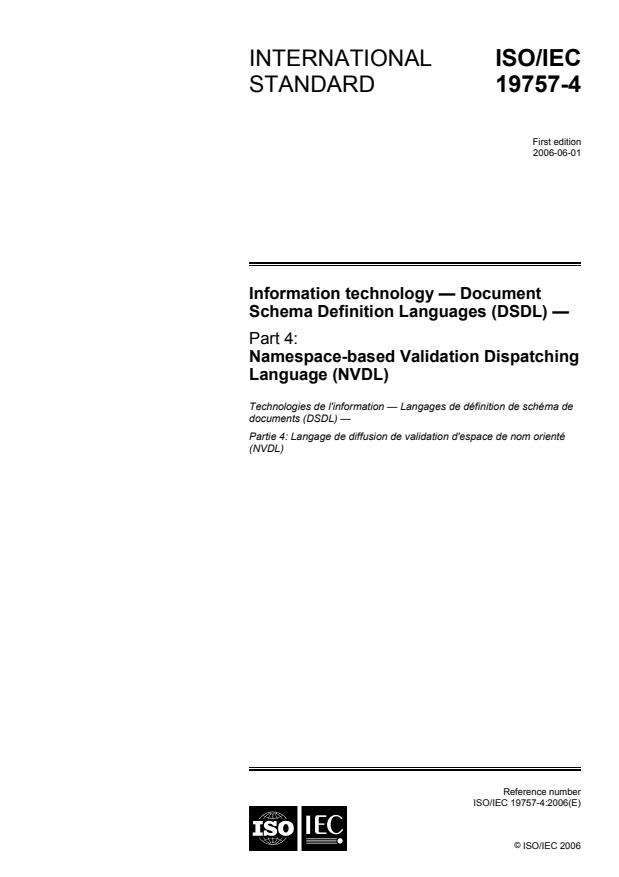
INTERNATIONAL ISO/IEC
STANDARD 19757-4
First edition
2006-06-01
Information technology — Document
Schema Definition Languages (DSDL) —
Part 4:
Namespace-based Validation Dispatching
Language (NVDL)
Technologies de l'information — Langages de définition de schéma de
documents (DSDL) —
Partie 4: Langage de diffusion de validation d'espace de nom orienté
(NVDL)
Reference number
©
ISO/IEC 2006
PDF disclaimer
This PDF file may contain embedded typefaces. In accordance with Adobe's licensing policy, this file may be printed or viewed but
shall not be edited unless the typefaces which are embedded are licensed to and installed on the computer performing the editing. In
downloading this file, parties accept therein the responsibility of not infringing Adobe's licensing policy. The ISO Central Secretariat
accepts no liability in this area.
Adobe is a trademark of Adobe Systems Incorporated.
Details of the software products used to create this PDF file can be found in the General Info relative to the file; the PDF-creation
parameters were optimized for printing. Every care has been taken to ensure that the file is suitable for use by ISO member bodies. In
the unlikely event that a problem relating to it is found, please inform the Central Secretariat at the address given below.
© ISO/IEC 2006
All rights reserved. Unless otherwise specified, no part of this publication may be reproduced or utilized in any form or by any means,
electronic or mechanical, including photocopying and microfilm, without permission in writing from either ISO at the address below or
ISO's member body in the country of the requester.
ISO copyright office
Case postale 56 • CH-1211 Geneva 20
Tel. + 41 22 749 01 11
Fax + 41 22 749 09 47
E-mail copyright@iso.org
Web www.iso.org
Published in Switzerland
ii © ISO/IEC 2006 – All rights reserved
Page
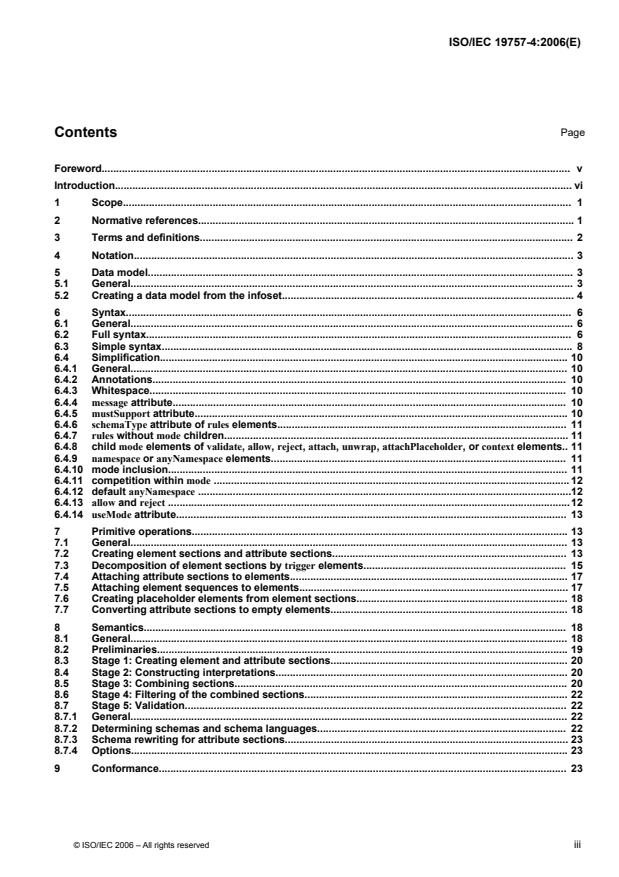
Contents
Foreword. v
Introduction. vi
1 Scope. 1
2 Normative references. 1
3 Terms and definitions. 2
4 Notation. 3
5 Data model. 3
5.1 General. 3
5.2 Creating a data model from the infoset. 4
6 Syntax. 6
6.1 General. 6
6.2 Full syntax. 6
6.3 Simple syntax. 8
6.4 Simplification. 10
6.4.1 General. 10
6.4.2 Annotations. 10
6.4.3 Whitespace. 10
6.4.4 message attribute. 10
6.4.5 mustSupport attribute. 10
6.4.6 schemaType attribute of rules elements. 11
6.4.7 rules without mode children. 11
6.4.8 child mode elements of validate, allow, reject, attach, unwrap, attachPlaceholder, or context elements. 11
6.4.9 namespace or anyNamespace elements. 11
6.4.10 mode inclusion. 11
6.4.11 competition within mode . 12
6.4.12 default anyNamespace .12
6.4.13 allow and reject .12
6.4.14 useMode attribute. 13
7 Primitive operations. 13
7.1 General. 13
7.2 Creating element sections and attribute sections. 13
7.3 Decomposition of element sections by trigger elements. 15
7.4 Attaching attribute sections to elements. 17
7.5 Attaching element sequences to elements. 17
7.6 Creating placeholder elements from element sections. 18
7.7 Converting attribute sections to empty elements. 18
8 Semantics. 18
8.1 General. 18
8.2 Preliminaries. 19
8.3 Stage 1: Creating element and attribute sections. 20
8.4 Stage 2: Constructing interpretations. 20
8.5 Stage 3: Combining sections. 20
8.6 Stage 4: Filtering of the combined sections. 22
8.7 Stage 5: Validation. 22
8.7.1 General. 22
8.7.2 Determining schemas and schema languages. 22
8.7.3 Schema rewriting for attribute sections. 23
8.7.4 Options. 23
9 Conformance. 23
© ISO/IEC 2006 – All rights reserved iii
Annex A (normative) Full syntax in RELAX NG. 24
Annex B (normative) Simple syntax in RELAX NG. 31
Annex C (informative) An NVDL script and RELAX NG schema for the full syntax. 35
C.1 General. 35
C.2 RELAX NG schema. 35
C.3 NVDL script. 40
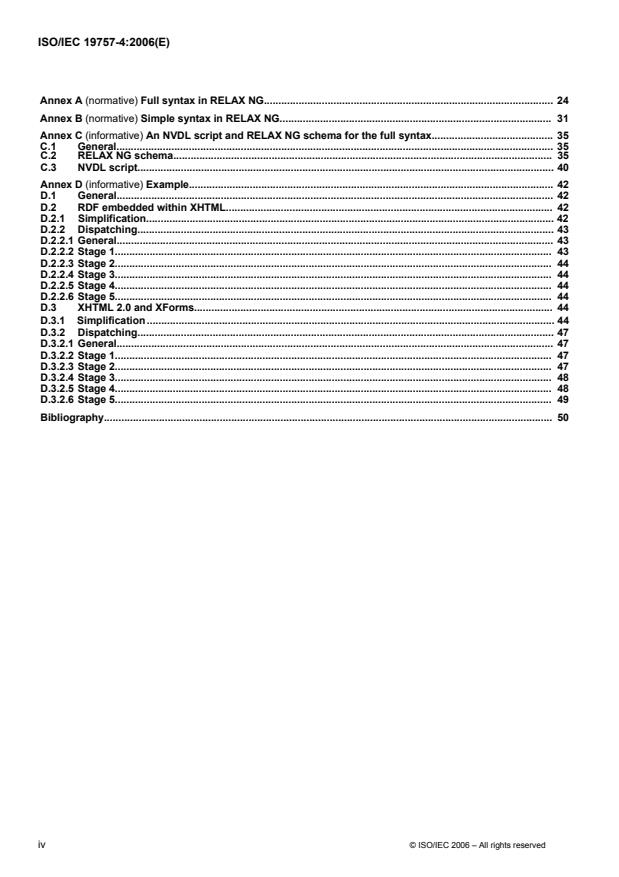
Annex D (informative) Example. 42
D.1 General. 42
D.2 RDF embedded within XHTML. 42
D.2.1 Simplification. 42
D.2.2 Dispatching. 43
D.2.2.1 General. 43
D.2.2.2 Stage 1. 43
D.2.2.3 Stage 2. 44
D.2.2.4 Stage 3. 44
D.2.2.5 Stage 4. 44
D.2.2.6 Stage 5. 44
D.3 XHTML 2.0 and XForms. 44
D.3.1 Simplification . 44
D.3.2 Dispatching. 47
D.3.2.1 General. 47
D.3.2.2 Stage 1. 47
D.3.2.3 Stage 2. 47
D.3.2.4 Stage 3. 48
D.3.2.5 Stage 4. 48
D.3.2.6 Stage 5. 49
Bibliography. 50
iv © ISO/IEC 2006 – All rights reserved
Foreword
ISO (the International Organization for Standardization) and IEC (the International Electrotechnical
Commission) form the specialized system for worldwide standardization. National bodies that are members of
ISO or IEC participate in the development of International Standards through technical committees
established by the respective organization to deal with particular fields of technical activity. ISO and IEC
technical committees collaborate in fields of mutual interest. Other international organizations, governmental
and non-governmental, in liaison with ISO and IEC, also take part in the work. In the field of information
technology, ISO and IEC have established a joint technical committee, ISO/IEC JTC 1.
International Standards are drafted in accordance with the rules given in the ISO/IEC Directives, Part 2.
The main task of the joint technical committee is to prepare International Standards. Draft International
Standards adopted by the joint technical committee are circulated to national bodies for voting. Publication as
an International Standard requires approval by at least 75 % of the national bodies casting a vote.
Attention is drawn to the possibility that some of the elements of this document may be the subject of patent
rights. ISO and IEC shall not be held responsible for identifying any or all such patent rights.
ISO/IEC 19757-4 was prepared by Joint Technical Committee ISO/IEC JTC 1, Information technology,
Subcommittee SC 34, Document description and processing languages.
ISO/IEC 19757 consists of the following parts, under the general title Information technology — Document
Schema Definition Languages (DSDL):
⎯ Part 1: Overview
⎯ Part 2: Regular-grammar-based validation — RELAX NG
⎯ Part 3: Rule-based validation — Schematron
⎯ Part 4: Namespace-based Validation Dispatching Language (NVDL)
The following parts are under preparation:
⎯ Part 5: Datatypes
⎯ Part 6: Path-based integrity constraints
⎯ Part 7: Character repertoire description language — CRDL
⎯ Part 8: Document schema renaming language — DSRL
⎯ Part 9: Datatype- and namespace-aware DTDs
⎯ Part 10: Validation management
© ISO/IEC 2006 – All rights reserved v
Introduction
ISO/IEC 19757 defines a set of Document Schema Definition Languages (DSDL) that can be used to specify one
or more validation processes performed against Extensible Markup Language (XML) documents. A number of
validation technologies are standardized in DSDL to complement those already available as standards or from
industry.
The main objective of ISO/IEC 19757 is to bring together different validation-related technologies to form a single
extensible framework that allows technologies to work in series or in parallel to produce a single or a set of
validation results. The extensibility of DSDL accommodates validation technologies not yet designed or specified.
The motivations of this part of ISO/IEC 19757 are twofold. One is to allow the interworking of schemas describing
different markup vocabularies. The other is to allow these schemas to be written in different schema languages. For
this purpose, this part of ISO/IEC 19757 specifies a Namespace-based Validation Dispatching Language (NVDL).
The structure of this part of ISO/IEC 19757 is as follows. Clause 5 describes the data model, which is the
abstraction of an XML document used throughout the rest of the document. Clause 6 describes the full syntax and
the simple syntax of NVDL scripts, and further describes the transformation from the full syntax to the simple
syntax. Clause 7 describes primitive operations for the NVDL data model, which are used for defining the NVDL
semantics. Clause 8 describes the semantics of a correct NVDL script in the simple syntax; the semantics specify
how elements and attributes in a given document are dispatched to different validators and which schema is used
by each of these validators. Clause 9 describes conformance requirements for NVDL dispatchers. Annex A and
Annex B define the full syntax and the simple syntax using RELAX NG, respectively. Annex C defines the full
syntax using NVDL and RELAX NG. Finally, Annex D provides examples of the application of NVDL.
The origin of NVDL is JIS TR X 0044[4], which was created and then submitted to ISO/IEC JTC1 as a fast-track
ISO/IEC DTR 22250-2[5] by the Japanese national member body for SC 34.
vi © ISO/IEC 2006 – All rights reserved
INTERNATIONAL STANDARD ISO/IEC 19757-4:2006(E)
Information technology — Document Schema Definition
Languages (DSDL) —
Part 4:
Namespace-based Validation Dispatching Language (NVDL)
1 Scope
This part of ISO/IEC 19757 specifies a Namespace-based Validation Dispatching Language (NVDL). An NVDL
script controls the dispatching of elements or attributes in a given XML document to different validators,
depending on the namespaces of the elements or attributes. An NVDL script also specifies which schemas are
used by these validators. These schemas may be written in any schema languages, including those specified by
ISO/IEC 19757.
2 Normative references
The following referenced documents are indispensable for the application of this document. For dated references,
only the edition cited applies. For undated references, the latest edition of the referenced document (including any
amendments) applies.
NOTE Each of the following documents has a unique identifier that is used to cite the document in the text. The unique
identifier consists of the part of the reference up to the first comma.
ISO/IEC 19757-2, Information technology — Document Schema Definition Languages (DSDL) — Part 2:
Regular-grammar-based validation— RELAX NG
W3C XML, Extensible Markup Language (XML) 1.0 (Third Edition), W3C Recommendation, 04 February 2004,
available at http://www.w3.org/TR/2004/REC-xml-20040204/
W3C XML-Names, Namespaces in XML, W3C Recommendation, 14 January 1999, available at
http://www.w3.org/TR/1999/REC-xml-names-19990114/
W3C XML-Infoset, XML Information Set (Second Edition), W3C Recommendation, 4 February 2004, available at
http://www.w3.org/TR/2004/REC-xml-infoset-20040204/
W3C XML Schema Part 2, XML Schema Part 2: Datatypes (Second Edition), W3C Recommendation, 28 October
2004, available at http://www.w3.org/TR/2004/REC-xmlschema-2-20041028/
IETF RFC 2045, Multipurpose Internet Mail Extensions (MIME) Part One: Format of Internet Message Bodies,
Internet Standards Track Specification, November 1996, available at http://www.ietf.org/rfc/rfc2045.txt
IETF RFC 2046, Multipurpose Internet Mail Extensions (MIME) Part Two: Media Types, Internet Standards Track
Specification, November 1996, available at http://www.ietf.org/rfc/rfc2046.txt
IETF RFC 3023, XML Media Types, Internet Standards Track Specification, August 1998, available at
http://www.ietf.org/rfc/rfc3023.txt
IETF RFC 3986, Uniform Resource Identifiers (URI): Generic Syntax, Internet Standards Track Specification,
January 2005, available at http://www.ietf.org/rfc/rfc3986.txt
IETF RFC 3987, Internationalized Resource Identifiers (IRIs), Internet Standards Track Specification, January
2005, available at http://www.ietf.org/rfc/rfc3987.txt
© ISO/IEC 2006 – All rights reserved 1
3 Terms and definitions
For the purposes of this document, the terms and definitions given in ISO/IEC 19757-2 and the following apply.
NOTE Where a term is defined in this part of ISO/IEC 19757 and in ISO/IEC 19757-2, the definition given in this part of
ISO/IEC 19757 applies.
3.1
action
a validate, reject, allow, attach, unwrap, cancelNestedActions, or attachPlaceholder element within an NVDL script
3.2
attribute section
a non-empty set of attributes having the same namespace name
3.3
attribute slot node
a slot for an attribute section
3.4
NVDL dispatcher
software module that determines whether an NVDL script is correct, creates validation candidates from an
instance, and invokes validators for these validation candidates
3.5
element section
an element such that a single namespace name applies to itself and all descendant elements
3.6
element slot node
a slot for an element section
3.7
full syntax
syntax of an NVDL script before simplification
3.8
instance
XML document from which validation candidates are created
3.9
media type
a two-part identifier specifying the nature of the referenced data
3.10
mode
a mapping from namespaces to actions
3.11
NVDL data model
abstract representation of an XML document defined by this part of ISO/IEC 19757
3.12
NVDL script
specification for namespace-based validation dispatching
3.13
parent element section
an element section containing a slot node for another section
3.14
path expression
a list of one or more choices separated by |, where each choice is a list of one or more NCName tokens separated
by /, optionally preceded by /
2 © ISO/IEC 2006 – All rights reserved
3.15
RELAX NG data model
abstract representation of an XML document defined by ISO/IEC 19757-2
3.16
section
either an attribute section or element section
3.17
simple syntax
syntax of an NVDL script after simplification
3.18
simplification
transformation of an NVDL script in the full syntax to a script in the simple syntax
3.19
slot node
either an attribute slot node or element slot node
3.20
validation candidate
an element not having any slot nodes as descendants
NOTE Different elements in a validation candidate may belong to different namespaces. Different attributes of an element
in a validation candidate may belong to different namespaces.
4 Notation
The following notations have been adopted in the formal definitions provided in this part of ISO/IEC 19757.
< [.] >: the context of an element in the NVDL data model,
< {.} >: the namespace name of an element in the NVDL data model
(.,.): a sequence of elements
{.,.}: a set of attributes
x+y: the concatenation of two element sequences x and y
e <- [sn, x]: an element constructed from e by replacing a slot node sn with an element sequence or attribute
section x
|e|: the number of descendant elements in an element e
createPlaceholder(s): a placeholder element created from an element section s as specified in 7.6.
virtualElement(s): an empty element created from an attribute section s as specified in 7.7
path(s): the path from the parent element section of s to s as defined in 8.2
5 Data model
5.1 General
NVDL deals with XML documents representing both schemas and instances through an abstract data model. XML
documents representing schemas and instances shall be well-formed in conformance with W3C XML and shall
conform to the constraints of W3C XML-Names.
© ISO/IEC 2006 – All rights reserved 3
This abstract NVDL data model is an extension of the RELAX NG data model. Names, contexts, attributes, and
strings in the NVDL data model are identical to those in the RELAX NG data model defined in ISO/IEC 19757-2.
Elements in the NVDL data model are extended as described in this clause.
An element consists of:
— a name,
— a context,
— a set of attributes or attribute slot nodes, and
— an ordered sequence of zero or more children; each child is either an element, a non-empty string, or an
element slot node; the sequence never contains two consecutive strings.
NOTE 1 Since contexts include mappings from prefixes to namespace names, validators invoked by NVDL dispatchers can
handle qualified names occurring in attribute values or element contents.
An element (say e) is said to be a descendant of another element (say e') when e occurs in the child sequence of
either e' or some descendant element of e'. Meanwhile, e is said to be an ancestor of e' when e' is a descendant of
e.
An attribute slot node is a slot for a non-empty set of attributes. An attribute slot node is said to belong to an
element (say e) when this attribute slot node is contained by the set of attributes or attribute slot nodes of either e
or some descendant element of e.
An element slot node is a slot for an element. An element slot node is said to belong to an element (say e) when
this element slot node occurs in the child sequence of either e or some descendant element of e.
NOTE 2 An element (say e) is not a descendant of another element (say e') if e' has an element slot node for e.
NOTE 3 Attribute or element slot nodes do not exist in the RELAX NG data model.
5.2 Creating a data model from the infoset
This process is identical to the process defined in ISO/IEC 19757-2.
EXAMPLE 1 Consider an XML document as follows.
text1
text2
text3
© ISO/IEC 2006 – All rights reserved
We use an XML-like syntax for representing data models, but there are two changes. First, in each start tag, the tag name is
replaced by a namespace name, local name, and context. Second, each end tag is represented by "".
The data model created from this document is shown below. (Whitespace is slightly changed for readability.) Every element in
this data model references to a context (say cx1) that maps ns1 to "http://www.example.com/one" and ns2 to
"http://www.example.com/two", respectively.
<{http://www.example.com/one}foo [cx1]>
<{http://www.example.com/one}foo1 [cx1]>
text1
<{http://www.example.com/two}foo11 [cx1]>
<{http://www.example.com/two}foo2 [cx1]>
text2
<{http://www.example.com/one}foo21 [cx1]>
text3
<{http://www.example.com/one}foo22 [cx1]>
<{http://www.example.com/one}foo3 [cx1]>
<{http://www.example.com/one}foo31 [cx1]>
Observe that the XML declaration and any comments or processing instructions in the input XML document do not appear in the
data model and that there are no empty-element tags.
EXAMPLE 2 The following XML document is obtained by adding attributes to the document in the previous example.
text1
text2
text3
The data model created from this document is shown below. cx1 is the same as in Example 1. Each attribute name is replaced
by a namespace name and local name.
<{http://www.example.com/one}foo [cx1]>
<{http://www.example.com/one}foo1 [cx1]
{}bar1="_" {}bar2="_">
text1
<{http://www.example.com/two}foo11 [cx1]>
<{http://www.example.com/two}foo2 [cx1]
{http://www.example.com/one}bar1="_"
{http://www.example.com/one}bar2="_"
{http://www.example.com/two}bar1="_"
{http://www.example.com/two}bar2="_"
{}bar1="_" {}bar2="_">
© ISO/IEC 2006 – All rights reserved
text2
<{http://www.example.com/one}foo21 [cx1]>
text3
<{http://www.example.com/one}foo22 [cx1]>
<{http://www.example.com/one}foo3 [cx1]
{http://www.example.com/two}bar1="_"
{http://www.example.com/two}bar2="_">
<{http://www.example.com/one}foo31 [cx1]>
6 Syntax
6.1 General
NVDL has the full syntax and the simple syntax. A correct NVDL script is always required to be in the full syntax
described in 6.2. Meanwhile, the simple syntax described in 6.3 is purely an internal artifact for specifying the
semantics of NVDL. NVDL scripts in the full syntax may be transformed to NVDL scripts in the simple syntax.
6.2 Full syntax
An NVDL script in the full syntax shall be an XML document valid against the following RELAX NG schema in the
compact syntax. The same schema in the XML syntax is shown in Annex A.
namespace local = ""
default namespace nvdl = "http://purl.oclc.org/dsdl/nvdl/ns/structure/1.0"
start =
element rules {
(schemaType?,
trigger*,
(rule* | (attribute startMode { xsd:NCName }, mode+)))
& foreign
}
trigger =
element trigger {
(attribute ns { xsd:string },
attribute nameList { list { xsd:NCName } })
& foreign
}
mode =
element mode {
(attribute name { xsd:NCName },
includedMode*,
rule*)
& foreign
}
includedMode =
element mode {
(attribute name {xsd:NCName}?,
includedMode*,
rule*)
& foreign
}
© ISO/IEC 2006 – All rights reserved
rule =
element namespace {
(attribute ns { xsd:string },
attribute wildCard {xsd:string{maxLength = "1"}}?,
ruleModel)
& foreign
}
| element anyNamespace { ruleModel & foreign}
ruleModel = attribute match { elementsOrAttributes }?, actions
elementsOrAttributes =
list {
("elements", "attributes")
| ("attributes", "elements")
| "elements"
| "attributes"
}
actions =
cancelAction |
(noResultAction*, (noResultAction|resultAction), noResultAction*)
cancelAction =
element cancelNestedActions {foreign}
noResultAction =
element validate {
(schemaType?,
(message | option)*,
schema,
modeUsage) & foreign
}
| element allow|reject { (message*, modeUsage) & foreign }
schema =
attribute schema { xsd:anyURI } |
element schema {(text | foreignElement), foreignAttribute*}
message =
attribute message {text}
| element message {(text, xmlAttribute*), nonXMLForeignAttribute*}
resultAction =
element attach|attachPlaceholder|unwrap { (message*, modeUsage) & foreign }
option =
element option {
(attribute name { xsd:anyURI },
attribute arg { text }?,
attribute mustSupport { xsd:boolean }?)
& foreign
}
modeUsage =
(attribute useMode { xsd:NCName }
| nestedMode)?,
element context {
(attribute path { path },
(attribute useMode { xsd:NCName }
| nestedMode)?
) & foreign
}*
nestedMode =
element mode {
© ISO/IEC 2006 – All rights reserved
(includedMode*,
rule*)
& foreign
}
schemaType = attribute schemaType { mediaType }
## 5.1 of RFC 2045 allows
## or tspecials>, where
##
## tspecials := "(" / ")" / "<" / ">" / "@" /
## "," / ";" / ":" / "\" / <">
## "/" / "[" / "]" / "?" / "="
##
mediaType =
xsd:string {
pattern = "\s*"
~ "[0-9A-Za-z!#$%&'\*\+\-\.\^_`\{\|\}~]*"
~ "/"
~ "[0-9A-Za-z!#$%&'\*\+\-\.\^_`\{\|\}~]*"
~ "\s*"}
path =
xsd:string {
pattern = "\s*(/\s*)?\i\c*(\s*/\s*\i\c*)*\s*"
~ "(\|\s*(/\s*)?\i\c*(\s*/\s*\i\c*)*\s*)*"
}
foreignElement =
element (* - nvdl:*) {attribute * {text}*, mixed{anyElement*}}
anyElement =
element * {attribute * {text}*, mixed{anyElement*}}
foreignAttribute = attribute * - (nvdl:* | local:*) {text}
nonXMLForeignAttribute = attribute * - (xml:* | nvdl:* | local:*) {text}
xmlAttribute =
attribute xml:lang {text}
| attribute xml:space {"default" | "preserve"}
| attribute xml:base {xsd:anyURI}
foreign = foreignAttribute*, foreignElement*
6.3 Simple syntax
The simple syntax is a subset of the full syntax. An NVDL script in the simple syntax shall be an XML document
valid against the following RELAX NG schema in the compact syntax. The same schema in the XML syntax is
shown in Annex B.
namespace local = ""
default namespace nvdl = "http://purl.oclc.org/dsdl/nvdl/ns/structure/1.0"
start =
element rules {
attribute startMode { xsd:NCName }, trigger*, mode+
}
trigger =
element trigger {
attribute ns { xsd:string },
© ISO/IEC 2006 – All rights reserved
attribute nameList { list { xsd:NCName } }
}
mode =
element mode {
attribute name { xsd:NCName },
rule*
}
rule =
element namespace {
attribute ns { xsd:string },
attribute wildCard {xsd:string{maxLength = "1"}},
ruleModel
}
| element anyNamespace { ruleModel }
ruleModel = attribute match { elementsOrAttributes }, actions
elementsOrAttributes =
"elements" | "attributes"
actions =
(noResultAction*, (noResultAction|resultAction), noResultAction*)
noResultAction =
element validate {
schemaType?,
(message | option)*,
schema,
modeUsage
}
schema =
attribute schema { xsd:anyURI } |
element schema {(text | foreignElement)}
message =
element message {text & attribute xml:lang {text}}
resultAction =
element attach|attachPlaceholder|unwrap { message*, modeUsage }
option =
element option {
attribute name { xsd:anyURI },
attribute arg { text }?,
attribute mustSupport { xsd:boolean }
}
modeUsage =
attribute useMode { xsd:NCName },
element context {
attribute path { path },
attribute useMode { xsd:NCName }
}*
schemaType = attribute schemaType { mediaType }
## 5.1 of RFC 2045 allows
## or tspecials>, where
##
## tspecials := "(" / ")" / "<" / ">" / "@" /
## "," / ";" / ":" / "\" / <">
## "/" / "[" / "]" / "?" / "="
##
© ISO/IEC 2006 – All rights reserved
mediaType =
xsd:string {
pattern = "\s*"
~ "[0-9A-Za-z!#$%&'\*\+\-\.\^_`\{\|\}~]*"
~ "/"
~ "[0-9A-Za-z!#$%&'\*\+\-\.\^_`\{\|\}~]*"
~ "\s*"}
path =
xsd:string {
pattern = "\s*(/\s*)?\i\c*(\s*/\s*\i\c*)*\s*"
~ "(\|\s*(/\s*)?\i\c*(\s*/\s*\i\c*)*\s*)*"
}
foreignElement =
element (* - nvdl:*) {attribute * {text}*, mixed{anyElement*}}
anyElement =
element * {attribute * {text}*, mixed{anyElement*}}
6.4 Simplification
6.4.1 General
The full syntax is transformed into the simple syntax by applying the following transformation rules in order. The
effect shall be as if each transformation rule was applied to all elements in the schema before the next
transformation rule is applied. A transformation rule may also specify constraints that shall be satisfied by a correct
schema. The transformation rules are applied at the data model level. Before the transformations are applied, the
schema is parsed into an element in the data model.
6.4.2 Annotations
Attributes having qualified names are removed, unless they belong to descendant elements of schema elements or
they are xml:lang attributes of message elements. Elements not belonging to the namespace
"http://purl.oclc.org/dsdl/nvdl/ns/structure/1.0" are removed unless they are descendants of schema elements.
NOTE It is safe to remove xml:base attributes at this stage because xml:base attributes are used in determining the [base
URI] property of an element information item, which is in turn used to construct the base URI of the context of an element. Thus,
after a document has been parsed into an element in the data model, xml:base attributes can be discarded.
6.4.3 Whitespace
For each element other than message and schema, each child that is a string containing only whitespace characters
is removed.
Leading and trailing whitespace characters are removed from the value of each startMode, useMode, match,
mustSupport, and schemaType attribute and removed from the value of each name attribute of mode.
6.4.4 message attribute
The message attribute on a validate, allow, reject, attach or unwrap element is transformed into a message child
element.
6.4.5 mustSupport attribute
If an option element does not have the mustSupport attribute, mustSupport="false" is added.
© ISO/IEC 2006 – All rights reserved
6.4.6 schemaType attribute of rules elements
If the top-level rules element has the attribute schemaType, this attribute is copied to those validate elements which
have neither a schemaType attribute nor a schema element. Then, the attribute schemaType of the top-level rules
element is removed.
6.4.7 rules without mode children
The top-level rules element is transformed so that it has mode elements as children. If its child elements are
namespace or anyNamespace elements, they are wrapped in a mode element. Then, a name attribute and startMode
attribute are added to the mode element and rules element, respectively. These attributes shall have the same
value, which shall be different from any other mode name.
6.4.8 child mode elements of validate, allow, reject, attach, unwrap, attachPlaceholder, or context elements
In this transformation rule, validate, allow, reject, attach, unwrap, attachPlaceholder, or context elements are
transformed so that they do not have mode elements as children.
If a mode element occurs as a child of a validate, allow, reject, attach, unwrap, attachPlaceholder, or context element that
has one and only one ancestor mode element, this mode element becomes the last child element of the rules element.
Then, a name attribute is added to the mode element, and a useMode attribute is added to the validate, allow, reject,
attach, unwrap, or attachPlaceholder element. These attributes shall have the same value, which shall be different
from any other mode name. This transformation rule is applied repeatedly until there are no mode elements within
validate, allow, reject, attach, unwrap, attachPlaceholder, or context elements.
6.4.9 namespace or anyNamespace elements
If a namespace or anyNamespace element does not specify a match attribute, match="elements" is added.
If the value of the match attribute of a namespace or anyNamespace element contains tokens "elements" as well as
"attributes", this element is replaced by a sequence of two copies of the element. The match attribute of the first copy
is transformed into match="elements", while that of the second is transformed into match="attributes".
If a namespace element does not specify the wildCard attribute, wildCard="*" is added.
6.4.10 mode inclusion
In this transformation rule, mode elements are transformed so that they do not have child mode elements.
NOTE It is intended that external parsed entities or XInclude[9] are used for syntactically including external NVDL script
fragments. The transformation defined here allows post-processing after such syntactical inclusion.
Define the lowest-level modes as mode elements without child mode elements.
An anyNamespace element within a lowest-level mode is said to be overridden when a mode directly containing this
mode has another anyNamespace element and these anyNamespace elements specify the same value for the match
attribute.
A namespace element within a lowest-level mode is said to be overridden when a mode directly containing this
mode has another namespace element and these namespace elements specify the same value for the match attribute,
the same value for the ns attribute, and the same value for the wildCard attribute.
For each lowest-level mode md the following transformations are applied in sequence:
— Each namespace or anyNamespace element within md is removed if it is overridden.
— md is replaced by its children
© ISO/IEC 2006 – All rights reserved
This transformation rule is applied repeatedly until mode elements do not have child mode elements.
— Finally, each namespace or anyNamespace element is removed if it has a cancelNestedActions element as a child.
6.4.11 competition within mode
The match attributes of two sibling anyNamespace elements shall not be identical.
Two sibling namespace elements shall not compete with each other if their match attributes are identical.
We define competition of namespace elements formally. Let w1 be the value of the wildCard attribute specified by the
first namespace element and let ns1 be the value of the ns attribute specified by the same element. Also let w2 and
ns2 be those specified by the second namespace element. These namespace elements compete when two pairs (ns1,
w1) and (ns2, w2) compete. These two pairs compete if and only if:
— Case 1: both ns1 and ns2 are empty strings,
— Case 2: either (1) ns1="" and ns2="w2" or (2) ns2="" and ns1="w1",
— Case 3: both ns1 and ns2 begin with the same character that is neither w1 nor w2, and a pair (nsTail1, w1)
competes with another pair (nsTail2, w2), where nsTail1 and nsTail2 are obtained by stripping the first
characters of ns1 and ns2, respectively,
NOTE 1 Case 3 implies that ("a", "*") and ("a", "?") compete.
— Case 4: w1 is not "", ns1 begins with w1, and a pair (ns1, w1) competes with another pair (nsTail2, w2), where
nsTail2 is obtained by stripping the first character of ns2, or
NOTE 2 Case 4 implies that ("*", "*") and ("a", "") compete.
— Case 5: w2 is not "", ns2 begins with w2, and a pair (ns2, w2) competes with another pair (nsTail1, w1), where
nsTail1 is obtained by stripping the first character of ns1
NOTE 3 The restriction in this clause ensures that only one namespace or anyNamespace in a mode is triggered by a
namespace name, so that at most one unwrap or attach is invoked.
6.4.12 default anyNamespace
If a mode element does not have an anyNamespace element with match="elements",
is added.
If a mode element does not have an anyNamespace element with match="attributes",
is added.
6.4.13 allow and reject
Each allow element is replaced by a validate element. Its content shall be the content of the allow element followed
by
,
© ISO/IEC 2006 – All rights reserved
where allow in the namespace "http://purl.oclc.org/dsdl/nvdl/ns/predefinedSchema/1.0" is a schema that allows any
document.
Each reject element is replaced by a validate element. Its content shall be the content of the reject element followed
by
,
where reject in the namespace "http://purl.oclc.org/dsdl/nvdl/ns/predefinedSchema/1.0" is a schema that allows no
documents.
NOTE The motivation for these predefined schemas is merely the ease of specifying their semantics.
6.4.14 useMode attribute
For each validate, attach, attachPlaceholder, unwrap, or context element without a useMode attribute, a useMode
attribute is added. The value shall be copied from the name attribute of the ancestor mode element.
7 Primitive operations
7.1 General
This clause introduces primitive o
...
Questions, Comments and Discussion
Ask us and Technical Secretary will try to provide an answer. You can facilitate discussion about the standard in here.
Loading comments...