


ISO/IEC 29500-2:2021
(Main)Document description and processing languages — Office Open XML file formats — Part 2: Open packaging conventions
General Information
- Abstract
This document defines a set of conventions for packaging one or more interrelated byte streams (parts) as a single resource (package). These conventions are applicable not only to Office Open XML specifications as described in ISO/IEC 29500-1 and ISO/IEC 29500-4, but also to other markup specifications.
- Status
- Published
- Publication Date
- 08-Aug-2021
- Technical Committee
- ISO/IEC JTC 1/SC 34 - Document description and processing languages
- Drafting Committee
- ISO/IEC JTC 1/SC 34/WG 4 - Office Open XML
- Current Stage
- 9020 - International Standard under periodical review
- Start Date
- 15-Jul-2026
- Completion Date
- 15-Jul-2026


Overview
ISO/IEC 29500-2:2021 - Part 2 of the Office Open XML family - defines the Open Packaging Conventions (OPC): a standardized set of rules for packaging one or more interrelated byte streams (called parts) into a single package resource. OPC is the foundation for Office Open XML file formats and is applicable to other markup-based formats that need a structured, interoperable container model.
Key Topics and Requirements
- Abstract package model: definition of parts, part names, media types, and XML usage rules that govern how content is organized and identified.
- Part addressing and pack IRIs: canonical methods for addressing and resolving part URIs (pack IRIs) and for composing/normalizing references inside packages.
- Relationships: standardized relationship parts and relationship markup to express how parts relate (document structure, resources, external references).
- Physical package model: guidelines for mapping the abstract package to physical formats - most commonly ZIP - including item naming, interleaving, media types stream, and ZIP feature constraints.
- Core properties and thumbnails: a defined Core Properties part for metadata (author, creation date, etc.) and thumbnail embedding rules.
- Digital signatures: OPC-specific restrictions and extensions to W3C XML-Signature Syntax and Processing, digital signature parts, signing/validation guidance, and relationship transform algorithms.
- Conformance and annexes: rules for conformance, preprocessing for relative references, schemas (W3C XML/RELAX NG), and normative constraints on ZIP features.
Practical Applications
- Creating interoperable Office Open XML files (.docx, .xlsx, .pptx) that follow a recognized packaging model.
- Designing custom document or markup-based formats that require a standardized container and metadata/relationship model.
- Implementing document management systems, archiving solutions, and converters that read/write OPC packages reliably.
- Enabling secure document workflows via standardized digital signatures and metadata handling.
- Supporting long-term preservation by enforcing consistent packaging, media type registration, and metadata (core properties).
Who Uses This Standard
- Software developers and implementers of office suites, document editors, and converters
- Standards engineers and technical architects designing file/container formats
- Archivists and records managers ensuring interoperable digital preservation
- Security engineers implementing document signing and validation
- QA teams validating conformance to OPC and ZIP-mapping rules
Related Standards
- ISO/IEC 29500-1 and ISO/IEC 29500-4 (other parts of Office Open XML)
- W3C XML-Signature Syntax and Processing (referenced for digital signatures)
- ZIP file format specifications (for physical mapping considerations)
Keywords: ISO/IEC 29500-2, Open Packaging Conventions, Office Open XML, OPC, packaging, ZIP mapping, digital signatures, core properties, part relationships.
Relations
- Effective Date
- 15-Apr-2023
- Effective Date
- 23-Apr-2020
Get Certified
Connect with accredited certification bodies for this standard

BSI Group
BSI (British Standards Institution) is the business standards company that helps organizations make excellence a habit.

NYCE
Mexican standards and certification body.
Sponsored listings
Frequently Asked Questions
ISO/IEC 29500-2:2021 is a standard published by the International Organization for Standardization (ISO). Its full title is "Document description and processing languages — Office Open XML file formats — Part 2: Open packaging conventions". This standard covers: This document defines a set of conventions for packaging one or more interrelated byte streams (parts) as a single resource (package). These conventions are applicable not only to Office Open XML specifications as described in ISO/IEC 29500-1 and ISO/IEC 29500-4, but also to other markup specifications.
This document defines a set of conventions for packaging one or more interrelated byte streams (parts) as a single resource (package). These conventions are applicable not only to Office Open XML specifications as described in ISO/IEC 29500-1 and ISO/IEC 29500-4, but also to other markup specifications.
ISO/IEC 29500-2:2021 is classified under the following ICS (International Classification for Standards) categories: 35.060 - Languages used in information technology; 35.240.30 - IT applications in information, documentation and publishing. The ICS classification helps identify the subject area and facilitates finding related standards.
ISO/IEC 29500-2:2021 has the following relationships with other standards: It is inter standard links to ISO/CD 6789-2.3, ISO/IEC 29500-2:2012. Understanding these relationships helps ensure you are using the most current and applicable version of the standard.
ISO/IEC 29500-2:2021 is available in PDF format for immediate download after purchase. The document can be added to your cart and obtained through the secure checkout process. Digital delivery ensures instant access to the complete standard document.
Standards Content (Sample)
INTERNATIONAL ISO/IEC
STANDARD 29500-2
Fourth edition
2021-08
Document description and processing
languages — Office Open XML file
formats —
Part 2:
Open packaging conventions
Description des documents et langages de traitement — Formats de
fichier "Office Open XML" —
Partie 2: Conventions de paquetage ouvert
Reference number
©
ISO/IEC 2021
COPYRIGHT PROTECTED DOCUMENT
© ISO/IEC 2021
All rights reserved. Unless otherwise specified, or required in the context of its implementation, no part of this publication may
be reproduced or utilized otherwise in any form or by any means, electronic or mechanical, including photocopying, or posting
on the internet or an intranet, without prior written permission. Permission can be requested from either ISO at the address
below or ISO’s member body in the country of the requester.
ISO copyright office
CP 401 • Ch. de Blandonnet 8
CH-1214 Vernier, Geneva
Phone: +41 22 749 01 11
Email: copyright@iso.org
Website: www.iso.org
Published in Switzerland
ii © ISO/IEC 2021 – All rights reserved
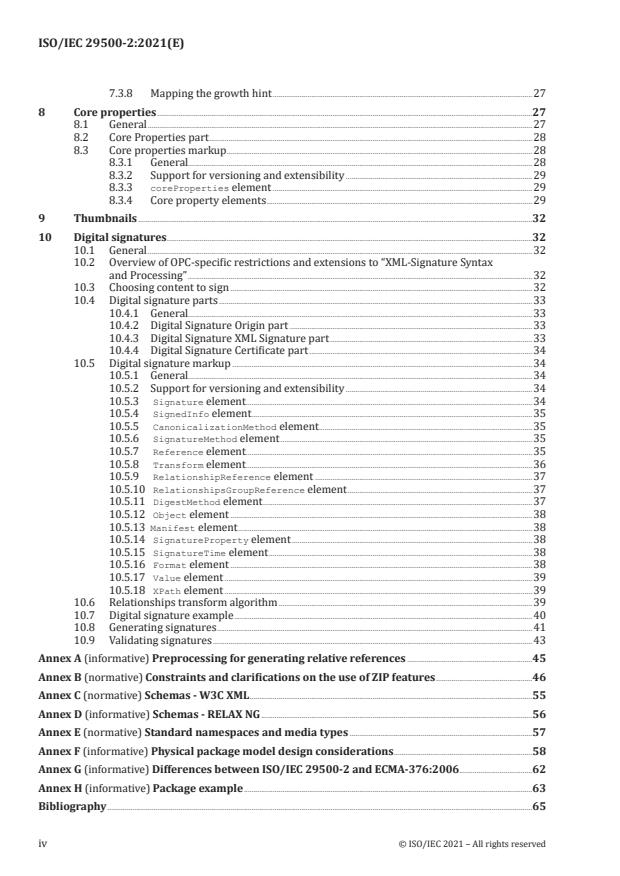
Contents Page
Foreword .v
Introduction .vii
1 Scope . 1
2 Normative references . 1
3 Terms and definitions . 2
3.1 Basics . 2
3.2 Abstract package model . 3
3.3 Physical package model. 4
3.4 Digital signature and thumbnail . 5
3.5 Implementations . 5
3.6 Core properties . 5
4 Conformance . 5
5 Overview . 5
6 Abstract package model . 6
6.1 General . 6
6.2 Parts . 6
6.2.1 General. 6
6.2.2 Part names . . . 6
6.2.3 Media types . 8
6.2.4 Growth hint. 8
6.2.5 XML usage . 8
6.3 Part addressing . 8
6.3.1 General. 8
6.3.2 Pack scheme . 9
6.3.3 Resolving a pack IRI to a resource .10
6.3.4 Composing a pack IRI .10
6.3.5 Equivalence.11
6.4 Resolving relative references .11
6.4.1 General.11
6.4.2 Base IRIs .11
6.4.3 Examples .12
6.5 Relationships .14
6.5.1 General.14
6.5.2 Relationships part .14
6.5.3 Relationship markup .15
6.5.4 Examples .17
7 Physical package model .19
7.1 General .19
7.2 Physical mapping guidelines .19
7.2.1 Using features of physical formats .19
7.2.2 Mapped components .20
7.2.3 Mapping media types to parts .20
7.2.4 Interleaving .23
7.2.5 Mapping part names to physical package item names.23
7.3 Mapping to a ZIP file .25
7.3.1 General.25
7.3.2 Mapping part data .25
7.3.3 ZIP item names .26
7.3.4 Mapping logical item names to ZIP item names .26
7.3.5 Mapping ZIP item names to logical item names .26
7.3.6 ZIP package limitations .26
7.3.7 Mapping the Media Types stream .27
© ISO/IEC 2021 – All rights reserved iii
7.3.8 Mapping the growth hint .27
8 Core properties .27
8.1 General .27
8.2 Core Properties part .28
8.3 Core properties markup .28
8.3.1 General.28
8.3.2 Support for versioning and extensibility .29
8.3.3 coreProperties element .29
8.3.4 Core property elements .29
9 Thumbnails .32
10 Digital signatures .32
10.1 General .32
10.2 Overview of OPC-specific restrictions and extensions to “XML-Signature Syntax
and Processing” .32
10.3 Choosing content to sign .32
10.4 Digital signature parts .33
10.4.1 General.33
10.4.2 Digital Signature Origin part .33
10.4.3 Digital Signature XML Signature part .33
10.4.4 Digital Signature Certificate part .34
10.5 Digital signature markup .34
10.5.1 General.34
10.5.2 Support for versioning and extensibility .34
10.5.3 Signature element . .34
10.5.4 SignedInfo element .35
10.5.5 CanonicalizationMethod element.35
10.5.6 SignatureMethod element .35
10.5.7 Reference element . .35
10.5.8 Transform element . .36
10.5.9 RelationshipReference element .37
10.5.10 RelationshipsGroupReference element .37
10.5.11 DigestMethod element .37
10.5.12 Object element .38
10.5.13 Manifest element .38
10.5.14 SignatureProperty element .38
10.5.15 SignatureTime element .38
10.5.16 Format element .38
10.5.17 Value element .39
10.5.18 XPath element .39
10.6 Relationships transform algorithm .39
10.7 Digital signature example .40
10.8 Generating signatures .41
10.9 Validating signatures .43
Annex A (informative) Preprocessing for generating relative references .45
Annex B (normative) Constraints and clarifications on the use of ZIP features .46
Annex C (normative) Schemas - W3C XML .55
Annex D (informative) Schemas - RELAX NG .56
Annex E (normative) Standard namespaces and media types .57
Annex F (informative) Physical package model design considerations .58
Annex G (informative) Differences between ISO/IEC 29500-2 and ECMA -376: 2006.62
Annex H (informative) Package example .63
Bibliography .65
iv © ISO/IEC 2021 – All rights reserved
Foreword
ISO (the International Organization for Standardization) and IEC (the International Electrotechnical
Commission) form the specialized system for worldwide standardization. National bodies that are
members of ISO or IEC participate in the development of International Standards through technical
committees established by the respective organization to deal with particular fields of technical
activity. ISO and IEC technical committees collaborate in fields of mutual interest. Other international
organizations, governmental and non-governmental, in liaison with ISO and IEC, also take part in the
work.
The procedures used to develop this document and those intended for its further maintenance are
described in the ISO/IEC Directives, Part 1. In particular, the different approval criteria needed for
the different types of document should be noted. This document was drafted in accordance with the
editorial rules of the ISO/IEC Directives, Part 2 (see www .iso .org/ directives or www .iec .ch/ members
_experts/ refdocs).
Attention is drawn to the possibility that some of the elements of this document may be the subject
of patent rights. ISO and IEC shall not be held responsible for identifying any or all such patent
rights. Details of any patent rights identified during the development of the document will be in the
Introduction and/or on the ISO list of patent declarations received (see www .iso .org/ patents) or the IEC
list of patent declarations received (see patents.iec.ch).
Any trade name used in this document is information given for the convenience of users and does not
constitute an endorsement.
For an explanation of the voluntary nature of standards, the meaning of ISO specific terms and
expressions related to conformity assessment, as well as information about ISO's adherence to the
World Trade Organization (WTO) principles in the Technical Barriers to Trade (TBT) see www .iso .org/
iso/ foreword .html. In the IEC, see www .iec .ch/ understanding -standards.
This document was prepared by Joint Technical Committee ISO/IEC JTC 1, Information technology,
Subcommittee SC 34, Document description and processing languages.
This fourth edition cancels and replaces the third edition (ISO/IEC 29500-2:2012), which has been
technically revised.
The main changes compared to the previous edition are as follows:
— Where appropriate, normative references have been updated to use undated or more recent versions
of other standards.
— Clause 3 (Terms and definitions) has been revised by removing terms not used by any normative
clauses and then reorganizing terms into groups.
— The subclause for diagram notes (5.1 in the preceding editions) has been removed, since core
properties are now defined by prose and schemas rather than by diagrams.
— The clause for acronyms and abbreviations (Clause 6 in the preceding editions) has been removed,
since it does not make sense for an ISO/IEC standard to define "ISO" and "IEC".
— Clause 6 (Abstract package model, Clause 8 in the previous edition) has been completely rewritten.
In particular, (1) pack IRIs have been defined in this clause rather than in an annex, (2) a new
subclause, "Resolving relative references", has been added; (3) part Relationships parts and
package Relationships parts have been distinguished; (4) base IRIs have been clearly defined; and
(5) handling of non-ASCII characters in part names has been clarified on the basis of RFC 3987.
— The option for media type to be an empty string has been removed, as this conflicts with the
definition of media type in RFC 2046 and the existing regular expression defined in the schema
referenced by C.2.
© ISO/IEC 2021 – All rights reserved v
— Clause 7 (Physical package model, Clause 9 in the previous edition) has been slightly revised.
Interleaving has been introduced before logical item names. Percent-encoding and un-percent
encoding of non-ASCII characters have been explicitly introduced in 7.3.4 and 7.3.5.
— Clause 8 (Core properties, Clause 10 in the previous edition) has been rewritten by using prose and
schemas rather than diagrams.
— Clause 10 (Digital signatures, Clause 12 in the previous edition) has been thoroughly revised. In
particular, this clause now makes clear a convention for the choice of algorithms for signature and
digest methods, which reflects the ongoing development of algorithms since the first edition of this
document.
— Annex A has been made informative.
— The normative annex that defined pack IRIs (Annex B in the preceding editions) has been dropped.
Pack IRIs are now defined in Clause 6.
— Annex C and Annex D (Annexes D and E in the preceding editions) no longer define schemas but
reference externally defined schemas.
— Guidelines for meeting conformance requirements (Annex H in the preceding editions) have been
dropped.
— Requirements around streaming consumption have been dropped.
— Wherever possible, requirements on programs have been rewritten as those on data.
— Annex H has been added to depict an example package.
— The Index (Annex J in the preceding editions) has been deleted.
— Bibliography has been added.
A list of all parts in the ISO/IEC 29500 series can be found on the ISO and IEC websites.
Any feedback or questions on this document should be directed to the user’s national standards body. A
complete listing of these bodies can be found at www .iso .org/ members .html and www .iec .ch/ national
-committees.
vi © ISO/IEC 2021 – All rights reserved
Introduction
ISO/IEC 29500 (all Parts) specifies a family of XML schemas, collectively called Office Open XML, which
define the XML vocabularies for word-processing, spreadsheet, and presentation documents, as well as
the packaging of documents that conform to these schemas.
The goal is to enable the implementation of the Office Open XML formats by the widest set of tools
and platforms, fostering interoperability across office productivity applications and line-of-business
systems, as well as to support and strengthen document archival and preservation, all in a way that is
1)
fully compatible with the existing corpus of Microsoft® Office documents.
This document includes two annexes (Annex C and Annex D) that refer to data files provided in
electronic form.
The document representation formats defined by this document are different from the formats defined
in the corresponding Part of ECMA -376: 2006. Some of the differences are reflected in schema changes,
as shown in Annex G.
This fourth edition preserves all previous functionality and adds no new functionality.
1) This information is given for the convenience of users of this document and does not constitute an endorsement
by ISO or IEC of the product named. Equivalent products may be used if they can be shown to lead to the same
results.
© ISO/IEC 2021 – All rights reserved vii
INTERNATIONAL STANDARD ISO/IEC 29500-2:2021(E)
Document description and processing languages — Office
Open XML file formats —
Part 2:
Open packaging conventions
1 Scope
This document defines a set of conventions for packaging one or more interrelated byte streams
(parts) as a single resource (package). These conventions are applicable not only to Office Open
XML specifications as described in ISO/IEC 29500-1 and ISO/IEC 29500-4, but also to other markup
specifications.
2 Normative references
The following documents are referred to in the text in such a way that some or all of their content
constitutes requirements of this document. For dated references, only the edition cited applies. For
undated references, the latest edition of the referenced document (including any amendments) applies.
ANSI/INCITS 4-1986 [R2017] - Information Systems - Coded Character Sets - 7-Bit American National
Standard Code For Information Interchange (7-Bit ASCII), American National Standards Institute (ANSI).
FIPS 186-4, Digital Signature Standard (DSS), National Institute of Standards and Technology, US
Department of Commerce, July 2013
ISO/IEC 29500-3, Information technology — Document description and processing languages — Office
Open XML File Formats — Part 3: Markup Compatibility and Extensibility
ISO/IEC 9594-8/ITU-T Rec. X.509, Information technology — Open systems interconnection — Part 8: The
Directory: Public-key and attribute certificate frameworks
ISO 15836-1, Information and documentation — The Dublin Core metadata element set — Part 1: Core
elements
ISO 15836-2, Information and documentation — The Dublin Core metadata element set — Part 2: DCMI
Properties and classes
RFC 2046, Multipurpose Internet Mail Extensions (MIME) Part Two: Media Types, The Internet Society,
November 1996, N. Freed and N. Borenstein. Available at https:// www .rfc -editor .org/ info/ rfc2046
RFC 3986, Uniform Resource Identifier (URI): Generic Syntax, The Internet Society, January 2005, Berners-
Lee, T., R. Fielding, and L. Masinter. Available at https:// www .rfc -editor .org/ info/ rfc3986
RFC 3987, Internationalized Resource Identifiers (IRIs), The Internet Society, January 2005, Duerst, M.
and M. Suignard. Available at https:// www .rfc -editor .org/ info/ rfc3987
RFC 5234, Augmented BNF for Syntax Specifications: ABNF, The Internet Society, January 2008, D. Crocker
and P.Overell, (editors). Available at https:// www .rfc -editor .org/ info/ rfc5234
RFC 6931, Additional XML Security Uniform Resource Identifiers (URIs), The Internet Society, April 2013,
rd
D. Eastlake 3 . Available at https:// www .rfc -editor .org/ info/ rfc6931
© ISO/IEC 2021 – All rights reserved 1
RFC 7231, Hypertext Transfer Protocol (HTTP/1.1): Semantics and Content, The Internet Society, June
2014, R. Fielding and J. Reschke. Available at https:// www .rfc -editor .org/ info/ rfc7231
Unicode, The Unicode Standard, The Unicode Consortium. Available at http:// www .unicode .org/
standard/ standard .html
The XML 1.0 specification, Extensible Markup Language (XML) 1.0, Fourth Edition. World Wide Web
Consortium, 2006, Tim Bray, Jean Paoli, Eve Maler, C. M. Sperberg-McQueen, and François Yergeau
2)
(editors). Available at http:// www .w3 .org/ TR/ 2006/ REC -xml -20060816/
XML Namespaces, Namespaces in XML 1.0 (Third Edition), 8 December 2009. World Wide Web Consortium,
Tim Bray, Dave Hollander, Andrew Layman, and Richard Tobin (editors). Available at http:// www .w3
.org/ TR/ 2009/ REC -xml -names -20091208/
XML Base, XML Base (Second Edition), World Wide Web Consortium, 28 January 2009. Jonathan Marsh
and Richard Tobin (editors). Available at https:// www .w3 .org/ TR/ 2009/ REC -xmlbase -20090128/
W3C XML Schema Structures, XML Schema Part 1: Structures (Second Edition), World Wide Web
Consortium, 28 October 2004, Henry Thompson, David Beech, Murray Maloney and Noah Mendelsohn
(editors). Available at https:// www .w3 .org/ TR/ xmlschema -1/
W3C XML Schema Datatypes, XML Schema Part 2: Datatypes (Second Edition), World Wide Web
Consortium, 28 October 2004, Paul Biron and Ashok Malhotra (editors). Available at https:// www .w3
.org/ TR/ xmlschema -2/
XML-Signature Syntax and Processing, World Wide Web Consortium, 12 February 2002, Donald Eastlake,
Joseph Reagle and David Solo (editors). Available at http:// www .w3 .org/ TR/ 2002/ REC -xmldsig -core
-20020212/
ZIP Appnote, ZIP File Format Specification Version 6.2.0, PKWARE Inc., 2004. Available at http:// www
.pkware .com/ documents/ APPNOTE/ APPNOTE _6 .2 .0 .txt
3 Terms and definitions
For the purposes of this document, the following terms and definitions apply.
ISO and IEC maintain terminological databases for use in standardization at the following addresses:
— ISO Online browsing platform: available at https:// www .iso .org/ obp
— IEC Electropedia: available at http:// www .electropedia .org/
3.1 Basics
3.1.1
byte
sequence of 8 bits treated as a unit
3.1.2
stream
linearly ordered sequence of bytes (3.1.1)
th
2) A further correction of the normative reference to XML to refer to the 5 Edition will be necessary when the
related Reference Specifications to which this document also makes normative reference, and which also depend
th
upon XML, such as XML Namespaces and XML Base, are all aligned with the 5 Edition.
2 © ISO/IEC 2021 – All rights reserved
3.2 Abstract package model
3.2.1
part
stream (3.1.2) with a name, a MIME media type and associated common properties
3.2.2
abstract package
logical entity that holds a collection of parts (3.2.1) and relationships (3.2.3)
3.2.3
relationship
package relationship (3.2.4) or part relationship (3.2.5)
3.2.4
package relationship
connection from a package to a specific part (3.2.1) in the same package, or to an external resource
3.2.5
part relationship
connection from a part (3.2.1) in a package to another part in the same package, or to an external
resource
3.2.6
source
part (3.2.1) or package from which a connection is established by a relationship (3.2.3)
3.2.7
target
part (3.2.1) or external resource to which a connection is established by a relationship (3.2.3)
3.2.8
relationship type
absolute IRI for specifying the role of a relationship (3.2.3)
3.2.9
Relationships part
part (3.2.1) containing an XML representation of relationships (3.2.3)
3.2.10
abstract package model
abstract model that defines abstract packages (3.2.2)
3.2.11
growth hint
suggested number of bytes (3.1.1) to reserve for a part (3.2.1) to grow in place
3.2.12
pack scheme
URI scheme that allows IRIs to be used as a uniform mechanism for addressing parts (3.2.1) within a
package
3.2.13
pack IRI
IRI that conforms to the pack scheme (3.2.12)
3.2.14
part name
string that uniquely identifies a part (3.2.1) within a package
© ISO/IEC 2021 – All rights reserved 3
3.2.15
relationship identifier
string that consists of XML name characters and uniquely identifies a relationship (3.2.3) among those
from the same source (3.2.6)
3.2.16
target mode
mode of resolution of relative references to targets (3.2.7)
3.2.17
I18N segment
Unicode string in a part name (3.2.14)
Note 1 to entry: The constraints on the value of the Unicode string shall be stated when the term is used in
6.2.2.2.
3.3 Physical package model
3.3.1
physical format
specific file format, or other persistence or transport mechanism
3.3.2
physical package
result of mapping an abstract package (3.2.2) to a physical format (3.3.1)
3.3.3
physical package model
pair of a physical format (3.3.1) and a mapping between the abstract package model (3.2.10) and that
physical format
3.3.4
piece
portion of a part (3.2.1)
3.3.5
logical item
non-interleaved part (3.2.1), non-interleaved Media Types stream (3.3.12), piece (3.3.4) of an interleaved
part, or piece of an interleaved Media Types stream
3.3.6
physical package item
atomic set of data in a physical package (3.3.2)
3.3.7
ZIP item
atomic set of data in a ZIP file (3.3.8) that becomes a file when the archive is uncompressed
3.3.8
ZIP file
file as defined in the ZIP Appnote
3.3.9
simple ordering
defined ordering for laying out the parts (3.2.1) in a package in which all the bits comprising each part
are stored contiguously
3.3.10
interleaved ordering
defined ordering for laying out the parts (3.2.1) in a package in which parts are broken into pieces
(3.3.4) and “mixed-in” with pieces from other parts
4 © ISO/IEC 2021 – All rights reserved
3.3.11
ASCII case-insensitive matching
comparing a sequence of code points as if all ASCII code points in the range 0x41 to 0x5A (A to Z) were
mapped to the corresponding code points in the range 0x61 to 0x7A (a to z)
Note 1 to entry: The ASCII code points shall be as defined by ANSI/INCITS 4-1986.
3.3.12
Media Types stream
stream (3.1.2) in a physical package (3.3.2) representing an XML document that specifies the media type
of each part (3.2.1) in the package
3.4 Digital signature and thumbnail
3.4.1
signature policy
specification of what parts (3.2.1) and relationships (3.2.3) are included in a signature and what
additional behaviors are required for generating and validating signatures
3.4.2
thumbnail
small image that is a graphical representation of a part (3.2.1) or the package as a whole
3.5 Implementations
3.5.1
package implementer
software that implements physical input-output operations on a package according to the requirements
and recommendations of this document
3.6 Core properties
3.6.1
core property
property of a package
4 Conformance
A package is of conformance class OPC if it obeys all syntactic constraints specified in this document.
OPC conformance is purely syntactic.
5 Overview
This document describes an abstract package model (Clause 6) and a physical package model (Clause 7)
for the use of XML, Unicode, ISO/IEC 10646 (see Reference [7]), ZIP, and other relevant technologies
and specifications to organize the content and resources of a document within a package. The package
structure is intended to support the organization of constituent resources for various applications and
categories of content. An example package is shown in Annex H.
The abstract package model is a package abstraction that holds a collection of parts and relationships.
The parts are composed, processed, and persisted according to a set of rules. Parts can have
relationships to other parts or external resources, and the package as a whole can have relationships
to parts it contains or to external resources. Parts have MIME media types and are uniquely identified
using the well-defined naming rules provided in this document.
The physical package model defines the mapping of the components of the abstract package model to
the features of a specific physical format, namely a ZIP file.
© ISO/IEC 2021 – All rights reserved 5
This document also describes other features, including core properties for package metadata, a
thumbnail for graphical representation of a package, and digital signatures of package contents.
This document relies on ISO/IEC 29500-3 to allow future extensions of OPC without introducing
compatibility problems.
This document specifies requirements for packages. Conformance requirements are identified
throughout this document. A formal conformance statement is given in Clause 4.
6 Abstract package model
6.1 General
This clause introduces abstract packages in terms of parts (6.2) and relationships (6.5). It also
introduces the pack scheme (6.3.2).
The purpose of an abstract package is to aggregate constituent components of a document (or other
type of content) into a single object. For example, an abstract package holding a document with a picture
can contain an XML markup part representing the text of the document and another part representing
the picture.
An example abstract package is shown in H.2.
6.2 Parts
6.2.1 General
A part is analogous to a file in a file system or to a resource on an HTTP server.
6.2.2 Part names
6.2.2.1 General
A part shall have a part name, which shall uniquely identify a part within an abstract package.
6.2.2.2 Syntax
A part name shall be a Unicode string that matches the following production rules in the ABNF syntax
defined in RFC 5234:
part_name = 1*( "/" isegment-nz )
isegment-nz =
and that further satisfies the constraints listed below, where an I18N segment is a Unicode string that
matches the non-terminal isegment-nz and percent-encoding represents a character by the percent
character "%" followed by two hexadecimal digits, as specified in RFC 3986:
— No I18N segments shall contain percent-encoded forward slash (“/”), or backward slash (“\”)
characters.
— No I18N segments shall contain percent-encoded characters that match the non-terminal
iunreserved in RFC 3987.
— No I18N segments shall end with a dot (“.”) character.
6 © ISO/IEC 2021 – All rights reserved
The part name "/_rels/.rels" shall be reserved (6.5.2.2). Part names in which the second-to-last I18N
segment is equivalent to " _rels" and the final segment is equivalent to any string ending with ".rels"
shall be reserved (6.5.2.3).
EXAMPLE 1 The part name "/hello/world/doc.xml" contains three path segments, namely, "hello",
"world", and "doc.xml".
EXAMPLE 2 The part name "/é" contains a path segment "é" where é is 'LATIN SMALL LETTER E WITH
ACUTE' (U+00E9).
NOTE Path segments are not explicitly represented as folders in the abstract package model; and no
directory of folders exists in the abstract package model.
A package implementer is not required to support non-ASCII part names, although doing so is
recommended.
6.2.2.3 Part name equivalence and integrity in an abstract package
Equivalence of part names shall be determined by ASCII case-insensitive matching. Such matching
compares a sequence of code points as if all ASCII code points in the range 0x41–0x5A (A–Z) were
mapped to the corresponding code points in the range 0x61–0x7A (a–z). See Reference [1].
The names of two different parts within an abstract package shall not be equivalent.
EXAMPLE 1 If an abstract package contains a part named "/a", the name of another part in that abstract
package cannot be "/a" or "/A".
For each part name N and string S, let the result of concatenating N, the forward slash, and S be denoted
by N[S]. A part name N1 is said to be derivable from another part name N2 if, for some string S, N1 is
equivalent to N2[S].
EXAMPLE 2 "/a/b" is derivable from "/a", where N is "/a" and S is "b".
The name of a part shall not be derivable from the name of another part.
EXAMPLE 3 Suppose that an abstract package contains a part named "/segment1/segment2/…/segmentn".
For it not to be derivable, other parts in that abstract package cannot have names such as "/segment1", "/
SEGMENT1", "/segment1/segment2", "/segment1/SEGMENT2", or "/segment1/segment2/…/segmentn-1".
This subclause further introduces recommendations, so that Unicode Normalization Form C (NFC) and
Unicode Normalization Form D (NFD) of part names do not cause part-name collisions. Note that some
implementations of directory structures always apply NFD normalization.
The application of NFC or NFD normalization to the names of two different parts within an abstract
package should not yield equivalent strings.
If an abstract package contains a part named "/é", where é is 'LATIN SMALL LETTER E' (U+0065)
followed by 'COMBINING ACUTE ACCENT' (U+0301), the name of another part in that abstract package
should not be "/é", where é is 'LATIN SMALL LETTER E WITH ACUTE' (U+00E9), or "/É", where É is
'LATIN CAPITAL LETTER E WITH ACUTE '(U+00C9).
If an abstract package contains a part named "/Å", where Å is 'ANGSTROM SIGN' (U+212B), the name of
another part in that abstract package should not be "/Å" where Å is 'LATIN CAPITAL LETTER A WITH
RING ABOVE' (U+00C5) because U+212B and U+00C5 are normalized to the same character sequence.
A part name N1 is said to be weakly derivable from another part name N2 if, for some string S, the
result of applying NFC or NFD to N1 is equivalent to the result of applying NFC or NFD to N2[S].
EXAMPLE 4 Consider a part name "/é", where é is 'LATIN SMALL LETTER E WITH ACUTE' (U+00E9). Another
part name "/é/a", where é is 'LATIN SMALL LETTER E' (U+0065) followed by 'COMBINING ACUTE ACCENT'
(U+0301) is weakly derivable from "/é". Another part name "/É/a", where É is 'LATIN CAPITAL LETTER E'
(U+0045) followed by 'COMBINING ACUTE ACCENT' (U+0301) is also weakly derivable.
© ISO/IEC 2021 – All rights reserved 7
The name of a part should not be weakly derivable from the name of another part.
Suppos
...