


ISO 21564:2025
(Main)Health informatics — Terminology resource map quality measures and requirements (MapQual)
Health informatics — Terminology resource map quality measures and requirements (MapQual)
This document provides quality requirements for producing a quality map between terminological systems. This document establishes measures which can be used to assess the quality and utility of a map between terminological resources. These measures can be used to determine the types and conformance levels of a map and their impact on common use cases in healthcare.
Titre manque
General Information
- Status
- Published
- Publication Date
- 27-May-2025
- Technical Committee
- ISO/TC 215 - Health informatics
- Drafting Committee
- ISO/TC 215 - Health informatics
- Current Stage
- 6060 - International Standard published
- Start Date
- 28-May-2025
- Due Date
- 19-Jan-2026
- Completion Date
- 28-May-2025
Relations
- Effective Date
- 28-Jan-2023
Overview
ISO 21564:2025 - Health informatics: Terminology resource map quality measures and requirements (MapQual) defines quality requirements and measurable determinants for creating, assessing and maintaining maps between terminological resources (code systems). The standard helps organizations quantify map quality and utility, determine conformance levels for specific use cases, and guide decisions on whether and how to build or adopt a map set. It updates and replaces the earlier technical specification and is produced by ISO/TC 215 (Health informatics).
Keywords: ISO 21564:2025, MapQual, health informatics, terminology mapping, map quality measures, code systems mapping.
Key topics and technical requirements
- Determinants of map quality: The document organizes map quality into determinants covering resource capacity, equivalence, map set construction, governance and maintenance. These include items such as common categorial structure, shared semantic domain, language/translation, equivalence identification and assessment, outliers, and currency of the map.
- Map development and documentation: Requirements for clear purpose statements, methodology documentation, tools used, workforce, business arrangements, and validation/consensus processes to support reproducible, auditable mapping.
- Governance and maintenance: Expectations for ongoing governance, versioning and map maintenance to manage currency and long‑term utility.
- Use-case driven conformance: Measures are framed to assess map suitability for common healthcare use cases (e.g., direct patient care, administrative/financial planning) and to indicate expected conformance levels for safety-sensitive applications.
- Practical measurement: Provides a framework to quantify map quality and to compare maps objectively rather than relying on ad hoc or undocumented approaches.
Keywords: map governance, map maintenance, equivalence assessment, map validation, terminological resources.
Practical applications - who uses ISO 21564:2025
- Health IT vendors and EHR integrators selecting or building code system mappings (e.g., between SNOMED CT, ICD-10, LOINC).
- Health information and data managers assessing map fitness for purpose and procurement officers specifying map quality requirements.
- Mapping teams (terminologists, coders, clinicians, epidemiologists) designing reproducible mapping processes and validation workflows.
- Researchers and decision‑makers who need to evaluate the reliability of mapped datasets for analytics or safety‑critical uses.
Keywords: EHR mapping, clinical mapping, terminologists, data managers, procurement.
Related standards and references
- ISO/TR 12300 (basis for this document)
- ISO/TS 17117-2 (referenced terminology)
- Produced by ISO/TC 215 - aligns with broader health informatics standardization.
Using ISO 21564:2025 (MapQual) enables evidence‑based decisions on mapping investments, improves interoperability risk management, and supports safer reuse of coded health data across systems and purposes.
Get Certified
Connect with accredited certification bodies for this standard

BSI Group
BSI (British Standards Institution) is the business standards company that helps organizations make excellence a habit.

NYCE
Mexican standards and certification body.
Sponsored listings
Frequently Asked Questions
ISO 21564:2025 is a standard published by the International Organization for Standardization (ISO). Its full title is "Health informatics — Terminology resource map quality measures and requirements (MapQual)". This standard covers: This document provides quality requirements for producing a quality map between terminological systems. This document establishes measures which can be used to assess the quality and utility of a map between terminological resources. These measures can be used to determine the types and conformance levels of a map and their impact on common use cases in healthcare.
This document provides quality requirements for producing a quality map between terminological systems. This document establishes measures which can be used to assess the quality and utility of a map between terminological resources. These measures can be used to determine the types and conformance levels of a map and their impact on common use cases in healthcare.
ISO 21564:2025 is classified under the following ICS (International Classification for Standards) categories: 35.240.80 - IT applications in health care technology. The ICS classification helps identify the subject area and facilitates finding related standards.
ISO 21564:2025 has the following relationships with other standards: It is inter standard links to ISO/TS 21564:2019. Understanding these relationships helps ensure you are using the most current and applicable version of the standard.
ISO 21564:2025 is available in PDF format for immediate download after purchase. The document can be added to your cart and obtained through the secure checkout process. Digital delivery ensures instant access to the complete standard document.
Standards Content (Sample)
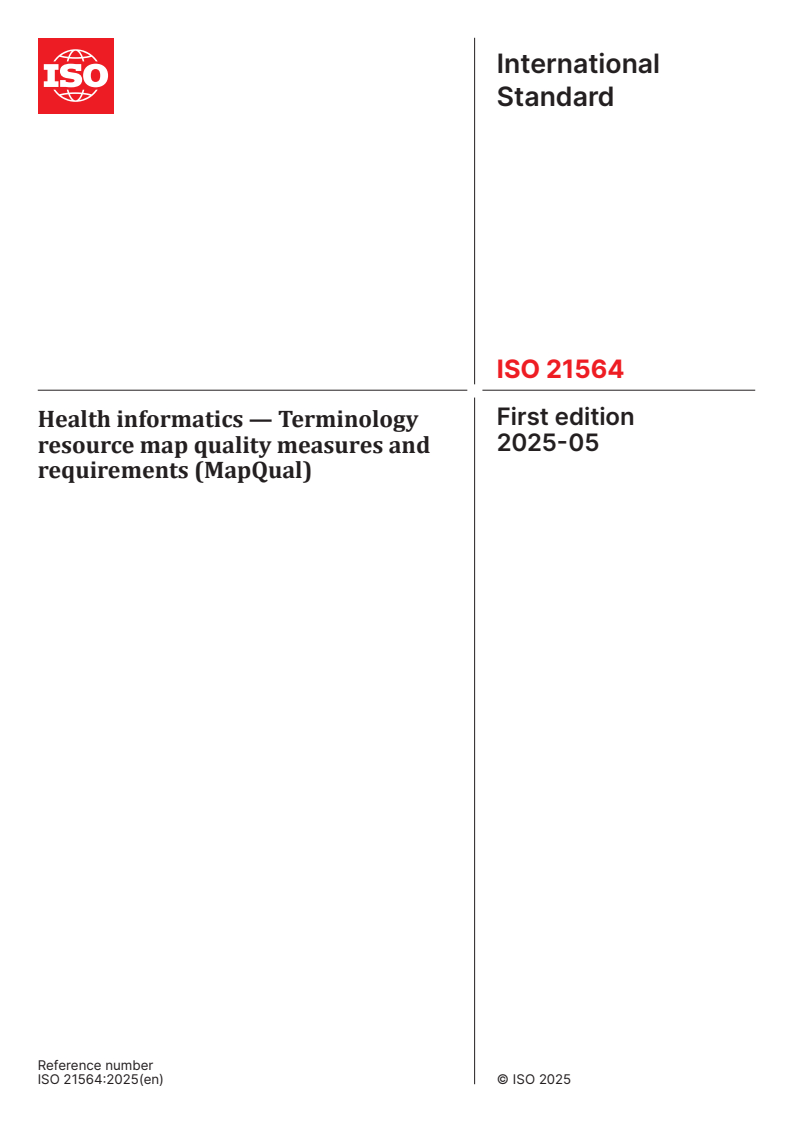
International
Standard
ISO 21564
First edition
Health informatics — Terminology
2025-05
resource map quality measures and
requirements (MapQual)
Reference number
© ISO 2025
All rights reserved. Unless otherwise specified, or required in the context of its implementation, no part of this publication may
be reproduced or utilized otherwise in any form or by any means, electronic or mechanical, including photocopying, or posting on
the internet or an intranet, without prior written permission. Permission can be requested from either ISO at the address below
or ISO’s member body in the country of the requester.
ISO copyright office
CP 401 • Ch. de Blandonnet 8
CH-1214 Vernier, Geneva
Phone: +41 22 749 01 11
Email: copyright@iso.org
Website: www.iso.org
Published in Switzerland
ii
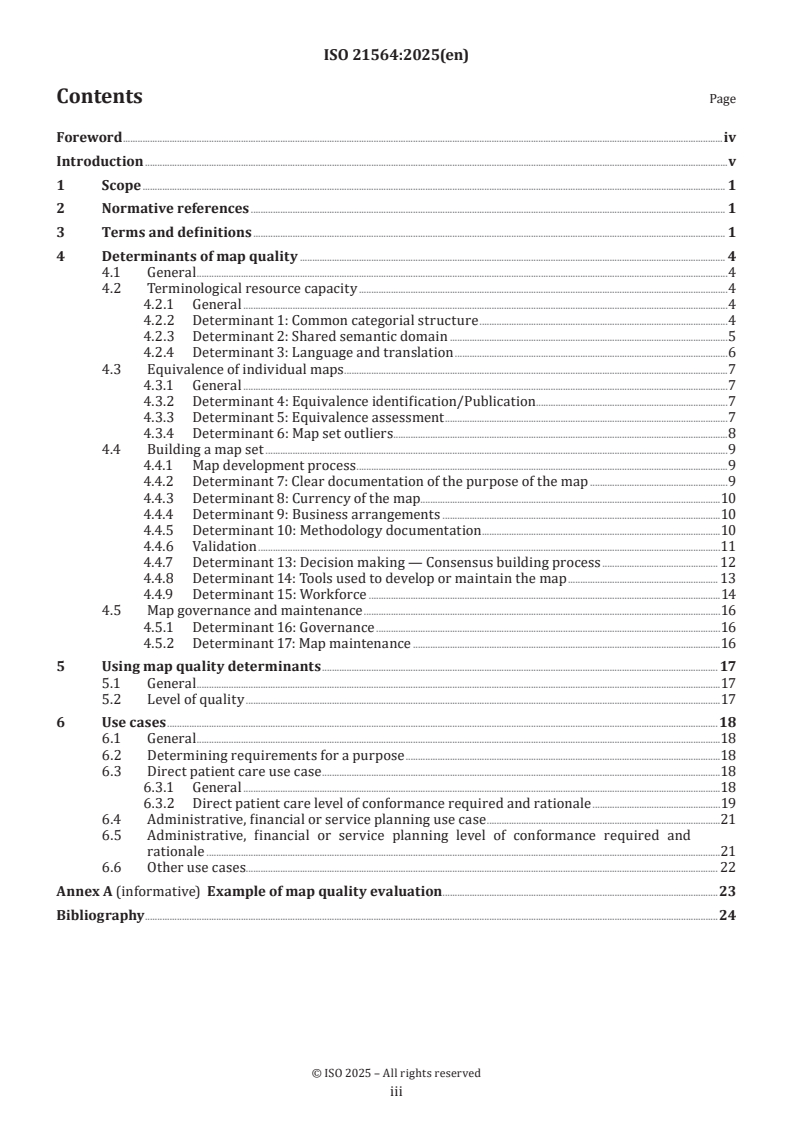
Contents Page
Foreword .iv
Introduction .v
1 Scope . 1
2 Normative references . 1
3 Terms and definitions . 1
4 Determinants of map quality . 4
4.1 General .4
4.2 Terminological resource capacity .4
4.2.1 General .4
4.2.2 Determinant 1: Common categorial structure .4
4.2.3 Determinant 2: Shared semantic domain .5
4.2.4 Determinant 3: Language and translation .6
4.3 Equivalence of individual maps .7
4.3.1 General .7
4.3.2 Determinant 4: Equivalence identification/Publication .7
4.3.3 Determinant 5: Equivalence assessment .7
4.3.4 Determinant 6: Map set outliers .8
4.4 Building a map set .9
4.4.1 Map development process .9
4.4.2 Determinant 7: Clear documentation of the purpose of the map .9
4.4.3 Determinant 8: Currency of the map.10
4.4.4 Determinant 9: Business arrangements .10
4.4.5 Determinant 10: Methodology documentation .10
4.4.6 Validation .11
4.4.7 Determinant 13: Decision making — Consensus building process . 12
4.4.8 Determinant 14: Tools used to develop or maintain the map . 13
4.4.9 Determinant 15: Workforce .14
4.5 Map governance and maintenance .16
4.5.1 Determinant 16: Governance .16
4.5.2 Determinant 17: Map maintenance .16
5 Using map quality determinants . 17
5.1 General .17
5.2 Level of quality .17
6 Use cases .18
6.1 General .18
6.2 Determining requirements for a purpose .18
6.3 Direct patient care use case .18
6.3.1 General .18
6.3.2 Direct patient care level of conformance required and rationale .19
6.4 Administrative, financial or service planning use case .21
6.5 Administrative, financial or service planning level of conformance required and
rationale .21
6.6 Other use cases. 22
Annex A (informative) Example of map quality evaluation .23
Bibliography .24
iii
Foreword
ISO (the International Organization for Standardization) is a worldwide federation of national standards
bodies (ISO member bodies). The work of preparing International Standards is normally carried out through
ISO technical committees. Each member body interested in a subject for which a technical committee
has been established has the right to be represented on that committee. International organizations,
governmental and non-governmental, in liaison with ISO, also take part in the work. ISO collaborates closely
with the International Electrotechnical Commission (IEC) on all matters of electrotechnical standardization.
The procedures used to develop this document and those intended for its further maintenance are described
in the ISO/IEC Directives, Part 1. In particular, the different approval criteria needed for the different types
of ISO documents should be noted. This document was drafted in accordance with the editorial rules of the
ISO/IEC Directives, Part 2 (see www.iso.org/directives).
ISO draws attention to the possibility that the implementation of this document may involve the use of (a)
patent(s). ISO takes no position concerning the evidence, validity or applicability of any claimed patent
rights in respect thereof. As of the date of publication of this document, ISO had not received notice of (a)
patent(s) which may be required to implement this document. However, implementers are cautioned that
this may not represent the latest information, which may be obtained from the patent database available at
www.iso.org/patents. ISO shall not be held responsible for identifying any or all such patent rights.
Any trade name used in this document is information given for the convenience of users and does not
constitute an endorsement.
For an explanation of the voluntary nature of standards, the meaning of ISO specific terms and expressions
related to conformity assessment, as well as information about ISO’s adherence to the World Trade
Organization (WTO) principles in the Technical Barriers to Trade (TBT), see www.iso.org/iso/foreword.html.
This document was prepared by Technical Committee ISO/TC 215, Health informatics.
This first edition of ISO 21564 cancels and replaces ISO/TS 21564:2019, which has been technically revised.
The main changes are as follows:
— revision of verbal forms and update of the title to reflect the inclusion of requirements.
Any feedback or questions on this document should be directed to the user’s national standards body. A
complete listing of these bodies can be found at www.iso.org/members.html.
iv
Introduction
0.1 General
Healthcare organizations and software vendors are increasingly using maps to convert data from one code
system to another. In the past, data in health information systems were largely used for organizations’
administrative planning and decision making. Data captured in electronic health record (EHR) systems for
patient care have a significant impact on patient safety. The use of these data as source of data for other
purposes and for information exchange in clinical care through the use of information technology is an
emerging problem. Where those data are translated through maps from one code system to another, the
safety and quality issues associated with data use can be significant. The increasing use of maps is costly.
The objective of this work is to provide a method to quantify the quality and requirements for map sets to:
a) establish standard quality conformance requirements for a map for a purpose;
b) assess the quality of a map for a purpose;
c) guide decision makers in map project requirements and processes;
d) establish pathways to improvement.
Maps are widely used but the quality of these maps cannot be accurately and consistently assessed and
compared against their intended use. It is not currently possible for decision makers to assess whether a
map will be worth the cost of building and whether the scope and map processes will deliver a map which is
able to meet the intended business case.
This document is based on ISO/TR 12300. Some terminological resources are so different in their content
and purpose that it is not possible to produce a useful map. Therefore, it is possible that the decision maker
needs to consider whether to map at all or to move to a new terminological resource.
Quality measures consider a wide range of requirements and processes relevant to the creation and
maintenance of data maps and their use (including manual and tool-based mapping), as well as for the map
sets delivered as a result of using that process.
0.2 Stakeholders and audience
This document is focused on the needs of:
a) implementers and software vendors developing and implementing maps sets;
b) health information and data managers developing and using maps sets;
c) data users such as researchers, government, decision makers;
d) developers of map sets in mapping teams, including terminologists, coders, clinical users, epidemiologists
and statisticians, project managers.
Additionally, the target audience for this document can include
— procurement officers who establish requirements of map product capacity and quality, or
— decision makers to determine and assess resources needed in projects and services associated with map
creation, maintenance, or use.
0.3 Challenges of mapping
Today, maps are being used for a much broader range of use cases and the challenges of their use include the
following.
a) Map purpose — it is possible that a map built for one purpose does not suit use for other purposes.
It is important to establish the purpose and use of a map at the beginning of a project to ensure the
v
best result when building a map from a source code to a target code. When the purpose changes, the
resultant map content is likely to need to be different.
b) Map accuracy — there are three broad aspects to accuracy. The first is map development and
maintenance. The second is how closely the results of applying the map deliver an outcome consistent
in meaning to that of original source data. The third is the ability to use the outcome of the map for the
purpose intended.
c) Map effectiveness — Information retrieval is a critical functionality of maps.
The actual consequence of assigned map links imposed between terms of different code schemes impacts
the effectiveness of information retrieval searches. Map purpose and accuracy can impact both the potential
safety and appropriateness of the use of that map in healthcare. If the original meaning is changed through
use of a map, this can impact clinical safety. There is also the consideration of whether the map is applied
consistently to defined data elements in the health record. The data element in which the original source
data is recorded can add meaning to the code allocated (e.g. family history of condition versus clinical
diagnosis of the individual).
Another significant issue is the cost of creation and maintenance of a map and the ongoing risk and
difficulties of maintaining currency of the map.
vi
International Standard ISO 21564:2025(en)
Health informatics — Terminology resource map quality
measures and requirements (MapQual)
1 Scope
This document provides quality requirements for producing a quality map between terminological systems.
This document establishes measures which can be used to assess the quality and utility of a map between
terminological resources. These measures can be used to determine the types and conformance levels of a
map and their impact on common use cases in healthcare.
2 Normative references
There are no normative references in this document.
3 Terms and definitions
For the purposes of this document, the following terms and definitions apply.
ISO and IEC maintain terminology databases for use in standardization at the following addresses:
— ISO Online browsing platform: available at https:// www .iso .org/ obp
— IEC Electropedia: available at https:// www .electropedia .org/
3.1
auto-matching
computational mapping (3.17) task, undertaken using an algorithm based upon the relationship between
concepts (3.5)
[SOURCE: ISO/TR 12300:2014, 2.1.1, modified — The Note to entry was removed.]
3.2
categorial structure
reduced system of concepts (3.5) to describe the organization of the semantic categories in a particular
system of concepts
Note 1 to entry: A categorial structure for body structure representation can include the categories for body system
(e.g. skin, digestive) and anatomical location (upper body, abdomen).
3.3
classification
exhaustive set of mutually exclusive categories to aggregate data at a pre-prescribed level of specialization
for a specific purpose
[SOURCE: ISO/TS 17117-2:2022, 3.3]
3.4
code system
organized, managed collection of codes each of which has associated designations, meanings and in some
cases relationships, properties or rules
Note 1 to entry: Code systems are often described as collections of uniquely identifiable concepts (3.5) such as ICD-
10, SNOMED CT and LOINC. Code systems are often established and maintained by authoritative sources such as
standards development organisations.
[SOURCE: ISO/TS 17117-2:2022, 3.2, modified —Note 1 to entry was added.]
3.5
concept
unit of knowledge created by a unique combination of characteristics
Note 1 to entry: Concepts are not necessarily bound to particular languages. They are, however, influenced by the
social or cultural background, often leading to different categorizations.
[SOURCE: ISO/TR 12300:2014, 2.2.6, modified — The original Notes 1 and 2 to entry were removed.]
3.6
context
related conditions and situations that provide a useful understanding and meaning of a subject
[SOURCE: ISO/TR 12300:2014, 2.2.7]
3.7
currency of the map
map currency
difference between the date of release of the target and source terminological resources (3.20) and the map
set (3.16)
3.8
determinant
influencing element or factor
3.9
equivalence
condition of being equal or the same in value, worth or function
Note 1 to entry: In terminological systems, two concepts (3.5) are (semantically) equivalent if their domain of meaning
overlaps and their semantic definitions are interpreted as identical. In the context of terminological resources (3.20),
‘equivalence’ and ‘semantic equivalence’ are often considered as synonyms.
3.10
individual map
index from one term (3.19) to another, sometimes using rules that allow translation from one representation
to another indicating degree of equivalence (3.9)
Note 1 to entry: An individual map is an entry in a map (3.12) which indicates how to translate from an individual
source concept (3.5) to a target concept. The term ‘map’ is often used to indicate a table of individual map entries.
It is for this reason that the individual and map tables are being differentiated. A map is often computable. A map is
the outcome of the mapping (3.17) process. This term is often used in ways which are confusing. It shall always be
made clear whether one is referring to an individual map, or a map table (or set). In SNOMED CT, each individual map
is represented as a row or group of rows in a map reference set. It links a single map source (3.15) concept code (e.g.
SNOMED CT Concept ID) to one or more codes in a map target (e.g. ICD Code).
3.11
priority map content
individual maps (3.10) in a map set (3.16) which are most important for a use case
Note 1 to entry: Importance can reflect the frequency of use or impact of the specific concepts (3.5) being mapped.
For example, a propriety map content set can be established to represent the most common diagnoses in hospitals for
morbidity reporting and this can be the priority map content for a map from SNOMED CT to ICD-based classification.
3.12
map
transformation
cross-map
device which provides an index from one term (3.19) to another, sometimes using rules that allow translation
from one representation to another indicating degree of equivalence (3.9)
Note 1 to entry: The index is used for the conversion of concepts in one code system (3.4) or representation into
concepts in an alternative code system or representation.
[SOURCE: ISO/TS 17117-2:2022, 3.5, modified — Admitted terms were added; Note 1 to entry was added.]
3.13
map quality determinant
attribute of a map (3.12), map development process or map metadata that is considered a reliable measure
of the suitability of the map to a use case
3.14
map quality measure
quantitative measure of the characteristics and attributes of a map (3.12)
3.15
map source
source mapping
terminology (3.21), coding scheme or classification (3.3) used as the starting point for map production
3.16
map set
map table
group of individual maps (3.10) used to convert a range of entries from source to target code system (3.4)
3.17
mapping
process of defining, building or using a relationship between concepts (3.5) in one coding system to concepts
in another coding system in accordance with a documented rationale, for a given purpose
Note 1 to entry: Quality mapping produces a usable map table. The production of such a map table is a reproducible
and understandable process. It is the relation with the best semantic correspondence between an element in one set
and an element in another set.
[SOURCE: ISO/TR 12300:2014, 2.1.12, modified — In the definition, “building or using” was added; the Note
to entry was modified by adding the second and third sentences.]
3.18
semantic domain
semantic space
area of meaning covered by a terminological resource (3.20)
Note 1 to entry: This is used to evaluate the lexical or formal overlap between such resources. In value set specification
this can also be called a value set domain.
Note 2 to entry: Terminology resources can include value sets, code systems (3.4), and subsets.
EXAMPLE One code system can have the domain of anatomy while another can have the domain of disease.
Though these are related concepts, the semantic domain of each code system is different.
3.19
term
linguistic representation of a concept (3.5)
Note 1 to entry: A term can contain symbols and have variants, e.g. different forms of spelling. Terms are members of a
terminology (3.21), a defined or limited vocabulary of terms or concepts, for example ICD, SNOMED CT, LOINC.
[SOURCE: ISO/TR 12300:2014, 2.2.8, modified — The Note to entry was modified by adding the second
sentence.]
3.20
terminological resource
controlled set of terms (3.19) in healthcare
Note 1 to entry: Usually designed and controlled for use with computers for specific healthcare purpose, such as data
entry, aggregation, retrieval and analysis.
[SOURCE: ISO/TR 12300:2014, 2.2.11]
3.21
terminology
structured, human readable and machine-readable representation of concepts (3.5)
Note 1 to entry: This includes the relationship of the terminology to the specifications for organizing, communicating
and interpreting such a set of concepts. The use of the term terminology in healthcare implies a terminology that is
designed for use in computer systems. The words ‘vocabulary’, ‘health’ or ‘medical language’ are used to indicate the
broader idea of linguistic representation without the specification of computability.
[SOURCE: ISO/TR 12300:2014, 2.2.9, modified — The Note to entry was modified by adding the second and
third sentences.]
4 Determinants of map quality
4.1 General
This document defines a set of quality determinants which cover the development and maintenance of map
content, and the precision of the map between source and target content. The precision represents accuracy
but also maintainability and usability.
Each determinant shall be measured separately in order to allow evaluation of purpose for use case and,
in that sense, stand alone. The specific measures are listed for each determinant. The lower the number
allocated to the measure, the higher the quality of the map. These measures are used to assess the quality of
a map. The required level of conformance for each determinant differs according to the use case for which
the map is intended. Clause 5 covers map quality measurement and requirement specification for specific
use cases, explaining how to apply the determinant measures of map quality.
4.2 Terminological resource capacity
4.2.1 General
To assess the quality of a map, the capacity and intent of the source code system and the target code system,
as well as how each of these code systems represent concepts, shall be understood.
4.2.2 Determinant 1: Common categorial structure
Evaluate whether the target and the source terminological resource share the same categorial structure.
This determinant seeks to specify whether the structure of each system is common.
EXAMPLE
If one terminological resource has a structure which includes
— clinical findings,
— substances, and
— events
and the other has a structure of
— body systems,
the terminological resources do not share a common categorial structure.
The degree of commonality affects the ability to produce a meaningful map. If there is no categorial
structure, or such a structure is not applied to the terminological resources, the ability to map between
terminological resources is less likely to deliver a high-quality product. The impact upon quality can differ
depending on the intended use case.
Categorial structure represents the structure within a semantic domain. Maps may be developed across an
entire categorial structure or a part of that structure, depending upon the semantic domain intended for use
in the map.
Measure:
0 — source and target terminological resources share the same categorial structure.
4 — source and target do not share the same categorial structure.
4.2.3 Determinant 2: Shared semantic domain
The ability to map one terminological resource to another assumes that each terminological resource shares
a common scope of meaning, e.g. that a code system for apples applies to apples and a second code system
for fruit also includes apples. If the code systems do not share some concepts, it is not possible to produce a
meaningful map between them. A high-quality map shall have assessed whether the semantic domains are
the same, overlapping, inclusive or without overlap. To evaluate the likely utility of a map, the amount of
overlap shall be considered.
The same semantic domain is where both terminological resources describe the same content, though they
may describe it in different ways, with different categorial structures.
EXAMPLE
a) The categorial structure is different to or does not include the thing being described by the code (such as the
concept of an apple – the apple itself).
b) The semantic domain is different ‒ one is describing the thing and its uses while the second describes the suitable
uses ‒ and the intended meanings differ. This provides an overlap of semantic domain which can impact the
quality of the map or the usability of the map.
Terminological resource 1 describes apples as eating or cooking apples, this can include additional attributes such as
apple colour, origin, cultivar, etc.
Terminological resource 2 describes apples by colour and suitable uses.
Each terminological resource describes apples, though the categorial structures are different. In the
example of apples, each concept has the attributes of colour and use, which are areas of overlap between
these terminological resources, but they do not share other key attributes such as origin or cultivar.
Where the attributes are represented differently in each code system but share a semantic domain, it can
be possible to map these concepts. Table 1 shows a shared semantic domain which would result in a quality
map. Table 2 indicates measurement of the semantic shared domain.
Table 1 — Example of shared semantic domain
System A System B Meaning
1 M Male
2 F Female
3 I Indeterminate
9 U Unknown or not provided
Table 2 — Measures of semantic domain
Measure Description Example
0 — Exact match on semantic The source terminological resource includes the
domain same semantic domain as the target terminological
resource.
1 — Fully inclusive overlap of The source terminological resource covers all of the A classification of fruit
semantic domain target terminological resource and also other includes apples.
concepts (or vice versa). A classification of apples is
completely included in the
classification of fruit.
2 — Non-inclusive overlap of The source terminological resource covers some of A classification of red edible
semantic domain the target terminological resource, and either code items does include some
system may have additional content beyond the scope apples, but not green apples;
of the other. it also includes items which
are not fruit, such as red
onions.
3 — No overlap Where the concepts described by one terminological
resource are not covered by the second
terminological resource, a map can be difficult.
It can be possible to map concepts at a very high level
of abstraction or by establishing some guidance and
rules to be applied when making mapping decisions,
but the outcome will not retain the meaning of the
source when represented in the target.
Where there is an overlap, it shall be assessed how much the areas which do not overlap will be relevant to
the map required. If the map only requires the mapping of red apples, the lack of complete overlap between
the two different terminological resources would not impact the quality of the result.
In each of these cases, it shall be determined the impact of this compatibility or lack of compatibility on the
outcome of the map for the purpose it is being developed or used for.
4.2.4 Determinant 3: Language and translation
A source terminological resource can be available in a specific language (such as English). The target
terminological resource can also be available in that language (English). If one terminological resource is
available in the language required and the other is not, a translation of language shall be undertaken. It
is appropriate to consider the cost of that translation and its maintenance and the potential impact upon
accurate representation of meaning.
If translations have been published by the terminology resource owner, they are more likely to be accurate
than those developed in smaller projects. The governance of the translations process can be relevant to the
assessment of the language quality requirement for the use case. Details of translations and guidance on
their use can be found in ISO 17100.
It is difficult to judge the semantic equivalence in linguistic translation. Use the measures for semantic
equivalence that are used in 4.3.
Different standards environments use the term translation and in some, such as HL7 FHIR, it means to map.
A common use case for translation is where a value set is published in English and is translated and mapped
for use in another language. Similarly, if a terminological resource source is in French and there is a desire
to use that code system in English, the terminological resource source shall first be translated into English.
This way, the map is between concepts in the same language.
The translation process firstly requires the translation of the target or source, or both, into the required
language, thereby producing a version of the concepts to be mapped in the required language. The map
should be created only after this has been done and verified.
Measure:
0 — no translation required, source, target and map are all in the same language.
1 — translation is required from target to source.
4.3 Equivalence of individual maps
4.3.1 General
A map between two different terminological resources involves a certain amount of compromise.
Identification of equivalence criteria is therefore crucial to establishing a level of acceptability and safety for
use of that map.
4.3.2 Determinant 4: Equivalence identification/Publication
This determinant indicates whether equivalence assessments are published in the map and available to all
users. Each individual map [i.e. each source concept to target concept(s)] shall have equivalence identified
and published. This information is then available when the map is used to provide assistance in determining
the validity of specific individual mapped values. If the meaning is not retained, the equivalence can be used
to assess the level of difference between the original source and the resultant representation after applying
[27]
the map. If equivalence is not published with the map set, then it is not possible to assess the quality of
the map for a specific purpose nor to alert the user of the map where the meaning of a concept might have
changed when converted to the target concept representation.
Measure:
0 — equivalence measure is identified and published in the map. This measure may be a more complex,
ontologically based measure than the one identified in 4.3.3.
1 — equivalence measure is available but is not in the published map.
2 — equivalence measures are available but are less specific than those identified in 4.3.3.
4 — no equivalence measures are provided or available.
4.3.3 Determinant 5: Equivalence assessment
There are two types of equivalence assessment. For a given use case one of two equivalence methods should
be selected to assess the quality and utility of the map for a specific purpose.
Either use
a) the median equivalence for the map set, or
b) the median equivalence for priority map content.
Equivalence measures are based on ISO/TR 12300 and are represented in a numeric measure (rather than a
[27]
code). This measure can then be arithmetically calculated.
Measure:
0 — equivalent meaning, where the highest quality equivalence is represented by the lowest number, 0 is
the ‘best score’.
1 — source is wholly included in target.
2 — source is partially included in target.
3 — source is mapped, however there were many options of possible target and overlaps. The map produced
is a best comparison rather than an actual correspondence. Such a map requires significant manual input to
create and maintain, and it should be used with care.
4 — no map possible (it is considered that no map is a safer and cheaper option than option 4). For instance,
if it is determined that a map set being established produces many individual maps with equivalence of no
map possible, the creation of the map set should be reconsidered. The resultant map set is not likely to be
safe for clinical use and it would involve fewer resources and expenses not to attempt a map at all than to
produce one of this type.
Map set equivalence represents the average equivalence [sum equivalence measure for each individual map
(row) (from the full or priority set) divided by the number of individual maps]. Table 3 shows an example of
how the overall equivalence of a map set is represented.
Table 3 — Example of equivalence measures average calculation
Individual map row Equivalence
A 0
B 0
C 1
D 1
E 2
The use of an average is not likely to provide a meaningful evaluation of this determinant, however median
or mode can provide a context which can be useful in specific use cases.
Where a map is created for a large number of concepts, a subset of the whole map can be considered of
priority if it is used extensively for the most common conditions. In some situations, it is more relevant to
assess the average equivalence for the priority criteria(s) of the map, such as those individual map entries
for concepts which are used extensively. This approach may be taken rather than to consider the median
equivalence of the whole map, as this impacts the majority of cases.
EXAMPLE Diagnosis map from SNOMED CT to ICD (variant).
This map is considered safe for use to support clinical coding, reporting and financial claims and the most common
conditions are those which will most impact the results obtained. The map users and developers can agree that a
number of common conditions (e.g. 10 000 of a potential 30 000) need to be accurate and represent high equivalence,
while the additional conditions are less important and would not significantly impact the utility of the map for the use
case defined.
4.3.4 Determinant 6: Map set outliers
This determinant is used to indicate how much of the map set evaluated for equivalence is within a pre-
determined acceptable range of equivalence. This way, it is possible to assess whether the majority of the
map has the level of equivalence required and only a small number of outliers are outside this limit, or
whether there are many outliers outside that limit.
The percentage applies to whichever (full or priority) map set group the equivalence has been calculated.
The way to calculate an outlier value for Table 3, is to identify the measure level at which the entry is
considered an outlier (in this case 2 or over).
EXAMPLE 1 Of the 5 entries in Table 3, one has an equivalence of that level. The map shown in Table 3 has an outlier
value of 20 % (1/5).
The acceptability of outliers or higher levels of inequality is dependent upon the use case.
EXAMPLE 2 For data used for service planning, 5 % of individual map entries which have equivalence of 2 or higher
(i.e. equivalence which is not an exact match or aggregated match) is acceptable for the use case.
Measure:
0 — no outliers.
1 — < x percentage to be determined according to the use case.
2 — ≥ x and < y.
3 — ≥ y and < z.
4 — z or greater.
4.4 Building a map set
4.4.1 Map development process
The quality and utility of a map is affected by the processes used to build and maintain the map. These
quality determinants impact quality according to the intended use of the map. Where a map is used for
one-time conversion of data from a legacy system to a new system, the documentation of the map process
and decisions may have a different focus and impact as there is a low requirement to be able to replicate the
building process to maintain the map. The one-time map documentation is still of value to ensure consistent
methodology throughout the map development.
4.4.2 Determinant 7: Clear documentation of the purpose of the map
A map is developed for a purpose which can be associated with a clinical information model as well as the
terminological resource used. The clear specification of the use case is essential to determine how to map
from source to target, and also to know how and where the application of such a map is appropriate.
The criteria which should be included in assessing the requirements for this use case and map conformance
include the following:
a) use case has a single purpose which is precisely described;
b) reason for using the map and its intended use;
c) benefits expected from using the mapped data;
d) stakeholders including implementers (such as vendors) and users of the mapped content.
Each of these criteria can impact the utility and quality of the map for a use case. The evaluation of the map
shall consider the importance of each criterion based on the business case of the map.
Measure:
0 — the documentation includes all the 4 specified criteria.
1 — the documentation includes only 3 of the specified criteria.
2 — the documentation includes only 2 of the specified criteria.
3 — the documentation includes only 1 of the specified criteria.
4 — the document does not include any of the specified criteria.
4.4.3 Determinant 8: Currency of the map
Evaluation should include consideration of the importance and impact of the currency of the map. If the
map represents existing target and source terminological resources consistent with those used in the
current source and target information systems, the accuracy of the map application should be as high as
possible given the equivalence measures of the map. If any of the existing and current target and source
terminological resources are not both using the current versions, then there can be difficulties in achieving
the equivalence required.
Measure:
0 — map reflects current source and target systems used in systems where the map will be applied.
1 to 3 — map reflects current source and target systems within a defined time frame of the release of
those systems (assessor determines the impact of this difference and assign value to weight this risk
appropriately).
4 — map does not reflect current source and target systems.
4.4.4 Determinant 9: Business arrangements
The business arrangement under which a map is developed can impact its quality or maintenance. If the map
is developed by the owner(s) of the terminological resources with open harmonisation efforts, the likely
quality can be higher than that done by a single commercial arrangement.
It shall be assessed whether this determinant can impact the quality of the map for the specific use case
involved.
No measure is provided here. It is up to the user of the map to determine their requirement in this area with
the lower number indicating the lower the potential risk.
The owner of the source or target code system may develop and maintain the map. In this case this
determinant shall have a weight of 0 to reflect that this is the only acceptable map quality for this
determinant.
4.4.5 Determinant 10: Methodology documentation
The methodology for development of the map shall be specified clearly and documented. There are many
methods which can be applied, and each should be described to a level where that method can be reliably
repeated to maintain the map. This determinant reflects the quality of methodology specification, not the
actual methodology which is assessed by other determinants. Documentation should clearly indicate the
versioning and update processes to be used to maintain the map. This documentation is important if the
map is to apply to historical data or to data which changes into the future, but if the map is applied once to
convert data to the source terminological system and the ‘old’ data is no longer maintained, this does not
impa
...
Questions, Comments and Discussion
Ask us and Technical Secretary will try to provide an answer. You can facilitate discussion about the standard in here.
Loading comments...