


ISO/FDIS 19932-3
(Main)Equipment for crop protection — Knapsack sprayers — Part 3: Inspection of knapsack sprayers in use
Equipment for crop protection — Knapsack sprayers — Part 3: Inspection of knapsack sprayers in use
Matériel de protection des cultures — Pulvérisateurs à dos — Partie 3: Contrôle des pulvérisateurs portables à dos en service
General Information
- Status
- Withdrawn
- Technical Committee
- ISO/TC 23/SC 6 - Equipment for crop protection
- Drafting Committee
- ISO/TC 23/SC 6/WG 5 - Portable sprayers
- Current Stage
- 5098 - Project deleted
- Start Date
- 31-Aug-2020
- Completion Date
- 14-Feb-2026
Relations
- Effective Date
- 12-Feb-2026
- Effective Date
- 06-Jun-2022
Buy Documents
ISO/FDIS 19932-3 - Equipment for crop protection — Knapsack sprayers — Part 3: Inspection of knapsack sprayers in use/30/2017
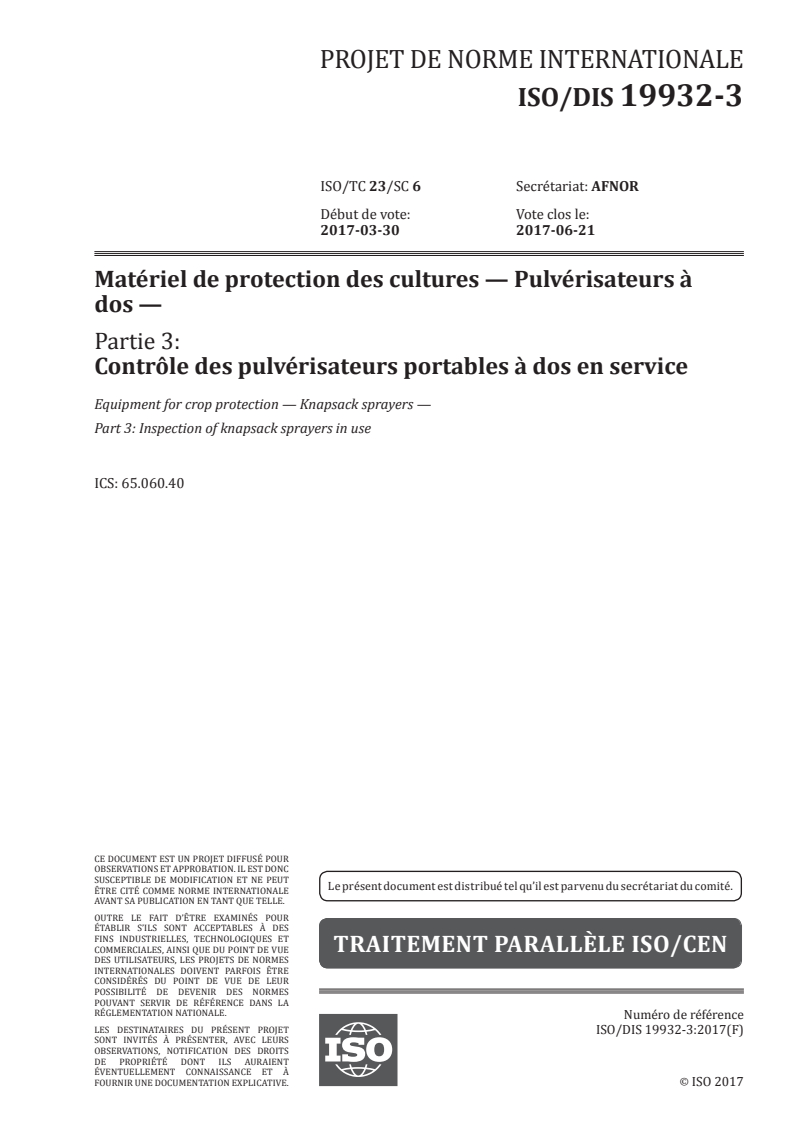
ISO/FDIS 19932-3 - Matériel de protection des cultures — Pulvérisateurs à dos — Partie 3: Contrôle des pulvérisateurs portables à dos en service/13/2017
Get Certified
Connect with accredited certification bodies for this standard

Control Union Certifications
Global certification for agriculture and sustainability.

ECOCERT
Organic and sustainability certification.

Rainforest Alliance Certification
Sustainable agriculture and forestry certification.
Sponsored listings
Frequently Asked Questions
ISO/FDIS 19932-3 is a draft published by the International Organization for Standardization (ISO). Its full title is "Equipment for crop protection — Knapsack sprayers — Part 3: Inspection of knapsack sprayers in use". This standard covers: Equipment for crop protection — Knapsack sprayers — Part 3: Inspection of knapsack sprayers in use
Equipment for crop protection — Knapsack sprayers — Part 3: Inspection of knapsack sprayers in use
ISO/FDIS 19932-3 is classified under the following ICS (International Classification for Standards) categories: 65.060.40 - Plant care equipment. The ICS classification helps identify the subject area and facilitates finding related standards.
ISO/FDIS 19932-3 has the following relationships with other standards: It is inter standard links to FprEN ISO 19932-3, ISO/IEC FDIS 29174-2. Understanding these relationships helps ensure you are using the most current and applicable version of the standard.
ISO/FDIS 19932-3 is available in PDF format for immediate download after purchase. The document can be added to your cart and obtained through the secure checkout process. Digital delivery ensures instant access to the complete standard document.
Standards Content (Sample)
DRAFT INTERNATIONAL STANDARD
ISO/DIS 19932-3
ISO/TC 23/SC 6 Secretariat: AFNOR
Voting begins on: Voting terminates on:
2017-03-30 2017-06-21
Equipment for crop protection — Knapsack sprayers —
Part 3:
Inspection of knapsack sprayers in use
Matériel de protection des cultures — Pulvérisateurs à dos —
Partie 3: Contrôle des pulvérisateurs portables à dos en service
ICS: 65.060.40
THIS DOCUMENT IS A DRAFT CIRCULATED
This document is circulated as received from the committee secretariat.
FOR COMMENT AND APPROVAL. IT IS
THEREFORE SUBJECT TO CHANGE AND MAY
NOT BE REFERRED TO AS AN INTERNATIONAL
STANDARD UNTIL PUBLISHED AS SUCH.
IN ADDITION TO THEIR EVALUATION AS
ISO/CEN PARALLEL PROCESSING
BEING ACCEPTABLE FOR INDUSTRIAL,
TECHNOLOGICAL, COMMERCIAL AND
USER PURPOSES, DRAFT INTERNATIONAL
STANDARDS MAY ON OCCASION HAVE TO
BE CONSIDERED IN THE LIGHT OF THEIR
POTENTIAL TO BECOME STANDARDS TO
WHICH REFERENCE MAY BE MADE IN
Reference number
NATIONAL REGULATIONS.
ISO/DIS 19932-3:2017(E)
RECIPIENTS OF THIS DRAFT ARE INVITED
TO SUBMIT, WITH THEIR COMMENTS,
NOTIFICATION OF ANY RELEVANT PATENT
RIGHTS OF WHICH THEY ARE AWARE AND TO
©
PROVIDE SUPPORTING DOCUMENTATION. ISO 2017
ISO/DIS 19932-3:2017(E)
© ISO 2017, Published in Switzerland
All rights reserved. Unless otherwise specified, no part of this publication may be reproduced or utilized otherwise in any form
or by any means, electronic or mechanical, including photocopying, or posting on the internet or an intranet, without prior
written permission. Permission can be requested from either ISO at the address below or ISO’s member body in the country of
the requester.
ISO copyright office
Ch. de Blandonnet 8 • CP 401
CH-1214 Vernier, Geneva, Switzerland
Tel. +41 22 749 01 11
Fax +41 22 749 09 47
copyright@iso.org
www.iso.org
ii © ISO 2017 – All rights reserved
ISO/DIS 19932-3:2017(E)
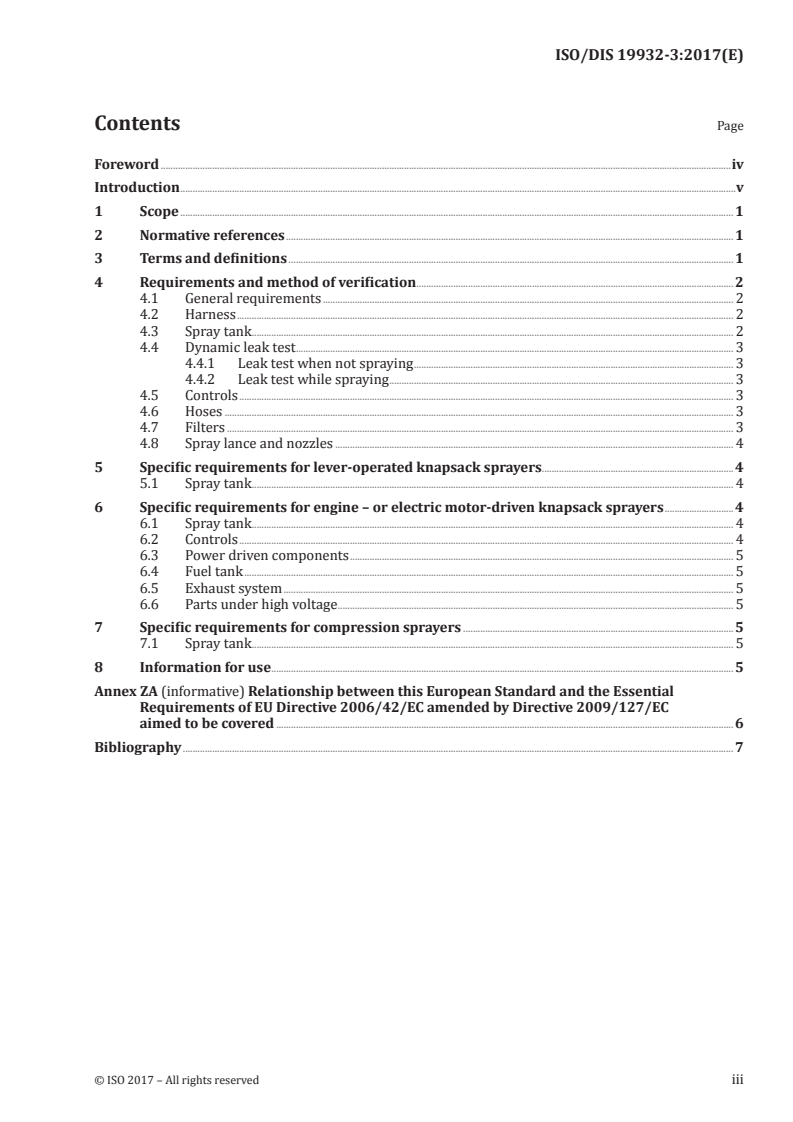
Contents Page
Foreword .iv
Introduction .v
1 Scope . 1
2 Normative references . 1
3 Terms and definitions . 1
4 Requirements and method of verification . 2
4.1 General requirements . 2
4.2 Harness . 2
4.3 Spray tank . 2
4.4 Dynamic leak test . 3
4.4.1 Leak test when not spraying . 3
4.4.2 Leak test while spraying . 3
4.5 Controls . 3
4.6 Hoses . 3
4.7 Filters . 3
4.8 Spray lance and nozzles . 4
5 Specific requirements for lever-operated knapsack sprayers. 4
5.1 Spray tank . 4
6 Specific requirements for engine – or electric motor-driven knapsack sprayers .4
6.1 Spray tank . 4
6.2 Controls . 4
6.3 Power driven components . 5
6.4 Fuel tank . 5
6.5 Exhaust system . 5
6.6 Parts under high voltage . 5
7 Specific requirements for compression sprayers . 5
7.1 Spray tank . 5
8 Information for use . 5
Annex ZA (informative) Relationship between this European Standard and the Essential
Requirements of EU Directive 2006/42/EC amended by Directive 2009/127/EC
aimed to be covered . 6
Bibliography . 7
ISO/DIS 19932-3:2017(E)
Foreword
ISO (the International Organization for Standardization) is a worldwide federation of national standards
bodies (ISO member bodies). The work of preparing International Standards is normally carried out
through ISO technical committees. Each member body interested in a subject for which a technical
committee has been established has the right to be represented on that committee. International
organizations, governmental and non-governmental, in liaison with ISO, also take part in the work.
ISO collaborates closely with the International Electrotechnical Commission (IEC) on all matters of
electrotechnical standardization.
International Standards are drafted in accordance with the rules given in the ISO/IEC Directives, Part 2.
The main task of technical committees is to prepare International Standards. Draft International
Standards adopted by the technical committees are circulated to the member bodies for voting.
Publication as an International Standard requires approval by at least 75 % of the member bodies
casting a vote.
Attention is drawn to the possibility that some of the elements of this document may be the subject of
patent rights. ISO shall not be held responsible for identifying any or all such patent rights.
ISO 19932-3 was prepared by Technical Committee ISO/TC 23, Tractors and machinery for agriculture
and forestry, Subcommittee SC 6, Equipment for crop protection.
iv © ISO 2017 – All rights reserved
ISO/DIS 19932-3:2017(E)
Introduction
There are three main reasons for inspection in use of knapsack sprayers which are the most widely
used means worldwide of applying Plant Protection Products (PPPs):
— less potential risk to the operator;
— less potential risk of environmental contamination by PPPs; and
— good control of pests with the minimum possible input of PPPs.
In order to use PPPs in agricultural production safely, it is necessary to define the requirements
and test methods for knapsack sprayers in use. This is a relevant step after having standardized
minimum requirements for new knapsack sprayers, in respect of safety hazards and potential risks of
environmental contamination (see ISO 19932-1 and −2).
Standardising the requirements and methods for inspection of sprayers in use takes into consideration
not only the original performance of the sprayer, but also its use, care and maintenance. This is the
logical link to ensure the continued benefit arising from the supply of new sprayers of good quality.
The inspection of sprayers in use can be a mandatory requirement or adopted on a voluntary basis. In
both cases further requirements, outside the scope of this standard, are necessary for the management
of inspections. These include, for example, requirements for the competence of persons carrying out
inspections and the frequency of inspections.
NOTE National or regional regulations may also apply concerning the qualifications and competence of
inspectors.
DRAFT INTERNATIONAL STANDARD ISO/DIS 19932-3:2017(E)
Equipment for crop protection — Knapsack sprayers —
Part 3:
Inspection of knapsack sprayers in use
1 Scope
This part of ISO 19932 specifies the requirements and test methods for the inspection in use of Knapsack
sprayers carried on the back or shoulder of the operator for use with Plant Protection Products (PPPs).
It is applicable to lever-operated knapsack sprayers, knapsack compression sprayers and knapsack
sprayers driven by an engine or electric motor using hydraulic pressure atomisation of the spray liquid,
intended for use primarily in agriculture, forestry and horticulture, with a nominal volume of more
than 6.0 l.
The requirements relate mainly to the condition of the sprayer with respect to its potential risk to the
operator and the environment and its performance to achieve good application.
It does not apply to knapsack combustion engine-driven air-
...
PROJET DE NORME INTERNATIONALE
ISO/DIS 19932-3
ISO/TC 23/SC 6 Secrétariat: AFNOR
Début de vote: Vote clos le:
2017-03-30 2017-06-21
Matériel de protection des cultures — Pulvérisateurs à
dos —
Partie 3:
Contrôle des pulvérisateurs portables à dos en service
Equipment for crop protection — Knapsack sprayers —
Part 3: Inspection of knapsack sprayers in use
ICS: 65.060.40
CE DOCUMENT EST UN PROJET DIFFUSÉ POUR
OBSERVATIONS ET APPROBATION. IL EST DONC
SUSCEPTIBLE DE MODIFICATION ET NE PEUT
Le présent document est distribué tel qu’il est parvenu du secrétariat du comité.
ÊTRE CITÉ COMME NORME INTERNATIONALE
AVANT SA PUBLICATION EN TANT QUE TELLE.
OUTRE LE FAIT D’ÊTRE EXAMINÉS POUR
ÉTABLIR S’ILS SONT ACCEPTABLES À DES
FINS INDUSTRIELLES, TECHNOLOGIQUES ET
COMMERCIALES, AINSI QUE DU POINT DE VUE TRAITEMENT PARALLÈLE ISO/CEN
DES UTILISATEURS, LES PROJETS DE NORMES
INTERNATIONALES DOIVENT PARFOIS ÊTRE
CONSIDÉRÉS DU POINT DE VUE DE LEUR
POSSIBILITÉ DE DEVENIR DES NORMES
POUVANT SERVIR DE RÉFÉRENCE DANS LA
RÉGLEMENTATION NATIONALE.
Numéro de référence
LES DESTINATAIRES DU PRÉSENT PROJET
ISO/DIS 19932-3:2017(F)
SONT INVITÉS À PRÉSENTER, AVEC LEURS
OBSERVATIONS, NOTIFICATION DES DROITS
DE PROPRIÉTÉ DONT ILS AURAIENT
ÉVENTUELLEMENT CONNAISSANCE ET À
©
FOURNIR UNE DOCUMENTATION EXPLICATIVE. ISO 2017
ISO/DIS 19932-3:2017(F) ISO/DIS 19932-3
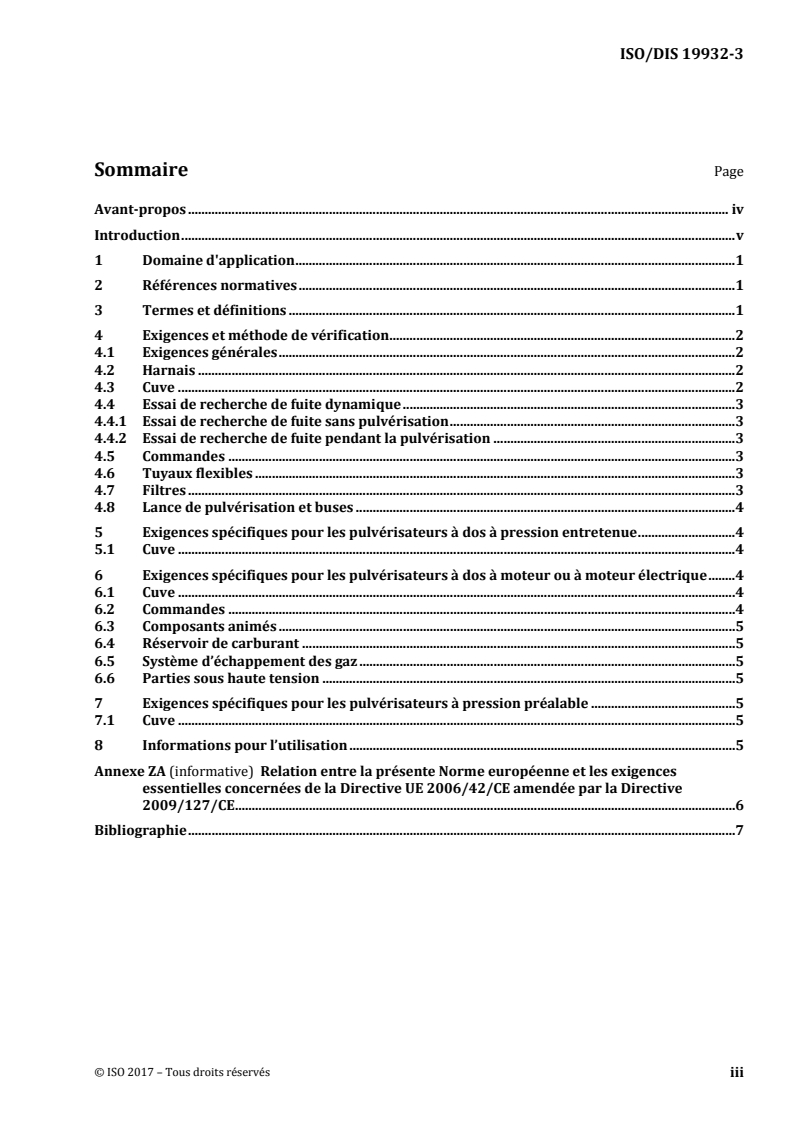
Sommaire Page
Avant-propos . iv
Introduction . v
1 Domaine d'application . 1
2 Références normatives . 1
3 Termes et définitions . 1
4 Exigences et méthode de vérification . 2
4.1 Exigences générales . 2
4.2 Harnais . 2
4.3 Cuve . 2
4.4 Essai de recherche de fuite dynamique . 3
4.4.1 Essai de recherche de fuite sans pulvérisation . 3
4.4.2 Essai de recherche de fuite pendant la pulvérisation . 3
4.5 Commandes . 3
4.6 Tuyaux flexibles . 3
4.7 Filtres . 3
4.8 Lance de pulvérisation et buses . 4
5 Exigences spécifiques pour les pulvérisateurs à dos à pression entretenue . 4
5.1 Cuve . 4
6 Exigences spécifiques pour les pulvérisateurs à dos à moteur ou à moteur électrique . 4
6.1 Cuve . 4
6.2 Commandes . 4
6.3 Composants animés . 5
6.4 Réservoir de carburant . 5
6.5 Système d’échappement des gaz . 5
6.6 Parties sous haute tension . 5
7 Exigences spécifiques pour les pulvérisateurs à pression préalable . 5
7.1 Cuve . 5
8 Informations pour l’utilisation . 5
Annexe ZA (informative) Relation entre la présente Norme européenne et les exigences
essentielles concernées de la Directive UE 2006/42/CE amendée par la Directive
2009/127/CE . 6
Bibliographie . 7
DOCUMENT PROTÉGÉ PAR COPYRIGHT
© ISO 2017, Publié en Suisse
Droits de reproduction réservés. Sauf indication contraire, aucune partie de cette publication ne peut être reproduite ni utilisée
sous quelque forme que ce soit et par aucun procédé, électronique ou mécanique, y compris la photocopie, l’affichage sur
l’internet ou sur un Intranet, sans autorisation écrite préalable. Les demandes d’autorisation peuvent être adressées à l’ISO à
l’adresse ci-après ou au comité membre de l’ISO dans le pays du demandeur.
ISO copyright office
Ch. de Blandonnet 8 • CP 401
CH-1214 Vernier, Geneva, Switzerland
Tel. +41 22 749 01 11
Fax +41 22 749 09 47
copyright@iso.org
www.iso.org
iii
ii © ISO 2017 – Tous droits réservés
ISO/DIS 19932-3
Sommaire Page
Avant-propos . iv
Introduction . v
1 Domaine d'application . 1
2 Références normatives . 1
3 Termes et définitions . 1
4 Exigences et méthode de vérification . 2
4.1 Exigences générales . 2
4.2 Harnais . 2
4.3 Cuve . 2
4.4 Essai de recherche de fuite dynamique . 3
4.4.1 Essai de recherche de fuite sans pulvérisation . 3
4.4.2 Essai de recherche de fuite pendant la pulvérisation . 3
4.5 Commandes . 3
4.6 Tuyaux flexibles . 3
4.7 Filtres . 3
4.8 Lance de pulvérisation et buses . 4
5 Exigences spécifiques pour les pulvérisateurs à dos à pression entretenue . 4
5.1 Cuve . 4
6 Exigences spécifiques pour les pulvérisateurs à dos à moteur ou à moteur électrique . 4
6.1 Cuve . 4
6.2 Commandes . 4
6.3 Composants animés . 5
6.4 Réservoir de carburant . 5
6.5 Système d’échappement des gaz . 5
6.6 Parties sous haute tension . 5
7 Exigences spécifiques pour les pulvérisateurs à pression préalable . 5
7.1 Cuve . 5
8 Informations pour l’utilisation . 5
Annexe ZA (informative) Relation entre la présente Norme européenne et les exigences
essentielles concernées de la Directive UE 2006/42/CE amendée par la Directive
2009/127/CE . 6
Bibliographie . 7
iii
ISO/DIS 19932-3
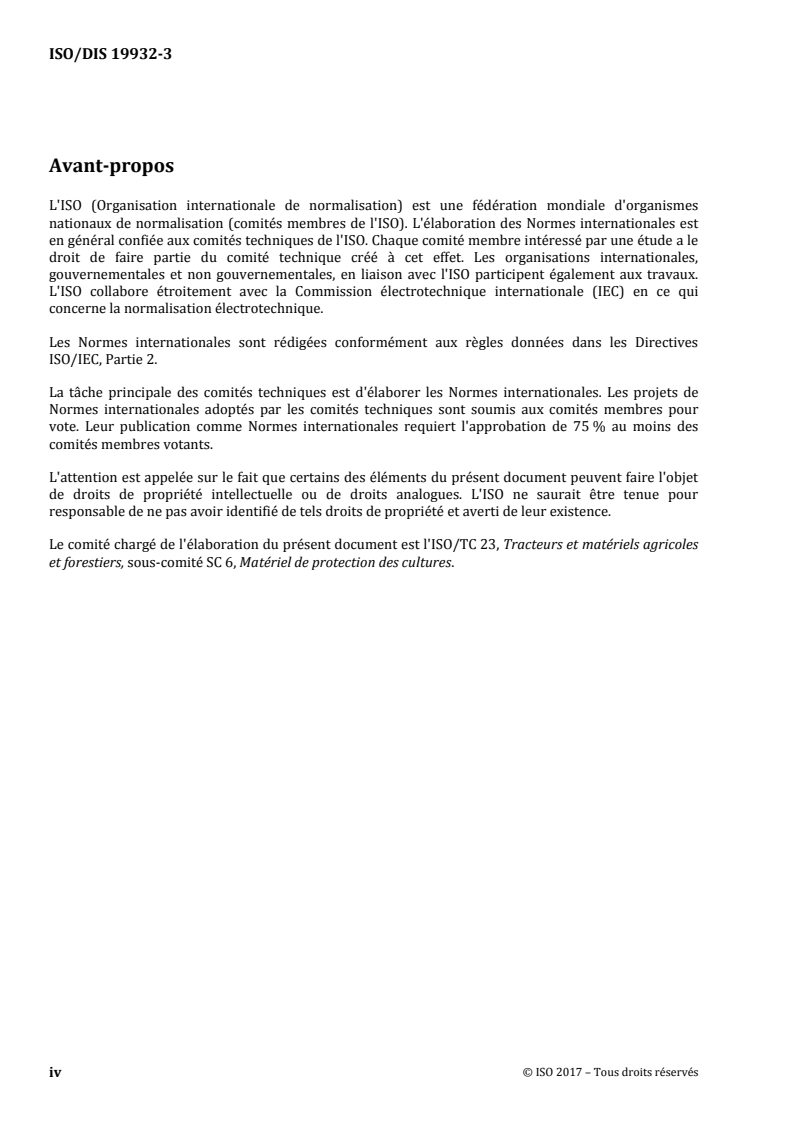
Avant-propos
L'ISO (Organisation internationale de normalisation) est une fédération mondiale d'organismes
nationaux de normalisation (comités membres de l'ISO). L'élaboration des Normes internationales est
en général confiée aux comités techniques de l'ISO. Chaque comité membre intéressé par une étude a le
droit de faire partie du comité technique créé à cet effet. Les organisations internationales,
gouvernementales et non gouvernementales, en liaison avec l'ISO participent également aux travaux.
L'ISO collabore étroitement avec la Commission électrotechnique internationale (IEC) en ce qui
concerne la normalisation électrotechnique.
Les Normes internationales sont rédigées conformément aux règles données dans les Directives
ISO/IEC, Partie 2.
La tâche principale des comités techniques est d'élaborer les Normes internationales. Les projets de
Normes internationales adoptés par les comités techniques sont soumis aux comités membres pour
vote. Leur publication comme Normes internationales requiert l'approbation de 75 % au moins des
comités membres votants.
L'attention est appelée sur le fait que certains des éléments du présent document peuvent faire l'objet
de droits de propriété intellectuelle ou de droits analogues. L'ISO ne saurait être tenue pour
responsable de ne pas avoir identifié de tels droits de propriété et averti de leur existence.
Le comité chargé de l'élaboration du présent document est l'ISO/TC 23, Tracteurs et matériels agricoles
et forestiers, sous-comité SC 6, Matériel de protection des cultures.
iv
ISO/DIS 19932-3 ISO/DIS 19932-3
Avant-propos
Introduction
L'ISO (Organisation internationale de normalisation) est une fédération mondiale d'organismes
Il y a trois raisons principales pour le contrôle de l’utilisation de pulvérisateurs { dos qui sont les
nationaux de normalisation (comités membres de l'ISO). L'élaboration des Normes internationales est
moyens les plus utilisés dans le monde entier pour l’application de produits de protection des
en général confiée aux comités techniques de l'ISO. Chaque comité membre intéressé par une étude a le
plantes (PPP) :
droit de faire partie du comité technique créé à cet effet. Les organisations internationales,
gouvernementales et non gouvernementales, en liaison avec l'ISO participent également aux travaux.
— la diminution du risque potentiel pour l’opérateur ;
L'ISO collabore étroitement avec la Commission électrotechnique internationale (IEC) en ce qui
concerne la normalisation électrotechnique.
— la diminution du risque potentiel de contamination de l’environnement par les PPP ;
Les Normes internationales sont rédigées conformément aux règles données dans les Directives
— une bonne maîtrise de la pression parasitaire avec le plus petit apport possible de PPP.
ISO/IEC, Partie 2.
Afin de sécuriser l’utilisation de PPP dans la production agricole, il est nécessaire de définir des
La tâche principale des comités techniques est d'élaborer les Normes internationales. Les projets de
exigences et des méthodes d’essai pour les pulvérisateurs { dos en service. Il s’agit d’une étape
Normes internationales adoptés par les comités techniques sont soumis aux comités membres pour
importante après avoir normalisé les exigences minimales pour les pulvérisateurs à dos neufs en ce qui
vote. Leur publication comme Normes internationales requiert l'approbation de 75 % au moins des
concerne les risques potentiels de contamination de l’environnement (voir l’ISO 19932-1 et
comités membres votants.
l’ISO 19932−2).
L'attention est appelée sur le fait que certains des éléments du présent document peuvent faire l'objet
La normalisation des exigences et des méthodes de contrôle des pulvérisateurs en service prend en
de droits de propriété intellectuelle ou de droits analogues. L'ISO ne saurait être tenue pour
compte non seulement la performance initiale du pulvérisateur, mais aussi son utilisation, son entretien
responsable de ne pas avoir identifié de tels droits de propriété et averti de leur existence.
et sa maintenance. Il s’agit d’une suite logique si l’on veut asseoir durablement les bénéfices liés { la
commercialisation de nouveaux pulvérisateurs de bonne qualité.
Le comité chargé de l'élaboration du présent document est l'ISO/TC 23, Tracteurs et matériels agricoles
et forestiers, sous-comité SC 6, Matériel de protection des cultures.
Le contrôle des pulvérisateurs en service peut être le fait d’une exigence obligatoire ou relever du
volontariat. Dans les deux cas, des exigences supplémentaires, n’entrant pas dans le domaine
d’application de la présente norme, sont nécessaires pour la gestion des contrôles. Il peut s’agir par
exemple d’exigences relatives aux compétences du personnel procédant aux contrôles et à la fréquence
de ces derniers.
NOTE Des réglementations nationales ou régionales peuvent également s’appliquer concernant les
qualifications et compétences des inspecteurs.
iv v
PROJET DE NORME INTERNATIONALE ISO/DIS 19932-3
Matériel de protection des cultures — Pulvérisateurs à dos —
Partie 3 : Contrôle des pulvérisateurs portables à dos
en service
1 Domaine d'application
La présente partie de l’ISO 19932 spécifie les exigences et méthodes d’essai pour le contrôle en service
des pulvérisateurs { dos que l’opérateur porte sur le dos ou sur l’épaule et destinés { être utilisés avec
des produits de protection des plantes (PPP).
Elle s’applique aux pulvérisateurs { dos { pression entretenue, aux pulvérisateurs { dos { pression
préalable et aux pulvérisateurs à dos entraînés par un moteur ou un moteur électrique utilisant la
pulvérisation sous pression hydraulique du liquide à pulvériser, destinés à être utilisés principalement
en agriculture, en foresterie et en horticulture et dont le volume nominal est supérieur à 6,0 l.
Les exigences concernent principalement l’état du pulvérisateur eu égard { son risque potentiel pour
l’opérateur et l’environnement, ainsi que de sa performance pour obtenir une bonne application.
Elle ne s’applique ni aux pulvérisateurs { jet portés { dos { moteur à combustion interne conformément
{ l’ISO/DIS 28139, ni au matériel d’application par gouttelettes contrôlées utilisant des buses
centrifuges, ni au matériel d’application portable pour application spatiale (par exemple nébulisateurs).
2 Références normatives
Les documents ci-après sont des références normatives indispensables { l’application du présent
document. Pour les références datées, seule l’édition citée s’applique. Pour les références non datées, la
dernière édition du document de référence s'applique (y compris les éventuels amendements).
1)
ISO 5681 , Matériel de traitement des cultures phytopharmaceutique — Vocabulaire.
3 Termes et définitions
Pour les besoins du présent document, les termes et définitions de l'ISO 5681, ainsi que les suivants,
s’appliquent.
L’ISO et l’IEC tiennent { jour des bases de données terminologiques destinées { être utilisées en
normalisation, consultables aux adresses suivantes :
— IEC Electropedia : disponible à l'adresse http://www.electropedia.org/.
— ISO Online browsing platform : disponible à l'adresse http://www.iso.org/obp.
3.1
pulvérisateur à dos
pulvérisateur autonome porté sur le dos ou l’épaule de l’opérateur au moyen d’une bretelle ou de
sangles
1)
En révision.
ISO/DIS 19932-3
PROJET DE NORME INTERNATIONALE ISO/DIS 19932-3
4 Exigences et méthode de vérification
4.1 Exigences générales
Matériel de pr
...
Questions, Comments and Discussion
Ask us and Technical Secretary will try to provide an answer. You can facilitate discussion about the standard in here.
Loading comments...