

ISO/TS 3691-8:2026
(Main)Industrial trucks — Safety requirements and verification — Part 8: Regional requirements for countries outside the European Community
- Abstract
This document gives regional requirements for Australia, Canada, China, Japan, South Africa and the United States of America, which are outside the United Kingdom and the European Economic Area (EEA), for the types of industrial trucks specified in the scopes of ISO 3691-1, ISO 3691-2, ISO 3691-3, ISO 3691-4 and ISO 3691-6. It is intended to be used in conjunction with ISO 3691-1, ISO 3691-2, ISO 3691-3, ISO 3691-4 and ISO 3691-6.
- Status
- Published
- Publication Date
- 03-Nov-2026
- Technical Committee
- ISO/TC 110/SC 2 - Safety of powered industrial trucks
- Drafting Committee
- ISO/TC 110/SC 2/WG 2 - Safety code
- Current Stage
- 6060 - International Standard published
- Start Date
- 04-Nov-2026
- Completion Date
- 04-Nov-2026

ISO/TS 3691-8:2026 is an ISO Technical Specification for industrial trucks. It gives regional safety requirements and verification rules for Australia, Canada, China, Japan, South Africa and the United States of America, and it is used together with ISO 3691-1, ISO 3691-2, ISO 3691-3, ISO 3691-4 and ISO 3691-6. It is written for manufacturers, safety engineers, test and certification teams, and users who need the regional additions or substitutions for those truck families.
What does ISO/TS 3691-8:2026 specify?
ISO/TS 3691-8:2026 specifies regional requirements that add to, or replace, the requirements in the main ISO 3691 safety parts for the named countries. It is organized into scope, normative references, terms and definitions, safety requirements, and a bibliography.
The core of the document is clause 4, which collects regional rules for electrical systems, travel speed, brakes, operator protection, visibility, marking, user responsibilities and special cases such as freight container handling in Australia. Clause 4.2 replaces the standard load centre distance table used with ISO 3691-4, and clause 4.3 adds regional rules for trucks covered by ISO 3691-3.
What are the key requirements of ISO/TS 3691-8:2026?
Electrical, speed and braking rules
ISO/TS 3691-8:2026 ties several safety functions to national or regional requirements. Electrical systems, maximum travel speed and brake performance are set differently depending on the country and truck type, so manufacturers have to check the target market before design, testing and release.
- Electrical requirements, 4.1.1 - the document points to different approvals or electrical standards for the USA, Australia, Canada, China and South Africa. In practice, this affects the power system, accessories, battery charger and hazardous-area approval route.
- Travel speed, 4.1.2 - the maximum speed depends on whether the truck is pedestrian-controlled, stand-on, or travelling with the mast elevated. This matters because the same truck may need different software or limiter settings for different regions.
- Brakes, 4.1.3 - Japan has stopping-distance and parking-brake gradient rules, while the USA, Canada and Australia point to different brake standards. That means brake design and verification must match the destination market.
Operator protection and truck behaviour
ISO/TS 3691-8:2026 adds regional rules for operator restraint, visibility, overhead guards, platforms and operation from outside the truck. These are the areas that most directly affect accident risk during everyday use.
- Additional operation from alongside the truck, 4.1.4 - travel speed is limited and the brakes must apply automatically when the control is released. For Canada, Japan and South Africa, activation from outside the truck is only allowed when the truck is stationary.
- Operator restraint, 4.1.9; visibility, 4.1.11; overhead guard, 4.1.12 - these requirements are country-specific and often refer to national or regional standards. In practice, they govern what must be fitted and how it is verified.
- Marking and user responsibilities, 4.1.13-4.1.15 - the document assigns market-specific duties for user instructions, markings and noise emissions.
Special load-handling cases
ISO/TS 3691-8:2026 also covers cases that need extra control because of the load or the operating environment.
- Standard load centre distance, 4.2 - the table replaces the ISO 3691-4 table for Australia, Canada, Japan, South Africa and the USA. This affects stability calculations and the rated-load basis used for the truck.
- Platforms and fall protection, 4.3 - Australia, Canada, the USA and Japan have different requirements for platforms with elevating operators and fall protection devices. This changes platform guarding, anchorage and marking.
- Truck modification, 4.4 - modifications that can affect capacity, stability or safety need manufacturer approval, or a controlled engineering process if the manufacturer is no longer available.
- Freight container handling for Australia, 4.5 - this clause sets special rules for trucks with spreaders, including speed limits, tyre pressure monitoring, load checking and bypass control.
What terms does ISO/TS 3691-8:2026 define?
ISO/TS 3691-8:2026 uses the vocabulary from ISO 5053-1, ISO 5053-2 and the related ISO 3691 parts. The following terms and abbreviations are central to the document:
- LPG - liquefied petroleum gas, used here for trucks with LPG component installations in Australia.
- EMC - electromagnetic compatibility, meaning the truck and its equipment must operate without unacceptable electromagnetic interference.
- VNA - very narrow aisle, used in the clause on installation information for guidance-system trucks in Japan.
- D - standard load centre distance, used in the replacement table linked to ISO 3691-4.
- Spreader - an integral or removable freight container handling device.
- Fall protection device - the harness, lanyard or related protection used on operator platforms.
- Operator restraint - the restraint system required for some truck types and markets.
Who uses ISO/TS 3691-8:2026?
ISO/TS 3691-8:2026 is used by truck manufacturers, importers, integrators, test laboratories, certification bodies and fleet owners. It is especially relevant to powered industrial truck design, warehouse equipment, order picking, container handling and regional compliance work in Australia, Canada, China, Japan, South Africa and the United States of America.
What changed in ISO/TS 3691-8:2026 from the previous edition?
ISO/TS 3691-8:2026 cancels and replaces ISO/TS 3691-8:2019. The foreword states these changes:
- revised Australian requirements for elevated forks, operator restraints, platform anchorage, low-level order pickers, platform references and freight container handling
- revised North American requirements for brakes, visibility and guarding for platforms
- new Canadian requirements for electrical systems, brakes, side operation, fork arms, operator restraint, EMC, visibility, overhead guard and user responsibility
- addition of the standard load centre distance table
- split of North America into Canada and the United States of America
- clarification of the regions throughout the document
- addition of China
Which standards are used with ISO/TS 3691-8:2026?
The document builds on the ISO 3691 series and several technical references:
- ISO 3691-1, -2, -3, -4 and -6 - the base safety requirements and truck families this part extends
- ISO 5053-1 and ISO 5053-2 - vocabulary for truck types, fork arms and attachments
- ISO 2330, ISO 6055, ISO 6292, ISO 13564-1 and ISO 20898 - fork arms, overhead guards, brake performance, visibility testing and electrical requirements
- ISO 12100 - general machinery risk assessment and risk reduction
- regional standards and codes such as ANSI/ITSDF B56 series, ANSI/NFPA 505, AS 2359.1, AS 2359.2, AS 4983, AS 5144.3, AS 22915.9, AS 22915.12, AS/NZS 1891.1, AS/NZS CISPR 14.1, CAN ICES-003, ICES-002, CSA B335-15, EN 1175, EN 12895, ANSI/CAN/UL 558 and ANSI/CAN/UL 583 - these provide the market-specific rules that ISO/TS 3691-8 aligns with
What does the ISO/TS 3691-8:2026 document contain?
ISO/TS 3691-8:2026 contains clause-by-clause regional safety requirements, including country-specific substitutes for speed, braking, visibility, guarding, marking and user duties. It includes a replacement table for standard load centre distance D and a detailed Australia-specific section for freight container handling.
It also contains procedures and conditions for platform fall protection, anchorage marking, truck modification control and container-handling speed limits. For users, the practical value is in knowing which parts of the base ISO 3691 series stay in force and which parts must be adapted for the target market.
Relations
- Effective Date
- 20-Jan-2024
Frequently Asked Questions
ISO/TS 3691-8:2026 is a technical specification published by the International Organization for Standardization (ISO). Its full title is "Industrial trucks — Safety requirements and verification — Part 8: Regional requirements for countries outside the European Community". This standard covers: This document gives regional requirements for Australia, Canada, China, Japan, South Africa and the United States of America, which are outside the United Kingdom and the European Economic Area (EEA), for the types of industrial trucks specified in the scopes of ISO 3691-1, ISO 3691-2, ISO 3691-3, ISO 3691-4 and ISO 3691-6. It is intended to be used in conjunction with ISO 3691-1, ISO 3691-2, ISO 3691-3, ISO 3691-4 and ISO 3691-6.
This document gives regional requirements for Australia, Canada, China, Japan, South Africa and the United States of America, which are outside the United Kingdom and the European Economic Area (EEA), for the types of industrial trucks specified in the scopes of ISO 3691-1, ISO 3691-2, ISO 3691-3, ISO 3691-4 and ISO 3691-6. It is intended to be used in conjunction with ISO 3691-1, ISO 3691-2, ISO 3691-3, ISO 3691-4 and ISO 3691-6.
ISO/TS 3691-8:2026 is classified under the following ICS (International Classification for Standards) categories: 53.060 - Industrial trucks. The ICS classification helps identify the subject area and facilitates finding related standards.
ISO/TS 3691-8:2026 has the following relationships with other standards: It is inter standard links to ISO/TS 3691-8:2019. Understanding these relationships helps ensure you are using the most current and applicable version of the standard.
ISO/TS 3691-8:2026 is available in PDF format for immediate download after purchase. The document can be added to your cart and obtained through the secure checkout process. Digital delivery ensures instant access to the complete standard document.
Standards Content (Sample)
Technical
Specification
ISO/TS 3691-8
Third edition
Industrial trucks — Safety
2026-11
requirements and verification —
Part 8:
Regional requirements for
countries outside the European
Community
Chariots de manutention — Exigences de sécurité et
vérification —
Partie 8: Exigences régionales pour les pays en dehors de la
Communauté européenne
Reference number
© ISO 2026
All rights reserved.
This ISO publication is protected by copyright and is owned by ISO and/or its licensors.
The content of this ISO publication is provided under licence, not sold. Use is subject to the applicable licence terms issued by ISO,
an ISO member body, or an authorized third-party distributor.
Except as required for implementation or expressly permitted by a separate licence, no part of this ISO publication may be
reproduced, distributed, modified, used, or made available in any form or by any means – electronic or mechanical, including
photocopying, scanning, recording, or posting on internal or external digital platforms.
Any use beyond the scope of the granted rights is prohibited and may result in legal action.
ISO copyright office
CP 401 • CH-1214 Vernier, Geneva
Phone: +41 22 749 01 11
Email: copyright@iso.org
Website: www.iso.org
Published in Switzerland
ii
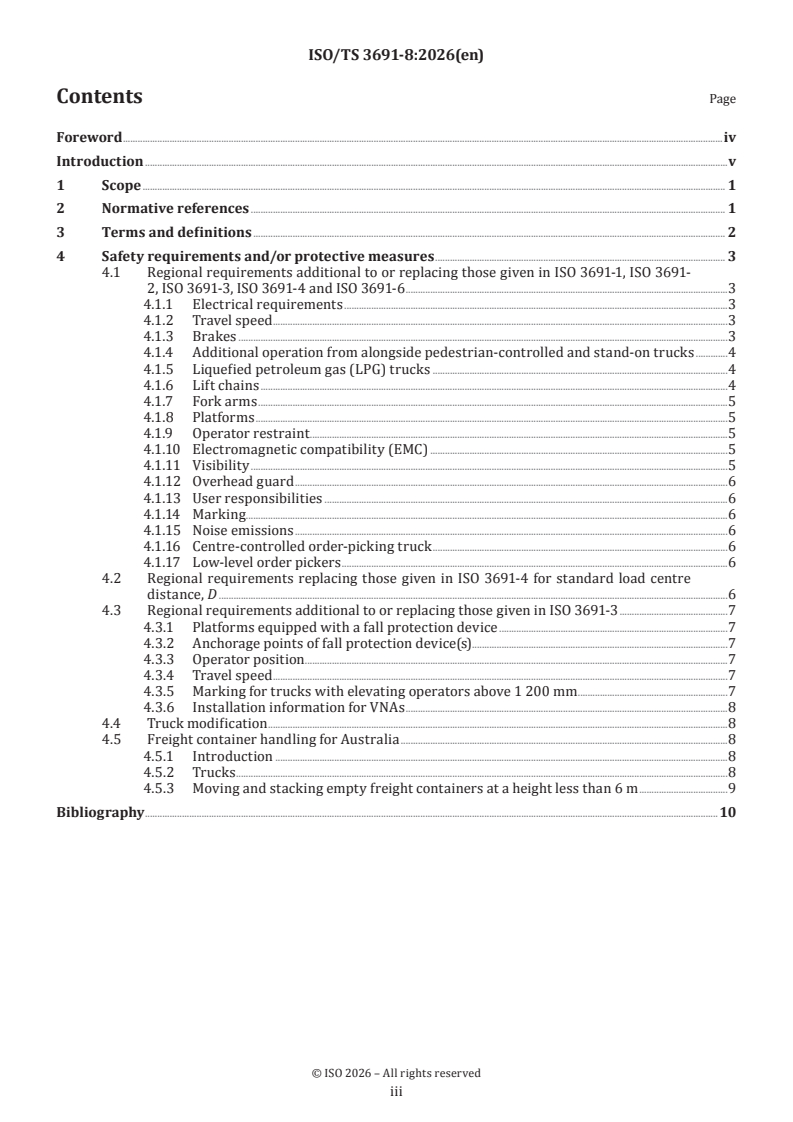
Contents Page
Foreword .iv
Introduction .v
1 Scope . 1
2 Normative references . 1
3 Terms and definitions . 2
4 Safety requirements and/or protective measures . 3
4.1 Regional requirements additional to or replacing those given in ISO 3691-1, ISO 3691-
2, ISO 3691-3, ISO 3691-4 and ISO 3691-6 .3
4.1.1 Electrical requirements .3
4.1.2 Travel speed .3
4.1.3 Brakes .3
4.1.4 Additional operation from alongside pedestrian-controlled and stand-on trucks .4
4.1.5 Liquefied petroleum gas (LPG) trucks .4
4.1.6 Lift chains .4
4.1.7 Fork arms .5
4.1.8 Platforms .5
4.1.9 Operator restraint .5
4.1.10 Electromagnetic compatibility (EMC) .5
4.1.11 Visibility .5
4.1.12 Overhead guard .6
4.1.13 User responsibilities .6
4.1.14 Marking . .6
4.1.15 Noise emissions .6
4.1.16 Centre-controlled order-picking truck .6
4.1.17 Low-level order pickers .6
4.2 Regional requirements replacing those given in ISO 3691-4 for standard load centre
distance, D .6
4.3 Regional requirements additional to or replacing those given in ISO 3691-3 .7
4.3.1 Platforms equipped with a fall protection device .7
4.3.2 Anchorage points of fall protection device(s).7
4.3.3 Operator position .7
4.3.4 Travel speed .7
4.3.5 Marking for trucks with elevating operators above 1 200 mm .7
4.3.6 Installation information for VNAs .8
4.4 Truck modification .8
4.5 Freight container handling for Australia .8
4.5.1 Introduction .8
4.5.2 Trucks . .8
4.5.3 Moving and stacking empty freight containers at a height less than 6 m .9
Bibliography .10
iii
Foreword
ISO (the International Organization for Standardization) is a worldwide federation of national standards
bodies (ISO member bodies). The work of preparing International Standards is normally carried out through
ISO technical committees. Each member body interested in a subject for which a technical committee
has been established has the right to be represented on that committee. International organizations,
governmental and non-governmental, in liaison with ISO, also take part in the work. ISO collaborates closely
with the International Electrotechnical Commission (IEC) on all matters of electrotechnical standardization.
The procedures used to develop this document and those intended for its further maintenance are described
in the ISO/IEC Directives, Part 1. In particular, the different approval criteria needed for the different types
of ISO document should be noted. This document was drafted in accordance with the editorial rules of the
ISO/IEC Directives, Part 2 (see www.iso.org/directives).
ISO draws attention to the possibility that the implementation of this document may involve the use of (a)
patent(s). ISO takes no position concerning the evidence, validity or applicability of any claimed patent
rights in respect thereof. As of the date of publication of this document, ISO had not received notice of (a)
patent(s) which may be required to implement this document. However, implementers are cautioned that
this may not represent the latest information, which may be obtained from the patent database available at
www.iso.org/patents. ISO shall not be held responsible for identifying any or all such patent rights.
Any trade name used in this document is information given for the convenience of users and does not
constitute an endorsement.
For an explanation of the voluntary nature of standards, the meaning of ISO specific terms and expressions
related to conformity assessment, as well as information about ISO's adherence to the World Trade
Organization (WTO) principles in the Technical Barriers to Trade (TBT), see www.iso.org/iso/foreword.html.
This document was prepared by Technical Committee ISO/TC 110, Industrial trucks, Subcommittee SC 2,
Safety of powered industrial trucks.
This third edition cancels and replaces the second edition (ISO/TS 3691-8:2019), which has been technically
revised.
The main changes are as follows:
— Changes have been made to the Australian requirements in relation to electric counterbalance trucks
travelling with elevated forks, operator restraints, platforms equipped with anchorage point(s) for fall
protection, low-level order pickers, platforms with reference to AS 5144.3 and freight container handling.
— Changes have been made to the North American requirements in relation to brakes, visibility and
guarding for platforms.
— Requirements for Canada have been added in relation to electrical, brakes, operation alongside pedestrian
and stand-on trucks, fork arms, operator restraint, electromagnetic compatibility, visibility overhead
guard and user responsibility.
— Standard load centre distance D table has been added.
— North America has been split into Canada and the United States of America for clarification.
— The regions have been clarified throughout the document.
— China has been added to the document.
A list of all parts in the ISO 3691 series can be found on the ISO website.
Any feedback or questions on this document should be directed to the user’s national standards body. A
complete listing of these bodies can be found at www.iso.org/members.html.
iv
Introduction
The ISO 3691 series has been developed to provide globally relevant International Standards for industrial
trucks. This goal was achieved with most of the issues. Where divergent regional requirements remain,
these are addressed by this document.
The EN 16307 series addresses legal requirements related to European Directives that are not accepted
worldwide. This document addresses requirements related to regulations and standards in force in Australia,
Canada, China, Japan, South Africa and the United States of America that are not applicable elsewhere.
This document does not repeat all the technical rules that are state-of-the-art and applicable to the material
used to construct the industrial truck. For these, see ISO 12100.
v
Technical Specification ISO/TS 3691-8:2026(en)
Industrial trucks — Safety requirements and verification —
Part 8:
Regional requirements for countries outside the European
Community
1 Scope
This document gives regional requirements for Australia, Canada, China, Japan, South Africa and the United
States of America, which are outside the United Kingdom and the European Economic Area (EEA), for the
types of industrial trucks specified in the scopes of ISO 3691-1, ISO 3691-2, ISO 3691-3, ISO 3691-4 and
ISO 3691-6.
It is intended to be used in conjunction with ISO 3691-1, ISO 3691-2, ISO 3691-3, ISO 3691-4 and ISO 3691-6.
2 Normative references
The following documents are referred to in the text in such a way that some or all of their content constitutes
requirements of this document. For dated references, only the edition cited applies. For undated references,
the latest edition of the referenced document (including any amendments) applies.
ISO 2330, Fork-lift trucks — Fork arms — Technical characteristics and testing
ISO 3691-1:2011, Industrial trucks — Safety requirements and verification — Part 1: Self-propelled industrial
trucks, other than driverless trucks, variable-reach trucks and burden-carrier trucks
ISO 3691-2, Industrial trucks — Safety requirements and verification — Part 2: Self-propelled variable-reach
trucks
ISO 3691-3, Industrial trucks — Safety requirements and verification — Part 3: Additional requirements for
trucks with elevating operator position and trucks specifically designed to travel with elevated loads
ISO 3691-3:2016/Amd 1:2023, Industrial trucks — Safety requirements and verification — Part 3: Additional
requirements for trucks with elevating operator position and trucks specifically designed to travel with elevated
loads — Amendment 1
ISO 3691-4, Industrial trucks — Safety requirements and verification — Part 4: Driverless industrial trucks and
their systems
ISO 3691-6, Industrial trucks — Safety requirements and verification — Part 6: Burden and personnel carriers
ISO 5053-1, Industrial trucks — Vocabulary — Part 1: Types of industrial trucks
ISO 5053-2, Industrial trucks — Vocabulary — Part 2: Fork arms and attachments
ISO 6055, Industrial trucks — Overhead guards — Specification and testing
ISO 6292, Powered industrial trucks and tractors — Brake performance and component strength
ISO 13564-1, Powered industrial trucks — Test methods for verification of visibility — Part 1: Sit-on and stand-
on operator trucks and variable-reach trucks up to and including 10 t capacity
ISO 20898, Industrial trucks — Electrical requirements
ICES-002, Issue 6, Vehicles, Boats and Other Devices Propelled by an Internal Combustion Engine, Electrical
Means or Both
ANSI/ITSDF B56.1, Safety Standard for Low Lift and High Lift Trucks
ANSI/ITSDF B56.5, Safety Standard for Driverless, Automatic Guided Industrial Vehicles and Automated
Functions of Manned Industrial Vehicles
ANSI/ITSDF B56.6, Safety Standard for Rough Terrain Forklift Trucks
ANSI/ITSDF B56.8, Safety Standard for Personnel and Burden Carriers
ANSI/ITSDF B56.9, Safety Standard for Operator Controlled Industrial Tow Tractors
ANSI/ITSDF B56.10, Safety Standard for Manually Propelled Low Lift, High Lift, and Scissor Lift Pallet Industrial
Trucks
ANSI/ITSDF B56.14, Safety Standard for Vehicle Mounted Forklifts
ANSI/NFPA 505, Fire Safety Standard for Powered Industrial Trucks Including Type Designations, Areas of Use,
Maintenance, and Operation
AS 2359.1:2019, Powered industrial trucks, Part 1: General requirements
AS 2359.2, Powered industrial trucks, Part 2: Operations
AS 4983, Gas fuel systems for forklifts and industrial engines
AS 5144.3:2019, Industrial trucks - Safety requirements and verification - Part 3: Additional requirements
for trucks with elevating operator position and trucks specifically designed to travel with elevated loads
(ISO 3691-3:2016, MOD)
AS 22915.9, Industrial trucks - Verification of stability, Part 9: Counterbalance trucks with mast handling freight
containers of 6 m (20 ft) length and longer (ISO 22915-9:2014, MOD)
AS 22915.12, Industrial trucks - Verification of stability, Part 12: Industrial variable-reach trucks handling
freight containers of 6 m (20 ft) length and longer (ISO 22915-12:2015, MOD)
AS/NZS 1891.1, Personal equipment for work at height, Part 1: Manufacturing requirements for full body
combination and lower body harnesses
AS/NZS CISPR 14.1, Electromagnetic Compatibility — Requirements for household appliances, electrical tools
and similar apparatus — Part 1: Emission
CAN ICES-003 (A) / NMB-003(A) Issue 7, Information technology equipment (including digital apparatus)
CSA B335-15, Safety standard for lift trucks
EN 1175, Safety of industrial trucks — Electrical/electronic requirements
EN 12895, Industrial trucks - Electromagnetic compatibility
ANSI/CAN/UL 558, Standard for Safety Industrial Trucks, Internal Combustion Engine-Powered
ANSI/CAN/UL 583, Standard for Safety Electric-Battery-Powered Industrial Trucks
3 Terms and definitions
For the purposes of this document, the terms and definitions given in ISO 5053-1, ISO 5053-2, ISO 3691-1,
ISO 3691-2, ISO 3691-3, ISO 3691-4 and ISO 3691-6 apply.
ISO and IEC maintain terminology databases for use in standardization at the following addresses:
— ISO Online browsing platform: available at https:// www .iso .org/ obp
— IEC Electropedia: available at https:// www .electropedia .org/
4 Safety require
...