


ISO/IEC 23681:2019
(Main)Information technology — Self-contained Information Retention Format (SIRF) Specification
Information technology — Self-contained Information Retention Format (SIRF) Specification
This document specifies the Self-contained Information Retention Format (SIRF) Level 1 and its serialization for LTFS, CDMI and OpenStack Swift. This document proposes an approach to digital content preservation that leverages the processes of the archival profession thus helping archivists remain comfortable with the digital domain.
Titre manque
General Information
- Status
- Published
- Publication Date
- 12-May-2019
- Technical Committee
- ISO/IEC JTC 1 - Information technology
- Drafting Committee
- ISO/IEC JTC 1 - Information technology
- Current Stage
- 9093 - International Standard confirmed
- Start Date
- 10-May-2025
- Completion Date
- 12-Feb-2026
Relations
- Consolidated By
ISO 3671:2023 - Plastics — Aminoplastic moulding materials — Determination of volatile matter - Effective Date
- 01-Oct-2022
Overview
ISO/IEC 23681:2019 - Self-contained Information Retention Format (SIRF) Specification - defines a vendor-neutral, archival-style container model for long-term digital preservation. The standard specifies SIRF Level 1 and its serialization for tape and cloud targets (LTFS, SNIA CDMI and OpenStack Swift). It provides a logical “container” concept with an embedded catalog that captures metadata about the container and each preservation object, enabling archivists and IT teams to manage, verify and retrieve preserved digital content over time.
Key technical topics and requirements
- Container model and catalog: SIRF defines a self-contained storage container that includes a machine-readable catalog describing the container and member objects.
- Metadata categories: The standard details container information metadata (e.g., Specification Category, Container ID, State, Provenance, Audit Log) and object information metadata (e.g., Object IDs, Dates, Related Objects, Packaging Format, Fixity, Retention, Audit Log, Extension).
- Fixity and provenance: Explicit support for integrity checks (fixity) and provenance/audit metadata to demonstrate authenticity and chain-of-custody.
- Serializations: Guidelines for serializing the SIRF catalog for LTFS, SNIA CDMI and OpenStack Swift object storage, including XML and JSON examples (Annexes provide schema and samples).
- Operational considerations: SIRF anticipates computational tasks (fixity verification, transformations) can be performed close to data (e.g., using storlets) to reduce bandwidth, improve security, and capture provenance.
- Interoperability: Designed to be compatible with archival practice and existing preservation metadata approaches (references include PREMIS, JSON, CDMI, LTFS, OpenStack Swift).
Practical applications and who uses it
SIRF is targeted at organizations that require durable, auditable preservation of fixed digital content:
- Archivists and records managers seeking a digital analogue of archival containers (boxes/folders) to aggregate and describe related items.
- Libraries, national archives and museums implementing large-scale digital preservation programs.
- Enterprises and regulated industries (legal, healthcare, finance) needing retention, compliance, and defensible audit trails.
- Storage architects and cloud/tape vendors implementing LTFS, CDMI, or OpenStack Swift support for preserved repositories.
- Developers of preservation workflows who need a standardized catalog, fixity strategies, and serialization formats (XML/JSON).
Related standards and resources
- ISO/IEC 17826:2012 - Cloud Data Management Interface (CDMI)
- ISO/IEC 20919:2016 - Linear Tape File System (LTFS)
- PREMIS (preservation metadata recommendations)
- OpenStack Swift, JSON (ECMA-404)
- OpenSIRF open source implementations and examples
ISO/IEC 23681:2019 helps bridge archival practice and modern storage systems by defining a practical, interoperable format for long-term digital retention, with emphasis on metadata, integrity and portability.
Get Certified
Connect with accredited certification bodies for this standard

BSI Group
BSI (British Standards Institution) is the business standards company that helps organizations make excellence a habit.

NYCE
Mexican standards and certification body.
Sponsored listings
Frequently Asked Questions
ISO/IEC 23681:2019 is a standard published by the International Organization for Standardization (ISO). Its full title is "Information technology — Self-contained Information Retention Format (SIRF) Specification". This standard covers: This document specifies the Self-contained Information Retention Format (SIRF) Level 1 and its serialization for LTFS, CDMI and OpenStack Swift. This document proposes an approach to digital content preservation that leverages the processes of the archival profession thus helping archivists remain comfortable with the digital domain.
This document specifies the Self-contained Information Retention Format (SIRF) Level 1 and its serialization for LTFS, CDMI and OpenStack Swift. This document proposes an approach to digital content preservation that leverages the processes of the archival profession thus helping archivists remain comfortable with the digital domain.
ISO/IEC 23681:2019 is classified under the following ICS (International Classification for Standards) categories: 35.240.30 - IT applications in information, documentation and publishing. The ICS classification helps identify the subject area and facilitates finding related standards.
ISO/IEC 23681:2019 has the following relationships with other standards: It is inter standard links to ISO 3671:2023. Understanding these relationships helps ensure you are using the most current and applicable version of the standard.
ISO/IEC 23681:2019 is available in PDF format for immediate download after purchase. The document can be added to your cart and obtained through the secure checkout process. Digital delivery ensures instant access to the complete standard document.
Standards Content (Sample)
INTERNATIONAL ISO/IEC
STANDARD 23681
First edition
2019-05
Information technology — Self-
contained Information Retention
Format (SIRF) Specification
Reference number
©
ISO/IEC 2019
© ISO/IEC 2019
All rights reserved. Unless otherwise specified, or required in the context of its implementation, no part of this publication may
be reproduced or utilized otherwise in any form or by any means, electronic or mechanical, including photocopying, or posting
on the internet or an intranet, without prior written permission. Permission can be requested from either ISO at the address
below or ISO’s member body in the country of the requester.
ISO copyright office
CP 401 • Ch. de Blandonnet 8
CH-1214 Vernier, Geneva
Phone: +41 22 749 01 11
Fax: +41 22 749 09 47
Email: copyright@iso.org
Website: www.iso.org
Published in Switzerland
ii © ISO/IEC 2019 – All rights reserved
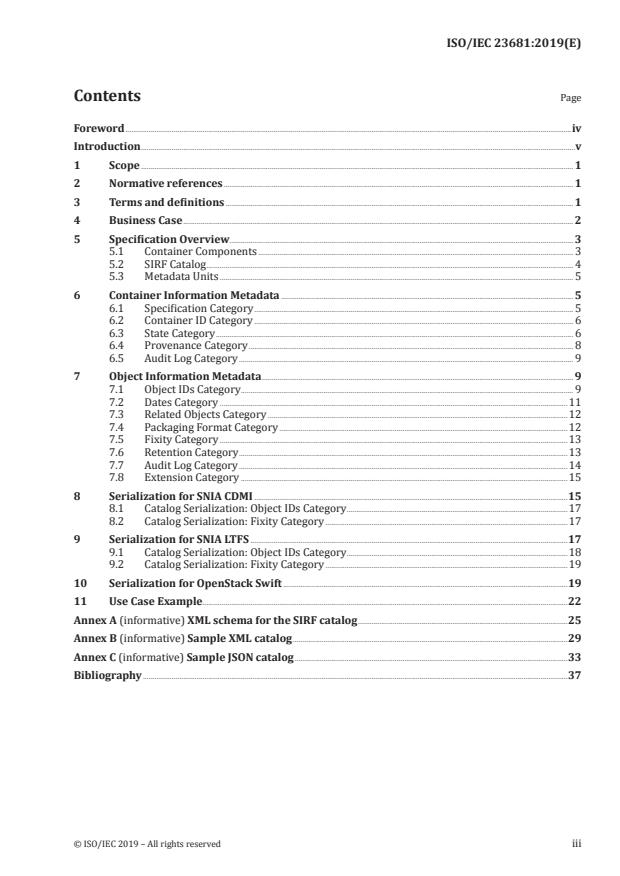
Contents Page
Foreword .iv
Introduction .v
1 Scope . 1
2 Normative references . 1
3 Terms and definitions . 1
4 Business Case . 2
5 Specification Overview . 3
5.1 Container Components . 3
5.2 SIRF Catalog . 4
5.3 Metadata Units . 5
6 Container Information Metadata . 5
6.1 Specification Category . 5
6.2 Container ID Category . 6
6.3 State Category . 6
6.4 Provenance Category . 8
6.5 Audit Log Category . 9
7 Object Information Metadata . 9
7.1 Object IDs Category . 9
7.2 Dates Category .11
7.3 Related Objects Category .12
7.4 Packaging Format Category .12
7.5 Fixity Category .13
7.6 Retention Category .13
7.7 Audit Log Category .14
7.8 Extension Category .15
8 Serialization for SNIA CDMI .15
8.1 Catalog Serialization: Object IDs Category .17
8.2 Catalog Serialization: Fixity Category .17
9 Serialization for SNIA LTFS .17
9.1 Catalog Serialization: Object IDs Category .18
9.2 Catalog Serialization: Fixity Category .19
10 Serialization for OpenStack Swift .19
11 Use Case Example.22
Annex A (informative) XML schema for the SIRF catalog .25
Annex B (informative) Sample XML catalog .29
Annex C (informative) Sample JSON catalog .33
Bibliography .37
© ISO/IEC 2019 – All rights reserved iii
Foreword
ISO (the International Organization for Standardization) and IEC (the International Electrotechnical
Commission) form the specialized system for worldwide standardization. National bodies that
are members of ISO or IEC participate in the development of International Standards through
technical committees established by the respective organization to deal with particular fields of
technical activity. ISO and IEC technical committees collaborate in fields of mutual interest. Other
international organizations, governmental and non-governmental, in liaison with ISO and IEC, also
take part in the work.
The procedures used to develop this document and those intended for its further maintenance are
described in the ISO/IEC Directives, Part 1. In particular, the different approval criteria needed for the
different types of document should be noted (see www .iso .org/directives).
Attention is drawn to the possibility that some of the elements of this document may be the subject
of patent rights. ISO and IEC shall not be held responsible for identifying any or all such patent
rights. Details of any patent rights identified during the development of the document will be in the
Introduction and/or on the ISO list of patent declarations received (see www .iso .org/patents) or the IEC
list of patent declarations received (see http: //patents .iec .ch).
Any trade name used in this document is information given for the convenience of users and does not
constitute an endorsement.
For an explanation of the voluntary nature of standards, the meaning of ISO specific terms and
expressions related to conformity assessment, as well as information about ISO's adherence to the
World Trade Organization (WTO) principles in the Technical Barriers to Trade (TBT) see www .iso
.org/iso/foreword .html.
This document was prepared by SNIA (as SIRF Specification V1.0) and drafted in accordance with
its editorial rules. It was adopted, under the JTC 1 PAS procedure, by Joint Technical Committee ISO/
IEC JTC 1, Information technology.
Any feedback or questions on this document should be directed to the user’s national standards body. A
complete listing of these bodies can be found at www .iso .org/members .html.
iv © ISO/IEC 2019 – All rights reserved
Introduction
Many organizations now have a requirement to preserve and maintain access to large volumes of
digital content indefinitely into the future. Regulatory compliance and legal issues require preservation
of email archives, medical records and information about intellectual property. Web services and
applications compete to provide storage, organization and sharing of consumers' photos, movies, and
other creations. And many other fixed-content repositories are charged with collecting and providing
access to scientific data, intelligence, libraries, movies and music. A key challenge to this need is the
creation of vendor-neutral storage containers that can be interpreted over time.
Archivists and records managers of physical items such as documents, records, etc., avoid processing
each item individually. Instead, they gather together a group of items that are related in some
manner — by usage, by association with a specific event, by timing, and so on — and then perform all
of the processing on the group as a unit. The group itself may be known as a series, a collection, or in
some cases as a record or a record group. Once assembled, an archivist will place the series in a physical
container (e.g., a file folder or a filing box of standard dimensions), mark the container with a name and
a reference number and place the container in a known location. Information about the series will be
included in a label that is physically attached to the container, as well as in a “finding aid” such as an
online catalog that conforms to a defined schema and gives the name and location of the series, its size,
and an overview of its contents.
This document proposes an approach to digital content preservation that leverages the processes of
the archival profession thus helping archivists remain comfortable with the digital domain. One of
the major needs to make this strategy possible is a digital equivalent to the physical container — the
archival box or file folder — that defines a series, and which can be labelled with standard information
in a defined format to allow retrieval when needed. Self-contained Information Retention Format
(SIRF) is intended to be that equivalent — a storage container format for a set of (digital) preservation
objects that also provides a catalog with metadata related to the entire contents of the container as
well as to the individual objects and their interrelationship. This logical container makes it easier and
more efficient to provide many of the processes that will be needed to address threats to the digital
content. Easier and more efficient preservation processes in turn lead to more scalable and less costly
preservation of digital content.
SIRF components, use cases and functional requirements were defined in [1] SIRF use cases and
functional requirements, working draft — version 0.5a and further described in [2] "Towards SIRF:
Self-contained Information Retention Format." This document goes one step further and details the
actual metadata, categories and elements in the container’s catalog. The document also describes how
the SIRF logical format is serialized for storage containers in the cloud and for tape based containers.
The SIRF serialization for the cloud is being experimented with OpenStack Swift object storage, and the
[3]
implementation is offered as open source in the OpenSIRF initiative .
Creating and maintaining the SIRF catalog requires executing data-intensive computations on the
various preservation objects including fixity checks, data transformations. This can be done efficiently
via executing computational modules — storlets — close to where the data is stored. The benefits of
using storlets include reduced bandwidth (reduce the number of bytes transferred over the WAN),
enhanced security (reduce exposure of sensitive data), costs savings (saving infrastructure at the client
[4]
side) and compliance support (improve provenance tracking). The Storlet Engine (see "Storlet Engine
for Executing Biomedical Processes within the Storage System") is an engine to support such storlets
computations in secure sandboxes within the storage system, and can be used to create and maintain
SIRF containers.
© ISO/IEC 2019 – All rights reserved v
INTERNATIONAL STANDARD ISO/IEC 23681:2019(E)
Information technology — Self-contained Information
Retention Format (SIRF) Specification
1 Scope
This document specifies the Self-contained Information Retention Format (SIRF) Level 1 and its
serialization for LTFS, CDMI and OpenStack Swift.
This document proposes an approach to digital content preservation that leverages the processes of the
archival profession thus helping archivists remain comfortable with the digital domain.
2 Normative references
The following documents are referred to in the text in such a way that some or all of their content
constitutes requirements of this document. For dated references, only the edition cited applies. For
undated references, the latest edition of the referenced document (including any amendments) applies.
ISO/IEC 17826:2012, Information technology — Cloud Data Management Interface (CDMI)
ISO/IEC 20919:2016, Information technology — Linear Tape File System (LTFS) Format Specification
Self-contained Information Retention Format (SIRF) use cases and functional requirements, working
draft — version 0.5a, SNIA, September 2010, http: //www .snia .org/tech _activities/publicreview/SIRF
_Use _Cases _V05a _DRAFT .pdf
JSON. ECMA-404, The JSON Data Interchange Standard. http: //json .org
OpenSIRF. http: //github .com/opensirf
OpenStack Swift. http: //swift .openstack .org
PREMIS. PREservation Metadata: Implementation, Strategies, http: //www .loc .gov/standards/premis
Rabinovici-Cohen S., Henis E., Marberg J., Nagin K. Storlet Engine for Executing Biomedical
Processes within the Storage System", Proceedings of the 7th International Workshop on Process-
oriented Information Systems in Healthcare (ProHealth), September 2014, Eindhoven, the Netherlands
Rabinovici-Cohen S., Baker M.G., Cummings R., Fineberg S., Marberg J. Towards SIRF: Self-
contained Information Retention Format", Proceedings of the Annual International Systems and
Storage Conference (SYSTOR), May 30-June 1, 2011, Haifa, Israel. https: //www .research .ibm
.com/haifa/projects/storage/datastores/papers/systor56 -rabinovici -cohen .pdf
Rabinovici-Cohen S., Cummings R., Fineberg S. Self-contained Information Retention Format for
Future Semantic Interoperability", Proceedings of the 4th International Workshop on Semantic Digital
Archives (SDA), September 2014, London, UK
W3C Prov Model Primer http: //www .w3 .org/TR/prov -primer/
3 Terms and definitions
No terms and definitions are listed in this document.
ISO and IEC maintain terminological databases for use in standardization at the following addresses:
— ISO Online browsing platform: available at https: //www .iso .org/obp
© ISO/IEC 2019 – All rights reserved 1
— IEC Electropedia: available at http: //www .electropedia .org/
4 Business Case
While no one wants to lose their digital content, the cost of maintaining integrity and access is
significant, in both money and effort. And unlike paper based content, the lifespan of digital content
can be very short unless if proactive steps are being taken to protect it. The use of a storage container
format like SIRF adds little expense and greatly increases the sustainability of data. However, this is not
adequate unless if the cost of preserving content is less than the (potential) cost of losing it.
In a business context, there are three major reasons why content is preserved. These are: to preserve
history, to mitigate risk or meet a legal mandate, and for future value of information. One or more of
these may apply, and the amount an entity is willing to spend will differ depending on how well these
reasons are aligned with the business goals of an organization.
One of the main reasons why people and organizations preserve content is to preserve history. In the
case of an individual, it may be photos, videos, and other content preserving one's life history. In a
business context, libraries, national archives, historians, and others have a primary mission to preserve
history.
This should mean that information under the control of these organizations or individuals would be
well protected. However, reality dictates that:
1) Organizations (and individuals) have limited resources, and they have to make choices how much
to invest in preservation. Typically, this happens with the organization's knowledge of what trade-
offs are being made. However, in the case of digital content, the choice not to invest in preservation
will typically result in loss.
2) Organizations cannot preserve everything as the cost would be prohibitive. However, it is difficult
to predict what will be of historic value. Sometimes important content is lost simply because its
value was not known at the time.
3) Lack of skilled and experienced personal may also result in loss, especially in situations where
simple solutions do not exist.
Another often cited reason for preserving data is for "risk mitigation", or in some cases for "legal
mandate". These are closely related reasons because legal mandate is often looked at through the lens
of legal risk. In other words, a mandate that is not enforced or whose penalty is small is less of a risk
than a mandate with a larger penalty.
For example, consider government entities like a national or state archive. Legislators require those
entities to keep records for a prescribed period of time. The penalty for losing those records may
include loss of job, loss of funding, or even criminal penalties. Since preservation is directly funded,
there is little excuse for losing information. However, even in those cases, underfunding, and lack of
expertise may result in loss. Further, when those agencies preserve historical information, the mandate
and funding will not allow them to keep everything. Therefore, even these archivists are required to
make choices about what to keep.
Another often cited legal mandate is in healthcare, where medical organizations are required to
retain information for the lifetime of a patient. This seems like a difficult requirement, especially since
records are often maintained in private doctors' offices and other places that may not exist 50 years or
75 years into the future. Anecdotal evidence shows that medical records are not maintained that long.
So, why is this happening? It is because records retention is expensive, and there are no penalties for
losing information. That is not to say that doctors and hospitals don't try, rather they won't spend the
necessary money to ensure that records are not lost.
The private sector is similar to healthcare. Preservation is seen as a cost, so it only makes sense where
the return on investment is positive. For example, businesses are very good at keeping recent tax
records, because they know that if they don't, the tax authority may levy fines. In the US, businesses
retain emails, because they know judges will fine them if they don't. They even implement searchable
2 © ISO/IEC 2019 – All rights reserved
archive systems, because they know that it will save money when they are forced to produce documents
responsive to a lawsuit. Note that this is different outside of the US, where judges often do not levy fines
or force companies to spend large sums of money on legal discovery.
When private sector companies do preserve information, they are typically focused on risk mitigation,
not preservation. If a company can legally delete information, they often will, because it eliminates the
chance that it can be used against them. If information is purely a risk, and a company is not in the
business of preservation, why would they keep it? The obvious answer is that they will keep information
that is valuable, and other information will not be kept. Value can result from future revenue, cost
savings, technical advantage, etc.
Regarding future value of information, one obvious example is in the entertainment industry. Movies,
TV shows, music, and other content can be re-sold and repurposed decades after its creation. This can
result in many dollars in revenue. So not surprisingly, organizations like the Motion Picture Experts
Group are at the leading edge of digital preservation. Entertainment companies spend significant
amounts of money retaining their content so that they will have it available to repurpose. However, this
does not mean they can retain everything. With the advent of digital movie production, the amount of
data that can be generated during the creation of a single film is immense. Therefore, even here where
future value is tangible, some hard choices need to be made.
In other industries, the mandate may not be as clear. Are design documents from an existing product
valuable? What about a retired product? What about research leading up to a product design? These
things may be needed for risk mitigation, but what about for use in future products? Companies make
decisions about these kinds of Intellectual Property content every day, and more times than not, the
data is either actively destroyed or lost due to inaction. The reason for this is actually because its value
(beyond risk mitigation) is unknown, so it's not clear how much a company should invest in retaining
the information.
So, how does SIRF help? SIRF brings down the expense of preservation, because data can remain
accessible even if the software that created the data no longer exists. This is because the stored data is
designed to be understandable, and does not need specialized software to interpret it. SIRF reduces the
complexity of logical and physical migration, making it easier for businesses to justify. By using SIRF
today, it becomes possible to retain more information, and to retain information with a lower perceived
future value. This is unlike proprietary and undocumented formats, which become useless soon after a
business stops paying for support.
5 Specification Overview
5.1 Container Components
Figure 1 illustrates the SIRF container, which includes the following components:
— A magic object that identifies whether this is a SIRF container and gives its version. The magic object
is independent of the media and has an agreed defined name and a fixed size. It also includes the
means to access the SIRF catalog (for example, the catalog’s location).
— Preservation objects that contain the actual data to be preserved. An example preservation object
can be the OAIS Archival Information Package (AIP). The container may include multiple versions
of a preservation object and multiple copies of each version, but each specific preservation object is
generally immutable.
— A catalog that is updateable and contains metadata needed to make the container and its preservation
objects portable and accessible into the future without relying on metadata external to the storage
subsystem.
While the semantics of traditional storage systems include only limited standardized metadata about
each object, SIRF provides for the rich metadata needed for preservation and ensures its grouping with
the data. This rich metadata is defined in the catalog in a logical format to allow its serialization for
different storage technologies.
© ISO/IEC 2019 – All rights reserved 3
Figure 1 — SIRF Components
5.2 SIRF Catalog
The SIRF catalog is an object that includes metadata about the Preservation Objects (POs) in the
container and their relationship. It has a well-defined standardized format so it can be understandable
in the future. The SIRF catalog is separated from the metadata contained in the POs themselves because
a strict standardized format is difficult to impose on the POs that are generated by different applications
and domains. Additionally, The SIRF catalog level 1 includes metadata that is not included in the PO, e.g.,
fixity value of the whole PO. Including this metadata within the PO changes the fixity value of the PO
making this metadata inherently incorrect.
The SIRF catalog includes metadata related to the whole container as well as metadata related to each
preservation object within the container. Both types of metadata are organized into categories.
The metadata for the whole container includes the following categories:
1 Container Information
1.1 Specification
1.2 Container ID
1.3 State
1.4 Provenance
1.5 Audit Log
The metadata for all the preservation objects set is aggregated under:
2 Objects Set
The metadata for each preservation object includes the following categories:
3 Object Information
3.1 Object IDs
3.2 Related Objects
3.3 Dates
4 © ISO/IEC 2019 – All rights reserved
3.4 Packaging Format
3.5 Fixity
3.6 Retention
3.7 Audit Log
3.8 Extension
Examples of SIRF Catalogs are shown in Annex A: (informative) XML schema for the SIRF catalog,
Annex B: (informative) Sample XML catalog, and Annex C: (informative) Sample JSON catalog.
5.3 Metadata Units
This document describes the specific metadata units in the various categories. Each category includes
several elements in which each element may be composed of several attributes. The document
also provides a hierarchical representation of the metadata units. The notation of the hierarchical
[5]
representation is based on PREMIS (PREservation Metadata: Implementation, Strategies) when
possible and includes the following notions:
Repeatability (R): A metadata unit designated as “Repeatable” (R) can take multiple values. It does not
mean that a repository must record multiple instances of the metadata unit. Similarly, a metadata unit
can be designated as Not Repeatable (NR).
Optionality (O): Whether a value for the metadata unit is optional (O) or mandatory (M). Values for
mandatory metadata units are required while values for optional metadata units are encouraged but
not required.
SIRF serialization for CDMI/LTFS/Swift specify how a CDMI container, LTFS Tape or Swift container
can become also SIRF-compliant. A SIRF-compliant CDMI container, LTFS Tape or Swift container
enables future CDMI/LTFS/Swift clients “understand” containers created by today’s CDMI/LTFS/
Swift clients although the properties of the future client is unknown to us today. By “understand”, it
means that clients can identify the preservation objects in the container, the packaging format of each
object, its fixity values, etc. (as defined in the SIRF catalog). This document also includes sections on
SIRF serialization for CDMI (Section 6), SIRF serialization for LTFS (Section 7) and SIRF serialization for
OpenStack Swift (Section 8).
SIRF includes metadata about the storage container, to help “understand” the container information
in the future. No single technology will be usable over the time spans mandated by current digital
preservation needs. SNIA CDMI, Swift and LTFS technologies are among best current choices, but are
good for perhaps 10 years to 20 years. SIRF provides a vehicle for collecting all of the information that
will be needed to transition to new technologies in the future, and it can be serialized for the future
technologies as they come.
6 Container Information Metadata
6.1 Specification Category
This category includes information about the SIRF specification used for this container. As the
specification may evolve over time and distinct containers may use different SIRF specifications,
it is denoted in the SIRF catalog the specification used, and the SIRF level. SIRF level 2 specification
defines more detailed metadata in the container.
The elements of the Specification category are:
— Specification ID (containerSpecificationIdentifier) — the specification identifier e.g., "SIRF-1.0"
— Specification Version (containerSpecificationVersion) — the specification version e.g., "1.0"
© ISO/IEC 2019 – All rights reserved 5
— SIRF Level (containerSpecificationSirfLevel) — the SIRF level that should be "1"
Hierarchical Representation
1 containerInformation (1-1: M, NR)
1.1 containerSpecification (1-1: M, NR)
1.1.1 containerSpecificationIdentifier (1-1: M, NR)
1.1.2 containerSpecificationVersion (1-1: M, NR)
1.1.3 containerSpecificationSirfLevel (1-1: M, NR)
6.2 Container ID Category
This category includes the container unique identifier and it has just one element:
— Container ID (containerIdentifier) — the container unique identifier, e.g., the tape id or cloud
container id
The Container ID element is composed of the following attributes:
— Container Identifier Type (containerIdentifierType) — a designation of the naming authority
and the domain within which the object identifier is unique.
— Container Identifier Locale (containerIdentifierLocale) — the locale of the identifier based on
the Internet Assigned Numbers Authority (IANA).
— Container Identifier Value (containerIdentifierValue) — a Unicode/UTF-8 string for identifier
actual value.
Hierarchical Representation
1 containerInformation (1-1: M, NR)
1.2 containerIdentifier (1-1: M, NR)
1.2.1 containerIdentifierType (1-1: M, NR)
1.2.2 containerIdentifierLocale (1-1: M, NR)
1.2.3 containerIdentifierValue (1-1: M, NR)
6.3 State Category
The state metadata is an indication of the progress of any activities that are to be carried out against a
container. For example, if a container holds many preservation objects, state may indicate whether all
of the objects intended for a container have been included or not. Or, state may indicate an in-process
migration of a container.
The elements of the State category, as shown in Table 1, are:
— State Type (containerStateType)
— State Value (containerStateValue)
6 © ISO/IEC 2019 – All rights reserved
Table 1 — State category types and values
Type Accepted Values Use
INITIALIZING TRUE TRUE when the container is being initialized, i.e., the magic
object, container provenance and/or catalog are being created
READY ACTIVE ACTIVE when the container is ready to receive new POs or
catalog changes
FINALIZED
FINALIZED when the container is closed, read-only, and can-
not receive more POs
NOT READY DESTROYED DESTROYED when the container has been destroyed and can
no longer be read or modified.
ERROR
ERROR when there's a failure that cannot be specified using
any other state type
MIGRATING TRUE TRUE when the data stored in a container are being moved to/
from another container
The container state transitions occur depending on the current state and the action that is being taken
in the container. Figure 2 shows the possible state transitions.
Figure 2 — Possible container states and transitions
Hierarchical Representation
1 containerInformation (1-1: M, NR)
1.3 containerState (1-1: M, NR)
1.3.1 containerStateType (1-1: M, NR)
1.3.2 containerStateValue (1-1: M, NR)
© ISO/IEC 2019 – All rights reserved 7
6.4 Provenance Category
Provenance is metadata describing the history of the information in a SIRF container (e.g., its origins,
[6]
chain of custody, preservation actions and effects). The W3C provenance primer (W3C Prov Model
Primer) describes three perspectives for provenance information:
1) One perspective might focus on agent-centered provenance, that is, what people or organizations
were involved in generating or manipulating the information in question. For example, in this
perspective the provenance of the container can include the user that created the SIRF container.
2) A second perspective might focus on object-centered provenance, by tracing the origins of portions
of the container. An example of this perspective is having the container assembled from content
from other containers.
3) A third perspective one might take is on process-centered provenance, capturing the actions and
steps taken to generate the information in question. For example, the container may have been
generated by invoking a service to retrieve data from a database, then generating preservation
objects, and finally storing the preservation objects with a specific application.
Regardless of the perspective from which provenance metadata is derived, it is critical for
understanding the container, its history, its context and meaning. SIRF enables the preservation of
container provenance information as part of a container’s metadata.
The provenance information may vary depending on the type of information being preserved or its
intended audience. In addition, it may be larger than what can reasonably be included in the catalog.
Therefore, it is included in the catalog by reference, and the actual information is stored in another
preservation object:
This category includes just one element:
— Provenance Reference (containerProvenanceReference) — reference to the object that contains
the provenance
The container provenance information stored in SIRF may be in the W3C-PROV format, or any other
well-known provenance format.
The containerProvenanceReference element is composed of the following attributes:
— Reference Type (referenceType) — whether internal referencing within the container or external
referencing
— Reference Role (referenceRole) — the value should be "Provenance"
— Reference Value (referenceValue) — the unique identifier of the referenced provenance object. If
the referenced object is an internal preservation object, the value will be its objectVersionIdentifier.
objectIdentifierValue
Hierarchical Representation
1 containerInformation (1-1: M, NR)
1.4 containerProvenance (1-*: M, NR)
1.4.1 containerProvenanceReference (1-1: M, NR)
1.4.1.1 referenceType (1-1: M, NR)
1.4.1.2 referenceRole (1-1: M, NR)
1.4.1.3 referenceValue (1-1: M, NR)
8 © ISO/IEC 2019 – All rights reserved
6.5 Audit Log Category
The audit log is provided as a place for preserving any important information about how a container
has been accessed or modified. Note that this category is for the audit log of the container, in contrast to
the audit log described in the Object Information Metadata section. The extent and contents of an audit
log depend on the needs of the specific preservation data store and its use case. Distinct domains have
different audit logs regulations e.g., SEC is for the market domain, FDA is for the pharmatutical domain.
In SIRF, audit logs are stored as SIRF preservation objects. Therefore, a container audit log information
is stored as an object ID in the SIRF catalog.
This category includes just one element:
— Audit Log Reference (containerAuditLogReference) — reference to the object that contains the
audit log
The containerAuditLogReference element is composed of the following attributes:
— Reference Type (referenceType) — whether internal referencing within the container or external
referencing
— Reference Role (referenceRole) — the value should be "AuditLog"
— Reference Value (referenceValue) — the unique identifier of the referenced audit log object. If the
referenced object is an internal preservation object, the value will be its objectVersionIdentifier.
objectIdentifierValue
Hierarchical Representation
1 containerInformation (1-1: M, NR)
1.5 containerAuditLog (0-*, O, R)
1.5.1 containerAuditLogReference (1-1: M, NR)
1.5.1.1 referenceType (1-1: M, NR)
1.5.1.2 referenceRole (1-1: M, NR)
1.5.1.3 referenceValue (1-1: M, NR)
7 Object Information Metadata
The SIRF container includes multiple preservation objects (POs). The objectsSet is the element in the
SIRF catalog that aggregates all the object information metadata of the various POs. Underneath the
objectsSet are the various objectInformation — one for each PO. Sections 0 through 7.8 describe the
categories, elements and attributes within the objectInformation.
Hierarchical Representation
2 objectsSet (1-*: M, R)
7.1 Object IDs Category
Identifiers (IDs) are used to identify a PO and to link to other POs. Managing identifiers over the long
term raises issues such as:
— how to ensure uniqueness of identifiers over long term
— how to handle evolution of identifiers over time
— how to ensure scalability of identifiers
© ISO/IEC 2019 – All rights reserved 9
SIRF helps addressing these issues by enabling redundancy in identifiers and registering the evolution
(genealogy) of POs. Hence, a PO in a SIRF container can have multiple identifiers as redundancy in
identifiers increases the chances that at least one identifier will survive for the long term. Nevertheless,
at any time, at least one of the identifiers should be persistent and unique.
When an identifier is qualified as unique, it should be unique across all types of storage including offline
storage and online storage. There are various methods to generate unique identifiers, which may vary
in the scope of uniqueness. Unique identifiers are sometimes based on external infrastructure. For
example, the British Library unique identifiers are based on a secure timestamp provided by the British
government. In another example, the unique identifier can be based on a domain name and include a
vendor identifier.
Universal Unique IDs (UUIDs) are sometimes selected for creating unique identifiers. Note that in a
long-term environment, there are additional challenges with managing UUIDs and ensuring their
uniqueness. For example, there is a need to ensure that the same process and method for generating
UUIDs is continually used, so that it can be guaranteed over long periods of time that no duplicate UUID
would be generated. Also note that as of today, there are no means to enforce the methods of which the
UUIDs are generated and to validate that they do not collide.
The elements of the Object IDs category are:
— PO Name (objectName) — non-unique identifier e.g., file name
— PO Version ID (objectVersionIdentifier) — unique identifier that identifies the specific version
of the PO
— PO Logical ID (objectLogicalIdentifier) — a unique identifier that identifies the various versions
that originate from the same ancestor
— PO Parent ID (objectParentIdentifier) — a unique identifier that identifies the parent PO from
which this PO version was created. The Parent PO shares the same logical ID as the current PO, but
has a different version ID. Parent ID can be added at a later stage, and it is not mandatory to specify
it when the PO is created. This is because the parent PO may be stored in the container at a later
stage or can be stored in another container.
A PO may have several copies that are bitwise identical. Different copies may reside in different
containers. Each one of these copies may have a different copy ID, but their version ID, logical ID, and
parent ID should be the same. Elements such as "copy ID" or "number of copies" are not maintained in
the SIRF catalog, as maintaining them in each container and updating the catalog each time a copy is
lost may be difficult and subject to inconsistency. It is hard to manage such an element, especially if
some of the copies reside in other storage containers. For example, consider the case in which a copy
of a PO is destroyed, and an update of the catalog of all containers was needed. Also, when a new copy
is created instead, some implementations may choose to assign a new copy ID to the newly created PO,
while other implementations may choose to assign the same copy ID as the destroyed one.
Each element in this category is composed of the following attributes:
— Object Identifier Type (objectIdentifierType) — a designation of the naming authority and
the domain within which the object identifier is unique. Identifier values cannot be assumed to
be unique across domains; the combination of objectIdentifierType and objectIdentifierValue should
ensure uniqueness. Examples of naming authority and domain include: URL, DataCite DOI, ARK,
UUID, vendor domain, DLC, DRS, Handle System HDL.
— Object Identifier Locale (objectIdentifierLocale) — the locale of the identifier based on the
Internet Assigned Numbers Authority (IANA).
— Object Identifier Value (objectIdentifierValue) — a Unicode/UTF-8 string for identifier actual
value. There is no limit on the objectIdentifierValue length in the architecture, but the implementation
can have size limits. The objectIdentifierValue can sometimes give a hint regarding the classification
of the data, but this is left to the implementation. Examples of identifiers values include: http: //x .y .z,
DOI: 123456, urn::xx::dd, hdl: 4263537.
10 © ISO/IEC 2019 – All rights reserved
Hierarchical Representation
The objectName includes all the non-unique identifiers of the object and there may be 0-* such identifiers
namely this element is optional (O) and there may be multiple such elements repeating (R).
The objectVersionIdentifier includes
...
Questions, Comments and Discussion
Ask us and Technical Secretary will try to provide an answer. You can facilitate discussion about the standard in here.
Loading comments...