


IWA 44:2025
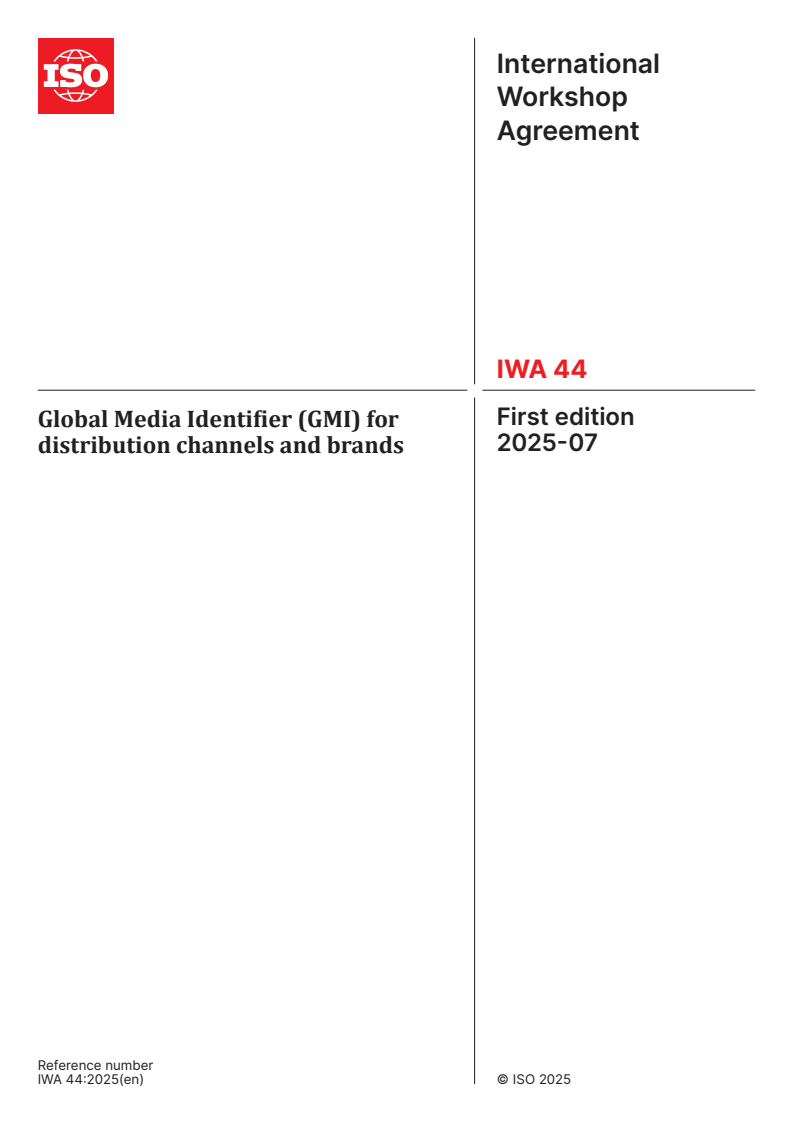
(Main)Global Media Identifier (GMI) for distribution channels and brands
Global Media Identifier (GMI) for distribution channels and brands
This document provides requirements and recommendations for the structure and associated metadata to be included and the governance of the Global Media Identifier (GMI) that can be assigned to all media outlets that publish content online. The identification of material or physical objects is out of scope of this document. This document also considers the GMI’s technical infrastructure and its practical implementation. It is a neutral, non-judgemental numbering or naming convention, not a certification scheme. This document does not include any provisions for the assessment of online content, e.g. as regards its trustworthiness, quality, or an outlet’s conformance with journalistic standards.
Titre manque
General Information
- Status
- Published
- Publication Date
- 13-Jul-2025
- Technical Committee
- ISO/TMBG - Technical Management Board - groups
- Drafting Committee
- ISO/TMBG - Technical Management Board - groups
- Current Stage
- 6060 - International Standard published
- Start Date
- 14-Jul-2025
- Completion Date
- 14-Jul-2025
Overview
IWA 44:2025 - Global Media Identifier (GMI) for distribution channels and brands (ISO) specifies requirements and recommendations for a standardized identifier system for online media outlets. The GMI is a neutral, non‑judgemental numbering/naming convention (not a certification scheme) intended to uniquely identify distribution channels, brands and other media outlets that publish content online. The standard covers identifier construction, associated metadata, governance, technical infrastructure and practical implementation while excluding identification of physical objects and assessments of content quality or trustworthiness.
Key topics and technical requirements
- Identifier structure and representation: Defines the construction rules for the GMI and how it should be represented for data exchange.
- Kernel and extended metadata: Specifies mandatory (“kernel”) metadata elements and optional (“extended”) metadata fields to describe outlets, brands, languages and relationships.
- Check digit: Includes a check‑digit scheme and the procedure for calculating it to ensure identifier integrity.
- Assignment and governance: Recommends governance models, assignment methods (automated, curated or mixed), and operating roles for issuing and managing GMIs (see Annex B).
- Interoperability: Addresses interoperability with existing identifier systems such as DOI and with automatic identification methods like QR codes (ISO 26324, ISO/IEC 18004).
- Security, integrity and transparency: Provides guidance on preventing misuse, ensuring data integrity and maintaining transparent operations (Annex C).
- Taxonomy and best practices: Offers a media data taxonomy and guidance for third‑party usage to harmonize indexing and reduce ambiguity (Annexes D and E).
Applications and practical value
The GMI is designed to improve transparency, traceability and interoperability across the online news ecosystem and wider content distribution chain. Practical applications include:
- Content platforms and social networks: Better indexation, recommendation and attribution of channels and brands.
- Publishers and broadcasters: Unified identity for multi‑platform presence (websites, social accounts, streaming channels).
- Ad tech and analytics: Clear source identifiers for ad placements, measurement and fraud prevention.
- Regulators and public bodies: Streamlined compliance checks and regulatory reporting (useful in contexts such as the Digital Services Act and other media‑related frameworks).
- Researchers and NGOs: Reliable datasets for media monitoring, pluralism studies and mapping ownership or affiliations.
Related standards
IWA 44 references and complements established standards for language, country codes, encoding and identifiers, for example:
- ISO 639 (languages), ISO 3166 (country codes)
- ISO 8601 (date/time), ISO 17442‑1 (LEI)
- ISO 26324 (DOI), ISO/IEC 7064 (check characters)
- ISO/IEC 18004 (QR codes), IETF RFC 4648 (Base encodings)
The GMI provides a harmonized, scalable identifier framework to reduce mismatches, support platform interoperability and strengthen the integrity of online media attribution.
Get Certified
Connect with accredited certification bodies for this standard

BSI Group
BSI (British Standards Institution) is the business standards company that helps organizations make excellence a habit.

NYCE
Mexican standards and certification body.
Sponsored listings
Frequently Asked Questions
IWA 44:2025 is a standardization document published by the International Organization for Standardization (ISO). Its full title is "Global Media Identifier (GMI) for distribution channels and brands". This standard covers: This document provides requirements and recommendations for the structure and associated metadata to be included and the governance of the Global Media Identifier (GMI) that can be assigned to all media outlets that publish content online. The identification of material or physical objects is out of scope of this document. This document also considers the GMI’s technical infrastructure and its practical implementation. It is a neutral, non-judgemental numbering or naming convention, not a certification scheme. This document does not include any provisions for the assessment of online content, e.g. as regards its trustworthiness, quality, or an outlet’s conformance with journalistic standards.
This document provides requirements and recommendations for the structure and associated metadata to be included and the governance of the Global Media Identifier (GMI) that can be assigned to all media outlets that publish content online. The identification of material or physical objects is out of scope of this document. This document also considers the GMI’s technical infrastructure and its practical implementation. It is a neutral, non-judgemental numbering or naming convention, not a certification scheme. This document does not include any provisions for the assessment of online content, e.g. as regards its trustworthiness, quality, or an outlet’s conformance with journalistic standards.
IWA 44:2025 is classified under the following ICS (International Classification for Standards) categories: 35.240.30 - IT applications in information, documentation and publishing; 35.240.95 - Internet applications. The ICS classification helps identify the subject area and facilitates finding related standards.
IWA 44:2025 is available in PDF format for immediate download after purchase. The document can be added to your cart and obtained through the secure checkout process. Digital delivery ensures instant access to the complete standard document.
Standards Content (Sample)
International
Workshop
Agreement
IWA 44
First edition
Global Media Identifier (GMI) for
2025-07
distribution channels and brands
Reference number
© ISO 2025
All rights reserved. Unless otherwise specified, or required in the context of its implementation, no part of this publication may
be reproduced or utilized otherwise in any form or by any means, electronic or mechanical, including photocopying, or posting on
the internet or an intranet, without prior written permission. Permission can be requested from either ISO at the address below
or ISO’s member body in the country of the requester.
ISO copyright office
CP 401 • Ch. de Blandonnet 8
CH-1214 Vernier, Geneva
Phone: +41 22 749 01 11
Email: copyright@iso.org
Website: www.iso.org
Published in Switzerland
ii
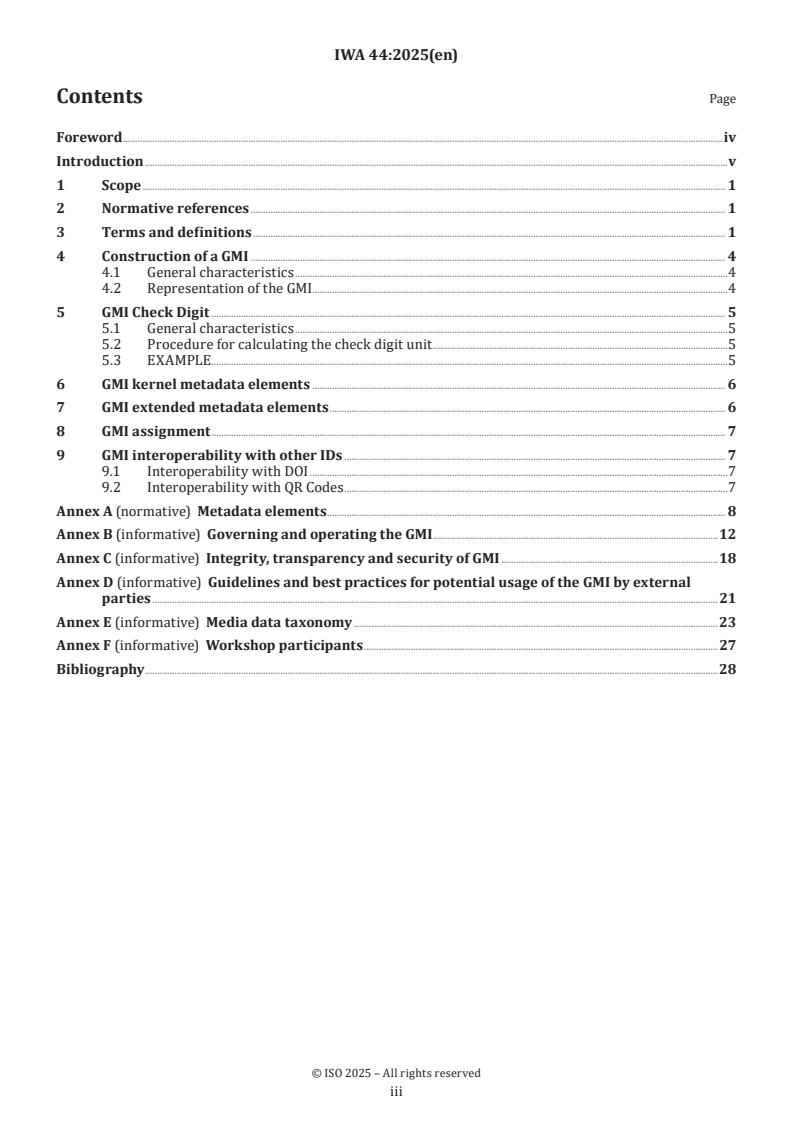
Contents Page
Foreword .iv
Introduction .v
1 Scope . 1
2 Normative references . 1
3 Terms and definitions . 1
4 Construction of a GMI . 4
4.1 General characteristics .4
4.2 Representation of the GMI . .4
5 GMI Check Digit . 5
5.1 General characteristics .5
5.2 Procedure for calculating the check digit unit .5
5.3 EXAMPLE . .5
6 GMI kernel metadata elements . 6
7 GMI extended metadata elements . 6
8 GMI assignment . 7
9 GMI interoperability with other IDs . 7
9.1 Interoperability with DOI .7
9.2 Interoperability with QR Codes .7
Annex A (normative) Metadata elements . . 8
Annex B (informative) Governing and operating the GMI .12
Annex C (informative) Integrity, transparency and security of GMI .18
Annex D (informative) Guidelines and best practices for potential usage of the GMI by external
parties .21
Annex E (informative) Media data taxonomy .23
Annex F (informative) Workshop participants .27
Bibliography .28
iii
Foreword
ISO (the International Organization for Standardization) is a worldwide federation of national standards
bodies (ISO member bodies). The work of preparing International Standards is normally carried out through
ISO technical committees. Each member body interested in a subject for which a technical committee
has been established has the right to be represented on that committee. International organizations,
governmental and non-governmental, in liaison with ISO, also take part in the work. ISO collaborates closely
with the International Electrotechnical Commission (IEC) on all matters of electrotechnical standardization.
The procedures used to develop this document and those intended for its further maintenance are described
in the ISO/IEC Directives, Part 1. In particular, the different approval criteria needed for the different types
of ISO document should be noted. This document was drafted in accordance with the editorial rules of the
ISO/IEC Directives, Part 2 (see www.iso.org/directives).
ISO draws attention to the possibility that the implementation of this document may involve the use of (a)
patent(s). ISO takes no position concerning the evidence, validity or applicability of any claimed patent
rights in respect thereof. As of the date of publication of this document, ISO had not received notice of (a)
patent(s) which may be required to implement this document. However, implementers are cautioned that
this may not represent the latest information, which may be obtained from the patent database available at
www.iso.org/patents. ISO shall not be held responsible for identifying any or all such patent rights.
Any trade name used in this document is information given for the convenience of users and does not
constitute an endorsement.
For an explanation of the voluntary nature of standards, the meaning of ISO specific terms and expressions
related to conformity assessment, as well as information about ISO's adherence to the World Trade
Organization (WTO) principles in the Technical Barriers to Trade (TBT), see www.iso.org/iso/foreword.html.
International Workshop Agreement IWA 44 was approved at a workshop hosted by the German Institute
for Standardization (DIN), in association with the Global Media Registry (GMR), held in Berlin, Germany, in
January 2025.
Any feedback or questions on this document should be directed to the user’s national standards body. A
complete listing of these bodies can be found at www.iso.org/members.html.
iv
Introduction
In July 2023, the Global Media Registry (GMR) and the German Institute for Standardization (DIN) submitted
a proposal to the Secretariat of the ISO Technical Management Board (TMB) for the development of an ISO
International Workshop Agreement (IWA).
The foundation of this IWA workshop was approved by the ISO members in November 2023. To ensure
that the broadest range of interested parties worldwide participated in the workshop, an invitation letter
was circulated to all ISO members and other potential stakeholders on 2023-11-16 and registration to the
workshop was possible until 2024-02-23.
This document was discussed and approved at a series of workshops held between February 2024 and
January 2025. This included an internal commenting phase as well as a public consultation phase.
Global Media Identifiers (GMI), as covered by this document, are a tool to enhance the integrity of the online
news ecosystem. Among other things, it helps to harmonise and improve the effectiveness of respective
signalling along the distribution chain to facilitate content indexation and recommendation by online
platforms (e.g. search, streaming and social media). In addition, the deliverables of this document can be used
by all other stakeholders that engage with mass media and content distribution online, such as providers/
operators of advertising technology, and public sector actors (e.g. regulatory authorities).
The aim of the GMI is to establish source identity, for example, between channels operated by the same
editorial unit across platforms, news media websites and their social media presence. Such an interoperable
system of GMIs is crucial to safeguarding the integrity of news and information ecosystems, which is relevant
when publishing, accessing, and managing content online. Additional parties engaged in this information
ecosystem such as individuals (influencers, bloggers, or independent journalists), as well as third-party
aggregators and other distributors, can be considered for GMI assignment.
GMIs are part of an open and scalable infrastructure of identifier systems and indicators that aim to
safeguard the transparency, responsibility and accountability of online content and its sources. The
purpose of this document is not to replace existing standards and indicators, but to add a holistic and global
framework with a view of harmonising them.
The functioning of our shared information space depends on digital infrastructure and platforms. Their
protocols and algorithmic-driven recommender systems determine how content can be accessed by users
online. In order to function properly, these recommender systems require up-to-date criteria by which
content is included, promoted or even excluded based upon inclusion lists of trustworthy sources of content,
or exclusion lists of bad actors.
The unique key of the GMI is designed to provide signal transparency and integrity in a neutral way and
is assigned to media outlets (which means all distribution channels and brands of a content provider), so
that the industry, regulators, audiences and other stakeholders can unambiguously identify the respective
source of information, for example, in order to trace back and identify its ultimate beneficial owner.
Identifiers of media are not a new idea. Most, if not all, major stakeholders concerned (such as social media
platforms and search engines, the advertising sector and public actors, such as national regulators, and
academic researchers) already use their own identifiers to index media companies, their outlets, brands and
channels, but those lists are often incomplete and not harmonized. The GMI is an effective and transparent
alternative or complement to these diffuse attempts. It mitigates related risks by facilitating harmonization
both vertically (e.g. between platforms and signal providers) and horizontally (e.g. amongst platforms and
ad-tech). This reduces errors, speeds up the processes, and prevents the mismatches and mix-ups that are
common in this space.
Many countries and transnational entities are currently in the process of updating their regulatory
frameworks to better reflect the realities of the online environment, safeguard transparency and protect the
rights of users. Assigning news sources with GMIs can enable key players to more effectively comply with
this kind of regulation. Some examples from the European Union (EU) context are the Digital Services Act
that requires online services to take effective mitigation measures against online risks, and the Copyright
Directive which obliges online platforms to pay rights holders for their content. The European Media
Freedom Act foresees a protected status for news media publishers and their accounts on social media.
v
Additionally, the co-regulatory Code of Practice on Disinformation prescribes indicators of trustworthiness
of online sources, to better inform users, guide content recommendation and to make advertising placement
more transparent. At the same time, compliance with the General Data Protection Regulation can affect the
assigning and managing of the GMI.
As highlighted above, current efforts to assign identifiers to online media have some shortcomings. A
problem occurs when different lists categorise accounts according to different criteria. This might be the
case with brands of the same name (e.g. there are several dozen media outlets called "Phoenix"), or with
affiliates, syndicated channels or sister-brands of the same origin, that might follow different editorial lines
(e.g. Al Jazeera, Phoenix or Fox). Even when a web-domain or social media account is always distinct, it might
not be immediately clear to which media outlet or company it belongs. This can lead to conflicting or wrong
signals, misleading algorithmic indexation and negatively impacting site integrity and user experience. Bad
actors can capitalise on this deficiency and try to game the recommender systems with similar sounding
names of channels, accounts, or brands.
Industry standard setting is a useful tool to solve the outlined problem in a fully self-regulatory and
consensual, but still authoritative way. Examples of such conventions are the two- or three-letter country
codes, the three letter codes for airports, or the international bank account number (IBAN). Specific to the
content creation process, the international standard name identifier (ISNI) is an identifier for the public
identity of parties.
The GMI project was proposed by the Global Media Registry, a Germany-based non-profit social enterprise
that supports transparency, accountability, and pluralism in the digital information space. The GMR is a
member of the Global Forum for Media Development (GFMD), a consortium member of the Global Media
and Internet Concentration Project (GMICP) and a member of the Media Freedom Cohort of the Summit for
Democracy. The proposer of the workshop has, in advance, taken into account the work of existing ISO/TCs
such as:
— ISO/TC 46, Information and documentation, Subcommittee SC 9, Identification and description;
— ISO/TC 204, Intelligent transport systems;
— ISO/TC 289, Brand evaluation;
— ISO/IEC JTC 1, Information technology;
— IEC/TC 100, Audio, video and multimedia systems and equipment.
Members or officials of the aforementioned ISO/TCs have actively participated in the preparation or
elaboration of this document. The IWA 44 workshop members have organized themselves in dedicated
subgroups on certain aspects of this document:
— subgroup on syntax and taxonomy to identify a possible format and the elements that are most suitable
for the GMI, based on use cases. This work includes the definitions of terminology, the entity relationships
and the scope of applicability, e.g. with regards to individuals;
— subgroup on operations and governance to identify the aspects relevant for assigning and managing
the GMI, including recommendations for possible entities involved in the process and their roles in the
governance, possible methods of assigning GMI keys (e.g. automated, curated or mixed) and business
model considerations;
— subgroup on integrity, transparency and security to assess relevant aspects of security, to identify
mechanisms to prevent misuse and to ensure that the GMI serves as a trusted resource for the industry
and audiences.
See Annex B for information about the governance and operation of the GMI.
See Annex F for information regarding workshop participants for this document.
vi
International Workshop Agreement IWA 44:2025(en)
Global Media Identifier (GMI) for distribution channels
and brands
1 Scope
This document provides requirements and recommendations for the structure and associated metadata to
be included and the governance of the Global Media Identifier (GMI) that can be assigned to all media outlets
that publish content online. The identification of material or physical objects is out of scope of this document.
This document also considers the GMI’s technical infrastructure and its practical implementation. It is a
neutral, non-judgemental numbering or naming convention, not a certification scheme. This document does
not include any provisions for the assessment of online content, e.g. as regards its trustworthiness, quality,
or an outlet’s conformance with journalistic standards.
2 Normative references
The following documents are referred to in the text in such a way that some or all of their content constitutes
requirements of this document. For dated references, only the edition cited applies. For undated references,
the latest edition of the referenced document (including any amendments) applies.
ISO 639, Code individual languages and language groups
ISO 3166-1, Codes for the representation of names of countries and their subdivisions — Part 1: Country code
ISO 3166-3, Codes for the representation of names of countries and their subdivisions — Part 3: Code for formerly
used names of countries
ISO 8601-1:2019, Date and time — Representations for information interchange — Part 1: Basic rules
ISO 17442-1, Financial services — Legal entity identifier (LEI) — Part 1: Assignment
ISO 26324, Information and documentation — Digital object identifier system
ISO/IEC 7064:2003, Information technology — Security techniques — Check character systems
ISO/IEC 18004, Information technology — Automatic identification and data capture techniques — QR code
bar code symbology specification
IETF RFC 4648, The Base16, Base32, and Base64 Data Encodings
3 Terms and definitions
For the purposes of this document, the following terms and definitions apply.
ISO and IEC maintain terminology databases for use in standardization at the following addresses:
— ISO Online browsing platform: available at https:// www .iso .org/ obp
— IEC Electropedia: available at https:// www .electropedia .org/
3.1
GMI system
global media identifier system
technical and management infrastructure that supports the assignment of GMI keys (3.2) and provides for
the network’s long-term maintenance, resolution and governance
3.2
GMI key
global media identifier key
alphanumeric string representing a unique outlet (3.10) in the GMI system (3.1)
3.3
code point
value in the universal coded character set (UCS) codespace
[SOURCE: ISO/IEC 10646:2020, 3.9]
3.4
GMI syntax
global media identifier syntax
rules for the form and sequence of code points (3.3) comprising any GMI key (3.2), specifically the form and
sequence of code points of a GMIprefix element (3.5) and suffix element (3.6)
3.5
GMI prefix
global media identifier prefix
unique string of code points (3.3) forming part of the beginning element of the GMI syntax (3.4)
3.6
GMI suffix
global media identifier suffix
unique string of code points (3.3) forming part of the ending element of the GMI syntax (3.4)
3.7
GMI kernel metadata
global media identifier kernel metadata
specific data associated with the outlet (3.10) identified with a GMI key (3.2) that is based on a data model
that is sufficient to uniquely identify the outlet
Note 1 to entry: Kernel metadata is specified in Annex A;
Note 2 to entry: Kernel metadata is mandatory in the metadata model.
3.8
GMI extended metadata
global media identifier extended metadata
specific data associated with the outlet (3.10) identified with a GMI key (3.2) that provides additional
information related to the outlet
Note 1 to entry: Examples of extended metadata are specified as optional in Annex A.
Note 2 to entry: Extended GMI metadata is managed by the issuing agent (3.9) with data of any desired degree of
precision and granularity to support identification and description in their market (3.12).
3.9
issuing agent
organization that assigns and registers a particular GMI key (3.2) to an outlet (3.10)
Note 1 to entry: Issuing agents can be registered and accredited within the GMI system (3.1) through a registration
authority.
3.10
outlet
media outlet
editorial entity that is the source of content with designated staff, distribution channels (3.14), assets (3.15)
and frequent or periodical output
Note 1 to entry: There is at least one ultimate beneficial owner (3.12).
Note 2 to entry: Usually, a legal entity (3.11) is affiliated with the outlet.
Note 3 to entry: Different channels of one outlet can target different media markets (3.13).
3.11
legal entity
registered body, usually a company or non-profit organisation, which is formed and owned by one or more
natural persons to engage in commercial activities, or a public-law body
Note 1 to entry: Through its registration, legal entities are always tied distinctively to one country, but can operate in
several language markets (3.13).
Note 2 to entry: Natural persons who partly or fully own and control a legal entity are owners (3.12).
3.12
owner
natural person who owns or controls a legal entity (3.11), typically through shares and voting rights as its
ultimate beneficiary
Note 1 to entry: A special case is the state as an owner, mostly represented by public law bodies, like a ministry or
other authority instead of natural persons.
Note 2 to entry: Another special case are some public service media entities stipulated by law and thus, existing in
their own right without any individual, let alone ultimate beneficial owner in a strictly legal sense.
3.13
media market
target area of channel (3.14) as a combination of the geographical or territorial dimension, defined by at
least one country or more, and one language or more
Note 1 to entry: Target markets can differ from jurisdiction (country) where an outlet (3.10) is either registered or
operates from, or both.
3.14
channel
distribution channel of a media outlet (3.10) and its editorial content
EXAMPLE FM radio frequency, a social media account or streaming channel
Note 1 to entry: A channel is always distinct and tied to one outlet.
Note 2 to entry: The affiliation of a channel might be ambiguous or fully covert (e. g. anonymous social media accounts,
impersonation, "pirate" radio stations).
Note 3 to entry: Different channels (3.13) of one outlet (3.10) can target different markets (3.13).
3.15
asset
content brand, such as a show, segment or publication title under an outlet (3.10)
Note 1 to entry: Assets are not part of the GMI scope, however the definition and an optional metadata element are
included to clarify terminology and allow for referencing content brands affiliated with a media outlet.
4 Construction of a GMI
4.1 General characteristics
A GMI key shall consist of an ordered sequence of case-insensitive alphanumeric code points encoded URI-
safe base64uri character set as defined in IETF RFC 4648 using the alphanumeric Latin characters A-Z in
capital and lowercase and the numbers 0-9.
NOTE The term code point is used instead of the term character, which is ambiguous in the context of Unicode
where a given abstract character can be encoded in multiple ways.
The code points are arranged in a GMI prefix and a GMI suffix and a two-element check digit:
a) GMI prefix: The GMI prefix shall consist of a string of four code points assigned by a registration
authority to the issuing agent.
b) GMI suffix: The GMI suffix shall consist of a string of ten code points identifying the outlet. The GMI
suffix shall be assigned by the issuing agent.
c) GMI checksum: The GMI checksum shall consist of two final code points.
Table 1 shows the structure of the GMI key.
Table 1 — Example of a GMI key
GMI Code 1 2 3 4 5 6 7 8 9 10 11 12 13 14 15 16
Point
GMI prefix: GMI suffix: GMI check-
issuing agent code – as- identifier for outlet – assigned by the issuing agent sum digits
signed by the registra-
tion authority
Example Z Z Z Z X X X X X X X X X X # #
The last two characters of the GMI key shall consist of a check digit element to ensure the validity of the GMI
key. The method for calculating the check digit element is described in Clause 5.
Further constraints on code points (e.g. the use of numeric characters only) can be defined for an application
by either the registration authority or by the issuing agency.
The combination of a GMI prefix (assigned by a registration authority to a particular GMI issuing agent) and
a GMI suffix (assigned by the issuing agent to a specific outlet) shall be unique. While GMI prefix may be
duplicative within the context of a specific issuing agent and, alternatively, a GMI suffix may be duplicated
across different issuing agents, the combination across the issuing agencies name spaces should prevent
GMI conflicts. This enables the decentralized allocation of GMI keys. The registration of the combination of
the prefix and suffix in the GMI system serves to validate the GMI syntax for a given GMI key. Care should
be taken to ensure that the same outlet is not identified multiple times through the use of a deduplication
process before the assignment is registered.
4.2 Representation of the GMI
In a human-readable context, the GMI key should be displayed as “GMI: ” followed by the GMI key. For human
readability, the GMI key may be separated by spaces but these spaces are not to be considered part of the
canonical representation of the GMI key.
For interoperability purposes with other identifiers (such as DOI) or for human readability, the GMI prefix
and GMI suffix may be separated by U+002F SOLIDUS. Alternatively, the U+002F SOLIDUS may be included
into the GMI key within the GMI suffix code point string. The canonical GMI key shall be the code point
string without the solidus separator.
NOTE U+002F SOLIDUS is also referred to as forward slash ("/").
The GMI key shall be regarded as an opaque string by users of the GMI system. No definitive information shall
be inferred from the specific sequence of code points that make up a GMI key, apart from the issuing agent
prefix. In particular, the inclusion in a GMI key of any GMI prefix allocated to a specific issuing agent does
not provide evidence of the ownership of rights, the current management responsibility of any intellectual
property in the referent, or in any relations to the geographical location of the owner of the outlet. The mere
assignment of a GMI key shall not imply endorsement of the outlet by any party.
5 GMI Check Digit
5.1 General characteristics
The GMI suffix shall end in a two-code point check digit unit. This unit shall be calculated and appended to
the first 14 code points of the GMI key, including both the prefix and the suffix. The check digit pair is used to
verify that the GMI key is properly formed.
The check digit pair shall be calculated based on the simplified procedure defined in ISO/IEC 7064:2003
(MOD 97-10) after the conversion of the leftmost 14 alphanumeric characters of the GMI key consisting of
both the GMI prefix and the GMI suffix into a character string consisting only of digits.
Valid check digit pairs are in the range of [02 . 98]. 00, 01, and 99 are not valid GMI check digit pairs.
If the check digit pair has been calculated correctly, when the entire 16-character GMI is converted to
numbers following the process described in 5.2, step 1, and divided by 97 as described in 5.2, step 3, the
reminder shall be “1”.
5.2 Procedure for calculating the check digit unit
Step 1: The value of any code points that represent digits shall be equal to their numeric digit value between
0 and 9. Any code points representing letters in the first 14 code points of the GMI key shall be converted to
digit pairs in accordance with Table 2, described below.
Table 2 — GMI key digit pairs
A (or a) =10 F (or f) K (or k) P (or p) U (or u) Z (or z)
=15 =20 =25 =30 =35
B (or b) =11 G (or g) L (or l) Q (or q) V (or v)
—
=16 =21 =26 =31
C (or c) =12 H (or h) M (or m) R (or r) W (or w)
—
=17 =22 =27 =32
D (or d) =13 I (or i) =18 N (or n) S (or s) X (or x)
—
=23 =28 =33
E (or e) =14 J (or j) =19 O (or o) T (or t) Y (or y)
—
=24 =29 =34
Step 2: Two zeros shall be appended to the resulting string at the rightmost positions.
Step 3: A Euclidian division of the resulting number by 97 shall be performed to determine the remainder.
Step 4: The remainder shall be subtracted from 98 to determine the check digit pair.
Step 5: The check digit pair shall be appended to the original 14 alphanumeric characters to form the
16-character alphanumeric string.
5.3 EXAMPLE
Examples of this model:
— 9523Gg2t87xz8H53 – 9523 (issuing agent) Gg2t87xz8H (identifier of outlet) 53 (checksum)
— 8802Uu877V2Mo770 – 8802 (issuing agent) Uu877V2Mo7 (identifier of outlet) 70 (checksum)
NOTE 1 These examples are fictional GMI keys and do not represent an implementation model of the GMI key.
NOTE 2 There exists the risk of collisions with other related ID systems which can be interoperable with the GMI
system. To avoid this, the registration authority can work with other identification systems to set aside reserved code
blocks in related namespaces where GMI and other identifiers can overlap. This can ensure there is not duplicative
assignment of identifier strings.
6 GMI kernel metadata elements
The GMI kernel metadata captures those attributes that are core to identifying and disambiguating the
media outlet, as well as to ensure proper management of the GMI system. An issuing agent shall generate a
complete GMI kernel metadata record in the system for a resulting GMI key to be valid.
GMI kernel metadata are all required attributes of a GMI systems record. Some of these attributes may be
withheld from public distribution of media outlets within the GMI system.
The GMI kernel metadata shall include the following attributes:
— the GMI key;
— the name of outlet;
— a transliteration of the name of the outlet, if the name of the outlet is not presented in Latin script;
— the owner of the outlet (can be represented by an organizational identifier, such as LEI);
NOTE Owners can be anonymous, or unknown to the issuing agent.
— the language(s) of the outlet, represented in accordance with ISO 639;
— media market of the outlet (can be an array of geography and language);
— either the country or jurisdiction, or both, of the outlet, represented in accordance with ISO 3166-1 or
ISO 3166-3;
— It is possible that some regions are not formally recognized and therefore do not have an official
ISO 3166 series code assigned. In these cases, the Specially Reserved Codes as defined in ISO 3166-1
shall be used to identify geographic regions which the origin is clear but where a country is not
formally recognized. If the country of origin is unknown, the country of assignment shall be noted,
with the notation “(assigned in)” to avoid confusion with the location of the origin.
— the date of assignment;
— the date of last amendment to record;
— the media type or types, if there are multiple, of the outlet (e.g. print, digital, broadcast TV, radio).
Full details of the GMI kernel metadata elements are specified in Annex A.
A future registration authority can establish additional required fields beyond those described here in the
implementation of the GMI system.
7 GMI extended metadata elements
The GMI metadata record may contain other metadata elements that provide additional context and
information regarding the outlet, its owners, markets, or other attributes worthy of the investment of
creating and maintaining the information. This extended metadata record is managed by the issuing agent.
Some of these data can be shared with the registration authority.
Additional metadata which are recommended, although not required, are specified in Annex A.
The registration authority or issuing agents can in the future establish additional metadata elements beyond
those described here in the implementation of the GMI system.
8 GMI assignment
The GMI shall not be construed to replace other identifiers, such as ISSN, ISAN, ISNI, LEI and other commonly
recognised identifiers.
Rules for assignment of GMI keys and GMI extended metadata can vary based on a functional definition of
the assignment scope based on the requirements of an issuing agent.
The GMI key shall be associated with kernel metadata that describes the referent to which the GMI name is
assigned.
In some circumstances, specific attributes of kernel metadata can be unavailable. Terms like “unavailable”
or “anonymous” may be included in attributes and metadata associated with a GMI that have been withheld.
9 GMI interoperability with other IDs
9.1 Interoperability with DOI
The GMI key allows for the use of the code point U+002F (i.e. solidus or forward slash) as an alternate
representation of GMI key string. This allows for the possibility of interoperability of the GMI with the
DOI system.
The user shall apply the DOI system in accordance with ISO 26324. In the use case where the GMI is integrated
with the DOI system, the GMI prefix shall be represented with the DOI prefix and the GMI suffix shall
represent the DOI suffix, with the two separated by the U+002F code point. Further integration between the
metadata schema for the GMI and the DOI can be addressed in coordination between the issuing agent, the
registration authority associated with the GMI, and the registration authority associated with the DOI.
9.2 Interoperability with QR Codes
The GMI key is defined as being case-insensitive using base64uri characters. The encoding of lower-
case characters in a QR code shall have significantly more data representation in the code processing, in
accordance with ISO/IEC 18004. Therefore, in the use case of a GMI being applied to a QR code, the GMI
should be represented in capital letters to improve interoperability with the QR code system.
Annex A
(normative)
Metadata elements
A.1 Metadata elements
Table A.1 shows the metadata elements associated with a GMI key. Some of these data elements may be
arrays of information in an operational system, to record history, changes, valid keys, or other data that can
change over time. Table A.2 shows examples of potential metadata sets. See Annex E for a visualization of
the connectivity of the different metadata elements attached to the GMI, as well as adjacent identifiers.
NOTE Some of these data elements can be unavailable, anonymous, or withheld in various circumstances. The
registration authority associated with the GMI can establish rules for how issuing agents handle data.
Table A.1 — Metadata Elements
Kernel/required
– or –extended/op- Element Description Related information
tional
REQUIRED GMI KEY The GMI KEY code point
string
REQUIRED NAME OF Identified source name, in If the NAME OF MEDIA OUTLET is in a
MEDIA OUTLET original LANGUAGE/script non-Latin script, there should also be
a transliteration
REQUIRED LEGAL ENTITY LEGAL ENTITY that oper- ISO 17442-1 (LEI)
ates the OUTLET (or alternate if noted) or potentially a
natural person
REQUIRED ULTIMATE BENEFI- Natural person or public
CIAL OWNER law body that owns and
controls LEGAL ENTITY
REQUIRED MARKET Geographical/territorial ISO 3166-1 alpha-2, ISO 3166-3 alpha
area that the OUTLET 4, (required) or Region UN M49 (op-
targets, defined by one or tional)
more COUNTRY
Potential Array
REQUIRED LANGUAGE Primary language of the ISO 639 (required), and IETF BCP-47
content in the OUTLET (optional)
Potential Array
REQUIRED COUNTRY Jurisdiction in which ISO 3166-1 alpha-2, ISO 3166-3 alpha
LEGAL ENTITY is regis- 4
tered
REQUIRED INTERNET DOMAIN Internet domain of the DNS URL
OUTLET
Potential array
REQUIRED DATE Date of assignment/record Administrative metadata
update
ISO 8601-1:2019, 5.2.2.1 b) (required)
REQUIRED CATEGORY The format of OUTLET Controlled vocabulary to be defined
by the registration authority of the
format of the outlet, such as print,
web, audio, video, etc.
Potential array
REQUIRED REGISTRANT Entity that requests the
identifier
TTabablele A A.11 ((ccoonnttiinnueuedd))
Kernel/required
– or –extended/op- Element Description Related information
tional
REQUIRED LOCATION Location of the OWNER
(Could be as specific as an
address, or as general as
“City/Country”)
REQUIRED ISSUING AGENT Entity that recorded the Administrative metadata
registration
REQUIRED VERIFICATION STATUS Corroboration level of data Controlled vocabulary as determined
by the related registration authority
REQUIRED REGISTRATION STA- Status of the OUTLET, such Administrative metadata
TUS as “Active”, “Ceased”, “Inac-
tive”, etc.
REQUIRED REGISTRATION STA- Date of last status change Administrative metadata
TUS DATE CHANGE
ISO 8601-1:2019, 5.2.2.1 b) (required)
Potential array
OPTIONAL LEGAL ENTITY TYPE Controlled vocabulary of
OWNER types, such as
government, corporate,
non-profit
OPTIONAL VARIANT NAMES Variant names of the Potential array
OUTLET/publication (ac-
ronyms, etc.), repository
of brand names including
logos
OPTIONAL CHANNELS Structured repository of Potential array
distribution channels of
OUTLET
OPTIONAL ASSET Content brand, like a show, Potential array
segment or publication
title under a media OUT-
LET
OPTIONAL OTHER RELATED EN- Identifiers of related enti- If not directly related to channel or
TITIES / IDENTIFIERS ties (owners, translations, outlet from above
republishers) or identifiers
Potential array
that might relate to the
media outlet
OPTIONAL RELATED IDENTIFIER Description of the identifi- More information about the related
INFORMATION er (type, relationship) IDs above
Potential array
OPTIONAL ALTERNATE IDENTI- Other identifiers of the Potential array
FIERS media outlet
OPTIONAL ALTERNATE IDENTIFI- Description of the identifi- More information about the alternate
ER TYPE er type IDs above
Potential array
OPTIONAL REGISTRATION CON- Contact information of the Administrative metadata
TACT registering entity
OPTIONAL PUBLIC SIGNING KEY Used for cryptographic id
Table A.2 — Fictitious Examples of Metadata Set
Kernel/required Element fictitious example #1 fictitious example #2
– or –extended/op-
tional
REQUIRED GMI KEY 9523Gg2t87xz8H53 8802Uu877V2Mo770
REQUIRED NAME OF MEDIA OUT- The Springfield Daily On- TV1
LET line News
REQUIRED LEGAL ENTITY Daily News Founda- First Channel Media Ltd.
tion (LEI: 94AAF735A- (LEI: 5493001KJTIIGC8Y1M12)
7170011FA84)
REQUIRED ULTIMATE BENEFI- N/A (member owned) Jane Doe
CIAL OWNER
REQUIRED MARKET GBR [XXX]
REQUIRED LANGUAGE eng eng
REQUIRED COUNTRY GBR [Country X]
REQUIRED INTERNET DOMAIN www .thespringfielddaily www .firstchannel .xx
.co .uk
REQUIRED DATE 2024-08-07 2024-03-24
REQUIRED CATEGORY web audiovisual broadcaster and web
REQUIRED REGISTRANT Daily News Foundation Media Empire Holding Inc.
REQUIRED LOCATION Springfield, United King- Exampletown, [Country X]
dom
REQUIRED ISSUING AGENT IMPRESS ID-Hub Ltd.
REQUIRED VERIFICATION STATUS verified verified
REQUIRED REGISTRATION STA- active active
TUS
REQUIRED REGISTRATION STA- 2024-08-07 2024-09-09
TUS DATE CHANGE
OPTIONAL LEGAL ENTITY TYPE non-profit corporate
OPTIONAL VARIANT NAMES SDON, The Springfield Channel 1, The First, TV1
Daily, SpringDay
OPTIONAL CHANNELS www .thespringfielddaily www .firstchannel .xx (open-web), @
.co .uk (open-web), @ firstchannel, @tv1news (YouTube;
springfield-daily (YouTube; streaming platform), @1stchannel (X,
streaming platform), @ Facebook; social media platforms),
springfield-news-online 2.0° E 1115 MHz H (Star satellite),
(X, Facebook, Instagram, UHF channel 45, 656 MHz (terrestrial
Snapchat; social media broadcasting)
platforms)
OPTIONAL ASSET SDON-Kids, SDON local Daily News Hour, Quiztime, Morning
newsletter, Spring- Show, etc.
field4You, City-Council
LIVE
OPTIONAL OTHER RELATED EN- N/A WvbtU59zAJHYeo3
TITIES / IDENTIFIERS
OPTIONAL RELATED IDENTIFIER N/A GMI, Movie Channel Y
INFORMATION
OPTIONAL ALTERNATE IDENTI- N/A 10.5240/ABCD-1234-5678-9XYZ-
FIERS Q000-0000-U
TTabablele A A.22 ((ccoonnttiinnueuedd))
Kernel/required Element fictitious example #1 fictitious example #2
– or –extended/op-
tional
OPTIONAL ALTERNATE IDENTIFI- N/A EIDR
ER TYPE
OPTIONAL REGISTRATION CON- 16-18 New Bridge Street, 123 Streetname, Othercity, [Country
TACT London, England, EC4V X]
6AG
OPTIONAL PUBLIC SIGNING KEY MCowBQYDK2VwAyEA N/A
4oxcRUfK5BuwXI5dF4D
2p0/fEgRkMYPxYbghx2u
wYXM=
Annex B
(informative)
Governing and operating the GMI
B.1 General
B.1.1 Purpose
The success of the GMI depends on the demand for it. This can only be met and further nurtured if suitable
governance and operational structures are in place to issue the identifier and to maintain it together with
its related reference metadata.
The purpose of this annex is to lay out requirements for such an infrastructure, including recommendations
of how to implement it. This takes into account that the details of operating and governing the GMI system
are subject to terms and conditions of service and other contractual instruments implemented by the future
registration authority (RA) at a later stage.
It was decided to choose the format of a reference document, annexed to the actual workshop agreement, in
order to emphasise the difference in character of these two main chapters. The specification of the actual
identifier, as constituting the main body of this workshop agreement, can be further developed into an
International Standard. However, requirements and recommendations regarding the relevant governance
and operational models can be provided separately, e.g. in this document.
B.1.2 Guiding principles a
...
Questions, Comments and Discussion
Ask us and Technical Secretary will try to provide an answer. You can facilitate discussion about the standard in here.
Loading comments...