


ISO/R 963:1969
(Main)Title missing - Legacy paper document
Title missing - Legacy paper document
General Information
- Status
- Withdrawn
- Publication Date
- 31-Dec-1968
- Technical Committee
- ISO/TMBG - Technical Management Board - groups
- Drafting Committee
- ISO/TMBG - Technical Management Board - groups
- Current Stage
- 9599 - Withdrawal of International Standard
- Start Date
- 01-Jan-1974
- Completion Date
- 14-Feb-2026
Relations
- Consolidated By
ISO 6360-4:2004 - Dentistry — Number coding system for rotary instruments — Part 4: Specific characteristics of diamond instruments - Effective Date
- 28-Feb-2023
Buy Documents
ISO/R 963:1969 - Title missing - Legacy paper document Released:1/1/1969
ISO/R 963:1969 - Title missing - Legacy paper document Released:1/1/1969
Frequently Asked Questions
ISO/R 963:1969 is a standardization document published by the International Organization for Standardization (ISO). Its full title is "Title missing - Legacy paper document". This standard covers: Title missing - Legacy paper document
Title missing - Legacy paper document
ISO/R 963:1969 has the following relationships with other standards: It is inter standard links to ISO 6360-4:2004. Understanding these relationships helps ensure you are using the most current and applicable version of the standard.
ISO/R 963:1969 is available in PDF format for immediate download after purchase. The document can be added to your cart and obtained through the secure checkout process. Digital delivery ensures instant access to the complete standard document.
Standards Content (Sample)
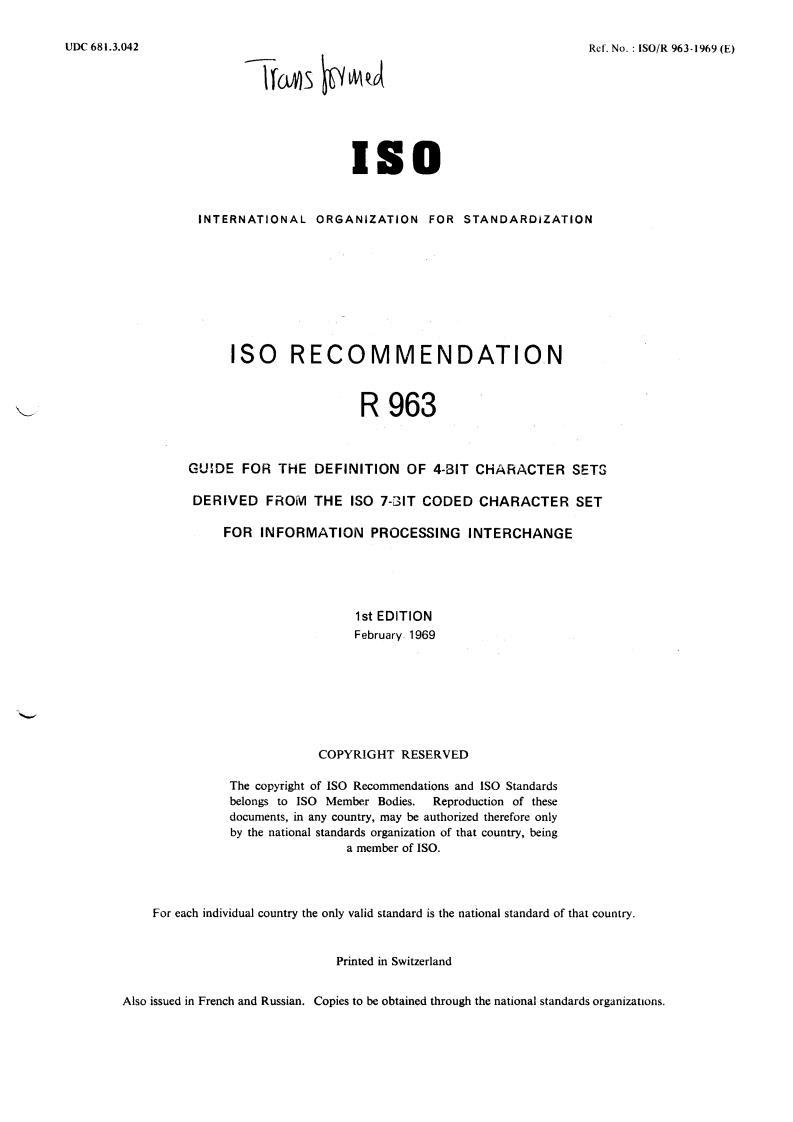
UDC 681.3.042 Ref. NO. : ISO/K 963-1969 (E)
I 1
IS0
I NT ERN AT1 ON A L O RG A N IZATl ON FOR STAND ARDi ZATl ON
IS0 RECO M M EN DATIO N
t R 963
GUSDE FOR THE DEFINITION OF 4-31T CHARACTER SETS
DERIVED Fi3OiVl THE IS0 7-BIT CODED CHARACTER SET
FOR INFORMATION PROCESSING INTERCHANGE
1st EDITION
February 1969
COPYRIGHT RESERVED
The copyright of IS0 Recommendations and IS0 Standards
belongs to IS0 Member Bodies. Reproduction of these
docunients, in any country, may be authorized therefore only
by the national standards organization of that country, being
a member of ISO.
For each individual country the only valid standard is the national standard of that country.
Printed in Switzerland
Also issued in French and Russian. Copies to be obtained through the national standards organizations.
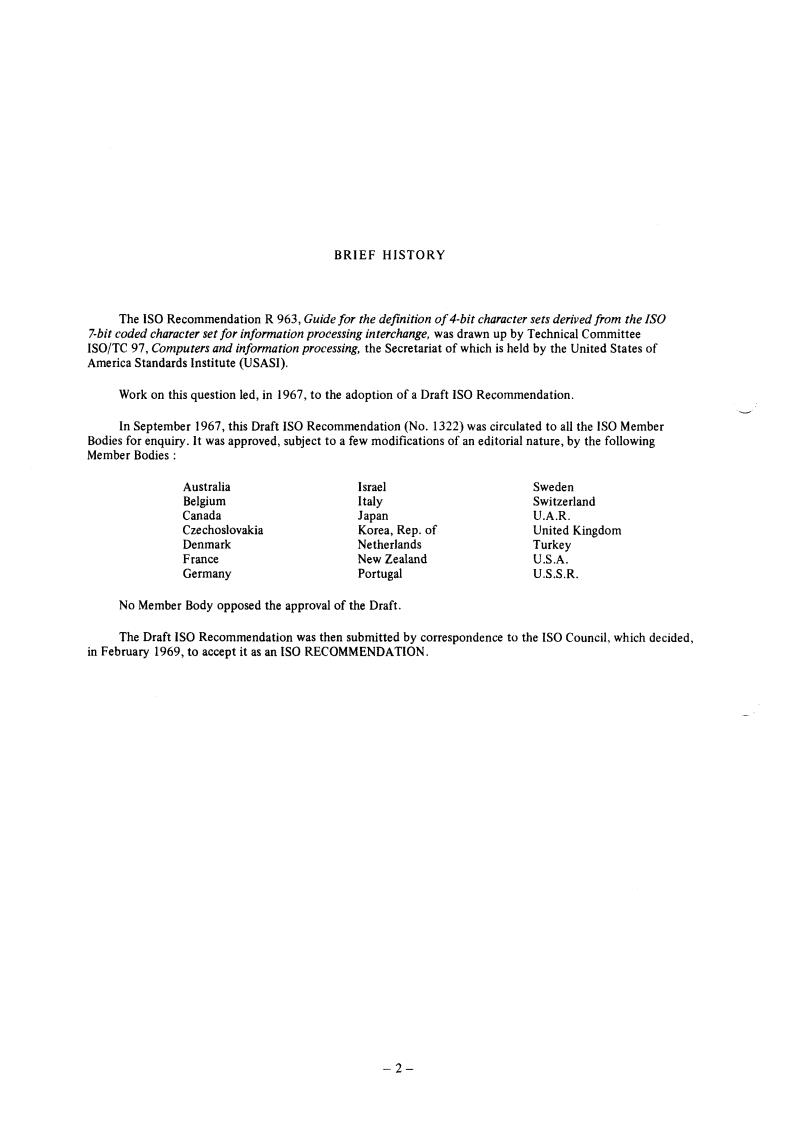
BRIEF HISTORY
IS0 Recommendation R 963, Guide jor the definition of 4-bit character sets derived from the IS0
The
Fbit coded character set for information processing interchange, was drawn up by Technical Committee
ISO/TC 97, Computers and information processing, the Secretariat of which is held by the United States of
America Standards Institute (USASI).
Work on this question led, in 1967, to the adoption of a Draft IS0 Recommendation.
In September 1967, this Draft IS0 Recommendation (No. 1322) was circulated to all the IS0 Member
Bodies for enquiry. It was approved, subject to a few modifications of an editorial nature, by the following
Member Bodies :
Australia Israel Sweden
Belgium Italy Switzerland
Canada Japan U.A.R.
Czechoslovakia Korea, Rep. of United Kingdom
Denmark Netherlands
Turkey
France New Zealand U.S.A.
Germany Portugal U .S .S .R.
No Member Body opposed the approval of the Draft.
The Draft IS0 Recommendation was then submitted by correspondence to the IS0 Council, which decided,
in February 1969, to accept it as an IS0 RECOMMENDATION.
-2-
ISO/R 963-1969 (E
IS0 Recommendation R 963 February 1969
GUIDE FOR THE DEFINITION OF 4-BIT CHARACTER SETS
DERIVED FROM THE IS0 7-BIT CODED CHARACTER SET
FOR INFORMATION PROCESSING INTERCHANGE
INTRODUCTION
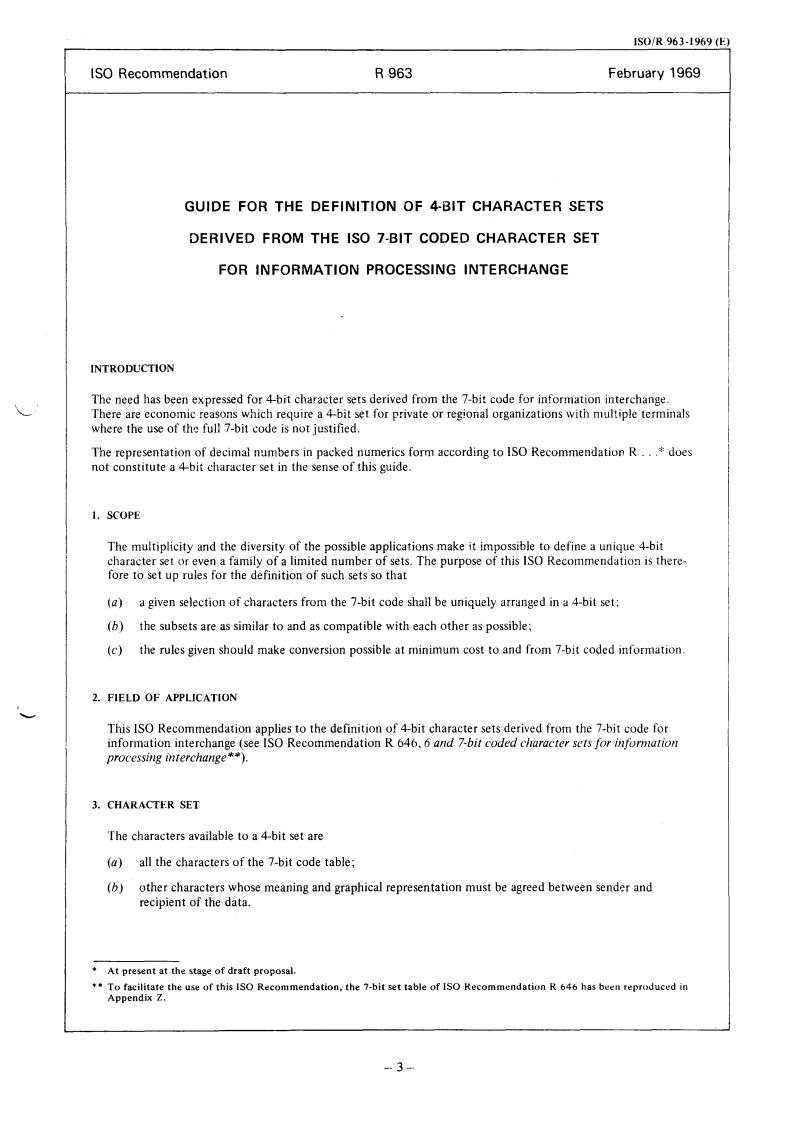
The need has been expressed for 4-bit character sets derived from the 7-bit code for information interchange.
There are economic reasons which require a 4bit set for private or regional organizations with multiple terminals
where the use of the fui: 7-bit code is not justified.
The representation of decimal numbers in packed numerics form according to IS0 Recommendatiori R . . .* does
not constitute a 4-bit character set in the sense of this guide.
1. SCOPE
The multiplicity and the diversity of the possible applications make it impossible to define a unique 4-bit
character set or even a family of a limited number of sets. The purpose of this IS0 Recornmendation is there-
fore to set up rules for the definition of such sets so that
a given selection of characters frem the 7-bit code shall be uniquely arranged in a 4-bit set;
(a)
the subsets are as similar to and as compatible with each other as possible;
(b)
the rules given should make conversion possible at minimum cost to and from 7-bit coded information
(c)
2. FIELD OF APPLICATION
This 1SO Recommendation applies to the definition of 4-bit character sets derived from the 7-bit code for
information interchange (see IS0 Recommendation R 646,6 and 7-bit coded cliaracter sets for inforniution
processing in terchange * *) .
3. CHARACTER SET
'The characters available to a 4-bit set are
all the characters of the 7-bit code table;
(a)
other characters whose meaning and graphical representation must be agreed between sendcr and
(h)
recipient of the data.
*
At present at the stage of draft proposal.
** To facilitate the use of this IS0 Recommendation, the 7-bit set table of IS0 Recommendation R 646 has berri reproduced in
Appendix Z.
-3-
ISO/R 963-1969 IE
4. DEFINITION OF A 4-BIT CHARACTER SET
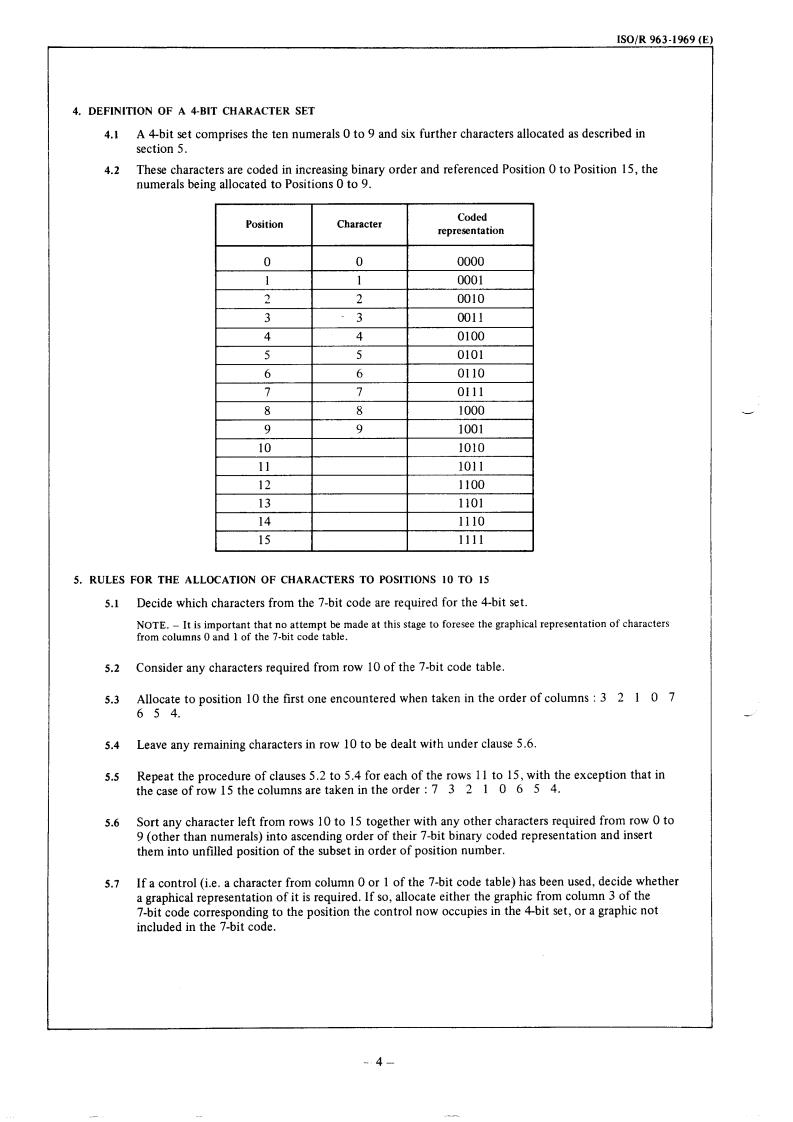
4.1 A Cbit set comprises the ten numerals O to 9 and six further characters allocated as described in
section 5.
These characters are coded in increasing binary order and referenced Position O to Position 15, the
4.2
numerals being allocated to Positions O to 9.
~~ ~~~
Coded
Position Character
representation
r
I 01 O I O000 I
1 1 O00 1
2 2 O010
3 -3 O01 1
I 5 I 5 I 0101 I
I 6 I 6 I O1 10 I
:"":/
10 1010
I Il I I 101 1 I
12 1100
13 1101
14 1110
I 15 I I 1111 I
5. RULES FOR THE ALLOCATION OF CHARACTERS TO POSITIONS 10 TO 15
5.1 Decide which characters from the 7-bit code are required for the 4-bit set.
NOTE. - It is important that no attempt be made at this stage to foresee the graphical representation of characters
from columns O and 1 of the 7-bit code table.
5.2 Consider any characters required from row 10 of the 7-bit code table.
Allocate to position 10 the first one encountered when taken in the order of columns : 3 2 1 O 7
5.3
6 5 4.
5.4 Leave any remaining characters in row 10 to be dealt with under clause 5.6.
5.5 Repeat the procedure of clauses 5.2 to 5.4 for each of the rows 1 1 to 15, with the exception that in
the case of row 15 the columns are taken in the order : 7 3 2 1 O 6 5 4.
5.6 Sort any character left from rows 10 to 15 together with any other characters required from row O to
9 (other than numerals) into ascending order of their 7-bit binary coded representation and insert
them into unfilled position of the subset in order of position number.
5.7 If a control (i.e. a character from column O or 1 of the 7-bit code table) has been used, decide whether
a graphical representation of it is required. If so, allocate either the graphic from column 3 of the
7-bit code corresponding to the position the control now occupies in the 4-bit set, or a graphic not
included in the 7-bit code.
- 4-
ISO/R 963-1969 (E
5.8 Allocate any required characters not included in the 7-bit code to the remaining vacant positions.
If a graphical representation is required of such a character, allocate either the graphic from
column 3 of the 7-bit code corresponding to the position which the character occupies in the +bit
set, or a graphic not included in the 7-bit code.
NOTE. -- For the selection of characters, it is recommended to proceed as follows :
select the non-numeric characters of the 4-hit set from the 7-bit code, even though other characters are not
(U)
prohibited;
select the characters in positions 10 to 15 of column 3 of the 7-bit code tablc (sec Appendix Z) to represent the
(h)
controls allocated to these positions, when the graphical representation is unimportant :O the application. However,
these graphics must not be used with the meaning of another graphic of the 7-bit code;
use, as far as possible, one but no more than one character from each of rows 10 to 15 of the 7-bit set table (%e
(c)
Appcndix Z).
-5-
lSO/R 963-1969 (E)
APPENDIX X
APPENDIX X
BACKGROUND AND DEVELOPMENT OF THE RULES
FOR FORMULATING 4BIT CHARACTER SETS
DERIVED FROM THE IS0 7-BIT CODE
X.l NEED FOR 4-BIT CHARACTER SETS
The need has been expressed for 4-bit sets derived from the 7-bit code, comprising O to Y and some additional
characters. There are economic reasons which require a 4-bit character set (or 4 information bits plus parity)
for private and regional organizations with multiple terminals where the full 7-bit code is not justified.
Nevertheless, such systems require a logical relationship to the 7-bit code since they must exchange
L
information with general purpose systems using the 7-bit code. Examples of such areas of application which
have becorne prominent are numeric control and data collection with particular field of application such as
those described by UIC (Union Internationale des Chemins de fer). Many of the potential fields of
application require data to pass across national boundaries, which makes it desirable to reach an
international understanding.
The purpose of this 4-bit standardization is not to set up another code for interchange between computers;
that is recognized to be the IS0 7-bit code. It is to permit simple closed systems to communicate with
each other at the 4-bit level in such a way that, when conversion to 7-bit is necessary, it can be achieved
easily and with the minimum of cost.
X.2 MEDIA CONSIDERATION
Examples of the media involved are punched tape, communication channels and certain classes of printed
documents. The devices likely to be involved in such applications will probably require a minimum key-
board (to reduce cost). Where punched tape andior communication channels are involved, a parity bit may
be added to provide a check against malfunctioning of the terminal device and for simple protection of the
transmission links. In order to allow the use of the all zeros combination in the four data bits, it would be
essential to use odd parity to distinguish it from unpunched tape.
L
X.3 CHARACTER SETS REQUIRED
Consideration of the different 4-bi
...
Ref. No : ISOiR 963-1969 (F)
CDU 681.3.042
IS0
ORGAN I SAT1 ON INTERN AT I ON A LE DE NORM A LI SAT1 ON
RECOMMANDATION IS0
R 963
GUIDE POIJR LA DÉFINITION DE JEUX DE CARACTÈRES À 4 ÉLÉMENTS
DÉRIVÉS DU JEU ISO DE CARACTÈRES co~És À 7 ELEMENTS
POUR L‘ÉCHANGE D’INFORMATION ENTRE MATÉR I E LS
DE TRAITEMENT DE L‘INFORMATION
ière EDITION
Février 1969
REPRODUCTION INTERDITE
Le droit de reproduction des Recommandations IS0 et des Normes
IS0 est la propriété des Comités Membres de I’ISO. En consé-
quence, dans chaque pays, la reproduction de ces documents ne
peut être autorisée que par l’organisation nationale de normali-
sation de ce pays, membre de I’ISO.
Seules les normes nationales sont valables dans leurs pays respectifs.
Imprimé en Stiisse
Ce document est également édité en anglais et en russe. II peut être obtenu auprès des organisations
nationales de normalisation.
HISTORIQUE
La Recommandation ISOIR 963, Guide pour la définition de jeux de caractères à 4 éléments dérivés du jeu
IS0 de caractères codes à 7 elements pour l’échange d’information entre matériels de traitement de I’injomation,
a été élaborée par le Comité Technique 1SOITC 97, Calculateurs et traitement de l’information, dont le Secrétariat
est assuré par le United States of America Standards lnstitute (USASI).
Les travaux relatifs à cette question aboutirent. en 1967, à l’adoption d’un Projet de Recommandation ISO.
En septembre 1967, ce Projet de Recommandation IS0 (NO 1332) fut soumis à l’enquête de tous les Comités
Membres de 1’1SO. il fut approuvé, sous réserve de quelques modifications d’ordre rédactionnel, par les Comités
Membres suivants :
Allemagne Israël Royaume-Uni
Australie Italie Suède
Belgique Japon Suisse
Canada Nouvelle-Zélacde Tchécoslovaquie
Corée, Rép. de Pays-Bas Turquie
Danemark
Portugal U.R.S.S.
France R.A.U. U.S.A.
Aucun Comité Membre ne se déclara opposé à l’approbation du Projet.
Le Projet de Recommandation IS0 fut alors soumis par correspondance au Conseil de 1’1SO qui décida, en
février 1969, de l’accepter comme RECOMMANDATION ISO.
-2-
ISO/R 963-1969 (F)
Recommandation IS0 R 963 Février 1969
GUIDE POUR LA DÉFINITION DE JEUX DE CARACTÈRES À 4 ÉLÉMENTS
DÉRIVÉS DU JEU ISO DE CARACTÈRES CODÉS À 7 ÉLÉMENTS
POUR L’ÉCHANGE D’INFORMATION ENTRE MATERIELS
DE TRAITEMENT DE L’INFORMATION
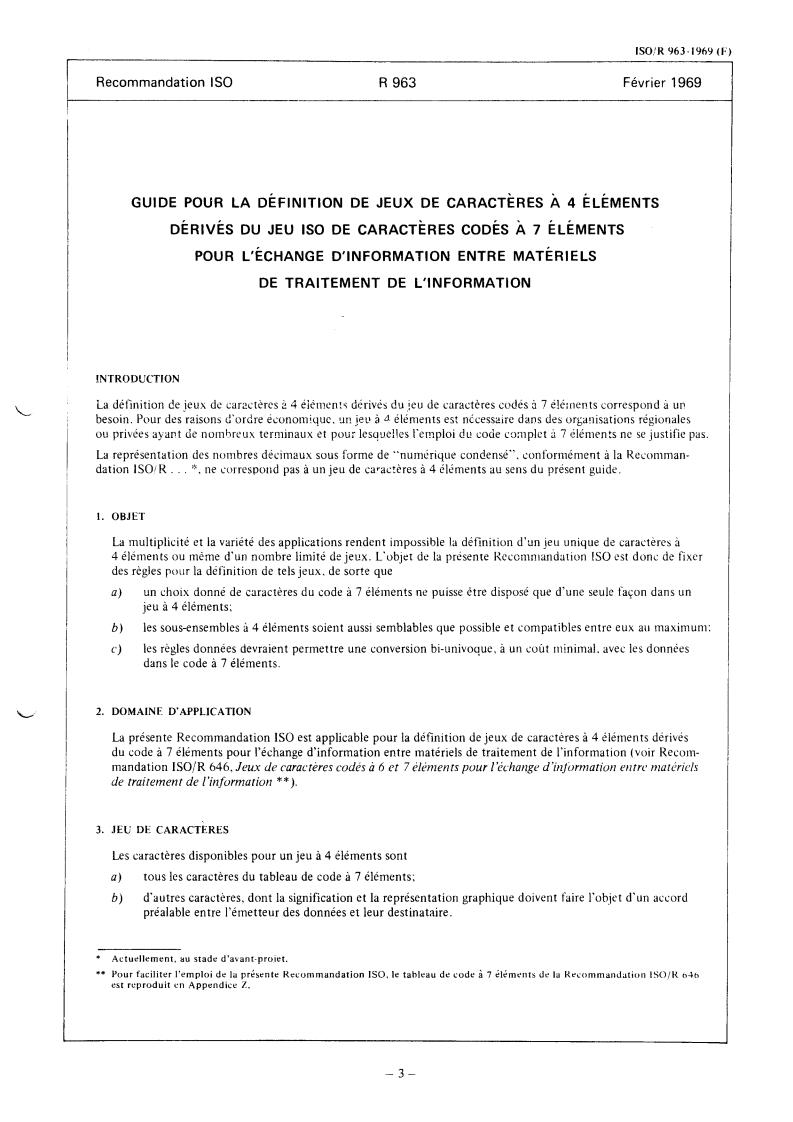
lNTRûDUCTlON
La définition de jeux de carrctères ri 4 éiétiien!s dérivés du jeu de caractères codés i 7 élé:rients correspond ii UP
besoin. Pour des raisons d’ordre éconorriiquc. w! jeu à a éléments es! nicesszire dans des organisations régionales
ou privées ayapt de nombreux terminaux et pow lesuve!!es l‘emploi du code complet i 7 éIénien:s ne se justifie pas.
La représentation des nombres décimaux sous farme de “numcrique condensé”. conformément i la Kecotnman-
dation ISO/K . . . ‘%. ne correspoiid pas à un jeu de caractères à 4 éléments au sens du présent guide.
1. OBJET
La multiplicité et la variété des applications rendent impossible la définition d’un jeu unique de caractères ii
4 éléments ou même d’un nombre limité de jecx. L’objet de la présente Kcccniniaridarion IS0 est donc de fixer
des règles pour la définition de tels jeux, de sorte que
un choix donné de caractères du code i 7 éléments ne puisse etre disposé que d’une seule faqon dans un
a)
jeu à 4 éléments;
les sous-ensembles i 4 éléments soient aussi semblables que possible et compatibles entre eux au maximuni:
b)
les règles données devraient permettre une conversion bi-univoque, à un coût iiiinimal. avec les données
c)
dans le code à 7 éléments.
2. DOMAINE D’APPLICATION
La présente Recommandation IS0 est applicable pour la définition de jeux de caractères à 4 éléments dérivés
du code à 7 éléments pour l’échange d’information entre matériels de traitement de l’information (voir Recoin-
mandation ISO/R 646, Jeux de caractères codés à 6 et 7 éléments pour l’échange d’irifbrmation etirrc, niurkricls
de traitement de l’in formation * * ).
3. JEU DE CARACTÈRES
Les caractères disponibles pour un jeu à 4 éléments sont
tous les caractères du tableau de code i 7 éléments;
a)
d’autres caractères, dont la signification et la représentation graphique doivent faire l’objet d’un accord
b)
préalable entre l’émetteur des données et leur destinataire.
* Actuellement, au stade d’avant-proiet.
*Ii Pour faciliter l’emploi de la prkente Recommandation ISO. le tableau de code à 7 dsmerits de la Kecomrnaiidütioii iSO/K o4h
est reproduit en Appendice %.
-3-
ISO/R 963-1969 (F)
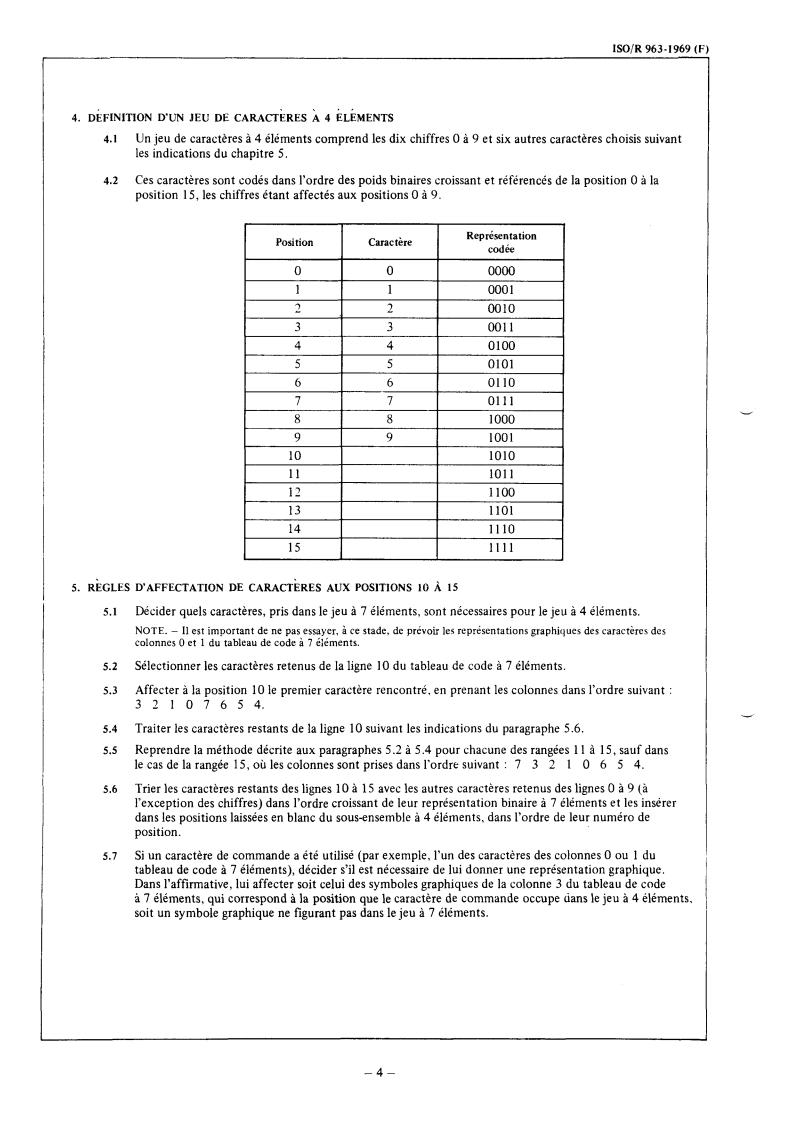
4. DÉFINITION D’UN JEU DE CARACTÈRES À 4 ÉLÉMENTS
4.1 Un jeu de caractères à 4 éléments comprend les dix chiffres O à 9 et six autres caractères choisis suivant
les indications du chapitre 5.
4.2 Ces caractères sont codés dans l’ordre des poids binaires croissant et référencés de la position O à la
position 15, les chiffres étant affectés aux positions O à 9.
Représentation
Position Caractère
I codée
I I I
O O
O000
I 1
I
1 O00 1
3 2 I 0010
I
3 3
O01 1
4 4
5 0101
I 5 I I I
6 O1 10
6 I I I
7 7 0111
8 8 1 O00
i
11 101 1
I 12 I 1100
13 I I I
14 1110
15 1111
5. RÈGLES D’AFFECTATION DE CARACTÈRES AUX POSITIONS 10 À 15
Décider quels caractères, pris dans le jeu à 7 éléments, sont nécessaires pour le jeu à 4 éléments.
5.1
NOTE. - I1 est important de ne pas essayer, à ce stade, de prévoir les representations graphiques des caractères des
colonnes O et 1 du tableau de code a 7 6;érnents.
Sélectionner les caractères retenus de la ligne 10 du tableau de code à 7 éléments.
5.2
Affecter à la position 10 le premier caractère rencontré, en prenant les colonnes dans l’ordre suivant :
5.3
32107654.
Traiter les caractères restants de la ligne 10 suivant les indications du paragraphe 5.6.
5.4
Reprendre la méthode décrite aux paragraphes 5.2 à 5.4 pour chacune des rangées 11 à 15, sauf dans
5.5
le cas de la rangée 15, où les colonnes sont prises dans l’ordre suivant : 7 3 2 1 O 6 5 4.
Trier les caractères restants des lignes 10 à 15 avec les autres caractères retenus des lignes O à 9 (à
5.6
l’exception des chiffres) dans l’ordre croissant de leur représentation binaire à 7 éléments et les insérer
dans les positions laissées en blanc du sous-ensemble à 4 éléments, dans l’ordre de leur numéro de
position.
Si un caractère de commande a été utilisé (par exemple, l’un des caractères des colonnes O ou 1 du
5.7
tableau de code à 7 éléments), décider s’il est nécessaire de lui donner une représentation graphique.
Dans l’affirmative, lui affecter soit celui des symboles graphiques de la colonne 3 du tableau de code
à 7 éléments, qui correspond à la position que le caractère de commande occupe uans le jeu à 4 éléments,
soit un symbole graphique ne figurant pas dans le jeu à 7 éléments.
-4-
ISO/’R 963-1969 (f
5.8 Affecter aux positions vacantes tout caractère ne figurant pas dans le jeu à 7 éléments. S’il est
nécessaire de lui donner une représentation graphique, lui affecter soit celui des symboles graphiques
de la colonne 3 du tableau de code à 7 éléments, qui correspond à la position que le caractère occupe
dans le jeu à 4 éléments, soit un symbole graphique ne figurant pas dans le jeu à 7 éléments.
NOTE. - Pour le choix des caractères, il est recommandé de procéder comme suit :
Choisir les caractères non numériques du jeu a 4 elements dans le jeu i 7 éléments, bien que d’autres caractères nc
a)
soient pas interdits.
Choisir les caractères dans les positions 10 à 15 de la colonne 3 du tableau de code i 7 6lénients (voir Appendice Z)
b)
pour représenter les commandes affectées a ces positions, en particulier lorsque la reprkentation graphique cst van\
importance. Cependant, ces symboles graphiques ne doivent pas être utilise5 avec la signification d’un autre symbole
graphique du jeu a 7 éléments.
ci N’utiliser, dans la mesure du possible, qu’un seul caractère des lignes 10 a 15 du tableau de code a 7 déments (voir
Appendice Z).
-5-
ISO/R 963-1969 (F)
APPENDICE X
APPENDICE X
ORIGINE ET MISE AU POINT DES RÈGLES
POUR LA DÉFINITION DE JEUX DE CARACTÈRES À 4 ÉLÉMENTS
DÉRIVÉS DU JEU ISO DE CARACTÈRES CODÉS À 7 ÉLÉMENTS
x.1 UTILITÉ DES JEUX DE CARACTÈRES À 4 ÉLÉMENTS
La définition de jeux de caractères à 4 éléments, comprenant les chiffres O à 9 et quelques caractères addition-
nels, dérivés du jeu de caractères codés à 7 éléments correspond à un besoin. Pour des raisons d’ordre économi-
L
que, un jeu de caractères à 4 éléments (ou 4 éléments d’information et un élément de parité) est nécessaire dans
des organisations régionales ou privées ayant de nombreux terminaux et pour lesquelles l’emploi du code complet
à 7 éléments ne se justifie pas. Néanmoins, de tels systèmes exigent une liaison logique avec le code à 7 éléments,
car ils doivent échanger des informations avec des systèmes à usage général utilisant le code à 7 éléments. La
commande numérique et la saisie de données dans des domaines d’application précis comme celui proposé par
I’UIC (Union Internationale des Chemins de fer) sont des exemples d’application, qui sont devenus importants.
De nombreux domaines d’application font déborder l’information des frontières nationales, ce qui rend désirable
une entente internationale.
L’objet de la normalisation de jeux à 4 éléments n’est pas de créer un autre code destiné à l’échange d’informa-
tion entre calculateurs; il est reconnu que c’est l’objet du code IS0 à 7 éléments. Elle doit permettre aux systèmes
simples, en circuit fermé, de communiquer entre eux au niveau de 4 éléments de telle manière que. lorsqu’une
conversion à 7 éléments s’avère nécessaire, elle peut être réalisée aisément et au moindre prix.
X.2 PRISE EN CONSIDERATION DES SUPPORTS D’INFORMATION
Les supports utilisés sont, par exemple, les bandes perforées, les voies de transmission et certains types de
documents imprimés. Les dispositifs susceptibles d’être employés pour de telles applications n’exigeront. sans
doute qu’un clavier réduit (afin d’en réduire le prix). Lorsque des bandes perforées et/ou des voies de transniis-
sion sont utilisées, un élément de parité peut être ajouté afin d’offrir un contrôle en cas de mauvais fonctionne-
L
ment du terminal et une protection simple des liaisons de transmission. Afin de rendre possible l’utilisation de la
combinaison “tous Léros” dans les 4 éléments d’information, il est primordial d’utiliser une parité impaire pour la
discerner de la bande non perforée.
X.3 JEUX DE CARACTERLS NECESSAIRES
L‘étude des divers jeux à 4 éléments désirés montre qu’à côté des chiffres,
...
Questions, Comments and Discussion
Ask us and Technical Secretary will try to provide an answer. You can facilitate discussion about the standard in here.
Loading comments...