


ISO 21138-3:2020
(Main)Plastics piping systems for non-pressure underground drainage and sewerage — Structured-wall piping systems of unplasticized poly(vinyl chloride) (PVC-U), polypropylene (PP) and polyethylene (PE) — Part 3: Pipes and fittings with non-smooth external surface, Type B
Plastics piping systems for non-pressure underground drainage and sewerage — Structured-wall piping systems of unplasticized poly(vinyl chloride) (PVC-U), polypropylene (PP) and polyethylene (PE) — Part 3: Pipes and fittings with non-smooth external surface, Type B
This document, together with ISO 21138‑1, specifies the definitions and requirements for pipes with a non-smooth external surface and a smooth internal surface (Type B), fittings and systems based on unplasticized poly(vinyl chloride) (PVC-U), polypropylene (PP) and polyethylene (PE) structured-wall piping systems intended to be used in non-pressure underground drainage and sewerage applications. NOTE 1 Pipes, fittings and the systems complying with this document can also be used for highway drainage and surface water. This document specifies test methods and test parameters. This document covers a range of pipe and fitting sizes, materials, pipe constructions and nominal ring stiffnesses, and gives recommendations concerning colours. NOTE 2 It is the responsibility of the purchaser or specifier to make the appropriate selections from these aspects, taking into account their particular requirements and installation practices or codes. In conjunction with ISO 21138‑1, this document is applicable to structured-wall pipes and fittings, to their joints and to joints with components of other plastics and non-plastics materials. It is applicable to pipes and fittings with or without an integral socket with elastomeric ring seal joints as well as welded and fused joints. NOTE 3 Pipes, fittings and other components conforming to any plastics product standards referred to in Clause 2 are deemed to be suitable for use with pipes and fittings conforming to this document, when they conform to the requirements for joint dimensions given in ISO 21138‑2 or ISO 21138‑3 (this document) and to the performance requirements given in Clause 10. NOTE 4 For dimensions larger than DN/OD 1200 or DN/ID 1200, this document can serve as general guidance regarding appearance, colour, physical and mechanical characteristics as well as performance requirements. Test methods are not included in this document.
Systèmes de canalisations en plastique pour les branchements et les collecteurs d'assainissement sans pression enterrés — Systèmes de canalisations à parois structurées en poly(chlorure de vinyle) non plastifié (PVC-U), polypropylène (PP) et polyéthylène (PE) — Partie 3: Tubes et raccords avec une surface externe non lisse, type B
General Information
- Status
- Published
- Publication Date
- 19-Jan-2020
- Current Stage
- 9092 - International Standard to be revised
- Start Date
- 21-Jan-2026
- Completion Date
- 14-Feb-2026
Relations
- Consolidated By
ISO 10993-2:2022 - Biological evaluation of medical devices — Part 2: Animal welfare requirements - Effective Date
- 06-Jun-2022
- Effective Date
- 04-Nov-2015
Overview - ISO 21138-3:2020 (structured-wall piping systems, Type B)
ISO 21138-3:2020 defines requirements for structured-wall piping systems made from unplasticized poly(vinyl chloride) (PVC‑U), polypropylene (PP) and polyethylene (PE) intended for non‑pressure underground drainage and sewerage. Part 3 covers pipes and fittings with a non‑smooth external surface and a smooth internal surface (Type B). The standard sits alongside ISO 21138‑1 and is applicable to socketed elastomeric ring joints as well as welded and fused joints. It also provides guidance for larger dimensions (greater than DN/OD 1200 or DN/ID 1200).
Key technical topics and requirements
- Materials: Requirements and characteristics for PVC‑U, PP and PE materials, including guidance on use of virgin, reprocessed and recycled material (normative annexes).
- Wall construction: Definition and designation of Type B structured‑wall constructions (e.g., ribbed or corrugated external profiles).
- Joints and jointing methods: Compatibility and dimensional requirements for elastomeric ring seal joints, welded and fused joints; joint performance criteria.
- Geometrical characteristics: Dimensions, diameters, lengths, and wall thickness ranges for Type B pipes and fittings.
- Mechanical and physical characteristics: Tests and parameters for ring stiffness, ring flexibility, tensile strength of seams and other mechanical properties.
- Performance and test methods: Specified test methods and parameters to demonstrate compliance (referenced ISO test methods).
- Colour and marking: Recommendations on colours and minimum marking information for traceability and installation.
- Scope limitations: Covers a range of sizes, materials and nominal ring stiffnesses; purchasers/specifiers must select appropriate combinations for their installation practices or codes.
Practical applications and users
ISO 21138-3 is intended for:
- Civil engineers and designers specifying non‑pressure drainage and sewerage systems
- Manufacturers of structured-wall PVC‑U, PP and PE pipes and fittings
- Procurement specialists and public works authorities setting technical specs
- Site contractors and installers checking joint compatibility and performance
- Highway drainage and surface water management projects (standard notes suitability)
Practical benefits include clear criteria for material selection, joint compatibility, performance verification and interchangeability with components conforming to related plastics product standards.
Related standards
- ISO 21138‑1 - General requirements for structured‑wall piping systems (use in conjunction with Part 3)
- ISO 21138‑2 - Joint dimensions and other parts of the ISO 21138 series (referenced for joint compatibility)
Keywords: ISO 21138-3:2020, structured-wall piping systems, Type B, PVC-U, PP, PE, non-pressure underground drainage, elastomeric ring seal, ring stiffness, drainage pipe standard.
Buy Documents


ISO 21138-3:2020 - Plastics piping systems for non-pressure underground drainage and sewerage -- Structured-wall piping systems of unplasticized poly(vinyl chloride) (PVC-U), polypropylene (PP) and polyethylene (PE)
ISO 21138-3:2020 - Plastics piping systems for non-pressure underground drainage and sewerage — Structured-wall piping systems of unplasticized poly(vinyl chloride) (PVC-U), polypropylene (PP) and polyethylene (PE) — Part 3: Pipes and fittings with non-smooth external surface, Type B Released:1/20/2020
Get Certified
Connect with accredited certification bodies for this standard

ICC Evaluation Service
Building products evaluation and certification.

QAI Laboratories
Building and construction product testing and certification.

Zavod za gradbeništvo Slovenije (ZAG) - Inšpekcija
ZAG inspection body for construction products, structures, and materials.
Sponsored listings
Frequently Asked Questions
ISO 21138-3:2020 is a standard published by the International Organization for Standardization (ISO). Its full title is "Plastics piping systems for non-pressure underground drainage and sewerage — Structured-wall piping systems of unplasticized poly(vinyl chloride) (PVC-U), polypropylene (PP) and polyethylene (PE) — Part 3: Pipes and fittings with non-smooth external surface, Type B". This standard covers: This document, together with ISO 21138‑1, specifies the definitions and requirements for pipes with a non-smooth external surface and a smooth internal surface (Type B), fittings and systems based on unplasticized poly(vinyl chloride) (PVC-U), polypropylene (PP) and polyethylene (PE) structured-wall piping systems intended to be used in non-pressure underground drainage and sewerage applications. NOTE 1 Pipes, fittings and the systems complying with this document can also be used for highway drainage and surface water. This document specifies test methods and test parameters. This document covers a range of pipe and fitting sizes, materials, pipe constructions and nominal ring stiffnesses, and gives recommendations concerning colours. NOTE 2 It is the responsibility of the purchaser or specifier to make the appropriate selections from these aspects, taking into account their particular requirements and installation practices or codes. In conjunction with ISO 21138‑1, this document is applicable to structured-wall pipes and fittings, to their joints and to joints with components of other plastics and non-plastics materials. It is applicable to pipes and fittings with or without an integral socket with elastomeric ring seal joints as well as welded and fused joints. NOTE 3 Pipes, fittings and other components conforming to any plastics product standards referred to in Clause 2 are deemed to be suitable for use with pipes and fittings conforming to this document, when they conform to the requirements for joint dimensions given in ISO 21138‑2 or ISO 21138‑3 (this document) and to the performance requirements given in Clause 10. NOTE 4 For dimensions larger than DN/OD 1200 or DN/ID 1200, this document can serve as general guidance regarding appearance, colour, physical and mechanical characteristics as well as performance requirements. Test methods are not included in this document.
This document, together with ISO 21138‑1, specifies the definitions and requirements for pipes with a non-smooth external surface and a smooth internal surface (Type B), fittings and systems based on unplasticized poly(vinyl chloride) (PVC-U), polypropylene (PP) and polyethylene (PE) structured-wall piping systems intended to be used in non-pressure underground drainage and sewerage applications. NOTE 1 Pipes, fittings and the systems complying with this document can also be used for highway drainage and surface water. This document specifies test methods and test parameters. This document covers a range of pipe and fitting sizes, materials, pipe constructions and nominal ring stiffnesses, and gives recommendations concerning colours. NOTE 2 It is the responsibility of the purchaser or specifier to make the appropriate selections from these aspects, taking into account their particular requirements and installation practices or codes. In conjunction with ISO 21138‑1, this document is applicable to structured-wall pipes and fittings, to their joints and to joints with components of other plastics and non-plastics materials. It is applicable to pipes and fittings with or without an integral socket with elastomeric ring seal joints as well as welded and fused joints. NOTE 3 Pipes, fittings and other components conforming to any plastics product standards referred to in Clause 2 are deemed to be suitable for use with pipes and fittings conforming to this document, when they conform to the requirements for joint dimensions given in ISO 21138‑2 or ISO 21138‑3 (this document) and to the performance requirements given in Clause 10. NOTE 4 For dimensions larger than DN/OD 1200 or DN/ID 1200, this document can serve as general guidance regarding appearance, colour, physical and mechanical characteristics as well as performance requirements. Test methods are not included in this document.
ISO 21138-3:2020 is classified under the following ICS (International Classification for Standards) categories: 23.040.20 - Plastics pipes; 23.040.45 - Plastics fittings; 91.140.80 - Drainage systems; 93.030 - External sewage systems. The ICS classification helps identify the subject area and facilitates finding related standards.
ISO 21138-3:2020 has the following relationships with other standards: It is inter standard links to ISO 10993-2:2022, ISO 21138-3:2007. Understanding these relationships helps ensure you are using the most current and applicable version of the standard.
ISO 21138-3:2020 is available in PDF format for immediate download after purchase. The document can be added to your cart and obtained through the secure checkout process. Digital delivery ensures instant access to the complete standard document.
Standards Content (Sample)
INTERNATIONAL ISO
STANDARD 21138-3
Second edition
2020-01
Plastics piping systems for non-
pressure underground drainage and
sewerage — Structured-wall piping
systems of unplasticized poly(vinyl
chloride) (PVC-U), polypropylene (PP)
and polyethylene (PE) —
Part 3:
Pipes and fittings with non-smooth
external surface, Type B
Systèmes de canalisations en plastique pour les branchements et les
collecteurs d'assainissement sans pression enterrés — Systèmes de
canalisations à parois structurées en poly(chlorure de vinyle) non
plastifié (PVC-U), polypropylène (PP) et polyéthylène (PE) —
Partie 3: Tubes et raccords avec une surface externe non lisse, type B
Reference number
©
ISO 2020
© ISO 2020
All rights reserved. Unless otherwise specified, or required in the context of its implementation, no part of this publication may
be reproduced or utilized otherwise in any form or by any means, electronic or mechanical, including photocopying, or posting
on the internet or an intranet, without prior written permission. Permission can be requested from either ISO at the address
below or ISO’s member body in the country of the requester.
ISO copyright office
CP 401 • Ch. de Blandonnet 8
CH-1214 Vernier, Geneva
Phone: +41 22 749 01 11
Fax: +41 22 749 09 47
Email: copyright@iso.org
Website: www.iso.org
Published in Switzerland
ii © ISO 2020 – All rights reserved
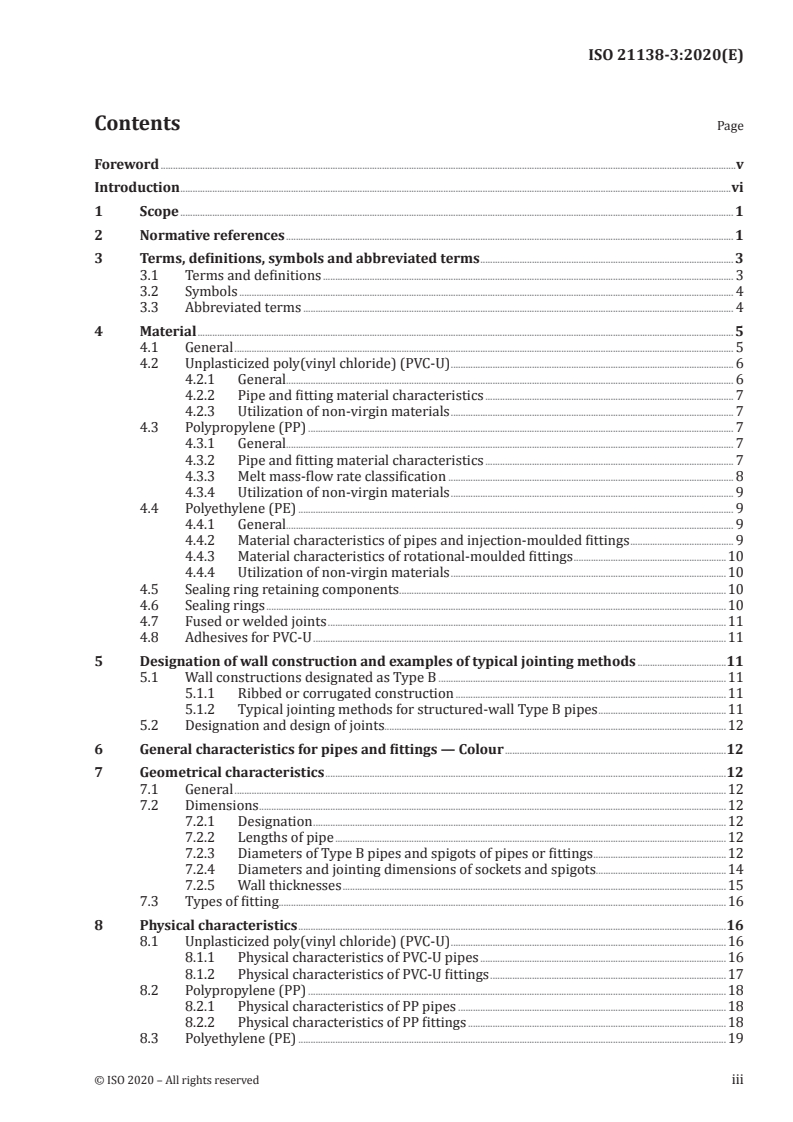
Contents Page
Foreword .v
Introduction .vi
1 Scope . 1
2 Normative references . 1
3 Terms, definitions, symbols and abbreviated terms . 3
3.1 Terms and definitions . 3
3.2 Symbols . 4
3.3 Abbreviated terms . 4
4 Material . 5
4.1 General . 5
4.2 Unplasticized poly(vinyl chloride) (PVC-U) . 6
4.2.1 General. 6
4.2.2 Pipe and fitting material characteristics . 7
4.2.3 Utilization of non-virgin materials . 7
4.3 Polypropylene (PP) . 7
4.3.1 General. 7
4.3.2 Pipe and fitting material characteristics . 7
4.3.3 Melt mass-flow rate classification . 8
4.3.4 Utilization of non-virgin materials . 9
4.4 Polyethylene (PE) . 9
4.4.1 General. 9
4.4.2 Material characteristics of pipes and injection-moulded fittings . 9
4.4.3 Material characteristics of rotational-moulded fittings .10
4.4.4 Utilization of non-virgin materials .10
4.5 Sealing ring retaining components . .10
4.6 Sealing rings .10
4.7 Fused or welded joints .11
4.8 Adhesives for PVC-U .11
5 Designation of wall construction and examples of typical jointing methods .11
5.1 Wall constructions designated as Type B .11
5.1.1 Ribbed or corrugated construction .11
5.1.2 Typical jointing methods for structured-wall Type B pipes .11
5.2 Designation and design of joints.12
6 General characteristics for pipes and fittings — Colour .12
7 Geometrical characteristics .12
7.1 General .12
7.2 Dimensions .12
7.2.1 Designation .12
7.2.2 Lengths of pipe .12
7.2.3 Diameters of Type B pipes and spigots of pipes or fittings .12
7.2.4 Diameters and jointing dimensions of sockets and spigots.14
7.2.5 Wall thicknesses .15
7.3 Types of fitting.16
8 Physical characteristics .16
8.1 Unplasticized poly(vinyl chloride) (PVC-U) .16
8.1.1 Physical characteristics of PVC-U pipes .16
8.1.2 Physical characteristics of PVC-U fittings .17
8.2 Polypropylene (PP) .18
8.2.1 Physical characteristics of PP pipes .18
8.2.2 Physical characteristics of PP fittings .18
8.3 Polyethylene (PE) .19
8.3.1 Physical characteristics of PE pipes .19
8.3.2 Physical characteristics of PE fittings .19
9 Mechanical characteristics .19
9.1 Mechanical characteristics of pipes .19
9.1.1 General.19
9.1.2 Ring flexibility .21
9.1.3 Tensile strength of seams .21
9.1.4 Additional requirements .21
9.2 Mechanical characteristics of fittings .21
10 Performance requirements .22
11 Marking .24
11.1 General .24
11.2 Minimum required marking .24
11.2.1 Pipes .24
11.2.2 Fittings .24
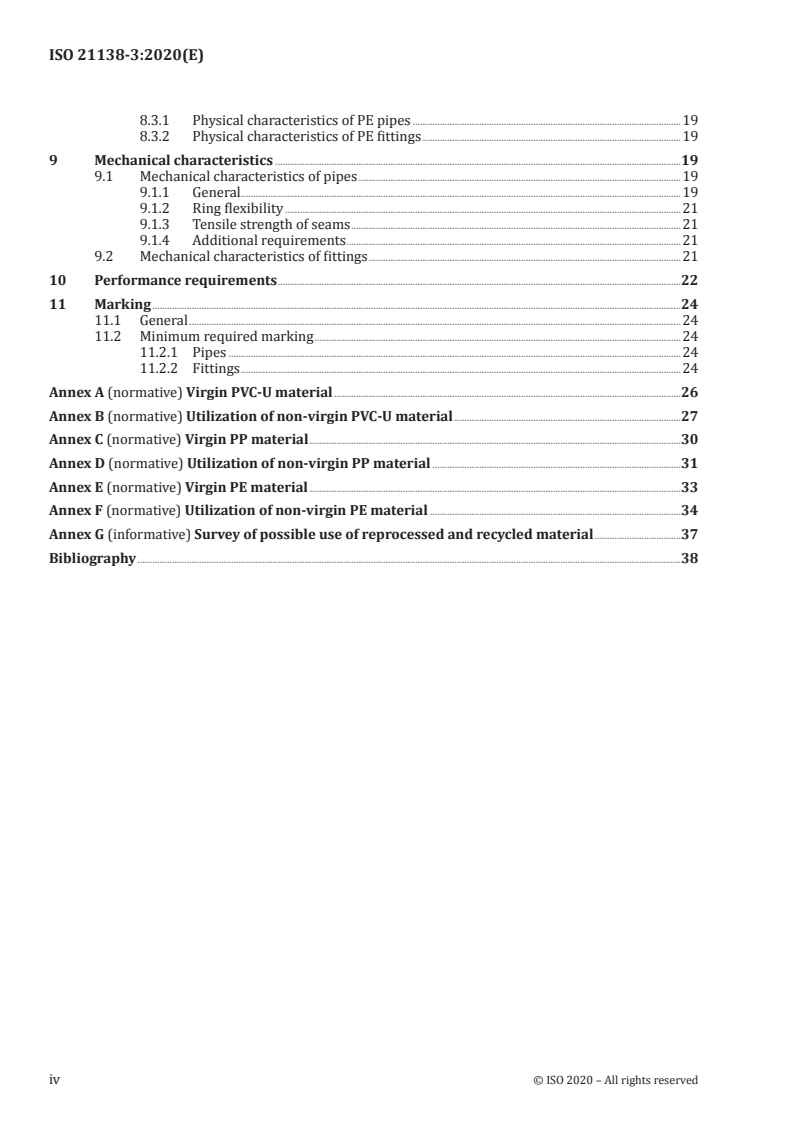
Annex A (normative) Virgin PVC-U material .26
Annex B (normative) Utilization of non-virgin PVC-U material .27
Annex C (normative) Virgin PP material .30
Annex D (normative) Utilization of non-virgin PP material .31
Annex E (normative) Virgin PE material .33
Annex F (normative) Utilization of non-virgin PE material .34
Annex G (informative) Survey of possible use of reprocessed and recycled material .37
Bibliography .38
iv © ISO 2020 – All rights reserved
Foreword
ISO (the International Organization for Standardization) is a worldwide federation of national standards
bodies (ISO member bodies). The work of preparing International Standards is normally carried out
through ISO technical committees. Each member body interested in a subject for which a technical
committee has been established has the right to be represented on that committee. International
organizations, governmental and non-governmental, in liaison with ISO, also take part in the work.
ISO collaborates closely with the International Electrotechnical Commission (IEC) on all matters of
electrotechnical standardization.
The procedures used to develop this document and those intended for its further maintenance are
described in the ISO/IEC Directives, Part 1. In particular, the different approval criteria needed for the
different types of ISO documents should be noted. This document was drafted in accordance with the
editorial rules of the ISO/IEC Directives, Part 2 (see www .iso .org/ directives).
Attention is drawn to the possibility that some of the elements of this document may be the subject of
patent rights. ISO shall not be held responsible for identifying any or all such patent rights. Details of
any patent rights identified during the development of the document will be in the Introduction and/or
on the ISO list of patent declarations received (see www .iso .org/ patents).
Any trade name used in this document is information given for the convenience of users and does not
constitute an endorsement.
For an explanation of the voluntary nature of standards, the meaning of ISO specific terms and
expressions related to conformity assessment, as well as information about ISO's adherence to the
World Trade Organization (WTO) principles in the Technical Barriers to Trade (TBT) see www .iso .org/
iso/ foreword .html.
This document was prepared by Technical Committee ISO/TC 138, Plastics pipes, fittings and valves for
the transport of fluids, Subcommittee SC 1, Plastics pipes and fittings for soil, waste and drainage (including
land drainage).
This second edition cancels and replaces the first edition (ISO 21138-3:2007), which has been
technically revised. The main changes compared to the previous edition are as follows:
— the normative references have been updated;
— references to EN test methods have been updated to ISO test methods, when applicable;
— editorial improvements have been made for clarification.
A list of all parts in the ISO 21138 series can be found on the ISO website.
Any feedback or questions on this document should be directed to the user’s national standards body. A
complete listing of these bodies can be found at www .iso .org/ members .html.
Introduction
The ISO 21138 series of standards covers plastics piping systems for non-pressure underground
drainage and sewerage, in particular thermoplastics structured-wall piping systems.
vi © ISO 2020 – All rights reserved
INTERNATIONAL STANDARD ISO 21138-3:2020(E)
Plastics piping systems for non-pressure underground
drainage and sewerage — Structured-wall piping
systems of unplasticized poly(vinyl chloride) (PVC-U),
polypropylene (PP) and polyethylene (PE) —
Part 3:
Pipes and fittings with non-smooth external surface, Type B
1 Scope
This document, together with ISO 21138-1, specifies the definitions and requirements for pipes with
a non-smooth external surface and a smooth internal surface (Type B), fittings and systems based on
unplasticized poly(vinyl chloride) (PVC-U), polypropylene (PP) and polyethylene (PE) structured-wall
piping systems intended to be used in non-pressure underground drainage and sewerage applications.
NOTE 1 Pipes, fittings and the systems complying with this document can also be used for highway drainage
and surface water.
This document specifies test methods and test parameters.
This document covers a range of pipe and fitting sizes, materials, pipe constructions and nominal ring
stiffnesses, and gives recommendations concerning colours.
NOTE 2 It is the responsibility of the purchaser or specifier to make the appropriate selections from these
aspects, taking into account their particular requirements and installation practices or codes.
In conjunction with ISO 21138-1, this document is applicable to structured-wall pipes and fittings, to
their joints and to joints with components of other plastics and non-plastics materials.
It is applicable to pipes and fittings with or without an integral socket with elastomeric ring seal joints
as well as welded and fused joints.
NOTE 3 Pipes, fittings and other components conforming to any plastics product standards referred to
in Clause 2 are deemed to be suitable for use with pipes and fittings conforming to this document, when they
conform to the requirements for joint dimensions given in ISO 21138-2 or ISO 21138-3 (this document) and to the
performance requirements given in Clause 10.
NOTE 4 For dimensions larger than DN/OD 1200 or DN/ID 1200, this document can serve as general guidance
regarding appearance, colour, physical and mechanical characteristics as well as performance requirements.
Test methods are not included in this document.
2 Normative references
The following documents are referred to in the text in such a way that some or all of their content
constitutes requirements of this document. For dated references, only the edition cited applies. For
undated references, the latest edition of the referenced document (including any amendments) applies.
ISO 178, Plastics — Determination of flexural properties
ISO 306:2013, Plastics — Thermoplastic materials — Determination of Vicat softening temperature (VST)
ISO 527-2:2012, Plastics — Determination of tensile properties — Part 2: Test conditions for moulding and
extrusion plastics
ISO 580, Plastics piping and ducting systems — Injection-moulded thermoplastics fittings — Methods for
visually assessing the effects of heating
ISO 1133-1, Plastics — Determination of the melt mass-flow rate (MFR) and melt volume-flow rate (MVR)
of thermoplastics — Part 1: Standard method
ISO 1158, Plastics — Vinyl chloride homopolymers and copolymers — Determination of chlorine content
ISO 1167-1, Thermoplastics pipes, fittings and assemblies for the conveyance of fluids — Determination of
the resistance to internal pressure — Part 1: General method
ISO 1167-2, Thermoplastics pipes, fittings and assemblies for the conveyance of fluids — Determination of
the resistance to internal pressure — Part 2: Preparation of pipe test pieces
ISO 1183-1, Plastics — Methods for determining the density of non-cellular plastics — Part 1: Immersion
method, liquid pycnometer method and titration method
ISO 2507-1, Thermoplastics pipes and fittings — Vicat softening temperature — Part 1: General test method
ISO 2507-2, Thermoplastics pipes and fittings — Vicat softening temperature — Part 2: Test conditions for
unplasticized poly(vinyl chloride) (PVC-U) or chlorinated poly(vinyl chloride) (PVC-C) pipes and fittings and
for high impact resistance poly (vinyl chloride) (PVC-HI) pipes
ISO 3126, Plastics piping systems — Plastics components — Determination of dimensions
ISO 3127, Thermoplastics pipes — Determination of resistance to external blows — Round-the-clock method
ISO 3451-1, Plastics — Determination of ash — Part 1: General methods
ISO 4435:2003, Plastics piping systems for non-pressure underground drainage and sewerage —
Unplasticized poly(vinyl chloride) (PVC-U)
ISO 6259-1, Thermoplastics pipes — Determination of tensile properties — Part 1: General test method
ISO 6259-2, Thermoplastics pipes — Determination of tensile properties — Part 2: Pipes made of
unplasticized poly(vinyl chloride) (PVC-U), chlorinated poly (vinyl chloride) (PVC-C) and high-impact poly
(vinyl chloride) (PVC-HI)
ISO 8772:2006, Plastics piping systems for non-pressure underground drainage and sewerage —
Polyethylene (PE)
ISO 8773:2006, Plastics piping systems for non-pressure underground drainage and sewerage —
Polypropylene (PP)
ISO 9852, Unplasticized poly(vinyl chloride) (PVC-U) pipes — Dichloromethane resistance at specified
temperature (DCMT) — Test method
ISO 9967, Thermoplastics pipes — Determination of creep ratio
ISO 9969, Thermoplastics pipes — Determination of ring stiffness
ISO 11173, Thermoplastics pipes — Determination of resistance to external blows — Staircase method
ISO 11357-6, Plastics — Differential scanning calorimetry (DSC) — Part 6: Determination of oxidation
induction time (isothermal OIT) and oxidation induction temperature (dynamic OIT)
ISO 12091, Structured-wall thermoplastics pipes — Oven test
ISO 13229, Thermoplastics piping systems for non-pressure applications — Unplasticized poly(vinyl
chloride) (PVC-U) pipes and fittings — Determination of the viscosity number and K-value
ISO 13254, Thermoplastics piping systems for non-pressure applications — Test method for watertightness
2 © ISO 2020 – All rights reserved
ISO 13259, Thermoplastics piping systems for underground non-pressure applications — Test method for
leaktightness of elastomeric sealing ring type joints
ISO 13260, Thermoplastics piping systems for non-pressure underground drainage and sewerage — Test
method for resistance to combined temperature cycling and external loading
ISO 13262, Thermoplastics piping systems for non-pressure underground drainage and sewerage —
Thermoplastics spirally-formed structured-wall pipes — Determination of the tensile strength of a seam
ISO 13263, Thermoplastics piping systems for non-pressure underground drainage and sewerage —
Thermoplastics fittings — Test method for impact strength
ISO 13264, Thermoplastics piping systems for non-pressure underground drainage and sewerage —
Thermoplastics fittings — Test method for mechanical strength or flexibility of fabricated fittings
ISO 13265, Thermoplastics piping systems for non-pressure underground drainage and sewerage — Joints
for buried non-pressure applications — Test method for the long-term sealing performance of joints with
elastomeric seals by estimating the sealing pressure
ISO 13967, Thermoplastics fittings — Determination of ring stiffness
ISO 13968, Plastics piping and ducting systems — Thermoplastics pipes — Determination of ring flexibility
ISO 18373-1, Rigid PVC pipes — Differential scanning calorimetry (DSC) method — Part 1: Measurement of
the processing temperature
ISO 21138-1, Plastics piping systems for non-pressure underground drainage and sewerage — Structured-
wall piping systems of unplasticized poly(vinyl chloride) (PVC-U), polypropylene (PP) and polyethylene
(PE) — Part 1: Material specifications and performance criteria for pipes, fittings and the system
ISO 21138-2, Plastics piping systems for non-pressure underground drainage and sewerage — Structured-
wall piping systems of unplasticized poly(vinyl chloride) (PVC-U), polypropylene (PP) and polyethylene
(PE) — Part 2: Pipes and fittings with smooth external surface, Type B
ISO 22088-3, Plastics — Determination of resistance to environmental stress cracking (ESC) — Part 3:
Bent strip method
EN 681-1, Elastomeric seals — Materials requirements for pipe joint seals used in water and drainage
applications — Part 1: Vulcanized rubber
EN 681-2, Elastomeric seals — Materials requirements for pipe joint seals used in water and drainage
applications — Part 2: Thermoplastic elastomers
EN 681-4, Elastomeric seals — Materials requirements for pipe joint seals used in water and drainage
applications — Part 4: Cast polyurethane sealing elements
EN 10204:2004, Metallic products — Types of inspection documents
EN 12099, Plastics piping systems — Polyethylene piping materials and components — Determination of
volatile content
EN 15344, Plastics — Recycled plastics — Characterisation of polyethylene) (PE) recyclates
EN 15345, Plastics — Recycled plastics — Characterisation of polypropylene) (PP) recyclates
EN 15346:2014, Plastics — Recycled plastics — Characterisation of poly(vinyl chloride) (PVC) recyclates
3 Terms, definitions, symbols and abbreviated terms
3.1 Terms and definitions
For the purposes of this document, the terms and definitions given in ISO 21138-1 apply.
ISO and IEC maintain terminological databases for use in standardization at the following addresses:
— IEC Electropedia: available at http:// www .electropedia .org/
— ISO Online browsing platform: available at http:// www .iso .org/ obp
3.2 Symbols
A length of engagement, or maximum pull-out whilst maintaining tightness
A minimum value of A
min
D inside diameter of a socket
i
D minimum value of D
i, min i
d outside diameter (of a pipe or a spigot)
e
d maximum value of the mean d
em, max e
d minimum value of the mean d
em, min e
d inside diameter of a pipe
i
d maximum value of the mean d
im, max i
d minimum value of the mean d
im, min i
e wall thickness (at any point)
e construction height
c
e wall thickness of the socket
e wall thickness of the groove
e wall thickness of the inside layer (waterway wall thickness)
e minimum value of e
4,min 4
e wall thickness of the inside layer under a hollow section
e minimum value of e
5,min 5
F distance from the end of a spigot to the effective sealing point
L length of a spigot
L minimum value of L
1,min 1
l effective length of a pipe
3.3 Abbreviated terms
CaCO calcium carbonate
CT close tolerance
DSC differential scanning calorimetry
4 © ISO 2020 – All rights reserved
MgCO magnesium carbonate
MFR melt mass-flow rate
OIT oxidation induction time
TIR true impact rate
TPE thermoplastic elastomer
VST Vicat softening temperature
4 Material
4.1 General
The material shall be one of the following: unplasticized poly (vinyl chloride) (PVC-U), polypropylene
(PP) or polyethylene (PE) to which are added those additives that are needed to facilitate the
manufacture of components conforming to this document, including the relevant annexes.
Spirally formed Type B pipes may include a support profile (see Figure 1) made from polymers other
than PVC-U, PP or PE.
Spirally formed pipe constructions may include a continuous elastomeric sealing component of
a material conforming to EN 681-1, EN 681-2 or EN 681-4 as applicable, or a continuous adhesive
conforming to 4.8.
Key
1 supporting profile
Figure 1 — Typical examples of Type B wall construction
4.2 Unplasticized poly(vinyl chloride) (PVC-U)
4.2.1 General
The raw material shall be PVC-U to which are added those additives that are needed to facilitate the
manufacture of components conforming to the requirements of this document (see also Annex A).
NOTE Additional information on the characteristics of PVC-U material or components made thereof is given
in ISO 21138-1:2020, Annex A.
6 © ISO 2020 – All rights reserved
4.2.2 Pipe and fitting material characteristics
When tested in accordance with the test method specified in Table 1, using the indicated parameters,
the material shall have characteristics conforming to the requirements given in Table 1.
Table 1 — Material characteristics of PVC-U pipes and injection-moulded fittings
Characteristic Requirements Test parameters Test
method
Resistance to internal No failure during Test temperature 60 °C ISO 1167-1
a,b
pressure the test period
Circumferential stress ISO 1167-2
— pipe material 10 MPa
— fitting material 6,3 MPa
Test period 1 000 h
Type of test Water-in-water
End caps Type A or B
Orientation Free
Number of test pieces 3
Conditioning period In accordance with
ISO 1167-1
a
For extrusion compounds, this test shall be carried out in the form of a solid-wall pipe made from the relevant extrusion
material.
b
For injection-moulding compounds, this test shall be carried out in the form of an injection-moulded or extruded
sample in solid-wall pipe form made from the relevant material.
4.2.3 Utilization of non-virgin materials
For the utilization of non-virgin PVC-U materials, conditions and requirements are given in Annex B,
and the non-virgin materials shall conform to the characterization specified in EN 15346.
NOTE Annex G gives a survey of the possible uses of reprocessed and recycled materials.
4.3 Polypropylene (PP)
4.3.1 General
The base material shall be polypropylene (PP) to which are added those additives that are needed to
facilitate the manufacture of components conforming to the requirements of this document (see also
Annex C).
NOTE Additional information on the characteristics of PP material or components made thereof is given in
ISO 21138-1:2020, Annex A.
4.3.2 Pipe and fitting material characteristics
When tested in accordance with the test methods specified in Table 2, using the indicated parameters,
the material shall have characteristics conforming to the requirements given in Table 2.
Table 2 — Material characteristics of PP pipes and injection-moulded fittings
Characteristic Requirements Test parameters Test
method
Resistance to internal No failure during Test temperature 80 °C ISO 1167-1
a,b
pressure 140 h the test period
Circumferential stress 4,2 MPa ISO 1167-2
Test period 140 h
Type of test Water-in-water
End caps Type A or B
Orientation Free
Number of test pieces 3
Conditioning period In accordance with
ISO 1167-1
Resistance to internal No failure during Test temperature 95 °C ISO 1167-1
a,b
pressure 1 000 h the test period
Circumferential stress 2,5 MPa ISO 1167-2
Test period 1 000 h
Type of test Water-in-water
End caps Type A or B
Orientation Free
Number of test pieces 3
Conditioning period In accordance with
ISO 1167-1
Melt mass-flow rate ≤1,5 g/10 min Temperature 230 °C ISO 1133-1
(MFR)
Loading mass 2,16 kg
Thermal stability, ≥8 min Temperature 200 °C ISO 11357-6
(OIT)
a
For extrusion compounds, this test shall be carried out in the form of a solid-wall pipe made from the relevant extrusion
material.
b
For injection-moulding compounds, this test shall be carried out in the form of an injection-moulded or extruded
sample in solid-wall pipe form made from the relevant material.
4.3.3 Melt mass-flow rate classification
Materials for pipes and fittings intended for jointing in the field by fusion or welding shall be designated
by the following MFR classes:
— Class A: MFR ≤ 0,3 g/10 min;
— Class B: 0,3 g/10 min < MFR ≤ 0,6 g/10 min;
— Class C: 0,6 g/10 min < MFR ≤ 0,9 g/10 min;
— Class D: 0,9 g/10 min < MFR ≤ 1,5 g/10 min.
In the case where a raw material, because of its MFR tolerance, arbitrarily falls in one of two adjacent
classes, the manufacturer of the components may mark the MFR class on the product as follows:
— for an MFR value across the border between A and B it is permitted to classify as class A;
— for an MFR value across the border between B and C it is permitted to classify as class C;
— for an MFR value across the border between C and D it is permitted to classify as class D.
8 © ISO 2020 – All rights reserved
4.3.4 Utilization of non-virgin materials
For the utilization of non-virgin PP materials, conditions and requirements are given in Annex D, and
the non-virgin materials shall conform to the characterization specified in EN 15345.
NOTE Annex G gives a survey of the possible uses of reprocessed and recycled materials.
4.4 Polyethylene (PE)
4.4.1 General
The base material shall be polyethylene (PE) to which are added those additives that are needed to
facilitate the manufacture of components conforming to this document. See also Annex E.
NOTE Additional information on the characteristics of PE material or components made thereof is given in
of ISO 21138-1:2020, Annex A.
4.4.2 Material characteristics of pipes and injection-moulded fittings
When tested in accordance with the test method specified in Table 3, using the indicated parameters,
the material shall have characteristics conforming to the requirements given in Table 3.
Table 3 — Material characteristics of PE pipes and injection-moulded fittings
Characteristic Requirements Test parameters Test
method
Resistance to internal No failure during Test temperature 80 °C ISO 1167-1
a,b
pressure 165 h the test period
Circumferential stress 4,0 MPa ISO 1167-2
Test period 165 h
Type of test Water-in-water
End caps Type A or B
Orientation Free
Number of test pieces 3
Conditioning period In accordance with
ISO 1167-1
Resistance to internal No failure during Test temperature 80 °C ISO 1167-1
a,b
pressure 1 000 h the test period
Circumferential stress 2,8 MPa ISO 1167-2
Test period 1 000 h
Type of test Water-in-water
End caps Type A or B
Orientation Free
Number of test pieces 3
Conditioning period In accordance with
ISO 1167-1
Melt mass-flow rate ≤1,6 g/10 min Temperature 190 °C ISO 1133-1
(MFR)
Loading mass 5 kg
Thermal stability, ≥20 min Temperature 200 °C ISO 11357-6
(OIT)
a
For extrusion compounds, this test shall be carried out in the form of a solid-wall pipe made from the relevant extrusion
material.
b
For injection-moulding compounds, this test shall be carried out in the form of an injection-moulded or extruded
sample in solid-wall pipe form made from the relevant material.
4.4.3 Material characteristics of rotational-moulded fittings
When tested in accordance with the test methods specified in Table 4, using the indicated parameters,
the material shall have characteristics conforming to the requirements given in Table 4.
Table 4 — Material characteristics of PE rotational-moulded fittings
Characteristic Requirements Test parameters Test
method
Resistance to internal No failure during Test temperature 60 °C ISO 1167-1
a
pressure 165 h the test period
Circumferential stress 3,9 MPa ISO 1167-2
Test period 165 h
Type of test Water-in-water
End caps Type A or B
Orientation Free
Number of test pieces 3
Conditioning period In accordance with
ISO 1167-1
Resistance to internal No failure during Test temperature 60 °C ISO 1167-1
a
pressure 1 000 h the test period
Circumferential stress 3,2 MPa ISO 1167-2
Test period 1 000 h
Type of test Water-in-water
End caps Type A or B
Orientation Free
Number of test pieces 3
Conditioning period In accordance with
ISO 1167-1
Melt mass-flow rate 3 g/10 min ≤ MFR Temperature 190 °C ISO 1133-1
(MFR) ≤ 16 g/10 min
Loading mass 5 kg
Thermal stability, ≥10 min Temperature 200 °C ISO 11357-6
(OIT)
Reference density ≥925 kg/m Temperature (23 ± 2) °C ISO 1183-1
a
This test shall be carried out in the form of an injection-moulded or extruded sample in solid-wall pipe form made from
the relevant material.
4.4.4 Utilization of non-virgin materials
For the utilization of non-virgin PE materials, conditions and requirements are given in Annex F, and
the non-virgin materials shall conform to the characterization specified in EN 15344.
NOTE Annex G gives a survey of the possible uses of reprocessed and recycled materials.
4.5 Sealing ring retaining components
It is permitted that sealing rings be retained using components made from any polymer.
4.6 Sealing rings
The sealing ring material shall conform to EN 681-1, EN 681-2 or EN 681-4, as applicable.
The sealing ring shall have no detrimental effects on the properties of the components and shall not
cause the test assembly to fail the performance requirements given in Clause 10.
10 © ISO 2020 – All rights reserved
4.7 Fused or welded joints
The design of fused or welded joints together with the manufacturer's instructions for the jointing
process shall not cause the test assembly to fail the performance requirements given in Clause 10.
4.8 Adhesives for PVC-U
The adhesive for solvent cement jointing of PVC-U shall be solvent cement and shall be as specified by
the manufacturer of the pipes or fittings, where appropriate.
The adhesive shall have no detrimental effects on the properties of components and shall not cause the
test assembly to fail the performance requirements given in Clause 10.
5 Designation of wall construction and examples of typical jointing methods
NOTE The figures are schematic sketches only to indicate the relevant dimensions. They do not necessarily
represent the manufactured components.
5.1 Wall constructions designated as Type B
5.1.1 Ribbed or corrugated construction
A pipe or fitting with a plain inside surface and a solid or hollow spiral or annular ribbed external
surface shall be designated Type B.
Typical examples of Type B constructions are shown in Figure 1.
5.1.2 Typical jointing methods for structured-wall Type B pipes
Relevant jointing dimensions for typical Type B joint constructions are shown in Figure 2 and Figure 3.
Figure 2 — Typical example of an elastomeric sealing ring joint with sealing ring located
on the spigot, Type B
Figure 3 — Typical example of an elastomeric sealing ring joint with sealing ring located
in the socket, Type B
5.2 Designation and design of joints
Pipes and fittings may be designed with spigot ends and sockets of another construction than the pipe
or fitting body. Such constructions may be Type A1, Type A2 or Type B or solid plain. For definitions and
specifications for Type A1 and Type A2 pipes, see ISO 21138-2.
NOTE Joints with elastomeric sealing rings are designed either with the sealing ring positioned on the spigot
(see Figure 2) or in the socket (see Figure 3).
6 General characteristics for pipes and fittings — Colour
Colour and appearance are specified in ISO 21138-1.
7 Geometrical characteristics
7.1 General
All dimensions shall be measured in accordance with ISO 3126.
7.2 Dimensions
7.2.1 Designation
Pipes and fittings are sized according to their outside diameter (DN/OD series) and/or according to
their inside diameter (DN/ID series).
Type B DN/OD pipes and fittings with plain spigot jointing dimensions conforming to ISO 4435:2003,
ISO 8772:2006 or ISO 8773:2006 for PVC-U, PE and PP respectively, and with larger d than the spigot,
e
are permitted to be designated by the spigot dimension.
7.2.2 Lengths of pipe
The effective length of pipe, l, shall be not less than that specified by the manufacturer when measured
as shown in Figure 2 and/or Figure 3, as applicable.
7.2.3 Diameters of Type B pipes and spigots of pipes or fittings
The nominal sizes and minimum mean inside diameters for DN/OD and DN/ID series are specified in
Table 5.
12 © ISO 2020 – All rights reserved
Other nominal sizes, greater than DN/ID 100 and DN/OD 110 and less than DN/OD and DN/ID 1200,
than those given in Table 5, are permitted.
They should preferably be selected from ISO 161-1.
For DN/ODs and DN/IDs not specified in Table 5, the minimum inside diameter, d , shall be linearly
im,min
interpolated between the adjacent values specified in the Table 5.
Table 5 — Nominal sizes, minimum mean inside diameters, thickness of inside layers
and socket length
Dimensions in millimetres
Diameters
Minimum wall
a
DN/OD series DN/ID series Socket
thickness
b b,c
PVC-U PP/ PE
DN/OD d d DN/ID d e e A
im,min im,min im,min 4,min 5,min min
110 97 90 100 95 1,0 1,0 32
125 107 105 1,1 1,0 35
125 120 1,2 1,0 38
160 135 134 1,2 1,0 42
150 145 1,3 1,0 43
200 172 167 1,4 1,1 50
200 195 1,5 1,1 54
250 216 209 225 220 1,7 1,4 55
250 245 1,8 1,5 59
315 270 263 1,9 1,6 62
300 294 2,0 1,7 64
400 340 335 2,3 2,0 70
400 392 2,5 2,3 74
500 432 418 2,8 2,8 80
500 490 3,0 3,0 85
630 540 527 3,3 3,3 93
600 588 3,5 3,5 96
800 680 669 4,1 4,1 110
800 785 4,5 4,5 118
1 000 864 837 5,0 5,0 130
1 000 985 5,0 5,0 140
1 200 1 037 1 005 5,0 5,0 150
1 200 1 185 5,0 5,0 162
a
For selection of the A requirements for a socket, refer to the pipe material and construction. For pipes longer than
min
6 m it is recommended that one produce a larger A than is specified in this Table.
b
The actual inside diameter of a pipe depends on the material, construction and stiffness. It may be considerably higher
than the minimum specified in this Table. For more information see the manufacturer's documentation.
c
The minimum mean inside diameter of a fitting shall be not less than 98 % of the specified minimum mean inside
diameter of the pipe for which it is designed or conform to this Table, whichever is the greater value.
DN/OD series pipes and spigots intended to have jointing dimensions as pipes and/or fittings according
to ISO 4435:2003, ISO 8772:2006 or ISO 8773:2006 for PVC, PE or PP respectively, shall comply with
whichever of those documents is relevant regarding the outside diameters and tolerances of the spigot.
For pipe
...
INTERNATIONAL ISO
STANDARD 21138-3
Second edition
2020-01
Plastics piping systems for non-
pressure underground drainage and
sewerage — Structured-wall piping
systems of unplasticized poly(vinyl
chloride) (PVC-U), polypropylene (PP)
and polyethylene (PE) —
Part 3:
Pipes and fittings with non-smooth
external surface, Type B
Systèmes de canalisations en plastique pour les branchements et les
collecteurs d'assainissement sans pression enterrés — Systèmes de
canalisations à parois structurées en poly(chlorure de vinyle) non
plastifié (PVC-U), polypropylène (PP) et polyéthylène (PE) —
Partie 3: Tubes et raccords avec une surface externe non lisse, type B
Reference number
©
ISO 2020
© ISO 2020
All rights reserved. Unless otherwise specified, or required in the context of its implementation, no part of this publication may
be reproduced or utilized otherwise in any form or by any means, electronic or mechanical, including photocopying, or posting
on the internet or an intranet, without prior written permission. Permission can be requested from either ISO at the address
below or ISO’s member body in the country of the requester.
ISO copyright office
CP 401 • Ch. de Blandonnet 8
CH-1214 Vernier, Geneva
Phone: +41 22 749 01 11
Fax: +41 22 749 09 47
Email: copyright@iso.org
Website: www.iso.org
Published in Switzerland
ii © ISO 2020 – All rights reserved
Contents Page
Foreword .v
Introduction .vi
1 Scope . 1
2 Normative references . 1
3 Terms, definitions, symbols and abbreviated terms . 3
3.1 Terms and definitions . 3
3.2 Symbols . 4
3.3 Abbreviated terms . 4
4 Material . 5
4.1 General . 5
4.2 Unplasticized poly(vinyl chloride) (PVC-U) . 6
4.2.1 General. 6
4.2.2 Pipe and fitting material characteristics . 7
4.2.3 Utilization of non-virgin materials . 7
4.3 Polypropylene (PP) . 7
4.3.1 General. 7
4.3.2 Pipe and fitting material characteristics . 7
4.3.3 Melt mass-flow rate classification . 8
4.3.4 Utilization of non-virgin materials . 9
4.4 Polyethylene (PE) . 9
4.4.1 General. 9
4.4.2 Material characteristics of pipes and injection-moulded fittings . 9
4.4.3 Material characteristics of rotational-moulded fittings .10
4.4.4 Utilization of non-virgin materials .10
4.5 Sealing ring retaining components . .10
4.6 Sealing rings .10
4.7 Fused or welded joints .11
4.8 Adhesives for PVC-U .11
5 Designation of wall construction and examples of typical jointing methods .11
5.1 Wall constructions designated as Type B .11
5.1.1 Ribbed or corrugated construction .11
5.1.2 Typical jointing methods for structured-wall Type B pipes .11
5.2 Designation and design of joints.12
6 General characteristics for pipes and fittings — Colour .12
7 Geometrical characteristics .12
7.1 General .12
7.2 Dimensions .12
7.2.1 Designation .12
7.2.2 Lengths of pipe .12
7.2.3 Diameters of Type B pipes and spigots of pipes or fittings .12
7.2.4 Diameters and jointing dimensions of sockets and spigots.14
7.2.5 Wall thicknesses .15
7.3 Types of fitting.16
8 Physical characteristics .16
8.1 Unplasticized poly(vinyl chloride) (PVC-U) .16
8.1.1 Physical characteristics of PVC-U pipes .16
8.1.2 Physical characteristics of PVC-U fittings .17
8.2 Polypropylene (PP) .18
8.2.1 Physical characteristics of PP pipes .18
8.2.2 Physical characteristics of PP fittings .18
8.3 Polyethylene (PE) .19
8.3.1 Physical characteristics of PE pipes .19
8.3.2 Physical characteristics of PE fittings .19
9 Mechanical characteristics .19
9.1 Mechanical characteristics of pipes .19
9.1.1 General.19
9.1.2 Ring flexibility .21
9.1.3 Tensile strength of seams .21
9.1.4 Additional requirements .21
9.2 Mechanical characteristics of fittings .21
10 Performance requirements .22
11 Marking .24
11.1 General .24
11.2 Minimum required marking .24
11.2.1 Pipes .24
11.2.2 Fittings .24
Annex A (normative) Virgin PVC-U material .26
Annex B (normative) Utilization of non-virgin PVC-U material .27
Annex C (normative) Virgin PP material .30
Annex D (normative) Utilization of non-virgin PP material .31
Annex E (normative) Virgin PE material .33
Annex F (normative) Utilization of non-virgin PE material .34
Annex G (informative) Survey of possible use of reprocessed and recycled material .37
Bibliography .38
iv © ISO 2020 – All rights reserved
Foreword
ISO (the International Organization for Standardization) is a worldwide federation of national standards
bodies (ISO member bodies). The work of preparing International Standards is normally carried out
through ISO technical committees. Each member body interested in a subject for which a technical
committee has been established has the right to be represented on that committee. International
organizations, governmental and non-governmental, in liaison with ISO, also take part in the work.
ISO collaborates closely with the International Electrotechnical Commission (IEC) on all matters of
electrotechnical standardization.
The procedures used to develop this document and those intended for its further maintenance are
described in the ISO/IEC Directives, Part 1. In particular, the different approval criteria needed for the
different types of ISO documents should be noted. This document was drafted in accordance with the
editorial rules of the ISO/IEC Directives, Part 2 (see www .iso .org/ directives).
Attention is drawn to the possibility that some of the elements of this document may be the subject of
patent rights. ISO shall not be held responsible for identifying any or all such patent rights. Details of
any patent rights identified during the development of the document will be in the Introduction and/or
on the ISO list of patent declarations received (see www .iso .org/ patents).
Any trade name used in this document is information given for the convenience of users and does not
constitute an endorsement.
For an explanation of the voluntary nature of standards, the meaning of ISO specific terms and
expressions related to conformity assessment, as well as information about ISO's adherence to the
World Trade Organization (WTO) principles in the Technical Barriers to Trade (TBT) see www .iso .org/
iso/ foreword .html.
This document was prepared by Technical Committee ISO/TC 138, Plastics pipes, fittings and valves for
the transport of fluids, Subcommittee SC 1, Plastics pipes and fittings for soil, waste and drainage (including
land drainage).
This second edition cancels and replaces the first edition (ISO 21138-3:2007), which has been
technically revised. The main changes compared to the previous edition are as follows:
— the normative references have been updated;
— references to EN test methods have been updated to ISO test methods, when applicable;
— editorial improvements have been made for clarification.
A list of all parts in the ISO 21138 series can be found on the ISO website.
Any feedback or questions on this document should be directed to the user’s national standards body. A
complete listing of these bodies can be found at www .iso .org/ members .html.
Introduction
The ISO 21138 series of standards covers plastics piping systems for non-pressure underground
drainage and sewerage, in particular thermoplastics structured-wall piping systems.
vi © ISO 2020 – All rights reserved
INTERNATIONAL STANDARD ISO 21138-3:2020(E)
Plastics piping systems for non-pressure underground
drainage and sewerage — Structured-wall piping
systems of unplasticized poly(vinyl chloride) (PVC-U),
polypropylene (PP) and polyethylene (PE) —
Part 3:
Pipes and fittings with non-smooth external surface, Type B
1 Scope
This document, together with ISO 21138-1, specifies the definitions and requirements for pipes with
a non-smooth external surface and a smooth internal surface (Type B), fittings and systems based on
unplasticized poly(vinyl chloride) (PVC-U), polypropylene (PP) and polyethylene (PE) structured-wall
piping systems intended to be used in non-pressure underground drainage and sewerage applications.
NOTE 1 Pipes, fittings and the systems complying with this document can also be used for highway drainage
and surface water.
This document specifies test methods and test parameters.
This document covers a range of pipe and fitting sizes, materials, pipe constructions and nominal ring
stiffnesses, and gives recommendations concerning colours.
NOTE 2 It is the responsibility of the purchaser or specifier to make the appropriate selections from these
aspects, taking into account their particular requirements and installation practices or codes.
In conjunction with ISO 21138-1, this document is applicable to structured-wall pipes and fittings, to
their joints and to joints with components of other plastics and non-plastics materials.
It is applicable to pipes and fittings with or without an integral socket with elastomeric ring seal joints
as well as welded and fused joints.
NOTE 3 Pipes, fittings and other components conforming to any plastics product standards referred to
in Clause 2 are deemed to be suitable for use with pipes and fittings conforming to this document, when they
conform to the requirements for joint dimensions given in ISO 21138-2 or ISO 21138-3 (this document) and to the
performance requirements given in Clause 10.
NOTE 4 For dimensions larger than DN/OD 1200 or DN/ID 1200, this document can serve as general guidance
regarding appearance, colour, physical and mechanical characteristics as well as performance requirements.
Test methods are not included in this document.
2 Normative references
The following documents are referred to in the text in such a way that some or all of their content
constitutes requirements of this document. For dated references, only the edition cited applies. For
undated references, the latest edition of the referenced document (including any amendments) applies.
ISO 178, Plastics — Determination of flexural properties
ISO 306:2013, Plastics — Thermoplastic materials — Determination of Vicat softening temperature (VST)
ISO 527-2:2012, Plastics — Determination of tensile properties — Part 2: Test conditions for moulding and
extrusion plastics
ISO 580, Plastics piping and ducting systems — Injection-moulded thermoplastics fittings — Methods for
visually assessing the effects of heating
ISO 1133-1, Plastics — Determination of the melt mass-flow rate (MFR) and melt volume-flow rate (MVR)
of thermoplastics — Part 1: Standard method
ISO 1158, Plastics — Vinyl chloride homopolymers and copolymers — Determination of chlorine content
ISO 1167-1, Thermoplastics pipes, fittings and assemblies for the conveyance of fluids — Determination of
the resistance to internal pressure — Part 1: General method
ISO 1167-2, Thermoplastics pipes, fittings and assemblies for the conveyance of fluids — Determination of
the resistance to internal pressure — Part 2: Preparation of pipe test pieces
ISO 1183-1, Plastics — Methods for determining the density of non-cellular plastics — Part 1: Immersion
method, liquid pycnometer method and titration method
ISO 2507-1, Thermoplastics pipes and fittings — Vicat softening temperature — Part 1: General test method
ISO 2507-2, Thermoplastics pipes and fittings — Vicat softening temperature — Part 2: Test conditions for
unplasticized poly(vinyl chloride) (PVC-U) or chlorinated poly(vinyl chloride) (PVC-C) pipes and fittings and
for high impact resistance poly (vinyl chloride) (PVC-HI) pipes
ISO 3126, Plastics piping systems — Plastics components — Determination of dimensions
ISO 3127, Thermoplastics pipes — Determination of resistance to external blows — Round-the-clock method
ISO 3451-1, Plastics — Determination of ash — Part 1: General methods
ISO 4435:2003, Plastics piping systems for non-pressure underground drainage and sewerage —
Unplasticized poly(vinyl chloride) (PVC-U)
ISO 6259-1, Thermoplastics pipes — Determination of tensile properties — Part 1: General test method
ISO 6259-2, Thermoplastics pipes — Determination of tensile properties — Part 2: Pipes made of
unplasticized poly(vinyl chloride) (PVC-U), chlorinated poly (vinyl chloride) (PVC-C) and high-impact poly
(vinyl chloride) (PVC-HI)
ISO 8772:2006, Plastics piping systems for non-pressure underground drainage and sewerage —
Polyethylene (PE)
ISO 8773:2006, Plastics piping systems for non-pressure underground drainage and sewerage —
Polypropylene (PP)
ISO 9852, Unplasticized poly(vinyl chloride) (PVC-U) pipes — Dichloromethane resistance at specified
temperature (DCMT) — Test method
ISO 9967, Thermoplastics pipes — Determination of creep ratio
ISO 9969, Thermoplastics pipes — Determination of ring stiffness
ISO 11173, Thermoplastics pipes — Determination of resistance to external blows — Staircase method
ISO 11357-6, Plastics — Differential scanning calorimetry (DSC) — Part 6: Determination of oxidation
induction time (isothermal OIT) and oxidation induction temperature (dynamic OIT)
ISO 12091, Structured-wall thermoplastics pipes — Oven test
ISO 13229, Thermoplastics piping systems for non-pressure applications — Unplasticized poly(vinyl
chloride) (PVC-U) pipes and fittings — Determination of the viscosity number and K-value
ISO 13254, Thermoplastics piping systems for non-pressure applications — Test method for watertightness
2 © ISO 2020 – All rights reserved
ISO 13259, Thermoplastics piping systems for underground non-pressure applications — Test method for
leaktightness of elastomeric sealing ring type joints
ISO 13260, Thermoplastics piping systems for non-pressure underground drainage and sewerage — Test
method for resistance to combined temperature cycling and external loading
ISO 13262, Thermoplastics piping systems for non-pressure underground drainage and sewerage —
Thermoplastics spirally-formed structured-wall pipes — Determination of the tensile strength of a seam
ISO 13263, Thermoplastics piping systems for non-pressure underground drainage and sewerage —
Thermoplastics fittings — Test method for impact strength
ISO 13264, Thermoplastics piping systems for non-pressure underground drainage and sewerage —
Thermoplastics fittings — Test method for mechanical strength or flexibility of fabricated fittings
ISO 13265, Thermoplastics piping systems for non-pressure underground drainage and sewerage — Joints
for buried non-pressure applications — Test method for the long-term sealing performance of joints with
elastomeric seals by estimating the sealing pressure
ISO 13967, Thermoplastics fittings — Determination of ring stiffness
ISO 13968, Plastics piping and ducting systems — Thermoplastics pipes — Determination of ring flexibility
ISO 18373-1, Rigid PVC pipes — Differential scanning calorimetry (DSC) method — Part 1: Measurement of
the processing temperature
ISO 21138-1, Plastics piping systems for non-pressure underground drainage and sewerage — Structured-
wall piping systems of unplasticized poly(vinyl chloride) (PVC-U), polypropylene (PP) and polyethylene
(PE) — Part 1: Material specifications and performance criteria for pipes, fittings and the system
ISO 21138-2, Plastics piping systems for non-pressure underground drainage and sewerage — Structured-
wall piping systems of unplasticized poly(vinyl chloride) (PVC-U), polypropylene (PP) and polyethylene
(PE) — Part 2: Pipes and fittings with smooth external surface, Type B
ISO 22088-3, Plastics — Determination of resistance to environmental stress cracking (ESC) — Part 3:
Bent strip method
EN 681-1, Elastomeric seals — Materials requirements for pipe joint seals used in water and drainage
applications — Part 1: Vulcanized rubber
EN 681-2, Elastomeric seals — Materials requirements for pipe joint seals used in water and drainage
applications — Part 2: Thermoplastic elastomers
EN 681-4, Elastomeric seals — Materials requirements for pipe joint seals used in water and drainage
applications — Part 4: Cast polyurethane sealing elements
EN 10204:2004, Metallic products — Types of inspection documents
EN 12099, Plastics piping systems — Polyethylene piping materials and components — Determination of
volatile content
EN 15344, Plastics — Recycled plastics — Characterisation of polyethylene) (PE) recyclates
EN 15345, Plastics — Recycled plastics — Characterisation of polypropylene) (PP) recyclates
EN 15346:2014, Plastics — Recycled plastics — Characterisation of poly(vinyl chloride) (PVC) recyclates
3 Terms, definitions, symbols and abbreviated terms
3.1 Terms and definitions
For the purposes of this document, the terms and definitions given in ISO 21138-1 apply.
ISO and IEC maintain terminological databases for use in standardization at the following addresses:
— IEC Electropedia: available at http:// www .electropedia .org/
— ISO Online browsing platform: available at http:// www .iso .org/ obp
3.2 Symbols
A length of engagement, or maximum pull-out whilst maintaining tightness
A minimum value of A
min
D inside diameter of a socket
i
D minimum value of D
i, min i
d outside diameter (of a pipe or a spigot)
e
d maximum value of the mean d
em, max e
d minimum value of the mean d
em, min e
d inside diameter of a pipe
i
d maximum value of the mean d
im, max i
d minimum value of the mean d
im, min i
e wall thickness (at any point)
e construction height
c
e wall thickness of the socket
e wall thickness of the groove
e wall thickness of the inside layer (waterway wall thickness)
e minimum value of e
4,min 4
e wall thickness of the inside layer under a hollow section
e minimum value of e
5,min 5
F distance from the end of a spigot to the effective sealing point
L length of a spigot
L minimum value of L
1,min 1
l effective length of a pipe
3.3 Abbreviated terms
CaCO calcium carbonate
CT close tolerance
DSC differential scanning calorimetry
4 © ISO 2020 – All rights reserved
MgCO magnesium carbonate
MFR melt mass-flow rate
OIT oxidation induction time
TIR true impact rate
TPE thermoplastic elastomer
VST Vicat softening temperature
4 Material
4.1 General
The material shall be one of the following: unplasticized poly (vinyl chloride) (PVC-U), polypropylene
(PP) or polyethylene (PE) to which are added those additives that are needed to facilitate the
manufacture of components conforming to this document, including the relevant annexes.
Spirally formed Type B pipes may include a support profile (see Figure 1) made from polymers other
than PVC-U, PP or PE.
Spirally formed pipe constructions may include a continuous elastomeric sealing component of
a material conforming to EN 681-1, EN 681-2 or EN 681-4 as applicable, or a continuous adhesive
conforming to 4.8.
Key
1 supporting profile
Figure 1 — Typical examples of Type B wall construction
4.2 Unplasticized poly(vinyl chloride) (PVC-U)
4.2.1 General
The raw material shall be PVC-U to which are added those additives that are needed to facilitate the
manufacture of components conforming to the requirements of this document (see also Annex A).
NOTE Additional information on the characteristics of PVC-U material or components made thereof is given
in ISO 21138-1:2020, Annex A.
6 © ISO 2020 – All rights reserved
4.2.2 Pipe and fitting material characteristics
When tested in accordance with the test method specified in Table 1, using the indicated parameters,
the material shall have characteristics conforming to the requirements given in Table 1.
Table 1 — Material characteristics of PVC-U pipes and injection-moulded fittings
Characteristic Requirements Test parameters Test
method
Resistance to internal No failure during Test temperature 60 °C ISO 1167-1
a,b
pressure the test period
Circumferential stress ISO 1167-2
— pipe material 10 MPa
— fitting material 6,3 MPa
Test period 1 000 h
Type of test Water-in-water
End caps Type A or B
Orientation Free
Number of test pieces 3
Conditioning period In accordance with
ISO 1167-1
a
For extrusion compounds, this test shall be carried out in the form of a solid-wall pipe made from the relevant extrusion
material.
b
For injection-moulding compounds, this test shall be carried out in the form of an injection-moulded or extruded
sample in solid-wall pipe form made from the relevant material.
4.2.3 Utilization of non-virgin materials
For the utilization of non-virgin PVC-U materials, conditions and requirements are given in Annex B,
and the non-virgin materials shall conform to the characterization specified in EN 15346.
NOTE Annex G gives a survey of the possible uses of reprocessed and recycled materials.
4.3 Polypropylene (PP)
4.3.1 General
The base material shall be polypropylene (PP) to which are added those additives that are needed to
facilitate the manufacture of components conforming to the requirements of this document (see also
Annex C).
NOTE Additional information on the characteristics of PP material or components made thereof is given in
ISO 21138-1:2020, Annex A.
4.3.2 Pipe and fitting material characteristics
When tested in accordance with the test methods specified in Table 2, using the indicated parameters,
the material shall have characteristics conforming to the requirements given in Table 2.
Table 2 — Material characteristics of PP pipes and injection-moulded fittings
Characteristic Requirements Test parameters Test
method
Resistance to internal No failure during Test temperature 80 °C ISO 1167-1
a,b
pressure 140 h the test period
Circumferential stress 4,2 MPa ISO 1167-2
Test period 140 h
Type of test Water-in-water
End caps Type A or B
Orientation Free
Number of test pieces 3
Conditioning period In accordance with
ISO 1167-1
Resistance to internal No failure during Test temperature 95 °C ISO 1167-1
a,b
pressure 1 000 h the test period
Circumferential stress 2,5 MPa ISO 1167-2
Test period 1 000 h
Type of test Water-in-water
End caps Type A or B
Orientation Free
Number of test pieces 3
Conditioning period In accordance with
ISO 1167-1
Melt mass-flow rate ≤1,5 g/10 min Temperature 230 °C ISO 1133-1
(MFR)
Loading mass 2,16 kg
Thermal stability, ≥8 min Temperature 200 °C ISO 11357-6
(OIT)
a
For extrusion compounds, this test shall be carried out in the form of a solid-wall pipe made from the relevant extrusion
material.
b
For injection-moulding compounds, this test shall be carried out in the form of an injection-moulded or extruded
sample in solid-wall pipe form made from the relevant material.
4.3.3 Melt mass-flow rate classification
Materials for pipes and fittings intended for jointing in the field by fusion or welding shall be designated
by the following MFR classes:
— Class A: MFR ≤ 0,3 g/10 min;
— Class B: 0,3 g/10 min < MFR ≤ 0,6 g/10 min;
— Class C: 0,6 g/10 min < MFR ≤ 0,9 g/10 min;
— Class D: 0,9 g/10 min < MFR ≤ 1,5 g/10 min.
In the case where a raw material, because of its MFR tolerance, arbitrarily falls in one of two adjacent
classes, the manufacturer of the components may mark the MFR class on the product as follows:
— for an MFR value across the border between A and B it is permitted to classify as class A;
— for an MFR value across the border between B and C it is permitted to classify as class C;
— for an MFR value across the border between C and D it is permitted to classify as class D.
8 © ISO 2020 – All rights reserved
4.3.4 Utilization of non-virgin materials
For the utilization of non-virgin PP materials, conditions and requirements are given in Annex D, and
the non-virgin materials shall conform to the characterization specified in EN 15345.
NOTE Annex G gives a survey of the possible uses of reprocessed and recycled materials.
4.4 Polyethylene (PE)
4.4.1 General
The base material shall be polyethylene (PE) to which are added those additives that are needed to
facilitate the manufacture of components conforming to this document. See also Annex E.
NOTE Additional information on the characteristics of PE material or components made thereof is given in
of ISO 21138-1:2020, Annex A.
4.4.2 Material characteristics of pipes and injection-moulded fittings
When tested in accordance with the test method specified in Table 3, using the indicated parameters,
the material shall have characteristics conforming to the requirements given in Table 3.
Table 3 — Material characteristics of PE pipes and injection-moulded fittings
Characteristic Requirements Test parameters Test
method
Resistance to internal No failure during Test temperature 80 °C ISO 1167-1
a,b
pressure 165 h the test period
Circumferential stress 4,0 MPa ISO 1167-2
Test period 165 h
Type of test Water-in-water
End caps Type A or B
Orientation Free
Number of test pieces 3
Conditioning period In accordance with
ISO 1167-1
Resistance to internal No failure during Test temperature 80 °C ISO 1167-1
a,b
pressure 1 000 h the test period
Circumferential stress 2,8 MPa ISO 1167-2
Test period 1 000 h
Type of test Water-in-water
End caps Type A or B
Orientation Free
Number of test pieces 3
Conditioning period In accordance with
ISO 1167-1
Melt mass-flow rate ≤1,6 g/10 min Temperature 190 °C ISO 1133-1
(MFR)
Loading mass 5 kg
Thermal stability, ≥20 min Temperature 200 °C ISO 11357-6
(OIT)
a
For extrusion compounds, this test shall be carried out in the form of a solid-wall pipe made from the relevant extrusion
material.
b
For injection-moulding compounds, this test shall be carried out in the form of an injection-moulded or extruded
sample in solid-wall pipe form made from the relevant material.
4.4.3 Material characteristics of rotational-moulded fittings
When tested in accordance with the test methods specified in Table 4, using the indicated parameters,
the material shall have characteristics conforming to the requirements given in Table 4.
Table 4 — Material characteristics of PE rotational-moulded fittings
Characteristic Requirements Test parameters Test
method
Resistance to internal No failure during Test temperature 60 °C ISO 1167-1
a
pressure 165 h the test period
Circumferential stress 3,9 MPa ISO 1167-2
Test period 165 h
Type of test Water-in-water
End caps Type A or B
Orientation Free
Number of test pieces 3
Conditioning period In accordance with
ISO 1167-1
Resistance to internal No failure during Test temperature 60 °C ISO 1167-1
a
pressure 1 000 h the test period
Circumferential stress 3,2 MPa ISO 1167-2
Test period 1 000 h
Type of test Water-in-water
End caps Type A or B
Orientation Free
Number of test pieces 3
Conditioning period In accordance with
ISO 1167-1
Melt mass-flow rate 3 g/10 min ≤ MFR Temperature 190 °C ISO 1133-1
(MFR) ≤ 16 g/10 min
Loading mass 5 kg
Thermal stability, ≥10 min Temperature 200 °C ISO 11357-6
(OIT)
Reference density ≥925 kg/m Temperature (23 ± 2) °C ISO 1183-1
a
This test shall be carried out in the form of an injection-moulded or extruded sample in solid-wall pipe form made from
the relevant material.
4.4.4 Utilization of non-virgin materials
For the utilization of non-virgin PE materials, conditions and requirements are given in Annex F, and
the non-virgin materials shall conform to the characterization specified in EN 15344.
NOTE Annex G gives a survey of the possible uses of reprocessed and recycled materials.
4.5 Sealing ring retaining components
It is permitted that sealing rings be retained using components made from any polymer.
4.6 Sealing rings
The sealing ring material shall conform to EN 681-1, EN 681-2 or EN 681-4, as applicable.
The sealing ring shall have no detrimental effects on the properties of the components and shall not
cause the test assembly to fail the performance requirements given in Clause 10.
10 © ISO 2020 – All rights reserved
4.7 Fused or welded joints
The design of fused or welded joints together with the manufacturer's instructions for the jointing
process shall not cause the test assembly to fail the performance requirements given in Clause 10.
4.8 Adhesives for PVC-U
The adhesive for solvent cement jointing of PVC-U shall be solvent cement and shall be as specified by
the manufacturer of the pipes or fittings, where appropriate.
The adhesive shall have no detrimental effects on the properties of components and shall not cause the
test assembly to fail the performance requirements given in Clause 10.
5 Designation of wall construction and examples of typical jointing methods
NOTE The figures are schematic sketches only to indicate the relevant dimensions. They do not necessarily
represent the manufactured components.
5.1 Wall constructions designated as Type B
5.1.1 Ribbed or corrugated construction
A pipe or fitting with a plain inside surface and a solid or hollow spiral or annular ribbed external
surface shall be designated Type B.
Typical examples of Type B constructions are shown in Figure 1.
5.1.2 Typical jointing methods for structured-wall Type B pipes
Relevant jointing dimensions for typical Type B joint constructions are shown in Figure 2 and Figure 3.
Figure 2 — Typical example of an elastomeric sealing ring joint with sealing ring located
on the spigot, Type B
Figure 3 — Typical example of an elastomeric sealing ring joint with sealing ring located
in the socket, Type B
5.2 Designation and design of joints
Pipes and fittings may be designed with spigot ends and sockets of another construction than the pipe
or fitting body. Such constructions may be Type A1, Type A2 or Type B or solid plain. For definitions and
specifications for Type A1 and Type A2 pipes, see ISO 21138-2.
NOTE Joints with elastomeric sealing rings are designed either with the sealing ring positioned on the spigot
(see Figure 2) or in the socket (see Figure 3).
6 General characteristics for pipes and fittings — Colour
Colour and appearance are specified in ISO 21138-1.
7 Geometrical characteristics
7.1 General
All dimensions shall be measured in accordance with ISO 3126.
7.2 Dimensions
7.2.1 Designation
Pipes and fittings are sized according to their outside diameter (DN/OD series) and/or according to
their inside diameter (DN/ID series).
Type B DN/OD pipes and fittings with plain spigot jointing dimensions conforming to ISO 4435:2003,
ISO 8772:2006 or ISO 8773:2006 for PVC-U, PE and PP respectively, and with larger d than the spigot,
e
are permitted to be designated by the spigot dimension.
7.2.2 Lengths of pipe
The effective length of pipe, l, shall be not less than that specified by the manufacturer when measured
as shown in Figure 2 and/or Figure 3, as applicable.
7.2.3 Diameters of Type B pipes and spigots of pipes or fittings
The nominal sizes and minimum mean inside diameters for DN/OD and DN/ID series are specified in
Table 5.
12 © ISO 2020 – All rights reserved
Other nominal sizes, greater than DN/ID 100 and DN/OD 110 and less than DN/OD and DN/ID 1200,
than those given in Table 5, are permitted.
They should preferably be selected from ISO 161-1.
For DN/ODs and DN/IDs not specified in Table 5, the minimum inside diameter, d , shall be linearly
im,min
interpolated between the adjacent values specified in the Table 5.
Table 5 — Nominal sizes, minimum mean inside diameters, thickness of inside layers
and socket length
Dimensions in millimetres
Diameters
Minimum wall
a
DN/OD series DN/ID series Socket
thickness
b b,c
PVC-U PP/ PE
DN/OD d d DN/ID d e e A
im,min im,min im,min 4,min 5,min min
110 97 90 100 95 1,0 1,0 32
125 107 105 1,1 1,0 35
125 120 1,2 1,0 38
160 135 134 1,2 1,0 42
150 145 1,3 1,0 43
200 172 167 1,4 1,1 50
200 195 1,5 1,1 54
250 216 209 225 220 1,7 1,4 55
250 245 1,8 1,5 59
315 270 263 1,9 1,6 62
300 294 2,0 1,7 64
400 340 335 2,3 2,0 70
400 392 2,5 2,3 74
500 432 418 2,8 2,8 80
500 490 3,0 3,0 85
630 540 527 3,3 3,3 93
600 588 3,5 3,5 96
800 680 669 4,1 4,1 110
800 785 4,5 4,5 118
1 000 864 837 5,0 5,0 130
1 000 985 5,0 5,0 140
1 200 1 037 1 005 5,0 5,0 150
1 200 1 185 5,0 5,0 162
a
For selection of the A requirements for a socket, refer to the pipe material and construction. For pipes longer than
min
6 m it is recommended that one produce a larger A than is specified in this Table.
b
The actual inside diameter of a pipe depends on the material, construction and stiffness. It may be considerably higher
than the minimum specified in this Table. For more information see the manufacturer's documentation.
c
The minimum mean inside diameter of a fitting shall be not less than 98 % of the specified minimum mean inside
diameter of the pipe for which it is designed or conform to this Table, whichever is the greater value.
DN/OD series pipes and spigots intended to have jointing dimensions as pipes and/or fittings according
to ISO 4435:2003, ISO 8772:2006 or ISO 8773:2006 for PVC, PE or PP respectively, shall comply with
whichever of those documents is relevant regarding the outside diameters and tolerances of the spigot.
For pipe
...
Questions, Comments and Discussion
Ask us and Technical Secretary will try to provide an answer. You can facilitate discussion about the standard in here.
Loading comments...