


ISO 14620-1:2026
(Main)Space systems — Safety requirements — Part 1: System safety
General Information
- Abstract
This document specifies the safety programme and the technical safety requirements that are implemented in order to conform to the safety policy defined in ISO 14300-2. It is intended to protect flight and ground personnel, the launch vehicle, associated payloads, ground support equipment, the general public, public and private property, and the environment from hazards associated with space systems. This document is applicable to all space projects where during any project phase there exists the potential for hazards to personnel or the general public, space flight systems, ground support equipment, facilities, public or private property, or the environment.
- Status
- Published
- Publication Date
- 24-Aug-2026
- Technical Committee
- ISO/TC 20/SC 14 - Space systems and operations
- Drafting Committee
- ISO/TC 20/SC 14/WG 5 - Space System Program Management and Quality
- Current Stage
- 6060 - International Standard published
- Start Date
- 25-Aug-2026
- Due Date
- 11-Jun-2026
- Completion Date
- 25-Aug-2026
Overview
ISO 14620-1:2026 sets out the foundational system safety requirements for space systems, as part of the International Organization for Standardization (ISO) 14620 series on space system safety. This voluntary international standard specifies the structured safety program and technical safety criteria necessary to comply with the safety policy defined in ISO 14300-2. Its main goal is to protect:
- Flight and ground personnel
- The launch vehicle and associated payloads
- Ground support equipment
- The general public and private property
- The environment
ISO 14620-1:2026 applies across all phases of space projects, wherever there is the potential for hazards to people, equipment, property, or the environment. It addresses new and existing space missions, regardless of size and complexity, requiring organizations to establish comprehensive safety management and risk mitigation throughout a project’s life cycle.
Key Topics
This standard covers a wide range of essential system safety elements for space projects, including:
- System Safety Programme: Outlines requirements for implementing a safety management system that aligns with project needs and safety criticality.
- Safety Organization: Emphasizes the appointment of qualified safety representatives, independent reporting lines, and coordinated safety integration.
- Safety Risk Management: Provides guidelines for hazard identification, analysis, control, and acceptance of residual risk.
- Project Phase Reviews: Mandates safety assessments at each project milestone (e.g., design, qualification, acceptance, operational readiness).
- Safety Engineering Principles: Addresses fault tolerance, safety-critical function identification, design for failure tolerance, and accident prevention.
- Safety Analysis and Verification: Requires systematic safety analysis, allocation of requirements, and formal verification of hazard controls.
- Operational Safety: Sets basic requirements for both flight and ground operations to ensure ongoing hazard mitigation.
- Safety Training: Stresses comprehensive safety education for all relevant personnel, from general awareness to product-specific instruction.
Applications
ISO 14620-1:2026 offers practical value for a wide array of space industry stakeholders, such as:
- Space system engineers and project managers: Enables integration of safety management into project planning, design, and execution.
- Manufacturers and suppliers of launch vehicles and payloads: Ensures conformity with international best practices for system safety and risk reduction.
- Launch facility operators and mission planners: Supports safe preparation, testing, and operation by specifying robust safety processes and organizational responsibilities.
- Regulatory bodies and safety authorities: Provides a framework for evaluating compliance with safety requirements across different project phases.
- Environmental protection agencies: Encourages measures to minimize environmental hazards during space system development and operation.
- Training and certification providers: Establishes a baseline for developing training curricula and verifying qualifications for personnel operating in hazardous environments.
The standard is essential for risk management in space system projects and facilitates smoother collaboration between international partners, compliance with national or regional regulations, and protection of public safety and the environment.
Related Standards
ISO 14620-1:2026 is designed for use alongside related standards in the ISO 14620 series and the broader ISO framework for space projects:
- ISO 14620-2: Space systems - Safety requirements - Part 2: Launch site operations
- ISO 14620-3: Space systems - Safety requirements - Part 3: Flight safety systems
- ISO 14300-1: Space systems - Programme management - Part 1: Structuring of a project
- ISO 14300-2: Space systems - Programme management - Part 2: Product assurance
- ISO 17666: Space systems - Programme management - Risk management
- ISO 21347: Space systems - Fracture and damage control
- ISO 24113: Space systems - Space debris mitigation requirements
By structuring and formalizing safety management, ISO 14620-1:2026 enhances the reliability, effectiveness, and public acceptance of global space operations, fostering a safer future for all space activities.
Relations
- Effective Date
- 15-Jun-2024
Get Certified
Connect with accredited certification bodies for this standard

BUREAU VERITAS Certification Germany
Bureau Veritas certification in Germany.

Element Materials Technology
Materials testing and product certification.

AQMS Ltd.
AQMS provides ISO certification to SMEs across the UK.
Sponsored listings
Frequently Asked Questions
ISO 14620-1:2026 is a standard published by the International Organization for Standardization (ISO). Its full title is "Space systems — Safety requirements — Part 1: System safety". This standard covers: This document specifies the safety programme and the technical safety requirements that are implemented in order to conform to the safety policy defined in ISO 14300-2. It is intended to protect flight and ground personnel, the launch vehicle, associated payloads, ground support equipment, the general public, public and private property, and the environment from hazards associated with space systems. This document is applicable to all space projects where during any project phase there exists the potential for hazards to personnel or the general public, space flight systems, ground support equipment, facilities, public or private property, or the environment.
This document specifies the safety programme and the technical safety requirements that are implemented in order to conform to the safety policy defined in ISO 14300-2. It is intended to protect flight and ground personnel, the launch vehicle, associated payloads, ground support equipment, the general public, public and private property, and the environment from hazards associated with space systems. This document is applicable to all space projects where during any project phase there exists the potential for hazards to personnel or the general public, space flight systems, ground support equipment, facilities, public or private property, or the environment.
ISO 14620-1:2026 is classified under the following ICS (International Classification for Standards) categories: 49.140 - Space systems and operations. The ICS classification helps identify the subject area and facilitates finding related standards.
ISO 14620-1:2026 has the following relationships with other standards: It is inter standard links to ISO 14620-1:2018. Understanding these relationships helps ensure you are using the most current and applicable version of the standard.
ISO 14620-1:2026 is available in PDF format for immediate download after purchase. The document can be added to your cart and obtained through the secure checkout process. Digital delivery ensures instant access to the complete standard document.
Standards Content (Sample)
International
Standard
ISO 14620-1
Third edition
Space systems — Safety
2026-08
requirements —
Part 1:
System safety
Systèmes spatiaux — Exigences de sécurité —
Partie 1: Sécurité système
Reference number
© ISO 2026
All rights reserved. Unless otherwise specified, or required in the context of its implementation, no part of this publication may
be reproduced or utilized otherwise in any form or by any means, electronic or mechanical, including photocopying, or posting on
the internet or an intranet, without prior written permission. Permission can be requested from either ISO at the address below
or ISO’s member body in the country of the requester.
ISO copyright office
CP 401 • Ch. de Blandonnet 8
CH-1214 Vernier, Geneva
Phone: +41 22 749 01 11
Email: copyright@iso.org
Website: www.iso.org
Published in Switzerland
ii
Contents Page
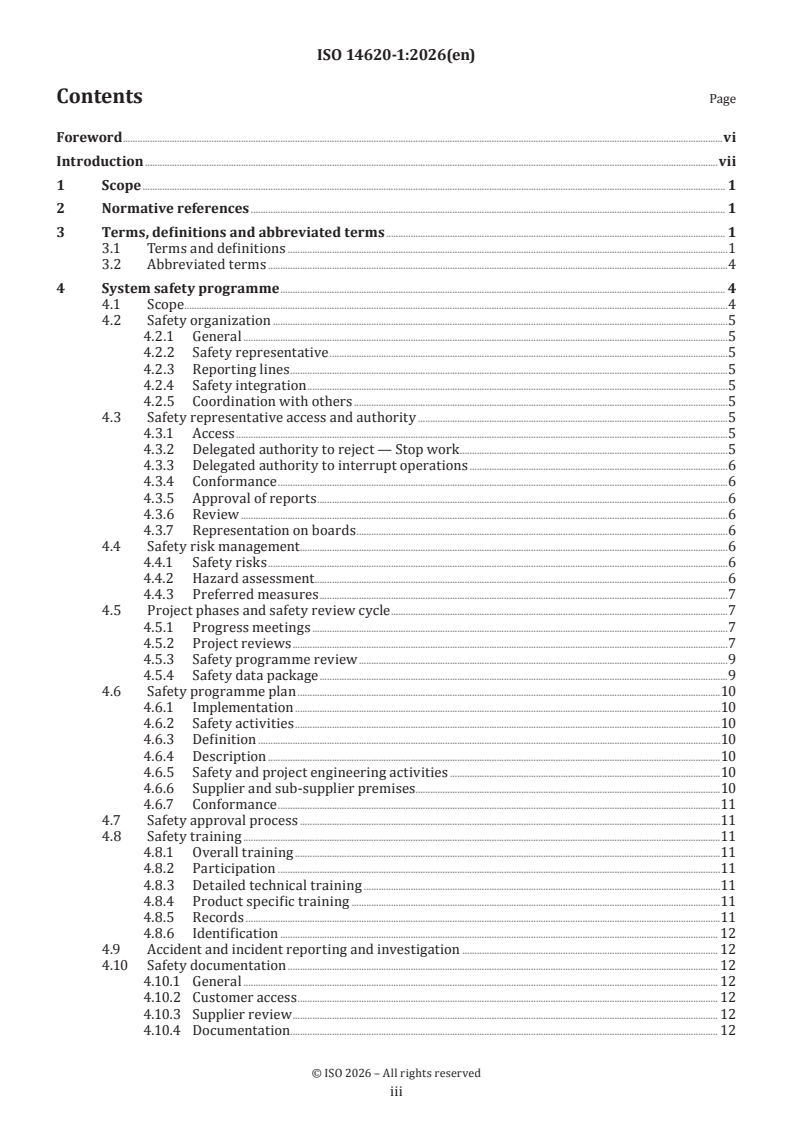
Foreword .vi
Introduction .vii
1 Scope . 1
2 Normative references . 1
3 Terms, definitions and abbreviated terms . 1
3.1 Terms and definitions .1
3.2 Abbreviated terms .4
4 System safety programme . 4
4.1 Scope . .4
4.2 Safety organization .5
4.2.1 General .5
4.2.2 Safety representative .5
4.2.3 Reporting lines .5
4.2.4 Safety integration .5
4.2.5 Coordination with others .5
4.3 Safety representative access and authority .5
4.3.1 Access .5
4.3.2 Delegated authority to reject — Stop work .5
4.3.3 Delegated authority to interrupt operations .6
4.3.4 Conformance .6
4.3.5 Approval of reports .6
4.3.6 Review .6
4.3.7 Representation on boards .6
4.4 Safety risk management . .6
4.4.1 Safety risks .6
4.4.2 Hazard assessment .6
4.4.3 Preferred measures .7
4.5 Project phases and safety review cycle .7
4.5.1 Progress meetings .7
4.5.2 Project reviews .7
4.5.3 Safety programme review .9
4.5.4 Safety data package .9
4.6 Safety programme plan .10
4.6.1 Implementation .10
4.6.2 Safety activities .10
4.6.3 Definition .10
4.6.4 Description .10
4.6.5 Safety and project engineering activities .10
4.6.6 Supplier and sub-supplier premises . .10
4.6.7 Conformance .11
4.7 Safety approval process .11
4.8 Safety training .11
4.8.1 Overall training .11
4.8.2 Participation .11
4.8.3 Detailed technical training .11
4.8.4 Product specific training .11
4.8.5 Records .11
4.8.6 Identification . 12
4.9 Accident and incident reporting and investigation . 12
4.10 Safety documentation . 12
4.10.1 General . 12
4.10.2 Customer access . 12
4.10.3 Supplier review . 12
4.10.4 Documentation. 12
iii
4.10.5 Safety data package . 12
4.10.6 Safety deviations and waivers . 13
4.10.7 Safety Verification tracking log . 13
4.10.8 Lessons-learned file. 13
5 Safety engineering . 14
5.1 Safety engineering objectives .14
5.1.1 General .14
5.1.2 Elements .14
5.1.3 Lessons learned .14
5.2 Safety design principles .14
5.2.1 Human life consideration .14
5.2.2 Design selection .14
5.2.3 System safety order of precedence .14
5.2.4 Environmental compatibility . 15
5.2.5 Safe without services . 15
5.2.6 Fail safe design .16
5.2.7 Hazard detection — Signalling and safing .16
5.2.8 Access .16
5.2.9 Safety risk reduction and control .16
5.3 Failure tolerance requirements .19
5.3.1 Basic requirements .19
5.3.2 Software .19
5.3.3 Payload interface .19
5.3.4 Redundancy separation .19
5.3.5 Failure propagation . 20
5.3.6 Design for minimum risk . 20
5.3.7 Probabilistic safety targets. 20
5.4 Identification and control of safety-critical functions .21
5.4.1 Identification .21
5.4.2 Flow-down of safety-critical functions .21
5.4.3 Inadvertent operation.21
5.4.4 Provisions .21
5.4.5 Shutdown and failure tolerance requirements . 22
5.4.6 Electronic, electrical, electromechanical . 22
6 Safety analysis requirements and techniques .22
6.1 General . 22
6.2 Assessment and allocation of requirements . 22
6.2.1 Safety requirements . 22
6.2.2 Additional safety requirements . 23
6.2.3 Define safety requirements — Functions . 23
6.2.4 Define safety requirements — Subsystems . 23
6.2.5 Justification . 23
6.2.6 Functional and subsystem specification. 23
6.3 Safety analysis . 23
6.3.1 General . 23
6.3.2 Mission analysis . 23
6.3.3 Feasibility . 23
6.3.4 Preliminary definition . 23
6.3.5 Detailed definition, production and qualification . 23
6.3.6 Utilization .24
6.3.7 Disposal .24
6.4 Specific safety analysis .24
6.4.1 General .24
6.4.2 Hazard analysis .24
6.4.3 Safety risk assessment . 25
6.4.4 Safety analysis for hardware-software systems . 25
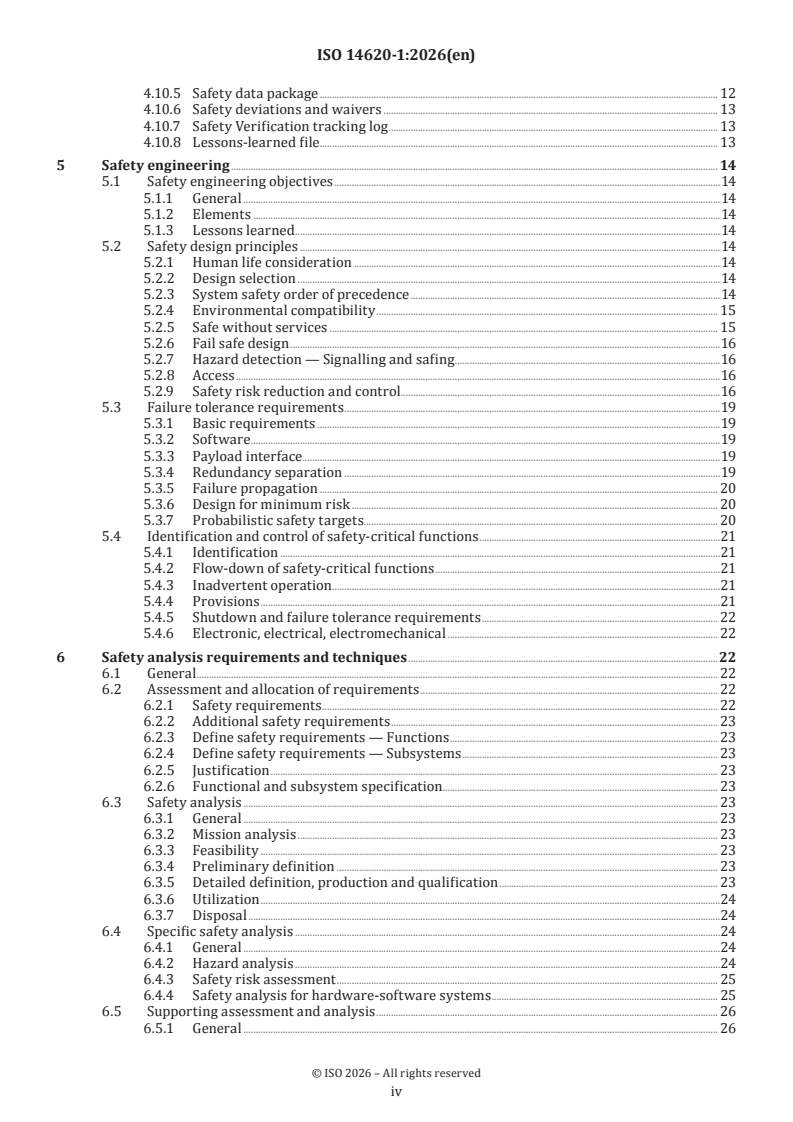
6.5 Supporting assessment and analysis . 26
6.5.1 General . 26
iv
6.5.2 Warning time analysis . 26
6.5.3 Caution and warning analysis . 26
6.5.4 Common cause and common mode failure analysis .27
6.5.5 Fault tree analysis .27
6.5.6 Human dependability analysis .27
6.5.7 Failure modes, effects and criticality analysis .27
6.5.8 Hardware-software interaction analysis (HSIA) .27
6.5.9 Sneak analysis . 28
6.5.10 Zonal analysis . 28
6.5.11 Energy trace analysis . 29
7 Safety verification .29
7.1 General . 29
7.2 Tracking of hazards . 29
7.2.1 Hazard reporting system . 29
7.2.2 Status . 29
7.2.3 Safety progress meeting . 29
7.2.4 Review and disposition . 29
7.2.5 Documentation. 29
7.2.6 Mandatory inspection points (MIPs) . 30
7.3 Safety verification methods . 30
7.3.1 Verification engineering and planning . 30
7.3.2 Methods and reports . 30
7.3.3 Verification requirements . 30
7.3.4 Analysis . 30
7.3.5 Inspections . 30
7.3.6 Tests . 30
7.3.7 Verification and approval .31
7.4 Qualification of safety-critical functions .31
7.4.1 Verification .31
7.4.2 Qualification .31
7.4.3 Failure tests .31
7.4.4 Verification of design or operational characteristics .31
7.4.5 Safety verification testing .31
7.5 Hazard close-out .31
7.5.1 Safety assurance verification .31
7.5.2 Safety approval authority .32
7.6 Residual risk reduction .32
8 Operational safety .32
8.1 General .32
8.2 Basic requirements .32
8.3 Flight operations and mission control .32
8.3.1 Launcher operations .32
8.3.2 Contamination . 33
8.3.3 Flight rules . 33
8.3.4 Hazardous commanding control . 33
8.3.5 Mission operation change control . 33
8.3.6 Safety surveillance and anomaly control . 33
8.4 Ground operations . 33
8.4.1 Applicability . 33
8.4.2 Initiation . 34
8.4.3 Review and inspection . 34
8.4.4 Hazardous operations . 34
8.4.5 Launch and landing site requirements . 34
8.4.6 GSE requirements . 34
Bibliography .35
v
Foreword
ISO (the International Organization for Standardization) is a worldwide federation of national standards
bodies (ISO member bodies). The work of preparing International Standards is normally carried out through
ISO technical committees. Each member body interested in a subject for which a technical committee
has been established has the right to be represented on that committee. International organizations,
governmental and non-governmental, in liaison with ISO, also take part in the work. ISO collaborates closely
with the International Electrotechnical Commission (IEC) on all matters of electrotechnical standardization.
The procedures used to develop this document and those intended for its further maintenance are described
in the ISO/IEC Directives, Part 1. In particular, the different approval criteria needed for the different types
of ISO documents should be noted. This document was drafted in accordance with the editorial rules of the
ISO/IEC Directives, Part 2 (see www.iso.org/directives).
ISO draws attention to the possibility that the implementation of this document may involve the use of (a)
patent(s). ISO takes no position concerning the evidence, validity or applicability of any claimed patent
rights in respect thereof. As of the date of publication of this document, ISO had not received notice of (a)
patent(s) which may be required to implement this document. However, implementers are cautioned that
this may not represent the latest information, which may be obtained from the patent database available at
www.iso.org/patents. ISO shall not be held responsible for identifying any or all such patent rights.
Any trade name used in this document is information given for the convenience of users and does not
constitute an endorsement.
For an explanation of the voluntary nature of standards, the meaning of ISO specific terms and expressions
related to conformity assessment, as well as information about ISO's adherence to the World Trade
Organization (WTO) principles in the Technical Barriers to Trade (TBT), see www.iso.org/iso/foreword.html.
This document was prepared by Technical Committee ISO/TC 20, Aircraft and space vehicles, Subcommittee
SC 14, Space systems and operations.
This third edition cancels and replaces the second edition (ISO 14620-1:2018), which has been technically
revised.
The main change is as follows:
— definitions have been revised.
A list of all parts in the ISO 14620 series can be found on the ISO website.
Any feedback or questions on this document should be directed to the user’s national standards body. A
complete listing of these bodies can be found at www.iso.org/members.html.
vi
Introduction
The ISO 14620 series is intended to be applied together for the management, engineering and product
assurance in space projects and applications.
The safety policy is implemented through a structured system safety programme supported by risk
assessment. Hazardous system and environmental characteristics, as well as functions with potentially
dangerous failure effects, are systematically identified and evaluated. Potential hazards are addressed
through a reduction process in which they are first eliminated from design and operations, then minimized,
and, if necessary, controlled and verified. Any residual risks are progressively assessed to ensure
conformance to safety requirements, support design decisions, and in order to prioritise risk contributors,
allocate resources, monitor progress in risk reduction, and inform safety-related decision-making. The
effectiveness of hazard and risk control measures is formally verified to enable safety validation and risk
acceptance. Finally, overall safety conformance is evaluated, and approval is obtained from the relevant
authorities for both crewed and uncrewed projects.
The imposition of these requirements on the project suppliers’ activities requires that the customer’s
project product assurance and safety organization also respond to these requirements in a manner which is
commensurate with the project’s safety criticality.
Launch site operations are described by ISO 14620-2 and flight safety systems in ISO 14620-3.
vii
International Standard ISO 14620-1:2026(en)
Space systems — Safety requirements —
Part 1:
System safety
1 Scope
This document specifies the safety programme and the technical safety requirements that are implemented
in order to conform to the safety policy defined in ISO 14300-2. It is intended to protect flight and ground
personnel, the launch vehicle, associated payloads, ground support equipment, the general public, public and
private property, and the environment from hazards associated with space systems.
This document is applicable to all space projects where during any project phase there exists the potential
for hazards to personnel or the general public, space flight systems, ground support equipment, facilities,
public or private property, or the environment.
2 Normative references
The following documents are referred to in the text in such a way that some or all of their content constitutes
requirements of this document. For dated references, only the edition cited applies. For undated references,
the latest edition of the referenced document (including any amendments) applies.
ISO 14300-1, Space systems — Programme management — Part 1: Structuring of a project
ISO 14300-2, Space systems — Programme management — Part 2: Product assurance
ISO 14620-2, Space systems — Safety requirements — Part 2: Launch site operations
ISO 14620-3, Space systems — Safety requirements — Part 3: Flight safety systems
ISO 17666, Space systems — Programme management — Risk management
ISO 21347, Space systems — Fracture and damage control
ISO 24113, Space systems — Space debris mitigation requirements
3 Terms, definitions and abbreviated terms
3.1 Terms and definitions
For the purposes of this document, the following terms and definitions apply.
ISO and IEC maintain terminology databases for use in standardization at the following addresses:
— ISO Online browsing platform: available at https:// www .iso .org/ obp
— IEC Electropedia: available at https:// www .electropedia .org/
3.1.1
accident
mishap
undesired event arising from operation of any project-specific items which results in:
a) human death or injury;
b) loss of, or damage to, hardware, software or facilities which can then affect the accomplishment of the
mission;
c) loss of, or damage to, public or private property; and
d) detrimental effects on the environment
[SOURCE: ISO 10795:2019, 3.8]
3.1.2
anomaly
gap between a current situation and an expected one
Note 1 to entry: An anomaly justifies an investigation that can lead to the discovery of a nonconformance, a defect.
Note 2 to entry: A deviation may be declared, foreseen or requested.
Note 3 to entry: An anomaly is often detected in comparison with what seems to be standard or with the expected use.
[SOURCE: ISO 10795:2019, 3.13]
3.1.3
cause
circumstance, condition, event or action that produces an effect or gives rise to any action, phenomenon or
condition
Note 1 to entry: Cause and effect are correlative terms.
Note 2 to entry: Specific to this document, cause, when used in the context of hazard analysis, is the action or condition
by which a hazardous event (3.1.11) is initiated (an initiating event). The cause can arise as the result of failure (3.1.9),
human error, design inadequacy, induced or natural environment, system configuration or operational mode(s).
[SOURCE: ISO 10795:2019, 3.35]
3.1.4
common cause failure
failure (3.1.9) of multiple items occurring from a single cause (3.1.3) which is common to all of them
[SOURCE: Adapted from NUREG/CR-2300 PRA: 1982, ISO 10795:2019, 3.4]
3.1.5
common mode failure
failure (3.1.9) of multiple identical items that fail in the same mode
Note 1 to entry: Common mode failures are a particular case of common cause failures (3.1.5).
[SOURCE: NUREG/CR-2300 PRA: 1982, ISO 10795:2019, 3.46]
3.1.6
emergency
situation where hazardous events (3.1.11) have occurred with potentially catastrophic or critical
consequences requiring an immediate action
[SOURCE: Adapted from EN 16601-00-01:2015, 2.3.73]
3.1.7
fail safe
design property of a system, or subsystem (or part of it), which prevents its failures (3.1.9) from resulting in
critical or catastrophic consequences (i.e. remain safe after one failure)
Note 1 to entry: Maintaining safety following two independent failures is referred to “fail safe – fail safe”.
[SOURCE: ISO 26871:2020, 3.1.32]
3.1.8
failure
event resulting in an item being no longer able to perform its required function
Note 1 to entry: "Failure" is an event, as distinguished from "fault" which is a state.
[SOURCE: EN 16601-00-01:2015, 2.3.81]
3.1.9
fault
state of an item characterized by inability to perform as required
Note 1 to entry: A fault can be the result of a failure of the item itself or can exist without prior failure.
Note 2 to entry: A fault can generate a failure.
[SOURCE: EN 16601-00-01:2015, 2.3.84]
3.1.10
hazard
existing or potential condition of an item that can result in an accident (3.1.1)
Note 1 to entry: This condition can be associated with the design, manufacturing, operation or environment.
Note 2 to entry: Hazards are not events but potential threats to safety.
[SOURCE: EN 16601-00-01:2015, 2.3.102]
3.1.11
hazardous event
accident (3.1.1) resulting from a hazard (3.1.10)
[SOURCE: EN 16601-00-01:2015, 2.3.103]
3.1.12
inhibit
design feature that prevents a function from undesirable execution
Note 1 to entry: An inhibit can be software or hardware.
[SOURCE: EN 16601-00-01:2015, 2.3.109]
3.1.13
residual risk
risk remaining after implementation of risk reduction measures
[SOURCE: ISO 17666:2025, 3.10]
3.1.14
safe state
state that does not lead to critical or catastrophic consequences
3.1.15
safety authority
body defining and making applicable (project specific) safety requirements and providing confirmation of
conformance to project specific safety requirements
3.1.16
safety-critical function
function that, if lost or degraded, or as a result of incorrect or inadvertent operation, would result in
catastrophic or critical consequences
[SOURCE: ISO 10795:2019, 3.212]
3.1.17
safing
action of containment or control of emergency and warning situations or placing a system (or part thereof)
in a predetermined safe condition
[SOURCE: EN 16601-00-01:2015, 2.3.180]
3.1.18
system safety
application of engineering and management principles, criteria and techniques to optimize all aspects of
safety within the constraints of operational effectiveness, time and cost throughou
...