


ISO 19683:2026
(Main)Space systems — Design qualification and acceptance tests of small spacecraft and units
Space systems — Design qualification and acceptance tests of small spacecraft and units
This document provides test methods and test requirements for design either qualification or acceptance, or both of small spacecraft or units. It provides the minimum test requirements and test methods to qualify the design and manufacturing methods of commercial small spacecraft and their units and to accept the final products. This document is applicable to satellites whose development methods are different from the ones used for traditional satellites that have little room for risk tolerance. The scope of this document encompasses different categories of small spacecraft, so-called mini-, micro-, nano-, pico- and femto spacecraft. This document includes CubeSat, as long as it is developed with the untraditional processes. This document does not cover satellite deployment mechanisms, such as picosatellite orbital deployer (POD), as the verification requirements are defined in the interface control document (ICD) with the launcher, such as ISO 26869[1]. This document does not cover software testing, although some tests such as functional test, mission test and end-to-end test are inherently used to test the software installed in the hardware being tested. General requirements and processes of satellite software testing can be found in various references, such as ECSS-E-ST40[2]. This document does not cover requirements regarding safety nor debris mitigation. Appropriate documents such as ISO 14620-1[3] or ISO 24113[4] can be referred to. Other common requirements for small spacecraft can be found in ISO 20991[5].
Systèmes spatiaux — Qualification de la conception et essais de réception des petits véhicules spatiaux
General Information
- Status
- Published
- Publication Date
- 21-May-2026
- Technical Committee
- ISO/TC 20/SC 14 - Space systems and operations
- Drafting Committee
- ISO/TC 20/SC 14 - Space systems and operations
- Current Stage
- 6060 - International Standard published
- Start Date
- 22-May-2026
- Due Date
- 15-Feb-2026
- Completion Date
- 22-May-2026
Relations
- Effective Date
- 18-Feb-2023
Overview
ISO 19683:2026 - Space systems - Design qualification and acceptance tests of small spacecraft and units establishes standardized test methods and minimum requirements for qualifying the design and manufacturing processes and accepting the final products of commercial small spacecraft and their units. This international standard, developed by ISO, is specifically tailored for satellites that rely on non-traditional development methods, including mini-, micro-, nano-, pico-, and femto-class satellites, as well as CubeSats produced using unconventional processes.
The document provides a robust framework to ensure that small satellites, which may tolerate higher risk than traditional satellites, undergo adequate and standardized verification testing prior to launch. The standard does not address deployment mechanisms, software testing, safety, or debris mitigation, but references other applicable standards for those domains.
Key Topics
ISO 19683:2026 covers a comprehensive range of qualification and acceptance test areas crucial to the reliability and performance of small spacecraft:
- General Requirements: Guidance on tailoring procedures, documentation, and overall testing philosophy.
- Test Types:
- Qualification tests
- Acceptance tests
- Proto-flight tests
- Retests
- Test Categories:
- Satellite system tests
- Unit (subsystem/component) tests
- Constellation-level tests
- Environmental and Functional Tests:
- Thermal, thermal vacuum, and thermal cycle tests
- Vibration (sinusoidal, random), shock, and acoustic tests
- Electromagnetic compatibility (EMC) tests
- Mechanical properties: alignment, physical properties, quasi-static load, modal survey
- Electrical interface, functional and mission-specific testing
- Specialized Space Environment Tests:
- Total Ionization Dose (TID)
- Single Event Effects (SEE)
- Electrostatic Discharge (ESD) from spacecraft charging
- Microvibration and bake-out/outgas tests
- Testing Documentation: Standardized reporting formats, including test plans, specifications, procedures, and results datasheets.
- Guidelines on Tailoring and Waivers: Allowing adaptation of requirements based on the specific mission or unit needs.
Applications
The practical value of ISO 19683:2026 is evident across the global space industry:
- CubeSats and Nanosat Manufacturers: Enables commercial and academic developers to ensure their spacecraft meet recognized industry benchmarks, facilitating access to launch services and partnerships.
- Satellite Integrators and Developers: Assists in the refinement of non-traditional satellite manufacturing pipelines, promoting quality assurance and risk management.
- Constellation Operators: Provides a structured approach to system-level and constellation-level testing, critical for missions involving swarms or fleets of small satellites.
- System Integrators and Launch Providers: Helps verify interfaces and ensure compatibility with launch vehicles, streamlining the pre-launch validation process.
- Regulatory and Procurement Bodies: Offers a measurable standard for satellite procurement, compliance, and quality evaluation.
With a growing number of organizations entering the small satellite market, ISO 19683:2026 delivers a clear, harmonized approach that bridges gaps between traditional and new space practices.
Related Standards
For a complete approach to small spacecraft development and verification, consider the following international standards referenced in ISO 19683:2026:
- ISO 26869: Requirements for satellite deployment mechanisms and interface verification with launchers.
- ECSS-E-ST-40: General requirements and processes for satellite software testing.
- ISO 14620-1 and ISO 24113: Standards for launch safety and space debris mitigation.
- ISO 20991: Contains other common requirements for small spacecraft.
By following ISO 19683:2026 and related standards, organizations can ensure that their small spacecraft missions achieve greater reliability, international acceptance, and long-term operational success.
Get Certified
Connect with accredited certification bodies for this standard

BUREAU VERITAS Certification Germany
Bureau Veritas certification in Germany.

Element Materials Technology
Materials testing and product certification.

AQMS Ltd.
AQMS provides ISO certification to SMEs across the UK.
Sponsored listings
Frequently Asked Questions
ISO 19683:2026 is a standard published by the International Organization for Standardization (ISO). Its full title is "Space systems — Design qualification and acceptance tests of small spacecraft and units". This standard covers: This document provides test methods and test requirements for design either qualification or acceptance, or both of small spacecraft or units. It provides the minimum test requirements and test methods to qualify the design and manufacturing methods of commercial small spacecraft and their units and to accept the final products. This document is applicable to satellites whose development methods are different from the ones used for traditional satellites that have little room for risk tolerance. The scope of this document encompasses different categories of small spacecraft, so-called mini-, micro-, nano-, pico- and femto spacecraft. This document includes CubeSat, as long as it is developed with the untraditional processes. This document does not cover satellite deployment mechanisms, such as picosatellite orbital deployer (POD), as the verification requirements are defined in the interface control document (ICD) with the launcher, such as ISO 26869[1]. This document does not cover software testing, although some tests such as functional test, mission test and end-to-end test are inherently used to test the software installed in the hardware being tested. General requirements and processes of satellite software testing can be found in various references, such as ECSS-E-ST40[2]. This document does not cover requirements regarding safety nor debris mitigation. Appropriate documents such as ISO 14620-1[3] or ISO 24113[4] can be referred to. Other common requirements for small spacecraft can be found in ISO 20991[5].
This document provides test methods and test requirements for design either qualification or acceptance, or both of small spacecraft or units. It provides the minimum test requirements and test methods to qualify the design and manufacturing methods of commercial small spacecraft and their units and to accept the final products. This document is applicable to satellites whose development methods are different from the ones used for traditional satellites that have little room for risk tolerance. The scope of this document encompasses different categories of small spacecraft, so-called mini-, micro-, nano-, pico- and femto spacecraft. This document includes CubeSat, as long as it is developed with the untraditional processes. This document does not cover satellite deployment mechanisms, such as picosatellite orbital deployer (POD), as the verification requirements are defined in the interface control document (ICD) with the launcher, such as ISO 26869[1]. This document does not cover software testing, although some tests such as functional test, mission test and end-to-end test are inherently used to test the software installed in the hardware being tested. General requirements and processes of satellite software testing can be found in various references, such as ECSS-E-ST40[2]. This document does not cover requirements regarding safety nor debris mitigation. Appropriate documents such as ISO 14620-1[3] or ISO 24113[4] can be referred to. Other common requirements for small spacecraft can be found in ISO 20991[5].
ISO 19683:2026 is classified under the following ICS (International Classification for Standards) categories: 49.140 - Space systems and operations. The ICS classification helps identify the subject area and facilitates finding related standards.
ISO 19683:2026 has the following relationships with other standards: It is inter standard links to ISO 19683:2017. Understanding these relationships helps ensure you are using the most current and applicable version of the standard.
ISO 19683:2026 is available in PDF format for immediate download after purchase. The document can be added to your cart and obtained through the secure checkout process. Digital delivery ensures instant access to the complete standard document.
Standards Content (Sample)
International
Standard
ISO 19683
Second edition
Space systems — Design
2026-05
qualification and acceptance tests of
small spacecraft and units
Systèmes spatiaux — Qualification de la conception et essais de
réception des petits véhicules spatiaux
Reference number
© ISO 2026
All rights reserved. Unless otherwise specified, or required in the context of its implementation, no part of this publication may
be reproduced or utilized otherwise in any form or by any means, electronic or mechanical, including photocopying, or posting on
the internet or an intranet, without prior written permission. Permission can be requested from either ISO at the address below
or ISO’s member body in the country of the requester.
ISO copyright office
CP 401 • Ch. de Blandonnet 8
CH-1214 Vernier, Geneva
Phone: +41 22 749 01 11
Email: copyright@iso.org
Website: www.iso.org
Published in Switzerland
ii
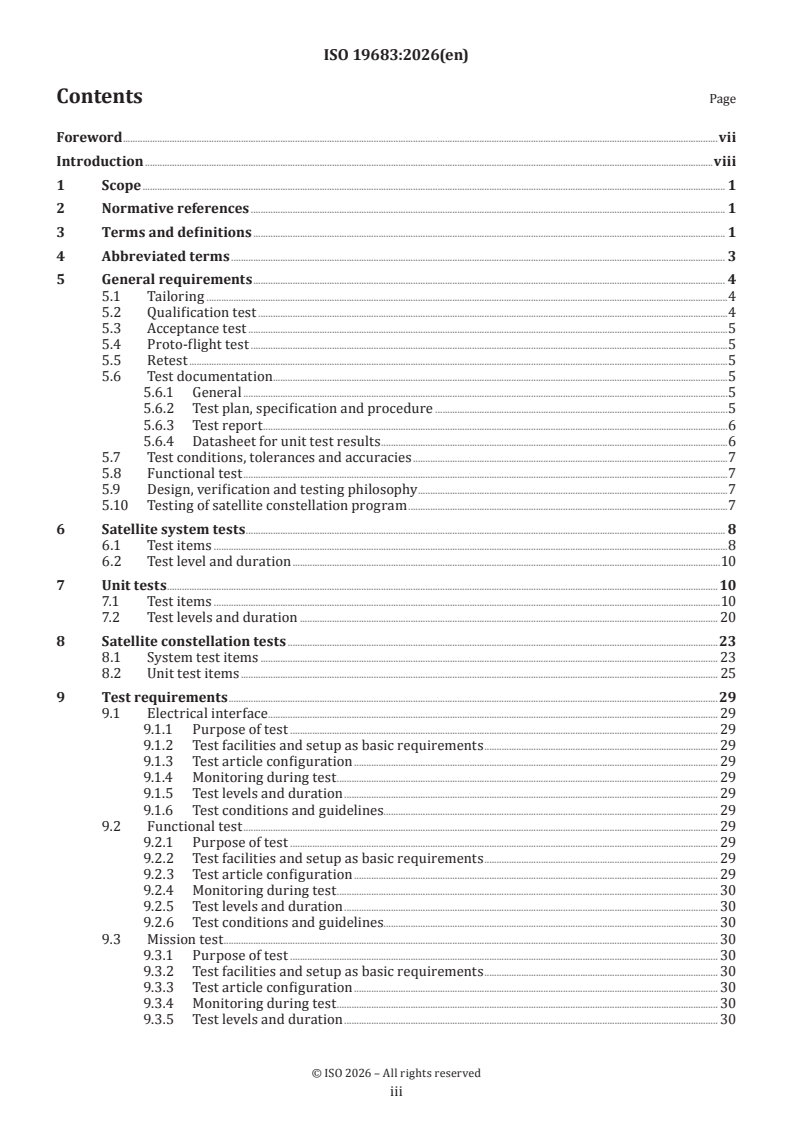
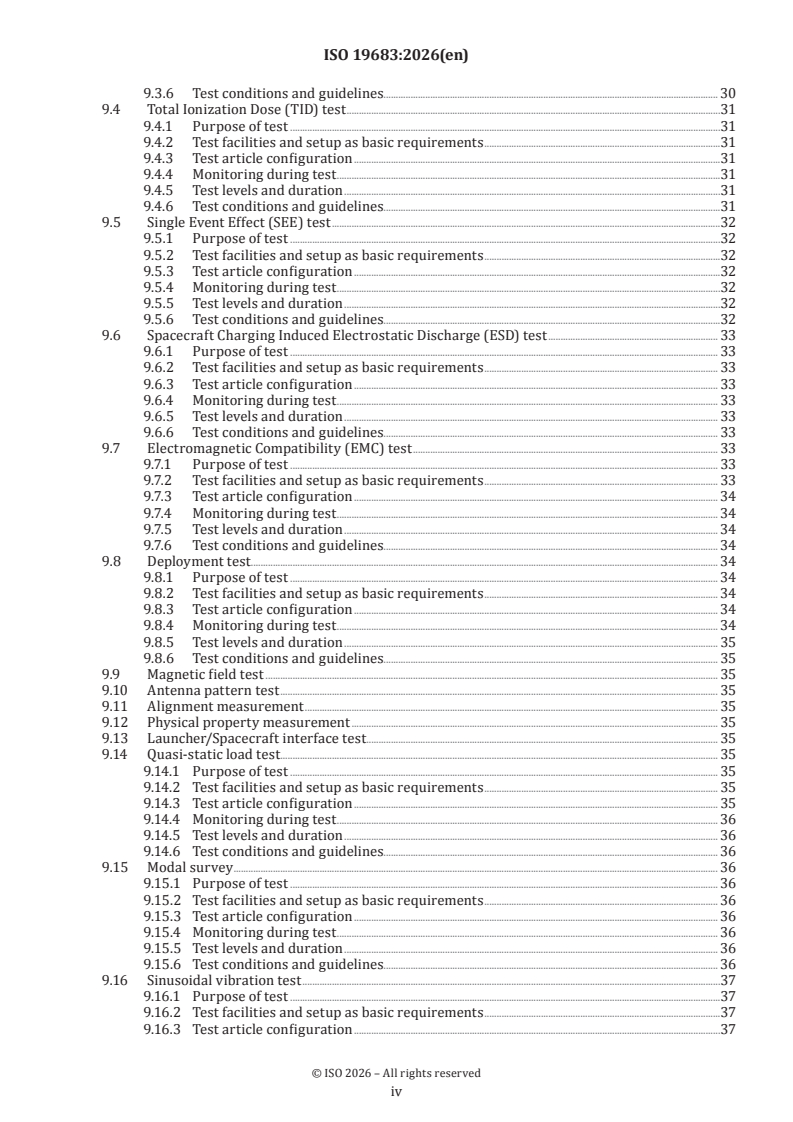
Contents Page
Foreword .vii
Introduction .viii
1 Scope . 1
2 Normative references . 1
3 Terms and definitions . 1
4 Abbreviated terms . 3
5 General requirements . 4
5.1 Tailoring .4
5.2 Qualification test .4
5.3 Acceptance test .5
5.4 Proto-flight test .5
5.5 Retest .5
5.6 Test documentation .5
5.6.1 General .5
5.6.2 Test plan, specification and procedure .5
5.6.3 Test report .6
5.6.4 Datasheet for unit test results .6
5.7 Test conditions, tolerances and accuracies .7
5.8 Functional test .7
5.9 Design, verification and testing philosophy .7
5.10 Testing of satellite constellation program .7
6 Satellite system tests . 8
6.1 Test items .8
6.2 Test level and duration .10
7 Unit tests .10
7.1 Test items .10
7.2 Test levels and duration . 20
8 Satellite constellation tests .23
8.1 System test items . 23
8.2 Unit test items . 25
9 Test requirements .29
9.1 Electrical interface . 29
9.1.1 Purpose of test . 29
9.1.2 Test facilities and setup as basic requirements . 29
9.1.3 Test article configuration . 29
9.1.4 Monitoring during test . 29
9.1.5 Test levels and duration . 29
9.1.6 Test conditions and guidelines. 29
9.2 Functional test . 29
9.2.1 Purpose of test . 29
9.2.2 Test facilities and setup as basic requirements . 29
9.2.3 Test article configuration . 29
9.2.4 Monitoring during test . 30
9.2.5 Test levels and duration . 30
9.2.6 Test conditions and guidelines. 30
9.3 Mission test . 30
9.3.1 Purpose of test . 30
9.3.2 Test facilities and setup as basic requirements . 30
9.3.3 Test article configuration . 30
9.3.4 Monitoring during test . 30
9.3.5 Test levels and duration . 30
iii
9.3.6 Test conditions and guidelines. 30
9.4 Total Ionization Dose (TID) test .31
9.4.1 Purpose of test .31
9.4.2 Test facilities and setup as basic requirements .31
9.4.3 Test article configuration .31
9.4.4 Monitoring during test .31
9.4.5 Test levels and duration .31
9.4.6 Test conditions and guidelines.31
9.5 Single Event Effect (SEE) test .32
9.5.1 Purpose of test .32
9.5.2 Test facilities and setup as basic requirements .32
9.5.3 Test article configuration .32
9.5.4 Monitoring during test .32
9.5.5 Test levels and duration .32
9.5.6 Test conditions and guidelines.32
9.6 Spacecraft Charging Induced Electrostatic Discharge (ESD) test . 33
9.6.1 Purpose of test . 33
9.6.2 Test facilities and setup as basic requirements . 33
9.6.3 Test article configuration . 33
9.6.4 Monitoring during test . 33
9.6.5 Test levels and duration . 33
9.6.6 Test conditions and guidelines. 33
9.7 Electromagnetic Compatibility (EMC) test . 33
9.7.1 Purpose of test . 33
9.7.2 Test facilities and setup as basic requirements . 33
9.7.3 Test article configuration . 34
9.7.4 Monitoring during test . 34
9.7.5 Test levels and duration . 34
9.7.6 Test conditions and guidelines. 34
9.8 Deployment test. 34
9.8.1 Purpose of test . 34
9.8.2 Test facilities and setup as basic requirements . 34
9.8.3 Test article configuration . 34
9.8.4 Monitoring during test . 34
9.8.5 Test levels and duration . 35
9.8.6 Test conditions and guidelines. 35
9.9 Magnetic field test . 35
9.10 Antenna pattern test . 35
9.11 Alignment measurement . 35
9.12 Physical property measurement . 35
9.13 Launcher/Spacecraft interface test . 35
9.14 Quasi-static load test . . 35
9.14.1 Purpose of test . 35
9.14.2 Test facilities and setup as basic requirements . 35
9.14.3 Test article configuration . 35
9.14.4 Monitoring during test . 36
9.14.5 Test levels and duration . 36
9.14.6 Test conditions and guidelines. 36
9.15 Modal survey . 36
9.15.1 Purpose of test . 36
9.15.2 Test facilities and setup as basic requirements . 36
9.15.3 Test article configuration . 36
9.15.4 Monitoring during test . 36
9.15.5 Test levels and duration . 36
9.15.6 Test conditions and guidelines. 36
9.16 Sinusoidal vibration test .37
9.16.1 Purpose of test .37
9.16.2 Test facilities and setup as basic requirements .37
9.16.3 Test article configuration .37
iv
9.16.4 Monitoring during test .37
9.16.5 Test levels and duration .37
9.16.6 Test conditions and guidelines.37
9.17 Random vibration test .37
9.17.1 Purpose of test .37
9.17.2 Test facilities and setup as basic requirements .37
9.17.3 Test article configuration .37
9.17.4 Monitoring during test .37
9.17.5 Test levels and duration . 38
9.17.6 Test conditions and guidelines. 38
9.18 Acoustic test . . 38
9.18.1 Purpose of test . 38
9.18.2 Test facilities and setup as basic requirements . 38
9.18.3 Test article configuration . 38
9.18.4 Monitoring during test . 38
9.18.5 Test levels and duration . 38
9.18.6 Test conditions and guidelines. 38
9.19 Shock test . 38
9.19.1 Purpose of test . 38
9.19.2 Test facilities and setup as basic requirements . 38
9.19.3 Test article configuration . 39
9.19.4 Monitoring during test . 39
9.19.5 Test levels and duration . 39
9.19.6 Test conditions and guidelines. 39
9.20 Thermal balance test . 39
9.20.1 Purpose of test . 39
9.20.2 Test facilities and setup as basic requirements . 39
9.20.3 Test article configuration . 39
9.20.4 Monitoring during test . 39
9.20.5 Test levels and duration . 39
9.20.6 Test conditions and guidelines. 40
9.21 Thermal vacuum test . 40
9.21.1 Purpose of test . 40
9.21.2 Test facilities and setup as basic requirements . 40
9.21.3 Test article configuration . 40
9.21.4 Monitoring during test . 40
9.21.5 Test levels and duration . 40
9.21.6 Test conditions and guidelines.41
9.22 Functional test in vacuum .41
9.22.1 Purpose of test .41
9.22.2 Test facilities and setup as basic requirements .41
9.22.3 Test article configuration .41
9.22.4 Monitoring during test .41
9.22.5 Test levels and duration .41
9.22.6 Test conditions and guidelines.42
9.23 Cold/Hot start test .42
9.23.1 Purpose of test .42
9.23.2 Test facilities and setup as basic requirements .42
9.23.3 Test article configuration .42
9.23.4 Monitoring during test .42
9.23.5 Test levels and duration .42
9.23.6 Test conditions and guidelines.42
9.24 Thermal cycle functional test.43
9.24.1 Purpose of test .43
9.24.2 Test facilities and setup as basic requirements .43
9.24.3 Test article configuration .43
9.24.4 Monitoring during test .43
9.24.5 Test levels and duration .43
9.24.6 Test conditions and guidelines.43
v
9.25 Thermal cycle endurance test . 44
9.25.1 Purpose of test . 44
9.25.2 Test facilities and setup as basic requirements . 44
9.25.3 Test article configuration . 44
9.25.4 Monitoring during test . 44
9.25.5 Test levels and duration . 44
9.25.6 Test conditions and guidelines. 44
9.26 Pressure test . . 44
9.27 Leakage test . 44
9.28 Microvibration test . 44
9.28.1 Purpose of test . 44
9.28.2 Test facilities and setup as basic requirements .45
9.28.3 Test article configuration .45
9.28.4 Monitoring during test .45
9.28.5 Test levels and duration .45
9.28.6 Test conditions and guidelines.45
9.29 Burn-in and wear-in test .45
9.30 End-to-end mission simulation .45
9.30.1 Purpose of test .45
9.30.2 Test facilities and setup as basic requirements .45
9.30.3 Test article configuration .45
9.30.4 Monitoring during test .45
9.30.5 Test levels and duration . 46
9.30.6 Test conditions and guidelines. 46
9.31 Bake out and outgas test . 46
9.31.1 Purpose of test . 46
9.31.2 Test facilities and setup as basic requirements . 46
9.31.3 Test article configuration . 46
9.31.4 Monitoring during test . 46
9.31.5 Test levels and duration . 46
9.31.6 Test conditions and guidelines. 46
9.32 Tailoring and waiver guides .47
Annex A (normative) Tailoring and waiver guides .48
Annex B (informative) Basis of test levels and duration .52
Annex C (informative) Design, verification and testing philosophy for small spacecrafts .55
Annex D (informative) Test selection logic flow . 74
Annex E (informative) Environment stress screening and burn-in .87
Annex F (informative) Thermal vacuum or thermal cycle? .88
Bibliography .91
vi
Foreword
ISO (the International Organization for Standardization) is a worldwide federation of national standards
bodies (ISO member bodies). The work of preparing International Standards is normally carried out through
ISO technical committees. Each member body interested in a subject for which a technical committee
has been established has the right to be represented on that committee. International organizations,
governmental and non-governmental, in liaison with ISO, also take part in the work. ISO collaborates closely
with the International Electrotechnical Commission (IEC) on all matters of electrotechnical standardization.
The procedures used to develop this document and those intended for its further maintenance are described
in the ISO/IEC Directives, Part 1. In particular, the different approval criteria needed for the different types
of ISO document should be noted. This document was drafted in accordance with the editorial rules of the
ISO/IEC Directives, Part 2 (see www.iso.org/directives).
ISO draws attention to the possibility that the implementation of this document may involve the use of (a)
patent(s). ISO takes no position concerning the evidence, validity or applicability of any claimed patent
rights in respect thereof. As of the date of publication of this document, ISO had not received notice of (a)
patent(s) which may be required to implement this document. However, implementers are cautioned that
this may not represent the latest information, which may be obtained from the patent database available at
www.iso.org/patents. ISO shall not be held responsible for identifying any or all such patent rights.
Any trade name used in this document is information given for the convenience of users and does not
constitute an endorsement.
For an explanation of the voluntary nature of standards, the meaning of ISO specific terms and expressions
related to conformity assessment, as well as information about ISO's adherence to the World Trade
Organization (WTO) principles in the Technical Barriers to Trade (TBT), see www.iso.org/iso/foreword.html.
This document was prepared by Technical Committee ISO/TC 20, Aircraft and space vehicles, Subcommittee
SC 14, Space systems and operations.
This second edition cancels and replaces the first edition (ISO 19683:2017), which has been technically
revised.
The main changes are as follows:
— updated terms and definitions;
— added 5.10 on testing of satellite constellation program;
— added Clause 8 on satellite constellation tests;
— updated Clause 9 on test requirements;
— updated Annex C.
Any feedback or questions on this document should be directed to the user’s national standards body. A
complete listing of these bodies can be found at www.iso.org/members.html.
vii
Introduction
There is an increasing demand for small, micro, nano or pico satellite development and utilization worldwide;
yet, there is no clear and globally accepted definition of what is considered “small”, “micro”, “nano” or “pico”
satellites. These satellites are often built with emphasis on low cost and fast delivery. They are characterized
by extensive use of non-space-qualified commercial-off-the-shelf (COTS) units (component). For the sake of
convenience, the term “small spacecraft” is used throughout this document as a generic term to refer to
these satellites.
A small spacecraft is a satellite that utilizes non-traditional risk-taking development and management
approaches to achieve low cost and fast delivery with a small number of team. To achieve these two points,
low cost and fast delivery, satellite design relies on the use of non-space-qualified COTS units (components),
making sate
...