


ISO 13628-7:2005
(Main)Petroleum and natural gas industries — Design and operation of subsea production systems — Part 7: Completion/workover riser systems
Petroleum and natural gas industries — Design and operation of subsea production systems — Part 7: Completion/workover riser systems
ISO 13628-7:2005 gives requirements and recommendations for the design, analysis, materials, fabrication, testing and operation of subsea completion/workover (C/WO) riser systems run from a floating vessel. It is applicable to all new C/WO riser systems and may be applied to modifications, operation of existing systems and reuse at different locations and with different floating vessels. ISO 13628-7:2005 is intended to serve as a common reference for designers, manufacturers and operators/users, thereby reducing the need for company specifications. ISO 13628-7:2005 is limited to risers, manufactured from low alloy carbon steels. Risers fabricated from special materials such as titanium, composite materials and flexible pipes are beyond the scope of ISO 13628-7:2005. Specific equipment covered by ISO 13628-7:2005 include riser joints, connectors; workover control systems; surface flow trees, surface tree tension frames, lower workover riser packages, lubricator valves, retainer valves, subsea test trees, shear subs, tubing hanger orientation systems, swivels, annulus circulation hoses, riser spiders, umbilical clamps, handling and test tools, tree cap running tools. Associated equipment not covered by ISO 13628-7:2005 include tubing hangers, internal and external tree caps, tubing hanger running tools, surface coiled tubing units, surface wireline units, surface tree kill and production jumpers.
Industries du pétrole et du gaz naturel — Conception et exploitation des systèmes de production immergés — Partie 7: Systèmes de liaison surface/fond de mer pour complétion/reconditionnement
L'ISO 13628:2005 donne des exigences et des recommandations relatives à la conception, à l'analyse, aux matériaux, à la fabrication et à l'exploitation des systèmes de liaison surface/fond de mer pour complétion/reconditionnement (C/R) immergés, opérés à partir d'une plate-forme flottante. Elle s'applique à tous les nouveaux systèmes de liaison surface/fond de mer pour C/R et peut s'appliquer aux modifications, à l'exploitation de systèmes existants et à la réutilisation sur différents sites et avec différentes plates-formes flottantes. L'ISO 13628:2005 est destinée à servir de référence commune aux concepteurs, fabricants et opérateurs/utilisateurs, et ainsi à réduire le besoin en spécifications d'entreprises. L'ISO 13628:2005 se limite aux colonnes montantes fabriquées à partir d'acier au carbone faiblement allié. Les colonnes montantes fabriquées à partir de matériaux spéciaux, tels que le titane, et de matériaux composites, ainsi que les colonnes flexibles, n'entrent pas dans le domaine d'application de l'ISO 13628:2005. Les équipements spécifiques traités par l'ISO 13628:2005 sont les suivants: les joints de colonne montante; les connecteurs; les systèmes de commande de reconditionnement; les têtes d'écoulement en surface; les cadres de tension de tête de production en surface; les modules de colonne montante de reconditionnement inférieurs; les vannes de lubrificateur; les vannes de retenue; les têtes de colonne pour essai de puits sous-marin; les réducteurs de cisaillement; les systèmes d'orientation de suspensions pour tubes de pompage; les têtes d'injection; les flexibles de circulation annulaire; les colliers à coins de colonne montante; les colliers d'ombilical; les outils de manutention et d'essai; les outils de pose de bouchon de tête de production. Les équipements associés non traités par l'ISO 13628:2005 sont les suivants: les suspensions pour tubes de pompage; les bouchons de tête de production internes et externes; les outils de pose des suspensions pour tubes de pompage; les tubes d'intervention enroulés de surface; les câbles métalliques de surface; les bretelles de production et d'arrêt de tête de production en surface.
General Information
- Status
- Withdrawn
- Publication Date
- 10-Nov-2005
- Technical Committee
- ISO/TC 67/SC 4 - Drilling and production equipment
- Drafting Committee
- ISO/TC 67/SC 4/WG 6 - Subsea equipment
- Current Stage
- 9599 - Withdrawal of International Standard
- Start Date
- 08-Dec-2025
- Completion Date
- 14-Feb-2026
Overview
ISO 13628-7:2005 - "Petroleum and natural gas industries - Design and operation of subsea production systems - Part 7: Completion/workover riser systems" provides requirements and recommendations for the design, analysis, materials, fabrication, testing and operation of subsea completion/workover (C/WO) riser systems deployed from a floating vessel. Intended as a common reference for designers, manufacturers and operators, it applies to new C/WO riser systems and can be used for modifications, reuse at different locations and operation of existing systems.
Note: the standard is limited to risers manufactured from low-alloy carbon steels; titanium, composites and flexible pipes are out of scope.
Key Topics
- System requirements & engineering: system definition, modes of operation, safety and barrier principles, organizational and personnel qualifications.
- Functional and design requirements: drift and component requirements, workover control systems, connector and pipe design criteria, loads and fatigue considerations.
- Components covered: riser joints and connectors, workover control systems, surface flow trees, surface tree tension frames, lower workover riser packages, lubricator/retainer valves, subsea test trees, swivels, annulus hoses, riser spiders, umbilical clamps, handling/test tools and tree cap running tools.
- Materials, fabrication & testing: material selection, manufacturing, NDT, pressure and qualification testing, hydraulic cleanliness and FAT (factory acceptance testing).
- Inspection, maintenance & monitoring: in-service inspection, reassessment, monitoring and lifecycle maintenance planning.
- Documentation & traceability: design basis, analysis, connector documentation, as-built records, installation & operation manuals, condition résumés.
- Annexes: practical guidance including fatigue analysis, structural resistance methods, connector qualification, purchasing guidance, bolt preload and seals.
Applications
ISO 13628-7:2005 is used to:
- Guide subsea riser system design for completion/workover operations from floating vessels.
- Define acceptance criteria for manufacturers and fabricators (materials, testing, FAT).
- Support operators in procedures for installation, operation, inspection and reassessment of C/WO risers.
- Serve procurement and project teams when specifying equipment interfaces, connector qualification and documentation deliverables.
- Reduce reliance on multiple company specs by providing a common engineering reference.
Who should use this standard
- Subsea and mechanical engineers (riser, connector, fatigue specialists)
- Equipment manufacturers and fabricators
- Offshore operations and maintenance teams
- Project managers, procurement and quality assurance personnel
- Regulatory and certification bodies reviewing riser safety and compliance
Related Standards
- Other parts of ISO 13628 (Part 1 general requirements, Part 4 subsea wellhead and tree equipment, Part 5 subsea umbilicals, Part 6 production control systems) provide complementary guidance for integrated subsea production systems.
Buy Documents
ISO 13628-7:2005 - Petroleum and natural gas industries — Design and operation of subsea production systems — Part 7: Completion/workover riser systems Released:11/11/2005
ISO 13628-7:2005 - Industries du pétrole et du gaz naturel — Conception et exploitation des systemes de production immergés — Partie 7: Systemes de liaison surface/fond de mer pour complétion/reconditionnement Released:4/1/2009
ISO 13628-7:2005 - Petroleum and natural gas industries — Design and operation of subsea production systems — Part 7: Completion/workover riser systems Released:3/21/2013
Get Certified
Connect with accredited certification bodies for this standard

Element Materials Technology
Materials testing and product certification.

ABS Group Brazil
ABS Group certification services in Brazil.

ABS Quality Evaluations Inc.
American Bureau of Shipping quality certification.
Sponsored listings
Frequently Asked Questions
ISO 13628-7:2005 is a standard published by the International Organization for Standardization (ISO). Its full title is "Petroleum and natural gas industries — Design and operation of subsea production systems — Part 7: Completion/workover riser systems". This standard covers: ISO 13628-7:2005 gives requirements and recommendations for the design, analysis, materials, fabrication, testing and operation of subsea completion/workover (C/WO) riser systems run from a floating vessel. It is applicable to all new C/WO riser systems and may be applied to modifications, operation of existing systems and reuse at different locations and with different floating vessels. ISO 13628-7:2005 is intended to serve as a common reference for designers, manufacturers and operators/users, thereby reducing the need for company specifications. ISO 13628-7:2005 is limited to risers, manufactured from low alloy carbon steels. Risers fabricated from special materials such as titanium, composite materials and flexible pipes are beyond the scope of ISO 13628-7:2005. Specific equipment covered by ISO 13628-7:2005 include riser joints, connectors; workover control systems; surface flow trees, surface tree tension frames, lower workover riser packages, lubricator valves, retainer valves, subsea test trees, shear subs, tubing hanger orientation systems, swivels, annulus circulation hoses, riser spiders, umbilical clamps, handling and test tools, tree cap running tools. Associated equipment not covered by ISO 13628-7:2005 include tubing hangers, internal and external tree caps, tubing hanger running tools, surface coiled tubing units, surface wireline units, surface tree kill and production jumpers.
ISO 13628-7:2005 gives requirements and recommendations for the design, analysis, materials, fabrication, testing and operation of subsea completion/workover (C/WO) riser systems run from a floating vessel. It is applicable to all new C/WO riser systems and may be applied to modifications, operation of existing systems and reuse at different locations and with different floating vessels. ISO 13628-7:2005 is intended to serve as a common reference for designers, manufacturers and operators/users, thereby reducing the need for company specifications. ISO 13628-7:2005 is limited to risers, manufactured from low alloy carbon steels. Risers fabricated from special materials such as titanium, composite materials and flexible pipes are beyond the scope of ISO 13628-7:2005. Specific equipment covered by ISO 13628-7:2005 include riser joints, connectors; workover control systems; surface flow trees, surface tree tension frames, lower workover riser packages, lubricator valves, retainer valves, subsea test trees, shear subs, tubing hanger orientation systems, swivels, annulus circulation hoses, riser spiders, umbilical clamps, handling and test tools, tree cap running tools. Associated equipment not covered by ISO 13628-7:2005 include tubing hangers, internal and external tree caps, tubing hanger running tools, surface coiled tubing units, surface wireline units, surface tree kill and production jumpers.
ISO 13628-7:2005 is classified under the following ICS (International Classification for Standards) categories: 75.180.10 - Exploratory, drilling and extraction equipment. The ICS classification helps identify the subject area and facilitates finding related standards.
ISO 13628-7:2005 is available in PDF format for immediate download after purchase. The document can be added to your cart and obtained through the secure checkout process. Digital delivery ensures instant access to the complete standard document.
Standards Content (Sample)
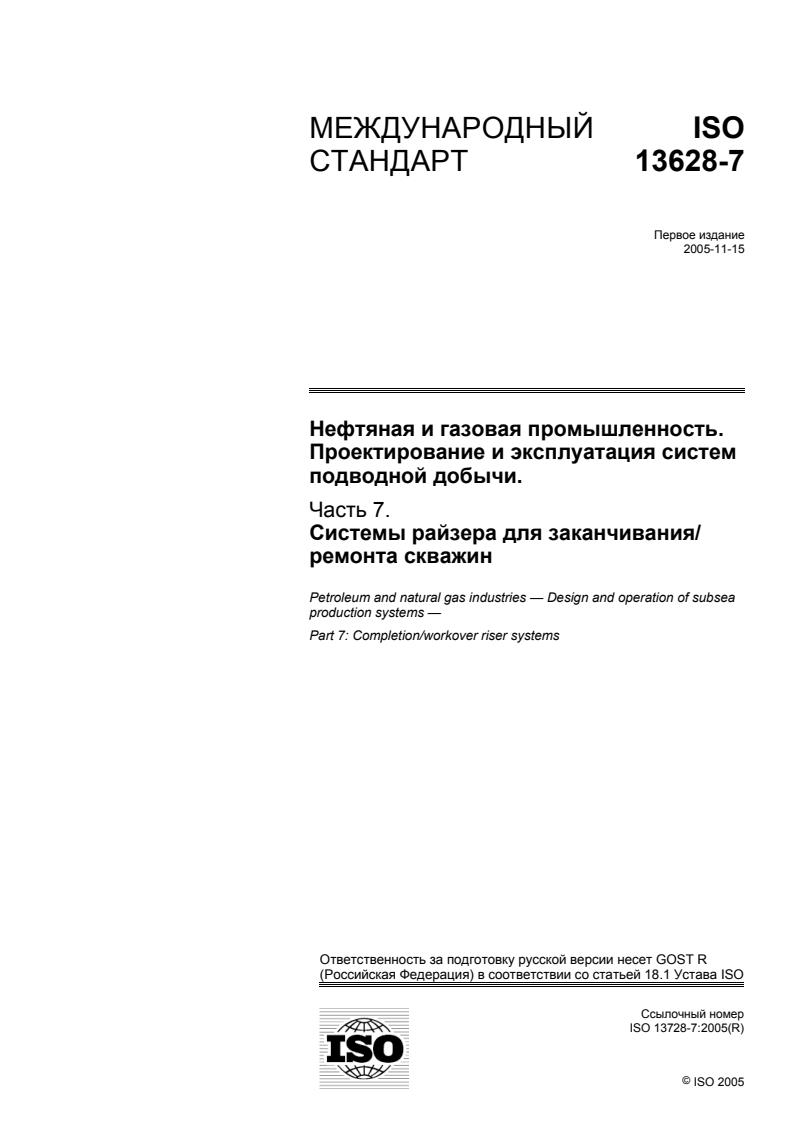
INTERNATIONAL ISO
STANDARD 13628-7
First edition
2005-11-15
Petroleum and natural gas industries —
Design and operation of subsea
production systems —
Part 7:
Completion/workover riser systems
Industries du pétrole et du gaz naturel — Conception et exploitation
des systèmes de production immergés —
Partie 7: Systèmes de liaison surface/fond de mer pour
complétion/reconditionnement
Reference number
©
ISO 2005
PDF disclaimer
This PDF file may contain embedded typefaces. In accordance with Adobe's licensing policy, this file may be printed or viewed but
shall not be edited unless the typefaces which are embedded are licensed to and installed on the computer performing the editing. In
downloading this file, parties accept therein the responsibility of not infringing Adobe's licensing policy. The ISO Central Secretariat
accepts no liability in this area.
Adobe is a trademark of Adobe Systems Incorporated.
Details of the software products used to create this PDF file can be found in the General Info relative to the file; the PDF-creation
parameters were optimized for printing. Every care has been taken to ensure that the file is suitable for use by ISO member bodies. In
the unlikely event that a problem relating to it is found, please inform the Central Secretariat at the address given below.
© ISO 2005
All rights reserved. Unless otherwise specified, no part of this publication may be reproduced or utilized in any form or by any means,
electronic or mechanical, including photocopying and microfilm, without permission in writing from either ISO at the address below or
ISO's member body in the country of the requester.
ISO copyright office
Case postale 56 • CH-1211 Geneva 20
Tel. + 41 22 749 01 11
Fax + 41 22 749 09 47
E-mail copyright@iso.org
Web www.iso.org
Published in Switzerland
ii © ISO 2005 – All rights reserved
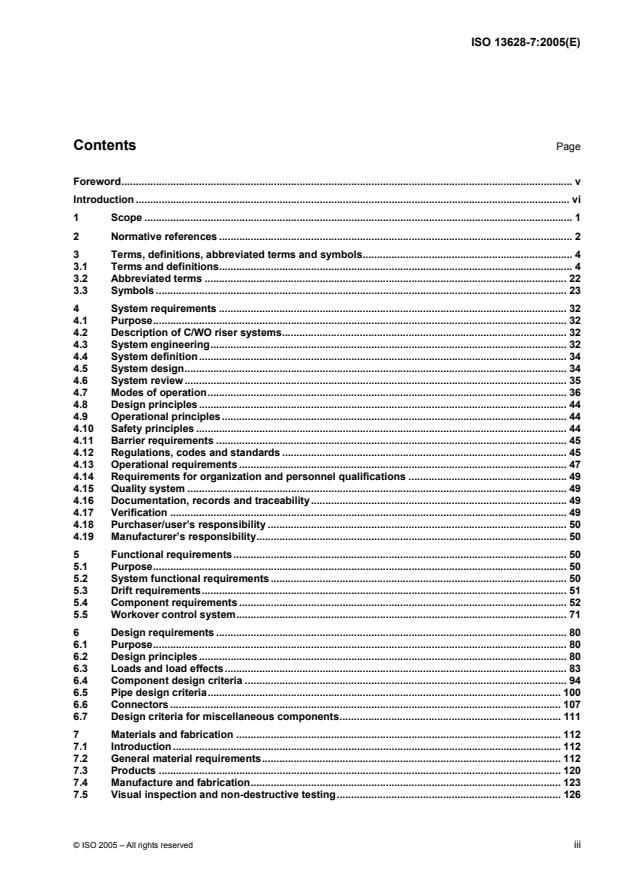
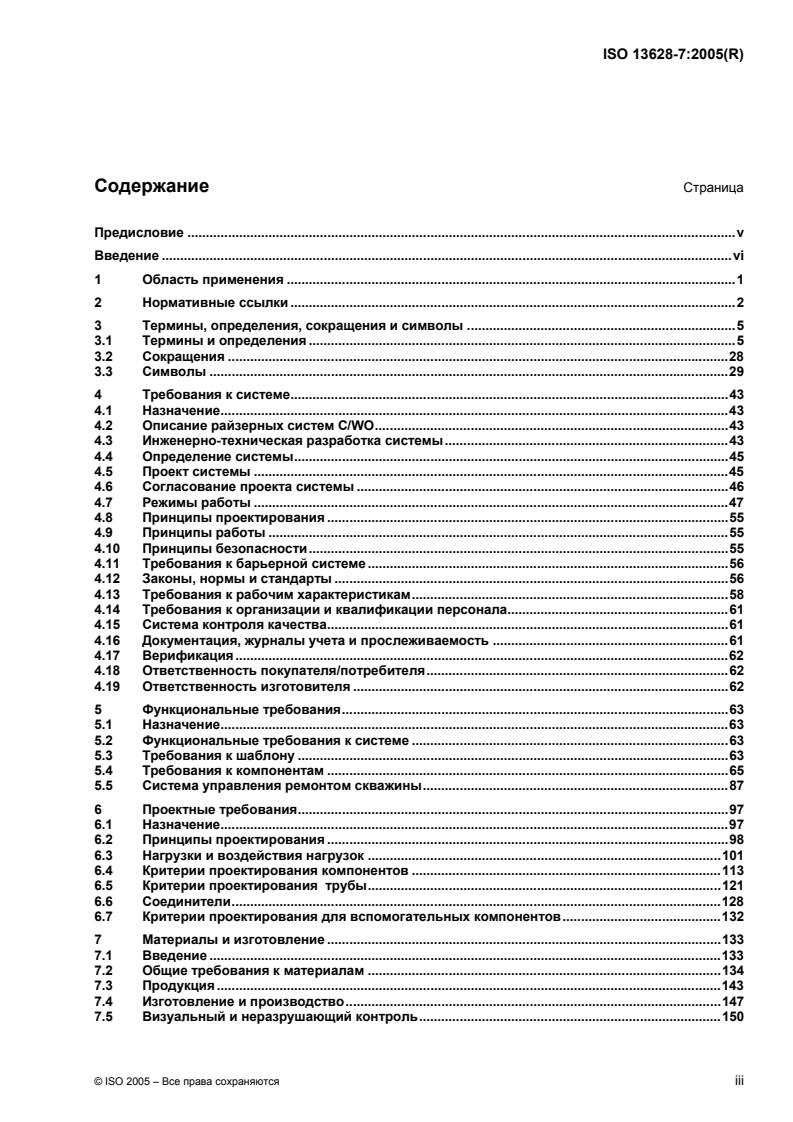
Contents Page
Foreword. v
Introduction . vi
1 Scope . 1
2 Normative references . 2
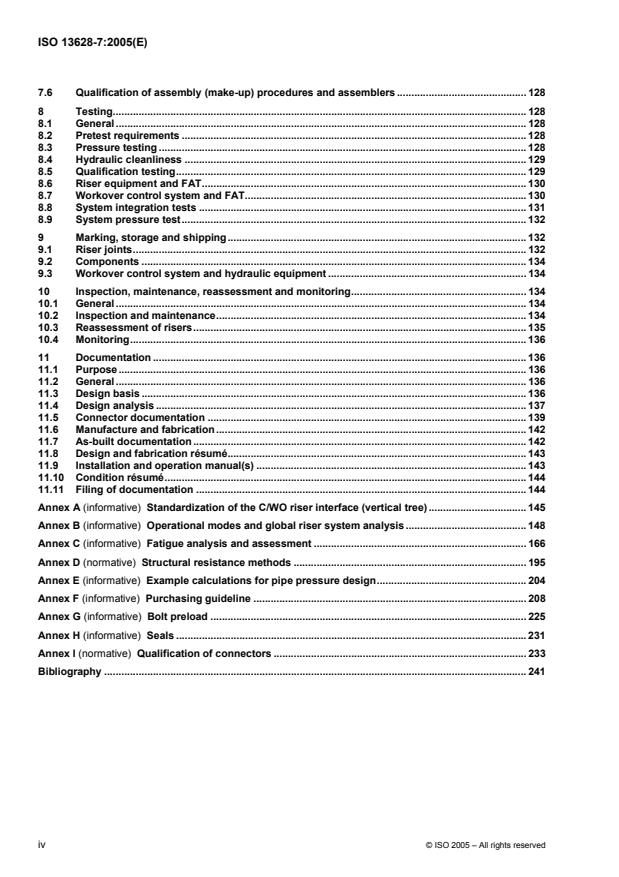
3 Terms, definitions, abbreviated terms and symbols. 4
3.1 Terms and definitions. 4
3.2 Abbreviated terms . 22
3.3 Symbols . 23
4 System requirements . 32
4.1 Purpose. 32
4.2 Description of C/WO riser systems. 32
4.3 System engineering. 32
4.4 System definition. 34
4.5 System design. 34
4.6 System review . 35
4.7 Modes of operation. 36
4.8 Design principles. 44
4.9 Operational principles. 44
4.10 Safety principles . 44
4.11 Barrier requirements . 45
4.12 Regulations, codes and standards . 45
4.13 Operational requirements . 47
4.14 Requirements for organization and personnel qualifications . 49
4.15 Quality system . 49
4.16 Documentation, records and traceability.49
4.17 Verification . 49
4.18 Purchaser/user’s responsibility . 50
4.19 Manufacturer’s responsibility. 50
5 Functional requirements. 50
5.1 Purpose. 50
5.2 System functional requirements . 50
5.3 Drift requirements. 51
5.4 Component requirements . 52
5.5 Workover control system. 71
6 Design requirements . 80
6.1 Purpose. 80
6.2 Design principles. 80
6.3 Loads and load effects. 83
6.4 Component design criteria . 94
6.5 Pipe design criteria. 100
6.6 Connectors . 107
6.7 Design criteria for miscellaneous components. 111
7 Materials and fabrication . 112
7.1 Introduction . 112
7.2 General material requirements. 112
7.3 Products . 120
7.4 Manufacture and fabrication. 123
7.5 Visual inspection and non-destructive testing. 126
7.6 Qualification of assembly (make-up) procedures and assemblers . 128
8 Testing. 128
8.1 General . 128
8.2 Pretest requirements . 128
8.3 Pressure testing . 128
8.4 Hydraulic cleanliness . 129
8.5 Qualification testing. 129
8.6 Riser equipment and FAT. 130
8.7 Workover control system and FAT. 130
8.8 System integration tests . 131
8.9 System pressure test. 132
9 Marking, storage and shipping. 132
9.1 Riser joints. 132
9.2 Components . 134
9.3 Workover control system and hydraulic equipment . 134
10 Inspection, maintenance, reassessment and monitoring. 134
10.1 General . 134
10.2 Inspection and maintenance. 134
10.3 Reassessment of risers. 135
10.4 Monitoring. 136
11 Documentation . 136
11.1 Purpose . 136
11.2 General . 136
11.3 Design basis . 136
11.4 Design analysis . 137
11.5 Connector documentation . 139
11.6 Manufacture and fabrication. 142
11.7 As-built documentation . 142
11.8 Design and fabrication résumé. 143
11.9 Installation and operation manual(s) . 143
11.10 Condition résumé. 144
11.11 Filing of documentation . 144
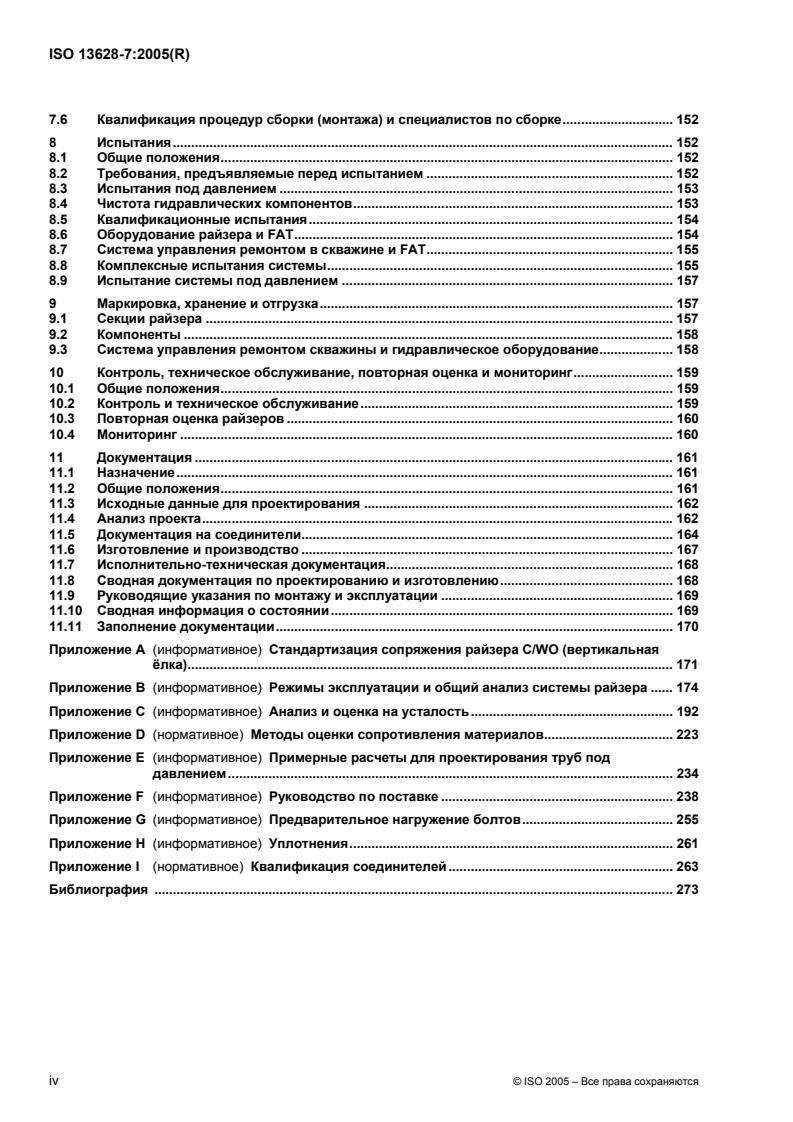
Annex A (informative) Standardization of the C/WO riser interface (vertical tree) . 145
Annex B (informative) Operational modes and global riser system analysis . 148
Annex C (informative) Fatigue analysis and assessment . 166
Annex D (normative) Structural resistance methods . 195
Annex E (informative) Example calculations for pipe pressure design. 204
Annex F (informative) Purchasing guideline . 208
Annex G (informative) Bolt preload . 225
Annex H (informative) Seals . 231
Annex I (normative) Qualification of connectors . 233
Bibliography . 241
iv © ISO 2005 – All rights reserved
Foreword
ISO (the International Organization for Standardization) is a worldwide federation of national standards bodies
(ISO member bodies). The work of preparing International Standards is normally carried out through ISO
technical committees. Each member body interested in a subject for which a technical committee has been
established has the right to be represented on that committee. International organizations, governmental and
non-governmental, in liaison with ISO, also take part in the work. ISO collaborates closely with the
International Electrotechnical Commission (IEC) on all matters of electrotechnical standardization.
International Standards are drafted in accordance with the rules given in the ISO/IEC Directives, Part 2.
The main task of technical committees is to prepare International Standards. Draft International Standards
adopted by the technical committees are circulated to the member bodies for voting. Publication as an
International Standard requires approval by at least 75 % of the member bodies casting a vote.
Attention is drawn to the possibility that some of the elements of this document may be the subject of patent
rights. ISO shall not be held responsible for identifying any or all such patent rights.
ISO 13628-7 was prepared by Technical Committee ISO/TC 67, Materials, equipment and offshore structures
for petroleum, petrochemical and natural gas industries, Subcommittee SC 4, Drilling and production
equipment.
ISO 13628 consists of the following parts, under the general title Petroleum and natural gas industries —
Design and operation of subsea production systems:
⎯ Part 1: General requirements and recommendations
⎯ Part 2: Unbonded flexible pipe systems for subsea and marine applications
⎯ Part 3: Through flowline (TFL) systems
⎯ Part 4: Subsea wellhead and tree equipment
⎯ Part 5: Subsea umbilicals
⎯ Part 6: Subsea production control systems
⎯ Part 7: Completion/workover riser systems
⎯ Part 8: Remotely Operated Vehicle (ROV) interfaces on subsea production systems
⎯ Part 9: Remotely Operated Tool (ROT) intervention systems
⎯ Part 10: Specification for bonded flexible pipe
⎯ Part 11: Flexible pipe systems for subsea and marine applications
Introduction
This part of ISO 13628 has been prepared to provide general requirements, recommendations and overall
guidance for the user to the various areas requiring consideration during development of subsea production
system. The functional requirements defined in this part of ISO 13628 allow alternatives in order to suit
specific field requirements.
This part of ISO 13628 constitutes the overall C/WO riser system standard. Functional requirements for
components comprising the system and detailed requirements for riser pipe and connector design and
analysis are included herein.
This part of ISO 13628 was developed on the basis of API RP 17G:1995, and other relevant documents on
subsea production systems.
It is necessary that the users of this part of ISO 13628 be aware that further or different requirements might be
needed for individual applications. This part of ISO 13628 is not intended to inhibit a vendor from offering, or
the purchaser from accepting, alternative equipment or engineering solutions for the individual application.
This is probably particularly applicable where there is innovative or developing technology. Where an
alternative is offered, it is the vendor's responsibility to identify any variations from this part of ISO 13628 and
provide details.
vi © ISO 2005 – All rights reserved
INTERNATIONAL STANDARD ISO 13628-7:2005(E)
Petroleum and natural gas industries — Design and operation
of subsea production systems —
Part 7:
Completion/workover riser systems
1 Scope
This part of ISO 13628 gives requirements and recommendations for the design, analysis, materials,
fabrication, testing and operation of subsea completion/workover (C/WO) riser systems run from a floating
vessel.
It is applicable to all new C/WO riser systems and may be applied to modifications, operation of existing
systems and reuse at different locations and with different floating vessels.
This part of ISO 13628 is intended to serve as a common reference for designers, manufacturers and
operators/users, thereby reducing the need for company specifications.
This part of ISO 13628 is limited to risers, manufactured from low alloy carbon steels. Risers fabricated from
special materials such as titanium, composite materials and flexible pipes are beyond the scope of this part of
ISO 13628.
Specific equipment covered by this part of ISO 13628 is listed as follows:
⎯ riser joints;
⎯ connectors;
⎯ workover control systems;
⎯ surface flow trees;
⎯ surface tree tension frames;
⎯ lower workover riser packages;
⎯ lubricator valves;
⎯ retainer valves;
⎯ subsea test trees;
⎯ shear subs;
⎯ tubing hanger orientation systems;
⎯ swivels;
⎯ annulus circulation hoses;
⎯ riser spiders;
⎯ umbilical clamps;
⎯ handling and test tools;
⎯ tree cap running tools.
Associated equipment not covered by this part of ISO 13628 is listed below:
⎯ tubing hangers;
⎯ internal and external tree caps;
⎯ tubing hanger running tools;
⎯ surface coiled tubing units;
⎯ surface wireline units;
⎯ surface tree kill and production jumpers.
2 Normative references
The following referenced documents are indispensable for the application of this document. For dated
references, only the edition cited applies. For undated references, the latest edition of the referenced
document (including any amendments) applies.
ISO 148, Steel — Charpy impact test (V-notch)
ISO 377, Steel and steel products — Location and preparation of samples and test pieces for mechanical
testing
ISO 783, Metallic materials — Tensile testing at elevated temperature
ISO 898-1, Mechanical properties of fasteners made of carbon steel and alloy steel — Part 1: Bolts, screws
and studs
ISO 898-2, Mechanical properties of fasteners — Part 2: Nuts with specified proof load values — Coarse
thread
ISO 1461, Hot dip galvanized coatings on fabricated iron and steel articles — Specifications and test methods
ISO 3183 (all parts), Petroleum and natural gas industries — Steel pipe for pipelines — Technical delivery
conditions
ISO 2566-1, Steel — Conversion of elongation values — Part 1: Carbon and low alloy steels
ISO 4885, Ferrous products — Heat treatment — Vocabulary
ISO 6507-1, Metallic materials — Vickers hardness test — Part 1: Test method
ISO 6892, Metallic materials — Tensile testing at ambient temperature
ISO 9327-1, Steel forgings and rolled or forged bars for pressure purposes — Technical delivery conditions —
Part 1: General requirements
ISO 9606-1, Approval testing of welders — Fusion welding — Part 1: Steels
2 © ISO 2005 – All rights reserved
ISO 9712, Non-destructive testing — Qualification and certification of personnel
ISO 10423:2003, Petroleum and natural gas industries — Drilling and production equipment — Wellhead and
christmas tree equipment
ISO 10432, Petroleum and natural gas industries — Downhole equipment — Subsurface safety valve
equipment
ISO 10474, Steel and steel products — Inspection documents
ISO 10945, Hydraulic fluid power — Gas-loaded accumulators — Dimensions of gas ports
ISO 11960:2001, Petroleum and natural gas industries — Steel pipes for use as casing or tubing for wells
ISO 11961, Petroleum and natural gas industries — Steel pipes for use as drill pipe — Specification
ISO 13533:2001, Petroleum and natural gas industries — Drilling and production equipment — Drill-through
equipment
ISO 13535, Petroleum and natural gas industries — Drilling and production equipment — Hoisting equipment
ISO 13628-2, Petroleum and natural gas industries — Design and operation of subsea production systems —
Part 2: Unbonded flexible pipe systems for subsea and marine applications
ISO 13628-4:1999, Petroleum and natural gas industries — Design and operation of subsea production
systems — Part 4: Subsea wellhead and tree equipment
ISO 13628-5, Petroleum and natural gas industries — Design and operation of subsea production systems —
Part 5: Subsea umbilicals
ISO 13628-6:2000, Petroleum and natural gas industries — Design and operation of subsea production
systems — Part 6: Subsea production control systems
ISO 14693, Petroleum and natural gas industries — Drilling and well-servicing equipment
ISO 15156-1, Petroleum and natural gas industries — Materials for use in H S-containing environments in oil
and gas production — Part 1: General principles for selection of cracking-resistant materials
ISO 15156-2:2003, Petroleum and natural gas industries — Materials for use in H S-containing environments
in oil and gas production — Part 2: Cracking-resistant carbon and low alloy steels, and the use of cast irons
ISO 15156-3, Petroleum and natural gas industries — Materials for use in H S-containing environments in oil
and gas production — Part 3: Cracking-resistant CRAs (corrosion-resistant alloys) and other alloys
ISO 17025, General requirements for the competence of testing and calibration laboratories
ISO 15579, Metallic materials — Tensile testing at low temperature
1) 2)
API Spec 7 , Rotary Drill Stem Elements
API Spec 16C, Specification for Choke and Kill Systems
API RP 17B, Recommended Practice for Flexible Pipe
1) American Petroleum Institute, 1220 L Street, North West Washington, DC 20005-4070, USA.
2) For the purposes of this part of ISO 13628, API Spec 7 will be replaced by ISO 10424-1 and ISO 10424-2 when they
become publicly available.
3)
ASME , Boiler and pressure vessel code, Section VIII:2001, Rules for construction of pressure vessels,
Division 1
ASME, Boiler and pressure vessel code, Section IX:2001, Welding and brazing qualification
ASTM A193, Standard Specification for Alloy-Steel and Stainless Steel Bolting Materials for High-Temperature
Service
ASTM A194, Standard Specification for Carbon and Alloy Steel Nuts for Bolts for High Pressure and High
Temperature Service
ASTM A320, Standard Specification for Alloy-Steel and Stainless Steel Bolting Materials for Low-Temperature
Service
4)
ASTM A370, Standard Test Methods and Definitions for Mechanical Testing of Steel Products
ASTM A508, Standard Specification for Quenched and Tempered Vacuum-Treated Carbon and Alloy Steel
Forgings for Pressure Vessels
5)
BS 7201, Hydro-pneumatic accumulators for fluid power purposes — Part 1: Specification for seamless
steel accumulator bodies above 0,5 l water capacity
6)
EN 287-1, Qualification test of welders — Fusion welding — Part 1: Steels
EN 288 (all parts), Specification and approval of welding procedures for metallic materials
EN 1418, Welding personnel — Approval testing of welding operators for fusion welding and resistance weld
setters for fully mechanized and automatic welding of metallic materials
7)
IEC 60089-0, Electrical apparatus for explosive gas atmospheres — Part 0: General Requirements, Fourth
Edition
8)
MSS SP-25, Standard Marking Systems for Valves, Fittings, Flanges and Unions
9)
SAE AS 4059, Aerospace fluid power — Cleanliness classification for hydraulic systems
3 Terms, definitions, abbreviated terms and symbols
For the purposes of this document, the following terms, definitions, abbreviations and symbols apply.
3.1 Terms and definitions
3.1.1
accidental load
load(s) which are imposed on the C/WO riser system under abnormal and unplanned conditions
EXAMPLES Loss of vessel station-keeping and heave compensator lock-up.
3) ASME International, Three Park Avenue, New York, NY 10016-5990, USA.
4) American Society for Testing and Materials, 100 Barr Harbor Drive, West Conshohocken, PA 19428-2959, USA.
5) British Standards Institution, 389 Chiswick High Road, London W4 4AL, UK.
6) European Committee for Standardization, 36 rue de Stassart, B-1050, Brussels, Belgium.
7) International Electrotechnical Commission, IEC Central Office, 3, rue de Varembé, P.O. Box 131, CH-1211 Geneva 20,
Switzerland.
8) Manufactures Standardization Society of the Valve & Fitting Industry, 127 Park Street, N.E., Vienna, VA 22180, USA.
9) SAE International, 400 Commonwealth Drive, Warrendale, PA 15096-0001, USA.
4 © ISO 2005 – All rights reserved
3.1.2
agreement
unless otherwise indicated, “by agreement” means “by agreement between manufacturer and purchaser at the
time of enquiry and order”
3.1.3
apparent weight
weight in water
wet weight
net lift
submerged weight
effective weight
submerged weight including content minus buoyancy
3.1.4
attachment weld
fillet or full penetration weld used for attachment of components to pipe or coupling
3.1.5
auxiliary line
conduit (excluding choke and kill lines) attached to the outside of the riser main pipe
EXAMPLES Hydraulic supply line and annulus circulation line.
3.1.6
ball joint
ball and socket assembly having a central through-passage equal to or greater than the riser internal diameter
NOTE This can be positioned in the riser string to reduce local bending stresses.
3.1.7
barrier
one or several barrier elements that are designed to prevent unintended flow of formation fluid
3.1.8
barrier element
device that, alone, cannot prevent flow from one side to the other side of itself
3.1.9
bearing stress
average normal stress on the contact surfaces of mating surfaces
3.1.10
blow-out preventer
BOP
device installed at the wellhead to contain well-bore pressure either in the annular space between the casing
and the tubulars or in an open hole during drilling, completion, testing or workover
3.1.11
BOP stack
assembly of well control equipment including BOPs, spools, valves, hydraulic connectors, and nipples that
connect to the subsea wellhead
NOTE As commonly used, this term sometimes includes the LMRP.
3.1.12
BOP adapter joint
BOP spanner joint
tubing hanger orientation joint
specialized C/WO riser joint used when the C/WO riser is deployed inside a drilling riser and subsea BOP to
install and retrieve an orientated subsea tubing hanger
3.1.13
BOP stack
assembly of well control equipment including BOPs, spools, valves, hydraulic connectors and nipples that
connects to the subsea wellhead
NOTE As commonly used, this term sometimes includes the LMRP.
3.1.14
buoyancy module
structure of low-mass material, usually foamed polymers strapped or clamped to the exterior of riser joints, to
reduce the submerged mass of the riser
3.1.15
calculation
use of analytical-based formulas or numerical-based methods, e.g. finite element method or boundary element
method, to investigate the structural safety of a component/system
3.1.16
Charpy V-notch test
test to indicate fracture toughness in terms of energy absorbed or lateral expansion or fracture appearance
3.1.17
choke-and-kill line
external conduits, arranged laterally along the riser pipe, and used to circulate fluids into and out of the
wellbore to control well pressure
3.1.18
connector
mechanical device used to connect adjacent components in the riser system to create a structural joint resisting
applied loads and preventing leakage
EXAMPLES Threaded types, including (i) one male fitting (pin), one female fitting (integral box) and seal ring(s), or (ii)
two pins, a coupling and seal sea ring(s); flanged types, including two flanges, bolts and a gasket/seal ring; clamped hub
types, including hubs, clamps, bolts and seal ring(s); dog-type connectors.
3.1.19
control module
assembly of subsea control equipment for piloted or sequential hydraulic or electrohydraulic operations from
surface
NOTE Can be configured as a riser control module used for operation of landing strings in tubing hanger mode or as
a workover control module in tree mode for operation of the lower workover package.
3.1.20
completion riser
temporary riser that is designed to run inside a BOP and drilling riser to allow for well completion
NOTE Completion operations are performed within the drilling riser. A completion riser can also be used for open-sea
workover operations.
6 © ISO 2005 – All rights reserved
3.1.21
completion/workover riser
C/WO riser
temporary riser used for completion or workover operations
3.1.22
component
part of the pressure-containing equipment, which can be considered as an individual item for the calculation
NOTE Includes structural components like pipes, connectors, stress joints, tension joints, landing blocks, slick joints,
tubing hanger orientation joints, adapter joints, etc.
3.1.23
corrosion allowance
amount of wall thickness added to the pipe or component to allow for corrosion, scaling, abrasion, erosion,
wear and all forms of material loss
3.1.24
crack tip opening displacement
CTOD
measure of crack severity that can be compared against a critical value at the onset of crack propagation
3.1.25
design basis
set of project-specific design data and functional requirements that are not specified or are left open in the
general standard
3.1.26
design check
assessment of a component for a load case by means of an application rule
3.1.27
design criteria
quantitative formulations which describe each failure mode the conditions shall fulfil
3.1.28
design factor
factor (usage factor) used in working stress design
3.1.29
design life
period for which a riser can be used for its intended purpose with anticipated maintenance but without
substantial repair or replacement being necessary including storage and working periods
NOTE The design life includes the entire period from start of manufacture to condemnation of the C/WO riser system
or part of the system.
3.1.30
design load
combination of load effects
3.1.31
design material strength
stress used for structural strength calculation
3.1.32
design pressure
maximum difference between internal pressure and external pressure that is unlikely to be exceeded during
the life of the riser, referred to a specified reference height
NOTE Design pressure is often named maximum allowable pressure or rated working pressure or maximum
allowable.
EXAMPLE Design pressure is the maximum pressure considering shut-in pressure at the wellhead (seabed) or at
the top of the riser with subsea valves open, maximum well fracturing pressure, maximum well injection pressure,
maximum surge pressure or maximum well kill pressure.
3.1.33
designer
individual or organization that takes the responsibility for the design of C/WO riser systems conforming with
requirements of this part of ISO 13628
3.1.34
drift
cylindrical mandrel for verifying drift diameter of individual and assembled equipment
3.1.35
meter
minimum diameter that allows for the passage of the drift
3.1.36
drift-off
unintended lateral movement of a dynamically positioned vessel off its intended location relative to the
wellhead, generally caused by loss of station-keeping control or propulsion
3.1.37
drill pipe riser
single string of drill pipe with an attached hydraulic control umbilical and annulus umbilical
3.1.38
drilling riser
system used with floating drilling vessel for guiding the drill string and circulating fluids between the drilling
vessel and the subsea BOP
3.1.39
drive-off
unintended movement of a dynamically positioned vessel off location driven by the vessel's main propulsion or
station-keeping thrusters
3.1.40
dynamic positioning
computerized means of maintaining a vessel on location by selectively activating thrusters
3.1.41
effective tension
axial tension calculated at any point along a riser by considering only the top tension and the apparent weight
of the riser and its contents (tension positive)
NOTE Global buckling and geometric stiffness is governed by the effective tension.
3.1.42
emergency disconnect package
subsea equipment package that typically forms part of the lower workover riser package and provides a
disconnection point between the riser and subsea equipment
NOTE This equipment is used when it is required to disconnect the riser from the well, typically in case of a vessel
drift-off or other emergency that could move the vessel away from the well location.
8 © ISO 2005 – All rights reserved
3.1.43
emergency quick-disconnect
automatic activation of an emergency shutdown followed by an automatic disconnect of the riser
3.1.44
emergency shutdown
controlled sequence of events that ensures that the well is secured against accidental release of
hydrocarbons into the environment, i.e. closing of barrier elements
3.1.45
environmental loads
loads due to the environment
EXAMPLES Waves, current and wind.
3.1.46
environmental seal
outermost pressure-containing seal at a connector interface
NOTE This seal normally separates a pressurized medium from the surrounding environment.
3.1.47
fabricator
individual or organization that takes the responsibility for the fabrication of C/WO riser systems conforming
with the requirements of this part of ISO 13628
3.1.48
factory acceptance test
FAT
test conducted by the manufacturer to verify that the manufacture of a specific assembly meets all intended
functional and operational requirements
3.1.49
fail-safe
term applied to equipment or a system so designed that, in the event of failure or malfunction of any part of the
system, devices are automatically activated to stabilize or secure the safety of the operation
3.1.50
failure
event causing an undesirable condition, e.g. loss of component or system function, or deterioration of
functional capability to such an extent that the safety of the unit, personnel or environment is significantly
reduced
EXAMPLE Structural failure (excessive yielding, buckling, rupture, leakage) or operational limitations (slick joint
protection length, clearance).
3.1.51
false rotary
component that sits on the drilling rotary and provides a slip profile for single, dual or triple tubing strings
NOTE This allows the workover control system umbilical to feed into the drilling riser without interfering with the slips.
3.1.52
fatigue analysis
conventional stress-life fatigue analysis using material S-N curves and specified fatigue design factors
3.1.53
fatigue crack growth analysis
analysis of crack growth from assumed initial defect size under the action of cyclic loading
NOTE Used to determine fabrication inspection requirements and in-service inspection plans.
3.1.54
finite element analysis
numerical method for analysing dynamic and static response, by dividing the structure into small continuous
elements with the given material properties
NOTE The analysis can be local or global.
3.1.55
flex joint
laminated metal and elastomer assembly, having a central through-passage equal to or greater in diameter
than the interfacing pipe or tubing bore, that is positioned in the riser string to reduce the local bending
stresses
3.1.56
floating vessel
buoyant installation that is floating and positioned relative to the sea bottom by station-keeping systems
NOTE The following types of station-keeping systems are normally considered: catenary mooring systems and
dynamic positioning systems based on thrusters. Combination of station-keeping systems can be considered.
EXAMPLE Semi-submersible drilling vessels and drill ships.
3.1.57
fluid
gases, liquids and vapour in pure phases as well as mixtures thereof
3.1.58
fractile
p-fractile (or percentile) and the corresponding fractile value X is defined as F(X ) = p, where F is the
p p
distribution function for X
p
3.1.59
fracture mechanics assessment
assessment and analysis where critical defect sizes under design loads are identified to determine the crack
growth life, i.e. leak or fracture
3.1.60
frequency domain
dynamic analysis method based on the assumption that any applied irregular process is a superposition of
fundamental, regular processes
NOTE Frequency domain analysis is usually associated with linear systems.
3.1.61
functional load
load caused by the physical existence of the riser system and by the operation and handling of the system,
excluding pressure loads
3.1.62
galling
cold welding of contacting material surfaces followed by tearing of the materials during further sliding/rotation
NOTE Galling results from the sliding of metallic surfaces that are under high bearing forces. Galling can generally be
attributed to insufficient lubrication between the surfaces. The purpose of the lubrication medium is to minimize the metal-
to-metal contact and allow efficient sliding of the surfaces. Other ways to prevent galling are to reduce the bearing forces
or reduce the sliding distance.
10 © ISO 2005 – All rights reserved
3.1.63
gasket
deformable material (or combination of materials) intended to be clamped between flanges to prevent leakage
of fluid
3.1.64
gimbal
device that interfaces with the spider and the riser joint and enables the riser to rotate about the horizontal
axis, thereby reducing the bending moments, which can otherwise occur due to vessel roll/pitch motions
3.1.65
global analysis
analysis of the complete riser string from the sea floor (wellhead) to top drive including tensioner joint, utilizing
beam element
NOTE Bending moments and effective tension distributions along the riser string due to functional loads, vessel
motions and environmental loads are determined by global analysis.
3.1.66
global buckling
elastic Euler buckling
3.1.67
grip length
combined thickness of all the elements clamped together by the bolts and nuts, including washers, gaskets
and joint members
3.1.68
gross structural discontinuity
structural or material discontinuity which affects the stress or strain distribution across the entire wall thickness
over a region of significant area
EXAMPLE End-to-pipe junction, connector-to-pipe junction, the junction of two pipes of different diameters,
thickness or material, or a stiffener-to-pipe junction.
3.1.69
hang-off
riser when disconnected from seabed
NOTE Hang-off is usually differentiated from disconnected. Disconnected is normally the condition directly after
disconnecting the riser. Hang-off is normally associated with the riser suspended from the rotary table.
3.1.70
heat-affected zone
region around a weld that has been affected by welding
3.1.71
heave
floating vessel motion in the vertical direction
3.1.72
horizontal tree
subsea tree with production and annulus bore valves located external to the tree, where the tubing hanger or
dummy tubing hanger is installed after the tree
3.1.73
hydraulic connector
mechanical connector that is activated hydraulically
3.1.74
hydrodynamic loads
flow-induced loads caused by the relative motion between the riser and the surrounding water
3.1.75
integral riser
integral style C/WO riser is a riser in which the pressure-containing conduits are mounted into a common
assembly or joint
NOTE 1 An integral riser is typically classified as either jacketed or non-jacketed. The integral riser joint allows the
production and annulus lines to be made up simultaneously.
NOTE 2 A jacketed C/WO riser can also contain hydraulic control lines inside the structural housing. This type of riser
is typically used in applications where high tensile or bending loads are anticipated.
3.1.76
jumper
short piece of flexible pipe
3.1.77
landing string
all the equipment of the riser above the tubing hanger that is contained wholly or partly within the BOP stack
and up to the first standard riser joint
NOTE For live well operations, the landing string typically consists of a tubing hanger running tool, subsea test tree,
shear sub, retainer valve and lubricator valve. For killed well operations, the landing string typically consists of a tubing
hanger running tool and tubing hanger o
...
NORME ISO
INTERNATIONALE 13628-7
Première édition
2005-11-15
Industries du pétrole et du gaz naturel —
Conception et exploitation des systèmes
de production immergés —
Partie 7:
Systèmes de liaison surface/fond de mer
pour complétion/reconditionnement
Petroleum and natural gas industries — Design and operation of
subsea production systems —
Part 7: Completion/workover riser systems
Numéro de référence
©
ISO 2005
PDF – Exonération de responsabilité
Le présent fichier PDF peut contenir des polices de caractères intégrées. Conformément aux conditions de licence d'Adobe, ce fichier
peut être imprimé ou visualisé, mais ne doit pas être modifié à moins que l'ordinateur employé à cet effet ne bénéficie d'une licence
autorisant l'utilisation de ces polices et que celles-ci y soient installées. Lors du téléchargement de ce fichier, les parties concernées
acceptent de fait la responsabilité de ne pas enfreindre les conditions de licence d'Adobe. Le Secrétariat central de l'ISO décline toute
responsabilité en la matière.
Adobe est une marque déposée d'Adobe Systems Incorporated.
Les détails relatifs aux produits logiciels utilisés pour la création du présent fichier PDF sont disponibles dans la rubrique General Info
du fichier; les paramètres de création PDF ont été optimisés pour l'impression. Toutes les mesures ont été prises pour garantir
l'exploitation de ce fichier par les comités membres de l'ISO. Dans le cas peu probable où surviendrait un problème d'utilisation,
veuillez en informer le Secrétariat central à l'adresse donnée ci-dessous.
DOCUMENT PROTÉGÉ PAR COPYRIGHT
© ISO 2005
Droits de reproduction réservés. Sauf prescription différente, aucune partie de cette publication ne peut être reproduite ni utilisée sous
quelque forme que ce soit et par aucun procédé, électronique ou mécanique, y compris la photocopie et les microfilms, sans l'accord écrit
de l'ISO à l'adresse ci-après ou du comité membre de l'ISO dans le pays du demandeur.
ISO copyright office
Case postale 56 • CH-1211 Geneva 20
Tel. + 41 22 749 01 11
Fax + 41 22 749 09 47
E-mail copyright@iso.org
Web www.iso.org
Version française parue en 2009
Publié en Suisse
ii © ISO 2005 – Tous droits réservés
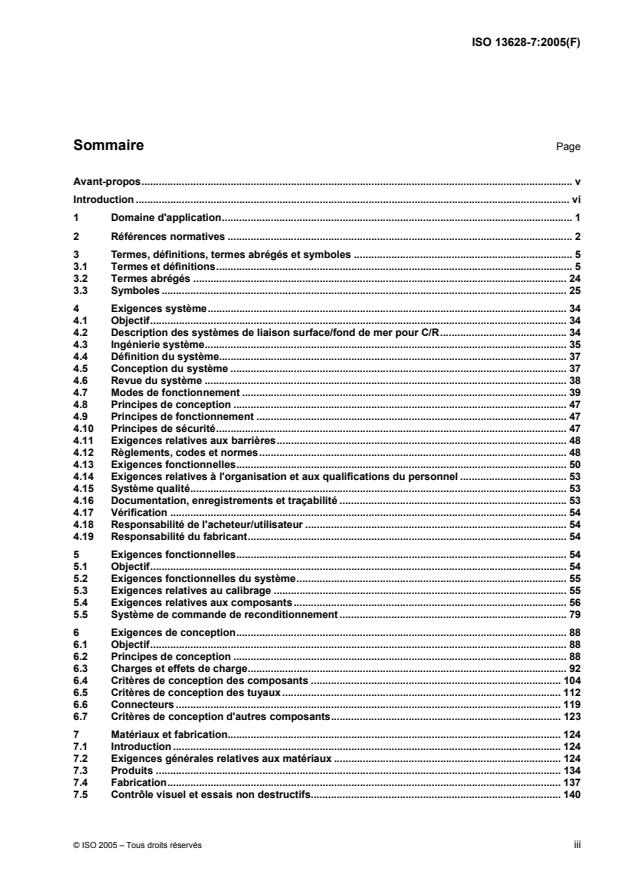
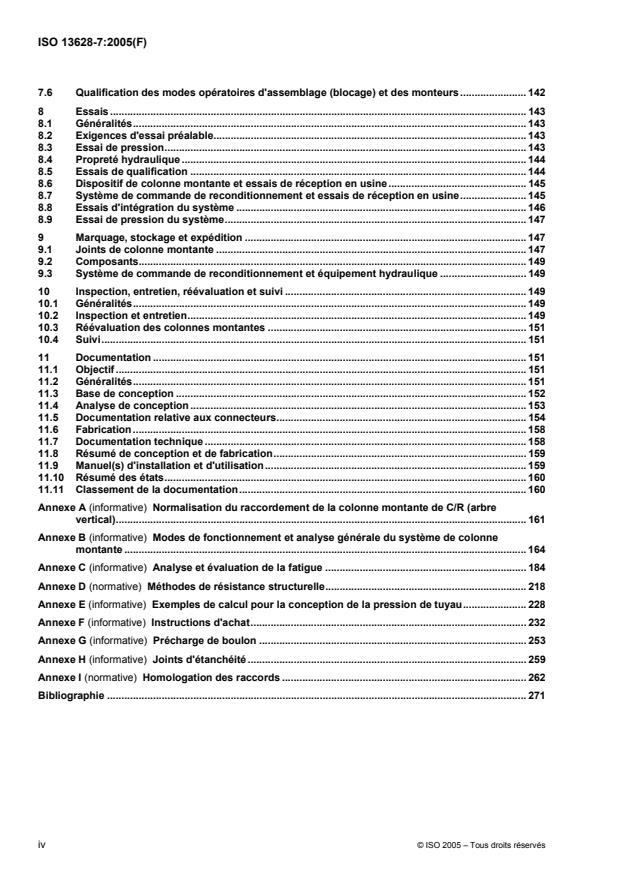
Sommaire Page
Avant-propos. v
Introduction . vi
1 Domaine d'application. 1
2 Références normatives . 2
3 Termes, définitions, termes abrégés et symboles . 5
3.1 Termes et définitions. 5
3.2 Termes abrégés . 24
3.3 Symboles . 25
4 Exigences système. 34
4.1 Objectif. 34
4.2 Description des systèmes de liaison surface/fond de mer pour C/R. 34
4.3 Ingénierie système. 35
4.4 Définition du système. 37
4.5 Conception du système . 37
4.6 Revue du système . 38
4.7 Modes de fonctionnement . 39
4.8 Principes de conception . 47
4.9 Principes de fonctionnement . 47
4.10 Principes de sécurité. 47
4.11 Exigences relatives aux barrières. 48
4.12 Règlements, codes et normes. 48
4.13 Exigences fonctionnelles. 50
4.14 Exigences relatives à l'organisation et aux qualifications du personnel . 53
4.15 Système qualité. 53
4.16 Documentation, enregistrements et traçabilité . 53
4.17 Vérification . 54
4.18 Responsabilité de l'acheteur/utilisateur . 54
4.19 Responsabilité du fabricant. 54
5 Exigences fonctionnelles. 54
5.1 Objectif. 54
5.2 Exigences fonctionnelles du système. 55
5.3 Exigences relatives au calibrage . 55
5.4 Exigences relatives aux composants. 56
5.5 Système de commande de reconditionnement . 79
6 Exigences de conception. 88
6.1 Objectif. 88
6.2 Principes de conception . 88
6.3 Charges et effets de charge. 92
6.4 Critères de conception des composants . 104
6.5 Critères de conception des tuyaux . 112
6.6 Connecteurs . 119
6.7 Critères de conception d'autres composants. 123
7 Matériaux et fabrication. 124
7.1 Introduction . 124
7.2 Exigences générales relatives aux matériaux . 124
7.3 Produits . 134
7.4 Fabrication. 137
7.5 Contrôle visuel et essais non destructifs. 140
7.6 Qualification des modes opératoires d'assemblage (blocage) et des monteurs. 142
8 Essais . 143
8.1 Généralités. 143
8.2 Exigences d'essai préalable. 143
8.3 Essai de pression. 143
8.4 Propreté hydraulique . 144
8.5 Essais de qualification . 144
8.6 Dispositif de colonne montante et essais de réception en usine. 145
8.7 Système de commande de reconditionnement et essais de réception en usine. 145
8.8 Essais d'intégration du système . 146
8.9 Essai de pression du système. 147
9 Marquage, stockage et expédition . 147
9.1 Joints de colonne montante . 147
9.2 Composants. 149
9.3 Système de commande de reconditionnement et équipement hydraulique . 149
10 Inspection, entretien, réévaluation et suivi . 149
10.1 Généralités. 149
10.2 Inspection et entretien. 149
10.3 Réévaluation des colonnes montantes . 151
10.4 Suivi. 151
11 Documentation . 151
11.1 Objectif. 151
11.2 Généralités. 151
11.3 Base de conception . 152
11.4 Analyse de conception . 153
11.5 Documentation relative aux connecteurs. 154
11.6 Fabrication. 158
11.7 Documentation technique . 158
11.8 Résumé de conception et de fabrication. 159
11.9 Manuel(s) d'installation et d'utilisation. 159
11.10 Résumé des états. 160
11.11 Classement de la documentation. 160
Annexe A (informative) Normalisation du raccordement de la colonne montante de C/R (arbre
vertical). 161
Annexe B (informative) Modes de fonctionnement et analyse générale du système de colonne
montante . 164
Annexe C (informative) Analyse et évaluation de la fatigue . 184
Annexe D (normative) Méthodes de résistance structurelle. 218
Annexe E (informative) Exemples de calcul pour la conception de la pression de tuyau. 228
Annexe F (informative) Instructions d'achat. 232
Annexe G (informative) Précharge de boulon . 253
Annexe H (informative) Joints d'étanchéité . 259
Annexe I (normative) Homologation des raccords . 262
Bibliographie . 271
iv © ISO 2005 – Tous droits réservés
Avant-propos
L'ISO (Organisation internationale de normalisation) est une fédération mondiale d'organismes nationaux de
normalisation (comités membres de l'ISO). L'élaboration des Normes internationales est en général confiée
aux comités techniques de l'ISO. Chaque comité membre intéressé par une étude a le droit de faire partie du
comité technique créé à cet effet. Les organisations internationales, gouvernementales et non
gouvernementales, en liaison avec l'ISO participent également aux travaux. L'ISO collabore étroitement avec
la Commission électrotechnique internationale (CEI) en ce qui concerne la normalisation électrotechnique.
Les Normes internationales sont rédigées conformément aux règles données dans les Directives ISO/CEI,
Partie 2.
La tâche principale des comités techniques est d'élaborer les Normes internationales. Les projets de Normes
internationales adoptés par les comités techniques sont soumis aux comités membres pour vote. Leur
publication comme Normes internationales requiert l'approbation de 75 % au moins des comités membres
votants.
L'attention est appelée sur le fait que certains des éléments du présent document peuvent faire l'objet de
droits de propriété intellectuelle ou de droits analogues. L'ISO ne saurait être tenue pour responsable de ne
pas avoir identifié de tels droits de propriété et averti de leur existence.
L'ISO 13628-7 a été élaborée par le comité technique ISO/TC 67, Matériel, équipement et structures en mer
pour les industries pétrolière, pétrochimique et du gaz naturel, sous-comité SC 4, Équipement de forage et de
production.
L'ISO 13628 comprend les parties suivantes, présentées sous le titre général Industries du pétrole et du gaz
naturel — Conception et exploitation des systèmes de production immergés:
⎯ Partie 1: Exigences générales et recommandations
⎯ Partie 2: Systèmes de canalisations flexibles non collées pour applications sous-marines et en milieu
marin
⎯ Partie 3: Systèmes d'injection TFL
⎯ Partie 4: Équipements immergés de tête de puits et tête de production
⎯ Partie 5: Faisceaux de câbles immergés
⎯ Partie 6: Commandes pour équipements immergés
⎯ Partie 7: Systèmes de liaison surface/fond de mer pour complétion/reconditionnement
⎯ Partie 8: Véhicules commandés à distance pour l'interface avec les matériels immergés
⎯ Partie 9: Systèmes d'intervention utilisant des dispositifs à commande à distance (ROT)
⎯ Partie 10: Spécification pour canalisations flexibles composites
⎯ Partie 11: Systèmes de canalisations flexibles pour applications sous-marines et en milieu marin
Introduction
La présente partie de l'ISO 13628 a été élaborée pour fournir à l'utilisateur des exigences générales, des
recommandations et des lignes directrices générales dans les différents domaines à prendre en compte lors
du développement d'un système de production immergé. Les exigences fonctionnelles définies dans la
présente partie de l'ISO 13628 autorisent des alternatives afin de s'adapter aux exigences d'application
spécifiques.
La présente partie de l'ISO 13628 constitue la norme des systèmes de liaison surface/fond de mer pour C/R.
Les exigences fonctionnelles relatives aux composants formant le système et les exigences détaillées
relatives à la conception de la colonne montante et du connecteur y sont incluses.
La présente partie de l'ISO 13628 a été élaborée sur la base de l'API RP 17G:1995 et d'autres documents
pertinents concernant les systèmes de production immergés.
Les utilisateurs de la présente partie de l'ISO 13628 doivent savoir que des exigences supplémentaires ou
différentes peuvent être requises pour des applications individuelles. La présente partie de l'ISO 13628 n'est
pas destinée à empêcher un vendeur de proposer ou l'acheteur d'accepter un autre équipement ou d'autres
solutions techniques pour certaines applications.
Cela peut s'appliquer en particulier dans le cas d'une technologie innovante ou en cours de développement.
Si une alternative est proposée, il incombe au vendeur d'identifier toutes variations par rapport à la présente
partie de l'ISO 13628 et de fournir des détails.
vi © ISO 2005 – Tous droits réservés
NORME INTERNATIONALE ISO 13628-7:2005(F)
Industries du pétrole et du gaz naturel — Conception et
exploitation des systèmes de production immergés —
Partie 7:
Systèmes de liaison surface/fond de mer pour
complétion/reconditionnement
1 Domaine d'application
La présente partie de l'ISO 13628 donne des exigences et des recommandations relatives à la conception, à
l'analyse, aux matériaux, à la fabrication et à l'exploitation des systèmes de liaison surface/fond de mer pour
complétion/reconditionnement (C/R) immergés, opérés à partir d'une plate-forme flottante.
Elle s'applique à tous les nouveaux systèmes de liaison surface/fond de mer pour C/R et peut s'appliquer aux
modifications, à l'exploitation de systèmes existants et à la réutilisation sur différents sites et avec différentes
plates-formes flottantes.
La présente partie de l'ISO 13628 est destinée à servir de référence commune aux concepteurs, fabricants et
opérateurs/utilisateurs, et ainsi à réduire le besoin en spécifications d'entreprises.
La présente partie de l'ISO 13628 se limite aux colonnes montantes fabriquées à partir d'acier au carbone
faiblement allié. Les colonnes montantes fabriquées à partir de matériaux spéciaux, tels que le titane, et de
matériaux composites, ainsi que les colonnes flexibles, n'entrent pas dans le domaine d'application de la
présente partie de l'ISO 13628.
Les équipements spécifiques traités par la présente partie de l'ISO 13628 sont les suivants:
⎯ les joints de colonne montante;
⎯ les connecteurs;
⎯ les systèmes de commande de reconditionnement;
⎯ les têtes d'écoulement en surface;
⎯ les cadres de tension de tête de production en surface;
⎯ les modules de colonne montante de reconditionnement inférieurs;
⎯ les vannes de lubrificateur;
⎯ les vannes de retenue;
⎯ les têtes de colonne pour essai de puits sous-marin;
⎯ les réducteurs de cisaillement;
⎯ les systèmes d'orientation de suspensions pour tubes de pompage;
⎯ les têtes d'injection;
⎯ les flexibles de circulation annulaire;
⎯ les colliers à coins de colonne montante;
⎯ les colliers d'ombilical;
⎯ les outils de manutention et d'essai;
⎯ les outils de pose de bouchon de tête de production.
Les équipements associés non traités par la présente partie de l'ISO 13628 sont les suivants:
⎯ les suspensions pour tubes de pompage;
⎯ les bouchons de tête de production internes et externes;
⎯ les outils de pose des suspensions pour tubes de pompage;
⎯ les tubes d'intervention enroulés de surface;
⎯ les câbles métalliques de surface;
⎯ les bretelles de production et d'arrêt de tête de production en surface.
2 Références normatives
Les documents de référence suivants sont indispensables pour l'application de la présente norme. Pour les
références datées, seule l'édition citée s'applique. Pour les références non datées, la dernière édition de la
publication à laquelle il est fait référence (y compris tous les amendements) s'applique.
ISO 148, Acier — Essai de résilience Charpy (entaille en V)
ISO 377, Acier et produits en acier — Position et préparation des échantillons et éprouvettes pour essais
mécaniques
ISO 783, Matériaux métalliques — Essai de traction à température élevée
ISO 898-1, Caractéristiques mécaniques des éléments de fixation en acier au carbone et en acier allié —
Partie 1: Vis et goujons
ISO 898-2, Caractéristiques mécaniques des éléments de fixation — Partie 2: Écrous avec charges
d'épreuves spécifiées — Filetages à pas gros
ISO 1461, Revêtements par galvanisation à chaud sur produits finis ferreux — Spécifications et méthodes
d'essai
ISO 3183 (toutes les parties), Industries du pétrole et du gaz naturel — Tubes en acier pour le transport des
fluides combustibles — Conditions techniques de livraison
ISO 2566-1, Acier — Conversion des valeurs d'allongement — Partie 1: Aciers au carbone et aciers
faiblement alliés
ISO 4885, Produits ferreux — Traitements thermiques — Vocabulaire
ISO 6507-1, Matériaux métalliques — Essai de dureté Vickers — Partie 1: Méthode d'essai
ISO 6892, Matériaux métalliques — Essai de traction à température ambiante
2 © ISO 2005 – Tous droits réservés
ISO 9327-1, Pièces forgées et barres laminées ou forgées en acier pour appareils à pression — Conditions
techniques de livraison — Partie 1: Exigences générales
ISO 9606-1, Épreuve de qualification des soudeurs — Soudage par fusion — Partie 1: Aciers
ISO 9712, Essais non destructifs — Qualification et certification du personnel
ISO 10423:2003, Industries du pétrole et du gaz naturel — Équipement de forage et de production —
Équipement pour têtes de puits et arbre de Noël
ISO 10432, Industries du pétrole et du gaz naturel — Équipement de forage vertical — Vannes de protection
de fond de puits
ISO 10474, Aciers et produits sidérurgiques — Documents de contrôle
ISO 10945, Transmissions hydrauliques — Accumulateurs hydropneumatiques — Dimensions des orifices
gaz
ISO 11960:2001, Industries du pétrole et du gaz naturel — Tubes d'acier utilisés comme cuvelage ou tubes
de protection dans les puits
ISO 11961, Industries du pétrole et du gaz naturel — Tubes d'acier pour tiges de forage — Spécifications
ISO 13533:2001, Industries du pétrole et du gaz naturel — Équipement de forage et de production —
Équipements à travers lesquels s'effectue le forage
ISO 13535, Industries du pétrole et du gaz naturel — Équipement de forage et de production — Équipements
de levage
ISO 13628-2, Industries du pétrole et du gaz naturel — Conception et exploitation des systèmes de
production immergés — Partie 2: Systèmes de canalisations flexibles non collées pour applications sous-
marines et en milieu marin
ISO 13628-4:1999, Industries du pétrole et du gaz naturel — Conception et exploitation des systèmes de
production immergés — Partie 4: Équipements immergés de tête de puits et tête de production
ISO 13628-5, Industries du pétrole et du gaz naturel — Conception et exploitation des systèmes de
production immergés — Partie 5: Faisceaux de câbles immergés
ISO 13628-6:2000, Industries du pétrole et du gaz naturel — Conception et exploitation des systèmes de
production immergés — Partie 6: Commandes pour équipements immergés
ISO 14693, Industries du pétrole et du gaz naturel — Équipement de forage et d'entretien des puits
ISO 15156-1, Industries du pétrole et du gaz naturel — Matériaux pour utilisation dans des environnements
contenant de l'hydrogène sulfuré (H S) dans la production de pétrole et de gaz naturel — Partie 1: Principes
généraux pour le choix des matériaux résistant au craquage
ISO 15156-2:2003, Industries du pétrole et du gaz naturel — Matériaux pour utilisation dans des
environnements contenant de l'hydrogène sulfuré (H S) dans la production de pétrole et de gaz naturel —
Partie 2: Aciers au carbone et aciers faiblement alliés résistants à la fissuration, et utilisation de fontes
ISO 15156-3, Industries du pétrole et du gaz naturel — Matériaux pour utilisation dans des environnements
contenant de l'hydrogène sulfuré (H S) dans la production de pétrole et de gaz naturel — Partie 3: ARC
(alliages résistants à la corrosion) et autres alliages résistants à la fissuration
ISO 17025, Exigences générales concernant la compétence des laboratoires d'étalonnages et d'essais
ISO 15579, Matériaux métalliques — Essai de traction à basse température
1) 2)
API Spec 7 , Rotary Drill Stem Elements
API Spec 16C, Specification for Choke and Kill Systems
API RP 17B, Recommended Practice for Flexible Pipe
3)
ASME , Boiler and pressure vessel code, Section VIII:2001, Rules for construction of pressure vessels,
Division 1
ASME, Boiler and pressure vessel code, Section IX:2001, Welding and brazing qualification
ASTM A193, Standard Specification for Alloy-Steel and Stainless Steel Bolting Materials for High-Temperature
Service
ASTM A194, Standard Specification for Carbon and Alloy Steel Nuts for Bolts for High Pressure and High
Temperature Service
ASTM A320, Standard Specification for Alloy-Steel and Stainless Steel Bolting Materials for Low-Temperature
Service
4)
ASTM A370, Standard Test Methods and Definitions for Mechanical Testing of Steel Products
ASTM A508, Standard Specification for Quenched and Tempered Vacuum-Treated Carbon and Alloy Steel
Forgings for Pressure Vessels
5)
BS 7201, Hydro-pneumatic accumulators for fluid power purposes — Part 1: Specification for seamless
steel accumulator bodies above 0,5 l water capacity
6)
EN 287-1, Épreuve de qualification des soudeurs — Soudage par fusion — Partie 1: Aciers
EN 288 (toutes les parties), Descriptif et qualification d'un mode opératoire de soudage pour les matériaux
métalliques
EN 1418, Personnel en soudage — Épreuve de qualification des opérateurs soudeurs pour le soudage par
fusion et des régleurs en soudage par résistance pour le soudage totalement mécanisé et automatique des
matériaux métalliques
7)
CEI 60089-0, Electrical apparatus for explosive gas atmospheres — Part 0: General Requirements, Fourth
Edition
8)
MSS SP-25, Standard Marking Systems for Valves, Fittings, Flanges and Unions
9)
SAE AS 4059, Aerospace fluid power — Cleanliness classification for hydraulic systems
1)
American Petroleum Institute, 1220 L Street, North West Washington, DC 20005-4070, États-Unis.
2)
Pour les besoins de la présente partie de l'ISO 13628, l'API Spec 7 sera remplacée par l'ISO 10424-1 et
l'ISO 10424-2 lorsqu’elles seront publiquement disponibles.
3)
ASME International, Three Park Avenue, New York, NY 10016-5990, États-Unis.
4)
American Society for Testing and Materials, 100 Barr Harbor Drive, West Conshohocken, PA 19428-2959, États-Unis.
5)
British Standards Institution, 389 Chiswick High Road, London W4 4AL, UK.
6)
Comité Européen de Normalisation, 36, rue de Stassart, B-1050, Bruxelles, Belgique.
7)
Commission Électrotechnique Internationale, IEC Central Office, 3, rue de Varembé, P.O. Box 131, CH-1211
Genève 20, Suisse.
8)
Manufactures Standardization Society of the Valve & Fitting Industry, 127 Park Street, N.E., Vienna, VA 22180,
États-Unis.
4 © ISO 2005 – Tous droits réservés
3 Termes, définitions, termes abrégés et symboles
Pour les besoins du présent document, les termes, définitions, termes abrégés et symboles suivants
s'appliquent.
3.1 Termes et définitions
3.1.1
charge accidentelle
charge(s) appliquée(s) au système de liaison surface/fond de mer pour C/R dans des conditions anormales et
non planifiées
EXEMPLES Perte du maintien à poste du navire et verrouillage du compensateur de pilonnement.
3.1.2
accord
sauf indication contraire, «par accord» signifie «par accord entre le fabricant et l'acheteur au moment de la
demande et de la commande»
3.1.3
poids apparent
poids dans l'eau
poids humide
force ascensionnelle nette
poids immergé
poids effectif
poids immergé y compris le contenu moins la flottabilité
3.1.4
soudure d'attache
cordon de soudure ou soudure traversée utilisée pour raccorder les composants au tuyau ou à l'accouplement
3.1.5
conduite auxiliaire
conduite (à l'exception des lignes de duse) fixée à l'extérieur de la conduite principale de la colonne montante
EXEMPLES Conduite d'alimentation hydraulique et conduite de circulation annulaire.
3.1.6
joint sphérique
ensemble joint à rotule disposant d'un passage central d'un diamètre supérieur ou égal à celui de la colonne
montante
NOTE Il peut être placé dans la colonne montante pour réduire les contraintes de flexion locales.
3.1.7
barrière
un ou plusieurs éléments de barrière conçus pour empêcher l'écoulement de fluide de formation
3.1.8
élément de barrière
dispositif qui, utilisé seul, ne peut pas empêcher l'écoulement de l'un ou l'autre de ses côtés
9)
SAE International, 400 Commonwealth Drive, Warrendale, PA 15096-0001, États-Unis.
3.1.9
contrainte de compression
contrainte normale moyenne exercée sur les surfaces de contact de surfaces d'ajustement
3.1.10
obturateur anti-éruption
BOP
dispositif installé sur une tête de puits pour contenir la pression du trou de forage dans l'espace annulaire
entre le tubage et le matériel tubulaire ou dans un trou non tubé pendant le forage, la complétion, l'essai ou le
reconditionnement
3.1.11
bloc obturateur de puits
ensemble d'équipements de contrôle de puits comprenant les BOP, les brides d'ancrage, les valves, les
raccords hydrauliques et les raccords, connecté à la tête de puits immergée
NOTE Selon l'usage général, ce terme inclut quelquefois le LMRP.
3.1.12
joint d'adaptation du BOP
joint de serrage du BOP
joint d'orientation de la suspension pour tubes de pompage
joint de liaison surface/fond de mer pour C/R spécialisé, utilisé lorsque la colonne montante pour C/R est
déployée à l'intérieur d'un riser de forage et d'un BOP immergé pour installer et extraire une suspension pour
tubes de pompage immergée orientée
3.1.13
bloc obturateur de puits
ensemble d'équipements de contrôle de puits comprenant les BOP, les brides d'ancrage, les valves, les
raccords hydrauliques et les raccords, connecté à la tête de puits immergée
NOTE Selon l'usage général, ce terme inclut quelquefois le LMRP.
3.1.14
module de flottaison
structure en matériaux de masse faible, généralement des polymères mousse, fixée par bride ou collier à
l'extérieur des joints de colonne montante pour réduire la masse immergée de la colonne montante
3.1.15
calcul
utilisation de formules analytiques ou numériques, par exemple la méthode par éléments finis ou par éléments
limites, pour examiner la sécurité structurelle d'un composant/système
3.1.16
essai de Charpy à entaille en V
essai permettant d'indiquer la résistance à la rupture en termes d'énergie absorbée, d'extension latérale ou
d'apparence de fissures
3.1.17
ligne de duse
conduites externes, disposées latéralement le long de la colonne montante, et utilisées pour faire circuler les
fluides dans et hors du trou de forage afin de contrôler la pression du puits
3.1.18
connecteur
dispositif mécanique utilisé pour raccorder des composants adjacents dans le système de liaison surface/fond
de mer afin de créer un joint structurel résistant aux charges appliquées et de prévenir les fuites
6 © ISO 2005 – Tous droits réservés
EXEMPLES Connecteurs filetés, y compris (i) une fixation mâle (broche), une fixation femelle (boîte intégrée) et une
ou plusieurs bagues d'étanchéité, ou (ii) deux broches, un accouplement et une ou plusieurs bagues marines d'étanchéité;
à brides, comprenant deux brides, des boulons et un joint/bague d'étanchéité; types à moyeu fixé par collier, comprenant
des moyeux, des colliers, des boulons et une ou plusieurs bagues d'étanchéité; à crampon.
3.1.19
module de commande
ensemble d'équipements de commande immergés pour des opérations pilotées ou à commande séquentielle
hydraulique ou électro-hydraulique depuis la surface
NOTE Peut être configuré en tant que module de commande de la colonne montante utilisé pour le fonctionnement
de colonnes de pose en mode suspension pour tube de pompage ou en tant que module de commande de
reconditionnement en mode tête de production pour le fonctionnement du module de reconditionnement inférieur.
3.1.20
colonne montante de complétion
colonne montante temporaire conçue pour fonctionner à l'intérieur d'un BOP et d'un riser de forage pour
permettre la complétion du puits
NOTE Les opérations de complétion sont effectuées à l'intérieur du riser de forage. Une colonne montante de
complétion peut également être utilisée pour des opérations de reconditionnement en haute mer.
3.1.21
colonne montante de complétion/reconditionnement
colonne montante C/R
colonne montante temporaire utilisée pour les opérations de complétion ou de reconditionnement
3.1.22
composant
partie de l'équipement sous pression, pouvant être considéré comme un élément individuel destiné au calcul
NOTE Inclut les composants structurels comme les tuyaux, les connecteurs, les joints de contrainte, les joints de
tension, les blocs de pose, les joints de tubes à garnissage, les joints d'orientation de suspension pour tubes de pompage,
les joints d'adaptation, etc.
3.1.23
surépaisseur de corrosion
quantité d'épaisseur de paroi ajoutée au tuyau ou au composant pour autoriser la corrosion, l'entartrage,
l'abrasion, l'érosion, l'usure et toutes les formes de perte de matériau
3.1.24
déplacement de l'ouverture de l'extrémité de fissures
CTOD
mesure de la gravité de la fissure pouvant être comparée à une valeur critique au début de la propagation de
la fissure
3.1.25
base de conception
ensemble de données de conception spécifiques au projet et d'exigences fonctionnelles qui ne sont pas
spécifiées ou laissées en attente dans la norme générale
3.1.26
vérification de la conception
évaluation d'un composant pour un cas de charge au moyen d'une règle d'application
3.1.27
critères de conception
formules quantitatives qui décrivent chaque mode de défaillance que les conditions doivent remplir
3.1.28
facteur de conception
facteur (facteur d'usage) utilisé dans la conception de contrainte admissible
3.1.29
durée de vie de conception
période pendant laquelle une colonne montante peut être utilisée pour son usage prévu, avec une
maintenance anticipée, mais sans nécessiter de réparation ou de remplacement important, y compris les
périodes de stockage et de fonctionnement
NOTE La durée de vie de conception comprend l'ensemble de la période du début de la fabrication à la
condamnation du système de liaison surface/fond de mer pour C/R ou d'une partie du système.
3.1.30
charge nominale
combinaison des effets de charge
3.1.31
résistance nominale du matériau
contrainte utilisée pour le calcul de la résistance structurelle
3.1.32
pression nominale
différence maximale entre la pression interne et externe dont le dépassement est improbable pendant la
durée de vie de la colonne montante, par rapport à une hauteur de référence spécifiée
NOTE La pression nominale est souvent appelée pression maximale autorisée ou pression de fonctionnement
nominale ou maximum autorisé.
EXEMPLE La pression nominale est la pression maximale tenant compte de la pression enfermée à la tête du puits
(fond marin) ou au sommet de la colonne montante avec les vannes immergées ouvertes, la pression de rupture du puits
maximale, la pression maximale d'injection dans le puits, la surpression maximale ou la pression de duse maximale.
3.1.33
concepteur
individu ou organisme responsable de la conception des systèmes de liaison surface/fond de mer pour C/R
conformes aux exigences de la présente partie de l'ISO 13628
3.1.34
calibreur
mandrin cylindrique destiné à vérifier le diamètre du calibre des équipements individuels et assemblés
3.1.35
mètre
diamètre minimal permettant le passage du calibre
3.1.36
dérive
mouvement latéral involontaire d'un navire positionné dynamiquement hors de sa position prévue par rapport
à la tête du puits, généralement causé par une perte de contrôle du maintien à poste ou de la propulsion
3.1.37
colonne montante de tige de forage
rame unique d'une tige de forage avec un ombilical de commande hydraulique fixé et un ombilical annulaire
3.1.38
riser de forage
système utilisé avec des plates-formes de forage flottantes pour guider la colonne de forage et les fluides en
circulation entre la plate-forme de forage et le BOP immergé
8 © ISO 2005 – Tous droits réservés
3.1.39
déplacement
mouvement involontaire d'un navire positionné dynamiquement hors de son emplacement, entraîné par la
propulsion principale du navire ou les propulseurs de maintien à poste
3.1.40
positionnement dynamique
moyens informatisés de maintien d'un navire sur place en activant les propulseurs de manière sélective
3.1.41
tension effective
tension axiale calculée à un point quelconque le long d'une colonne montante en prenant uniquement en
compte la tension à la surface et le poids apparent de la colonne montante et de son contenu (tension
positive)
NOTE Le flambage et la rigidité géométrique globaux sont déterminés par la tension effective.
3.1.42
module de déconnexion d'urgence
module d'équipements immergé formant généralement une partie de l'ensemble de colonne montante de
reconditionnement inférieur et offrant un point de déconnexion entre la colonne montante et l'équipement
sous-marin
NOTE Cet équipement est utilisé lorsqu'il est nécessaire de déconnecter la colonne montante du puits, généralement
en cas de dérive du navire, ou d'une autre situation d'urgence qui aurait pour conséquence l'éloignement du navire par
rapport à l'emplacement du puits.
3.1.43
déconnexion rapide d'urgence
activation automatique d'un arrêt d'urgence suivie d'une déconnexion automatique de la colonne montante
3.1.44
arrêt d'urgence
séquence d'événements contrôlée qui garantit la sécurisation du puits contre l'écoulement accidentel
d'hydrocarbures dans l'environnement, c'est-à-dire la fermeture des éléments de barrière
3.1.45
charges environnementales
charges dues à l'environnement
EXEMPLES Vagues, courant et vent.
3.1.46
joint environnemental
joint sous pression le plus à l'extérieur sur une interface de connexion
NOTE Ce joint sépare normalement un milieu sous pression de l'environnement extérieur.
3.1.47
fabricant
individu ou organisme prenant en charge la fabrication des systèmes de liaison surface/fond de mer pour C/R
conformes aux exigences de la présente partie de l'ISO 13628
3.1.48
essai de réception en usine
FAT
essai réalisé par le fabricant pour vérifier que la fabrication d'un ensemble spécifique satisfait à toutes les
exigences fonctionnelles et opérationnelles prévues
3.1.49
à sûreté intégrée
terme appliqué à un équipement ou à un système conçu de manière à activer automatiquement des dispositifs
destinés à stabiliser ou à garantir la sécurité de fonctionnement en cas de défaillance ou de mauvais
fonctionnement d'une partie du système
3.1.50
défaillance
événement causant un état non désiré, par exemple la perte d'un composant ou d'une fonction du système,
ou une détérioration des capacités fonctionnelles telle que la sécurité de l'unité, du personnel ou de
l'environnement est réduite de manière significative
EXEMPLE Défaillance structurelle (fléchissement, distorsion, rupture, fuite excessifs) ou limites opérationnelles
(longueur de la protection du joint de tube à garnissage, jeu).
3.1.51
faux rotor
composant installé sur le rotor de forage qui fournit un profil de glissement pour les colonnes de production
simples, doubles ou triples
NOTE Ce composant permet d'introduire l'ombilical du système de commande de reconditionnement dans le riser de
forage sans interférer avec les coins de retenue.
3.1.52
analyse de fatigue
analyse «de résistance à la fatigue» conventionnelle à l'aide de courbes S-N du matériau et des facteurs de
fatigue nominaux
3.1.53
analyse de la propagation des fissures de fatigue
analyse de la propagation des fissures à partir de la taille initiale supposée du défaut sous l'action d'un
chargement cyclique
NOTE Utilisée pour déterminer les exigences d'inspection de fabrication et les plans d'inspection sur site.
3.1.54
analyse par éléments finis
méthode numérique d'analyse de la réponse statique et dynamique, impliquant la division de la structure en
petits éléments continus avec les propriétés matérielles données
NOTE L'analyse peut être l
...
МЕЖДУНАРОДНЫЙ ISO
СТАНДАРТ 13628-7
Первое издание
2005-11-15
Нефтяная и газовая промышленность.
Проектирование и эксплуатация систем
подводной добычи.
Часть 7.
Системы райзера для заканчивания/
ремонта скважин
Petroleum and natural gas industries — Design and operation of subsea
production systems —
Part 7: Completion/workover riser systems
Ответственность за подготовку русской версии несет GOST R
(Российская Федерация) в соответствии со статьей 18.1 Устава ISO
Ссылочный номер
ISO 13728-7:2005(R)
©
ISO 2005
Отказ от ответственности при работе в PDF
Настоящий файл PDF может содержать интегрированные шрифты. В соответствии с условиями лицензирования, принятыми
фирмой Adobe, этот файл можно распечатать или смотреть на экране, но его нельзя изменить, пока не будет получена
лицензия на установку интегрированных шрифтов в компьютере, на котором ведется редактирование. В случае загрузки
настоящего файла заинтересованные стороны принимают на себя ответственность за соблюдение лицензионных условий
фирмы Adobe. Центральный секретариат ISO не несет никакой ответственности в этом отношении.
Adobe - торговый знак фирмы Adobe Systems Incorporated.
Подробности, относящиеся к программным продуктам, использованным для создания настоящего файла PDF, можно найти в
рубрике General Info файла; параметры создания PDF были оптимизированы для печати. Были приняты во внимание все
меры предосторожности с тем, чтобы обеспечить пригодность настоящего файла для использования комитетами-членами
ISO. В редких случаях возникновения проблемы, связанной со сказанным выше, просьба проинформировать Центральный
секретариат по адресу, приведенному ниже.
© ISO 2005
Все права сохраняются. Если не указано иное, никакую часть настоящей публикации нельзя копировать или использовать в
какой-либо форме или каким-либо электронным или механическим способом, включая фотокопии и микрофильмы, без
предварительного письменного согласия ISO, которое должно быть получено после запроса о разрешении, направленного по
адресу, приведенному ниже, или в комитет-член ISO в стране запрашивающей стороны.
.
ISO copyright office
Case postale 56 • CH-1211 Geneva 20
Tel. + 41 22 749 01 11
Fax + 41 22 749 09 47
E-mail copyright@iso.org
Web www.iso.org
Опубликовано в Швейцарии
ii © ISO 2005 – Все права сохраняются
Содержание Страница
Предисловие .v
Введение .vi
1 Область применения .1
2 Нормативные ссылки .2
3 Термины, определения, сокращения и символы .5
3.1 Термины и определения .5
3.2 Сокращения .28
3.3 Символы .29
4 Требования к системе.43
4.1 Назначение.43
4.2 Описание райзерных систем C/WO.43
4.3 Инженерно-техническая разработка системы.43
4.4 Определение системы.45
4.5 Проект системы .45
4.6 Согласование проекта системы .46
4.7 Режимы работы .47
4.8 Принципы проектирования .55
4.9 Принципы работы .55
4.10 Принципы безопасности.55
4.11 Требования к барьерной системе.56
4.12 Законы, нормы и стандарты .56
4.13 Требования к рабочим характеристикам.58
4.14 Требования к организации и квалификации персонала.61
4.15 Система контроля качества.61
4.16 Документация, журналы учета и прослеживаемость .61
4.17 Верификация.62
4.18 Ответственность покупателя/потребителя.62
4.19 Ответственность изготовителя .62
5 Функциональные требования.63
5.1 Назначение.63
5.2 Функциональные требования к системе .63
5.3 Требования к шаблону .63
5.4 Требования к компонентам .65
5.5 Система управления ремонтом скважины.87
6 Проектные требования.97
6.1 Назначение.97
6.2 Принципы проектирования .98
6.3 Нагрузки и воздействия нагрузок .101
6.4 Критерии проектирования компонентов .113
6.5 Критерии проектирования трубы.121
6.6 Соединители.128
6.7 Критерии проектирования для вспомогательных компонентов.132
7 Материалы и изготовление .133
7.1 Введение .133
7.2 Общие требования к материалам .134
7.3 Продукция .143
7.4 Изготовление и производство.147
7.5 Визуальный и неразрушающий контроль.150
7.6 Квалификация процедур сборки (монтажа) и специалистов по сборке. 152
8 Испытания. 152
8.1 Общие положения. 152
8.2 Требования, предъявляемые перед испытанием . 152
8.3 Испытания под давлением . 153
8.4 Чистота гидравлических компонентов. 153
8.5 Квалификационные испытания. 154
8.6 Оборудование райзера и FAT. 154
8.7 Система управления ремонтом в скважине и FAT. 155
8.8 Комплексные испытания системы. 155
8.9 Испытание системы под давлением . 157
9 Маркировка, хранение и отгрузка. 157
9.1 Секции райзера . 157
9.2 Компоненты . 158
9.3 Система управления ремонтом скважины и гидравлическое оборудование. 158
10 Контроль, техническое обслуживание, повторная оценка и мониторинг. 159
10.1 Общие положения. 159
10.2 Контроль и техническое обслуживание. 159
10.3 Повторная оценка райзеров . 160
10.4 Мониторинг . 160
11 Документация . 161
11.1 Назначение. 161
11.2 Общие положения. 161
11.3 Исходные данные для проектирования . 162
11.4 Анализ проекта. 162
11.5 Документация на соединители. 164
11.6 Изготовление и производство . 167
11.7 Исполнительно-техническая документация. 168
11.8 Сводная документация по проектированию и изготовлению. 168
11.9 Руководящие указания по монтажу и эксплуатации . 169
11.10 Сводная информация о состоянии. 169
11.11 Заполнение документации. 170
Приложение A (информативное) Стандартизация сопряжения райзера C/WO (вертикальная
ёлка). 171
Приложение B (информативное) Режимы эксплуатации и общий анализ системы райзера . 174
Приложение С (информативное) Анализ и оценка на усталость. 192
Приложение D (нормативное) Методы оценки сопротивления материалов. 223
Приложение E (информативное) Примерные расчеты для проектирования труб под
давлением. 234
Приложение F (информативное) Руководство по поставке . 238
Приложение G (информативное) Предварительное нагружение болтов. 255
Приложение H (информативное) Уплотнения. 261
Приложение I (нормативное) Квалификация соединителей . 263
Библиография . 273
iv © ISO 2005 – Все права сохраняются
Предисловие
Международная организация по стандартизации (ISO) является всемирной федерацией национальных
организаций по стандартизации (стандартизующих органов членов ISO). Подготовка международных
стандартов обычно проводится в технических комитетах ISO. Каждый стандартизующий орган,
являющийся членом ISO, и заинтересованный в области, для которой был создан технический комитет,
имеет право участвовать в деятельности этого комитета. В этой работе также участвуют
международные, правительственные и неправительственные организации, имеющие соответствующие
соглашения о сотрудничестве с ISO. ISO тесно сотрудничает с Международной электротехнической
комиссией (IEC) по всем вопросам стандартизации в электротехнике.
Международные стандарты разрабатываются в соответствии с правилами, приведенными в
Директивах ISO/IEC, Часть 2.
Основной задачей технических комитетов является подготовка международных стандартов. Проекты
международных стандартов, принятые техническими комитетами, рассылаются стандартизующим
органам членам ISO для голосования. Публикация в качестве международного стандарта требует его
утверждения не менее 75 % стандартизующих органов членов ISO, участвующих в голосовании.
Необходимо иметь в виду, что некоторые элементы настоящего документа могут быть объектом
патентного права. ISO не берет на себя ответственность за идентификацию какого-либо отдельного
или всех таких патентных прав.
ISO 13628-7 был подготовлен Техническим комитетом ISO/TC 67, Материалы, оборудование и
морские конструкции для нефтяной, нефтехимической и газовой промышленности, Подкомитетом
SC 4, Буровое и эксплуатационное оборудование.
ISO 13628 состоит из следующих частей под общим названием Нефтяная и газовая промышленность.
Проектирование и эксплуатация систем подводной добычи:
⎯ Часть 1. Общие требования и рекомендации
⎯ Часть 2. Гибкие трубные системы многослойной структуры без связующих слоев для
подводного и морского применения
⎯ Часть 3. Системы выкидных проходных трубопроводов (TFL)
⎯ Часть 4. Подводное оборудование устья скважины и устьевой елки
⎯ Часть 5. Подводные шлангокабели
⎯ Часть 6. Подводные системы контроля добычи
⎯ Часть 7. Системы райзера для заканчивания/ремонта скважин
⎯ Часть 8. Интерфейсы дистанционно управляемых устройств (ROV) в системах подводной
добычи
⎯ Часть 9. Системы дистанционно управляемых инструментов (ROT) для работ в скважине
⎯ Часть 10. Технические условия на гибкую трубу многослойной структуры со связующими
слоями
⎯ Часть 11. Системы гибких трубопроводов для подводного и морского применения
Введение
Настоящая часть ISO 13628 разработана для определения общих требований, рекомендаций и
комплексных руководящих указаний для пользователей с учетом требований к применению в
различных областях при разработке систем подводной добычи. Функциональные требования,
определенные в данной части ISO 13628, допускают использование альтернативных решений в
зависимости от конкретных условий применения.
Настоящая часть ISO 13628 представляет собой всеохватывающий стандарт для райзерных систем
C/WO. В данном документе приводятся функциональные требования к компонентам, включая
системные и детализированные требования к конструкции и анализу труб райзера и соединителя.
Настоящая часть ISO 13628 разработана на базе API RP 17G:1995 и других документов, относящихся к
системам подводной добычи.
Пользователям настоящей части ISO 13628 следует учитывать, что в конкретных условиях применения
могут возникать дополнительные или отличающиеся требования. Настоящая часть ISO 13628 не
ставит целью установить ограничения для продавцов предлагать, или для потребителей принимать к
использованию альтернативное оборудование или инженерные решения для конкретных условий
применения.
Это имеет особое значение в случае совершенствования продукции или применения инновационных
технологий. В случае предложения альтернативного решения продавцу следует указать все отличия от
настоящей части ISO 13628 и дать их подробное описание.
vi © ISO 2005 – Все права сохраняются
МЕЖДУНАРОДНЫЙ СТАНДАРТ ISO 13628-7:2005(R)
Нефтяная и газовая промышленность. Проектирование и
эксплуатация систем подводной добычи.
Часть 7.
Системы райзера для заканчивания/ремонта скважин
1 Область применения
Настоящая часть ISO 13628 определяет технические требования и рекомендации по проектированию,
анализу, материалам, изготовлению, испытаниям и эксплуатации райзерных систем для подводного
заканчивания/ремонта скважин с использованием плавучих средств.
Настоящая часть ISO 13628 применима для всех новых райзерных систем C/WO и может применяться
при модернизации, эксплуатации существующих систем и повторного использования на различных
промыслах и на различных плавучих средствах.
Настоящая часть ISO 13628 предназначена для использования в качестве общего ссылочного
документа для проектировщиков, изготовителей и операторов/пользователей, снижая, таким образом,
необходимость в использовании стандартов компании.
Настоящая часть ISO 13628 ограничивается рассмотрением райзеров, изготавливаемых из
низколегированных углеродистых сталей. На райзеры, изготавливаемые из специальных материалов,
таких как титан, композитные материалы и гибкие трубы, положения данной части ISO 13628 не
распространяются.
Настоящая часть ISO 13628 относится к следующему специальному оборудованию:
⎯ секции райзера;
⎯ соединители;
⎯ системы управления ремонтом скважин;
⎯ надводные елки;
⎯ натяжные рамы надводной елки;
⎯ нижние блоки райзера для ремонта скважины;
⎯ лубрикаторная арматура;
⎯ удерживающая арматура;
⎯ подводные елки для опробования скважин;
⎯ срезные переходники;
⎯ системы ориентации трубодержателя НКТ;
⎯ вертлюги;
⎯ циркуляционные шланги кольцевого пространства;
⎯ спайдеры райзера;
⎯ хомуты шлангокабелей;
⎯ инструменты для манипулирования и испытаний;
⎯ инструменты для спуска колпака устьевой елки.
Настоящая часть ISO 13628 не применима к следующему оборудованию:
⎯ держатели НКТ;
⎯ наружные и внутренние колпаки устьевой елки;
⎯ инструменты для спуска держателей НКТ;
⎯ надводные установки для использования гибких труб на барабане;
⎯ надводные установки для проведения работ с помощью канатной техники;
⎯ надводные соединители устьевой елки для глушения и эксплуатации.
2 Нормативные ссылки
Указанные ниже ссылочные документы являются обязательными для применения настоящего
документа. Для ссылок с твердой идентификацией применяется только указанное издание. Для ссылок
со скользящей идентификацией применяется самое последнее издание нормативного документа, на
который дается ссылка (включая любые дополнения).
ISO 148, Материалы металлические. Испытание на удар по Шарпи на маятниковом копре
ISO 377, Сталь и стальные изделия. Расположение и подготовка образцов и испытываемых
деталей для механических испытаний
ISO 783, Материалы металлические. Прочность на растяжение при повышенной температуре
ISO 898-1, Механические свойства крепежных изделий из углеродистой и легированной стали.
Часть 1. Болты, винты и шпильки
ISO 898-2, Механические свойства крепежных изделий. Часть 2. Гайки с установленными
значениями контрольной нагрузки. Крупная резьба
ISO 1461, Покрытия, нанесенные методом горячего цинкования на изделия из чугуна и стали.
Технические требования и методы испытания
ISO 3183 (все части), Нефтяная и газовая промышленность. Стальные трубы для трубопроводных
систем транспортировки. Технические условия поставки
ISO 2566-1, Сталь. Таблицы перевода величин относительного удлинения. Часть 1. Сталь
углеродистая и низколегированная
ISO 4885, Изделия из черных металлов. Виды термообработки. Словарь
ISO 6507-1, Материалы металлические. Определение твердости по Виккерсу. Часть 1. Метод
определения
2 © ISO 2005 ― Все права сохраняются
ISO 6892, Материалы металлические. Испытания на растяжение при комнатной температуре
ISO 9327-1, Поковки и катаные или кованые прутки стальные для работы под давлением.
Технические условия поставки. Часть 1. Общие требования
ISO 9606-1, Квалификационные испытания сварщиков. Сварка плавлением. Часть 1. Стали
ISO 9712, Контроль неразрушающий. Квалификация и аттестация персонала
ISO 10423:2003, Нефтяная и газовая промышленность. Буровое и эксплуатационное оборудование.
Устьевая и фонтанная арматура
ISO 10432, Нефтяная и газовая промышленность. Скважинное оборудование. Оборудование
скважинных предохранительных клапанов
ISO 10474, Сталь и стальные изделия. Документы контроля
ISO 10945, Приводы гидравлические. Гидропневматические аккумуляторы. Размеры отверстий для
газа
ISO 11960:2001, Нефтяная и газовая промышленность. Стальные трубы, используемые в
скважинах в качестве обсадных или насосно-компрессорных труб
ISO 11961, Нефтяная и газовая промышленность. Стальные бурильные трубы. Технические
условия
ISO 13533:2001, Нефтяная и газовая промышленность. Буровое и эксплуатационное оборудование.
Оборудование со стволовым проходом
ISO 13535, Нефтяная и газовая промышленность. Буровое и эксплуатационное оборудование.
Оборудование для спуско-подъёмных операций
ISO 13628-2, Нефтяная и газовая промышленность. Проектирование и эксплуатация систем
подводной добычи. Часть 2. Гибкие трубные системы многослойной структуры без связующих
слоёв для подводного и морского применения
ISO 13628-4:1999, Нефтяная и газовая промышленность. Проектирование и эксплуатация систем
подводной добычи. Часть 4. Подводное оборудование устья скважины и устьевой елки
ISO 13628-5, Нефтяная и газовая промышленность. Проектирование и эксплуатация систем
подводной добычи. Часть 5. Подводные шлангокабели
ISO 13628-6:2000, Нефтяная и газовая промышленность. Проектирование и эксплуатация систем
подводной добычи. Часть 6. Подводные системы контроля добычи
ISO 14693, Нефтяная и газовая промышленность. Буровое оборудование и оборудование для
ремонта скважин
ISO 15156-1, Нефтяная и газовая промышленность. Материалы для использования в средах,
содержащих H S при добыче нефти и газа. Часть 1. Общие принципы выбора трещиноустойчивых
материалов
ISO 15156-2:2003, Нефтяная и газовая промышленность. Материалы для использования в средах,
содержащих H S при добыче нефти и газа. Часть 2. Трещиноустойчивые углеродистые и
низколегированные стали и применение литейного чугуна
ISO 15156-3, Нефтяная и газовая промышленность. Материалы для использования в средах,
содержащих H S при добыче нефти и газа. Часть 3. Трещиноустойчивые CRA (коррозионностойкие
сплавы) и другие сплавы
ISO 17025, Общие требования к компетентности испытательных и калибровочных лабораторий
ISO 15579, Материалы металлические. Испытание на растяжение при низкой температуре
1) 2)
API Spec 7 , Элементы бурильной колонны для роторного бурения
API Spec 16C, Технические условия для систем дросселирования и глушения скважин
API RP 17B, Практические рекомендации для гибких труб
3)
ASME , Правила для котлов и сосудов под давлением, Секция VIII:2001, Правила изготовления
сосудов под давлением, Раздел 1
ASME, Правила для котлов и сосудов под давлением, Секция IX:2001, Квалификационные испытания
технологии сварки и пайки
ASTM A193, Технические условия для материалов болтовых соединений из легированной и
нержавеющей стали при эксплуатации в условиях высоких температур
ASTM A194, Технические условия для материалов болтовых соединений из углеродистой и
легированной стали при эксплуатации при высоком давлении и высоких температурах
ASTM A320, Технические условия для материалов болтовых соединений из легированной и
нержавеющей стали при эксплуатации в условиях низких температур
4)
ASTM A370, Стандартные методы испытаний и определения для механических испытаний
стальной продукции
ASTM A508, Технические условия на поковки для работающих под давлением сосудов из закаленной
и отпущенной вакуумированной углеродистой и легированной стали
5)
BS 7201, Аккумуляторы гидропневматические для передачи энергии. Часть 1. Технические
условия на бесшовные стальные аккумуляторные корпуса вместимостью свыше 0,5 л воды
6)
EN 287-1, Квалификационное испытание сварщиков. Сварка плавлением. Часть 1. Стали
EN 288 (все части), Технические условия и квалификация сварочных процессов для металлических
материалов
EN 1418, Персонал, выполняющий сварочные работы. Квалификационные испытания операторов
сварочных машин для сварки плавлением и контактной сварки при проведении полностью
механизированной и автоматизированной сварки металлических материалов
7)
IEC 60089-0, Электрооборудование для взрывоопасных газовых сред. Часть 0. Общие требования,
Четвертое издание
8)
MSS SP-25, Стандартная система маркировки арматуры, фитингов, фланцев и соединений
9)
SAE AS 4059, Гидроэнергия в авиакосмической промышленности. Классификация степени
чистоты для гидравлических систем
1) American Petroleum Institute, 1220 L Street, North West Washington, DC 20005-4070, USA.
2) Для целей настоящей части ISO 13628, API Spec 7 будет заменен на ISO 10424-1 и ISO 10424-2, когда они
станут общедоступными.
3) ASME International, Three Park Avenue, New York, NY 10016-5990, USA.
4) American Society for Testing and Materials, 100 Barr Harbor Drive, West Conshohocken, PA 19428-2959, USA.
5) British Standards Institution, 389 Chiswick High Road, London W4 4AL, UK.
6) European Committee for Standardization, 36 rue de Stassart, B-1050, Brussels, Belgium.
7) International Electrotechnical Commission, IEC Central Office, 3, rue de Varembé, P.O. Box 131, CH-1211 Geneva 20,
Switzerland.
8) Manufactures Standardization Society of the Valve & Fitting Industry, 127 Park Street, N.E., Vienna, VA 22180, USA.
9) SAE International, 400 Commonwealth Drive, Warrendale, PA 15096-0001, USA.
4 © ISO 2005 ― Все права сохраняются
3 Термины, определения, сокращения и символы
В настоящем документе используются следующие термины, определения, сокращения и символы.
3.1 Термины и определения
3.1.1
случайная нагрузка
accidental load
нагрузка (нагрузки), воздействующая на райзерную систему C/WO в аномальных или непредвиденных
условиях
ПРИМЕРЫ Нарушение позиционирования плавучего основания и блокировка компенсатора вертикальной
качки.
3.1.2
соглашение
agreement
если не указано иначе, выражение “по соглашению” означает “по соглашению между изготовителем и
покупателем в момент запроса и заказа”
3.1.3
кажущийся вес
вес в воде
мокрый вес
вес в погруженном состоянии
эффективный вес
apparent weight
weight in water
wet weight
net lift
submerged weight
effective weight
вес в погруженном состоянии, включая содержимое минус плавучесть
3.1.4
соединительный сварной шов
attachment weld
угловой или проплавной сварной шов, используемый для закрепления компонентов на трубе или
соединении
3.1.5
вспомогательный трубопровод
auxiliary line
трубопровод (исключая линии дросселирования и глушения), закрепленный снаружи основной трубы
райзера
ПРИМЕРЫ Подающий трубопровод гидросистемы и циркуляционный трубопровод в кольцевом пространстве.
3.1.6
шаровое соединение
ball joint
шарнирная компоновка с центральным проходным отверстием равным внутреннему диаметру райзера,
или превышающим его
ПРИМЕЧАНИЕ Может размещаться в колонне райзера для снижения локальных изгибающих напряжений.
3.1.7
барьер
barrier
один или несколько барьерных элементов, предназначенных для предотвращения непредусмотренных
поступлений пластового флюида
3.1.8
барьерный элемент
barrier element
устройство, которое само по себе не может предотвратить поток от одной своей стороны к другой
3.1.9
напряжение смятия
bearing stress
среднее нормальное напряжение на контактирующих поверхностях соприкасающихся поверхностей
3.1.10
превентор
blow-out preventer
BOP
устройство, установленное на устье скважины для удержания давления в стволе скважины и
кольцевом пространстве между обсадной и насосно-компрессорной колоннами, или в открытом стволе
скважины во время бурения, заканчивания, опробования или ремонта скважины
3.1.11
блок BOP
BOP stack
блок оборудования контроля скважины, включая ВОР, катушки, арматуру, гидравлические соединители
и ниппели, соединенные с подводным устьем скважины
ПРИМЕЧАНИЕ При широком использовании этот термин иногда включает LMRP.
3.1.12
переходное соединение ВОР
соединение ВОР под ключ
BOP adapter joint
BOP spanner joint
соединение для ориентации трубодержателя НКТ
специальное соединение райзера C/WO для использования в случае, когда райзер C/WO размещается
внутри бурового райзера и подводного ВОР для установки и извлечения ориентируемого подводного
трубодержателя НКТ
3.1.13
блок BOP
BOP stack
блок оборудования контроля скважины, включая ВОР, катушки, арматуру, гидравлические соединители
и ниппели, соединенные с подводным устьем скважины
ПРИМЕЧАНИЕ При широком использовании этот термин иногда включает LMRP.
3.1.14
модуль плавучести
buoyancy module
конструкция из легкого материала, обычно пенопласта, закрепленная или установленная на наружной
поверхности секций райзера для снижения веса райзера в погруженном состоянии
6 © ISO 2005 ― Все права сохраняются
3.1.15
расчет
calculation
использование аналитических формул или цифровых методов, например, метода конечных элементов
или метода граничных элементов, для исследования конструкционной надежности компонента/системы
3.1.16
испытание на ударную вязкость по Шарпи образцов с V-образным надрезом
Charpy V-notch test
испытание для определения сопротивления развитию трещины в показателях поглощенной энергии,
поперечного расширения или характера излома
3.1.17
устьевая обвязка дросселирования и глушения скважины
choke-and-kill line
наружные трубопроводы, расположенные сбоку вдоль райзера и используемые для циркуляции
флюидов в скважину и из нее для управления внутрискважинным давлением
3.1.18
соединитель
connector
механическое устройство для соединения смежных компонентов райзерной системы для обеспечения
конструкционного соединения, выдерживающего прилагаемые нагрузки и предотвращения утечек
ПРИМЕРЫ Резьбовые типы, включая (i) один фитинг с наружной резьбой (ниппель), один фитинг с
внутренней резьбой (неразъемная муфта) и уплотнительное кольцо (уплотнительные кольца), или (ii) два ниппеля,
муфта и уплотнительное кольцо (уплотнительные кольца); фланцевый тип, включая два фланца, болты и
прокладки/уплотнительное кольцо (уплотнительные кольца); бугельные типы с хомутами, включая бугели, хомуты,
болты и уплотнительное кольцо (уплотнительные кольца); соединители с защелками.
3.1.19
управляющий модуль
control module
блок подводного управляющего оборудования для управления последовательными гидравлическими
или электрогидравлическими операциями с поверхности
ПРИМЕЧАНИЕ Может представлять собой управляющий модуль райзера, используемый для выполнения
операций спуска колонн с использованием трубодержателя НКТ или как управляющий модуль при выполнении
ремонта с использованием устьевой елки для работы нижнего блока оборудования ремонта скважины.
3.1.20
райзер заканчивания скважины
completion riser
временный райзер, предназначенный для прохождения через ВОР, и буровой райзер для
заканчивания скважины
ПРИМЕЧАНИЕ Операции заканчивания скважины выполняются через буровой райзер. Райзер для
заканчивания скважины также может использоваться для операций в открытом море.
3.1.21
райзер для заканчивания/ремонта скважины
райзер C/WO
completion/workover riser
C/WO riser
временный райзер, предназначенный для выполнения операций по заканчиванию или ремонту
скважины
3.1.22
компонент
component
деталь оборудования под давлением, которая при расчетах может рассматриваться как отдельный
элемент
ПРИМЕЧАНИЕ Включает такие конструкционные компоненты, как трубы, соединители, силовые секции,
натяжные секции, посадочные блоки, секции скольжения, соединения системы ориентации трубодержателя НКТ,
переходники и т.п.
3.1.23
припуск на коррозию
corrosion allowance
значение величины толщины стенки, добавленное для трубы или компонента на коррозию, отслоение,
истирание, эрозию, износ и другие формы потери материала
3.1.24
смещение раскрытия вершины трещины
crack tip opening displacement
CTOD
оценка размера трещины, который можно сравнить с критическим значением в начале
распространения трещины
3.1.25
исходные данные для проектирования
design basis
набор специфических для проекта проектных данных и функциональных требований, которые не
указаны или оставлены открытыми в общих стандартах
3.1.26
контроль проекта
design check
оценка компонента на расчетный вариант нагрузки с учетом правил применения
3.1.27
критерии проектирования
design criteria
представление количественных характеристик, описывающих каждый тип отказа при потенциально
возможных условиях
3.1.28
расчетный коэффициент
design factor
коэффициент (коэффициент использования), применяемый при проектировании расчетных рабочих
напряжений
3.1.29
расчетный срок эксплуатации
design life
период, в течение которого райзер может использоваться по предусмотренному назначению с
предусмотренным техническим обслуживанием, но без необходимости значительного ремонта или
замены, включая периоды хранения и эксплуатации
ПРИМЕЧАНИЕ Расчетный срок эксплуатации включает весь период от начала изготовления до списания
райзерной системы C/WO или ее части.
3.1.30
расчетная нагрузка
design load
комбинация воздействующих нагрузок
8 © ISO 2005 ― Все права сохраняются
3.1.31
расчетная прочность материала
design material strength
напряжение, используемое для расчетов прочности конструкции
3.1.32
расчетное давление
design pressure
максимальная разница между значениями внутреннего и наружного давления, которая с небольшой
вероятностью может быть превышена в период эксплуатации, с привязкой к базовой высоте
ПРИМЕЧАНИЕ Расчетное давление часто называют максимально допустимым давлением, или номинальным
рабочим давлением, или максимально допустимым давлением.
ПРИМЕР Расчетное давление – это максимальное давление, рассматриваемое как статическое давление
при закрытом устье скважины (у поверхности дна) или в верхней части райзера при открытой подводной арматуре,
максимальное давление гидроразрыва, максимальное давление нагнетания, максимальное гидродинамическое
давление или максимальное давление глушения скважины.
3.1.33
проектировщик
designer
физическое лицо или компания-разработчик, которая принимает на себя ответственность за
проектирование райзерных систем C/WO в соответствии с требованиями настоящей части ISO 13628
3.1.34
шаблон
drift
цилиндрическая оправка для проверки проходного диаметра отдельной единицы оборудования или
блока оборудования в собранном виде
3.1.35
размер
meter
минимальный диаметр, который позволяет прохождение шаблона
3.1.36
снос
drift-off
непредусмотренное боковое отклонение судна с динамическим позиционированием от его
предусмотренного положения относительно устья скважины, обычно вызываемое потерей контроля
позиционирования или перемещением
3.1.37
райзер из бурильных труб
drill pipe riser
отдельная колонна бурильных труб с закрепленными шлангокабелями гидравлического управления и
шлангокабелями кольцевого пространства
3.1.38
буровой райзер
drilling riser
система, используемая на плавучих буровых основаниях для направления бурильной колонны и
циркуляции флюидов между плавучим буровым основанием и подводным ВОР
3.1.39
отведение
drive-off
непредусмотренное смещение плавучего основания с динамическим позиционированием за счет
главного двигателя или подруливающих устройств, обеспечивающих динамическое позиционирование
3.1.40
динамическое позиционирование
dynamic positioning
компьютеризированные средства поддержания плавучего основания в заданном положении за счет
избирательно включаемых подруливающих устройств
3.1.41
фактическое натяжение
effective tension
осевое натяжение, рассчитанное в любой точке по длине райзера с учетом только верхнего натяжения
и кажущегося веса райзера и его содержимого (положительное натяжение)
ПРИМЕЧАНИЕ Общая потеря устойчивости и геометрическая жесткость определяется фактическим
натяжением.
3.1.42
блок аварийной расстыковки
emergency disconnect package
блок подводного оборудования, который обычно является частью нижнего соединительного узла
райзера и обеспечивает место разъединения между райзером и подводным оборудованием
ПРИМЕЧАНИЕ Такое оборудование используется при необходимости отделения райзера от скважины, обычно
в случае смещения плавучего основания или другой аварийной ситуации, при которой возможно удаление
плавучего основания от места расположения скважины.
3.1.43
аварийное быстрое отсоединение
emergency quick-disconnect
автоматическое срабатывание аварийного закрытия скважины с последующим автоматическим
отсоединением райзера
3.1.44
аварийное закрытие скважины
emergency shutdown
управляемая последовательность событий, которая обеспечивает защиту скважины от случайного
сброса углеводородов в окружающую среду, т.е. закрытие барьерных элементов
3.1.45
нагрузки от воздействия окружающей среды
environmental loads
нагрузки, возникающие от воздействия факторов окружающей среды
ПРИМЕРЫ Волны, течение и ветер.
3.1.46
герметизация от окружающей среды
environmental seal
внешнее находящееся под давлением уплотнение на рабочих поверхностях контактов соединителя
ПРИМЕЧАНИЕ Такое уплотнение обычно отделяет среду под давлением от окружающей среды.
3.1.47
производитель
fabricator
физическое лицо или организация, которая берет на себя ответственность за изготовление райзерных
систем C/WO в соответствии с требованиями настоящей части ISO 13628
10 © ISO 2005 ― Все права сохраняются
3.1.48
заводские приемочные испытания
factory acceptance test
FAT
испытания, проводимые изготовителем для проверки соответствия заказанного оборудования
предусмотренным функциональным и эксплуатационным требованиям
3.1.49
отказобезопасный
fail-safe
термин, применяемый к оборудованию или системе, разработанным таким образом, что в случае
отказа или повреждения любой части системы, устройства срабатывают автоматически для
стабилизации или обеспечения безопасности функционирования
3.1.50
отказ
failure
событие, приводящее к возникновению нежелательных условий, т.е. потере работоспособности
компонента или системы, или ухудшению функциональных возможностей, приводящих к
существенному снижению безопасности оборудования, персонала или окружающей среды
ПРИМЕР Повреждение конструкции (чрезмерная пластическая деформация, потеря устойчивости,
разрушение, утечка) или эксплуатационные ограничения (защищенная длина секции скольжения, зазор).
3.1.51
вспомогательный ротор
false rotary
компонент, который расположен на буровом роторе и снабжен клиновым профилем для одинарной,
двойной или тройной насосно-компрессорной колонны
ПРИМЕЧАНИЕ Это позволяет подавать шлангокабель системы управления ремонтом скважины в буровой
райзер без использования клиньев.
3.1.52
анализ на усталость
fatigue analysis
типовой анализ на усталость с учетом напряжений и долговечности, с использованием кривых S-N и
установленных расчетных коэффициентов на усталость
3.1.53
анализ развития усталостных трещин
fatigue crack growth analysis
анализ развития трещин от принятого исходного размера дефекта под воздействием циклических
нагрузок
ПРИМЕЧАНИЕ Используется для определения требований к контролю изготовления и планов контроля при
эксплуатации.
3.1.54
анализ методом конечных элементов
finite element analysis
численный метод анализа влияния динамических и статических нагрузок, разделением конструкции на
небольшие непрерывные элементы с заданными свойствами материала
ПРИМЕЧАНИЕ Анализ может быть локальным или общим.
3.1.55
гибкое соединение
flex joint
многослойная металлическая и эластомерная конструкция, с центральным проходным отверстием
равного или большего диаметра относительно сопрягаемых труб или проходных диаметров,
устанавливаемая в колонне райзера для снижения местных напряжений изгиба
3.1.56
плавучее основание
floating vessel
плавучее сооружение, которое удерживается на плаву и позиционируется относительно морского дна с
использованием систем позиционирования
ПРИМЕЧАНИЕ Обычно рассматриваются следующие типы систем позиционирования: якорные системы
швартовки и системы динамического позиц
...
Questions, Comments and Discussion
Ask us and Technical Secretary will try to provide an answer. You can facilitate discussion about the standard in here.
Loading comments...