


ISO/IEC Guide 77-1:2008
(Main)Guide for specification of product properties and classes — Part 1: Fundamental benefits
Guide for specification of product properties and classes — Part 1: Fundamental benefits
ISO/IEC Guide 77 provides recommendations for standardization committees for the description of products and their properties for the creation of computer processable product libraries, catalogues and reference dictionaries. This description will provide the details of the products and their properties in an unambiguous manner capable of computer communication, in a form that is independent from any proprietary application software. ISO/IEC Guide 77 is intended to assist the objective of enabling the flow of technical information between internal and external business partners in a cost-effective and timely manner. The guidance given in ISO/IEC Guide 77-1:2008 is intended to assist convenors and members of ISO and IEC Technical Committees, as well as managers and technical experts in the manufacturing industry. ISO/IEC Guide 77-1:2008 is intended to provide an overview of the needs and benefits and the process of creating product libraries, catalogues and reference dictionaries. The following are within the scope of ISO/IEC Guide 77-1:2008: international standardization activities related to reference dictionaries; benefits of reference dictionaries to International Standards; a procedure for creating reference dictionaries; resources required; assessment of savings; sources of information and expertise. The following are outside the scope of ISO/IEC Guide 77-1:2008: technical guidance for the creation of product libraries and dictionaries; case studies from experiences in the creation of dictionaries of product information in industrial practice. Reference dictionaries can be useful in the context of product data in the supply chain, as well as in the business context of product data management. ISO/IEC Guide 77-1:2008 is for guidance only and is intended to support activities such as education.
Guide pour la spécification des classes et des propriétés du produit — Partie 1: Avantages fondamentaux
General Information
- Status
- Published
- Publication Date
- 14-Jan-2008
- Technical Committee
- ISO/TMBG - Technical Management Board - groups
- Drafting Committee
- ISO/TMBG - Technical Management Board - groups
- Current Stage
- 9093 - International Standard confirmed
- Start Date
- 18-Mar-2022
- Completion Date
- 14-Feb-2026
Overview
ISO/IEC Guide 77-1:2008 - Guide for specification of product properties and classes, Part 1: Fundamental benefits provides high-level guidance for creating unambiguous, computer-processable descriptions of products and their properties. Its purpose is to support the development of product libraries, catalogues and reference dictionaries that enable cost‑effective, timely exchange of product data across internal systems and the supply chain. The guide is intended for ISO/IEC technical committee convenors and members, manufacturing managers, and technical experts, and is offered as educational guidance rather than prescriptive technical rules.
Key topics
- Scope and objectives
- Describes the need for standardized, machine-readable product property definitions to reduce duplication, interpretation errors and rework.
- Emphasizes enabling seamless product data exchange across the product life cycle (design, manufacture, sales, service, recycling).
- Reference dictionaries
- Recommends creation and reuse of common reference dictionaries where each property is defined once, unambiguously and in a computer‑sensible form.
- Covers responsibilities for maintenance and ongoing governance.
- Procedure and resources
- Presents a high‑level procedure for creating reference dictionaries and building product libraries/catalogues.
- Identifies resources required, maintenance needs and organizational considerations.
- Benefits and savings
- Explains business benefits (reduced duplication, improved interoperability, faster data exchange) and includes an assessment of savings potential (Annex A).
- Technical aspects and guidance sources
- Outlines general technical considerations and points readers to further technical expertise (Annex B).
- Boundaries
- Clarifies that detailed technical creation guidance is covered in ISO/IEC Guide 77‑2, and practical case studies in Guide 77‑3.
Applications and users
ISO/IEC Guide 77-1 is useful for:
- Standards committees preparing product-related international standards.
- Manufacturers and suppliers producing electronic catalogues and datasheets.
- Information brokers / distributors and marketplace operators.
- Enterprise architects and PDM/PLM managers implementing product data management.
- System integrators aiming for interoperable, computer-processable product data across ERP, CAD/CAx and procurement portals.
Practical applications include creating harmonized product property vocabularies for supplier portals, e‑catalogues, CAD libraries, PDM/PLM systems and automated procurement workflows.
Related standards
- IEC 61360-1 and ISO 13584-42 - referenced methodologies for machine‑readable property definitions and dictionary structures.
- ISO/IEC Guide 77-2 - technical principles and guidance (detailed implementation).
- ISO/IEC Guide 77-3 - experience and case studies.
By adopting the guidance in ISO/IEC Guide 77-1, organizations can improve product data interoperability, reduce manual rework, and support scalable electronic product data exchange across the supply chain.
Get Certified
Connect with accredited certification bodies for this standard

BSI Group
BSI (British Standards Institution) is the business standards company that helps organizations make excellence a habit.

National Aerospace and Defense Contractors Accreditation Program (NADCAP)
Global cooperative program for special process quality in aerospace.
CARES (UK Certification Authority for Reinforcing Steels)
UK certification for reinforcing steels and construction.
Sponsored listings
Frequently Asked Questions
ISO/IEC Guide 77-1:2008 is a guide published by the International Organization for Standardization (ISO). Its full title is "Guide for specification of product properties and classes — Part 1: Fundamental benefits". This standard covers: ISO/IEC Guide 77 provides recommendations for standardization committees for the description of products and their properties for the creation of computer processable product libraries, catalogues and reference dictionaries. This description will provide the details of the products and their properties in an unambiguous manner capable of computer communication, in a form that is independent from any proprietary application software. ISO/IEC Guide 77 is intended to assist the objective of enabling the flow of technical information between internal and external business partners in a cost-effective and timely manner. The guidance given in ISO/IEC Guide 77-1:2008 is intended to assist convenors and members of ISO and IEC Technical Committees, as well as managers and technical experts in the manufacturing industry. ISO/IEC Guide 77-1:2008 is intended to provide an overview of the needs and benefits and the process of creating product libraries, catalogues and reference dictionaries. The following are within the scope of ISO/IEC Guide 77-1:2008: international standardization activities related to reference dictionaries; benefits of reference dictionaries to International Standards; a procedure for creating reference dictionaries; resources required; assessment of savings; sources of information and expertise. The following are outside the scope of ISO/IEC Guide 77-1:2008: technical guidance for the creation of product libraries and dictionaries; case studies from experiences in the creation of dictionaries of product information in industrial practice. Reference dictionaries can be useful in the context of product data in the supply chain, as well as in the business context of product data management. ISO/IEC Guide 77-1:2008 is for guidance only and is intended to support activities such as education.
ISO/IEC Guide 77 provides recommendations for standardization committees for the description of products and their properties for the creation of computer processable product libraries, catalogues and reference dictionaries. This description will provide the details of the products and their properties in an unambiguous manner capable of computer communication, in a form that is independent from any proprietary application software. ISO/IEC Guide 77 is intended to assist the objective of enabling the flow of technical information between internal and external business partners in a cost-effective and timely manner. The guidance given in ISO/IEC Guide 77-1:2008 is intended to assist convenors and members of ISO and IEC Technical Committees, as well as managers and technical experts in the manufacturing industry. ISO/IEC Guide 77-1:2008 is intended to provide an overview of the needs and benefits and the process of creating product libraries, catalogues and reference dictionaries. The following are within the scope of ISO/IEC Guide 77-1:2008: international standardization activities related to reference dictionaries; benefits of reference dictionaries to International Standards; a procedure for creating reference dictionaries; resources required; assessment of savings; sources of information and expertise. The following are outside the scope of ISO/IEC Guide 77-1:2008: technical guidance for the creation of product libraries and dictionaries; case studies from experiences in the creation of dictionaries of product information in industrial practice. Reference dictionaries can be useful in the context of product data in the supply chain, as well as in the business context of product data management. ISO/IEC Guide 77-1:2008 is for guidance only and is intended to support activities such as education.
ISO/IEC Guide 77-1:2008 is classified under the following ICS (International Classification for Standards) categories: 25.040.40 - Industrial process measurement and control; 35.240.50 - IT applications in industry. The ICS classification helps identify the subject area and facilitates finding related standards.
ISO/IEC Guide 77-1:2008 is available in PDF format for immediate download after purchase. The document can be added to your cart and obtained through the secure checkout process. Digital delivery ensures instant access to the complete standard document.
Standards Content (Sample)
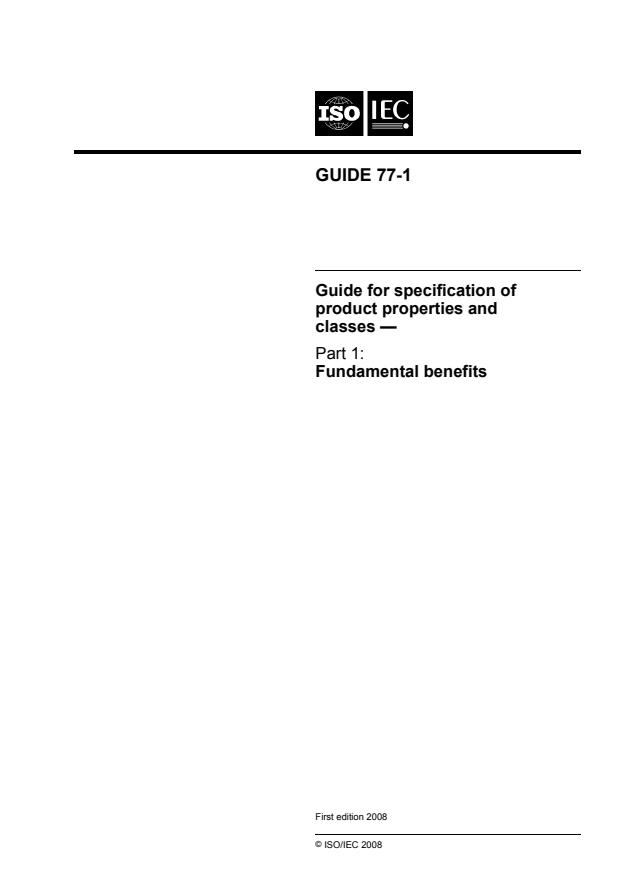
GUIDE 77-1
Guide for specification of
product properties and
classes —
Part 1:
Fundamental benefits
First edition 2008
©
ISO/IEC 2008
PDF disclaimer
This PDF file may contain embedded typefaces. In accordance with Adobe's licensing policy, this file may be printed or viewed but
shall not be edited unless the typefaces which are embedded are licensed to and installed on the computer performing the editing. In
downloading this file, parties accept therein the responsibility of not infringing Adobe's licensing policy. The ISO Central Secretariat
accepts no liability in this area.
Adobe is a trademark of Adobe Systems Incorporated.
Details of the software products used to create this PDF file can be found in the General Info relative to the file; the PDF-creation
parameters were optimized for printing. Every care has been taken to ensure that the file is suitable for use by ISO member bodies. In
the unlikely event that a problem relating to it is found, please inform the Central Secretariat at the address given below.
© ISO/IEC 2008
All rights reserved. Unless otherwise specified, no part of this publication may be reproduced or utilized in any form or by any means,
electronic or mechanical, including photocopying and microfilm, without permission in writing from either ISO at the address below or
ISO's member body in the country of the requester.
ISO copyright office
Case postale 56 • CH-1211 Geneva 20
Tel. + 41 22 749 01 11
Fax + 41 22 749 09 47
E-mail copyright@iso.org
Web www.iso.org
Published in Switzerland
ii © ISO/IEC 2008 – All rights reserved
Contents Page
Foreword. iv
Introduction . v
1 Scope . 1
2 Product data in the supply chain . 2
2.1 General. 2
2.2 Business context . 2
2.3 Goal and solution. 3
2.4 International standardization activities . 4
2.5 Benefits. 6
3 Procedure for creating reference dictionaries.7
3.1 General. 7
3.2 Building a reference dictionary. 7
3.3 Resources required . 8
3.4 Maintenance . 9
4 Technical aspects. 9
Annex A (informative) Assessment of savings potential . 11
Annex B (informative) Technical expertise and guidance . 13
Bibliography . 14
© ISO/IEC 2008 – All rights reserved iii
Foreword
ISO (the International Organization for Standardization) is a worldwide federation of national standards bodies
(ISO member bodies). The work of preparing International Standards is normally carried out through ISO
technical committees. Each member body interested in a subject for which a technical committee has been
established has the right to be represented on that committee. International organizations, governmental and
non-governmental, in liaison with ISO, also take part in the work. ISO collaborates closely with the
International Electrotechnical Commission (IEC) on all matters of electrotechnical standardization.
International Standards are drafted in accordance with the rules given in the ISO/IEC Directives, Part 2.
Draft Guides adopted by the responsible Committee or Group are circulated to the member bodies for voting.
Publication as a Guide requires approval by at least 75 % of the member bodies casting a vote.
Attention is drawn to the possibility that some of the elements of this document may be the subject of patent
rights. ISO shall not be held responsible for identifying any or all such patent rights.
ISO/IEC Guide 77-1 was prepared by the Joint Technical Advisory Group of the ISO Technical Management
Board and the IEC Standardization Management Board on product properties and families.
ISO/IEC Guide 77 consists of the following parts, under the general title Guide for specification of product
properties and classes:
⎯ Part 1: Fundamental benefits
⎯ Part 2: Technical principles and guidance
⎯ Part 3: Experience gained
iv © ISO/IEC 2008 – All rights reserved
Introduction
Business processes are increasingly being conducted electronically, a situation which applies to internal
processes as well as to the interfaces with external partners. Product data is currently defined predominantly
on a system-specific or organization-specific basis, usually without the general exchangeability of the data
being taken into account. On the originator side, this results in costly multiple definition and data storage for
different addressees or customers and, on the recipient side, in repeated data editing and system integration
of data from different sources combined with inherent, costly interpretation and conversion errors. Hence,
there is a massive opportunity here for rationalization.
From the market side, pressure is increasingly being exerted to supply product data in electronic form and as
this pressure grows, it will have a considerably impact on all businesses. For these reasons, a seamless
exchange of product data, i.e. an exchange that is free from media discontinuities requires a unified, joint
approach both for exchanging internal product data within a company and for exchanging product data with
suppliers and customers.
Information about a product is generated over the entire life cycle of the product, from the idea, planning and
design stages, through the manufacture, marketing, service and use stages, to product disposal. Information
is required in the course of many process steps, both during product manufacture and sales and during
product utilization (e.g. for maintenance and service) and recycling. Therefore, a harmonized, consistent
process for preparing and disseminating relevant information about a product (across all organization and
information systems) is of critical importance, as illustrated in Figure 1.
Figure 1 — Example of product life cycle and information transfer
This calls for the use of a methodology that allows product descriptions to be produced in a standardized,
computer-sensible form that is acceptable over a wide range of industrial systems. Such a methodology is
provided by IEC 61360-1 and ISO 13584-42. This methodology should be proactively promoted both internally
in a company and externally between the business partners so that it becomes standard practice, thereby
increasing the efficiency and cost-effectiveness of electronic business processes.
A company should respond to these external and internal requirements and ensure that electronic product
data is supplied in a coordinated and inexpensive manner. This includes the provision of uniform data
(i.e. product properties) for catalogues, electronic marketplaces, computer-aided design/computer-aided
systems (CAD/CAx systems), product data management (PDM) systems, etc. To this end, rules for
harmonization have been laid down. A common internal database is required to ensure the cost-effective
utilization and distribution of this product data, both internally in a company and externally between the
business partners.
© ISO/IEC 2008 – All rights reserved v
Guide for specification of product properties and classes —
Part 1:
Fundamental benefits
1 Scope
ISO/IEC Guide 77 provides recommendations for standardization committees for the description of products
and their properties for the creation of computer processable product libraries, catalogues and reference
dictionaries. This description will provide the details of the products and their properties in an unambiguous
manner capable of computer communication, in a form that is independent from any proprietary application
software.
NOTE 1 The term “product” is taken to include devices, processes, systems, installations, etc.
ISO/IEC Guide 77 is intended to assist the objective of enabling the flow of technical information between
internal and external business partners in a cost-effective and timely manner.
The guidance given in this part of ISO/IEC Guide 77 is intended to assist convenors and members of ISO and
IEC Technical Committees, as well as managers and technical experts in the manufacturing industry.
This part of ISO/IEC Guide 77 is intended to provide an overview of the needs and benefits and the process of
creating product libraries, catalogues and reference dictionaries. The following are within the scope of this part
of ISO/IEC Guide 77:
⎯ international standardization activities related to reference dictionaries;
⎯ benefits of reference dictionaries to International Standards;
⎯ a procedure for creating reference dictionaries;
⎯ resources required;
⎯ assessment of savings;
⎯ sources of information and expertise.
The following are outside the scope of this part of ISO/IEC Guide 77:
⎯ technical guidance for the creation of product libraries and dictionaries;
NOTE 2 Technical guidance for the creation of product libraries and dictionaries is provided in
ISO/IEC Guide 77-2.
⎯ case studies from experiences in the creation of dictionaries of product information in industrial practice.
NOTE 3 Experience gained in the creation of product libraries and dictionaries is provided in ISO/IEC Guide 77-3.
Reference dictionaries can be useful in the context of product data in the supply chain, as well as in the
business context of product data management.
This part of ISO/IEC Guide 77 is for guidance only and is intended to support activities such as education.
© ISO/IEC 2008 – All rights reserved 1
2 Product data in the supply chain
2.1 General
This part of ISO/IEC Guide 77 is intended to assist technical standards committees and subcommittees,
together with their working groups and project teams, who wish to describe products covered by their
standards in a computer-sensible form.
This can also be useful for the following groups:
⎯ suppliers of products who wish to describe them in catalogues, data sheets, etc.;
⎯ information brokers and distributors;
⎯ end users who wish to build corporate databases.
Information on products is required at all stages of the life cycle of the product, from initial concepts through
design and development to manufacture, then sales and marketing, followed by use of the product, which may
entail maintenance, and finally to withdrawal from use, decommissioning and recycling. For all these phases
in the life of a product, different requirements apply, resulting in different views on the product information,
where each view may require a specific set of properties and their related product data. As well as the need
for product data to be created, they also need to be communicated along the supply chain from the original
manufacturer through to the end user and be capable of storage and retrieval for reference purposes.
2.2 Business context
2.2.1 General
Traditionally, product data have been made available as paper-based data sheets and catalogues. With the
rapid increase in the use of IT tools for capturing, transmitting and using such data, there is an increasing
demand for the data to be supplied from the outset in computer-sensible form, in order to avoid the delays and
errors inherent in transcribing data from a paper-based form into a machine-based one. Furthermore, when
data are transcribed in this way, the work is carried out without reference to standard methodologies that
would, if used, ensure the exchangeability and interoperability of these data both within an enterprise and with
partners outside it. Figure 2 illustrates some of the issues that arise in this information supply chain, notably
the question of whether data really is exchangeable or not.
NOTE IT = information technology; CAE = computer-aided engineering.
Figure 2 — Exchangeability or non-exchangeability of data in information transfer
2 © ISO/IEC 2008 – All rights reserved
A considerable proportion of product data continue to be provided in paper form (e.g. catalogues, datasheets,
operating instructions) or on paper-like electronic media [e.g. documents in portable document format (PDF)]
that cannot be used directly in IT systems or cannot be processed further.
2.2.2 Non-structured definition and modelling of product data
Many items of product data are captured in data sheets, which therefore represent a vast capital asset for a
company. Data sheets can be quite complex, as they contain much assumed information that is logical to the
human reader but not to a computer that needs to interpret the product data.
Moreover many different views of the same product data are required depending on the user and his business
use of the data. For the reuse of available product data in IT systems, the first step should usually be to bring
the data into a computer-processable form, i.e. to analyse, convert and often even manually re-enter the data.
In doing so, many different data models are used to describe the product data, meaning that there is a need to
maintain knowledge about various data models in use by internal and external customers.
Where a formalized property definition is lacking, many interpretations can be given and are in use for product
properties. For this reason, the user may be unsure as to what exactly is meant by each piece of data and is
often obliged to verify the meaning with the originator or originators of the data. The probability is therefore
very high that product data are in fact inconsistent, and it is very difficult to verify whether the product data are
complete and consistent.
This is clearly a time-consuming and costly exercise, which in turn leads to misinterpretations and conversion
errors.
The need for consistent and complete acquisition and dissemination of product data and information has been
generally recognized worldwide. As a result, companies have worked on improvement of internal business
processes and data structures. Information has been digitized, partly brought into enterprise resource
planning (ERP) systems and, increasingly, standard software tools have been introduced.
At industry level, industry groups and solution providers have been engaged in working out standards for
product model data that should facilitate unambiguous and efficient communication. Unfortunately, there are
still many standards that partially overlap and often compete.
2.3 Goal and solution
From a business point of view, the goal is to achieve seamless product data exchange and storage over the
full life cycle of the product, and equally over the life cycle of the plant or installation in which the product will
be used.
One technical possibility is to create reference dictionaries where each property is defined unambiguously and
in a computer-sensible way only once, and to continually reuse this definition (see Figure 3). This
methodology, which should obtain international agreement, should then be used by all parties to ensure
common property definitions across industry.
The technical solution to achieve this is to define and supply all properties of a product in a clear,
unambiguous and internationally-agreed way, so that there can be no misunderstanding during the exchange
processes. This can be done by providing a reference dictionary. These reference dictionaries can then be
used to produce product catalogues or libraries of product information in computer-sensible form, in
accordance with a well-defined and accepted methodology, so that they can be exchanged and processed by
all who wish to use them.
To realize the technical solution, ISO/IEC Guide 77 proposes the following:
⎯ for the clear and unambiguous definition and interpretation of product properties, common reference
dictionaries need to be established with clear responsibilities for maintenance;
⎯ a standard methodology should be used for product data cataloguing, based on the common reference
dictionaries with clear responsibilities for maintenance and enrichment; this needs to be gradually
integrated into the purchasing portals in use;
© ISO/IEC 2008 – All rights reserved 3
⎯ external requirements of customers purchasing the product should be satisfied by providing product
properties with references to the internationally-agreed reference dictionaries.
For each of these steps, any organization or, in particular, any company should ensure care has been taken of
tasks such as continuous maintenance of those dictionaries and catalogues, so that these processes will be
sustainable.
Since the mid-1990s, various industry groups and national standards bodies, as well as ISO and IEC, have
been working very hard to produce product model data standards for creating common reference dictionaries
and to produce a number of common reference dictionaries for a range of discipline subject areas.
In the context of ISO and IEC, internationally-agreed product model data standards have been developed and
common reference dictionaries have been based on them. In order to achieve the long-term technical solution
mentioned above, a huge task lies ahead that will take many years for industry to realize. Good, intelligent use
needs to be made of both industry group dictionaries and internationally-agreed standard dictionaries. The
latter group is outlined in 2.4 below.
Figure 3 — Continual reuse of product characteristic
2.4 International standardization activities
Since the mid-1990s, technical experts from many companies and many countries have been working in ISO
and IEC to develop internationally-agreed standards on product model data standards for creating common
reference dictionaries and actually creating common standard reference dictionaries for some discipline areas.
The result of this has been two main internationally-agreed standards for product model data and a number of
standard common reference dictionaries, as outlined below.
a) ISO 13584 is a series of standards that provides:
⎯ a formal information model for reference dictionaries;
4 © ISO/IEC 2008 – All rights reserved
⎯ rules, guidelines and exchange formats for suppliers of product data libraries based on common
reference dictionaries, in order to facilitate one consistent methodology for the exchange of these
libraries or parts thereof and for their inclusion into multi-supplier libraries.
NOTE Although ISO 13584 is entitled “Parts library” (PLIB), it can be used for describing products composed of
several products or parts.
b) IEC 61360 is a series of standards that defines a methodology for reference dictionaries in electro-
technology. It includes the same information model as the one in ISO 13584, and it also provides a
common reference dictionary for electrical components.
c) Standard common reference dictionaries comply with ISO 13584 and IEC 61360 for the following product
areas:
⎯ environment and laboratory-use measuring instruments (ISO 13584-501);
⎯ mechanical fasteners (ISO 13584-511);
⎯ cutting tools (ISO 13399).
Figure 4 summarizes these developments and situates ISO/IEC Guide 77 within the context of the
developments: the basic standard is the common reference dictionary information model of ISO 13584-42 and
IEC 61360-2. From the basis of this model, the development of domain reference dictionaries is done, mainly
in technical committees of ISO and IEC. ISO/IEC Guide 77 aims to be a methodological basis for the use of
the basic standards and a means to understand the basic elements by which reference dictionaries are built.
Figure 4 — Status of international standardization activities
© ISO/IEC 2008 – All rights reserved 5
Figure 4 also illustrates how the resulting reference dictionaries are used in companies. Companies often
have their own databases for the description of product specifications. For the purpose of exchanging data
with business partners, these dictionaries need to be mapped to the standardized reference dictionaries.
Companies should be prepared to d
...
Questions, Comments and Discussion
Ask us and Technical Secretary will try to provide an answer. You can facilitate discussion about the standard in here.
Loading comments...