


ISO 13628-11:2007
(Main)Petroleum and natural gas industries — Design and operation of subsea production systems — Part 11: Flexible pipe systems for subsea and marine applications
Petroleum and natural gas industries — Design and operation of subsea production systems — Part 11: Flexible pipe systems for subsea and marine applications
ISO 13628-11:2007 provides guidelines for the design, analysis, manufacture, testing, installation and operation of flexible pipes and flexible pipe systems for onshore, subsea and marine applications. ISO 13628-11:2007 supplements ISO 13628-2 and ISO 13628-10, which specify minimum requirements for the design, material selection, manufacture, testing, marking and packaging of unbonded and bonded flexible pipes, respectively. ISO 13628-11:2007 applies to flexible pipe assemblies, consisting of segments of flexible pipe body with end fittings attached to both ends. Both bonded and unbonded pipe types are covered. In addition, ISO 13628-11:2007 applies to flexible pipe systems, including ancillary components. The applications covered by ISO 13628-11:2007 are sweet- and sour-service production, including export and injection applications. ISO 13628-11:2007 applies to both static and dynamic flexible pipe systems used as flowlines, risers and jumpers. ISO 13628-11:2007 does cover, in general terms, the use of flexible pipes for offshore loading systems. ISO 13628-11:2007 does not cover flexible pipes for use in choke and kill lines or umbilical and control lines.
Industries du pétrole et du gaz naturel — Conception et exploitation des systèmes de production immergés — Partie 11: Systèmes de canalisations flexibles pour applications sous-marines et en milieu marin
L'ISO 13628-11:2007 fournit des lignes directrices pour la conception, l'analyse, la fabrication, les essais, la pose et l'exploitation des canalisations flexibles et des systèmes de canalisations flexibles pour les applications terrestres, sous-marines et en milieu marin. L'ISO 13628-11:2007 vient en complément de l'ISO 13628-2 et de l'ISO 13628-10 qui spécifient respectivement les exigences minimales relatives à la conception, au choix des matériaux, à la fabrication, aux essais, au marquage et au conditionnement des canalisations flexibles non collées et composites. L'ISO 13628-11:2007 s'applique aux ensembles de canalisations flexibles constitués de tronçons de corps de canalisations flexibles munis de pièces d'extrémité fixées aux deux extrémités. Les canalisations composites et les canalisations non collées sont couvertes. En outre, l'ISO 13628-11:2007 s'applique aux systèmes de canalisations flexibles, y compris les composants auxiliaires. Les applications couvertes par l'ISO 13628-11:2007 sont la production de fluides non corrosifs et corrosifs, y compris les applications d'exportation et d'injection. L'ISO 13628-11:2007 s'applique aux systèmes de canalisations flexibles statiques et dynamiques utilisés comme goulottes, colonnes montantes et tuyaux de raccordement. L'ISO 13628-11:2007 couvre, en termes généraux, l'utilisation de canalisations flexibles pour les systèmes de chargement en mer. L'ISO 13628-11:2007 ne couvre pas les canalisations flexibles destinées à être utilisées dans les lignes de duse et dans les conduites d'injection ou dans les ombilicaux et dans les lignes de commande.
General Information
- Status
- Published
- Publication Date
- 12-Sep-2007
- Technical Committee
- ISO/TC 67/SC 4 - Drilling and production equipment
- Drafting Committee
- ISO/TC 67/SC 4/WG 6 - Subsea equipment
- Current Stage
- 9599 - Withdrawal of International Standard
- Start Date
- 08-Dec-2025
- Completion Date
- 12-Feb-2026
Relations
- Effective Date
- 12-Feb-2026
- Effective Date
- 06-Jun-2022
- Consolidated By
ISO 16000-32:2014 - Indoor air — Part 32: Investigation of buildings for the occurrence of pollutants - Effective Date
- 06-Jun-2022
- Effective Date
- 15-Apr-2008
Overview - ISO 13628-11:2007 (Flexible pipe systems)
ISO 13628-11:2007 provides international guidelines for the design, analysis, manufacture, testing, installation and operation of flexible pipes and flexible pipe systems for onshore, subsea and marine applications. It covers both bonded and unbonded flexible pipe assemblies (pipe segments with end fittings) and their ancillary components, for sweet- and sour-service production including export and injection. The standard applies to static and dynamic systems used as flowlines, risers and jumpers, and addresses, in general terms, use of flexible pipes for offshore loading systems. It does not cover choke/kill lines or umbilical/control lines.
Key topics and technical requirements
ISO 13628-11:2007 complements ISO 13628-2 and ISO 13628-10 and includes guidance on:
- System, pipe and component description - definitions, configurations and interfaces for flexible pipe systems.
- Pipe design considerations - design overview, failure modes, design criteria and representative load cases.
- Materials - material selection and testing considerations for bonded and unbonded pipes, polymers, elastomers and metallic components.
- Analysis and global-response evaluation - recommended analysis techniques and load modelling for static and dynamic applications.
- Prototype testing and test protocols - classification, standard and special prototype tests and qualification procedures.
- Manufacturing, marking and storage - manufacturing processes for both pipe types, marking and storage guidance.
- Handling, transportation and installation - logistics, installation procedures, pre-commissioning and commissioning.
- Retrieval, reuse and integrity monitoring - retrieval/reuse considerations, failure modes, condition monitoring and inspection recommendations.
- Ancillary components and system interfaces - fittings, terminations and subsystem integration.
Practical applications and users
ISO 13628-11:2007 is used by:
- Offshore and subsea engineers designing flexible risers, flowlines and jumpers.
- Manufacturers of bonded and unbonded flexible pipe and end fittings.
- Project managers and contractors planning installation, handling and transportation.
- Inspection and integrity specialists implementing condition monitoring and reuse/retrieval strategies.
- Regulatory and procurement teams specifying minimum requirements for subsea flexible pipe systems.
Typical applications include subsea production systems, export lines, injection lines and offshore loading systems where flexible pipe performance, material compatibility (sweet/sour service), and dynamic behaviour are critical.
Related standards
- ISO 13628-2:2006 (Unbonded flexible pipe systems)
- ISO 13628-10:2005 (Specification for bonded flexible pipe) (ISO 13628-11:2007 supplements these parts and aligns with API/RP 17B-derived practices.)
Keywords: ISO 13628-11:2007, flexible pipe systems, subsea, marine, bonded pipe, unbonded pipe, risers, flowlines, jumpers, flexible pipe design, prototype testing, integrity monitoring.
ISO 13628-11:2007 - Petroleum and natural gas industries -- Design and operation of subsea production systems
ISO 13628-11:2007 - Industries du pétrole et du gaz naturel -- Conception et exploitation des systemes de production immergés
Get Certified
Connect with accredited certification bodies for this standard

ABS Quality Evaluations Inc.
American Bureau of Shipping quality certification.

Element Materials Technology
Materials testing and product certification.

ABS Group Brazil
ABS Group certification services in Brazil.
Sponsored listings
Frequently Asked Questions
ISO 13628-11:2007 is a standard published by the International Organization for Standardization (ISO). Its full title is "Petroleum and natural gas industries — Design and operation of subsea production systems — Part 11: Flexible pipe systems for subsea and marine applications". This standard covers: ISO 13628-11:2007 provides guidelines for the design, analysis, manufacture, testing, installation and operation of flexible pipes and flexible pipe systems for onshore, subsea and marine applications. ISO 13628-11:2007 supplements ISO 13628-2 and ISO 13628-10, which specify minimum requirements for the design, material selection, manufacture, testing, marking and packaging of unbonded and bonded flexible pipes, respectively. ISO 13628-11:2007 applies to flexible pipe assemblies, consisting of segments of flexible pipe body with end fittings attached to both ends. Both bonded and unbonded pipe types are covered. In addition, ISO 13628-11:2007 applies to flexible pipe systems, including ancillary components. The applications covered by ISO 13628-11:2007 are sweet- and sour-service production, including export and injection applications. ISO 13628-11:2007 applies to both static and dynamic flexible pipe systems used as flowlines, risers and jumpers. ISO 13628-11:2007 does cover, in general terms, the use of flexible pipes for offshore loading systems. ISO 13628-11:2007 does not cover flexible pipes for use in choke and kill lines or umbilical and control lines.
ISO 13628-11:2007 provides guidelines for the design, analysis, manufacture, testing, installation and operation of flexible pipes and flexible pipe systems for onshore, subsea and marine applications. ISO 13628-11:2007 supplements ISO 13628-2 and ISO 13628-10, which specify minimum requirements for the design, material selection, manufacture, testing, marking and packaging of unbonded and bonded flexible pipes, respectively. ISO 13628-11:2007 applies to flexible pipe assemblies, consisting of segments of flexible pipe body with end fittings attached to both ends. Both bonded and unbonded pipe types are covered. In addition, ISO 13628-11:2007 applies to flexible pipe systems, including ancillary components. The applications covered by ISO 13628-11:2007 are sweet- and sour-service production, including export and injection applications. ISO 13628-11:2007 applies to both static and dynamic flexible pipe systems used as flowlines, risers and jumpers. ISO 13628-11:2007 does cover, in general terms, the use of flexible pipes for offshore loading systems. ISO 13628-11:2007 does not cover flexible pipes for use in choke and kill lines or umbilical and control lines.
ISO 13628-11:2007 is classified under the following ICS (International Classification for Standards) categories: 75.180.10 - Exploratory, drilling and extraction equipment. The ICS classification helps identify the subject area and facilitates finding related standards.
ISO 13628-11:2007 has the following relationships with other standards: It is inter standard links to EN ISO 13628-11:2008, ISO 4880:1997, ISO 16000-32:2014, ISO 10420:1994. Understanding these relationships helps ensure you are using the most current and applicable version of the standard.
ISO 13628-11:2007 is available in PDF format for immediate download after purchase. The document can be added to your cart and obtained through the secure checkout process. Digital delivery ensures instant access to the complete standard document.
Standards Content (Sample)
INTERNATIONAL ISO
STANDARD 13628-11
First edition
2007-09-15
Petroleum and natural gas industries —
Design and operation of subsea
production systems —
Part 11:
Flexible pipe systems for subsea and
marine applications
Industries du pétrole et du gaz naturel — Conception et exploitation des
systèmes de production immergés —
Partie 11: Systèmes de canalisations flexibles pour applications sous-
marines et en milieu marin
Reference number
©
ISO 2007
PDF disclaimer
This PDF file may contain embedded typefaces. In accordance with Adobe's licensing policy, this file may be printed or viewed but
shall not be edited unless the typefaces which are embedded are licensed to and installed on the computer performing the editing. In
downloading this file, parties accept therein the responsibility of not infringing Adobe's licensing policy. The ISO Central Secretariat
accepts no liability in this area.
Adobe is a trademark of Adobe Systems Incorporated.
Details of the software products used to create this PDF file can be found in the General Info relative to the file; the PDF-creation
parameters were optimized for printing. Every care has been taken to ensure that the file is suitable for use by ISO member bodies. In
the unlikely event that a problem relating to it is found, please inform the Central Secretariat at the address given below.
© ISO 2007
All rights reserved. Unless otherwise specified, no part of this publication may be reproduced or utilized in any form or by any means,
electronic or mechanical, including photocopying and microfilm, without permission in writing from either ISO at the address below or
ISO's member body in the country of the requester.
ISO copyright office
Case postale 56 • CH-1211 Geneva 20
Tel. + 41 22 749 01 11
Fax + 41 22 749 09 47
E-mail copyright@iso.org
Web www.iso.org
Published in Switzerland
ii © ISO 2007 – All rights reserved
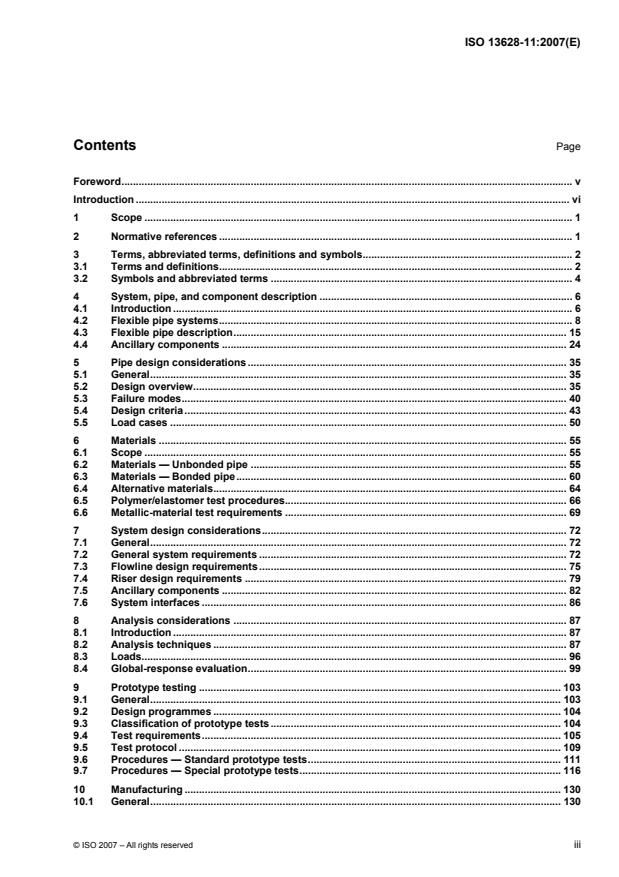
Contents Page
Foreword. v
Introduction . vi
1 Scope . 1
2 Normative references . 1
3 Terms, abbreviated terms, definitions and symbols. 2
3.1 Terms and definitions. 2
3.2 Symbols and abbreviated terms . 4
4 System, pipe, and component description . 6
4.1 Introduction . 6
4.2 Flexible pipe systems. 8
4.3 Flexible pipe description. 15
4.4 Ancillary components . 24
5 Pipe design considerations . 35
5.1 General. 35
5.2 Design overview. 35
5.3 Failure modes. 40
5.4 Design criteria . 43
5.5 Load cases . 50
6 Materials . 55
6.1 Scope . 55
6.2 Materials — Unbonded pipe . 55
6.3 Materials — Bonded pipe. 60
6.4 Alternative materials. 64
6.5 Polymer/elastomer test procedures. 66
6.6 Metallic-material test requirements . 69
7 System design considerations. 72
7.1 General. 72
7.2 General system requirements . 72
7.3 Flowline design requirements . 75
7.4 Riser design requirements . 79
7.5 Ancillary components . 82
7.6 System interfaces . 86
8 Analysis considerations . 87
8.1 Introduction . 87
8.2 Analysis techniques . 87
8.3 Loads. 96
8.4 Global-response evaluation. 99
9 Prototype testing . 103
9.1 General. 103
9.2 Design programmes . 104
9.3 Classification of prototype tests . 104
9.4 Test requirements. 105
9.5 Test protocol . 109
9.6 Procedures — Standard prototype tests. 111
9.7 Procedures — Special prototype tests. 116
10 Manufacturing . 130
10.1 General. 130
10.2 Manufacturing — Unbonded pipe . 130
10.3 Manufacturing — Bonded pipe. 135
10.4 Marking. 137
10.5 Storage . 140
11 Handling, transportation, and installation. 141
11.1 General . 141
11.2 Handling. 141
11.3 Transportation. 143
11.4 Installation . 144
11.5 Pre-commissioning and commissioning. 157
12 Retrieval and reuse . 161
12.1 General . 161
12.2 Retrieval . 161
12.3 Reuse. 163
13 Integrity and condition monitoring . 167
13.1 General . 167
13.2 General philosophy. 167
13.3 Failure modes and potential pipe defects . 168
13.4 Monitoring methods. 169
13.5 Recommendations . 171
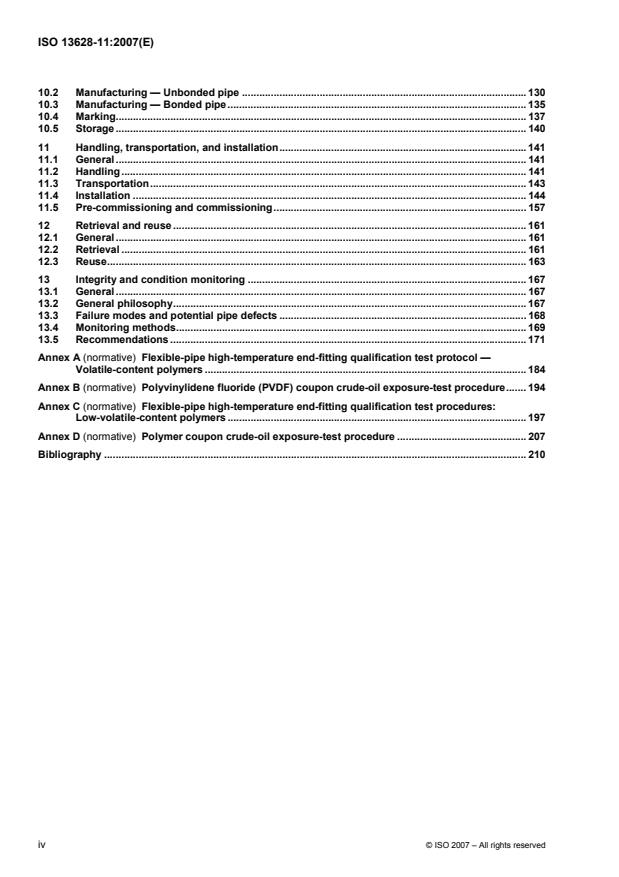
Annex A (normative) Flexible-pipe high-temperature end-fitting qualification test protocol —
Volatile-content polymers . 184
Annex B (normative) Polyvinylidene fluoride (PVDF) coupon crude-oil exposure-test procedure. 194
Annex C (normative) Flexible-pipe high-temperature end-fitting qualification test procedures:
Low-volatile-content polymers . 197
Annex D (normative) Polymer coupon crude-oil exposure-test procedure . 207
Bibliography . 210
iv © ISO 2007 – All rights reserved
Foreword
ISO (the International Organization for Standardization) is a worldwide federation of national standards bodies
(ISO member bodies). The work of preparing International Standards is normally carried out through ISO
technical committees. Each member body interested in a subject for which a technical committee has been
established has the right to be represented on that committee. International organizations, governmental and
non-governmental, in liaison with ISO, also take part in the work. ISO collaborates closely with the
International Electrotechnical Commission (IEC) on all matters of electrotechnical standardization.
International Standards are drafted in accordance with the rules given in the ISO/IEC Directives, Part 2.
The main task of technical committees is to prepare International Standards. Draft International Standards
adopted by the technical committees are circulated to the member bodies for voting. Publication as an
International Standard requires approval by at least 75 % of the member bodies casting a vote.
Attention is drawn to the possibility that some of the elements of this document may be the subject of patent
rights. ISO shall not be held responsible for identifying any or all such patent rights.
ISO 13628-11 was prepared by Technical Committee ISO/TC 67, Materials, equipment and offshore
structures for petroleum, petrochemical and natural gas industries, Subcommittee SC 4, Drilling and
production equipment.
This first edition of ISO 13628-11 cancels and replaces ISO 10420:1994, which has been technically revised.
ISO 13628 consists of the following parts, under the general title Petroleum and natural gas industries —
Design and operation of subsea production systems:
⎯ Part 1: General requirements and recommendations
⎯ Part 2: Unbonded flexible pipe systems for subsea and marine applications
⎯ Part 3: Through flowline (TFL) systems
⎯ Part 4: Subsea wellhead and tree equipment
⎯ Part 5: Subsea umbilicals
⎯ Part 6: Subsea production control systems
⎯ Part 7: Completion/workover riser systems
⎯ Part 8: Remotely Operated Vehicle (ROV) interfaces on subsea production systems
⎯ Part 9: Remotely Operated Tool (ROT) intervention systems
⎯ Part 10: Specification for bonded flexible pipe
⎯ Part 11: Flexible pipe systems for subsea and marine applications
A part 12 dealing with dynamic production risers, a part 13 dealing with remotely operated tools and interfaces
on subsea production systems and a part 15 dealing with subsea structures and manifolds are under
preparation.
Introduction
This part of ISO 13628 is based on API RP 17B and on matching ISO procedures and API procedures. This
ISO standard has been technically updated and revised to cater for the needs of the international oil and
natural gas industries. This part of ISO 13628 provides information complementary to ISO 13628-2 and
ISO 13628-10.
Users of this International Standard should be aware that further or differing requirements can be needed for
individual applications. This International Standard is not intended to inhibit a vendor from offering, or the
purchaser from accepting, alternative equipment or engineering solutions for the individual application. This
can be particularly applicable where there is innovative or developing technology. Where an alternative is
offered, the vendor should identify any variations from this International Standard and provide details.
vi © ISO 2007 – All rights reserved
INTERNATIONAL STANDARD ISO 13628-11:2007(E)
Petroleum and natural gas industries — Design and operation
of subsea production systems —
Part 11:
Flexible pipe systems for subsea and marine applications
1 Scope
This part of ISO 13628 provides guidelines for the design, analysis, manufacture, testing, installation and
operation of flexible pipes and flexible pipe systems for onshore, subsea and marine applications. This part of
ISO 13628 supplements ISO 13628-2 and ISO 13628-10, which specify minimum requirements for the design,
material selection, manufacture, testing, marking and packaging of unbonded and bonded flexible pipe,
respectively.
This part of ISO 13628 applies to flexible pipe assemblies, consisting of segments of flexible pipe body with
end fittings attached to both ends. Both bonded and unbonded pipe types are covered. In addition, this part of
ISO 13628 applies to flexible pipe systems, including ancillary components.
The applications covered by this part of ISO 13628 are sweet- and sour-service production, including export
and injection applications. This part of ISO 13628 applies to both static and dynamic flexible pipe systems
used as flowlines, risers and jumpers. This part of ISO 13628 does cover, in general terms, the use of flexible
pipes for offshore loading systems.
NOTE Refer also to Reference [30] for offshore loading systems.
This part of ISO 13628 does not cover flexible pipes for use in choke and kill lines or umbilical and control
lines.
2 Normative references
The following referenced documents are indispensable for the application of this document. For dated
references, only the edition cited applies. For undated references, the latest edition of the referenced
document (including any amendments) applies.
ISO 13628-2:2006, Petroleum and natural gas industries — Design and operation of subsea production
systems — Part 2: Unbonded flexible pipe systems for subsea and marine applications
ISO 13628-3:2000, Petroleum and natural gas industries — Design and operation of subsea production
systems — Part 3: Through flowline (TFL) systems
ISO 13628-10:2005, Petroleum and natural gas industries — Design and operation of subsea production
systems — Part 10: Specification for bonded flexible pipe
NACE TM0177, Laboratory testing of metals for resistance to sulfide stress cracking and stress corrosion
cracking in H S environments
3 Terms, abbreviated terms, definitions and symbols
For the purposes of this document, the following terms, definitions, symbols and abbreviated terms apply.
3.1 Terms and definitions
3.1.1
annulus
space between two concentric plastic sheaths of an unbonded flexible pipe cross-section
3.1.2
Arrhenius plot
log-linear scale used to plot service life against the inverse of temperature for some polymer materials
3.1.3
basket
device used for storage and transport of flexible pipe
NOTE All pipes are laid freely into the basket.
3.1.4
bird-caging
buckling of the tensile-armour wires, usually caused by extreme axial compression, which results in significant
radial deformation
3.1.5
buoyancy module
buoys used in significant numbers at discrete points over a section of riser to achieve wave-shape riser
configurations
NOTE See 4.4.6.
3.1.6
carousel
device used for storage and transport of very long lengths of flexible pipe and which rotates about a vertical
axis
NOTE Pipe is wound under tension around the centre hub.
3.1.7
Chinese fingers
woven steel wire or fabric sleeve that can be installed over a flexible pipe and drawn tight to grip it for support
or applying tension to the pipe
3.1.8
end fitting
termination in a flexible pipe
3.1.9
flexible pipe system
fluid conveyance system for which the flexible pipe(s) is/are the primary component and which includes
ancillary components attached directly or indirectly to the pipe
3.1.10
free-hanging catenary
riser configuration that spans the water column in a catenary shape modified by the bending stiffness of the
riser
NOTE See Figure 4.
2 © ISO 2007 – All rights reserved
3.1.11
integrated service umbilical
1)
ISU™
structure in which the inner core is a standard flexible pipe construction
NOTE 1 Umbilical components are wound around the core pipe and covered with a protective outer sheath (see 4.3.6).
NOTE 2 ISU is a trademark of Coflexip Stena Offshore.
3.1.12
lazy wave
free-hanging catenary modified by a section with distributed buoyancy modules
NOTE See Figure 4.
3.1.13
lazy-S
free-hanging catenary modified by a section with concentrated buoyancy modules
NOTE See Figure 4.
3.1.14
multibore
multiple flexible pipes or umbilicals contained in a single construction with an outer sheath extruded over the
bundle
NOTE See 4.3.7.
3.1.15
multiple configuration
riser system with more than one riser connected at a mid-depth location
3.1.16
ovalization
out-of-roundness of the pipe, calculated as follows:
DD−
max min
DD+
max min
where D and D are maximum and minimum pipe outside diameter, respectively.
max min
3.1.17
piggy back
attachment of two parallel and adjacent independent pipes, rigid or flexible, over a significant length
3.1.18
prototype test
test to establish or verify a principal performance characteristic for a particular pipe design, which may be a
new or established design
3.1.19
rapid decompression
sudden depressurization of a system during which gas in the pipe expands rapidly and can cause blistering or
collapse of the internal pressure sheath or other gas-saturated layers
1) ISU™ is an example of a suitable product available commercially. This information is given for the convenience of
users of this part of ISO 13628 and does not constitute an endorsement by ISO of this product.
3.1.20
reel
large-diameter structure used for storage of long lengths of flexible pipe, which rotates about a horizontal axis
3.1.21
riser base
structure positioned on the seabed, used to provide a structural and pressure-tight connection between a
flexible riser and a flowline
NOTE 1 See 4.4.8.
NOTE 2 It may be a PLET or a PLEM.
3.1.22
riser hang-off
structure for supporting a riser at the connection to a platform
EXAMPLE Jacket, semi-sub, tanker, etc.
3.1.23
steep wave
lazy wave with a touchdown point fixed to the seabed
NOTE See Figure 4.
3.1.24
steep-S
lazy-S with a touchdown point fixed to the seabed
NOTE See Figure 4.
3.1.25
subsea buoy
concentrated buoyancy system
NOTE This system generally consists of steel or syntactic foam tanks, as used in S-type riser configurations (4.4.5).
See also buoyancy module (3.1.4).
3.1.26
tensioner
mechanical device used to support or apply tension to a pipe during installation
3.1.27
umbilical
bundle of helically or sinusoidally wound small-diameter chemical, hydraulic, and electrical conductors for
power and control systems
3.2 Symbols and abbreviated terms
The following symbols and abbreviated terms are used in this document.
CPE chlorinated polyethylene
CR polychloroprene
DA dynamic application
DBS dibutyl sebacate
DOF degrees of freedom
4 © ISO 2007 – All rights reserved
EPDM ethylene propylenediene monomer rubber
FAT factory acceptance test
FPS floating production system
FPSO floating production storage and offloading
HDPE high density polyethylene
HIC hydrogen-induced cracking
HNBR hydrogenated nitrile rubber
ID inside diameter
ISU integrated service umbilical
MBR minimum bend radius
MDPE medium density polyethylene
MWL mean water level
NBR nitrile butadiene rubber
NR natural rubber
OD outer diameter
PA polyamide
PE polyethylene
PP polypropylene
PLEM pipeline end manifold
PU polyurethane
PVC polyvinyl chloride
PVDF polyvinylidene fluoride
REF riser end fitting
ROV remotely operated vehicle
SA static application
SBR storage bend radius
SSC sulfide stress cracking
TFL through flowline
UV ultraviolet
VIV vortex-induced vibration
XLPE cross-linked polyethylene
C hydrodynamic drag coefficient
d
C hydrodynamic inertia coefficient
m
D maximum pipe outside diameter
max
D minimum pipe outside diameter
min
σ material ultimate stress
u
σ material yield stress
y
4 System, pipe, and component description
4.1 Introduction
4.1.1 General
Clause 4 provides a general overview of flexible pipe systems, pipe cross-section designs and ancillary
components. In addition, Clause 4 gives an overview of all aspects of flexible pipe technology and identifies
the clauses and subclauses of this part of ISO 13628 and of ISO 13628-2:2006 and ISO 13628-10:2005 to be
consulted for relevant issues.
In general, flexible pipe is a custom-built product that can be designed and manufactured in a variety of
methods. It is not the intent of this part of ISO 13628 to discourage novel or new developments in flexible pipe.
On the contrary, it is recognized that a variety of designs and methods of analysis are possible. For this
reason, some topics are presented in general terms to provide guidance to the user while still leaving open the
possibility of using alternative approaches.
The reader should be aware that flexible-pipe technology (concepts, design and analysis methodologies and
criteria, components manufacturing and testing, operational roles and demands, maintenance and inspection,
etc.) is in a state of rapid and continuing evolution. Potential users shall, therefore, apply care in their
application of the recommendations within this part of ISO 13628.
4.1.2 Recommended practice and specification overview
4.1.2.1 This part of ISO 13628 provides the current best practice for design and procurement of flexible
pipe systems and gives guidance on the implementation of the specification for standard flexible-pipe products.
In addition, the recommended practice shows guidelines on the qualification of prototype products.
4.1.2.2 All aspects of flexible-pipe technology, from functional definition to installation, are addressed in
either this part of ISO 13628 or in ISO 13628-2 and ISO 13628-10. Some issues are addressed in all three
documents. The various stages in the procurement and use of flexible pipes are defined in Figure 1.
6 © ISO 2007 – All rights reserved
Figure 1 — Flexible pipe overview
4.2 Flexible pipe systems
4.2.1 Definition of system
4.2.1.1 The flexible pipe system is an important part of the overall field development and can influence or
be influenced by the design and specification of other components in the development. The definition of the
flexible pipe system should therefore commence at the initiation of the overall project as development
strategies evolve. Aspects of the development strategy that can influence the flexible pipe system include field
layout (template versus satellite wells) and production-vessel type (platform, tanker including turret location,
semi-sub, etc.). Current limitations in flexible-pipe technology, such as application range and manufacturing
capability, can also fundamentally influence potential overall field development options.
4.2.1.2 It is necessary to address the flexible pipe system and the flexible pipe or pipes within that system.
It is necessary to consider the relevant parameters, as well as the interactions between the pipe design and
the system design. Critical parameters that can affect the pipe design should be identified early in the process
and can include the following:
a) severe internal conditions, such as high H S content (sour service);
b) extreme external environmental conditions;
c) difficult installation conditions (such as extreme environment);
d) frequent, cyclic, large-amplitude pressure and temperature fluctuations;
e) large vessel offsets.
4.2.1.3 To define accurately all relevant parameters, interaction between the purchaser and manufacturer
is required at an early stage in the project. An important aspect of this is the identification of critical system
issues, such as interfaces. See 7.6 for potentially critical interfaces that should be considered at project
commencement.
4.2.1.4 ISO 13628-2 and ISO 13628-10:2005, Annex A, provide purchasing guidelines, which may be
used in the definition of the flexible pipe system and which address all aspects from general design
parameters to detailed flowline- and riser-specific requirements.
4.2.2 Applications
4.2.2.1 General
4.2.2.1.1 Flexible pipe for offshore and onshore applications is grouped into either a static or dynamic
category (Figures 2 and 3). It is used for a multitude of functions, including the following:
a) production: oil, gas, condensate, water;
b) injection: water, gas, downhole chemicals;
c) export: semi-processed oil and gas;
d) services: wellhead chemicals, control fluids.
4.2.2.1.2 The static and dynamic categories place different physical demands on the pipe. While both
require long life, mechanical strength, internal and external damage resistance and minimal maintenance,
dynamic service pipes also require pliancy and high fatigue resistance.
8 © ISO 2007 – All rights reserved
a) Early field production scheme b) Flowlines repositioned for mature field
production scheme
c) Flexible pipe connected to a J-tube d) Flexible pipe connected to the manifold
Key
1 J-tube
2 flexible pipe
3 rigid pipe
4 manifold
5 flexible pipe spool piece
6 rigid steel flowline
Figure 2 — Examples of static applications for flexible pipe
a) FPS b) FPS with rigid riser
c) Floating tanker/terminal mooring
Key
1 flexible riser
2 subsea buoy
3 rigid riser
4 anchor chain
Figure 3 — Examples of dynamic applications for flexible pipe
10 © ISO 2007 – All rights reserved
4.2.2.2 Static applications
4.2.2.2.1 The use of flexible pipe for static applications is primarily for flowline and fixed jacket-riser service.
Flexible pipe is used in these applications to simplify design or installation procedures, or for its inherent
insulation or corrosion-resistant properties. In addition, reduction of installation and end-connection loads and
moments may be achieved using flexible pipe. Examples of where the use of flexible pipe results in simplified
flowline design or installation include the following (see Figure 2):
a) subsea flowline end connections where expensive or difficult operations, such as exact orientation
measurements for spool pieces or the use of large alignment equipment to reposition the flowline, can be
eliminated;
b) situations involving gross movements and damage to flowlines because of mudslides can be reduced
through the use of slack sections of flexible pipe;
c) applications in which field hardware and flowline location change with the field’s production characteristics,
which can necessitate the recovery and reuse of the flowlines;
d) applications with uneven seabed to avoid seabed preparation;
e) in deepwater or severe environment applications, where flexible pipe installation is economically attractive
relative to rigid pipe installation.
NOTE Instead of mobilizing an expensive pipe-laying spread, it is often preferable to use flexible pipe installed from a
dynamically positioned vessel.
4.2.2.2.2 Flexible pipe flowlines generally range in internal diameter from 0,05 m to 0,5 m (2 in to 20 in)
although some low-pressure, bonded flexible pipes, such as oil suction and discharge hoses, have internal
diameters up to 0,91 m (36 in). Section lengths are limited by transport capabilities and diameter is limited
only by current manufacturing capability.
4.2.2.2.3 The functional requirements of a flexible-pipe flowline are generally the same as for a steel-pipe
flowline. Significant dynamic loading or motions are generally not experienced, so the flexibility properties of
flexible pipe simplify the project transport and installation phases.
4.2.2.3 Dynamic applications
4.2.2.3.1 Dynamic applications use flexible pipe between supply and delivery points if there is relative
movement between these two points while in service. These types of applications usually involve an offshore
floating production facility or terminal connected to another floating facility, fixed structure or fixed base
(Figure 3). Examples of dynamic applications include the following:
a) flexible-pipe risers for offshore loading systems;
b) flexible-pipe riser connections between floating production facilities and subsea equipment.
4.2.2.3.2 Figure 4 illustrates schematics of the riser configurations typically used. In general, the critical
sections in the riser configurations are at the top (or bottom), where there are high tensile forces (and large
curvatures); at the sag bend, where there is large curvature (at low tension); and at the hog of a wave
buoyancy section, where there is large curvature (at low tension).
4.2.2.3.3 The present dynamic applications of flexible pipes have only been for the production phase.
However, with the advent of downhole motors, flexibles may also be used as drilling risers, as described by
[23]
FPS 2000 .
4.2.2.3.4 In addition to riser systems that use flexible pipe throughout, systems that combine flexible pipe
and rigid pipe in the flow path have been used. Described as hybrid riser systems, they typically use a lower
rigid-riser section (such as a free-standing riser) and an upper flexible-pipe section (jumper line).
a) Free-hanging catenary
b) Steep-S c) Lazy-S
d) Steep wave e) Lazy wave
Figure 4 — Examples of flexible riser configurations
12 © ISO 2007 – All rights reserved
4.2.2.4 Jumper lines
4.2.2.4.1 In addition to flowlines and risers, jumper lines, a further category, may be used for either static or
dynamic applications. Examples of flexible pipes used in jumper-line applications include the following
(Figure 5):
a) static applications:
1) intra-field connection of wellheads and manifolds (typically in lengths less than 100 m),
2) connection of topside wellheads and platform piping on tension leg platforms (TLPs);
b) dynamic applications:
1) connection of wellhead platforms and floating support vessels,
2) lines in FPSO turret motion transfer systems.
4.2.2.4.2 The functions of the dynamic jumper lines (excluding internal turret lines) are similar to riser
systems. Their operation, however, is somewhat different. The lines are generally more exposed to wave
loading, and the configuration varies between the connected condition and the stand-off condition, which
imposes extra requirements on the end connectors and bend stiffeners. The performance of these
components should be evaluated carefully for dynamic jumper-line applications.
a) Flexible pipe as a fluid transfer line
b) Flexible pipe connected to Xmas tree c) Flexible pipe connected to manifold
Key
1 support vessel 8 moving end
2 flexible jumper 9 wellbay
3 wellhead platform 10 grated deck
4 fixed end 11 tree deck
5 topsides piping 12 rigid riser
6 end fitting 13 manifold
7 Xmas tree 14 wellheads
Figure 5 — Examples of flexible-pipe jumper-line applications
14 © ISO 2007 – All rights reserved
4.3 Flexible pipe description
4.3.1 General
4.3.1.1 This part of ISO 13628 does not apply to flexible pipes for use in choke and kill line or umbilical
applications.
4.3.1.2 A flexible pipe generally combines low bending stiffness with high axial tensile stiffness, which is
achieved by a composite pipe wall construction. This is more applicable to unbonded flexible pipes than to
bonded flexible pipes. The two basic components are helical armouring layers and polymer sealing layers,
which allow a much smaller radius of curvature than for a steel pipe with the same pressure capacity.
Generally, a flexible pipe is designed specifically for each application and is not an off-the-shelf product,
although flexible pipes may be grouped according to specific designs and, hence, applications. This allows the
pipe to be optimized for each application.
4.3.2 Unbonded flexible pipe construction
4.3.2.1 Figure 6 shows a typical cross-section of a flexible pipe. The main layers in this cross-section are
identified in 4.3.2.2 to 4.3.2.6
4.3.2.2 The carcass is an interlocked metallic layer which provides collapse resistance. Figure 7
illustrates an example of a carcass profile.
4.3.2.3 The internal pressure sheath is an extruded polymer layer which provides internal fluid integrity.
4.3.2.4 The pressure armour is an interlocked metallic layer which supports the internal pressure sheath
and system internal-pressure loads in the radial direction. Figure 7 includes some example profiles for the
pressure-armour wires. A back-up pressure-armour layer (generally not interlocked) also can be used for
higher-pressure applications.
4.3.2.5 The tensile-armour layers typically use flat, round, or shaped metallic wires, in two or four layers
crosswound at an angle between 20° and 60°. The lower angles are used for pipe constructions which include
a pressure-armour layer. Where no pressure-armour layer is used, the tensile-armour layers are crosswound
at an angle close to 55° to obtain a torsionally balanced pipe and to balance hoop and axial loads.
4.3.2.6 The outer sheath is an extruded polymer sheath that provides external fluid integrity.
a) Bonded flexible pipe
b) Unbonded flexible pipe
Key
1 tensile layer
2 anti-friction layer
3 outer sheath
4 hoop stress layer
5 outer layer of tensile armour
6 anti-wear layer
7 inner layer of tensile armour
8 back-up pressure armour
9 interlocked pressure armour
10 internal pressure sheath
11 carcass
12 anti-bird-cage layer
Figure 6 — Schematic of typical flexible riser cross-sections
16 © ISO 2007 – All rights reserved
a) Z-shape (pressure-armour profile)
b) C-shape (pressure-armour profile)
c) T-shape 1 (pressure-armour profile)
d) T-shape 2 (pressure-armour profile)
e) Carcass profile
Key
1 clip 2 T-wire
Figure 7 — Pressure-armour and carcass interlock profiles
4.3.3 Bonded flexible pipe construction
4.3.3.1 A typical bonded flexible pipe consists of several layers of elastomer either wrapped or extruded
individually and then bonded together through the use of adhesives or by applying heat and/or pressure to
fuse the layers into a single construction. Figure 6 shows an example of a bonded pipe construction. The main
layers are identified in 4.3.3.2 to 4.3.3.5.
4.3.3.2 The carcass is an interlocked, metallic layer, which provides collapse resistance. Figure 7 shows
an example of a carcass profile.
4.3.3.3 The liner is a wrapped or extruded elastomer layer, which provides internal fluid integrity.
4.3.3.4 The reinforcement layer is comprised typically of helically wound, steel cables in an embedding
elastomer compound used to sustain tensile and internal pressure load on the pipe. The steel cables are
typically laid at an angle of 55° to obtain a torsionally balanced pipe, in addition to equivalent hoop and
longitudinal forces in the layer due to pressure. However, this angle may increase or decrease depending on
the required strength characteristics of the pipe. For example, a higher angle may be used if increased
strength in the hoop direction is required at the expense of tensile capacity and axial stiffness of the pipe.
4.3.3.5 The outer layer is a wrapped or extruded elastomer layer that provides external fluid integrity and
protection against external environments, corrosion, abrasion and mechanical damage.
NOTE The concept of separate layers in a bonded pipe construction is notional because the final pipe cross-section
is a bonded composite construction.
4.3.4 Classification of flexible pipe
4.3.4.1 Currently, unbonded flexible pipes can generally be classified into three distinct families. These
classifications are identified in Table 1. Distinctions exist between pipes for static and dynamic applications
within these families, with the main distinction being the use of anti-wear layers for dynamic applications if
they are required to achieve service-life criteria.
Table 1 — Description of standard flexible-pipe families — Unbonded pipe
Product family III
Product family I Product family II
Layer Layer primary
Rough-bore,
No. function
Smooth-bore pipe Rough-bore pipe
reinforced pipe
1 Prevent collapse Pressure-armour Carcass Carcass
layer(s)
2 Internal fluid integrity Internal pressure Internal pressure Internal pressure
sheath sheath sheath
3 Hoop stress resistance Pressure-armour — Pressure-armour
layer(s) layer(s)
4 External fluid integrity Intermediate sheath — —
5 Tensile-stress Crosswound tensile Crosswound tensile Crosswound tensile
resistance armours armours armours
6 External fluid integrity Outer sheath Outer sheath Outer sheath
NOTE 1 All pipe constructions can include various non-structural layers, such as anti-wear layers, tapes,
manufacturing aid layers, etc.
NOTE 2 An external carcass can be added for protection purposes.
NOTE 3 The pressure layer can be subdivided into interlocked layer(s) and back-up layer(s).
NOTE 4 The number of crosswound armour layers can vary, though is generally either two or four.
NOTE 5 Thermal insulation can be added to the pipe.
NOTE 6 The internal pressure and outer sheaths can consist of a number of sublayers.
NOTE 7 Product family III is generally used for higher-pressure applications than II.
NOTE 8 The intermediate sheath for smooth-bore pipes is optional if there is no external pressure or the external
pressure is less than the collapse pressure of the internal pressure sheath for the given application.
18 © ISO 2007 – All rights reserved
4.3.4.2 The classifications for bonded flexible pipe are identified in Table 2. Smooth-bore flexible pipes
(product family I, unbonded and product family IV, bonded) often are used for water injection or dead crude
applications.
Table 2 — Description of standard flexible pipe families — Bonded pipe
Product family IV Product family V
Layer
Layer primary function
No.
Smooth-bore pipe Rough-bore pi
...
NORME ISO
INTERNATIONALE 13628-11
Première édition
2007-09-15
Industries du pétrole et du gaz naturel —
Conception et exploitation des systèmes
de production immergés —
Partie 11:
Systèmes de canalisations flexibles pour
applications sous-marines et en milieu
marin
Petroleum and natural gas industries — Design and operation of
subsea production systems —
Part 11: Flexible pipe systems for subsea and marine applications
Numéro de référence
©
ISO 2007
PDF – Exonération de responsabilité
Le présent fichier PDF peut contenir des polices de caractères intégrées. Conformément aux conditions de licence d'Adobe, ce fichier
peut être imprimé ou visualisé, mais ne doit pas être modifié à moins que l'ordinateur employé à cet effet ne bénéficie d'une licence
autorisant l'utilisation de ces polices et que celles-ci y soient installées. Lors du téléchargement de ce fichier, les parties concernées
acceptent de fait la responsabilité de ne pas enfreindre les conditions de licence d'Adobe. Le Secrétariat central de l'ISO décline toute
responsabilité en la matière.
Adobe est une marque déposée d'Adobe Systems Incorporated.
Les détails relatifs aux produits logiciels utilisés pour la création du présent fichier PDF sont disponibles dans la rubrique General Info
du fichier; les paramètres de création PDF ont été optimisés pour l'impression. Toutes les mesures ont été prises pour garantir
l'exploitation de ce fichier par les comités membres de l'ISO. Dans le cas peu probable où surviendrait un problème d'utilisation,
veuillez en informer le Secrétariat central à l'adresse donnée ci-dessous.
DOCUMENT PROTÉGÉ PAR COPYRIGHT
© ISO 2007
Droits de reproduction réservés. Sauf prescription différente, aucune partie de cette publication ne peut être reproduite ni utilisée sous
quelque forme que ce soit et par aucun procédé, électronique ou mécanique, y compris la photocopie et les microfilms, sans l'accord écrit
de l'ISO à l'adresse ci-après ou du comité membre de l'ISO dans le pays du demandeur.
ISO copyright office
Case postale 56 • CH-1211 Geneva 20
Tel. + 41 22 749 01 11
Fax + 41 22 749 09 47
E-mail copyright@iso.org
Web www.iso.org
Version française parue en 2008
Publié en Suisse
ii © ISO 2007 – Tous droits réservés
Sommaire Page
Avant-propos. v
Introduction . vii
1 Domaine d'application. 1
2 Références normatives . 1
3 Termes, définitions, abréviations et symboles. 2
3.1 Termes et définitions. 2
3.2 Symboles et abréviations . 5
4 Description du système, des canalisations et des composants . 6
4.1 Introduction . 6
4.2 Systèmes de canalisations flexibles. 9
4.3 Description d'une canalisation flexible . 16
4.4 Composants auxiliaires . 26
5 Considérations relatives à la conception des canalisations . 39
5.1 Généralités . 39
5.2 Aperçu général de la conception . 39
5.3 Modes de défaillance. 45
5.4 Critères de conception. 49
5.5 Cas de charge . 57
6 Matériaux . 64
6.1 Domaine d'application. 64
6.2 Matériaux — Canalisation non collée . 64
6.3 Matériaux — Canalisation composite. 69
6.4 Autres matériaux. 74
6.5 Modes opératoires d'essai des polymères/des élastomères . 76
6.6 Exigences d'essai des matériaux métalliques. 80
7 Considérations relatives à la conception du système. 83
7.1 Généralités . 83
7.2 Exigences générales relatives au système. 84
7.3 Exigences de conception des goulottes . 87
7.4 Exigences de conception des colonnes montantes . 92
7.5 Composants auxiliaires . 95
7.6 Interfaces du système . 99
8 Considérations relatives à l'analyse. 100
8.1 Introduction . 100
8.2 Techniques d'analyse. 100
8.3 Charges. 110
8.4 Évaluation de la réponse globale. 114
9 Essais de prototype. 119
9.1 Généralités . 119
9.2 Programmes de conception . 120
9.3 Classification des essais de prototype . 120
9.4 Exigences relatives aux essais . 122
9.5 Protocole d'essai . 126
9.6 Modes opératoires ― Essais de prototype standard. 129
9.7 Modes opératoires ― Essais de prototype spéciaux . 135
10 Fabrication. 151
10.1 Généralités . 151
10.2 Fabrication — Canalisation non collée. 151
10.3 Fabrication — Canalisation composite. 156
10.4 Marquage . 159
10.5 Stockage . 162
11 Manutention, transport et pose . 164
11.1 Généralités. 164
11.2 Manutention. 164
11.3 Transport. 167
11.4 Pose. 168
11.5 Réception préalable et mise en service. 181
12 Récupération et réutilisation. 185
12.1 Généralités. 185
12.2 Récupération . 185
12.3 Réutilisation. 187
13 Surveillance de l'intégrité et de l'état. 192
13.1 Généralités. 192
13.2 Principe général . 192
13.3 Modes de défaillance et défauts possibles des canalisations. 194
13.4 Méthodes de surveillance . 194
13.5 Recommandations . 197
Annexe A (normative) Protocole d'essai de qualification des pièces d'extrémité de canalisations
flexibles à haute température — Polymères contenant des substances volatiles . 213
Annexe B (normative) Mode opératoire d'essai d'exposition au pétrole brut d'un coupon de
fluorure de polyvinylidène (PVDF) . 225
Annexe C (normative) Modes opératoires d'essai de qualification des pièces d'extrémité de
canalisations flexibles à haute température: polymères à faible teneur en substances
volatiles. 229
Annexe D (normative) Mode opératoire d'essai d'exposition au pétrole brut d'un coupon de
polymère . 241
Bibliographie . 245
iv © ISO 2007 – Tous droits réservés
Avant-propos
L'ISO (Organisation internationale de normalisation) est une fédération mondiale d'organismes nationaux de
normalisation (comités membres de l'ISO). L'élaboration des Normes internationales est en général confiée
aux comités techniques de l'ISO. Chaque comité membre intéressé par une étude a le droit de faire partie du
comité technique créé à cet effet. Les organisations internationales, gouvernementales et non
gouvernementales, en liaison avec l'ISO participent également aux travaux. L'ISO collabore étroitement avec
la Commission électrotechnique internationale (CEI) en ce qui concerne la normalisation électrotechnique.
Les Normes internationales sont rédigées conformément aux règles données dans les Directives ISO/CEI,
Partie 2.
La tâche principale des comités techniques est d'élaborer les Normes internationales. Les projets de Normes
internationales adoptés par les comités techniques sont soumis aux comités membres pour vote. Leur
publication comme Normes internationales requiert l'approbation de 75 % au moins des comités membres
votants.
L'attention est appelée sur le fait que certains des éléments du présent document peuvent faire l'objet de
droits de propriété intellectuelle ou de droits analogues. L'ISO ne saurait être tenue pour responsable de ne
pas avoir identifié de tels droits de propriété et averti de leur existence.
L'ISO 13628-11 a été élaborée par le comité technique ISO/TC 67, Matériel, équipement et structures en mer
pour les industries pétrolière, pétrochimique et du gaz naturel, sous-comité SC 4, Équipement de forage et de
production.
Cette première édition de l'ISO 13628-11 annule et remplace l'ISO 10420:1994, qui a fait l'objet d'une révision
technique. La présente version française incorpore également le Rectificatif technique
L'ISO 13628 comprend les parties suivantes, présentées sous le titre général Industries du pétrole et du gaz
naturel — Conception et exploitation des systèmes de production immergés:
⎯ Partie 1: Exigences générales et recommandations
⎯ Partie 2: Systèmes de canalisations flexibles non collées pour applications sous-marines et en milieu
marin
⎯ Partie 3: Systèmes d'injection TFL
⎯ Partie 4: Équipements immergés de tête de puits et tête de production
⎯ Partie 5: Faisceaux de câbles immergés
⎯ Partie 6: Commandes pour équipements immergés
⎯ Partie 7: Systèmes de liaison surface/fond de mer pour complétion/reconditionnement
⎯ Partie 8: Véhicules commandés à distance pour l'interface avec les matériels immergés
⎯ Partie 9: Systèmes d'intervention utilisant des dispositifs à commande à distance (ROT)
⎯ Partie 10: Spécification pour canalisations flexibles composites
⎯ Partie 11: Systèmes de canalisations flexibles pour applications sous-marines et en milieu marin
Une partie 12 traitant des colonnes montantes en production dynamique, une partie 13 traitant des dispositifs
à commande à distance et des interfaces avec les systèmes de production immergés et une partie 15 traitant
des structures et des manifolds immergés sont en cours d'élaboration.
vi © ISO 2007 – Tous droits réservés
Introduction
La présente partie de l'ISO 13628 est basée sur l'API RP 17B et sur des modes opératoires ISO et API
correspondants. La présente Norme internationale a fait l'objet d'une mise à jour et d'une révision technique
afin de répondre aux besoins des industries internationales du pétrole et du gaz naturel. La présente partie de
l'ISO 13628 fournit des informations complémentaires à l'ISO 13628-2 et à l'ISO 13628-10.
Il est préférable que les utilisateurs de la présente Norme internationale soient conscients que des exigences
supplémentaires ou différentes peuvent être nécessaires pour des applications particulières. La présente
Norme internationale n'est pas destinée à interdire à un vendeur d'offrir ou à l'acheteur d'accepter, d'autres
équipements ou d'autres solutions techniques pour une application particulière. Cela peut être notamment
applicable en cas de technologie innovante ou en cours de développement. Lorsqu'une alternative est
proposée, il convient que le vendeur identifie tous les écarts par rapport à la présente Norme internationale et
en fournisse les détails.
NORME INTERNATIONALE ISO 13628-11:2007(F)
Industries du pétrole et du gaz naturel — Conception et
exploitation des systèmes de production immergés —
Partie 11:
Systèmes de canalisations flexibles pour applications
sous-marines et en milieu marin
1 Domaine d'application
La présente partie de l'ISO 13628 fournit des lignes directrices pour la conception, l'analyse, la fabrication, les
essais, la pose et l'exploitation des canalisations flexibles et des systèmes de canalisations flexibles pour les
applications terrestres, sous-marines et en milieu marin. La présente partie de l'ISO 13628 vient en
complément de l'ISO 13628-2 et de l'ISO 13628-10 qui spécifient respectivement les exigences minimales
relatives à la conception, au choix des matériaux, à la fabrication, aux essais, au marquage et au
conditionnement des canalisations flexibles non collées et composites.
La présente partie de l'ISO 13628 s'applique aux ensembles de canalisations flexibles constitués de tronçons
de corps de canalisations flexibles munis de pièces d'extrémité fixées aux deux extrémités. Les canalisations
composites et les canalisations non collées sont couvertes. En outre, la présente partie de l'ISO 13628
s'applique aux systèmes de canalisations flexibles, y compris les composants auxiliaires.
Les applications couvertes par la présente partie de l'ISO 13628 sont la production de fluides non corrosifs et
corrosifs, y compris les applications d'exportation et d'injection. La présente partie de l'ISO 13628 s'applique
aux systèmes de canalisations flexibles statiques et dynamiques utilisés comme goulottes, colonnes
montantes et tuyaux de raccordement. La présente partie de l'ISO 13628 couvre, en termes généraux,
l'utilisation de canalisations flexibles pour les systèmes de chargement en mer.
NOTE Voir aussi la Référence [30] pour les systèmes de chargement en mer.
La présente partie de l'ISO 13628 ne couvre pas les canalisations flexibles destinées à être utilisées dans les
lignes de duse et dans les conduites d'injection ou dans les ombilicaux et dans les lignes de commande.
2 Références normatives
Les documents de référence suivants sont indispensables pour l'application du présent document. Pour les
références datées, seule l'édition citée s'applique. Pour les références non datées, la dernière édition du
document de référence (y compris les éventuels amendements) s'applique.
ISO 13628-2:2006, Industries du pétrole et du gaz naturel ― Conception et exploitation des systèmes de
production immergés ― Partie 2: Systèmes de canalisations flexibles non collées pour applications
sous-marines et en milieu marin
ISO 13628-3:2000, Industries du pétrole et du gaz naturel ― Conception et exploitation des systèmes de
production sous-marins ― Partie 3: Systèmes d'injection TFL
ISO 13628-10:2005, Industries du pétrole et du gaz naturel ― Conception et exploitation des systèmes de
production immergés ― Partie 10: Spécification pour canalisations flexibles composites
NACE TM0177, Laboratory testing of metals for resistance to sulfide stress cracking and stress corrosion
cracking in H S environments
3 Termes, définitions, abréviations et symboles
Pour les besoins du présent document, les termes, définitions, abréviations et symboles suivants s'appliquent.
3.1 Termes et définitions
3.1.1
espace annulaire
espace entre deux gaines en plastique concentriques d'une section de canalisation flexible non collée
3.1.2
courbe d'Arrhenius
échelle logarithmique-linéaire utilisée pour tracer la durée de vie en fonction de l'inverse de la température
pour certains matériaux polymères
3.1.3
benne
dispositif utilisé pour le stockage et le transport des canalisations flexibles
NOTE Toutes les canalisations sont déposées librement dans la benne.
3.1.4
cage d'oiseau
flambage d'une couche d'armature de traction, généralement provoqué par une compression axiale extrême,
qui se traduit par une importante déformation radiale
3.1.5
module de flottabilité
bouées utilisées en grand nombre en des points discrets au-dessus d'un tronçon de colonne montante pour
obtenir des configurations de colonne montante en forme d'onde
NOTE Voir 4.4.6.
3.1.6
carrousel
dispositif utilisé pour le stockage et le transport de très grandes longueurs de canalisations flexibles et qui
tourne autour d'un axe vertical
NOTE La canalisation est enroulée sous tension autour du moyeu central.
3.1.7
chaussette de tirage
manchon en fil métallique ou en tissu qui peut être installé sur une canalisation flexible et resserré pour
l'agripper en vue de soutenir ou de tendre la canalisation
3.1.8
pièce d'extrémité
terminaison d'une canalisation flexible
3.1.9
système de canalisations flexibles
système de transport de fluide pour lequel la ou les canalisations flexibles sont le composant principal et qui
comprend des composants auxiliaires fixés directement ou indirectement sur la canalisation
3.1.10
caténaire à suspente libre
configuration de colonne montante qui traverse la colonne d'eau sous une forme de caténaire modifiée par la
rigidité en flexion de la colonne montante
NOTE Voir Figure 4.
2 © ISO 2007 – Tous droits réservés
3.1.11
ombilical de service intégré
1)
ISU™
structure dans laquelle l'âme est une construction de canalisation flexible standard
NOTE 1 Les composants du câble ombilical sont enroulés autour de la canalisation centrale et revêtus d'une gaine
extérieure de protection (voir 4.3.6).
NOTE 2 ISU est une marque déposée de Coflexip Stena Offshore.
3.1.12
ondulation lâche
caténaire à suspente libre modifiée par un tronçon muni de modules de flottabilité dispersés
NOTE Voir Figure 4.
3.1.13
configuration lâche en S
caténaire à suspente libre modifiée par un tronçon muni de modules de flottabilité concentrés
NOTE Voir Figure 4.
3.1.14
tube à alésages multiples
canalisations flexibles ou câbles ombilicaux multiples contenus dans une seule construction munie d'une
gaine extérieure extrudée sur le faisceau
NOTE Voir 4.3.7.
3.1.15
configuration multiple
système de liaison surface/fond de mer comportant plusieurs colonnes montantes raccordées à mi-profondeur
3.1.16
ovalisation
ovalisation de la canalisation, calculée comme suit:
DD−
max min
DD+
max min
où D et D représentent respectivement les diamètres extérieurs maximal et minimal de la canalisation.
max min
3.1.17
jumelage
réunion de deux canalisations indépendantes parallèles et adjacentes, rigides ou flexibles, sur une longueur
significative
3.1.18
essai de prototype
essai visant à établir ou à vérifier une caractéristique de performance principale pour une conception de
canalisation particulière qui peut être une conception nouvelle ou établie
1)
ISU™ est un exemple de produit approprié disponible sur le marché. Cette information est donnée à l'intention des
utilisateurs de la présente partie de l'ISO 13628 et ne signifie nullement que l'ISO approuve ou recommande l'emploi
exclusif du produit ainsi désigné.
3.1.19
décompression rapide
dépressurisation soudaine d'un système durant laquelle le gaz contenu dans la canalisation se détend
rapidement et peut provoquer un cloquage ou un effondrement de la gaine de pression intérieure ou d'autres
couches saturées en gaz
3.1.20
tambour
structure de grand diamètre utilisée pour le stockage de grandes longueurs de canalisation flexible, qui tourne
autour d'un axe horizontal
3.1.21
base de colonne montante
structure positionnée sur le fond marin, utilisée pour assurer une connexion structurale étanche à la pression
entre une colonne montante flexible et une goulotte
NOTE 1 Voir 4.4.8.
NOTE 2 Il peut s'agir d'un module de terminaison de canalisation (PLET) ou d'un manifold de terminaison de
canalisation (PLEM).
3.1.22
suspente de colonne montante
structure permettant de soutenir une colonne montante au niveau de la connexion à une plate-forme
EXEMPLE Treillis, installation semi-submersible, navire-citerne, etc.
3.1.23
ondulation raide
ondulation lâche avec un point de contact fixé sur le fond de mer
NOTE Voir Figure 4.
3.1.24
configuration raide en S
configuration lâche en S avec un point de contact fixé sur le fond de mer
NOTE Voir Figure 4.
3.1.25
bouée immergée
système de flottabilité concentré
NOTE Ce système est généralement constitué de réservoirs en acier ou en mousse syntactique, tels que ceux
utilisés dans les configurations de colonne montante en S (4.4.5). Voir aussi module de flottabilité (3.1.5).
3.1.26
tensionneur
dispositif mécanique utilisé pour soutenir ou appliquer une tension à une canalisation pendant la pose
3.1.27
câble ombilical
faisceau de conducteurs et conduites chimiques, hydrauliques et électriques de faible diamètre, enroulés de
manière hélicoïdale ou sinusoïdale, pour les systèmes d'alimentation et de commande
4 © ISO 2007 – Tous droits réservés
3.2 Symboles et abréviations
Les symboles et abréviations suivants sont utilisés dans la présente partie de l'ISO 13628.
PE-C polyéthylène chloré
CR polychloroprène
DA application dynamique
DBS sébacate de dibutyle
DOF degrés de liberté
EPDM caoutchouc à base de monomères d'éthyl-propyl-diène
FAT essai de réception en usine
FPS système de production flottant
FPSO stockage et déchargement de production flottants
PEHD polyéthylène haute densité
HIC fissuration induite par l'hydrogène
HNBR caoutchouc nitrile hydrogéné
DI diamètre intérieur
ISU câble ombilical de service intégré
MBR rayon de courbure minimal
PEMD polyéthylène à densité moyenne
MWL niveau moyen de l'eau
NBR caoutchouc nitrile butadiène
NR caoutchouc naturel
DE diamètre extérieur
PA polyamide
PE polyéthylène
PP polypropylène
PLEM manifold de terminaison de canalisation
PLET module de terminaison de canalisation
PU polyuréthane
PVC chlorure de polyvinyle
PVDF fluorure de polyvinyl-diène
REF pièce d'extrémité de colonne montante
ROV véhicule commandé à distance
SA application statique
SBR rayon de courbure de stockage
SSC fissuration par corrosion acide sous tension
TFL injection au travers de la goulotte
UV ultraviolet
VIV vibration induite par le tourbillon
XLPE polyéthylène réticulé
C coefficient de traînée hydrodynamique
d
C coefficient d'inertie hydrodynamique
m
D diamètre extérieur maximal de la canalisation
max
D diamètre extérieur minimal de la canalisation
min
σ contrainte de rupture du matériau
u
σ limite apparente d'élasticité du matériau
y
4 Description du système, des canalisations et des composants
4.1 Introduction
4.1.1 Généralités
Le présent article donne un aperçu général des systèmes de canalisation flexible, de la conception de
sections de canalisation et des composants auxiliaires. De plus, le présent article donne un aperçu général de
tous les aspects de la technologie des canalisation flexible et identifie les articles et les paragraphes de la
présente partie de l'ISO 13628, de l'ISO 13628-2 et de l'ISO 13628-10 devant être consultés pour des
questions pertinentes.
En général, une canalisation flexible est un produit sur mesure qui peut être conçu et fabriqué par diverses
méthodes. La présente partie de l'ISO 13628 n'a pas pour objet de décourager les innovations ou les
nouveaux développements dans le domaine des canalisations flexibles. Au contraire, il est reconnu que
diverses conceptions et diverses méthodes analytiques sont possibles. C'est la raison pour laquelle certains
sujets sont présentés en termes généraux pour servir de guide à l'utilisateur, tout en lui laissant la possibilité
d'opter pour d'autres méthodes.
Il convient que le lecteur sache que la technologie des canalisations flexibles (concepts, méthodes et critères
de conception et d'analyse, fabrication et essais des composants, rôles et besoins opérationnels,
6 © ISO 2007 – Tous droits réservés
maintenance et inspection, etc.) est en évolution rapide et constante. Les utilisateurs potentiels doivent donc
faire preuve de vigilance dans l'application des recommandations de la présente partie de l'ISO 13628.
4.1.2 Aperçu général de la spécification et de la pratique recommandée
4.1.2.1 La présente partie de l'ISO 13628 fournit la meilleure pratique actuelle en matière de conception
et d'acquisition de systèmes de canalisations flexibles et donne des indications sur la mise en œuvre de la
spécification relative aux produits courants de canalisations flexibles. De plus, la pratique recommandée
donne des lignes directrices pour la qualification de produits prototypes.
4.1.2.2 Tous les aspects de la technologie des canalisations flexibles, de la définition fonctionnelle à la
pose, sont traités soit dans la présente partie de l'ISO 13628 soit dans l'ISO 13628-2 et dans l'ISO 13628-10.
Certaines questions sont abordées dans les trois documents. Les différentes étapes de l'approvisionnement
et de l'utilisation des canalisations flexibles sont définies à la Figure 1.
Figure 1 — Vue d'ensemble des canalisations flexibles
8 © ISO 2007 – Tous droits réservés
4.2 Systèmes de canalisations flexibles
4.2.1 Définition d'un système
4.2.1.1 Le système de canalisations flexibles est une partie importante de l'aménagement général d'un
champ et peut avoir une incidence ou être influencé par la conception et la spécification des autres
composants de l'exploitation. Il convient donc que la définition du système de canalisations flexibles débute
dès le lancement du projet global car les stratégies de développement évoluent. Les aspects de la stratégie
de développement qui peuvent avoir une incidence sur le système de canalisations flexibles comprennent
l'agencement du champ (châssis de guidage par rapport aux puits satellites) et du type d'installation de
production (plate-forme, navire-citerne y compris position de la tourelle, installation semi-submersible, etc.).
Les limites actuelles de la technologie des canalisations flexibles, telles que le champ d'application et la
capacité de fabrication, peuvent aussi avoir une incidence fondamentale sur les options possibles
d'aménagement général d'un champ.
4.2.1.2 Il est nécessaire de traiter le système de canalisations flexibles et les canalisations flexibles au
sein de ce système. Il est nécessaire de tenir compte des paramètres pertinents ainsi que des interactions
entre la conception des canalisations et la conception du système. Dès les premières phases du processus, il
convient d'identifier les paramètres critiques susceptibles d'avoir une incidence sur la conception des
canalisations. Ceux-ci peuvent comprendre:
a) des conditions internes sévères, par exemple une haute teneur en H S (service corrosif);
b) des conditions extrêmes de l'environnement extérieur;
c) des conditions de pose difficiles (par exemple un environnement extrême);
d) des fluctuations de pression et de température de grande amplitude, fréquentes et cycliques;
e) des déports importants du navire.
4.2.1.3 Pour définir avec exactitude tous les paramètres pertinents, une interaction entre l'acheteur et le
fabricant est nécessaire dès le début du projet. Un aspect important de celle-ci est l'identification des points
critiques du système, tels que les interfaces. Voir 7.6 pour les interfaces potentiellement critiques qu'il
convient d'étudier dès le début du projet.
4.2.1.4 L'ISO 13628-2 et l'ISO 13628-10:2005, Annexe A, donnent des lignes directrices d'achat qui
peuvent être utilisées dans la définition du système de canalisations flexibles et qui abordent tous les aspects,
depuis les paramètres généraux de conception jusqu'aux exigences détaillées propres aux goulottes et aux
colonnes montantes.
4.2.2 Applications
4.2.2.1 Généralités
4.2.2.1.1 Les canalisations flexibles pour applications en mer et applications terrestres sont regroupées en
catégories statique ou dynamique (Figures 2 et 3). Elles sont utilisées pour de multiples fonctions,
notamment:
a) production: pétrole, gaz, condensat, eau;
b) injection: eau, gaz, produits chimiques de fond de trou;
c) exportation: pétrole semi-traité et gaz;
d) services: produits chimiques de tête de puits et fluides de commande.
4.2.2.1.2 Les catégories statique et dynamique imposent différentes exigences physiques pour les
canalisations. Alors que les deux catégories exigent une longue durée de vie, une résistance mécanique, une
résistance aux dommages internes et externes et une maintenance minimale, les canalisations de service
dynamiques exigent également une souplesse et une haute résistance à la fatigue.
a) Plan initial de production sur champ b) Goulottes repositionnées pour le plan avancé
de production sur champ
c) Canalisation flexible raccordée à un tube en J d) Canalisation flexible raccordée à un manifold
Légende
1 tube en J
2 canalisation flexible
3 canalisation rigide
4 manifold
5 manchette de raccordement de la canalisation flexible
6 goulotte rigide en acier
Figure 2 — Exemples d'applications statiques pour une canalisation flexible
10 © ISO 2007 – Tous droits réservés
a) Système de production flottant (FPS) b) FPS avec colonne montante rigide
c) Amarrage de navire-citerne/terminal flottant
Légende
1 colonne montante flexible
2 bouée immergée
3 colonne montante rigide
4 chaîne d'ancrage
Figure 3 — Exemples d'applications dynamiques pour une canalisation flexible
4.2.2.2 Applications statiques
4.2.2.2.1 L'utilisation d'une canalisation flexible pour des applications statiques concerne principalement le
service par goulotte et par colonne montante-treillis fixe. Une canalisation flexible est utilisée dans ces
applications pour simplifier la conception ou les modes opératoires de pose, ou pour ses propriétés
intrinsèques d'isolation ou de résistance à la corrosion. De plus, une réduction des charges et des moments
liés à la pose et au raccordement d'extrémités peut être obtenue en utilisant une canalisation flexible. Les
circonstances dans lesquelles l'utilisation d'une canalisation flexible permet de simplifier la conception ou la
pose de la goulotte sont par exemple les suivantes (voir Figure 2):
a) raccordements d'extrémité de goulotte immergée où il est possible de supprimer des opérations
coûteuses ou difficiles telles que des mesurages d'orientation exacte des manchettes de raccordement
ou l'utilisation d'un important équipement d'alignement pour repositionner la goulotte;
b) situations impliquant des déplacements importants et un endommagement des goulottes parce qu'il est
possible de réduire les glissements de boue en utilisant des tronçons lâches de canalisation flexible;
c) applications dans lesquelles le matériel de chantier et l'emplacement des goulottes varient en fonction
des caractéristiques de production du champ qui peuvent nécessiter la récupération et la réutilisation des
goulottes;
d) applications associées à un fond de mer irrégulier pour éviter la préparation du fond de mer;
e) dans les applications en eau profonde ou dans un environnement rigoureux, où la pose de canalisations
flexibles est économiquement intéressante par rapport à la pose de canalisations rigides.
NOTE Au lieu de mobiliser une unité de pose de canalisations coûteuse, il est souvent préférable d'utiliser une
canalisation flexible installée depuis un navire à positionnement dynamique.
4.2.2.2.2 Les goulottes en tube flexible ont généralement un diamètre intérieur compris entre 0,05 m et
0,5 m (2 in et 20 in), bien que certaines canalisations flexibles composites basse pression, telles que les
flexibles d'aspiration et de refoulement du pétrole, aient un diamètre intérieur pouvant aller jusqu'à 0,91 m
(36 in). Les longueurs de tronçon sont limitées par les capacités de transport et le diamètre n'est limité que
par la capacité de fabrication actuelle.
4.2.2.2.3 Les exigences fonctionnelles relatives à une goulotte flexible sont généralement les mêmes que
pour une goulotte en acier. Ne subissant généralement pas de charges ou de déplacements dynamiques
importants, les caractéristiques de souplesse d'une canalisation flexible simplifient les phases de transport et
de pose du projet.
4.2.2.3 Applications dynamiques
4.2.2.3.1 Les applications dynamiques utilisent des canalisations flexibles entre les points d'alimentation et
de refoulement en cas de mouvement relatif entre ces deux points en service. Ces types d'applications
nécessitent habituellement une installation ou un terminal de production flottant en mer raccordé à une autre
installation flottante, à une structure fixe ou à une base fixe (Figure 3). Les applications dynamiques
comprennent par exemple
a) des colonnes montantes flexibles pour systèmes de chargement en mer;
b) des raccordements de colonnes montantes flexibles entre les installations de production flottantes et
l'équipement sous-marin.
4.2.2.3.2 La Figure 4 illustre schématiquement les configurations de colonnes montantes habituellement
employées. En général, les sections critiques des configurations de colonnes montantes se situent au
sommet (ou au fond) où les forces de traction sont élevées (et les courbures importantes); au niveau du
coude du tube vers le bas où la courbure est importante (à faible tension); et au niveau de l'arc de la section
de flottabilité où la courbure est importante (à faible tension).
4.2.2.3.3 Les applications dynamiques actuelles des canalisations flexibles ne concernent que la phase de
production. Néanmoins, avec l'arrivée des moteurs de fond, les flexibles peuvent également être utilisés
[23]
comme colonne montante de forage, comme décrit dans le document FPS 2000 .
4.2.2.3.4 Outre les systèmes de liaison surface/fond de mer qui utilisent des canalisations flexibles d'une
extrémité à l'autre, des systèmes combinant des canalisations flexibles et des canalisations rigides dans la
voie de passage ont été utilisés. Décrits comme des systèmes hydrides de liaison surface/fond de mer, ils
utilisent généralement une section inférieure de colonne montante rigide (telle qu'une colonne montante libre)
et une section supérieure de tube flexible (tuyau de raccordement).
12 © ISO 2007 – Tous droits réservés
a) Caténaire à suspente libre
b) Configuration raide en S c) Configuration lâche en S
d) Ondulation raide e) Ondulation lâche
Figure 4 — Exemples de configurations de colonnes montantes flexibles
4.2.2.4 Tuyaux de raccordement
4.2.2.4.1 Outre les goulottes et les colonnes montantes, une autre catégorie, les tuyaux de raccordement,
peuvent être utilisés pour des applications statiques ou dynamiques. Des exemples de canalisations flexibles
utilisées dans des applications de tuyaux de raccordement comprennent les suivantes (Figure 5):
a) applications statiques:
1) raccordement dans le champ entre têtes de puits et manifolds (longueurs généralement inférieures à
100 m;
2) raccordement entre des têtes de puits de surface et la tuyauterie de la plate-forme sur des
plates-formes à lignes tendues;
b) applications dynamiques:
1) raccordement entre les plates-formes de tête de puits et les supports flottants;
2) conduites dans les systèmes de transfert à tourelle orientable des FPSO.
4.2.2.4.2 Les fonctions des tuyaux de raccordement dynamiques (à l'exclusion des conduites internes de
tourelle) sont similaires à celles des systèmes de liaison surface/fond de mer. Leur fonctionnement est
néanmoins quelque peu différent. Les conduites sont généralement plus exposées à la charge de la houle et
la configuration varie entre l'état raccordé et l'état autonome qui impose des exigences supplémentaires pour
les raccords d'extrémité et les raidisseurs anti-courbure. Il convient d'évaluer soigneusement les
performances de ces composants pour des applications dynamiques de type tuyau de raccordement.
14 © ISO 2007 – Tous droits réservés
a) Canalisation flexible utilisée comme conduite de transfert de fluide
b) Canalisation flexible raccordée c) Canalisation flexible raccordée à un manifold
à un arbre de Noël
Légende
1 support flottant 8 extrémité mobile
2 tuyau flexible de raccordement 9 baie de forage
3 plate-forme de la tête de puits 10 pont à caillebotis
4 extrémité fixe 11 pont d'arbre
5 tuyauterie de superstructure 12 colonne montante rigide
6 pièce d'extrémité 13 manifold
7 arbre de Noël 14 têtes de puits
Figure 5 — Exemples d'applications de flexibles de raccordement
4.3 Description d'une canalisation flexible
4.3.1 Généralités
4.3.1.1 La présente partie de l'ISO 13628 ne s'applique pas aux canalisations flexibles destinées à être
utilisées dans les applications de type ligne de duse et conduite d'injection ou de type câble ombilical.
4.3.1.2 Une canalisation flexible associe généralement une faible rigidité en flexion à une haute rigidité
en traction axiale, obtenues par une construction à paroi de canalisation composite. Cela s'applique
davantage aux canalisations flexibles non collées qu'aux canalisations flexibles composites. Les deux
composants de base sont des
...
МЕЖДУНАРОДНЫЙ ISO
СТАНДАРТ 13628-11
Первое издание
2007-09-15
Нефтяная и газовая промышленность.
Проектирование и эксплуатация
систем подводной добычи.
Часть 11.
Системы гибких трубопроводов для
подводного и морского применения
Petroleum and natural gas industries — Design and operation of
subsea production systems —
Part 11: Flexible pipe systems for subsea and marine applications
Ответственность за подготовку русской версии несет GOST R
(Российская Федерация) в соответствии со статьей 18.1 Устава ISO
Ссылочный номер
©
ISO 2007
Отказ от ответственности при работе в PDF
Настоящий файл PDF может содержать интегрированные шрифты. В соответствии с условиями лицензирования, принятыми
фирмой Adobe, этот файл можно распечатать или смотреть на экране, но его нельзя изменить, пока не будет получена
лицензия на установку интегрированных шрифтов в компьютере, на котором ведется редактирование. В случае загрузки
настоящего файла заинтересованные стороны принимают на себя ответственность за соблюдение лицензионных условий
фирмы Adobe. Центральный секретариат ISO не несет никакой ответственности в этом отношении.
Adobe - торговый знак фирмы Adobe Systems Incorporated.
Подробности, относящиеся к программным продуктам, использованным для создания настоящего файла PDF, можно найти в
рубрике General Info файла; параметры создания PDF были оптимизированы для печати. Были приняты во внимание все
меры предосторожности с тем, чтобы обеспечить пригодность настоящего файла для использования комитетами-членами
ISO. В редких случаях возникновения проблемы, связанной со сказанным выше, просьба проинформировать Центральный
секретариат по адресу, приведенному ниже.
ДОКУМЕНТ ЗАЩИЩЕН АВТОРСКИМ ПРАВОМ
© ISO 2007
Все права сохраняются. Если не указано иное, никакую часть настоящей публикации нельзя копировать или использовать в
какой-либо форме или каким-либо электронным или механическим способом, включая фотокопии и микрофильмы, без
предварительного письменного согласия ISO, которое должно быть получено после запроса о разрешении, направленного по
адресу, приведенному ниже, или в комитет-член ISO в стране запрашивающей стороны.
ISO copyright office
Case postale 56 • CH-1211 Geneva 20
Tel. + 41 22 749 01 11
Fax + 41 22 749 09 47
E-mail copyright@iso.org
Web www.iso.org
Опубликовано в Швейцарии
ii © ISO 2007 – Все права сохраняются
Содержание Страница
Предисловие. v
Введение . vi
1 Область применения . 1
2 Нормативные ссылки . 1
3 Термины, сокращения, определения и условные обозначения . 2
3.1 Термины и определения . 2
3.2 Условные обозначения и сокращения . 5
4 Описание системы, трубы и компонентов . 8
4.1 Введение . 8
4.2 Гибкие трубные системы . 10
4.3 Описание гибкой трубы . 18
4.4 Вспомогательные компоненты . 29
5 Факторы, которые необходимо учитывать при проектировании трубы . 41
5.1 Общие положения . 41
5.2 Общий анализ конструкции . 41
5.3 Режимы разрушения . 47
5.4 Критерии проектирования . 51
5.5 Случаи нагрузки . 58
6 Материалы . 65
6.1 Цель . 65
6.2 Материалы. Трубы многослойной структуры без связующих слоев . 66
6.3 Материалы. Трубы многослойной структуры со связующими слоями . 71
6.4 Альтернативные материалы . 75
6.5 Процедуры испытания полимеров/эластомеров . 77
6.6 Требования к испытаниям металлических материалов . 81
7 Факторы, которые необходимо учитывать при проектировании системы . 84
7.1 Общие положения . 84
7.2 Общие требования к системе . 85
7.3 Требования к проектированию выкидных трубопроводов. 87
7.4 Требования к проектированию райзера . 93
7.5 Вспомогательные компоненты . 96
7.6 Системные сопряжения . 100
8 Факторы, которые необходимо учитывать при анализе . 101
8.1 Введение . 101
8.2 Методы анализа . 102
8.3 Нагрузки . 112
8.4 Оценка общей реакции . 116
9 Испытания опытного образца . 121
9.1 Общие положения . 121
9.2 Программа проектно-конструкторских работ . 121
9.3 Классификация испытаний опытного образца . 122
9.4 Требования к испытанию. 124
9.5 Протокол испытаний. 128
9.6 Процедуры. Типовые испытания опытного образца . 131
9.7 Процедуры. Специальные испытания опытного образца . 137
10 Изготовление . 154
10.1 Общие положения . 154
10.2 Изготовление. Труба многослойной структуры без связующих слоев . 154
10.3 Изготовление. Труба многослойной структуры со связующими слоями . 159
10.4 Маркировка . 162
10.5 Хранение . 166
11 Погрузочно-разгрузочные работы, транспортировка и установка . 167
11.1 Общие положения . 167
11.2 Погрузочно-разгрузочные работы . 167
11.3 Транспортировка . 169
11.4 Установка . 171
11.5 Предварительные пуско-наладочные работы и ввод в эксплуатацию . 184
12 Извлечение и повторное использование . 189
12.1 Общие положения . 189
12.2 Извлечение . 189
12.3 Повторное использование . 191
13 Мониторинг целостности и технического состояния . 197
13.1 Общие положения . 197
13.2 Основные принципы . 197
13.3 Режимы разрушения и возможные дефекты труб . 198
13.4 Методы мониторинга . 199
13.5 Рекомендации . 201
Приложение А (нормативное) Протокол квалификационного испытания
концевого фитинга гибкой трубы при высокой температуре.
Полимеры, содержащие летучие вещества . 217
Приложение B (нормативное) Процедура испытания образца поливинилхлорида (PVDF)
под воздействием сырой нефти. 229
Приложение С (нормативное) Процедуры квалификационного испытания
концевого фитинга гибкой трубы при высокой температуре: полимеры с низким
содержанием летучих веществ . 232
Приложение D (нормативное) Процедура испытания образца полимера
под воздействием сырой нефти. 244
Библиография . 247
iv © ISO 2007 – Все права сохраняются
Предисловие
Международная организация по стандартизации (ISO) является всемирной федерацией национальных
организаций по стандартизации (стандартизующих органов членов ISO). Подготовка международных
стандартов обычно проводится в технических комитетах ISO. Каждый стандартизующий орган,
являющийся членом ISO, и заинтересованный в области, для которой был создан технический комитет,
имеет право участвовать в деятельности этого комитета. В этой работе также участвуют
международные, правительственные и неправительственные организации, имеющие соответствующие
соглашения о сотрудничестве с ISO. ISO тесно сотрудничает с Международной электротехнической
комиссией (IEC) по всем вопросам стандартизации в электротехнике.
Международные стандарты разрабатываются в соответствии с правилами, приведенными в
Директивах ISO/IEC, Часть 2.
Основной задачей технических комитетов является подготовка международных стандартов. Проекты
международных стандартов, принятые техническими комитетами, рассылаются стандартизующим
органам членам ISO для голосования. Публикация в качестве международного стандарта требует его
утверждения не менее 75 % стандартизующих органов членов ISO, участвующих в голосовании.
Необходимо иметь в виду, что некоторые элементы настоящего документа могут быть объектом
патентного права. ISO не берет на себя ответственность за идентификацию какого-либо отдельного
или всех таких патентных прав.
ISO 13628-11 был подготовлен Техническим комитетом ISO/TC 67, Материалы, оборудование и
морские конструкции для нефтяной, нефтехимической и газовой промышленности, Подкомитетом
SC 4, Буровое и эксплуатационное оборудование.
Настоящее первое издание ISO 13628-11 отменяет и заменяет ISO 10420:1994, которое было
технически пересмотрено.
ISO 13628 состоит из следующих частей под общим названием Нефтяная и газовая промышленность.
Проектирование и эксплуатация систем подводных добычи:
Часть 1. Общие требования и рекомендации
Часть 2. Гибкие трубные системы многослойной структуры без связующих слоев для
подводного и морского применения
Часть 3. Системы проходных выкидных трубопроводов (TFL)
Часть 4. Подводное оборудование устья скважины и устьевой елки
Часть 5. Подводные шлангокабели
Часть 6. Подводные системы контроля добычи
Часть 7. Системы райзера для заканчивания/ремонта скважин
Часть 8. Интерфейсы дистанционно управляемых устройств (ROV) в системах подводной добычи
Часть 9. Системы дистанционно управляемых инструментов (ROT) для работ в скважине
Часть 10. Технические условия на гибкую трубу многослойной структуры со связующими слоями
Часть 11. Системы гибких трубопроводов для подводного и морского применения
Часть 12, относящаяся к динамическим эксплуатационным райзерам, часть 13, относящаяся к
дистанционно управляемым инструментам и интерфейсам в системах подводной добычи, и часть 15,
относящаяся к подводным конструкциям и манифольдам, находятся в разработке.
Введение
Настоящая часть ISO 13628 разработана на базе API RP 17B и согласованных правил ISO и API.
Выполнены технический пересмотр и обновление данного стандарта ISO с учетом потребностей
международной нефтяной и газовой промышленности. Настоящая часть ISO 13628 предоставляет
информацию в дополнение к ISO 13628-2 и ISO 13628-10.
Пользователям настоящего международного стандарта следует учитывать, что в конкретных условиях
применения могут возникать дополнительные или отличающиеся требования. Настоящий
международный стандарт не ставит целью установить ограничения для продавцов предлагать, или
для потребителей принимать к использованию альтернативное оборудование или инженерные
решения для конкретных условий применения. Это имеет особое значение в случае
совершенствования продукции или применения инновационных технологий. В случае предложения
альтернативного решения продавцу следует указать все отличия от настоящего международного
стандарта и дать их подробное описание.
vi © ISO 2007 – Все права сохраняются
МЕЖДУНАРОДНЫЙ СТАНДАРТ ISO 13628-11:2007(R)
Нефтяная и газовая промышленность. Проектирование и
эксплуатация систем подводной добычи.
Часть 11.
Системы гибких трубопроводов для подводного и морского
применения
1 Область применения
Настоящая часть ISO 13628 определяет технические требования к проектированию, анализу,
изготовлению, испытаниям, монтажу и эксплуатации гибких труб и гибких трубных систем для
берегового, подводного и морского применения. Настоящая часть ISO 13628 дополняет ISO 13628-2 и
ISO 13628-10, которые определяют минимальные требования к проектированию, выбору материалов,
изготовлению, испытаниям, маркировке и упаковке гибких трубных систем многослойной структуры без
связующих слоёв и со связующими слоями соответственно.
Настоящая часть ISO 13628 применима к сборкам гибких труб, содержащих сегменты тела гибкой
трубы с концевыми фитингами, закрепленными на обоих концах. Это относится к обоим типам труб,
как без связующих слоёв, так и со связующими слоями. В дополнение, эта часть ISO 13628 применима
к гибким трубным системам, включая вспомогательные компоненты.
К областям применения, рассматриваемым в настоящей части ISO 13628, относятся добыча без
присутствия и в присутствии сернистых соединений, включая применение для отвода и нагнетания.
Настоящая часть ISO 13628 применима к статическим и динамическим гибким трубным системам,
используемым в качестве выкидных трубопроводов, райзеров и трубных соединителей. Настоящая
часть ISO 13628 в общих чертах применима к использованию гибких труб в системах морской отгрузки.
ПРИМЕЧАНИЕ Системы морской отгрузки см. в [30].
Настоящая часть ISO 13628 не применима к гибким трубам для использования в качестве устьевой
обвязки для дросселирования и глушения скважины, или шлангокабелям и управляющим линиям.
2 Нормативные ссылки
Указанные ниже ссылочные документы являются обязательными для применения настоящего
документа. Для ссылок с твердой идентификацией применяется только указанное издание. Для ссылок
со скользящей идентификацией применяется самое последнее издание нормативного документа, на
который дается ссылка (включая любые дополнения).
ISO 13628-2:2006, Нефтяная и газовая промышленность. Проектирование и эксплуатация систем
подводной добычи. Часть 2. Гибкие трубные системы многослойной структуры без связующих
слоёв для подводного и морского применения
ISO 13628-3:2000, Нефтяная и газовая промышленность. Проектирование и эксплуатация систем
подводной добычи. Часть 3. Системы проходных выкидных трубопроводов
i © ISO 2007 – All rights reserved
ISO 13628-10:2005, Нефтяная и газовая промышленность. Проектирование и эксплуатация систем
подводной добычи. Часть 10. Технические условия на гибкую трубу многослойной структуры со
связующими слоями
NACE TM0177, Лабораторные испытания стойкости металлов к сульфидному растрескиванию под
напряжением и коррозионному растрескиванию под напряжением в H S-содержащих средах
3 Термины, сокращения, определения и условные обозначения
В настоящем документе используются следующие термины, определения, условные обозначения и
сокращения.
3.1 Термины и определения
3.1.1
кольцевое пространство
annulus
пространство между двумя концентрическими пластмассовыми оболочками в поперечном сечении
гибкой трубы многослойной структуры без связующих слоёв
3.1.2
график Аррениуса
Arrhenius plot
логарифмическо-линейная шкала, используемая для графического представления срока службы
некоторых полимерных материалов в зависимости от температуры
3.1.3
контейнер
basket
приспособление для хранения и транспортировки гибких труб
ПРИМЕЧАНИЕ Все трубы свободно укладываются в контейнер.
3.1.4
выпучивание
bird-caging
потеря устойчивости армирующей проволоки на растяжение, обычно вызываемая экстремальным
осевым сжатием, что приводит к значительным радиальным деформациям
3.1.5
модуль плавучести
buoyancy module
буи, используемые в необходимом количестве в отдельных точках по длине райзера, чтобы
обеспечить волнообразную конфигурацию райзера
ПРИМЕЧАНИЕ См. 4.4.6.
3.1.6
карусельное устройство
carousel
устройство, используемое для хранения и транспортировки длинномерных гибких труб, которое
вращается вокруг вертикальной оси
ПРИМЕЧАНИЕ Труба наматывается с натяжением вокруг центральной втулки.
2 © ISO 2007 – Все права сохраняются
3.1.7
китайские пальцы
Chinese fingers
стальная оплетка или плетеный арматурный рукав, который может устанавливаться на гибкую трубу и
плотно затягиваться для удерживания или натяжения трубы
3.1.8
концевой фитинг
end fitting
концевое соединение гибкой трубы
3.1.9
система гибких труб
flexible pipe system
система транспортировки флюидов, для которой гибкая труба (гибкие трубы) является (являются)
базовым компонентом, и которая включает вспомогательные компоненты, прямо или косвенно
соединенные с трубой
3.1.10
свободно подвешенная конфигурация
free-hanging catenary
конфигурация райзера в форме арки, определяемая жесткостью райзера на изгиб, которую он
принимает в толще воды
ПРИМЕЧАНИЕ См. Рисунок 4.
3.1.11
комбинированный шлангокабель
integrated service umbilical
1)
ISU™
структура, в которой внутренним центральным элементом является гибкая труба стандартной
конструкции
ПРИМЕЧАНИЕ 1 Компоненты шлангокабеля наматываются вокруг центральной трубы и покрываются наружной
защитной оболочкой (см. 4.3.6).
ПРИМЕЧАНИЕ 2 ISU является торговой маркой Coflexip Stena Offshore.
3.1.12
плавная волна
lazy wave
свободно подвешенная конфигурация, форма которой изменена секцией с распределенными
модулями плавучести
ПРИМЕЧАНИЕ См. Рисунок 4.
3.1.13
плавная S
lazy-S
свободно подвешенная конфигурация, форма которой изменена секцией с локализованными
модулями плавучести
ПРИМЕЧАНИЕ См. Рисунок 4.
1) ISU™ - является примером доступных коммерческих продуктов. Эта информация приведена для удобства пользователей
данной части ISO 13628 и не является утверждением этих продуктов ИСО.
3.1.14
многоканальный
multibore
несколько гибких труб или шлангокабелей, объединенных в единую конструкцию с экструдированной
наружной оболочкой вокруг связки
ПРИМЕЧАНИЕ См. 4.3.7.
3.1.15
многоствольная конфигурация
multiple configuration
райзерная система, состоящая из нескольких райзеров, соединенных в месте, равноудаленном от
поверхности и дна
3.1.16
овальность
ovalization
отклонение формы трубы от окружности, рассчитываемое следующим образом:
D −D
max min
D +D
max min
где D и D – максимальный и минимальный наружный диаметр трубы, соответственно.
max min
3.1.17
связка
piggy back
скрепление двух параллельных и смежных независимых труб, жестких или гибких, на значительной
длине
3.1.18
испытание опытного образца
prototype test
испытание для определения основных эксплуатационных характеристик конкретной конструкции
трубы, которая может быть новой или известной конструкцией
3.1.19
быстрое снижение давления
rapid decompression
внезапный сброс давления в системе, во время которого происходит быстрое расширение газа в
трубе, что может привести к образованию вспучиваний, смятию внутренней оболочки на давление или
других газонасыщенных слоев
3.1.20
барабан
reel
конструкция большого диаметра, используемая для хранения длинномерных гибких труб, которая
вращается вокруг горизонтальной оси
3.1.21
основание райзера
riser base
конструкция, расположенная на дне моря, используемая для обеспечения конструкционного и
герметичного соединения между гибким райзером и выкидным трубопроводом
ПРИМЕЧАНИЕ 1 См. 4.4.8.
ПРИМЕЧАНИЕ 2 Это может быть PLET или PLEM.
4 © ISO 2007 – Все права сохраняются
3.1.22
подвеска райзера
riser hang-off
конструкция, обеспечивающая удерживание райзера в соединении с платформой
ПРИМЕР Опорное основание, полупогружное основание, танкер, и т.п.
3.1.23
крутая волна
steep wave
плавная волна с точкой касания, закрепленной на дне моря
ПРИМЕЧАНИЕ См. Рисунок 4.
3.1.24
крутая S
steep-S
плавная S с точкой касания, закрепленной на дне моря
ПРИМЕЧАНИЕ См. Рисунок 4.
3.1.25
подводный буй
subsea buoy
точечная система обеспечения плавучести
ПРИМЕЧАНИЕ Такая система обычно состоит из емкостей, стальных или из сферопластика, как для
S-образной конфигурации райзера (4.4.5). См. также модуль плавучести (3.1.4).
3.1.26
устройство натяжения
tensioner
механическое устройство, используемое для поддержания или создания натяжения трубы в процессе
установки
3.1.27
шлангокабель
umbilical
связка спирально или синусоидально намотанных химических, гидравлических и электрических
проводников небольшого диаметра для систем энергопитания и управления
3.2 Условные обозначения и сокращения
В настоящем документе используются следующие условные обозначения и сокращения.
CPE хлорированный полиэтилен
chlorinated polyethylene
CR полихлоропрен
polychloroprene
DA динамическое применение
dynamic application
DBS дибутилсебацинат
dibutyl sebacate
DOF степени свободы
degrees of freedom
EPDM этилен-пропилен-диен-мономер каучук
ethylene propylenediene monomer rubber
FAT заводское приёмочное испытание
factory acceptance test
FPS плавучая система добычи
floating production system
FPSO плавучая система добычи, хранения и отгрузки
floating production storage and offloading
HDPE полиэтилен высокой плотности
high density polyethylene
HIC водородное растрескивание
hydrogen-induced cracking
HNBR гидрированный бутадиен-нитрильный каучук
hydrogenated nitrile rubber
ID внутренний диаметр
inside diameter
ISU комбинированный шлангокабель
integrated service umbilical
MBR минимальный радиус изгиба
minimum bend radius
MDPE полиэтилен средней плотности
medium density polyethylene
MWL средний уровень воды
mean water level
NBR бутадиен-нитрильный каучук
nitrile butadiene rubber
NR натуральный каучук
natural rubber
OD наружный диаметр
outer diameter
PA полиамид
polyamide
PE полиэтилен
polyethylene
PP полипропилен
polypropylene
6 © ISO 2007 – Все права сохраняются
PLEM концевой манифольд трубопровода
pipeline end manifold
PU полиуретан
polyurethane
PVC поливинилхлорид
polyvinyl chloride
PVDF поливинилиденфторид
polyvinylidene fluoride
REF концевой фитинг райзера
riser end fitting
ROV дистанционно управляемое устройство
remotely operated vehicle
SA статическое применение
static application
SBR радиус изгиба при хранении
storage bend radius
SSC сульфидное растрескивание под напряжением
sulfide stress cracking
TFL проходной выкидной трубопровод
through flowline
UV ультрафиолет
ultraviolet
VIV вибрация, вызванная вихреобразованием
vortex-induced vibration
XLPE полиэтилен с межмолекулярными связями
cross-linked polyethylene
C коэффициент гидродинамического сопротивления
d
hydrodynamic drag coefficient
C коэффициент гидродинамической инерции
m
hydrodynamic inertia coefficient
D максимальный наружный диаметр трубы
max
maximum pipe outside diameter
D минимальный наружный диаметр трубы
min
minimum pipe outside diameter
σ предел прочности материала
u
material ultimate stress
σ предел текучести материала
y
material yield stress
4 Описание системы, трубы и компонентов
4.1 Введение
4.1.1 Общие положения
Раздел 4 представляет общий анализ гибких трубных систем, конструктивных решений сечения трубы
и вспомогательных компонентов. Кроме этого, Раздел 4 дает обзор всех аспектов технологии гибких
труб и указывает разделы и подразделы настоящей части ISO 13628, ISO 13628-2:2006 и
ISO 13628-10:2005, относящиеся к соответствующим вопросам.
В целом, гибкие трубы представляют продукт, изготовленный по техническим условиям заказчика, для
проектирования и изготовления которого могут применяться различные методы. Целью настоящей
части ISO 13628 не является противодействие модернизации или новым разработкам гибких труб.
Напротив, признается, что возможны различные конструкции и методы анализа. Поэтому некоторые
темы представлены в общем виде, чтобы дать общие рекомендации потребителю, оставляя при этом
открытую возможность использования альтернативных подходов.
Читателю следует иметь в виду, что технологии гибких труб (концепции, методологии и критерии
конструкции и анализа, изготовление и испытания компонентов, эксплуатационные задачи и
потребности, техническое обслуживание и контроль, и т.п.) находятся в процессе быстрого и
постоянного развития. Поэтому потенциальный потребитель при их применении должен уделять
особое внимание рекомендациям, представленным в настоящей части ISO 13628.
4.1.2 Анализ методических рекомендаций и технических условий
4.1.2.1 Настоящая часть ISO 13628 определяет современные передовые технические методы по
конструктивным решениям и комплектации гибких трубных систем, и предоставляет руководящие
указания по использованию технических условий на стандартную продукцию гибких трубных систем.
Кроме того, методические рекомендации содержат инструкции по квалификационным испытаниям
опытных образцов.
4.1.2.2 Все технологические аспекты гибких трубных систем, от функционального определения до
ввода в эксплуатацию, рассматриваются либо в настоящей части ISO 13628, либо в ISO 13628-2 и
ISO 13628-10. Некоторые проблемы рассматриваются во всех трех документах. Различные этапы
комплектации и эксплуатации гибких труб показаны на Рисунке 1.
8 © ISO 2007 – Все права сохраняются
Рисунок 1 — Обзор гибкой трубы
4.2 Гибкие трубные системы
4.2.1 Определение системы
4.2.1.1 Гибкая трубная система является важнейшей частью общей разработки месторождения и
может оказывать влияние или находиться под влиянием конструкции и технических характеристик
других компонентов в ходе разработки. Поэтому, определение гибкой трубной системы следует
начинать в начале общего проекта как раздел общей стратегии разработки. Аспекты стратегии
разработки, которые могут оказывать влияние на гибкую трубную систему, включают схему
месторождения (донная плита относительно скважин-спутников) и тип системы сбора и подготовки
продукции (платформа, танкер с причальным устройством турельного типа, полупогружное плавучее
основание и т.п.). Существующие ограничения технологий гибких трубных систем, такие как область
применения и технологические возможности, также могут оказать существенное влияние на
возможные варианты разработки месторождения.
4.2.1.2 Гибкую трубную систему и гибкую трубу или трубы необходимо рассматривать в составе
такой системы. Необходимо учитывать соответствующие параметры, а также взаимное влияние
конструкции трубы и конструкции системы. Критические параметры, которые могут оказывать влияние
на конструкцию трубы, следует определять заранее, к ним может относиться следующее:
a) жесткие внутренние условия, такие как содержание H S (работа в присутствии сернистых
соединений);
b) экстремальные условия окружающей среды;
c) сложные условия монтажа (такие, как экстремальные условия окружающей среды);
d) повторяющиеся циклические колебания давления и температуры большой амплитуды;
e) значительные смещения плавучего основания.
4.2.1.3 Чтобы точно определить все необходимые параметры необходимо взаимодействие между
покупателем и изготовителем, начиная с самых ранних этапов проекта. Важным вопросом при этом
является идентификация критических моментов системы, таких, как сопряжения. В 7.6. обозначены
потенциальные критические сопряжения, которые следует рассматривать на начальных этапах
проектирования.
4.2.1.4 ISO 13628-2 и ISO 13628-10:2005, Приложение A, приводят инструкции, которые могут
использоваться при определении гибких трубных систем, и которые рассматривают все аспекты от
общих параметров проектирования до детализированных технических требований, относящихся к
выкидным трубопроводам и райзерам.
4.2.2 Условия применения
4.2.2.1 Общие положения
4.2.2.1.1 Гибкая труба для подводного и наземного применения относится к статической или
динамической категории (Рисунки 2 и 3). Она используется для выполнения большого числа функций,
включая следующие:
a) добыча: нефть, газ, конденсат, вода;
b) закачивание: вода, газ, скважинные химические реагенты;
c) отвод: продукты первичной переработки нефти и газа;
d) обслуживание: устьевые химические реагенты, флюиды управления давлением в скважине.
10 © ISO 2007 – Все права сохраняются
4.2.2.1.2 Статическая и динамическая категории предъявляют различные требования к физическим
характеристикам трубы. При этом обе категории требуют продолжительный срок службы,
механическую прочность, стойкость к внутренним и внешним повреждениям и минимальное
техническое обслуживание, динамическое использование труб также требует гибкости и высокого
сопротивления усталости.
a) Начальная схема разработки b) Расположение выкидных трубопроводов
месторождения для разработки освоенного месторождения
c) Гибкая труба, соединенная с J-образной d) Гибкая труба, соединенная с манифольдом
трубой
Обозначение
1 J-образная труба
2 гибкая труба
3 жесткая труба
4 манифольд
5 гибкая трубная секция
6 жесткий стальной выкидной трубопровод
Рисунок 2 — Примеры статических применений гибкой трубы
a) FPS b) FPS с жестким райзером
c) Плавучая швартовка танкера/терминала
Обозначение
1 гибкий райзер
2 подводный буй
3 жесткий райзер
4 якорная цепь
Рисунок 3 — Примеры динамических применений гибкой трубы
12 © ISO 2007 – Все права сохраняются
4.2.2.2 Статические условия применения
4.2.2.2.1 В статических условиях применения гибкая труба используется, прежде всего, в качестве
выкидного трубопровода и закрепленного райзера стационарной платформы. В таких условиях
применения гибкая труба используется для упрощения конструкции или монтажных работ, или
благодаря своим изолирующим или коррозионно-стойким свойствам. Кроме того, при использовании
гибких труб может быть достигнуто снижение нагрузок и моментов при монтаже и на концевые
соединения. К примерам упрощения конструкции выкидных линий или монтажа при использовании
гибких труб относится следующее (см. Рисунок 2):
a) отказ от концевых соединений подводных выкидных трубопроводов, для которых необходимы
дорогостоящие или сложные операции, такие, как определение точных координат положения
трубных секций, или использование крупногабаритного оборудования для обеспечения соосности
при расположении выкидных трубопроводов;
b) возникновение ситуаций, приводящих к масштабным перемещениям и повреждению выкидных
трубопроводов из-за оползней, может быть уменьшено за счет использования ненатянутых
участков гибких труб;
c) условия применения, в которых размещение промыслового оборудования и выкидных
трубопроводов изменяется в зависимости от характеристик продуктивности месторождения, что
может определить необходимость извлечения и повторного использования выкидных
трубопроводов;
d) условия применения с неравномерной поверхностью морского дна, что позволяет отказаться от
работ по предварительной подготовке дна;
e) в условиях применения на больших глубинах или в суровых условиях окружающей среды, где
использование гибких труб экономически привлекательно, по сравнению с использованием
жестких трубных конструкций.
ПРИМЕЧАНИЕ Вместо использования дорогостоящего комплекса оборудования по прокладке трубопроводов
зачастую бывает предпочтительнее использовать гибкие трубы, укладываемые с судна с динамическим
позиционированием.
4.2.2.2.2 Гибкие выкидные трубопроводы обычно имеют внутренний диаметр в интервале от 0,05 м
до 0,5 м (от 2 дюйм до 20 дюйм), хотя некоторые гибкие трубы многослойной структуры со связующими
слоями низкого давления, такие как откачивающие и нагнетательные шланги, имеют внутренний
диаметр до 0,91 м (36 дюйм). Длина секции ограничена возможностью транспортировки, а диаметр
ограничивается только имеющимися технологическими возможностями.
4.2.2.2.3 Функциональные требования к гибкому выкидному трубопроводу обычно такие же, как и к
стальному выкидному трубопроводу. При отсутствии значительных динамических нагрузок или
перемещений гибкие свойства гибкой трубы упрощают этапы транспортировки и монтажа при
реализации проекта.
4.2.2.3 Динамические условия применения
4.2.2.3.1 Динамические условия применения гибких труб имеют место между начальным и конечным
пунктами, если в процессе эксплуатации происходят относительные перемещения между этими двумя
пунктами. Такие типы применения обычно используют морская плавучая эксплуатационная платформа
или терминал, соединенный с другим плавучим основанием, стационарным сооружением или
стационарным основанием (Рисунок 3). Примерами динамических применений являются:
a) гибкие райзеры для систем морской отгрузки;
b) гибкие райзерные соединения между плавучими эксплуатационными основаниями и подводным
оборудованием.
4.2.2.3.2 На Рисунке 4 схематично представлены типовые конфигурации райзеров. Обычно
критическими секциями в конфигурациях райзера являются верхняя (или нижняя), где возникают
высокие растягивающие нагрузки (и значительные изгибы); вертикальные колена, где возникают
значительные изгибы (при незначительном натяжении); и прогиб волновой секции плавучести, где
возникают значительные изгибы (при незначительном натяжении).
4.2.2.3.3 Представленные условия динамического применения гибких труб имеют место только на
этапе эксплуатации. Однако с появлением забойных двигателей гибкие трубы могут использоваться
[23]
также как буровые райзеры, что описано в FPS 2000 .
4.2.2.3.4 Кроме райзерных систем, которые используют гибкую трубу, используются также системы,
объединяющие использование гибких и жестких труб на пути движения потока. Описываемые как
комбинированные райзерные системы, они обычно используют нижнюю жесткую секцию райзера
(например, свободно стоящий райзер) и верхнюю гибкую секцию райзера (соединительный
трубопровод).
14 © ISO 2007 – Все права сохраняются
a) Свободное подвешивание
b) Крутая S c) Плавная S
d) Крутая волна e) Плавная волна
Рисунок 4 — Примеры конфигураций гибких райзеров
4.2.2.4 Соединительные трубопроводы
4.2.2.4.1 Кроме выкидных трубопроводов и райзеров, могут использоваться, как дополнительная
категория, соединительные трубопроводы, как для статических, так и для динамических применений. К
примерам гибких труб, используемых в качестве соединительных трубопроводов, относится
следующее (Рисунок 5):
a) статические условия применения:
1) внутрипромысловые соединения устьевой арматуры и манифольдов (обычно длиной менее
100 м),
2) соединение надводной устьевой арматуры с трубной обвязкой платформы на платформах с
натяжными опорами (TLP);
f) динамические условия применения:
1) соединение платформы куста скважин со вспомогательными судами,
2) трубопроводы в транспортных системах FPSO с причальными устройствами турельного типа.
4.2.2.4.2 Функции динамических соединительных трубопроводов (за исключением внутренних
трубопроводов турельных установок) аналогичны райзерным системам. Однако их эксплуатация
несколько иная. Трубопроводы обычно более подвержены волновым нагрузкам, и их конфигурация
различается в зависимости от условий соединения и условий удаления, которые устанавливают
дополнительные требования к концевым соединителям и элементам жесткости на изгиб. Для
использования соединительных трубопроводов в динамических условиях следует внимательно
оценивать технические характеристики этих компонентов.
16 © ISO 2007 – Все права сохраняются
a) Гибкая труба как трубопровод для перекачивания флюидов
b) Гибкая труба, соединенная с устьевой
ёлкой c) Гибкая труба, соединенная с манифольдом
Обозначение
1 вспомогательное судно 8 подвижный конец
2 соединительный трубопровод 9 устьевой модуль
3 платформа куста скважин 10 решетчатая палуба
4 закреплённый конец 11 палуба устьевой елки
5 палубная трубная обвязка 12 жесткий райзер
6 концевой фитинг 13 манифольд
7 устьевая елка 14 устьевая арматура
Рисунок 5 — Примеры применения гибких труб в качестве соединительных трубопроводов
4.3 Описание гибкой трубы
4.3.1 Общие положения
4.3.1.1 Настоящая часть ISO 13628 не применима для гибких труб, используемых в дроссельных
линиях и линиях глушения скважин или для шлангокабелей.
4.3.1.2 Обычно гибкая труба сочетает низкую жесткость на изгиб с высокой осевой жесткостью на
растяжение, что достигается за счет сложной комбинированной конструкции стенки трубы. Это больше
относится к гибким трубам многослойной структуры без связующих слоев, чем к гибким трубам
многослойной структуры со связующими слоями. Двумя основными компонентами являются
спиральные армирующие слои и полимерные герметизирующие слои, которые обеспечивают
возможность допускать значительно меньший радиус изгиба, чем для стальных труб с аналогичными
характеристиками на давление. Обычно гибкие трубы проектируются специально для каждого
применения и не являются серийной продукцией, не смотря на то, что гибкие трубы могут быть
сгруппированы в соответствии с особенностями конструкции, и, следовательно, с условиями
применения. Это позволяет оптимизировать трубы для каждого применения.
4.3.2 Конструкция гибкой трубы многослойной структуры без связующих слоев
4.3.2.1 На Рисунке 6 показано типовое поперечное сечение гибкой трубы. Основные слои этого
поперечного сечения определены с 4.3.2.2 по 4.3.2.6.
4.3.2.2 Каркас представляет собой слой из взаимосвязанных металлических элементов, который
обеспечивает сопротивление смятию. На Рисунке 7 показан пример профиля каркаса.
4.3.2.3 Оболочка на внутреннее давление представляет собой слой экструдированного полимера,
который обеспечивает герметичность для внутреннего флюида.
4.3.2.4 Армирование на давление представляет собой слой из взаимосвязанных металлических
элементов, который удерживает оболочку внутреннего давления и воспринимает нагрузки от
внутреннего давления системы в радиальном направлении. На Рисунке 7 приведены некоторые
примеры профилей армирующей проволоки на давление. В условиях высокого давления также может
использоваться дублирующий армирующий сло
...
Questions, Comments and Discussion
Ask us and Technical Secretary will try to provide an answer. You can facilitate discussion about the standard in here.
Loading comments...