


ISO 10477:2026
(Main)Dentistry — Polymer-based crown and veneering materials
General Information
- Abstract
This document classifies polymer-based crown and veneering materials used in dentistry and specifies their requirements. It also specifies the test methods to be used to determine conformity to these requirements. This document is applicable to polymer-based crown and veneering materials for laboratory fabricated permanent veneers or crowns. It also applies to polymer-based dental crown and veneering materials for which the manufacturer claims adhesion to the substructure without macro-mechanical retention such as beads or wires.
- Status
- Published
- Publication Date
- 07-Sep-2026
- Technical Committee
- ISO/TC 106/SC 2 - Prosthodontic materials
- Drafting Committee
- ISO/TC 106/SC 2 - Prosthodontic materials
- Current Stage
- 6060 - International Standard published
- Start Date
- 08-Sep-2026
- Due Date
- 17-Apr-2026
- Completion Date
- 08-Sep-2026
Buy Documents

ISO 10477:2026 - Dentistry — Polymer-based crown and veneering materials

ISO 10477:2026 - Médecine bucco-dentaire — Produits à base de polymères pour couronnes et facettes
Overview
ISO 10477:2026 sets out international standards for polymer-based crown and veneering materials used in dentistry. Developed by the International Organization for Standardization (ISO), this standard classifies these dental materials, establishes technical requirements, and details test methods to confirm performance. ISO 10477:2026 applies specifically to laboratory-fabricated permanent dental veneers and crowns made from polymers, including those intended for additive (3D printing) and subtractive (milling) manufacturing processes. This ensures dental practitioners and manufacturers can rely on consistent quality, safety, and reliability for crown and veneering materials that claim adhesion to substructures without macro-mechanical retention.
Key Topics
- Classification: Materials are categorized by activation system:
- Self-curing
- Externally activated (heat, light, or UV)
- Dual-cure (both self and external activation)
- Additive manufacturing (e.g., vat photopolymerization)
- Subtractive manufacturing (e.g., milling)
- Physical and Performance Requirements: Includes flexural strength, bond strength, depth of cure, surface finish, water sorption, solubility, shade consistency, and color stability.
- Test Methods: Specifies procedures for measuring performance such as flexural strength, hardness, color stability, and surface gloss, ensuring product conformity.
- Sampling and Quality Control: Outlines procedures for sample selection, including multiple shades and batch comparisons for tests such as shade consistency and color stability.
- Packaging and Labeling: Details requirements for packaging and mandatory information to be included with each product batch.
Applications
ISO 10477:2026 is highly relevant in the following areas:
- Dental Laboratories: Ensures that laboratory-fabricated polymer-based veneers and crowns meet strict, internationally recognized requirements for permanent prosthetic restorations.
- Dental Material Manufacturers: Provides definitive criteria for product development, quality control, and regulatory conformity, streamlining access to global markets.
- Clinicians and Dental Practices: Assures that the polymer-based materials used for crowns and veneers are safe, reliable, and functionally appropriate, aiding optimal patient care.
- Additive and Subtractive Manufacturing: Covers dental polymers used in CAD/CAM systems, including 3D-printed and milled crowns and veneers, supporting modern digital dentistry workflows.
- Regulatory Bodies and Procurement: Offers clear standards for compliance assessment, procurement decisions, and the approval of dental materials for clinical use.
Related Standards
Understanding ISO 10477:2026 is enhanced by familiarity with other key standards in dental materials and testing methods, such as:
- ISO 1942: Dentistry - Vocabulary
- ISO 3696: Water for analytical laboratory use
- ISO 5139: Dentistry composite machinable blanks
- ISO 6344-2 / ISO 6344-3: Abrasives and grain size distribution
- ISO 6507-1: Metallic materials - Vickers hardness test
- ISO 7491: Determination of color stability of dental materials
- ISO 7500-1: Calibration of static uniaxial testing machines
- ISO 18739: Vocabulary of process chain for CAD/CAM systems in dentistry
- ISO 22674: Metallic materials for restorations and appliances
Practical Value
By adhering to ISO 10477:2026, dental professionals and manufacturers can:
- Guarantee reliable, high-performing polymer-based dental restorations.
- Align product development with the latest international requirements for both conventional and digital manufacturing processes.
- Improve patient satisfaction through consistent shade matching, color stability, and long-term durability of dental crowns and veneers.
- Facilitate regulatory approval and acceptance in international markets, supporting the global supply of safe and effective dental materials.
In summary, ISO 10477:2026 is essential for assuring quality, safety, and performance in polymer-based crown and veneering materials in modern dentistry.
Relations
- Consolidates
EN ISO 10477:2026 - Dentistry - Polymer-based crown and veneering materials (ISO 10477:2026) - Effective Date
- 12-Feb-2026
- Effective Date
- 19-Nov-2022
- Effective Date
- 06-Jun-2022
Buy Documents
ISO 10477:2026 - Dentistry — Polymer-based crown and veneering materials
ISO 10477:2026 - Médecine bucco-dentaire — Produits à base de polymères pour couronnes et facettes
Get Certified
Connect with accredited certification bodies for this standard

BSI Group
BSI (British Standards Institution) is the business standards company that helps organizations make excellence a habit.

TÜV Rheinland
TÜV Rheinland is a leading international provider of technical services.

TÜV SÜD
TÜV SÜD is a trusted partner of choice for safety, security and sustainability solutions.
Sponsored listings
Frequently Asked Questions
ISO 10477:2026 is a standard published by the International Organization for Standardization (ISO). Its full title is "Dentistry — Polymer-based crown and veneering materials". This standard covers: This document classifies polymer-based crown and veneering materials used in dentistry and specifies their requirements. It also specifies the test methods to be used to determine conformity to these requirements. This document is applicable to polymer-based crown and veneering materials for laboratory fabricated permanent veneers or crowns. It also applies to polymer-based dental crown and veneering materials for which the manufacturer claims adhesion to the substructure without macro-mechanical retention such as beads or wires.
This document classifies polymer-based crown and veneering materials used in dentistry and specifies their requirements. It also specifies the test methods to be used to determine conformity to these requirements. This document is applicable to polymer-based crown and veneering materials for laboratory fabricated permanent veneers or crowns. It also applies to polymer-based dental crown and veneering materials for which the manufacturer claims adhesion to the substructure without macro-mechanical retention such as beads or wires.
ISO 10477:2026 is classified under the following ICS (International Classification for Standards) categories: 11.060.10 - Dental materials. The ICS classification helps identify the subject area and facilitates finding related standards.
ISO 10477:2026 has the following relationships with other standards: It is inter standard links to EN ISO 10477:2026, ISO 15708-4:2017, ISO 10477:2020. Understanding these relationships helps ensure you are using the most current and applicable version of the standard.
ISO 10477:2026 is available in PDF format for immediate download after purchase. The document can be added to your cart and obtained through the secure checkout process. Digital delivery ensures instant access to the complete standard document.
Standards Content (Sample)
International
Standard
ISO 10477
Fifth edition
Dentistry — Polymer-based crown
2026-09
and veneering materials
Médecine bucco-dentaire — Produits à base de polymères pour
couronnes et facettes
Reference number
© ISO 2026
All rights reserved. Unless otherwise specified, or required in the context of its implementation, no part of this publication may
be reproduced or utilized otherwise in any form or by any means, electronic or mechanical, including photocopying, or posting on
the internet or an intranet, without prior written permission. Permission can be requested from either ISO at the address below
or ISO’s member body in the country of the requester.
ISO copyright office
CP 401 • Ch. de Blandonnet 8
CH-1214 Vernier, Geneva
Phone: +41 22 749 01 11
Email: copyright@iso.org
Website: www.iso.org
Published in Switzerland
ii
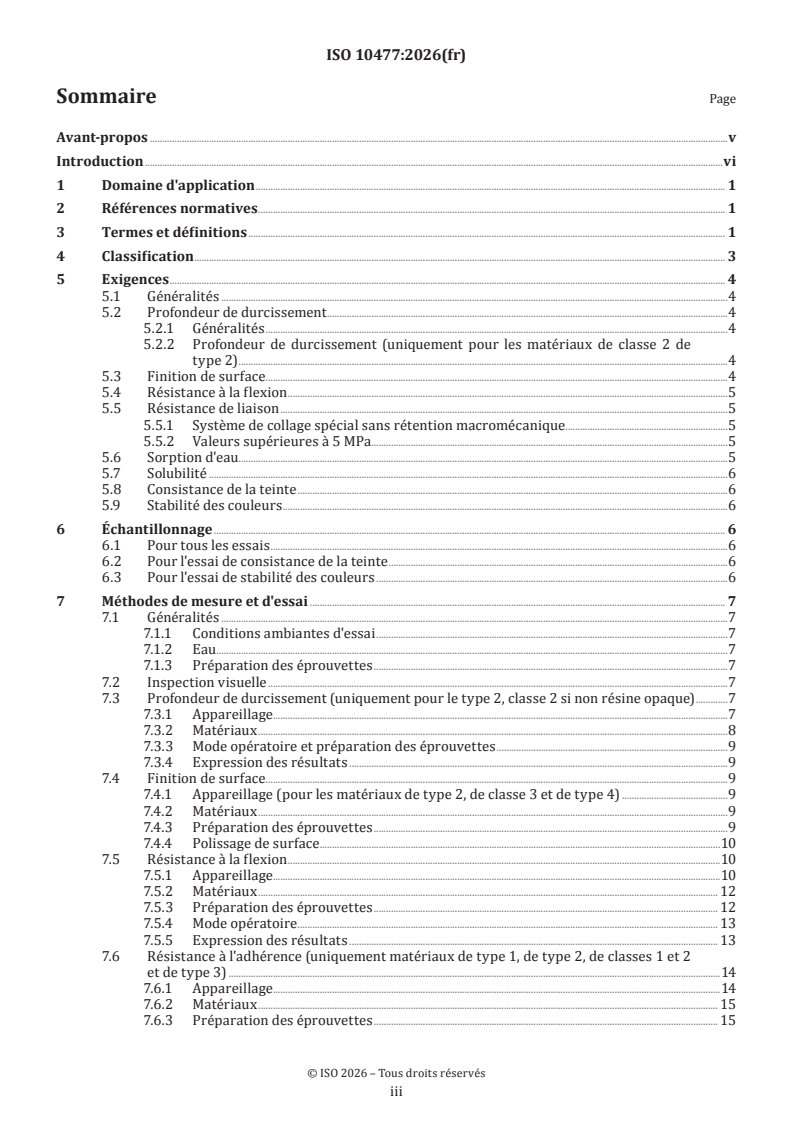
Contents Page
Foreword .v
Introduction .vi
1 Scope . 1
2 Normative references . 1
3 Terms and definitions . 1
4 Classification . 3
5 Requirements . 3
5.1 General .3
5.2 Depth of cure .4
5.2.1 General .4
5.2.2 Depth of cure (only type 2 class 2 materials) .4
5.3 Surface finish .4
5.4 Flexural strength.4
5.5 Bond strength .5
5.5.1 Special bonding system without macromechanical retention .5
5.5.2 Values higher than 5 MPa .5
5.6 Water sorption .5
5.7 Solubility .5
5.8 Shade consistency .5
5.9 Colour stability .6
6 Sampling . 6
6.1 For all tests.6
6.2 For test of shade consistency .6
6.3 For test of colour stability .6
7 Measurement and test methods . 6
7.1 General .6
7.1.1 Ambient test conditions .6
7.1.2 Water .6
7.1.3 Preparation of test specimens .6
7.2 Visual inspection .7
7.3 Depth of cure (only for type 2, class 2 if not opaque resin) .7
7.3.1 Apparatus .7
7.3.2 Materials .8
7.3.3 Procedure and specimen preparation.9
7.3.4 Expression of results .9
7.4 Surface finish .9
7.4.1 Apparatus (for type 2 class 3 and type 4 materials) .9
7.4.2 Materials .9
7.4.3 Specimen preparation .9
7.4.4 Surface polishing .10
7.5 Flexural strength.10
7.5.1 Apparatus .10
7.5.2 Materials .11
7.5.3 Preparation of test specimens .11
7.5.4 Procedure . 12
7.5.5 Expression of results . 13
7.6 Bond strength (only type 1, type 2 classes 1 and 2 and type 3 materials) . 13
7.6.1 Apparatus . 13
7.6.2 Materials .14
7.6.3 Preparation of test specimens . 15
7.6.4 Procedure . 15
7.6.5 Expression of results . 15
iii
7.7 Water sorption and solubility .16
7.7.1 Apparatus .16
7.7.2 Materials .16
7.7.3 Preparation of test specimen .17
7.7.4 Procedure .17
7.7.5 Expression of results .18
7.8 Shade consistency and colour stability .19
7.8.1 General .19
7.8.2 Apparatus .19
7.8.3 Materials .19
7.8.4 Preparation of test specimens . 20
7.8.5 Procedure . 20
7.8.6 Colour comparison.21
7.8.7 Expression of results for shade consistency . .21
7.8.8 Expression of results for colour stability .21
8 Packaging and labelling .21
8.1 Packaging .21
8.2 Labelling and instructions for use .21
Bibliography .25
iv
Foreword
ISO (the International Organization for Standardization) is a worldwide federation of national standards
bodies (ISO member bodies). The work of preparing International Standards is normally carried out through
ISO technical committees. Each member body interested in a subject for which a technical committee
has been established has the right to be represented on that committee. International organizations,
governmental and non-governmental, in liaison with ISO, also take part in the work. ISO collaborates closely
with the International Electrotechnical Commission (IEC) on all matters of electrotechnical standardization.
The procedures used to develop this document and those intended for its further maintenance are described
in the ISO/IEC Directives, Part 1. In particular, the different approval criteria needed for the different types
of ISO documents should be noted. This document was drafted in accordance with the editorial rules of the
ISO/IEC Directives, Part 2 (see www.iso.org/directives).
ISO draws attention to the possibility that the implementation of this document may involve the use of (a)
patent(s). ISO takes no position concerning the evidence, validity or applicability of any claimed patent
rights in respect thereof. As of the date of publication of this document, ISO [had/had not] received notice of
(a) patent(s) which may be required to implement this document. However, implementers are cautioned that
this may not represent the latest information, which may be obtained from the patent database available at
www.iso.org/patents. ISO shall not be held responsible for identifying any or all such patent rights.
Any trade name used in this document is information given for the convenience of users and does not
constitute an endorsement.
For an explanation of the voluntary nature of standards, the meaning of ISO specific terms and expressions
related to conformity assessment, as well as information about ISO's adherence to the World Trade
Organization (WTO) principles in the Technical Barriers to Trade (TBT), see www.iso.org/iso/foreword.html.
This document was prepared by Technical Committee ISO/TC 106, Dentistry, Subcommittee SC 2,
Prosthodontic materials, in collaboration with the European Committee for Standardization (CEN) Technical
Committee CEN/TC 55, Dentistry, in accordance with the Agreement on technical cooperation between ISO
and CEN (Vienna Agreement).
This fifth edition cancels and replaces the fourth edition (ISO 10477:2020), which has been technically
revised.
The main changes are as follows:
— materials for additive manufacturing have been added to Clause 4 as type 2 class 3;
— materials for subtractive manufacturing have been added to Clause 4 as type 4;
— editorial updates have been made.
Any feedback or questions on this document should be directed to the user’s national standards body. A
complete listing of these bodies can be found at www.iso.org/members.html.
v
Introduction
Specific qualitative and quantitative test methods for demonstrating freedom from unacceptable biological
hazards are not included in this document, but, for the assessment of possible biological hazards, reference
[1] [2]
should be made to ISO 10993-1 and ISO 7405 .
vi
International Standard ISO 10477:2026(en)
Dentistry — Polymer-based crown and veneering materials
1 Scope
This document classifies polymer-based crown and veneering materials used in dentistry and specifies their
requirements. It also specifies the test methods to be used to determine conformity to these requirements.
This document is applicable to polymer-based crown and veneering materials for laboratory fabricated
permanent veneers or crowns. It also applies to polymer-based dental crown and veneering materials for
which the manufacturer claims adhesion to the substructure without macro-mechanical retention such as
beads or wires.
2 Normative references
The following documents are referred to in the text in such a way that some or all of their content constitutes
requirements of this document. For dated references, only the edition cited applies. For undated references,
the latest edition of the referenced document (including any amendments) applies.
ISO 1942, Dentistry — Vocabulary
ISO 3696:1987, Water for analytical laboratory use — Specification and test methods
ISO 5139, Dentistry — Polymer-based composite machinable blanks
ISO 6344-2, Coated abrasives — Determination and designation of grain size distribution — Part 2: Macrogrit
sizes P12 to P220
ISO 6344-3, Coated abrasives — Determination and designation of grain size distribution — Part 3: Microgrit
sizes P240 to P5000
ISO 6507-1, Metallic materials — Vickers hardness test — Part 1: Test method
ISO 7491, Dental materials — Determination of colour stability
ISO 7500-1, Metallic materials — Calibration and verification of static uniaxial testing machines — Part 1:
Tension/compression testing machines — Calibration and verification of the force-measuring system
ISO 8601-1, Date and time — Representations for information interchange — Part 1: Basic rules
ISO 18739, Dentistry — Vocabulary of process chain for CAD/CAM systems
ISO 22674, Dentistry — Metallic materials for fixed and removable restorations and appliances
3 Terms and definitions
For the purposes of this document, the terms and definitions given in ISO 1942, ISO 18739 as well as the
following apply.
ISO and IEC maintain terminology databases for use in standardization at the following addresses:
— IEC Electropedia: available at http:// www .electropedia .org/
— ISO Online browsing platform: available at http:// www .iso .org/ obp
3.1
polymer-based crown and veneering material
dental material supplied as a composite of powders and liquids or pastes that can contain monomers, either
inorganic fillers or polymeric fillers, or both, or pre-polymerized blocks or discs that can contain polymers
and inorganic fillers, and that, when polymerized or processed, is suitable for use as permanent dental
veneers or crowns
Note 1 to entry: Polymerization is effected either by mixing initiator(s) and activator(s) (“self-curing” materials) or by
external energy activation [by heat (“heat-curing” materials), photoactivated materials, either by visible light radiation
(“light-curing” materials) or by UV radiation ("UV-curing" materials), or both], or both (“dual-cure” materials).
Note 2 to entry: The polymer-based crown and veneering materials for laboratory-fabricated permanent veneers or
crowns can be used without substructure or can be attached to a substructure.
3.2
dentine resin
pigmented and slightly translucent polymer-based crown and veneering material (3.1) used to simulate the
natural appearance of the dentine in a resin-based restoration or dental prosthesis
3.3
enamel resin
translucent, lightly pigmented polymer-based crown and veneering material (3.1) used to simulate the natural
appearance of enamel, including the incisal portion of a resin-based restoration or dental prosthesis
3.4
cervical resin
intensely pigmented slightly translucent polymer-based crown and veneering material (3.1) having colours
simulating those of cervical parts of natural teeth
3.5
opaque resin
polymer-based crown and veneering material (3.1) which, when applied to a substructure in accordance with
the manufacturer's instructions, bonds to the surface and forms a layer that masks the underlying colour
Note 1 to entry: Opaque resins are only required to fulfil the requirement of 5.5.
3.6
subtractive manufacturing
milling
process of machining, grinding or reducing a larger bulk object to create a smaller detailed three-dimensional
object using computer-aided design software and computer-aided manufacturing methods
Note 1 to entry: The term milling (3.6) is used in this document as it is a common term in dental technology and clinical
dentistry for the processing of these materials.
3.7
additive manufacturing
AM
printing
process of joining materials to make parts from 3D model data, usually layer upon layer, as opposed to
subtractive manufacturing (3.6) and formative manufacturing methodologies
Note 1 to entry: The term printing (3.7) is used in this document as it is a common term in dental technology and
clinical dentistry for the processing of these materials.
3.8
vat photopolymerization
VPP
additive manufacturing (3.7) process in which liquid photopolymer in a vat (3.9) is selectively cured by
photo-activated polymerization
Note 1 to entry: The liquid photopolymer can consist of monomers and photo-polymerization initiators and contain
fillers.
Note 2 to entry: The term printing (3.7) can be used instead of the term vat photopolymerization (3.8) in dental
technology and clinical dentistry for the processing of these materials.
3.9
vat
small tub, part of the polymerization device that contains the liquid photopolymer
3.10
computer-aided milling machine
computer-aided machining device designed for subtractive manufacturing (3.6) of dental restorations and
dental prostheses using rotary instruments for cutting and grinding
4 Classification
The polymer-based crown and veneering materials described in this document shall be classified according
to their activation system for polymerization:
— Type 1: polymer-based crown and veneering materials whose setting is effected by mixing initiator(s)
and activator(s) (“self-curing” materials);
— Type 2: polymer-based crown and veneering materials whose setting is effected by the application of
energy from an external source (“external-energy-activated” materials), e.g. heat or radiation (visible or
UV range) or both;
— Class 1: polymer-based crown and veneering materials that do not contain a photo-polymerization
initiator;
— Class 2: polymer-based crown and veneering materials that contain a photopolymerization initiator
and are not intended for additive manufacturing (printing);
— Class 3: polymer-based crown and veneering materials that are intended for additive manufacturing,
e.g. vat photopolymerization (printing);
— Type 3: polymer-based crown and veneering materials whose setting is affected by mixing initiator(s)
and activator(s) and also by the application of energy from an external source (“dual-cure” materials);
— Type 4: polymer-based crown and veneering materials that are intended for subtractive manufacturing
(e.g. milling).
5 Requirements
5.1 General
The tests required for a crown and veneering material depend on the classification according to type and
class.
See Table 1 for the necessity of the specific tests described in 5.2 to 5.9.
Table 1 — Test protocol
Type 2
Subclause Property Type 1 Type 3 Type 4
Class 1 Class 2 Class 3
a b
5.2 Depth of cure — — + — — —
Surface
a a a a
5.3 + + + + + +
finish
Flexural
a a a a
5.4 + + + + + +
strength
Bond
strength to
c c
5.5 + + + — + —
the frame-
work
Water
sorption, sol-
a a a a
5.6 to 5.9 ubility, shade + + + + + +
consistency,
colour
Key
+ carry out test
— do not test
a
If the material is opaque resin, do not test.
b
Not required because the curing process is inherently defined in the vat photopolymerization device and process (see 5.2.2).
c
Not required as these materials are not intended for veneering of frameworks.
5.2 Depth of cure
5.2.1 General
Testing shall be carried out in accordance with 7.3.
5.2.2 Depth of cure (only type 2 class 2 materials)
For type 2 class 2 materials, the hardness of the bottom surface shall be not less than 70 % of that of the top
surface (see Table 2). This requirement is not applicable to opaque resins.
For type 1, type 2 class 1, and type 3 and type 4 materials, no requirement is specified.
For type 2 class 3 materials, no requirement is specified as the curing process is inherently defined in the
additive manufacturing process.
5.3 Surface finish
A test specimen polished in accordance with 7.4 shall have a glossy surface.
Testing shall be carried out in accordance with 7.4. This requirement is not applicable to opaque resins.
5.4 Flexural strength
Flexural strength shall be at least 50 MPa for:
— type 1;
— type 2 classes 1 and 2;
— type 3.
Flexural strength shall be at least 80 MPa for type 2 class 3 and type 4 materials (see Table 2). This
requirement is not applicable to opaque resins.
Testing shall be carried out in accordance with 7.5.
Table 2 — Physical and chemical requirements
Subclause Property Requirement
Hardness of bottom surface ≥70 %
5.2 Depth of cure
of top surface
≥50 MPa for type 1, type 2 classes 1
and 2 and type 3
5.4 Flexural strength
≥ 80 MPa for type 2 class 3 and type 4
5.5.1 ≥5 MPa
Bond strength
≥80 % of the value claimed but
5.5.2
≥5 MPa
5.6 Water sorption ≤40 µg/mm
5.7 Solubility ≤7,5 µg/mm
5.5 Bond strength
5.5.1 Special bonding system without macromechanical retention
If the manufacturer recommends a special bonding system without macromechanical retention, the strength
of bond to the material used for the substructure shall be not less than 5 MPa (see Table 1 and Table 2).
Testing shall be carried out in accordance with 7.6.
5.5.2 Values higher than 5 MPa
If the manufacturer claims a value higher than 5 MPa for the bond strength, then the bond strength shall be
not less than 80 % of the value claimed with a minimum of 5 MPa.
Testing shall be carried out in accordance with 7.6.
5.6 Water sorption
The water sorption of the cured polymer-based crown and veneering material shall be not more than 40 µg/
mm (see Table 2).
Testing shall be carried out in accordance with 7.7. This requirement is not applicable to opaque resins.
5.7 Solubility
The solubility in water of the cured polymer-based crown and veneering material shall be not more than 7,5
µg/mm (see Table 2).
Testing shall be carried out in accordance with 7.7. This requirement is not applicable to opaque resins.
5.8 Shade consistency
The colours of the cured polymer-based crown and veneering material from different batches (according to
6.1 and 6.2) shall show no more than a slight difference with the colour indicated by the manufacturer.
Testing shall be carried out in accordance with 7.8 and ISO 7491.
5.9 Colour stability
The polymer-based crown and veneering material shall show no more than a slight change in colour.
Testing shall be carried out in accordance with 7.8 and ISO 7491.
6 Sampling
6.1 For all tests
The test sample shall consist of one or more packages of one selected shade, corresponding to the purpose of
the test, from a single batch and contain sufficient material to carry out the specified tests, plus an allowance
for any necessary repetition of tests.
For type 1, type 2 classes 1 and 2 and type 3 materials, an amount of 20 ml of material is recommended.
6.2 For test of shade consistency
The sample for the test of shade consistency (5.8 and 7.8) shall consist of the same shade as in 6.1 but from
another batch.
For type 1, type 2 classes 1 and 2, and type 3 materials, an amount of 1 ml of material is recommended.
6.3 For test of colour stability
The sample for the test of colour stability (5.9 and 7.8) shall consist of two further shades of the
material. The shade of the resin sample shall consist of three different shades each of which correspond
to one representative shade of enamel resin, dentine resin and cervical resin. They should be selected in
consideration of its colouring components, if different colouring components are used.
For type 1, type 2 classes 1 and 2 and type 3 materials, an amount of 1 ml of material is recommended.
7 Measurement and test methods
7.1 General
7.1.1 Ambient test conditions
Tests shall be carried out at room conditions (23 ± 2) °C and (50 ± 20) % relative humidity.
7.1.2 Water
Unless otherwise specified, the water to be used shall conform to ISO 3696:1987, Grade 3.
7.1.3 Preparation of test specimens
For the preparation of type 2 and type 3 polymer-based crown and veneering materials, reference shall
be made to the instruction for use that state the external energy source or sources recommended for the
materials to be tested. Care shall be taken to ensure that the energy source is fully functional.
Mix or otherwise prepare the polymer-based crown and veneering material in accordance with the
instruction for use and the test conditions specified in 7.1.1.
Use only the quantity required to prepare one of the corresponding specimens.
If fully cured specimens are required for testing (7.4 to 7.8), the specimens shall behomogeneous. There
shall be no voids, clefts or air inclusions present by visual inspection without magnification.
A separating medium which does not interfere with the setting reaction (e.g. 3 % solution of polyvinylstearyl
ether wax in hexane) can be used to facilitate removal of the specimen.
For the preparation of type 2 class 3 polymer-based crown and veneering materials, reference shall be made
to the instructions for use that state the vat photopolymerization device and process specification.
For the preparation of type 4 polymer-based crown and veneering materials, reference shall be made to
the instructions for use that state the computer-aided milling machine and process specification. It shall be
taking care to avoid excess heat generation.
7.2 Visual inspection
Use visual inspection to determine conformity to Clause 8. The colour comparison in 7.8 shall be performed
in accordance with ISO 7491.
7.3 Depth of cure (only for type 2, class 2 if not opaque resin)
7.3.1 Apparatus
7.3.1.1 Split rings, such as shown in Figure 1, (15 ± 1) mm in diameter and (1,0 ± 0,1) mm in height.
Dimensions in millimetres
Key
1 glass or metal plates
2 split ring
3 retaining plate or former
Figure 1 — Mould for the preparation of test specimens for depth of cure, surface finish, water
sorption, solubility, shade consistency and colour stability
7.3.1.2 Two plates, e.g. polished metal or glass, measuring approximately 20 mm × 20 mm × 5 mm.
7.3.1.3 Radiation source, as recommended in the instructions for use.
7.3.1.4 Hardness testing instrument, for HV 0,5.
7.3.1.5 Oven, set at (37 ± 1) °C.
7.3.2 Materials
7.3.2.1 White filter paper.
7.3.2.2 Film, colourless, transparent, (50 ± 30) μm thick.
7.3.3 Procedure and specimen preparation
Cover one plate with a piece of white filter paper followed by the film and position the split ring upon it.
Prepare the polymer-based crown and veneering material according to the instruction for use and place it
into the split ring to a slight excess. Cover the polymer-based crown and veneering material and the split
ring with a second piece of film and the second plate and extrude the excess material. Remove the upper
plate and irradiate the test specimen in the split ring through the film in accordance with the instruction for
use. Remove the test specimen from the split ring.
Prepare three specimens and store them in water at (37 ± 1) °C for (24 ± 2) h. Carry out the hardness test on
the upper and lower surfaces of the specimens three times in accordance with ISO 6507-1.
7.3.4 Expression of results
Express the hardness of each surface as the mean of the three values obtained for it.
All three specimens shall meet the requirement of 5.2. Otherwise the polymer-based crown and veneering
material does not conform with the requirement of 5.2.
7.4 Surface finish
7.4.1 Apparatus (for type 2 class 3 and type 4 materials)
7.4.1.1 Vat photopolymerization device (for type 2 class 3), as recommended in the instructions for use.
7.4.1.2 Cleaning device (for type 2 class 3), for removing unreacted monomer as recommended in the
instructions for use.
7.4.1.3 Post curing device (for type 2 class 3), as recommended in the instructions for use.
7.4.1.4 Computer-aided milling machine (for type 4), as recommended in the instructions for use.
7.4.2 Materials
7.4.2.1 Abrasive paper, at P220 (in accordance with ISO 6344-2) or P320 (in accordance with ISO 6344-3).
7.4.2.2 Abrasive paper, at least P1000 or finer (in accordance with ISO 6344-3).
7.4.2.3 Polishing compound, precipitated calcium carbonate (CaCO ).
7.4.2.4 Muslin wheel, unstitched, 18-to 36-ply, having a diameter of 70 mm to 95 mm.
7.4.3 Specimen preparation
For type 1, type 2 classes 1 and 2 and type 3 materials, prepare a specimen according to 7.3.3. Polish the test
specimen prepared in accordance with the instruction for use. If no specific procedure is given, polish in
accordance with the instructions provided under 7.4.3.
For type 2 class 3 materials, manufacture the specimen in the required dimension [round specimen, diameter
(15 ± 1) mm, heights (1,0 ± 0,1) mm or square shaped specimen, (13 ± 1) mm, heights (1.0 ± 0,1) mm].
Remove the supports and carefully remove any flash by gently abrading with P220 or P320 of abrasive paper.
After removing any flash, polish the surface using P1000 or finer of abrasive paper.
For type 4 materials, mill or saw the specimen in the required dimension [round specimen, diameter (15 ± 1)
mm, heights (1.0 ± 0,1) mm or square shaped specimen, (13 ± 1) mm, heights (1.0 ± 0,1) mm].
Remove the supports and carefully remove any flash by gently abrading with P220 or P320 of abrasive paper.
After removing any flash, polish the surface using P1000 or finer of abrasive paper.
7.4.4 Surface polishing
Grind (wet) the specimen on both sides and polish according to the instruction for use. If no specific
procedure is given, polish for not longer than 1 min with a muslin wheel at a circumferential speed of (650
± 350) m/min and with polishing compound. Keep at least 10 mm between the outer diameter of the wheel
and the stitching or other reinforcement.
Thoroughly clean the specimen by rinsing with water, blot dry, and visually inspect the surface. If the surface
of the specimen is glossy when visually inspected. the polymer-based veneering material conforms with the
requirements of 5.3.
NOTE A wheel with a diameter of 70 mm rotating at 1 500 r/min has a circumferential speed of 330 m/min and a
100 mm diameter wheel rotating at 3 500 r/min has a circumferential speed of 1 100 m/min.
7.5 Flexural strength
7.5.1 Apparatus
7.5.1.1 Split stainless steel mould (for type 1, type 2 classes 1 and 2 and type 3 materials), coated with
a separating medium (e.g. 3 % solution of polyvinylstearyl ether wax in hexane), as shown in Figure 2, in an
appropriate mounting device.
Dimensions in millimetres
Figure 2 — Split mould for test specimens for the flexural test for type 1, type 2 classes 1 and 2 and
type 3 materials
7.5.1.2 Two glass or metal plates (for type 1, type 2 classes 1 and 2 and type 3 materials), of approximately
30 mm × 30 mm × 2 mm.
7.5.1.3 Small screw clamp (for type 1, type 2 classes 1 and 2, and type 3 materials).
7.5.1.4 Polymerization apparatus (for type 2 classes 1 and 2, and type 3 materials), as recommended in
the instruction for use.
7.5.1.5 Vat photopolymerization device (for type 2 class 3), as recommended in the instructions for use.
7.5.1.6 Cleaning device (for type 2 class 3), for removing unreacted monomer as recommended in the
instructions for use.
7.5.1.7 Post curing device (for type 2 class 3), as recommended in the instructions for use.
7.5.1.8 Computer-aided milling machine (for type 4), as recommended in the instructions for use.
7.5.1.9 Saw, (optional) suitable for cutting type 4 material.
7.5.1.10 Oven, set at (37 ± 1) °C.
7.5.1.11 Flexural strength test apparatus, calibrated in accordance with ISO 7500-1, to provide a constant
cross-head speed of (1,0 ± 0,3) mm/min. The apparatus consists of two rods (2 mm in diameter), mounted
parallel with 12 mm or 20 mm (for 25 mm specimen) (in accordance with ISO 5139) between centres and
a third rod (2 mm in diameter) centred between and parallel to the other two, so that the three rods in
combination can be used to give a three-point loading to the specimen. Other instruments with a constant
loading rate of (50 ± 16) N/min may also be used.
7.5.1.12 Micrometer, with an accuracy of 0,01 mm.
7.5.1.13 Timer, accurate to ± 1 s.
7.5.2 Materials
7.5.2.1 White filter paper, as in 7.3.2.1.
7.5.2.2 Film, as in 7.3.2.2.
7.5.2.3 Abrasive paper, at P220 (in accordance with ISO 6344-2) or P320 (in accordance with ISO 6344-3),
as in 7.4.2.1.
7.5.2.4 Abrasive paper, at least P1000 or finer (in accordance with ISO 6344-3), as in 7.4.2.2.
7.5.2.5 Metal or glass plates, 1 quartz plate for UV photo-activated material, no less than 30 mm × 10 mm
× 2 mm.
7.5.2.6 Water, conforming to ISO 3696:1987, Grade 2.
7.5.3 Preparation of test specimens
7.5.3.1 General
Prepare five specimens in accordance with 7.5.3.2 to 7.5.3.5. After preparation, store the specimen in water
(7.5.2.6) at (37 ± 1) °C (7.5.1.10) until the start of testing (7.5.4). Specimens shall be plane-parallel for flexural
testing.
7.5.3.2 Type 1 and type 2 class 1 materials
Cover one of the metal or glass plates with the film and position the mould upon it. Prepare the polymer-
based crown and veneering material in accordance with the instruction for use and immediately place it
in the mould to a slight excess. Place a second piece of film onto the polymer-based crown and veneering
material in the mould and cover this with the second metal or glass plate. Apply pressure to displace excess
material by means of the clamp.
Polymerize the polymer-based crown and veneering material in accordance with the instruction for use.
Fifteen minutes after polymerization, remove the specimen and carefully remove any flash by gently
abrading with abrasive paper (7.5.2.3), avoiding touching any other surface.
7.5.3.3 Type 2 class 2 and type 3 materials
For light (385 nm to 515 nm) photopolymerization initiator materials, cover with a glass plate as top plate.
For UV (below 385 nm) photopolymerization initiator materials, cover with a quartz plate as top plate.
Cover the bottom plate with the white filter paper, followed by the film, and position the mould upon it.
Prepare the polymer-based crown and veneering material in accordance with the instruction for use and
fill the mould with the polymer-based crown and veneering material, as described in 7.5.3.2. Place a second
piece of film on the polymer-based crown and veneering material in the mould. For light photopolymerization
initiator materials cover this with a glass plate. For photo-polymerization initiator materials, cover this with
a quartz plate. Apply pressure to displace excess material by means of the clamp.
Polymerize the polymer-based crown and veneering material in accordance with the instruction for use.
Irradiate the specimen through the top glass or quartz plate, remove both plates and the white filter paper.
Irradiate the specimen from the other side. Fifteen minutes after polymerization, remove the specimen and
carefully remove any flash by gently abrading with abrasive paper (7.5.2.3).
7.5.3.4 Type 2 class 3 materials
Process the material using vat photopolymerization device, cleaning device and post-curing device and
fabricate the test specimens in the required dimension [bar, >14 mm (length) × (4,0 ± 0,2) mm (width) × (1,2
± 0,2) mm (height); at least 2 mm longer than the test span, 12 mm) or (bar, >22 mm (length) × (2,0 ± 0,2)
mm (width) × (2,0 ± 0,2) mm (height); at least 2 mm longer than the test span, 20 mm].
Remove the supports and carefully remove any flash by gently abrading with P220 or P320 of abrasive paper.
After removing any flash, polish the surface using P1000 or finer of abrasive paper.
7.5.3.5 Type 4 materials
Saw or mill the material using saw or computer-aided milling machine and fabricate the test specimens in
the required dimension [bar, >14 mm (length) × (4,0 ± 0,2) mm (width) × (1,2 ± 0,2) mm (height); at least 2
mm longer than the test span, 12 mm) or bar, >22 mm (length) × (2,0 ± 0,2) mm (width) × (
...
Norme
internationale
ISO 10477
Cinquième édition
Médecine bucco-dentaire —
2026-09
Produits à base de polymères pour
couronnes et facettes
Dentistry — Polymer-based crown and veneering materials
Numéro de référence
DOCUMENT PROTÉGÉ PAR COPYRIGHT
© ISO 2026
Tous droits réservés. Sauf prescription différente ou nécessité dans le contexte de sa mise en œuvre, aucune partie de cette
publication ne peut être reproduite ni utilisée sous quelque forme que ce soit et par aucun procédé, électronique ou mécanique,
y compris la photocopie, ou la diffusion sur l’internet ou sur un intranet, sans autorisation écrite préalable. Une autorisation peut
être demandée à l’ISO à l’adresse ci-après ou au comité membre de l’ISO dans le pays du demandeur.
ISO copyright office
Case postale 401 • Ch. de Blandonnet 8
CH-1214 Vernier, Genève
Tél.: +41 22 749 01 11
E-mail: copyright@iso.org
Web: www.iso.org
Publié en Suisse
ii
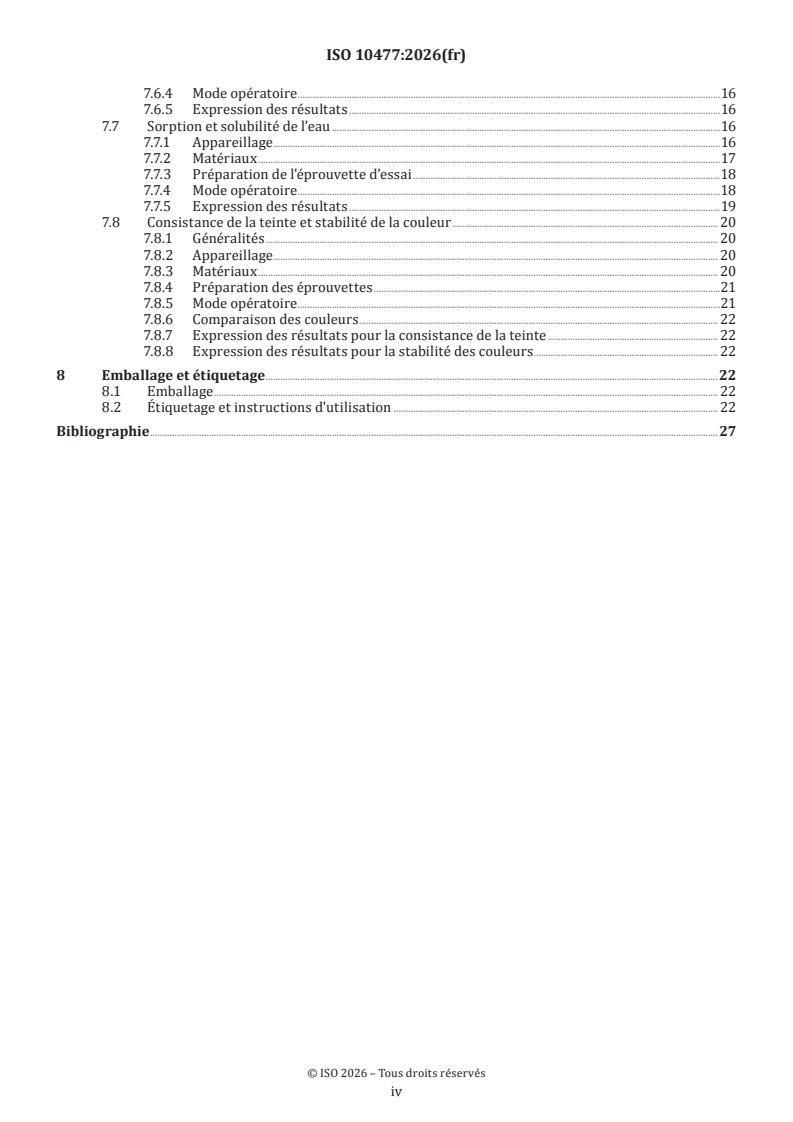
Sommaire Page
Avant-propos .v
Introduction .vi
1 Domaine d'application . 1
2 Références normatives . 1
3 Termes et définitions . 1
4 Classification . 3
5 Exigences . 4
5.1 Généralités .4
5.2 Profondeur de durcissement .4
5.2.1 Généralités .4
5.2.2 Profondeur de durcissement (uniquement pour les matériaux de classe 2 de
type 2) .4
5.3 Finition de surface .4
5.4 Résistance à la flexion .5
5.5 Résistance de liaison .5
5.5.1 Système de collage spécial sans rétention macromécanique .5
5.5.2 Valeurs supérieures à 5 MPa . .5
5.6 Sorption d'eau .5
5.7 Solubilité .6
5.8 Consistance de la teinte .6
5.9 Stabilité des couleurs .6
6 Échantillonnage . 6
6.1 Pour tous les essais .6
6.2 Pour l'essai de consistance de la teinte .6
6.3 Pour l'essai de stabilité des couleurs .6
7 Méthodes de mesure et d'essai . 7
7.1 Généralités .7
7.1.1 Conditions ambiantes d'essai .7
7.1.2 Eau .7
7.1.3 Préparation des éprouvettes .7
7.2 Inspection visuelle .7
7.3 Profondeur de durcissement (uniquement pour le type 2, classe 2 si non résine opaque) .7
7.3.1 Appareillage.7
7.3.2 Matériaux .8
7.3.3 Mode opératoire et préparation des éprouvettes .9
7.3.4 Expression des résultats .9
7.4 Finition de surface .9
7.4.1 Appareillage (pour les matériaux de type 2, de classe 3 et de type 4) .9
7.4.2 Matériaux .9
7.4.3 Préparation des éprouvettes .9
7.4.4 Polissage de surface . . .10
7.5 Résistance à la flexion .10
7.5.1 Appareillage.10
7.5.2 Matériaux . 12
7.5.3 Préparation des éprouvettes . 12
7.5.4 Mode opératoire . . 13
7.5.5 Expression des résultats . 13
7.6 Résistance à l'adhérence (uniquement matériaux de type 1, de type 2, de classes 1 et 2
et de type 3) .14
7.6.1 Appareillage.14
7.6.2 Matériaux . 15
7.6.3 Préparation des éprouvettes . 15
iii
7.6.4 Mode opératoire . .16
7.6.5 Expression des résultats .16
7.7 Sorption et solubilité de l'eau .16
7.7.1 Appareillage.16
7.7.2 Matériaux .17
7.7.3 Préparation de l'éprouvette d'essai .18
7.7.4 Mode opératoire . .18
7.7.5 Expression des résultats .19
7.8 Consistance de la teinte et stabilité de la couleur . 20
7.8.1 Généralités . 20
7.8.2 Appareillage. 20
7.8.3 Matériaux . 20
7.8.4 Préparation des éprouvettes .21
7.8.5 Mode opératoire . .21
7.8.6 Comparaison des couleurs . 22
7.8.7 Expression des résultats pour la consistance de la teinte . 22
7.8.8 Expression des résultats pour la stabilité des couleurs . 22
8 Emballage et étiquetage .22
8.1 Emballage . 22
8.2 Étiquetage et instructions d'utilisation . 22
Bibliographie .27
iv
Avant-propos
L'ISO (Organisation internationale de normalisation) est une fédération mondiale d'organismes nationaux
de normalisation (comités membres de l'ISO). Le travail d'élaboration des Normes internationales est
normalement effectué par l'intermédiaire des comités d'études de l'ISO. Chaque comité membre intéressé
par un sujet pour lequel un comité technique a été créé a le droit d'être représenté au sein de ce comité. Des
organisations internationales, gouvernementales et non gouvernementales, en liaison avec l'ISO, participent
également aux travaux. L'ISO collabore étroitement avec la Commission électrotechnique internationale
(IEC) sur toutes les questions de normalisation électrotechnique.
Les procédures utilisées pour élaborer le présent document et celles destinées à sa mise à jour sont décrites
dans les directives ISO/IEC, Partie 1. En particulier, il convient de noter les différents critères d'approbation
nécessaires pour les différents types de documents ISO. Le présent document a été rédigé conformément
aux règles de rédaction des directives ISO/IEC, Partie 2 (voir www.iso.org/directives).
L'ISO attire l'attention sur le fait que la mise en œuvre du présent document peut impliquer l'utilisation
d'un ou de plusieurs brevets. L'ISO ne prend pas position quant à la preuve, à la validité ou à l'applicabilité
des droits de propriété revendiqués à cet égard. À la date de publication du présent document, l'ISO n'avait
pas reçu notification d'un ou de plusieurs brevets qui pourraient être nécessaires pour mettre en œuvre
le présent document. Toutefois, les responsables de la mise en œuvre sont avertis que cela peut ne pas
représenter les informations les plus récentes, qui peuvent être obtenues à partir de la base de données sur
les brevets disponible à l'adresse www.iso.org/patents. L'ISO ne saurait être tenue pour responsable d'avoir
identifié tout ou partie de tels droits de propriété.
Toute appellation commerciale utilisée dans le présent document est donnée par souci de commodité à
l'intention des utilisateurs et ne saurait constituer un engagement.
Pour une explication de la nature volontaire des normes, la signification des termes et expressions
spécifiques de l'ISO liés à l'évaluation de la conformité, ou pour toute information au sujet de l'adhésion de
l'ISO aux principes de l'Organisation mondiale du commerce (OMC) concernant les obstacles techniques au
commerce (OTC), voir le site www.iso.org/iso/foreword.html.
Le présent document a été élaboré par le comité technique ISO/TC 106, Médecine bucco-dentaire, sous-comité
SC 2, Produits pour prothèses dentaires, en collaboration avec le comité technique CEN/TC 55, Médecine bucco-
dentaire, du Comité européen de normalisation (CEN), conformément à l'Accord de coopération technique
entre l'ISO et le CEN (Accord de Vienne).
Cette cinquième édition annule et remplace la quatrième édition (ISO 10477:2020), qui a fait l'objet d'une
révision technique.
Les principales modifications sont les suivantes:
— les matériaux pour la fabrication additive ont été ajoutés à l'Article 4 en tant que classe 3 de type 2;
— des matériaux pour la fabrication soustractive ont été ajoutés à l'Article 4 en tant que type 4;
— des mises à jour éditoriales ont été effectuées.
Il convient que tout retour d'information ou toute question concernant le présent document soit adressé
à l'organisme national de normalisation de l'utilisateur. Une liste complète de ces organismes peut être
consultée à l'adresse www.iso.org/members.html.
v
Introduction
Les méthodes d'essai qualitatives et quantitatives spécifiques permettant de démontrer l'absence de risques
biologiques inacceptables ne sont pas incluses dans le présent document, mais il convient de se référer à
[1] [2]
l'ISO 10993-1 et à l'ISO 7405 pour l'évaluation des risques biologiques éventuels.
vi
Norme internationale ISO 10477:2026(fr)
Médecine bucco-dentaire — Produits à base de polymères
pour couronnes et facettes
1 Domaine d'application
Le présent document classe les matériaux de recouvrement et de couronne à base de polymères utilisés en
médecine bucco-dentaire et spécifie leurs exigences. Elle spécifie également les méthodes d'essai à utiliser
pour déterminer la conformité à ces exigences.
Le présent document est applicable aux matériaux de recouvrement et de recouvrement à base de polymères
pour les revêtements permanents ou les couronnes fabriqués en laboratoire. Elle s’applique également
aux matériaux de recouvrement et de couronne dentaire à base de polymères pour lesquels le fabricant
revendique une adhérence à l’infrastructure sans rétention macro-mécanique, tels que les billes ou les fils.
2 Références normatives
Les documents suivants sont cités dans le texte de telle sorte qu'ils constituent, pour tout ou partie de leur
contenu, des exigences du présent document. Pour les références datées, seule l'édition citée s'applique. Pour
les références non datées, la dernière édition du document de référence s'applique (y compris les éventuels
amendements).
ISO 1942, Médecine bucco-dentaire — Vocabulaire
ISO 3696:1987, Eau pour laboratoire à usage analytique — Spécification et méthodes d'essai
ISO 5139, Médecine bucco-dentaire — Ébauches usinables en composite à base de polymères
ISO 6344-2, Abrasifs appliqués — Détermination et désignation de la distribution granulométrique — Partie 2:
Macrograins P12 à P220
ISO 6344-3, Abrasifs appliqués — Détermination et désignation de la distribution granulométrique — Partie 3:
Micrograins P240 à P5000
ISO 6507-1, Matériaux métalliques — Essai de dureté Vickers — Partie 1: Méthode d'essai
ISO 7491, Produits dentaires — Détermination de la stabilité de couleur
ISO 7500-1, Matériaux métalliques — Étalonnage et vérification des machines pour essais statiques uniaxiaux
— Partie 1: Machines d'essai de traction/compression — Étalonnage et vérification du système de mesure de
force
ISO 8601-1, Date et heure — Représentations pour l'échange d'information — Partie 1: Règles de base
ISO 18739, Médecine bucco-dentaire — Vocabulaire de la chaîne de processus pour les systèmes de CFAO
ISO 22674, Médecine bucco-dentaire — Matériaux métalliques pour les restaurations fixes et amovibles et les
appareils
3 Termes et définitions
Pour les besoins du présent document, les termes et définitions donnés dans l'ISO 1942, l'ISO 18739 ainsi
que les suivants s'appliquent.
L'ISO et l'IEC tiennent à jour des bases de données terminologiques destinées à être utilisées en normalisation
aux adresses suivantes:
— IEC Electropedia: disponible à l'adresse http:// www .electropedia .org/
— ISO Online browsing platform: disponible à l'adresse http:// www .iso .org/ obp
3.1
couronne à base de polymère et matériau de recouvrement
matériau dentaire fourni sous forme de composite de poudres et de liquides ou de pâtes pouvant contenir
des monomères, des charges inorganiques ou polymères, ou les deux, ou des blocs ou disques prépolymérisés
pouvant contenir des polymères et des charges inorganiques, et qui, lorsqu’il est polymérisé ou traité, est
adapté à une utilisation comme revêtements dentaires permanents ou couronnes
Note 1 à l'article: La polymérisation est effectuée soit par mélange d'initiateur(s) et d'activateur(s) (matériaux
«autopolymérisables»), soit par activation énergétique externe [par chaleur (matériaux «thermopolymérisables»),
matériaux photoactivés, soit par rayonnement lumineux visible (matériaux «photopolymérisables»), soit par
rayonnement UV (matériaux «photopolymérisables»), soit par les deux], ou les deux (matériaux «à double
polymérisation»).
Note 2 à l'article: La couronne à base de polymère et les matériaux de recouvrement pour les revêtements permanents
ou les couronnes fabriqués en laboratoire peuvent être utilisés sans infrastructure ou peuvent être fixés à une
infrastructure.
3.2
résine dentine
matériau de recouvrement et de couronne à base de polymère pigmenté et légèrement translucide (3.1) utilisé
pour simuler l’aspect naturel de la dentine dans une restauration ou une prothèse dentaire à base de résine
3.3
résine émaillée
matériau translucide, légèrement pigmenté, à base de polymère, de la couronne et du revêtement (3.1) utilisé
pour simuler l'aspect naturel de l'émail, y compris la partie incisive d'une restauration à base de résine ou
d'une prothèse dentaire
3.4
résine cervicale
matériau de recouvrement et de couronne à base de polymère intensément pigmenté légèrement translucide
(3.1) ayant des couleurs simulant celles des parties cervicales des dents naturelles
3.5
résine opaque
matériau de recouvrement et de couronne à base de polymère (3.1) qui, lorsqu'il est appliqué sur une
infrastructure conformément aux instructions du fabricant, adhère à la surface et forme une couche qui
masque la couleur sous-jacente
Note 1 à l'article: Les résines opaques sont uniquement requises pour satisfaire à l'exigence de 5.5.
3.6
fabrication soustractive
fraisage
procédé d'usinage, de meulage ou de réduction d'un objet en vrac de plus grande taille pour créer un objet
tridimensionnel détaillé plus petit à l'aide d'un logiciel de conception assistée par ordinateur et de méthodes
de fabrication assistées par ordinateur
Note 1 à l'article: Le terme fraisage (3.6) est utilisé dans le présent document car il s’agit d’un terme courant en
technologie dentaire et en médecine bucco-dentaire pour le traitement de ces matériaux.
3.7
fabrication additive
AM
impression
processus d'assemblage de matériaux pour fabriquer des pièces à partir de données de modèles 3D,
généralement couche par couche, par opposition à la fabrication soustractive (3.6) et aux méthodes de
fabrication formative
Note 1 à l'article: Le terme fabrication additive (3.7) est utilisé dans le présent document car il s’agit d’un terme courant
en technologie dentaire et en médecine bucco-dentaire clinique pour le traitement de ces matériaux.
3.8
photopolymérisation en cuve
VPP
procédé de fabrication additive (3.7) dans lequel le photopolymère liquide dans une cuve (3.9) est polymérisé
sélectivement par polymérisation photoactivée
Note 1 à l'article: Le photopolymère liquide peut être constitué de monomères et d'initiateurs de photo-polymérisation
et contenir des charges.
Note 2 à l'article: Le terme fabrication additive (3.7) peut être utilisé à la place du terme photopolymérisation en cuve
(3.8) en technologie dentaire et en médecine bucco-dentaire clinique pour le traitement de ces matériaux.
3.9
tva
petite cuve, partie du dispositif de polymérisation qui contient le photopolymère liquide
3.10
fraiseuse assistée par ordinateur
dispositif d’usinage assisté par ordinateur conçu pour la fabrication soustractive (3.6) de restaurations
dentaires et de prothèses dentaires à l’aide d’instruments rotatifs de coupe et de meulage
4 Classification
Les matériaux de recouvrement et de recouvrement à base de polymères décrits dans le présent document
doivent être classés en fonction de leur système d'activation pour la polymérisation:
— Type 1: matériaux de couronne et de revêtement à base de polymères dont la prise est effectuée en
mélangeant un ou plusieurs initiateurs et un ou plusieurs activateurs (matériaux «autopolymérisables»);
— Type 2: matériaux à base de polymères pour couronnes et revêtements dont la prise est effectuée par
l'application d'énergie provenant d'une source externe (matériaux «activés par énergie externe»), par
exemple chaleur ou rayonnement (domaine visible ou UV) ou les deux;
— Classe 1: matériaux de couronne et de revêtement à base de polymère qui ne contiennent pas
d'initiateur de photo-polymérisation;
— Classe 2: matériaux à base de polymères pour couronnes et revêtements qui contiennent un initiateur
de photopolymérisation et qui ne sont pas destinés à la fabrication additive (impression);
— Classe 3: matériaux de recouvrement et de couronne à base de polymères destinés à la fabrication
additive, par exemple la photopolymérisation en cuve (impression);
— Type 3: matériaux de couronne et de revêtement à base de polymères dont la prise est affectée par le
mélange d'initiateur(s) et d'activateur(s) et également par l'application d'énergie provenant d'une source
externe (matériaux «à double polymérisation»);
— Type 4: matériaux de couronne et de revêtement à base de polymères destinés à la fabrication soustractive
(par exemple, fraisage).
5 Exigences
5.1 Généralités
Les essais requis pour une couronne et un matériau de recouvrement dépendent de la classification selon le
type et la classe.
Voir le Tableau 1 pour la nécessité des essais spécifiques décrits de 5.2 à 5.9.
Tableau 1 — Protocole d'essai
Type 2
Paragraphe Propriété Type 1 Type 3 Type 4
Classe 1 Classe 2 Classe 3
Profondeur
a b
5.2 de durcisse- — — + — — —
ment
Finition de
a a a a
5.3 + + + + + +
surface
Résistance à
a a a a
5.4 + + + + + +
la flexion
Force de
c c
5.5 liaison à + + + — + —
l'ossature
Sorption
d’eau,
solubilité,
a a a a
5.6 à 5.9 + + + + + +
consistance
de la teinte,
couleur
Légende
+ effectuer l'essai
— ne pas soumettre à essai
a
Si le matériau est de la résine opaque, ne pas soumettre à essai.
b
Non requis car le processus de polymérisation est intrinsèquement défini dans le dispositif et le processus de pho-
topolymérisation en cuve (voir 5.2.2).
c
Non requis car ces matériaux ne sont pas destinés au revêtement des cadres.
5.2 Profondeur de durcissement
5.2.1 Généralités
Les essais doivent être effectués conformément à 7.3.
5.2.2 Profondeur de durcissement (uniquement pour les matériaux de classe 2 de type 2)
Pour les matériaux de classe 2 de type 2, la dureté de la surface inférieure ne doit pas être inférieure à 70 %
de celle de la surface supérieure (voir Tableau 2). Cette exigence n'est pas applicable aux résines opaques.
Pour les matériaux de type 1, de type 2, de classe 1, de type 3 et de type 4, aucune exigence n'est spécifiée.
Pour les matériaux de classe 3 de type 2, aucune exigence n'est spécifiée car le processus de polymérisation
est intrinsèquement défini dans le processus de fabrication additive.
5.3 Finition de surface
Une éprouvette polie conformément à 7.4 doit avoir une surface brillante.
Les essais doivent être effectués conformément à 7.4. Cette exigence n'est pas applicable aux résines opaques.
5.4 Résistance à la flexion
La résistance à la flexion doit être d'au moins 50 MPa pour:
— Type 1;
— les classes 1 et 2 de type 2;
— type 3.
La résistance à la flexion doit être d'au moins 80 MPa pour les matériaux de type 2, classe 3 et type 4 (voir
Tableau 2). Cette exigence n'est pas applicable aux résines opaques.
Les essais doivent être effectués conformément à 7.5.
Tableau 2 — Exigences physiques et chimiques
Paragraphe Propriété Exigence
Dureté de la surface inférieure ≥ 70 %
5.2 Profondeur de durcissement
de la surface supérieure
≥ 50 MPa pour le type 1, le type 2, les
classes 1 et 2 et le type 3
5.4 Résistance à la flexion
≥ 80 MPa pour les types 2, classe 3 et
type 4
5.5.1 ≥ 5 MPa
Résistance de liaison
≥ 80 % de la valeur revendiquée
5.5.2
mais ≥ 5 MPa
5.6 Sorption d'eau ≤ 40 µg/mm
5.7 Solubilité ≤ 7,5 µg/mm
5.5 Résistance de liaison
5.5.1 Système de collage spécial sans rétention macromécanique
Si le fabricant recommande un système de collage spécial sans rétention macromécanique, la résistance
du collage au matériau utilisé pour l'infrastructure ne doit pas être inférieure à 5 MPa (voir Tableau 1 et
Tableau 2).
Les essais doivent être effectués conformément à 7.6.
5.5.2 Valeurs supérieures à 5 MPa
Si le fabricant revendique une valeur supérieure à 5 MPa pour l'adhérence, alors l'adhérence ne doit pas être
inférieure à 80 % de la valeur revendiquée avec un minimum de 5 MPa.
Les essais doivent être effectués conformément à 7.6.
5.6 Sorption d'eau
L'absorption d'eau de la couronne et du matériau de revêtement polymérisés ne doit pas dépasser 40 µg/
mm (voir Tableau 2).
Les essais doivent être effectués conformément à 7.7. Cette exigence n'est pas applicable aux résines opaques.
5.7 Solubilité
La solubilité dans l'eau de la couronne et du matériau de recouvrement polymérisés ne doit pas
dépasser 7,5 µg/mm (voir Tableau 2).
Les essais doivent être effectués conformément à 7.7. Cette exigence n'est pas applicable aux résines opaques.
5.8 Consistance de la teinte
Les couleurs de la couronne polymérisée et du matériau de recouvrement provenant de différents lots (selon
6.1 et 6.2) ne doivent pas présenter plus d'une légère différence avec la couleur indiquée par le fabricant.
Les essais doivent être effectués conformément à 7.8 et à l'ISO 7491.
5.9 Stabilité des couleurs
La couronne à base de polymère et le matériau de recouvrement ne doivent présenter qu'un léger changement
de couleur.
Les essais doivent être effectués conformément à 7.8 et à l'ISO 7491.
6 Échantillonnage
6.1 Pour tous les essais
L'échantillon pour essai doit être constitué d'un ou de plusieurs emballages d'une nuance choisie,
correspondant à l'objectif de l'essai, provenant d'un seul lot et contenant suffisamment de matériau pour
réaliser les essais spécifiés, plus une tolérance pour toute répétition nécessaire des essais.
Pour les matériaux de type 1, de type 2, de classes 1 et 2 et de type 3, une quantité de 20 ml de matériau est
recommandée.
6.2 Pour l'essai de consistance de la teinte
L'échantillon pour l'essai de consistance de la teinte (5.8 et 7.8) doit être de la même teinte qu'en 6.1 mais
provenant d'un autre lot.
Pour les matériaux de type 1, de type 2, de classes 1 et 2, et de type 3, une quantité de 1 ml de matériau est
recommandée.
6.3 Pour l'essai de stabilité des couleurs
L'échantillon pour l'essai de stabilité des couleurs (5.9 et 7.8) doit être constitué de deux autres nuances de
matériau. La teinte de l'échantillon de résine doit être composée de trois teintes différentes correspondant
chacune à une teinte représentative de résine émaillée, de résine dentine et de résine cervicale. Il convient de
les choisir en tenant compte de leurs composants colorants, si différents composants colorants sont utilisés.
Pour les matériaux de type 1, de type 2, de classes 1 et 2 et de type 3, une quantité de 1 ml de matériau est
recommandée.
7 Méthodes de mesure et d'essai
7.1 Généralités
7.1.1 Conditions ambiantes d'essai
Les essais doivent être effectués dans des conditions ambiantes de (23 ± 2) °C et (50 ± 20) % d'humidité
relative.
7.1.2 Eau
Sauf spécification contraire, l'eau à utiliser doit être conforme à l'ISO 3696:1987, qualité 3.
7.1.3 Préparation des éprouvettes
Pour la préparation des matériaux de recouvrement et de couronne à base de polymères de type 2 et de type
3, il doit être fait référence aux instructions d'utilisation qui indiquent la ou les sources d'énergie externes
recommandées pour les matériaux à soumettre à essai. Veiller à ce que la source d'énergie soit pleinement
fonctionnelle.
Mélanger ou préparer de toute autre manière la couronne à base de polymère et le matériau de recouvrement
conformément aux instructions d'utilisation et aux conditions d'essai spécifiées en 7.1.1.
Utiliser uniquement la quantité requise pour préparer une des éprouvettes correspondantes.
Si des éprouvettes complètement polymérisées sont requises pour les essais (7.4 à 7.8), les éprouvettes
doivent être homogènes. Il ne doit pas y avoir de vides, de fentes ou d'inclusions d'air présentes par examen
visuel sans grossissement.
Un milieu de séparation qui n'interfère pas avec la réaction de prise (par exemple, solution à 3 % de cire de
polyvinylstéaryléther dans l'hexane) peut être utilisé pour faciliter le retrait de l'éprouvette.
Pour la préparation des matériaux de recouvrement et de couronne à base de polymères de type 2 et de classe
3, il doit être fait référence aux instructions d'utilisation qui indiquent le dispositif de photopolymérisation
en cuve et la spécification du procédé.
Pour la préparation des matériaux de recouvrement et de couronne à base de polymères de type 4, il doit
être fait référence aux instructions d'utilisation qui indiquent la machine de fraisage assistée par ordinateur
et la spécification du procédé. Il doit veiller à éviter toute production excessive de chaleur.
7.2 Inspection visuelle
Procéder à un examen visuel pour déterminer la conformité à l'Article 8. La comparaison des couleurs en 7.8
doit être effectuée conformément à l'ISO 7491.
7.3 Profondeur de durcissement (uniquement pour le type 2, classe 2 si non résine opaque)
7.3.1 Appareillage
7.3.1.1 Anneaux fendus, tels que représentés dans la Figure 1, (15 ± 1) mm de diamètre et (1,0 ± 0,1) mm
de hauteur.
Dimensions en millimètres
Légende
1 plaques de verre ou de métal
2 anneau fendu
3 plaque de maintien ou gabarit
Figure 1 — Moule pour la préparation des éprouvettes d'essai pour la profondeur de durcissement,
l'état de surface, l'absorption d'eau, la solubilité, la consistance de la teinte et la stabilité de la
couleur
7.3.1.2 Deux plaques, par exemple en métal ou en verre poli, mesurant environ 20 mm × 20 mm × 5 mm.
7.3.1.3 Source de rayonnement, comme recommandé dans les instructions d'utilisation.
7.3.1.4 Instrument d'essai de dureté, pour HV 0,5.
7.3.1.5 Étuve, réglée à (37 ± 1) °C.
7.3.2 Matériaux
7.3.2.1 Papier filtre blanc.
7.3.2.2 Film, incolore, transparent, (50 ± 30) μm thick.
7.3.3 Mode opératoire et préparation des éprouvettes
Couvrir une plaque avec un morceau de papier filtre blanc suivi du film et placer l'anneau fendu dessus.
Préparer la couronne à base de polymère et le matériau de recouvrement conformément aux instructions
d'utilisation et les placer dans l'anneau fendu jusqu'à un léger excès. Recouvrir la couronne à base de
polymère et le matériau de revêtement ainsi que l'anneau fendu avec un deuxième morceau de film et la
deuxième plaque et extruder l'excédent de matériau. Retirer la plaque supérieure et irradier l'éprouvette
dans l'anneau fendu à travers le film conformément aux instructions d'utilisation. Retirer l'éprouvette de
l'anneau fendu.
Préparer trois éprouvettes et les conserver dans de l'eau à (37 ± 1) °C pendant (24 ± 2) h. Effectuer l'essai de
dureté sur les surfaces supérieure et inférieure des éprouvettes trois fois conformément à l'ISO 6507-1.
7.3.4 Expression des résultats
Exprimer la dureté de chaque surface sous forme de moyenne des trois valeurs obtenues pour celle-ci.
Les trois éprouvettes doivent satisfaire à l'exigence de 5.2. Sinon, la couronne à base de polymère et le
matériau de recouvrement ne sont pas conformes à l'exigence de 5.2.
7.4 Finition de surface
7.4.1 Appareillage (pour les matériaux de type 2, de classe 3 et de type 4)
7.4.1.1 Dispositif de photopolymérisation en cuve (pour type 2 classe 3), tel que recommandé dans les
instructions d'utilisation.
7.4.1.2 Dispositif de nettoyage (pour la classe 3 de type 2), pour éliminer le monomère n'ayant pas réagi,
comme recommandé dans les instructions d'utilisation.
7.4.1.3 Dispositif de post-durcissement (pour type 2 classe 3), tel que recommandé dans les instructions
d'utilisation.
7.4.1.4 Fraiseuse assistée par ordinateur (pour le type 4), comme recommandé dans les instructions
d'utilisation.
7.4.2 Matériaux
7.4.2.1 Papier abrasif, P220 (conformément à l'ISO 6344-2) ou P320 (conformément à l'ISO 6344-3).
7.4.2.2 Papier abrasif, au moins P1000 ou plus fin (conformément à l'ISO 6344-3).
7.4.2.3 Composé de polissage, carbonate de calcium précipité (CaCO ).
7.4.2.4 Roue en mousseline, non cousue, de 18 à 36 plis, d'un diamètre de 70 mm à 95 mm.
7.4.3 Préparation des éprouvettes
Pour les matériaux de type 1, de type 2, de classes 1 et 2 et de type 3, préparer une éprouvette conformément
à 7.3.3. Polir l'éprouvette préparée conformément aux instructions d'utilisation. En l'absence de mode
opératoire spécifique, polir conformément aux instructions données en 7.4.3.
Pour les matériaux de classe 3 de type 2, fabriquer l'éprouvette dans les dimensions requises [éprouvette
ronde, diamètre (15 ± 1) mm, hauteurs (1,0 ± 0,1) mm ou éprouvette carrée, (13 ± 1) mm, hauteurs
(1,0 ± 0,1) mm].
Retirer les supports et éliminer soigneusement tout éclair en abrasant doucement avec du papier abrasif
P220 ou P320.
Après élimination de tout éclair, polir la surface avec du papier abrasif P1000 ou plus fin.
Pour les matériaux de type 4, broyer ou scier l'éprouvette dans les dimensions requises [éprouvette ronde,
diamètre (15 ± 1) mm, hauteurs (1,0 ± 0,1) mm ou éprouvette carrée, (13 ± 1) mm, hauteurs (1,0 ± 0,1) mm].
Retirer les supports et éliminer soigneusement tout éclair en abrasant doucement avec du papier abrasif
P220 ou P320.
Après élimination de tout éclair, polir la surface avec du papier abrasif P1000 ou plus fin.
7.4.4 Polissage de surface
Broyer (mouiller) l'éprouvette sur les deux côtés et polir conformément aux instructions d'utilisation. Si
aucun mode opératoire spécifique n’est indiqué, polir pendant 1 min maximum avec une meule de mousseline
à une vitesse circonférentielle de (650 ± 350) m/min et avec un produit de polissage. Maintenir une distance
d'au moins 10 mm entre le diamètre extérieur de la meule et la couture ou autre armature.
Nettoyer soigneusement l'éprouvette en la rinçant à l'eau, la sécher par épongeage et examiner visuellement
la surface. Si la surface de l'éprouvette est brillante lors d'un examen visuel, le matériau de revêtement à
base de polymère est conforme aux exigences de 5.3.
NOTE Une roue d'un diamètre de 70 mm tournant à 1 500 r/min a une vitesse circonférentielle de 330 m/min et
une roue de 100 mm de diamètre tournant à 3 500 r/min a une vitesse circonférentielle de 1 100 m/min.
7.5 Résistance à la flexion
7.5.1 Appareillage
7.5.1.1 Moule en acier inoxydable fendu (pour les matériaux de type 1, de type 2, de classes 1 et 2 et de
type 3), recouvert d'un milieu de séparation (par exemple, solution à 3 % de cire de polyvinylstéaryléther
dans de l'hexane), comme indiqué dans la Figure 2, dans un dispositif de montage approprié.
Dimensions en millimètres
Figure 2 — Moule fendu pour éprouvettes pour l'essai de flexion des matériaux de type 1, de type 2,
de classes 1 et 2 et de type 3
7.5.1.2 Deux plaques de verre ou de métal (pour les matériaux de type 1, de type 2, de classes 1 et 2 et
de type 3), d'environ 30 mm × 30 mm × 2 mm.
7.5.1.3 Petite pince à vis (pour les matériaux de type 1, de type 2, de classes 1 et 2 et de type 3).
7.5.1.4 Appareillage de polymérisation (pour les matériaux de type 2, classes 1 et 2, et de type 3), tel
que recommandé dans les instructions d’utilisation.
7.5.1.5 Dispositif de photopolymérisation en cuve (pour type 2 classe 3), tel que recommandé dans les
instructions d'utilisation.
7.5.1.6 Dispositif de nettoyage (pour la classe 3 de type 2), pour éliminer le monomère n'ayant pas réagi,
comme recommandé dans les instructions d'utilisation.
7.5.1.7 Dispositif de post-durcissement (pour type 2 classe 3), tel que recommandé dans les instructions
d'utilisation.
7.5.1.8 Fraiseuse assistée par ordinateur (pour le type 4), comme recommandé dans les instructions
d'utilisation.
7.5.1.9 Scie, (facultative) adaptée à la découpe de matériau de type 4.
7.5.1.10 Étuve, réglée à (37 ± 1) °C.
7.5.1.11 Appareillage d'essai de résistance à la flexion, étalonné conformément à l'ISO 7500-1, pour
fournir une vitesse constante de déplacement de la traverse de (1,0 ± 0,3) mm/min. L'appareillage est
constitué de deux tiges (2 mm de diamètre), montées parallèlement entre leurs centres sur 12 mm ou 20 mm
(pour une éprouvette de 25 mm) (conformément à l'ISO 5139) et d'une troisième tige (2 mm de diamètre)
centrée entre les deux autres et parallèle à celles-ci, de sorte que les trois tiges combinées puissent être
utilisées pour appliquer une charge trois points à l'éprouvette. D’autres instruments ayant une vitesse de
charge constante de (50 ± 16) N/min peuvent également être utilisés.
...