


ISO/IEC 20016-1:2014
(Main)Information technology for learning, education and training — Language accessibility and human interface equivalencies (HIEs) in e-learning applications — Part 1: Framework and reference model for semantic interoperability
Information technology for learning, education and training — Language accessibility and human interface equivalencies (HIEs) in e-learning applications — Part 1: Framework and reference model for semantic interoperability
ISO/IEC 20016-1:2014 states the principles, rules and metadata elements for specifying language accessibility and Human Interface Equivalents (HIEs) in e-learning environments. It is structured to be able to support the requirements of applicable jurisdictional domains and in particular that of the UN Convention on the Rights of Persons with Disabilities.
Technologies de l'information pour l'apprentissage, l'éducation et la formation — Accessibilité au langage et équivalences d'interface humaines (HIEs) dans les application d'apprentissage électronique — Partie 1: Cadre et modèle de référence pour l'interopérabilité sémantique
General Information
- Status
- Published
- Publication Date
- 04-Feb-2014
- Current Stage
- 9092 - International Standard to be revised
- Start Date
- 30-Sep-2025
- Completion Date
- 12-Feb-2026
Overview
ISO/IEC 20016-1:2014 defines a framework and reference model for semantic interoperability focused on language accessibility and Human Interface Equivalencies (HIEs) in e‑learning, education and training systems. The standard sets out principles, rules and metadata elements to specify how language and human-interface alternatives should be represented and exchanged so that educational content and interfaces are accessible, adaptable and interoperable across jurisdictions - in particular to support obligations under the UN Convention on the Rights of Persons with Disabilities (CRPD).
Key topics and technical requirements
- Framework for semantic interoperability: A reference model to represent meaning (semantics) of language-accessibility resources and HIEs so systems can interpret and exchange them consistently.
- Human Interface Equivalency Model (HIEM): A structured model describing how different human-interface representations (visual, audio, textual, symbolic, etc.) map to equivalent semantics.
- Semantic Collaboration Space (SCS): Conceptual space defining how participants (systems, agents) collaborate to achieve unambiguous semantic exchange of HIEs.
- Levels of semantic and linguistic equivalence: Classification of equivalency degrees to guide matching and substitution of language/interface items.
- Rules for language choice and accessibility: Guidance on internal/external constraints, official or legally recognized languages, and declared semantic equivalents (DSE).
- Template for individual accessibility requirements: A standardized template to specify IT-interface and human-interface needs for individuals as Structured Resource Items (SRI).
- Principles and conformance: Core principles include support for UN CRPD, inclusive design, linguistic diversity, rule-based approaches, scalability, reuse of international standards, and IT-platform neutrality.
- Metadata and identifiers: Use of HIE identifiers and metadata elements to enable reliable discovery, exchange and localization.
Practical applications and users
Who uses ISO/IEC 20016-1:
- LMS/platform vendors and developers integrating accessibility and multilingual support
- Instructional designers specifying alternative representations for learners with disabilities
- Accessibility and assistive-technology specialists aligning interfaces with semantic models
- Localization and translation teams ensuring consistent equivalencies across languages
- Policy makers, procurement teams and standards developers enforcing jurisdictional accessibility requirements
Typical applications:
- Defining metadata for accessible course content and alternative interfaces
- Enabling interoperable exchange of HIEs between authoring tools, LMSs and assistive technologies
- Supporting legal compliance with the UN CRPD and jurisdictional language accessibility rules
- Designing inclusive, multilingual e‑learning experiences that preserve meaning across formats
Related standards
- ISO/IEC JTC 1 standardization context (general IT standards)
- ISO 5964 referenced for multilingual thesauri and related language equivalency guidance
ISO/IEC 20016-1 is primarily a conceptual and metadata reference that helps implementers create interoperable, inclusive e‑learning ecosystems centered on language accessibility and human-interface equivalence.
Get Certified
Connect with accredited certification bodies for this standard

BSI Group
BSI (British Standards Institution) is the business standards company that helps organizations make excellence a habit.

Bureau Veritas
Bureau Veritas is a world leader in laboratory testing, inspection and certification services.

DNV
DNV is an independent assurance and risk management provider.
Sponsored listings
Frequently Asked Questions
ISO/IEC 20016-1:2014 is a standard published by the International Organization for Standardization (ISO). Its full title is "Information technology for learning, education and training — Language accessibility and human interface equivalencies (HIEs) in e-learning applications — Part 1: Framework and reference model for semantic interoperability". This standard covers: ISO/IEC 20016-1:2014 states the principles, rules and metadata elements for specifying language accessibility and Human Interface Equivalents (HIEs) in e-learning environments. It is structured to be able to support the requirements of applicable jurisdictional domains and in particular that of the UN Convention on the Rights of Persons with Disabilities.
ISO/IEC 20016-1:2014 states the principles, rules and metadata elements for specifying language accessibility and Human Interface Equivalents (HIEs) in e-learning environments. It is structured to be able to support the requirements of applicable jurisdictional domains and in particular that of the UN Convention on the Rights of Persons with Disabilities.
ISO/IEC 20016-1:2014 is classified under the following ICS (International Classification for Standards) categories: 03.100.30 - Management of human resources; 35.240.90 - IT applications in education; 35.240.99 - IT applications in other fields. The ICS classification helps identify the subject area and facilitates finding related standards.
ISO/IEC 20016-1:2014 is available in PDF format for immediate download after purchase. The document can be added to your cart and obtained through the secure checkout process. Digital delivery ensures instant access to the complete standard document.
Standards Content (Sample)
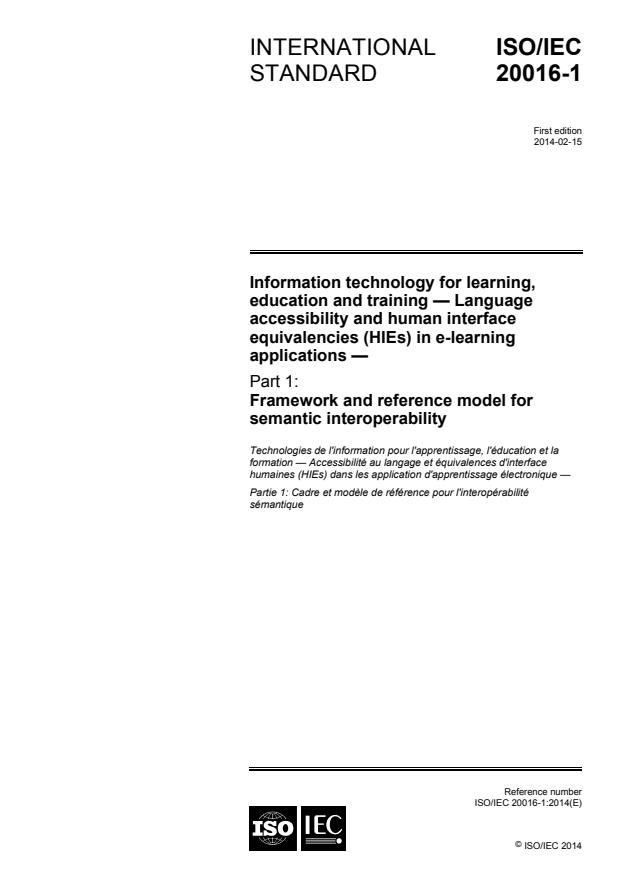
INTERNATIONAL ISO/IEC
STANDARD 20016-1
First edition
2014-02-15
Information technology for learning,
education and training — Language
accessibility and human interface
equivalencies (HIEs) in e-learning
applications —
Part 1:
Framework and reference model for
semantic interoperability
Technologies de l'information pour l'apprentissage, l'éducation et la
formation — Accessibilité au langage et équivalences d'interface
humaines (HIEs) dans les application d'apprentissage électronique —
Partie 1: Cadre et modèle de référence pour l'interopérabilité
sémantique
Reference number
©
ISO/IEC 2014
© ISO/IEC 2014
All rights reserved. Unless otherwise specified, no part of this publication may be reproduced or utilized in any form or by any means,
electronic or mechanical, including photocopying and microfilm, without permission in writing from either ISO at the address below or
ISO's member body in the country of the requester.
ISO copyright office
Case postale 56 CH-1211 Geneva 20
Tel. + 41 22 749 01 11
Fax + 41 22 749 09 47
E-mail copyright@iso.org
Web www.iso.org
Published in Switzerland
ii © ISO/IEC 2014 – All rights reserved
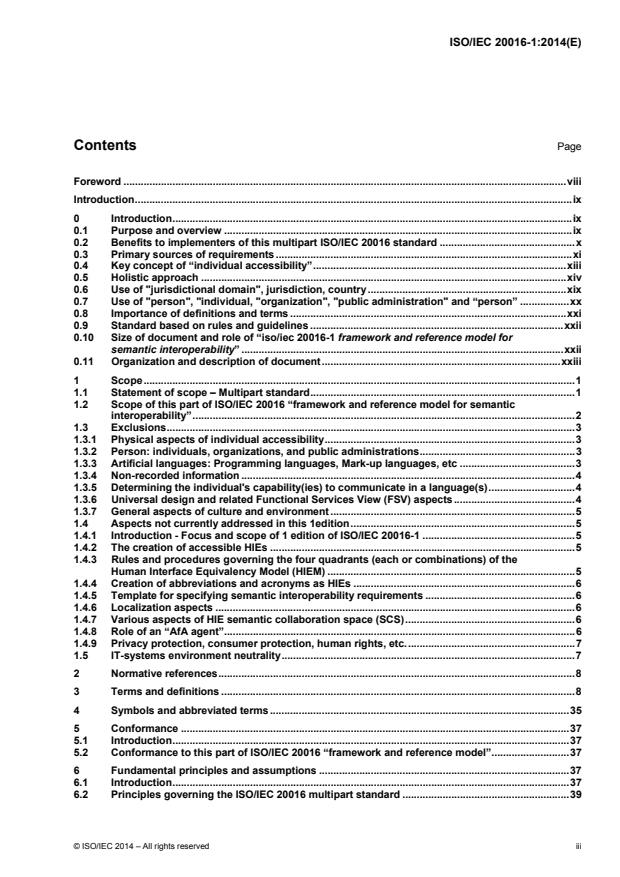
Contents Page
Foreword . viii
Introduction . ix
0 Introduction . ix
0.1 Purpose and overview . ix
0.2 Benefits to implementers of this multipart ISO/IEC 20016 standard . x
0.3 Primary sources of requirements . xi
0.4 Key concept of “individual accessibility” . xiii
0.5 Holistic approach . xiv
0.6 Use of "jurisdictional domain", jurisdiction, country . xix
0.7 Use of "person", "individual, "organization", "public administration" and “person” . xx
0.8 Importance of definitions and terms . xxi
0.9 Standard based on rules and guidelines . xxii
0.10 Size of document and role of “iso/iec 20016-1 framework and reference model for
semantic interoperability” . xxii
0.11 Organization and description of document . xxiii
1 Scope . 1
1.1 Statement of scope – Multipart standard . 1
1.2 Scope of this part of ISO/IEC 20016 “framework and reference model for semantic
interoperability” . 2
1.3 Exclusions . 3
1.3.1 Physical aspects of individual accessibility . 3
1.3.2 Person: individuals, organizations, and public administrations . 3
1.3.3 Artificial languages: Programming languages, Mark-up languages, etc . 3
1.3.4 Non-recorded information . 4
1.3.5 Determining the individual's capability(ies) to communicate in a language(s) . 4
1.3.6 Universal design and related Functional Services View (FSV) aspects . 4
1.3.7 General aspects of culture and environment . 5
1.4 Aspects not currently addressed in this 1edition . 5
1.4.1 Introduction - Focus and scope of 1 edition of ISO/IEC 20016-1 . 5
1.4.2 The creation of accessible HIEs . 5
1.4.3 Rules and procedures governing the four quadrants (each or combinations) of the
Human Interface Equivalency Model (HIEM) . 5
1.4.4 Creation of abbreviations and acronyms as HIEs . 6
1.4.5 Template for specifying semantic interoperability requirements . 6
1.4.6 Localization aspects . 6
1.4.7 Various aspects of HIE semantic collaboration space (SCS) . 6
1.4.8 Role of an “AfA agent” . 6
1.4.9 Privacy protection, consumer protection, human rights, etc. . 7
1.5 IT-systems environment neutrality . 7
2 Normative references . 8
3 Terms and definitions . 8
4 Symbols and abbreviated terms . 35
5 Conformance . 37
5.1 Introduction . 37
5.2 Conformance to this part of ISO/IEC 20016 “framework and reference model” . 37
6 Fundamental principles and assumptions . 37
6.1 Introduction . 37
6.2 Principles governing the ISO/IEC 20016 multipart standard . 39
© ISO/IEC 2014 – All rights reserved iii
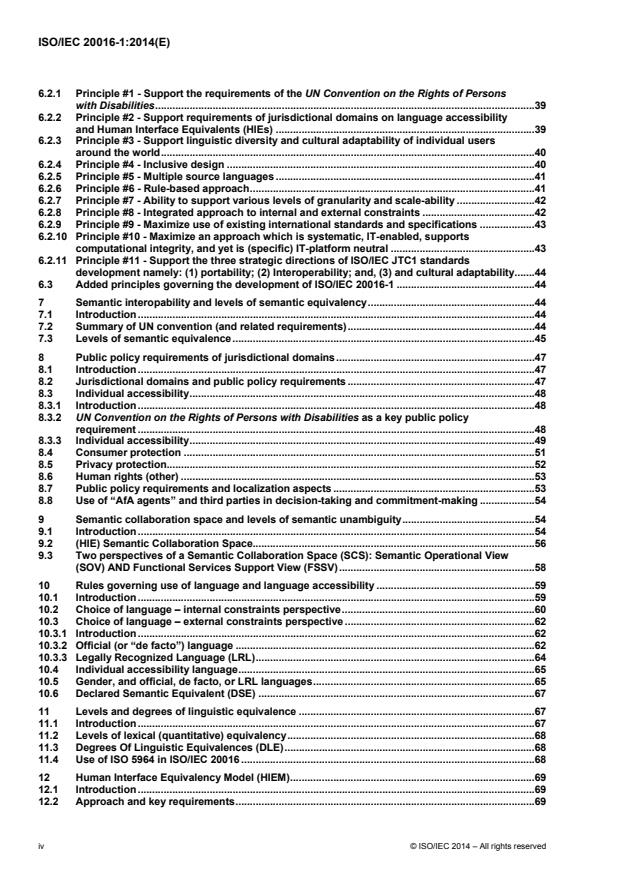
6.2.1 Principle #1 - Support the requirements of the UN Convention on the Rights of Persons
with Disabilities .39
6.2.2 Principle #2 - Support requirements of jurisdictional domains on language accessibility
and Human Interface Equivalents (HIEs) .39
6.2.3 Principle #3 - Support linguistic diversity and cultural adaptability of individual users
around the world .40
6.2.4 Principle #4 - Inclusive design .40
6.2.5 Principle #5 - Multiple source languages .41
6.2.6 Principle #6 - Rule-based approach .41
6.2.7 Principle #7 - Ability to support various levels of granularity and scale-ability .42
6.2.8 Principle #8 - Integrated approach to internal and external constraints .42
6.2.9 Principle #9 - Maximize use of existing international standards and specifications .43
6.2.10 Principle #10 - Maximize an approach which is systematic, IT-enabled, supports
computational integrity, and yet is (specific) IT-platform neutral .43
6.2.11 Principle #11 - Support the three strategic directions of ISO/IEC JTC1 standards
development namely: (1) portability; (2) Interoperability; and, (3) and cultural adaptability .44
6.3 Added principles governing the development of ISO/IEC 20016-1 .44
7 Semantic interopability and levels of semantic equivalency .44
7.1 Introduction .44
7.2 Summary of UN convention (and related requirements) .44
7.3 Levels of semantic equivalence .45
8 Public policy requirements of jurisdictional domains .47
8.1 Introduction .47
8.2 Jurisdictional domains and public policy requirements .47
8.3 Individual accessibility .48
8.3.1 Introduction .48
8.3.2 UN Convention on the Rights of Persons with Disabilities as a key public policy
requirement .48
8.3.3 Individual accessibility .49
8.4 Consumer protection .51
8.5 Privacy protection.52
8.6 Human rights (other) .53
8.7 Public policy requirements and localization aspects .53
8.8 Use of “AfA agents” and third parties in decision-taking and commitment-making .54
9 Semantic collaboration space and levels of semantic unambiguity .54
9.1 Introduction .54
9.2 (HIE) Semantic Collaboration Space.56
9.3 Two perspectives of a Semantic Collaboration Space (SCS): Semantic Operational View
(SOV) AND Functional Services Support View (FSSV) .58
10 Rules governing use of language and language accessibility .59
10.1 Introduction .59
10.2 Choice of language – internal constraints perspective .60
10.3 Choice of language – external constraints perspective .62
10.3.1 Introduction .62
10.3.2 Official (or “de facto”) language .62
10.3.3 Legally Recognized Language (LRL) .64
10.4 Individual accessibility language .65
10.5 Gender, and official, de facto, or LRL languages .65
10.6 Declared Semantic Equivalent (DSE) .67
11 Levels and degrees of linguistic equivalence .67
11.1 Introduction .67
11.2 Levels of lexical (quantitative) equivalency .68
11.3 Degrees Of Linguistic Equivalences (DLE) .68
11.4 Use of ISO 5964 in ISO/IEC 20016 .68
12 Human Interface Equivalency Model (HIEM) .69
12.1 Introduction .69
12.2 Approach and key requirements .69
iv © ISO/IEC 2014 – All rights reserved
12.3 The Human Interface Equivalency Model (HIEM) itself . 70
12.4 Role of a HIE identifier . 72
13 Template for specifying individual accessibility requirements applicable to any HIE as a
SRI . 72
13.1 Introduction to and purpose of template . 72
13.2 Template structure and content . 73
13.2.1 IT-interface needs perspective . 73
13.2.2 Human interface needs perspective . 74
13.3 General rules governing use of template. 75
13.4 Specific rules governing entries in the template . 75
13.5 Template . 75
14 Rules governing the structure, management and addition of new parts of this multipart
standard . 75
14.1 Introduction . 75
14.2 Default template for “table of contents” of parts of ISO/IEC 20016 . 75
14.3 Reserve ISO/IEC 20016-10 for a consolidated vocabulary . 77
Annex A (normative) Consolidated list of terms and definitions with cultural adaptability: ISO
English and ISO French language equivalency . 78
A.1 Introduction . 78
A.2 ISO English and ISO French . 78
A.3 Cultural adaptability and quality control . 78
A.4 Organization of ANNEX A - Consolidated list in matrix form . 79
A.5 Consolidated list of ISO/IEC 20016-1 Terms and definitions . 80
Annex B (normative) Impacts and requirements of the UN Convention on the Rights of Persons
with Disabilities on requirements for semantic interoperability for language accessibility
and Human Interface Equivalents (HIEs) . 147
B.1 Introduction and purpose . 147
B.2 Summary overview . 147
B.3 Impact of the UN Convention on Rights of Persons with Disabilities (2006) . 151
B.3.1 Objective of Clause B.3 . 151
B.3.2 Key objectives and requirements of the UN Convention impacting ISO/IEC 20016-1
Framework and Reference Model . 151
Annex C (normative) Degrees of linguistic equivalences based on ISO 5964 . 155
C.1 Introduction and context . 155
C.2 Purpose . 155
C.3 Summary of ISO 5964 Degrees Of Linguistic Equivalence (DLE) . 155
C.4 Application and use of ISO 5964 in an ISO/IEC 20016-1 context . 157
Annex D (normative) Individual Accessibility Model: (IAM) . 159
D.1 Introduction . 159
D.2 Purpose . 160
D.3 Key elements of the Individual Accessibility Model (IAM) . 160
D.3.1 Introduction . 160
D.3.2 Summary overview of Business Transaction Model (BTM) . 160
D.3.3 Three key elements of the individual accessibility model . 163
Annex E (normative) Default conventions for unambiguous identification and referencing of
codes representing jurisdictional domains (countries), languages and currencies in
support of semantic interoperability . 165
E.1 Introduction . 165
E.2 Purpose . 167
E.3 Exclusions to Annex E . 167
E.4 Current issues and approach taken . 168
E.4.1 Summary of nature of issues pertaining to interworking of codes representing countries,
languages, and currencies . 168
E.4.2 ISO 3166-1 “Country Codes" . 169
E.4.3 ISO 639-2 "Language Codes" . 170
E.4.4 ISO 4217 "Currency Codes" . 171
© ISO/IEC 2014 – All rights reserved v
E.5 Principles governing approach taken . 171
E.6 Common default conventions . 172
E.6.1 Default convention #1 for the unambiguous identification and referencing of
combinations of codes representing countries, languages and currencies in support of
semantic interoperability . 172
E.6.2 Default convention #2 for the ordering of codes representing countries, languages and
currencies . 172
E.7 Application of default convention #1 for identifying codes representing countries,
languages and currencies with default convention #2 for ordering them . 173
E.8 Examples of applying “default convention #1”” in an ITLET context . 173
Annex F (normative) Classes of constraints . 174
F.1 Introduction . 174
F.2 Purpose . 174
F.3 Constraints: internal and external . 174
Annex G (informative) Summary on issues of language equivalencies . 179
G.1 Introduction and context . 179
G.2 Purpose . 180
G.3 Summary notes on “language equivalency” . 180
G.4 Bibliography . 183
Annex H (informative) Examples of multiple Human Interface Equivalents (HIEs) for a single IT-
Interface Identifier . 185
H.1 Purpose and use of Annex H . 185
H.2 Example 1: Taken from ISO 19135:2005 (E) . 185
H.3 Example 2: Taken from ISO/IEC 5218:2004 . 187
Annex I (informative) Examples of the need for specifying gender of terms and nouns to ensure
unambiguity in the use of an official language . 190
I.1 Introduction . 190
I.2 Organization of the ANNEX I matrix . 190
I.3 Examples of the same word having two gender forms and two different meanings . 191
Annex J (informative) Case study of multilingual retrieval of HIEs for unilingual users: the
“potato” . 192
Annex K (informative) Notes on standard table of contents template for parts 2+ of ISO/IEC 20016 . 195
K.1 Introduction . 195
K.2 Notes on Clause 0 Introduction . 195
K.3 Notes on Clause 1 Scope . 195
K.4 Notes on Clause 2 Normative references . 196
K.5 Notes on Clause 4 Symbols and abbreviated terms . 196
K.6 Notes on Clause 5 Conformance . 196
K.7 Notes on Clause 6 Fundamental principles and assumptions . 196
Annex L (informative) ISO/IEC 14662 open-edi reference model, commitment exchange and
collaboration space . 197
L.1 Introduction . 197
L.2 Relevance of open-edi reference model . 198
L.3 Basic aspects of open-edi collaboration space: content provider and individual user . 199
Annex M (informative) Implementation considerations for the ISO/IEC 20016-1 Framework and
reference model . 203
M.1 Introduction . 203
M.2 Purpose . 203
M.3 Implementation considerations . 203
st
M.3.1 Application of Clause 1.4 “Aspects not currently addressed in this 1 edition” . 203
M.3.2 Implementation of individual accessibility as a human right is enforced by jurisdictional
domain requirements . 203
M.3.3 Intended use of a SRI as prepared by a content provider . 204
M.4 Example case studies as “scenarios” . 205
Annex N (informative) Contributors and acknowledgement . 208
vi © ISO/IEC 2014 – All rights reserved
Bibliography . 209
© ISO/IEC 2014 – All rights reserved vii
Foreword
ISO (the International Organization for Standardization) and IEC (the International Electrotechnical
Commission) form the specialized system for worldwide standardization. National bodies that are members of
ISO or IEC participate in the development of International Standards through technical committees
established by the respective organization to deal with particular fields of technical activity. ISO and IEC
technical committees collaborate in fields of mutual interest. Other international organizations, governmental
and non-governmental, in liaison with ISO and IEC, also take part in the work. In the field of information
technology, ISO and IEC have established a joint technical committee, ISO/IEC JTC 1.
International Standards are drafted in accordance with the rules given in the ISO/IEC Directives, Part 2.
The main task of the joint technical committee is to prepare International Standards. Draft International
Standards adopted by the joint technical committee are circulated to national bodies for voting. Publication as
an International Standard requires approval by at least 75 % of the national bodies casting a vote.
Attention is drawn to the possibility that some of the elements of this document may be the subject of patent
rights. ISO and IEC shall not be held responsible for identifying any or all such patent rights.
ISO/IEC 20016-1 was prepared by Joint Technical Committee ISO/IEC JTC 1, Information technology,
Subcommittee SC 36, Information technology for learning, education and training.
ISO/IEC 20016 consists of the following parts, under the general title Information technology for learning,
education and training — Language accessibility and human interface equivalencies (HIEs) in e-learning
applications:
Part 1: Framework and reference model for semantic interoperability
viii © ISO/IEC 2014 – All rights reserved
Introduction
0 Introduction
0.1 Purpose and overview
In an “Access for All” (AfA) approach, a key missing component in the development of ITLET standards, in
support of culture, language, and individual needs is one which focuses on the (intended) meaning and use of
the contents of the recorded information being interchanged among, on the one hand, (1) an individual as a
learner, and, on the other, (2) other Persons in an ITLET context. This requires the assurance of the
development and availability of contents, (e.g. as Human Interface Equivalents (HIEs), in any ITLET
application which support individual accessibility requirements in the form of language accessibility.
The primary purpose of this multipart standard is to ensure that “individual accessibility” rights are supported
from a “content” and semantic interoperability requirements perspective, both:
1) within the IT system(s) of an organization, and/or public administration; and,
2) Open-edi interchanges of the IT system(s) of that organization and/or public administrations with any
individual.
It is also recognized that there already exist international standards (ISO, ISO/IEC and/or ITU) which need to
be integrated and/or taken into account in the development of this Part of ISO/IEC 20016 “Framework and
Reference Model”.
Further, it is recognized that localization requirements of a cultural adaptability and multilingual requirements
nature need to be capable of being supported in this multipart standard.
In addition, this standard is based on the principle of maximizing use of applicable / relevant international
standards.
The UN Convention of the Rights of Persons with Disabilities (2006) provides a unifying basis for legal and
regulatory requirements of jurisdictional domains as external constraints pertaining to language accessibility
and the provision of human interface equivalents in support of semantic interoperability.
A primary purpose of ISO/IEC 20016-1 Framework and Reference Model is to make organizations and public
administrations aware, that where they are content providers to develop content, (e.g., as sets of recorded
information (SRIs)) for use by individuals that such SRIs meet applicable language accessibility requirements
from an individual accessibility requirements needs perspective, i.e., as applicable in that jurisdictional domain
doing so through the parallel development of required human interface equivalents for these SRIs.
As such, the development of any SRI requires the assurance of the development and availability of its
contents in any learning, education and training (LET) application in a manner that supports individual
accessibility requirements. This requires the development and preparation in a non-temporal manner of all the
HIEs (from both content and presentation perspectives) as are required in the accordance with the
requirements of individual accessibility the applicable jurisdictional domain (at whatever level) for use in a LET
context.
The language(s) used in a learning, education and training (LET) context is determined by four key factors;
namely:
1) the language of the learner (apart from the learner wanting to learn another language);
2) language of instruction (LOI);
© ISO/IEC 2014 – All rights reserved ix
3) the needs of the learner with disabilities and anyone in a disabling context (this includes providing the
semantics of the contents in the form of a Human Interface Equivalents (HIEs) and doing so in a
systematic and IT-facilitated manner) ;
4) the fact that the language of instruction (LOI), and thus the development of LET related products and
services is often governed by: (a) general rules governing the use of an official language (or de facto
language) of the jurisdictional domain in which the LET activity takes place; (b) a particular law or
regulation of a jurisdictional domain which pertains to the use of a language for LET purposes, i.e., as a
“legally recognized language (LRL)”.
Jurisdictional domains have also instituted policies or legislation that require the ability to provide access to
education in one or more languages and to do so increasingly in support of cultural diversity within a single
country as a jurisdictional domain. Examples include: (1) Gaelic and Welsh in addition to English in the UK; (2)
aboriginal and native languages in addition to English and/or French in Canada; and (3) multiple official
languages in the states of South Africa, India, Nigeria and many other countries. In addition, the EU as a
jurisdictional domain has multilingual Human Interface Equivalency requirements within itself as a single
(supra) jurisdictional domain.
This multipart standard recognizes that jurisdictional domains have also instituted policies, legislation,
regulations, etc., that require LET provides to (1) have the ability from both ICT and content semantic
perspectives to provide learning, education, and/or training in one or more languages; and, (2) to do so in
support of not only its cultural diversity but more importantly in support of any “LET language (LET-L). This
work integrates regulatory requirements from both “accessibility” and “language” requirements of jurisdictional
domains.
In addition to the three strategic directions of ISO/IEC JTC1 standards development work, i.e. (1) portability,
(2) interoperability, and, (3) cultural adaptability, this standard also adds individual accessibility requirements
(as stated in the “UN Convention on the Rights of Persons with Disabilities). {See further below Annex B} As
such, linguistic adaptability and use of language are of importance.
The ISO/IEC 20016 multipart standard, and in particular ISO/IEC 20016-1 Framework and Reference Model
for Semantic Interoperability, has been developed and structured in a manner to be able to support and
facilitate legal and regulatory requirements governing the application and use of ITLET standards and
solutions.
0.2 Benefits to implementers of this multipart ISO/IEC 20016 standard
There are several benefits from taking an integrated approach: First, this standard provides for a systematic,
cost-efficient and effective approach to the creation of robust, (re-)useable and accessible contents
components for individual users, i.e., human interface equivalents (HIEs) at any level of granularity from that
of simple (atomic) data element to that of a “book” or a law or regulation, the contents of a whole Website, etc.
Without this standards development work, it will be very difficult to achieve workable solutions to providing
language accessibility alternatives to individuals in their use of information technologies (IT) in support of
learning, education, and training (LET) as provided by organizations and public administrations.
There already exist both different forms of written representations of a language as well as in the form of symbols,
glyphs, oral, pictorial, etc. We also have other forms of recorded information of a language including audio, visual,
transforms, (e.g., Braille, etc.).
While “individual accessibility” here is a right of individuals in support of any individual being informed, provided
recorded information at a level of unambiguity to be able to support “decision-taking” and/or commitment-making”, the
more generic requirement here in support of the same among individuals, organizations and/or public administrations is
that of “semantic interoperability”.
x © ISO/IEC 2014 – All rights reserved
Second, this multipart standard will provide cost savings to those organizations and public administrations,
individual users and LET providers of LET-based products and services, (“LET providers”). In addition, it will
provide the benefits of semantic interoperability, re-usability and accessibility (access) for all (AfA). It will do so
from a multilingual requirements perspective and in support of cultural adaptability and diversity.
Third, having a common IT-facilitated approach will: (1) benefit individual users world-wide (doing so in
respect and support of cultural diversity); (b) ensure that requirements of jurisdictional domains (at whatever
level) can be supported in a very cost-effective and efficient manner; and, (2) also benefit LET providers of
LET focused products.
Fourth, essential to interoperability are elements for making e-learning accessible to all. Without this work,
solutions to providing language accessibility alternatives in the use of information technologies in support of
learning, education, training (LET): (1) will not be integrated across IT platforms and organizations; (2) will be
unnecessarily re-invented in every organization and public administration involving added large costs; (3) will
exacerbate current lack of interoperability; (4) lead to waste of potential accessibility gains for individuals
unable to identify and access e-learning systems and content in their language of use; and, (5) increase loss
of usability and re-usability gains and benefits for everyone.
The present (and potential) world of use of IT systems in support of LET is gradually establishing networks
and cooperative approaches which include multiple jurisdictional domains, implement accessibility
alternatives, etc. Here and elsewhere, there is a requirement for metadata to support the ability to specify
language accessibility and human interface equivalency in the provision of content and services. As such, this
ISO/IEC 20016 multipart standard serves to further enable this developmental process.
The concept of semantic collaboration space (SCS), introduced in Clause 7 below, with respect to language
accessibility and human interface equivalents (HIE) aspects of semantic interoperability requirements is
directed at supporting the implementation of the UN Convention on the Rights of Persons with Disabilities in
an ITLET context.
However, this multipart ISO/IEC 20016 standard, while developed in an ITLET context, like the multipart
ISO/IEC 24751 standard, has many aspects which are not ITLET specific. The ISO/IEC 24751 multipart
standard is being used by many Persons, (organizations and public administrations), for implementation in
domains which are not ITLET specific. This ISO/IEC 20016-1 Framework and Reference Model for Semantic
Interoperability standard supports a similar “Access for All” (AfA) approach.
0.3 Primary sources of requirements
The evolution of information communication technologies has created the ability to be able to support any and
all language accessibility and provide human interface equivalents (HIEs) representations for any set of
recorded information (SRI) in support of:
1) individual accessibility requirements; and,
2) to do so at whatever level of unambiguity and granularity required.
There are therefore no information or communication technology (ICT) barriers to the ability to support
individual accessibility requirements for sets of recorded information (SRIs) within the IT systems of
organizations and public administrations.
Multilingual communications (whatever the supporting IT platform used including the Internet) is already supported by
existing technologies. Many ISO/IEC and ISO standards already exist (or are under development) whose contents can
and will be used as building blocks for the integration of this new LET standard.
© ISO/IEC 2014 – All rights reserved xi
The primary source of requirements governing the development of this multipar
...
Questions, Comments and Discussion
Ask us and Technical Secretary will try to provide an answer. You can facilitate discussion about the standard in here.
Loading comments...