


ISO 13833:2013
(Main)Stationary source emissions — Determination of the ratio of biomass (biogenic) and fossil-derived carbon dioxide — Radiocarbon sampling and determination
Stationary source emissions — Determination of the ratio of biomass (biogenic) and fossil-derived carbon dioxide — Radiocarbon sampling and determination
ISO 13833:2013 specifies sampling methods and analysis methods for the determination of the ratio of biomass- and fossil-derived carbon dioxide (CO2) in the CO2 from exhaust gases of stationary sources, based on the radiocarbon (14C isotope) method. The lower limit of application is a biogenic to total CO2 fraction of 0,02. The working range is a biogenic to total CO2 fraction of 0,02 to 1,0.
Émissions de sources fixes — Détermination du rapport du dioxyde de carbone de la biomasse (biogénique) et des dérivés fossiles — Échantillonnage et détermination du radiocarbone
L'ISO 13833:2013 spécifie des méthodes d'échantillonnage et d'analyse pour la détermination du rapport du dioxyde de carbone (CO2) provenant de la biomasse et de combustibles fossiles dans le CO2 des effluents gazeux de sources fixes, d'après la méthode du radiocarbone (isotope 14C). La limite inférieure d'application est une fraction de CO2 biogénique/total de 0,02. La plage de travail est une fraction de CO2 biogénique/total de 0,02 à 1,0.
General Information
Relations
Standards Content (Sample)
INTERNATIONAL ISO
STANDARD 13833
First edition
2013-04-01
Stationary source emissions —
Determination of the ratio of biomass
(biogenic) and fossil-derived carbon
dioxide — Radiocarbon sampling and
determination
Émissions de sources fixes — Détermination du rapport du dioxyde
de carbone de la biomasse (biogénique) et des dérivés fossiles —
Échantillonnage et détermination du radiocarbone
Reference number
©
ISO 2013
© ISO 2013
All rights reserved. Unless otherwise specified, no part of this publication may be reproduced or utilized otherwise in any form
or by any means, electronic or mechanical, including photocopying, or posting on the internet or an intranet, without prior
written permission. Permission can be requested from either ISO at the address below or ISO’s member body in the country of
the requester.
ISO copyright office
Case postale 56 • CH-1211 Geneva 20
Tel. + 41 22 749 01 11
Fax + 41 22 749 09 47
E-mail copyright@iso.org
Web www.iso.org
Published in Switzerland
ii © ISO 2013 – All rights reserved
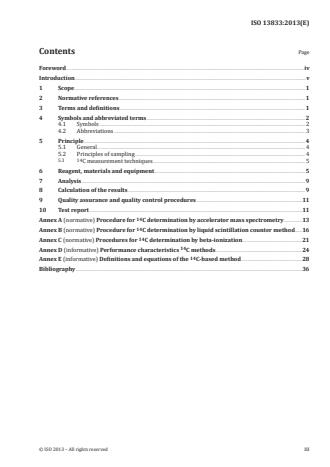
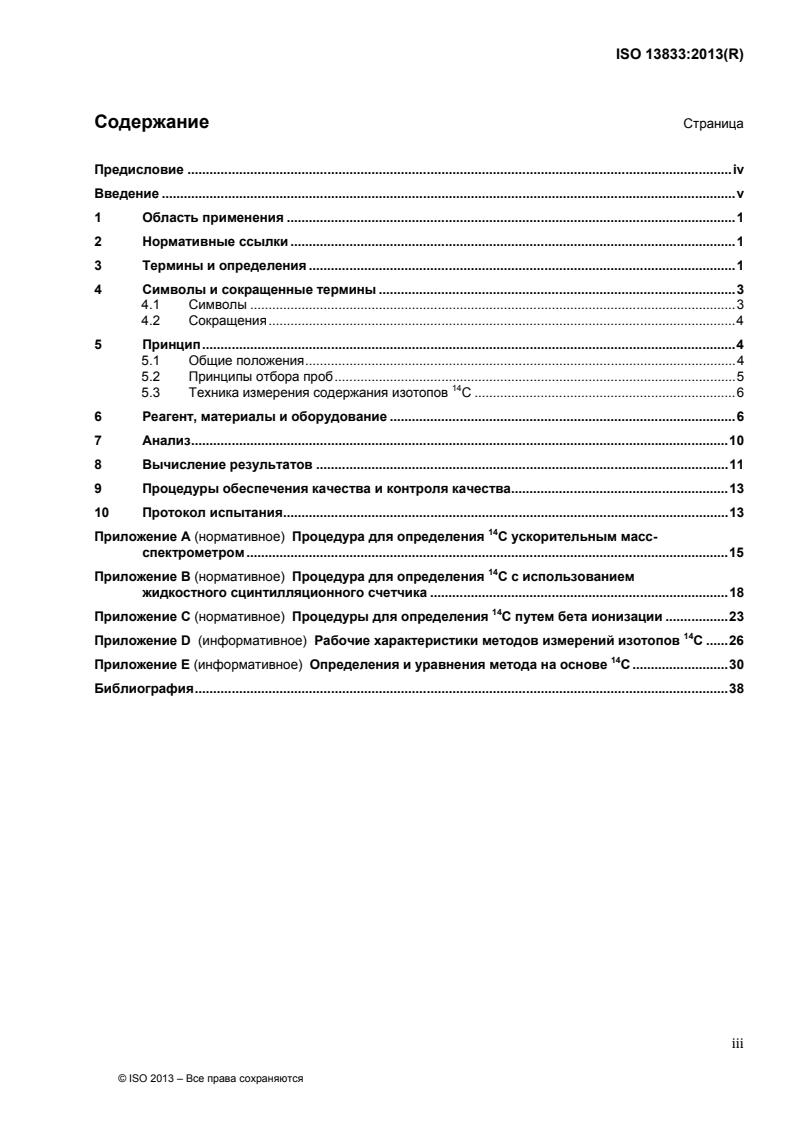
Contents Page
Foreword .iv
Introduction .v
1 Scope . 1
2 Normative references . 1
3 Terms and definitions . 1
4 Symbols and abbreviated terms . 2
4.1 Symbols . 2
4.2 Abbreviations . 3
5 Principle . 4
5.1 General . 4
5.2 Principles of sampling . 4
5.3 14
C measurement techniques. 5
6 Reagent, materials and equipment . 5
7 Analysis . 9
8 Calculation of the results . 9
9 Quality assurance and quality control procedures .11
10 Test report .11
Annex A (normative) Procedure for C determination by accelerator mass spectrometry .13
Annex B (normative) Procedure for C determination by liquid scintillation counter method .16
Annex C (normative) Procedures for C determination by beta-ionization .21
Annex D (informative) Performance characteristics C methods .24
Annex E (informative) Definitions and equations of the C-based method .28
Bibliography .36
Foreword
ISO (the International Organization for Standardization) is a worldwide federation of national standards
bodies (ISO member bodies). The work of preparing International Standards is normally carried out
through ISO technical committees. Each member body interested in a subject for which a technical
committee has been established has the right to be represented on that committee. International
organizations, governmental and non-governmental, in liaison with ISO, also take part in the work.
ISO collaborates closely with the International Electrotechnical Commission (IEC) on all matters of
electrotechnical standardization.
International Standards are drafted in accordance with the rules given in the ISO/IEC Directives, Part 2.
The main task of technical committees is to prepare International Standards. Draft International
Standards adopted by the technical committees are circulated to the member bodies for voting.
Publication as an International Standard requires approval by at least 75 % of the member bodies
casting a vote.
ISO 13833 was prepared by Technical Committee ISO/TC 146, Air quality, Subcommittee SC 1, Stationary
source emissions.
iv © ISO 2013 – All rights reserved
Introduction
Reliable data for biogenic carbon dioxide (CO ) emissions are needed for carbon emission trading and in
order to provide more accurate inventories.
When combusting mixtures of fuels from fossil and biogenic origin, it is often difficult to determine the
exact ratio of biogenic and fossil CO in the total CO that is emitted through the stack gas, because the
2 2
biogenic and fossil composition of the combusted fuels is not always known or cannot be determined
with sufficient accuracy. This is the case when solid recovered fuels (SRF) are used.
The contribution of solid, liquid, and gaseous biofuels to energy production is likely to increase. A reliable
and robust method for the determination of the ratio of fossil and biogenic CO in the total emitted CO
2 2
of stack gas will enhance the implementation of these products, as reliable data for carbon emission
trading can be generated with this approach.
Different methods exist to determine the ratio of fossil and biogenic CO in stack gas. The radiocarbon
( C isotope) method has been applied since the 1950s in a variety of sample types, like food, fuels,
polymers, and atmospheric and combustion CO to determine the ratio of biogenic and fossil carbon
(Reference [18]). Biogenic and fossil carbon can be distinguished based on the measured amount of
the C isotope in the sample. Another, relatively new applied method is the “balance method”, which
combines standard data on the chemical composition of biogenic and fossil organic matter with routinely
measured operating data of the plant (Reference [10]). Similar methods using stoichiometric methods,
for example, can also be used.
This International Standard gives sampling and analysis methods for the determination of the ratio of
biomass and fossil fuel-derived CO in the total emitted CO from exhaust gases of stationary sources,
2 2
based on the radiocarbon ( C isotope) method. Sample strategies for integrated sampling for periods
from 1 h up to 1 month are given. Radiocarbon determination procedures include accelerated mass
spectrometry (AMS), beta-ionization (BI), and liquid scintillation (LS) measurement procedures for the
determination of the radiocarbon content.
The International Organization for Standardization (ISO) draws attention to the fact that it is
claimed that compliance with this document may involve the use of patents concerning the use of the
radiocarbon isotope as biogenic marker: a) Method for determining the relationship of renewable to non-
renewable sources of energy; b) Method for determining the fossil fuel content in a fuel stream, as well as a
an incineration furnace.
ISO takes no position concerning the evidence, validity and scope of these patent rights.
The holders of these patent rights have assured ISO that they are willing to negotiate licences under
reasonable and non-discriminatory terms and conditions with applicants throughout the world. In this
respect, statements of the holders of these patent rights are registered with ISO. Information may be
obtained from:
a) European Cement Research Academy (ECRA)
Tannenstrasse 2, D-40476, DÜSSELDORF. Tel.: +49 211 23 98 38 0; E-mail: info@ecra-online.org
b) Energy Research Centre of the Netherlands
Westerduinweg 3, PO Box 1, NL-1755 ZG PETTEN. Tel.: +31 224 56 4475; E-mail: denuijl@ecn.nl
Attention is drawn to the possibility that some of the elements of this document may be the subject of
patent rights other than those identified above. ISO shall not be held responsible for identifying any or
all such patent rights.
ISO (www.iso.org/patents) maintains on-line databases of patents relevant to its documents. Users are
encouraged to consult the databases for the most up to date information concerning patents.
INTERNATIONAL STANDARD ISO 13833:2013(E)
Stationary source emissions — Determination of the ratio
of biomass (biogenic) and fossil-derived carbon dioxide —
Radiocarbon sampling and determination
1 Scope
This International Standard specifies sampling methods and analysis methods for the determination of
the ratio of biomass- and fossil-derived carbon dioxide (CO ) in the CO from exhaust gases of stationary
2 2
sources, based on the radiocarbon ( C isotope) method. The lower limit of application is a biogenic to
total CO fraction of 0,02. The working range is a biogenic to total CO fraction of 0,02 to 1,0.
2 2
2 Normative references
The following referenced documents are indispensable for the application of this document. For dated
references, only the edition cited applies. For undated references, the latest edition of the referenced
document (including any amendments) applies.
ISO 7934, Stationary source emissions — Determination of the mass concentration of sulfur dioxide —
Hydrogen peroxide/barium perchlorate/Thorin method
ISO 10396, Stationary source emissions — Sampling for the automated determination of gas emission
concentrations for permanently-installed monitoring systems
ISO 15713, Stationary source emissions — Sampling and determination of gaseous fluoride content
3 Terms and definitions
For the purposes of this document, the following terms and definitions apply.
3.1
biogenic
produced in natural processes by living organisms but not fossilized or derived from fossil resources
3.2
biomass
material of biological origin excluding material embedded in geological formation or transformed to fossil
3.3
isotope abundance
fraction of atoms of a particular isotope of an element
3.4
organic carbon
amount of carbon bound in an organic material
3.5
percentage modern carbon
pmC
normalized and standardized value for the amount of the C isotope in a sample, calculated relative to the
1)
standardized and normalized C isotope amount of oxalic acid standard reference material, SRM 4990c
Note 1 to entry: In 2009, the value of 100 % bio-based carbon was set at 105 pmC.
1) SRM 4990c is the trade name of a product supplied by the US National Institute of Standards and Technology.
3.6
proportional sampling
flow proportional sampling
technique for obtaining a sample from flowing stack gas in which the wet or dry sample flow rate is
directly proportional to the mass flow rate, volume flow rate or velocity in the stack
3.7
radiocarbon
radioactive isotope of the element carbon, C, having 8 neutrons, 6 protons, and 6 electrons
−10 14
Note 1 to entry: Of the total carbon on Earth, 1 × 10 % mass fraction is C. It decays exponentially with a half-
life of 5 730 years and as such it is not measurable in fossil materials derived from petroleum, coal, natural gas or
any other source older than about 50 000 years.
3.8
sample
quantity of material, representative of a larger quantity for which the property is to be determined
3.9
sample preparation
all the actions taken to obtain representative analyses, samples or test portions from the original sample
3.10
test portion
quantity of material drawn from the test sample (or from the laboratory sample if both are the same)
and on which the test or observation is actually carried out
3.11
beta-particle
electron or positron which has been emitted by an atomic nucleus or neutron in a nuclear transformation
[1]
[ISO 921:1997, definition 81]
4 Symbols and abbreviated terms
4.1 Symbols
A disintegrations per second
b default C content (in pmC) of 100 % biomass, produced and harvested in 2011
E counting rate
C coefficient of variation
V
E(R ) counting rate of blank
E(R ) lower limit of detection
n,LLD
i increment number
k + k coverage factor (typical value: 1,645)
1 − α 1 − β
m measured C content of the sample
m mass of CO
CO
This information is given for the convenience of users of this document and does not constitute an endorsement by
ISO of the product named. Equivalent products may be used if they can be shown to lead to the same results.
2 © ISO 2013 – All rights reserved
M 44,01 kg/kmole
CO
n number of increments
r biogenic CO to total CO ratio derived from the measured pmC value
2 2
t operating time
t counting time of sample
b
t counting time of blank
V total amount of stack gas emitted
V volume of CO
CO
V actual stack gas flow at moment i
i
V 22,41 m /kmol (at 273 K and 1 013 hPa)
m
−
β beta-particle (electron emitted during radioactive decay)
ϕ average concentration of CO
CO
ϕ actual concentration of CO
CO ,i
η counting efficiency of the apparatus (0 < η < 1)
4.2 Abbreviations
AMS accelerator mass spectrometer; accelerator mass spectrometry
BI beta-ionization measurement, gas proportional counter, proportional gas counter
cpm counts per minute
cps counts per second
dpm disintegrations per minute
dps disintegrations per second, equivalent to becquerel
GM Geiger–Müller
LLD lower limit of detection
LSC liquid scintillation counter; liquid scintillation counting
pmC percentage modern carbon
SRF solid recovered fuel
5 Principle
5.1 General
The measurement of the presence of the C isotope in flue gas or stack gas enables the determination
of the biogenic and fossil fractions of the CO that is emitted. The determination of the biogenic CO
2 2
fraction in flue gas or stack gas consists of:
— representative sampling of CO ;
— measurement of the sampled C;
— calculation of the biogenic CO fraction in the stack gas emitted during the sampling period.
Procedures for collection of whole gas samples and absorption of CO in liquid and solid alkaline media
are given. Three C determination procedures that can be used are described. The biogenic fraction
is determined using the measured C value. From the calculated biogenic CO fraction, the emitted
amount of biogenic and fossil CO can be calculated. Examples are given.
5.2 Principles of sampling
5.2.1 General
Sampling of CO in stack gas is in principle not different from sampling of other acid gaseous substances
like sulfur dioxide (SO ) or hydrogen chloride (HCl). The CO present in a representative stack gas sample
2 2
is absorbed in an alkaline medium or transferred to a gas bag or lecture bottle and after sampling the
collected CO is prepared for C analysis.
Standard equipment as used for other gaseous components may be utilized. As CO is present in relatively
high concentrations compared to other acidic gaseous substances, the capacity of the absorption media
used requires consideration, an excess of alkaline media shall be used to ensure complete absorption
during the sampling period.
Sampling shall be carried out in accordance with applicable standards.
NOTE Sampling and sampling strategies for continuous and intermittent measurements of stationary source
[4]
emissions are specified, for example, in ISO 10396 and EN 15259. Unlike other species where a concentration is
determined, for biogenic CO a ratio of biogenic CO to the total is determined. Many uncertainties that occur if a
2 2
concentration is actually measured can be excluded if an amount of a component with exactly the same chemical
behaviour as the various CO isotopes is determined instead. Some uncertainties specific for spectroscopic
measurement can, however, affect the preferred CO analyser for flow proportional sampling.
5.2.2 Grab gas samples
If applicable, use accepted procedures for the collection of gas in gas bags, canisters or gas bottles.
Only gas bags impenetrable to CO shall be used. Most aluminium-lined gas bags are suitable.
5.2.3 Absorption samples
When liquid or solid absorbers are used, the CO is collected in a medium containing alkaline reagents.
For sampling with liquids, alkaline solutions of, for example, 2 mol/l to 4 mol/l potassium hydroxide
(KOH) or equivalent (sodium hydroxide, NaOH) are suitable. For solid CO absorbers, commercial
products are suitable.
After collection of the samples, close the absorbers and ensure that they are gastight, in order to prevent
the ingress of atmospheric CO .
4 © ISO 2013 – All rights reserved
5.3 14
C measurement techniques
The C content of the collected samples can be determined using:
— accelerator mass spectrometry (AMS);
— beta-ionization (BI) measurement (gas proportional counter);
— the liquid scintillation counting technique (LSC).
All sampling methods mentioned in 5.2 are suitable for the collection of CO .
Depending on the C analysis technique different amounts of sampled CO are required. For AMS
measurements the minimum volume of CO is 4 ml. For BI measurements, 2 l to 10 l CO are required.
2 2
For LSC measurements, the required amount of CO depends on the way the sample is prepared for
measurement, but at least a few grams are necessary.
6 Reagent, materials and equipment
During the analysis, unless otherwise stated, use only reagents of recognized analytical grade and
distilled or demineralized water or water of equivalent purity containing negligible amounts of
carbonate, i.e. at concentrations that do not contribute significantly to the determinations.
6.1 Reagent. A setup consisting of:
— glass bottle (standard glass sample bottle with plastic screw cap resistant to the alkaline medium used);
— alkaline absorption medium;
2)
— solid absorber suitable for the collection of CO .
Mixing of water and NaOH or KOH should be done under the addition of inert gas, in order to reduce
absorption of CO from ambient air and exhalation.
For the preparation of a carbonate-free absorption liquid, preparation using freshly opened NaOH or
KOH pellet containers is sufficient. Dissolve the NaOH or KOH pellets in a small amount of water (the
heat produced enhances dissolution). Small amounts of precipitation are an indication of the presence
of sodium carbonate (Na CO ). By decanting the clear phase, the almost carbonate-free solution can be
2 3
diluted to the desired volume. As NaOH dissolution is an exothermic process, take extra care as boiling
of the concentrated solution during dilution can occur.
6.2 Materials and equipment. The components in the sampling device are listed in the following.
— Stack gas flow measurement device (typically based on S-type, P-type or L-type Pitot tube) according
[2]
to ISO 10780.
NOTE 1 Under “steady-state” conditions, the stack gas flow can be calculated from the fuel consumption. If this
is done, no instrumentation for stack gas flow determination is needed.
— Standard equipment for sampling stack gas for main component analysis.
NOTE 2 If a conditioning system for gas analysis is already present, this needs to be taken into consideration in
the sampling plan and part of the conditioned gas used, e.g. using a T-piece somewhere in the sampling line. In these
standard gas conditioning devices, usually a typical gas flow of 60 l/h to 100 l/h is available after conditioning,
— Mass flow controller, externally adjustable. An external adjustable mass flow controller is needed
only for proportional sampling as it is necessary to use the signal obtained from the measurement
of the total flow in the duct to adjust the sampling flow linearly proportionally to it. Use mass flow
2) Ascarite II is an example of a suitable product available commercially. This information is given for the
convenience of users of this document and does not constitute an endorsement by ISO of this product.
controllers in the range of e.g. 0,1 ml/min . 1 ml/min or 10 ml/min . 100 ml/min, tuned for stack
gas composition.
— Sample containers.
— Gas sampling: use air tight vessels, compatible with the system design, which includes flexible
bags, evacuated canisters, lecture gas bottles.
— Liquid sampling: use accepted gas wash bottles (e.g. 250 ml glass wash bottles).
— Solid sampling: use air tight container (e.g. glass tube, length by diameter: 200 mm × 18 mm,
with standard fitting).
— Gas analysis system for CO and O measurement.
2 2
[3]
Perform any CO , CO, or O measurements required according to ISO 12039.
2 2
Before measurement, the homogeneity of the stack gas shall be tested. Perform homogeneity testing
in accordance with ISO 10396. Use the CO concentration as measurand. If homogeneity testing is
successful, sampling can be done on a single point.
Comprehensive measurement planning shall be performed before sampling, taking into consideration
the specific measurement task.
If stack gas pre-sample and analysis equipment is already present, part of this gas sampling stream can
be used to collect the sample. If that is not the case, a probe suitable for gas sampling, equipped with an
in-stack or out of stack filter for removal of particulate matter shall be used, and provisions shall be made
for excess water removal. To ensure representative sampling and to ensure the equivalence between the
measured total CO concentration and the CO sampled for the C analysis, accepted standards for the
2 2
[4]
measurement of bulk components in stack gas, namely ISO 10396 or EN 15259, shall be used.
There are several methods for intermediate storage of the collected CO . The simplest solution is the
use of a gasbag. If long storage periods are expected, the use of aluminium-lined gas bags is preferred
to prevent the ingress of CO from ambient air. Proper blank procedures shall ensure that suitable gas
bags were used.
When more CO has to be collected, a gas cylinder can be used for storage. Standard canisters can be
used for this purpose. Provisions shall be made for controlled intake of stack gas independent of pressure
build-up during the sampling process.
As CO in stack gas can be trapped with 100 % efficiency using alkaline media, collection of the emitted
CO can be done using a wash bottle filled with alkaline solution or a suitable solid alkaline scrubber, as
long as excess absorption capacity is present and the sample flow does not exceed the flow that is typical
for the type of scrubber used.
Typical values for liquid sampling are: 250 ml wash bottle filled with 200 ml 2 mol/l KOH solution,
sampling flow 1 ml/min to 50 ml/min, corresponding to sampling periods in the range of 1 day
(50 ml/min) to 1 month (1 ml/min) for flue gas with ~10 % volume fraction CO .
2)
Typical values for solid sampling are: glass tube (200 × 18 mm) packed with 40 g Ascarite II® absorbent
(~8 mesh to ~20 mesh), sampling flow 1 ml/min to 50 ml/min, corresponding to sampling periods in the
range of 1 day (50 ml/min) to 1 month (1 ml/min) for flue gas with ~10 % volume fraction CO .
If standard gas analysis probes and pre-sample systems are present, part of the conditioned gas can be
used for CO sampling. The standard gas analysis can be combined with simultaneous sampling of CO
2 2
as long as this sampling does not affect the standard gas analysis (consider the required sample flow
and the risk of leakage).
If the required measurements concern a steady-state situation, a sampling setup as shown in Figure 1
or equivalent may be used.
6 © ISO 2013 – All rights reserved
Key
1 flue gas 9 sampling pump
2 probe 10 bypass valve
3 heater 11 to analyser(s)
4 primary filter 12 manifold
5 heated sample line 13 flow meter (optional)
6 dehumidifier unit 14 exhaust
7 water discharge 15 mass flow controller
8 secondary filter 16 CO
absorber (LS)
Figure 1 — Example of sampling train for steady-state measurements
If the stack gas flow rate of the installation is expected to be fluctuating, then an assessment of that
influence will have to be made and if a significant contribution from fluctuation is foreseen, a sampling
setup as shown in Figure 2 or equivalent may be used. Guidelines of how to prepare a sampling plan are
[4]
available (see EN 15259 ).
In practice, overall changes in stack gas flow rates not exceeding a coefficient of variation (2C ) of 55 % can
V
be considered as a condition for constant sampling, assuming continuous operation in the sampling period.
Use the readings from the flow rate indicator (e.g. pressure differential, steam rate, fuel rate) to calculate
the mean (μ) and standard deviation (s).
[7]
NOTE The 55 % (2C ) specification is in accordance with ASTM 7459.
v
Key
1 flue gas 10 bypass valve
2 probe 11 to analyser(s)
3 heater 12 manifold
4 primary filter 13 flow meter (optional)
5 heated sample line 14 exhaust
6 dehumidifier unit 15 mass flow controller
7 water discharge 16 CO absorber (LS)
8 secondary filter 17 velocity measurement
9 sampling pump 18 flow rate meter
Figure 2 — Example of sampling train for proportional sampling
If proportional sampling is required, the flow rate of the mass flow controller shall be proportional to
the measured flue gas velocity, volume flow or mass flow.
In the sampling plan, an assessment of the minimum number of increments (sampling rate) needed for
effective proportional sampling shall be made.
6.3 Minimum requirements for sampling equipment
In order to be able to obtain the performance characteristics as given in this International Standard, the
following requirements shall be met:
— external adjustable mass flow controller: accuracy at least 5 % of reading;
— solid adsorber: containing more than 90 % mass fraction NaOH;
— liquid adsorber: concentration more than 1 mol/l NaOH;
— capacity left after sampling: more than 25 % of the total capacity of the adsorber.
NOTE Instead of NaOH, other strong bases like KOH can be used.
8 © ISO 2013 – All rights reserved
6.4 Interferents
Consider the possible interferents listed in the following.
— Several acidic substances (e.g NO , SO , HCl, RCOOH) may be present in the flue gas and may be
x x
captured by alkaline samplers. Care shall be taken to avoid potential interference from such
substances; see description of the particular analysis methods (in Annex B and C).
— CO concentrations well above 0,1 % volume fraction in the stack gas (e.g. pyrolysis plants), might
contribute to the measured pmC value in CO .
— Take into account the presence of CO in the combustion air (0,04 % volume fraction if ambient air
[4] 14
is used as combustion air) when the biogenic CO fraction is <0,1 (see EN 15259 ). The C value
(in pmC) of the ambient air depends on the location of the sampling site and on the time of sampling
(specific year and time of year).
7 Analysis
The methods for the determination of the carbon dioxide content derived from biomass specified in this
International Standard are based on the determination of the C content.
The measurement of the C content of the sample shall be done according to one of the methods in
Annexes A, B or C. The performance characteristics of the three techniques are different, the typical
analytical error (expressed as standard deviation) for AMS and proportional gas counting is 0,1 pmC to
0,5 pmC, the typical analytical error for LSC with benzene synthesis is 0,3 pmC to 2 pmC and the typical
analytical error for LSC with CO absorption is 20 pmC, which can be improved to 2 pmC to 4 pmC under
strict laboratory controlled conditions and using high-precision LSC instrumentation.
The results of the measurements shall be expressed as the percentage modern carbon (pmC).
When the collected samples are sent to specialized laboratories, the samples should be stored in a way
that no CO from ambient air can enter the absorption solution. A check on the ingress of CO from air
2 2
shall be performed by preparing laboratory and field blanks during the sampling stage.
8 Calculation of the results
Calculate the ratio of biogenic CO in the total CO of a sample from the measured C content and a
2 2
reference C value for 100 % biogenic CO using Formula (1):
m
r= (1)
b
where
r is the biogenic CO to total CO ratio derived from the measured pmC value;
2 2
m is the measured C content of the sample (in pmC) (as determined according to Annex A, B or
C);
b is the default C content (in pmC) of 100 % biomass, produced and harvested in 2011.
NOTE 1 In 2011, a consensus outdoor air CO value of 104 was used by radiocarbon laboratories. Therefore the
pmC value for 100 % biomass, grown and harvested in 2011 is set at 104 pmC. An annual decrease of 0,3 % can be
taken into account.
NOTE 2 For municipal waste or other mixed fuel streams, typical regional values are reported in studies on local
reference pmC values. These values can be used as local reference value if generally accepted evidence is provided.
NOTE 3 See Annex E for detailed information about the definition of pmC and discussion on the used
reference value.
EXAMPLE A C value of 40 pmC is measured in the CO sample. Then the percentage biogenic CO in the CO
2 2 2
sample is (40/104) × 100 = 38 % and the fossil CO fraction is 100 % − 38 % = 62 %
The total amount of biogenic CO emitted in the sampling period can be derived from the measured total
CO concentration, the total stack gas amount emitted and the calculated biogenic CO fraction.
2 2
For steady-state sampling conditions, use Formula (2)
ϕ
CO
V = Vr (2)
CO
where
is the total amount of biogenic CO emitted in m ;
V 2
CO
ϕ is the average concentration of CO expressed as a % volume fraction;
CO
V is the total amount of stack gas emitted in m ;
r is the biogenic CO to total CO ratio derived from the measured pmC value.
2 2
If no CO measurements are available, the total amount of emitted CO can be derived from the amount
2 2
of fuel that was combusted during the sampling period taking in account the carbon content of that fuel.
For proportional sampling conditions use Formula (3).
n
r
VV= ϕ 100×n ××t (3)
CO CO ,ii
∑
i
where
is the total amount of biogenic CO emitted in m ;
V
CO
ϕ is the actual CO concentration at moment i expressed as a % volume fraction;
CO ,i
V is the actual stack gas flow at moment i in m /h;
i
r is the calculated biogenic CO fraction of the sample CO expressed as a %;
2 2
n is the number of increments;
i is the increment number;
t is the operating time in hours.
10 © ISO 2013 – All rights reserved
Calculate m from V using Formula (4):
CO CO
2 2
VM
CO CO
2 2
m =× (4)
CO
1000 V
m
where
is the mass of CO in tonnes;
m
CO
V is the volume of CO in m ;
CO
M is the molar mass of CO , i.e. 44,01 kg/kmol;
CO
V is the molar volume of a gas at 273 K and 1 013 hPa, i.e. 22,41 m /kmol.
m
Water can be removed before collection in the bag or container using a condensation unit, in which case
consider the necessity of corrections to Formulae (1) to (4) for concentration changes resulting from
this water removal.
9 Quality assurance and quality control procedures
The collection of the carbonate from the stack gas is in principle in line with the collection of other
gases like HF, SO , and NH using wash bottles, therefore the quality assurance and control procedures
2 3
specified in ISO 7934 and ISO 15713 shall be used.
When liquid or solid CO absorbers are used, blank samples shall be measured to confirm the absence of
ingress of CO from ambient air.
For proportional sampling, the total amount of CO collected shall be verified by standard chemical
analysis (e.g. titration) of a test portion.
The values obtained can be compared with values calculated from the fuel composition (if available).
Performance characteristics are given in Annex D.
10 Test report
The test report shall be in accordance with international or national regulations. If not specified
otherwise, the test report shall include at least the following information:
a) reference to this International Standard (ISO 13833:2013);
b) description of the purpose of tests;
c) principle of gas sampling;
d) information about the sampling and conditioning line;
e) identification of the analysis technique used;
f) description of plant and process;
g) identification the sampling plane;
h) actions taken to achieve representative samples;
i) description of the location of the sampling point(s) in the sampling plane;
j) description of the operating conditions of the plant process;
k) changes in the plant operations during sampling;
l) sampling date, time and duration;
m) time averaging on relevant periods;
n) measurement uncertainty;
o) any deviations from this International Standard.
12 © ISO 2013 – All rights reserved
Annex A
(normative)
Procedure for C determination by accelerator mass spectrometry
A.1 General
This annex specifies the procedure for the determination of the C content by accelerator mass
spectrometry (AMS) in the CO and exhaust gas samples collected at stationary sources.
A.2 Principle
The AMS method determines the presence of the C isotope directly. The atoms in the sample are converted
into a beam of ions. The ions formed are accelerated in an electric field, deflected in a magnetic field, and
detected in ion detectors, resulting in the determination of the relative isotope abundances of these ions.
AMS uses a high potential electrostatic field, which serves not only to accelerate but also to specifically
n+
form only C ions (n = 1 . 4) that are allowed into the spectrometer, excluding all other ionic species.
This greatly enhances sensitivity without compromising selectivity. In most AMS systems, the C is
currently determined from graphite (carbon) sample targets. To obtain graphite sample targets, it is
necessary to convert the CO in each sample into graphite before analysing.
With AMS the amount of C atoms is measured relative to the amount of (one of) the more abundant
12 13 14 12 14 13
carbon isotopes C and/or C. This measured C/ C or C/ C ratio is calculated relative to the
measured isotope ratio in a reference material with standardized C amount, to obtain standardized
and normalized C content (in pmC) for each sample.
A.3 Reagents and materials
Use only reagents of recognized analytical grade.
A.3.1 Catalyst (iron, copper).
A.3.2 Reducing reagents, hydrogen or Zn powder.
1)
A.3.3 Oxalic acid primary standard, e.g. SRM 4990c.
A.3.4 Acid solution, extra pure; containing no carbon.
A.3.5 Liquid nitrogen.
A.4 Apparatus
Usual laboratory equipment and in particular the following.
A.4.1 Sample preparation equipment.
A.4.2 Liquid nitrogen trap.
A.4.3 Accelerator mass spectrometer.
A.5 Procedure
A.5.1 Transfer the carbonate solution to the extraction bottle.
A.5.2 Attach the acid solution dosing device.
A.5.3 Evacuate the bottle and dosing device (degassing, removal of dissolved N and O from air).
2 2
A.5.4 Add acid solution to the carbonate solution.
A.5.5 Remove water vapour by using a trap filled with acetone and dry ice.
A.5.6 Collect the CO formed in a trap that is submersed in liquid N (A.4.2).
2 2
A.5.7 Transfer the CO to the graphitizing rig system.
A.5.8 When the samples are collected in gas bags, follow the same procedure, but start at A.5.5. Alternatively,
gas samples might be analysed with an AMS (A.4.3) with a direct gas inlet and a gas-capable ion source.
Gaseous samples can be either introduced into the system by release from a quartz tube or after they
have been trapped in liquid nitrogen followed by subsequent heating. Then convert (A.3.2) the gas to
graphite using an iron or copper catalyst (A.3.1) according to the equations:
CO + H ⇌ H O + CO
2 2 2
(A.1)
CO + H ⇌ H O + C
2 2
(A.2)
NOTE Alternatively, a Zn-based reduction process can be used, provided that its accuracy and precision are
controlled by reference measurements.
A.5.9 Ensure a complete reduction to graphite to avoid fractionation (e.g. water removal, controlling
the reaction pressures).
A.5.10 Press the graphite into a target and mount it on a wheel before it is loaded into the AMS (A.4.3). In
+
the ion source a high current beam of cesium ions (Cs ) is focused on the target. This liberates negatively
−
charged target atoms, producing a beam of C ions. Targets are kept 10 mm away from each other to avoid
cross-contamination and moved during sputtering to avoid cratering, which causes fractionation. The
negative ion beam is then focused by a lens into a recombinator. Here a series of magnets remove non-
12 13 14
carbon ions from the beam and separate the three carbon isotopes ( C, C and C). The chopper wheel
then physically blocks most of the C, allowing a much reduced beam of carbon ions to be recombined
for simultaneous injection into the accelerator.
−
A.5.11 In the tandem accelerator the C ions are accelerated to the terminal, then changed to multiply-
charged ions in the gas stripper. These positive ions are accelerated to higher velocities to allow for
accurate separation in the high-energy mass spectrometer.
12 13
A.5.12 Measure the C and C in the Faraday cups (typical current, 250 nA).
A.5.13 Purify the C ions by an electromagnetic mass analyser and detect the ions by either a gas-filled
or a solid state detector. The detector may need separation from the accelerator vacuum by a thin foil.
14 © ISO 2013 – All rights reserved
A.6 Calculation of the results
14 12 14 13 13 12
The isotopic ratios of C/ C or C/ C and C/ C are determined relative to the appropriate primary
reference material (see Annex E). All pmC values obtained from the radiocarbon analysis measurements
shall be corrected for isotopic fractionation using stable isotope data ( δ-values, based on measured
13 12
C/ C ratios).
Calculate the C amount of each sample in pmC, according to the standardization procedure for the
AMS measurement described in E.4.2.2.
Annex B
(normative)
Procedure for C determination by liquid scintillation counter
method
B.1 General
This annex specifies the procedure for C determination by LSC in CO and exhaust gas samples
collected from a stationary source.
B.2 Principle
LSC determines the isotope abundance of C indirectly, through its emission of beta-particles due to
the radioactive decay of the C isotope. The beta-particles are observed through their interaction with
a scintillator.
There are two methods that can be used for the preparation of the collected CO for activity measurement.
— The CO extracted from the flue gas is converted to benzene. This benzene is mixed with an organic
solution containing a scintillator.
— The CO extracted from the flue gas is trapped in an amine solution thus forming carbamates. This
solution is mixed with the organic solution containing the scintillation reagent.
The C activity of the mixture is measured in a liquid scintillation counter in Bq. This measured activity
of the sample is calculated relative to the known C activity of a standard reference material to obtain
standardized and normalized C content (in pmC) for each sample.
B.3 Reagents and materials
Use only reagents of recognized analytical grade and distilled or demineralized water or water of
equivalent purity
B.3.1 General
1)
B.3.1.1 Oxalic acid primary standard, e.g. SRM 4990c.
B.3.1.2 HCl solution, 5 mol/l, or H SO solution, 4 mol/l.
2 4
B.3.1.3 Dry ice.
B.3.1.4 Scintillation cocktail.
3)
B.3.1.5 Amine-based trapping solution, e.g. 3-methoxypropylamine in ethanolamine or Carbo-Sorb E® .
B.3.1.6 C-labelled spike solutions for standard addition purposes.
3) Carbo-Sorb E is an example of a suitable product available commercially. This information is given for the
convenience of users of this document and does not constitute an endorsement by ISO of this product.
16 © ISO 2013 – All rights reserved
B.3.2 Benzene method
B.3.2.1 Metallic lithium.
B.3.2.2 Concentrated phosphoric acid.
B.3.2.3 Chromium or vanadium catalyst.
B.3.2.4 Liquid nitrogen.
B.4 Apparatus
−10
The extremely low levels of radiocarbon even in biomass (in the Earth’s atmosphere about 1 × 10 %
mass fraction) requires extra precautions for accurate measurement of C.
Care should be taken to eliminate the influence of cosmic and environmental background radiation,
other radioisotopes being present, electronic noise and instability, and other factors. These background
factors limit the accuracy, precision.
Therefore, quality of liquid scintillation counting equipment, and the proper operation of it, is crucial to
be able to meet the desired specifications.
B.5 Procedure
B.5.1 General
The best performance characteristics are obtained when conversion of the collected CO to benzene
and direct counting of the benzene in a suitable scintillation cocktail (B.3.1.4), e.g.
...
NORME ISO
INTERNATIONALE 13833
Première édition
2013-04-01
Émissions de sources fixes —
Détermination du rapport du
dioxyde de carbone de la biomasse
(biogénique) et des dérivés
fossiles — Échantillonnage et
détermination du radiocarbone
Stationary source emissions — Determination of the ratio of biomass
(biogenic) and fossil-derived carbon dioxide — Radiocarbon sampling
and determination
Numéro de référence
©
ISO 2013
DOCUMENT PROTÉGÉ PAR COPYRIGHT
© ISO 2013
Droits de reproduction réservés. Sauf indication contraire, aucune partie de cette publication ne peut être reproduite ni utilisée
sous quelque forme que ce soit et par aucun procédé, électronique ou mécanique, y compris la photocopie, l’affichage sur
l’internet ou sur un Intranet, sans autorisation écrite préalable. Les demandes d’autorisation peuvent être adressées à l’ISO à
l’adresse ci-après ou au comité membre de l’ISO dans le pays du demandeur.
ISO copyright office
Case postale 56 • CH-1211 Geneva 20
Tel. + 41 22 749 01 11
Fax + 41 22 749 09 47
E-mail copyright@iso.org
Web www.iso.org
Publié en Suisse
ii © ISO 2013 – Tous droits réservés
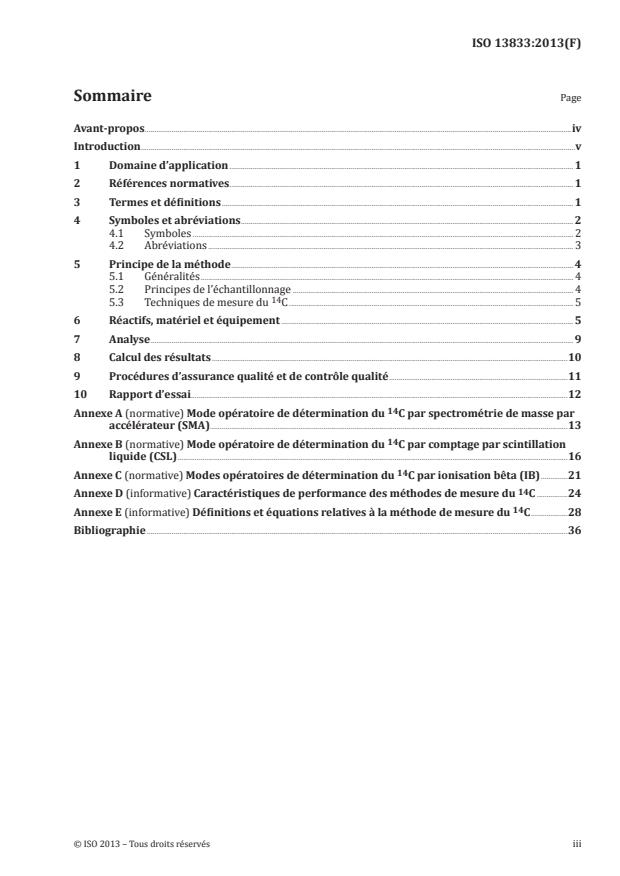
Sommaire Page
Avant-propos .iv
Introduction .v
1 Domaine d’application . 1
2 Références normatives . 1
3 Termes et définitions . 1
4 Symboles et abréviations . 2
4.1 Symboles . 2
4.2 Abréviations . 3
5 Principe de la méthode . 4
5.1 Généralités . 4
5.2 Principes de l’échantillonnage . 4
5.3 Techniques de mesure du C . 5
6 Réactifs, matériel et équipement . 5
7 Analyse . 9
8 Calcul des résultats .10
9 Procédures d’assurance qualité et de contrôle qualité .11
10 Rapport d’essai .12
Annexe A (normative) Mode opératoire de détermination du C par spectrométrie de masse par
accélérateur (SMA) .13
Annexe B (normative) Mode opératoire de détermination du C par comptage par scintillation
liquide (CSL) .16
Annexe C (normative) Modes opératoires de détermination du C par ionisation bêta (IB) .21
Annexe D (informative) Caractéristiques de performance des méthodes de mesure du C .24
Annexe E (informative) Définitions et équations relatives à la méthode de mesure du C .28
Bibliographie .36
Avant-propos
L’ISO (Organisation internationale de normalisation) est une fédération mondiale d’organismes
nationaux de normalisation (comités membres de l’ISO). L’élaboration des Normes internationales est
en général confiée aux comités techniques de l’ISO. Chaque comité membre intéressé par une étude
a le droit de faire partie du comité technique créé à cet effet. Les organisations internationales,
gouvernementales et non gouvernementales, en liaison avec l’ISO participent également aux travaux.
L’ISO collabore étroitement avec la Commission électrotechnique internationale (CEI) en ce qui concerne
la normalisation électrotechnique.
Les Normes internationales sont rédigées conformément aux règles données dans les Directives
ISO/CEI, Partie 2.
La tâche principale des comités techniques est d’élaborer les Normes internationales. Les projets de
Normes internationales adoptés par les comités techniques sont soumis aux comités membres pour vote.
Leur publication comme Normes internationales requiert l’approbation de 75 % au moins des comités
membres votants.
L’ISO 13833 a été élaborée par le comité technique ISO/TC 146, Qualité de l’air, sous-comité SC 1, Émissions
de sources fixes.
iv © ISO 2013 – Tous droits réservés
Introduction
Des données fiables relatives à l’émission de dioxyde de carbone (CO ) biogénique sont nécessaires à
l’échange de droits d’émissions de carbone ainsi que pour fournir des inventaires plus précis.
Lors de la combustion de mélanges de combustibles d’origine fossile et biogénique, il est souvent
difficile de déterminer le rapport exact de CO biogénique et fossile dans le CO total qui est émis dans
2 2
le gaz émis à la cheminée, car la composition biogénique et fossile des combustibles consumés n’est pas
toujours connue ou ne peut pas être déterminée avec une précision suffisante. C’est le cas lorsque des
combustibles solides de récupération (CSR) sont utilisés.
La contribution des biocombustibles solides, liquides et gazeux à la production d’énergie est appelée à
augmenter. Une méthode fiable et robuste pour déterminer le rapport du CO fossile et biogénique dans
le CO total émis du gaz émis à la cheminée facilite la mise en œuvre de ces produits car cette approche
permet de produire des données fiables concernant l’échange de droits d’émissions de carbone.
Différentes méthodes permettent de déterminer le rapport du CO fossile et biogénique dans le gaz émis à
la cheminée. La méthode du radiocarbone (isotope C) est appliquée depuis les années 50 dans plusieurs
types d’échantillons, notamment les aliments, les combustibles, les polymères et le CO atmosphérique et
de combustion pour déterminer le rapport du carbone biogénique et fossile (Référence [18]). Le carbone
biogénique et le carbone fossile peuvent être différenciés d’après la quantité mesurée de l’isotope C
dans l’échantillon. Une autre méthode, relativement nouvelle, est la «méthode de la balance», qui combine
les données normalisées sur la composition chimique de la matière organique biogénique et fossile et
les données de fonctionnement mesurées en routine de l’installation (Référence [10]). Des méthodes
similaires, utilisant par exemple des proportions stœchiométriques, peuvent également être utilisées.
La présente Norme internationale décrit des méthodes d’échantillonnage et d’analyse pour la
détermination du rapport du CO provenant de la biomasse et de combustibles fossiles dans le CO
2 2
total émis des effluents gazeux de sources fixes, d’après la méthode du radiocarbone (isotope C). Des
stratégies d’échantillonnage pour l’échantillonnage intégré sur des périodes allant d’1 h à 1 mois sont
données. Des modes opératoires de détermination du radiocarbone comprendront les modes opératoires
de mesure par spectrométrie de masse par accélérateur (SMA), ionisation bêta (IB) et scintillation
liquide (SL) pour la détermination de la teneur en radiocarbone.
L’Organisation internationale de normalisation (ISO) attire l’attention sur le fait qu’il est déclaré que la
conformité avec les dispositions du présent document peut impliquer l’utilisation de brevets concernant
l’utilisation du radiocarbone comme marqueur biogénique: a) Méthode de détermination de la relation
des sources d’énergie renouvelables par rapport aux sources d’énergie non renouvelables; b) Méthode de
détermination de la teneur en combustibles fossiles dans un flux de combustibles, ainsi que dans un four
d’incinération.
L’ISO ne prend pas position quant à la preuve, à la validité et à la portée de ces droits de propriété.
Le détenteur de ces droits de propriété a donné l’assurance à l’ISO qu’il consent à négocier des licences
avec des demandeurs du monde entier, soit gratuites, soit à des termes et conditions raisonnables et non
discriminatoires. À ce propos, la déclaration du détenteur des droits de propriété est enregistrée à l’ISO.
Des informations peuvent être demandées à:
a) European Cement Research Academy (ECRA)
Tannenstrasse 2, D-40476, DÜSSELDORF. Tel.: +49 211 23 98 38 0; E-mail: info@ecra-online.org
b) Energy Research Centre of the Netherlands
Westerduinweg 3, PO Box 1, NL-1755 ZG PETTEN. Tel.: +31 224 56 4475; E-mail: denuijl@ecn.nl
L’attention est d’autre part attirée sur le fait que certains des éléments du présent document peuvent
faire l’objet de droits de propriété autres que ceux qui ont été mentionnés ci-dessus. L’ISO ne saurait être
tenue pour responsable de l’identification de ces droits de propriété en tout ou partie.
L’ISO (www.iso.org/brevets) tient à jour des bases de données en ligne des droits de propriété relatifs à
ses normes. Les utilisateurs sont invités à consulter les bases de données pour avoir l’information la plus
à jour sur les droits de propriété.
vi © ISO 2013 – Tous droits réservés
NORME INTERNATIONALE ISO 13833:2013(F)
Émissions de sources fixes — Détermination du rapport
du dioxyde de carbone de la biomasse (biogénique) et
des dérivés fossiles — Échantillonnage et détermination
du radiocarbone
1 Domaine d’application
La présente Norme internationale spécifie des méthodes d’échantillonnage et d’analyse pour la
détermination du rapport du dioxyde de carbone (CO ) provenant de la biomasse et de combustibles
fossiles dans le CO des effluents gazeux de sources fixes, d’après la méthode du radiocarbone
(isotope C). La limite inférieure d’application est une fraction de CO biogénique/total de 0,02. La
plage de travail est une fraction de CO biogénique/total de 0,02 à 1,0.
2 Références normatives
Les documents de référence suivants sont indispensables pour l’application du présent document. Pour
les références datées, seule l’édition citée s’applique. Pour les références non datées, la dernière édition
du document de référence s’applique (y compris les éventuels amendements).
ISO 7934, Émissions de sources fixes — Détermination de la concentration en masse de dioxyde de soufre —
Méthode au peroxyde d’hydrogène/perchlorate de baryum/Thorin
ISO 10396, Émissions de sources fixes — Échantillonnage pour la détermination automatisée des
concentrations d’émission de gaz pour des systèmes fixes de surveillance
ISO 15713, Émissions de sources fixes — Échantillonnage et détermination de la teneur en fluorure gazeux
3 Termes et définitions
Pour les besoins du présent document, les termes et définitions suivants s’appliquent.
3.1
biogénique
produit lors de processus naturels par des organismes vivants mais non fossilisés ou dérivés de
ressources fossiles
3.2
biomasse
matière d’origine biologique, à l’exclusion de la matière incorporée dans la formation géologique ou
transformée en fossile
3.3
abondance isotopique
fraction d’atomes d’un isotope particulier d’un élément
3.4
carbone organique
quantité de carbone intégrée dans la matière organique
3.5
pourcentage de carbone moderne
pmC
valeur normalisée et standardisée pour la quantité de l’isotope C dans un échantillon, calculée en fonction
14 1)
de la quantité standardisée et normalisée d’isotope C du matériau de référence acide oxalique SRM 4990c
Note 1 à l’article: En 2009, la valeur du carbone biosourcé à 100 % était fixée à 105 pmC.
3.6
échantillonnage proportionnel
échantillonnage proportionnel au débit
technique permettant de prélever un échantillon d’un gaz émis à la cheminée en circulation de sorte
que le débit de l’échantillon humide ou sec est directement proportionnel au débit massique, au débit
volumétrique ou à la vitesse du gaz émis à la cheminée
3.7
radiocarbone
isotope radioactif du carbone élémentaire, C, ayant 8 neutrons, 6 protons et 6 électrons
−10 14
Note 1 à l’article: Sur Terre, 1 × 10 % (fraction massique) du carbone total est du C. Il décroît de manière
exponentielle, avec une demi-vie de 5 730 ans et, comme tel, il n’est pas mesurable dans les matériaux fossiles
provenant du pétrole, du charbon, du gaz naturel ou de toute autre source de plus de 50 000 ans environ.
3.8
échantillon
quantité de matériau, représentative d’une plus grande quantité pour laquelle la propriété doit être
déterminée
3.9
préparation de l’échantillon
ensemble des mesures prises pour obtenir des analyses, des échantillons ou des prises d’essai
représentatifs de l’échantillon d’origine
3.10
prise d’essai
quantité de matière prélevée sur l’échantillon pour essai (ou sur l’échantillon pour laboratoire, s’il est
identique) et sur laquelle sont effectivement menés l’essai ou l’observation
3.11
particule bêta
électron de charge positive ou négative qui a été émis par un noyau
atomique ou un neutron au cours d’une transformation nucléaire
[1]
[ISO 921:1997 définition 81]
4 Symboles et abréviations
4.1 Symboles
A désintégrations par seconde
b teneur en C par défaut (en pmC) de 100 % de biomasse, produite et récoltée en 2011
E taux de comptage
1) SRM 4990c est l’appellation commerciale d’un produit distribué par l’US National Institute of Standards and
Technology. Cette information est donnée à l’intention des utilisateurs du présent document et ne signifie nullement
que l’ISO approuve ou recommande l’emploi exclusif du produit ainsi désigné. Des produits équivalents peuvent être
utilisés s’il est démontré qu’ils conduisent aux mêmes résultats.
2 © ISO 2013 – Tous droits réservés
C coefficient de variation
V
E(R ) taux de comptage du blanc
E(R ) limite inférieure de détection
n,LLD
i numéro de prélèvement élémentaire
k + k facteur d’élargissement (valeur type: 1,645)
1 − α 1 − β
m teneur en C mesurée de l’échantillon
m masse de CO
CO
M 44,01 kg/kmol
CO
n nombre de prélèvements élémentaires
r rapport du CO biogénique au CO total, obtenu à partir de la valeur pmC mesurée
2 2
t durée de fonctionnement
t temps de comptage de l’échantillon
b
t temps de comptage du blanc
V quantité totale de gaz émis à la cheminée
V volume de CO
CO
débit réel du gaz émis à la cheminée au moment i
V
i
V 22,41 m /kmol (à 273 K et 1 013 hPa)
m
−
β particule bêta (électron émis pendant la décroissance radioactive)
ϕ concentration moyenne en CO
CO
ϕ concentration réelle en CO
CO ,i
η efficacité de comptage de l’appareil (0 < η < 1)
4.2 Abréviations
SMA spectromètre de masse par accélérateur; spectrométrie de masse par accélérateur
IB mesurage de l’ionisation bêta, compteur proportionnel à gaz, compteur à gaz proportionnel
cpm coups par minute
cps coups par seconde
dpm désintégrations par minute
dps désintégrations par seconde, équivalentes au becquerel
GM Geiger-Müller
LID limite inférieure de détection
CSL compteur à scintillateur liquide; comptage par scintillation liquide
pmC pourcentage de carbone moderne
CSR combustible solide de récupération
5 Principe de la méthode
5.1 Généralités
Le mesurage de la présence de l’isotope C dans l’effluent gazeux ou le gaz émis à la cheminée permet
de déterminer les fractions biogéniques et fossiles du CO émis. La détermination de la fraction de CO
2 2
biogénique dans le gaz de combustion ou le gaz émis à la cheminée consiste à:
— effectuer un échantillonnage représentatif du CO ,
— mesurer le C prélevé, et
— calculer la fraction de CO biogénique dans le gaz émis à la cheminée pendant la période
d’échantillonnage.
Des modes opératoires de collecte d’échantillons entièrement gazeux et d’absorption du CO dans des
milieux alcalins liquides et solides sont donnés. Trois modes opératoires de détermination du C qui
peuvent être utilisés sont décrits. La fraction biogénique est déterminée à l’aide de la valeur mesurée du
C. D’après la fraction calculée de CO biogénique, la quantité émise de CO biogénique et fossile peut
2 2
être calculée. Des exemples sont donnés.
5.2 Principes de l’échantillonnage
5.2.1 Généralités
En principe, l’échantillonnage du CO présent dans le gaz émis à la cheminée ne diffère pas de
l’échantillonnage d’autres substances gazeuses acides telles que le dioxyde de soufre (SO ) ou le chlorure
d’hydrogène (HCl). Le CO présent dans un échantillon représentatif de gaz émis à la cheminée est
absorbé dans un milieu alcalin ou transféré dans un sac ou une bouteille de gaz. Après l’échantillonnage,
le CO collecté est préparé en vue de l’analyse du C.
Un équipement standard tel que celui utilisé pour d’autres composants gazeux peut être utilisé. Le CO
étant présent à des concentrations relativement élevées par rapport à d’autres substances gazeuses
acides, la capacité du milieu d’absorption utilisé doit être prise en compte et un excédent de milieu
alcalin doit être utilisé pour garantir une absorption complète pendant la période d’échantillonnage.
L’échantillonnage doit être effectué conformément aux normes en vigueur.
NOTE L’échantillonnage et les stratégies relatives aux mesurages en continu et intermittents des émissions
[4]
de sources fixes sont spécifiés, par exemple, dans l’ISO 10396 et dans l’EN 15259 . Contrairement à d’autres
espèces pour lesquelles une concentration est mesurée, un rapport du CO biogénique au total est déterminé pour
le CO biogénique. Les nombreuses incertitudes qui se produisent si une concentration est effectivement mesurée
peuvent être exclues si une quantité d’un composant ayant exactement le même comportement chimique que les
divers isotopes du CO est mesurée à la place. Certaines incertitudes spécifiques au mesurage spectroscopique
peuvent, cependant, affecter l’analyseur de CO préféré pour l’échantillonnage proportionnel au débit.
5.2.2 Échantillons de gaz collectés dans un réceptacle
Dans le cas où le gaz émis à la cheminée doit être collecté dans un sac, un canister ou une bouteille de
gaz, utiliser les modes opératoires acceptés pour la collecte de gaz dans ces types de récipients.
4 © ISO 2013 – Tous droits réservés
Seuls des sacs de gaz étanches au CO doivent être utilisés. La plupart des sacs de gaz revêtus
d’aluminium convient.
5.2.3 Échantillons de gaz collectés par absorption
En cas d’utilisation d’absorbants liquides ou solides, le CO est collecté dans un milieu contenant des
réactifs alcalins. Pour l’échantillonnage avec des liquides, des solutions alcalines d’hydroxyde de
potassium (KOH), par exemple de 2 mol/l à 4 mol/l ou équivalent (hydroxyde de sodium, NaOH) sont
appropriées. Pour les absorbants de CO solides, des produits disponibles dans le commerce sont adaptés.
Après prélèvement des échantillons, fermer les absorbants et s’assurer qu’ils sont étanches aux gaz, afin
d’éviter toute entrée de CO atmosphérique.
5.3 Techniques de mesure du C
La teneur en C des échantillons collectés peut être déterminée à l’aide des techniques suivantes:
— spectromètre de masse par accélérateur (SMA);
— mesurage de l’ionisation bêta (IB) (compteur proportionnel à gaz);
— comptage par scintillation liquide (CSL).
Toutes les méthodes d’échantillonnage mentionnées en 5.2 conviennent à la collecte du CO .
Selon la technique d’analyse du C, différentes quantités de CO prélevé sont requises. Pour les mesurages
SMA, le volume minimal de CO est de 4 ml. Pour les mesurages IB, 2 l à 10 l de CO sont requis. Pour les
2 2
mesurages CSL, la quantité requise de CO dépend de la façon dont l’échantillon est préparé en vue du
mesurage, mais au moins quelques grammes sont nécessaires.
6 Réactifs, matériel et équipement
Au cours de l’analyse, sauf indication contraire, utiliser uniquement des réactifs de qualité analytique
reconnue et de l’eau distillée ou déminéralisée, ou de l’eau de pureté équivalente contenant des quantités
négligeables de carbonate, c’est-à-dire des quantités qui ne contribuent pas significativement aux
déterminations.
6.1 Réactifs. Un montage composé de:
— flacon en verre (flacon d’échantillon en verre normalisé équipé d’un bouchon à visser en plastique
résistant au milieu alcalin utilisé);
— milieu d’absorption alcalin;
2)
— absorbant solide approprié à la collecte de CO .
Il convient de mélanger l’eau et le NaOH ou le KOH tout en ajoutant un gaz inerte, pour réduire l’absorption
de CO à partir de l’air ambiant et son exhalation.
Pour la préparation d’un liquide d’absorption exempt de carbonate, il suffit d’utiliser des récipients de
granulés de NaOH ou de KOH fraîchement ouverts. Dissoudre les granulés de NaOH ou de KOH dans
une petite quantité d’eau (la chaleur produite favorise la dissolution). De petites quantités de précipité
CO ). En décantant la phase limpide,
sont une indication de la présence de carbonate de sodium (Na
2 3
la solution pratiquement exempte de carbonate peut être diluée au volume souhaité. La dissolution du
NaOH étant un processus exothermique, il faut être particulièrement vigilant car la solution concentrée
peut bouillir pendant la dilution.
2) Ascarite II est un exemple de produit approprié disponible sur le marché. Cette information est donnée
à l’intention des utilisateurs du présent document et ne signifie nullement que l’ISO approuve ou recommande
l’emploi exclusif du produit ainsi désigné.
6.2 Matériel et équipement. Les composants du dispositif d’échantillonnage sont donnés ci-après.
— Un dispositif de mesure du débit du gaz émis à la cheminée (utilisant en général un tube de Pitot de
[2]
type S, de type P ou de type L) conforme à l’ISO 10780 .
NOTE 1 Dans des conditions «stables», le débit du gaz émis à la cheminée peut être calculé d’après la consommation
de combustible. Dans ce cas, aucun appareil de mesure du débit du gaz émis à la cheminée n’est nécessaire.
— Un équipement normalisé pour prélever le gaz émis à la cheminée en vue d’analyser ses
principaux composants.
NOTE 2 Si un système de conditionnement pour l’analyse du gaz est déjà présent, cela nécessite d’être pris en
considération dans le plan d’échantillonnage et une partie du gaz conditionné utilisée, par exemple en utilisant un
raccord en T quelque part dans la ligne de prélèvement. Dans ces dispositifs de conditionnement des gaz étalons,
un débit de gaz typique de 60 l/h à 100 l/h est possible après conditionnement.
— Un régulateur de débit massique, réglable depuis l’extérieur. Pour l’échantillonnage proportionnel
uniquement, un régulateur de débit massique réglable depuis l’extérieur est nécessaire car le signal
obtenu par le mesurage du débit total dans le conduit est requis pour régler le débit d’échantillonnage
proportionnellement linéaire au débit dans le conduit. Utiliser des régulateurs de débit massique
dans la gamme de 0,1 ml/min à 1 ml/min ou de 10 ml/min à 100 ml/min, par exemple, adaptés à la
composition du gaz émis à la cheminée.
— Des récipients d’échantillon.
— Échantillonnage de gaz: utiliser des récipients étanches à l’air, compatibles avec la conception du
système, notamment des sacs souples, des canisters sous vide, des petites bouteilles de gaz en acier.
— Échantillonnage de liquides: utiliser des flacons laveurs de gaz acceptés (par exemple, des
flacons laveurs en verre de 250 ml).
— Échantillonnage de solides: utiliser des récipients étanches à l’air (par exemple, un tube en verre
de 200 mm × 18 mm, équipé de raccords normalisés).
— Un système d’analyse des gaz pour le mesurage du CO et de l’O .
2 2
[3]
Effectuer tout mesurage du CO , du CO ou de l’O requis conformément à l’ISO 12039 .
2 2
L’homogénéité du gaz émis à la cheminée doit être contrôlée avant d’effectuer le mesurage. Réaliser l’analyse
de l’homogénéité conformément à l’ISO 10396. Utiliser la concentration en CO comme mesurande. Si
l’analyse de l’homogénéité s’avère probante, l’échantillonnage peut être effectué sur un seul point.
Une planification complète du mesurage doit être réalisée avant l’échantillonnage, en tenant compte de
la tâche de mesure spécifique.
Si un équipement de pré-échantillonnage et d’analyse du gaz émis à la cheminée est déjà présent, une
partie de ce flux d’échantillonnage de gaz peut être utilisée pour collecter l’échantillon. Si ce n’est pas
le cas, une sonde appropriée à l’échantillonnage de gaz, équipée d’un filtre dans le conduit ou hors du
conduit pour éliminer la matière particulaire doit être utilisée, et il faut prévoir d’éliminer l’excédent
d’eau. Pour garantir un échantillonnage représentatif et pour assurer l’équivalence entre la concentration
totale mesurée en CO et le CO prélevé pour l’analyse du C, des normes approuvées pour le mesurage
2 2
des composants de la plupart des gaz émis à la cheminée doivent être utilisées, par exemple l’ISO 10396
[4]
ou l’EN 15259 .
Il existe plusieurs méthodes relatives au stockage intermédiaire du CO collecté. La solution la plus
simple consiste à utiliser un sac de gaz. Si l’on prévoit de longues périodes de stockage, il est préférable
d’utiliser des sacs de gaz revêtus d’aluminium, afin d’éviter toute entrée de CO depuis l’air ambiant. Des
modes opératoires à blanc appropriés doivent garantir l’utilisation de sacs de gaz adéquats.
S’il faut collecter une plus grande quantité de CO , une bouteille de gaz peut être utilisée pour le stockage.
Des canisters normalisés peuvent être utilisés à cette fin. Pendant le processus d’échantillonnage,
l’entrée régulée du gaz émis à la cheminée doit être indépendante de l’accumulation de pression.
6 © ISO 2013 – Tous droits réservés
Le CO présent dans le gaz émis à la cheminée pouvant être piégé avec une efficacité de 100 % en milieux
alcalins, la collecte du CO émis peut être effectuée en utilisant un flacon laveur rempli de solution
alcaline ou un épurateur de solides alcalins adéquat, à condition qu’un excès de capacité d’absorption
soit observé et que le débit d’échantillon ne dépasse pas le débit propre au type d’épurateur utilisé.
Les valeurs types pour l’échantillonnage de liquides sont: flacon laveur de 250 ml rempli avec 200 ml
de solution de KOH à 2 mol/l, débit d’échantillonnage de 1 ml/min à 50 ml/min, ce qui correspond à des
durées d’échantillonnage comprises entre un jour (50 ml/min) et un mois (1 ml/min) pour l’effluent
gazeux contenant environ 10 % (fraction volumique) de CO .
Les valeurs types pour l’échantillonnage de solides sont: tube en verre (200 mm × 18 mm) rempli avec
2)
40 g d’absorbant Ascarite II® (~8 mesh à 20 mesh), débit d’échantillonnage de 1 ml/min à 50 ml/min,
ce qui correspond à des durées d’échantillonnage comprises entre un jour (50 ml/min) et un mois
(1 ml/min) pour l’effluent gazeux contenant environ 10 % (fraction volumique) de CO .
Si des sondes d’analyse et des systèmes de pré-échantillonnage des gaz étalons sont présents, une partie
du gaz conditionné peut être utilisée pour l’échantillonnage du CO . L’analyse des gaz étalons peut être
combinée à l’échantillonnage simultané du CO tant que cet échantillonnage n’affecte pas l’analyse des
gaz étalons (considérer le débit d’échantillon requis et le risque de fuite).
Si les mesurages requis concernent une situation stable, une configuration d’échantillonnage telle
qu’indiquée à la Figure 1 ou une configuration équivalente peut être utilisée.
Légende
1 effluent gazeux 9 pompe d’échantillonnage
2 sonde 10 soupape de dérivation
3 chauffage 11 vers l’/les analyseur(s)
4 préfiltre 12 collecteur
5 ligne de prélèvement chauffée 13 débitmètre (en option)
6 déshumidificateur 14 sortie
7 évacuation de l’eau 15 régulateur de débit massique
8 filtre secondaire 16 absorbant de CO (SL)
Figure 1 — Exemple de dispositif d’échantillonnage pour mesurages stables
Si le débit du gaz émis à la cheminée de l’installation est censé fluctuer, alors une évaluation de cette
influence doit être effectuée. Si l’on prévoir une contribution significative de la fluctuation, une
configuration d’échantillonnage telle qu’indiquée à la Figure 2 ou une configuration équivalente peut être
utilisée. Des lignes directrices concernant la préparation d’un plan d’échantillonnage sont disponibles
[4]
(voir l’EN 15259 ).
En pratique, toute variation globale des débits du gaz émis à la cheminée ne dépassant pas un coefficient
de variation (2C ) de 55 % peut être considérée comme validant les conditions d’un échantillonnage
v
constant, en supposant que le fonctionnement est continu pendant la période d’échantillonnage.
Utiliser les mesures du débitmètre (par exemple, différentiel de pression, débit de vapeur, débit de
combustible) pour calculer la moyenne (µ) et l’écart-type (s).
[7]
NOTE La spécification de 55 % (2C ) est conforme à l’ASTM 7459 .
v
Légende
1 effluent gazeux 10 soupape de dérivation
2 sonde 11 vers l’/les analyseur(s)
3 chauffage 12 collecteur
4 préfiltre 13 débitmètre (en option)
5 ligne de prélèvement chauffée 14 sortie
6 déshumidificateur 15 régulateur de débit massique
7 évacuation de l’eau 16 absorbant de CO (SL)
8 filtre secondaire 17 mesurage de la vitesse
9 pompe d’échantillonnage 18 débitmètre
Figure 2 — Exemple de dispositif d’échantillonnage pour l’échantillonnage proportionnel
Si un échantillonnage proportionnel est requis, le débit du régulateur de débit massique doit être
proportionnel à la vitesse de l’effluent gazeux mesurée, en volume ou en masse.
Dans le plan d’échantillonnage, une évaluation du nombre minimal de prélèvements élémentaires (débit
d’échantillonnage) nécessaires à un échantillonnage proportionnel efficace doit être effectuée.
6.3 Exigences minimales relatives à l’équipement d’échantillonnage
Pour obtenir les caractéristiques de performance indiquées dans la présente Norme internationale, les
exigences suivantes doivent être satisfaites:
— régulateur de débit massique, réglable depuis l’extérieur: précision de lecture d’au moins 5 %;
8 © ISO 2013 – Tous droits réservés
— absorbant solide: contenant plus de 90 % (fraction massique) de NaOH;
— absorbant liquide: concentration en NaOH supérieure à 1 mol/l;
— capacité restante après échantillonnage: plus de 25 % de la capacité totale de l’absorbant.
NOTE D’autres bases fortes telles que le KOH peuvent être utilisées à la place du NaOH.
6.4 Interférents
Considérer les éventuels interférents énumérés ci-après.
— Plusieurs substances acides (par exemple, NO , SO , HCl, RCOOH) peuvent être présentes dans
x x
l’effluent gazeux et peuvent être capturées par des échantillonneurs alcalins. Veiller à éviter toute
interférence potentielle de ces substances; voir la description des méthodes d’analyse spécifiques
(dans les Annexes B et C).
— Des concentrations en CO bien au-dessus de 0,1 % (fraction volumique) dans le gaz émis à la cheminée
(par exemple, usines de pyrolyse) peuvent contribuer à la valeur pmC mesurée dans le CO .
— Tenir compte de la présence de CO dans l’air de combustion [0,04 % (fraction volumique) si l’air
ambiant est utilisé comme air de combustion] lorsque la fraction de CO biogénique est < 0,1 (voir
[4] 14
l’EN 15259 ). La valeur de C (en pmC) de l’air ambiant dépend du lieu d’échantillonnage et de la
durée d’échantillonnage (année et période de l’année spécifiques).
7 Analyse
Les méthodes de détermination de la teneur en dioxyde de carbone provenant de la biomasse, spécifiées
dans la présente Norme internationale, reposent sur la détermination de la teneur en C.
Le mesurage de la teneur en C de l’échantillon doit être effectué conformément à l’une des méthodes
décrites dans les Annexes A, B ou C. Les caractéristiques de performance des trois techniques sont
différentes, l’erreur analytique type (exprimée sous forme d’écart-type) pour la SMA et le comptage
à gaz proportionnel est de 0,1 pmC à 0,5 pmC, l’erreur analytique type pour le CSL avec synthèse de
benzène est de 0,3 pmC à 2 pmC et l’erreur analytique type pour le CSL avec absorption de CO est de
20 pmC, avec une possibilité de + 2 pmC à + 4 pmC dans des conditions strictes contrôlées en laboratoire
et à l’aide d’instruments CSL de haute précision.
Les résultats des mesurages doivent être exprimés en pourcentage de carbone moderne (pmC).
Lorsque les échantillons collectés sont envoyés à des laboratoires spécialisés, il convient de les stocker
de façon à éviter que du CO de l’air ambiant n’entre dans la solution d’absorption. L’absence d’entrée de
CO depuis l’air doit être vérifiée en préparant des blancs de laboratoire et de terrain pendant l’étape
d’échantillonnage.
8 Calcul des résultats
Calculer le rapport de CO biogénique dans le CO total d’un échantillon d’après la teneur mesurée en C
2 2
et une valeur de référence de C pour le CO biogénique à 100 % à l’aide de la Formule (1):
m
r= (1)
b
où
r est le rapport du CO biogénique au CO total, obtenu à partir de la valeur pmC mesurée;
2 2
m est la teneur mesurée en C de l’échantillon (en pmC) (déterminée conformément aux
Annexes A, B ou C);
b est la teneur en C par défaut (en pmC) de 100 % de biomasse, produite et récoltée en 2011.
NOTE 1 En 2011, un consensus sur la valeur du CO de l’air extérieur de 104 a été utilisé par les laboratoires
de radiocarbone. Par conséquent, la valeur pmC pour 100 % de biomasse, produite et récoltée en 2011, est fixée à
104 pmC. Une baisse annuelle de 0,3 % peut être prise en compte.
NOTE 2 Pour les déchets municipaux ou d’autres flux de combustibles mixtes, des valeurs régionales sont
rapportées dans les études portant sur les valeurs pmC de référence locales. Ces valeurs peuvent être utilisées
comme des valeurs de référence locales si des preuves généralement admises sont fournies.
NOTE 3 Voir l’Annexe E pour des informations détaillées sur la définition du pmC et pour une discussion sur la
valeur de référence utilisée.
EXEMPLE Une valeur de C de 40 pmC est mesurée dans l’échantillon de CO . Le pourcentage de CO
2 2
biogénique dans l’échantillon de CO est alors de (40/104) × 100 = 38 % et la fraction de CO fossile est de
2 2
100 % − 38 % = 62 %.
La quantité totale de CO biogénique émis pendant la période d’échantillonnage peut être obtenue à
partir de la concentration totale mesurée en CO , de la quantité totale des gaz émis à la cheminée et de
la fraction calculée de CO biogénique.
Pour des conditions d’échantillonnage constant, utiliser la Formule (2):
ϕ
CO
V = Vr (2)
CO
où
est la quantité totale de CO biogénique émis, en m ;
V 2
CO
ϕ est la concentration moyenne de CO , exprimée en % (fraction volumique);
CO
V est la quantité totale de gaz émis à la cheminée, en m ;
r rapport du CO biogénique au CO total, obtenu à partir de la valeur pmC mesurée.
2 2
Si aucun mesurage de CO n’est disponible, la quantité totale de CO émis peut être obtenue à partir de
2 2
la quantité de combustible qui a été consumé pendant la période d’échantillonnage, en tenant compte de
la teneur en carbone de ce combustible.
10 © ISO 2013 – Tous droits réservés
Pour des conditions d’échantillonnage proportionnel, utiliser la Formule (3):
n
r
VV= ϕ 100×n ××t (3)
CO ∑ CO ,ii
i
où
est la quantité totale de CO biogénique émis, en m ;
V
CO
ϕ
est la concentration réelle en CO au moment i, exprimée en % (fraction volumique);
CO ,i
3
est le débit réel du gaz émis à la cheminée au moment i, en m /h;
V
i
r est la fraction calculée de CO biogénique du CO de l’échantillon, exprimée en %;
2 2
n est le nombre de prélèvements élémentaires;
i est le numéro du prélèvement élémentaire;
t est la durée de fonctionnement, en heures.
Calculer m à partir de V à l’aide de la Formule (4):
CO CO
2 2
VM
CO CO
2 2
m =× (4)
CO
1000 V
m
où
est la quantité de CO , en tonnes;
m 2
CO
V est le volume de CO , en m ;
CO
M est la masse molaire du CO , c’est-à-dire 44,01 kg/kmol;
CO
V est le volume molaire d’un gaz à 273 K et 1 013 hPa, c’est-à-dire 22,41 m /kmol).
m
L’eau peut être éliminée avant la collecte dans le sac ou le récipient en utilisant une unité de condensation.
Dans ce cas, il peut s’avérer nécessaire d’apporter des corrections au niveau des Formules (1) à (4) pour
les changements de concentration résultant de cette extraction d’eau.
9 Procédures d’assurance qualité et de contrôle qualité
La collecte du carbonate émis par le gaz émis à la cheminée correspond en principe à la collecte d’autres
gaz tels que HF, SO et NH avec des flacons laveurs. Par conséquent, les procédures d’assurance et de
2 3
contrôle qualité spécifiées dans l’ISO 7934 et l’ISO 15713 doivent être utilisées.
Lorsque des absorbants de CO liquides ou solides sont utilisés, des blancs doivent être mesurés pour
confirmer l’absence de pénétration du CO de l’air ambiant.
Pour l’échantillonnage proportionnel, la quantité totale de CO collecté doit être vérifiée en effectuant
une analyse chimique normalisée (par exemple, titrage) d’une prise d’essai.
Les valeurs obtenues peuvent être comparées avec les valeurs calculées à partir de la composition de
combustible (si celle-ci est disponible).
Les caractéristiques de performance sont données dans l’Annexe D.
10 Rapport d’essai
Le rapport d’essai doit être conforme aux réglementations internationales ou nationales. Sauf indication
contraire, le rapport d’essai doit contenir au moins les informations suivantes:
a) une référence à la présente Norme internationale (ISO 13833:2013);
b) une description de l’objectif des essais;
c) le principe du prélèvement des gaz;
d) des informations relatives à la ligne de prélèvement et de conditionnement;
e) l’identification de la technique d’analyse utilisée;
f) la description de l’installation et du processus;
g) l’identification du plan d’échantillonnage;
h) les actions entreprises pour obtenir des échantillons représentatifs;
i) la description de l’emplacement du ou des points de prélèvement dans le plan d’échantillonnage;
j) la description des conditions de fonctionnement de l’installation;
k) les changements dans le fonctionnement de l’installation au cours de l’échantillonnage;
l) la date, l’heure et la durée de l’échantillonnage;
m) la détermination des moyennes sur les périodes correspondantes;
n) l’incertitude de mesure;
o) tout écart par rapport à la présente Norme internationale.
12 © ISO 2013 – Tous droits réservés
Annexe A
(normative)
Mode opératoire de détermination du C par spectrométrie de
masse par accélérateur (SMA)
A.1 Généralités
La présente annexe décrit le mode opératoire pour la détermination de la teneur en C par spectrométrie
de masse par accélérateur (SMA) dans les échantillons de CO et d’effluents gazeux collectés sur des
sources fixes.
A.2 Principe
La méthode SMA détermine directement la présence de l’isotope C. Les atomes présents dans
l’échantillon sont convertis en un faisceau d’ions. Les ions formés sont accélérés dans un champ
électrique, déviés dans un champ magnétique et détectés dans des détecteurs d’ions, ce qui permet de
déterminer les abondances isotopiques relatives de ces ions.
La SMA est une forme de spectrométrie de masse qui utilise un champ électrostatique puissant, qui sert
n+
non seulement à accélérer mais également à former spécifiquement uniquement des ions C (n = 1.4)
qui peuvent entrer dans le spectromètre, à l’exclusion de toute autre espèce ionique. Cela améliore
grandement la sensibilité, sans compromettre la sélectivité. Dans la plupart des systèmes SMA, le C
est déterminé à partir d’échantillons cibles de graphite (carbone). Pour obtenir des échantillons cibles
de graphite, il est nécessaire de convertir le CO dans chaque échantillon en graphite avant analyse.
Avec la SMA, la quantité d’atomes de C est mesurée en fonction de la quantité de l’un des plus abondants
12 13 14 12 14 13
isotopes de carbone C et/ou C. Ce rapport mesuré de C/ C ou C/ C est calculé en fonction du
rapport isotopique mesuré dans un matériau de référence avec une quantité standardisée de C, pour
obtenir une teneur en C standardisée et normalisée (en pmC) pour chaque échantillon.
A.3 Réactifs et matériaux
Utiliser seulement des réactifs de qualité analytique reconnue.
A.3.1 Catalyseur (fer, cuivre).
A.3.2 Réactifs réducteurs (hydrogène ou poudre de Zn).
1)
A.3.3 Étalon primaire d’acide oxalique (par exemple SRM 4990c ).
A.3.4 Solution acide (extra pure; sans carbone).
A.3.5 N liquide.
A.4 Appareillage
Équipement de laboratoire usuel, y compris ce qui suit:
A.4.1 Équipement de préparation de l’échantillon.
A.4.2 Piège à azote liquide.
A.4.3 Spectromètre de masse par accélérateur (SMA).
A.5 Mode opératoire
A.5.1 Transférer la solution de carbonate dans le flacon d’extraction.
A.5.2 Fixer le dispositif de dosage de la solution a
...
МЕЖДУНАРОДНЫЙ ISO
СТАНДАРТ 13833
Первое издание
2013-04-01
Выбросы стационарных источников.
Определение соотношения CO ,
выделяемого биомассой биогенного и
ископаемого происхождения. Отбор проб
и определение радиоуглеродным методом
Stationary source emission – Determination of the ratio of biomass
(biogenic) and fossil-derived carbon dioxide – Radiocarbon sampling
and determination
Ответственность за подготовку русской версии несёт GOST R
(Российская Федерация) в соответствии со статьёй 18.1 Устава ISO
Ссылочный номер
©
ISO 2013
ДОКУМЕНТ ЗАЩИЩЕН АВТОРСКИМ ПРАВОМ
Все права сохраняются. Если не указано иное, никакую часть настоящей публикации нельзя копировать или использовать в
какой-либо форме или каким-либо электронным или механическим способом, включая фотокопии и микрофильмы, без
предварительного письменного согласия ISO, которое должно быть получено после запроса о разрешении, направленного по
адресу, приведенному ниже, или в комитет-член ISO в стране запрашивающей стороны.
ISO copyright office
Case postale 56 • CH-1211 Geneva 20
Tel. + 41 22 749 01 11
Fax + 41 22 749 09 47
E-mail copyright@iso.org
Web www.iso.org
Опубликовано в Швейцарии
ii © ISO 2013 – Все права сохраняются
Содержание Страница
Предисловие .iv
Введение .v
1 Область применения .1
2 Нормативные ссылки .1
3 Термины и определения .1
4 Символы и сокращенные термины .3
4.1 Символы .3
4.2 Сокращения.4
5 Принцип.4
5.1 Общие положения.4
5.2 Принципы отбора проб.5
5.3 Техника измерения содержания изотопов C .6
6 Реагент, материалы и оборудование .6
7 Анализ.10
8 Вычисление результатов .11
9 Процедуры обеспечения качества и контроля качества.13
10 Протокол испытания.13
Приложение A (нормативное) Процедура для определения C ускорительным масс-
спектрометром.15
Приложение B (нормативное) Процедура для определения C с использованием
жидкостного сцинтилляционного счетчика .18
Приложение C (нормативное) Процедуры для определения C путем бета ионизации .23
Приложение D (информативное) Рабочие характеристики методов измерений изотопов C .26
Приложение E (информативное) Определения и уравнения метода на основе C .30
Библиография.38
iii
Предисловие
Международная организация по стандартизации (ISO) является всемирной федерацией национальных
организаций по стандартизации (комитетов-членов ISO). Разработка международных стандартов
обычно осуществляется техническими комитетами ISO. Каждый комитет-член, заинтересованный в
деятельности, для которой был создан технический комитет, имеет право быть представленным в этом
комитете. Международные правительственные и неправительственные организации, имеющие связи с
ISO, также принимают участие в работах. Что касается стандартизации в области электротехники, то
ISO работает в тесном сотрудничестве с Международной электротехнической комиссией (IEC).
Проект настоящего документа был подготовлен в соответствии с правилами Директив ISO/IEC, Часть 2.
Основной задачей технических комитетов является подготовка международных стандартов. Проекты
международных стандартов, принятые техническими комитетами, рассылаются комитетам-членам на
голосование. Их опубликование в качестве международных стандартов требует одобрения не менее
75 % комитетов-членов, принимающих участие в голосовании.
ISO 13833 подготовил Технический комитет ISO/TC 146, Качество воздуха, Подкомитет SC 1, Выбросы
стационарных источников.
iv
iv © ISO 2013 – Все права сохраняются
Введение
Надежные данные выбросов биогенного диоксида углерода (CO ) необходимы для поиска компромиссов в
углеродных выбросах и для того, чтобы дать более точные данные его суммарного количества.
При сжигании смесей топлив ископаемого и биогенного происхождения часто трудно установить
точное соотношение биогенного и ископаемого CO в суммарном количестве углекислого газа, который
выбрасывается вместе с топочным (дымовым) газом, так как биогенный и ископаемый состав
сжигаемых топлив не всегда известен или не может быть определен с достаточной правильностью.
Это как раз относится к случаю использования твердых добываемых топлив (solid recovered fuels-SRF).
Вклад твердых, жидких и газообразных биотоплив в производство энергии, вероятно, будет увеличиваться.
Надежный и устойчивый метод определения соотношения ископаемого и биогенного углекислого газа в суммарном
выбросе CO топочного дыма будет способствовать внедрению этих топлив по мере того, как надежные данные для
поиска компромиссов в углеродных выбросах могут быть получены с таким подходом.
Существуют разные методы, чтобы установить соотношение ископаемого и биогенного CO в топочном (дымовом)
газе. Радиоуглеродный метод (определение соотношения содержания радиоактивного изотопа С) был применен с
1950-ых годов в разнообразии таких типов образцов и проб, как продукты питания, виды топлива, полимеры,
углекислых газ в атмосфере и выделяемый при горении, чтобы установить соотношение биогенного и ископаемого
углерода (ссылка [18]). Углерод биогенного и ископаемого происхождения можно различить на основе измеренного в
образце или пробе количества изотопа С. Другим, относительно новым применяемым методом, является ”метод
баланса”, который объединяет стандартные данные химического состава биогенного и ископаемого органического
вещества с регулярно измеренными рабочими данным производственного предприятия (ссылка [10]). Подобные
методы, использующие стехиометрическое горение, могут быть также использованы.
Настоящий международный стандарт дает методы отбора проб и анализа для определения соотношения СО
биомассы и углекислого газа, выделяемого из ископаемого топлива, в общем выбросе CO отходящих газов
стационарных источников. Он базируется на радиоуглеродном методе определения содержания изотопа С. Здесь
также даются методики выборки для объединенного отбора проб за периоды от 1 ч до 1 месяца. Радиоуглеродные
методы включают применение ускорительного масс-спектрометра (AMS), бета ионизацию (BI) и жидкостную
сцинтилляцию для измерения содержания радиоактивного углерода
Международная организация по стандартизации (ISO) обращает внимание на заявление о том, что соответствие
этому документу может вовлекать патентные права, касающиеся использования радиоуглеродного изотопа в
качестве биогенного маркера. К ним относятся: a) Метод определения взаимоотношения между
возобновляемыми и не возобновляемыми источниками энергии; и b) Метод для определения содержания
ископаемого топлива в топливном потоке, а также мусоросжигательной установке.
Позиция ISO является нейтральной в том, что касается подтверждения, проверки достоверности и
области применения этих патентных прав.
Обладатели этих патентных прав заверили ISO в том, что они проявляют желание вести переговоры о выдаче
лицензий на разумных и не дискриминационных условиях с заявителями по всему миру. В этом случае, заявления
обладателей патентных прав регистрируются в ISO. Информация может быть получена в следующих организациях:
a) Европейский НИИ цемента (ECRA)
Tannenstrasse 2, D-40476, Дюссельдорф, тел. +49 211 23 98 38 0; E-mail: info@ecra-online.org
b) Энергетический НИЦ Нидерландов
Westerduinweg 3, PO Box 1, NL-1755 ZG PETTEN, тел. +31 224 56 4475; E-mail: denuijl@ecn.nl
Внимание обращается на возможность, что некоторые элементы этого документа могут быть предметом
других патентных прав, кроме прав, указанных выше. ISO не берет на себя никаких обязательств в
отношении идентификации любого или всех таких прав.
ISO (www.iso.org/patents) оперативно поддерживает базы данных о патентах, имеющих отношение к ее
документам. Пользователи могут использовать эти базы данных для получения самой последней
информации, касающейся патентов.
v
МЕЖДУНАРОДНЫЙ СТАНДАРТ ISO 13833:2013(R)
Выбросы стационарных источников. Определение
соотношения CO , выделяемого биомассой биогенного и
ископаемого происхождения. Отбор проб и определение
радиоуглеродным методом
1 Область применения
Настоящий международный стандарт задает методы отбора проб и методы анализа для установления
соотношения диоксида углерода, извлеченного из биомассы и ископаемого топлива, в CO отходящих
газов стационарных источников на основе определения содержания радиоактивного изотопа C.
Нижним пределом применения является величина 0,02 соотношения фракции биогенного CO к
суммарному содержанию углекислого газа. Рабочий диапазон соотношения фракции биогенного CO к
общему CO составляет от 0,02 до 1,0.
2 Нормативные ссылки
Следующие ссылочные документы являются обязательными для применения настоящего документа.
Для датированных документов применяется только указанное издание. Для недатированных
документов применяется самое последнее издание такого документа (включая любые поправки).
ISO 7934, Выбросы стационарных источников. Определение массовой концентрации диоксида серы.
Метод перекиси водорода/перхлората бора/тория
ISO 10396, Выбросы стационарных источников. Отбор проб для автоматического определения
концентраций выделения газа во временно установленных системах мониторинга
ISO 15713, Выбросы стационарных источников. Отбор проб и определение газо-фторидного
содержания
3 Термины и определения
В настоящем документе применяются следующие термины и определения.
3.1
биогенная (биомасса)
biogenic
созданная в природных процессах живыми организмами, но не окаменевшая или извлеченная из
ископаемых ресурсов
3.2
биомасса
biomass
материал биологического происхождения, исключая материал, вкрапленный в геологическую
формацию или преобразованный в ископаемое
3.3
относительное содержание изотопа
isotope abundance
фракция атомов конкретного изотопа элемента
3.4
органический углерод
organic carbon
количество углерода, связанного в органическом материале
3.5
процент нового углерода
percentage modern carbon
pmC
нормализованное и стандартизованное значение для количества изотопа C в пробе, вычисленное
относительно стандартизованного и нормализованного количества изотопов C в стандартном
контрольном материале щавелевой кислоты (standard reference material) SRM 4990c
ПРИМЕЧАНИЕ В 2009 году значение 100 % биологического углерода было установлено на величину,
105 pmC.
3.6
пропорциональный отбор проб
proportional sampling
flow proportional sampling
пропорциональный отбор проб потока
техника получения пробы из текущего топочного (дымового) газа, в котором расход мокрой или сухой
пробы прямо пропорционален массовому расходу, объемному расходу или скорости в дымовой трубе
3.7
радиоактивный изотоп углерода
radiocarbon
радиоактивный изотоп элементного углерода, C, имеющий 8 нейтронов, 6 протонов и 6 электронов
−10 14
ПРИМЕЧАНИЕ Из общего углерода на Земле массовая фракция 1 × 10 % приходится на изотоп C. Его
экспоненциальный период полураспада исчисляется 5 730 годами и, как таковой, он не является измеримым в
ископаемых материалах, которые являются производными нефти, угля, природного газа или любого другого
источника старше около 50 000 лет.
3.8
проба
sample
количество материала, представляющего большую величину, для которой надо установить
определенное свойство
3.9
приготовление пробы
sample preparation
все предпринятые действия, чтобы получить представительный анализ, образцы или пробы или
исследуемые части исходного образца для испытаний
3.10
исследуемая часть
test portion
количество материала, полученного из образца или пробы для испытаний (или от лабораторного
образца, если оба являются одним и тем же), на котором реально проводится испытание или
наблюдение
SRM 4990c является торговым названием продукта, поставляемого Национальным институтом стандартов и
технологий США. Эта информация дается для удобства пользователей настоящего документа и не означает
официального признания названного продукта со стороны ISO. Эквивалентные продукты могут быть
использованы, если может быть показано, что они ведут к тем же результатам.
2 © ISO 2013 – Все права сохраняются
3.11
бета-частица
beta-particle
электрон или позитрон, который был излучен атомным ядром, или нейтрон в ядерном преобразовании
[1]
[ISO 921:1997, определение 81]
4 Символы и сокращенные термины
4.1 Символы
A распад в секунду
b содержание недостатка изотопа C (в pmC) в 100 % биомассе, созданной и собранной в
2011 году
E скорость счета
C коэффициент вариации
V
E(R ) скорость холостого счета
E(R ) нижний предел обнаружения
n,LLD
i число приращения
k + k коэффициент охвата (типичное значение: 1,645)
1 −α 1 −β
m измеренное содержание C в пробе
масса углекислого газа
m
CO
44,01 кг/кмоль
M
CO
n число приращений
r биогенный CO в общем CO , выведенном из измеренного значения процента нового
2 2
углерода (pmC)
t рабочее время
t время счета пробы
b
t время холостого счета
V общее количество выброшенного дымового газа
объем углекислого газа
V
CO
& действительный поток дымового газа в момент i
V
i
V 22,41 м /кмоль (на 273 K и 1 013 гПа)
m
−
β бета-частица (электрон, излученный во время радиоактивного распада)
средняя концентрация углекислого газа
ϕ
CO
действительная концентрация углекислого газа
ϕ
CO ,i
η эффективность счета прибором (0 < η < 1)
4.2 Сокращения
AMS accelerator mass spectrometer; accelerator mass spectrometry–ускорительный масс-спектрометр
BI beta-ionization measurement, gas proportional counter, proportional gas counter – измерение бета-
ионизации, счетчик пропорционального газа, пропорциональный газовый счетчик
cpm counts per minute – подсчетов в минуту
cps counts per second – подсчетов в секунду
dpm disintegrations per minute – распадов за минуту
dps disintegrations per second, equivalent to Becquerel – распадов за секунду, эквивалент
Беккерелю
GM Geiger–Müller Гейгер-Мюллер
LLD lower limit of detection – нижний предел обнаружения
LSC liquid scintillation counter; liquid scintillation counting – жидкостный сцинтилляционный счетчик
(подсчет)
pmC percentage modern carbon – процент нового углерода
SRF solid recovered fuel – твердое ископаемое топливо
5 Принцип
5.1 Общие положения
Измерение присутствия изотопа C в дымовом или топочном (дымовом) газе дает возможность
устанавливать фракции отходящего углекислого газа биогенного и ископаемого происхождения.
Определение фракции биогенного CO в дымовом или топочном газе включает следующее:
— репрезентативный отбор проб CO ;
— измерение выборочных изотопов C;
— вычисление фракции биогенного CO в топочном (дымовом) газе в течение периода выборки.
4 © ISO 2013 – Все права сохраняются
Даны процедуры сбора проб всего газа и поглощение CO в жидкой и твердой щелочной среде. Дается
описание трех процедур, которые могут быть использованы для определения содержания изотопов
14 14
C. Биогенная фракция устанавливается, используя измеренное значение C. Из вычисленной
фракции биогенного CO может быть вычислено количество выделенного CO . биогенного и
2 2
ископаемого происхождения. Даются примеры.
5.2 Принципы отбора проб
5.2.1 Общие положения
Отбор проб CO в топочном (дымовом) газе не отличается в принципе от взятия проб кислотных
газообразных субстанций, подобных диоксиду серы (SO ) или хлористому водороду (HCl). Углекислый
газ (CO ), присутствующий в пробе топочного (дымового) газа, абсорбируется в щелочной среде или
переносится в газовую подушку или лабораторную бутылку и после отбора проб собранный CO
подготавливается для анализа на содержание изотопов C.
Может быть использовано стандартное оборудование, которое используется для других газообразных
компонентов. Так как CO присутствует в относительно высоких концентрациях по сравнению с
другими щелочными газообразными субстанциями, то необходимо принимать во внимание
поглощающую способность используемой среды, Избыток щелочной среды должен быть использован
для обеспечения полной абсорбции в течение периода отбора проб.
Отбор проб должен быть проведен в соответствии с приемлемыми стандартами.
ПРИМЕЧАНИЕ Отбор проб и методики отбора проб для непрерывных и прерывистых измерений выбросов
[4]
стационарных источников задаются, например, в ISO 10396 и EN 15259. В отличие от других видов органических
соединений, когда определяется их концентрация, для биогенного CO устанавливается его соотношение в
общем углекислом газе. Многие неопределенности, которые возникают при реальном измерении концентрации,
могут быть исключены, если вместо этого определяется количество компонента с точно таким же химическим
поведением, как у разных изотопов углекислого газа. Некоторые неопределенности, специфические для
спектроскопического измерения, могут, однако, влиять на предпочтительный анализатор CO , который
используется для пропорционального взятия проб из потока.
5.2.2 Пробы захваченного газа
В приемлемом случае используйте принятые способы сбора газа в газовые подушки, канистры или
газовые бутылки.
Необходимо использовать только газовые подушки, непроницаемые для CO . Подходящими является
большинство газовых подушек с алюминиевой подкладкой.
5.2.3 Пробы для измерения поглощения
Когда используются жидкостные или твердотельные поглотители, CO собирается в среде,
содержащей щелочные реагенты. Для отбора проб с жидкостями подходят щелочные растворы,
например, гидроокись калия с концентрацией от 2 моль/л до 4 моль/л (KOH) или эквивалент
(гидроокись натрия, NaOH). Для твердотельных поглотителей CO годятся коммерческие продукты.
После сбора проб закройте поглотители и обеспечьте их герметичность, чтобы предотвратить
проникновение извне атмосферного углекислого газа.
5.3 Техника измерения содержания изотопов C
Содержание изотопов C собранных проб может быть установлено путем использования
— ускорительной масс-спектрометрии (AMS);
— измерение бета ионизации (BI) (счетчик пропорционального газа);
— техники жидкостного сцинтилляционного подсчета (LSC).
Все методы отбора проб, упомянутые в 5.2, являются пригодными для сбора CO .
В зависимости от техники анализа на содержание C требуется разное количество выборочного CO .
Для измерений с помощью AMS минимальный объем CO составляет 4 мл. Для измерений BI
требуется от 2 л до 10 л CO . Чтобы измерять с использованием LSC, необходимое количество CO
2 2
зависит от способа приготовления пробы для измерения, но, по меньшей мере, необходимо иметь
несколько грамм.
6 Реагент, материалы и оборудование
Во время анализа, если не заявлено иначе, используйте только реагенты признанного аналитического
качества и дистиллированную или деминерализованную воду или воду эквивалентной чистоты,
которая содержит незначительные количества углерода, т.е. с концентрациями, не оказывающими
значимого влияния на измерения.
6.1 Реагент. Установка для измерений состоит из следующего:
— стеклянная бутылка (стандартная стеклянная бутылка для проб с пластмассовой
навинчивающейся крышкой, стойкой к воздействию используемой щелочной среды);
— щелочная поглощающая среда;
— твердотельный поглотитель для сбора CO .
Смешивание воды и NaOH или KOH следует делать с добавлением инертного газа, чтобы снизить
поглощение CO из окружающего воздуха и выдыхания.
Для приготовления поглощающей жидкости, не содержащей углерод, достаточно использовать только
что открытые контейнеры с таблетками NaOH или KOH. Растворите таблетки NaOH или KOH в
небольшом количестве воды (подогрев дает ускоренное растворение). Выпадение небольшого
количества осадка является индикацией присутствия карбоната натрия (Na CO ). Путем сцеживания
2 3
светлой фазы получаем раствор, почти не содержащий углерода, который может быть разбавлен до
желаемого объема. Так как растворение NaOH является экзотермическим процессом, то будьте
осторожными, так как во время разбавления может произойти кипение концентрированного раствора.
6.2 Материалы и оборудование. Компоненты в устройстве выборки перечисляются
следующие.
— Устройство измерения потока топочного (дымового) газа (типично на основе S-образного, P-
[2]
образного или L-образного типа трубки Пито) в соответствии с ISO 10780.
Ascarite II является примером коммерчески доступного продукта. Эта информация дается для удобства
пользователей и не означает официального признания этого продукта со стороны ISO.
6 © ISO 2013 – Все права сохраняются
ПРИМЕЧАНИЕ 1 В режиме “установившегося” состояния поток топочного (дымного) газа может быть вычислен
из состава топлива. В этом случае приборы измерения потока дымового газа не потребуются.
— Стандартное оборудование отбора проб дымового газа для анализа главных компонентов.
ПРИМЕЧАНИЕ 2 Если система кондиционирования для анализа газа уже присутствует, то это следует учесть
в плане отбора проб и при использовании части собранного газа, например, используя T-образную часть где-либо
в линии взятия проб. В этих стандартных устройствах кондиционирования газа обеспечивается типичный поток
газа от 60 л/ч до 100 л/ч после кондиционирования.
— Контроллер массового потока регулируется извне. Контролер с внешней регулировкой потока
массы требуется только для пропорционального отбора проб, так как необходимо использовать
сигнал, полученный от измерения общего потока в канале, чтобы регулировать поток отбора проб
линейно пропорционально этому потоку. Используйте контроллеры массового потока в диапазоне,
например, от 0,1 мл/мин . 1 мл/мин или 10 мл/мин . 100 мл/мин, настроенные для состава
топочного (дымового) газа.
— Контейнеры пробы.
— Отбор проб: используйте воздухонепроницаемые сосуды, совместимые с дизайном системы,
которые включают гибкие подушки, откаченные канистры, газовые бутылки.
— Отбор проб жидкости: используйте газовые промывочные бутылки (например, стеклянные
промывочные бутылки емкостью 250 мл).
— Отбор твердых образцов: используйте воздухонепроницаемый контейнер (например,
стеклянную трубку размером по длине 200 мм и диаметру 18 мм со стандартным фитингом).
— Система анализа газа для измерения CO и O .
2 2
[3]
Выполните любые измерения CO , CO, или O , которые необходимы согласно ISO 12039.
2 2
Перед измерением должна быть проверена однородность топочного (дымового) газа. Выполните
тестирование на однородность в соответствии с ISO 10396. Используйте измеренную концентрацию
CO . Если тестирование на однородность пройдет успешно, то отбор проб может быть сделан в одном
месте.
Планирование комплексных измерений должно быть сделано перед отбором проб и с учетом
специфической задачи измерения.
Если предварительная проба топочного (дымового) газа и анализирующая аппаратур уже имеется, то
часть выборки газа из потока может быть использована для сбора пробы. Если это не представляется
возможным, то должен быть использован зонд, подходящий для отбора пробы газа. Этот зонд должен
быть оснащен фильтром, расположенным в дымовой трубе или снаружи трубы для удаления твердых
частиц. Должны быть приняты меры предосторожности для удаления избытка воды. Чтобы
гарантировать репрезентативный отбор проб и обеспечить эквивалентность между измеренной
концентрацией всего углекислого газа и CO , взятого как проба для анализа изотопов C, необходимо
использовать принятые стандарты для измерения объемных компонентов в дымовом газе, а именно
[4]
ISO 10396 или EN 15259, .
Имеется несколько методов для промежуточного хранения собранного CO . Самое простое решение
заключается в использовании газовой подушки. Если ожидаются длинные периоды хранения, то
использование газовых подушек с алюминиевой подкладкой является предпочтительным для
предотвращения проникновения CO из атмосферного воздуха. Должные процедуры с пустыми
пробами должны гарантировать, что были использованы подходящие газовые подушки.
Когда надо собирать CO в большем количестве, то для его хранения может быть использован газовый
баллон. Стандартные канистры могут быть использованы для этой цели. Меры предосторожности
должны быть приняты для управляемого впуска дымового газа независимо от наращивания давления
во время процесса отбора проб.
Так как CO в дымовом газе может быть захвачен со 100 % эффективностью, используя щелочную
среду, то сбор выделяемого CO может быть сделан с использованием промывочной бутылки с
щелочным раствором или подходящего твердотельного щелочного газопромывателя. Эти поглотители
могут быть использованы до тех пор, пока присутствует избыточная поглощающая способность, а
поток выборки не превышает потока, который является типичным для используемого типа
газопромывателя.
Типичные значения отбора проб жидкостей следующие. Промывочная бутылка на 250 мл имеет 200 мл
(2 моль/л) раствора KOH. Расход при отборе проб составляет от 1 мл/мин до 50 мл/мин, что
соответствует периодам выборки в диапазоне от одного дня (50 мл/мин) до одного месяца (1 мл/мин)
для дымового газа с объемной фракцией CO приблизительно ~10 %.
Типичные значения отбора твердых проб следующие. Стеклянная трубка (200 × 18 мм) имеет 40 г
2)
поглотителя Ascarite II® (меш от ~8 до меш ~20). Расход при отборе проб составляет от 1 мл/мин до
50 мл/мин, что соответствует периодам выборки в диапазоне от одного дня (50 мл/мин) до одного
месяца (1 мл/мин) для дымового газа с объемной фракцией CO приблизительно ~10 %.
Если присутствуют зонды и системы предварительной выборки для стандартного анализа газа, то
часть кондиционированного газа может быть использована для отбора проб CO . Стандартный
газовый анализ может быть объединен с одновременным отбором проб CO до тех пор, пока эта
выборка не начнет влиять на стандартный газовый анализ (с учетом необходимого расхода выборки и
риском утечки).
Если необходимые измерения касаются установившейся ситуации, то может быть использована схема
отбора проб, как показано на Рисунке 1, или эквивалент.
Обозначение
1 дымовой газ 9 насос отбора проб
2 зонд 10 вентиль байпаса
3 нагреватель 11 к анализатору
4 первичный фильтр 12 коллектор трубопроводов
5 линия нагретой пробы 13 расходомер (по заявке пользователя)
6 устройство уменьшения влажности 14 отходящий газ
7 выпуск воды 15 контроллер массового потока
8 вторичный фильтр 16 поглотитель CO (LS)
Рисунок 1 — Пример линии отбора проб для измерений в установившемся состоянии
8 © ISO 2013 – Все права сохраняются
Если ожидается флюктуация расхода дымового газа установки, тогда должна быть сделана оценка
этого влияния. Если прогнозируется значимый вклад от флюктуации, то может быть использована
схема отбора проб, показанная на Рисунке 2, или эквивалент. Руководящие указания по составлению
[4]
плана отбора проб имеются в наличии (см. EN 15259 ).
На практике, общие изменения в расходах топочного (дымового) газа, не превышающие коэффициент
вариации (2C ) 55 %, могут быть рассмотрены как состояние для постоянного отбора проб, допуская
V
непрерывную работу в период отбора проб.
Используйте показания индикатора расхода (например, дифференциал давления, удельный расход
пара, удельный расход топлива), чтобы вычислить среднее (μ) и среднеквадратическое отклонение (s).
[7]
ПРИМЕЧАНИЕ Спецификация 55 % (2C ) дается в соответствии с ASTM 7459.
v
Обозначение
1 дымовой газ 10 вентиль байпаса
2 зонд 11 к анализатору
3 нагреватель 12 коллектор трубопроводов
4 первичный фильтр 13 расходомер (по заявке пользователя)
5 линия нагретой пробы 14 отходящий газ
6 устройство уменьшения влажностиt 15 контроллер массового потока
7 выпуск воды 16 поглотитель CO (LS)
8 вторичный фильтр 17 измерение скорости
9 насос отбора проб 18 расходомер
Рисунок 2 — Пример линии отбора проб для пропорциональной выборки
Если требуется пропорциональная выборка, то расход контроля потока по массе должен быть
пропорциональным с измеренной скоростью дымового газа, объемным расходом или массовым
расходом.
В плане отбора проб должна быть сделана оценка минимального числа приращений (скорости
выборки), необходимых для эффективного пропорционального отбора проб.
6.3 Минимальные требования к устройствам отбора проб
Чтобы иметь рабочие характеристики, данные в настоящем международном стандарте, должны быть
удовлетворены следующие требования:
— точность контролера массового потока с внешним регулированием должна составлять, по
меньшей мере, 5 % показания прибора;
— твердотельный поглотитель: должен содержать больше 90 % массовой фракции NaOH;
— жидкий поглотитель: должен иметь концентрацию NaOH больше чем 1 моль/л;
— поглощающая способность, оставшаяся после отбора проб, должна составлять больше 25 %
общей способности поглотителя.
ПРИМЕЧАНИЕ Вместо NaOH можно использовать другое сильное основание, подобное KOH.
6.4 Помехи
Примите во внимание возможные помехи, перечисленные ниже.
— Несколько кислотных субстанций (например, NO , SO , HCl, RCOOH) могут присутствовать в
x x
дымовом газе и могут быть захвачены щелочными пробоотборниками. Необходимо проявлять
осторожность, чтобы избежать потенциальной помехи от таких субстанций; смотрите описание
методов анализа твердых частиц (в Приложениях B и C).
— Концентрации угарного газа (CO) 0,1 % объемной фракции в дымовом газе (например, пиролизные
предприятия) могут вносить свой вклад в измеренное значение pmC в CO .
— Учтите присутствие CO в воздухе горения (объемная фракция 0,04 %, если окружающий воздух
[4]
используется в качестве воздуха горения), когда фракция биогенного CO <0,1 (см. EN 15259 ).
Значение C (в pmC) окружающего воздуха зависит от расположения места отбора проб и
времени выборки (определенный год и время года).
7 Анализ
Методы определения содержания углекислого газа, выделенного из биомассы, которые заданы в
настоящем международном стандарте, базируются на определении содержания изотопов C.
Измерение содержания C в пробе должно быть сделано согласно методам в Приложениях A, B или
C. Рабочие характеристики этих трех методов являются разными, типичная аналитическая ошибка
(выраженная как среднеквадратическое отклонение) для AMS and пропорционального газового
подсчета составляет от 0,1 pmC до 0,5 pmC. Типичная аналитическая ошибка для LSC с бензоловым
синтезом равна от 0,3 pmC до 2 pmC, а типичная аналитическая ошибка для LSC с поглощением CO
составляет 20 pmC, которую можно снизить до предела от 2 pmC до 4 pmC в строго контролируемых
лабораторных условиях и с использованием LSC инструментария высокой точности.
10 © ISO 2013 – Все права сохраняются
Результаты измерений должны быть выражены как процент нового углерода (pmC).
Когда собранные пробы отсылаются в специализированные лаборатории, то пробы следует хранить
таким образом, что углекислый газ наружной атмосферы не может проникнуть в поглощающий
раствор. Проверка проникновения CO из окружающего воздуха должна быть выполнена путем
приготовления лабораторных и полевых пустых проб на стадии выборки.
8 Вычисление результатов
Вычислите соотношение биогенного CO в общем углекислом газе пробы по измеренному содержанию
14 14
изотопов C и контрольному значению C для 100 % биогенного углекислого газа, используя Формулу (1):
m
r= (1)
b
где
r соотношение биогенного CO в общем CO , которое выведено из измеренного значения pmC;
2 2
m измеренное содержание C пробы (в pmC) (как определено в соответствии с Приложением A,
B или C);
b содержание недостатка изотопа C (в pmC) в 100 % биомассе, созданной и собранной в 2011
году.
ПРИМЕЧАНИЕ 1 В 2011 году лаборатории по исследованию радиоактивного углерода использовали
согласованное значение CO наружного воздуха на уровне 104. Поэтому значение pmC для 100 % биомассы,
выращенной и собранной в 2011 году, установлено на величине 104 процента нового углерода. Может быть
учтено ежегодное уменьшение на 0,3 %.
ПРИМЕЧАНИЕ 2 Для муниципальных отходов или других смешанных топливных потоков типичные
региональные значения были сообщены в исследованиях местных контрольных значений pmC. Эти значения
могут быть использованы как местное контрольное значение, если предоставляется общепринятое
свидетельство.
ПРИМЕЧАНИЕ 3 Смотрите в Приложении E подробную информацию об определении pmC, а также
обсуждение по использованному контрольному значению.
ПРИМЕР Значение C для 40 процентов нового углерода измеряется в пробе CO . Тогда процент биогенного
CO в пробе углекислого газа составляет (40/104) × 100 = 38 %, а ископаемой фракции углекислого газа (CO )
2 2
составляет 100 % − 38 % = 62 %
Общее количество биогенного CO , выделенного в период выборки, может быть выведено по
измеренной общей концентрации CO , общему количеству выделенного топочного (дымового) газа и
вычисленной фракции биогенного CO .
Для установившегося режима используйте Формулу (2)
ϕ
CO
V = Vr (2)
CO
где
общее количество выделенного биогенного углекислого газа (CO ) в м ;
V 2
CO
средняя концентрация CO , выраженная как процент объемной фракции;
ϕ 2
CO
V общее количество выделенного дымового газа в м ;
r отношение биогенного углекислого газа к общему CO , выведенному по измеренному
значению pmC.
Если имеются в распоряжении измерения CO , то общее количество выделенного CO может быть
2 2
выведено из количества топлива, которое сгорело во время отбора проб с учетом содержания
углерода в этом топливе.
Для условий пропорционального отбора проб используйте Формулу (3).
n
⎡⎤
⎛⎞
r
&
⎢⎥⎜⎟
VV=×ϕ 100n××t (3)
CO ∑ CO ,ii
⎜⎟
⎢⎥ 100
⎝⎠i
⎣⎦
где
V общее количество выделенного биогенного углекислого газа (CO ) в м ;
CO
действительная концентрация CO в момент i , выраженная как % объемной фракции;
ϕ 2
CO ,i
&
действительный расход дымового газа в момент i в м /ч;
V
i
r вычисленная фракция биогенного углекислого газа пробы CO , выраженная в процентах;
n количество приращений;
i номер приращения;
t время работы в часах .
Вычислите m из V , используя Формулу (4):
CO CO
2 2
VM
CO CO
m=× (4)
CO
1000 V
m
где
масса CO в тоннах;
m 2
CO
объем CO в м ;
V
CO
молярная масса CO , т.е. 44,01 кг/кмоль;
M
CO
V молярный объем газа на 273 K и 1 013 гПа, т.е. 22,41 м /кмоль.
m
Вода может быть удалена перед сбором в подушку или контейнер, используя устройство конденсации.
В этом случае учтите необходимость коррекций в Формулах с (1) по (4) для изменений концентрации,
являющихся результатом этого удаления воды.
12 © ISO 2013 – Все права сохраняются
9 Процедуры обеспечения качества и контроля качества
Отбор углерода из топочного (дымового) газа осуществляется в принципе в соответствии с отбором
других газов, например, HF, SO и NH , используя промывочные бутылки, поэтому должны быть
2 3
использованы процедуры обеспечения и контроля качества, заданные в ISO 7934 и ISO 15713.
Когда используются жидкостные или твердотельные поглотители CO , то пустые пробы должны быть
измерены для подтверждения отсутствия проникновения CO из окружающего воздуха.
Для пропорционального отбора проб общее количество собранного CO должно быть проверено
стандартным химическим анализом (например, титрованием) исследуемой части.
Полученные значения можно сравнивать со значениями, вычисленными из состава топлива (если
имеется в распоряжении).
Рабочие характеристики даются в Приложении D.
10 Протокол испытания
Протокол испытания должен быть в соответствии с международными или национальными правилами.
Если не задано иначе, то в протокол испытания необходимо включать, по меньшей мере, следующую
информацию:
a) ссылку на настоящий международный стандарт (ISO 13833:2013);
b) описание цели тестов;
c) принцип выборки газа;
d) информацию о линии отбора проб и кондиционирования;
e) идентификацию использованной техники анализа;
f) описание предприятия и процесса;
g) идентификацию плоскости отбора проб;
h) действия, предпринятые для достижения репрезентативных проб;
i) описание местоположения точки или точек выборки в плоскости отбора проб;
j) описание рабочего режима процесса предприятия;
k) изменения в операциях предприятия во время отбора проб;
l) дату, время и длительность выборки;
m) время, усредненное по уместным периодам
n) измерение неопределенности;
o) любые отклонения от настоящего международного стандарта.
14 © ISO 2013 – Все права сохраняются
Приложение A
(нормативное)
Процедура для определения C ускорительным масс-
спектрометром
A.1 Общие положения
Настоящее приложение задает процедуру для определения содержания изотопов C с помощью
ускорительного масс-спектрометра (AMS) в CO и пробах отходящих газов, собранных на
стационарных источниках.
A.2 Принцип
Метод AMS устанавливает непосредственно присутствие изотопов C. Атомы в пробе преобразуются
в поток ионов. Образованные ионы ускоряются в электрическом поле, отклоняются в магнитном поле и
обнаруживаются детекторами ионов, имея результатом определение относительного содержания
изотопов этих ионов.
Спектрометр AMS использует электростатическое поле высокого потенциала, которое служит не
n+
только для того, чтобы ускорять, но также специфически формировать только ионы C (n = 1 . 4),
которым разрешается быть в спектрометре, исключая все другие ионные молекулы. Этим значительно
увеличивается чувствительность без нарушения селективности. В большинстве систем AMS, изотоп
C устанавливается в настоящее время из графитовых (углеродных) мишеней пробы. Чтобы получить
графитовые мишени пробы, необходимо преобразовать CO в каждой пробе в графит до начала
анализа.
При анализе с AMS количество атомов C измеряется относительно количества (одного из) более
12 13 14 12
относительного содержания изотопов углерода C и/или C. Это измеренное соотношение C/ C или
14 13
C/ C вычисляется относительно измеренного соотношения изотопов в контрольном материале со
стандартизованным количеством C, чтобы получить стандартизованное и нормализованное
содержание C (в процентах нового углерода - pmC) для каждой пробы.
A.3 Реагенты и материалы
Используйте реагенты только признанного аналитического качества.
A.3.1 Катализатор (железо, медь).
A.3.2 Восстанавливающие реагенты, водород или порошок цинка.
1)
A.3.3 Первичный стандарт (эталон) щавелевой кислоты, например, SRM 4990c.
A.3.4 Кислотный раствор, очень чистый, не содержащий углерод.
A.3.5 Жидкий азот.
A.4 Аппаратура
Обычное лабораторное оборудование и, в частности, следующее.
A.4.1 Оборудование для приготовления пробы.
A.4.2 Ловушка, охлаждаемая жидким азотом
A.4.3 Ускоряющий масс-спектрометр.
A.5 Процедура
A.5.1 Перенесите карбонатный раствор в экстракционную бутылку.
A.5.2 Подсоедините устройство дозирования кислотного раствора.
A.5.3 Опорожните бутылку и дозирующее устройство (дегазация, удаление растворенных N и O из
2 2
воздуха).
A.5.4 Добавьте кислотный раствор в карбонатный раствор.
A.5.5 Удалите водяной пар путем использования ловушки, заполненной ацетоном или сухим льдом.
A.5.6 Соберите CO , образованный в ловушке, которая погружается в жидкий N (A.4.2).
2 2
A.5.7 Перенесите CO в устройство для преобразования CO в графит.
2 2
A.5.8 Когда пробы соберутся в газовых подушках, то следуйте той же самой процедуре, но начинайте
с A.5.5. Альтернативно, газовые пробы могут быть анализированы AMS (A.4.3) с непосредственным
впуском газа и источником ионов газа.
Газообразные пробы могут быть введены в систему путем выпуска из кварцевой трубки или
после того, как они были захвачены в жидком азоте с последующим нагреванием. Затем
преобразуйте (A.3.2) газ в графит, используя катализатор железо или медь (A.3.1) согласно
уравнениям:
CO + H � H O + CO (A.1)
2 2 2
CO + H � H O + C (A.2)
2 2
ПРИМЕЧАНИЕ Альтернативно, процесс восстановления на основе Zn может быть использован при условии,
что его точность управляется контрольными измерениями.
A.5.9 Обеспечьте полное восстановление в графит, чтобы избежать фракционирования, например,
удаления воды, управления давлением реакций).
16 © ISO 2013 – Все права сохраняются
A.5.10 Вложите графит в мишень и установите его на круг перед загрузкой в AMS (A.4.3). В
+
источнике ионов высокоскоростной пучок ионов цезия (Cs ) фокусируется на мишень. Этим
−
высвобождаются отрицательно заряженные атомы мишени, создавая поток C ионов. Мишени
находятся в 10 мм друг от друга, чтобы избежать перекрестного загрязнения, и перемещаются во
время распыления, чтобы не допустить образования лунок, которые вызывают фракционирование.
Затем пучок отрицательных ионов фокусируется линзами в рекомбинатор. Здесь ряд магнитов
12 13 14
изымают не углеродные ионы из пучка и отделяют три углеродных изотопа ( C, C и C). Кольцо с
прерывателем затем физически блокирует большинство изотопов C, разрешая
...
Questions, Comments and Discussion
Ask us and Technical Secretary will try to provide an answer. You can facilitate discussion about the standard in here.