


ISO/IEC TR 29166:2011
(Main)Information technology — Document description and processing languages — Guidelines for translation between ISO/IEC 26300 and ISO/IEC 29500 document formats
Information technology — Document description and processing languages — Guidelines for translation between ISO/IEC 26300 and ISO/IEC 29500 document formats
OASIS Open Document Format ODF 1.0 (ISO/IEC 26300) and Office Open XML (ISO/IEC 29500) are both open document formats for saving and exchanging word processing documents, spreadsheets and presentations. Both formats are XML based but differ in design and scope. ISO/IEC TR 29166:2012 aims at analysing the two International Standards and their underlying concepts in terms of interoperability issues for a selected set of features. It analyses the way these features are implemented in both International Standards and estimates the degree of translatability between them using a table-based comparison. ISO/IEC TR 29166:2012 serves as a preliminary technical translation guideline for evaluating translatability between certain parts of the two International Standards. It does not compare different implementations which can cause additional kinds of interoperability problems. It starts by studying common use cases to identify how the most important functionalities of one document format can be represented in the other format. This is followed by a thorough review of the concepts, architectures and various features of the two document formats in order to provide a good understanding of the commonalities and differences. It is expected that functionalities will be able to be translated with different degrees of fidelity to the other format. As an illustrative sample of this functionality, detailed information is provided on the extent to which those functionalities can be translated. ISO/IEC TR 29166:2012 addresses both developers seeking to implement either ISO/IEC 26300 or ISO/IEC 29500 and template designers and other power users whose competences cut across the spectrum of XML and XML-related technologies which directly or remotely deal with one or both of the two International Standards. ISO/IEC TR 29166:2012 will be of great assistance to those seeking to exchange documents between formats, to extract data from or import data into documents, or to write applications supporting the two formats. ISO/IEC TR 29166:2012 is a necessary step to the goal of helping achieve interoperability and harmonization between the two formats. It should encourage standards bodies as well as the developers of office suites to translate some of the ideas into future versions of the standards and products.
Technologies de l'information — Description des documents et langages de traitement — Lignes directrices pour la traduction des formats de document ISO/CEI 26300 et ISO/CEI 29500
General Information
- Status
- Published
- Publication Date
- 06-Dec-2011
- Technical Committee
- ISO/IEC JTC 1/SC 34 - Document description and processing languages
- Drafting Committee
- ISO/IEC JTC 1/SC 34 - Document description and processing languages
- Current Stage
- 9093 - International Standard confirmed
- Start Date
- 21-Sep-2021
- Completion Date
- 12-Feb-2026
Overview
ISO/IEC TR 29166:2011 is a technical report providing guidelines for translation between ISO/IEC 26300 (ODF 1.0) and ISO/IEC 29500 (Office Open XML / OOXML) document formats. Both standards are XML‑based open formats for word processing, spreadsheets and presentations. This report analyses concepts, architectures and feature implementations in each standard, assesses interoperability issues and estimates the degree of translatability for a selected set of features using table‑based comparisons and use cases. It is a preliminary translation guideline - focused on format semantics rather than specific software implementations.
Key Topics
- Comparative analysis of ODF and OOXML: architectural and conceptual differences that affect conversion fidelity.
- Use cases: representative scenarios for word processing, spreadsheets and presentations (e.g., simple text, Asian language support, tables, formulas, animations, multimedia).
- Feature coverage: text and paragraph formatting, styles, lists (itemization & numeration), tables, headers/footers, indices, change tracking, bibliographies, forms, charts, embedded objects, font embedding and substitution.
- Representation and XML structure: logical document models and element-level mapping challenges for both formats.
- Translation complexity and fidelity: categorization of translations as easy, moderate, or difficult; guidelines for evaluating translatability and documenting fidelity expectations.
- Sample translations and tools: illustrative mappings and practical tools to support conversion and interoperability testing.
- Limitations: does not compare different product implementations (which can introduce additional interoperability problems).
Applications
ISO/IEC TR 29166:2011 is designed for practical use by:
- Developers and implementers building converters, import/export filters or document-processing libraries supporting ODF and OOXML.
- Office-suite vendors planning interoperable features or improving fidelity of round‑trip conversions.
- Template designers and power users working across formats who need to understand what features translate reliably.
- IT architects and archivists evaluating document exchange policies, long‑term preservation and automated processing scenarios.
- Standards bodies and working groups considering harmonization and evolution of document format standards.
Practical benefits include improved decision making for format conversion, clearer expectations of feature loss or approximation, and a foundation for harmonizing future standard revisions.
Related Standards
- ISO/IEC 26300 - Open Document Format (ODF) 1.0
- ISO/IEC 29500 - Office Open XML (OOXML)
Keywords: ISO/IEC TR 29166:2011, ODF, OOXML, ISO/IEC 26300, ISO/IEC 29500, document interoperability, XML document formats, file format conversion, translation guidelines, translatability.

Get Certified
Connect with accredited certification bodies for this standard

BSI Group
BSI (British Standards Institution) is the business standards company that helps organizations make excellence a habit.

NYCE
Mexican standards and certification body.
Sponsored listings
Frequently Asked Questions
ISO/IEC TR 29166:2011 is a technical report published by the International Organization for Standardization (ISO). Its full title is "Information technology — Document description and processing languages — Guidelines for translation between ISO/IEC 26300 and ISO/IEC 29500 document formats". This standard covers: OASIS Open Document Format ODF 1.0 (ISO/IEC 26300) and Office Open XML (ISO/IEC 29500) are both open document formats for saving and exchanging word processing documents, spreadsheets and presentations. Both formats are XML based but differ in design and scope. ISO/IEC TR 29166:2012 aims at analysing the two International Standards and their underlying concepts in terms of interoperability issues for a selected set of features. It analyses the way these features are implemented in both International Standards and estimates the degree of translatability between them using a table-based comparison. ISO/IEC TR 29166:2012 serves as a preliminary technical translation guideline for evaluating translatability between certain parts of the two International Standards. It does not compare different implementations which can cause additional kinds of interoperability problems. It starts by studying common use cases to identify how the most important functionalities of one document format can be represented in the other format. This is followed by a thorough review of the concepts, architectures and various features of the two document formats in order to provide a good understanding of the commonalities and differences. It is expected that functionalities will be able to be translated with different degrees of fidelity to the other format. As an illustrative sample of this functionality, detailed information is provided on the extent to which those functionalities can be translated. ISO/IEC TR 29166:2012 addresses both developers seeking to implement either ISO/IEC 26300 or ISO/IEC 29500 and template designers and other power users whose competences cut across the spectrum of XML and XML-related technologies which directly or remotely deal with one or both of the two International Standards. ISO/IEC TR 29166:2012 will be of great assistance to those seeking to exchange documents between formats, to extract data from or import data into documents, or to write applications supporting the two formats. ISO/IEC TR 29166:2012 is a necessary step to the goal of helping achieve interoperability and harmonization between the two formats. It should encourage standards bodies as well as the developers of office suites to translate some of the ideas into future versions of the standards and products.
OASIS Open Document Format ODF 1.0 (ISO/IEC 26300) and Office Open XML (ISO/IEC 29500) are both open document formats for saving and exchanging word processing documents, spreadsheets and presentations. Both formats are XML based but differ in design and scope. ISO/IEC TR 29166:2012 aims at analysing the two International Standards and their underlying concepts in terms of interoperability issues for a selected set of features. It analyses the way these features are implemented in both International Standards and estimates the degree of translatability between them using a table-based comparison. ISO/IEC TR 29166:2012 serves as a preliminary technical translation guideline for evaluating translatability between certain parts of the two International Standards. It does not compare different implementations which can cause additional kinds of interoperability problems. It starts by studying common use cases to identify how the most important functionalities of one document format can be represented in the other format. This is followed by a thorough review of the concepts, architectures and various features of the two document formats in order to provide a good understanding of the commonalities and differences. It is expected that functionalities will be able to be translated with different degrees of fidelity to the other format. As an illustrative sample of this functionality, detailed information is provided on the extent to which those functionalities can be translated. ISO/IEC TR 29166:2012 addresses both developers seeking to implement either ISO/IEC 26300 or ISO/IEC 29500 and template designers and other power users whose competences cut across the spectrum of XML and XML-related technologies which directly or remotely deal with one or both of the two International Standards. ISO/IEC TR 29166:2012 will be of great assistance to those seeking to exchange documents between formats, to extract data from or import data into documents, or to write applications supporting the two formats. ISO/IEC TR 29166:2012 is a necessary step to the goal of helping achieve interoperability and harmonization between the two formats. It should encourage standards bodies as well as the developers of office suites to translate some of the ideas into future versions of the standards and products.
ISO/IEC TR 29166:2011 is classified under the following ICS (International Classification for Standards) categories: 35.060 - Languages used in information technology; 35.240.30 - IT applications in information, documentation and publishing. The ICS classification helps identify the subject area and facilitates finding related standards.
ISO/IEC TR 29166:2011 is available in PDF format for immediate download after purchase. The document can be added to your cart and obtained through the secure checkout process. Digital delivery ensures instant access to the complete standard document.
Standards Content (Sample)
TECHNICAL ISO/IEC
REPORT TR
First edition
2011-12-15
Information technology — Document
description and processing languages —
Guidelines for translation between
ISO/IEC 26300 and ISO/IEC 29500
document formats
Technologies de l'information — Description des documents et
langages de traitement — Lignes directrices pour la traduction des
formats de document ISO/CEI 26300 et ISO/CEI 29500
Reference number
©
ISO/IEC 2011
© ISO/IEC 2011
All rights reserved. Unless otherwise specified, no part of this publication may be reproduced or utilized in any form or by any means,
electronic or mechanical, including photocopying and microfilm, without permission in writing from either ISO at the address below or
ISO's member body in the country of the requester.
ISO copyright office
Case postale 56 CH-1211 Geneva 20
Tel. + 41 22 749 01 11
Fax + 41 22 749 09 47
E-mail copyright@iso.org
Web www.iso.org
Published in Switzerland
ii © ISO/IEC 2011 – All rights reserved
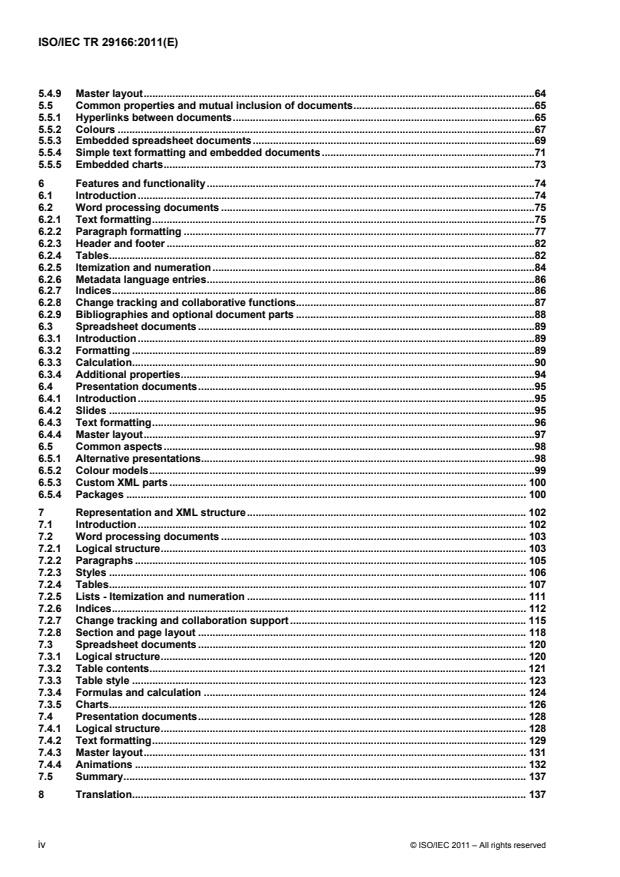
Contents Page
Foreword . vi
Introduction . vii
1 Scope . 1
2 Normative references . 1
3 Terms and definitions . 2
4 Basic principles . 4
4.1 Structure of the report . 4
4.1.1 Enterprise view . 4
4.1.2 Computational view . 5
4.1.3 Information view . 5
4.1.4 Engineering view . 5
4.1.5 Technical view . 5
4.2 Approach . 6
5 Use cases . 8
5.1 Introduction . 8
5.2 Word processing documents . 8
5.2.1 Empty document . 8
5.2.2 Simple text and paragraph formatting . 10
5.2.3 Asian language support . 11
5.2.4 Line breaks in East Asian text . 14
5.2.5 Text direction . 16
5.2.6 Phonetic guide functions . 18
5.2.7 Tables and field functions . 20
5.2.8 Footnotes and endnotes . 22
5.2.9 Itemization and numeration . 24
5.2.10 Indices and tables of contents . 25
5.2.11 Metadata and settings . 26
5.2.12 Change tracking and collaboration support . 28
5.2.13 Bibliographies and optional document parts . 31
5.2.14 Sub documents and books . 32
5.2.15 Forms . 35
5.2.16 Vector graphics . 36
5.2.17 Font embedding and paper size . 38
5.2.18 Font metrics and font substitution . 40
5.2.19 Document fields . 41
5.2.20 Inclusion of user defined XML . 43
5.2.21 Mathematical formulas. 45
5.3 Spreadsheet documents . 46
5.3.1 Empty spreadsheet document . 46
5.3.2 Listing and structural features . 48
5.3.3 Formulas and calculation . 49
5.4 Presentation documents. 51
5.4.1 Empty presentation document . 51
5.4.2 Simple text formatting . 52
5.4.3 Itemization and numeration . 54
5.4.4 Positioning and layout . 55
5.4.5 Slide blending and animation effects . 57
5.4.6 Animations . 58
5.4.7 Comments . 60
5.4.8 Multimedia content . 62
© ISO/IEC 2011 – All rights reserved iii
5.4.9 Master layout .64
5.5 Common properties and mutual inclusion of documents .65
5.5.1 Hyperlinks between documents .65
5.5.2 Colours .67
5.5.3 Embedded spreadsheet documents .69
5.5.4 Simple text formatting and embedded documents .71
5.5.5 Embedded charts .73
6 Features and functionality .74
6.1 Introduction .74
6.2 Word processing documents .75
6.2.1 Text formatting .75
6.2.2 Paragraph formatting .77
6.2.3 Header and footer .82
6.2.4 Tables .82
6.2.5 Itemization and numeration .84
6.2.6 Metadata language entries .86
6.2.7 Indices .86
6.2.8 Change tracking and collaborative functions .87
6.2.9 Bibliographies and optional document parts .88
6.3 Spreadsheet documents .89
6.3.1 Introduction .89
6.3.2 Formatting .89
6.3.3 Calculation .90
6.3.4 Additional properties .94
6.4 Presentation documents .95
6.4.1 Introduction .95
6.4.2 Slides .95
6.4.3 Text formatting .96
6.4.4 Master layout .97
6.5 Common aspects .98
6.5.1 Alternative presentations .98
6.5.2 Colour models .99
6.5.3 Custom XML parts . 100
6.5.4 Packages . 100
7 Representation and XML structure . 102
7.1 Introduction . 102
7.2 Word processing documents . 103
7.2.1 Logical structure . 103
7.2.2 Paragraphs . 105
7.2.3 Styles . 106
7.2.4 Tables . 107
7.2.5 Lists - Itemization and numeration . 111
7.2.6 Indices . 112
7.2.7 Change tracking and collaboration support . 115
7.2.8 Section and page layout . 118
7.3 Spreadsheet documents . 120
7.3.1 Logical structure . 120
7.3.2 Table contents . 121
7.3.3 Table style . 123
7.3.4 Formulas and calculation . 124
7.3.5 Charts . 126
7.4 Presentation documents . 128
7.4.1 Logical structure . 128
7.4.2 Text formatting . 129
7.4.3 Master layout . 131
7.4.4 Animations . 132
7.5 Summary . 137
8 Translation . 137
iv © ISO/IEC 2011 – All rights reserved
8.1 Introduction . 137
8.2 Translation complexity . 137
8.3 Sample translations . 139
8.3.1 Easy translation . 139
8.3.2 Moderate translation . 143
8.3.3 Difficult translations . 149
8.4 Guidelines for evaluating translatability . 150
8.4.1 Translation fidelity . 151
8.4.2 Document interoperability . 152
9 Examples and tools . 153
10 Conclusion . 154
10.1 Resume . 155
Bibliography . 156
© ISO/IEC 2011 – All rights reserved v
Foreword
ISO (the International Organization for Standardization) and IEC (the International Electrotechnical
Commission) form the specialized system for worldwide standardization. National bodies that are members of
ISO or IEC participate in the development of International Standards through technical committees
established by the respective organization to deal with particular fields of technical activity. ISO and IEC
technical committees collaborate in fields of mutual interest. Other international organizations, governmental
and non-governmental, in liaison with ISO and IEC, also take part in the work. In the field of information
technology, ISO and IEC have established a joint technical committee, ISO/IEC JTC 1.
International Standards are drafted in accordance with the rules given in the ISO/IEC Directives, Part 2.
The main task of the joint technical committee is to prepare International Standards. Draft International
Standards adopted by the joint technical committee are circulated to national bodies for voting. Publication as
an International Standard requires approval by at least 75 % of the national bodies casting a vote.
In exceptional circumstances, when the joint technical committee has collected data of a different kind from
that which is normally published as an International Standard (“state of the art”, for example), it may decide to
publish a Technical Report. A Technical Report is entirely informative in nature and shall be subject to review
every five years in the same manner as an International Standard.
Attention is drawn to the possibility that some of the elements of this document may be the subject of patent
rights. ISO and IEC shall not be held responsible for identifying any or all such patent rights.
ISO/IEC TR 29166 was prepared by Joint Technical Committee ISO/IEC JTC 1, Information technology,
Subcommittee SC 34, Document description and processing languages.
vi © ISO/IEC 2011 – All rights reserved
Introduction
OASIS Open Document Format ODF 1.0 (ISO/IEC 26300) and Office Open XML (ISO/IEC 29500) are both
open document formats for saving and exchanging word processing documents, spreadsheets and
presentations. Both formats are XML based but differ in design and scope.
OASIS ODF 1.0 was published by OASIS as an OASIS standard in May 2005. The second edition of ODF 1.0
has been published by OASIS as a committee specification in July 2006 and accepted as an International
Standard by ISO (ISO/IEC 26300) in December 2006. Office Open XML was first approved in December 2006
by the ECMA International General Assembly as ECMA-376. An updated version was published in November
nd
2008 by ISO (ISO/IEC 29500). The corresponding version, ECMA-376 2 edition, was published in December
2008.
This Technical Report addresses both developers seeking to implement either the OpenDocument or the
Office Open XML International Standard and template designers and other power users whose competences
cut across the spectrum of XML and XML-related technologies which directly or remotely deal with one or both
of the two International Standards. This Technical Report will be of great assistance to those seeking to
exchange documents between formats, to extract data from or import data into documents, or to write
applications supporting the two formats.
This Technical Report aims at analysing the two International Standards and their underlying concepts in
terms of interoperability issues for a selected set of features. It analyses the way these features are
implemented in both International Standards and estimates the degree of translatability between them using a
table-based comparison. This Technical Report serves as a preliminary technical translation guideline for
evaluating translatability between certain parts of the two International Standards. It does not compare
different implementations which can cause additional kinds of interoperability problems.
Both Office Open XML and OpenDocument formats are basically descriptions of schemas used for word
processing documents, spreadsheets and presentations created by office application suites. Both are open
formats. A key design objective is to guarantee long-term access to data without the legal or technical barriers
associated with proprietary binary formats. XML schema definitions are normative parts of both International
Standards.
Manipulating documents is fundamentally facilitated by separating a document’s layout from its content.
Editing the layout and data components independently of one another affords considerable flexibility in
creating and editing office documents. Defining the structure and content of documents has been the focus of
both International Standards. A document’s layout is ultimately governed by the implementation of the office
suite, in particular by the rendering engine. Thus, as depicted in Figure 1, using exactly the same standard to
describe a document does not guarantee that different office suites will produce identical layouts.
Consequently, this Technical Report focuses more on the definition of guidelines for the translation of
document structure, content and presentation instructions than on the preservation of document layout.
In this Technical Report the two International Standards will be examined in their universality and not by
comparing specific implementations such as Microsoft Office or OpenOffice.org/LibreOffice. For this reason,
various examples have been developed using a simple XML editor which supports both standards. The
names of specific implementations may be used in the use cases to illustrate the real world scenario behind
the use case. The figures in this Technical Report are created for illustration purposes, using available tools
such as OpenOffice 3.* and Microsoft Office 2010. It should not be assumed that the current versions of these
implementations support all the features needed to implement the use case, especially the document
standards and the translation between them.
Several use cases do not mention existing tools, but rather use abstract names such as document format A
(DF-A) and document format B (DF-B).
This Technical Report begins with a presentation of typical use cases characterizing scenarios where specific
features supported by both document formats are used. It then analyses the most important features of one
© ISO/IEC 2011 – All rights reserved vii
document format and shows how those features can best be represented in the other format. It then reviews
the concepts and various features of the two document formats in order to provide a good understanding of
the formats' common features and especially their differences. Most features can be translated to the other
format with varying degrees of fidelity. For the most important features, this Technical Report provides
detailed information on the implementation of the feature and the extents to which that feature can be
translated, including typical translation rules. Finally, an overview summing up the most important results and
deriving guidelines for the translation between both formats concludes this Technical Report.
The following abbreviations are used throughout this Technical Report:
ODF, which stands for OpenDocument Format (ISO/IEC 26300:2006);
OOXML, which stands for Office Open XML (ISO/IEC 29500:2008).
It is hoped that this Technical Report will be useful in understanding how the ODF and OOXML International
Standards compare and how their functionality can be mapped between the two formats. It is a necessary
step to the goal of helping achieve interoperability and harmonization between the two formats.
History of ODF and OOXML
ODF was originally developed by Sun Microsystems between 2000 and 2002 with the following objective:
“To create as a community, the leading international office suite that will run on all major platforms and provide
access to all functionality and data through open-component based APIs and an XML-based file format.”
In 2002, the standardization process was initiated at OASIS, and in 2005 the standard was published as
OASIS Open Document Format for Office Applications, abbreviated as OpenDocument or ODF. In 2006,
Open Document Format for Office Applications v.1.0 became an ISO International Standard (ISO/IEC 26300).
Open Document Format for Office Applications v.1.1 has been published by OASIS as an OASIS standard in
February 2007. At the time of writing (June 2011) Version 1.2 has been released as a Committee
Specification 1.0. While version 1.0 of the ODF standard only consists of one part, the current version is
structured into three parts: core, formulas, and packages.
Microsoft followed suit in 2006 via the Open Specification Promise (OSP ) by opening the format of its 2007
version of the Microsoft office suite (version 12) for which it also uses XML as an exchange and storage
format. OOXML is a file format originally developed by Microsoft as a successor to its earlier Office 2003 file
formats. It is used for representing spreadsheet, presentation and word processing documents. In 2006 Office
st
Open XML became an ECMA standard (ECMA-376, 1 edition). In 2008, a revised version of ECMA-376
became an ISO International Standard (ISO/IEC 29500:2008), which has its equivalent in the ECMA-376,
nd
2 edition.
ISO/IEC 29500 is structured into four parts, each of which contains normative as well as informative material:
Fundamentals and Markup Language Reference, Open Packaging Conventions, Markup Compatibility and
Extensibility, and Transitional Migration Features.
At the time of writing (June 2011) the following corrigenda and amendments have been published:
ISO/IEC 29500-1:2008/Cor.1:2010, ISO/IEC 29500-2:2008/Cor.1:2010, ISO/IEC 29500-3:2008/
Cor.1:2010 and ISO/IEC 29500-4:2008/Cor.1:2010, containing minor technical corrections and
editorial modifications;
ISO/IEC 29500-1:2008/Amd.1:2010 and ISO/IEC 29500-4:2008/Amd.1:2010, containing namespace
changes and modifications concerning the usage of percentage (%) values;
http://www.openoffice.org/about_us/ooo_release.html
http://www.microsoft.com/interop/osp/default.mspx
viii © ISO/IEC 2011 – All rights reserved
rd
ISO/IEC 29500:2011 (ECMA 376 3 edition) as a consolidated version of OOXML containing the
above-mentioned corrigenda and amendments;
ISO/IEC 26300:2006/Cor.1:2010, containing editorial modifications;
ISO/IEC 26300:2006/Cor.2:2011, fixing editorial errors.
In addition, the following Amendments are under preparation:
Amendment 1 to ISO/IEC 29500-1:2011 and Amendment 1 to ISO/IEC 29500-4:2011 about ISO 8601
dates;
Amendment 1 to ISO/IEC 26300:2006 introducing ODF 1.1.
© ISO/IEC 2011 – All rights reserved ix
TECHNICAL REPORT ISO/IEC TR 29166:2011(E)
Information technology — Document description and
processing languages — Guidelines for translation between
ISO/IEC 26300 and ISO/IEC 29500 document formats
1 Scope
This Technical Report provides guidelines for translation between ISO/IEC 26300 and ISO/IEC 29500
document formats. It starts by studying common use cases to identify how the most important functionalities of
one document format can be represented in the other format. This is followed by a thorough review of the
concepts, architectures and various features of the two document formats in order to provide a good
understanding of the commonalities and differences. It is expected that functionalities will be able to be
translated with different degrees of fidelity to the other format. As an illustrative sample of this functionality,
detailed information is provided on the extent to which those functionalities can be translated. This Technical
Report is a necessary step to the goal of helping achieve interoperability and harmonization between the two
formats.
2 Normative references
The following referenced documents are indispensable for the application of this document. For dated
references, only the edition cited applies. For undated references, the latest edition of the referenced
document (including any amendments) applies.
ISO/IEC 26300:2006, Information technology — Open Document Format for Office Applications
(OpenDocument) v1.0
ISO/IEC 29500-1:2008, Information technology — Document description and processing languages — Office
Open XML File Formats — Part 1: Fundamentals and Markup Language Reference
ISO/IEC 29500-2:2008, Information technology — Document description and processing languages — Office
Open XML File Formats — Part 2: Open Packaging Conventions
ISO/IEC 29500-3:2008, Information technology — Document description and processing languages — Office
Open XML File Formats — Part 3: Markup Compatibility and Extensibility
ISO/IEC 29500-4:2008, Information technology — Document description and processing languages — Office
Open XML File Formats — Part 4: Transitional Migration Features
© ISO/IEC 2011 – All rights reserved 1
3 Terms and definitions
For the purposes of this document, the following terms and definitions apply.
3.1
translation type
methods used when translating between ODF and OOXML documents
NOTE This Technical Report distinguishes four translation types:
one way ODF to OOXML translation;
one way OOXML to ODF translation;
round trip ODF to OOXML to ODF translation;
round trip OOXML to ODF to OOXML translation.
3.2
translation fidelity
quality of a translation process between the ODF and OOXML document formats
NOTE 1 Translation fidelity depends on document properties.
NOTE 2 Translation fidelity cannot be measured in an absolute manner; it depends on the intentions of the document's
authors.
3.3
document type
characterization of the specific purpose and content of a document
NOTE 1 This Technical Report distinguishes three major document types: word processing, spreadsheet and
presentation documents.
NOTE 2 Some document features only exist in one document type; other features have been defined for more than
one document type.
NOTE 3 The association between document type and document feature can be different for ODF and OOXML.
3.4
document property
description of different yet independent dimensions within the specification of a document
NOTE 1 As defined in 4.2 this Technical Report distinguishes the following document properties:
presentation instructions;
content;
dynamic content;
meta data;
annotations and security;
document parts.
NOTE 2 Document properties are implemented using document features.
2 © ISO/IEC 2011 – All rights reserved
3.5
document feature
characterization of a document used to implement specific aspects of a document property
NOTE 1 Document features are visible to a user.
NOTE 2 Document features are illustrated by associated use cases in this Technical Report.
NOTE 3 The terms feature, functionality and sub functionality are used to structure the comparison of both document
formats in Clause 6.
NOTE 4 Document features implement document properties.
3.6
document format
synonym for document standard within this Technical Report
3.7
functionality
refinement of document features
NOTE 1 For example, the format of a paragraph is a feature and the height of a line is a functionality.
NOTE 2 In many cases functionality is implemented using XML types or elements.
3.8
sub functionality
itemization of functionality
NOTE 1 For example, the height of a line can be defined as fixed, font-independent, automatic, etc.
NOTE 2 In many cases sub functionality is implemented using XML attributes.
3.9
translatability level
rough scale for translation fidelity
NOTE 1 Translatability levels are used in Clause 6.
NOTE 2 Translatability levels have a three tier range (low, medium, high).
3.10
translation complexity
description of the complexity of the translation process for document features, considering their structures and
associated translation rules
NOTE 1 Translation complexity is a three value metric system (easy, moderate, difficult).
NOTE 2 Translation complexity is used in Clause 8 to classify the translation of document features or functionalities
from one format to the other.
© ISO/IEC 2011 – All rights reserved 3
4 Basic principles
4.1 Structure of the report
The report is structured according to the viewpoints introduced in the reference model for Open Distributed
Processing ODP (ISO/IEC 10746). Refer to ISO/IEC 10746-1:1998 and ISO/IEC 10746-3:1996.
4.1.1 Enterprise view
The enterprise viewpoint is concerned with the purpose, scope and policies governing the activities of the
specified system within the organization of which it is a part. All requirements that are relevant to defining the
architecture and properties of the system are gathered in this viewpoint.
In clause 5 the TR describes the translation process from the enterprise viewpoint. It focuses on use cases
that describe how a document is used in a specific scenario. Features and functionalities of documents like
presentation instructions, structural information, application context, and the content itself as well as certain
conformance classes based on translation types and properties have been taken into consideration. Users of
document standards and decision makers are the intended readers of this section.
4.1.1.1 Use case template
To facilitate comparisons and a quick overview, use cases are described using the following template:
Textual description:
Describe the scenario/story the use case is going to tell;
Include one or more figures demonstrating the use case (optional);
Define the translation type and fidelity to be demonstrated.
Implementation:
Describe the features necessary to implement the use case.
Use case name:
Translation type and properties:
ODF OOXML
or/and
One-trip translation
OOXML ODF
ODFOOXMLODF
Round trip translation
or/and
OOXMLODFOOXML
Presentation instructions
Document content
Dynamic content
Metadata
Annotations and security
Document parts
For details about the use case table please refer to section 4.2.
4 © ISO/IEC 2011 – All rights reserved
Additional properties .
Required features:
Feature a including references to standards
Feature b including references to standards
Requirements:
Describe the expected behaviour of a feature's translation between both International Standards;
Describe how the document(s) used in the use case should be defined to achieve the intended
fidelity.
Conclusion:
Compare the applicable features in both International Standards and the translation rules and fidelity
as elaborated on in clauses 6 and 8.
4.1.2 Computational view
The computational viewpoint is concerned with the functional decomposition of a system into a set of objects
that interact at interfaces: thus enabling system distribution.
In clause 6 the TR describes the translation process from the computational viewpoint. It focuses on the
features and functionalities of a document. The what is described, independent of how the feature is
implemented in the particular standard. Power users and developers are the intended readers of this section.
4.1.3 Information view
The information viewpoint is concerned with the kinds of information handled by a system and constraints on
the use and interpretation of that information. An information specification of a system defines the semantics
of information and the semantics of information processing.
In clause 7 the TR describes the translation process from the information viewpoint. It is focusing on how the
functionality and features of a document are implemented in the standards. The document structure and its
XML markup are described. Power users, developers and persons responsible for the maintenance of the
standards are the intended readers of this section.
4.1.4 Engineering view
The engineering viewpoint is concerned with the infrastructure required to support system distribution. An
engineering specification defines the mechanisms and functions required to support distributed interaction
between objects.
In clause 8 the TR describes the translation process from the engineering viewpoint. It focuses on how the
features and structures are translated and preserved in the translation process. Developers and persons
responsible for the maintenance of the International Standards are the intended readers of this section.
4.1.5 Technical view
The technology viewpoint is concerned with the choice of technology used to support system distribution.
© ISO/IEC 2011 – All rights reserved 5
In clause 9 the TR describes the translation process from the technical viewpoint. It focuses on available
resources and tools for creating, editing and translating documents. All groups mentioned above are the
intended readers of this section.
4.2 Approach
This TR takes a use case based approach to identify the requirements needed for translating between ODF
and OOXML. As depicted in Figure 2, use cases are selected and categorized along two lines: type of
translation and document properties defining the fidelity of a translation. This approach covers all aspects of
translations between the two document formats. Both International Standards define a storage and exchange
format for documents, including information about both a document’s presentation and its content. The
process of document rendering or laying out is beyond the scope of the actual standards, and thus beyond the
scope of both the translation process and this report.
Graphic fidelity between different rendering engines (i.e. layout implementations), another important category
of uses cases, is also beyond the scope of this report. In such use cases, different rendering engines are
provided with the same information, but may produce visually different results. Since the actual layout process
is not described by either the ODF or the OOXML International Standard, this report does not deal with such
use cases. However, it does cover preservation of layout information and presentation instructions around
format translations so that the selfsame rendering engine can produce the same visual result from the same
information encoded in different formats as depicted in Figure 1. Nevertheless, from a user's point of view in
many use cases the graphical appearance of a document will be the major criterion for the evaluation of the
fidelity of a transformation process. Therefore the graphical appearance of the documents depicted in Figure 1
should be independent of the chosen path.
Translation
Documents
ODF OOXML
Presentation instructions Presentation instructions
Path B
Application A Application B Application C
Path A Path C
Rendering Rendering Rendering
engine X engine Y engine Z
A /= B B /= C
ODF OOXML
A /= C
Applications
ODF OOXML
Figure 1 — Translation of presentation instructions
Use case descriptions reference subclause 4.2 for the description of demonstrated translation types and
fidelities and clause 6 for a comparison of required features and functionalities.
6 © ISO/IEC 2011 – All rights reserved
Translation types Document properties
One-time translation Presentation instructions
OOXML -> ODF
Document content
ODF -> OOXML
Dynamic content
Round-trip translation
Meta data
OOXML -> ODF –> OOXML
ODF -> OOXML -> ODF
Annotations and security
Document parts
Figure 2 — Use case category overview
Translation fidelity of a document depends on the following document properties:
Presentation instructions include all layout and presentation related information such as fonts, spacing,
margins, colours, paper layout and settings, and animation in office documents.
Document content covers all properties of content (
...
Questions, Comments and Discussion
Ask us and Technical Secretary will try to provide an answer. You can facilitate discussion about the standard in here.
Loading comments...