


ISO 3008-1:2025
(Main)Fire resistance tests — Door and shutter assemblies — Part 1: General requirements
Fire resistance tests — Door and shutter assemblies — Part 1: General requirements
This document, used in conjunction with ISO 834-1, specifies a method for determining the fire resistance of door and shutter assemblies designed primarily for installation within openings incorporated in vertical separating elements, such as: — hinged and pivoted doors, — horizontally sliding and vertically sliding doors, including articulated sliding doors and sectional doors, — steel single-skin folding shutters (un-insulated), — other sliding, folding doors, — tilting doors, — rolling shutter doors, — removable panels in walls, — self-closing openable windows. Requirements are included for mechanical pre-conditioning, e.g. “cycling” of door and shutter assemblies prior to the conduct of the fire-resistance test. This document does not cover: — Lift landing doors which are tested in accordance with ISO 3008-2.
Essais de résistance au feu — Assemblages de portes et volets — Partie 1: Exigences générales
General Information
- Status
- Published
- Publication Date
- 01-Jun-2025
- Technical Committee
- ISO/TC 92/SC 2 - Fire containment
- Current Stage
- 6060 - International Standard published
- Start Date
- 02-Jun-2025
- Due Date
- 02-Nov-2026
- Completion Date
- 02-Jun-2025
Relations
- Revises
ISO 3008-1:2019 - Fire resistance tests — Door and shutter assemblies — Part 1: General requirements - Effective Date
- 04-Nov-2023
Overview
ISO 3008-1:2025 - Fire resistance tests - Door and shutter assemblies - Part 1: General requirements specifies a standardized method for determining the fire resistance of door and shutter assemblies (including hinged, sliding, folding, rolling, tilting doors, removable wall panels and self-closing openable windows) installed in vertical separating elements. Designed to be used in conjunction with ISO 834-1, this second edition updates general requirements, adds a normative Annex C on fire-seal testing, and clarifies preconditioning and unexposed-surface measurement locations. The standard excludes lift landing doors (covered by ISO 3008-2).
Key topics and technical requirements
ISO 3008-1:2025 sets out technical requirements and test protocols, including:
- Test specimen requirements: size, number, design, construction and verification of door and shutter assemblies.
- Installation and supporting construction: definitions of associated/supporting construction, restraint, gaps and installation details that affect test results.
- Preconditioning: conditioning for moisture and mechanical pre-conditioning (e.g., cycling) prior to fire tests.
- Instrumentation and measurement: placement and use of temperature sensors (furnace and unexposed-face thermocouples), pressure measurement, heat-flux measurement, deflection monitoring and associated apparatus.
- Test procedure: procedures to conduct the fire-resistance test in conjunction with ISO 834-1 fire curves and furnace conditions.
- Performance criteria: pass/fail criteria for integrity and insulation, including how to assess unexposed-face temperatures and maximum temperature limits.
- Test reporting and field of direct application: required test-report content and guidance for direct application of test results to timber, steel and glazed constructions and hardware.
- Normative and informative annexes: Annex A (conditioning requirements for supporting constructions), Annex B (estimating radiant heat flux), and new Annex C (testing of fire seals).
Practical applications - who uses this standard
ISO 3008-1:2025 is essential for:
- Fire test laboratories conducting standardized fire-resistance tests on door and shutter assemblies.
- Door and shutter manufacturers developing products, validating fire performance, and preparing technical documentation for certification.
- Architects, specifiers and façade engineers selecting compliant fire doors and detailing installations that meet performance expectations.
- Regulatory authorities, certification bodies and insurance assessors evaluating compliance with building regulations and fire safety codes.
- Fire safety consultants and researchers modeling fire performance and comparing assemblies.
Related standards and references
- ISO 834-1:2025 - Elements of building construction - General fire-resistance test requirements (used alongside ISO 3008-1)
- ISO 3008-2 - Lift landing doors (exclusion)
- ISO 834-8 - Specific requirements for non-loadbearing vertical separating elements
- ISO 13943 - Fire safety vocabulary
Keywords: ISO 3008-1:2025, fire resistance tests, door and shutter assemblies, fire seals, preconditioning, ISO 834-1, fire performance testing, fire test laboratory.

Get Certified
Connect with accredited certification bodies for this standard

ICC Evaluation Service
Building products evaluation and certification.

NSF International
Global independent organization facilitating standards development and certification.

QAI Laboratories
Building and construction product testing and certification.
Sponsored listings
Frequently Asked Questions
ISO 3008-1:2025 is a standard published by the International Organization for Standardization (ISO). Its full title is "Fire resistance tests — Door and shutter assemblies — Part 1: General requirements". This standard covers: This document, used in conjunction with ISO 834-1, specifies a method for determining the fire resistance of door and shutter assemblies designed primarily for installation within openings incorporated in vertical separating elements, such as: — hinged and pivoted doors, — horizontally sliding and vertically sliding doors, including articulated sliding doors and sectional doors, — steel single-skin folding shutters (un-insulated), — other sliding, folding doors, — tilting doors, — rolling shutter doors, — removable panels in walls, — self-closing openable windows. Requirements are included for mechanical pre-conditioning, e.g. “cycling” of door and shutter assemblies prior to the conduct of the fire-resistance test. This document does not cover: — Lift landing doors which are tested in accordance with ISO 3008-2.
This document, used in conjunction with ISO 834-1, specifies a method for determining the fire resistance of door and shutter assemblies designed primarily for installation within openings incorporated in vertical separating elements, such as: — hinged and pivoted doors, — horizontally sliding and vertically sliding doors, including articulated sliding doors and sectional doors, — steel single-skin folding shutters (un-insulated), — other sliding, folding doors, — tilting doors, — rolling shutter doors, — removable panels in walls, — self-closing openable windows. Requirements are included for mechanical pre-conditioning, e.g. “cycling” of door and shutter assemblies prior to the conduct of the fire-resistance test. This document does not cover: — Lift landing doors which are tested in accordance with ISO 3008-2.
ISO 3008-1:2025 is classified under the following ICS (International Classification for Standards) categories: 13.220.50 - Fire-resistance of building materials and elements; 91.060.50 - Doors and windows. The ICS classification helps identify the subject area and facilitates finding related standards.
ISO 3008-1:2025 has the following relationships with other standards: It is inter standard links to ISO 3008-1:2019. Understanding these relationships helps ensure you are using the most current and applicable version of the standard.
ISO 3008-1:2025 is available in PDF format for immediate download after purchase. The document can be added to your cart and obtained through the secure checkout process. Digital delivery ensures instant access to the complete standard document.
Standards Content (Sample)
International
Standard
ISO 3008-1
Second edition
Fire resistance tests — Door and
2025-06
shutter assemblies —
Part 1:
General requirements
Essais de résistance au feu — Assemblages de portes et volets —
Partie 1: Exigences générales
Reference number
© ISO 2025
All rights reserved. Unless otherwise specified, or required in the context of its implementation, no part of this publication may
be reproduced or utilized otherwise in any form or by any means, electronic or mechanical, including photocopying, or posting on
the internet or an intranet, without prior written permission. Permission can be requested from either ISO at the address below
or ISO’s member body in the country of the requester.
ISO copyright office
CP 401 • Ch. de Blandonnet 8
CH-1214 Vernier, Geneva
Phone: +41 22 749 01 11
Email: copyright@iso.org
Website: www.iso.org
Published in Switzerland
ii
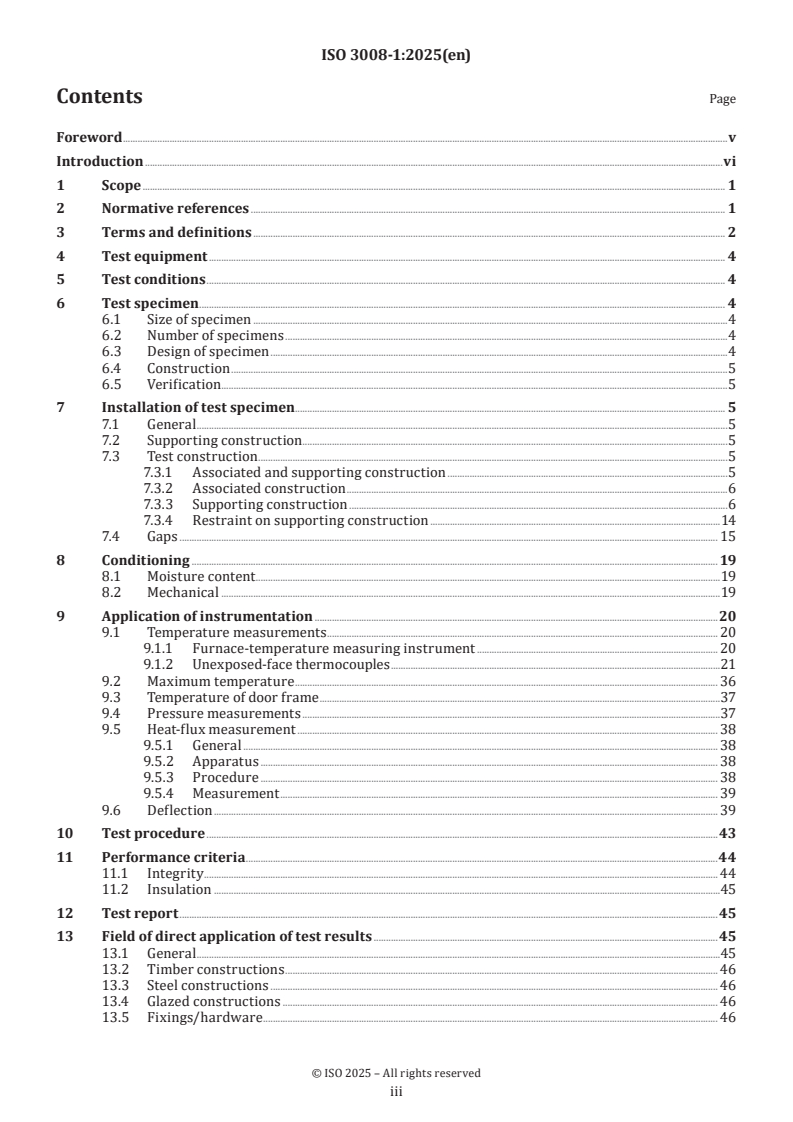
Contents Page
Foreword .v
Introduction .vi
1 Scope . 1
2 Normative references . 1
3 Terms and definitions . 2
4 Test equipment . 4
5 Test conditions . 4
6 Test specimen . 4
6.1 Size of specimen .4
6.2 Number of specimens .4
6.3 Design of specimen .4
6.4 Construction .5
6.5 Verification .5
7 Installation of test specimen . . 5
7.1 General .5
7.2 Supporting construction . .5
7.3 Test construction . .5
7.3.1 Associated and supporting construction .5
7.3.2 Associated construction .6
7.3.3 Supporting construction .6
7.3.4 Restraint on supporting construction .14
7.4 Gaps . 15
8 Conditioning . 19
8.1 Moisture content .19
8.2 Mechanical .19
9 Application of instrumentation .20
9.1 Temperature measurements . . 20
9.1.1 Furnace-temperature measuring instrument . 20
9.1.2 Unexposed-face thermocouples .21
9.2 Maximum temperature . 36
9.3 Temperature of door frame .37
9.4 Pressure measurements .37
9.5 Heat-flux measurement . 38
9.5.1 General . 38
9.5.2 Apparatus . 38
9.5.3 Procedure . 38
9.5.4 Measurement . 39
9.6 Deflection . 39
10 Test procedure .43
11 Performance criteria .44
11.1 Integrity . 44
11.2 Insulation .45
12 Test report .45
13 Field of direct application of test results .45
13.1 General .45
13.2 Timber constructions . 46
13.3 Steel constructions . 46
13.4 Glazed constructions . 46
13.5 Fixings/hardware . 46
iii
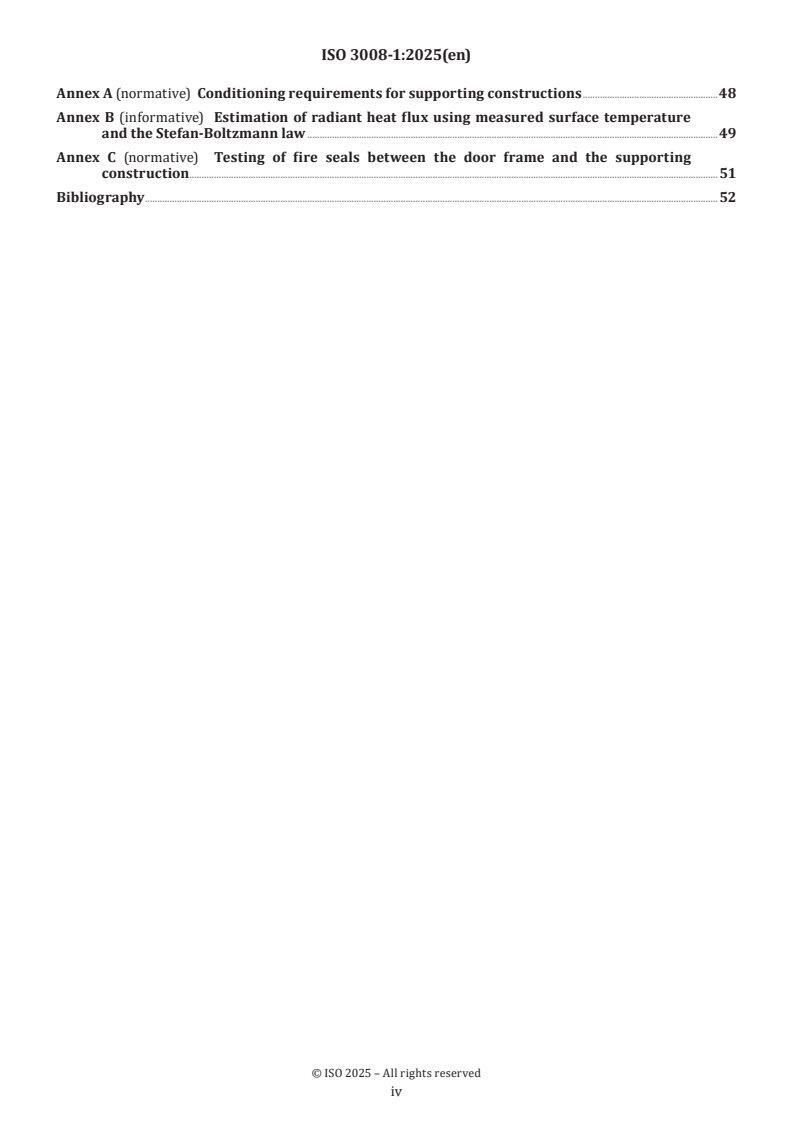
Annex A (normative) Conditioning requirements for supporting constructions .48
Annex B (informative) Estimation of radiant heat flux using measured surface temperature
and the Stefan-Boltzmann law .49
Annex C (normative) Testing of fire seals between the door frame and the supporting
construction . 51
Bibliography .52
iv
Foreword
ISO (the International Organization for Standardization) is a worldwide federation of national standards
bodies (ISO member bodies). The work of preparing International Standards is normally carried out through
ISO technical committees. Each member body interested in a subject for which a technical committee
has been established has the right to be represented on that committee. International organizations,
governmental and non-governmental, in liaison with ISO, also take part in the work. ISO collaborates closely
with the International Electrotechnical Commission (IEC) on all matters of electrotechnical standardization.
The procedures used to develop this document and those intended for its further maintenance are described
in the ISO/IEC Directives, Part 1. In particular, the different approval criteria needed for the different types
of ISO document should be noted. This document was drafted in accordance with the editorial rules of the
ISO/IEC Directives, Part 2 (see www.iso.org/directives).
ISO draws attention to the possibility that the implementation of this document may involve the use of (a)
patent(s). ISO takes no position concerning the evidence, validity or applicability of any claimed patent
rights in respect thereof. As of the date of publication of this document, ISO had not received notice of (a)
patent(s) which may be required to implement this document. However, implementers are cautioned that
this may not represent the latest information, which may be obtained from the patent database available at
www.iso.org/patents. ISO shall not be held responsible for identifying any or all such patent rights.
Any trade name used in this document is information given for the convenience of users and does not
constitute an endorsement.
For an explanation of the voluntary nature of standards, the meaning of ISO specific terms and expressions
related to conformity assessment, as well as information about ISO's adherence to the World Trade
Organization (WTO) principles in the Technical Barriers to Trade (TBT), see www.iso.org/iso/foreword.html.
This document was prepared by Technical Committee ISO/TC 92, Fire safety, Subcommittee SC 2, Fire
resistance.
This second edition of ISO 3008-1 cancels and replaces the first edition of ISO 3008-1:2019, which has been
technically revised.
The following main changes have been made:
— a new normative Annex C has been added;
— openable windows are now included in the Scope;
— revisions have been made to locations and measuring techniques for unexposed surface temperature
measurements and preconditioning requirements for door and shutter assemblies.
A list of all the parts in the ISO 3008 series can be found on the ISO website.
Any feedback or questions on this document should be directed to the user’s national standards body. A
complete listing of these bodies can be found at www.iso.org/members.html.
v
Introduction
This document contains specific requirements for fire-resistance testing which are unique to the elements
of building construction described as doors and shutters. The requirements for these doors and shutters are
intended to be applied in appropriate conjunction with the detailed and general requirements contained in
ISO 834-1.
vi
International Standard ISO 3008-1:2025(en)
Fire resistance tests — Door and shutter assemblies —
Part 1:
General requirements
CAUTION — The attention of all persons concerned with managing and carrying out this fire-
resistance test is drawn to the fact that fire testing can be hazardous and that there is a possibility
of toxic and/or harmful smoke and gases being evolved during the test. Mechanical and operational
hazards can also arise during the construction of the test elements or structures, their testing and
disposal of test residues.
An assessment of all potential hazards and risks to health shall be made and safety precautions shall
be identified and provided. Written safety instructions shall be issued. Appropriate training shall
be given to relevant personnel. Laboratory personnel shall ensure that they follow written safety
instructions at all times.
1 Scope
This document, used in conjunction with ISO 834-1, specifies a method for determining the fire resistance
of door and shutter assemblies designed primarily for installation within openings incorporated in vertical
separating elements, such as:
— hinged and pivoted doors,
— horizontally sliding and vertically sliding doors, including articulated sliding doors and sectional doors,
— steel single-skin folding shutters (un-insulated),
— other sliding, folding doors,
— tilting doors,
— rolling shutter doors,
— removable panels in walls,
— self-closing openable windows.
Requirements are included for mechanical pre-conditioning, e.g. “cycling” of door and shutter assemblies
prior to the conduct of the fire-resistance test.
This document does not cover:
— Lift landing doors which are tested in accordance with ISO 3008-2.
2 Normative references
The following documents are referred to in the text in such a way that some or all of their content constitutes
requirements of this document. For dated references, only the edition cited applies. For undated references,
the latest edition of the referenced document (including any amendments) applies.
ISO 834-1:2025, Fire-resistance tests — Elements of building construction — Part 1: General requirements
ISO 834-8, Fire-resistance tests — Elements of building construction — Part 8: Specific requirements for non-
loadbearing vertical separating elements
ISO 13943, Fire safety — Vocabulary
3 Terms and definitions
For the purposes of this document, the terms and definitions given in ISO 834-1, ISO 13943 and the
following apply.
ISO and IEC maintain terminological databases for use in standardization at the following addresses:
— IEC Electropedia: available at https:// www .electropedia .org/
— ISO Online browsing platform: available at https:// www .iso .org/ obp
3.1
associated supporting construction
specific construction in which the door or shutter assembly is installed as intended for use in practice and
which is used to close off the furnace and provide the levels of restraint and thermal heat transfer to be
experienced in normal use
3.2
cill
member that spans between two frame jambs at the base, which might or might not be set into the floor, and
that remains visible
3.3
door assembly
door set
complete assembly, consisting of pivoted, hinged or sliding door leaves or leaf including any frame that is
provided for the closing of permanent openings in separating elements
Note 1 to entry: This includes all side panels, vision panels or transom panels. The assembly shall be complete with
grilles and louvers together with the door hardware and any fire seals, smoke seals, draught seals, acoustic seals that
are used in the assembly.
3.4
door hardware
items that are, or can be, used in the door or shutter assembly
EXAMPLE Hinges, handles, locks, panic bar(s), escutcheons, letter plates, kick plates, sliding gear, closing devices,
electrical components, wiring.
3.5
double action
action of a fire door leaf that opens in both directions
3.6
fire seal
seal fitted to the frame or to the leaf edge for the purpose of extending the period of integrity of the assembly
3.7
floor
upper surface of the horizontal element on which the door or shutter assembly is mounted and which extends
from the exposed face to the unexposed face of the assembly
3.8
flush over panel
fixed panel fitted within the head and jambs above the door leaf without a transom fitted
3.9
gap
clearance between two nominally adjacent surfaces and/or edges
EXAMPLE Between the edge of a leaf and the frame or face of the leaf and the frame stop.
3.10
primary leaf
leaf of a multi-leaved door assembly that is the largest and/or has the handle attached to it as the preferred
leaf for general operation
Note 1 to entry: If the leaves of a multi-leaved door are the same size and if the handles (or other hardware such as
push plates) are fitted to all leaves, then no primary leaf exists for that door assembly.
3.11
shutter assembly
complete assembly consisting of rolling, folded or sliding curtains, including guides, rollers, tracks and
operating mechanism and housings
3.12
side panel
fixed panel that is incorporated to one side of a door that is part of the test specimen
3.13
single action
action of a fire door leaf that opens in only one direction
3.14
smoke seal
seal fitted to the frame or to the leaf edge for the purpose of restricting the flow of smoke or hot gases
3.15
standard supporting construction
form of construction used to close off the furnace and to support the door or shutter assembly being evaluated
and which has a quantifiable influence on both the thermal heat transfer between the construction and the
test specimen and provides known resistance to thermal distortion
3.16
test specimen
door or shutter assembly that is installed in a standard or associated supporting construction to allow its
evaluation
3.17
through connection
fixing or internal spacer that either penetrates through the door or shutter construction from one face to
another or directly connects the faces to one another
3.18
transom
member that extends across the frame from jamb to jamb at the head of the leaf and that creates an aperture
to house a transom panel
3.19
transom panel
fixed panel that is incorporated above a door and is bounded on all edges by either the frame head, the jambs
or the transom
3.20
air transfer grille
product which is installed in an aperture in a door or shutter assembly that allows a path for air movement
through the door or shutter assembly
4 Test equipment
4.1 The test equipment shall be as specified in ISO 834-1. The furnace used shall be related to the
orientation of the test specimen. For vertical specimens, the wall testing furnace is suitable, for horizontal
specimens, the floor furnace is applicable.
4.2 Measurement of heat flux from the unexposed surface of specimens shall be made as described in 9.5.
4.3 Where it is not possible to apply disc thermocouples as specified in ISO 834-1 to the unexposed surface
of the test specimen, due to the size or shape of the specimen, or when the dimension of the element to
be measured is less than 12 mm, such as when testing air transfer grilles, an alternate thermocouple and
pad may be used. Instead of copper discs, twisted thermocouple wire may be used. The wire leads of the
thermocouple are to have an immersion under the pad and be in contact with the unexposed surface for
not less than 25 mm. The hot junction of the thermocouple is to be placed approximately under the centre
of the pad. The pad is permitted to be deformed in order to be held firmly against the surface of the element
being measured and is to fit closely about the thermocouple. When the blade of the air transfer grille or
other parts of the test specimen is less than the specified pad size, reduce the pad to match the element
being measured. The pad length shall be as specified and parallel to the test specimen length. If the modified
thermocouple pad cannot be placed on the contour of the surface, then no thermocouple is required at that
location. The wires for the thermocouple in the length covered by the pad shall not be heavier than 0,82 mm
and are to be electrically insulated with heat-resistant and moisture-resistant coatings.
5 Test conditions
Test conditions require the application of the heating and pressure conditions of the standard test as defined
in ISO 834-1.
6 Test specimen
6.1 Size of specimen
The test specimen and all its components shall be full size. When this is restricted by the size of the opening
of the furnace (which is normally 3 m × 3 m), the door or shutter assembly or the self-closing openable
window shall be tested at the maximum size possible and the fire resistance of the full-sized assembly
shall be derived by an extended application analysis. However, the minimum dimensions of supporting
construction shall not be less than that prescribed in 7.3.1.
6.2 Number of specimens
The number of test specimens shall be selected as described in ISO 834-1. If testing is carried out from one
side only, it shall be stated in the test report whether this is due to the symmetrical nature of the door or
because it is required to resist fire from one side only.
6.3 Design of specimen
6.3.1 The design of the test specimen and the choice of supporting construction shall take into account the
requirements of 7.3 if the widest field of direct application is to be achieved.
6.3.2 Where the door or shutter assembly incorporates air transfer grilles or side, transom or flush over
panels, whether glazed or unglazed, these shall be tested as part of the door or shutter assembly. The side
panel shall always be on the latch side.
6.3.3 The test specimen shall be fully representative of the door or shutter assembly as intended for use
in practice, including any appropriate surface finishes and fittings that are an essential part of the specimen
and that can influence its behaviour in a test construction.
6.3.4 In instances where a linear joint sealing material is used to seal the gap between a fire door frame
and the supporting construction, testing shall be conducted as described in Annex C.
6.4 Construction
The test specimen shall be constructed as described in ISO 834-1.
6.5 Verification
6.5.1 The sponsor shall provide a specification to a level of detail sufficient to allow the laboratory to
conduct a detailed examination of the specimen before the test and to agree on the accuracy of the
information supplied. ISO 834-1 provides detailed guidance on verification of the test specimen.
6.5.2 When the method of construction precludes a detailed survey of the specimen without having to
permanently damage it, or if it is considered that it will subsequently be impossible to evaluate construction
details from a post-test examination, then one of two options shall be exercised by the laboratory:
— either the laboratory shall oversee the manufacture of the door or shutter assembly(ies) subjected to the
test, or
— the sponsor shall, at the discretion of the laboratory, be requested to supply an additional assembly or
that part of the assembly that cannot be verified (e.g. a door leaf) in addition to the number required for
the testing. The laboratory shall then choose freely which of these shall be subjected to the testing and
which shall be used to verify the construction.
7 Installation of test specimen
7.1 General
7.1.1 The test specimen shall be installed as intended for use in practice, incorporating all hardware and
other items that can influence the performance of the specimen.
7.1.2 The test specimen shall be mounted in a supporting construction, the field of application of which
covers the type (see 7.3.1) in which it is intended for use. The design of the connection between the test
specimen and the supporting construction, including any fixings and materials used to make the connection,
shall be as intended for use in practice and shall be regarded as part of the test specimen.
7.1.3 The whole area of the test specimen, together with at least the minimum dimensions of the
supporting construction required by 7.3.1, shall be exposed to the heating conditions.
7.2 Supporting construction
The fire resistance of any supporting construction shall not be determined from a test in conjunction with a
test specimen and shall be at least commensurate with that anticipated for the test specimen.
7.3 Test construction
7.3.1 Associated and supporting construction
The space between the specimen and the frame shall be filled with either
— associated construction, or
— supporting construction.
There shall be a minimum zone, 200 mm wide, of supporting construction exposed within the furnace each
side and over the top of the aperture into which the test specimen is fixed. The thickness of the supporting
construction may be increased outside of the 200 mm zone. The test construction may incorporate more
than one test specimen providing that there is a minimum separation of 200 mm between each specimen
and between the specimens and the edge of the furnace.
7.3.2 Associated construction
When the test specimen is always installed in a specific, normally proprietary form of construction, that is
permanently associated with its intended use in practice, then the specimen shall be installed in a sample of
this associated construction.
7.3.3 Supporting construction
7.3.3.1 Where the test specimen is not permanently associated with a specific form of construction,
the area between the test specimen and the support frame shall be filled with a rigid or flexible standard
supporting construction as specified in ISO 834-8.
7.3.3.2 The choice of standard supporting construction shall reflect the range of intended use for the door
or shutter assembly. The rules governing the applicability of the chosen standard supporting construction to
other end use situations are given in Clause 13.
Figures 1 to 8 illustrate the use of supporting constructions in conjunction with the mounting of specimens
of different types.
Key
1 steel vertical “C” stud
2 12,5 mm plasterboard
3 screws at 300 mm fixing centres
Figure 1 — Example of a horizontal cross-section of a flexible standard supporting construction
Key
1 standard supporting construction (block wall)
2 door assembly (test specimen)
3 test frame
a
Key items 1 and 2 form the test construction.
Figure 2 — Example of door assembly in a rigid standard supporting construction
Key
1 standard or associated supporting construction
2 door assembly (test specimen)
3 test frame
4 free edge insulation
a
Key items 1 and 2 form the test construction.
Figure 3 — Example of a door assembly in flexible standard or associated supporting construction
Dimensions in millimetres
Key
1 floor
2 standard supporting construction
3 associated supporting construction
4 free edge insulation
Figure 4 — Example of horizontal sections for mounting hinged door specimens
Dimensions in millimetres
Key
1 rigid non-combustible material
2 cill
Figure 5 — Examples for mounting hinged door specimens (vertical sections)
Dimensions in millimetres
a) Vertical section
b) Horizontal section
Key
1 supporting construction
2 floor, rigid non-combustible material
3 top of furnace
4 bottom of furnace
5 side of furnace
Figure 6 — Example of details for mounting sliding door specimens
Dimensions in millimetres
a) Vertical section
b) Horizontal section
Key
1 supporting construction
2 floor, rigid non-combustible material
3 top of furnace
Figure 7 — Example of details for mounting folding door specimens
Dimensions in millimetres
a) Vertical section
b) Horizontal section
Key
1 supporting construction
2 floor, rigid non-combustible material
Figure 8 — Example of details for mounting rolling-shutter specimens
7.3.4 Restraint on supporting construction
7.3.4.1 For flexible standard supporting constructions and all associated supporting constructions, the
partition or wall shall be erected so that it can distort freely perpendicular to the plane of the construction
along the vertical edges, i.e. there shall be a free edge at each end of the construction.
7.3.4.2 For rigid standard supporting constructions, the wall shall be erected with no freedom to distort
perpendicular to the plane of the wall along the vertical edges, i.e. it shall be fixed to the inside of the test
frame as in normal practice.
7.3.4.3 If the bottom of the test specimen is at floor level in practice, then, at the bottom of the aperture,
continuity of the floor shall be simulated using a solid, non-combustible rigid material that has a minimum
width of 200 mm on each side of the assembly, i.e. from the exposed to the unexposed face. The furnace floor
can be regarded as part of the simulation of the floor continuity provided that it is level with the base of the
assembly. If a cill detail is incorporated as part of the door or shutter assembly, this shall be incorporated
within, or placed on top of, the extension. If the test specimen is not to be used at floor level, and provided
that it has a frame detail to all four sides of the aperture, then it may be mounted simply within the thickness
of the wall, without the extension.
If the specimen is tested in conjunction with a non-combustible floor, then this might not represent the
situation when the specimen is installed above a combustible flooring such as timber or carpet.
7.4 Gaps
7.4.1 The adjustment of the door leaf, leaves or shutter and gaps shall be within the tolerances of the
design values stipulated by the sponsor. These shall be representative of those used as intended for use in
practice, so that appropriate clearances exist, e.g. between the fixed and moveable components.
7.4.2 In order to generate the widest field of direct application, the gaps shall be set between the middle
value and the maximum value within the range of gaps given by the sponsor.
NOTE A door or shutter assembly with a specified range of gaps from 3 mm to 8 mm is tested with gaps set
between 5,5 mm and 8 mm.
Examples of gap measurement are given in Figures 9 to 12.
Figure 9 — Examples of clearance gap measurements for hinged and pivoted doors — Vertical
sections
a) Single doors
b) Meeting edge for double doors
Figure 10 — Examples of gap measurements for hinged and pivoted doors
a) Sliding doors
b) Roller shutters
c) Sliding folding doors
Key
1 junction between two leaves
Figure 11 — Examples of gap measurements — Horizontal sections
a) Sliding doors b) Roller shutters c) Sliding folding doors
Figure 12 — Examples of gap measurements — Vertical sections
8 Conditioning
8.1 Moisture content
The test specimen shall be conditioned in accordance with ISO 834-1. The requirements for conditioning of
supporting constructions given in Annex A shall apply.
8.2 Mechanical
Some product standards exist for certification purposes that require mechanical testing such as opening
and closing force measurements before the start of the fire test. Durability requirements are given in the
relevant product standard. Where a relevant product standard does not exist, the following preconditioning
shall be performed before the start of the fire test exposure:
The testing laboratory shall be satisfied that the door leaf, panel or shutter curtain operates satisfactorily.
A series of 50 opening/closing cycles of at least 75° for side-hung doorsets and at least 300 mm for sliding
doorsets and shutters shall precede the fire test.
9 Application of instrumentation
9.1 Temperature measurements
9.1.1 Furnace-temperature measuring instrument
Plate thermometers shall be provided in accordance with ISO 834-1. They shall be evenly distributed over a
vertical plane 100 mm from the nearest plane of the test construction; see Figure 13. There shall be at least
one plate thermometer for every 1,5 m of the exposed surface area of the test construction, subject to a
minimum of four. The plate thermometer shall be oriented so that “side A” faces the back wall of the furnace.
Dimensions in millimetres
Key
1 plane of furnace
2 nearest plane of test construction
3 test frame
Figure 13 — Example of positions of furnace-temperature measuring devices (plate
thermometer) — Horizontal section
9.1.2 Unexposed-face thermocouples
9.1.2.1 Where no evaluation against the insulation criteria is required of the door or shutter assembly, or
any part thereof, no temperature measurements are required.
9.1.2.2 Where it is required to evaluate compliance with the insulation criteria, thermocouples of the
type specified in ISO 834-1 shall be attached to the unexposed face for the purpose of obtaining the average
and maximum surface temperatures. Where it is not possible to apply disc thermocouples as specified in
ISO 834-1 to the unexposed surface of the test specimen, due to the size or shape of the specimen, such
as when testing air transfer grilles, an alternate thermocouple and pad shall be used as described in 4.3.
Examples of the location of unexposed-face thermocouples are shown in Figures 14 to 27.
Dimensions in millimetres
Key
thermocouple for maximum temperature rise
thermocouple for average temperature rise
1 door frame
2 door leaf
Figure 14 — Example of locations of unexposed-face thermocouples —
General arrangement — Single-leaf door, 1 200 mm
Dimensions in millimetres
Key
thermocouple for maximum temperature rise
thermocouple for average temperature rise
1 primary door leaf
2 secondary door leaf
3 door frame
NOTE This figure shows a general arrangement, namely a double-leaf door assembly, with primary leaf 1
2 000 mm wide and secondary leaf < 1 200 mm wide.
Figure 15 — Example of locations of unexposed-face thermocouples
Dimensions in millimetres
Key
thermocouple for maximum temperature rise
1 clear opening
NOTE Although thermocouples are shown on both sides of the door face in this illustration to show proximity to
the frame, they are placed only on the non-fire-exposed face.
Figure 16 — Example of locations of unexposed-face thermocouples at periphery
of hinged and pivoted doors (detail)
Dimensions in millimetres
Key
thermocouple for maximum temperature rise
NOTE Although thermocouples are shown on both sides of the door face in this illustration to show proximity to
the meeting edge, they are placed only on the non-fire-exposed face.
Figure 17 — Example of location of unexposed-face thermocouples on meeting edges — Hinged or
pivoted double-leaf doors
Dimensions in millimetres
Key
thermocouple for maximum temperature rise
thermocouple for average temperature rise
1 clear opening
2 door track
Figure 18 — Example of locations of unexposed-face thermocouples —
Single-leaf sliding door – Front View
Dimensions in millimetres
a) Section view
b) Plan view
c) Plan view
Key
thermocouple for maximum temperature rise
NOTE Although thermocouples are shown on both sides of the door face in this illustration to show proximity to
the frame, they are placed only on the non-fire-exposed face.
Figure 19 — Example of locations of unexposed-face thermocouples —
Single-leaf sliding door – Section and Plan Views
Dimensions in millimetres
Key
thermocouple for maximum temperature rise
thermocouple for average temperature rise
1 clear opening
2 shutter curtain
NOTE Although thermocouples are shown on both sides of the door face in this illustration to show proximity to
the frame, they are placed only on the non-fire-exposed face.
Figure 20 — Example of locations of unexposed-face thermocouples, general arrangement —
Roller shutter
Dimensions in millimetres
Key
1 to 6 thermocouples for maximum temperature rise
Thermocouples 1, 3, 4 and 6 are always required. Thermocouples 2 and 5 are not required if the leaf width is
less than 1 200 mm.
Figure 21 — Reduction in number of unexposed-face thermocouples with decreasing leaf width
Dimensions in millimetres
Key
thermocouple for maximum temperature rise
thermocouple for average temperature rise
W width of panel
H height of panel
NOTE Examples of discrete areas include side panels, over panels and transom panels, assuming that there is only
one of each type in the specimen
Figure 22 — Examples of locations of thermocouples in discrete areas
Dimensions in millimetres
Key
thermocouple for maximum temperature rise
thermocouple for average temperature rise
Figure 23 — Example of locations of thermocouples on unexposed face —
Example of double-leaf door with hinged flush over panel (largest leaf width <1 200 mm)
Dimensions in millimetres
Key
thermocouple for maximum temperature rise
thermocouple for average temperature rise
Figure 24 — Example of locations of thermocouples on unexposed face — Example for double-leaf
door with transom panel (largest leaf width <1 200 mm)
Dimensions in millimetres
Key
thermocouple for maximum temperature rise
1 transom frame width for application of thermocouples
2 transom panel
3 door leaf
NOTE 1 Although thermocouples are shown on both sides of the door face in this illustration to show proximity to
the frame, they are placed only on the non-fire-exposed face.
NOTE 2 See 9.3 for additional guidance on single doors.
Figure 25 — Example of locations of thermocouples on an unexposed face —
Example for do
...
Questions, Comments and Discussion
Ask us and Technical Secretary will try to provide an answer. You can facilitate discussion about the standard in here.
Loading comments...