


ISO 22899-3:2025
(Main)Determination of the resistance to jet fires of passive fire protection materials — Part 3: Extended test requirements
Determination of the resistance to jet fires of passive fire protection materials — Part 3: Extended test requirements
This document describes an extended test method determining the resistance to jet fires of passive fire protection (PFP) materials and systems or critical process control equipment. It gives an indication of how PFP material or equipment behaves in a severe jet fire and provides performance data under the specified conditions. It does not include an assessment of other properties of the passive fire protection material such as weathering, ageing, shock resistance, impact or explosion resistance, or smoke production. This document is intended to be complementary to ISO 22899-1. It is intended for use in situations when the required fire conditions or limitations on test specimen size or type preclude application of ISO 22899-1.
Détermination de la résistance aux feux propulsés des matériaux de protection passive contre l'incendie — Partie 3: Titre manque
General Information
- Status
- Published
- Publication Date
- 22-Jan-2025
- Technical Committee
- ISO/TC 92/SC 2 - Fire containment
- Drafting Committee
- ISO/TC 92/SC 2 - Fire containment
- Current Stage
- 6060 - International Standard published
- Start Date
- 23-Jan-2025
- Due Date
- 29-Aug-2025
- Completion Date
- 23-Jan-2025
Overview
ISO 22899-3:2025 - Determination of the resistance to jet fires of passive fire protection materials, Part 3: Extended test requirements - defines an extended fire-test method that evaluates how passive fire protection (PFP) materials, systems and critical process control equipment (CPCE) behave under severe jet-fire exposure. It is complementary to ISO 22899-1 and is intended for situations where the standard test (Part 1) cannot be applied because of required fire conditions, specimen size or configuration. The document provides performance data for severe jets (indicative sustained heat flux up to 350 kW/m²) but explicitly does not assess other material properties such as weathering, ageing, impact, explosion resistance or smoke production.
Key topics and technical requirements
- Scope and purpose: Extended procedures for larger or non‑standard specimens and for CPCE testing when Part 1 is unsuitable.
- Test configurations: Includes options for specimens mounted in the rear wall of the flame compartment or positioned approximately in the compartment centre; covers panel specimens, structural steelwork, tubular sections and CPCE.
- Test apparatus & conditions: Detailed requirements for nozzle geometry/position, fuel, test environment, temperature rise rates and minimum sustained temperatures, and use of added air where applicable.
- Instrumentation: Specification of fire control thermocouples (wire and cube types), specimen thermocouples and other measurement locations required for reliable data.
- Specimen construction & conditioning: Guidance on substrates, thickness control, density and conditioning of PFP materials and assemblies (e.g., cable transit and pipe penetration systems).
- Performance criteria & reporting: Criteria for pass/fail, repeatability/reproducibility guidance, uncertainty of measurement and required contents of the test report (annexed example report and classification guidance included).
- Limitations: Clarifies which properties are outside the scope and identifies factors affecting test validity (e.g., interruption of the jet fire, thermocouple failures, compartment failures).
Applications and who uses this standard
ISO 22899-3:2025 is used to generate credible, repeatable data on how PFP materials and systems perform in extreme jet-fire scenarios. Typical users include:
- Manufacturers of intumescent coatings, insulating wraps, penetration seals and other PFP products - for product development and certification.
- Independent fire-test laboratories - to run extended jet‑fire tests and issue test reports.
- Operators and engineers in oil & gas, petrochemical, LNG and process industries - for risk assessment and protective system selection.
- Regulators, classification societies and certification bodies - when evaluating PFP performance against severe jet‑fire hazards.
Related standards
- ISO 22899-1 (Jet fire test - basic requirements) - Part 3 is complementary and used when Part 1 is not applicable.
- ISO 22899 series (other parts) and ISO/TC 92 guidance on fire resistance and test methods.
Keywords: ISO 22899-3:2025, jet fires, passive fire protection, PFP materials, extended test requirements, critical process control equipment, fire testing, fire resistance, ISO standard.

Get Certified
Connect with accredited certification bodies for this standard

NSF International
Global independent organization facilitating standards development and certification.

CIS Institut d.o.o.
Personal Protective Equipment (PPE) certification body. Notified Body NB-2890 for EU Regulation 2016/425 PPE.

Kiwa BDA Testing
Building and construction product certification.
Sponsored listings
Frequently Asked Questions
ISO 22899-3:2025 is a standard published by the International Organization for Standardization (ISO). Its full title is "Determination of the resistance to jet fires of passive fire protection materials — Part 3: Extended test requirements". This standard covers: This document describes an extended test method determining the resistance to jet fires of passive fire protection (PFP) materials and systems or critical process control equipment. It gives an indication of how PFP material or equipment behaves in a severe jet fire and provides performance data under the specified conditions. It does not include an assessment of other properties of the passive fire protection material such as weathering, ageing, shock resistance, impact or explosion resistance, or smoke production. This document is intended to be complementary to ISO 22899-1. It is intended for use in situations when the required fire conditions or limitations on test specimen size or type preclude application of ISO 22899-1.
This document describes an extended test method determining the resistance to jet fires of passive fire protection (PFP) materials and systems or critical process control equipment. It gives an indication of how PFP material or equipment behaves in a severe jet fire and provides performance data under the specified conditions. It does not include an assessment of other properties of the passive fire protection material such as weathering, ageing, shock resistance, impact or explosion resistance, or smoke production. This document is intended to be complementary to ISO 22899-1. It is intended for use in situations when the required fire conditions or limitations on test specimen size or type preclude application of ISO 22899-1.
ISO 22899-3:2025 is classified under the following ICS (International Classification for Standards) categories: 13.220.50 - Fire-resistance of building materials and elements. The ICS classification helps identify the subject area and facilitates finding related standards.
ISO 22899-3:2025 is available in PDF format for immediate download after purchase. The document can be added to your cart and obtained through the secure checkout process. Digital delivery ensures instant access to the complete standard document.
Standards Content (Sample)
International
Standard
ISO 22899-3
First edition
Determination of the resistance to
2025-01
jet fires of passive fire protection
materials —
Part 3:
Extended test requirements
Reference number
© ISO 2025
All rights reserved. Unless otherwise specified, or required in the context of its implementation, no part of this publication may
be reproduced or utilized otherwise in any form or by any means, electronic or mechanical, including photocopying, or posting on
the internet or an intranet, without prior written permission. Permission can be requested from either ISO at the address below
or ISO’s member body in the country of the requester.
ISO copyright office
CP 401 • Ch. de Blandonnet 8
CH-1214 Vernier, Geneva
Phone: +41 22 749 01 11
Email: copyright@iso.org
Website: www.iso.org
Published in Switzerland
ii
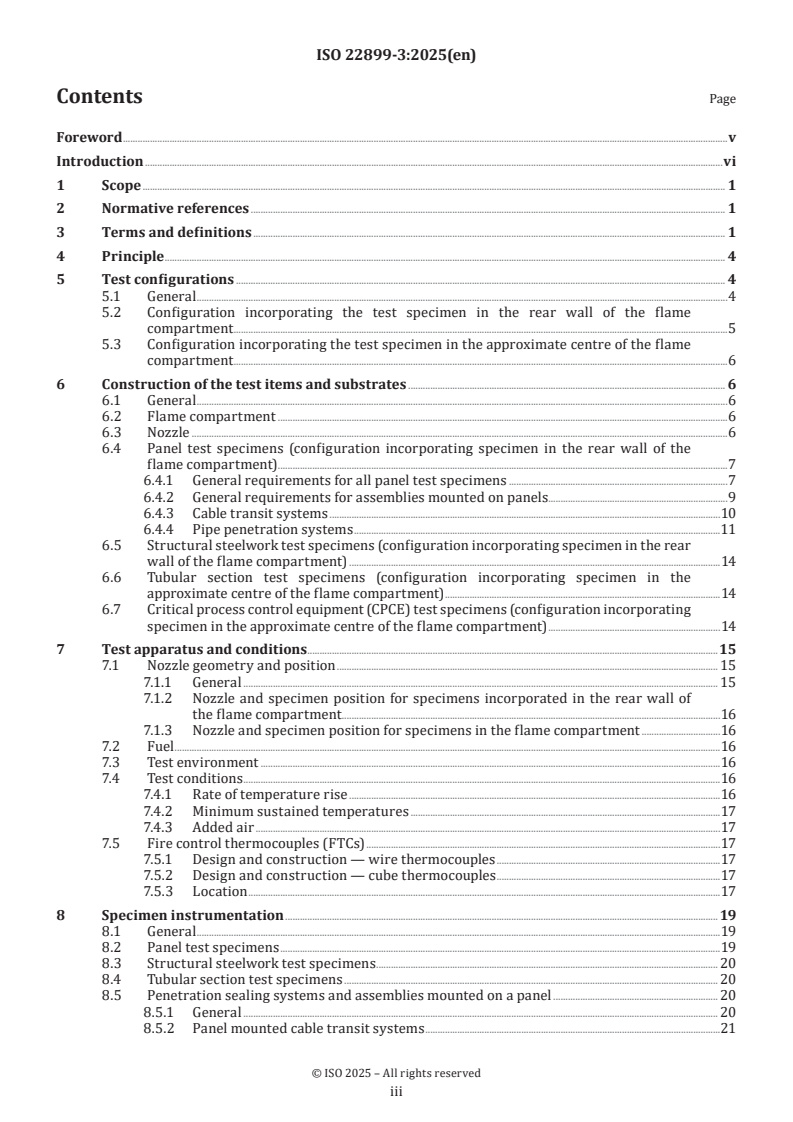
Contents Page
Foreword .v
Introduction .vi
1 Scope . 1
2 Normative references . 1
3 Terms and definitions . 1
4 Principle . 4
5 Test configurations . 4
5.1 General .4
5.2 Configuration incorporating the test specimen in the rear wall of the flame
compartment .5
5.3 Configuration incorporating the test specimen in the approximate centre of the flame
compartment .6
6 Construction of the test items and substrates . 6
6.1 General .6
6.2 Flame compartment .6
6.3 Nozzle .6
6.4 Panel test specimens (configuration incorporating specimen in the rear wall of the
flame compartment) .7
6.4.1 General requirements for all panel test specimens .7
6.4.2 General requirements for assemblies mounted on panels.9
6.4.3 Cable transit systems .10
6.4.4 Pipe penetration systems .11
6.5 Structural steelwork test specimens (configuration incorporating specimen in the rear
wall of the flame compartment) .14
6.6 Tubular section test specimens (configuration incorporating specimen in the
approximate centre of the flame compartment) .14
6.7 Critical process control equipment (CPCE) test specimens (configuration incorporating
specimen in the approximate centre of the flame compartment) .14
7 Test apparatus and conditions . .15
7.1 Nozzle geometry and position . 15
7.1.1 General . 15
7.1.2 Nozzle and specimen position for specimens incorporated in the rear wall of
the flame compartment . .16
7.1.3 Nozzle and specimen position for specimens in the flame compartment .16
7.2 Fuel .16
7.3 Test environment .16
7.4 Test conditions .16
7.4.1 Rate of temperature rise .16
7.4.2 Minimum sustained temperatures .17
7.4.3 Added air .17
7.5 Fire control thermocouples (FTCs) .17
7.5.1 Design and construction — wire thermocouples .17
7.5.2 Design and construction — cube thermocouples .17
7.5.3 Location .17
8 Specimen instrumentation . 19
8.1 General .19
8.2 Panel test specimens .19
8.3 Structural steelwork test specimens . 20
8.4 Tubular section test specimens . 20
8.5 Penetration sealing systems and assemblies mounted on a panel . 20
8.5.1 General . 20
8.5.2 Panel mounted cable transit systems .21
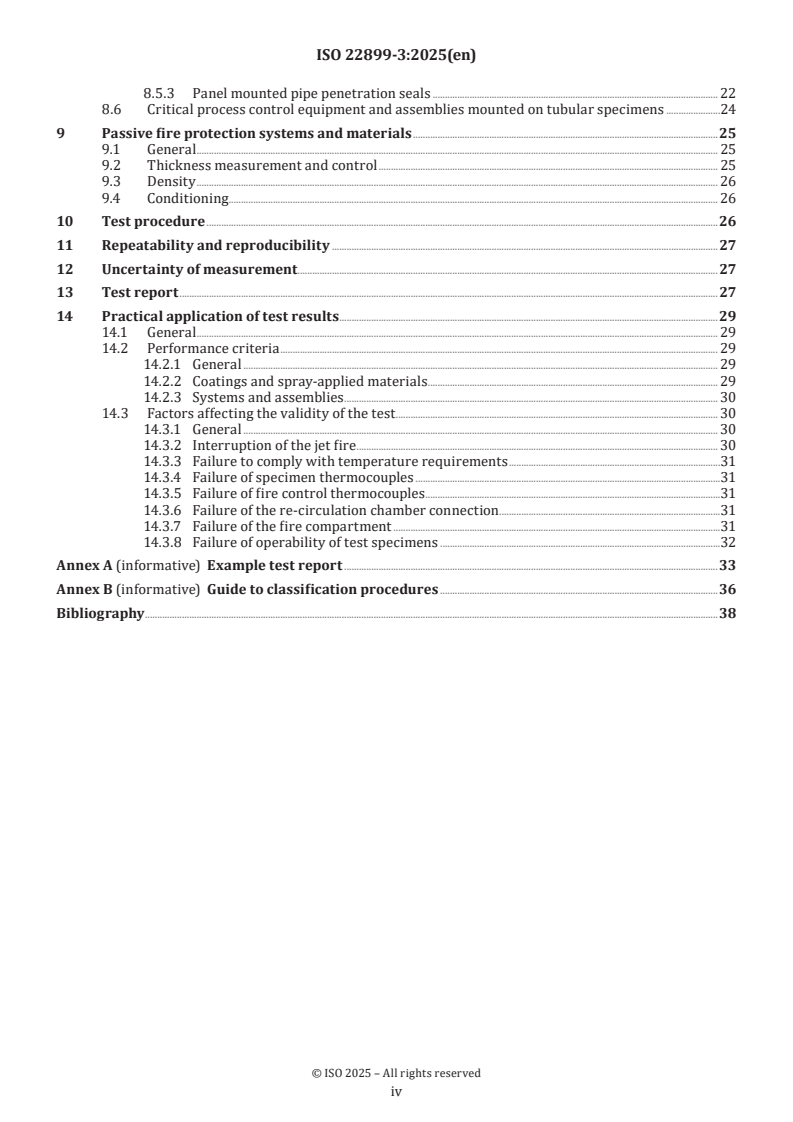
iii
8.5.3 Panel mounted pipe penetration seals . 22
8.6 Critical process control equipment and assemblies mounted on tubular specimens .24
9 Passive fire protection systems and materials .25
9.1 General . 25
9.2 Thickness measurement and control . 25
9.3 Density . 26
9.4 Conditioning. 26
10 Test procedure .26
11 Repeatability and reproducibility .27
12 Uncertainty of measurement .27
13 Test report .27
14 Practical application of test results .29
14.1 General . 29
14.2 Performance criteria . 29
14.2.1 General . 29
14.2.2 Coatings and spray-applied materials . 29
14.2.3 Systems and assemblies . 30
14.3 Factors affecting the validity of the test . 30
14.3.1 General . 30
14.3.2 Interruption of the jet fire . 30
14.3.3 Failure to comply with temperature requirements .31
14.3.4 Failure of specimen thermocouples .31
14.3.5 Failure of fire control thermocouples .31
14.3.6 Failure of the re-circulation chamber connection .31
14.3.7 Failure of the fire compartment .31
14.3.8 Failure of operability of test specimens .32
Annex A (informative) Example test report .33
Annex B (informative) Guide to classification procedures .36
Bibliography .38
iv
Foreword
ISO (the International Organization for Standardization) is a worldwide federation of national standards
bodies (ISO member bodies). The work of preparing International Standards is normally carried out through
ISO technical committees. Each member body interested in a subject for which a technical committee
has been established has the right to be represented on that committee. International organizations,
governmental and non-governmental, in liaison with ISO, also take part in the work. ISO collaborates closely
with the International Electrotechnical Commission (IEC) on all matters of electrotechnical standardization.
The procedures used to develop this document and those intended for its further maintenance are described
in the ISO/IEC Directives, Part 1. In particular, the different approval criteria needed for the different types
of ISO document should be noted. This document was drafted in accordance with the editorial rules of the
ISO/IEC Directives, Part 2 (see www.iso.org/directives).
ISO draws attention to the possibility that the implementation of this document may involve the use of (a)
patent(s). ISO takes no position concerning the evidence, validity or applicability of any claimed patent
rights in respect thereof. As of the date of publication of this document, ISO had not received notice of (a)
patent(s) which may be required to implement this document. However, implementers are cautioned that
this may not represent the latest information, which may be obtained from the patent database available at
www.iso.org/patents. ISO shall not be held responsible for identifying any or all such patent rights.
Any trade name used in this document is information given for the convenience of users and does not
constitute an endorsement.
For an explanation of the voluntary nature of standards, the meaning of ISO specific terms and expressions
related to conformity assessment, as well as information about ISO's adherence to the World Trade
Organization (WTO) principles in the Technical Barriers to Trade (TBT), see www.iso.org/iso/foreword.html.
This document was prepared by Technical Committee ISO/TC 92, Fire safety, Subcommittee SC 2, Fire
Resistance.
A list of all parts in the ISO 22899 series can be found on the ISO website.
Any feedback or questions on this document should be directed to the user’s national standards body. A
complete listing of these bodies can be found at www.iso.org/members.html.
v
Introduction
The tests and procedures described in ISO 22899-1 are designed to give an indication of how passive fire
protection materials and systems will perform in a jet fire. This document provides extended test procedures
to meet three objectives:
1) to permit testing of critical process control equipment;
2) to permit an increase in the size and configurations of specimen that can be tested; and
3) to give an indication of how passive fire protection materials and systems will perform in a severe
jet fire associated with significant confinement or other severe release scenarios that can generate
sustained heat fluxes of 350 kW/m .
Guidance on the applicability of the test is covered in Reference [9].
Even with the extended test procedures herein, the dimensions of the test specimen can be smaller than
typical items of structure and plant and the release of gas can be substantially less than that which might
occur in a credible event. However, individual thermal and mechanical loads imparted to the passive fire
protection material from the jet fire defined in this document have been shown by simulation to be similar to
those imparted by a wide range of large-scale jet fires resulting from high-pressure releases of a range of fuels.
Although the method specified has been designed to simulate some of the conditions that occur in an actual
jet fire, it cannot reproduce them all exactly and the thermal and mechanical loads do not necessarily
coincide. The results of this test do not guarantee safety but may be used as elements of a fire risk assessment
for structures or plants. Such a fire risk assessment should also take into account all the other factors
that are pertinent to an assessment of the fire hazard for a particular end use. The test described in this
[2]
document is not intended to replace the hydrocarbon fire resistance test (EN 1363-2 ) or the test described
in ISO 22899-1. Rather, it is a complementary test.
vi
International Standard ISO 22899-3:2025(en)
Determination of the resistance to jet fires of passive fire
protection materials —
Part 3:
Extended test requirements
1 Scope
This document describes an extended test method determining the resistance to jet fires of passive fire
protection (PFP) materials and systems or critical process control equipment. It gives an indication of how
PFP material or equipment behaves in a severe jet fire and provides performance data under the specified
conditions.
It does not include an assessment of other properties of the passive fire protection material such as
weathering, ageing, shock resistance, impact or explosion resistance, or smoke production.
This document is intended to be complementary to ISO 22899-1. It is intended for use in situations when the
required fire conditions or limitations on test specimen size or type preclude application of ISO 22899-1.
2 Normative references
The following documents are referred to in the text in such a way that some or all of their content constitutes
requirements of this document. For dated references, only the edition cited applies. For undated references,
the latest edition of the referenced document (including any amendments) applies.
ISO 834-1:1999, Fire-resistance tests — Elements of building construction — Part 1: General requirements
ISO 13702, Oil and gas industries — Control and mitigation of fires and explosions on offshore production
installations — Requirements and guidelines
ISO 22899-1:2021, Determination of the resistance to jet fires of passive fire protection materials — Part 1:
General requirements
3 Terms and definitions
For the purposes of this document, the following terms and definitions apply.
ISO and IEC maintain terminology databases for use in standardization at the following addresses:
— ISO Online browsing platform: available at https:// www .iso .org/ obp
— IEC Electropedia: available at https:// www .electropedia .org/
3.1
assembly
unit or structure composed of a combination of materials or products, or both
3.2
critical process control equipment
CPCE
industrial equipment that performs a safety-critical function by actively changing a hydrocarbon
processing routine
Note 1 to entry: This can include valves, actuators, sensors, control panels, transducers, junction boxes, etc.
3.3
critical temperature
maximum temperature that the equipment, assembly or structure to be protected is allowed to reach
3.4
ΔT
max
maximum temperature rise recorded by any of the installed thermocouples
3.5
fire barrier
separating element that resists the passage of flame, heat effluents, or a combination of these, for a period of
time under specified conditions
3.6
fire resistance
ability of an item to fulfil, for a stated period of time, the required stability, integrity or thermal insulation,
or a combination of these three criteria, along with another expected duty if applicable (such as a restriction
from reaching the critical temperature) specified in a standard fire-resistance test
3.7
fire test
procedure designed to measure or assess the performance of a material, product, structure or system to one
or more aspects of fire
3.8
flame compartment
chamber constructed around the nozzle to contain the test specimen, increasing the size of the fireball and
increasing heat fluxes
3.9
flame re-circulation chamber
mild steel box, open at the front, and as defined in ISO 22899-1, into which the jet fire is directed giving a re-
circulating flame resulting in a fireball
Note 1 to entry: Materials other than mild steel may be used when appropriate.
3.10
integrity
ability of a separating element, when exposed to fire on one side, to prevent the passage of flames and
hot gases or the occurrence of flames on the unexposed side, for a stated period of time in a standard fire
resistance test
3.11
intermediate-scale test
test performed on an item of medium dimensions
Note 1 to entry: A test performed on an item of which the maximum dimension is between 1 m and 3 m is usually
called “an intermediate-scale test”. This document describes an intermediate-scale jet fire test.
3.12
jet fire
ignited discharge of propane vapour under pressure
3.13
jet nozzle
assembly from which the flammable material issues
3.14
outside specimen diameter
specimen diameter measured to the outer surface of the passive fire protection system on a tubular
specimen
3.15
operability
ability of an item of process control equipment to perform its required function
Note 1 to entry: The required function can be either a change in state (opening or closing) or the activation of a change
in state.
3.16
passive fire protection
PFP
coating or cladding arrangement or free-standing system which, in the event of fire, will provide thermal
protection to restrict the rate at which heat is transmitted to the object or area being protected
Note 1 to entry: The term "passive" is used to distinguish the systems tested, including those systems that react
chemically (e.g. intumescents), from active systems such as water deluge.
3.17
passive fire protection material
PFP material
PFP system
material or system, such as a coating, cladding removable jacket or inspection panel, cable transit system,
pipe penetration seal or other such system that, in the event of a fire, will provide thermal protection to
restrict the rate at which heat is transmitted to the object or area being protected
3.18
penetration seal
seal used to maintain the fire resistance of a separating element at the position where there is provision for
services to pass through the separating element
3.19
protective chamber
mild steel box, open at the front and back, which is designed to be attached to the rear of the flame
re-circulation chamber to shield the rear of the flame re-circulation chamber from environmental influences
Note 1 to entry: A protective chamber is not required for tubular section tests but may be used to provide additional
stability to the flame re-circulation chamber, if used.
3.20
temperature rise
rise in measured temperature above the initial temperature at a given location
3.21
coaming
raised border around a penetration
3.22
transit sealing system
cable transit consisting of a metal frame, box or coaming, penetration seal or material and cables
Note 1 to entry: It may be uninsulated, partially insulated or fully insulated.
4 Principle
The method provides an indication of how PFP materials or systems or critical process control equipment
performs in a severe jet fire that can occur, for example, in petrochemical installations. It aims to simulate the
thermal and mechanical loads imparted to passive fire protection material by large-scale jet fires resulting
from high-pressure releases of flammable gas, pressure liquefied gas or flashing liquid fuels through use
of an intermediate-scale test. Jet fires give rise to high convective and radiative heat fluxes as well as high
−1
erosive forces. To generate both types of heat flux in sufficient quantity, a 0,3 kg s sonic release of gas is
aimed into a partially enclosed compartment, producing an extended fireball. The heat flux to the specimen
is increased beyond that of ISO 22899-1 due to an increase in the flame thickness and radiation from the
flame compartment. Propane is used as the fuel since it has a greater propensity to form soot than natural
gas and can therefore produce a flame of higher luminosity. The high erosive forces generated by the release
of the sonic velocity gas jet 1 m from the specimen surface are equivalent to those produced in ISO 22899-1.
5 Test configurations
5.1 General
There are two basic configurations under which the test can be operated:
a) a configuration where the rear wall of the flame compartment incorporates the test specimen;
b) a configuration where the test specimen is installed on supports inside the approximate centre of the
flame compartment.
These two alternative configurations are shown in Figures 1 and 2.
Dimensions in millimetres
Key
1 roof blocks
2 aerated concrete blocks for rear wall and side walls (not shown)
3 protective chamber
4 test specimen, consisting of a structural box, a panel incorporated within the rear wall, or consisting of an entire
construction instead of the rear wall.
5 jet nozzle
6 optional air inlets
Figure 1 — Layout for configuration incorporating the test specimen in a wall of the flame
compartment
Dimensions in millimetres
Key
1 roof blocks
2 aerated concrete blocks for rear wall and side walls (not shown)
3 test specimen
4 test specimen mounted within the wall or on end supports
5 jet nozzle
6 optional air inlets
Figure 2 — Layout for configuration incorporating the test specimen in the approximate centre of
the flame compartment
5.2 Configuration incorporating the test specimen in the rear wall of the flame
compartment
The rear wall test configuration is used for determining the jet fire resistance of:
a) protection systems for plane surfaces;
b) protection systems for structural steelwork with an open profile;
c) fire barriers;
d) penetration and transit sealing systems used in conjunction with fire barriers.
5.3 Configuration incorporating the test specimen in the approximate centre of the flame
compartment
The central test configuration is used for determining the jet fire resistance of:
a) critical process control equipment not used in conjunction with fire barriers;
b) protection systems for structural steelwork with a closed (hollow) profile;
c) PFP systems and assemblies mounted on structural sections with a closed (hollow) profile.
6 Construction of the test items and substrates
6.1 General
The key items required for the test are the jet release nozzle, the test specimen (which can, but does not
necessarily, include a flame re-circulation chamber and a protective chamber) and the flame compartment.
These items are required for all configurations of the test. In the configuration of the test where the test
specimen is in the approximate centre of the fire compartment, the flame re-circulation chamber and
protective chamber is not used.
6.2 Flame compartment
The flame compartment shall be constructed of a rear wall, 2 sides walls and a roof. Walls shall be constructed
from aerated concrete blocks, or other suitable insulative material, and shall be parallel or perpendicular to
each other. The width of the flame compartment shall be 2 500 mm to 3 000 mm, measured across the width
of the opening. The depth of the flame compartment shall be greater than or equal to 2 500 mm, measured
from the opening to the rear wall. The height of the flame compartment shall be 3 000 mm to 4 000 mm,
measured from the floor to the roof.
The roof shall extend from the test specimen to the opening for a minimum distance of 1 400 mm, with
the exact distance determined by the requirement to meet the temperature requirements during the test
described in 7.4.
The flame compartment may be insulated (in whole or in part) with a fire-resistant board or blanket to
ensure rapid temperature rise at the start of the test and to reduce the dependency of the test on wall
construction. Retention of the insulation shall be designed to ensure the insulation remains in place for a
minimum of 30 minutes, and failure or detachment of the insulation thereafter shall not happen in a manner
that impedes heating of the test specimen.
NOTE Failure of any side wall insulation after the temperature requirements in 7.4.1 can affect the validity of the
test, as described in 14.3.7.
The flame compartment may be equipped with two air inlets, positioned on the floor symmetrically on
either side of the nozzle. Air may be blown into the fire compartment during the test if required to reach the
conditions stated in 7.4.
The flame compartment may have a front wall up to the mid-height of the compartment and a vent (or vents),
to help achieve the test condition requirements in 7.4.
Test specimens that extend beyond the flame compartment wall or are mounted within the flame
compartment wall shall have any openings sealed to prevent loss of hot gases from the flame compartment
at the edges of specimens.
6.3 Nozzle
The fuel shall be released towards the specimen from a nozzle as defined in ISO 22899-1:2021, 6.3. The
tapered, converging nozzle shall be of length 200 mm ± 1 mm, inlet diameter 52 mm ± 0,5 mm and outlet
diameter 17,8 mm ± 0,2 mm. Figure 3 shows the details of construction. The nozzle shall be constructed of
heat resistant stainless steel. Provisions may be made for fitting a sighting device.
The nozzle shall be a minimum of 1 000 mm above the floor of the fire compartment. The nozzle and, if
necessary, the connecting fuel line shall be protected such that the position of the nozzle does not change
throughout the test by more than 50 mm.
Dimensions in millimetres
Figure 3 — Nozzle
6.4 Panel test specimens (configuration incorporating specimen in the rear wall of the
flame compartment)
6.4.1 General requirements for all panel test specimens
The panel test specimen shall consist of a panel mounted within a rigid frame to permit connection to the
adjacent flame compartment chamber wall. The test specimen may form part or all of the rear wall of the
fire compartment. The connection between the panel and the frame or adjacent fire compartment wall shall
be gas tight. The method of mounting depends on the type of passive fire protection as described in 9.1.
The panel specimen shall be used for cases that simulate fire barriers, steelwork with no corners or edge
features, cylindrical or spherical vessels, pipes and tubular sections of outside diameter greater than
500 mm. The panel shall have minimum dimensions of 1 620 mm × 1 620 mm and shall be constructed from
10 mm thick steel or designed to replicate the material and thickness of the item being simulated.
Specimens with dimensions 1 620 mm × 1 620 mm may use a flame recirculation chamber as described in
ISO 22899-1:2021, 6.4 and shall use a protective chamber based on that in ISO 22899-1:2021, 6.5.
Specimens of size greater than that specified in ISO 22899-1:2021, 6.4 may be protected from environmental
effects on the non-fire side using other means, as determined by the test laboratory in accordance with the
test sponsor.
NOTE It is recognized that the protective chamber described in ISO 22899-1:2021, 6.5 is not practical for
specimens significantly larger than those described in ISO 22899-1:2021, 6.4. Therefore, other methods are permitted
to protect the non-fire side of such specimens.
When the passive fire protection material is in the form of a panel, the panel shall be fixed to act as part of
the rear wall of the flame compartment. Specimens that use a flame recirculation chamber as described in
ISO 22899-1:2021, 6.4 shall be fixed so that the front of the recirculation chamber is flush with the rear wall
of the flame compartment.
The method of mounting shown in Figure 4 depends on the type of passive fire protection and is detailed as
follows.
a) For a rigid stand-alone panel, at least one joint shall be included in the panel and this shall be positioned
vertically, offset from the centre by 250 mm ± 50 mm. If the joint is not symmetrically resistant to a jet
fire flowing across the front of the rear wall of the flame re-circulation chamber (e.g. a lap joint) the
joint shall be oriented to give the most severe exposure to the jet fire as shown in Figure 12. The rigid
panel may extend to the full dimensions of the substrate as discussed in 6.5.
b) If the panel profile is not planar (e.g. trapezoidal), it can be necessary to incorporate a rigid surround
around the panel to achieve a gas tight connection.
c) When the passive fire protection material is in the form of a flexible panel, it can be necessary to
incorporate a rigid surround (e.g. 50 mm box section steel) around the panel to achieve a gas tight
connection as shown in Figure 4.
d) When the passive fire protection is in the form of a coating, mesh joints shall be in accordance with
requirements of ISO 22899-1.
The connection between the test specimen and the flame compartment shall be sealed to prevent passage of
hot gases, for example, using soft mastic or fibre.
If a flame recirculation chamber is used, the connection between the panel and the flame recirculation
chamber shall be sealed to prevent passage of hot gases (for example, using soft mastic or fibre) and the side,
top and bottom walls of the flame re-circulation chamber shall be protected by an alkaline earth silicate
board insulation material or other suitable passive fire protection material.
Key
1 joint
2 face exposed to jet fire
3 flat rigid panel
4 profile rigid panel
5 box section surround or alternative rigid frame
6 passive fire protection covering
7 passive fire protection coating
Figure 4 — Different types of panel PFP
6.4.2 General requirements for assemblies mounted on panels
Penetration sealing systems or assemblies to be mounted in a fire barrier shall be mounted onto a jet-fire
resistant panel made from the type of division to be used in the intended application and constructed in
accordance with 6.4.
The panel, within the frame, shall be incorporated within the rear wall of the flame compartment as shown
in Figure 1. The connection between the panel and the frame or walls of the fire compartment shall be sealed
to prevent passage of hot gases, for example, using soft mastic or fibre. The side, top and bottom walls of the
frame shall be protected by an alkaline earth silicate board insulation material or other suitable passive fire
protection material.
If the assembly cannot be tested full size without affecting the key features of the test, then a reduced scale
assembly can be used, provided it reproduces the key features of the intended application.
The assembly shall be positioned no closer than 200 mm from exposed edges of the panel. The position for
a single panel mounted assembly should be offset horizontally from the jet impingement point by 100 mm.
Where two or more assemblies are to be tested simultaneously in a panel, the separation between adjacent
assemblies shall be at least 200 mm. If two assemblies are tested simultaneously, they shall be placed
symmetrically about either side of the vertical centreline of the panel. When two or more assemblies are to
be tested simultaneously, all assemblies shall be offset from the jet impingement point by 100 mm, situated
at a height greater than that of the jet impact point, and separated from other assemblies and the edges of
the panel by at least 200 mm.
When the size or shape of assemblies prevent this from being achieved with the jet impingement point at
a height of 1 375 mm from the floor of the flame compartment, the nozzle may be raised to a maximum
height above the floor of the fire compartment of 1 600 mm. The distance from the assemblies to the jet
impingement point shall include any insulation which is part of the system.
The positions for a single panel mounted assembly and two panel mounted assemblies are given in Figure 5.
The positioning of features that may affect the flow of the jet fire shall be at the discretion of the test
laboratory and any third-party certifying body.
Dimensions in millimetres
Key
1 jet position
Figure 5 — Positions of panel mounted assemblies
6.4.3 Cable transit systems
The metal frame, box or coaming shall be mounted into a panel representative of the fire barrier using the
normal method. For example, the frame, box or coaming which supports the cable transit system may be
incorporated into a fire barrier. The frame, box or coaming should be fitted such that it is flush with the front
surface of the panel. The fire barrier is then welded into a hole cut into a support panel, e.g. a firewall. This
forms the test specimen. The transit(s) shall be tested incorporating a range of different types of cable (e.g.
in terms of number and type of conductor, type of sheathing, type of insulation material or size) and should
provide an assembly which represents a practical situation. No more than 40 % of the inside cross-sectional
area of each transit shall be occupied by cables and the distances between the cables and the inside of the
transit shall be the minimum which is allowable for the actual transit sealing system. The cables shall project
no more than 250 mm beyond the panel on the exposed side of the panel and 500 mm on the unexposed side.
6.4.4 Pipe penetration systems
A pipe penetration sealing system typically consists of a sleeve or collar mounted in the rear wall of the
flame re-circulation chamber forming an annulus through which a pipe of smaller diameter passes. The
sealing system is designed to provide a fire-resistant barrier for the gap between the sleeve or collar and
the pipe to prevent the passage fire smoke or flames and, where required, ensure the insulation rating of the
division is maintained.
These systems generally come in two forms: pack type systems that fill the void between the outer surface
of the pipe and the inner surface of the sleeve or collar and wrap type systems that wrap around the outside
of the sleeve or collar and the outside of the pipe.
When testing a penetration, the maximum outside dimension, including any PFP, should not exceed
400 mm in diameter. When testing two penetrations, the aggregate of the two outside dimensions should
not exceed 500 mm.
EXAMPLE A 400 mm diameter penetration can be tested alongside a 100 mm diameter penetration.
When testing a single penetration, either the left or the right position may be used and the other shall be left
blank. Pipe penetrations shall have a minimum separation distance of 200 mm from the insulation on the
insides of the flame re-circulation chamber. Each penetration shall be positioned so that the outside edge of
the penetration is horizontally offset from the centre line by between 100 mm and 150 mm.
The centre of the first and second pipe penetration tested shall be vertically offset from the jet impact
position by 100 mm. The relative positions described are illustrated in Figure 6.
When testing wrap-type penetrations, the longitudinal joint shall be positioned so that it faces the jet
impact point.
Where PFP or insulation is added outside the seal onto either the sleeve or collar, or on the pipe, or both, it
shall be deemed to be part of the sealing system when defining its fire rating and shall be recorded in the
test report.
Dimensions in millimetres
Key
1 jet impingement point
2 insulation on the inside edge of the recirculation chamber
3 pipe penetration
4 orientation of the joint towards the jet impingement p
...
Questions, Comments and Discussion
Ask us and Technical Secretary will try to provide an answer. You can facilitate discussion about the standard in here.
Loading comments...