


ISO 16750-2:2023
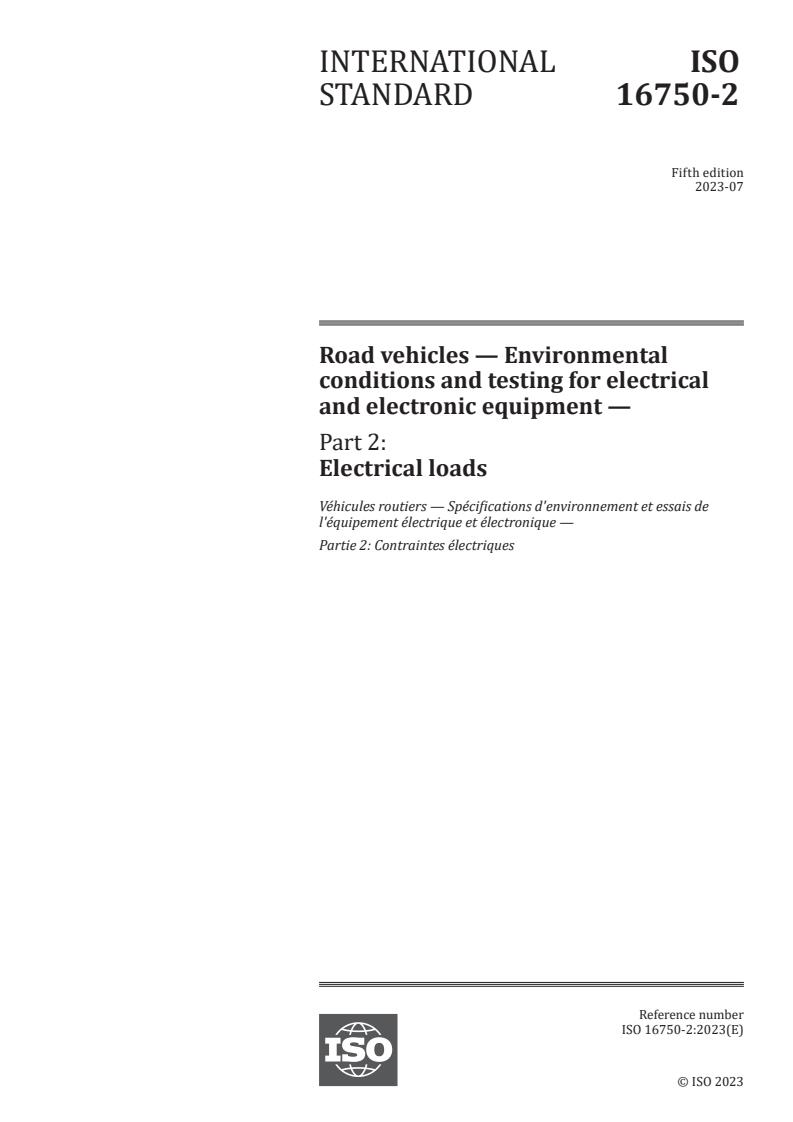
(Main)Road vehicles — Environmental conditions and testing for electrical and electronic equipment — Part 2: Electrical loads
Road vehicles — Environmental conditions and testing for electrical and electronic equipment — Part 2: Electrical loads
This document applies to electric and electronic systems/components for road vehicles. This document describes the potential environmental stresses and specifies tests and requirements for the specific mounting location on/in the road vehicle. This document describes electrical loads. This document is not intended to apply to environmental requirements or testing for systems and components of motorcycles and mopeds. Electromagnetic compatibility (EMC) is not covered by this document. Electrical loads are independent from the mounting location, but can vary due to the electrical impedance (including both the resistance and the inductance) in the vehicle wiring harness and connection system. Systems and their components released for production, or systems and their components already under development prior to the publication date of this document, can be exempted from fulfilling the changes in this edition compared to the previous one.
Véhicules routiers — Spécifications d'environnement et essais de l'équipement électrique et électronique — Partie 2: Contraintes électriques
General Information
- Status
- Published
- Publication Date
- 11-Jul-2023
- Technical Committee
- ISO/TC 22/SC 32 - Electrical and electronic components and general system aspects
- Drafting Committee
- ISO/TC 22/SC 32/WG 2 - Environmental conditions
- Current Stage
- 6060 - International Standard published
- Start Date
- 12-Jul-2023
- Due Date
- 14-Sep-2022
- Completion Date
- 12-Jul-2023
Relations
- Effective Date
- 23-Jun-2018
Overview
ISO 16750-2:2023 - Road vehicles: Environmental conditions and testing for electrical and electronic equipment - Part 2: Electrical loads - defines electrical load tests and requirements for automotive electrical/electronic systems and components. The fifth edition updates and expands test methods (e.g., transient overvoltage, load dump verification, extended superimposed alternating voltage range) while clarifying test conditions and operating-mode usage. This standard applies to road vehicles (excluding motorcycles and mopeds) and is intended for OEMs, suppliers, test labs and design engineers involved in automotive electronics validation.
Key topics and technical requirements
- Scope and applicability
- Covers electrical loads independent of mounting location; excludes EMC testing.
- Systems already in production or under development prior to publication may be exempt from edition changes.
- Test categories included
- Direct current (DC) supply voltage (minimum/maximum supply verification)
- Overvoltage (long-term and transient)
- Superimposed alternating voltage (extended to higher frequencies)
- Slow decrease/increase of supply voltage, micro interruptions and drops
- Reset behaviour at voltage drop, starting profiles and load dump
- Reversed voltage, ground reference and supply offset
- Open circuit (single/multiple line interruption)
- Short circuit / overload protection and overloading tests
- Withstand voltage and insulation resistance
- General test rules
- Measurements are taken at the device-under-test (DUT) terminals.
- Minimum sample size: two DUTs for validation (larger samples by agreement).
- Tolerances (unless specified otherwise): frequency/time ±5%, voltages ±0.2 V, currents ±2%, inductance ±10%, resistance ±10%.
- Special provisions for devices on secondary feed (e.g., 5 V sensors supplied from a 12 V DUT) - tests adjusted based on actual vehicle installation.
- New / revised features in 2023 edition
- Use of operating modes for electrical tests, transient overvoltage introduction, updated superimposed alternating voltage test (up to 200 kHz), micro interruption tests, and more detailed reverse-voltage and ground-offset specifications.
Practical applications - who uses it and why
- Automotive OEMs and Tier-1/2 suppliers use ISO 16750-2 to define electrical robustness requirements during design, validation and supplier contracts.
- Test laboratories implement the specified test methods (DC supply profiles, load dump, interruptions, over/under voltage) to certify component resilience.
- Design and quality engineers rely on the standard to design protective circuits (e.g., short-circuit protection, reverse-polarity protection) and to ensure components tolerate real vehicle electrical stresses.
- Procurement and compliance teams reference the standard when specifying contractual test criteria and ensuring components meet industry-accepted environmental load requirements.
Related standards
- ISO 16750-1: General requirements and terminology (referenced for operating modes and definitions)
- ISO 16750-4: Climatic loads
- ISO 8820 (all parts): Fuse-links
Keywords: ISO 16750-2:2023, electrical loads, automotive environmental testing, load dump, overvoltage, DC supply voltage, road vehicle electronics, automotive standards.
Get Certified
Connect with accredited certification bodies for this standard

TÜV Rheinland
TÜV Rheinland is a leading international provider of technical services.

TÜV SÜD
TÜV SÜD is a trusted partner of choice for safety, security and sustainability solutions.

AIAG (Automotive Industry Action Group)
American automotive industry standards and training.
Sponsored listings
Frequently Asked Questions
ISO 16750-2:2023 is a standard published by the International Organization for Standardization (ISO). Its full title is "Road vehicles — Environmental conditions and testing for electrical and electronic equipment — Part 2: Electrical loads". This standard covers: This document applies to electric and electronic systems/components for road vehicles. This document describes the potential environmental stresses and specifies tests and requirements for the specific mounting location on/in the road vehicle. This document describes electrical loads. This document is not intended to apply to environmental requirements or testing for systems and components of motorcycles and mopeds. Electromagnetic compatibility (EMC) is not covered by this document. Electrical loads are independent from the mounting location, but can vary due to the electrical impedance (including both the resistance and the inductance) in the vehicle wiring harness and connection system. Systems and their components released for production, or systems and their components already under development prior to the publication date of this document, can be exempted from fulfilling the changes in this edition compared to the previous one.
This document applies to electric and electronic systems/components for road vehicles. This document describes the potential environmental stresses and specifies tests and requirements for the specific mounting location on/in the road vehicle. This document describes electrical loads. This document is not intended to apply to environmental requirements or testing for systems and components of motorcycles and mopeds. Electromagnetic compatibility (EMC) is not covered by this document. Electrical loads are independent from the mounting location, but can vary due to the electrical impedance (including both the resistance and the inductance) in the vehicle wiring harness and connection system. Systems and their components released for production, or systems and their components already under development prior to the publication date of this document, can be exempted from fulfilling the changes in this edition compared to the previous one.
ISO 16750-2:2023 is classified under the following ICS (International Classification for Standards) categories: 43.040.10 - Electrical and electronic equipment. The ICS classification helps identify the subject area and facilitates finding related standards.
ISO 16750-2:2023 has the following relationships with other standards: It is inter standard links to ISO 16750-2:2012. Understanding these relationships helps ensure you are using the most current and applicable version of the standard.
ISO 16750-2:2023 is available in PDF format for immediate download after purchase. The document can be added to your cart and obtained through the secure checkout process. Digital delivery ensures instant access to the complete standard document.
Standards Content (Sample)
INTERNATIONAL ISO
STANDARD 16750-2
Fifth edition
2023-07
Road vehicles — Environmental
conditions and testing for electrical
and electronic equipment —
Part 2:
Electrical loads
Véhicules routiers — Spécifications d'environnement et essais de
l'équipement électrique et électronique —
Partie 2: Contraintes électriques
Reference number
© ISO 2023
All rights reserved. Unless otherwise specified, or required in the context of its implementation, no part of this publication may
be reproduced or utilized otherwise in any form or by any means, electronic or mechanical, including photocopying, or posting on
the internet or an intranet, without prior written permission. Permission can be requested from either ISO at the address below
or ISO’s member body in the country of the requester.
ISO copyright office
CP 401 • Ch. de Blandonnet 8
CH-1214 Vernier, Geneva
Phone: +41 22 749 01 11
Email: copyright@iso.org
Website: www.iso.org
Published in Switzerland
ii
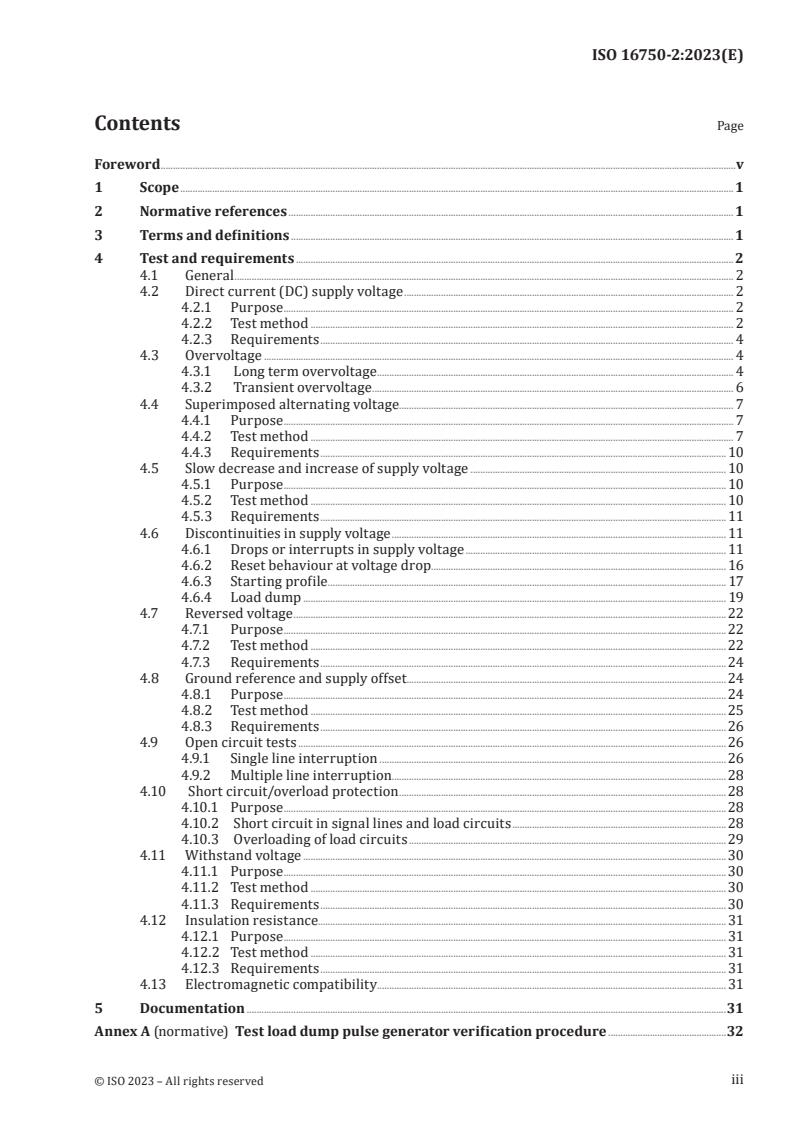
Contents Page
Foreword .v
1 Scope . 1
2 Normative references . 1
3 Terms and definitions . 1
4 Test and requirements .2
4.1 General . 2
4.2 Direct current (DC) supply voltage . 2
4.2.1 Purpose . 2
4.2.2 Test method . 2
4.2.3 Requirements . 4
4.3 Overvoltage . 4
4.3.1 Long term overvoltage . 4
4.3.2 Transient overvoltage . 6
4.4 Superimposed alternating voltage . 7
4.4.1 Purpose . 7
4.4.2 Test method . 7
4.4.3 Requirements . 10
4.5 Slow decrease and increase of supply voltage . 10
4.5.1 Purpose . 10
4.5.2 Test method . 10
4.5.3 Requirements . 11
4.6 Discontinuities in supply voltage . 11
4.6.1 Drops or interrupts in supply voltage . 11
4.6.2 Reset behaviour at voltage drop . 16
4.6.3 Starting profile . 17
4.6.4 Load dump . 19
4.7 Reversed voltage .22
4.7.1 Purpose .22
4.7.2 Test method . 22
4.7.3 Requirements . 24
4.8 Ground reference and supply offset. 24
4.8.1 Purpose . 24
4.8.2 Test method . 25
4.8.3 Requirements . 26
4.9 Open circuit tests . 26
4.9.1 Single line interruption . 26
4.9.2 Multiple line interruption . .28
4.10 Short circuit/overload protection .28
4.10.1 Purpose .28
4.10.2 Short circuit in signal lines and load circuits .28
4.10.3 Overloading of load circuits .29
4.11 Withstand voltage .30
4.11.1 Purpose .30
4.11.2 Test method . 30
4.11.3 Requirements . 30
4.12 Insulation resistance. 31
4.12.1 Purpose . 31
4.12.2 Test method . 31
4.12.3 Requirements . 31
4.13 Electromagnetic compatibility. 31
5 Documentation .31
Annex A (normative) Test load dump pulse generator verification procedure .32
iii
Annex B (informative) Origin of load dump pulse in road vehicles electrical systems .33
Bibliography .34
iv
Foreword
ISO (the International Organization for Standardization) is a worldwide federation of national standards
bodies (ISO member bodies). The work of preparing International Standards is normally carried out
through ISO technical committees. Each member body interested in a subject for which a technical
committee has been established has the right to be represented on that committee. International
organizations, governmental and non-governmental, in liaison with ISO, also take part in the work.
ISO collaborates closely with the International Electrotechnical Commission (IEC) on all matters of
electrotechnical standardization.
The procedures used to develop this document and those intended for its further maintenance are
described in the ISO/IEC Directives, Part 1. In particular, the different approval criteria needed for the
different types of ISO document should be noted. This document was drafted in accordance with the
editorial rules of the ISO/IEC Directives, Part 2 (see www.iso.org/directives).
ISO draws attention to the possibility that the implementation of this document may involve the use
of (a) patent(s). ISO takes no position concerning the evidence, validity or applicability of any claimed
patent rights in respect thereof. As of the date of publication of this document, ISO had not received
notice of (a) patent(s) which may be required to implement this document. However, implementers are
cautioned that this may not represent the latest information, which may be obtained from the patent
database available at www.iso.org/patents. ISO shall not be held responsible for identifying any or all
such patent rights.
Any trade name used in this document is information given for the convenience of users and does not
constitute an endorsement.
For an explanation of the voluntary nature of standards, the meaning of ISO specific terms and
expressions related to conformity assessment, as well as information about ISO's adherence to
the World Trade Organization (WTO) principles in the Technical Barriers to Trade (TBT), see
www.iso.org/iso/foreword.html.
This document was prepared by Technical Committee ISO/TC 22, Road vehicles, Subcommittee SC 32,
Electrical and electronic components and general system aspects.
This fifth edition cancels and replaces the fourth edition (ISO 16750-2:2012), which has been technically
revised.
The main changes are as follows:
— introduction of use of operating mode for the electrical tests;
— introduction of concept with redundant supplies for relevant test cases;
— more detailed specification of direct current supply voltage test;
— more detailed specification of jump start test (overvoltage test at RT);
— introduction of transient overvoltage test;
— complete update of superimposed alternating voltage test (e.g. updated test method, extension of
frequency range to 200 kHz, etc.);
— more detailed specification of slow decrease and increase of supply voltage test;
— introduction of micro interruption in supply voltage test;
— more detailed specification of reset behaviour at voltage drop test;
— explanation of severity levels in starting profile test;
— more detailed specification of reversed voltage test;
v
— more detailed specification of ground reference and supply offset test;
— single line interruption test divided in two test cases; static interruption (single interruption event)
and dynamic interruption (multiple interruption events, i.e. bursts);
— short circuit protection test changed to short circuit/overload protection test. more detailed
specification on test cases. Introduction of test case overloading of load circuits;
— more detailed description of origin of load dump pulse in Annex B;
— various editorial updates and clarifications.
A list of all parts in the ISO 16750 series can be found on the ISO website.
Any feedback or questions on this document should be directed to the user’s national standards body. A
complete listing of these bodies can be found at www.iso.org/members.html.
vi
INTERNATIONAL STANDARD ISO 16750-2:2023(E)
Road vehicles — Environmental conditions and testing for
electrical and electronic equipment —
Part 2:
Electrical loads
1 Scope
This document applies to electric and electronic systems/components for road vehicles. This document
describes the potential environmental stresses and specifies tests and requirements for the specific
mounting location on/in the road vehicle.
This document describes electrical loads.
This document is not intended to apply to environmental requirements or testing for systems and
components of motorcycles and mopeds. Electromagnetic compatibility (EMC) is not covered by this
document.
Electrical loads are independent from the mounting location, but can vary due to the electrical
impedance (including both the resistance and the inductance) in the vehicle wiring harness and
connection system.
Systems and their components released for production, or systems and their components already under
development prior to the publication date of this document, can be exempted from fulfilling the changes
in this edition compared to the previous one.
2 Normative references
The following documents are referred to in the text in such a way that some or all of their content
constitutes requirements of this document. For dated references, only the edition cited applies. For
undated references, the latest edition of the referenced document (including any amendments) applies.
ISO 8820 (all parts), Road vehicles — Fuse-links
ISO 16750-1, Road vehicles — Environmental conditions and testing for electrical and electronic
equipment — Part 1: General
ISO 16750-4:2023, Road vehicles — Environmental conditions and testing for electrical and electronic
equipment — Part 4: Climatic loads
3 Terms and definitions
For the purposes of this document, the terms and definitions given in ISO 16750-1 apply.
ISO and IEC maintain terminology databases for use in standardization at the following addresses:
— ISO Online browsing platform: available at https:// www .iso .org/ obp
— IEC Electropedia: available at https:// www .electropedia .org/
4 Test and requirements
4.1 General
If not otherwise specified, the following tolerances shall apply:
— frequency and time: ±5 %;
— voltages: ±0,2 V;
— currents: ±2 %;
— inductance: ±10 %;
— resistance: ±10 %.
All voltage curves are shown without load.
If not otherwise specified, measure all voltages at the relevant terminals of the DUT.
For devices and units operating on secondary feed (e.g. 5 V sensor being supplied from 12 V supplied
DUT), special considerations shall apply to voltage supply range, and specific tests shall be adjusted with
consideration to the actual vehicle installation. Which tests that are applicable and what considerations
that apply shall be agreed between the customer and the supplier.
NOTE For a device or unit working on secondary feed, the electrical testing is sometimes carried out
together with the 12/24 V supplied DUT providing the secondary feed.
A minimum of two DUTs shall be used for validation. If judged necessary by agreement between the
customer and the supplier, an increased sample size may be used for final validation phases (process
validation).
For redundant supplies and redundantly supplied DUTs, see definition in ISO 16750-1.
4.2 Direct current (DC) supply voltage
4.2.1 Purpose
The purpose of this test is to verify equipment functionality at minimum and maximum supply voltage.
4.2.2 Test method
Set the supply voltage as specified in Table 3 or Table 4 to all relevant inputs (connections) of the DUT.
Use the test profile as described in Figure 1 and Table 2. The test profile shall be run with the DUT in
operating mode 3.3, with the DUT in operating mode 3.4 (i.e. to test both minimum and maximum load
conditions), and at both T and T , as defined in ISO 16750-1. If agreed between the customer and
min max
the supplier, one of the operating modes 3.3 or 3.4 may be chosen for the test.
The test profile shall also be run once at room temperature at normal loading conditions, operating
mode 3.2 as defined in ISO 16750-1.
See Table 1 for combinations of test conditions.
Table 1 — DC supply voltage, combinations of test conditions
Temperature / operating mode T RT T
min max
Operating mode 3.3 U / U - U / U
Smin Smax Smin Smax
Operating mode 3.2 - U / U -
Smin Smax
Operating mode 3.4 U / U - U / U
Smin Smax Smin Smax
Key
t time, in seconds
U test voltage, in volts
Figure 1 — DC supply voltage test profile
Table 2 — Test parameters for DC supply voltage
U See ISO 16750-1
A
U See Table 3 or Table 4
Smax
U See Table 3 or Table 4
Smin
t 30 s
t 60 s
t 1 V/s
rise
t 1 V/s
fall
If the DUT is supplied by two or more redundant supplies, all different possible combinations of U
Smin
and U on the supply input ports of the DUT shall be tested.
Smax
The voltages listed in Table 3 or Table 4 are relevant within the operating temperature range as
specified in ISO 16750-4, without time limits. When considering the minimum and maximum voltage
levels in the vehicle it should be noted that these are highly dependent on the voltage supply in the
electrical system, e.g. DC/DC, alternator.
Table 3 — Supply voltage for system devices with 12 V nominal voltage
Code Minimum supply voltage, U Maximum supply voltage, U
Smin Smax
A 6 V 16 V
B 8 V 16 V
C 9 V 16 V
D 10,5 V 16 V
Z As agreed
Table 4 — Supply voltage for system devices with 24 V nominal voltage
Code Minimum supply voltage, U Maximum supply voltage, U
Smin Smax
E 10 V 32 V
F 16 V 32 V
TTabablele 4 4 ((ccoonnttiinnueuedd))
Code Minimum supply voltage, U Maximum supply voltage, U
Smin Smax
G 22 V 32 V
H 18 V 32 V
Z As agreed
4.2.3 Requirements
Functional status class A as defined in ISO 16750-1 is required during active operating modes when
tested in the supply voltage ranges given in Table 3 or Table 4, respectively.
4.3 Overvoltage
4.3.1 Long term overvoltage
4.3.1.1 Test at a temperature of (T – 20) °C for alternator failure
max
4.3.1.1.1 Purpose
This test simulates the condition where the alternator regulator fails, so that the output voltage of the
alternator rises above normal values.
This test is relevant for both 12 V and 24 V systems.
4.3.1.1.2 Test method
Heat the DUT in a hot air oven to a temperature that is 20 K below the maximum operating temperature,
T .
max
For 12 V systems, apply a voltage of 18 V for 60 min to all relevant inputs (connections) of the DUT.
For 24 V systems, apply a voltage of 36 V for 60 min to all relevant inputs (connections) of the DUT.
The operating mode of the DUT shall be 3.4, as defined in ISO 16750-1.
If the DUT is supplied by two or more redundant supplies, and if agreed between the customer and the
supplier, the test voltage as specified above shall be applied to one of the redundant supply lines at a
time. The other supply or supplies shall then be kept at U as defined in ISO 16750-1.
A
4.3.1.1.3 Requirements
Minimum functional status class C as defined in ISO 16750-1 is required.
Where more stringent requirements are necessary, functional status class A as defined in ISO 16750-1
is required during active operating modes.
4.3.1.2 Test at room temperature and T for jump start
min
4.3.1.2.1 Purpose
This test simulates a jump start from a 24 V system to a 12 V system vehicle. A simulated use case could
be a jump start from a donor vehicle using a 24 V system, but without engine running in the donor
vehicle (i.e. without applied charging on the 24 V side). A use case could also be a jump start from a 24 V
stand-alone battery pack. This test is only applicable for 12 V systems. The test shall be done both in
room temperature conditions and at T . If agreed between the customer and the supplier, test at T
min min
can be omitted.
4.3.1.2.2 Test method
Ensure that the DUT has stabilized at temperature given in Table 5. Apply a voltage of 26 V for (60 ± 6) s
to all relevant inputs (connections) of the DUT as described in Figure 2 and Table 5.
For DUTs necessary for engine start, the operating mode shall be 2.2, as defined in ISO 16750-1. For all
other DUTs, the operating mode shall be 2.3.
If the DUT is supplied by two or more redundant supplies, and if agreed between the customer and
the supplier, the test voltage shall be applied to one of the redundant supply lines at a time. The other
supply or supplies shall then be kept at U as defined in ISO 16750-1.
B
Test shall be performed one time for each temperature value given in Table 5.
Key
t time, in seconds
U test voltage, in volts
U transient test voltage, in volts
trans
U supply voltage, in volts
Smin
n number of transients in sequence
t fall time, in seconds
fall
t transient duration, in seconds
trans
t rise time, in seconds
rise
t rest time between transient events, in seconds
rest
Figure 2 — Jump start transient
Table 5 — Jump start test values
Parameter Temperature t t t t U U n
rise fall trans rest Smin trans
RT ≤ 10 ms ≤ 10 ms 60 s 120 s 10,8 V 26 V 1
12 V system
T ≤ 10 ms ≤ 10 ms 60 s 120 s 10,8 V 26 V 1
min
4.3.1.2.3 Requirements
If not otherwise agreed between the customer and the supplier, minimum functional status class C as
defined in ISO 16750-1 is required.
Where more stringent requirements are necessary, functional status class A as defined in ISO 16750-1
is required during active operating modes.
4.3.2 Transient overvoltage
4.3.2.1 Purpose
This test simulates when a DUT is affected by switching loads or loads injecting current in the electrical
distribution system. This test is relevant for both 12 V and 24 V systems.
4.3.2.2 Test method
Apply the test pulse five times as specified in Figure 3 and Table 6 simultaneously to all relevant inputs
(connections) of the DUT. The operating mode of the DUT shall be 3.4, as defined in ISO 16750-1.
Key
t time, in seconds
U test voltage, in volts
U maximum supply voltage, in volts
Smax
U transient overvoltage, in volts
trans
n number of test pulse in sequence
t fall time, in seconds
fall
t transient pulse duration, in seconds
trans
t rise time, in seconds
rise
t rest time between transient pulses, in seconds
rest
Figure 3 — Test profile for transient overvoltage
Table 6 — Transient overvoltage test values
Parameter t t t t U n
rise fall rest trans trans
12 V system 1 ms 1 ms 1 s 400 ms 18 V 5
24 V system 2 ms 2 ms 1 s 400 ms 36 V 5
If the DUT is supplied by two or more redundant supplies, and if agreed between the customer and
the supplier, the test voltage cycle as specified in Figure 3 and Table 6 shall be applied to one of the
redundant supply lines at a time. The other supply or supplies shall then be kept at U as defined in
A
ISO 16750-1.
4.3.2.3 Requirements
Minimum functional status class B as defined in ISO 16750-1 is required during active operating modes.
For specific applications where there is a need for more stringent control of the voltage range (where
deviations outside of normal voltage range could be considered harmful for design reasons) functional
status class C as defined in ISO 16750-1 can be considered if agreed between the customer and the
supplier.
4.4 Superimposed alternating voltage
4.4.1 Purpose
This test is intended to check immunity of a component to ripples in the on-board system, caused, for
example, by an alternator or a DC/DC converter.
It specifies a conducted voltage test method and procedure for determining the immunity of electronic
components. The method is applied to all DUT power supply lines simultaneously. For a DUT with
redundant supplies, any combination of exposures shall be agreed between the customer and the
supplier.
The severity level 1, 2, 3 and 4 shall be chosen in accordance with the application, see Table 8.
This test is relevant for both 12 V and 24 V systems.
4.4.2 Test method
4.4.2.1 General
Figure 4 is showing a rough overview of the test voltage profile for min. and max. applied superimposed
alternating voltage, a more precise description of the voltage profile can be found in 4.4.2.2 and 4.4.2.3.
Key
t time, in seconds
U test voltage, in volts
U minimum supply voltage, in volts
Smin
U maximum supply voltage, in volts
Smax
U DC level of applied test voltage, in volts
U voltage ripple peak-to-peak value, in volts
pp
Figure 4 — Test profiles for Superimposed alternating voltage
The values of U and U are selected according to code (A … H) in 4.2.2 (Table 3 and Table 4).
Smax Smin
Setup the test with reference to Table 7.
Table 7 — Test parameters for superimposed alternating voltage
U 12 V system 24 V system
N
Operating mode 3.2 3.2
Frequency range f : 10 Hz to 30 kHz f : 10 Hz to 30 kHz
1 1
f : 30 kHz to 200 kHz f : 30 kHz to 200 kHz
2 2
U U = U - U /2 U = U - U /2
0 0 Smax pp 0 Smax pp
U = U + U /2 U = U + U /2
0 Smin pp 0 Smin pp
Dwell time ≥ 2 s ≥ 2 s
Frequency step logarithmic 2 % logarithmic 2 %
Voltage ripple limit: U f : Severity level 1-3 f : Severity level 1-3
pp 1 1
f : Severity level 4 f : Severity level 4
2 2
Current limit: I f : 15 A f : 15 A
pp 1 1
f : 10 A f : 10 A
2 2
Requested test combina- See Table 8 See Table 8
tions
Number of cycles 1 test sequence for each test combina- 1 test sequence for each test combina-
tion tion
Table 8 — Severity level for test Superimposed alternating voltage
Severity level U Frequency range U for 12 V U for 24 V
pp pp pp
1 DUT supplied by alternator without battery 10 Hz to 30 kHz 6 V ± 0,2 V 10 V ± 0,2 V
(emergency run)
2 DUT supplied by alternator 10 Hz to 30 kHz 3 V ± 0,2 V 3 V ± 0,2 V
3 DUT supplied by DC/DC converter 10 Hz to 30 kHz 2 V ± 0,1 V 2 V ± 0,1 V
4 DUT supplied by DC/DC converter 30 kHz to 200 kHz 1 V ± 0,1 V 1 V ± 0,1 V
The power source shall be able to produce the requested ripple voltage and/or the currents in the
specified frequency range.
Prior to starting this test, measure and record the impedance of the DUT at its 12/24 V supply terminals.
Connect an AC voltage measurement (e.g. oscilloscope with voltage probe) to the test signal generator
output (loaded by the DUT) and an AC current measurement device (e.g. oscilloscope with current
probe) and an AC voltage measurement to the DUT input as shown in Table 7 and Figure 5.
Key
1 power supply
2 DUT
U AC ripple voltage at power supply
R
U peak-to-peak AC voltage at DUT
pp
U DC level of applied test voltage, in volts
I peak-to-peak AC current at DUT
pp
Locate voltage meter and ampere meter within 10 cm from the DUT.
Figure 5 — Test setup for superimposed alternating voltage
4.4.2.2 Reference test
Before the test is pursued in operating mode 3.2, a reference test is applied in operating mode 3.3. While
operating the device in 3.3, it shall be ensured that all DUT internal energy buffers (e.g. capacitors,
inductors) are active/present.
NOTE 1 The impedance of energy buffers which are connected in operating mode 3.3 are very important for
the reference test, because it mainly determines the current ripple during the reference test. If the architecture
of the DUT features any switch which disconnects the energy buffers from the power supply, the reference test
would not determine the correct voltage ripple U .
R
The reference test determines the necessary voltage ripple U at the power supply which shall be
R
applied to the DUT in order not to exceed the current limit I for the applied excitation frequency.
pp
For the reference test, each frequency range is tested at the voltage values given in Table 7.
The power supply shall inject an AC voltage ripple U on top of U which shall be progressively increased
R 0
until either the maximum voltage ripple U at the DUT or the maximum current limit I is reached.
pp pp
The ascertained ripple voltages of U of the power supply for every frequency step shall be documented.
R
It is necessary to distinguish between U and U due to the impedance of the cable harness and input
R pp
impedance of the DUT. Therefore, U can be much higher than U .
R pp
NOTE 2 If the DUT contains a low pass input filter (e.g. EMC filter), it is possible that the test is only relevant to
be performed for frequencies where the filter of the DUT has a frequency response of more than -20 dB. Evidence
of the frequency response of the input filter is helpful when determining the appropriate frequency range of the
test. Depending on the impedance of the DUT and the cable harness, too high and unrealistic values of U would
R
be tested at higher frequencies. Therefore, performing the test until this threshold is considered sufficient.
4.4.2.3 Voltage ripple test
In order to perform the voltage ripple test, the ascertained voltage ripple U from the reference test for
R
each frequency step is applied to the DUT in operating mode 3.2. It is not allowed to further reduce the
voltage ripple U even if the current limit I is now exceeded.
R pp
The setup of the test shall be the same as in the reference test (type and length of cable).
Record I and U during the voltage ripple test.
pp pp
If the DUT is supplied by two or more redundant supplies, the following test combinations shall be
performed:
— voltage ripple test as defined in 4.4.2.3 is applied to all redundant supply lines simultaneously;
— voltage ripple test as defined in 4.4.2.3 is applied to one of the redundant supply lines, the other
supply lines held at U as defined in ISO 16750-1. Repeat for each redundant supply line.
Smin
4.4.3 Requirements
Functional status class A as defined in ISO 16750-1 is required during active operating modes. The DUT
impedance shall be measured before and after the test. Tolerance for the impedance measurement shall
be agreed between the customer and the supplier. In case the impedance deviation is bigger than the
agreed tolerance the test is failed corresponding to functional status class E.
4.5 Slow decrease and increase of supply voltage
4.5.1 Purpose
This test simulates a gradual discharge and recharge of the battery. This test is relevant for both 12 V
and 24 V systems.
4.5.2 Test method
Apply the following test simultaneously to all relevant inputs (connections) of the DUT.
Decrease the supply voltage from U to 0 V, then increase it from 0 V to U , as described in Figure 6,
A A
applying a change rate of (0,5 ± 0,1) V/min, either linear, or in equal steps of not more than 25 mV.
Key
t time, in seconds
U test voltage, in volts
U supply voltage for alternator in operation, in volts (see ISO 16750-1)
A
Figure 6 — Test profile for Slow decrease and increase of supply voltage
The operating mode of the DUT shall be 3.2, as defined in ISO 16750-1.
If the DUT is supplied by two or more redundant supplies, the following test combinations shall be
performed:
— test voltage is applied to all redundant supply lines simultaneously;
— test voltage is applied to one of the redundant supply lines, the other supply lines held at U as
A
defined in ISO 16750-1. Repeat for each redundant supply line.
4.5.3 Requirements
Functional status class A as defined in ISO 16750-1 is required during active operating modes when
tested in the supply voltage ranges given in Table 3 or Table 4, respectively. Outside these ranges,
minimum functional status class D as defined in ISO 16750-1 is required.
Where more stringent requirements are necessary, functional status class C as defined in ISO 16750-1
may be specified.
For a DUT with redundant supplies, depending on the combination of exposures, up to functional status
class A may be specified. This shall be agreed between the customer and the supplier.
4.6 Discontinuities in supply voltage
4.6.1 Drops or interrupts in supply voltage
4.6.1.1 Momentary drop in supply voltage
4.6.1.1.1 Purpose
This test simulates the effect when a conventional fuse element melts in a parallel circuit. This test is
relevant for both 12 V and 24 V systems.
4.6.1.1.2 Test method
Apply the test pulse (see Figure 7 and Figure 8) simultaneously to all relevant inputs (connections) of
the DUT. The rise time and fall time shall be not more than 10 ms.
The operating mode of the DUT shall be 3.4, as defined in ISO 16750-1.
Key
t time, in seconds
U test voltage, in volts
U minimum supply voltage, in volts
Smin
Figure 7 — Short voltage drop for systems with 12 V nominal voltage
Key
t time, in seconds
U test voltage, in volts
U minimum supply voltage, in volts
Smin
Figure 8 — Short voltage drop for systems with 24 V nominal voltage
If the DUT is supplied by two or more redundant supplies, and if agreed between the customer and the
supplier, the test voltage with short voltage drop shall be applied to one of the redundant supply lines at
a time. The other supply or supplies shall then be kept at U as defined in ISO 16750-1.
Smin
4.6.1.1.3 Requirements
Minimum functional status class B as defined in ISO 16750-1 is required during active operating modes.
Functional status class C can be permitted if agreed between the customer and the supplier.
For a DUT with redundant supplies, up to functional status class A may be specified. This shall be
agreed between the customer and the supplier.
4.6.1.2 Micro interruption in supply voltage
4.6.1.2.1 Purpose
This test simulates the effect of micro interruption events in supply voltage caused by short circuits or
open circuits of the supply lines, for instance by contact faults, defect relays, relay-contact bounce or by
switching from the main power supply to a redundant power supply.
This test is relevant for both 12 V and 24 V systems.
4.6.1.2.2 Test method
4.6.1.2.2.1 General
To verify the switch reaction time, two reference measurements shall be performed and documented
with the test set up given in Figure 9. In the first reference measurement, the DUT is replaced with a
1 kΩ resistor, and in the second measurement, the DUT is replaced with a 10 Ω resistor. The reference
measurements enable the reaction time of the switch to be verified as acceptable before the full test is
performed. The resistors used shall, therefore, have low inductance. Acceptable reaction time for the
switch shall be ≤ 10 µs. After the transition time performance of the switch has been verified, the DUT
shall be tested with the full set up as shown in Figure 9.
Apply the test simultaneously to all power supply inputs (connections) of the DUT. Both test case 1 (see
Figure 10 and Table 9 in 4.6.1.2.2.2) and test case 2 (see Figure 11 and Table 10 in 4.6.1.2.2.3) shall be
performed.
If the DUT is supplied by two or more redundant supplies, and if agreed between the customer and
the supplier, the test voltage with micro interruptions shall be applied to one of the redundant supply
lines while the others are supplied. The other supply or supplies shall then be kept at U as defined in
B
ISO 16750-1.
While the supply line is interrupted by a switch, inductive voltage peaks shall be avoided, e.g. by
connecting a low resistance parallel load, if agreed between the customer and the supplier.
The following test condition shall be met:
— open switch resistance: ≥ 10 MΩ.
The operating mode of the DUT shall be 3.4, as defined in ISO 16750-1.
Key
1 power supply
2 programmable control circuit to open the switch connection
3 DUT
4 normally closed switch
5 optional low resistance parallel load
Figure 9 — Test set up for micro interruption with 12/24 V nominal voltage (U )
N
4.6.1.2.2.2 Test case 1 - variable interruption time
Key
t time, in seconds
S switch control signal
C switch closed
NC switch open
n number of complete test sequences
t micro interruption duration, in seconds
micro
t recovery time between voltage interrupts, in seconds
recovery
Figure 10 — Micro interruption for variable interruption with 12/24 V nominal voltage (U )
N
Table 9 — Micro interruption test value for variable interruption duration time exposure with
12 V and 24 V nominal voltage (U )
N
t t increased in t n
micro micro recovery
steps of
10 μs to 100 μs 10 μs
100 μs to 1 ms 100 μs ≥ 5 s
1 ms to 10 ms 1 ms 1
The test voltage U shall be held at least until
B
10 ms to 100 ms 10 ms the DUT has achieved 100 % serviceability (all
systems rebooted without error)
100 ms to 2 s 100 ms
4.6.1.2.2.3 Test case 2 - variable recovery time
Key
t time, in seconds
S switch control signal
C switch closed
NC switch open
n number of complete test sequences
t micro interruption duration, in seconds
micro
t recovery time between voltage interrupts, in seconds
recovery
Figure 11 — Micro interruption for variable recovery with 12/24 V nominal voltage (U )
N
Table 10 — Micro interruption test value for variable recovery duration time exposure with
12 V and 24 V nominal voltage (U )
N
t t t increased in n
micro recovery recovery
steps of
100 μs to 1 ms 100 μs
≥ 100 ms 1 ms to 10 ms 1 ms
The test voltage U shall be at least interrupted 10 ms to 100 ms 10 ms 1
B
until the DUT has achieved reset condition.
100 ms to 1 s 100 ms
1 s to 10 s 1 s
4.6.1.2.3 Requirements
4.6.1.2.3.1 Test case 1
For t ≤ 100 us, functional status class A as defined in ISO 16750-1 is required during active
micro
operating modes.
For t > 100 us, minimum functional status class C as defined in ISO 16750-1 is required.
micro
For a DUT with redundant supplies, up to functional status class A may be specified for all interrupt
durations. This shall be agreed between the customer and the supplier.
4.6.1.2.3.2 Test case 2
Minimum functional status class C as defined in ISO 16750-1 is required.
For a DUT with redundant supplies, up to functional status class A may be specified for all recovery
durations. This shall be agreed between the customer and the supplier.
4.6.2 Reset behaviour at voltage drop
4.6.2.1 Purpose
This test verifies the reset behaviour of the DUT at different voltage drops. This test is applicable to
equipment with reset function, e.g. equipment containing microcontroller(s).
This test is relevant for both 12 V and 24 V systems.
4.6.2.2 Test method
Apply the test pulse simultaneously in Figure 12 to all relevant inputs (connections) of the DUT and
check the reset behaviour of the DUT.
Decrease the supply voltage by 5 % from the minimum supply voltage, U , to 0,95U . Hold this
Smin Smin
voltage for at least 5 s. Raise the voltage to U . Hold U for at least 10 s and perform a functional
Smin Smin
test. Then decrease the voltage to 0,9U . Continue with steps of 5 % of U , as shown in Figure 12,
Smin Smin
until the lower value has reached 0 V. Then raise the voltage to U again.
Smin
The operating mode of the DUT shall be 3.4, as defined in ISO 16750-1.
If the DUT has internal capacitor buffer on the voltage supply lines that may sustain the internal voltages
of the DUT during a voltage drop, monitoring of the DUT internal supply voltage is recommended to be
done during the test to assure that the DUT supply voltage level has dropped to the test level defined by
each step in Figure 12. If voltage monitoring cannot be done in the actual test set-up for reasons of test
feasibility (e.g. sealed DUT), the internal voltage drop followability shall be shown in some other way,
e.g. simulations, lab measurements, calculations, engineering judgement.
Key
t time, in seconds
U test voltage measured as a percentage of U
Smin
U minimum supply voltage, in volts
Smin
Figure 12 — Test profile for reset behaviour at voltage drop
If the DUT is supplied by two or more redundant supplies, the test voltage according to Figure 12 shall
be applied to all redundant supply lines
...
Questions, Comments and Discussion
Ask us and Technical Secretary will try to provide an answer. You can facilitate discussion about the standard in here.
Loading comments...