


ISO/IEC 19788-2:2026
(Main)Information technology for learning, education and training — Metadata for learning resources — Part 2: Dublin Core properties
General Information
- Abstract
This document provides a set of properties for the description of learning resources from ISO 15836-1 and ISO 15836-2 using the framework provided in ISO/IEC 19788-1. This document specifies properties whose codomain is "literal" (as considered in early Dublin Core) and properties whose codomain is a resource class; the ISO 15836 series implicitly allowing both. This provides full interoperability at the time of expressing existing Dublin Core records with MLR, while allowing a linked data approach for the description of learning resources.
- Status
- Published
- Publication Date
- 08-Sep-2026
- Technical Committee
- ISO/IEC JTC 1/SC 36 - Information technology for learning, education and training
- Drafting Committee
- ISO/IEC JTC 1/SC 36/WG 4 - Management and delivery
- Current Stage
- 6060 - International Standard published
- Start Date
- 09-Sep-2026
- Due Date
- 09-Oct-2026
- Completion Date
- 09-Sep-2026
Overview
ISO/IEC 19788-2:2026 is an international standard developed by ISO and IEC under the JTC 1/SC 36 committee, focused on information technology for learning, education, and training. Specifically, this part of the ISO/IEC 19788 series addresses the description of learning resources using metadata properties derived from the well-established Dublin Core standard (ISO 15836-1 and ISO 15836-2), within the metadata learning resources (MLR) framework described in ISO/IEC 19788-1.
ISO/IEC 19788-2:2026 enables organizations to describe learning resources in a way that is both interoperable with existing Dublin Core records and suitable for a linked data approach. This interoperability is crucial for educational repositories, libraries, and platforms aiming to maximize resource discoverability, reusability, and data sharing across diverse systems.
Key Topics
- Dublin Core Integration: Incorporates elements from the Dublin Core Metadata Initiative, ensuring compatibility with widely used resource discovery standards.
- MLR Framework: Utilizes the structure and property model from ISO/IEC 19788-1, supporting extensions, modularity, and community-specific refinements.
- Literal and Resource-Class Values: Specifies both literal properties (string values) and resource-class properties (referencing entities such as people or organizations), allowing flexible metadata representations.
- Property Attributes: Introduces attributes such as identifier, label, domain, codomain, and best practices for each property.
- Linked Data Support: Facilitates a linked data approach, enabling richer semantic descriptions and improved connectivity between learning resources.
- Deprecation and Migration: Reflects revisions over the previous edition, including the deprecation of data element specifications (DES) in favor of the more current property-based approach.
Applications
ISO/IEC 19788-2:2026 provides significant practical value for organizations involved in the creation, management, and distribution of digital learning resources. Key applications include:
- Educational Resource Repositories: Standardized metadata allows for seamless aggregation, search, and exchange of learning resources across institutional or national repositories.
- Digital Libraries and Archives: Facilitates robust cataloging of educational content, ensuring interoperability with other library systems that use Dublin Core metadata.
- Learning Management Systems (LMS): Improves the ability of platforms to effectively index, present, and recommend educational materials based on well-structured metadata.
- Open Educational Resources (OER) Initiatives: Promotes discoverability and sharing of OERs by providing common metadata descriptors recognized globally.
- Linked Data and Semantic Web: Organizations seeking to expose educational assets as linked data benefit from the dual support for literal and resource-class metadata, enabling richer data integration and analysis.
Related Standards
- ISO/IEC 19788-1:2024: Framework for metadata for learning resources - foundational structure for all subsequent parts, including property specification and rule sets.
- ISO 15836-1:2017 & ISO 15836-2:2019: Dublin Core Metadata Element Set and Terms - primary sources for the properties integrated in this standard.
- ISO/IEC 19788-8:2015: Provides data elements for MLR records, supporting consistent metadata implementation.
- ISO/IEC 19788-9:2015: Data elements for persons, referenced when describing creators, publishers, or contributors as resource classes.
By leveraging ISO/IEC 19788-2:2026, organizations ensure their learning resources are described using internationally recognized metadata standards, which boosts interoperability, enhances resource visibility, and supports long-term data sustainability in the global education and training sector.
Relations
- Effective Date
- 12-Feb-2026
- Effective Date
- 03-May-2025
- Effective Date
- 28-Oct-2023
- Effective Date
- 14-Oct-2023
Get Certified
Connect with accredited certification bodies for this standard

BSI Group
BSI (British Standards Institution) is the business standards company that helps organizations make excellence a habit.

Bureau Veritas
Bureau Veritas is a world leader in laboratory testing, inspection and certification services.

DNV
DNV is an independent assurance and risk management provider.
Sponsored listings
Frequently Asked Questions
ISO/IEC 19788-2:2026 is a standard published by the International Organization for Standardization (ISO). Its full title is "Information technology for learning, education and training — Metadata for learning resources — Part 2: Dublin Core properties". This standard covers: This document provides a set of properties for the description of learning resources from ISO 15836-1 and ISO 15836-2 using the framework provided in ISO/IEC 19788-1. This document specifies properties whose codomain is "literal" (as considered in early Dublin Core) and properties whose codomain is a resource class; the ISO 15836 series implicitly allowing both. This provides full interoperability at the time of expressing existing Dublin Core records with MLR, while allowing a linked data approach for the description of learning resources.
This document provides a set of properties for the description of learning resources from ISO 15836-1 and ISO 15836-2 using the framework provided in ISO/IEC 19788-1. This document specifies properties whose codomain is "literal" (as considered in early Dublin Core) and properties whose codomain is a resource class; the ISO 15836 series implicitly allowing both. This provides full interoperability at the time of expressing existing Dublin Core records with MLR, while allowing a linked data approach for the description of learning resources.
ISO/IEC 19788-2:2026 is classified under the following ICS (International Classification for Standards) categories: 03.100.30 - Management of human resources; 35.240.90 - IT applications in education. The ICS classification helps identify the subject area and facilitates finding related standards.
ISO/IEC 19788-2:2026 has the following relationships with other standards: It is inter standard links to EN ISO/IEC 19788-2:2026, ISO/IEC TR 15067-3-7:2020, ISO/IEC 19788-2:2011/Amd 1:2016, ISO/IEC 19788-2:2011. Understanding these relationships helps ensure you are using the most current and applicable version of the standard.
ISO/IEC 19788-2:2026 is available in PDF format for immediate download after purchase. The document can be added to your cart and obtained through the secure checkout process. Digital delivery ensures instant access to the complete standard document.
Standards Content (Sample)
International
Standard
ISO/IEC 19788-2
Second edition
Information technology for
2026-09
learning, education and training —
Metadata for learning resources —
Part 2:
Dublin Core properties
Reference number
© ISO/IEC 2026
All rights reserved. Unless otherwise specified, or required in the context of its implementation, no part of this publication may
be reproduced or utilized otherwise in any form or by any means, electronic or mechanical, including photocopying, or posting on
the internet or an intranet, without prior written permission. Permission can be requested from either ISO at the address below
or ISO’s member body in the country of the requester.
ISO copyright office
CP 401 • Ch. de Blandonnet 8
CH-1214 Vernier, Geneva
Phone: +41 22 749 01 11
Email: copyright@iso.org
Website: www.iso.org
Published in Switzerland
© ISO/IEC 2026 – All rights reserved
ii
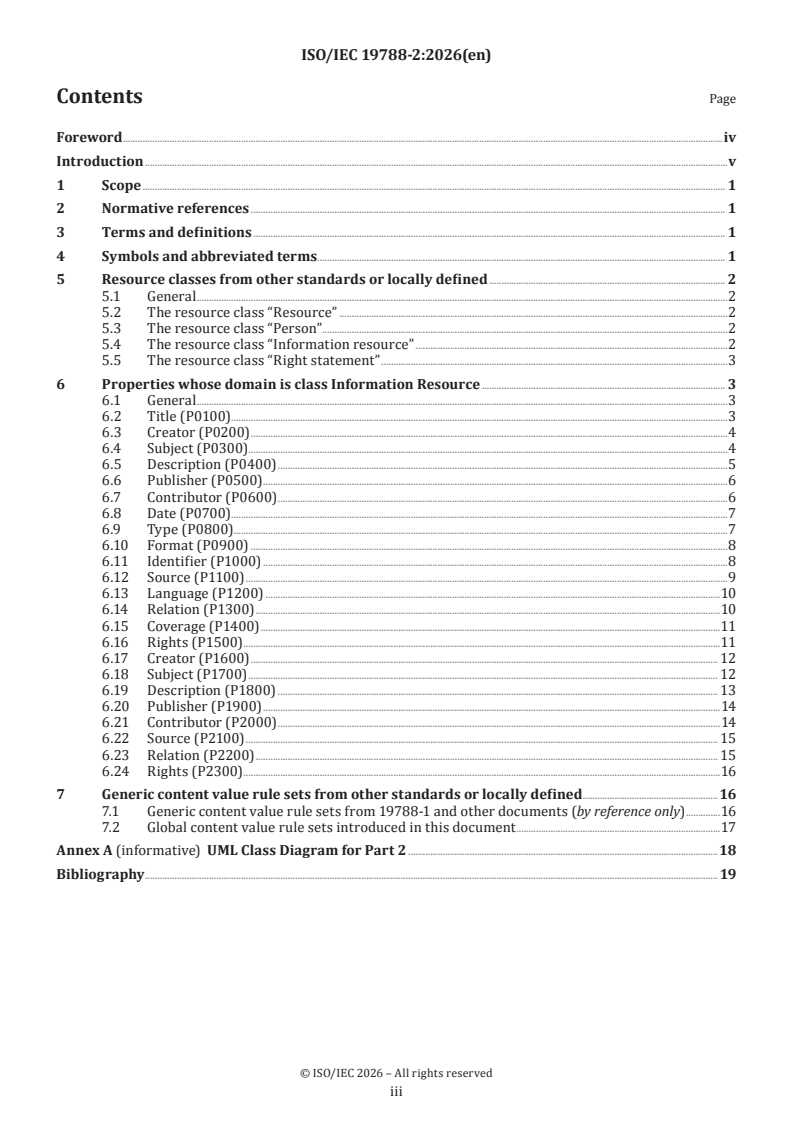
Contents Page
Foreword .iv
Introduction .v
1 Scope . 1
2 Normative references . 1
3 Terms and definitions . 1
4 Symbols and abbreviated terms. 1
5 Resource classes from other standards or locally defined . 2
5.1 General .2
5.2 The resource class “Resource” .2
5.3 The resource class “Person”.2
5.4 The resource class “Information resource” .2
5.5 The resource class “Right statement” .3
6 Properties whose domain is class Information Resource . 3
6.1 General .3
6.2 Title (P0100) .3
6.3 Creator (P0200) .4
6.4 Subject (P0300) . .4
6.5 Description (P0400) .5
6.6 Publisher (P0500) .6
6.7 Contributor (P0600) .6
6.8 Date (P0700) .7
6.9 Type (P0800).7
6.10 Format (P0900) .8
6.11 Identifier (P1000) .8
6.12 Source (P1100) .9
6.13 Language (P1200) .10
6.14 Relation (P1300) .10
6.15 Coverage (P1400) .11
6.16 Rights (P1500) .11
6.17 Creator (P1600) . 12
6.18 Subject (P1700) . 12
6.19 Description (P1800) . 13
6.20 Publisher (P1900) .14
6.21 Contributor (P2000) .14
6.22 Source (P2100) . 15
6.23 Relation (P2200) . 15
6.24 Rights (P2300) .16
7 Generic content value rule sets from other standards or locally defined .16
7.1 Generic content value rule sets from 19788-1 and other documents (by reference only) .16
7.2 Global content value rule sets introduced in this document .17
Annex A (informative) UML Class Diagram for Part 2 .18
Bibliography . 19
© ISO/IEC 2026 – All rights reserved
iii
Foreword
ISO (the International Organization for Standardization) and IEC (the International Electrotechnical
Commission) form the specialized system for worldwide standardization. National bodies that are
members of ISO or IEC participate in the development of International Standards through technical
committees established by the respective organization to deal with particular fields of technical activity.
ISO and IEC technical committees collaborate in fields of mutual interest. Other international organizations,
governmental and non-governmental, in liaison with ISO and IEC, also take part in the work.
The procedures used to develop this document and those intended for its further maintenance are described
in the ISO/IEC Directives, Part 1. In particular, the different approval criteria needed for the different types
of document should be noted. This document was drafted in accordance with the editorial rules of the ISO/
IEC Directives, Part 2 (see www.iso.org/directives or www.iec.ch/members_experts/refdocs).
ISO and IEC draw attention to the possibility that the implementation of this document may involve the
use of (a) patent(s). ISO and IEC take no position concerning the evidence, validity or applicability of any
claimed patent rights in respect thereof. As of the date of publication of this document, ISO and IEC had not
received notice of (a) patent(s) which may be required to implement this document. However, implementers
are cautioned that this may not represent the latest information, which may be obtained from the patent
database available at www.iso.org/patents and https://patents.iec.ch. ISO and IEC shall not be held
responsible for identifying any or all such patent rights.
Any trade name used in this document is information given for the convenience of users and does not
constitute an endorsement.
For an explanation of the voluntary nature of standards, the meaning of ISO specific terms and expressions
related to conformity assessment, as well as information about ISO's adherence to the World Trade
Organization (WTO) principles in the Technical Barriers to Trade (TBT) see www.iso.org/iso/foreword.html.
In the IEC, see www.iec.ch/understanding-standards.
This document was prepared by Joint Technical Committee ISO/IEC JTC 1, Information technology,
Subcommittee SC 36, Information technology for learning, education and training, in collaboration with the
European Committee for Standardization (CEN) Technical Committee CEN/TC 353, Technologies supporting
education and learning processes, in accordance with the Agreement on technical cooperation between ISO
and CEN (Vienna Agreement).
This second edition cancels and replaces the first edition (ISO/IEC 19788-2:2011), which has been technically
revised. It also incorporates the Amendment (ISO/IEC 19788-2:2011/Amd 1:2016).
The main changes are as follows:
— application of the ISO/IEC 19788-1:2024 framework, namely the use of the term ”property” (P) is used
instead of “data element specification” (DES) which becomes deprecated;
— new domain and property attributes, such as Label and Canonical Identifier, are introduced.
A list of all parts in the ISO 19788 series can be found on the ISO and IEC websites.
Any feedback or questions on this document should be directed to the user’s national standards
body. A complete listing of these bodies can be found at www.iso.org/members.html and
www.iec.ch/national-committees.
© ISO/IEC 2026 – All rights reserved
iv
Introduction
The ISO/IEC 19788 series specifies, in a rule-based manner, properties and their attributes for the description
of learning resources. This includes the rules governing the identification of properties and the specification
of their attributes. These properties may be used to form the description of a learning resource, i.e. as a
metadata learning resource (MLR) record described in ISO/IEC 19788-8:2015 Data elements for MLR records.
This document uses the property specification model and framework provided in ISO/IEC 19788-1:2024 to
[1]
describe the properties of Dublin Core ISO 15836-1:2017 Core elements and ISO 15836-2:2019 Properties
[2]
and classes so that they can be used with other properties of ISO/IEC 19788 series, addressing specific
user communities' needs for extensions, modularization or refinement.
© ISO/IEC 2026 – All rights reserved
v
International Standard ISO/IEC 19788-2:2026(en)
Information technology for learning, education and
training — Metadata for learning resources —
Part 2:
Dublin Core properties
1 Scope
This document provides a set of properties for the description of learning resources from ISO 15836-1 and
ISO 15836-2 using the framework provided in ISO/IEC 19788-1. This document specifies properties whose
codomain is "literal" (as considered in early Dublin Core) and properties whose codomain is a resource class;
the ISO 15836 series implicitly allowing both. This provides full interoperability at the time of expressing
existing Dublin Core records with MLR, while allowing a linked data approach for the description of learning
resources.
2 Normative references
The following documents are referred to in the text in such a way that some or all of their content constitutes
requirements of this document. For dated references, only the edition cited applies. For undated references,
the latest edition of the referenced document (including any amendments) applies.
ISO/IEC 19788-1:2024, Information technology for learning, education and training — Metadata for learning
resources — Part 1: Framework
3 Terms and definitions
For the purposes of this document, the terms and definitions ISO/IEC 19788-1 apply.
ISO and IEC maintain terminology databases for use in standardization at the following addresses:
— ISO Online browsing platform: available at https:// www .iso .org/ obp
— IEC Electropedia: available at https:// www .electropedia .org/
4 Symbols and abbreviated terms
BCP Best Current Practice
DC Dublin Core
DCMI Dublin Core Metadata Initiative
DOI Digital Object Identifier
ISAN International Standard Audiovisual Number
ISBN International Standard Book Number
ISIN International Securities Identification Number
© ISO/IEC 2026 – All rights reserved
ISMN International Standard Music Number
ISSN International Standard Serial Number
P Property
PRS Predefined Rule Set
PURL Persistent Uniform Resource Locator
RC Resource Class
URI Uniform Resource Identifier
URL Uniform Resource Locator
URN Uniform Resource Name
UUID Universally Unique IDentifier
5 Resource classes from other standards or locally defined
5.1 General
In order to promote the dissemination of this document and not overload it with ontology, the classes and
properties defined in this document are available at: https:// standards .iso .org/ iso -iec/ 19788/ -2/ ed -2/ en.
This ZIP file contains a README.md file with the list of available files, the ontology corresponding to this
document, as well as JSON-LD files containing the linguistic equivalents of names and labels of generic
resource classes, generic properties and generic content value rule sets.
5.2 The resource class “Resource”
Resource class specification
Identifier ISO _IEC _19788 -1: 2024: : RC0001
Canonical identifier ISO_IEC_19788-1::RC0001
Label Resource
5.3 The resource class “Person”
Resource class specification
Identifier ISO _IEC _19788 -1: 2024: : RC0003
Canonical identifier ISO_IEC_19788-1::RC0003
Label Person
5.4 The resource class “Information resource”
Resource class specification
Identifier ISO _IEC _19788 -1: 2024: : RC0004
Canonical identifier ISO_IEC_19788-1::RC0004
Label Information Resource
© ISO/IEC 2026 – All rights reserved
5.5 The resource class “Right statement”
Resource class specification
Identifier ISO _IEC _19788 -2: 2026: : RC0001
Canonical identifier ISO_IEC_19788-2::RC0001
Label Rights Statement
Name RightsStatement
Instances of this class are statements about the intellectual
property rights (IPR) held in or over a resource, a legal document
Definition
giving official permission to do something with a resource, or a
statement about access rights.
Subclass of ISO_IEC_19788-1::RC0004 (Information Resource)
1. The source for understanding and application of IPRs are
the treaties and conventions of the World Intellectual Property
Organization (WIPO)
Note
2. With respect to IPR of a "copyright" nature pertaining to a
learning resource, one should consider making use of the spec-
ifications found in a "Creative Commons" license
6 Properties whose domain is class Information Resource
6.1 General
These properties are defined in accordance with Figure A.1.
6.2 Title (P0100)
Property specification
Essential attributes
Identifier ISO _IEC _19788 -2: 2026: : P0100
Canonical identifier ISO_IEC_19788-2::P0100
Label title
Name title
Definition Name given to the information resource.
Domain ISO_IEC_19788-1::RC0004 (Information Resource)
Codomain literal
Linguistic indicator linguistic
Content value rules ISO_IEC_19788-1::PRS0001 (MLR string)
Non-essential attributes
Refines -
Example(s) Collection of Golden Leaves (en)
Note(s) 1) Is a subproperty of https:// purl .org/ dc/ elements/ 1 .1/ title (ISO 15836-1:2017).
2) Is a subproperty of https:// purl .org/ dc/ terms/ title (ISO 15836-2:2019).
3) ISO _IEC _19788 -2: 2011: : DES0100 is deprecated.
Best practice(s) -
© ISO/IEC 2026 – All rights reserved
6.3 Creator (P0200)
Property specification
Essential attributes
Identifier ISO _IEC _19788 -2: 2026: : P0200
Canonical identifier ISO_IEC_19788-2::P0200
Label creator
Name creator
Definition Entity primarily responsible for making the information resource.
Domain ISO_IEC_19788-1::RC0004 (Information Resource)
Codomain literal
Linguistic indicator linguistic
Content value rules ISO_IEC_19788-1::PRS0001 (MLR string)
Non-essential attributes
Refines ISO _IEC _19788 -2: 2026: : P0600 (Contributor)
Example(s) John Doe
Note(s) 1. A property (P1600) with the same name (creator), but with non-literal content value
is also provided: see subclause 6.17.
2. Is a subproperty of https:// purl .org/ dc/ elements/ 1 .1/ creator (ISO 15836-1:2017).
3. ISO _IEC _19788 -2: 2011: : DES0200 is deprecated
Best practice(s) -
6.4 Subject (P0300)
Property specification
Essential attributes
Identifier ISO _IEC _19788 -2: 2026: : P0300
Canonical identifier ISO_IEC_19788-2::P0300
Label subject
Name subject
Definition Topic of the information resource.
Domain ISO_IEC_19788-1::RC0004 (Information Resource)
Codomain literal
Linguistic indicator linguistic
Content value rules ISO_IEC_19788-1::PRS0001 (MLR string)
Non-essential attributes
Refines -
© ISO/IEC 2026 – All rights reserved
Property specification
Example(s) Creutzfeldt–Jakob disease (en)
Note(s) 1. Typically, the subject will be represented using keywords, key phrases or
classification codes.
2. A property (P1700) with the same name (subject), but with non-literal content
value is also provided: see subclause 6.18.
3. Is a subproperty of https:// purl .org/ dc/ elements/ 1 .1/ subject
(ISO 15836-1:2017)
4. Is a subproperty of https:// purl .org/ dc/ terms/ subject (ISO 15836-2:2019).
5. ISO _IEC _19788 -2: 2011: : DES0300 is deprecated.
Best practice(s) 1. To describe the spatial or temporal topic of the information resource, use the
ISO _IEC _19788 -2: 2026: : P1400 (coverage) element.
2. Use a controlled vocabulary.
6.5 Description (P0400)
Property specification
Essential attributes
Identifier ISO _IEC _19788 -2: 2026: : P0400
Canonical identifier ISO_IEC_19788-2::P0400
Label description
Name description
Definition Account of the information resource.
Domain ISO_IEC_19788-1::RC0004 (Information Resource)
Codomain literal
Linguistic indicator linguistic
Content value rules ISO_IEC_19788-1::PRS0001 (MLR string)
Non-essential attributes
Refines -
Example(s) This Java applet shows a car moving with constant acceleration. The green control panel
contains text fields where you can vary the values of initial position, initial velocity and
acceleration. (en)
Note(s) 1. Description may include, but is not limited to, an abstract, a table of contents, a
graphical representation, or a free-text account of the information resource.
2. A property (P1800) with the same name (description), but with non-literal
content value is also provided: see subclause 6.19.
3. Is a subproperty of https:// purl .org/ dc/ elements/ 1 .1/ description
(ISO 15836-1:2017)
4. Is a subproperty of https:// purl .org/ dc/ terms/ description (IS
...