

ISO/FDIS 17651-4
(Main)Simultaneous interpreting — Interpreters’ working environment — Part 4: Requirements and recommendations for signed language interpreting
- Abstract
This document specifies the logistical and technical equipment requirements for the working environments of conference signed language interpreters. This document builds upon the existing standards on interpreters’ working environment, interpreting equipment, simultaneous interpreting delivery platforms and conference equipment ISO 17651-1, ISO 17651-2, ISO 17651-3, ISO 20109, ISO 24019 and ISO 22259.
- Status
- Not Published
- Technical Committee
- ISO/TC 37/SC 5 - Translation, interpreting and related technology
- Drafting Committee
- ISO/TC 37/SC 5 - Translation, interpreting and related technology
- Current Stage
- 5020 - FDIS ballot initiated: 2 months. Proof sent to secretariat
- Start Date
- 05-Oct-2026
- Completion Date
- 05-Oct-2026
Buy Documents

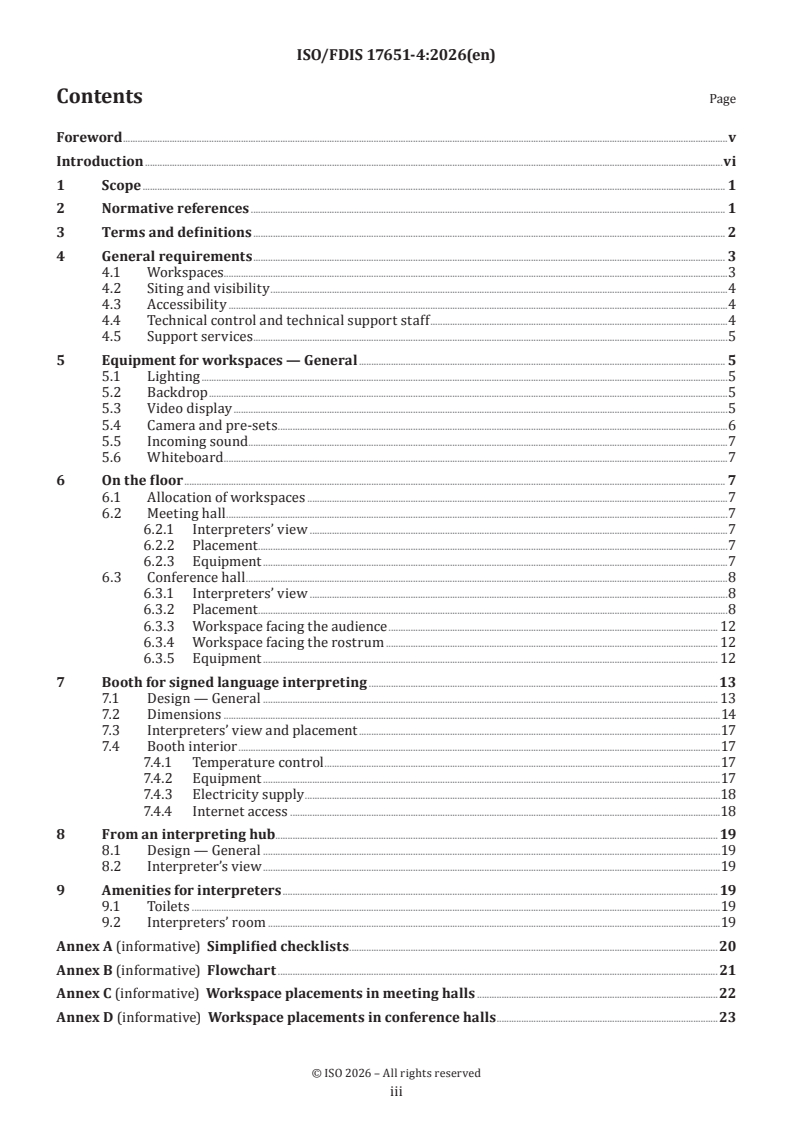

ISO/FDIS 17651-4 - Simultaneous interpreting — Interpreters’ working environment — Part 4: Requirements and recommendations for signed language interpreting
REDLINE ISO/FDIS 17651-4 - Simultaneous interpreting — Interpreters’ working environment — Part 4: Requirements and recommendations for signed language interpreting


ISO/FDIS 17651-4 - Interprétation simultanée — Environnement de travail des interprètes — Partie 4: Exigences et recommandations pour l’interprétation en langue des signes
ISO/FDIS 17651-4 is an ISO draft International Standard for the working environment of conference signed language interpreters. It specifies logistical and technical equipment requirements and recommendations for interpreting workspaces, with a focus on usability, accessibility, visibility and team coordination. It is written for interpreters, event organizers, technical support staff and venue planners who set up or assess signed language interpreting spaces.
What does ISO/FDIS 17651-4 specify?
ISO/FDIS 17651-4 specifies the working environment for signed language interpreting in conference settings. It covers both requirements and recommendations for floor workspaces, booths and interpreting hubs, and it ties those arrangements to the wider ISO 17651 series and related equipment and accessibility standards.
The document is organized into nine clauses. Clauses 4 to 9 move from general working-environment requirements to equipment, on-the-floor placement, dedicated booths, interpreting hubs and interpreter amenities. Annexes A to F provide practical checklists, flowcharts and layout examples used when planning, testing and operating an event.
| Annex | What it covers |
|---|---|
| Annex A | Simplified checklists for onsite events without broadcast and with broadcast |
| Annex B | Flowchart of the working environment of signed language interpreters |
| Annex C | Workspace placements in meeting halls |
| Annex D | Workspace placements in conference halls |
| Annex E | Layout of video displays |
| Annex F | Broadcast image |
What are the key requirements of ISO/FDIS 17651-4?
ISO/FDIS 17651-4 sets out the conditions needed for signed language interpreters to work with clear sight lines, stable audio and usable visual information. In practice, the standard is about placing the interpreter correctly, giving them the right displays and sound, and making sure the room and equipment support continuous visual-manual communication.
Workspaces must support visibility, comfort and accessibility
Clause 4.1 requires every workspace to provide uninterrupted incoming sound, clear lighting, an unobstructed view of the room and visual resources, and physical comfort. The workspace can be on the floor, in a dedicated booth at the venue, or in an interpreting hub. The standard also requires accessibility support in line with ISO 17069 and integration into the building layout in line with ISO 21542 when rooms are new or renovated.
This matters because signed language interpreting depends on seeing speakers, signers, visual aids and other interpreters. The room should also be kept away from distracting sources such as kitchens, corridors and passageways, and out of bright backlight.
Visual contact and teamwork are built into the layout
Clause 4.2 requires workspaces shared with signing participants to be clearly visible and free of visual obstructions. When signers are present and the interpreting is from a signed language to a spoken language, the interpreters work on the floor where the event is taking place. Clause 4.4 adds that trained technical support staff shall assist, monitor the system and stay able to communicate directly with interpreters.
That means the event team must plan for collaboration, not just equipment. The standard expects the interpreter, the technical staff and the organizers to be able to see and support one another during the event.
Lighting, backdrop and display requirements protect readability
Clause 5.1 requires indirect lighting or a lamp reflector to reduce glare, with each light source adjustable for beam angle and intensity. Clause 5.2 requires a uniform, non-reflective backdrop of sufficient size behind the interpreter. Clause 5.3 requires a video display in the interpreter’s direct line of sight, with ergonomic viewing angles and no aspect-ratio distortion.
In practice, the interpreter needs an image that is easy to read quickly and for long periods. The displays must show the audience view, live text where needed, and enough contrast for comfortable reading.
Camera, image framing and sound are tightly controlled
Clause 5.4 requires a camera positioned at interpreter eye level, with adjustable height, suitable framing, and at least 30 FPS. The broadcast image must show facial expression and hand movement clearly, and the hands must remain in frame. Clause 5.5 requires incoming sound through a wireless receiver connected to headphones, with selectable audio sources and manual volume control.
For users, this means the camera and sound system are not optional extras. They are part of the interpreting workflow, and the interpreter must be able to control them without losing concentration.
Floor workspaces are defined for meeting halls and conference halls
Clause 6.2 places the meeting-hall workspace across from the signing participants, within a maximum distance of 3 m, with equipment added if visibility, lighting or sound are not already sufficient. Clause 6.3 sets out conference-hall layouts, including a workspace next to the rostrum facing the audience and a second workspace facing the rostrum.
The conference-hall rules matter because larger events may need more than one signed language team. The standard also requires the workspace on the floor to be clearly marked and protected from accidental entry.
Booths and interpreting hubs have dedicated space and support
Clause 7 requires a dedicated booth for signed language interpreting to be close to the spoken-language booths, with room for a team of three interpreters. The booth has minimum internal dimensions of 5,00 m by 4,00 m by 2,30 m, and it must include lighting, backdrop, video displays, camera, incoming sound, a control pedal, anti-fatigue mat, electricity and internet access.
Clause 8 applies the booth logic to interpreting hubs and adds that simultaneous delivery platforms shall conform to ISO 24019 and the audio-video equipment shall conform to ISO 20109. This matters for remote or distributed setups where the interpreter is not in the room with the speakers or audience.
Preparation and amenities are part of the system
Clause 4.5 requires organizers to provide relevant documentation before the event because interpreters cannot handle documents while signing. Clause 9 requires toilets to be within easy reach and prefers a separate interpreters’ room for interpreters and technical support staff.
That means planning does not stop at the booth or camera. The standard treats preparation, rest space and access to materials as part of the working environment.
What terms does ISO/FDIS 17651-4 define?
ISO/FDIS 17651-4 uses these key terms from its definitions clause:
- Interpreter - a person who interprets.
- Interpreting - rendering spoken or signed information from a source language into a target language in spoken or signed form, while conveying meaning and register.
- Signed language - a language that uses hand shapes, movement, body orientation and facial expressions.
- Signed language interpreting - interpreting between two signed languages, or between a signed language and a spoken language.
- Simultaneous interpreting - interpreting performed while the speaker or signer is still speaking or signing.
- Booth - a self-contained unit that encloses the interpreter’s workspace and helps separate noise.
- Video display - an electronic device that presents information in visual form.
- Communicative event - an encounter between two or more parties during which information is transmitted.
Who uses ISO/FDIS 17651-4?
ISO/FDIS 17651-4 is used by signed language interpreters, conference interpreters, event organizers, venue designers, interpreting service providers and technical support staff. It is also relevant to broadcasters and streaming teams when signed language interpretation is displayed on screens or sent to webcast, television or app streaming.
In practice, these users apply the standard when choosing workspace placement, specifying lighting and camera setups, arranging audio access, planning booth size and access, and checking that the room supports collaboration between signed and spoken language interpreters.
Which standards are used with ISO/FDIS 17651-4?
| Standard | What it contributes |
|---|---|
| ISO 17651-1 | Permanent booth requirements and general booth features |
| ISO 17651-2 | Mobile booth requirements, used as a related booth reference |
| ISO 17651-3 | Interpreting hub requirements |
| ISO 20109 | Requirements for simultaneous interpreting equipment, including audio, video, microphones and headphones |
| ISO 24019 | Requirements and recommendations for simultaneous interpreting delivery platforms |
| ISO 22259 | Conference systems equipment requirements and room-context guidance |
| ISO 17069 | Accessible meeting considerations and assistive products |
| ISO 21542 | Accessibility and usability of the built environment |
| ISO 9241-20 | Ergonomic accessibility principles for physical input devices |
| ISO 9241-303 | Requirements for electronic visual displays |
| IEC 60118-4 | Induction-loop system performance requirements |
| IEC 60268-4 | Microphone requirements |
| IEC 62489-1 | Measurement and specification of induction-loop system components |
| EN 1335-1 | Office chair dimensions used for seated interpreter work |
What does the ISO/FDIS 17651-4 document contain?
ISO/FDIS 17651-4 contains clauses on general requirements, workspace equipment, floor placement, dedicated booths, interpreting hubs and interpreter amenities. It also includes defined layouts for meeting halls and conference halls, plus guidance for lighting, backdrops, video displays, camera framing, incoming sound and microphone use.
The annexes add practical tools for implementation. Annex A gives simplified checklists, Annex B gives a flowchart, Annexes C and D show workspace placements, Annex E shows video display layouts, and Annex F shows broadcast image layouts for one or two signed languages.
The figures and annexes are intended for planning, setup and verification. They help teams check sight lines, display placement, broadcast image composition and room organization before and during an event.
Relations
- Effective Date
- 22-Apr-2026
- Effective Date
- 12-Feb-2026
- Effective Date
- 06-Jul-2024
Buy Documents
ISO/FDIS 17651-4 - Simultaneous interpreting — Interpreters’ working environment — Part 4: Requirements and recommendations for signed language interpreting
REDLINE ISO/FDIS 17651-4 - Simultaneous interpreting — Interpreters’ working environment — Part 4: Requirements and recommendations for signed language interpreting
ISO/FDIS 17651-4 - Interprétation simultanée — Environnement de travail des interprètes — Partie 4: Exigences et recommandations pour l’interprétation en langue des signes
Get Certified
Connect with accredited certification bodies for this standard

DIBt (Deutsches Institut für Bautechnik)
German Institute for Building Technology.
DIN CERTCO
DIN Group product certification.

Aboma Certification B.V.
Specialized in construction, metal, and transport sectors.
Sponsored listings
Frequently Asked Questions
ISO/FDIS 17651-4 is a draft published by the International Organization for Standardization (ISO). Its full title is "Simultaneous interpreting — Interpreters’ working environment — Part 4: Requirements and recommendations for signed language interpreting". This standard covers: This document specifies the logistical and technical equipment requirements for the working environments of conference signed language interpreters. This document builds upon the existing standards on interpreters’ working environment, interpreting equipment, simultaneous interpreting delivery platforms and conference equipment ISO 17651-1, ISO 17651-2, ISO 17651-3, ISO 20109, ISO 24019 and ISO 22259.
This document specifies the logistical and technical equipment requirements for the working environments of conference signed language interpreters. This document builds upon the existing standards on interpreters’ working environment, interpreting equipment, simultaneous interpreting delivery platforms and conference equipment ISO 17651-1, ISO 17651-2, ISO 17651-3, ISO 20109, ISO 24019 and ISO 22259.
ISO/FDIS 17651-4 is classified under the following ICS (International Classification for Standards) categories: 91.040.10 - Public buildings. The ICS classification helps identify the subject area and facilitates finding related standards.
ISO/FDIS 17651-4 has the following relationships with other standards: It is inter standard links to EN ISO 17651-3:2026, prEN ISO 17651-4, ISO/TS 4676:2022. Understanding these relationships helps ensure you are using the most current and applicable version of the standard.
ISO/FDIS 17651-4 is available in PDF format for immediate download after purchase. The document can be added to your cart and obtained through the secure checkout process. Digital delivery ensures instant access to the complete standard document.
Standards Content (Sample)
FINAL DRAFT
International
Standard
ISO/TC 37/SC 5
Simultaneous interpreting —
Secretariat: DIN
Interpreters’ working
Voting begins on:
environment —
2026-10-05
Part 4:
Voting terminates on:
2026-11-30
Requirements and
recommendations for signed
language interpreting
Interprétation simultanée — Environnement de travail des
interprètes —
Partie 4: Exigences et recommandations pour l’interprétation en
langue des signes
RECIPIENTS OF THIS DRAFT ARE INVITED TO SUBMIT,
WITH THEIR COMMENTS, NOTIFICATION OF ANY
RELEVANT PATENT RIGHTS OF WHICH THEY ARE AWARE
AND TO PROVIDE SUPPOR TING DOCUMENTATION.
IN ADDITION TO THEIR EVALUATION AS
BEING ACCEPTABLE FOR INDUSTRIAL, TECHNO-
ISO/CEN PARALLEL PROCESSING LOGICAL, COMMERCIAL AND USER PURPOSES, DRAFT
INTERNATIONAL STANDARDS MAY ON OCCASION HAVE
TO BE CONSIDERED IN THE LIGHT OF THEIR POTENTIAL
TO BECOME STAN DARDS TO WHICH REFERENCE MAY BE
MADE IN NATIONAL REGULATIONS.
Reference number
FINAL DRAFT
International
Standard
ISO/TC 37/SC 5
Simultaneous interpreting —
Secretariat: DIN
Interpreters’ working
Voting begins on:
environment —
Part 4:
Voting terminates on:
Requirements and
recommendations for signed
language interpreting
Interprétation simultanée — Environnement de travail des
interprètes —
Partie 4: Exigences et recommandations pour l’interprétation en
langue des signes
RECIPIENTS OF THIS DRAFT ARE INVITED TO SUBMIT,
WITH THEIR COMMENTS, NOTIFICATION OF ANY
RELEVANT PATENT RIGHTS OF WHICH THEY ARE AWARE
AND TO PROVIDE SUPPOR TING DOCUMENTATION.
© ISO 2026
IN ADDITION TO THEIR EVALUATION AS
All rights reserved. Unless otherwise specified, or required in the context of its implementation, no part of this publication may
BEING ACCEPTABLE FOR INDUSTRIAL, TECHNO-
ISO/CEN PARALLEL PROCESSING
LOGICAL, COMMERCIAL AND USER PURPOSES, DRAFT
be reproduced or utilized otherwise in any form or by any means, electronic or mechanical, including photocopying, or posting on
INTERNATIONAL STANDARDS MAY ON OCCASION HAVE
the internet or an intranet, without prior written permission. Permission can be requested from either ISO at the address below
TO BE CONSIDERED IN THE LIGHT OF THEIR POTENTIAL
or ISO’s member body in the country of the requester.
TO BECOME STAN DARDS TO WHICH REFERENCE MAY BE
MADE IN NATIONAL REGULATIONS.
ISO copyright office
CP 401 • Ch. de Blandonnet 8
CH-1214 Vernier, Geneva
Phone: +41 22 749 01 11
Email: copyright@iso.org
Website: www.iso.org
Published in Switzerland Reference number
ii
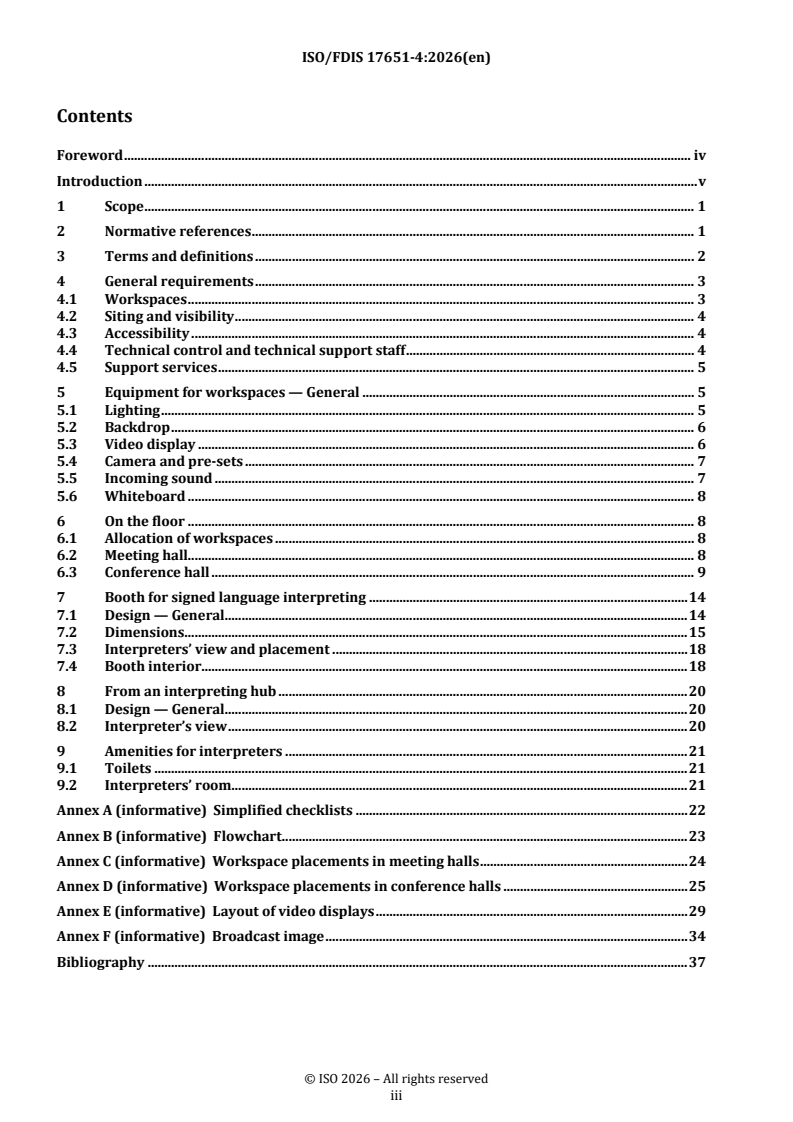
Contents Page
Foreword .v
Introduction .vi
1 Scope . 1
2 Normative references . 1
3 Terms and definitions . 2
4 General requirements . 3
4.1 Workspaces.3
4.2 Siting and visibility .4
4.3 Accessibility .4
4.4 Technical control and technical support staff .4
4.5 Support services . .5
5 Equipment for workspaces — General . 5
5.1 Lighting .5
5.2 Backdrop .5
5.3 Video display .5
5.4 Camera and pre-sets .6
5.5 Incoming sound .7
5.6 Whiteboard . .7
6 On the floor . 7
6.1 Allocation of workspaces .7
6.2 Meeting hall .7
6.2.1 Interpreters’ view .7
6.2.2 Placement .7
6.2.3 Equipment .7
6.3 Conference hall .8
6.3.1 Interpreters’ view .8
6.3.2 Placement .8
6.3.3 Workspace facing the audience . 12
6.3.4 Workspace facing the rostrum . 12
6.3.5 Equipment . 12
7 Booth for signed language interpreting .13
7.1 Design — General . 13
7.2 Dimensions .14
7.3 Interpreters’ view and placement .17
7.4 Booth interior .17
7.4.1 Temperature control .17
7.4.2 Equipment .17
7.4.3 Electricity supply .18
7.4.4 Internet access .18
8 From an interpreting hub . . 19
8.1 Design — General .19
8.2 Interpreter’s view .19
9 Amenities for interpreters . 19
9.1 Toilets .19
9.2 Interpreters’ room .19
Annex A (informative) Simplified checklists .20
Annex B (informative) Flowchart .21
Annex C (informative) Workspace placements in meeting halls .22
Annex D (informative) Workspace placements in conference halls .23
iii
Annex E (informative) Layout of video displays.27
Annex F (informative) Broadcast image .32
Bibliography .35
iv
Foreword
ISO (the International Organization for Standardization) is a worldwide federation of national standards
bodies (ISO member bodies). The work of preparing International Standards is normally carried out through
ISO technical committees. Each member body interested in a subject for which a technical committee
has been established has the right to be represented on that committee. International organizations,
governmental and non-governmental, in liaison with ISO, also take part in the work. ISO collaborates closely
with the International Electrotechnical Commission (IEC) on all matters of electrotechnical standardization.
The procedures used to develop this document and those intended for its further maintenance are described
in the ISO/IEC Directives, Part 1. In particular, the different approval criteria needed for the different types
of ISO document should be noted. This document was drafted in accordance with the editorial rules of the
ISO/IEC Directives, Part 2 (see www.iso.org/directives).
ISO draws attention to the possibility that the implementation of this document may involve the use of (a)
patent(s). ISO takes no position concerning the evidence, validity or applicability of any claimed patent
rights in respect thereof. As of the date of publication of this document, ISO had not received notice of (a)
patent(s) which may be required to implement this document. However, implementers are cautioned that
this may not represent the latest information, which may be obtained from the patent database available at
www.iso.org/patents). ISO shall not be held responsible for identifying any or all such patent rights.
Any trade name used in this document is information given for the convenience of users and does not
constitute an endorsement.
For an explanation of the voluntary nature of standards, the meaning of ISO specific terms and expressions
related to conformity assessment, as well as information about ISO’s adherence to the World Trade
Organization (WTO) principles in the Technical Barriers to Trade (TBT), see www.iso.org/iso/foreword.html.
This document was prepared by Technical Committee ISO/TC 37, Language and terminology, Subcommittee
SC 5, Translation, Interpreting and related technology, in collaboration with the European Committee for
Standardization, in accordance with the Agreement on technical cooperation between ISO and CEN (Vienna
Agreement).
A list of all parts in the ISO 17651 series can be found on the ISO website.
Any feedback or questions on this document should be directed to the user’s national standards body. A
complete listing of these bodies can be found at www.iso.org/members.html.
v
Introduction
This document concerns the logistical and technical equipment requirements and recommendations for the
working environment of signed language interpreters.
Interpreting services can be provided at a communicative event where the interpreter is at the same or
a different location as speakers, signers, participants, the audience or other interpreters. In both cases
technical support is needed. Interpreters in signed languages and spoken languages interpreting at the
same communicative event interact and collaborate with each other. As signed languages are expressed and
perceived in the visual-manual modality, interpreting into and from a signed language requires a working
environment that provides the signed language interpreter with the required audio-visual input, and an
unobstructed view of the communicative event, depending on the location of the interpreter in relation to
the speaker or signer, participant, audience and other interpreters.
Signed language interpreters interpret in various workspaces, depending on:
[1]
— the professional context such as conference interpreting (see ISO 23155 ), community interpreting
[2] [3] [4]
(see ISO 13611 ), healthcare interpreting (see ISO 21998 ) and legal interpreting (see ISO 20228 );
— the layout of the room where the communicative event takes place, such as:
— either a dedicated booth for signed language interpreting, a dedicated workspace for signed language
interpreting on the floor, or both;
— or at a distance from a booth for signed language interpreting in an interpreting hub.
This document addresses the following:
a) workspace requirements specific to signed language interpreters;
b) visual communication between interpreters and participants at an event;
c) teamwork among interpreters and among interpreters and technical support staff;
d) technical requirements and dedicated technical support;
e) dimensions and design of a dedicated booth for signed language interpreting;
f) a working environment that minimizes factors contributing to cognitive load, recognizing that
interpreting demands sustained high levels of concentration.
This document complements the existing parts 1 to 3 of the ISO 17651 series; these set out the essential
requirements for simultaneous interpreting: Part 1: Requirements and recommendations for permanent booths,
Part 2: Requirements and recommendations for mobile booths, Part 3: Requirements and recommendations for
interpreting hubs and this fourth part details comprehensively the relevant requirements for the workspaces
of signed language interpreters.
[5]
ISO/IEC Guide 71 has been used to develop an accessible standard in consultation with key stakeholders.
vi
FINAL DRAFT International Standard ISO/FDIS 17651-4:2026(en)
Simultaneous interpreting — Interpreters’ working
environment —
Part 4:
Requirements and recommendations for signed language
interpreting
1 Scope
This document specifies the logistical and technical equipment requirements and recommendations for
the working environment of signed language interpreters. This document also ensures the usability and
accessibility of workspaces of signed language interpreters.
It draws from, and adds to, the existing standards on interpreters’ working environment, interpreting
[6]
equipment, simultaneous interpreting delivery platforms and conference equipment: ISO 17651-1 ,
[7] [8] [9] [10] [11]
ISO 17651-2 , ISO 17651-3 , ISO 20109 , ISO 24019 and ISO 22259 .
2 Normative references
The following documents are referred to in the text in such a way that some or all of their content constitutes
requirements of this document. For dated references, only the edition cited applies. For undated references,
the latest edition of the referenced document (including any amendments) applies.
ISO 9241-20, Ergonomics of human-system interaction — Part 20: An ergonomic approach to accessibility within
the ISO 9241 series
ISO 9241-303, Ergonomics of human-system interaction — Part 303: Requirements for electronic visual displays
ISO 17069, Accessible design — Consideration and assistive products for accessible meeting
ISO 17651-1, Simultaneous interpreting — Interpreters’ working environment — Part 1: Requirements and
recommendations for permanent booths
ISO 17651-1:2024, Simultaneous interpreting — Interpreters’ working environment — Part 1: Requirements
and recommendations for permanent booths
ISO 17651-3, Simultaneous interpreting — Interpreters’ working environment — Part 3: Requirements and
recommendations for interpreting hubs
ISO 20109:2025, Simultaneous interpreting — Equipment — Requirements
ISO 20109, Simultaneous interpreting — Equipment — Requirements
ISO 21542, Building construction — Accessibility and usability of the built environment
ISO 24019, Simultaneous interpreting delivery platforms — Requirements and recommendations
IEC 60118-4, Electroacoustics - Hearing aids - Part 4: Induction-loop systems for hearing aid purposes - System
performance requirements
IEC 60268-4, Sound system equipment - Part 4: Microphones
IEC 62489-1, Electroacoustics - Audio-frequency induction loop systems for assisted hearing - Part 1: Methods of
measuring and specifying the performance of system components
EN 1335-1, Office furniture - Office work chair - Part 1: Dimensions - Determination of dimensions
3 Terms and definitions
For the purposes of this document, the following terms and definitions apply.
ISO and IEC maintain terminology databases for use in standardization at the following addresses:
— ISO Online browsing platform: available at https:// www .iso .org/ obp
— IEC Electropedia: available at https:// www .electropedia .org/
3.1
interpreter
person who interprets
[12]
[SOURCE: ISO 20539:2023 , 3.1.13]
3.2
interpreting
interpretation
rendering spoken or signed information from a source language into a target language in spoken or signed
form, conveying both the meaning and language register of the source language content
[12]
[SOURCE: ISO 20539:2023 , 3.1.11]
3.3
signed language
language which uses a combination of hand shapes, orientation and movement of the hands, arms or body,
and facial expressions
[12]
[SOURCE: ISO 20539:2023 , 3.1.7]
3.4
signed language interpreting
interpreting (3.2) between two signed languages (3.3) or between a signed language and a spoken language
[12]
[SOURCE: ISO 20539:2023 , 3.4.3]
3.5
simultaneous interpreting
mode of interpreting (3.2) performed while a speaker or signer is still speaking or signing
[12]
[SOURCE: ISO 20539:2023 , 3.4.12]
3.6
booth
simultaneous interpreting booth
self-contained unit enclosing the interpreter’s (3.1) workspace
Note 1 to entry: One of the purposes of booths is to provide insulation, both from the noise transmitted from the
booth’s external environment into the booth itself and vice versa, and from noise passing from one booth to another.
[12]
[SOURCE: ISO 20539:2023 , 3.5.2.1]
3.7
video display
electronic device which represents information in a visual form
[12]
[SOURCE: ISO 20539:2023 , 3.5.2.43]
3.8
overlay
substitution of part of an image by another image
[12]
[SOURCE: ISO 20539:2023 , 3.5.2.44]
3.9
accessibility
extent to which products, systems, services, environments and facilities can be used by people from a
population with the widest range
[13]
[SOURCE: ISO 9241-112:2025 , 3.11, modified — “of user needs, characteristics and capabilities to achieve
identified goals in identified contexts of use” deleted at the end of the definition; Note 1 to entry deleted]
3.10
communicative event
encounter between two or more parties during which information is transmitted
[12]
[SOURCE: ISO 20539:2023 , 3.4.32]
4 General requirements
4.1 Workspaces
Signed language interpreters interpret in diverse settings based on the nature and configuration of each
communicative event. All workspaces shall provide adequate conditions, including:
— uninterrupted incoming sound;
— clear lighting;
— unobstructed view of the room and the visual resources;
— physical comfort.
Appropriate logistical and technical arrangements shall be made to meet the above requirements.
Workspaces for signed language interpreters can be:
— a dedicated space on the floor where the communicative event is held;
— a booth for signed language interpreting at the venue where the communicative event is held;
— a booth for signed language interpreting in an interpreting hub.
When providing signed language interpreting at a communicative event, organizers and service providers
shall ensure accessibility support in accordance with ISO 17069.
When designing new rooms or renovating existing ones, workspaces for interpreters — either a booth or
a workspace on the floor, or both — shall be integrated into the structure so that the room itself and the
workspaces constitute a well-balanced unit in terms of layout, people flow within buildings, accessibility
and usability in accordance with ISO 21542.
Workspaces for interpreters shall be located away from extraneous sources of disturbance, such as kitchens,
public corridors and passageways. The workspaces shall not be placed in front of a window or an area that
produces a bright backlight.
In order to facilitate speech intelligibility, the room should not cause reverberation or echoes exceeding the
[14]
values recommended for the type of room in accordance with AS/NZS 2107 .
[14]
NOTE AS/NZS 2107 also specifies methods of measuring the background sound level and the reverberation
time in unoccupied spaces.
Technical advisors and interpreters with expert knowledge of workspaces for interpreters and related
equipment, qualified technicians or suppliers shall be consulted for the design and operation.
4.2 Siting and visibility
Signed language interpreting involves visual interaction with signing participants. To enable visual
interaction, workspaces for interpreters in a shared physical space with signing participants shall be clearly
visible and free of visual obstructions. When signers are present and interpreting from a signed language to
a spoken language is provided, the interpreters’ workspace shall be on the floor where the communicative
event is held (see 4.1 and Figure B.1). Additionally, a second signed language interpreting team can interpret
into a signed language from a booth dedicated for signed language interpreting (see Clause 7). The
interpreter can be broadcast to either screens in the same hall and venue, or publicly, or both (see Annex B).
4.3 Accessibility
It shall be possible to quickly, easily and safely access:
— the dedicated workspaces for signed language interpreting on the floor;
— one booth from another booth;
— all booths from inside or outside the room.
A booth for signed language interpreting shall be accessible to persons with a disability, in accordance with
ISO 21542.
An individual induction loop shall be provided in the room or in the booth dedicated for signed language
interpreting, and shall conform to IEC 60118-4 and IEC 62489-1.
Live captions provide access to the spoken language in text format and should be provided when requested
by the interpreters.
4.4 Technical control and technical support staff
In settings where technical equipment for signed language interpreters is used, specifically trained technical
[15]
support staff shall assist and monitor the work system of the interpreters (see ISO 6385 ) to:
— check the set-up of the dedicated interpreters’ workspaces, including the required equipment such as
cameras, lighting, backdrop, and audio receivers (see 5.2 and 7.4);
— align the dedicated lighting on the interpreter to the light in the room (see 5.1 and 7.4.2.2);
— demarcate and block off the dedicated interpreters’ workspace on the floor (e.g. with the use of a
stanchion);
— adjust or pre-set the height, zoom and framing of the camera for each of the interpreting team members;
— demonstrate and explain to the interpreting team the use of a pre-set camera control panel, if provided
(see 7.4.2.5);
— send the input to the broadcasters to display the broadcast image of the signed language interpreter,
such as on television, webcast and app streaming.
The technical controls shall be placed close to the interpreters’ workspaces so that:
— technical support staff can access them easily;
— visual communication between the technical support staff and the interpreters is possible;
— technical support staff have a clear view of the entire room, including the rostrum, speakers, signers and
all visual aids such as projection screens and displays.
The technical control should be installed:
— on a table;
— in a rack;
— in a booth that conforms to the requirements and recommendations for a permanent booth or a mobile
[6] [7]
booth for simultaneous interpreting in accordance with ISO 17651-1 or ISO 17651-2 .
If not present in the room, a central technical control shall be available in the venue.
Interpreters shall be able to communicate directly with the technical support staff, who shall have safe,
quick and easy access to the interpreters’ workspaces and the room.
NOTE In technically complex settings it has proven to be useful to have the presence of dedicated technical
support staff for the signed language interpreting team.
4.5 Support services
Signed language interpreters are unable to hold and handle documents whilst interpreting into a signed
language. Consequently, to conduct the required preparation, the event organizers shall provide signed
language interpreters with all relevant documentation prior to the start of the event.
5 Equipment for workspaces — General
5.1 Lighting
To protect the interpreter from disability glare, indirect lighting or a lamp reflector in accordance with
ISO 9241-303 shall be used. Each lighting source projected on the interpreter shall be individually and
manually adjustable for:
— beam angle;
— light intensity.
5.2 Backdrop
The backdrop behind the signed language interpreter shall cover the vertical space from the floor up. The
horizontal space shall comfortably cover the signing space of the interpreter. The following minimum
dimensions shall apply:
— width: 2,00 m;
— height: 2,30 m.
The location where the interpreter will be positioned shall be marked on the floor. The distance between the
interpreter and the backdrop shall be at least 1 m.
The backdrop shall have a uniform colour, so that the image of the interpreter can be seen without any visual
distraction. The backdrop colour value shall be mid-range. The backdrop material shall be flat without any
unevenness, non-glaring and cause no reflections.
NOTE 1 Viewers who identify as deafblind or with a visual impairment can indicate their preferred colour backdrop.
NOTE 2 Interpreters can wear plain clothes in a colour that contrasts with their skin colour.
5.3 Video display
A video display in the direct line of sight of the interpreter shall provide the incoming images as seen by the
audience on the main screen. The video display shall be positioned at a convenient ergonomic angle, i.e. with
a gaze angle from 0° to 40° and a head-tilt angle from 0° to 25° in accordance with ISO 9241-303.
For interpreters who are working directly from captions, a second video display shall provide the live text
and shall be positioned underneath or next to the camera to avoid eye strain. The video display shall be
positioned at a convenient ergonomic angle for the interpreter to read the text without the need to tilt or
move their head.
The incoming signal of the video displays shall be displayed without distorting their original aspect ratio.
Video displays shall be flat and flicker-free. They should be anti-glare and easily cleanable. The video display
shall not obstruct visibility into and from the room in which the communicative event takes place.
Screen sizes shall be in proportion to the viewing distance to ensure the interpreter can comfortably read
any displayed text. There shall be sufficient contrast between the text and the background. Both the symbols
[16]
and the screen background should have different luminance or colour, in accordance with ISO 9241-303 .
The incoming image shall follow the requirements in accordance with ISO 20109:2025, 5.2. Video displays
shall conform to ISO 20109:2025, 7.3.
The image size and quality shall be such that the visual content is readable and the speaker’s face is clearly
visible. The image of the signer shall transmit their detailed facial expression, lip and hand movements. The
image of the signer shall be framed from one hand span above their head to just below their hips so that the
hands of the signer are never out of frame. Examples of different configurations on the video display are
provided in Annex E.
NOTE 1 Good results have been achieved with:
— dual video displays with a diagonal dimension between 140 cm (55 inches) and 165 cm (65 inches) at a viewing
distance between 170 cm and 200 cm;
— single video displays with a diagonal dimension between 165 cm (65 inches) and 216 cm (85 inches) with multi-
view of the different video signals at a viewing distance between 170 cm and 200 cm.
NOTE 2 It is good practice that technical support staff and interpreters coordinate the configuration of the content
to be displayed to interpreters.
5.4 Camera and pre-sets
The camera shall be positioned at the eye level of the interpreter at a convenient ergonomic angle, i.e. with a
gaze angle from 0° to 40° and a head-tilt angle from 0° to 25° in accordance with ISO 9241-303.
The camera height shall be adjustable via a control panel automatically adapting the pre-set height of the
camera to the height of the interpreter.
The broadcast image of the interpreter shall:
— position the interpreter within the frame with sufficient space on either side to fully capture arm
movements;
— transmit the interpreter’s detailed facial expression, lip movements and hand movements;
— be framed at least 15 cm above the interpreter’s head to just below their hips so that the interpreter’s
hands are never out of frame;
— cover at least 1/3 of the horizontal plane of the display on the main screen in the room;
— not be overlayed by any other images or text.
Examples of broadcast images are provided in Annex F.
The camera shall have a frame rate of 30 (FPS) or higher to capture the fluid movements in signed language
communication, including facial expressions and mouth movements. For viewers, adequate bitrate at lower
[17][18]
resolution improves signed language comprehension over insufficient bitrate at a higher resolution.
In case of bandwidth constraints, encoders shall prioritize bitrate and compression quality over spatial
resolution.
NOTE Good results have been achieved with the following minimum bitrates for various resolutions:
— 3840×2160 (4K): 16 Mbps;
— 1920×1080 (Full HD): 8 Mbps;
— 1280×720 (HD): 4 Mbps.
5.5 Incoming sound
Incoming sound shall be provided through a wireless receiver in accordance with ISO 20109:2025, 10.3, and
shall be connected to the interpreters’ headphones, allowing for uninterrupted sound input.
NOTE Good results have been achieved with radio frequency (RF) receivers. Infrared (IR) receivers are not
suitable as the interpreters’ signing movements disrupt the IR signal.
The receiver shall allow the interpreters to select either the audio from the floor or a minimum of three pre-
set interpreted languages.
The interpreters’ headphones shall conform to ISO 20109:2025, 8.3.1.
5.6 Whiteboard
A whiteboard of A4 size with markers and wiper shall be provided for the interpreters to write information
on.
6 On the floor
6.1 Allocation of workspaces
The allocation of the interpreters’ workspace depends on the layout of the meeting hall or conference hall
[11]
and the seating arrangement of the various parties in the communicative event (see ISO 22259 ).
NOTE It is good practice that event organizers consult with the signing participants and interpreters on the
location of the interpreters’ workspace and the participants’ seating arrangements.
6.2 Meeting hall
6.2.1 Interpreters’ view
The interpreters’ workspace(s) shall be placed in such a way that the interpreters have a direct view of the
entire room, the speakers, signers and all visual resources, such as projection screens and displays.
6.2.2 Placement
In a meeting hall where all parties are physically present there are various possible workspaces. Examples
of workspaces in meeting halls are provided in Figure C.1 and Figure C.2. The workspace shall be allocated
across from the signing participants at a maximum distance of 3 m.
6.2.3 Equipment
In cases where the workspace does not provide the visibility, lighting or sound levels for interpreters to
interpret, the following shall be provided:
— lighting in accordance with 5.1;
— incoming sound in accordance with 6.3.5.5;
— a microphone in accordance with 6.3.5.7;
— video displays in accordance with 5.3.
In a small meeting hall where all participants are seated, the interpreters shall also be seated on comfortable
chairs in accordance with EN 1335-1 with the following characteristics:
— easily movable;
— adjustable height;
— adjustable or removable armrests.
A simplified checklist for an onsite communicative event without broadcast is provided in Clause A.1.
6.3 Conference hall
6.3.1 Interpreters’ view
The interpreters’ workspaces shall be placed in such a way that the interpreters have a direct unobstructed
view of the entire room, including the rostrum, speakers, signers and all visual aids, such as projection
screen and displays (see Annex D). Visual cooperation between the interpreters in the interpreting team(s)
is essential. The interpreters’ workspaces shall be situated in such a way that the interpreters’ view is
without any visual obstruction.
The logistical and technical setup shall enable all interpreters in signed languages and spoken languages
at the same communicative event to collaborate with each other from their respective workspaces. The
workspaces for signed language interpreters shall not hinder the view from the booths into the room. In
large rooms, video displays shall be used to facilitate the interpreters’ view of speakers and signers, in
accordance with ISO 20109:2025.
6.3.2 Placement
In a hall with a theatre-style seating arrangement, there are two dedicated workspaces for signed language
interpreters:
— on the floor, next to the rostrum, facing the audience (see 6.3.3);
— on the floor, facing the rostrum (see 6.3.4).
A designated area next to the rostrum facing the audience shall be allocated for signed language interpreters,
within view of all participants in the audience and without any visual obstructions (see Figure 1).
A second space at the front of the room, facing the rostrum, shall be allocated for the team of interpreters
interpreting between a signed language and a spoken language or between two signed languages (see
Figure 2).
In a communicative event, both workspaces can be used at the same time to provide interpreting: the
workspace on the conference hall floor next to the rostrum facing the audience for signing participants
and the workspace on the conference floor facing the rostrum for signers on the rostrum. When signing
participants are physically present, the workspace facing the rostrum shall be used for interpreting for
signers on the rostrum (see Figure 2).
Additionally, in cases where the conference hall has a dedicated booth for signed language interpreting (see
Clause 7), a second team can interpret into a signed language from the booth for the image to be broadcast
(see Annex F).
For each additional signed language, additional dedicated workspaces shall be provided next to the rostrum
(see Figure 3) and opposite of the rostrum (see Figure 4). If available, additional booths dedicated for signed
language interpreting can also be used for each additional signed language (see Clause 7).
Additional examples of placement of workspaces in a conference hall are provided in Figure D.1, Figure D.2,
Figure D.3 and Figure D.4.
A simplified checklist for an onsite communicative event with broadcast is provided in Clause A.2.
Figure 1 — Dedicated workspaces for interpreters on the floor of a conference hall next to the
rostrum (from a spoken language to one signed language), with a speaker at the rostrum
Figure 2 — Dedicated workspaces for interpreters on the floor of a conference hall next to the
rostrum (from a spoken to a signed language) and facing the rostrum (from a signed to a spoken
language), with a signer at the rostrum
Figure 3 — Dedicated workspaces for interpreters on the floor of a conference hall next to the
rostrum (from spoken language(s) into two signed languages), with a speaker at the rostrum
Figure 4 — Dedicated workspaces for interpreters on the floor of a conference hall next to the
rostrum (from spoken language(s) into two signed languages) and facing the rostrum (from a
signed to a spoken language), with a signer at the rostrum
6.3.3 Workspace facing the audience
The workspace facing the audience is the main workspace and shall be positioned next to the rostrum to allow
for a view of the rostrum and the signers and speakers, as well as visual contact between the interpreters
and physically present signing participants (see Figure 3). The allocated workspace shall be at least 2 m × 2
m and clearly demarcated and designed to prevent any non-interpreter from physically entering the space
(e.g. with the use of stanchions). A video display (see 5.3) shall be used to provide the interpreter facing the
audience with a view of the speaker or signer, as well as other visual materials displayed on the main screen
for the audience.
6.3.4 Workspace facing the rostrum
A second workspace for signed language interpreting shall be positioned across from the audience-facing
interpreter to allow for visual contact and cooperation between the interpreters (see Figure 2 and Figure 4).
This workspace can also be used for interpreting to signers on the rostrum. The allocated workspace shall
be clearly marked to avoid any non-interpreter physically entering the workspace.
6.3.5 Equipment
6.3.5.1 General
Workspaces shall have:
— lighting in accordance with 5.1 and 6.3.5.2;
— a backdrop in accordance with 5.2 and 6.3.5.3;
— video display(s) in accordance with 5.3 and 6.3.5.4;
— a camera in accordance with 5.4 and 6.3.5.6;
— incoming sound in accordance with 5.5 and 6.3.5.5;
— a microphone in accordance with 6.3.5.7.
6.3.5.2 Lighting
Lighting shall be provided in accordance with 5.1.
Additional lighting sources shall be used to ensure a clear image of the interpreter without shadows on the
interpreter’s body,
...
ISO/DISFDIS 17651-4
ISO/TC 37/SC 5
Secretariat: DIN
Date: 2026-07-0609-18
Simultaneous interpreting — Interpreters’ working environment —
Part 4:
Requirements and recommendations for signed language
interpreting
Interprétation simultanée — Environnement de travail des interprètes —
Partie 4: Exigences et recommandations pour l’interprétation en langue des signes
DISFDIS stage
TTTTTTTThhhhhhhhiiiiiiiissssssss d d d d d d d drrrrrrrraftaftaftaftaftaftaftaft i i i i i i i issssssss s s s s s s s suuuuuuuubbbbbbbbmmmmmmmmiiiiiiiittttttttttttttttedededededededed t t t t t t t toooooooo a pa pa pa pa pa pa pa pararararararararallel vallel vallel vallel vallel vallel vallel vallel vooooooootttttttte e e e e e e e iiiiiiiinnnnnnnn I I I I I I I ISSSSSSSSOOOOOOOO,,,,,,,, C C C C C C C CEEEEEEEENNNNNNNN.
VVVotototiiinnnggg b b beeegggiiinnnsss on on on::: 222000222666---000111---000111
VVVoootintintinggg te te termrmrmiiinnnaaatetetesss o o onnn::: 2 2 2000222666---000333---222666
All rights reserved. Unless otherwise specified, or required in the context of its implementation, no part of this publication
may be reproduced or utilized otherwise in any form or by any means, electronic or mechanical, including photocopying,
or posting on the internet or an intranet, without prior written permission. Permission can be requested from either ISO
at the address below or ISO’s member body in the country of the requester.
ISO copyright office
CP 401 • Ch. de Blandonnet 8
CH-1214 Vernier, Geneva
Phone: + 41 22 749 01 11
E-mail: copyright@iso.org
Website: www.iso.org
Published in Switzerland
ii
Contents
Foreword . iv
Introduction . v
1 Scope . 1
2 Normative references . 1
3 Terms and definitions . 2
4 General requirements . 3
4.1 Workspaces . 3
4.2 Siting and visibility . 4
4.3 Accessibility . 4
4.4 Technical control and technical support staff . 4
4.5 Support services . 5
5 Equipment for workspaces — General . 5
5.1 Lighting . 5
5.2 Backdrop . 6
5.3 Video display . 6
5.4 Camera and pre-sets . 7
5.5 Incoming sound . 7
5.6 Whiteboard . 8
6 On the floor . 8
6.1 Allocation of workspaces . 8
6.2 Meeting hall. 8
6.3 Conference hall . 9
7 Booth for signed language interpreting . 14
7.1 Design — General . 14
7.2 Dimensions. 15
7.3 Interpreters’ view and placement . 18
7.4 Booth interior . 18
8 From an interpreting hub . 20
8.1 Design — General . 20
8.2 Interpreter’s view . 20
9 Amenities for interpreters . 21
9.1 Toilets . 21
9.2 Interpreters’ room. 21
Annex A (informative) Simplified checklists . 22
Annex B (informative) Flowchart . 23
Annex C (informative) Workspace placements in meeting halls . 24
Annex D (informative) Workspace placements in conference halls . 25
Annex E (informative) Layout of video displays . 29
Annex F (informative) Broadcast image . 34
Bibliography . 37
iii
Foreword
ISO (the International Organization for Standardization) is a worldwide federation of national standards
bodies (ISO member bodies). The work of preparing International Standards is normally carried out through
ISO technical committees. Each member body interested in a subject for which a technical committee has been
established has the right to be represented on that committee. International organizations, governmental and
non-governmental, in liaison with ISO, also take part in the work. ISO collaborates closely with the
International Electrotechnical Commission (IEC) on all matters of electrotechnical standardization.
The procedures used to develop this document and those intended for its further maintenance are described
in the ISO/IEC Directives, Part 1. In particular, the different approval criteria needed for the different types of
ISO document should be noted. This document was drafted in accordance with the editorial rules of the
ISO/IEC Directives, Part 2 (see www.iso.org/directives).
ISO draws attention to the possibility that the implementation of this document may involve the use of (a)
patent(s). ISO takes no position concerning the evidence, validity or applicability of any claimed patent rights
in respect thereof. As of the date of publication of this document, ISO had not received notice of (a) patent(s)
which may be required to implement this document. However, implementers are cautioned that this may not
represent the latest information, which may be obtained from the patent database available at
www.iso.org/patents). ISO shall not be held responsible for identifying any or all such patent rights.
Any trade name used in this document is information given for the convenience of users and does not
constitute an endorsement.
For an explanation of the voluntary nature of standards, the meaning of ISO specific terms and expressions
related to conformity assessment, as well as information about ISO’s adherence to the World Trade
Organization (WTO) principles in the Technical Barriers to Trade (TBT), see www.iso.org/iso/foreword.html.
This document was prepared by Technical Committee ISO/TC 37, Language and terminology, Subcommittee
SC 5, Translation, Interpreting and related technology, in collaboration with the European Committee for
Standardization, in accordance with the Agreement on technical cooperation between ISO and CEN (Vienna
Agreement).
A list of all parts in the ISO 17651 series can be found on the ISO website.
Any feedback or questions on this document should be directed to the user’s national standards body. A
complete listing of these bodies can be found at www.iso.org/members.html.
iv
Introduction
This document concerns the logistical and technical equipment requirements and recommendations for the
working environment of signed language interpreters.
Interpreting services can be provided at a communicative event where the interpreter is at the same or a
different location as speakers, signers, participants, the audience or other interpreters. In both cases technical
support is needed. Interpreters in signed languages and spoken languages interpreting at the same
communicative event interact and collaborate with each other. As signed languages are expressed and
perceived in the visual-manual modality, interpreting into and from a signed language requires a working
environment that provides the signed language interpreter with the required audio-visual input, and an
unobstructed view of the communicative event, depending on the location of the interpreter in relation to the
speaker or signer, participant, audience and other interpreters.
Signed language interpreters interpret in various workspaces, depending on:
[1]
— the professional context such as conference interpreting (see ISO 23155 ), community interpreting (see
[2] [3] [4]
ISO 13611 ), healthcare interpreting (see ISO 21998 ),) and legal interpreting (see ISO 20228 );
— the layout of the room where the communicative event takes place, such as:
— either a dedicated booth for signed language interpreting, a dedicated workspace for signed language
interpreting on the floor, or both;
— or at a distance from a booth for signed language interpreting in an interpreting hub.
This document addresses the following:
a) workspace requirements specific to signed language interpreters;
b) visual communication between interpreters and participants at an event;
c) teamwork among interpreters and among interpreters and technical support staff;
d) technical requirements and dedicated technical support;
e) dimensions and design of a dedicated booth for signed language interpreting;
f) a working environment that minimizes factors contributing to cognitive load, recognizing that
interpreting demands sustained high levels of concentration.
This document complements the existing parts 1 to 3 of the ISO 17651 series; these set out the essential
requirements for simultaneous interpreting: Part 1: Requirements and recommendations for permanent booths,
Part 2: Requirements and recommendations for mobile booths, Part 3: Requirements and recommendations for
interpreting hubs and this fourth part details comprehensively the relevant requirements for the workspaces
of signed language interpreters.
[5]
ISO/IEC Guide 71 The has been used to develop an accessible standard in consultation with key
stakeholders.
v
Simultaneous interpreting — Interpreters’ working environment —
Part 4:
Requirements and recommendations for signed language interpreting
1 Scope
This document specifies the logistical and technical equipment requirements and recommendations for the
working environment of signed language interpreters. This document also ensures the usability and
accessibility of workspaces of signed language interpreters.
It draws from, and adds to, the existing standards on interpreters’ working environment, interpreting
[23]
equipment, simultaneous interpreting delivery platforms and conference equipment: ISO 17651-1 , ISO
[7] [8] [9] [10] [19]
17651-2 , ISO 17651-3 , ISO 20109 , ISO 24019 and ISO 22259 .
2 Normative references
The following documents are referred to in the text in such a way that some or all of their content constitutes
requirements of this document. For dated references, only the edition cited applies. For undated references,
the latest edition of the referenced document (including any amendments) applies.
ISO 9241-20, Ergonomics of human-system interaction — Part 20: An ergonomic approach to accessibility within
the ISO 9241 series
ISO 9241-303, Ergonomics of human-system interaction — Part 303: Requirements for electronic visual displays
ISO 17069, Accessible design — Consideration and assistive products for accessible meeting
ISO 17651-1, Simultaneous interpreting — Interpreters’ working environment — Part 1: Requirements and
recommendations for permanent booths
ISO 17651-1:2024, Simultaneous interpreting — Interpreters’ working environment — Part 1: Requirements
and recommendations for permanent booths
ISO 17651-3, Simultaneous interpreting — Interpreters’ working environment — Part 3: Requirements and
recommendations for interpreting hubs
ISO 20109:2025, Simultaneous interpreting — Equipment — Requirements
ISO 20109, Simultaneous interpreting — Equipment — Requirements
ISO 21542, Building construction — Accessibility and usability of the built environment
ISO 24019, Simultaneous interpreting delivery platforms — Requirements and recommendations
IEC 60118-4, Electroacoustics - Hearing aids - Part 4: Induction-loop systems for hearing aid purposes - System
performance requirements
IEC 60268-4, Sound system equipment - Part 4: Microphones
IEC 62489-1, Electroacoustics - Audio-frequency induction loop systems for assisted hearing - Part 1: Methods of
measuring and specifying the performance of system components
EN 1335-1, Office furniture - Office work chair - Part 1: Dimensions - Determination of dimensions
3 Terms and definitions
For the purposes of this document, the following terms and definitions apply.
ISO and IEC maintain terminology databases for use in standardization at the following addresses:
— ISO Online browsing platform: available at httphttps://www.iso.org/obp
— IEC Electropedia: available at https://www.electropedia.org/
3.1
interpreter
person who interprets
[12]
[SOURCE: ISO 20539:2023 , 3.1.13]
3.2
interpreting
interpretation
rendering spoken or signed information from a source language into a target language in spoken or signed
form, conveying both the meaning and language register of the source language content
[12]
[SOURCE: ISO 20539:2023 , 3.1.11]
3.3
signed language
language which uses a combination of hand shapes, orientation and movement of the hands, arms or body,
and facial expressions
[12]
[SOURCE: ISO 20539:2023 , 3.1.7]
3.4
signed language interpreting
interpreting (3.2) between two signed languages (3.3) or between a signed language and a spoken language
[12]
[SOURCE: ISO 20539:2023 , 3.4.3]
3.5
simultaneous interpreting
mode of interpreting (3.2) performed while a speaker or signer is still speaking or signing
[12]
[SOURCE: ISO 20539:2023 , 3.4.12]
3.6
booth
simultaneous interpreting booth
self-contained unit enclosing the interpreter’s (3.1) workspace
Note 1 to entry: One of the purposes of booths is to provide insulation, both from the noise transmitted from the booth’s
external environment into the booth itself and vice versa, and from noise passing from one booth to another.
[12]
[SOURCE: ISO 20539:2023 , 3.5.2.1]
3.7
video display
electronic device which represents information in a visual form
[12]
[SOURCE: ISO 20539:2023 , 3.5.2.43]
3.8
overlay
substitution of part of an image by another image
[12]
[SOURCE: ISO 20539:2023 , 3.5.2.44]
3.9
accessibility
extent to which products, systems, services, environments and facilities can be used by people from a
population with the widest range
[13]
[SOURCE: ISO 9241-112:2025 , 3.11, modified - "— “of user needs, characteristics and capabilities to
achieve identified goals in identified contexts of use” deleted at the end of the definition; Note 1 to entry
deleted]
3.10
communicative event
encounter between two or more parties during which information is transmitted
[12]
, 3.4.32]
[SOURCE: ISO 20539:2023
4 General requirements
4.1 Workspaces
Signed language interpreters interpret in diverse settings based on the nature and configuration of each
communicative event. All workspaces shall provide adequate conditions, including:
— uninterrupted incoming sound;
— clear lighting;
— unobstructed view of the room and the visual resources;
— physical comfort.
Appropriate logistical and technical arrangements shall be made to meet the above requirements.
Workspaces for signed language interpreters can be:
— a dedicated space on the floor where the communicative event is held;
— a booth for signed language interpreting at the venue where the communicative event is held;
— a booth for signed language interpreting in an interpreting hub.
When providing signed language interpreting at a communicative event, organizers and service providers
shall ensure accessibility support in accordance with ISO 17069.
When designing new rooms or renovating existing ones, workspaces for interpreters — either a booth, or a
workspace on the floor, or both — shall be integrated into the structure so that the room itself and the
workspaces constitute a well-balanced unit in terms of layout, people flow within buildings, accessibility and
usability in accordance with ISO 21542.
Workspaces for interpreters shall be located away from extraneous sources of disturbance, such as kitchens,
public corridors and passageways. The workspaces shall not be placed in front of a window or an area that
produces a bright backlight.
In order to facilitate speech intelligibility, the room should not cause reverberation or echoes exceeding the
[14]
values recommended for the type of room in accordance with AS/NZS 2107 .
[14]
NOTE AS/NZS 2107 also specifies methods of measuring the background sound level and the reverberation time
in unoccupied spaces.
Technical advisors and interpreters with expert knowledge of workspaces for interpreters and related
equipment, qualified technicians or suppliers shall be consulted for the design and operation.
4.2 Siting and visibility
Signed language interpreting involves visual interaction with signing participants. To enable visual
interaction, workspaces for interpreters in a shared physical space with signing participants shall be clearly
visible and free of visual obstructions. When signers are present and interpreting from a signed language to a
spoken language is provided, the interpreters’ workspace shall be on the floor where the communicative event
is held (see 4.1 and Figure B.1). Additionally, a second signed language interpreting team can interpret into a
signed language from a booth dedicated for signed language interpreting (see Clause 7). The interpreter can
be broadcast to either screens in the same hall and venue, or publicly, or both (see Annex B).
4.3 Accessibility
It shall be possible to quickly, easily and safely access:
— the dedicated workspaces for signed language interpreting on the floor;
— one booth from another booth;
— all booths from inside or outside the room.
A booth for signed language interpreting shall be accessible to persons with a disability, in accordance with
ISO 21542.
An individual induction loop shall be provided in the room or in the booth dedicated for signed language
interpreting, and shall conform to IEC 60118-4 and IEC 62489-1.
Live captions provide access to the spoken language in text format and should be provided when requested
by the interpreters.
4.4 Technical control and technical support staff
In settings where technical equipment for signed language interpreters is used, specifically trained technical
[15]
support staff shall assist and monitor the work system of the interpreters (see ISO 6385 ) to:
— check the set-up of the dedicated interpreters’ workspaces, including the required equipment such as
cameras, lighting, backdrop, and audio receivers (see 5.2 and 7.4);
— align the dedicated lighting on the interpreter to the light in the room (see 5.1 and 7.4.2.2);
— demarcate and block off the dedicated interpreters’ workspace on the floor, for example (e.g. with the use
of a stanchion;);
— adjust or pre-set the height, zoom and framing of the camera for each of the interpreting team members;
— demonstrate and explain to the interpreting team the use of a pre-set camera control panel, if provided
(see 7.4.2.5);
— send the input to the broadcasters to display the broadcast image of the signed language interpreter, such
as on television, webcast and app streaming.
The technical controls shall be placed close to the interpreters’ workspaces so that:
— technical support staff can access them easily;
— visual communication between the technical support staff and the interpreters is possible;
— technical support staff have a clear view of the entire room, including the rostrum, speakers, signers and
all visual aids such as projection screens and displays.
The technical control should be installed:
— on a table;
— in a rack;
— in a booth that conforms to the requirements and recommendations for a permanent booth or a mobile
[23] [7]
booth for simultaneous interpreting in accordance with ISO 17651-1 or ISO 17651-2 .
If not present in the room, a central technical control shall be available in the venue.
Interpreters shall be able to communicate directly with the technical support staff, who shall have safe, quick
and easy access to the interpreters’ workspaces and the room.
NOTE In technically complex settings it has proven to be useful to have the presence of dedicated technical support
staff for the signed language interpreting team.
4.5 Support services
Signed language interpreters are unable to hold and handle documents whilst interpreting into a signed
language. Consequently, to conduct the required preparation, the event organizers shall provide signed
language interpreters with all relevant documentation prior to the start of the event.
5 Equipment for workspaces: general — General
5.1 Lighting
To protect the interpreter from disability glare, indirect lighting or a lamp reflector in accordance with ISO
9241-303 shall be used. Each lighting source projected on the interpreter shall be individually and manually
adjustable for:
— beam angle;
— light intensity.
5.2 Backdrop
The backdrop behind the signed language interpreter shall cover the vertical space from the floor up. The
horizontal space shall comfortably cover the signing space of the interpreter. The following minimum
dimensions shall apply:
— width: 2,00 m;
— height: 2,30 m.
The location where the interpreter will be positioned shall be marked on the floor. The distance between the
interpreter and the backdrop shall be at least 1 m.
The backdrop shall have a uniform colour, so that the image of the interpreter can be seen without any visual
distraction. The backdrop colour value shall be mid-range. The backdrop material shall be flat without any
unevenness, non-glaring and cause no reflections.
NOTE 1 Viewers who identify as deafblind or with a visual impairment can indicate their preferred colour backdrop.
NOTE 2 Interpreters can wear plain clothes in a colour that contrasts with their skin colour.
5.3 Video display
A video display in the direct line of sight of the interpreter shall provide the incoming images as seen by the
audience on the main screen. The video display shall be positioned at a convenient ergonomic angle, i.e. with
a gaze angle from 0° to 40° and a head-tilt angle from 0° to 25° in accordance with ISO 9241-303.
For interpreters who are working directly from captions, a second video display shall provide the live text and
shall be positioned underneath or next to the camera to avoid eye strain. The video display shall be positioned
at a convenient ergonomic angle for the interpreter to read the text without the need to tilt or move their head.
The incoming signal of the video displays shall be displayed without distorting their original aspect ratio.
Video displays shall be flat and flicker-free. They should be anti-glare and easily cleanable. The video display
shall not obstruct visibility into and from the room in which the communicative event takes place.
Screen sizes shall be in proportion to the viewing distance to ensure the interpreter can comfortably read any
displayed text. There shall be sufficient contrast between the text and the background. Both the symbols and
[16]
the screen background should have different luminance or colour, in accordance with ISO 9241-303 .
The incoming image shall follow the requirements in accordance with ISO 20109:2025, 5.2. Video displays
shall conform to ISO 20109:2025, 7.3.
The image size and quality shall be such that the visual content is readable and the speaker’s face is clearly
visible. The image of the signer shall transmit their detailed facial expression, lip and hand movements. The
image of the signer shall be framed from one hand span above their head to just below their hips so that the
hands of the signer are never out of frame. Examples of different configurations on the video display are
provided in Annex E.
NOTE 1 Good results have been achieved with:
— dual video displays with a diagonal dimension between 140 cm (55 inches) and 165 cm (65 inches) at a viewing
distance between 170 cm and 200 cm;
— single video displays with a diagonal dimension between 165 cm (65 inches) and 216 cm (85 inches) with multi-
view of the different video signals at a viewing distance between 170 cm and 200 cm.
NOTE 2 It is good practice that technical support staff and interpreters coordinate the configuration of the content to
be displayed to interpreters.
5.4 Camera and pre-sets
The camera shall be positioned at the eye level of the interpreter at a convenient ergonomic angle, i.e. with a
gaze angle from 0° to 40° and a head-tilt angle from 0° to 25° in accordance with ISO 9241-303.
The camera height shall be adjustable via a control panel automatically adapting the pre-set height of the
camera to the height of the interpreter.
The broadcast image of the interpreter shall:
— position the interpreter within the frame with sufficient space on either side to fully capture arm
movements;
— transmit the interpreter’s detailed facial expression, lip movements and hand movements;
— be framed at least 15 cm above the interpreter’s head to just below their hips so that the interpreter’s
hands are never out of frame;
— cover at least 1/3 of the horizontal plane of the display on the main screen in the room;
— not be overlayed by any other images or text.
Examples of broadcast images are provided in Annex F.
The camera shall have a frame rate of 30 (FPS) or higher to capture the fluid movements in signed language
communication, including facial expressions and mouth movements. For viewers, adequate bitrate at lower
[17] [18]
resolution improves signed language comprehension over insufficient bitrate at a higher resolution. In
case of bandwidth constraints, encoders shall prioritize bitrate and compression quality over spatial
resolution.
NOTE Good results have been achieved with the following minimum bitrates for various resolutions:
— 3840×2160 (4K): 16 Mbps;
— 1920×1080 (Full HD): 8 Mbps;
— 1280×720 (HD): 4 Mbps.
5.5 Incoming sound
Incoming sound shall be provided through a wireless receiver in accordance with ISO 20109:2025, 10.3, and
shall be connected to the interpreters’ headphones, allowing for uninterrupted sound input.
NOTE Good results have been achieved with radio frequency (RF) receivers. Infrared (IR) receivers are not suitable
as the interpreters’ signing movements disrupt the infraredIR signal.
The receiver shall allow the interpreters to select either the audio from the floor or a minimum of three pre-
set interpreted languages.
The interpreters’ headphones shall conform to ISO 20109:2025, 8.3.1.
5.6 Whiteboard
A whiteboard of A4 size with markers and wiper shall be provided for the interpreters to write information
on.
6 On the floor
6.1 Alloc
...
PROJET FINAL
Norme
internationale
ISO/TC 37/SC 5
Interprétation simultanée —
Secrétariat: DIN
Environnement de travail des
Début de vote:
interprètes —
2026-10-05
Partie 4:
Vote clos le:
2026-11-30
Exigences et recommandations
pour l’interprétation en langue des
signes
Simultaneous interpreting — Interpreters’ working
environment —
Part 4: Requirements and recommendations for signed language
interpreting
LES DESTINATAIRES DU PRÉSENT PROJET SONT
INVITÉS À PRÉSENTER, AVEC LEURS OBSERVATIONS,
NOTIFICATION DES DROITS DE PROPRIÉTÉ DONT ILS
AURAIENT ÉVENTUELLEMENT CONNAISSANCE ET À
FOURNIR UNE DOCUMENTATION EXPLICATIVE.
OUTRE LE FAIT D’ÊTRE EXAMINÉS POUR
ÉTABLIR S’ILS SONT ACCEPTABLES À DES FINS
INDUSTRIELLES, TECHNOLOGIQUES ET COM-MERCIALES,
AINSI QUE DU POINT DE VUE DES UTILISATEURS, LES
PROJETS DE NORMES
TRAITEMENT PARALLÈLE ISO/CEN
INTERNATIONALES DOIVENT PARFOIS ÊTRE CONSIDÉRÉS
DU POINT DE VUE DE LEUR POSSI BILITÉ DE DEVENIR DES
NORMES POUVANT
SERVIR DE RÉFÉRENCE DANS LA RÉGLEMENTATION
NATIONALE.
Numéro de référence
PROJET FINAL
Norme
internationale
ISO/TC 37/SC 5
Interprétation simultanée —
Secrétariat: DIN
Environnement de travail des
Début de vote:
interprètes —
2026-10-05
Partie 4:
Vote clos le:
2026-11-30
Exigences et recommandations
pour l’interprétation en langue des
signes
Simultaneous interpreting — Interpreters’ working
environment —
Part 4: Requirements and recommendations for signed language
interpreting
DOCUMENT PROTÉGÉ PAR COPYRIGHT
© ISO 2026
LES DESTINATAIRES DU PRÉSENT PROJET SONT
Tous droits réservés.
INVITÉS À PRÉSENTER, AVEC LEURS OBSERVATIONS,
NOTIFICATION DES DROITS DE PROPRIÉTÉ DONT ILS
La présente publication de l’ISO est protégée par le droit d’auteur et demeure la propriété de l’ISO et/ou de ses concédants de
AURAIENT ÉVENTUELLEMENT CONNAISSANCE ET À
licence.
FOURNIR UNE DOCUMENTATION EXPLICATIVE.
Le contenu de la présente publication de l’ISO est fourni sous licence, et n’est pas vendu. Son utilisation est soumise aux conditions
OUTRE LE FAIT D’ÊTRE EXAMINÉS POUR
ÉTABLIR S’ILS SONT ACCEPTABLES À DES FINS
de licence applicables définies par l’ISO, un organisme membre de l’ISO, ou un distributeur tiers agréé.
INDUSTRIELLES, TECHNOLOGIQUES ET COM-MERCIALES,
Sous réserve des besoins liés à sa mise en œuvre ou d’une autorisation expresse prévue aux termes d’une licence distincte, aucune
AINSI QUE DU POINT DE VUE DES UTILISATEURS, LES
partie de la présente publication de l’ISO ne peut être reproduite, distribuée, modifiée, utilisée ou mise à disposition sous quelque PROJETS DE NORMES
TRAITEMENT PARALLÈLE ISO/CEN
INTERNATIONALES DOIVENT PARFOIS ÊTRE CONSIDÉRÉS
forme ou par quelque moyen que ce soit – électronique ou mécanique, y compris la photocopie, la numérisation, l’enregistrement
DU POINT DE VUE DE LEUR POSSI BILITÉ DE DEVENIR DES
ou la publication sur des plateformes numériques internes ou externes.
NORMES POUVANT
SERVIR DE RÉFÉRENCE DANS LA RÉGLEMENTATION
Toute utilisation hors du champ d’application des droits accordés est interdite et peut donner lieu à des poursuites judiciaires.
NATIONALE.
ISO copyright office
Case postale 401 • CH-1214 Vernier, Genève
Tél.: +41 22 749 01 11
E-mail: copyright@iso.org
Web: www.iso.org
Publié en Suisse
Numéro de référence
ii
Sommaire Page
Avant-propos .v
Introduction .vi
1 Domaine d’application . 1
2 Références normatives . 1
3 Termes et définitions . 2
4 Exigences générales . . 3
4.1 Espaces de travail .3
4.2 Emplacement et visibilité .4
4.3 Accessibilité.4
4.4 Régie technique et personnel de support technique .4
4.5 Support .5
5 Équipement pour les espaces de travail — Généralités . 5
5.1 Éclairage .5
5.2 Toile de fond .6
5.3 Écran vidéo .6
5.4 Caméra et préréglages .7
5.5 Son entrant .7
5.6 Tableau blanc .7
6 Sur place . 8
6.1 Attribution des espaces de travail .8
6.2 Salle de réunion .8
6.2.1 Point de vue des interprètes .8
6.2.2 Placement .8
6.2.3 Équipement .8
6.3 Salle de conférence .8
6.3.1 Point de vue des interprètes .8
6.3.2 Placement .9
6.3.3 Espace de travail face au public . 13
6.3.4 Espace de travail face à la tribune . 13
6.3.5 Équipement . 13
7 Cabine d’interprétation en langue des signes .15
7.1 Conception — Généralités . 15
7.2 Dimensions . 15
7.3 Point de vue des interprètes et placement . .18
7.4 Intérieur de la cabine .18
7.4.1 Contrôle de la température .18
7.4.2 Équipement .18
7.4.3 Alimentation électrique . 20
7.4.4 Accès Internet . 20
8 Depuis un hub d’interprétation .20
8.1 Conception — Généralités . 20
8.2 Point de vue de l’interprète . 20
9 Commodités pour interprètes .20
9.1 Toilettes . 20
9.2 Salle des interprètes .21
Annexe A (informative) Listes de contrôle simplifiées.22
Annexe B (informative) Logigramme .23
Annexe C (informative) Placement des espaces de travail dans les salles de réunion .24
Annexe D (informative) Placement des espaces de travail dans les salles de conférence .25
iii
Annexe E (informative) Agencement des écrans vidéo .29
Annexe F (informative) Image diffusée .33
Bibliographie .36
iv
Avant-propos
L'ISO (Organisation internationale de normalisation) est une fédération mondiale d'organismes nationaux
de normalisation (comités membres de l'ISO). L'élaboration des Normes internationales est en général
confiée aux comités techniques de l'ISO. Chaque comité membre intéressé par une étude a le droit de faire
partie du comité technique créé à cet effet. Les organisations internationales, gouvernementales et non
gouvernementales, en liaison avec l'ISO participent également aux travaux. L'ISO collabore étroitement avec
la Commission électrotechnique internationale (IEC) en ce qui concerne la normalisation électrotechnique.
Les procédures utilisées pour élaborer le présent document et celles destinées à sa mise à jour sont
décrites dans les Directives ISO/IEC, Partie 1. Il convient, en particulier, de prendre note des différents
critères d'approbation requis pour les différents types de documents ISO. Le présent document a
été rédigé conformément aux règles de rédaction données dans les Directives ISO/IEC, Partie 2 (voir
www.iso.org/directives).
L'ISO attire l'attention sur le fait que la mise en application du présent document peut entraîner l'utilisation
d'un ou de plusieurs brevets. L’ISO ne prend pas position quant à la preuve, à la validité et à l’applicabilité de
tout droit de brevet revendiqué à cet égard. À la date de publication du présent document, l'ISO n'avait pas
reçu notification qu'un ou plusieurs brevets pouvaient être nécessaires à sa mise en application. Toutefois,
il y a lieu d’avertir les responsables de la mise en application du présent document que des informations
plus récentes sont susceptibles de figurer dans la base de données de brevets, disponible à l’adresse
www.iso.org/brevets. L'ISO ne saurait être tenue pour responsable de ne pas avoir identifié tout ou partie de
tels droits de brevet.
Les appellations commerciales éventuellement mentionnées dans le présent document sont données pour
information, par souci de commodité, à l'intention des utilisateurs et ne sauraient constituer un engagement.
Pour une explication de la nature volontaire des normes, la signification des termes et expressions
spécifiques de l’ISO liés à l’évaluation de la conformité, ou pour toute information au sujet de l’adhésion de
l’ISO aux principes de l’Organisation mondiale du commerce (OMC) concernant les obstacles techniques au
commerce (OTC), voir le lien suivant: www.iso.org/iso/fr/avant-propos.
Le présent document a été élaboré par le comité technique ISO/TC 37, Langage et terminologie, sous-comité
SC 5, Traduction, interprétation et technologies apparentées, en collaboration avec le Comité européen de
normalisation, conformément à l’Accord de coopération technique entre l’ISO et le CEN (Accord de Vienne).
Une liste de toutes les parties de la série ISO 17651 se trouve sur le site web de l’ISO.
Il convient que l’utilisateur adresse tout retour d’information ou toute question concernant le présent
document à l’organisme national de normalisation de son pays. Une liste exhaustive desdits organismes se
trouve à l'adresse www.iso.org/fr/members.html.
v
Introduction
Le présent document concerne les exigences et recommandations logistiques et techniques relatives à
l’équipement nécessaire à l’environnement de travail des interprètes en langues des signes.
Les services d’interprétation peuvent être fournis lors d’un événement de communication où l’interprète
se trouve au même endroit ou à un endroit différent de celui des orateurs, des signeurs, des participants,
du public ou d’autres interprètes. Dans les deux cas, un support technique est nécessaire. Les interprètes
en langues des signes et en langues parlées qui interprètent lors d’un même événement de communication
interagissent et collaborent entre eux. Comme les langues des signes s’expriment et se perçoivent de manière
visuelle et manuelle, l’interprétation vers et depuis une langue des signes nécessite un environnement de
travail qui fournit à l’interprète en langue des signes les informations audiovisuelles nécessaires et une vue
dégagée sur l’événement de communication, en fonction de la position de l’interprète par rapport à l’orateur
ou au signeur, aux participants, au public et aux autres interprètes.
Les interprètes en langues des signes interprètent dans divers espaces de travail, en fonction:
[1]
— du contexte professionnel, tel que l’interprétation de conférence (voir l’ISO 23155 ), l’interprétation de
[2] [3]
service public (voir l’ISO 13611 ), l’interprétation dans le domaine de la santé (voir l’ISO 21998 ) et
[4]
l’interprétation juridique et judiciaire (voir l’ISO 20228 );
— de la configuration de la salle où l’événement de communication a lieu, par exemple:
— soit une cabine dédiée à l’interprétation en langue des signes, un espace de travail dédié à
l’interprétation en langue des signes sur place, ou les deux;
— soit à distance depuis une cabine d’interprétation en langue des signes dans un hub d’interprétation.
Le présent document traite des aspects suivants:
a) les exigences spécifiques en matière d’espace de travail pour les interprètes en langues des signes;
b) la communication visuelle entre les interprètes et les participants à un événement;
c) le travail d’équipe entre les interprètes et entre les interprètes et le personnel de support technique;
d) les exigences techniques et le support technique dédié;
e) les dimensions et la conception d’une cabine dédiée à l’interprétation en langue des signes;
f) un environnement de travail qui réduit le plus possible les facteurs contribuant à la charge cognitive, en
reconnaissant que l’interprétation exige des niveaux de concentration élevés et soutenus.
Le présent document vient compléter les Parties 1 à 3 existantes de la série ISO 17651, qui définissent les
exigences essentielles relatives à l’interprétation simultanée: Partie 1: Exigences et recommandations pour les
cabines permanentes, Partie 2: Exigences et recommandations pour les cabines mobiles, Partie 3: Exigences et
recommandations pour les hubs d’interprétation, et cette quatrième partie détaille de manière exhaustive les
exigences applicables aux espaces de travail des interprètes en langues des signes.
[5]
Le Guide ISO/IEC 71 a été utilisé pour élaborer une norme accessible en concertation avec les principales
parties prenantes.
vi
PROJET FINAL Norme internationale ISO/FDIS 17651-4:2026(fr)
Interprétation simultanée — Environnement de travail des
interprètes —
Partie 4:
Exigences et recommandations pour l’interprétation en
langue des signes
1 Domaine d’application
Le présent document spécifie les exigences et recommandations logistiques et techniques relatives à
l’équipement nécessaire à l’environnement de travail des interprètes en langues des signes. Ce document
garantit également la facilité d’utilisation et l’accessibilité des espaces de travail des interprètes en langues
des signes.
Il s’appuie sur les normes existantes relatives à l’environnement de travail des interprètes, à l’équipement
d’interprétation, aux plateformes de distribution d’interprétation simultanée et à l’équipement de
[23] [7] [8] [9] [10] [19]
conférence: ISO 17651-1 , ISO 17651-2, ISO 17651-3, ISO 20109, ISO 24019 et ISO 22259, et les
complète.
2 Références normatives
Les documents suivants sont cités dans le texte de sorte qu'ils constituent, pour tout ou partie de leur
contenu, des exigences du présent document. Pour les références datées, seule l'édition citée s'applique. Pour
les références non datées, la dernière édition du document de référence s'applique (y compris les éventuels
amendements).
ISO 9241-20, Ergonomie de l’interaction homme-système — Partie 20: Approche ergonomique de l’accessibilité
dans la série ISO 9241
ISO 9241-303, Ergonomie de l'interaction homme-système — Partie 303: Exigences relatives aux écrans de
visualisation électroniques
ISO 17069, Conception accessible — Considérations et produits d'assistance pour réunion accessible
ISO 17651-1, Interprétation simultanée — Environnement de travail des interprètes — Partie 1: Exigences et
recommandations pour les cabines permanentes
ISO 17651-1:2024, Interprétation simultanée — Environnement de travail des interprètes — Partie 1: Exigences
et recommandations pour les cabines permanentes
ISO 17651-3, Interprétation simultanée — Environnement de travail des interprètes — Partie 3: Exigences et
recommandations pour les hubs d’interprétation
ISO 20109:2025, Interprétation simultanée — Équipement — Exigences
ISO 20109, Interprétation simultanée — Équipement — Exigences
ISO 21542, Cadre bâti — Accessibilité et usage de l’environnement bâti
ISO 24019, Plateformes de distribution d’interprétation simultanée — Exigences et recommandations
IEC 60118-4, Électroacoustique — Appareils de correction auditive — Partie 4: Systèmes de boucles d’induction
utilisées à des fins de correction auditive — Exigences de performances système
IEC 60268-4, Équipements pour systèmes électroacoustiques — Partie 4: Microphones
IEC 62489-1, Électroacoustique — Systèmes de boucles d’induction audiofréquences pour améliorer l’audition —
Partie 1: Méthodes de mesure et de spécification des performances des composants de systèmes
EN 1335-1, Mobilier de bureau — Sièges de travail de bureau — Partie 1: Dimensions — Détermination des
dimensions
3 Termes et définitions
Pour les besoins du présent document, les termes et définitions suivants s'appliquent.
L’ISO et l’IEC tiennent à jour des bases de données terminologiques destinées à être utilisées en normalisation,
consultables aux adresses suivantes:
— ISO Online browsing platform: disponible à l’adresse https:// www .iso .org/ obp
— IEC Electropedia: disponible à l’adresse https:// www .electropedia .org/
3.1
interprète
personne qui interprète
[12]
[SOURCE: ISO 20539:2023, 3.1.13]
3.2
interprétation
interprétation
restitution des informations parlées ou signées d’une langue source dans une langue cible sous forme parlée
ou signée, en transmettant à la fois la signification et le registre de langue du contenu dans la langue source
[12]
[SOURCE: ISO 20539:2023, 3.1.11]
3.3
langue des signes
langue qui utilise une combinaison de formes des mains, d’orientation et de mouvement des mains, des bras
ou du corps, et d’expressions faciales
[12]
[SOURCE: ISO 20539:2023, 3.1.7]
3.4
interprétation en langue des signes
interprétation (3.2) entre deux langues des signes (3.3) ou entre une langue des signes et une langue orale
[12]
[SOURCE: ISO 20539:2023, 3.4.3]
3.5
interprétation simultanée
mode d’interprétation (3.2) réalisé pendant qu’un orateur ou un signeur continue de parler ou de signer
[12]
[SOURCE: ISO 20539:2023, 3.4.12]
3.6
cabine
cabine d’interprétation simultanée
unité autonome contenant l’espace de travail de l’interprète (3.1)
Note 1 à l'article: L’un des objectifs des cabines est de fournir une isolation à la fois vis-à-vis des bruits transmis depuis
l’environnement extérieur dans la cabine et inversement, et vis-à-vis du bruit d’une cabine à une autre.
[12]
[SOURCE: ISO 20539:2023, 3.5.2.1]
3.7
écran vidéo
dispositif électronique qui représente des informations sous une forme visuelle
[12]
[SOURCE: ISO 20539:2023, 3.5.2.43]
3.8
incrustation
substitution d’une partie d’une image par une autre image
[12]
[SOURCE: ISO 20539:2023, 3.5.2.44]
3.9
accessibilité
degré selon lequel des produits, des systèmes, des services, des environnements et des installations peuvent
être utilisés par des personnes appartenant à une population la plus large possible
[13]
[SOURCE: ISO 9241-112:2025, 3.11, modifié — “ayant le plus large éventail possible” a été remplacé par
“la plus large possible”; suppression de “de besoins, de caractéristiques et de capacités utilisateur pour
atteindre des buts définis dans des contextes d’utilisation identifiés” à la fin de la définition; la Note 1 à
l’article a été supprimée.]
3.10
événement de communication
rencontre entre au moins deux parties au cours de laquelle des informations sont transmises
[12]
[SOURCE: ISO 20539:2023, 3.4.32]
4 Exigences générales
4.1 Espaces de travail
Les interprètes en langues des signes interprètent dans divers contextes en fonction de la nature et de
la configuration de chaque événement de communication. Tous les espaces de travail doivent offrir des
conditions adéquates, notamment:
— un son entrant ininterrompu;
— un éclairage clair;
— une vue dégagée de la salle et des ressources visuelles;
— un confort physique.
Des dispositions logistiques et techniques appropriées doivent être prises pour satisfaire aux exigences ci-
dessus.
Les espaces de travail pour les interprètes en langues des signes peuvent être:
— un espace dédié sur le lieu où se tient l’événement de communication;
— une cabine d’interprétation en langue des signes sur le lieu où se tient l’événement de communication;
— une cabine d’interprétation en langue des signes dans un hub d’interprétation.
Lorsqu’ils fournissent une interprétation en langue des signes lors d’un événement de communication,
les organisateurs et les prestataires de services doivent assurer une aide à l’accessibilité conformément à
l’ISO 17069.
Lors de la conception de nouvelles salles ou de la rénovation de salles existantes, les espaces de travail
destinés aux interprètes, qu’il s’agisse d’une cabine ou d’un espace de travail sur place, ou des deux, doivent
être intégrés dans la structure de sorte que la salle elle-même ainsi que les espaces de travail constituent
un ensemble judicieux en termes d’agencement, de circulation des personnes à l’intérieur des bâtiments,
d’accessibilité et de facilité d’utilisation conformément à l’ISO 21542.
Les espaces de travail des interprètes doivent être situés à l’écart des sources de perturbation extérieures,
telles que les cuisines, les couloirs publics et les zones de passage. Les espaces de travail ne doivent pas être
placés devant une fenêtre ou une zone produisant un fort contre-jour.
Afin de faciliter l’intelligibilité de la parole, il convient que la salle ne provoque pas de réverbération ou
[14]
d’échos dépassant les valeurs recommandées pour ce type de salle conformément à l’AS/NZS 2107 .
[14]
NOTE L’AS/NZS 2107 spécifie également les méthodes de mesure du niveau sonore de fond et du temps de
réverbération dans les espaces inoccupés.
Des conseillers techniques et des interprètes ayant une connaissance approfondie des espaces de travail
destinés aux interprètes et des équipements associés, ou encore des techniciens qualifiés ou des fournisseurs
doivent être consultés pour la conception et l’exploitation.
4.2 Emplacement et visibilité
L’interprétation en langue des signes implique une interaction visuelle avec les participants qui utilisent
la langue des signes. Pour permettre une interaction visuelle, les espaces de travail des interprètes dans
un espace physique partagé avec les participants qui utilisent la langue des signes doivent être clairement
visibles et exempts d’obstacles visuels. Lorsque des signeurs sont présents et qu’une interprétation d’une
langue des signes en langue parlée est prévue, l’espace de travail des interprètes doit se trouver sur
le lieu où se tient l’événement de communication (voir 4.1 et Figure B.1 ). En outre, une deuxième équipe
d’interprétation en langue des signes peut interpréter en langue des signes depuis une cabine dédiée à
l’interprétation en langue des signes (voir l’Article 7). L’interprète peut être diffusé soit sur des écrans de la
même salle et du même lieu, soit publiquement, soit les deux (voir l’Annexe B).
4.3 Accessibilité
Il doit être possible d’accéder rapidement, facilement et en toute sécurité:
— aux espaces de travail dédiés à l’interprétation en langue des signes sur place;
— d’une cabine à une autre;
— à toutes les cabines depuis l’intérieur ou l’extérieur de la salle.
Une cabine d’interprétation en langue des signes doit être accessible aux personnes en situation de handicap,
conformément à l’ISO 21542.
Une boucle d’induction individuelle doit être prévue dans la salle ou dans la cabine dédiée à l’interprétation
en langue des signes, et doit être conforme à l’IEC 60118-4 et à l’IEC 62489-1.
Les sous-titres en direct donnent accès à la langue parlée sous forme de texte et il convient de les fournir à la
demande des interprètes.
4.4 Régie technique et personnel de support technique
Dans les environnements où de l’équipement technique est utilisé pour les interprètes en langues des signes,
un personnel de support technique spécialement formé doit assister et surveiller le système de travail des
[15]
interprètes (voir ISO 6385 ) pour:
— vérifier la configuration des espaces de travail dédiés aux interprètes, y compris les équipements requis
tels que caméras, éclairage, arrière-plan et récepteurs audio (voir 5.2 et 7.4);
— aligner l’éclairage dédié de l’interprète sur la lumière de la salle (voir 5.1 et 7.4.2.2);
— délimiter et bloquer l’espace de travail dédié aux interprètes sur place (par exemple à l’aide d’une
barrière);
— ajuster ou prérégler la hauteur, le zoom et le cadrage de la caméra pour chacun des membres de l’équipe
d’interprétation;
— montrer et expliquer à l’équipe d’interprétation l’utilisation d’un panneau de commande de caméra
préréglé, le cas échéant (voir 7.4.2.5);
— envoyer les données aux diffuseurs afin qu’ils affichent l’image diffusée de l’interprète en langue des
signes, par exemple à la télévision, en webdiffusion et sur une application de streaming.
Les commandes techniques doivent être placées à proximité des espaces de travail des interprètes de sorte
que:
— le personnel de support technique puisse y accéder facilement;
— une communication visuelle soit possible entre le personnel de support technique et les interprètes;
— le personnel de support technique ait une vue dégagée de l’ensemble de la salle, y compris la tribune,
les orateurs, les signeurs et tous les supports visuels tels que les écrans de projection et les dispositifs
d’affichage.
Il convient d’installer la régie technique:
— sur une table;
— sur un rack;
— dans une cabine conforme aux exigences et recommandations d’une cabine permanente ou d’une cabine
[23] [7]
mobile pour l’interprétation simultanée conformément à l’ISO 17651-1 ou à l’ISO 17651-2 .
Si elle n’est pas présente dans la salle, une régie technique centrale doit être accessible sur site.
Les interprètes doivent pouvoir communiquer directement avec le personnel de support technique, qui doit
pouvoir accéder rapidement, facilement et en toute sécurité aux espaces de travail des interprètes et à la
salle.
NOTE Dans les environnements techniquement complexes, il s’est avéré utile de disposer d’un personnel de
support technique dédié à l’équipe d’interprétation en langue des signes.
4.5 Support
Les interprètes en langues des signes ne sont pas en capacité de tenir et de manipuler des documents pendant
qu’ils interprètent en langues des signes. Par conséquent, pour effectuer la préparation nécessaire, les
organisateurs de l’événement doivent fournir aux interprètes en langues des signes toute la documentation
pertinente avant le début de l’événement.
5 Équipement pour les espaces de travail — Généralités
5.1 Éclairage
Pour protéger l’interprète d’un éblouissement handicapant, un éclairage indirect ou un réflecteur de lampe
conforme à l’ISO 9241-303 doit être utilisé. Chaque source d’éclairage projetée sur l’interprète doit être
réglable individuellement et manuellement pour:
— l’angle du faisceau;
— l’intensité lumineuse.
5.2 Toile de fond
La toile de fond derrière l’interprète en langue des signes doit couvrir l’espace vertical depuis le sol. L’espace
horizontal doit couvrir largement l’espace de signation de l’interprète. Les dimensions minimales suivantes
doivent s’appliquer:
— largeur: 2,00 m;
— hauteur: 2,30 m.
L’emplacement où sera positionné l’interprète doit être marqué au sol. La distance entre l’interprète et la
toile de fond doit être au moins de 1 m.
La toile de fond doit être de couleur uniforme, de sorte que l’image de l’interprète soit visible sans entraîner
de distraction visuelle. La valeur de la couleur de fond doit être de milieu de gamme. La matière de la toile de
fond doit être plane, sans aucune irrégularité, non éblouissante et ne provoquer aucun reflet.
NOTE 1 Les spectateurs qui s’identifient comme sourdaveugles ou malvoyants peuvent indiquer la couleur de fond
qu’ils préfèrent.
NOTE 2 Les interprètes peuvent porter des vêtements unis d’une couleur qui contraste avec la couleur de leur peau.
5.3 Écran vidéo
Un écran vidéo situé dans le champ de vision direct de l’interprète doit diffuser les images d’entrée telles
qu’elles sont vues par le public sur l’écran principal. L’écran vidéo doit être positionné selon un angle
ergonomique pratique, c’est-à-dire avec un angle de direction du regard allant de 0° à 40° et un angle
d’inclinaison de la tête allant de 0° à 25° conformément à l’ISO 9241-303.
Pour les interprètes qui travaillent directement à partir de sous-titres, un second écran vidéo doit diffuser le
texte en direct et doit être placé sous ou à côté de la caméra pour éviter la fatigue oculaire. L’écran vidéo doit
être positionné selon un angle ergonomique pratique pour permettre à l’interprète de lire le texte sans avoir
besoin d’incliner ou de bouger la tête.
Le signal entrant des écrans vidéo doit être affiché sans aucune distorsion de son rapport largeur/hauteur
initial. Les écrans vidéo doivent être plats et sans scintillement. Il convient qu’ils soient dotés d’une surface
antireflet et facile à nettoyer. L’écran vidéo ne doit pas gêner la visibilité vers et depuis la salle dans laquelle
l’événement de communication a lieu.
La taille des écrans doit être proportionnelle à la distance de vision afin de s’assurer que l’interprète peut
lire aisément tout texte affiché. Le contraste entre le texte et l’arrière-plan doit être suffisant. Il convient
que les symboles et le fond de l’écran aient une luminance ou une couleur différente, conformément à
[16]
l’ISO 9241-303 .
L’image d’entrée doit respecter les exigences conformément à l’ISO 20109:2025, 5.2. Les écrans vidéo doivent
être conformes à l’ISO 20109:2025, 7.3.
La taille et la qualité de l’image doivent être telles que le contenu visuel soit lisible et que le visage de l’orateur
soit clairement visible. L’image du signeur doit transmettre son expression faciale détaillée, les mouvements
de ses lèvres et de ses mains. L’image du signeur doit être cadrée en plan de taille de telle sorte que les mains
du signeur ne se trouvent jamais hors cadre. Des exemples de différentes configurations d’écrans vidéo sont
fournis à l’Annexe E.
NOTE 1 De bons résultats ont été obtenus avec:
— deux écrans vidéo d’une diagonale comprise entre 140 cm (55 pouces) et 165 cm (65 pouces) à une distance de
vision comprise entre 170 cm et 200 cm;
— des écrans vidéo simples d’une diagonale comprise entre 165 cm (65 pouces) et 216 cm (85 pouces) avec affichage
multiple des différents signaux vidéo à une distance de vision comprise entre 170 cm et 200 cm.
NOTE 2 Il est de bonne pratique que le personnel de support technique et les interprètes coordonnent la
configuration du contenu à afficher aux interprètes.
5.4 Caméra et préréglages
La caméra doit être positionnée au niveau des yeux de l’interprète selon un angle ergonomique pratique,
c’est-à-dire avec un angle de direction du regard allant de 0° à 40° et un angle d’inclinaison de la tête allant
de 0° à 25° conformément à l’ISO 9241-303.
La hauteur de la caméra doit être réglable à l’aide d’un panneau de commande adaptant automatiquement la
hauteur prédéfinie de la caméra à la hauteur de l’interprète.
L’image diffusée de l’interprète doit:
— positionner l’interprète à l’intérieur du cadre avec un espace suffisant de chaque côté pour capturer
complètement les mouvements des bras;
— transmettre l’expression faciale détaillée de l’interprète, les mouvements de ses lèvres et de ses mains;
— être cadrée au moins 15 cm au-dessus de la tête de l’interprète et juste au-dessous de ses hanches, de
sorte que les mains de l’interprète ne se trouvent jamais hors cadre;
— couvrir au moins 1/3 du plan horizontal de l’affichage sur l’écran principal de la salle;
— ne présenter aucune incrustation d’autres images ou textes.
Des exemples d’images diffusées sont fournis à l’Annexe F.
La caméra doit avoir une fréquence d’images de 30 (FPS) ou plus pour capturer les mouvements fluides
dans la communication en langue des signes, y compris les expressions faciales et les mouvements de la
bouche. Pour les spectateurs, un débit binaire adéquat à une résolution plus faible permet une meilleure
[17][18]
compréhension de la langue des signes qu’un débit binaire insuffisant à une résolution plus élevée .
En cas de contraintes de bande passante, les codeurs doivent privilégier le débit binaire et la qualité de
compression aux dépens de la résolution spatiale.
NOTE De bons résultats ont été obtenus avec les débits binaires minimaux suivants pour différentes résolutions:
— 3 840 × 2 160 (4K): 16 Mbps;
— 1 920 × 1 080 (Full HD): 8 Mbps;
— 1 280 × 720 (HD): 4 Mbps.
5.5 Son entrant
Le son entrant doit être fourni grâce à un récepteur sans fil conformément à l’ISO 20109:2025, 10.3, et doit
être connecté aux écouteurs des interprètes pour qu’ils bénéficient d’un son entrant ininterrompu.
NOTE De bons résultats ont été obtenus avec les récepteurs radiofréquence (RF). Les récepteurs à infrarouge (IR)
ne sont pas adaptés car les mouvements de signation des interprètes perturbent le signal IR.
Le récepteur doit permettre aux interprètes de sélectionner soit l’audio provenant de la salle, soit un
minimum de trois langues interprétées prédéfinies.
Les écouteurs des interprètes doivent être conformes à l’ISO 20109:2025, 8.3.1.
5.6 Tableau blanc
Un tableau blanc de format A4 avec des marqueurs et une brosse doit être mis à la disposition des interprètes
pour qu’ils puissent y noter des informations.
6 Sur place
6.1 Attribution des espaces de travail
L’attribution de l’espace de travail des interprètes dépend de l’agencement de la salle de réunion ou de la salle
de conférence et de la disposition des places assises des différentes parties à l’événement de communication
[19]
(voir ISO 22259 ).
NOTE Il est de bonne pratique que les organisateurs de l’événement consultent les participants qui utilisent la
langue des signes et les interprètes sur l’emplacement de l’espace de travail des interprètes et la disposition des places
assises des participants.
6.2 Salle de réunion
6.2.1 Point de vue des interprètes
Le ou les espaces de travail des interprètes doivent être placés de manière que les interprètes aient une vue
directe sur l’ensemble de la salle, les orateurs, les signeurs et toutes les ressources visuelles, telles que les
écrans de projection et les dispositifs d’affichage.
6.2.2 Placement
Dans une salle de réunion où toutes les parties sont physiquement présentes, différents espaces de travail
sont possibles. Des exemples d’espaces de travail dans des salles de réunion sont fournis à la Figure C.1 et la
Figure C.2 . L’espace de travail doit être situé en face des participants qui utilisent la langue des signes, à une
distance maximale de 3 m.
6.2.3 Équipement
Si l’espace de travail n’offre pas la visibilité, l’éclairage ou les niveaux sonores nécessaires aux interprètes
pour exercer leur métier, les éléments suivants doivent être prévus:
— un éclairage conformément à 5.1;
— un son entrant conformément à 6.3.5.5;
— un microphone conformément à 6.3.5.7;
— des écrans vidéo conformément à 5.3.
Dans une petite salle de réunion où tous les participants sont assis, les interprètes doivent également être
assis sur des sièges confortables conformément à l’EN 1335-1, et présentant les caractéristiques suivantes:
— facilement déplaçable;
— hauteur réglable;
— accoudoirs réglables ou amovibles.
Une liste de contrôle simplifiée pour un événement de communication sur site sans diffusion est fournie à
l’Article A.1.
6.3 Salle de conférence
6.3.1 Point de vue des interprètes
Les espaces de travail des interprètes doivent être placés de manière que les interprètes aient une vue
directe dégagée sur l’ensemble de la salle, y compris la tribune, les orateurs, les signeurs et tous les supports
visuels, tels que l’écran de projection et les dispositifs d’affichages (voir l’Annexe D). La coopération visuelle
entre les interprètes au sein de la ou des équipes d’interprétation est essentielle. Les espaces de travail des
interprètes doivent être situés de manière que la vue des interprètes ne soit pas obstruée.
La configuration logistique et technique doit permettre à tous les interprètes en langues des signes et en
langues parlées d’un même événement de communication de collaborer entre eux depuis leurs espaces de
travail respectifs. Les espaces de travail des interprètes en langues des signes ne doivent pas gêner la vue
sur la salle depuis les cabines. Dans les grandes salles, des écrans vidéo doivent être utilisés pour faciliter la
vision des interprètes sur les orateurs et les signeurs, conformément à l’ISO 20109:2025.
6.3.2 Placement
Dans une salle dont les sièges sont disposés comme dans un théâtre, deu
...