


EN ISO 17651-3:2026
(Main)Simultaneous interpreting - Interpreters’ working environment - Part 3: Requirements and recommendations for interpreting hubs (ISO 17651-3:2026)
General Information
- Abstract
This document specifies requirements and provides recommendations for the design, equipment and operation of interpreting hubs for simultaneous interpreting. This document also ensures the usability and accessibility of interpreting hubs for all interpreters.
This document builds upon ISO 20109 and ISO 24019, which both contain requirements and recommendations regarding the equipment necessary for simultaneous interpreting.
- Status
- Published
- Publication Date
- 10-Mar-2026
- Technical Committee
- CEN/SS A07 - Translation services
- Drafting Committee
- CEN/SS A07 - Translation services
- Current Stage
- 6060 - Definitive text made available (DAV) - Publishing
- Start Date
- 11-Mar-2026
- Completion Date
- 11-Mar-2026

Overview
EN ISO 17651-3:2026 is an international standard developed by CEN, specifying the requirements and recommendations for the design, equipment, and operation of interpreting hubs used in simultaneous interpreting. As the third part of the ISO 17651 series, this standard aims to ensure both usability and accessibility of interpreting hubs for all interpreters, including those with disabilities. It builds upon key standards such as ISO 20109 and ISO 24019, which address the technical equipment and platforms necessary for high-quality simultaneous interpreting.
By providing clear guidelines for facilities, IT infrastructure, equipment, and interpreter support, EN ISO 17651-3:2026 supports organizations, event organizers, and interpreting service providers to create optimal working environments for interpreters, particularly those working remotely or from dedicated interpreting hubs.
Key Topics
Interpreting Hub Design: The standard outlines how interpreting hubs should be sited and constructed to minimize disturbances and facilitate efficient workflow, comfort, and collaboration among interpreters.
- Hubs should be easily accessible by public and private transport
- Strategic placement to avoid noise and disturbance from other building areas
Accessibility and Usability: Requirements ensure interpreting hubs and booths are accessible to all users. At least 10% of the booths must be accessible to persons with disabilities, in line with ISO 21542.
Booth Specifications:
- Booths for both spoken and signed language interpreting must provide adequate space, ergonomics, acoustics, lighting, and sight lines as detailed in associated standards (ISO 17651-1 & ISO 20109).
- Visual and acoustic separation to maintain confidentiality and comfort
IT Infrastructure: Dedicated, robust, and secure IT infrastructure is essential for uninterrupted, high-quality simultaneous interpreting.
- Redundant internet connections and individual wired connections for each interpreter workstation
- Real-time technical control and support to maintain the quality and security of audio and video signals
Interpreting Equipment: Compliance with the technical requirements set out in ISO 20109 and ISO 24019, including the use of hard or soft interpreter consoles, microphones, headsets, and video displays.
Interpreter Amenities: Appropriate amenities, such as toilets and interpreters’ rest rooms, must be provided in proximity to the booths to support interpreter well-being during assignments.
Applications
EN ISO 17651-3:2026 is relevant for a wide range of organizations and facilities, including:
- Conference Centers and Public Buildings: To support multilingual events by providing professional interpreting environments, whether with permanent or ad hoc hub setups.
- Remote Interpreting Service Providers: To ensure distance interpreting hubs meet recognized international standards for technical quality, usability, and accessibility.
- Event Organizers & Corporate Meeting Venues: For planning and equipping spaces used for international conferences, webinars, or hybrid meetings requiring simultaneous language interpretation.
- Government and Institutional Settings: For the consistent implementation of high-quality interpreting infrastructure in support of official multilingual communication.
By implementing these requirements, organizations can guarantee a professional, efficient, and accessible environment for interpreters, reducing cognitive load and supporting high-quality language services for diverse communicative events.
Related Standards
EN ISO 17651-3:2026 references and should be implemented in conjunction with several other key standards:
- ISO 20109: Simultaneous interpreting - Equipment - Requirements
- ISO 24019: Simultaneous interpreting delivery platforms - Requirements and recommendations
- ISO 17651-1: Simultaneous interpreting - Interpreters’ working environment - Requirements for permanent booths
- ISO 17651-2: Simultaneous interpreting - Interpreters’ working environment - Requirements for mobile booths
- ISO 21542: Building construction - Accessibility and usability of the built environment
- EN 17037:2018+A1: Daylight in buildings
- ISO 717-1 and ISO 16283-1: Acoustics and sound insulation in buildings
- ISO 9241-303: Visual display requirements for ergonomic work environments
Organizations aiming for best practices in simultaneous interpreting are encouraged to adopt EN ISO 17651-3:2026 as part of a comprehensive approach to interpreter working environment standards, supporting both quality interpretation services and interpreter well-being.
Relations
- Effective Date
- 22-Apr-2026
- Effective Date
- 22-Apr-2026
- Effective Date
- 22-Apr-2026
- Effective Date
- 22-Apr-2026
- Refers
ISO 24019:2022 - Simultaneous interpreting delivery platforms — Requirements and recommendations - Effective Date
- 22-Apr-2026
- Effective Date
- 22-Apr-2026
- Effective Date
- 22-Apr-2026
- Effective Date
- 22-Apr-2026
- Effective Date
- 12-Feb-2026
Get Certified
Connect with accredited certification bodies for this standard

DIBt (Deutsches Institut für Bautechnik)
German Institute for Building Technology.
DIN CERTCO
DIN Group product certification.

Aboma Certification B.V.
Specialized in construction, metal, and transport sectors.
Sponsored listings
Frequently Asked Questions
EN ISO 17651-3:2026 is a standard published by the European Committee for Standardization (CEN). Its full title is "Simultaneous interpreting - Interpreters’ working environment - Part 3: Requirements and recommendations for interpreting hubs (ISO 17651-3:2026)". This standard covers: This document specifies requirements and provides recommendations for the design, equipment and operation of interpreting hubs for simultaneous interpreting. This document also ensures the usability and accessibility of interpreting hubs for all interpreters. This document builds upon ISO 20109 and ISO 24019, which both contain requirements and recommendations regarding the equipment necessary for simultaneous interpreting.
This document specifies requirements and provides recommendations for the design, equipment and operation of interpreting hubs for simultaneous interpreting. This document also ensures the usability and accessibility of interpreting hubs for all interpreters. This document builds upon ISO 20109 and ISO 24019, which both contain requirements and recommendations regarding the equipment necessary for simultaneous interpreting.
EN ISO 17651-3:2026 is classified under the following ICS (International Classification for Standards) categories: 91.040.10 - Public buildings. The ICS classification helps identify the subject area and facilitates finding related standards.
EN ISO 17651-3:2026 has the following relationships with other standards: It is inter standard links to ISO 17651-1:2024, ISO 16283-1:2014, EN 17037:2018+A1:2021, ISO 20109:2025, ISO 24019:2022, ISO 9241-303:2011, ISO 17651-2:2024, ISO 21542:2021, ISO 17651-3:2026. Understanding these relationships helps ensure you are using the most current and applicable version of the standard.
EN ISO 17651-3:2026 is available in PDF format for immediate download after purchase. The document can be added to your cart and obtained through the secure checkout process. Digital delivery ensures instant access to the complete standard document.
Standards Content (Sample)
SLOVENSKI STANDARD
01-julij-2026
Simultano tolmačenje - Delovno okolje tolmačev - 3. del: Zahteve in priporočila za
tolmaške studie (ISO 17651-3:2026)
Simultaneous interpreting - Interpreter’s working environment - Part 3: Requirements and
recommendations for interpreting hubs (ISO 17651-3:2026)
Simultandolmetschen - Arbeitsumfeld des Dolmetschers - Teil 3: Anforderungen an und
Empfehlungen für Dolmetsch-Hubs (ISO 17651-3:2026)
Interprétation simultanée - Environnement de travail de l'interprète - Partie 3 : exigences
et recommandations pour les pôles d'interprétation (ISO 17651-3:2026)
Ta slovenski standard je istoveten z: EN ISO 17651-3:2026
ICS:
91.040.10 Javne stavbe Public buildings
2003-01.Slovenski inštitut za standardizacijo. Razmnoževanje celote ali delov tega standarda ni dovoljeno.
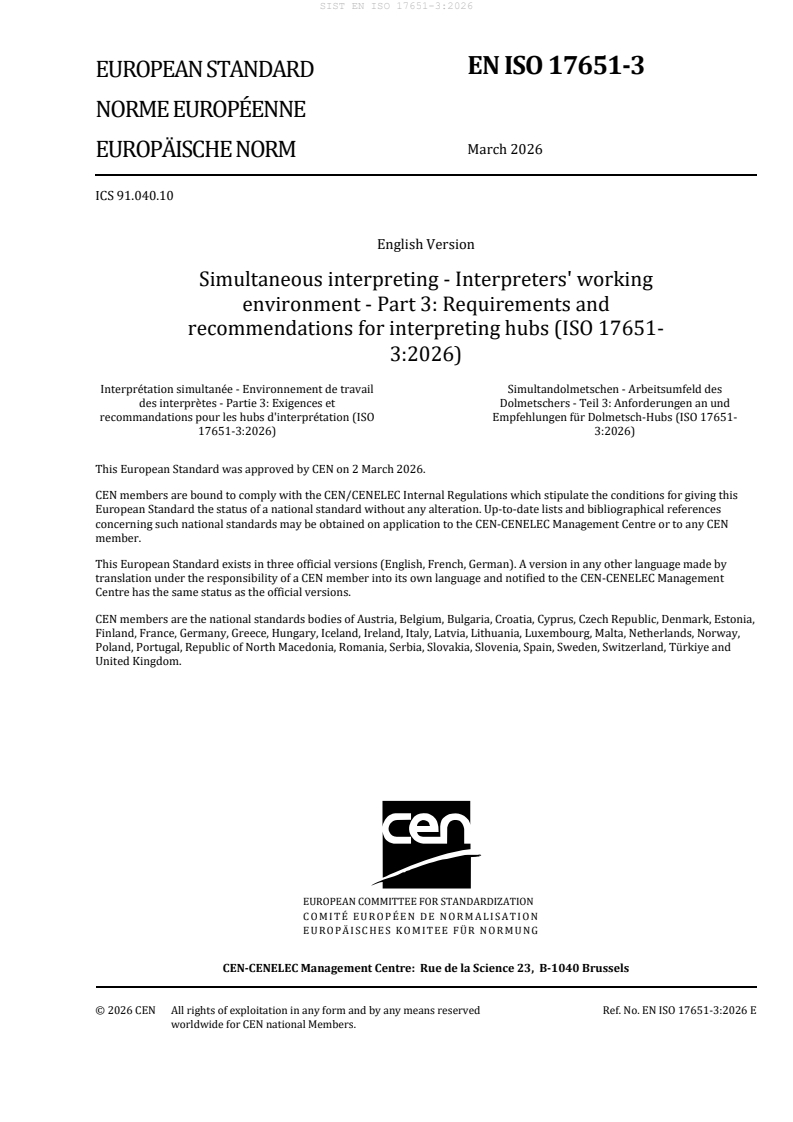
EN ISO 17651-3
EUROPEAN STANDARD
NORME EUROPÉENNE
March 2026
EUROPÄISCHE NORM
ICS 91.040.10
English Version
Simultaneous interpreting - Interpreters' working
environment - Part 3: Requirements and
recommendations for interpreting hubs (ISO 17651-
3:2026)
Interprétation simultanée - Environnement de travail Simultandolmetschen - Arbeitsumfeld des
des interprètes - Partie 3: Exigences et Dolmetschers - Teil 3: Anforderungen an und
recommandations pour les hubs d'interprétation (ISO Empfehlungen für Dolmetsch-Hubs (ISO 17651-
17651-3:2026) 3:2026)
This European Standard was approved by CEN on 2 March 2026.
CEN members are bound to comply with the CEN/CENELEC Internal Regulations which stipulate the conditions for giving this
European Standard the status of a national standard without any alteration. Up-to-date lists and bibliographical references
concerning such national standards may be obtained on application to the CEN-CENELEC Management Centre or to any CEN
member.
This European Standard exists in three official versions (English, French, German). A version in any other language made by
translation under the responsibility of a CEN member into its own language and notified to the CEN-CENELEC Management
Centre has the same status as the official versions.
CEN members are the national standards bodies of Austria, Belgium, Bulgaria, Croatia, Cyprus, Czech Republic, Denmark, Estonia,
Finland, France, Germany, Greece, Hungary, Iceland, Ireland, Italy, Latvia, Lithuania, Luxembourg, Malta, Netherlands, Norway,
Poland, Portugal, Republic of North Macedonia, Romania, Serbia, Slovakia, Slovenia, Spain, Sweden, Switzerland, Türkiye and
United Kingdom.
EUROPEAN COMMITTEE FOR STANDARDIZATION
COMITÉ EUROPÉEN DE NORMALISATION
EUROPÄISCHES KOMITEE FÜR NORMUNG
CEN-CENELEC Management Centre: Rue de la Science 23, B-1040 Brussels
© 2026 CEN All rights of exploitation in any form and by any means reserved Ref. No. EN ISO 17651-3:2026 E
worldwide for CEN national Members.
Contents Page
European foreword . 3
European foreword
This document (EN ISO 17651-3:2026) has been prepared by Technical Committee ISO/TC 37
"Language and terminology" in collaboration with CCMC.
This European Standard shall be given the status of a national standard, either by publication of an
identical text or by endorsement, at the latest by September 2026, and conflicting national standards
shall be withdrawn at the latest by September 2026.
Attention is drawn to the possibility that some of the elements of this document may be the subject of
patent rights. CEN shall not be held responsible for identifying any or all such patent rights.
Any feedback and questions on this document should be directed to the users’ national standards
body/national committee. A complete listing of these bodies can be found on the CEN website.
According to the CEN-CENELEC Internal Regulations, the national standards organizations of the
following countries are bound to implement this European Standard: Austria, Belgium, Bulgaria,
Croatia, Cyprus, Czech Republic, Denmark, Estonia, Finland, France, Germany, Greece, Hungary, Iceland,
Ireland, Italy, Latvia, Lithuania, Luxembourg, Malta, Netherlands, Norway, Poland, Portugal, Republic of
North Macedonia, Romania, Serbia, Slovakia, Slovenia, Spain, Sweden, Switzerland, Türkiye and the
United Kingdom.
Endorsement notice
The text of ISO 17651-3:2026 has been approved by CEN as EN ISO 17651-3:2026 without any
modification.
International
Standard
ISO 17651-3
First edition
Simultaneous interpreting —
2026-03
Interpreters’ working
environment —
Part 3:
Requirements and
recommendations for interpreting
hubs
Interprétation simultanée — Environnement de travail des
interprètes —
Partie 3: Exigences et recommandations pour les hubs
d’interprétation
Reference number
ISO 17651-3:2026(en) © ISO 2026
ISO 17651-3:2026(en)
© ISO 2026
All rights reserved. Unless otherwise specified, or required in the context of its implementation, no part of this publication may
be reproduced or utilized otherwise in any form or by any means, electronic or mechanical, including photocopying, or posting on
the internet or an intranet, without prior written permission. Permission can be requested from either ISO at the address below
or ISO’s member body in the country of the requester.
ISO copyright office
CP 401 • Ch. de Blandonnet 8
CH-1214 Vernier, Geneva
Phone: +41 22 749 01 11
Email: copyright@iso.org
Website: www.iso.org
Published in Switzerland
ii
ISO 17651-3:2026(en)
Contents Page
Foreword .iv
Introduction .v
1 Scope . 1
2 Normative references . 1
3 Terms and definitions . 1
4 Facilities . 4
4.1 General .4
4.2 Siting and visibility .4
4.3 Accessibility .4
5 Purpose-built interpreting hubs . 4
5.1 Spoken language hub booths .4
5.2 Signed language hub booths .5
6 Ad hoc interpreting hubs . 5
7 IT infrastructure . 6
7.1 General .6
7.2 Power .6
7.3 Network equipment and data transmission.6
7.3.1 Wide area network (WAN) .6
7.3.2 Local area network (LAN) .6
7.3.3 Additional data connections .6
7.3.4 Security . . .7
7.4 Control .7
8 Interpreting equipment . 7
9 Image content . 7
10 Technical control and technical support staff . 8
11 On-site assistance . 8
12 Amenities for interpreters . 8
12.1 Toilets .8
12.2 Interpreters’ room .8
Bibliography . 9
iii
ISO 17651-3:2026(en)
Foreword
ISO (the International Organization for Standardization) is a worldwide federation of national standards
bodies (ISO member bodies). The work of preparing International Standards is normally carried out through
ISO technical committees. Each member body interested in a subject for which a technical committee
has been established has the right to be represented on that committee. International organizations,
governmental and non-governmental, in liaison with ISO, also take part in the work. ISO collaborates closely
with the International Electrotechnical Commission (IEC) on all matters of electrotechnical standardization.
The procedures used to develop this document and those intended for its further maintenance are described
in the ISO/IEC Directives, Part 1. In particular, the different approval criteria needed for the different types
of ISO document should be noted. This document was drafted in accordance with the editorial rules of the
ISO/IEC Directives, Part 2 (see www.iso.org/directives).
ISO draws attention to the possibility that the implementation of this document may involve the use of (a)
patent(s). ISO takes no position concerning the evidence, validity or applicability of any claimed patent
rights in respect thereof. As of the date of publication of this document, ISO had not received notice of (a)
patent(s) which may be required to implement this document. However, implementers are cautioned that
this may not represent the latest information, which may be obtained from the patent database available at
www.iso.org/patents. ISO shall not be held responsible for identifying any or all such patent rights.
Any trade name used in this document is information given for the convenience of users and does not
constitute an endorsement.
For an explanation of the voluntary nature of standards, the meaning of ISO specific terms and expressions
related to conformity assessment, as well as information about ISO’s adherence to the World Trade
Organization (WTO) principles in the Technical Barriers to Trade (TBT), see www.iso.org/iso/foreword.html.
This document was prepared by Technical Committee ISO/TC 37, Language and terminology, Subcommittee
SC 5, Translation, interpreting and related technology, in collaboration with the European Committee
for Standardization (CEN) Technical Committee CEN/SS A07, Translation and Interpretation services, in
accordance with the Agreement on technical cooperation between ISO and CEN (Vienna Agreement).
A list of all parts in the ISO 17651 series can be found on the ISO website.
Any feedback or questions on this document should be directed to the user’s national standards body. A
complete listing of these bodies can be found at www.iso.org/members.html.
iv
ISO 17651-3:2026(en)
Introduction
In light of the surge in distance interpreting, new working environments for simultaneous interpreting have
developed.
This document concerns purpose-built and ad hoc interpreting hubs which allow interpreters to provide
simultaneous interpreting when they are at a location other than that of all participants of a communicative
event without a direct view of the proceedings and where technical support is provided.
Interpreting is an activity that requires high levels of concentration; therefore, the working environment
should minimize factors which add to cognitive load.
This document addresses the following:
a) distinct workplace requirements as compared to booths with a direct view of the communicative event;
b) dedicated information and communication technology (ICT) infrastructure and technical control;
c) communication between interpreters, and between interpreters and technical support staff.
This document complements ISO 17651-1, ISO 17651-2 and ISO 17651-4.
v
International Standard ISO 17651-3:2026(en)
Simultaneous interpreting — Interpreters’ working
environment —
Part 3:
Requirements and recommendations for interpreting hubs
1 Scope
This document specifies requirements and provides recommendations for the design, equipment and
operation of interpreting hubs for simultaneous interpreting. This document also ensures the usability and
accessibility of interpreting hubs for all interpreters.
This document builds upon ISO 20109 and ISO 24019, which both contain requirements and recommendations
regarding the equipment necessary for simultaneous interpreting.
2 Normative references
The following documents are referred to in the text in such a way that some or all of their content constitutes
requirements of this document. For dated references, only the edition cited applies. For undated references,
the latest edition of the referenced document (including any amendments) applies.
ISO 9241-303, Ergonomics of human-system interaction — Part 303: Requirements for electronic visual displays
ISO 16283-1, Acoustics — Field measurement of sound insulation in buildings and of building elements — Part 1:
Airborne sound insulation
ISO 17651-1:2024, Simultaneous interpreting — Interpreters’ working environment — Part 1: Requirements
and recommendations for permanent booths
ISO 17651-2, Simultaneous interpreting — Interpreters’ working environment — Part 2: Requirements and
recommendations for mobile booths
1)
ISO 17651-4:— , Simultaneous interpreting — Interpreters’ working environment — Part 4: Requirements and
recommendations for signed language interpreting
ISO 20109:2025, Simultaneous
...