

ISO/PAS 45007:2026
(Main)Occupational health and safety management — Risks arising from climate change and climate change action — Guidance for organizations
- Abstract
This document gives guidance to organizations on planning for and addressing occupational health and safety (OH&S) risks arising from climate change and climate change action, including: OH&S risks which arise as a result of climate change adaptation efforts, including changing ways of working and work processes, and infrastructure upgrades; OH&S risks arising from climate change mitigation actions; OH&S opportunities arising from both climate change adaptation and mitigation actions. This document is applicable to all organizations taking a systematic approach to addressing OH&S risks arising from climate change. It is applicable to organizations of all sizes including small and medium-sized enterprises (SMEs).
- Status
- Published
- Publication Date
- 13-Jan-2026
- Technical Committee
- ISO/TC 283 - Occupational health and safety management
- Drafting Committee
- ISO/TC 283 - Occupational health and safety management
- Current Stage
- 6060 - International Standard published
- Start Date
- 14-Jan-2026
- Due Date
- 10-Oct-2025
- Completion Date
- 14-Jan-2026
Buy Documents


ISO/PAS 45007:2026 - Occupational health and safety management — Risks arising from climate change and climate change action — Guidance for organizations Released:14. 01. 2026
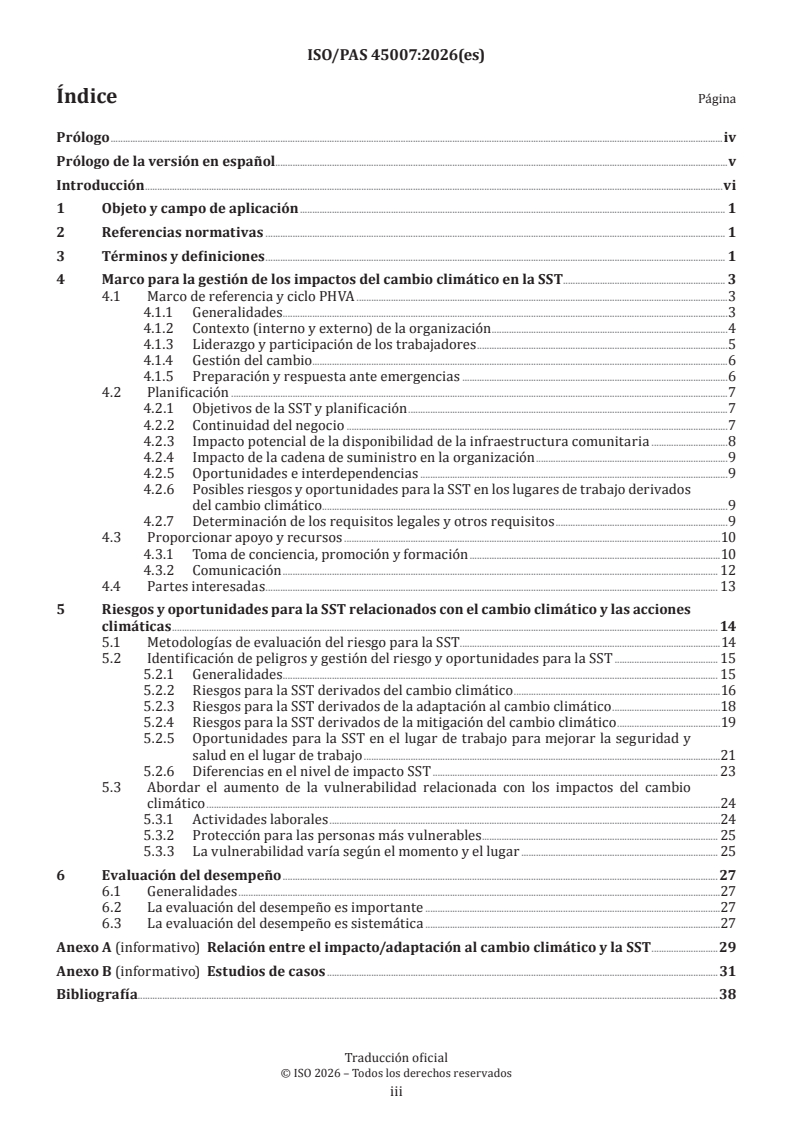
ISO/PAS 45007:2026 - Occupational health and safety management — Risks arising from climate change and climate change action — Guidance for organizations
Overview
ISO/PAS 45007:2026 is a guidance document from the International Organization for Standardization (ISO) that focuses on managing occupational health and safety (OH&S) risks arising from climate change and climate change actions. The standard supports organizations in proactively identifying, assessing, and addressing OH&S risks and opportunities linked to both direct climate impacts and organizational responses such as adaptation and mitigation efforts.
Applicable to organizations of all sizes, including small and medium-sized enterprises (SMEs), ISO/PAS 45007:2026 aligns with existing OH&S management frameworks and is designed to be compatible whether or not an organization operates a formal OH&S management system like ISO 45001. The guidance aids organizations in making workplaces more resilient to climate change, safeguarding worker health and safety, and leveraging new opportunities brought by environmental shifts.
Key Topics
1. Systems Approach and Framework
- Integration of OH&S climate risk management within existing systems (e.g., Plan-Do-Check-Act cycle).
- Consideration of both internal and external organizational context, including worker demographics, resources, location, and community infrastructure.
- Emphasis on leadership and worker participation to foster engagement and facilitate information flow.
2. Identification and Management of Risks
- Identification of OH&S risks from climate change, such as extreme weather events (heatwaves, floods, storms).
- Assessment of risks and opportunities related to adaptation actions (e.g., infrastructure upgrades, new work patterns) and mitigation measures (e.g., new technologies, processes to reduce carbon footprint).
- Risk management processes tailored for organizational context.
3. Emergency Preparedness and Business Continuity
- Enhanced emergency management processes, including integration of climate risk into risk assessments and incident response planning.
- Coordination with local authorities and emergency services to address climate-induced disruptions.
- Developing and regularly updating business continuity and disaster recovery plans to account for climate variability.
4. Supply Chain and Community Interactions
- Evaluation of risks to supply chain stability and potential knock-on effects on worker safety.
- Collaboration with community stakeholders to strengthen overall resilience and mutual support capabilities.
5. Training, Awareness, and Communication
- Developing training programs to improve worker awareness and preparedness for climate-related OH&S risks.
- Ongoing communication and consultation mechanisms to ensure participation at all levels.
Applications
ISO/PAS 45007:2026 provides practical guidance that can be applied in various settings:
- Risk Assessment: Integrate climate risk considerations into routine OH&S risk assessments across sectors such as construction, manufacturing, agriculture, and services.
- Workplace Adaptation: Guide workplace upgrades and shift planning to manage heat stress, air quality, or changes in operational hours due to climate factors.
- Emergency Planning: Structure emergency preparedness, evacuation protocols, and worker safety measures for climate-triggered events.
- Training and Advocacy: Support continuous training programs about climate impacts, fostering a safety culture attentive to emerging hazards.
- Supply Chain Management: Ensure the robustness of the supply chain against climate-related disruptions, minimizing worker exposure to secondary hazards.
- Policy and Compliance: Stay aligned with evolving legal and regulatory requirements for health, safety, and environmental responsibility.
Related Standards
Organizations implementing ISO/PAS 45007:2026 may also benefit from referencing the following ISO standards for comprehensive OH&S and climate risk management:
- ISO 45001:2018 - Occupational health and safety management systems - Requirements with guidance for use
- ISO 45006:2023 - OH&S management - Protecting workers from infectious diseases
- ISO 8025:2024 - Assessment of OH&S risks in hot environments
- ISO 28803:2012 - Assessment of OH&S risks in cold environments
- ISO 7243:2017 - Assessment of ergonomics and thermal environment
- ISO 14090:2019 - Adaptation to climate change - Principles, requirements, and guidelines
- ISO 14080:2018 - Guidelines on climate action for organizations
- ISO Guide 84:2020 - Guidelines for addressing climate change in standards
ISO/PAS 45007:2026 is a key resource for integrating climate resilience into occupational health and safety management, helping organizations navigate the challenges of a changing climate while protecting their workforce and seizing new opportunities.
Buy Documents
ISO/PAS 45007:2026 - Occupational health and safety management — Risks arising from climate change and climate change action — Guidance for organizations Released:14. 01. 2026
ISO/PAS 45007:2026 - Occupational health and safety management — Risks arising from climate change and climate change action — Guidance for organizations
Get Certified
Connect with accredited certification bodies for this standard

BSI Group
BSI (British Standards Institution) is the business standards company that helps organizations make excellence a habit.

Bureau Veritas
Bureau Veritas is a world leader in laboratory testing, inspection and certification services.

DNV
DNV is an independent assurance and risk management provider.
Sponsored listings
Frequently Asked Questions
ISO/PAS 45007:2026 is a technical specification published by the International Organization for Standardization (ISO). Its full title is "Occupational health and safety management — Risks arising from climate change and climate change action — Guidance for organizations". This standard covers: This document gives guidance to organizations on planning for and addressing occupational health and safety (OH&S) risks arising from climate change and climate change action, including: OH&S risks which arise as a result of climate change adaptation efforts, including changing ways of working and work processes, and infrastructure upgrades; OH&S risks arising from climate change mitigation actions; OH&S opportunities arising from both climate change adaptation and mitigation actions. This document is applicable to all organizations taking a systematic approach to addressing OH&S risks arising from climate change. It is applicable to organizations of all sizes including small and medium-sized enterprises (SMEs).
This document gives guidance to organizations on planning for and addressing occupational health and safety (OH&S) risks arising from climate change and climate change action, including: OH&S risks which arise as a result of climate change adaptation efforts, including changing ways of working and work processes, and infrastructure upgrades; OH&S risks arising from climate change mitigation actions; OH&S opportunities arising from both climate change adaptation and mitigation actions. This document is applicable to all organizations taking a systematic approach to addressing OH&S risks arising from climate change. It is applicable to organizations of all sizes including small and medium-sized enterprises (SMEs).
ISO/PAS 45007:2026 is classified under the following ICS (International Classification for Standards) categories: 13.100 - Occupational safety. Industrial hygiene. The ICS classification helps identify the subject area and facilitates finding related standards.
ISO/PAS 45007:2026 is available in PDF format for immediate download after purchase. The document can be added to your cart and obtained through the secure checkout process. Digital delivery ensures instant access to the complete standard document.
Standards Content (Sample)
SLOVENSKI STANDARD
01-september-2026
Vodenje varnosti in zdravja pri delu - Tveganja, povezana s podnebnimi
spremembami in ukrepi za njihovo obvladovanje - Smernice za organizacije
Occupational health and safety management - Risks arising from climate change and
climate change action - Guidance for organizations
Management de la santé et de la sécurité au travail — Risques dus aux changements
climatiques et action contre le changement climatique — Recommandations pour les
organisations
Ta slovenski standard je istoveten z: ISO/PAS 45007:2026
ICS:
13.100 Varnost pri delu. Industrijska Occupational safety.
higiena Industrial hygiene
2003-01.Slovenski inštitut za standardizacijo. Razmnoževanje celote ali delov tega standarda ni dovoljeno.
Publicly
Available
Specification
ISO/PAS 45007
First edition
Occupational health and safety
2026-01
management — Risks arising
from climate change and climate
change action — Guidance for
organizations
Management de la santé et de la sécurité au travail — Risques
dus aux changements climatiques et action contre le changement
climatique — Recommandations pour les organisations
Reference number
© ISO 2026
All rights reserved. Unless otherwise specified, or required in the context of its implementation, no part of this publication may
be reproduced or utilized otherwise in any form or by any means, electronic or mechanical, including photocopying, or posting on
the internet or an intranet, without prior written permission. Permission can be requested from either ISO at the address below
or ISO’s member body in the country of the requester.
ISO copyright office
CP 401 • Ch. de Blandonnet 8
CH-1214 Vernier, Geneva
Phone: +41 22 749 01 11
Email: copyright@iso.org
Website: www.iso.org
Published in Switzerland
ii
Contents Page
Foreword .iv
Introduction .v
1 Scope . 1
2 Normative references . 1
3 Terms and definitions . 1
4 Framework for the management of climate change impacts on OH&S . 3
4.1 General framework and PDCA cycle .3
4.1.1 General .3
4.1.2 Context (internal and external) of the organization .4
4.1.3 Leadership and worker participation .5
4.1.4 Management of change .5
4.1.5 Emergency preparedness and response .6
4.2 Planning .7
4.2.1 OH&S objectives and planning .7
4.2.2 Business continuity .7
4.2.3 Potential impact of the availability of the community infrastructure.8
4.2.4 Impact from the supply chain on the organization .8
4.2.5 Opportunities and interdependencies .8
4.2.6 Possible OH&S risks and opportunities arising from climate change at
workplaces .8
4.2.7 Determination of legal requirements and other requirements .9
4.3 Providing support and resources .9
4.3.1 Awareness, advocacy and training . .9
4.3.2 Communication.11
4.4 Interested parties . 12
5 OH&S risks and opportunities related to climate change and climate change actions .13
5.1 OH&S risk assessment methodologies . 13
5.2 Identifying hazards and managing OH&S risks and opportunities .14
5.2.1 General .14
5.2.2 OH&S risks arising from climate change . 15
5.2.3 OH&S risks arising from climate change adaptation .17
5.2.4 OH&S risks arising from climate change mitigation .18
5.2.5 OH&S opportunities to improve health and safety in the workplace . 20
5.2.6 Differences of level of OH&S impact . 22
5.3 Addressing increased vulnerability related to climate change impacts . 23
5.3.1 Work activities . 23
5.3.2 Protection for the most vulnerable. 23
5.3.3 Vulnerability varies with time and place . 23
6 Performance evaluation .25
6.1 General . 25
6.2 Performance evaluation is important . 25
6.3 Performance evaluation is systematic . 26
Annex A (informative) Relationship between climate change impact/adaptation and OH&S .27
Annex B (informative) Case studies .28
Bibliography .34
iii
Foreword
ISO (the International Organization for Standardization) is a worldwide federation of national standards
bodies (ISO member bodies). The work of preparing International Standards is normally carried out through
ISO technical committees. Each member body interested in a subject for which a technical committee
has been established has the right to be represented on that committee. International organizations,
governmental and non-governmental, in liaison with ISO, also take part in the work. ISO collaborates closely
with the International Electrotechnical Commission (IEC) on all matters of electrotechnical standardization.
The procedures used to develop this document and those intended for its further maintenance are described
in the ISO/IEC Directives, Part 1. In particular, the different approval criteria needed for the different types
of ISO document should be noted. This document was drafted in accordance with the editorial rules of the
ISO/IEC Directives, Part 2 (see www.iso.org/directives).
ISO draws attention to the possibility that the implementation of this document may involve the use of (a)
patent(s). ISO takes no position concerning the evidence, validity or applicability of any claimed patent
rights in respect thereof. As of the date of publication of this document, ISO had not received notice of (a)
patent(s) which may be required to implement this document. However, implementers are cautioned that
this may not represent the latest information, which may be obtained from the patent database available at
www.iso.org/patents. ISO shall not be held responsible for identifying any or all such patent rights.
Any trade name used in this document is information given for the convenience of users and does not
constitute an endorsement.
For an explanation of the voluntary nature of standards, the meaning of ISO specific terms and expressions
related to conformity assessment, as well as information about ISO’s adherence to the World Trade
Organization (WTO) principles in the Technical Barriers to Trade (TBT), see www.iso.org/iso/foreword.html.
This document was prepared by Technical Committee ISO/TC 283, Occupational health and safety
management.
Any feedback or questions on this document should be directed to the user’s national standards body. A
complete listing of these bodies can be found at www.iso.org/members.html.
iv
Introduction
Climate change poses significant challenges to organizations worldwide, impacting not only the environment
but also occupational health and safety (OH&S), meaning that it is important that organizations proactively
address the OH&S challenges arising from climate change and climate change actions. This document
provides comprehensive guidance for organizations to manage these risks and opportunities effectively.
This document is intended for all organizations, whether or not they have implemented informal or formal
OH&S management system such as ISO 45001. Such a management system includes the relevant elements
of a Plan-Do-Check-Act (PDCA) system. Taking a systems approach facilitates the coordination of resources
and efforts, which is important in managing climate change.
This document will assist organizations to better understand the impacts of climate change and climate
change actions on OH&S and to create resilient and sustainable work environments that protect the health
and safety of workers.
It encompasses OH&S risks resulting from climate change itself, as well as those arising from climate change
adaptation efforts, such as changes in work processes or infrastructure upgrades, and those associated
with climate change mitigation efforts aimed at reducing greenhouse gas (GHG) effects or an organization’s
carbon footprint.
It also highlights the opportunities to enhance workplace health and safety through proactive measures.
Due to the nature of the subject, many definitions and concepts have been imported from the fields of
climate change science and adapted to the context of hazard identification and assessment and control of
OH&S risks, with focus on both health and safety impacts and opportunities.
v
Publicly Available Specification ISO/PAS 45007:2026(en)
Occupational health and safety management — Risks arising
from climate change and climate change action — Guidance
for organizations
1 Scope
This document gives guidance to organizations on planning for and addressing occupational health and
safety (OH&S) risks arising from climate change and climate change action, including:
— OH&S risks which arise as a result of climate change adaptation efforts, including changing ways of
working and work processes, and infrastructure upgrades;
— OH&S risks arising from climate change mitigation actions;
— OH&S opportunities arising from both climate change adaptation and mitigation actions.
This document is applicable to all organizations taking a systematic approach to addressing OH&S risks
arising from climate change. It is applicable to organizations of all sizes including small and medium-sized
enterprises (SMEs).
2 Normative references
There are no normative references in this document.
3 Terms and definitions
For the purposes of this document, the following terms and definitions apply.
ISO and IEC maintain terminology databases for use in standardization at the following addresses:
— ISO Online browsing platform: available at https:// www .iso .org/ obp
— IEC Electropedia: available at https:// www .electropedia .org/
3.1
climate
statistical description of weather in terms of the mean and variability of relevant quantities over a period of
time ranging from months to thousands or millions of years
Note 1 to entry: The usual period for considering these variables is 30 years, as defined by the World Meteorological
Organization.
Note 2 to entry: The relevant quantities are most often near-surface variables such as temperature, precipitation and
wind.
[SOURCE: ISO 14090:2019, 3.4]
3.2
climate change
change in climate (3.1) that persists for an extended period, typically decades or longer
Note 1 to entry: Change in climate can be identified (e.g. by using statistical tests) by changes in the mean and/or the
variability of its properties.
Note 2 to entry: Climate change can be due to natural processes, internal to the climate system, or external forces such
as modulations of the solar cycles, volcanic eruptions, and persistent anthropogenic changes in the composition of the
atmosphere or in land use.
[SOURCE: ISO Guide 84:2020, 3.1.2]
3.3
climate change action
initiative to achieve climate change measures or goals based on mitigation and/or adaptation priorities
under climate change policies
Note 1 to entry: Climate change action intends to a) reduce or prevent emissions or enhance removals, and b) reduce
vulnerability, maintain and increase the resilience, and increase adaptive capacity of human and ecological systems
from adverse climate change impacts (3.5).
[SOURCE: ISO 14080:2018, 3.1.1.1, modified — “change” added to the term.]
3.4
climate change adaptation
process of adjustment to actual or expected climate (3.1) and its effects
Note 1 to entry: In human systems, adaptation seeks to moderate or avoid harm or exploit beneficial opportunities.
Note 2 to entry: In some natural systems, human intervention can facilitate adjustment to expected climate and its
effects.
[SOURCE: ISO 14090:2019, 3.1, modified — “climate change adaptation” replaced “adaptation to climate
change” as the preferred term.]
3.5
climate change impact
effect on natural and human systems of extreme weather and climate events and of climate change (3.2)
Note 1 to entry: Impacts generally refer to effects on lives, livelihoods, health, ecosystems, economies, societies,
cultures, services and infrastructure due to the interaction of climate change or hazardous climate events occurring
within a specific time period and the vulnerability of an exposed society or system. Impacts are also referred to as
consequences and outcomes. The impacts of climate change on geophysical systems, including floods, droughts and
sea level rise, are a subset of impacts called “physical impacts”.
[SOURCE: ISO 14090:2019, 3.8, modified — “climate change” added to the term. “of extreme weather and
climate events and of climate change” added to the definition. “In the context of climate change” deleted
from Note 1 to entry.]
3.6
climate change mitigation
human intervention to reduce greenhouse gas (GHG) emissions or enhance GHG removals
[SOURCE: ISO 14080:2018, 3.1.2.1, modified — “to reduce greenhouse gas (GHG) emissions or enhance
GHG removals” replaced “to reduce the sources or enhance the sinks of greenhouse gases (GHGs)” in the
definition.]
3.7
climate change risk
risk of negative climate change impacts (3.5) that reflects the interaction among vulnerability, exposure and
hazard
Note 1 to entry: A risk assessment can include the consideration of vulnerabilities, exposure and climate change
hazards, or the consideration of likelihoods and consequences.
[SOURCE: ISO Guide 84:2020, 3.1.6]
3.8
extreme weather event
event that is significantly different from typical weather patterns or occurrences
Note 1 to entry: What is considered extreme can change based on location and can change over time.
3.9
impact chain
analytical approach that enables understanding of how given hazards generate direct and indirect impacts
which propagate through a system at risk
3.10
organization
person or group of people that has its own functions with responsibilities, authorities and relationships to
achieve its objectives
Note 1 to entry: The concept of organization includes, but is not limited to, sole-trader, company, corporation, firm,
enterprise, authority, partnership, charity or institution, or part or combination thereof, whether incorporated or not,
public or private.
3.11
occupational health and safety risk
OH&S risk
combination of the likelihood of occurrence of a work-related hazardous event(s) or exposure(s) and the
severity of injury and ill health that can be caused by the event(s) or exposure(s)
Note 1 to entry: In this document, referring to “OH&S risk” means OH&S risks and risks to the OH&S management
system.
Note 2 to entry: OH&S risk includes the “cause – effect” relationship of cascading risks (chain of events) in the context
of climate change (3.2), for both existing and new/emerging risks.
[SOURCE: ISO 45001:2018, 3.21, modified — Notes 1 and 2 to entry added.]
4 Framework for the management of climate change impacts on OH&S
4.1 General framework and PDCA cycle
4.1.1 General
An informal or formal system to manage OH&S risks and opportunities outlines the need for an organization
to identify issues that can affect its ability to achieve the intended result(s). A formal management system
includes the relevant elements of a PDCA system (see Figure 1). Climate change is an external issue (see the
examples given in Annex B) which poses OH&S risks (and opportunities) and can require the organization to
adapt its OH&S management system, due to changes in context, risks, availability of technologies and other
aspects related to OH&S management.
It is crucial that the organization analyses its context before adopting relevant changes in production, work
organization, introduction of technologies and other actions.
Actions to address the effects of climate change by introducing new work systems and technologies can
create new OH&S risks and opportunities. The risks can impact workers’ mental and physical health and
safety.
Regardless of the framework adopted, it is important that processes and arrangements are tailored to
reflect the organization and its context. This includes tailoring to reflect the demands on the organization’s
management of OH&S risk(s) that arise from climate change. This clause highlights some of the key areas for
attention.
Figure 1 — Framework of this document and its relationship to PDCA
4.1.2 Context (internal and external) of the organization
The organization should determine internal and external issues that affect its ability to address the OH&S-
related effects, where applicable, of climate change and the needs and expectations of interested parties
(e.g. contractors, insurance companies) in relation to these effects. The organization should consider how
these issues affect its OH&S risks and opportunities, and how they are managed.
Examples of internal issues that can affect the organization’s management of the OH&S impacts, some
broader and others more specific to climate change, include:
— issues raised by workers and other interested parties that can impact the organization’s internal
activities;
— internal requirements, including policies and practices, mission, vision, values, objectives, strategies,
agreements and guidelines;
— organization structure and governance model, work scope, work shifts, roles, functions and
responsibilities;
— processes, products and services, including the location of premises in geographical zones with higher
climate change impacts and frequent travels of workers due to their work activity, including zones with
specific impacts of climate change (e.g. extreme temperatures);
— differences in vulnerability due to demographic characteristics of workers (e.g. gender, age, disabilities);
— proficiency in languages, literacy and education levels;
— financial, human (availability, competence, etc.) and technological (availability and conditions of
equipment, products, facilities, systems and workplaces) resources and distribution of resources.
Examples of external issues that can affect the organization’s management of the OH&S impacts, some
broader and others more specific to climate change, include:
— legal requirements and other requirements, including legislation, sectoral agreements, conventions and
voluntary agreements subscribed to by the organization;
— local authorities that plan to cope with specific climate change impacts and/or possible impacts of
climate change on supplies such as water or electricity, or emergency response;
— local transport services and infrastructure, potentially affecting the organization’s ability to effect
significant changes to working hours, or shift patterns (e.g. to avoid the hottest times of day);
— dependence upon supplied products and services, utilities and external services (e.g. emergency response
and medical services) and the resilience of these in relation to climate change;
— influence of economic, financial, political factors, national or international conflict on local resources
and delivery (e.g. disaster relief delivery);
— influence of climate change impacts (e.g. loss of crops producing economic conflict) on economic,
financial, political stability in a region where operations are conducted;
— technological innovations, equipment, products and systems evolution, and more specifically those
intended to reduce OH&S risks as a result of climate change mitigation or adaptation (e.g. cooling vest
against extreme heat for construction workers);
— the geographical location of the organization relative to natural or human-originated disasters and
associated climate change impacts.
4.1.3 Leadership and worker participation
Top management should engage in, promote, communicate and monitor the performance and effectiveness
of the organization in addressing the OH&S-related impacts of climate change, and in minimizing OH&S
harm from climate change mitigation and adaptation. How this can be applied depends on various factors,
such as the size and complexity of the organization, its management style and organizational culture.
In addition to providing direction to the organization, top management should also ensure that the
organization provides the necessary physical and financial resources to enable it to effectively address the
OH&S-related effects of climate change.
Top management should encourage worker participation by:
— communicating the importance of the organization’s efforts to address the impacts of climate change on
OH&S and encouraging workers to support them;
— ensuring the organization establishes processes for consultation and participation of workers, and their
representatives when they exist, and removing barriers that limit worker participation;
— ensuring that workers are protected from reprisals when they report climate-change-related OH&S
issues and concerns by ensuring the organization identifies or establishes processes for investigating
and resolving relevant concerns and complaints, as well as a whistleblowing system and policy.
4.1.4 Management of change
The organization should include in its process(es) for the management of change the new aspects arising
from climate change and its OH&S-related impacts.
Changes made to the organization’s operations to mitigate and/or adapt to the effects of climate change
should be managed to avoid adverse OH&S impacts on workers. This should include consultation with
affected workers.
NOTE Changes can result in OH&S risks and opportunities.
4.1.5 Emergency preparedness and response
The focus of this subclause is to provide specific guidance on emergency preparedness and response of the
organization arising from:
— OH&S-related emergency situations resulting from climate change (e.g. such as heatwaves, tornados,
flooding);
— climate change effects on the organization’s emergency management (e.g. lack of access to water, limited
external emergency services response).
The emergency management processes can include the use of information provided by the early warning
system (EWS).
NOTE EWS refers to a system or mechanism that provides advance notice of a serious or dangerous event that is
about to happen. It can be used in various contexts, such as detecting enemy attacks, predicting natural disasters or
identifying potential health problems.
Therefore, to effectively address OH&S risk arising from climate change, the organization should consider
establishing vigorous and robust emergency management processes.
The organization should make efforts to enhance its preparedness, coordination and response strategies to
effectively mitigate the health and safety risks associated with climate-change-related emergencies, by:
— incorporating climate change considerations into its OH&S risk assessments;
— determining how climate change can create risks to the OH&S management system and OH&S
opportunities;
— developing adaptive/dynamic/resilient response plans;
— promoting collaboration between emergency teams/establishments, public health agencies and other
relevant interested parties.
The organization should review how relevant climate change events/disasters at the workplaces can
adversely affect the effectiveness of its emergency preparedness and response. Climate change events/
disasters can lead to:
a) exposure to new hazards;
b) exposing emergency response workers to new OH&S risks;
c) the increasing likelihood or severity, or both, of previously identified OH&S risks (related to a lack of
understanding of the severity of emergency situations including disasters, underestimating the size and
scale, and failing to keep up to date with local and regional climate-change-related emergency tiers/
levels such as civil defence agencies, fire departments and healthcare agencies);
d) limitation of the interested party’s capability to respond to emergencies (e.g. vulnerability of supply
chain, regulatory and voluntary agreement issues).
The organization should consider inclusiveness when planning for emergency preparedness and response to
climate change events/disasters.
4.2 Planning
4.2.1 OH&S objectives and planning
The organization should establish clear objectives regarding risks, opportunities and impacts resulting from
climate change, its adaptations and climate change actions, and determine whether it needs to establish new
processes, procure new technologies or other actions.
The organization should determine specific objectives and expected results for continuing operations,
addressing climate-change-related problems including supply chains and protecting vulnerable groups or
individuals.
EXAMPLE Storms, floods, blackouts, reduced work performance due to heat-related issues.
The organization should regularly review its OH&S objectives to determine:
a) if they are still valid;
b) if some objectives need to be revised;
c) if objectives need to be added or removed.
NOTE In some countries, operational risk assessment and the derivation of measures is a legal obligation.
4.2.2 Business continuity
Business continuity refers to the capability of an organization to continue its critical functions during and
after a disruptive incident or crisis, minimizing adverse impact on the organization, its interested parties
and society as a whole.
Organizations should include OH&S considerations when analysing the situations arising from climate
change consequences that can challenge business continuity.
The organization should consider the following key aspects (using the case of flooding as an example):
— risk management;
EXAMPLE 1 Identifying and assessing the increasing likelihood and possible impact of flooding due to extreme
precipitation on business continuity and the safety of workers, and taking preventive measures such as adequate
flood defences so that work can continue safely. Considering accessing past and present weather data from EWS
organizations, aimed at enabling early action to save and protect lives, livelihoods and assets of people at risk.
— incident management;
EXAMPLE 2 Allocating appropriate resources to address adverse effects of extreme or prolonged precipitation,
ensuring safe spaces and access to basic needs such as potable water and food.
— incident preparedness and response;
EXAMPLE 3 Establishing and circulating plans to prepare for and respond to incidents, such as safe evacuation
after flooding.
— communication and training;
EXAMPLE 4 Developing communication plans (see 4.3.2 for details) to ensure that all workers are aware of the
emergency protocols and are trained by means of periodic evacuation drills.
— workplace recovery;
EXAMPLE 5 Outlining a process for returning to full operation following eventual flooding, while restoring or
even improving the health and safety of the workplace (building back better).
— continual improvement;
EXAMPLE 6 Regularly reviewing and updating business continuity as well as emergency plans, and drawing
lessons from climate-change-related incidents to better protect the health and safety of workers in case of new
incidents.
— reviewing policies that encourage remote (home) working, which can increase the social isolation of
workers and cause psychological harm.
4.2.3 Potential impact of the availability of the community infrastructure
The organization should engage with local interested parties and decision-makers to:
— understand the likely effects of climate change on local community infrastructure;
— consider the potential for mutual support among interested parties;
— collaborate in the development of any community emergency plans that will involve or impact the
organization;
The increased frequency and scale of demand upon local emergency response agencies can lead to the
development of local policies to establish priorities for emergency response, to optimize the available
response capability. Where such policies limit the support that agencies can provide in response to incidents;
this can increase OH&S risks to workers (e.g. by extending response times or by creating the need for greater
involvement by workers themselves in dealing with incidents).
EXAMPLE 1 Transport infrastructure and utility supplies are subject to more frequent or prolonged disruption.
EXAMPLE 2 Access to, and the support available from, community emergency responders and local medical
facilities are affected by extreme weather events, or by the demands arising from large-scale events (e.g. storms)
affecting the whole community.
4.2.4 Impact from the supply chain on the organization
The impact of climate change on the supply chain presents specific OH&S risks to workers that should be
taken into account. The organization’s planning should consider the limits of the organization’s influence,
its interfaces, and the effects of disruption, incorrect or late deliveries, from an OH&S perspective. This
provides opportunities for improvement to reduce health and safety risks.
4.2.5 Opportunities and interdependencies
When planning to address its climate related OH&S risks, the organization should also consider
opportunities to improve OH&S. For example, if operations are relocated to a different location, there can be
the opportunity to provide a better working environment in terms of layout, lighting or climate control (air
conditioning, ventilation), or to introduce more flexible working.
4.2.6 Possible OH&S risks and opportunities arising from climate change at workplaces
OH&S risks arising from the climate change can result from three different situations:
a) direct impacts of climate change on OH&S;
b) actions to adapt to climate change;
c) actions to mitigate climate change.
A non-exhaustive list of impacts can be found in 5.2, and specifically in 5.2.2, 5.2.3 and 5.2.4.
Climate change impacts can modify the type and level of risks existing at the workplace. The organization
should review its risk assessment as well as actions derived from it and control measures.
For specific risk assessments, other standards are available:
— for infectious diseases, see ISO 45006:2023;
— for hot environments, see ISO 8025:2024;
— for cold environments, see ISO 28803:2012;
— for assessing the ergonomics of the thermal environment, see ISO 7243:2017.
4.2.7 Determination of legal requirements and other requirements
The organization should establish, implement and maintain a process or processes to:
a) determine and have access to up-to-date legal requirements and other requirements that are applicable
to its hazards and OH&S risks, including those from public health and environmental authorities, related
to climate change;
b) determine how these legal requirements and other requirements apply to the organization and what
needs to be communicated;
c) take these legal requirements and other requirements into account when establishing, implementing,
maintaining and continually improving its management of OH&S.
The organization should maintain and retain documented information on its legal requirements and other
requirements and should ensure that it is updated to reflect any changes.
4.3 Providing support and resources
4.3.1 Awareness, advocacy and training
4.3.1.1 Principle
The organization can effectively address OH&S risks arising from climate change by providing all workers
with the knowledge, skills and ability needed to effectively mitigate and respond to these risks. This
proactive approach improves resilience, minimizes disruptions and promotes a culture of sustainability
that directly supports a culture of safety throughout the organization.
The organization should provide awareness, advocacy and training so that it can:
— address climate change risks in a comprehensive and holistic way, especially if the organization has
strategic level climate change risk management work (based on Task Force on Climate-Related Financial
Disclosures (TCFD) or other sustainability/environmental, social and governance (ESG) requirements);
— provide the necessary resources;
— provide workers with the knowledge, skills, and ability needed to effectively signal/identify heat related
OH&S risks to management and adapt, mitigate and respond to OH&S risks arising from climate change.
These measures support a proactive approach to risk management, rather than a reactive one.
The organization should ensure that all workers:
— are aware that climate change can affect the workplace and its OH&S management system;
— understand how climate change can affect them when they perform their work and work-related
activities (hazards and OH&S risks related to climate change);
— have access to a mechanism to raise their concerns and provide feedback related to OH&S risks arising
from climate change.
4.3.1.2 Design
In developing awareness, advocacy and training programmes, the organization should consider:
— context (e.g. geographical location, industry sector, operational vulnerabilities);
— results of risks and opportunities assessment related to climate change impacts on the OH&S management
system;
NOTE Climate change can have impacts on an organization’s workforce and its internal and external
infrastructure that it heavily depends on for the effectiveness of the OH&S management system, access to supply
chain, etc.).
— results of its OH&S risk assessment;
— results of gap analysis and training gaps related to climate change;
— specific needs for different levels and functions in the organization.
When designing and implementing awareness, advocacy and training programmes, the organization should
consider:
— the level of depth and comprehensiveness required related to the understanding of climate change
risks and their implications for the organization’s operations, public and worker health and safety, and
emergency response;
— addressing the needs of different worker groups, such as executives, managers, supervisors and frontline
workers, including temporary workers and self-employed contract workers;
— providing training that is relevant to roles (training can cover topics such as basic climate change,
identification of climate-change-related hazards and OH&S risks, including how it affects OH&S risk
assessment, local and regional climate forecasts, emergency response procedures, adaptation and
mitigation strategies, and specific training such as how workers can perform their role in mitigating and
responding to OH&S risks arising from climate change);
— avoiding a one-size-fits-all approach (each level/function can have specific designs, different roles within
the organization can have specific responsibilities and requirements related to climate change risks).
The organization should take into account the diversity of its workers and interested parties when designing
the training, by:
— enabling workers to understand the relevance of climate change risks to the organization’s specific
industry, operations and local context;
— using a variety of training methods to cater to different learning styles and preferences;
— incorporating case studies and real-life examples, to highlight successful adaptation and response
strategies.
4.3.1.3 Outcome
The organization should monitor and evaluate the effectiveness of training, by:
— evaluating the effectiveness of awareness and training programmes to ensure that they meet the
intended objectives;
— assessing competency (as relevant and necessary) such as knowledge retention, behaviour change and
the application of these new learned concepts in the workplace;
— using feedback mechanisms, assessments and indicators to identify areas for improvement;
— including it in OH&S internal audits;
— improving training programmes by making necessary adjustments to the training content and delivery
methods.
Top management should ensure that its OH&S management system is resilient in addressing OH&S risks
arising from climate change. Top management can demonstrate this by advocating for:
— policies or decisions that encourage workers to understand the connections between their daily activities
and climate change risks/impacts;
— climate change related to health and safety considerations to be integrated into existing OH&S awareness
and environmental awareness initiatives to reinforce the importance of addressing these risks jointly;
— the promotion of a culture of climate change awareness throughout the organization;
— the involvement and feedback from workers, workers representatives and other interested parties (to
address their inputs and ideas to improve the organization’s climate change adaptation, mitigation and
emergency response efforts);
— monitoring and evaluation of the effectiveness of the organization’s OH&S responses to climate change
to ensure that they meet the intended objectives (resiliency).
4.3.2 Communication
4.3.2.1 General
In the context of climate change, communication is important to ensure that the organization is aware of the
risks associated with climate change and takes appropriate measures to protect worker health and safety,
which can also extend to the community it operates within.
Additionally, effectiv
...
Publicly
Available
Specification
ISO/PAS 45007
First edition
Occupational health and safety
2026-01
management — Risks arising
from climate change and climate
change action — Guidance for
organizations
Management de la santé et de la sécurité au travail — Risques
dus aux changements climatiques et action contre le changement
climatique — Recommandations pour les organisations
Reference number
© ISO 2026
All rights reserved. Unless otherwise specified, or required in the context of its implementation, no part of this publication may
be reproduced or utilized otherwise in any form or by any means, electronic or mechanical, including photocopying, or posting on
the internet or an intranet, without prior written permission. Permission can be requested from either ISO at the address below
or ISO’s member body in the country of the requester.
ISO copyright office
CP 401 • Ch. de Blandonnet 8
CH-1214 Vernier, Geneva
Phone: +41 22 749 01 11
Email: copyright@iso.org
Website: www.iso.org
Published in Switzerland
ii
Contents Page
Foreword .iv
Introduction .v
1 Scope . 1
2 Normative references . 1
3 Terms and definitions . 1
4 Framework for the management of climate change impacts on OH&S . 3
4.1 General framework and PDCA cycle .3
4.1.1 General .3
4.1.2 Context (internal and external) of the organization .4
4.1.3 Leadership and worker participation .5
4.1.4 Management of change .5
4.1.5 Emergency preparedness and response .6
4.2 Planning .7
4.2.1 OH&S objectives and planning .7
4.2.2 Business continuity .7
4.2.3 Potential impact of the availability of the community infrastructure.8
4.2.4 Impact from the supply chain on the organization .8
4.2.5 Opportunities and interdependencies .8
4.2.6 Possible OH&S risks and opportunities arising from climate change at
workplaces .8
4.2.7 Determination of legal requirements and other requirements .9
4.3 Providing support and resources .9
4.3.1 Awareness, advocacy and training . .9
4.3.2 Communication.11
4.4 Interested parties . 12
5 OH&S risks and opportunities related to climate change and climate change actions .13
5.1 OH&S risk assessment methodologies . 13
5.2 Identifying hazards and managing OH&S risks and opportunities .14
5.2.1 General .14
5.2.2 OH&S risks arising from climate change . 15
5.2.3 OH&S risks arising from climate change adaptation .17
5.2.4 OH&S risks arising from climate change mitigation .18
5.2.5 OH&S opportunities to improve health and safety in the workplace . 20
5.2.6 Differences of level of OH&S impact . 22
5.3 Addressing increased vulnerability related to climate change impacts . 23
5.3.1 Work activities . 23
5.3.2 Protection for the most vulnerable. 23
5.3.3 Vulnerability varies with time and place . 23
6 Performance evaluation .25
6.1 General . 25
6.2 Performance evaluation is important . 25
6.3 Performance evaluation is systematic . 26
Annex A (informative) Relationship between climate change impact/adaptation and OH&S .27
Annex B (informative) Case studies .28
Bibliography .34
iii
Foreword
ISO (the International Organization for Standardization) is a worldwide federation of national standards
bodies (ISO member bodies). The work of preparing International Standards is normally carried out through
ISO technical committees. Each member body interested in a subject for which a technical committee
has been established has the right to be represented on that committee. International organizations,
governmental and non-governmental, in liaison with ISO, also take part in the work. ISO collaborates closely
with the International Electrotechnical Commission (IEC) on all matters of electrotechnical standardization.
The procedures used to develop this document and those intended for its further maintenance are described
in the ISO/IEC Directives, Part 1. In particular, the different approval criteria needed for the different types
of ISO document should be noted. This document was drafted in accordance with the editorial rules of the
ISO/IEC Directives, Part 2 (see www.iso.org/directives).
ISO draws attention to the possibility that the implementation of this document may involve the use of (a)
patent(s). ISO takes no position concerning the evidence, validity or applicability of any claimed patent
rights in respect thereof. As of the date of publication of this document, ISO had not received notice of (a)
patent(s) which may be required to implement this document. However, implementers are cautioned that
this may not represent the latest information, which may be obtained from the patent database available at
www.iso.org/patents. ISO shall not be held responsible for identifying any or all such patent rights.
Any trade name used in this document is information given for the convenience of users and does not
constitute an endorsement.
For an explanation of the voluntary nature of standards, the meaning of ISO specific terms and expressions
related to conformity assessment, as well as information about ISO’s adherence to the World Trade
Organization (WTO) principles in the Technical Barriers to Trade (TBT), see www.iso.org/iso/foreword.html.
This document was prepared by Technical Committee ISO/TC 283, Occupational health and safety
management.
Any feedback or questions on this document should be directed to the user’s national standards body. A
complete listing of these bodies can be found at www.iso.org/members.html.
iv
Introduction
Climate change poses significant challenges to organizations worldwide, impacting not only the environment
but also occupational health and safety (OH&S), meaning that it is important that organizations proactively
address the OH&S challenges arising from climate change and climate change actions. This document
provides comprehensive guidance for organizations to manage these risks and opportunities effectively.
This document is intended for all organizations, whether or not they have implemented informal or formal
OH&S management system such as ISO 45001. Such a management system includes the relevant elements
of a Plan-Do-Check-Act (PDCA) system. Taking a systems approach facilitates the coordination of resources
and efforts, which is important in managing climate change.
This document will assist organizations to better understand the impacts of climate change and climate
change actions on OH&S and to create resilient and sustainable work environments that protect the health
and safety of workers.
It encompasses OH&S risks resulting from climate change itself, as well as those arising from climate change
adaptation efforts, such as changes in work processes or infrastructure upgrades, and those associated
with climate change mitigation efforts aimed at reducing greenhouse gas (GHG) effects or an organization’s
carbon footprint.
It also highlights the opportunities to enhance workplace health and safety through proactive measures.
Due to the nature of the subject, many definitions and concepts have been imported from the fields of
climate change science and adapted to the context of hazard identification and assessment and control of
OH&S risks, with focus on both health and safety impacts and opportunities.
v
Publicly Available Specification ISO/PAS 45007:2026(en)
Occupational health and safety management — Risks arising
from climate change and climate change action — Guidance
for organizations
1 Scope
This document gives guidance to organizations on planning for and addressing occupational health and
safety (OH&S) risks arising from climate change and climate change action, including:
— OH&S risks which arise as a result of climate change adaptation efforts, including changing ways of
working and work processes, and infrastructure upgrades;
— OH&S risks arising from climate change mitigation actions;
— OH&S opportunities arising from both climate change adaptation and mitigation actions.
This document is applicable to all organizations taking a systematic approach to addressing OH&S risks
arising from climate change. It is applicable to organizations of all sizes including small and medium-sized
enterprises (SMEs).
2 Normative references
There are no normative references in this document.
3 Terms and definitions
For the purposes of this document, the following terms and definitions apply.
ISO and IEC maintain terminology databases for use in standardization at the following addresses:
— ISO Online browsing platform: available at https:// www .iso .org/ obp
— IEC Electropedia: available at https:// www .electropedia .org/
3.1
climate
statistical description of weather in terms of the mean and variability of relevant quantities over a period of
time ranging from months to thousands or millions of years
Note 1 to entry: The usual period for considering these variables is 30 years, as defined by the World Meteorological
Organization.
Note 2 to entry: The relevant quantities are most often near-surface variables such as temperature, precipitation and
wind.
[SOURCE: ISO 14090:2019, 3.4]
3.2
climate change
change in climate (3.1) that persists for an extended period, typically decades or longer
Note 1 to entry: Change in climate can be identified (e.g. by using statistical tests) by changes in the mean and/or the
variability of its properties.
Note 2 to entry: Climate change can be due to natural processes, internal to the climate system, or external forces such
as modulations of the solar cycles, volcanic eruptions, and persistent anthropogenic changes in the composition of the
atmosphere or in land use.
[SOURCE: ISO Guide 84:2020, 3.1.2]
3.3
climate change action
initiative to achieve climate change measures or goals based on mitigation and/or adaptation priorities
under climate change policies
Note 1 to entry: Climate change action intends to a) reduce or prevent emissions or enhance removals, and b) reduce
vulnerability, maintain and increase the resilience, and increase adaptive capacity of human and ecological systems
from adverse climate change impacts (3.5).
[SOURCE: ISO 14080:2018, 3.1.1.1, modified — “change” added to the term.]
3.4
climate change adaptation
process of adjustment to actual or expected climate (3.1) and its effects
Note 1 to entry: In human systems, adaptation seeks to moderate or avoid harm or exploit beneficial opportunities.
Note 2 to entry: In some natural systems, human intervention can facilitate adjustment to expected climate and its
effects.
[SOURCE: ISO 14090:2019, 3.1, modified — “climate change adaptation” replaced “adaptation to climate
change” as the preferred term.]
3.5
climate change impact
effect on natural and human systems of extreme weather and climate events and of climate change (3.2)
Note 1 to entry: Impacts generally refer to effects on lives, livelihoods, health, ecosystems, economies, societies,
cultures, services and infrastructure due to the interaction of climate change or hazardous climate events occurring
within a specific time period and the vulnerability of an exposed society or system. Impacts are also referred to as
consequences and outcomes. The impacts of climate change on geophysical systems, including floods, droughts and
sea level rise, are a subset of impacts called “physical impacts”.
[SOURCE: ISO 14090:2019, 3.8, modified — “climate change” added to the term. “of extreme weather and
climate events and of climate change” added to the definition. “In the context of climate change” deleted
from Note 1 to entry.]
3.6
climate change mitigation
human intervention to reduce greenhouse gas (GHG) emissions or enhance GHG removals
[SOURCE: ISO 14080:2018, 3.1.2.1, modified — “to reduce greenhouse gas (GHG) emissions or enhance
GHG removals” replaced “to reduce the sources or enhance the sinks of greenhouse gases (GHGs)” in the
definition.]
3.7
climate change risk
risk of negative climate change impacts (3.5) that reflects the interaction among vulnerability, exposure and
hazard
Note 1 to entry: A risk assessment can include the consideration of vulnerabilities, exposure and climate change
hazards, or the consideration of likelihoods and consequences.
[SOURCE: ISO Guide 84:2020, 3.1.6]
3.8
extreme weather event
event that is significantly different from typical weather patterns or occurrences
Note 1 to entry: What is considered extreme can change based on location and can change over time.
3.9
impact chain
analytical approach that enables understanding of how given hazards generate direct and indirect impacts
which propagate through a system at risk
3.10
organization
person or group of people that has its own functions with responsibilities, authorities and relationships to
achieve its objectives
Note 1 to entry: The concept of organization includes, but is not limited to, sole-trader, company, corporation, firm,
enterprise, authority, partnership, charity or institution, or part or combination thereof, whether incorporated or not,
public or private.
3.11
occupational health and safety risk
OH&S risk
combination of the likelihood of occurrence of a work-related hazardous event(s) or exposure(s) and the
severity of injury and ill health that can be caused by the event(s) or exposure(s)
Note 1 to entry: In this document, referring to “OH&S risk” means OH&S risks and risks to the OH&S management
system.
Note 2 to entry: OH&S risk includes the “cause – effect” relationship of cascading risks (chain of events) in the context
of climate change (3.2), for both existing and new/emerging risks.
[SOURCE: ISO 45001:2018, 3.21, modified — Notes 1 and 2 to entry added.]
4 Framework for the management of climate change impacts on OH&S
4.1 General framework and PDCA cycle
4.1.1 General
An informal or formal system to manage OH&S risks and opportunities outlines the need for an organization
to identify issues that can affect its ability to achieve the intended result(s). A formal management system
includes the relevant elements of a PDCA system (see Figure 1). Climate change is an external issue (see the
examples given in Annex B) which poses OH&S risks (and opportunities) and can require the organization to
adapt its OH&S management system, due to changes in context, risks, availability of technologies and other
aspects related to OH&S management.
It is crucial that the organization analyses its context before adopting relevant changes in production, work
organization, introduction of technologies and other actions.
Actions to address the effects of climate change by introducing new work systems and technologies can
create new OH&S risks and opportunities. The risks can impact workers’ mental and physical health and
safety.
Regardless of the framework adopted, it is important that processes and arrangements are tailored to
reflect the organization and its context. This includes tailoring to reflect the demands on the organization’s
management of OH&S risk(s) that arise from climate change. This clause highlights some of the key areas for
attention.
Figure 1 — Framework of this document and its relationship to PDCA
4.1.2 Context (internal and external) of the organization
The organization should determine internal and external issues that affect its ability to address the OH&S-
related effects, where applicable, of climate change and the needs and expectations of interested parties
(e.g. contractors, insurance companies) in relation to these effects. The organization should consider how
these issues affect its OH&S risks and opportunities, and how they are managed.
Examples of internal issues that can affect the organization’s management of the OH&S impacts, some
broader and others more specific to climate change, include:
— issues raised by workers and other interested parties that can impact the organization’s internal
activities;
— internal requirements, including policies and practices, mission, vision, values, objectives, strategies,
agreements and guidelines;
— organization structure and governance model, work scope, work shifts, roles, functions and
responsibilities;
— processes, products and services, including the location of premises in geographical zones with higher
climate change impacts and frequent travels of workers due to their work activity, including zones with
specific impacts of climate change (e.g. extreme temperatures);
— differences in vulnerability due to demographic characteristics of workers (e.g. gender, age, disabilities);
— proficiency in languages, literacy and education levels;
— financial, human (availability, competence, etc.) and technological (availability and conditions of
equipment, products, facilities, systems and workplaces) resources and distribution of resources.
Examples of external issues that can affect the organization’s management of the OH&S impacts, some
broader and others more specific to climate change, include:
— legal requirements and other requirements, including legislation, sectoral agreements, conventions and
voluntary agreements subscribed to by the organization;
— local authorities that plan to cope with specific climate change impacts and/or possible impacts of
climate change on supplies such as water or electricity, or emergency response;
— local transport services and infrastructure, potentially affecting the organization’s ability to effect
significant changes to working hours, or shift patterns (e.g. to avoid the hottest times of day);
— dependence upon supplied products and services, utilities and external services (e.g. emergency response
and medical services) and the resilience of these in relation to climate change;
— influence of economic, financial, political factors, national or international conflict on local resources
and delivery (e.g. disaster relief delivery);
— influence of climate change impacts (e.g. loss of crops producing economic conflict) on economic,
financial, political stability in a region where operations are conducted;
— technological innovations, equipment, products and systems evolution, and more specifically those
intended to reduce OH&S risks as a result of climate change mitigation or adaptation (e.g. cooling vest
against extreme heat for construction workers);
— the geographical location of the organization relative to natural or human-originated disasters and
associated climate change impacts.
4.1.3 Leadership and worker participation
Top management should engage in, promote, communicate and monitor the performance and effectiveness
of the organization in addressing the OH&S-related impacts of climate change, and in minimizing OH&S
harm from climate change mitigation and adaptation. How this can be applied depends on various factors,
such as the size and complexity of the organization, its management style and organizational culture.
In addition to providing direction to the organization, top management should also ensure that the
organization provides the necessary physical and financial resources to enable it to effectively address the
OH&S-related effects of climate change.
Top management should encourage worker participation by:
— communicating the importance of the organization’s efforts to address the impacts of climate change on
OH&S and encouraging workers to support them;
— ensuring the organization establishes processes for consultation and participation of workers, and their
representatives when they exist, and removing barriers that limit worker participation;
— ensuring that workers are protected from reprisals when they report climate-change-related OH&S
issues and concerns by ensuring the organization identifies or establishes processes for investigating
and resolving relevant concerns and complaints, as well as a whistleblowing system and policy.
4.1.4 Management of change
The organization should include in its process(es) for the management of change the new aspects arising
from climate change and its OH&S-related impacts.
Changes made to the organization’s operations to mitigate and/or adapt to the effects of climate change
should be managed to avoid adverse OH&S impacts on workers. This should include consultation with
affected workers.
NOTE Changes can result in OH&S risks and opportunities.
4.1.5 Emergency preparedness and response
The focus of this subclause is to provide specific guidance on emergency preparedness and response of the
organization arising from:
— OH&S-related emergency situations resulting from climate change (e.g. such as heatwaves, tornados,
flooding);
— climate change effects on the organization’s emergency management (e.g. lack of access to water, limited
external emergency services response).
The emergency management processes can include the use of information provided by the early warning
system (EWS).
NOTE EWS refers to a system or mechanism that provides advance notice of a serious or dangerous event that is
about to happen. It can be used in various contexts, such as detecting enemy attacks, predicting natural disasters or
identifying potential health problems.
Therefore, to effectively address OH&S risk arising from climate change, the organization should consider
establishing vigorous and robust emergency management processes.
The organization should make efforts to enhance its preparedness, coordination and response strategies to
effectively mitigate the health and safety risks associated with climate-change-related emergencies, by:
— incorporating climate change considerations into its OH&S risk assessments;
— determining how climate change can create risks to the OH&S management system and OH&S
opportunities;
— developing adaptive/dynamic/resilient response plans;
— promoting collaboration between emergency teams/establishments, public health agencies and other
relevant interested parties.
The organization should review how relevant climate change events/disasters at the workplaces can
adversely affect the effectiveness of its emergency preparedness and response. Climate change events/
disasters can lead to:
a) exposure to new hazards;
b) exposing emergency response workers to new OH&S risks;
c) the increasing likelihood or severity, or both, of previously identified OH&S risks (related to a lack of
understanding of the severity of emergency situations including disasters, underestimating the size and
scale, and failing to keep up to date with local and regional climate-change-related emergency tiers/
levels such as civil defence agencies, fire departments and healthcare agencies);
d) limitation of the interested party’s capability to respond to emergencies (e.g. vulnerability of supply
chain, regulatory and voluntary agreement issues).
The organization should consider inclusiveness when planning for emergency preparedness and response to
climate change events/disasters.
4.2 Planning
4.2.1 OH&S objectives and planning
The organization should establish clear objectives regarding risks, opportunities and impacts resulting from
climate change, its adaptations and climate change actions, and determine whether it needs to establish new
processes, procure new technologies or other actions.
The organization should determine specific objectives and expected results for continuing operations,
addressing climate-change-related problems including supply chains and protecting vulnerable groups or
individuals.
EXAMPLE Storms, floods, blackouts, reduced work performance due to heat-related issues.
The organization should regularly review its OH&S objectives to determine:
a) if they are still valid;
b) if some objectives need to be revised;
c) if objectives need to be added or removed.
NOTE In some countries, operational risk assessment and the derivation of measures is a legal obligation.
4.2.2 Business continuity
Business continuity refers to the capability of an organization to continue its critical functions during and
after a disruptive incident or crisis, minimizing adverse impact on the organization, its interested parties
and society as a whole.
Organizations should include OH&S considerations when analysing the situations arising from climate
change consequences that can challenge business continuity.
The organization should consider the following key aspects (using the case of flooding as an example):
— risk management;
EXAMPLE 1 Identifying and assessing the increasing likelihood and possible impact of flooding due to extreme
precipitation on business continuity and the safety of workers, and taking preventive measures such as adequate
flood defences so that work can continue safely. Considering accessing past and present weather data from EWS
organizations, aimed at enabling early action to save and protect lives, livelihoods and assets of people at risk.
— incident management;
EXAMPLE 2 Allocating appropriate resources to address adverse effects of extreme or prolonged precipitation,
ensuring safe spaces and access to basic needs such as potable water and food.
— incident preparedness and response;
EXAMPLE 3 Establishing and circulating plans to prepare for and respond to incidents, such as safe evacuation
after flooding.
— communication and training;
EXAMPLE 4 Developing communication plans (see 4.3.2 for details) to ensure that all workers are aware of the
emergency protocols and are trained by means of periodic evacuation drills.
— workplace recovery;
EXAMPLE 5 Outlining a process for returning to full operation following eventual flooding, while restoring or
even improving the health and safety of the workplace (building back better).
— continual improvement;
EXAMPLE 6 Regularly reviewing and updating business continuity as well as emergency plans, and drawing
lessons from climate-change-related incidents to better protect the health and safety of workers in case of new
incidents.
— reviewing policies that encourage remote (home) working, which can increase the social isolation of
workers and cause psychological harm.
4.2.3 Potential impact of the availability of the community infrastructure
The organization should engage with local interested parties and decision-makers to:
— understand the likely effects of climate change on local community infrastructure;
— consider the potential for mutual support among interested parties;
— collaborate in the development of any community emergency plans that will involve or impact the
organization;
The increased frequency and scale of demand upon local emergency response agencies can lead to the
development of local policies to establish priorities for emergency response, to optimize the available
response capability. Where such policies limit the support that agencies can provide in response to incidents;
this can increase OH&S risks to workers (e.g. by extending response times or by creating the need for greater
involvement by workers themselves in dealing with incidents).
EXAMPLE 1 Transport infrastructure and utility supplies are subject to more frequent or prolonged disruption.
EXAMPLE 2 Access to, and the support available from, community emergency responders and local medical
facilities are affected by extreme weather events, or by the demands arising from large-scale events (e.g. storms)
affecting the whole community.
4.2.4 Impact from the supply chain on the organization
The impact of climate change on the supply chain presents specific OH&S risks to workers that should be
taken into account. The organization’s planning should consider the limits of the organization’s influence,
its interfaces, and the effects of disruption, incorrect or late deliveries, from an OH&S perspective. This
provides opportunities for improvement to reduce health and safety risks.
4.2.5 Opportunities and interdependencies
When planning to address its climate related OH&S risks, the organization should also consider
opportunities to improve OH&S. For example, if operations are relocated to a different location, there can be
the opportunity to provide a better working environment in terms of layout, lighting or climate control (air
conditioning, ventilation), or to introduce more flexible working.
4.2.6 Possible OH&S risks and opportunities arising from climate change at workplaces
OH&S risks arising from the climate change can result from three different situations:
a) direct impacts of climate change on OH&S;
b) actions to adapt to climate change;
c) actions to mitigate climate change.
A non-exhaustive list of impacts can be found in 5.2, and specifically in 5.2.2, 5.2.3 and 5.2.4.
Climate change impacts can modify the type and level of risks existing at the workplace. The organization
should review its risk assessment as well as actions derived from it and control measures.
For specific risk assessments, other standards are available:
— for infectious diseases, see ISO 45006:2023;
— for hot environments, see ISO 8025:2024;
— for cold environments, see ISO 28803:2012;
— for assessing the ergonomics of the thermal environment, see ISO 7243:2017.
4.2.7 Determination of legal requirements and other requirements
The organization should establish, implement and maintain a process or processes to:
a) determine and have access to up-to-date legal requirements and other requirements that are applicable
to its hazards and OH&S risks, including those from public health and environmental authorities, related
to climate change;
b) determine how these legal requirements and other requirements apply to the organization and what
needs to be communicated;
c) take these legal requirements and other requirements into account when establishing, implementing,
maintaining and continually improving its management of OH&S.
The organization should maintain and retain documented information on its legal requirements and other
requirements and should ensure that it is updated to reflect any changes.
4.3 Providing support and resources
4.3.1 Awareness, advocacy and training
4.3.1.1 Principle
The organization can effectively address OH&S risks arising from climate change by providing all workers
with the knowledge, skills and ability needed to effectively mitigate and respond to these risks. This
proactive approach improves resilience, minimizes disruptions and promotes a culture of sustainability
that directly supports a culture of safety throughout the organization.
The organization should provide awareness, advocacy and training so that it can:
— address climate change risks in a comprehensive and holistic way, especially if the organization has
strategic level climate change risk management work (based on Task Force on Climate-Related Financial
Disclosures (TCFD) or other sustainability/environmental, social and governance (ESG) requirements);
— provide the necessary resources;
— provide workers with the knowledge, skills, and ability needed to effectively signal/identify heat related
OH&S risks to management and adapt, mitigate and respond to OH&S risks arising from climate change.
These measures support a proactive approach to risk management, rather than a reactive one.
The organization should ensure that all workers:
— are aware that climate change can affect the workplace and its OH&S management system;
— understand how climate change can affect them when they perform their work and work-related
activities (hazards and OH&S risks related to climate change);
— have access to a mechanism to raise their concerns and provide feedback related to OH&S risks arising
from climate change.
4.3.1.2 Design
In developing awareness, advocacy and training programmes, the organization should consider:
— context (e.g. geographical location, industry sector, operational vulnerabilities);
— results of risks and opportunities assessment related to climate change impacts on the OH&S management
system;
NOTE Climate change can have impacts on an organization’s workforce and its internal and external
infrastructure that it heavily depends on for the effectiveness of the OH&S management system, access to supply
chain, etc.).
— results of its OH&S risk assessment;
— results of gap analysis and training gaps related to climate change;
— specific needs for different levels and functions in the organization.
When designing and implementing awareness, advocacy and training programmes, the organization should
consider:
— the level of depth and comprehensiveness required related to the understanding of climate change
risks and their implications for the organization’s operations, public and worker health and safety, and
emergency response;
— addressing the needs of different worker groups, such as executives, managers, supervisors and frontline
workers, including temporary workers and self-employed contract workers;
— providing training that is relevant to roles (training can cover topics such as basic climate change,
identification of climate-change-related hazards and OH&S risks, including how it affects OH&S risk
assessment, local and regional climate forecasts, emergency response procedures, adaptation and
mitigation strategies, and specific training such as how workers can perform their role in mitigating and
responding to OH&S risks arising from climate change);
— avoiding a one-size-fits-all approach (each level/function can have specific designs, different roles within
the organization can have specific responsibilities and requirements related to climate change risks).
The organization should take into account the diversity of its workers and interested parties when designing
the training, by:
— enabling workers to understand the relevance of climate change risks to the organization’s specific
industry, operations and local context;
— using a variety of training methods to cater to different learning styles and preferences;
— incorporating case studies and real-life examples, to highlight successful adaptation and response
strategies.
4.3.1.3 Outcome
The organization should monitor and evaluate the effectiveness of training, by:
— evaluating the effectiveness of awareness and training programmes to ensure that they meet the
intended objectives;
— assessing competency (as relevant and necessary) such as knowledge retention, behaviour change and
the application of these new learned concepts in the workplace;
— using feedback mechanisms, assessments and indicators to identify areas for improvement;
— including it in OH&S internal audits;
— improving training programmes by making necessary adjustments to the training content and delivery
methods.
Top management should ensure that its OH&S management system is resilient in addressing OH&S risks
arising from climate change. Top management can demonstrate this by advocating for:
— policies or decisions that encourage workers to understand the connections between their daily activities
and climate change risks/impacts;
— climate change related to health and safety considerations to be integrated into existing OH&S awareness
and environmental awareness initiatives to reinforce the importance of addressing these risks jointly;
— the promotion of a culture of climate change awareness throughout the organization;
— the involvement and feedback from workers, workers representatives and other interested parties (to
address their inputs and ideas to improve the organization’s climate change adaptation, mitigation and
emergency response efforts);
— monitoring and evaluation of the effectiveness of the organization’s OH&S responses to climate change
to ensure that they meet the intended objectives (resiliency).
4.3.2 Communication
4.3.2.1 General
In the context of climate change, communication is important to ensure that the organization is aware of the
risks associated with climate change and takes appropriate measures to protect worker health and safety,
which can also extend to the community it operates within.
Additionally, effective communication plays an important role in provoking a response to climate change, by
raising awareness and making people feel involved and ultimately take action.
Framing OH&S risks as a worker and a public health and safety threat together with recommendations will
make the communication message more effective.
Additional guidance on communication with respect to OH&S and OH&S management systems can be found
in ISO 45001:2018 and ISO 45002:2023, 7.4, which can help organizations establish and implement a process
to communicate internally and externally about the risks associated with climate change.
4.3.2.2 Initial communication
The organization can address climate change impacts and engage in risk communication through its OH&S
policy. Workers’ representatives should be consulted and should participate in the drafting of the policy,
whether new or updated. The OH&S policy should be shared with workers and other affected interested
parties.
The organization should also communicate its arrangements for addressing OH&S risks arising from climate
change actions in its risk assessment, operational control, business continuity plan, emergency preparedness
plan or any other climate-change-specific risk plans, protocols or procedures.
4.3.2.3 Ongoing communication
Ongoing communication ensures that the organization is effective and efficient in managing OH&S risks
and improving its performance. This can be done by establishing, implementing and
...
Especificación
Disponible al
Público
ISO/PAS 45007
Primera edición
Gestión de la seguridad y salud en
2026-01
el trabajo — Riesgos derivados del
cambio climático y de las acciones
contra el cambio climático —
Orientación para las organizaciones
Occupational health and safety management — Risks arising
from climate change and climate change action — Guidance for
organizations
Publicado por la Secretaría Central de ISO en Ginebra, Suiza,
como traducción oficial en español avalada por el Translation
Management Group, que ha certificado la conformidad en
relación con las versiones inglesa y francesa.
Número de referencia
DOCUMENTO PROTEGIDO POR COPYRIGHT
© ISO 2026
Todos los derechos reservados.
Esta publicación ISO está protegida por derechos de autor y es propiedad de ISO y/o de sus licenciantes.
El contenido de esta publicación ISO se proporciona bajo licencia y no se vende. Su utilización está sujeta a las condiciones de la
licencia aplicable emitida por ISO, un organismo miembro de ISO o un distribuidor tercero autorizado.
Salvo en la medida necesaria para su implementación o cuando esté expresamente permitido por una licencia específica, ninguna
parte de esta publicación ISO se podrá reproducir, distribuir, modificar, utilizar ni poner a disposición de terceros, en forma alguna
y por ningún medio, ya sea electrónico o mecánico, incluidos por fotocopia, escáner, grabación o publicación en plataformas
digitales internas o externas.
Queda prohibido cualquier uso que exceda el alcance de los derechos concedidos y la infracción de dicha prohibición puede dar
lugar al ejercicio de acciones legales.
ISO copyright office
CP 401 • CH-1214 Vernier, Ginebra
Teléfono: +41 22 749 01 11
Email: copyright@iso.org
Sitio web: www.iso.org
Publicado en Suiza
Versión en español publicada en 2026
Traducción oficial
ii
Índice Página
Prólogo .iv
Prólogo de la versión en español.v
Introducción .vi
1 Objeto y campo de aplicación . 1
2 Referencias normativas . 1
3 Términos y definiciones . 1
4 Marco para la gestión de los impactos del cambio climático en la SST . 3
4.1 Marco de referencia y ciclo PHVA .3
4.1.1 Generalidades .3
4.1.2 Contexto (interno y externo) de la organización .4
4.1.3 Liderazgo y participación de los trabajadores .5
4.1.4 Gestión del cambio .6
4.1.5 Preparación y respuesta ante emergencias .6
4.2 Planificación .7
4.2.1 Objetivos de la SST y planificación .7
4.2.2 Continuidad del negocio .7
4.2.3 Impacto potencial de la disponibilidad de la infraestructura comunitaria .8
4.2.4 Impacto de la cadena de suministro en la organización .9
4.2.5 Oportunidades e interdependencias .9
4.2.6 Posibles riesgos y oportunidades para la SST en los lugares de trabajo derivados
del cambio climático.9
4.2.7 Determinación de los requisitos legales y otros requisitos .9
4.3 Proporcionar apoyo y recursos .10
4.3.1 Toma de conciencia, promoción y formación .10
4.3.2 Comunicación . 12
4.4 Partes interesadas . 13
5 Riesgos y oportunidades para la SST relacionados con el cambio climático y las acciones
climáticas . 14
5.1 Metodologías de evaluación del riesgo para la SST.14
5.2 Identificación de peligros y gestión del riesgo y oportunidades para la SST . 15
5.2.1 Generalidades . 15
5.2.2 Riesgos para la SST derivados del cambio climático .16
5.2.3 Riesgos para la SST derivados de la adaptación al cambio climático .18
5.2.4 Riesgos para la SST derivados de la mitigación del cambio climático .19
5.2.5 Oportunidades para la SST en el lugar de trabajo para mejorar la seguridad y
salud en el lugar de trabajo .21
5.2.6 Diferencias en el nivel de impacto SST . 23
5.3 Abordar el aumento de la vulnerabilidad relacionada con los impactos del cambio
climático .24
5.3.1 Actividades laborales .24
5.3.2 Protección para las personas más vulnerables . 25
5.3.3 La vulnerabilidad varía según el momento y el lugar . 25
6 Evaluación del desempeño .27
6.1 Generalidades .27
6.2 La evaluación del desempeño es importante .27
6.3 La evaluación del desempeño es sistemática .27
Anexo A (informativo) Relación entre el impacto/adaptación al cambio climático y la SST .29
Anexo B (informativo) Estudios de casos .31
Bibliografía.38
Traducción oficial
iii
Prólogo
ISO (Organización Internacional de Normalización) es una federación mundial de organismos nacionales
de normalización (organismos miembros de ISO). El trabajo de elaboración de las Normas Internacionales
se lleva a cabo normalmente a través de los comités técnicos de ISO. Cada organismo miembro interesado
en una materia para la cual se haya establecido un comité técnico, tiene el derecho de estar representado
en dicho comité. Las organizaciones internacionales, gubernamentales y no gubernamentales, vinculadas
con ISO, también participan en el trabajo. ISO colabora estrechamente con la Comisión Electrotécnica
Internacional (IEC) en todos los temas de normalización electrotécnica.
En la Parte 1 de las Directivas ISO/IEC se describen los procedimientos utilizados para desarrollar este
documento y aquellos previstos para su mantenimiento posterior. En particular debería tomarse nota de los
diferentes criterios de aprobación necesarios para los distintos tipos de documentos ISO. Este documento
ha sido redactado de acuerdo con las reglas editoriales de la Parte 2 de las Directivas ISO/IEC (véase
www.iso.org/directives).
ISO llama la atención sobre la posibilidad de que la implementación de este documento pueda conllevar el uso
de una o varias patentes. ISO no se posiciona respecto a la evidencia, validez o aplicabilidad de los derechos
de patente reivindicados. A la fecha de publicación de este documento, ISO no había recibido notificación
de que una o varias patentes pudieran ser necesarias para su implementación. No obstante, se advierte a
los usuarios que esta puede no ser la información más reciente, la cual puede obtenerse de la base de datos
de patentes disponible en www.iso.org/patents. ISO no será responsable de la identificación de parte o la
totalidad de dichos derechos de patente.
Cualquier nombre comercial utilizado en este documento es información que se proporciona para comodidad
del usuario y no constituye una recomendación.
Para una explicación de la naturaleza voluntaria de las normas, el significado de los términos específicos de
ISO y las expresiones relacionadas con la evaluación de la conformidad, así como la información acerca de la
adhesión de ISO a los principios de la Organización Mundial del Comercio (OMC) respecto a los Obstáculos
Técnicos al Comercio (OTC), véase www.iso.org/iso/foreword.html.
Este documento ha sido elaborado por el Comité Técnico ISO/TC 283, Gestión de la seguridad y salud en el
trabajo.
Cualquier comentario o pregunta sobre este documento deberían dirigirse al organismo nacional de
normalización del usuario. En www.iso.org/members.html se puede encontrar un listado completo de estos
organismos.
Traducción oficial
iv
Prólogo de la versión en español
Este documento ha sido traducido por el Grupo de Trabajo Spanish Translation Task Force (STTF) del
Comité Técnico ISO/TC 283, Sistemas de gestión de la seguridad y salud en el trabajo, en el que participan
representantes de los organismos nacionales de normalización y otras partes interesadas, para lograr la
unificación de la terminología en lengua española en el ámbito de la gestión de la seguridad y salud en el
trabajo.
Este documento ha sido validado por el ISO/TMBG/Spanish Translation Management Group (STMG)
conformado por los siguientes países: Argentina, Bolivia, Chile, Colombia, Costa Rica, Cuba, Ecuador, El
Salvador, España, Guatemala, Honduras, República Dominicana, México, Panamá, Paraguay, Perú y Uruguay.
Traducción oficial
v
Introducción
El cambio climático plantea importantes retos a las organizaciones de todo el mundo, ya que afecta no solo
al ambiente, sino también a la seguridad y salud en el trabajo (SST), lo que significa que es importante que
las organizaciones aborden de forma proactiva los retos de SST derivados del cambio climático y de las
acciones contra el cambio climático. Este documento proporciona una orientación completa para que las
organizaciones gestionen estos riesgos y oportunidades de forma eficaz.
Este documento está destinado a todas las organizaciones, independientemente de que hayan implementado
o no un sistema de gestión de la SST informal o formal, como la Norma ISO 45001. Dicho sistema de gestión
incluye los elementos pertinentes de un sistema Planificar-Hacer-Verificar-Actuar (PHVA). Adoptar un
enfoque sistémico facilita la coordinación de recursos y esfuerzos, lo cual es importante para gestionar el
cambio climático.
Este documento ayudará a las organizaciones a comprender mejor los impactos del cambio climático y de
las acciones contra el cambio climático en la SST, y a crear entornos de trabajo resilientes y sostenibles que
protejan la seguridad y salud de los trabajadores.
Abarca los riesgos para la SST resultantes del propio cambio climático, así como los que se derivan de los
esfuerzos de adaptación al cambio climático, como los cambios en los procesos de trabajo o las mejoras de
las infraestructuras, y los asociados a los esfuerzos de mitigación del cambio climático destinados a reducir
los efectos de los gases de efecto invernadero (GEI) o la huella de carbono de una organización.
También destaca las oportunidades para mejorar la seguridad y salud en el lugar de trabajo mediante
medidas proactivas.
Debido a la naturaleza del tema, se han importado muchas definiciones y conceptos de los campos de la
ciencia del cambio climático y se han adaptado al contexto de la identificación de peligros y la evaluación
y control de los riesgos para la SST, centrándose tanto en los impactos como en las oportunidades para la
seguridad y la salud.
Traducción oficial
vi
Especificación Disponible al Público ISO/PAS 45007:2026(es)
Gestión de la seguridad y salud en el trabajo — Riesgos
derivados del cambio climático y de las acciones contra el
cambio climático — Orientación para las organizaciones
1 Objeto y campo de aplicación
Este documento proporciona orientación a las organizaciones sobre la planificación y el abordaje de los
riesgos para la seguridad y salud en el trabajo (SST) derivados del cambio climático y de las acciones contra
el cambio climático, entre los que se incluyen:
— los riesgos para la SST que se derivan como resultado de los esfuerzos de adaptación al cambio climático,
incluidos los cambios en las formas de trabajar y los procesos de trabajo, y las mejoras de la infraestructura;
— los riesgos para la SST derivados de las acciones de mitigación del cambio climático;
— oportunidades para la SST derivadas tanto de las acciones de adaptación al cambio climático como de las
acciones de mitigación del cambio climático.
Este documento es aplicable a todas las organizaciones que adoptan un enfoque sistemático para abordar
los riesgos para la SST derivados del cambio climático. Es aplicable a organizaciones de todos los tamaños,
incluidas las pequeñas y medianas empresas (pymes).
2 Referencias normativas
No hay referencias normativas en este documento.
3 Términos y definiciones
Para los fines de este documento, se aplican los términos y definiciones siguientes:
ISO e IEC mantienen bases de datos terminológicas para su utilización en normalización en las siguientes
direcciones:
— Plataforma de búsqueda en línea de ISO: disponible en https:// www .iso .org/ obp
— Electropedia de IEC: disponible en https:// www .electropedia .org/
3.1
clima
descripción estadística del tiempo atmosférico en términos de la media y de la variabilidad de las magnitudes
pertinentes durante un período que va desde meses hasta miles o millones de años
Nota 1 a la entrada: El período habitual para considerar estas variables es de 30 años, según lo define la Organización
Meteorológica Mundial.
Nota 2 a la entrada: Las cantidades pertinentes son con mayor frecuencia variables de superficie, tales como la
temperatura, la precipitación y el viento.
[FUENTE: ISO 14090:2019, 3.4]
Traducción oficial
3.2
cambio climático
cambio en el clima (3.1) que persiste durante un periodo prolongado, generalmente décadas o más
Nota 1 a la entrada: El cambio climático se puede identificar (por ejemplo, mediante pruebas estadísticas) por los
cambios en la media y/o la variabilidad de sus propiedades.
Nota 2 a la entrada: El cambio climático puede corresponder a procesos naturales, internos del sistema climático,
o a fuerzas externas, tales como las modulaciones de los ciclos solares, las erupciones volcánicas y los cambios
antropogénicos persistentes en la composición de la atmósfera o en el uso del suelo.
[FUENTE: Guía ISO 84:2020, 3.1.2]
3.3
acción contra el cambio climático
iniciativa para lograr objetivos o medidas sobre cambio climático con base en prioridades de mitigación y/o
adaptación de acuerdo con políticas de cambio climático
Nota 1 a la entrada: La acción contra el cambio climático tiene por objeto a) reducir o prevenir emisiones o mejorar las
remociones y b) reducir la vulnerabilidad, mantener e incrementar la resiliencia y aumentar la capacidad de adaptación
de sistemas humanos y ecológicos frente a los impactos del cambio climático (3.5) adversos.
[FUENTE: ISO 14080:2018, 3.1.1.1, modificado — se ha añadido "contra el cambio climático" al término.]
3.4
adaptación al cambio climático
proceso de ajuste al clima (3.1) real o esperado y sus efectos
Nota 1 a la entrada: En los sistemas humanos, la adaptación busca moderar o evitar daños o aprovechar oportunidades
beneficiosas.
Nota 2 a la entrada: En algunos sistemas naturales, la intervención humana puede facilitar el ajuste al clima esperado
y sus efectos.
[FUENTE: ISO 14090:2019, 3.1]
3.5
impacto del cambio climático
efecto en los sistemas naturales y humanos de los fenómenos meteorológicos y climáticos extremos y del
cambio climático (3.2)
Nota 1 a la entrada: Los impactos generalmente se refieren a los efectos en la vida, medios de subsistencia, salud,
ecosistemas, economías, sociedades, culturas, servicios e infraestructura debido a la interacción del cambio climático
o los eventos climáticos peligrosos que ocurren dentro de un período de tiempo específico y la vulnerabilidad de una
sociedad o sistema expuesto. Los impactos también son referidos como consecuencias y resultados. Los impactos del
cambio climático en los sistemas geofísicos, incluidas las inundaciones, las sequías y el aumento del nivel del mar, son
un subconjunto de los impactos llamados "impactos físicos".
[FUENTE: ISO 14090:2019, 3.8, modificado — Se ha añadido "del cambio climático" al término. Se ha añadido
"de los fenómenos meteorológicos y climáticos extremos y del cambio climático" a la definición. Se ha
eliminado "En el contexto del cambio climático" de la Nota 1 a la entrada.]
3.6
mitigación del cambio climático
intervención humana para reducir las emisiones de gases de efecto invernadero (GEI) o mejorar las
remociones de GEI
[FUENTE: ISO 14080:2018, 3.1.2.1, modificado — "para reducir las emisiones de gases de efecto invernadero
(GEI) o mejorar la remoción de GEI" sustituye a "para reducir las fuentes de GEI o mejorar los sumideros de
gases de efecto invernadero (GEI)" en la definición.]
Traducción oficial
3.7
riesgo de cambio climático
riesgo de impactos negativos del cambio climático (3.5) que refleja la interacción entre la vulnerabilidad, la
exposición y el peligro
Nota 1 a la entrada: Una evaluación del riesgo puede incluir la consideración de las vulnerabilidades, la exposición y los
peligros del cambio climático, o la consideración de las probabilidades y las consecuencias.
[FUENTE: ISO Guide 84:2020, 3.1.6]
3.8
fenómeno meteorológico extremo
fenómeno que difiere significativamente de los patrones o sucesos meteorológicos típicos
Nota 1 a la entrada: Lo que se considera extremo puede variar en función de la ubicación y puede cambiar con el
tiempo.
3.9
cadena de impacto
enfoque analítico que permite comprender cómo determinados peligros generan impactos directos e
indirectos que se propagan a través de un sistema en riesgo
3.10
organización
persona o grupo de personas que tiene sus propias funciones con responsabilidades, autoridades y relaciones
para alcanzar sus objetivos
Nota 1 a la entrada: El concepto de organización incluye, entre otros, un trabajador independiente, compañía,
corporación, firma, empresa, autoridad, sociedad, organización benéfica o institución, o una parte o combinación de
estas, ya estén constituidas o no, públicas o privadas.
3.11
riesgo para la seguridad y salud en el trabajo
riesgo para la SST
combinación de la probabilidad de que ocurran eventos o exposiciones peligrosos relacionados con el trabajo
y la severidad de la lesión y deterioro de la salud que pueden causar los eventos o exposiciones
Nota 1 a la entrada: En este documento, la referencia al "riesgo para la SST" se refiere a los riesgos para la SST y a los
riesgos para el sistema de gestión de la SST.
Nota 2 a la entrada: El riesgo para la SST incluye la relación "causa-efecto" de los riesgos en cascada (cadena de eventos)
en el contexto del cambio climático (3.2), tanto para los riesgos existentes como para los nuevos o emergentes.
[FUENTE: ISO 45001:2018, 3.21, modificado — Notas 1 y 2 a la entrada añadidas.]
4 Marco para la gestión de los impactos del cambio climático en la SST
4.1 Marco de referencia y ciclo PHVA
4.1.1 Generalidades
Un sistema informal o formal para gestionar los riesgos y oportunidades para la SST describe la necesidad
de que una organización identifique las cuestiones que pueden afectar a su capacidad para alcanzar los
resultados previstos. Un sistema de gestión formal incluye los elementos pertinentes de un sistema PHVA
(véase la Figura 1). El cambio climático es una cuestión externa (véanse los ejemplos que figuran en el
Anexo B) que plantea riesgos (y oportunidades) para la SST y puede requerir que la organización adapte su
sistema de gestión de la SST, debido a cambios en el contexto, los riesgos, la disponibilidad de tecnologías y
otros aspectos relacionados con la gestión de la SST.
Es fundamental que la organización analice su contexto antes de adoptar cambios pertinentes en la
producción, la organización del trabajo, la introducción de tecnologías y otras acciones.
Traducción oficial
Las acciones para hacer frente a los efectos del cambio climático mediante la introducción de nuevos
sistemas de trabajo y tecnologías pueden crear nuevos riesgos y oportunidades para la SST. Los riesgos
pueden afectar a la seguridad y a la salud física y mental de los trabajadores.
Independientemente del marco adoptado, es importante que los procesos y disposiciones se adapten para
reflejar la organización y su contexto. Esto incluye la adaptación para reflejar las exigencias de la gestión de
la organización de los riesgos para la SST que se derivan del cambio climático. Este capítulo destaca algunas
de las áreas clave a las que hay que prestar atención.
Figura 1 — Marco de este documento y su relación con el PHVA
4.1.2 Contexto (interno y externo) de la organización
La organización debería determinar las cuestiones internas y externas que afectan su capacidad para
abordar los efectos relacionados con la seguridad y salud en el trabajo, cuando sea aplicable, del cambio
climático y las necesidades y expectativas de las partes interesadas (por ejemplo, contratistas, compañías
de seguros) en relación con estos efectos. La organización debería considerar cómo estas cuestiones afectan
a sus riesgos y oportunidades para la SST, y cómo se gestionan.
Ejemplos de cuestiones internas que pueden afectar a la gestión de los impactos en la SST de la organización,
algunas más generales y otras más específicas del cambio climático, incluyen:
— cuestiones planteadas por los trabajadores y otras partes interesadas que pueden tener un impacto en
las actividades internas de la organización;
— requisitos internos, incluidas políticas y prácticas, misión, visión, valores, objetivos, estrategias, acuerdos
y directrices;
Traducción oficial
— la estructura de la organización y el modelo de gobernanza, el alcance del trabajo, los turnos de trabajo,
roles, las funciones y las responsabilidades;
— los procesos, productos y servicios, incluida la ubicación de las instalaciones en zonas geográficas con
mayores impactos del cambio climático y los desplazamientos frecuentes de los trabajadores debido a
su actividad laboral, incluidas las zonas con impactos específicos del cambio climático (por ejemplo,
temperaturas extremas);
— diferencias en la vulnerabilidad debido a las características demográficas de los trabajadores (por
ejemplo, género, edad, discapacidades);
— dominio de idiomas, alfabetización y niveles de educación;
— recursos financieros, humanos (disponibilidad, competencia, etc.) y tecnológicos (disponibilidad y
condiciones de los equipos, productos, instalaciones, sistemas y lugares de trabajo) y distribución de los
recursos.
Ejemplos de cuestiones externas que pueden afectar a la gestión de los impactos en la SST de la organización,
algunas más generales y otras más específicas del cambio climático, incluyen:
— requisitos legales y otros requisitos, incluida la legislación, los acuerdos sectoriales, los convenios y los
acuerdos voluntarios suscritos por la organización;
— autoridades locales que planifican hacer frente a impactos específicos del cambio climático y/o posibles
impactos del cambio climático en suministros como el agua o la electricidad, o en la respuesta a
emergencias;
— servicios e infraestructuras de transporte locales, que potencialmente afectan la capacidad de la
organización para introducir cambios significativos en los horarios de trabajo o en los turnos (por
ejemplo, para evitar las horas más calurosas del día);
— la dependencia de los productos y servicios suministrados, los servicios públicos y los servicios externos
(por ejemplo, la respuesta a emergencias y los servicios médicos) y la resiliencia de estos en relación con
el cambio climático;
— influencia de factores económicos, financieros y políticos, así como de conflictos nacionales o
internacionales, en los recursos locales y su suministro (por ejemplo, la prestación de ayuda en caso de
desastres);
— influencia de los impactos del cambio climático (por ejemplo, la pérdida de cosechas que provoca
conflictos económicos) en la estabilidad económica, financiera y política de una región donde se realizan
las operaciones;
— innovaciones tecnológicas, evolución de equipos, productos y sistemas, y más concretamente aquellos
destinados a reducir los riesgos para la SST como resultado de la mitigación del cambio climático o la
adaptación al cambio climático (por ejemplo, chalecos refrigerantes contra el calor extremo para los
trabajadores de la construcción);
— la ubicación geográfica de la organización en relación con los desastres naturales o de origen humano y
los impactos asociados al cambio climático.
4.1.3 Liderazgo y participación de los trabajadores
La alta dirección debería involucrarse en promover, comunicar y hacer seguimiento del desempeño y
la eficacia de la organización en abordar los impactos del cambio climático relacionados con la SST, y de
minimizar los daños a la SST derivados de la mitigación y adaptación del cambio climático. Como esto puede
ser aplicado depende de diversos factores, como el tamaño y la complejidad de la organización, su estilo de
gestión y su cultura organizacional.
Además de proporcionar orientación a la organización, la alta dirección también debería asegurar que la
organización proporcione los recursos físicos y financieros necesarios para permitirle abordar de manera
eficaz los efectos del cambio climático relacionados con la SST.
Traducción oficial
La alta dirección debería animar a los trabajadores a participar:
— comunicando la importancia de los esfuerzos de la organización para abordar los impactos del cambio
climático en SST y animando a los trabajadores a apoyarlos;
— asegurando que la organización establezca procesos de consulta y participación de los trabajadores
y sus representantes, cuando existan, y eliminando las barreras que limitan la participación de los
trabajadores;
— asegurando que los trabajadores estén protegidos contra represalias cuando reporten cuestiones e
inquietudes del cambio climático relacionados con la SST, asegurando de que la organización identifique
o establezca procesos para investigar y resolver las inquietudes y quejas pertinentes, así como un sistema
y una política de denuncia.
4.1.4 Gestión del cambio
La organización debería incluir en sus procesos de gestión del cambio los nuevos aspectos derivados del
cambio climático y sus impactos relacionados con la SST.
Los cambios introducidos en las operaciones de la organización para mitigar y/o adaptarse a los efectos del
cambio climático deberían ser gestionados para evitar impactos adversos en la SST de los trabajadores. Esto
debería incluir la consulta con los trabajadores afectados.
NOTA Los cambios pueden resultar en riesgos y oportunidades para la SST.
4.1.5 Preparación y respuesta ante emergencias
El objetivo de este apartado es proporcionar orientación específica sobre la preparación y respuesta ante
emergencias de la organización derivadas de:
— situaciones de emergencia relacionadas con la SST resultantes del cambio climático (por ejemplo, olas de
calor, tornados, inundaciones);
— los efectos del cambio climático en la gestión de emergencias de la organización (por ejemplo, falta de
acceso al agua, respuesta limitada de los servicios de emergencia externos).
Los procesos de gestión de emergencias pueden incluir el uso de la información proporcionada por el sistema
de alerta temprana (SAT).
NOTA El SAT se refiere a un sistema o mecanismo que proporciona un aviso previo de un evento grave o peligroso
que está a punto de ocurrir. Puede utilizarse en diversos contextos, como la detección de ataques enemigos, la
predicción de desastres naturales o la identificación de posibles problemas de salud.
Por lo tanto, para abordar de manera eficaz los riesgos para la SST derivados del cambio climático, la
organización debería considerar el establecimiento de procesos de gestión de emergencias vigorosos y
sólidos.
La organización debería realizar esfuerzos por mejorar sus estrategias de preparación, coordinación y
respuesta para mitigar eficazmente los riesgos para la seguridad y salud asociados a las emergencias
relacionadas con el cambio climático, mediante:
— la incorporación de consideraciones sobre el cambio climático en sus evaluaciones del riesgo para la SST;
— la determinación de cómo el cambio climático puede crear riesgos para el sistema de gestión de la SST y
oportunidades para la SST;
— el desarrollo de planes de respuesta adaptativos, dinámicos y resilientes;
— la promoción de la colaboración entre los equipos/establecimientos de emergencia, los organismos de
salud pública y otras partes interesadas pertinentes.
Traducción oficial
La organización debería revisar cómo los eventos/desastres del cambio climático pertinentes para los lugares
de trabajo pueden afectar negativamente a la eficacia de su preparación y respuesta ante emergencias. Los
fenómenos/desastres del cambio climático pueden provocar:
a) la exposición a nuevos peligros;
b) la exposición de los trabajadores de respuesta a emergencias a nuevos riesgos para la SST;
c) el aumento de la probabilidad o la gravedad, o ambas cosas, de los riesgos para la SST previamente
identificados (relacionados con la falta de comprensión de la gravedad de las situaciones de emergencia,
incluidos los desastres, la subestimación de su magnitud y escala, y la falta de actualización con
los niveles de emergencia locales y regionales relacionados con el cambio climático, como los de los
organismos de protección civil, los cuerpos de bomberos y los organismos de cuidado de la salud);
d) una limitación de la capacidad de la parte interesada para responder a emergencias (por ejemplo,
vulnerabilidad de la cadena de suministro, cuestiones normativas y acuerdos voluntarios).
La organización debería tener en cuenta la inclusividad a la hora de planificar la preparación y la respuesta
ante emergencias relacionadas con el cambio climático o desastres.
4.2 Planificación
4.2.1 Objetivos de la SST y planificación
La organización debería establecer objetivos claros en relación con los riesgos, las oportunidades y los
impactos derivados del cambio climático, sus adaptaciones y las acciones para el cambio climático, y
determinar si es necesario establecer nuevos procesos, adquirir nuevas tecnologías u otras acciones.
La organización debería determinar objetivos específicos y resultados esperados para continuar con sus
operaciones, abordando los problemas relacionados con el cambio climático, incluidas las cadenas de
suministro y la protección de grupos o personas vulnerables.
EJEMPLO Tormentas, inundaciones, apagones, reducción del desempeño laboral debidos a cuestiones
relacionadas con el calor.
La organización debería revisar con regularidad sus objetivos de la SST para determinar:
a) si siguen siendo válidos;
b) si es necesario revisar algunos objetivos;
c) si es necesario añadir o eliminar objetivos.
NOTA En algunos países, la evaluación de los riesgos operacionales y la derivación de medidas es una obligación
legal.
4.2.2 Continuidad del negocio
La continuidad del negocio se refiere a la capacidad de una organización para continuar con sus funciones
críticas durante y después de un incidente o crisis disruptiva, minimizando el impacto adverso sobre la
organización, sus partes interesadas y la sociedad en su conjunto.
Las organizaciones deberían incluir consideraciones de SST cuando analizan las situaciones derivadas de las
consecuencias del cambio climático que pueden poner en peligro la continuidad del negocio.
La organización debería tener en cuenta los siguientes aspectos clave (utilizando el caso de las inundaciones
como ejemplo):
— gestión del riesgo;
Traducción oficial
EJEMPLO 1 Identificar y evaluar la creciente probabilidad y el posible impacto de las inundaciones debidas
a precipitaciones extremas en la continuidad de las actividades y la seguridad de los trabajadores, y adoptar
medidas preventivas, como defensas adecuadas contra las inundaciones, para que el trabajo pueda continuar de
forma segura. Considerar acceder a los datos meteorológicos pasados y presentes de las organizaciones de SAT,
con el fin de permitir una acción temprana para salvar y proteger las vidas, los medios de subsistencia y los bienes
de las personas en riesgo.
— gestión de incidentes;
EJEMPLO 2 Asignar los recursos adecuados para hacer frente a los efectos adversos de las precipitaciones
extremas o prolongadas, asegurando espacios seguros y acceso a necesidades básicas como el agua potable y los
alimentos.
— preparación y respuesta ante incidentes;
EJEMPLO 3 Establecer y divulgar planes para prepararse y responder a incidentes, como la evacuación segura
tras una inundación.
— comunicación y formación;
EJEMPLO 4 Desarrollar planes de comunicación (véase 4.3.2 para más detalles) para asegurar que todos
los trabajadores conozcan los protocolos de emergencia y estén entrenados mediante simulacros de evacuación
periódicos.
— recuperación del lugar de trabajo;
EJEMPLO 5 Esbozar un proceso para retornar a la plena operación tras una eventual inundación, al tiempo
que se restaura o incluso se mejora la seguridad y salud en el lugar de trabajo (reconstruir mejor).
— mejora continua;
EJEMPLO 6 Revisar y actualizar con regularidad la continuidad del negocio, así como los planes de emergencia,
y extraer lecciones de los incidentes relacionados con el cambio climático para proteger mejor la seguridad y salud
de los trabajadores en caso de nuevos incidentes.
— revisión de las políticas que animan al trabajo a distancia (desde el hogar), que pueden aumentar el
aislamiento social de los trabajadores y causarles daños psicológicos.
4.2.3 Impacto potencial de la disponibilidad de la infraestructura comunitaria
La organización debería colaborar con las partes interesadas y con los tomadores de decisiones locales para:
— comprender los posibles efectos del cambio climático en la infraestructura de la comunidad local;
— considerar el potencial de apoyo mutuo entre las partes interesadas;
— colaborar en el desarrollo de cualquier plan de emergencia comunitario que involucre o impacte en la
organización.
El aumento de la frecuencia y de la magnitud de la demanda sobre los organismos locales de respuesta a
emergencias puede dar lugar a la elaboración de políticas locales para establecer prioridades en la respuesta
a emergencias, con el fin de optimizar la capacidad de respuesta disponible. Cuando estas políticas limitan
el apoyo que los organismos pueden prestar en respuesta a incidentes, esto puede aumentar los riesgos para
la SST de los trabajadores (por ejemplo, al prolongar los tiempos de respuesta o al crear la necesidad de un
mayor involucramiento de los propios trabajadores en la gestión de los incidentes).
EJEMPLO 1 Las infraestructuras de transporte y los suministros de servicios públicos están sujetos a disrupciones
más frecuentes o prolongadas.
EJEMPLO 2 El acceso a los servicios de emergencia de la comunidad y a las instalaciones médicas locales, así como
el apoyo que estos pueden proporcionar, se ven afectados por fenómenos meteorológicos extremos o por las demandas
derivadas de acontecimientos a gran escala (por ejemplo, tormentas) que afectan a toda la comunidad.
Traducción oficial
4.2.4 Impacto de la cadena de suministro en la organización
El impacto del cambio climático en la cadena de suministro presenta riesgos específicos para la seguridad
y salud de los trabajadores que deberían tenerse en cuenta. La planificación de la organización debería
considerar los límites de influencia de la organización, sus interfaces y los efectos de las disrupciones, las
entregas incorrectas o tardías, desde la perspectiva de la SST. Esto brinda oportunidades de mejora para
reducir los riesgos para la seguridad y salud.
4.2.5 Oportunidades e interdependencias
Al planificar cómo abordar sus riesgos para la SST relacionados con el clima, la organización también
debería considerar las oportunidades para mejorar la SST. Por ejemplo, si las operaciones se reubican en
un lugar diferente, puede existir la oportunidad de proporcionar un mejor entorno de trabajo en términos
de distribución, iluminación o control climático (aire acondicionado, ventilación), o de introducir un trabajo
más flexible.
4.2.6 Posibles riesgos y oportunidades para la SST en los lugares de trabajo derivados del cambio
climático
Los riesgos para la SST derivados del cambio climático pueden resultar de tres situaciones diferentes:
a) impactos directos del cambio climático en SST;
b) las acciones de adaptación al cambio climático;
c) las acciones para la mitigación del cambio climático.
En el apartado 5.2, y concretamente en los apartados 5.2.2, 5.2.3 y 5.2.4, se puede encontrar una lista no
exhaustiva de los impactos.
Los impactos del cambio climático pueden modificar el tipo y el nivel de los riesgos existentes en el lugar de
trabajo. La organización debería revisar su evaluación del riesgo, así como las acciones derivadas de ella y
las medidas de control.
Para evaluaciones de riesgos específicos, existen otras normas disponibles:
— para enfermedades infecciosas, véase la Norma ISO 45006:2023;
— para entornos calientes, véase la Norma ISO 8025:2024;
— para entornos fríos, véase la Norma ISO 28803:2012;
— para evaluar la ergonomía del entorno térmico, véase la Norma ISO 7243:2017.
4.2.7 Determinación de los requisitos legales y otros requisitos
La organización debería establecer, implementar y mantener uno o varios procesos para:
a) determinar y tener acceso a los requisitos legales y otros requisitos actualizados que sean aplicables
a sus peligros y riesgos para la SST, incluidos los de las autoridades de salud pública y ambientales,
relacionados con el cambio climático;
b) determinar cómo estos requisitos legales y otros requisitos aplican a la organización y qué es necesario
comunicar;
c) tener en cuenta estos requisitos legales y otros requisitos al establecer, implementar, mantener y
mejorar en forma continua su gestión de la SST.
La organización debería mantener y conservar la información documentada sobre sus requisitos legales y
otros requisitos, y debería asegurarse de que se actualice para reflejar cualquier cambio.
Traducción oficial
4.3 Proporcionar apoyo y recursos
4.3.1 Toma de conciencia, promoción y formación
4.3.1.1 Principio
La organización puede abordar eficazmente los riesgos para la S
...