

ISO/FDIS 21569-1
(Main)Horizontal methods for molecular biomarker analysis — Methods of analysis for the detection of genetically modified organisms and derived products — Part 1: Qualitative nucleic acid based methods
- Abstract
This International Standard describes the procedure to qualitatively detect genetically modified organisms (GMOs) and derived products by analysing the nucleic acids extracted from the sample under study. The main focus is on polymerase chain reaction (PCR) based amplification methods. It gives general requirements for the specific detection and identification of target nucleic acid sequences (DNA) and for the confirmation of the identity of the amplified DNA sequence. Guidelines, minimum requirements and performance criteria laid down in this International Standard are intended to ensure that comparable, accurate and reproducible results are obtained in different laboratories. This International Standard has been established for food matrices, but could also be applied to other matrices (e.g. feed and plant samples from the environment). Specific examples of methods are provided in Annexes A to D.
- Status
- Not Published
- Technical Committee
- ISO/TC 34/SC 16 - Horizontal methods for molecular biomarker analysis
- Current Stage
- 5020 - FDIS ballot initiated: 2 months. Proof sent to secretariat
- Start Date
- 29-Oct-2026
- Completion Date
- 29-Oct-2026
Buy Documents

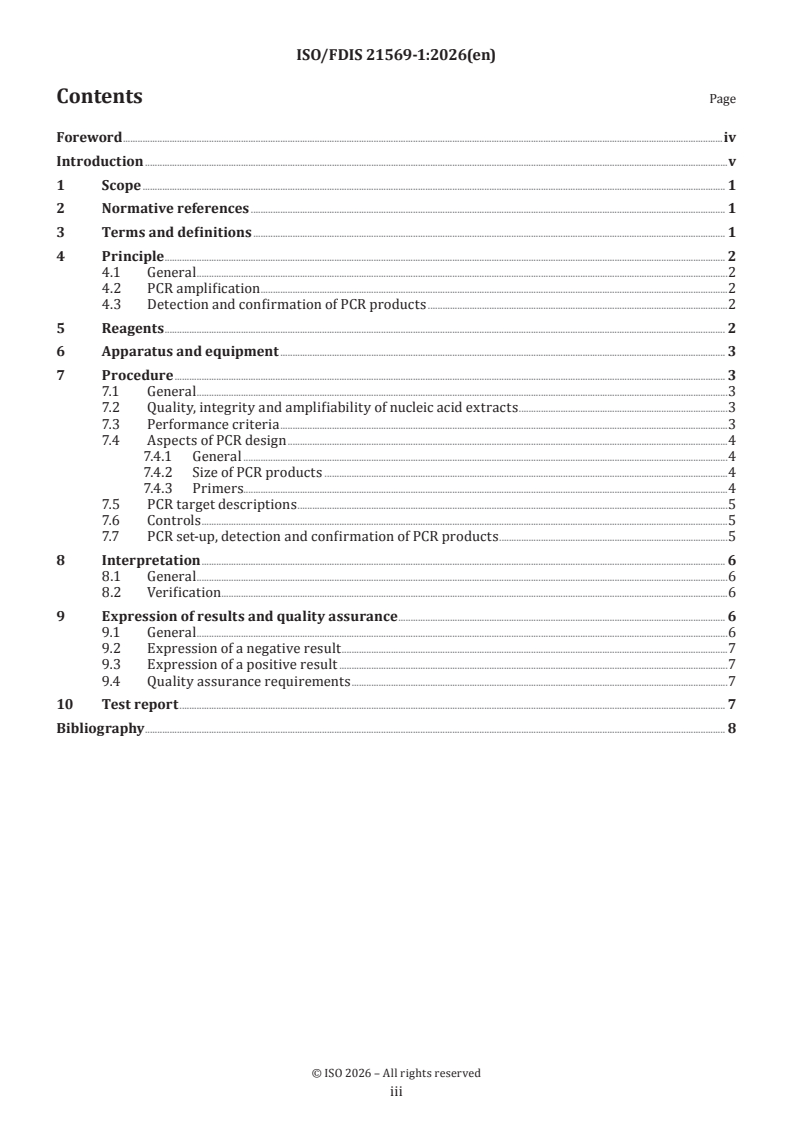
ISO/FDIS 21569-1 - Horizontal methods for molecular biomarker analysis — Methods of analysis for the detection of genetically modified organisms and derived products — Part 1: Qualitative nucleic acid based methods
REDLINE ISO/FDIS 21569-1 - Horizontal methods for molecular biomarker analysis — Methods of analysis for the detection of genetically modified organisms and derived products — Part 1: Qualitative nucleic acid based methods
ISO/FDIS 21569-1 is an ISO standard for qualitative nucleic acid based methods used to detect genetically modified organisms (GMOs) and derived products. It specifies PCR-based procedures for finding and confirming target DNA sequences in nucleic acids extracted from a sample, so laboratories can produce comparable results across sites. The document is aimed at food matrices, and it can also be applied to feed and plant samples from the environment.
What does ISO/FDIS 21569-1 specify?
ISO/FDIS 21569-1 specifies a general procedure for qualitative detection of GMOs and derived products by analysing extracted nucleic acids, with the main focus on polymerase chain reaction (PCR) amplification methods. It sets out how to detect, identify, and confirm target DNA sequences, and it links that work to comparable, accurate, and reproducible results in different laboratories.
The document is organized into Clauses 1 to 10, covering scope, normative references, terms and definitions, principle, reagents, apparatus and equipment, procedure, interpretation, expression of results and quality assurance, and test report. Its scope also points to specific examples of methods in the broader ISO 21569 series.
What are the key requirements of ISO/FDIS 21569-1?
ISO/FDIS 21569-1 focuses on how to design, run, control, and report a qualitative GMO PCR assay. The practical message is simple: the method must be specific to the target sequence, controlled well enough to avoid false positives and false negatives, and reported in a clear yes/no form.
- Target-specific detection - Clause 4 states that each method shall specify the target sequence and that the result must show the presence or absence of the genetic element relative to appropriate controls. In practice, the lab must know exactly what DNA element it is looking for.
- PCR amplification and detection - Clause 4 distinguishes conventional PCR from real-time PCR. Conventional PCR needs a post-PCR detection step, while real-time PCR monitors amplification during the reaction, which affects how the lab reads and confirms the result.
- Extract quality and inhibition control - Clause 7 requires nucleic acid extracts to be pure enough for analysis and substantially free of PCR inhibitors. This matters because poor extract quality can lower sensitivity or give a false negative result.
- Performance and reaction optimization - Clause 7 says the general performance criteria of ISO 24276 shall be followed, and the PCR conditions, especially magnesium chloride and thermocycling, should be optimized for each primer pair and system. The method must be validated for the matrix so the sensitivity is not lost to unwanted side reactions.
- Primer design and validation - Clause 7 gives design guidance for primers and requires both theoretical and experimental validation of specificity. The lab should check sequence similarity in databases and then test inclusivity and exclusivity so the primers distinguish the target from closely related non-target sequences.
- Controls and confirmation - Clause 7 requires appropriate controls in each assay and allows confirmation by an alternative target, sequencing, hybridization, restriction analysis, or another equivalent method. This is what supports a defensible positive result.
- Result expression and quality assurance - Clause 9 requires unambiguous reporting, including how to express negative and positive results and how to handle inconsistent replicate results. Clause 10 requires the test report to state the limit of detection (LOD), the method specificity, and the result as expressed in Clause 9.
What terms does ISO/FDIS 21569-1 define?
ISO/FDIS 21569-1 uses the terms and definitions from ISO 24276. The following terms are central to how the document is applied:
- GMO - a genetically modified organism, which is the main target of the analytical procedure.
- Target sequence - the specific DNA sequence the PCR method is designed to detect.
- PCR - polymerase chain reaction, the amplification technique used for qualitative detection.
- Real-time PCR - a PCR format in which amplification and detection happen simultaneously.
- Conventional PCR - a PCR format that requires a separate post-PCR detection step.
- LOD - limit of detection, the lowest level that the method can state in the report.
- Inclusivity - testing that the method detects the intended target members reliably.
- Exclusivity - testing that the method does not react with non-target sequences.
Who uses ISO/FDIS 21569-1?
ISO/FDIS 21569-1 is used by laboratories that test food, feed, and plant samples for GMO-related DNA. It is also relevant to method developers, validation staff, quality managers, and analysts who need a controlled PCR procedure for screening, event-specific detection, or confirmation work.
What changed in ISO/FDIS 21569-1 from the previous edition?
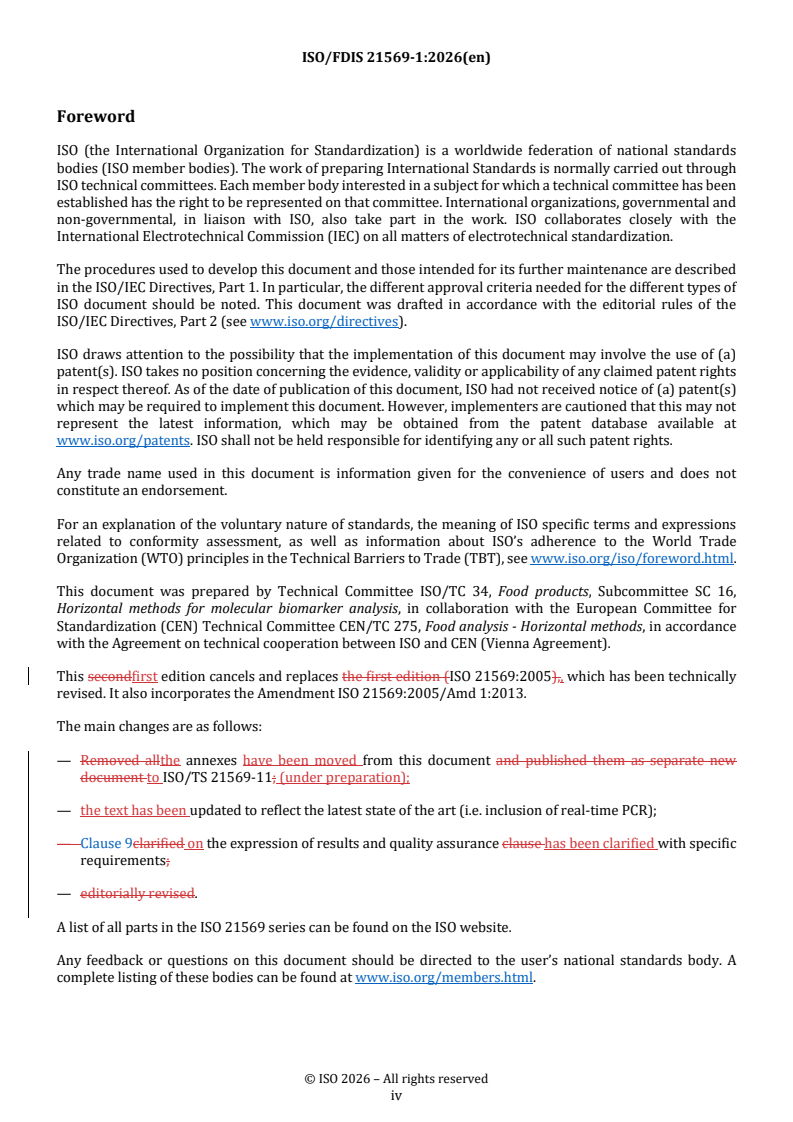
ISO/FDIS 21569-1 cancels and replaces ISO 21569:2005 and incorporates ISO 21569:2005/Amd 1:2013. The foreword states that the main changes are the removal of the annexes into ISO/TS 21569-11, updating the text to reflect the latest state of the art including real-time PCR, clarification of Clause 9 on expression of results and quality assurance, and editorial revision.
Which standards are used with ISO/FDIS 21569-1?
ISO/FDIS 21569-1 refers to two normative standards:
- ISO 21571 - gives the nucleic acid extraction methods that support sample preparation.
- ISO 24276 - gives the general requirements and definitions used throughout this series.
The document also points users to ISO/TS 21569-11 and the other parts of the ISO 21569 series for specific PCR examples and detailed procedure steps, and it notes ISO 21570 for quantitative nucleic acid based methods.
What does the ISO/FDIS 21569-1 document contain?
ISO/FDIS 21569-1 contains the principle of qualitative GMO detection, reagent requirements, apparatus guidance, and a detailed procedure covering extract quality, performance criteria, PCR design, target descriptions, controls, and PCR set-up. It also includes rules for interpreting positive and negative results, quality assurance requirements for replicate consistency, and the minimum contents of the test report.
The technical detail is concentrated in Clause 7, which covers primer validation, PCR design, and confirmation approaches for PCR products. Clause 9 gives the reporting language and handling of ambiguous results, while Clause 10 defines what the report must include for routine use and documented laboratory work.
Relations
- Effective Date
- 12-Feb-2026
- Effective Date
- 07-Sep-2024
- Effective Date
- 31-Aug-2024
Buy Documents
ISO/FDIS 21569-1 - Horizontal methods for molecular biomarker analysis — Methods of analysis for the detection of genetically modified organisms and derived products — Part 1: Qualitative nucleic acid based methods
REDLINE ISO/FDIS 21569-1 - Horizontal methods for molecular biomarker analysis — Methods of analysis for the detection of genetically modified organisms and derived products — Part 1: Qualitative nucleic acid based methods
Get Certified
Connect with accredited certification bodies for this standard

BSI Group
BSI (British Standards Institution) is the business standards company that helps organizations make excellence a habit.

Bureau Veritas
Bureau Veritas is a world leader in laboratory testing, inspection and certification services.

DNV
DNV is an independent assurance and risk management provider.
Sponsored listings
Frequently Asked Questions
ISO/FDIS 21569-1 is a draft published by the International Organization for Standardization (ISO). Its full title is "Horizontal methods for molecular biomarker analysis — Methods of analysis for the detection of genetically modified organisms and derived products — Part 1: Qualitative nucleic acid based methods". This standard covers: This International Standard describes the procedure to qualitatively detect genetically modified organisms (GMOs) and derived products by analysing the nucleic acids extracted from the sample under study. The main focus is on polymerase chain reaction (PCR) based amplification methods. It gives general requirements for the specific detection and identification of target nucleic acid sequences (DNA) and for the confirmation of the identity of the amplified DNA sequence. Guidelines, minimum requirements and performance criteria laid down in this International Standard are intended to ensure that comparable, accurate and reproducible results are obtained in different laboratories. This International Standard has been established for food matrices, but could also be applied to other matrices (e.g. feed and plant samples from the environment). Specific examples of methods are provided in Annexes A to D.
This International Standard describes the procedure to qualitatively detect genetically modified organisms (GMOs) and derived products by analysing the nucleic acids extracted from the sample under study. The main focus is on polymerase chain reaction (PCR) based amplification methods. It gives general requirements for the specific detection and identification of target nucleic acid sequences (DNA) and for the confirmation of the identity of the amplified DNA sequence. Guidelines, minimum requirements and performance criteria laid down in this International Standard are intended to ensure that comparable, accurate and reproducible results are obtained in different laboratories. This International Standard has been established for food matrices, but could also be applied to other matrices (e.g. feed and plant samples from the environment). Specific examples of methods are provided in Annexes A to D.
ISO/FDIS 21569-1 is classified under the following ICS (International Classification for Standards) categories: 67.050 - General methods of tests and analysis for food products. The ICS classification helps identify the subject area and facilitates finding related standards.
ISO/FDIS 21569-1 has the following relationships with other standards: It is inter standard links to FprEN ISO 21569-1, ISO 21569:2005/Amd 1:2013, ISO 21569:2005. Understanding these relationships helps ensure you are using the most current and applicable version of the standard.
ISO/FDIS 21569-1 is available in PDF format for immediate download after purchase. The document can be added to your cart and obtained through the secure checkout process. Digital delivery ensures instant access to the complete standard document.
Standards Content (Sample)
FINAL DRAFT
International
Standard
ISO/TC 34/SC 16
Horizontal methods for molecular
Secretariat: ANSI
biomarker analysis — Methods
Voting begins on:
of analysis for the detection of
2026-10-29
genetically modified organisms and
Voting terminates on:
derived products —
2026-12-10
Part 1:
Qualitative nucleic acid based
methods
Méthodes horizontales d’analyse de biomarqueurs
moléculaires — Méthodes d’analyse pour la détection des
organismes génétiquement modifiés et des produits dérivés —
Partie 1: Méthodes qualitatives basées sur l’utilisation des acides
nucléiques
RECIPIENTS OF THIS DRAFT ARE INVITED TO SUBMIT,
WITH THEIR COMMENTS, NOTIFICATION OF ANY
RELEVANT PATENT RIGHTS OF WHICH THEY ARE AWARE
AND TO PROVIDE SUPPOR TING DOCUMENTATION.
IN ADDITION TO THEIR EVALUATION AS
BEING ACCEPTABLE FOR INDUSTRIAL, TECHNO-
ISO/CEN PARALLEL PROCESSING LOGICAL, COMMERCIAL AND USER PURPOSES, DRAFT
INTERNATIONAL STANDARDS MAY ON OCCASION HAVE
TO BE CONSIDERED IN THE LIGHT OF THEIR POTENTIAL
TO BECOME STAN DARDS TO WHICH REFERENCE MAY BE
MADE IN NATIONAL REGULATIONS.
Reference number
FINAL DRAFT
International
Standard
ISO/TC 34/SC 16
Horizontal methods for molecular
Secretariat: ANSI
biomarker analysis — Methods
Voting begins on:
of analysis for the detection of
genetically modified organisms and
Voting terminates on:
derived products —
Part 1:
Qualitative nucleic acid based
methods
Méthodes horizontales d’analyse de biomarqueurs
moléculaires — Méthodes d’analyse pour la détection des
organismes génétiquement modifiés et des produits dérivés —
Partie 1: Méthodes qualitatives basées sur l’utilisation des acides
nucléiques
© ISO 2026
All rights reserved.
RECIPIENTS OF THIS DRAFT ARE INVITED TO SUBMIT,
WITH THEIR COMMENTS, NOTIFICATION OF ANY
This ISO publication is protected by copyright and is owned by ISO and/or its licensors.
RELEVANT PATENT RIGHTS OF WHICH THEY ARE AWARE
The content of this ISO publication is provided under licence, not sold. Use is subject to the applicable licence terms issued by ISO,
AND TO PROVIDE SUPPOR TING DOCUMENTATION.
an ISO member body, or an authorized third-party distributor.
IN ADDITION TO THEIR EVALUATION AS
BEING ACCEPTABLE FOR INDUSTRIAL, TECHNO-
Except as required for implementation or expressly permitted by a separate licence, no part of this ISO publication may be
ISO/CEN PARALLEL PROCESSING
LOGICAL, COMMERCIAL AND USER PURPOSES, DRAFT
reproduced, distributed, modified, used, or made available in any form or by any means – electronic or mechanical, including
INTERNATIONAL STANDARDS MAY ON OCCASION HAVE
photocopying, scanning, recording, or posting on internal or external digital platforms. TO BE CONSIDERED IN THE LIGHT OF THEIR POTENTIAL
TO BECOME STAN DARDS TO WHICH REFERENCE MAY BE
Any use beyond the scope of the granted rights is prohibited and may result in legal action.
MADE IN NATIONAL REGULATIONS.
ISO copyright office
CP 401 • CH-1214 Vernier, Geneva
Phone: +41 22 749 01 11
Email: copyright@iso.org
Website: www.iso.org
Published in Switzerland
Reference number
ii
Contents Page
Foreword .iv
Introduction .v
1 Scope . 1
2 Normative references . 1
3 Terms and definitions . 1
4 Principle . 2
4.1 General .2
4.2 PCR amplification .2
4.3 Detection and confirmation of PCR products .2
5 Reagents . 2
6 Apparatus and equipment . 3
7 Procedure . 3
7.1 General .3
7.2 Quality, integrity and amplifiability of nucleic acid extracts .3
7.3 Performance criteria .3
7.4 Aspects of PCR design .4
7.4.1 General .4
7.4.2 Size of PCR products .4
7.4.3 Primers.4
7.5 PCR target descriptions .5
7.6 Controls .5
7.7 PCR set-up, detection and confirmation of PCR products .5
8 Interpretation . 6
8.1 General .6
8.2 Verification . .6
9 Expression of results and quality assurance . 6
9.1 General .6
9.2 Expression of a negative result .7
9.3 Expression of a positive result .7
9.4 Quality assurance requirements .7
10 Test report . 7
Bibliography . 8
iii
Foreword
ISO (the International Organization for Standardization) is a worldwide federation of national standards
bodies (ISO member bodies). The work of preparing International Standards is normally carried out through
ISO technical committees. Each member body interested in a subject for which a technical committee
has been established has the right to be represented on that committee. International organizations,
governmental and non-governmental, in liaison with ISO, also take part in the work. ISO collaborates closely
with the International Electrotechnical Commission (IEC) on all matters of electrotechnical standardization.
The procedures used to develop this document and those intended for its further maintenance are described
in the ISO/IEC Directives, Part 1. In particular, the different approval criteria needed for the different types
of ISO document should be noted. This document was drafted in accordance with the editorial rules of the
ISO/IEC Directives, Part 2 (see www.iso.org/directives).
ISO draws attention to the possibility that the implementation of this document may involve the use of (a)
patent(s). ISO takes no position concerning the evidence, validity or applicability of any claimed patent
rights in respect thereof. As of the date of publication of this document, ISO had not received notice of (a)
patent(s) which may be required to implement this document. However, implementers are cautioned that
this may not represent the latest information, which may be obtained from the patent database available at
www.iso.org/patents. ISO shall not be held responsible for identifying any or all such patent rights.
Any trade name used in this document is information given for the convenience of users and does not
constitute an endorsement.
For an explanation of the voluntary nature of standards, the meaning of ISO specific terms and expressions
related to conformity assessment, as well as information about ISO’s adherence to the World Trade
Organization (WTO) principles in the Technical Barriers to Trade (TBT), see www.iso.org/iso/foreword.html.
This document was prepared by Technical Committee ISO/TC 34, Food products, Subcommittee SC 16,
Horizontal methods for molecular biomarker analysis, in collaboration with the European Committee for
Standardization (CEN) Technical Committee CEN/TC 275, Food analysis - Horizontal methods, in accordance
with the Agreement on technical cooperation between ISO and CEN (Vienna Agreement).
This first edition cancels and replaces ISO 21569:2005, which has been technically revised. It also
incorporates the Amendment ISO 21569:2005/Amd 1:2013.
The main changes are as follows:
— the annexes have been moved from this document to ISO/TS 21569-11 (under preparation);
— the text has been updated to reflect the latest state of the art (i.e. inclusion of real-time PCR);
— Clause 9 on the expression of results and quality assurance has been clarified with specific requirements.
A list of all parts in the ISO 21569 series can be found on the ISO website.
Any feedback or questions on this document should be directed to the user’s national standards body. A
complete listing of these bodies can be found at www.iso.org/members.html.
iv
Introduction
The search for a genetically modified origin of ingredients is performed by means of the following successive
(or simultaneous) steps:
— After sample collection, nucleic acids are extracted from the test portion.
— Extracted nucleic acids can be further purified, simultaneously or after the extraction process.
— Afterwards, they are quantified (if necessary), diluted (if necessary) and subjected to analytical
procedures (such as polymerase chain reaction (PCR)).
[1] [2]
These steps are detailed in this document and in ISO 21570 and ISO 21571 .
Further information about general requirements and definitions involving the steps cited above are collected
[3]
in ISO 24276 .
The qualitative detection of DNA target sequences is performed in order to obtain a yes or no answer to the
question of whether a certain target sequence is detected or not relative to appropriate controls and within
the detection limits of the analytical method used and test portion analysed.
[4]
The specificity of the methods, as described in ISO/TS 21569-11 (under preparation) and the other parts
of this series, ranges from screening methods to detect common DNA sequences characteristic of genetically
modified organisms (GMOs) to specific identification of a genetic construct or a specific transformation
event.
v
FINAL DRAFT International Standard ISO/FDIS 21569-1:2026(en)
Horizontal methods for molecular biomarker analysis —
Methods of analysis for the detection of genetically modified
organisms and derived products —
Part 1:
Qualitative nucleic acid based methods
1 Scope
This document specifies a procedure to qualitatively detect genetically modified organisms (GMOs) and
derived products by analysing the nucleic acids extracted from the sample under study. The main focus is on
polymerase chain reaction (PCR)-based amplification methods.
It specifies general requirements for the specific detection and identification of target nucleic acid sequences
(DNA) and for the confirmation of the identity of the amplified DNA sequence.
Guidance, minimum requirements and performance criteria given in this document are intended to ensure
that comparable, accurate and reproducible results are obtained in different laboratories.
This document is applicable to food matrices. It is also applicable to other matrices (e.g. feed and plant
samples from the environment).
[4]
Specific examples of methods are provided in ISO/TS 21569-11 (under preparation) and the other parts of
this series.
2 Normative references
The following documents are referred to in the text in such a way that some or all of their content constitutes
requirements of this document. For dated references, only the edition cited applies. For undated references,
the latest edition of the referenced document (including any amendments) applies.
ISO 21571, Foodstuffs — Methods of analysis for the detection of genetically modified organisms and derived
products — Nucleic acid extraction
ISO 24276, Foodstuffs — Methods of analysis for the detection of genetically modified organisms and derived
products — General requirements and definitions
3 Terms and definitions
For the purposes of this document, the terms and definitions given in ISO 24276 apply.
ISO and IEC maintain terminology databases for use in standardization at the following addresses:
— ISO Online browsing platform: available at https:// www .iso .org/ obp
— IEC Electropedia: available at https:// www .electropedia .org/
4 Principle
4.1 General
Qualitative analysis consists of specific detection of target nucleic acid sequences in the test samples. Each
method shall specify the target sequence.
A qualitative result shall clearly demonstrate the presence or absence of the genetic element under study,
relative to appropriate controls.
NOTE Detection limits and size of the test portion are critical aspects of a method.
PCR methods for qualitative analysis are conventional PCR and real-time PCR. Conventional PCR monitors
the amplification of a targeted DNA at its end and requires a post-PCR analysis step. In real-time PCR,
the amplification is monitored during the PCR, either by using a sequence-specific probe consisting of an
fluorescent-labelled oligonucleotide or by using non-specific fluorescent dyes that intercalate with any
double-stranded DNA.
4.2 PCR amplification
Amplification of the target sequence occurs in vitro through a reaction catalysed by a DNA polymerase in
the presence of oligonucleotide primers and deoxyribonucleoside triphosphates in a defined reaction buffer.
[5][6]
An important prerequisite for the amplification of the target sequence
...
ISO/DISFDIS 21569-1
ISO/TC 34/SC 16
Secretariat: ANSI
Date: 2026-08-1210-14
Horizontal methods for molecular biomarker analysis — Methods of
analysis for the detection of genetically modified organisms and
derived products —
Part 1:
Qualitative nucleic acid based methods
Méthodes horizontales d’analyse de biomarqueurs moléculaires — Méthodes d’analyse pour la détection des
organismes génétiquement modifiés et des produits dérivés —
Partie 1: Méthodes qualitatives basées sur l’utilisation des acides nucléiques
FDIS stage
TTTTTThhhhhhiiiiiissssss d d d d d drrrrrraftaftaftaftaftaft i i i i i issssss s s s s s suuuuuubbbbbbmmmmmmiiiiiittttttttttttedededededed t t t t t toooooo a pa pa pa pa pa pararararararallel vallel vallel vallel vallel vallel vooooootttttte e e e e e iiiiiinnnnnn I I I I I ISSSSSSOOOOOO,,,,,, C C C C C CEEEEEENNNNNN.
All rights reserved.
This ISO publication is protected by copyright and is owned by ISO and/or its licensors.
The content of this ISO publication is provided under licence, not sold. Use is subject to the applicable licence terms issued
by ISO, an ISO member body, or an authorized third-party distributor.
Except as required for implementation or expressly permitted by a separate licence, no part of this ISO publication may
be reproduced, distributed, modified, used, or made available in any form or by any means – electronic or mechanical,
including photocopying, scanning, recording, or posting on internal or external digital platforms.
Any use beyond the scope of the granted rights is prohibited and may result in legal action.
ISO copyright office
CP 401 • CH-1214 Vernier, Geneva
Phone: + 41 22 749 01 11
Email: copyright@iso.org
Website: www.iso.org
Published in Switzerland
ii
Contents
Foreword . iv
Introduction . v
1 Scope . 1
2 Normative references . 1
3 Terms and definitions . 1
4 Principle . 2
4.1 General. 2
4.2 PCR amplification . 2
4.3 Detection and confirmation of PCR products . 2
5 Reagents . 2
6 Apparatus and equipment . 3
7 Procedure . 3
7.1 General. 3
7.2 Quality, integrity and amplifiability of nucleic acid extracts . 3
7.3 Performance criteria . 4
7.4 Aspects of PCR design . 4
7.5 PCR target descriptions . 6
7.6 Controls . 6
7.7 PCR set-up, detection and confirmation of PCR products . 6
8 Interpretation . 6
8.1 General. 6
8.2 Verification . 7
9 Expression of results and quality assurance . 7
9.1 General. 7
9.2 Expression of a negative result . 7
9.3 Expression of a positive result . 8
9.4 Quality assurance requirements . 8
10 Test report . 8
Bibliography . 9
iii
Foreword
ISO (the International Organization for Standardization) is a worldwide federation of national standards
bodies (ISO member bodies). The work of preparing International Standards is normally carried out through
ISO technical committees. Each member body interested in a subject for which a technical committee has been
established has the right to be represented on that committee. International organizations, governmental and
non-governmental, in liaison with ISO, also take part in the work. ISO collaborates closely with the
International Electrotechnical Commission (IEC) on all matters of electrotechnical standardization.
The procedures used to develop this document and those intended for its further maintenance are described
in the ISO/IEC Directives, Part 1. In particular, the different approval criteria needed for the different types of
ISO document should be noted. This document was drafted in accordance with the editorial rules of the
ISO/IEC Directives, Part 2 (see www.iso.org/directives).
ISO draws attention to the possibility that the implementation of this document may involve the use of (a)
patent(s). ISO takes no position concerning the evidence, validity or applicability of any claimed patent rights
in respect thereof. As of the date of publication of this document, ISO had not received notice of (a) patent(s)
which may be required to implement this document. However, implementers are cautioned that this may not
represent the latest information, which may be obtained from the patent database available at
www.iso.org/patents. ISO shall not be held responsible for identifying any or all such patent rights.
Any trade name used in this document is information given for the convenience of users and does not
constitute an endorsement.
For an explanation of the voluntary nature of standards, the meaning of ISO specific terms and expressions
related to conformity assessment, as well as information about ISO’s adherence to the World Trade
Organization (WTO) principles in the Technical Barriers to Trade (TBT), see www.iso.org/iso/foreword.html.
This document was prepared by Technical Committee ISO/TC 34, Food products, Subcommittee SC 16,
Horizontal methods for molecular biomarker analysis, in collaboration with the European Committee for
Standardization (CEN) Technical Committee CEN/TC 275, Food analysis - Horizontal methods, in accordance
with the Agreement on technical cooperation between ISO and CEN (Vienna Agreement).
This secondfirst edition cancels and replaces the first edition (ISO 21569:2005),, which has been technically
revised. It also incorporates the Amendment ISO 21569:2005/Amd 1:2013.
The main changes are as follows:
— Removed allthe annexes have been moved from this document and published them as separate new
document to ISO/TS 21569-11; (under preparation);
— the text has been updated to reflect the latest state of the art (i.e. inclusion of real-time PCR);
— Clause 9clarified on the expression of results and quality assurance clause has been clarified with specific
requirements;
— editorially revised.
A list of all parts in the ISO 21569 series can be found on the ISO website.
Any feedback or questions on this document should be directed to the user’s national standards body. A
complete listing of these bodies can be found at www.iso.org/members.html.
iv
Introduction
The search for a genetically modified origin of ingredients is performed by means of the following successive
(or simultaneous) steps. :
— After sample collection, nucleic acids are extracted from the test portion.
— Extracted nucleic acids can be further purified, simultaneously or after the extraction process.
— Afterwards, they are quantified (if necessary), diluted (if necessary) and subjected to analytical
procedures (such as polymerase chain reaction (PCR)).
[1] [2]
These steps are detailed in this document and in ISO 21570 and ISO 21571 .
Further information about general requirements and definitions involving the steps cited above are collected
[3]
in ISO 24276 .
The qualitative detection of DNA target sequences is performed in order to obtain a yes or no answer to the
question of whether a certain target sequence is detected or not relative to appropriate controls and within
the detection limits of the analytical method used and test portion analysed.
[4]
The specificity of the methods, as described in ISO/TS 21569-11 (under preparation) and the other parts
of this series, ranges from screening methods to detect common DNA sequences characteristic of genetically
modified organisms (GMOs),) to specific identification of a genetic construct or a specific transformation
event.
v
Horizontal methods for molecular biomarker analysis — Methods of
analysis for the detection of genetically modified organisms and
derived products —
Part 1:
Qualitative nucleic acid based methods
1 Scope
This document specifies a procedure to qualitatively detect genetically modified organisms (GMOs) and
derived products by analysing the nucleic acids extracted from the sample under study. The main focus is on
polymerase chain reaction (PCR)-based amplification methods.
It specifies general requirements for the specific detection and identification of target nucleic acid sequences
(DNA) and for the confirmation of the identity of the amplified DNA sequence.
Guidance, minimum requirements and performance criteria given in this document are intended to ensure
that comparable, accurate and reproducible results are obtained in different laboratories.
This document is applicable to food matrices, but it. It is also applicable to other matrices (e.g. feed and plant
samples from the environment).
[4]
Specific examples of methods are provided in ISO/TS 21569-11 (under preparation) and the other parts of
this series.
2 Normative references
The following documents are referred to in the text in such a way that some or all of their content constitutes
requirements of this document. For dated references, only the edition cited applies. For undated references,
the latest edition of the referenced document (including any amendments) applies.
ISO 21571, Foodstuffs — Methods of analysis for the detection of genetically modified organisms and derived
products — Nucleic acid extraction
ISO 24276, Foodstuffs — Methods of analysis for the detection of genetically modified organisms and derived
products — General requirements and definitions
ISO 24276, Foodstuffs — Methods of analysis for the detection of genetically modified organisms and derived
products — General requirements and definitions
3 Terms and definitions
For the purposes of this document, the terms and definitions given in ISO 24276 apply.
ISO and IEC maintain terminology databases for use in standardization at the following addresses:
— ISO Online browsing platform: available at https://www.iso.org/obp
— IEC Electropedia: available at https://www.electropedia.org/
4 Principle
4.1 General
Qualitative analysis consists of specific detection of target nucleic acid sequences in the test samples. Each
method shall specify the target sequence.
A qualitative result shall clearly demonstrate the presence or absence of the genetic element under study,
relative to appropriate controls.
NOTE Detection limits and size of the test portion are critical aspects of a method.
PCR methods for qualitative analysis are conventional PCR and real-time PCR. Conventional PCR monitors the
amplification of a targeted DNA at its end and requires a post-PCR analysis step. In real-time PCR, the
amplification is monitored during the PCR, either by using a sequence-specific probe consitingconsisting of an
fluorescent-labelled oligonucleotide or by using non-specific fluorescent dyes that intercalate with any
double-stranded DNA.
4.2 PCR amplification
Amplification of the target sequence occurs in vitro through a reaction catalysed by a DNA polymerase in the
[5] [6]
presence of oligonucleotide primers and deoxyribonucleoside triphosphates in a defined reaction buffer.
An important prerequisite for the amplification of the target sequence is that the reaction mixture contains no
polymerase inhibitors. Amplification of the DNA is a cyclical process consisting of:
— denaturation of the double-stranded DNA into single-stranded nucleic acid by means of heating;
— annealing of the primers to the target sequence at a suitable temperature;
— extension of the primers, which are bound to both single strands, by a DNA polymerase suitable for PCR,
at an appropriate temperature.
4.3 Detection and confirmation of PCR products
Conventional PCR products are detected by gel electrophoresis or an appropriate alternative, if necessary,
after isolation by means of a suitable separation procedure. The identity of any detected target sequence
should be verified by an appropriate technique (e.g. by DNA sequence analysis, by hybridization or by
restriction enzyme analysis).
In the case of real-time PCR analysis, amplification and detection occur simultaneously.
5 Reagents
The reaction solutions required for the analytical method should be stored at approximately –20 °C if not
specified otherwise.
It can also be appropriate to aliquot the reaction solutions required for the analytical method in order to avoid
subjecting them to repeated freeze-thaw cycles, and/or to reduce chances of cross contamination.
5.1 Target DNA/control.
5.2 Water.
5.3 Deoxyribonucleoside triphosphate (dNTP) solution, containing dATP, dCTP, dGTP, and dTTP /
/dUTP.
NOTE The use of dUTP can interfere with restriction enzyme analyses of PCR products.
5.4 PCR buffer solution.
The PCR buffer solution is usually delivered with the DNA polymerase, which can, but does not always, include
MgCl in a concentration specified by the manufacturer. The final MgCl concentrations are method specific
2 2
and are therefore listed in the method. Ready-to-use reagents can be commercially available. The
manufacturer’s instructions for use should be considered.
5.5 Thermostable DNA polymerase.
5.6 Forward primer.
5.7 Reverse primer.
5.8 Fluorescent labelled oligonucleotide probe or intercalating fluorescent dye in the case of real-
time PCR.
6 Apparatus and equipment
The information on apparatus and equipment shall be given in the specific method.
7 Procedure
7.1 General
For the basic principl
...