

FprEN ISO 21569-1
(Main)Horizontal methods for molecular biomarker analysis - Methods of analysis for the detection of genetically modified organisms and derived products - Part 1: Qualitative nucleic acid based methods (ISO/FDIS 21569-1:2026)
- Abstract
This International Standard describes the procedure to qualitatively detect genetically modified organisms
(GMOs) and derived products by analysing the nucleic acids extracted from the sample under study. The main
focus is on polymerase chain reaction (PCR) based amplification methods.
It gives general requirements for the specific detection and identification of target nucleic acid sequences
(DNA) and for the confirmation of the identity of the amplified DNA sequence.
Guidelines, minimum requirements and performance criteria laid down in this International Standard are
intended to ensure that comparable, accurate and reproducible results are obtained in different laboratories.
This International Standard has been established for food matrices, but could also be applied to other
matrices (e.g. feed and plant samples from the environment).
Specific examples of methods are provided in Annexes A to D.
- Status
- Not Published
- Publication Date
- 10-Mar-2027
- Technical Committee
- CEN/TC 275 - Food analysis - Horizontal methods
- Drafting Committee
- CEN/TC 275/WG 11 - Genetically modified foodstuffs
- Current Stage
- 5020 - Submission to Vote - Formal Approval
- Start Date
- 29-Oct-2026
- Completion Date
- 29-Oct-2026


FprEN ISO 21569-1 is a draft CEN standard for the qualitative detection of genetically modified organisms (GMOs) and derived products by analysing extracted nucleic acids. It specifies PCR-based methods for finding target DNA sequences and confirming the identity of amplified DNA, mainly for food matrices and also for feed and plant samples from the environment.
What does FprEN ISO 21569-1 specify?
FprEN ISO 21569-1 sets out the procedure for qualitative GMO detection from nucleic acids extracted from a sample. The document is organized into clauses on scope, references, terms, principle, reagents, apparatus, procedure, interpretation, expression of results and quality assurance, and test report.
The standard is aimed at getting comparable, accurate and reproducible results between laboratories. It also gives examples of methods in Annexes A to D, so users can see how the general rules are applied in practice.
What are the key requirements of FprEN ISO 21569-1?
The standard focuses on the full PCR workflow, from extract quality to result reporting. In practice, it tells a laboratory what to control, how to design the assay, and how to decide whether a result is valid.
Extract quality and PCR inhibition
FprEN ISO 21569-1 requires nucleic acid extracts to be pure enough for analysis and the quality and amount of extracted nucleic acid to be repeatable and reproducible for a given matrix and method. It also requires PCR inhibition controls, because inhibitors can cause false negatives and weak signals. The document describes checking inhibition by serial dilution of the template and, for real-time PCR, comparing Cq values from undiluted and diluted samples.
PCR design and performance
FprEN ISO 21569-1 requires each method to specify the target sequence and to match the PCR product size to the DNA quality in the extract. This matters because degraded DNA from processed food usually needs shorter products than raw material.
Primer design is treated as a key control point. The document gives preferred primer characteristics, calls for both theoretical and experimental specificity checks, and requires inclusivity and exclusivity testing so the primers detect the target and avoid non-target sequences.
The method also expects PCR conditions to be optimized for each primer pair or system, especially MgCl concentration and thermocycling conditions. Hot-start PCR is recommended to reduce mispriming and primer-dimer formation. The optimized reaction should be capable of producing a detectable product within 40 cycles from a reference sample of 100 copies of template DNA.
Detection, confirmation and controls
FprEN ISO 21569-1 allows PCR products to be detected by gel electrophoresis or an appropriate alternative. Positive findings can be confirmed by a second target, hybridization, restriction analysis, sequencing, or another equivalent method.
Each diagnostic PCR assay shall include appropriate controls to reduce the risk of false positive and false negative results. If available and appropriate, certified reference materials should be used as positive and negative controls.
Interpretation and reporting
A result is positive when the specific PCR product is detected and the controls perform as required. A result is negative when the product is not detected and the controls are acceptable. Ambiguous results are repeated.
Results must be stated unambiguously. The document also requires the test report to include the limit of detection (LOD), the specificity of the method, and the result expressed according to the reporting rules in the standard.
What terms does FprEN ISO 21569-1 define?
- Genetically modified organism (GMO) - an organism whose genetic material is the subject of the detection method described here.
- Polymerase chain reaction (PCR) - an in vitro amplification method used here to copy a chosen DNA target so it can be detected.
- Target sequence - the DNA sequence selected for detection and identification in the assay.
- Limit of detection (LOD) - the lowest level at which the method can report a target reliably under the stated conditions.
- Inclusivity - the ability of the primers to detect the intended target across relevant members of the target group.
- Exclusivity - the ability of the primers to avoid detection of closely related non-target sequences.
- Real-time PCR - a PCR format in which amplification and detection occur at the same time.
Who uses FprEN ISO 21569-1?
FprEN ISO 21569-1 is used by laboratories and technical teams that test food, feed, and plant samples for GMO presence. It is relevant to quality managers, analytical laboratories, and buyers or regulators who need consistent qualitative GMO results and documented test reporting.
What changed in FprEN ISO 21569-1 from the previous edition?
FprEN ISO 21569-1 replaces the first edition, ISO 21569:2005. The document states three main changes: inclusion of the 2013 amendment, publication of all annexed methods in ISO/TS 21569-11, and editorial revision.
Which standards are used with FprEN ISO 21569-1?
- ISO 21571 - provides the nucleic acid extraction methods used before PCR analysis.
- ISO 24276 - provides general requirements and definitions for GMO analysis and is also used for controls, reporting logic, and quality-related rules.
- ISO/TS 21569-11 - contains the annexed method examples referred to for specific PCR applications.
- Other parts of the ISO 21569 series - supply additional specific methods and procedural details.
- ISO 11781 - supports single-laboratory validation of qualitative real-time PCR methods.
- ISO/TS 21569-7 - gives methods for CaMV and Agrobacterium Ti-plasmid derived DNA sequences, useful for confirmation work.
What does the FprEN ISO 21569-1 document contain?
The document contains the principle of qualitative GMO detection, reagent and equipment requirements, detailed PCR procedure guidance, interpretation rules, and reporting requirements. It also covers extract quality, inhibition checks, performance criteria, primer design, target descriptions, controls, and confirmation options such as hybridization, restriction analysis, and sequencing.
Annexes A to D provide specific method examples that show how the general requirements are applied to particular PCR approaches. The document is intended for method development, laboratory implementation, validation, and routine analytical reporting.
Relations
- Effective Date
- 12-Feb-2026
- Effective Date
- 04-Sep-2024
- Effective Date
- 04-Sep-2024
Get Certified
Connect with accredited certification bodies for this standard

BSI Group
BSI (British Standards Institution) is the business standards company that helps organizations make excellence a habit.

Bureau Veritas
Bureau Veritas is a world leader in laboratory testing, inspection and certification services.

DNV
DNV is an independent assurance and risk management provider.
Sponsored listings
Frequently Asked Questions
FprEN ISO 21569-1 is a draft published by the European Committee for Standardization (CEN). Its full title is "Horizontal methods for molecular biomarker analysis - Methods of analysis for the detection of genetically modified organisms and derived products - Part 1: Qualitative nucleic acid based methods (ISO/FDIS 21569-1:2026)". This standard covers: This International Standard describes the procedure to qualitatively detect genetically modified organisms (GMOs) and derived products by analysing the nucleic acids extracted from the sample under study. The main focus is on polymerase chain reaction (PCR) based amplification methods. It gives general requirements for the specific detection and identification of target nucleic acid sequences (DNA) and for the confirmation of the identity of the amplified DNA sequence. Guidelines, minimum requirements and performance criteria laid down in this International Standard are intended to ensure that comparable, accurate and reproducible results are obtained in different laboratories. This International Standard has been established for food matrices, but could also be applied to other matrices (e.g. feed and plant samples from the environment). Specific examples of methods are provided in Annexes A to D.
This International Standard describes the procedure to qualitatively detect genetically modified organisms (GMOs) and derived products by analysing the nucleic acids extracted from the sample under study. The main focus is on polymerase chain reaction (PCR) based amplification methods. It gives general requirements for the specific detection and identification of target nucleic acid sequences (DNA) and for the confirmation of the identity of the amplified DNA sequence. Guidelines, minimum requirements and performance criteria laid down in this International Standard are intended to ensure that comparable, accurate and reproducible results are obtained in different laboratories. This International Standard has been established for food matrices, but could also be applied to other matrices (e.g. feed and plant samples from the environment). Specific examples of methods are provided in Annexes A to D.
FprEN ISO 21569-1 is classified under the following ICS (International Classification for Standards) categories: 67.050 - General methods of tests and analysis for food products. The ICS classification helps identify the subject area and facilitates finding related standards.
FprEN ISO 21569-1 has the following relationships with other standards: It is inter standard links to ISO/FDIS 21569-1, EN ISO 21569:2005/A1:2013, EN ISO 21569:2005. Understanding these relationships helps ensure you are using the most current and applicable version of the standard.
FprEN ISO 21569-1 is available in PDF format for immediate download after purchase. The document can be added to your cart and obtained through the secure checkout process. Digital delivery ensures instant access to the complete standard document.
Standards Content (Sample)
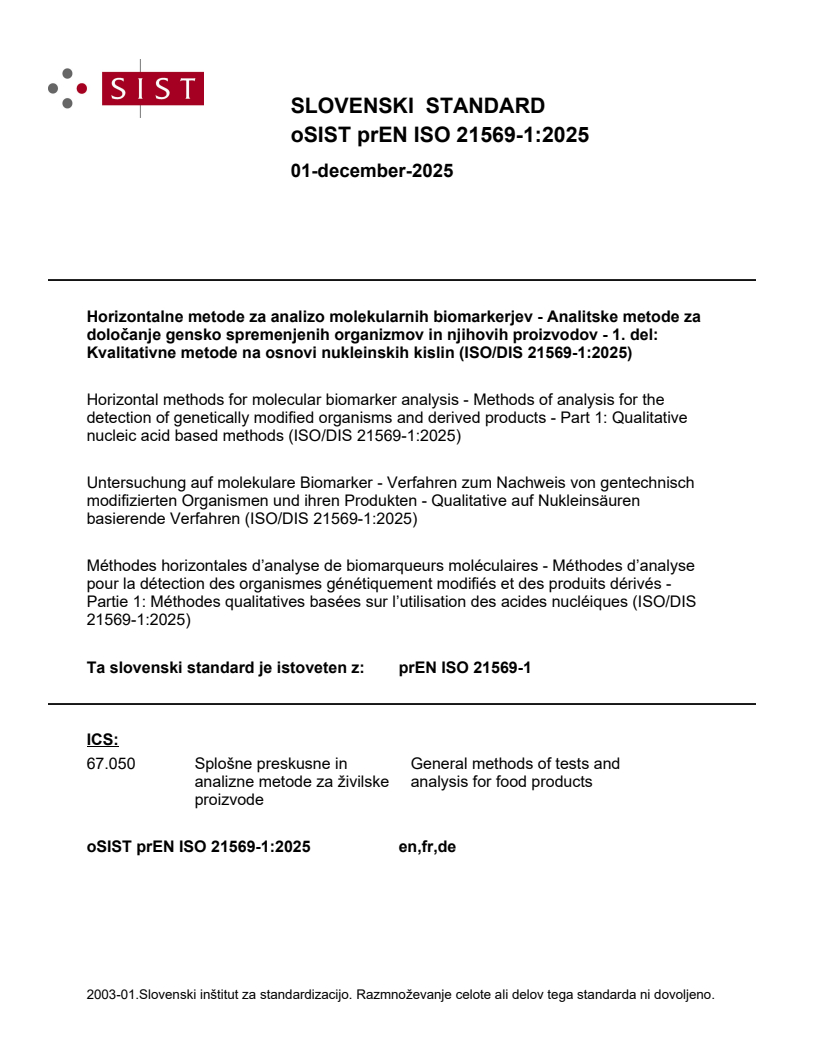
SLOVENSKI STANDARD
01-december-2025
Horizontalne metode za analizo molekularnih biomarkerjev - Analitske metode za
določanje gensko spremenjenih organizmov in njihovih proizvodov - 1. del:
Kvalitativne metode na osnovi nukleinskih kislin (ISO/DIS 21569-1:2025)
Horizontal methods for molecular biomarker analysis - Methods of analysis for the
detection of genetically modified organisms and derived products - Part 1: Qualitative
nucleic acid based methods (ISO/DIS 21569-1:2025)
Untersuchung auf molekulare Biomarker - Verfahren zum Nachweis von gentechnisch
modifizierten Organismen und ihren Produkten - Qualitative auf Nukleinsäuren
basierende Verfahren (ISO/DIS 21569-1:2025)
Méthodes horizontales d’analyse de biomarqueurs moléculaires - Méthodes d’analyse
pour la détection des organismes génétiquement modifiés et des produits dérivés -
Partie 1: Méthodes qualitatives basées sur l’utilisation des acides nucléiques (ISO/DIS
21569-1:2025)
Ta slovenski standard je istoveten z: prEN ISO 21569-1
ICS:
67.050 Splošne preskusne in General methods of tests and
analizne metode za živilske analysis for food products
proizvode
2003-01.Slovenski inštitut za standardizacijo. Razmnoževanje celote ali delov tega standarda ni dovoljeno.
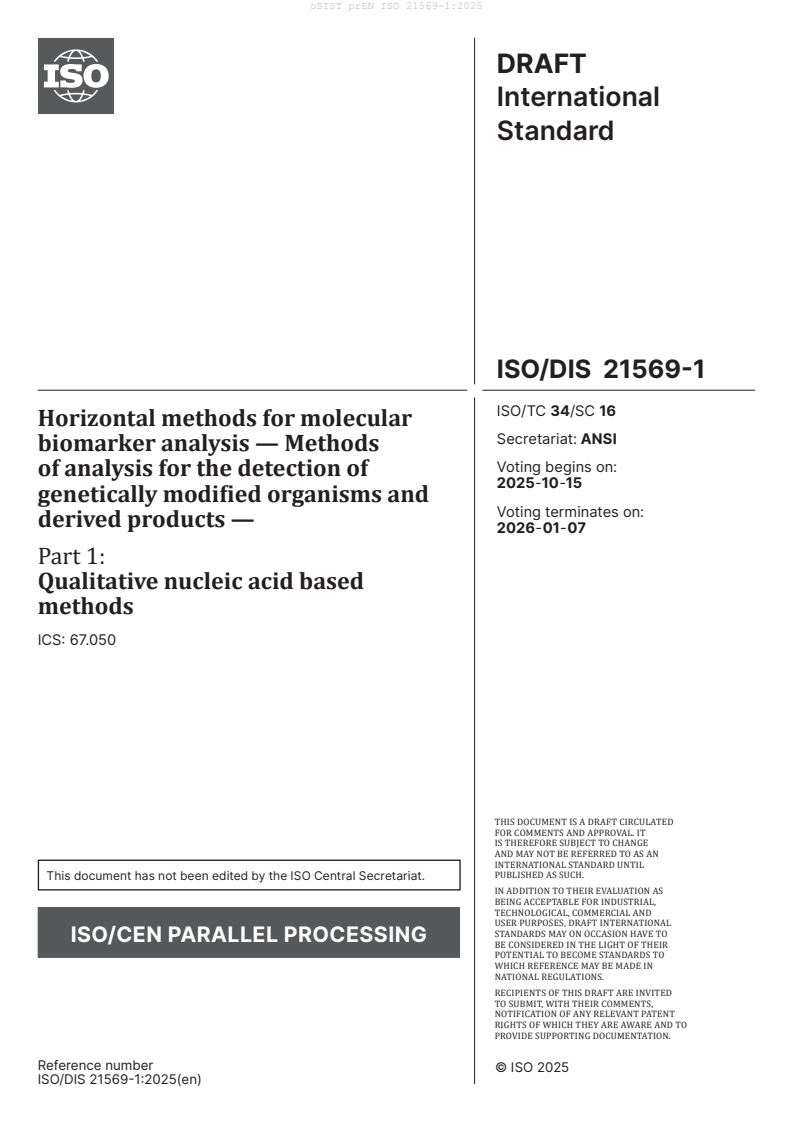
DRAFT
International
Standard
ISO/DIS 21569-1
ISO/TC 34/SC 16
Horizontal methods for molecular
Secretariat: ANSI
biomarker analysis — Methods
Voting begins on:
of analysis for the detection of
2025-10-15
genetically modified organisms and
Voting terminates on:
derived products —
2026-01-07
Part 1:
Qualitative nucleic acid based
methods
ICS: 67.050
THIS DOCUMENT IS A DRAFT CIRCULATED
FOR COMMENTS AND APPROVAL. IT
IS THEREFORE SUBJECT TO CHANGE
AND MAY NOT BE REFERRED TO AS AN
INTERNATIONAL STANDARD UNTIL
PUBLISHED AS SUCH.
This document has not been edited by the ISO Central Secretariat.
IN ADDITION TO THEIR EVALUATION AS
BEING ACCEPTABLE FOR INDUSTRIAL,
TECHNOLOGICAL, COMMERCIAL AND
USER PURPOSES, DRAFT INTERNATIONAL
STANDARDS MAY ON OCCASION HAVE TO
ISO/CEN PARALLEL PROCESSING
BE CONSIDERED IN THE LIGHT OF THEIR
POTENTIAL TO BECOME STANDARDS TO
WHICH REFERENCE MAY BE MADE IN
NATIONAL REGULATIONS.
RECIPIENTS OF THIS DRAFT ARE INVITED
TO SUBMIT, WITH THEIR COMMENTS,
NOTIFICATION OF ANY RELEVANT PATENT
RIGHTS OF WHICH THEY ARE AWARE AND TO
PROVIDE SUPPORTING DOCUMENTATION.
Reference number
ISO/DIS 21569-1:2025(en)
DRAFT
ISO/DIS 21569-1:2025(en)
International
Standard
ISO/DIS 21569-1
ISO/TC 34/SC 16
Horizontal methods for molecular
Secretariat: ANSI
biomarker analysis — Methods
Voting begins on:
of analysis for the detection of
genetically modified organisms and
Voting terminates on:
derived products —
Part 1:
Qualitative nucleic acid based
methods
ICS: 67.050
THIS DOCUMENT IS A DRAFT CIRCULATED
FOR COMMENTS AND APPROVAL. IT
IS THEREFORE SUBJECT TO CHANGE
AND MAY NOT BE REFERRED TO AS AN
INTERNATIONAL STANDARD UNTIL
PUBLISHED AS SUCH.
This document has not been edited by the ISO Central Secretariat.
IN ADDITION TO THEIR EVALUATION AS
BEING ACCEPTABLE FOR INDUSTRIAL,
© ISO 2025
TECHNOLOGICAL, COMMERCIAL AND
USER PURPOSES, DRAFT INTERNATIONAL
All rights reserved. Unless otherwise specified, or required in the context of its implementation, no part of this publication may
STANDARDS MAY ON OCCASION HAVE TO
ISO/CEN PARALLEL PROCESSING
be reproduced or utilized otherwise in any form or by any means, electronic or mechanical, including photocopying, or posting on
BE CONSIDERED IN THE LIGHT OF THEIR
the internet or an intranet, without prior written permission. Permission can be requested from either ISO at the address below
POTENTIAL TO BECOME STANDARDS TO
WHICH REFERENCE MAY BE MADE IN
or ISO’s member body in the country of the requester.
NATIONAL REGULATIONS.
ISO copyright office
RECIPIENTS OF THIS DRAFT ARE INVITED
CP 401 • Ch. de Blandonnet 8
TO SUBMIT, WITH THEIR COMMENTS,
CH-1214 Vernier, Geneva
NOTIFICATION OF ANY RELEVANT PATENT
Phone: +41 22 749 01 11
RIGHTS OF WHICH THEY ARE AWARE AND TO
PROVIDE SUPPORTING DOCUMENTATION.
Email: copyright@iso.org
Website: www.iso.org
Published in Switzerland Reference number
ISO/DIS 21569-1:2025(en)
ii
ISO/DIS 21569-1:2025(en)
Contents Page
Foreword .iv
Introduction .v
1 Scope . 1
2 Normative references . 1
3 Terms and definitions . 1
4 Principle . 2
4.1 General .2
4.2 PCR amplification .2
4.3 Detection and confirmation of PCR products .2
5 Reagents . 2
6 Apparatus and equipment . 3
7 Procedure . 3
7.1 Quality, integrity and amplifiability of nucleic acid extracts .3
7.2 Performance criteria .3
7.3 Aspects of PCR design .4
7.3.1 General .4
7.3.2 Size of PCR products .4
7.3.3 Primers.4
7.4 PCR target descriptions .5
7.5 Controls .5
7.6 PCR set-up, detection and confirmation of PCR products .5
8 Interpretation . 6
8.1 General .6
8.2 Verification . .6
9 Expression of results and quality assurance . 6
9.1 General .6
9.2 Expression of a negative result .6
9.3 Expression of a positive result .7
9.4 Quality assurance requirements .7
10 Test report . 7
Bibliography . 8
iii
ISO/DIS 21569-1:2025(en)
Foreword
ISO (the International Organization for Standardization) is a worldwide federation of national standards
bodies (ISO member bodies). The work of preparing International Standards is normally carried out through
ISO technical committees. Each member body interested in a subject for which a technical committee
has been established has the right to be represented on that committee. International organizations,
governmental and non-governmental, in liaison with ISO, also take part in the work. ISO collaborates closely
with the International Electrotechnical Commission (IEC) on all matters of electrotechnical standardization.
The procedures used to develop this document and those intended for its further maintenance are described
in the ISO/IEC Directives, Part 1. In particular the different approval criteria needed for the different types
of ISO documents should be noted. This document was drafted in accordance with the editorial rules of the
ISO/IEC Directives, Part 2 (see www.iso.org/directives).
Attention is drawn to the possibility that some of the elements of this document may be the subject of patent
rights. ISO shall not be held responsible for identifying any or all such patent rights. Details of any patent
rights identified during the development of the document will be in the Introduction and/or on the ISO list of
patent declarations received (see www.iso.org/patents).
Any trade name used in this document is information given for the convenience of users and does not
constitute an endorsement.
For an explanation on the meaning of ISO specific terms and expressions related to conformity assessment,
as well as information about ISO's adherence to the World Trade Organization (WTO) principles in the
Technical Barriers to Trade (TBT) see the following URL: www.iso.org/iso/foreword.html.
This document was prepared by Technical Committee ISO/TC 34, Food products, Subcommittee SC 16,
Horizontal methods for molecular biomarker analysis.
This second edition cancels and replaces the first edition (ISO 21569:2005), which has been technically
revised.
The main changes compared to the previous edition are as follows:
— inclusion of the amendment from 2013;
— publication of all annexed methods in ISO/TS 21569-11
— editorial revison.
A list of all parts in the ISO 21569 series can be found on the ISO website.
Any feedback or questions on this document should be directed to the user’s national standards body. A
complete listing of these bodies can be found atwww.iso.org/members.html.
iv
ISO/DIS 21569-1:2025(en)
Introduction
The search for a genetically modified origin of ingredients is performed by means of the following successive
(or simultaneous) steps. After sample collection, nucleic acids are extracted from the test portion. Extracted
nucleic acids can be further purified, simultaneously or after the extraction process. Afterwards, they are
quantified (if necessary), diluted (if necessary) and subjected to analytical procedures (such as PCR). These
steps are detailed in this International Standard and in the following series of International Standards with
the general title Foodstuffs — Methods of analysis for the detection of genetically modified organisms and
derived products:
— Quantitative nucleic acid based methods (ISO 21570);
— Nucleic acid extraction (ISO 21571).
Further information about general requirements and definitions involving the steps cited above are collected
in ISO 24276.
The qualitative detection of DNA target sequences is performed in order to obtain a yes or no answer to the
question whether a certain target sequence is detected or not relative to appropriate controls and within
the detection limits of the analytical method used and test portion analysed.
The specificity of the methods, as described in ISO/TS 21569-11 and the other parts of this series, ranges
from screening methods to detect common DNA sequences characteristic of GMOs, to specific identification
of a genetic construct or a specific transformation event.
The International Organization for Standardization (ISO) draws attention to the fact that it is claimed that
compliance with this document may involve the use of a patent.
ISO takes no position concerning the evidence, validity and scope of this patent right.
The holder of this patent right has assured ISO that he/she is willing to negotiate licences under reasonable
and non-discriminatory terms and conditions with applicants throughout the world. In this respect, the
statement of the holder of this patent right is registered with ISO. Information may be obtained from the
patent database available at www.iso.org/patents.
Attention is drawn to the possibility that some of the elements of this document may be the subject of patent
rights other than those in the patent database. ISO shall not be held responsible for identifying any or all
such patent rights.
v
DRAFT International Standard ISO/DIS 21569-1:2025(en)
Horizontal methods for molecular biomarker analysis —
Methods of analysis for the detection of genetically modified
organisms and derived products —
Part 1:
Qualitative nucleic acid based methods
1 Scope
This document describes the procedure to qualitatively detect genetically modified organisms (GMOs) and
derived products by analysing the nucleic acids extracted from the sample under study. The main focus is on
polymerase chain reaction (PCR) based amplification methods.
It gives general requirements for the specific detection and identification of target nucleic acid sequences
(DNA) and for the confirmation of the identity of the amplified DNA sequence.
Guidelines, minimum requirements and performance criteria laid down in this document are intended to
ensure that comparable, accurate and reproducible results are obtained in different laboratories.
This document has been established for food matrices, but could also be applied to other matrices (e.g. feed
and plant samples from the environment).
Specific examples of methods are provided in ISO/TS 21569 part 11 and the other parts of this series.
2 Normative references
The following documents are referred to in the text in such a way that some or all of their content constitutes
requirements of this document. For dated references, only the edition cited applies. For undated references,
the latest edition of the referenced document (including any amendments) applies.
ISO 21571, Foodstuffs — Methods of analysis for the detection of genetically modified organisms and derived
products — Nucleic acid extraction
ISO 24276:2006, Foodstuffs — Methods of analysis for the detection of genetically modified organisms and
derived products — General requirements and definitions
ISO 24276, Foodstuffs — Methods of analysis for the detection of genetically modified organisms and derived
products — General requirements and definitions
3 Terms and definitions
For the purposes of this document, the terms and definitions given in ISO 24276 apply.
ISO and IEC maintain terminological databases for use in standardization at the following addresses
...