


ISO 19642-2:2023
(Main)Road vehicles — Automotive cables — Part 2: Test methods
General Information
- Abstract
This document defines test methods for electrical cables in road vehicles, which are used in other parts of the ISO 19642 series. This edition is a successor standard to ISO 6722-1, ISO 6722-2, and ISO 14572.
- Status
- Published
- Publication Date
- 30-Aug-2023
- Current Stage
- 9092 - International Standard to be revised
- Start Date
- 16-Sep-2026
- Completion Date
- 19-Sep-2026
Overview
ISO 19642-2:2023 - Road vehicles - Automotive cables - Part 2: Test methods defines standardized test methods for electrical cables used in road vehicles. It provides the measurement, electrical, mechanical and environmental test procedures referenced by other parts of the ISO 19642 series, enabling consistent verification of cable performance for automotive applications.
Key topics and technical requirements
The standard is organized into normative test procedures and supporting information. Major technical areas include:
General provisions
- Test conditions, safety, ovens, specimen preparation, and normative references.
- Terms, definitions and specification requirements used throughout the test methods.
Single-core cable tests
- Dimensional: outside diameter, insulation thickness, conductor diameter, cross-sectional area (CSA), in-process diameter.
- Electrical: conductor resistance, temperature-coefficient determination, withstand voltage (including after environmental exposure), insulation faults, insulation volume resistivity.
- Mechanical: strip force, abrasion, breaking force, cyclic bending, flexibility.
- Environmental: long-term heat ageing (3 000 h at rated temperature), short-term heat ageing (240 h at rated temperature +25 °C), thermal overload (6 h at rated temperature +50 °C), high-temperature pressure tests, heat shrinkage, low-temperature winding, cold impact, temperature/humidity cycling, resistance to hot water and liquid chemicals, marking durability, stress cracking, ozone and flame propagation resistance.
Sheathed and multi-conductor cable tests
- Dimensional: cable diameter, sheath ovality and thickness, lay length, in-process diameter.
- Electrical: continuity, final inspection withstand voltage, screening effectiveness, sheath faults, low-frequency tests (resistance unbalance, capacitance, inductance) and high-frequency/RF tests (velocity of propagation, characteristic impedance in frequency/time domains, insertion loss, return loss, NEXT/FEXT, alien crosstalk measures).
- Mechanical and environmental tests tailored for screened, sheathed and RF cables (dynamic/cyclic bending, minimum bend radius, sheath/screen strip force, abrasion, artificial weathering).
Annexes
- Informative and normative annexes with examples of materials and suppliers, flexibility test apparatus, flame test apparatus, and guidance on concentricity and related factors.
Practical applications and users
This part of ISO 19642 is intended for:
- Automotive OEMs and wiring-harness designers for cable specification and validation.
- Cable manufacturers and suppliers for product development and factory testing.
- Independent test laboratories performing compliance and qualification tests.
- Quality/assurance, procurement and R&D teams assessing material selection, lifetime performance, electrical and RF characteristics, and environmental durability.
Keywords: ISO 19642-2, automotive cables test methods, road vehicles cable testing, cable electrical tests, mechanical and environmental cable tests, RF cable testing, cable qualification.
Relations
- Effective Date
- 06-Jun-2022
Get Certified
Connect with accredited certification bodies for this standard

TÜV Rheinland
TÜV Rheinland is a leading international provider of technical services.

TÜV SÜD
TÜV SÜD is a trusted partner of choice for safety, security and sustainability solutions.

DEKRA Certification Inc.
DEKRA US certification services.
Sponsored listings
Frequently Asked Questions
ISO 19642-2:2023 is a standard published by the International Organization for Standardization (ISO). Its full title is "Road vehicles — Automotive cables — Part 2: Test methods". This standard covers: This document defines test methods for electrical cables in road vehicles, which are used in other parts of the ISO 19642 series. This edition is a successor standard to ISO 6722-1, ISO 6722-2, and ISO 14572.
This document defines test methods for electrical cables in road vehicles, which are used in other parts of the ISO 19642 series. This edition is a successor standard to ISO 6722-1, ISO 6722-2, and ISO 14572.
ISO 19642-2:2023 is classified under the following ICS (International Classification for Standards) categories: 43.040.10 - Electrical and electronic equipment. The ICS classification helps identify the subject area and facilitates finding related standards.
ISO 19642-2:2023 has the following relationships with other standards: It is inter standard links to ISO 19642-2:2019. Understanding these relationships helps ensure you are using the most current and applicable version of the standard.
ISO 19642-2:2023 is available in PDF format for immediate download after purchase. The document can be added to your cart and obtained through the secure checkout process. Digital delivery ensures instant access to the complete standard document.
Standards Content (Sample)
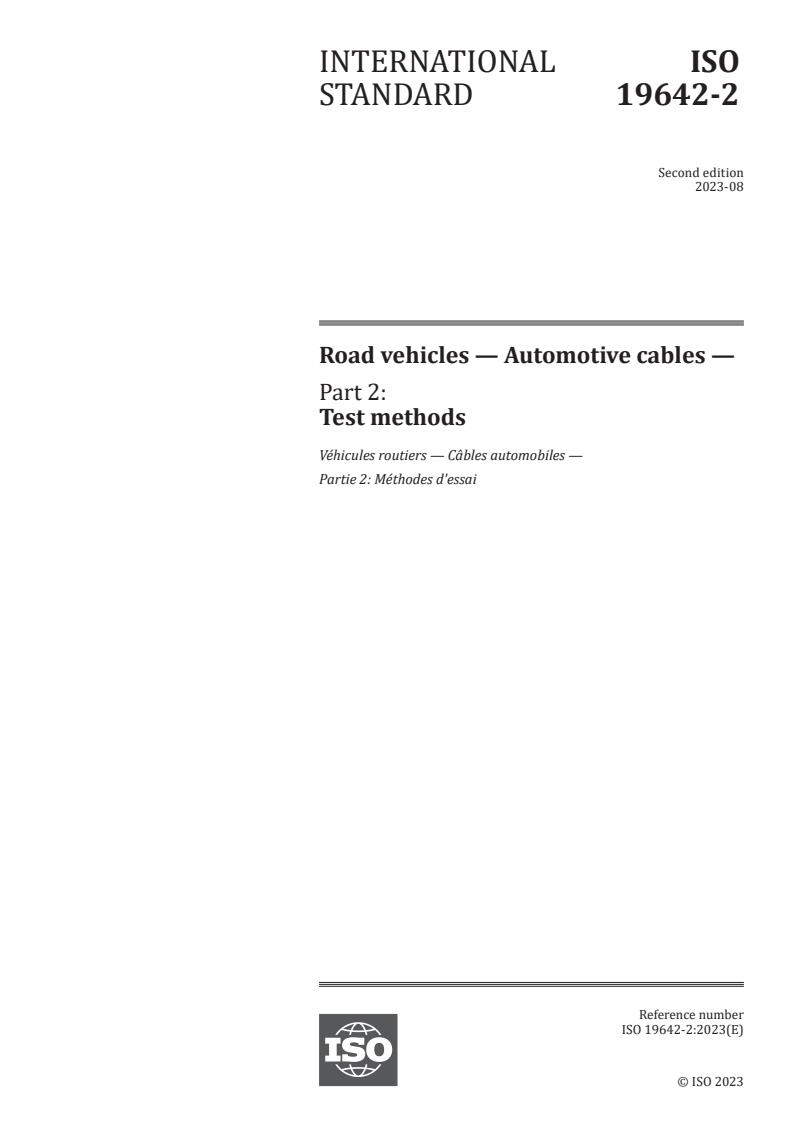
INTERNATIONAL ISO
STANDARD 19642-2
Second edition
2023-08
Road vehicles — Automotive cables —
Part 2:
Test methods
Véhicules routiers — Câbles automobiles —
Partie 2: Méthodes d'essai
Reference number
© ISO 2023
All rights reserved. Unless otherwise specified, or required in the context of its implementation, no part of this publication may
be reproduced or utilized otherwise in any form or by any means, electronic or mechanical, including photocopying, or posting on
the internet or an intranet, without prior written permission. Permission can be requested from either ISO at the address below
or ISO’s member body in the country of the requester.
ISO copyright office
CP 401 • Ch. de Blandonnet 8
CH-1214 Vernier, Geneva
Phone: +41 22 749 01 11
Email: copyright@iso.org
Website: www.iso.org
Published in Switzerland
ii
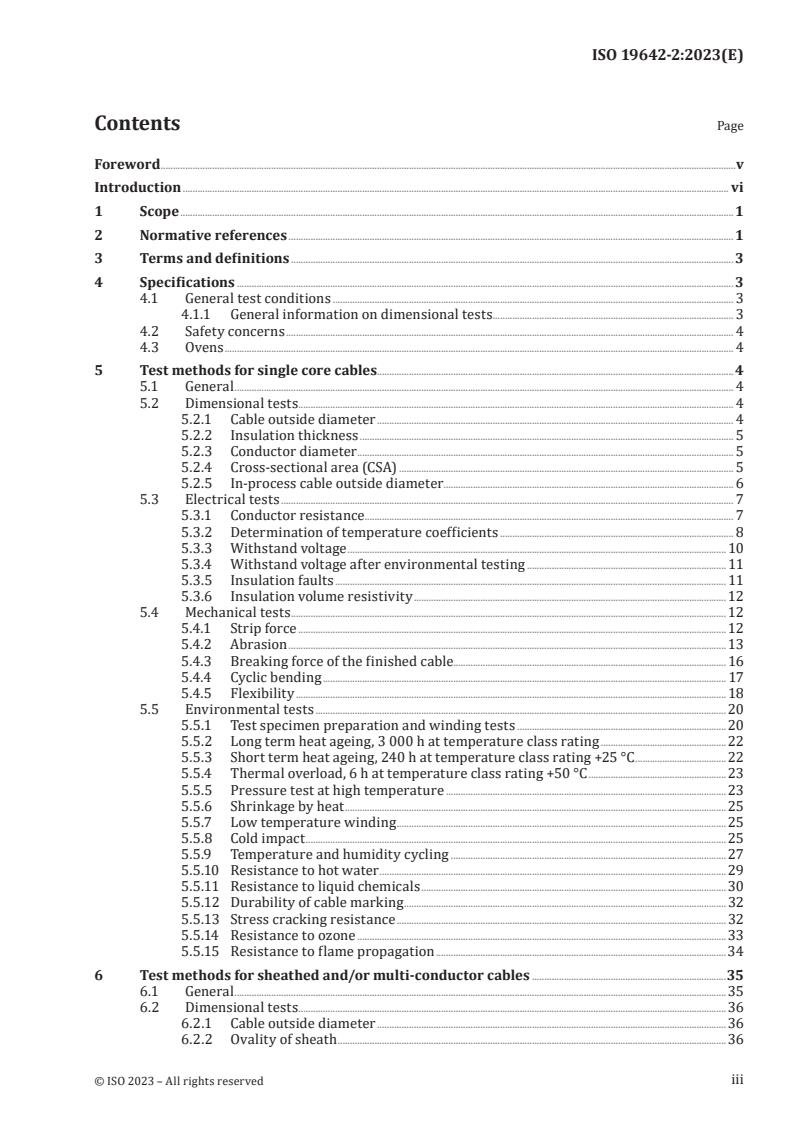
Contents Page
Foreword .v
Introduction . vi
1 Scope . 1
2 Normative references . 1
3 Terms and definitions . 3
4 Specifications . 3
4.1 General test conditions . 3
4.1.1 General information on dimensional tests. 3
4.2 Safety concerns . 4
4.3 Ovens . 4
5 Test methods for single core cables.4
5.1 General . 4
5.2 Dimensional tests . . 4
5.2.1 Cable outside diameter . 4
5.2.2 Insulation thickness . 5
5.2.3 Conductor diameter . 5
5.2.4 Cross-sectional area (CSA) . 5
5.2.5 In-process cable outside diameter . 6
5.3 Electrical tests . 7
5.3.1 Conductor resistance . . 7
5.3.2 Determination of temperature coefficients . 8
5.3.3 Withstand voltage . 10
5.3.4 Withstand voltage after environmental testing . 11
5.3.5 Insulation faults . 11
5.3.6 Insulation volume resistivity .12
5.4 Mechanical tests .12
5.4.1 Strip force .12
5.4.2 Abrasion .13
5.4.3 Breaking force of the finished cable. 16
5.4.4 Cyclic bending . 17
5.4.5 Flexibility . 18
5.5 Environmental tests . 20
5.5.1 Test specimen preparation and winding tests . 20
5.5.2 Long term heat ageing, 3 000 h at temperature class rating .22
5.5.3 Short term heat ageing, 240 h at temperature class rating +25 °C .22
5.5.4 Thermal overload, 6 h at temperature class rating +50 °C .23
5.5.5 Pressure test at high temperature . 23
5.5.6 Shrinkage by heat .25
5.5.7 Low temperature winding . 25
5.5.8 Cold impact . 25
5.5.9 Temperature and humidity cycling . 27
5.5.10 Resistance to hot water .29
5.5.11 Resistance to liquid chemicals .30
5.5.12 Durability of cable marking . 32
5.5.13 Stress cracking resistance . 32
5.5.14 Resistance to ozone .33
5.5.15 Resistance to flame propagation .34
6 Test methods for sheathed and/or multi-conductor cables .35
6.1 General . 35
6.2 Dimensional tests . .36
6.2.1 Cable outside diameter . 36
6.2.2 Ovality of sheath .36
iii
6.2.3 Thickness of sheath. 36
6.2.4 In-process cable outside diameter .36
6.2.5 Lay length . 37
6.3 Electrical tests .38
6.3.1 Electrical continuity .38
6.3.2 Withstand voltage at final inspection .38
6.3.3 Screening effectiveness .38
6.3.4 Sheath fault on screened cables . 41
6.3.5 General information on electrical test setups of unscreened balanced cables . 42
6.3.6 General information on low frequency electrical tests .46
6.3.7 Resistance unbalance .46
6.3.8 Capacitance . 47
6.3.9 Inductance . .48
6.3.10 General information on high radio frequency (RF) electrical tests .48
6.3.11 Velocity of propagation . . 51
6.3.12 Characteristic impedance in frequency domain (CIF).55
6.3.13 Characteristic impedance in time domain (CIT) .56
6.3.14 Insertion loss, (IL) .58
6.3.15 Return loss, (RL) .58
6.3.16 Unbalance attenuations .58
6.3.17 Near-end crosstalk, NEXT . 59
6.3.18 Far-end crosstalk, FEXT . 59
6.3.19 PS alien near-end crosstalk, PS-ANEXT – exogenous crosstalk . 59
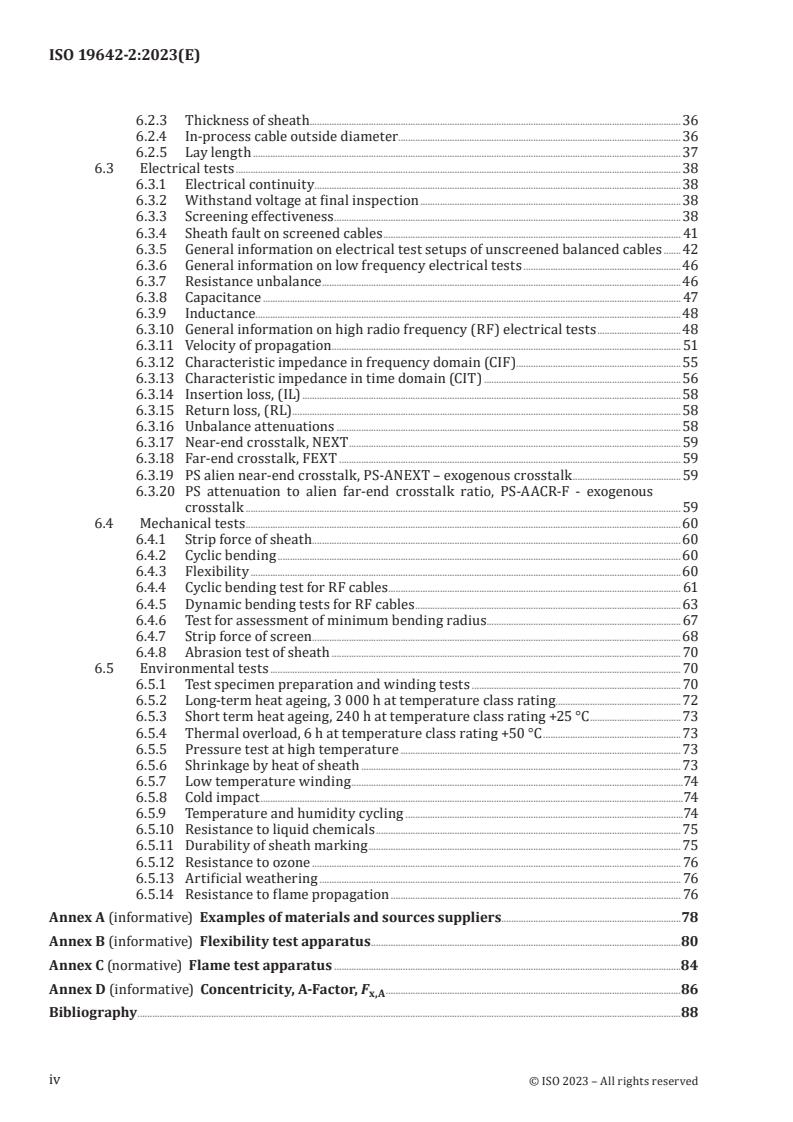
6.3.20 PS attenuation to alien far-end crosstalk ratio, PS-AACR-F - exogenous
crosstalk . 59
6.4 Mechanical tests .60
6.4.1 Strip force of sheath.60
6.4.2 Cyclic bending .60
6.4.3 Flexibility .60
6.4.4 Cyclic bending test for RF cables . 61
6.4.5 Dynamic bending tests for RF cables .63
6.4.6 Test for assessment of minimum bending radius. 67
6.4.7 Strip force of screen .68
6.4.8 Abrasion test of sheath . 70
6.5 Environmental tests . 70
6.5.1 Test specimen preparation and winding tests . 70
6.5.2 Long-term heat ageing, 3 000 h at temperature class rating.72
6.5.3 Short term heat ageing, 240 h at temperature class rating +25 °C .73
6.5.4 Thermal overload, 6 h at temperature class rating +50 °C .73
6.5.5 Pressure test at high temperature .73
6.5.6 Shrinkage by heat of sheath .73
6.5.7 Low temperature winding .74
6.5.8 Cold impact .74
6.5.9 Temperature and humidity cycling .74
6.5.10 Resistance to liquid chemicals . 75
6.5.11 Durability of sheath marking . 75
6.5.12 Resistance to ozone . 76
6.5.13 Artificial weathering . 76
6.5.14 Resistance to flame propagation . 76
Annex A (informative) Examples of materials and sources suppliers.78
Annex B (informative) Flexibility test apparatus .80
Annex C (normative) Flame test apparatus .84
Annex D (informative) Concentricity, A-Factor, F .86
x,A
Bibliography .88
iv
Foreword
ISO (the International Organization for Standardization) is a worldwide federation of national standards
bodies (ISO member bodies). The work of preparing International Standards is normally carried out
through ISO technical committees. Each member body interested in a subject for which a technical
committee has been established has the right to be represented on that committee. International
organizations, governmental and non-governmental, in liaison with ISO, also take part in the work.
ISO collaborates closely with the International Electrotechnical Commission (IEC) on all matters of
electrotechnical standardization.
The procedures used to develop this document and those intended for its further maintenance are
described in the ISO/IEC Directives, Part 1. In particular, the different approval criteria needed for the
different types of ISO document should be noted. This document was drafted in accordance with the
editorial rules of the ISO/IEC Directives, Part 2 (see www.iso.org/directives).
ISO draws attention to the possibility that the implementation of this document may involve the use
of (a) patent(s). ISO takes no position concerning the evidence, validity or applicability of any claimed
patent rights in respect thereof. As of the date of publication of this document, ISO had not received
notice of (a) patent(s) which may be required to implement this document. However, implementers are
cautioned that this may not represent the latest information, which may be obtained from the patent
database available at www.iso.org/patents. ISO shall not be held responsible for identifying any or all
such patent rights.
Any trade name used in this document is information given for the convenience of users and does not
constitute an endorsement.
For an explanation of the voluntary nature of standards, the meaning of ISO specific terms and
expressions related to conformity assessment, as well as information about ISO's adherence to
the World Trade Organization (WTO) principles in the Technical Barriers to Trade (TBT), see
www.iso.org/iso/foreword.html.
This document was prepared by Technical Committee ISO/TC 22, Road vehicles, Subcommittee SC 32,
Electrical and electronic components and general system aspects.
This second edition cancels and replaces the first edition (ISO 19642-2:2019), which has been technically
revised.
The main changes are as follows:
— new parts have been added to the ISO 19642 series (ISO 19642-11 and ISO 19642-12);
— both new International Standards refer to this document for definition of test procedures. Some
new test procedures are needed for the new standards of the ISO 19642 series and have been added
accordingly;
— some new test procedures for screened RF cables have been added for a new standard of the
ISO 19642 series.
A list of all parts in the ISO 19642 series can be found on the ISO website.
Any feedback or questions on this document should be directed to the user’s national standards body. A
complete listing of these bodies can be found at www.iso.org/members.html.
v
Introduction
This document was prepared following a joint resolution to improve the general structure of the ISO
Automotive Electric Cable standards. This new structure adds more clarity and, by defining a new
standard family, opens up the standard for future amendments.
Many other standards currently refer to ISO 6722-1, ISO 6722-2 and ISO 14572. These standards will
stay valid at least until the next scheduled systematic review and will be replaced later on by the
ISO 19642 series.
For new automotive cable projects customers and suppliers are advised on using the ISO 19642 series.
vi
INTERNATIONAL STANDARD ISO 19642-2:2023(E)
Road vehicles — Automotive cables —
Part 2:
Test methods
WARNING — The use of this document can involve hazardous materials, operations and
equipment. This document does not purport to address all of the safety concerns, if any, associated
with its use. It is the responsibility of the user of this document to establish appropriate safety
practices and determine the applicability of regulatory limitations prior to use.
1 Scope
This document defines test methods for electrical cables in road vehicles, which are used in other parts
of the ISO 19642 series.
2 Normative references
The following documents are referred to in the text in such a way that some or all of their content
constitutes requirements of this document. For dated references, only the edition cited applies. For
undated references, the latest edition of the referenced document (including any amendments) applies.
1)
ISO 1817 , Rubber, vulcanized or thermoplastic — Determination of the effect of liquids
ISO 4141-1, Road vehicles — Multi-core connecting cables — Part 1: Test methods and requirements for
basic performance sheathed cables
ISO 4892-2, Plastics — Methods of exposure to laboratory light sources — Part 2: Xenon-arc lamps
ISO 4926, Road vehicles — Hydraulic braking systems — Non-petroleum-based reference fluid
ISO 6931-1, Stainless steels for springs — Part 1: Wire
ISO 19642-1, Road vehicles — Automotive cables — Part 1 — Vocabulary and design guidelines
ISO 19642-3, Road vehicles — Automotive cables — Part 3: Dimensions and requirements for 30 V a.c. or
60 V d.c. single core copper conductor cables
ISO 19642-4, Road vehicles — Automotive cables — Part 4: Dimensions and requirements for 30 V a.c. and
60 V d.c. single core aluminium conductor cables
ISO 19642-5, Road vehicles — Automotive cables — Part 5: Dimensions and requirements for 600 V a.c. or
900 V d.c. and 1 000 V a.c. or 1 500 V d.c. single core copper conductor cables
ISO 19642-6, Road vehicles — Automotive cables — Part 6: Dimensions and requirements for 600 V a.c. or
900 V d.c. and 1 000 V a.c. or 1 500 V d.c. single core aluminium conductor cables
SAE RM-66-06, Motor Vehicle Brake Fluid — High Boiling Compatibility/Reference Fluid
IEC 60216-4-1, Electrical insulating materials — Thermal endurance properties — Part 4-1: Ageing
ovens — Single-chamber ovens
IEC 60216-4-2, Electrical insulating materials — Thermal endurance properties — Part 4-2: Ageing
ovens — Precision ovens for use up to 300 °C
1) Eight edition under preparation. Stage at the time of publication: ISO/DIS 1817:2023.
IEC 60811-201, Electric and optical fibre cables — Test methods for non-metallic materials — Part 201:
General tests — Measurement of insulation thickness
IEC 60811-202, Electric and optical fibre cables — Test methods for non-metallic materials — Part 202:
General tests — Measurement of thickness of non-metallic sheath
IEC 60811-401, Electric and optical fibre cables — Test methods for non-metallic materials — Part 401:
Miscellaneous tests - Thermal ageing methods - Ageing in an air oven
IEC 60811-403, Electric and optical fibre cables — Test methods for non-metallic materials — Part 403:
Miscellaneous tests — Ozone resistance test on cross-linked compounds
IEC 60811-501, Electric and optical fibre cables — Test methods for non-metallic materials — Part 501:
Mechanical tests — Tests for determining the mechanical properties of insulating and sheathing compounds
IEC 60811-508:2012, Electric and optical fibre cables — Test methods for non-metallic materials — Part
508: Mechanical tests — Mechanical tests - Pressure test at high temperature for insulation and sheaths
IEC 61156-1, Multicore and symmetrical pair/quad cables for digital communications - Part 1 — Generic
specification
IEC TR 61156-1-2:2009+AMD1: 2014, CSV Consolidated version, Multicore and symmetrical pair/quad
cables for digital communications — Part 1-2: Electrical transmission characteristics and test methods
of — Symmetrical pair/quad cables
IEC 61196-1, Coaxial communication cables — Part 1: Generic specification — General, definitions and
requirements
IEC 61196-1-100, Coaxial communication cables — Part 1-100: Electrical test methods — General
requirements
IEC 61196-1-103, Coaxial communication cables — Part 1-103: Electrical test methods — Test for
capacitance of cable
IEC 61196-1-108, Coaxial communication cables — Part 1-108: Electrical test methods — Test for
characteristic impedance, phase and group delay, electrical length and propagation velocity
IEC 61196-1-112, Coaxial communication cables — Part 1-112: Electrical test methods — Test for return
loss (uniformity of impedance)
IEC 61196-1-113, Coaxial communication cables — Part 1-113: Electrical test methods — Test for
attenuation constant
IEC 61196-1-114, Coaxial communication cables — Part 1-114: Electrical test methods — Test for inductance
IEC 61196-1-116, Coaxial communication cables — Part 1-116: Electrical test methods — Test for impedance
with time domain reflectometry (TDR)
IEC 62153-4-3, Metallic communication cable test methods — Part 4-3: Electromagnetic compatibility
(EMC) - Surface transfer impedance — Triaxial method
IEC 62153-4-4, Metallic communication cable test methods — Part 4-4: Electromagnetic compatibility
(EMC) —Test method for measuring of the screening attenuation as up to and above 3 GHz, triaxial method
IEC 62153-4-5, Metallic communication cables test methods — Part 4-5: Electromagnetic compatibility
(EMC) — Coupling or screening attenuation — Absorbing clamp method
IEC 62153-4-9, Metallic communication cables test methods — Part 4-9: Electromagnetic compatibility
(EMC) — Coupling attenuation of screened balanced cables, triaxial method
EN 50289-1-1, Communication cables— Specifications for test methods— Electrical test methods —
General requirements
EN 50289-1-5, Communication cables— Specifications for test methods— Electrical test methods —
Capacitance
EN 50289-1-12, Communication cables— Specifications for test methods— Electrical test methods —
Inductance
3 Terms and definitions
For the purposes of this document, the terms and definitions given in ISO 19642-1 and the following
apply.
ISO and IEC maintain terminology databases for use in standardization at the following addresses:
— ISO Online browsing platform: available at https:// www .iso .org/ obp
— IEC Electropedia: available at https:// www .electropedia .org/
4 Specifications
4.1 General test conditions
Unless specified otherwise, the device under test (DUT) shall be preconditioned continuously for at
least 16 h at a room temperature (RT) (see ISO 19642-1). Unless specified otherwise, all tests other than
“in process” shall be conducted in these conditions.
Where no tolerance is specified, all values shall be considered to be approximate.
When AC tests are performed, they shall be at 50 Hz or 60 Hz. Applications at higher frequencies may
require additional testing.
Use the temperature tolerances shown in Table 1 unless specified in the individual tests.
Table 1 — Test temperature tolerance
Test temperature Temperature
(T) tolerance
°C °C
T ≤ 100 ±2
100 < T ≤ 200 ±3
T > 200 ±4
Unintentional direct contact between different metals shall not occur with any of the test methods, in
order to avoid electrochemical effects on the test results.
All tests shall be performed on the same manufactured batch of cable. If, for any reason, a different
batch of cable is used for any of the tests, it should be noted accordingly on the test report and test
summary.
Unless otherwise specified, each test is to be performed on at least three test specimens.
If suppliers and customers agree upon modifications or changes to the methods and requirements, it is
required that all the changes and modifications be clearly documented.
4.1.1 General information on dimensional tests
Measure with a device accurate to at least 0,01 mm.
It is preferred to cut a small slice from the sample (perpendicular to the cable length) and use an optical
measurement device to magnify the specimen.
In case of disputed results due to specimen deformation in preparation, a referee method is provided
below.
Prepare three test specimens from a cable test specimen 3 m in length. Take these test specimens at
1 m intervals. A test specimen consists of a 20 mm length of cable. Take care not to deform the test
specimen. Immerse the test specimens in a casting resin. After hardening, take a section perpendicular
to the axis of the test specimen.
In case of dispute specimen under test may be encapsulated in synthetic resin before performing the
measurement. In this case the following measurement is to be performed using a microscope with a
resolution better than 10 µm.
This remark is applicable to tests 5.2.1, 5.2.2 and 5.2.3.
4.2 Safety concerns
The precautions as described in the WARNING at the beginning of this document shall be followed.
4.3 Ovens
An oven with or without forced air circulation as described in IEC 60216-4-1 and/or IEC 60216-4-2
or equivalent shall be used. The air shall enter the oven in such a way that it flows over the surface of
the test specimens and exits the oven. Measure the rate of complete air changes per hour according
to IEC 60811-401:2012, Annex A, Method 1. The oven shall have not less than 8 and not more than
20 complete air changes per hour at the specified ageing temperature.
5 Test methods for single core cables
5.1 General
This paragraph is needed to ensure the alignment of paragraph numbers with the other parts of the
ISO 19642 series.
5.2 Dimensional tests
5.2.1 Cable outside diameter
5.2.1.1 Purpose
This test is intended to verify that the cable outside diameter is within the required tolerances for
intended functional applications.
5.2.1.2 Test specimen
Prepare one test specimen of 3 m in length.
5.2.1.3 Test
The cable outside diameter shall be measured at three separate cross-sections located 1 m apart from
each other. Two perpendicular readings shall be taken at each cross-section.
Document the initial readings for each cross section for determination of ovality.
For each specimen calculate the mean value from each point of measurement. From the mean values of
all three specimens determine the minimum and maximum value.
The minimum and maximum values shall be in accordance with the cable dimension tables in the
ISO 19642 series for the various cable types.
For large cables (outside diameter ≥ 18,0 mm), the test method described in IEC 60811-203:2012, 4.2 b,
may be used for measuring the outside diameter.
5.2.2 Insulation thickness
5.2.2.1 Purpose
This test is intended to verify that the cable insulation thickness is within the required tolerances to
withstand electrical, mechanical and chemical abuse.
5.2.2.2 Test specimens
Prepare three test specimens from a cable test specimen 3 m in length. Take the test specimens at
1 m intervals. Strip the insulation from the cable. A test specimen consists of a thin cross-section of
insulation. Take care not to deform the test specimen during the preparation process. If cable marking
causes indentation of the insulation, take the first test specimen and measure at this indentation.
5.2.2.3 Test
Use a measuring device which shall not cause deformation.
Place the test specimen under the measuring equipment with the plane of the cut perpendicular to
the optical axis. Determine the minimum insulation thickness in accordance with IEC 60811-201. For
sheath use IEC 60811-202.
5.2.3 Conductor diameter
5.2.3.1 Purpose
This test is intended to verify that the cable conductor diameter is within the specified dimensions to
fit terminal crimps and mechanical demands.
5.2.3.2 Test specimens
Use the test specimens as specified in 5.2.2.
5.2.3.3 Test
Use a measuring device which does not cause deformation.
Determine the conductor diameter by measuring the inside diameter of the test specimens and record
the maximum inside diameter for each test specimen.
5.2.4 Cross-sectional area (CSA)
5.2.4.1 Purpose
This test is intended to verify that the cable conductor fulfils the specified requirements.
5.2.4.2 Test of cross-sectional area, A
In case of dispute, method 2 (weight method) is the referee method to determine the cross-sectional
area, A.
— Method 1: By using the obtained resistance value, R , according to 5.3.1, the CSA, A, is calculated
using the following formula:
1000×+1 F
()
x,b
A=
κ×R
where
A is the cross-sectional area in mm ;
R is the conductor resistance at 20 °C in mΩ/m;
κ is the conductivity of the used conductor material in Sm/mm :
for copper use a conductivity of 58,0 Sm/mm ;
for aluminium use a conductivity of 35,5 Sm/mm ;
for aluminium alloy use a conductivity of 33,5 Sm/mm ;
for other alloys with different conductivity, values can be used based on agreement between
the customer and supplier;
F is bunching loss, depending on strand construction (see ISO 19642-1).
x,b
— Method 2: Carefully strip the insulation from 1 m ± 5 mm of the cable under test. The conductor is
weighed with a scale capable of measurement to 0,5 % accuracy of the measured value. From the
result, A is calculated using the following formula:
m
co
A=
ρ
where
A is cross-sectional area in mm ;
m is the conductor weight in g/m;
co
ρ is the density of the used conductor material in g/cm :
for copper use a density of 8,89 g/cm ;
for aluminium use a density of 2,70 g/cm ;
applicable densities shall be used for alloys.
5.2.5 In-process cable outside diameter
5.2.5.1 Purpose
This in-process monitoring is intended to verify that the cable outside diameter is within the required
tolerances.
5.2.5.2 Test specimens
The test specimen is 100 % of the cable production; all cable produced is to be monitored.
5.2.5.3 Test
The measurement of diameter shall be performed in the most stable area of the extrusion process.
5.3 Electrical tests
5.3.1 Conductor resistance
5.3.1.1 Purpose
This test is intended to verify that the cable conductor resistance does not exceed the maximum
permitted value.
5.3.1.2 Test specimens
Prepare one test specimen of 2 m length, including the length necessary for connections.
5.3.1.3 Preparation of conductor ends
For copper and copper alloy conductors, the ends of the test specimen may be soldered.
For aluminium and aluminium alloy conductors, the oxide film on the aluminium surface shall be
removed before carrying out the measurement following one of the two methods mentioned below.
In case of dispute, method 1 is the reference method.
— Method 1 for removal of oxide film on the aluminium surface by soldering
Remove the insulation from the wire, apply a soldering fluid on the aluminium surface and dip the
aluminium wire into the solder bath.
In case of doubt – for example, if the resistance requirements are not met – it is possible that the
soldering fluid is not applicable. The following referee soldering fluid shall be used.
The referee soldering fluid consists of the following components:
— diethanolamine: 45 % to 65 %;
— fluoroboric acid: 11 % to 13 %;
— diethylene triamine: 14 % to 17 %.
The solder bath consists of the following components:
— tin: 80 % to 90 %;
— zinc: 10 % to 20 %;
— other metals: 1 %.
— Method 2 for removal of oxide film on the aluminium surface by pickling
Remove the insulation and immerse the aluminium conductor in a solution consisting of 3,5 %
hydrochloric acid in water for 1 min. Remove the wire from the hydrochloric acid solution, rinse
the immersed part with distilled water and dry. Perform the conductor measurement immediately
after drying.
5.3.1.4 Test
The current needs to be supplied to the DUT with extra terminals situated outside of the voltage probes
(4-wire measurement method). The thickness of the blades for the voltage measurement shall be smaller
than 0,5 mm. The distance between the inner edges of the voltage probes shall be 1 000 mm ± 5 mm.
Use a resistance measuring device with an accuracy of ±0,1 % of the measured value and a thermometer
with an accuracy of ±0,5 °C.
Measure the ambient room temperature at the time of test. Take care to ensure that connections are
secure. Measure the resistance of the test specimen.
Correct the measured value using the following formula:
R
T
R =
LT×+12α ×− 0
()
v ρ
where
R is the corrected conductor resistance at the reference temperature of 20 °C, expressed in
mΩ/m;
R is the conductor resistance measured at the conductor temperature in mΩ;
T
L is the distance between the inner edges of the voltage probes, which shall be free from sol-
v
der and is expressed in m;
T is the ambient room temperature at the time of measurement in °C;
α in 1/K, is the temperature coefficient for converting the measured resistance to the value at
ρ
20 °C.
The temperature coefficient for copper with 100 % conductivity at temperatures at 20 °C is
−3
3,93 × 10 1/K.
For coated wires or alloys, the correction factor shall be established by agreement between
the customer and supplier.
−3
For soft aluminium the temperature coefficient is 4,03 × 10 1/K.
For other types of aluminium conductor, e.g. alloyed aluminium, CCA, this may be different.
The applied temperature coefficient shall be measured according to 5.3.2 or as agreed be-
tween customer and supplier and be reported.
5.3.2 Determination of temperature coefficients
5.3.2.1 Purpose
The resistance of a cable under test is determined while its temperature is increased from room
temperature up to 50 °C. The resistance is calculated from a measurement of the potential difference
across the cable and a measurement of the current passing through the cable. The current is supplied
by a constant-current source (a DC power supply).
5.3.2.2 Test specimen
Prepare one test specimen according to Table 2, including the length necessary for connections.
Table 2 — Length of cable test specimen
ISO conductor size
Length
(a)
mm m
a < 2,5 10
2,5 ≤ a < 10 5
a ≥ 10 2
5.3.2.3 Calibration graph
The cable under test is submitted to a temperature range from 20 °C up to 50 °C in a silicone oil bath.
At least 80 % of the cable length is submersed in the oil. Alternatively, the test can be performed in a
suitable heating chamber.
5.3.2.4 4-point measurement method
Apply a constant current according to Table 3. The current shall not cause warming of the conductor.
Table 3 — Maximum permissible current for resistance measurement
ISO conductor size Maximum permissible
(a) current
mm mA
a < 0,35 10
0,35 ≤ a < 6 100
a ≥ 6 1 000
The contact points for voltage measurement shall be below the oil surface in the oil bath to ensure that
the part of cable between the voltage measurement points has a uniform temperature.
For the voltage measurement, a gauge with an input impedance greater than 1 MΩ shall be used.
The resistance of the cable is determined at each predefined temperature point by measurement of the
current and voltage drop.
5.3.2.5 Procedure
The temperature of the oil bath shall be measured and controlled. The oil bath temperature
measurement shall be more accurate than ±0,2 °C. The temperature of the oil bath shall be constant
throughout the duration of the bath.
Starting at room temperature less than or equal to 25 °C, the oil is heated up to 30 °C and subsequently
in steps of 10 °C up to 60 °C.
After each temperature step, wait until the change in oil temperature is less than ±0,2 °C and the change
in the measured resistance value is lower than 0,04 % for 60 s.
Calculate the resistance at each temperature from the measured current, voltage and length between
the voltage measurement terminals.
5.3.2.6 Analysis of test results, linear approximation
The determined resistance values, R' in Ω/m, compared to the temperature increase, ΔT (oil bath
temperature T − 20 °C), represents the calibration graph, R'(ΔT).
o
The data pairs R’(ΔT) and ΔT from 30 °C up to and including 60 °C are fitted by linear interpolation to
determine the parameters a and b in the following formula:
′
RT()ΔΔ=×aT +b
where
R'(∆T) is the determined resistance at the increased temperature ∆T;
∆T is the increased temperature.
For calculation of the resistance temperature coefficient, α , this formula can be expressed as:
ρ
′ ′ ′
RT()ΔΔ=×α RT×+R
ρ 20 20
where
R' is the electrical resistance per unit length at 20 °C in Ω/m;
α is the linear temperature coef
...