


IEC 61914:2021
(Main)Cable cleats for electrical installations
General Information
- Abstract
IEC 61914:2021 specifies requirements and tests for cable cleats used for securing cables in electrical installations and for intermediate restraints used for holding cables together in formation in electrical installations. Cable cleats provide resistance to electromechanical forces where declared. This document includes cable cleats that rely on a mounting surface specified by the manufacturer for axial and/or lateral retention of cables.
This third edition cancels and replaces the second edition published in 2015. This edition constitutes a technical revision.
This edition includes the following significant technical changes with respect to the previous edition:
requirements for mandrels used in testing rationalised and detailed in the general test requirements (Clause 5);
definition of liner added and test requirements where liners and other optional parts are used;
definitions for LV, MV and HV cables added and test requirements where MV & HV cable are used ;
new corrosion resistance classes for plated products added;
new requirements and test for durability and legibility of markings added;
new test requirements for axial load testing of cleats for more than one cable added;
lateral load test requirements for intermediate restraints added.
- Status
- Published
- Publication Date
- 05-Oct-2021
- Technical Committee
- SC 23A - Cable management systems
- Drafting Committee
- MT 16 - TC 23/SC 23A/MT 16
- Current Stage
- PPUB - Publication issued
- Start Date
- 06-Oct-2021
- Completion Date
- 22-Oct-2021
Buy Documents
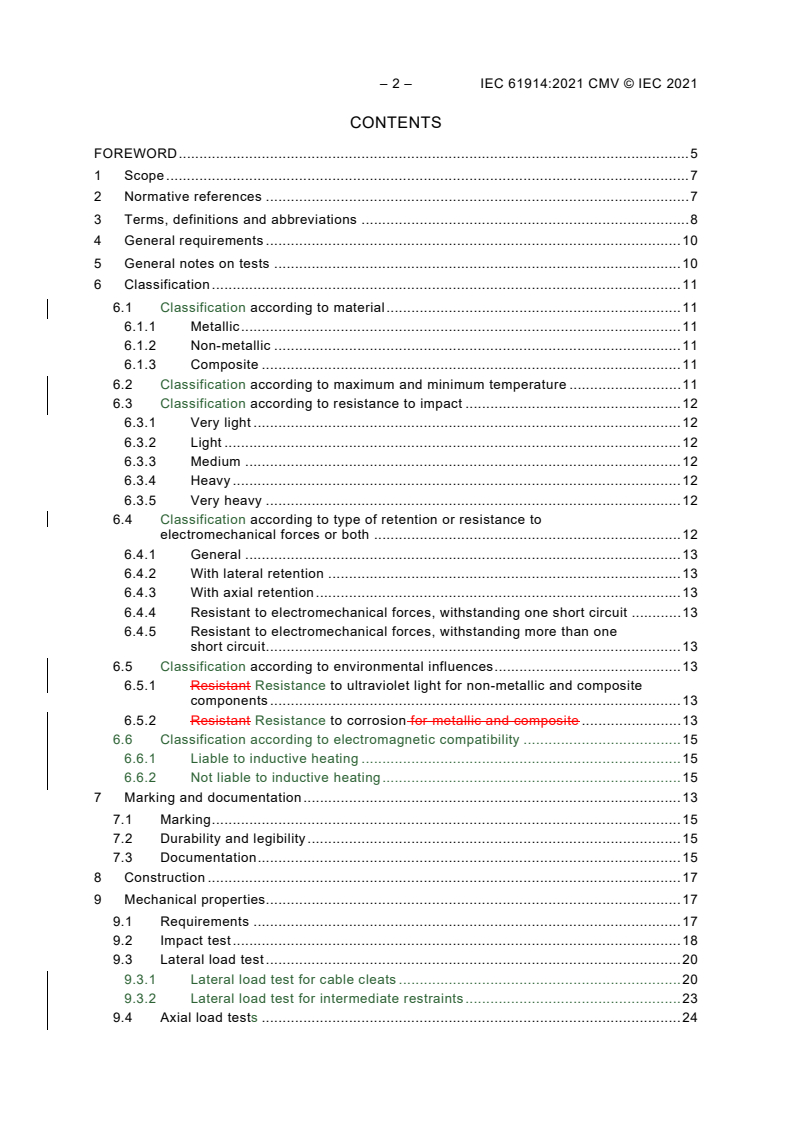
REDLINE IEC 61914:2021 CMV - Cable cleats for electrical installations Released:10/6/2021
IEC 61914:2021 - Cable cleats for electrical installations Released:10/6/2021
Overview
IEC 61914:2021 - Cable cleats for electrical installations - is the third edition international standard that specifies requirements and tests for cable cleats and intermediate restraints used to secure electrical cables. It defines performance criteria for retention (axial and lateral), resistance to electromechanical forces (including short‑circuit events), environmental durability, marking legibility, and compatibility with mounting surfaces. This 2021 edition supersedes IEC 61914:2015 and introduces several technical revisions to testing and classification.
Key topics and technical requirements
- Scope and classification: Covers metallic, non‑metallic and composite cleats; classifications by temperature range, impact resistance, corrosion resistance and electromagnetic behaviour (inductive heating).
- Mechanical performance tests: Detailed lateral load, axial load and impact tests to verify retention and physical robustness. New axial load tests cover cleats securing more than one cable.
- Resistance to electromechanical forces: Test methods and classifications for cleats that must withstand forces generated during short‑circuit currents (single and multiple short‑circuit events).
- Test mandrels and liners: Clarified requirements for mandrels used in mechanical testing and a new definition and test requirements when liners or optional parts are used.
- Environmental durability: Corrosion resistance classes (including new classes for plated products), ultraviolet resistance for non‑metallic components, salt spray testing and other environmental influence tests.
- Marking and documentation: New requirements for durability and legibility of markings, plus documentation needed for correct selection and installation.
- Fire and EMC considerations: Requirements and tests for flame propagation, smoke emission/toxicity and inductive heating behaviour for cable arrangements used with cleats.
Practical applications
IEC 61914:2021 applies wherever secure cable retention is critical:
- Power generation plants, substations and switchgear rooms
- Industrial and petrochemical installations, offshore and marine environments
- Tunnels, rail and transport systems
- Commercial and high‑rise building electrical installations Use of compliant cable cleats ensures mechanical safety during fault conditions, improves cable routing reliability, reduces risk from cable whip or collapse, and supports regulatory compliance and insurance requirements.
Who should use this standard
- Cable cleat and restraint manufacturers (design, testing, CE/third‑party assessment)
- Electrical design engineers and specifiers selecting cleats for LV, MV and HV cable systems
- Installation and maintenance contractors
- Testing laboratories and certification bodies assessing compliance
- Procurement and asset‑management teams ensuring correct product selection
Related standards (guidance)
Refer to other IEC and national standards on electrical installation design, short‑circuit current calculation, cable performance and testing for integrated compliance and system safety.
Keywords: IEC 61914:2021, cable cleats, cable restraint, electrical installations, electromechanical forces, axial load, lateral retention, corrosion resistance, short‑circuit testing.
Relations
- Effective Date
- 05-Sep-2023
Buy Documents
REDLINE IEC 61914:2021 CMV - Cable cleats for electrical installations Released:10/6/2021
IEC 61914:2021 - Cable cleats for electrical installations Released:10/6/2021
Get Certified
Connect with accredited certification bodies for this standard

IMQ S.p.A. (Certification)
Italian electrical product certification.

SLG Prüf- und Zertifizierungs GmbH
German testing and certification body.

UL Solutions
Global safety science company with testing, inspection and certification.
Sponsored listings
Frequently Asked Questions
IEC 61914:2021 is a standard published by the International Electrotechnical Commission (IEC). Its full title is "Cable cleats for electrical installations". This standard covers: IEC 61914:2021 specifies requirements and tests for cable cleats used for securing cables in electrical installations and for intermediate restraints used for holding cables together in formation in electrical installations. Cable cleats provide resistance to electromechanical forces where declared. This document includes cable cleats that rely on a mounting surface specified by the manufacturer for axial and/or lateral retention of cables. This third edition cancels and replaces the second edition published in 2015. This edition constitutes a technical revision. This edition includes the following significant technical changes with respect to the previous edition: requirements for mandrels used in testing rationalised and detailed in the general test requirements (Clause 5); definition of liner added and test requirements where liners and other optional parts are used; definitions for LV, MV and HV cables added and test requirements where MV & HV cable are used ; new corrosion resistance classes for plated products added; new requirements and test for durability and legibility of markings added; new test requirements for axial load testing of cleats for more than one cable added; lateral load test requirements for intermediate restraints added.
IEC 61914:2021 specifies requirements and tests for cable cleats used for securing cables in electrical installations and for intermediate restraints used for holding cables together in formation in electrical installations. Cable cleats provide resistance to electromechanical forces where declared. This document includes cable cleats that rely on a mounting surface specified by the manufacturer for axial and/or lateral retention of cables. This third edition cancels and replaces the second edition published in 2015. This edition constitutes a technical revision. This edition includes the following significant technical changes with respect to the previous edition: requirements for mandrels used in testing rationalised and detailed in the general test requirements (Clause 5); definition of liner added and test requirements where liners and other optional parts are used; definitions for LV, MV and HV cables added and test requirements where MV & HV cable are used ; new corrosion resistance classes for plated products added; new requirements and test for durability and legibility of markings added; new test requirements for axial load testing of cleats for more than one cable added; lateral load test requirements for intermediate restraints added.
IEC 61914:2021 is classified under the following ICS (International Classification for Standards) categories: 29.120.20 - Connecting devices. The ICS classification helps identify the subject area and facilitates finding related standards.
IEC 61914:2021 has the following relationships with other standards: It is inter standard links to IEC 61914:2015. Understanding these relationships helps ensure you are using the most current and applicable version of the standard.
IEC 61914:2021 is available in PDF format for immediate download after purchase. The document can be added to your cart and obtained through the secure checkout process. Digital delivery ensures instant access to the complete standard document.
Standards Content (Sample)
IEC 61914 ®
Edition 3.0 2021-10
COMMENTED VERSION
INTERNATIONAL
STANDARD
colour
inside
Cable cleats for electrical installations
All rights reserved. Unless otherwise specified, no part of this publication may be reproduced or utilized in any form
or by any means, electronic or mechanical, including photocopying and microfilm, without permission in writing from
either IEC or IEC's member National Committee in the country of the requester. If you have any questions about IEC
copyright or have an enquiry about obtaining additional rights to this publication, please contact the address below or
your local IEC member National Committee for further information.
IEC Central Office Tel.: +41 22 919 02 11
3, rue de Varembé info@iec.ch
CH-1211 Geneva 20 www.iec.ch
Switzerland
About the IEC
The International Electrotechnical Commission (IEC) is the leading global organization that prepares and publishes
International Standards for all electrical, electronic and related technologies.
About IEC publications
The technical content of IEC publications is kept under constant review by the IEC. Please make sure that you have the
latest edition, a corrigendum or an amendment might have been published.
IEC publications search - webstore.iec.ch/advsearchform IEC online collection - oc.iec.ch
The advanced search enables to find IEC publications by a Discover our powerful search engine and read freely all the
variety of criteria (reference number, text, technical publications previews. With a subscription you will always
committee, …). It also gives information on projects, replaced have access to up to date content tailored to your needs.
and withdrawn publications.
Electropedia - www.electropedia.org
IEC Just Published - webstore.iec.ch/justpublished
The world's leading online dictionary on electrotechnology,
Stay up to date on all new IEC publications. Just Published
containing more than 22 000 terminological entries in English
details all new publications released. Available online and
and French, with equivalent terms in 18 additional languages.
once a month by email.
Also known as the International Electrotechnical Vocabulary
(IEV) online.
IEC Customer Service Centre - webstore.iec.ch/csc
If you wish to give us your feedback on this publication or
need further assistance, please contact the Customer Service
Centre: sales@iec.ch.
IEC 61914 ®
Edition 3.0 2021-10
COMMENTED VERSION
INTERNATIONAL
STANDARD
colour
inside
Cable cleats for electrical installations
INTERNATIONAL
ELECTROTECHNICAL
COMMISSION
ICS 29.120.20 ISBN 978-2-8322-4984-0
– 2 – IEC 61914:2021 CMV © IEC 2021
CONTENTS
FOREWORD . 5
1 Scope . 7
2 Normative references . 7
3 Terms, definitions and abbreviations . 8
4 General requirements . 10
5 General notes on tests . 10
6 Classification . 11
6.1 Classification according to material . 11
6.1.1 Metallic . 11
6.1.2 Non-metallic . 11
6.1.3 Composite . 11
6.2 Classification according to maximum and minimum temperature . 11
6.3 Classification according to resistance to impact . 12
6.3.1 Very light . 12
6.3.2 Light . 12
6.3.3 Medium . 12
6.3.4 Heavy . 12
6.3.5 Very heavy . 12
6.4 Classification according to type of retention or resistance to
electromechanical forces or both . 12
6.4.1 General . 13
6.4.2 With lateral retention . 13
6.4.3 With axial retention . 13
6.4.4 Resistant to electromechanical forces, withstanding one short circuit . 13
6.4.5 Resistant to electromechanical forces, withstanding more than one
short circuit . 13
6.5 Classification according to environmental influences . 13
6.5.1 Resistant Resistance to ultraviolet light for non-metallic and composite
components . 13
6.5.2 Resistant Resistance to corrosion for metallic and composite . 13
6.6 Classification according to electromagnetic compatibility . 15
6.6.1 Liable to inductive heating . 15
6.6.2 Not liable to inductive heating . 15
7 Marking and documentation . 13
7.1 Marking . 15
7.2 Durability and legibility . 15
7.3 Documentation . 15
8 Construction . 17
9 Mechanical properties. 17
9.1 Requirements . 17
9.2 Impact test . 18
9.3 Lateral load test . 20
9.3.1 Lateral load test for cable cleats . 20
9.3.2 Lateral load test for intermediate restraints . 23
9.4 Axial load tests . 24
9.5 Test for resistance to electromechanical forces . 26
9.5.1 General . 26
9.5.2 For cable cleats and intermediate restraints classified in 6.4.4 . 30
9.5.3 For cable cleats and intermediate restraints classified in 6.4.5 . 30
10 Fire hazards . 30
10.1 Flame propagation . 31
10.2 Smoke emission . 32
10.3 Smoke toxicity . 32
11 Environmental influences . 33
11.1 Resistance to ultraviolet light . 33
11.2 Resistance to corrosion . 33
11.2.1 General . 33
11.2.2 Non-metallic components. 34
11.2.3 Components made of stainless steel . 34
11.2.4 Components made of mild steel or cast iron with metallic coating . 34
11.2.5 Components made of non-ferrous alloys . 35
11.2.6 Salt spray test . 33
12 Electromagnetic compatibility . 36
12.1 Electromagnetic emission . 36
12.2 Inductive heating . 36
Annex A (informative) Examples of cable cleats and intermediate restraints . 37
Annex B (informative) Calculation of forces caused by short-circuit currents . 40
B.1 Characteristics . 40
B.2 Specification of the test current . 43
B.3 Calculation of the mechanical forces between conductors . 43
Annex C (normative) Identification of MV or HV cable used in short-circuit test . 46
Bibliography . 47
List of comments . 48
Figure 1 – Test piston dimensions. 16
Figure 2 – Typical arrangement for impact test . 18
Figure 3 – Typical arrangements for lateral load test for cable cleats . 22
Figure 4 – Typical arrangements for lateral load test for intermediate restraints . 23
Figure 5 – Typical arrangement for axial load test . 25
Figure 6 – Typical assemblies for test for resistance to electromechanical force . 27
Figure 7 – Typical arrangement of three cables in trefoil formation . 29
Figure 8 – Typical arrangement of cables in flat formation . 29
Figure 9 – Typical arrangement of the needle-flame test . 32
Figure A.1 – Metallic strap cable cleat for single or bundled cables . 38
Figure A.2 – Metallic single bolt cable cleat for single cable . 38
Figure A.3 – Metallic two-bolt cable cleat for single cable . 38
Figure A.4 – Composite cable cleat for three cables in trefoil formation . 38
Figure A.5 – Non-metallic cable cleat for single cable . 38
Figure A.6 – Metallic cable cleat for single cable with integral mounting stud . 38
Figure A.7 – Non-metallic cable cleat for three cables in flat formation . 38
Figure A.8 – Metallic cable cleat for use with channel cable support system . 38
– 4 – IEC 61914:2021 CMV © IEC 2021
Figure A.9 – Non-metallic cable cleat for three cables in trefoil formation . 38
Figure A.10 – Non-metallic cable cleat for three cables in trefoil formation with integral
ladder rung clamp . 39
Figure A.11 – Metallic intermediate restraint for three cables in flat formation . 39
Figure A.12 – Composite intermediate restraint for bundled cables . 39
Figure B.1 – Short-circuit current of a far-from-generator short circuit with constant a.c.
component . 41
Figure B.2 – Short-circuit current of a near-to-generator short circuit with decaying a.c.
component . 42
Figure B.3 – Two parallel conductors . 44
Table 1 – Maximum temperature for permanent application . 12
Table 2 – Minimum temperature for permanent application . 12
Table 3 – Classification for resistance against corrosion for stainless steel components . 14
Table 4 – Resistance to corrosion .
Table 4 – Classification for resistance against corrosion for coated mild steel or cast-iron
components . 14
Table 5 – Impact test values . 20
Table 6 – Component compliance and classification for resistance against corrosion . 34
Table 7 – Zinc coating thickness of reference materials . 35
INTERNATIONAL ELECTROTECHNICAL COMMISSION
____________
CABLE CLEATS FOR ELECTRICAL INSTALLATIONS
FOREWORD
1) The International Electrotechnical Commission (IEC) is a worldwide organization for standardization comprising
all national electrotechnical committees (IEC National Committees). The object of IEC is to promote international
co-operation on all questions concerning standardization in the electrical and electronic fields. To this end and
in addition to other activities, IEC publishes International Standards, Technical Specifications, Technical Reports,
Publicly Available Specifications (PAS) and Guides (hereafter referred to as “IEC Publication(s)”). Their
preparation is entrusted to technical committees; any IEC National Committee interested in the subject dealt with
may participate in this preparatory work. International, governmental and non-governmental organizations liaising
with the IEC also participate in this preparation. IEC collaborates closely with the International Organization for
Standardization (ISO) in accordance with conditions determined by agreement between the two organizations.
2) The formal decisions or agreements of IEC on technical matters express, as nearly as possible, an international
consensus of opinion on the relevant subjects since each technical committee has representation from all
interested IEC National Committees.
3) IEC Publications have the form of recommendations for international use and are accepted by IEC National
Committees in that sense. While all reasonable efforts are made to ensure that the technical content of IEC
Publications is accurate, IEC cannot be held responsible for the way in which they are used or for any
misinterpretation by any end user.
4) In order to promote international uniformity, IEC National Committees undertake to apply IEC Publications
transparently to the maximum extent possible in their national and regional publications. Any divergence between
any IEC Publication and the corresponding national or regional publication shall be clearly indicated in the latter.
5) IEC itself does not provide any attestation of conformity. Independent certification bodies provide conformity
assessment services and, in some areas, access to IEC marks of conformity. IEC is not responsible for any
services carried out by independent certification bodies.
6) All users should ensure that they have the latest edition of this publication.
7) No liability shall attach to IEC or its directors, employees, servants or agents including individual experts and
members of its technical committees and IEC National Committees for any personal injury, property damage or
other damage of any nature whatsoever, whether direct or indirect, or for costs (including legal fees) and
expenses arising out of the publication, use of, or reliance upon, this IEC Publication or any other IEC
Publications.
8) Attention is drawn to the Normative references cited in this publication. Use of the referenced publications is
indispensable for the correct application of this publication.
9) Attention is drawn to the possibility that some of the elements of this IEC Publication may be the subject of patent
rights. IEC shall not be held responsible for identifying any or all such patent rights.
This commented version (CMV) of the official standard IEC 61914:2021 edition 3.0 allows
the user to identify the changes made to the previous IEC 61914:2015 edition 2.0.
Futhermore, comments from IEC SC 23A experts are provided to explain the reasons of
the most relevant changes.
A vertical bar appears in the margin wherever a change has been made. Additions are in
green text, deletions are in strikethrough red text. Experts' comments are identified by a
blue-background number. Mouse over a number to display a pop-up note with the
comment.
This publication contains the CMV and the official standard. The full list of comments is
available at the end of the CMV.
IEC 61914 has been prepared by subcommittee 23A: Cable management systems, of IEC
technical committee 23: Electrical accessories. It is an International Standard.
This third edition cancels and replaces the second edition published in 2015. This edition
constitutes a technical revision.
– 6 – IEC 61914:2021 CMV © IEC 2021
This edition includes the following significant technical changes with respect to the previous
edition:
a) requirements for mandrels used in testing rationalised and detailed in the general test
requirements (Clause 5);
b) definition of liner added and test requirements where liners and other optional parts are
used;
c) definitions for LV, MV and HV cables added and test requirements where MV & HV cable
are used ;
d) new corrosion resistance classes for plated products added;
e) new requirements and test for durability and legibility of markings added;
f) new test requirements for axial load testing of cleats for more than one cable added;
g) lateral load test requirements for intermediate restraints added.
The text of this International Standard is based on the following documents:
FDIS Report on voting
23A/976/FDIS 23A/982/RVD
Full information on the voting for its approval can be found in the report on voting indicated in
the above table.
The language used for the development of this International Standard is English.
This document was drafted in accordance with ISO/IEC Directives, Part 2, and developed in
accordance with ISO/IEC Directives, Part 1 and ISO/IEC Directives, IEC Supplement, available
at www.iec.ch/members_experts/refdocs. The main document types developed by IEC are
described in greater detail at www.iec.ch/standardsdev/publications.
In this standard, the following print types are used:
– requirements proper: in roman type;
– test specifications: in italic type;
– notes: in smaller roman type.
The committee has decided that the contents of this document will remain unchanged until the
stability date indicated on the IEC website under webstore.iec.ch in the data related to the
specific document. At this date, the document will be
• reconfirmed,
• withdrawn,
• replaced by a revised edition, or
• amended.
IMPORTANT – The 'colour inside' logo on the cover page of this publication indicates that it
contains colours which are considered to be useful for the correct understanding of its
contents. Users should therefore print this document using a colour printer.
CABLE CLEATS FOR ELECTRICAL INSTALLATIONS
1 Scope
This International Standard specifies requirements and tests for cable cleats used for securing
cables in electrical installations and for intermediate restraints used for securing cable holding
cables together in formation in electrical installations. Cable cleats provide resistance to
electromechanical forces where declared. This document includes cable cleats that rely on a
mounting surface specified by the manufacturer for axial and/or lateral retention of cables.
Various types of cable cleats and intermediate restraints are shown in Annex A.
NOTE Requirements for manufacturers in this document also apply to importers and responsible vendors where
appropriate.
This document does not apply to cable glands, cable ties.
2 Normative references
The following documents are referred to in the text in such a way that some or all of their content
constitutes requirements of this document. For dated references, only the edition cited applies.
For undated references, the latest edition of the referenced document (including any
amendments) applies.
IEC 60060-1:2010, High-voltage test techniques – Part 1: General definitions and test
requirements
IEC 60502-1, Power cables with extruded insulation and their accessories for rated voltages
from 1 kV (U = 1,2 kV) up to 30 kV (U = 36 kV) – Part 1: Cables for rated voltages of 1 kV
m m
(U = 1,2 kV) and 3 kV (U = 3,6 kV)
m m
IEC 60695-11-5:2004, Fire hazard testing – Part 11-5: Test flames – Needle-flame test method
– Apparatus, confirmatory test arrangement and guidance
ISO 1461, Hot dip galvanized coatings on fabricated iron and steel articles – Specifications and
test methods
ISO 2081, Metallic and other inorganic coatings – Electroplated coatings of zinc with
supplementary treatments on iron or steel
ISO 3575, Continuous hot dip zinc-coated and zinc-iron alloy-coated carbon steel sheet of
commercial and drawing qualities
ISO 4287:1997, Geometrical Product Specifications (GPS) – Surface texture: Profile method –
Terms, definitions and surface texture parameters
ISO 4892-2:2006, Plastics – Methods of exposure to laboratory light sources – Part 2: Xenon-
arc lamps
ISO 4998, Continuous hot-dip zinc-coated and zinc-iron alloy-coated carbon steel sheet of
structural quality
ISO 9227:2012, Corrosion tests in artificial atmospheres – Salt spray tests
– 8 – IEC 61914:2021 CMV © IEC 2021
ISO 14713-1, Zinc coatings – Guidelines and recommendations for the protection against
corrosion of iron and steel in structures – Part 1: General principles of design and corrosion
resistance
ISO 14713-2, Zinc coatings – Guidelines and recommendations for the protection against
corrosion of iron and steel in structures – Part 2: Hot dip galvanizing
EN 10346, Continuously hot-dip coated steel flat products for cold forming – Technical delivery
conditions
3 Terms, definitions and abbreviations
For the purposes of this document, the following terms and definitions and abbreviations apply.
ISO and IEC maintain terminological databases for use in standardization at the following
addresses:
• IEC Electropedia: available at http://www.electropedia.org/
• ISO Online browsing platform: available at http://www.iso.org/obp
3.1
cable cleat
device provided with a means of attachment to a mounting surface and designed to that
provides securing of cables when installed at intervals along the length of cables
Note 1 to entry: A cable cleat is provided with a means of attachment to a mounting surface but does not rely on
an unspecified mounting surface for the retention of the cables. Examples of mounting surfaces that may be specified
are ladder, tray, strut (see Figure A.8) or rail. Where declared, cable cleats provide resistance to electromechanical
forces. Hardware, such as screws or bolts, needed to secure cable cleats to the mounting surface is not necessarily
supplied with cable cleats.
Note 2 to entry: Some examples of cable cleats are shown in Annex A (see Figure A.1 to Figure A.9 Figure A.10).
These examples do not limit the use of other cable cleat designs that conform to the requirements of this document.
3.2
intermediate restraint
cable retaining device designed intended to be used with cable cleats, without being attached
to a mounting surface, to hold cables together in order formation and/or to provide resistance
to electromechanical forces
3.3
metallic
consisting of metal only
3.4
non-metallic
consisting of non-metallic material only
3.5
composite
consisting of metallic and non-metallic materials
Note 1 to entry: Fibre reinforced resin materials are not considered to be composite under this definition.
Note 2 to entry: Materials include any materials supplied by the manufacturer as part of a cable cleat or intermediate
restraint or with a cable cleat or intermediate restraint in the same packaging. This may include fixings such as nuts,
bolts, screws, washers, springs and pins. Fixings supplied by the installer are not considered in this document.
3.6
short-circuit current
overcurrent resulting from a circuit condition in which the current flows through an abnormal or
unintended path of negligible impedance between live conductors, or between a live conductor
and an earth, having a difference in potential under normal operating conditions
3.7
peak short-circuit current
i
p
maximum possible instantaneous value of the short-circuit current
SEE: Annex B
3.8
initial r.m.s. symmetrical short-circuit current
I"
k
r.m.s. value of the a.c. symmetrical component of a short-circuit current, applicable at the
instant of the short circuit if the impedance remains at the zero-time value
SEE: Annex B
3.9
decaying (aperiodic) component of short-circuit current
i
d.c.
mean value between the top and bottom envelope of a short-circuit current decaying from an
initial value to zero
SEE: Annex B
3.10
steady-state short-circuit current
I
k
r.m.s. value of the short-circuit current which remains after the decay of the transient
phenomena
SEE: Annex B
3.11
trefoil formation
formation of three cables so laid as to be mutually equidistant
Note 1 to entry: Viewed in cross-section, the lines joining the cable centres form an equilateral triangle
(see Figure 7).
Note 2 to entry: The formation is known as “close trefoil” formation when the cables are touching each other.
3.12
flat formation
formation of a number of cables laid in a plane, usually with equal spacing between adjacent
cables (see Figure 8)
3.13
electromechanical forces
induced forces acting on current-carrying conductors
3.14
retention
limiting the lateral and/or axial movement of the cable
– 10 – IEC 61914:2021 CMV © IEC 2021
3.15
securing
fixing to or from a mounting surface or another product
3.16
environmental influences
capacity for environmental factors to have an effect on the intended function of cable cleats
and/or intermediate restraints (e.g. effect of corrosive substances or solar radiation, etc.)
3.17 1
LV cables
cables with a rated voltage of 1,0 kV ac, 1,5 kV dc or less
3.18 1
MV or HV cables
cables with a rated voltage of more than 1,0 kV ac or 1,5 kV dc
3.19 2
liner
polymeric component between the cable and the cable cleat or intermediate restraint
3.20 3
product type
group of cable cleats for which only the cable or bundle diameter may be changed
Note 1 to entry: For guidance in determining product types, cable cleats or intermediate restraints having material,
design, construction characteristics, and classifications according to Clause 6 below, in common, are considered to
be the same product type.
4 General requirements
Products covered by this document shall be so designed and constructed that, when assembled
and installed as for normal use according to the manufacturer’s instructions, they ensure
securing and/or holding in formation of cables as declared in accordance with Clause 6 and
shall not cause damage to the cable.
Compliance is checked by the relevant tests specified in this document.
5 General notes on tests
5.1 Tests according to this document are type tests.
– Products of all sizes shall comply with Clause 8 and 9.1 a).
– Where cleats or intermediate restraints may be supplied with optional extra parts (e.g.
liners), all tests shall be performed on the product without any of the optional parts. Where
the addition of any optional part affects the performance of the product (e.g. the axial load
performance with the addition of a liner), the tests shall be repeated with the optional parts
in place.
– For the requirements in 9.1 b), 9.1 c) and 9.1 d) where there are a number of cable cleats
in a range, the range is divided into one or more product types. In this case, the smallest
and the largest size of cable cleat of each type are tested.
– The test for compliance with 9.1 e) is performed on the set of samples selected as defined
in 9.5.1.
NOTE For guidance in determining types, cable cleats or intermediate restraints having material, construction
characteristics, and classifications according to Clause 6 below, in common, are considered to be the same type.
5.2 Unless otherwise specified, all tests shall be carried out on three new samples of each
size selected as specified in 5.1, assembled and installed as for normal use according to the
manufacturer’s or responsible vendor's instructions. Where a cable cleat is designed to
accommodate more than one cable the number, size and shape of the mandrels used in the
test shall represent the number, size and shape of the cables for which the cable cleat is
intended.
5.3 Tests on non-metallic and composite cable cleats and intermediate restraints and any
test that includes a liner shall not commence earlier than 168 h after manufacture.
5.4 Unless otherwise specified, the tests shall be carried out at an ambient temperature of
+5
(23 ) °C.
−5
When toxic or hazardous processes are used, due regard shall be taken of the safety of persons
within the test area.
5.5 Metal mandrels used in testing shall be made from carbon steel, stainless steel, brass or
aluminium. Where testing is performed at a temperature below 105 °C, mandrels may be made
from polyamide or HDPE. All mandrels shall have a surface roughness less than or equal to
7 µm Ra in accordance with ISO 4287. 4
5.6 Compliance with this document is satisfied if all the applicable test requirements are
achieved. If only one of the samples does not satisfy a test due to a manufacturing fault, then
that test and any preceding one which may have influenced the results of the test shall be
repeated and also the tests which follow shall be made in the same required sequence on
another full set of samples, all of which shall comply with the requirements.
The applicant, when submitting the first set of samples, may also submit an additional set of
samples, which may be necessary should one sample fail. The test house should then, without
further request, test the additional set of samples and should only reject if a further failure
occurs. If the additional set of samples is not submitted at the same time, a failure of one sample
would entail rejection.
6 Classification
6.1 Classification according to material
6.1.1 Metallic
See 3.3 and examples in Annex A.
6.1.2 Non-metallic
See 3.4 and examples in Annex A.
6.1.3 Composite
See 3.5 and examples in Annex A.
– 12 – IEC 61914:2021 CMV © IEC 2021
6.2 Classification according to maximum and minimum temperature
Table 1 – Maximum temperature for permanent application
A. Maximum temperature
°C
+ 40
+ 60
+ 85
+ 105
+ 120
Table 2 – Minimum temperature for permanent application
B. Minimum temperature
°C
+ 5
− 5
− 15
− 25
− 40
− 60
For temperature values above 120 °C and below −60 °C, the manufacturer or responsible
vendor may declare temperatures outside the values provided in Table 1 and Table 2 above.
6.3 Classification according to resistance to impact
6.3.1 Very light
See Table 5.
6.3.2 Light
See Table 5.
6.3.3 Medium
See Table 5.
6.3.4 Heavy
See Table 5.
6.3.5 Very heavy
See Table 5.
6.4 Classification according to type of retention or resistance to electromechanical
forces or both
6.4.1 General
Manufacturers of cable cleats shall declare a classification under 6.4.2 and may also declare a
classification under 6.4.3. Manufacturers of cable cleats may also declare a classification under
6.4.4 or 6.4.5.
Manufacturers of intermediate restraints shall declare a classification under 6.4.2 and under
6.4.4 or 6.4.5 in association with cable cleats.
6.4.2 With lateral retention
Tested in accordance with 9.3.
6.4.3 With axial retention
Tested in accordance with 9.4.
NOTE This value The axial retention test result is for guidance purposes as it is not possible to replicate cables
using mandrels.
6.4.4 Resistant to electromechanical forces, withstanding one short circuit
Tested in accordance with 9.5.2.
6.4.5 Resistant to electromechanical forces, withstanding more than one short
circuit
Tested in accordance with 9.5.3.
NOTE The intent for cable cleats and intermediate restraints classified under 6.4.5 is that after one short-circuit
application, the cable cleat and intermediate restraints, if used, will continue to perform as designed and tested
according to this document. The physical condition of the cable cleats and intermediate restraints after short-circuit
application has only been evaluated under laboratory conditions. The continued use of the cable cleats and
intermediate restraints, if used, following an actual short-circuit incident, is solely at the discretion of the party
responsible for the installation.
6.5 Classification according to environmental influences
6.5.1 Resistant Resistance to ultraviolet light for non-metallic and composite
components
6.5.1.1 Not declared
No resistance to UV light is claimed.
6.5.1.2 Resistant to ultraviolet light
Tested in accordance with 11.1.
6.5.2 Resistant Resistance to corrosion for metallic and composite components
6.5.2.1 Low
6.5.2.2 High
6.5.2.1 General
If components within the cable cleat or intermediate restraint have different classifications, then
the manufacturer shall declare all relevant classifications.
– 14 – IEC 61914:2021 CMV © IEC 2021
6.5.2.2 Non-metallic components
Non-metallic components are considered to be inherently resistant to corrosion and do not
require testing.
6.5.2.3 Components made of stainless steel
Resistance against corrosion is classified according to Table 3.
Table 3 – Classification for resistance against corrosion for stainless steel components
Class Typical usage Reference material
Indoor Dry indoor locations Stainless steel containing at
least 13 % chromium
Wet outdoor unpolluted areas Stainless steel containing at
Outdoor
(IEC 60364-5-51 – AF1) least 16 % chromium
For use in any other environment, additional protection may be required and consideration
should be given to the appropriate duration of test exposure or to the use of an alternative test
method.
6.5.2.4 Components made of mild steel or cast-iron with coatings
Resistance against corrosion is classified according to Table 4. This table lists materials as
references for classification purposes. The classification is an indication only and is used for
comparison purposes and should not be used to determine life expectancy of the coating.
To indicate the life to first maintenance for zinc coated products, refer to ISO 14713-1 and
ISO 14713-2.
Table 4 – Classification for resistance against corrosion
for coated mild steel or cast-iron components
Class Neutral salt spray Reference material and metallic coating
(NSS) test duration
h
a
0 -
None
2 96 or Electroplated to a minimum thickness of 12 μm according to ISO 2081
3 155 or Pre-galvanised with coating designation Z275 according to ISO 3575,
ISO 4998 or EN 10346
8 850 or Post-galvanised to a zinc mean coating thickness of not less than 85 μm
according to ISO 1461 for zinc thickness only
NOTE The classes listed above have been selected from Table 1 of IEC 61537:2006.
a
For materials which have no declared corrosion resistance classification.
– If a coating is referenced in Table 4, a classification without testing can be obtained from
the table;
– For materials made of mild steel or cast-iron with a coating and not referenced in Table 4,
a salt spray test is required. The classification obtained shall be the one corresponding to
the duration of the salt spray test;
– The classification of coating referenced in Table 4 can be higher if it passes a salt spray
test for a longer duration. The classification obtained shall be the one corresponding to the
longer duration of the salt spray test. 5
EXAMPLE A sample electroplated to a minimum thickness of 12 μm according to ISO 2081 is classified as class 2
according to Table 4, equivalent to 96 h. If the sample is tested in accordance with 11.2.6 for a duration of 155 h and
passes the test, then it can be classified as class 3.
6.5.2.5 Components made of non-ferrous alloys
Under consideration.
6.6 Classification according to electromagnetic compatibility
6.6.1 Liable to inductive heating
Capable of forming an electrically conductive and magnetically permeable loop around a cable.
6.6.2 Not liable to inductive heating
Not capable of forming an electrically conductive and magnetically permeable loop around a
cable.
7 Marking and documentation
7.1 Marking
Each cable cleat and intermediate restraint shall be marked with
– the manufacturer’s or responsible vendor’s name or logo or trademark;
– the product identification or product type.
Where it is not possible to apply the marking directly onto the product, then the marking shall
be placed on the smallest supplied package.
7.2 Durability and legibility
Marking on the product shall be easily legible to normal or corrected vision, durable and
indelible.
NOTE 1 Examples of methods for applying marking are by moulding, pressing, engraving, printing, adhesive labels,
etc.
Compliance is checked by inspection and by rubbing the marking by hand for 15 s with a piece
of cloth soaked with water and again for 15 s with a piece of cloth soaked with petroleum spirit,
using normal or corrected vision, without additional magnification and, if necessary, by the test
below.
After the test, the marking shall remain legible to normal or corrected vision.
Marking made by moulding, pressing or engraving is not subjected to the rubbing test.
Laser marking directly on the product and markings made by moulding, pressing or engraving
are not subjected to the test below.
The test is made by rubbing the marking for 15 s with a piece of cotton cloth soaked with water
and again for 15 s with a piece of cotton cloth soaked with n-hexane 95 % (Chemical Abstracts
Service Registry Number, CAS RN, 110-54-3).
NOTE 2 n-hexane 95 % (Chemical Abstracts Service Registry Number, CAS RN, 110-54-3) is available from a
variety of chemical suppliers as a high pressure liquid chromatography (HPLC) solvent.
– 16 – IEC 61914:2021 CMV © IEC 2021
When using the liquid specified for the test, precautions as stated in the relative material safety
datasheet provided by the chemical supplier shall be taken to safeguard the laboratory
technicians.
The marking surface to be tested shall be dried after the test with water.
Rubbing shall commence immediately after soaking the piece of cotton, applying a compression
force of (5 ± 1) N at a rate of about one cycle per second (a cycle comprising a forward and
backward movement along the length of the marking). For markings longer than 20 mm, rubbing
can be limited to a part of the marking, over a path of at least 20 mm length.
The compression force is applied by means of a test piston, which is wrapped with cotton
comprising cotton wool covered by a piece of cotton medical gauze.
Key
+
A piston diameter, mm
( 0 )
−
+0,5
B piston head radius, mm
( )
−0,5
+1
C gap between piston head and cylinder, mm
( )
−0
Figure 1 – Test piston dimensions
The test piston shall have the dimensions specified in Figure 1 and shall be made of an elastic
material which is inert against the test liquids and has a Shore-A hardness of 47 ± 5 (for
example synthetic rubber).
When it is not possible to carry out the test on the specimens due to the shape/size of the
product, a suitable piece having the same characteristics as the product can be submitted to
the test. 6
7.3 Documentation
The manufacturers or responsible vendor shall provide in their literature:
– the classifications according to Clause 6;
– the maximum and minimum number of cables;
– the maximum and minimum cable or bundle diameters dimensions;
– the lateral load for cable cleats declared under 6.4.2;
– the axial load for cable cleats if declared under 6.4.3. Where the axial load test is performed
using multiple mandrels, the number of mandrels, the axial load applied to all mandrels
together and the lowest load applied to the individual mandrels shall be declared;
– the method of assembly and installation including tightening torques, where appropriate.
Where overtightening of the cable cleat or intermediate restraint may cause damage to the
cable, cable cleat or intermediate restrai
...
IEC 61914 ®
Edition 3.0 2021-10
INTERNATIONAL
STANDARD
NORME
INTERNATIONALE
colour
inside
Cable cleats for electrical installations
Brides de câbles pour installations électriques
All rights reserved. Unless otherwise specified, no part of this publication may be reproduced or utilized in any form
or by any means, electronic or mechanical, including photocopying and microfilm, without permission in writing from
either IEC or IEC's member National Committee in the country of the requester. If you have any questions about IEC
copyright or have an enquiry about obtaining additional rights to this publication, please contact the address below or
your local IEC member National Committee for further information.
Droits de reproduction réservés. Sauf indication contraire, aucune partie de cette publication ne peut être reproduite
ni utilisée sous quelque forme que ce soit et par aucun procédé, électronique ou mécanique, y compris la photocopie
et les microfilms, sans l'accord écrit de l'IEC ou du Comité national de l'IEC du pays du demandeur. Si vous avez des
questions sur le copyright de l'IEC ou si vous désirez obtenir des droits supplémentaires sur cette publication, utilisez
les coordonnées ci-après ou contactez le Comité national de l'IEC de votre pays de résidence.
IEC Central Office Tel.: +41 22 919 02 11
3, rue de Varembé info@iec.ch
CH-1211 Geneva 20 www.iec.ch
Switzerland
About the IEC
The International Electrotechnical Commission (IEC) is the leading global organization that prepares and publishes
International Standards for all electrical, electronic and related technologies.
About IEC publications
The technical content of IEC publications is kept under constant review by the IEC. Please make sure that you have the
latest edition, a corrigendum or an amendment might have been published.
IEC publications search - webstore.iec.ch/advsearchform IEC online collection - oc.iec.ch
The advanced search enables to find IEC publications by a Discover our powerful search engine and read freely all the
variety of criteria (reference number, text, technical publications previews. With a subscription you will always
committee, …). It also gives information on projects, replaced have access to up to date content tailored to your needs.
and withdrawn publications.
Electropedia - www.electropedia.org
IEC Just Published - webstore.iec.ch/justpublished
The world's leading online dictionary on electrotechnology,
Stay up to date on all new IEC publications. Just Published
containing more than 22 000 terminological entries in English
details all new publications released. Available online and
and French, with equivalent terms in 18 additional languages.
once a month by email.
Also known as the International Electrotechnical Vocabulary
(IEV) online.
IEC Customer Service Centre - webstore.iec.ch/csc
If you wish to give us your feedback on this publication or
need further assistance, please contact the Customer Service
Centre: sales@iec.ch.
A propos de l'IEC
La Commission Electrotechnique Internationale (IEC) est la première organisation mondiale qui élabore et publie des
Normes internationales pour tout ce qui a trait à l'électricité, à l'électronique et aux technologies apparentées.
A propos des publications IEC
Le contenu technique des publications IEC est constamment revu. Veuillez vous assurer que vous possédez l’édition la
plus récente, un corrigendum ou amendement peut avoir été publié.
Recherche de publications IEC - IEC online collection - oc.iec.ch
webstore.iec.ch/advsearchform Découvrez notre puissant moteur de recherche et consultez
La recherche avancée permet de trouver des publications IEC gratuitement tous les aperçus des publications. Avec un
en utilisant différents critères (numéro de référence, texte, abonnement, vous aurez toujours accès à un contenu à jour
comité d’études, …). Elle donne aussi des informations sur adapté à vos besoins.
les projets et les publications remplacées ou retirées.
Electropedia - www.electropedia.org
IEC Just Published - webstore.iec.ch/justpublished
Le premier dictionnaire d'électrotechnologie en ligne au
Restez informé sur les nouvelles publications IEC. Just
monde, avec plus de 22 000 articles terminologiques en
Published détaille les nouvelles publications parues.
anglais et en français, ainsi que les termes équivalents dans
Disponible en ligne et une fois par mois par email.
16 langues additionnelles. Egalement appelé Vocabulaire
Electrotechnique International (IEV) en ligne.
Service Clients - webstore.iec.ch/csc
Si vous désirez nous donner des commentaires sur cette
publication ou si vous avez des questions contactez-nous:
sales@iec.ch.
IEC 61914 ®
Edition 3.0 2021-10
INTERNATIONAL
STANDARD
NORME
INTERNATIONALE
colour
inside
Cable cleats for electrical installations
Brides de câbles pour installations électriques
INTERNATIONAL
ELECTROTECHNICAL
COMMISSION
COMMISSION
ELECTROTECHNIQUE
INTERNATIONALE
ICS 29.120.20 ISBN 978-2-8322-1030-0
– 2 – IEC 61914:2021 © IEC 2021
CONTENTS
FOREWORD . 5
1 Scope . 7
2 Normative references . 7
3 Terms, definitions and abbreviations . 8
4 General requirements . 10
5 General notes on tests . 10
6 Classification . 11
6.1 Classification according to material . 11
6.1.1 Metallic . 11
6.1.2 Non-metallic . 11
6.1.3 Composite . 11
6.2 Classification according to maximum and minimum temperature . 12
6.3 Classification according to resistance to impact . 12
6.3.1 Very light . 12
6.3.2 Light . 12
6.3.3 Medium . 12
6.3.4 Heavy . 12
6.3.5 Very heavy . 12
6.4 Classification according to type of retention or resistance to
electromechanical forces or both . 13
6.4.1 General . 13
6.4.2 With lateral retention . 13
6.4.3 With axial retention . 13
6.4.4 Resistant to electromechanical forces, withstanding one short circuit . 13
6.4.5 Resistant to electromechanical forces, withstanding more than one
short circuit . 13
6.5 Classification according to environmental influences . 13
6.5.1 Resistance to ultraviolet light for non-metallic and composite
components . 13
6.5.2 Resistance to corrosion . 13
6.6 Classification according to electromagnetic compatibility . 15
6.6.1 Liable to inductive heating . 15
6.6.2 Not liable to inductive heating . 15
7 Marking and documentation . 15
7.1 Marking . 15
7.2 Durability and legibility . 15
7.3 Documentation . 16
8 Construction . 17
9 Mechanical properties. 17
9.1 Requirements . 17
9.2 Impact test . 17
9.3 Lateral load test . 19
9.3.1 Lateral load test for cable cleats . 19
9.3.2 Lateral load test for intermediate restraints . 21
9.4 Axial load tests . 23
9.5 Test for resistance to electromechanical forces . 24
9.5.1 General . 24
9.5.2 For cable cleats and intermediate restraints classified in 6.4.4 . 27
9.5.3 For cable cleats and intermediate restraints classified in 6.4.5 . 27
10 Fire hazards . 27
10.1 Flame propagation . 27
10.2 Smoke emission . 28
10.3 Smoke toxicity . 28
11 Environmental influences . 29
11.1 Resistance to ultraviolet light . 29
11.2 Resistance to corrosion . 29
11.2.1 General . 29
11.2.2 Non-metallic components. 30
11.2.3 Components made of stainless steel . 30
11.2.4 Components made of mild steel or cast iron with metallic coating . 30
11.2.5 Components made of non-ferrous alloys . 30
11.2.6 Salt spray test . 31
12 Electromagnetic compatibility . 31
12.1 Electromagnetic emission . 31
12.2 Inductive heating . 31
Annex A (informative) Examples of cable cleats and intermediate restraints . 32
Annex B (informative) Calculation of forces caused by short-circuit currents . 34
B.1 Characteristics . 34
B.2 Specification of the test current . 35
B.3 Calculation of the mechanical forces between conductors . 35
Annex C (normative) Identification of MV or HV cable used in short-circuit test . 38
Bibliography . 39
Figure 1 – Test piston dimensions. 16
Figure 2 – Typical arrangement for impact test . 18
Figure 3 – Typical arrangements for lateral load test for cable cleats . 21
Figure 4 – Typical arrangements for lateral load test for intermediate restraints . 22
Figure 5 – Typical arrangement for axial load test . 24
Figure 6 – Typical assemblies for test for resistance to electromechanical force . 25
Figure 7 – Typical arrangement of three cables in trefoil formation . 25
Figure 8 – Typical arrangement of cables in flat formation . 26
Figure 9 – Typical arrangement of the needle-flame test . 28
Figure A.1 – Metallic strap cable cleat for single or bundled cables . 32
Figure A.2 – Metallic single bolt cable cleat for single cable . 32
Figure A.3 – Metallic two-bolt cable cleat for single cable . 32
Figure A.4 – Composite cable cleat for three cables in trefoil formation . 32
Figure A.5 – Non-metallic cable cleat for single cable . 32
Figure A.6 – Metallic cable cleat for single cable with integral mounting stud . 32
Figure A.7 – Non-metallic cable cleat for three cables in flat formation . 32
Figure A.8 – Metallic cable cleat for use with channel cable support system . 32
Figure A.9 – Non-metallic cable cleat for three cables in trefoil formation . 32
– 4 – IEC 61914:2021 © IEC 2021
Figure A.10 – Non-metallic cable cleat for three cables in trefoil formation with integral
ladder rung clamp . 33
Figure A.11 – Metallic intermediate restraint for three cables in flat formation . 33
Figure A.12 – Composite intermediate restraint for bundled cables . 33
Figure B.1 – Short-circuit current of a far-from-generator short circuit with constant a.c.
component . 34
Figure B.2 – Short-circuit current of a near-to-generator short circuit with decaying a.c.
component . 35
Figure B.3 – Two parallel conductors . 36
Table 1 – Maximum temperature for permanent application . 12
Table 2 – Minimum temperature for permanent application . 12
Table 3 – Classification for resistance against corrosion for stainless steel components . 14
Table 4 – Classification for resistance against corrosion for coated mild steel or cast-
iron components . 14
Table 5 – Impact test values . 19
Table 6 – Component compliance and classification for resistance against corrosion . 29
Table 7 – Zinc coating thickness of reference materials . 30
INTERNATIONAL ELECTROTECHNICAL COMMISSION
____________
CABLE CLEATS FOR ELECTRICAL INSTALLATIONS
FOREWORD
1) The International Electrotechnical Commission (IEC) is a worldwide organization for standardization comprising
all national electrotechnical committees (IEC National Committees). The object of IEC is to promote international
co-operation on all questions concerning standardization in the electrical and electronic fields. To this end and
in addition to other activities, IEC publishes International Standards, Technical Specifications, Technical Reports,
Publicly Available Specifications (PAS) and Guides (hereafter referred to as “IEC Publication(s)”). Their
preparation is entrusted to technical committees; any IEC National Committee interested in the subject dealt with
may participate in this preparatory work. International, governmental and non-governmental organizations liaising
with the IEC also participate in this preparation. IEC collaborates closely with the International Organization for
Standardization (ISO) in accordance with conditions determined by agreement between the two organizations.
2) The formal decisions or agreements of IEC on technical matters express, as nearly as possible, an international
consensus of opinion on the relevant subjects since each technical committee has representation from all
interested IEC National Committees.
3) IEC Publications have the form of recommendations for international use and are accepted by IEC National
Committees in that sense. While all reasonable efforts are made to ensure that the technical content of IEC
Publications is accurate, IEC cannot be held responsible for the way in which they are used or for any
misinterpretation by any end user.
4) In order to promote international uniformity, IEC National Committees undertake to apply IEC Publications
transparently to the maximum extent possible in their national and regional publications. Any divergence between
any IEC Publication and the corresponding national or regional publication shall be clearly indicated in the latter.
5) IEC itself does not provide any attestation of conformity. Independent certification bodies provide conformity
assessment services and, in some areas, access to IEC marks of conformity. IEC is not responsible for any
services carried out by independent certification bodies.
6) All users should ensure that they have the latest edition of this publication.
7) No liability shall attach to IEC or its directors, employees, servants or agents including individual experts and
members of its technical committees and IEC National Committees for any personal injury, property damage or
other damage of any nature whatsoever, whether direct or indirect, or for costs (including legal fees) and
expenses arising out of the publication, use of, or reliance upon, this IEC Publication or any other IEC
Publications.
8) Attention is drawn to the Normative references cited in this publication. Use of the referenced publications is
indispensable for the correct application of this publication.
9) Attention is drawn to the possibility that some of the elements of this IEC Publication may be the subject of patent
rights. IEC shall not be held responsible for identifying any or all such patent rights.
IEC 61914 has been prepared by subcommittee 23A: Cable management systems, of IEC
technical committee 23: Electrical accessories. It is an International Standard.
This third edition cancels and replaces the second edition published in 2015. This edition
constitutes a technical revision.
This edition includes the following significant technical changes with respect to the previous
edition:
a) requirements for mandrels used in testing rationalised and detailed in the general test
requirements (Clause 5);
b) definition of liner added and test requirements where liners and other optional parts are
used;
c) definitions for LV, MV and HV cables added and test requirements where MV & HV cable
are used ;
d) new corrosion resistance classes for plated products added;
e) new requirements and test for durability and legibility of markings added;
f) new test requirements for axial load testing of cleats for more than one cable added;
– 6 – IEC 61914:2021 © IEC 2021
g) lateral load test requirements for intermediate restraints added.
The text of this International Standard is based on the following documents:
FDIS Report on voting
23A/976/FDIS 23A/982/RVD
Full information on the voting for its approval can be found in the report on voting indicated in
the above table.
The language used for the development of this International Standard is English.
This document was drafted in accordance with ISO/IEC Directives, Part 2, and developed in
accordance with ISO/IEC Directives, Part 1 and ISO/IEC Directives, IEC Supplement, available
at www.iec.ch/members_experts/refdocs. The main document types developed by IEC are
described in greater detail at www.iec.ch/standardsdev/publications.
In this standard, the following print types are used:
– requirements proper: in roman type;
– test specifications: in italic type;
– notes: in smaller roman type.
The committee has decided that the contents of this document will remain unchanged until the
stability date indicated on the IEC website under webstore.iec.ch in the data related to the
specific document. At this date, the document will be
• reconfirmed,
• withdrawn,
• replaced by a revised edition, or
• amended.
IMPORTANT – The "colour inside" logo on the cover page of this document indicates that it
or the correct understanding of its
contains colours which are considered to be useful f
contents. Users should therefore print this document using a colour printer.
CABLE CLEATS FOR ELECTRICAL INSTALLATIONS
1 Scope
This International Standard specifies requirements and tests for cable cleats used for securing
cables in electrical installations and for intermediate restraints used for holding cables together
in formation in electrical installations. Cable cleats provide resistance to electromechanical
forces where declared. This document includes cable cleats that rely on a mounting surface
specified by the manufacturer for axial and/or lateral retention of cables.
Various types of cable cleats and intermediate restraints are shown in Annex A.
NOTE Requirements for manufacturers in this document also apply to importers and responsible vendors where
appropriate.
This document does not apply to cable ties.
2 Normative references
The following documents are referred to in the text in such a way that some or all of their content
constitutes requirements of this document. For dated references, only the edition cited applies.
For undated references, the latest edition of the referenced document (including any
amendments) applies.
IEC 60060-1:2010, High-voltage test techniques – Part 1: General definitions and test
requirements
IEC 60502-1, Power cables with extruded insulation and their accessories for rated voltages
from 1 kV (U = 1,2 kV) up to 30 kV (U = 36 kV) – Part 1: Cables for rated voltages of 1 kV
m m
(U = 1,2 kV) and 3 kV (U = 3,6 kV)
m m
IEC 60695-11-5, Fire hazard testing – Part 11-5: Test flames – Needle-flame test method –
Apparatus, confirmatory test arrangement and guidance
ISO 1461, Hot dip galvanized coatings on fabricated iron and steel articles – Specifications and
test methods
ISO 2081, Metallic and other inorganic coatings – Electroplated coatings of zinc with
supplementary treatments on iron or steel
ISO 3575, Continuous hot dip zinc-coated and zinc-iron alloy-coated carbon steel sheet of
commercial and drawing qualities
ISO 4287, Geometrical Product Specifications (GPS) – Surface texture: Profile method –Terms,
definitions and surface texture parameters
ISO 4892-2, Plastics – Methods of exposure to laboratory light sources – Part 2: Xenon-arc
lamps
ISO 4998, Continuous hot-dip zinc-coated and zinc-iron alloy-coated carbon steel sheet of
structural quality
ISO 9227, Corrosion tests in artificial atmospheres – Salt spray tests
– 8 – IEC 61914:2021 © IEC 2021
ISO 14713-1, Zinc coatings – Guidelines and recommendations for the protection against
corrosion of iron and steel in structures – Part 1: General principles of design and corrosion
resistance
ISO 14713-2, Zinc coatings – Guidelines and recommendations for the protection against
corrosion of iron and steel in structures – Part 2: Hot dip galvanizing
EN 10346, Continuously hot-dip coated steel flat products for cold forming – Technical delivery
conditions
3 Terms, definitions and abbreviations
For the purposes of this document, the following terms and definitions apply.
ISO and IEC maintain terminological databases for use in standardization at the following
addresses:
• IEC Electropedia: available at http://www.electropedia.org/
• ISO Online browsing platform: available at http://www.iso.org/obp
3.1
cable cleat
device provided with a means of attachment to a mounting surface and that provides securing
of cables when installed at intervals along the length of cables
Note 1 to entry: Examples of mounting surfaces that may be specified are ladder, tray, strut (see Figure A.8) or rail.
Hardware, such as screws or bolts, needed to secure cable cleats to the mounting surface is not necessarily supplied
with cable cleats.
Note 2 to entry: Some examples of cable cleats are shown in Annex A (see Figure A.1 to Figure A.10). These
examples do not limit the use of other cable cleat designs that conform to the requirements of this document.
3.2
intermediate restraint
cable retaining device intended to be used with cable cleats, without being attached to a
mounting surface, to hold cables together in formation and/or to provide resistance to
electromechanical forces
3.3
metallic
consisting of metal only
3.4
non-metallic
consisting of non-metallic material only
3.5
composite
consisting of metallic and non-metallic materials
Note 1 to entry: Fibre reinforced resin materials are not considered to be composite under this definition.
Note 2 to entry: Materials include any materials supplied by the manufacturer as part of a cable cleat or intermediate
restraint or with a cable cleat or intermediate restraint in the same packaging. This may include fixings such as nuts,
bolts, screws, washers, springs and pins. Fixings supplied by the installer are not considered in this document.
3.6
short-circuit current
overcurrent resulting from a circuit condition in which the current flows through an abnormal or
unintended path of negligible impedance between live conductors, or between a live conductor
and an earth, having a difference in potential under normal operating conditions
3.7
peak short-circuit current
i
p
maximum possible instantaneous value of the short-circuit current
SEE: Annex B
3.8
initial r.m.s. symmetrical short-circuit current
I"
k
r.m.s. value of the a.c. symmetrical component of a short-circuit current, applicable at the
instant of the short circuit if the impedance remains at the zero-time value
SEE: Annex B
3.9
decaying aperiodic component of short-circuit current
i
d.c.
mean value between the top and bottom envelope of a short-circuit current decaying from an
initial value to zero
SEE: Annex B
3.10
steady-state short-circuit current
I
k
r.m.s. value of the short-circuit current which remains after the decay of the transient
phenomena
SEE: Annex B
3.11
trefoil formation
formation of three cables so laid as to be mutually equidistant
Note 1 to entry: Viewed in cross-section, the lines joining the cable centres form an equilateral triangle
(see Figure 7).
3.12
flat formation
formation of a number of cables laid in a plane, usually with equal spacing between adjacent
cables (see Figure 8)
3.13
electromechanical forces
induced forces acting on current-carrying conductors
3.14
retention
limiting the lateral and/or axial movement of the cable
– 10 – IEC 61914:2021 © IEC 2021
3.15
securing
fixing to or from a mounting surface
3.16
environmental influences
capacity for environmental factors to have an effect on the intended function of cable cleats
and/or intermediate restraints (e.g. effect of corrosive substances or solar radiation, etc.)
3.17
LV cables
cables with a rated voltage of 1,0 kV ac, 1,5 kV dc or less
3.18
MV or HV cables
cables with a rated voltage of more than 1,0 kV ac or 1,5 kV dc
3.19
liner
polymeric component between the cable and the cable cleat or intermediate restraint
3.20
product type
group of cable cleats for which only the cable or bundle diameter may be changed
Note 1 to entry: For guidance in determining product types, cable cleats or intermediate restraints having material,
design, construction characteristics, and classifications according to Clause 6 below, in common, are considered to
be the same product type.
4 General requirements
Products covered by this document shall be so designed and constructed that, when assembled
and installed as for normal use according to the manufacturer’s instructions, they ensure
securing and/or holding in formation of cables as declared in accordance with Clause 6 and
shall not cause damage to the cable.
Compliance is checked by the relevant tests specified in this document.
5 General notes on tests
5.1 Tests according to this document are type tests.
– Products of all sizes shall comply with Clause 8 and 9.1 a).
– Where cleats or intermediate restraints may be supplied with optional extra parts (e.g.
liners), all tests shall be performed on the product without any of the optional parts. Where
the addition of any optional part affects the performance of the product (e.g. the axial load
performance with the addition of a liner), the tests shall be repeated with the optional parts
in place.
– For the requirements in 9.1 b), 9.1 c) and 9.1 d) where there are a number of cable cleats
in a range, the range is divided into one or more product types. In this case, the smallest
and the largest size of cable cleat of each type are tested.
– The test for compliance with 9.1 e) is performed on the set of samples selected as defined
in 9.5.1.
5.2 Unless otherwise specified, all tests shall be carried out on three new samples of each
size selected as specified in 5.1, assembled and installed as for normal use according to the
manufacturer’s instructions. Where a cable cleat is designed to accommodate more than one
cable the number, size and shape of the mandrels used in the test shall represent the number,
size and shape of the cables for which the cable cleat is intended.
5.3 Tests on non-metallic and composite cable cleats and intermediate restraints and any
test that includes a liner shall not commence earlier than 168 h after manufacture.
5.4 Unless otherwise specified, the tests shall be carried out at an ambient temperature of
+5
(23 ) °C.
−5
When toxic or hazardous processes are used, due regard shall be taken of the safety of persons
within the test area.
5.5 Metal mandrels used in testing shall be made from carbon steel, stainless steel, brass or
aluminium. Where testing is performed at a temperature below 105 °C, mandrels may be made
from polyamide or HDPE. All mandrels shall have a surface roughness less than or equal to
7 µm Ra in accordance with ISO 4287.
5.6 Compliance with this document is satisfied if all the applicable test requirements are
achieved. If only one of the samples does not satisfy a test due to a manufacturing fault, then
that test and any preceding one which may have influenced the results of the test shall be
repeated and also the tests which follow shall be made in the same required sequence on
another full set of samples, all of which shall comply with the requirements.
The applicant, when submitting the first set of samples, may also submit an additional set of
samples, which may be necessary should one sample fail. The test house should then, without
further request, test the additional set of samples and should only reject if a further failure
occurs. If the additional set of samples is not submitted at the same time, a failure of one sample
would entail rejection.
6 Classification
6.1 Classification according to material
6.1.1 Metallic
See 3.3 and examples in Annex A.
6.1.2 Non-metallic
See 3.4 and examples in Annex A.
6.1.3 Composite
See 3.5 and examples in Annex A.
– 12 – IEC 61914:2021 © IEC 2021
6.2 Classification according to maximum and minimum temperature
Table 1 – Maximum temperature for permanent application
A. Maximum temperature
°C
+ 40
+ 60
+ 85
+ 105
+ 120
Table 2 – Minimum temperature for permanent application
B. Minimum temperature
°C
+ 5
− 5
− 15
− 25
− 40
− 60
For temperature values above 120 °C and below −60 °C, the manufacturer may declare
temperatures outside the values provided in Table 1 and Table 2 above.
6.3 Classification according to resistance to impact
6.3.1 Very light
See Table 5.
6.3.2 Light
See Table 5.
6.3.3 Medium
See Table 5.
6.3.4 Heavy
See Table 5.
6.3.5 Very heavy
See Table 5.
6.4 Classification according to type of retention or resistance to electromechanical
forces or both
6.4.1 General
Manufacturers of cable cleats shall declare a classification under 6.4.2 and may also declare a
classification under 6.4.3. Manufacturers of cable cleats may also declare a classification under
6.4.4 or 6.4.5.
Manufacturers of intermediate restraints shall declare a classification under 6.4.2 and under
6.4.4 or 6.4.5 in association with cable cleats.
6.4.2 With lateral retention
Tested in accordance with 9.3.
6.4.3 With axial retention
Tested in accordance with 9.4.
NOTE The axial retention test result is for guidance purposes as it is not possible to replicate cables using mandrels.
6.4.4 Resistant to electromechanical forces, withstanding one short circuit
Tested in accordance with 9.5.2.
6.4.5 Resistant to electromechanical forces, withstanding more than one short
circuit
Tested in accordance with 9.5.3.
NOTE The intent for cable cleats and intermediate restraints classified under 6.4.5 is that after one short-circuit
application, the cable cleat and intermediate restraints, if used, will continue to perform as designed and tested
according to this document. The physical condition of the cable cleats and intermediate restraints after short-circuit
application has only been evaluated under laboratory conditions. The continued use of the cable cleats and
intermediate restraints, if used, following an actual short-circuit incident, is solely at the discretion of the party
responsible for the installation.
6.5 Classification according to environmental influences
6.5.1 Resistance to ultraviolet light for non-metallic and composite components
6.5.1.1 Not declared
No resistance to UV light is claimed.
6.5.1.2 Resistant to ultraviolet light
Tested in accordance with 11.1.
6.5.2 Resistance to corrosion
6.5.2.1 General
If components within the cable cleat or intermediate restraint have different classifications, then
the manufacturer shall declare all relevant classifications.
6.5.2.2 Non-metallic components
Non-metallic components are considered to be inherently resistant to corrosion and do not
require testing.
– 14 – IEC 61914:2021 © IEC 2021
6.5.2.3 Components made of stainless steel
Resistance against corrosion is classified according to Table 3.
Table 3 – Classification for resistance against corrosion for stainless steel components
Class Typical usage Reference material
Indoor Dry indoor locations Stainless steel containing at
least 13 % chromium
Outdoor Wet outdoor unpolluted areas Stainless steel containing at
(IEC 60364-5-51 – AF1) least 16 % chromium
For use in any other environment, additional protection may be required and consideration
should be given to the appropriate duration of test exposure or to the use of an alternative test
method.
6.5.2.4 Components made of mild steel or cast-iron with coatings
Resistance against corrosion is classified according to Table 4. This table lists materials as
references for classification purposes. The classification is an indication only and is used for
comparison purposes and should not be used to determine life expectancy of the coating.
To indicate the life to first maintenance for zinc coated products, refer to ISO 14713-1 and
ISO 14713-2.
Table 4 – Classification for resistance against corrosion
for coated mild steel or cast-iron components
Class Neutral salt spray Reference material and metallic coating
(NSS) test duration
h
a
0 -
None
2 96 or Electroplated to a minimum thickness of 12 μm according to ISO 2081
3 155 or Pre-galvanised with coating designation Z275 according to ISO 3575,
ISO 4998 or EN 10346
8 850 or Post-galvanised to a zinc mean coating thickness of not less than 85 μm
according to ISO 1461 for zinc thickness only
NOTE The classes listed above have been selected from Table 1 of IEC 61537:2006.
a
For materials which have no declared corrosion resistance classification.
– If a coating is referenced in Table 4, a classification without testing can be obtained from
the table;
– For materials made of mild steel or cast-iron with a coating and not referenced in Table 4,
a salt spray test is required. The classification obtained shall be the one corresponding to
the duration of the salt spray test;
– The classification of coating referenced in Table 4 can be higher if it passes a salt spray
test for a longer duration. The classification obtained shall be the one corresponding to the
longer duration of the salt spray test.
EXAMPLE A sample electroplated to a minimum thickness of 12 μm according to ISO 2081 is classified as class 2
according to Table 4, equivalent to 96 h. If the sample is tested in accordance with 11.2.6 for a duration of 155 h and
passes the test, then it can be classified as class 3.
6.5.2.5 Components made of non-ferrous alloys
Under consideration.
6.6 Classification according to electromagnetic compatibility
6.6.1 Liable to inductive heating
Capable of forming an electrically conductive and magnetically permeable loop around a cable.
6.6.2 Not liable to inductive heating
Not capable of forming an electrically conductive and magnetically permeable loop around a
cable.
7 Marking and documentation
7.1 Marking
Each cable cleat and intermediate restraint shall be marked with
– the manufacturer’s name or logo or trademark;
– the product identification or product type.
Where it is not possible to apply the marking directly onto the product, then the marking shall
be placed on the smallest supplied package.
7.2 Durability and legibility
Marking shall be easily legible, durable and indelible.
NOTE 1 Examples of methods for applying marking are by moulding, pressing, engraving, printing, adhesive labels,
etc.
Compliance is checked by inspection, using normal or corrected vision, without additional
magnification and, if necessary, by the test below.
Laser marking directly on the product and markings made by moulding, pressing or engraving
are not subjected to the test below.
The test is made by rubbing the marking for 15 s with a piece of cotton cloth soaked with water
and again for 15 s with a piece of cotton cloth soaked with n-hexane 95 % (Chemical Abstracts
Service Registry Number, CAS RN, 110-54-3).
NOTE 2 n-hexane 95 % (Chemical Abstracts Service Registry Number, CAS RN, 110-54-3) is available from a
variety of chemical suppliers as a high pressure liquid chromatography (HPLC) solvent.
When using the liquid specified for the test, precautions as stated in the relative material safety
datasheet provided by the chemical supplier shall be taken to safeguard the laboratory
technicians.
The marking surface to be tested shall be dried after the test with water.
Rubbing shall commence immediately after soaking the piece of cotton, applying a compression
force of (5 ± 1) N at a rate of about one cycle per second (a cycle comprising a forward and
backward movement along the length of the marking). For markings longer than 20 mm, rubbing
can be limited to a part of the marking, over a path of at least 20 mm length.
The compression force is applied by means of a test piston, which is wrapped with cotton
comprising cotton wool covered by a piece of cotton medical gauze.
– 16 – IEC 61914:2021 © IEC 2021
Key
+2
A piston diameter, mm
( )
−0
+0,5
B piston head radius, mm
( )
−0,5
+1
C gap between piston head and cylinder, mm
( −0)
Figure 1 – Test piston dimensions
The test piston shall have the dimensions specified in Figure 1 and shall be made of an elastic
material which is inert against the test liquids and has a Shore-A hardness of 47 ± 5 (for
example synthetic rubber).
When it is not possible to carry out the test on the specimens due to the shape/size of the
product, a suitable piece having the same characteristics as the product can be submitted to
the test.
7.3 Documentation
The manufacturers shall provide in their literature:
– the classifications according to Clause 6;
– the maximum and minimum number of cables;
– the maximum and minimum cable or bundle dimensions;
– the lateral load for cable cleats declared under 6.4.2;
– the axial load for cable cleats if declared under 6.4.3. Where the axial load test is performed
using
...