


IEC 60268-16:2011
(Main)Sound system equipment - Part 16: Objective rating of speech intelligibility by speech transmission index
General Information
- Abstract
IEC 60268-16:2011 specifies objective methods for rating the transmission quality of speech with respect to intelligibility. It provides a comprehensive manual for all types of users of the STI method in the fields of audio, communications and acoustics. Three methods are presented, which are closely related and are referred to as STI, STIPA, and STITEL. The first two methods are intended for rating speech transmission performance with or without sound systems. The STITEL method has more restricted uses. This fourth edition cancels and replaces the third edition, published in 2003, and constitutes a technical revision. It includes the following significant technical changes with respect to the previous edition:
- development of more comprehensive, complete and unambiguous standardization of the STI methodology;
- the term STIr is discontinued. A new function for the prediction of auditory masking effects is introduced;
- the concept of 'speech level' and the setting of the level of the test signal have been introduced;
- additional information has been included on prediction and measurement procedures. The French version of this standard has not been voted upon.
- Status
- Published
- Publication Date
- 27-Jun-2011
- Technical Committee
- TA 20 - Analogue and digital audio
- Current Stage
- DELPUB - Deleted Publication
- Start Date
- 25-Sep-2020
- Completion Date
- 28-Aug-2026
Buy Documents
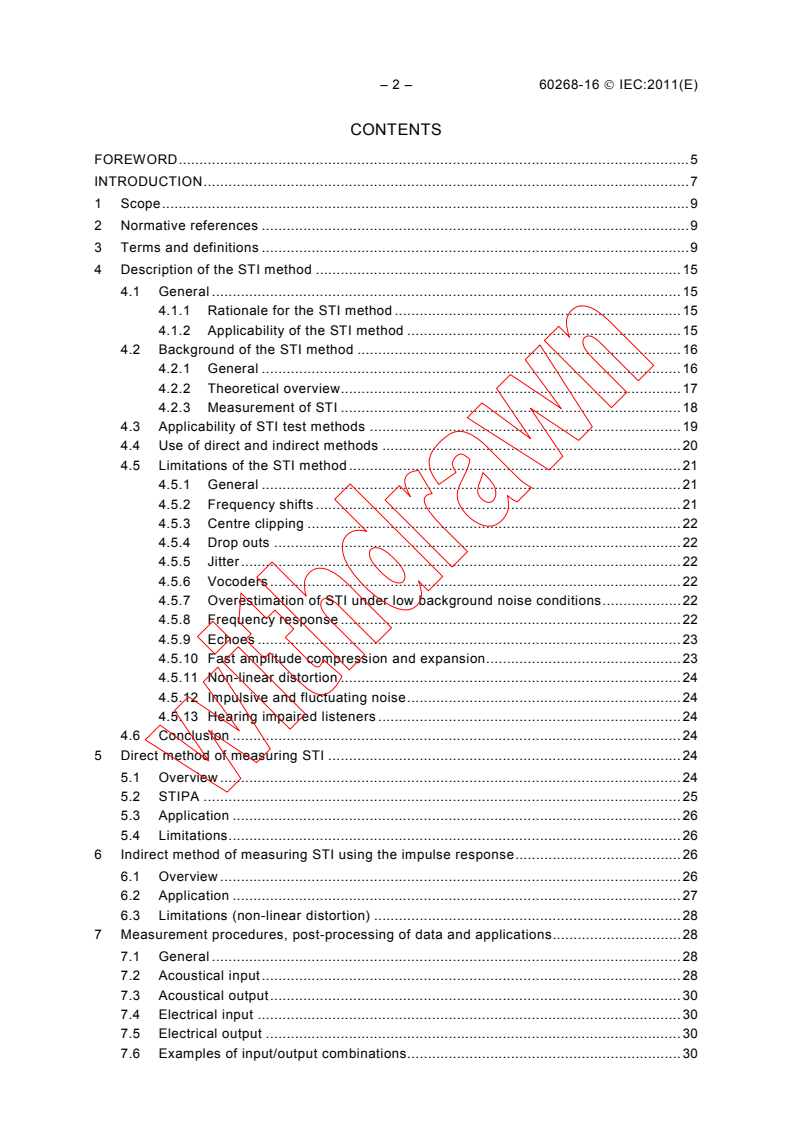
IEC 60268-16:2011 - Sound system equipment - Part 16: Objective rating of speech intelligibility by speech transmission index Released:6/28/2011
IEC 60268-16:2011 - Sound system equipment - Part 16: Objective rating of speech intelligibility by speech transmission index Released:6/28/2011
Overview
IEC 60268-16:2011 - Sound system equipment, Part 16: Objective rating of speech intelligibility by Speech Transmission Index (STI) - is the 4th edition (2011) international standard that defines objective methods for rating speech intelligibility. It provides standardized procedures, test signals and post‑processing guidance for the Speech Transmission Index family of methods (STI, STIPA and STITEL) used across audio, communications and acoustics applications. This edition refines STI methodology, introduces a formal treatment of speech level and test‑signal level setting, and adds a prediction function for auditory masking effects.
Key topics and technical requirements
- STI family of methods: Describes three closely related objective methods - STI, STIPA (Practical A), and STITEL - and their intended scope (with STIPA and STI for general systems and STITEL for restricted uses).
- Measurement approaches: Covers direct (modulated test signals) and indirect (impulse‑response based) measurement methods, including when to apply each approach.
- Test signal and calibration: Specifies the concept of speech level, calibration and the setting of the STI test‑signal level to ensure repeatable, comparable results.
- Post‑processing and MTF: Defines how to compute the Modulation Transfer Function (MTF) from measurements and convert it to an STI score, including binaural measurements and corrections for occupancy/noise.
- Limitations and error sources: Documents applicability limits and common distortions that affect STI (e.g., echoes, non‑linear distortion, fluctuating noise, frequency shifts, compression/expansion, vocoders and hearing impairment considerations).
- Prediction and design: Includes methods for statistical prediction, simulation from impulse responses and design guidance for predicting intelligibility during system planning.
- Normative and informative annexes: Provide detailed procedures (Annexes A–C, J, L) and supporting guidance (qualification bands, reporting examples, adjustments for non‑native or hearing‑impaired listeners).
Practical applications and primary users
IEC 60268-16:2011 is used by:
- Audio and acoustical engineers for commissioning and tuning PA systems, conference rooms, auditoria and voice evacuation systems.
- Communications engineers assessing intelligibility of telephony, VoIP, intercom and wireless voice links.
- System integrators and consultants performing objective acceptance tests and compliance checks.
- Safety and building services professionals validating voice alarm and emergency communication intelligibility.
- Researchers modeling and predicting speech intelligibility in design simulations.
Practical uses include performance acceptance testing, design prediction of room/system intelligibility, troubleshooting intelligibility complaints, and comparing alternative system designs.
Related standards
- Other parts of the IEC 60268 series (Sound system equipment) cover complementary topics in audio equipment and measurement. National regulations and local building/safety codes may reference IEC 60268-16 for intelligibility requirements.
Keywords: IEC 60268-16:2011, Speech Transmission Index, STI, STIPA, speech intelligibility, objective rating, sound system, acoustics, PA systems, impulse response, modulation transfer function.
Relations
- Effective Date
- 25-Aug-2026
- Effective Date
- 25-Aug-2026
- Effective Date
- 25-Aug-2026
- Effective Date
- 05-Sep-2023
- Effective Date
- 05-Sep-2023
Buy Documents
IEC 60268-16:2011 - Sound system equipment - Part 16: Objective rating of speech intelligibility by speech transmission index Released:6/28/2011
IEC 60268-16:2011 - Sound system equipment - Part 16: Objective rating of speech intelligibility by speech transmission index Released:6/28/2011
Get Certified
Connect with accredited certification bodies for this standard

ANCE
Mexican certification and testing association.

Intertek Slovenia
Intertek testing, inspection, and certification services in Slovenia.

LNE (Laboratoire National de Métrologie et d'Essais)
French national laboratory for metrology and testing.
Sponsored listings
Frequently Asked Questions
IEC 60268-16:2011 is a standard published by the International Electrotechnical Commission (IEC). Its full title is "Sound system equipment - Part 16: Objective rating of speech intelligibility by speech transmission index". This standard covers: IEC 60268-16:2011 specifies objective methods for rating the transmission quality of speech with respect to intelligibility. It provides a comprehensive manual for all types of users of the STI method in the fields of audio, communications and acoustics. Three methods are presented, which are closely related and are referred to as STI, STIPA, and STITEL. The first two methods are intended for rating speech transmission performance with or without sound systems. The STITEL method has more restricted uses. This fourth edition cancels and replaces the third edition, published in 2003, and constitutes a technical revision. It includes the following significant technical changes with respect to the previous edition: - development of more comprehensive, complete and unambiguous standardization of the STI methodology; - the term STIr is discontinued. A new function for the prediction of auditory masking effects is introduced; - the concept of 'speech level' and the setting of the level of the test signal have been introduced; - additional information has been included on prediction and measurement procedures. The French version of this standard has not been voted upon.
IEC 60268-16:2011 specifies objective methods for rating the transmission quality of speech with respect to intelligibility. It provides a comprehensive manual for all types of users of the STI method in the fields of audio, communications and acoustics. Three methods are presented, which are closely related and are referred to as STI, STIPA, and STITEL. The first two methods are intended for rating speech transmission performance with or without sound systems. The STITEL method has more restricted uses. This fourth edition cancels and replaces the third edition, published in 2003, and constitutes a technical revision. It includes the following significant technical changes with respect to the previous edition: - development of more comprehensive, complete and unambiguous standardization of the STI methodology; - the term STIr is discontinued. A new function for the prediction of auditory masking effects is introduced; - the concept of 'speech level' and the setting of the level of the test signal have been introduced; - additional information has been included on prediction and measurement procedures. The French version of this standard has not been voted upon.
IEC 60268-16:2011 is classified under the following ICS (International Classification for Standards) categories: 33.160.01 - Audio, video and audiovisual systems in general. The ICS classification helps identify the subject area and facilitates finding related standards.
IEC 60268-16:2011 has the following relationships with other standards: It is inter standard links to EN ISO 24504:2016, EN ISO 3382-3:2012, EN ISO 20108:2017, IEC 60268-16:2003, IEC 60268-16:2020. Understanding these relationships helps ensure you are using the most current and applicable version of the standard.
IEC 60268-16:2011 is available in PDF format for immediate download after purchase. The document can be added to your cart and obtained through the secure checkout process. Digital delivery ensures instant access to the complete standard document.
Standards Content (Sample)
IEC 60268-16 ®
Edition 4.0 2011-06
INTERNATIONAL
STANDARD
Sound system equipment –
Part 16: Objective rating of speech intelligibility by speech transmission index
All rights reserved. Unless otherwise specified, no part of this publication may be reproduced or utilized in any form
or by any means, electronic or mechanical, including photocopying and microfilm, without permission in writing from
either IEC or IEC's member National Committee in the country of the requester.
If you have any questions about IEC copyright or have an enquiry about obtaining additional rights to this publication,
please contact the address below or your local IEC member National Committee for further information.
IEC Central Office
3, rue de Varembé
CH-1211 Geneva 20
Switzerland
Email: inmail@iec.ch
Web: www.iec.ch
About the IEC
The International Electrotechnical Commission (IEC) is the leading global organization that prepares and publishes
International Standards for all electrical, electronic and related technologies.
About IEC publications
The technical content of IEC publications is kept under constant review by the IEC. Please make sure that you have the
latest edition, a corrigenda or an amendment might have been published.
Catalogue of IEC publications: www.iec.ch/searchpub
The IEC on-line Catalogue enables you to search by a variety of criteria (reference number, text, technical committee,…).
It also gives information on projects, withdrawn and replaced publications.
IEC Just Published: www.iec.ch/online_news/justpub
Stay up to date on all new IEC publications. Just Published details twice a month all new publications released. Available
on-line and also by email.
Electropedia: www.electropedia.org
The world's leading online dictionary of electronic and electrical terms containing more than 20 000 terms and definitions
in English and French, with equivalent terms in additional languages. Also known as the International Electrotechnical
Vocabulary online.
Customer Service Centre: www.iec.ch/webstore/custserv
If you wish to give us your feedback on this publication or need further assistance, please visit the Customer Service
Centre FAQ or contact us:
Email: csc@iec.ch
Tel.: +41 22 919 02 11
Fax: +41 22 919 03 00
IEC 60268-16 ®
Edition 4.0 2011-06
INTERNATIONAL
STANDARD
Sound system equipment –
Part 16: Objective rating of speech intelligibility by speech transmission index
INTERNATIONAL
ELECTROTECHNICAL
COMMISSION
PRICE CODE
XB
ICS 33.160.01 ISBN 978-2-88912-522-7
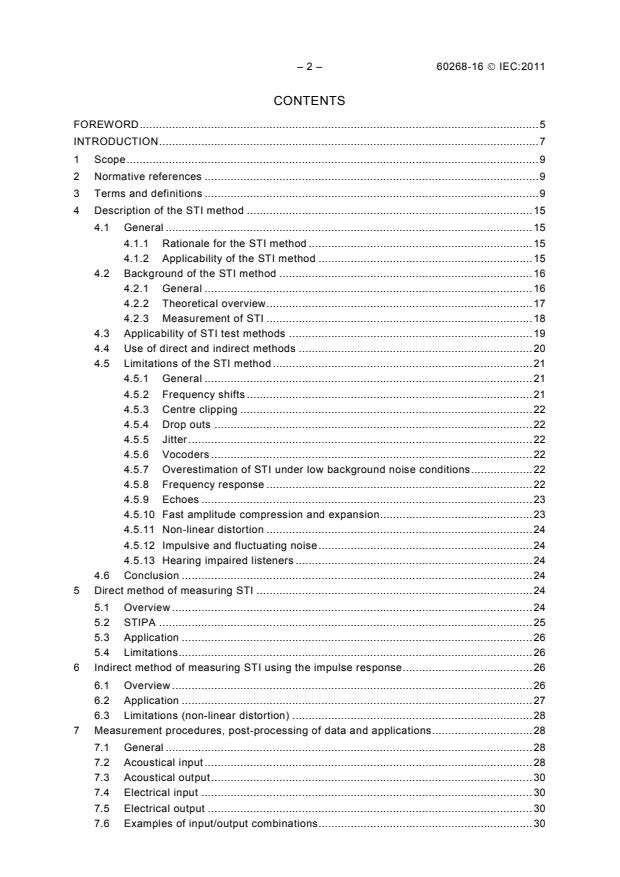
– 2 – 60268-16 IEC:2011(E)
CONTENTS
FOREWORD . 5
INTRODUCTION . 7
1 Scope . 9
2 Normative references . 9
3 Terms and definitions . 9
4 Description of the STI method . 15
4.1 General . 15
4.1.1 Rationale for the STI method . 15
4.1.2 Applicability of the STI method . 15
4.2 Background of the STI method . 16
4.2.1 General . 16
4.2.2 Theoretical overview . 17
4.2.3 Measurement of STI . 18
4.3 Applicability of STI test methods . 19
4.4 Use of direct and indirect methods . 20
4.5 Limitations of the STI method . 21
4.5.1 General . 21
4.5.2 Frequency shifts . 21
4.5.3 Centre clipping . 22
4.5.4 Drop outs . 22
4.5.5 Jitter . 22
4.5.6 Vocoders . 22
4.5.7 Overestimation of STI under low background noise conditions . 22
4.5.8 Frequency response . 22
4.5.9 Echoes . 23
4.5.10 Fast amplitude compression and expansion . 23
4.5.11 Non-linear distortion . 24
4.5.12 Impulsive and fluctuating noise . 24
4.5.13 Hearing impaired listeners . 24
4.6 Conclusion . 24
5 Direct method of measuring STI . 24
5.1 Overview . 24
5.2 STIPA . 25
5.3 Application . 26
5.4 Limitations . 26
6 Indirect method of measuring STI using the impulse response . 26
6.1 Overview . 26
6.2 Application . 27
6.3 Limitations (non-linear distortion) . 28
7 Measurement procedures, post-processing of data and applications . 28
7.1 General . 28
7.2 Acoustical input . 28
7.3 Acoustical output . 30
7.4 Electrical input . 30
7.5 Electrical output . 30
7.6 Examples of input/output combinations. 30
60268-16 IEC:2011(E) – 3 –
7.6.1 Acoustical input – Acoustical output . 30
7.6.2 Electrical input – Electrical output (e.g. assessment of wired and
wireless) communication systems) . 30
7.6.3 Acoustical input – Electrical output (e.g. assessment of microphones) . 31
7.6.4 Electrical input – Acoustical output (e.g. assessment of PA systems) . 31
7.7 Post-processing of measured MTF data . 31
7.8 Issues concerning noise . 31
7.8.1 General . 31
7.8.2 Measurement of background noise . 32
7.8.3 Fluctuating noise . 32
7.9 Analysis and interpretation of the results . 32
7.10 Binaural STI measurements . 33
8 Use of STI as a design prediction tool . 33
8.1 Overview . 33
8.2 Statistical predictions . 33
8.3 Prediction from simulated impulse response . 34
Annex A (normative) Speech transmission index (STI) and revised STI methods . 35
Annex B (normative) STIPA method . 47
Annex C (normative) STITEL method . 48
Annex D (informative) RASTI method (obsolete) . 49
Annex E (informative) Qualification of the STI and relationships with other speech
intelligibility measures. 51
Annex F (informative) Nominal qualification bands for STI . 53
Annex G (informative) Examples of STI qualification bands and typical applications . 54
Annex H (informative) Non-native listeners . 55
Annex I (informative) Effect of age-related hearing loss and hearing impairment on
speech intelligibility. 56
Annex J (normative) Calibration of STI test signal level . 57
Annex K (informative) Example test report sheet for STI measurements . 59
Annex L (normative) Prediction of STI using statistical methods . 61
Annex M (informative) Adjustments to measured STI and STIPA results for simulation
of occupancy noise and different speech levels . 63
Annex N (informative) Other methods of determining speech intelligibility . 67
Bibliography . 69
Figure 1 – Concept of the reduction in modulation due to a transmission channel . 16
Figure 2 – Modulation transfer function – Input/output comparison . 17
Figure A.1 – Envelope function (panel A) of a 10 s speech signal for the 250 Hz
octave band and corresponding envelope spectrum (panel B) . 35
Figure A.2 – Theoretical expression of the MTF . 36
Figure A.3 – Measurement system and frequencies for the STI method . 38
Figure A.4 – Auditory masking of octave band (k – 1) on octave band (k) . 39
Figure D.1 – Illustration of a practical RASTI test signal . 50
Figure E.1 – Relationships between some speech intelligibility measures . 51
Figure E.2 – Relationship between STI, speech intelligibility scores and listening
difficulty ratings [34], [35] . 52
Figure F.1 – STI qualification bands . 53
– 4 – 60268-16 IEC:2011(E)
Table 1 – Comparison of STI test methods for different types of distortion . 19
Table 2 – Applicability of test . 20
Table 3 – Choice of method . 21
Table A.1 – Auditory masking as a function of the octave band level. 40
Table A.2 – Absolute speech reception threshold level in octave bands . 41
Table A.3 – MTI octave band weighting factors . 41
Table A.4 – Octave band levels (dB) relative to the A-weighted speech level . 42
Table B.1 – Modulation frequencies for the STIPA method . 47
Table C.1 – Modulation frequencies for the STITEL method . 48
Table D.1 – Modulation frequencies for the RASTI method . 49
Table E.1 – Categories for listening difficulty . 52
Table G.1 – Examples between STI qualification bands and typical applications . 54
Table H.1 – Adjusted intelligibility qualification tables for non-native listeners . 55
Table I.1 – Adjusted intelligibility qualification tables for normal listeners and people
over 60 years old with hearing loss . 56
Table M.1 – Example calculation . 63
60268-16 IEC:2011(E) – 5 –
INTERNATIONAL ELECTROTECHNICAL COMMISSION
____________
SOUND SYSTEM EQUIPMENT –
Part 16: Objective rating of speech intelligibility
by speech transmission index
FOREWORD
1) The International Electrotechnical Commission (IEC) is a worldwide organization for standardization comprising
all national electrotechnical committees (IEC National Committees). The object of IEC is to promote
international co-operation on all questions concerning standardization in the electrical and electronic fields. To
this end and in addition to other activities, IEC publishes International Standards, Technical Specifications,
Technical Reports, Publicly Available Specifications (PAS) and Guides (hereafter referred to as “IEC
Publication(s)”). Their preparation is entrusted to technical committees; any IEC National Committee interested
in the subject dealt with may participate in this preparatory work. International, governmental and non-
governmental organizations liaising with the IEC also participate in this preparation. IEC collaborates closely
with the International Organization for Standardization (ISO) in accordance with conditions determined by
agreement between the two organizations.
2) The formal decisions or agreements of IEC on technical matters express, as nearly as possible, an international
consensus of opinion on the relevant subjects since each technical committee has representation from all
interested IEC National Committees.
3) IEC Publications have the form of recommendations for international use and are accepted by IEC National
Committees in that sense. While all reasonable efforts are made to ensure that the technical content of IEC
Publications is accurate, IEC cannot be held responsible for the way in which they are used or for any
misinterpretation by any end user.
4) In order to promote international uniformity, IEC National Committees undertake to apply IEC Publications
transparently to the maximum extent possible in their national and regional publications. Any divergence
between any IEC Publication and the corresponding national or regional publication shall be clearly indicated in
the latter.
5) IEC itself does not provide any attestation of conformity. Independent certification bodies provide conformity
assessment services and, in some areas, access to IEC marks of conformity. IEC is not responsible for any
services carried out by independent certification bodies.
6) All users should ensure that they have the latest edition of this publication.
7) No liability shall attach to IEC or its directors, employees, servants or agents including individual experts and
members of its technical committees and IEC National Committees for any personal injury, property damage or
other damage of any nature whatsoever, whether direct or indirect, or for costs (including legal fees) and
expenses arising out of the publication, use of, or reliance upon, this IEC Publication or any other IEC
Publications.
8) Attention is drawn to the Normative references cited in this publication. Use of the referenced publications is
indispensable for the correct application of this publication.
9) Attention is drawn to the possibility that some of the elements of this IEC Publication may be the subject of
patent rights. IEC shall not be held responsible for identifying any or all such patent rights.
International Standard IEC 60268-16 has been prepared by IEC technical committee 100:
Multimedia equipment and systems.
This fourth edition cancels and replaces the third edition, published in 2003, and constitutes a
technical revision.
This edition includes the following significant technical changes with respect to the previous
edition:
• development of more comprehensive, complete and unambiguous standardization of the
STI methodology;
• the term STI is discontinued. A new function for the prediction of auditory masking effects
r
is introduced;
• the concept of ‘speech level’ and the setting of the level of the test signal have been
introduced;
– 6 – 60268-16 IEC:2011(E)
• additional information has been included on prediction and measurement procedures.
NOTE See Introduction for a historical summary referring to the various changes from the first to the fourth
edition (current edition).
The text of this standard is based on the following documents:
FDIS Report on voting
100/1812/FDIS 100/1849/RVD
Full information on the voting for the approval of this standard can be found in the report on
voting indicated in the above table.
This publication has been drafted in accordance with the ISO/IEC Directives, Part 2.
A list of all the parts in the IEC 60268 series, published under the general title Sound system
equipment can be found on the IEC website.
The committee has decided that the contents of this publication will remain unchanged until
the stability date indicated on the IEC web site under "http://webstore.iec.ch" in the data
related to the specific publication. At this date, the publication will be
• reconfirmed,
• withdrawn,
• replaced by a revised edition, or
• amended.
A bilingual version of this publication may be issued at a later date.
60268-16 IEC:2011(E) – 7 –
INTRODUCTION
The Speech Transmission Index (STI) is an objective measure to predict the intelligibility of
speech transmitted from talker to listener by a transmission channel. The STI method has
been the subject of ongoing development and refinement since its introduction in the 1970s.
Major improvements of the STI have been consolidated by incorporating them in successive
revisions of IEC 60268-16.
The history of revisions is as follows.
• Revision 1: 1988. In the first version of the STI standard, a gender-independent test
signal spectrum was used.
• Revision 2: 1998. Gender specific test signals were introduced, for male and female
talkers, each gender relating to a specific set of weighting factors. In addition, weightings
were introduced for redundancy factors. The term STI was introduced to signify the use of
r
these redundancy factors.
• Revision 3: 2003. Important differences between Revision 2 and Revision 3 are the
introduction of
− level dependent masking functions,
− the STI derivative STIPA.
STIPA was specially developed as a fast measurement method that could deal with
electro-acoustic and acoustic effects while determining the speech transmission quality of
PA systems.
• Revision 4: 2010. The aim of Revision 4 (this revision) is to provide a more
comprehensive, complete and unambiguous standardization of the STI methodology. The
term STI is now discontinued. A new function for the prediction of auditory masking
r
effects is introduced.
Speech is considered to be the major method of communication between humans. In many
situations the speech signal is degraded by the signal path or the transmission channel
between talker and listener, resulting in a reduction of the intelligibility of the speech at the
listener’s location.
To quantify the deterioration of the speech intelligibility induced by the transmission channel,
a fast and objective measuring method was developed; the Speech Transmission Index (STI).
The STI method applies a specific test signal to the transmission channel and by analysing
the received test signal; the speech transmission quality of the channel is derived and
expressed in a value between 0 and 1, as the Speech Transmission Index (STI). Using the
obtained STI-value, the potential speech intelligibility can be determined.
Although there are limitations to the STI method, the use of STI has proved useful in many
situations and has gained international acceptance.
Items that have changed in this revision
Specific changes that have been incorporated in this revision are:
• refinement of the STI model with respect to the level dependent masking function;
• Room Acoustic Speech Transmission Index (RASTI) has become obsolete and should not
be used;
• calculations to add or remove the effects of background noise and to change the speech
level and a worked example;
• notes regarding limitations of the STI method;
• methods to predict the STI performance of transmission channels based on the predicted
(as distinct from measured) performance of parts or all of the transmission channel;
– 8 – 60268-16 IEC:2011(E)
• introduction of STI corrections for non-native language listeners;
• introduction of STI corrections for listeners with some specific forms of hearing loss;
• relationships between STI and ‘Listening Difficulty’ scale.
Potential applications of STI
STI may be used to measure the potential intelligibility of a wide range of electronic systems
and acoustic environments. Typical applications include:
• measurement of Public Address and Sound Reinforcement Systems;
• measurement and Certification of Voice Alarm and emergency sound systems;
• measurement of communication channels / systems such as intercoms and wireless
communication;
• measurement of potential speech intelligibility and communication in rooms and auditoria;
• evaluation of direct speech communication (situations without electronic amplification) in
rooms or acoustic spaces including vehicles;
• evaluation of the potential intelligibility of Assistive Hearing Systems;
NOTE The STI method is not validated for the measurement and evaluation of speech privacy or speech masking
systems.
Potential users of STI
The range of users of STI measurements is diverse. Among the users who may apply this
method are:
• certifiers of voice alarm and other types of emergency systems;
• certifiers of sound reinforcement and audio systems;
• audio and telecommunication equipment manufacturers;
• audio and communication engineers;
• acoustical and electro-acoustical engineers;
• sound system installers;
• researchers into STI methods and developers of instruments to measure STI.
To avoid misinterpretation of STI results, it is important that all users have an understanding
of the basic principles, the application domain and its limitations.
60268-16 IEC:2011(E) – 9 –
SOUND SYSTEM EQUIPMENT –
Part 16: Objective rating of speech intelligibility
by speech transmission index
1 Scope
This part of IEC 60268 specifies objective methods for rating the transmission quality of
speech with respect to intelligibility.
The objective of this standard is to provide a comprehensive manual for all types of users of
the STI method in the fields of audio, communications and acoustics.
This standard does not provide STI criteria for certification of transmission channels (e.g.
criteria for a voice-alarm system).
Three methods are presented, which are closely related and are referred to as STI, STIPA,
and STITEL. The first two methods are intended for rating speech transmission performance
with or without sound systems. The STITEL method has more restricted uses.
NOTE None of the methods are suitable for the measurement and assessment of speech privacy and speech
masking systems, as STI has not been validated for conditions that represent speech privacy applications [1] .
The following information is included:
• measurement techniques;
• prediction techniques.
2 Normative references
The following referenced documents are indispensable for the application of this document.
For dated references, only the edition cited applies. For undated references, the latest edition
of the referenced document (including any amendments) applies:
IEC 61260:1995, Electroacoustics – Octave-band and fractional-octave-band filters
Amendment 1 (2001)
ISO 18233:2006, Acoustics – Application of new measurement methods in building and room
acoustics
3 Terms and definitions
For the purpose of this document, the following terms and definitions apply.
3.1
speech intelligibility
rating of the proportion of speech that is understood
—————————
Figures in square brackets refer to the Bibliography.
– 10 – 60268-16 IEC:2011(E)
3.2
speech quality
rating of sound quality of a speech signal
3.3
speech transmission index
STI
metric ranging between 0 and 1 representing the transmission quality of speech with respect
to intelligibility by a speech transmission channel
3.4
speech intelligibility index
SII
objective method for prediction of speech intelligibility based on the Articulation Index
3.5
STI method
FULL STI
objective method for prediction and measurement of the speech transmission index that uses
14 modulation frequencies over a range of 7 octave bands
3.6
distortion
any unintentional and generally undesired change of the form of a signal occurring in a
speech transmission channel
NOTE Distortion can include both linear and non-linear effects in both frequency and time domain.
3.7
speech transmission index for public address systems
STIPA
method obtained by using a condensed version of the STI method but still responsive to
distortions found in room acoustics and/or public address systems
NOTE STIPA is applied as a direct method.
3.8
speech transmission index for telecommunication systems
STITEL
method obtained by using a condensed version of the STI method but still responsive to
distortions found in communication systems
NOTE STITEL is applied as a direct method.
3.9
room acoustical speech transmission index
RASTI
method obtained by using a condensed version of the STI method, to be used for screening
purposes only and focused on direct communication between persons without making use of
an electro-acoustic communication system
NOTE 1 RASTI accounts for noise interference and distortions in the time domain (echoes, reverberation).
NOTE 2 RASTI is now obsolete.
3.10
direct STI method
method using modulated (speech like) test signals to directly measure the modulation transfer
function
60268-16 IEC:2011(E) – 11 –
3.11
indirect STI method
method using the impulse response and forward energy integral (Schroeder integral) to derive
the modulation transfer function
3.12
speech transmission channel
acoustic or electro-acoustic signal path between a talker and a listener
3.13
public address system
PA
electronic sound distribution system, employing microphones, amplifiers and loudspeakers,
used to reinforce or amplify a given sound (such as an announcement or a pre-recorded
message) and distributing the sound within a building or a space
3.14
voice alarm system
VAS
sound distribution system that broadcasts speech messages or warning signals, or both, in an
emergency
3.15
real speech level
signal level of a speech signal in dB A where only the segments that contribute to the speech
signal are taken into account; pauses and silences between words and sentences are ignored
NOTE See also Annex J.
3.16
reference speech level
speech level equivalent to 60 dB A at 1 m distance in front of the talker’s mouth
3.17
vocal effort
exertion of the speaker, quantified objectively by the A-weighted speech level at 1 m distance
in front of the mouth and qualified subjectively by a description
3.18
artificial mouth
device consisting of a loudspeaker mounted in an enclosure and having a directivity and
radiation pattern similar to those of the average human mouth
NOTE The degree of similarity required cannot be easily specified and depends on the particular application. See
for example ITU-T P.50 [47].
3.19
non-native speaker
person speaking a language which is different from the language that was learned as primary
language during the childhood of the speaker
3.20
absolute speech reception threshold
absolute threshold of hearing increased by the minimal required dynamic range for the correct
recognition of speech
– 12 – 60268-16 IEC:2011(E)
3.21
auditory masking
process by which the threshold of hearing (audibility) for one sound is raised by the presence
of another (masking) sound
NOTE Within the STI method, auditory masking is also referred to as the upward spread of masking.
3.22
artificial ear
device with similar characteristics as the human ear for the reception of acoustic signals
NOTE See IEC 60318 [2].
3.23
intensity function
the squared amplitude signal as a function of time
3.24
envelope function
envelope of the intensity function
3.25
envelope spectrum
relative contribution of spectral components of the envelope function
3.26
modulation frequency
frequency of the sinusoidal variation of the envelope function
NOTE The modulation frequency f is expressed in Hertz (Hz).
m
3.27
modulation index
value between 0 and 1 that describes the depth of a sinusoidal modulation of the intensity
function
3.28
modulation transfer ratio
ratio between the modulation depth of the received and the original (transmitted) modulation
depth of the intensity function
3.29
modulation transfer function
MTF
modulation transfer ratios as a function of the modulation frequency
3.30
octave band weighting factor
α
relative contribution of each octave band to the speech transmission index
3.31
octave band redundancy factor
β
fraction of information overlap between two adjacent octave bands with respect to the speech
intelligibility
60268-16 IEC:2011(E) – 13 –
3.32
background noise
all sounds including noise remaining in the absence of the speech or test signal
3.33
fluctuating noise
continuous sound or noise whose sound pressure level varies significantly, but not in an
impulsive manner, during the observation period
3.34
impulsive noise
sound or noise characterized by brief bursts of sound pressure
3.35
signal-to-noise ratio
SNR
difference between the sound pressure level of the speech or test signal and the sound
pressure level of the background noise where the sound pressure levels are determined with
a standardized frequency weighting
NOTE The signal-to-noise ratio SNR is expressed in decibels (dB).
3.36
effective signal-to-noise ratio
SNR
eff
difference between the level of the intensity modulation and the level of the intensity of all the
distortions of a received STI test signal
NOTE 1 The effective signal-to-noise ratio is expressed in decibels (dB).
NOTE 2 Examples of distortions are reverberation field levels, ambient noise levels, non-linear distortion levels
and masking levels.
3.37
crest factor
difference between the peak and the RMS sound pressure levels during a given time-interval
NOTE The crest-factor is expressed in decibels (dB).
3.38
Lombard effect
spontaneous increase of the vocal effort induced by the increase of the ambient noise level at
the speaker’s ear
NOTE Voice pitch shift at higher talking levels is not accounted for here.
3.39
fractional-octave-band filter
bandpass filter for which the ratio of upper cut-off frequency f to lower cut-off frequency f is
2 1
two raised to an exponent equal to the fraction of an octave band
1/b
NOTE 1 In symbols, the ratio of the cut-off frequencies is f /f = 2 , with 1/b denoting the fraction of an octave.
2 1
1/2
EXAMPLE 1 For half-octave band filters, the frequency ratio is 2 = √2.
EXAMPLE 2 For octave band filters, the frequency ratio is 2.
NOTE 2 For further information, refer to IEC 61260.
– 14 – 60268-16 IEC:2011(E)
3.40
reference sound pressure
p
sound pressure, conventionally chosen to be equal to 20 μPa for airborne sound
3.41
sound pressure level
twenty times the logarithm to the base ten of the ratio of RMS sound pressure to the reference
sound pressure
NOTE The sound pressure level is expressed in decibels (dB). The notation is L .
p
3.42
equivalent continuous sound pressure level
ten-fold logarithm to the base ten of the ratio of the squared RMS sound pressure level for a
given time-interval to the squared reference sound pressure.
NOTE 1 The sound pressure level L is given by the following equation:
eq,T
t
p (t)dt
∫
T
t
L =10lg
eq,T
p
where
p(t) is the instantaneous sound pressure at time t;
t is the integration variable for time;
T = t – t , is the length of the time interval, for which the continuous sound pressure level is determined and
2 1
p the reference sound pressure (20 µPa).
The numerator in the argument of the logarithm in the given equation is the RMS sound pressure for the averaging
time T.
NOTE 2 As a matter of principle, no time-weighting is applied in the determination of the continuous sound
pressure level.
NOTE 3 For further definitions, see IEC 61672 [3].
3.43
percentile level
ten-fold decimal logarithm of the ratio of the squared RMS sound pressure level being
exceeded for a given part of the measurement time to the squared reference sound pressure
where the RMS sound pressure is determined with a standardized time and frequency
weighting, e.g., L or L
10 A10
NOTE 1 For application within the framework of this standard, the time-weighting “Fast” is to be applied for the
determination of the percentile level.
NOTE 2 L is the A and Fast-weighted sound pressure level being exceeded in 10 % of the measurement time.
A10
3.44
modulation transfer index
MTI
unweighted mean of the scaled effective signal to noise ratios for a given octave band
3.45
operational speech level
sound pressure level of speech signal that will be used or is found in the applicable situation
60268-16 IEC:2011(E) – 15 –
3.46
operational background noise level
sound pressure level of background that will be present or is found in the applicable situation
NOTE This level is used for predictions and post-processing of measurements.
4 Description of the STI method
4.1 General
4.1.1 Rationale for the STI method
The STI method was developed as a fast and objective test method for determining the
speech transmission quality of speech transmission channels. Using the speech transmission
index, the speech intelligibility can be predicted for different types of word and sentence
formats for a wide range of speech transmission systems.
In speech, the intensity of the signal varies with time producing a variation in the intensity
envelope of the speech. Slow fluctuations of the intensity envelope correspond with word and
sentence boundaries while fast fluctuations coincide with individual phonemes within words.
Within the STI concept, preservation of the intensity envelope is considered to be of the
utmost importance.
In contrast to the original approach of the articulation index [4], which is based on the signal
to noise ratios in different speech spectral bands, the STI measurement determines the
degree to which the intensity envelope of the speech signal is affected by a transmission
channel. A Modulation Transfer Function (MTF) is determined which quantifies how the
channel affects the intensity envelope of the speech signal.
The STI produces a metric on a scale of 0 to 1, based on weighted contributions from a range
of frequency bands present in speech.
The STI method and its derivatives (see below) can be used to determine the potential
intelligibility of a speech transmission channel at various locations and for various conditions.
In particular, the effect of changes in the acoustic properties of spaces can be assessed.
4.1.2 Applicability of the STI method
The STI method is an objective and validated measure of speech transmission quality for a
wide range of acoustic and electro-acoustical distortions that influence intelligibility. However,
as it is a simplification of human speech, the STI model can be limited in its applicability.
Users of the STI method that apply the method beyond its current limits may obtain inaccurate
intelligibility predictions. An overview of the applications and limitations is therefore given that
aims to help STI users decide on which STI method is most suitable for their application, so
as to obtain the most meaningful and accurate results.
The STI method was validated for an acoustic output using a single omnidirectional
microphone. The use of a directional microphone produces different and uncorrelatable
results and is not normally advised. Further information is given in clause 7.10.
If the situation or the transmission channel does not allow the use of STI methods, alternative
techniques for assessing intelligibility shall be used. Other methods exist to assess the quality
of speech communication, each with their advantages and disadvantages and therefore have
different users. Annex N describes a number of other measures of intelligibility.
– 16 – 60268-16 IEC:2011(E)
4.2 Background of the STI method
4.2.1 General
The STI concept is based on the empirical finding that the fluctuations in speech signals carry
the most relevant information relating to speech intelligibility, see [5], [6] and [7]. Fluctuations
in speech result from the acoustic separation of sentences, words and phonemes, which are
the fundamental elements of speech. The fluctuations, termed modulations, can be quantified
as a function of modulation frequency F producing the modulation spectrum. For clear speech,
the modulation frequencies typically extend from 0,5 Hz up to 16 Hz with maximum
modulation at approximately 3 Hz.
Any deterioration of the modulation spectrum by the transmission channel is generally
considered to result in a reduction of the speech intelligibility. This deterioration of the
modulation spectrum corresponds to a reduction of the modulation depth at one or more
modulation frequencies and is calculated as a modulation transmission value for each octave
band over the speech spectral range. Figure 1 shows the concept of the reduction in
modulation that can occur between a talker and listener.
Received speech signal
Transmitted speech signal
modulation index = m < 1
modulation index = 1
I (1 + m Cos 2 πF (t + τ))
I (1 + Cos 2 πFt)
I
t
t
1/F
1/F
IEC 1148/11
Figure 1 – Concept of the reduction in modulation due to a transmission channel
The STI method has been optimised and validated with subject-based intelligibility
experiments using CVC (Dutch)-word scores for a large variety of distortions in transmission
channels. Such distortions include noise, reverberation, echoes, non-linear distortion, and
digital encoding techniques.
Using parameters derived from speech material, the STI test signal was developed. In general,
the STI test signal comprises seven octave band noise signals corresponding with the octave
bands from 125 Hz up to 8 kHz. Each noise carrier is modulated with one or more modulation
frequencies at one-third octave intervals ranging from 0,63 Hz up to and including 12,5 Hz.
60268-16 IEC:2011(E) – 17 –
The STI method, described in Annex A, determines the modulation transfer function m(F) of
the transmission channel. A total of 98 results are obtained, corresponding to the 14
modulation frequencies and the seven octave bands (see Figure A.3). The RMS level of each
octave-band carrier matches the relative level of the average, long term spectrum of speech
material (see also 4.5 for further information). Each octave band has a contribution to speech
intelligibility which is weighted according to that band. Using the weighted sum of these
transmission index values, the overall STI value for the transmission channel is determined.
Research [4] has shown that adjacent octave bands contain redundant information with
respect to speech intelligibility. If one octave band does not contribute to intelligibility (e.g. by
masking from reverberation or background noise) then neighbouring octave bands can partly
compensate for this missing contribution. This insight has lead to the use of redundancy
factors in the STI-methodology.
4.2.2 Theoretical overview
The modulation index m of a test signal is played into a room or through a communication
i
channel and received at a listener position as the modulation index m . To measure, for
o
example, the STI for the situation in Figure 1, the test signal would be transmitted by a sound
...
IEC 60268-16 ®
Edition 4.0 2011-06
INTERNATIONAL
STANDARD
NORME
INTERNATIONALE
Sound system equipment –
Part 16: Objective rating of speech intelligibility by speech transmission index
Equipements pour systèmes électroacoustiques –
Partie 16: Evaluation objective de l'intelligibilité de la parole au moyen de l'indice
de transmission de la parole
All rights reserved. Unless otherwise specified, no part of this publication may be reproduced or utilized in any form or by
any means, electronic or mechanical, including photocopying and microfilm, without permission in writing from either IEC or
IEC's member National Committee in the country of the requester.
If you have any questions about IEC copyright or have an enquiry about obtaining additional rights to this publication,
please contact the address below or your local IEC member National Committee for further information.
Droits de reproduction réservés. Sauf indication contraire, aucune partie de cette publication ne peut être reproduite
ni utilisée sous quelque forme que ce soit et par aucun procédé, électronique ou mécanique, y compris la photocopie
et les microfilms, sans l'accord écrit de la CEI ou du Comité national de la CEI du pays du demandeur.
Si vous avez des questions sur le copyright de la CEI ou si vous désirez obtenir des droits supplémentaires sur cette
publication, utilisez les coordonnées ci-après ou contactez le Comité national de la CEI de votre pays de résidence.
IEC Central Office
3, rue de Varembé
CH-1211 Geneva 20
Switzerland
Email: inmail@iec.ch
Web: www.iec.ch
About the IEC
The International Electrotechnical Commission (IEC) is the leading global organization that prepares and publishes
International Standards for all electrical, electronic and related technologies.
About IEC publications
The technical content of IEC publications is kept under constant review by the IEC. Please make sure that you have the
latest edition, a corrigenda or an amendment might have been published.
Catalogue of IEC publications: www.iec.ch/searchpub
The IEC on-line Catalogue enables you to search by a variety of criteria (reference number, text, technical committee,…).
It also gives information on projects, withdrawn and replaced publications.
IEC Just Published: www.iec.ch/online_news/justpub
Stay up to date on all new IEC publications. Just Published details twice a month all new publications released. Available
on-line and also by email.
Electropedia: www.electropedia.org
The world's leading online dictionary of electronic and electrical terms containing more than 20 000 terms and definitions
in English and French, with equivalent terms in additional languages. Also known as the International Electrotechnical
Vocabulary online.
Customer Service Centre: www.iec.ch/webstore/custserv
If you wish to give us your feedback on this publication or need further assistance, please visit the Customer Service
Centre FAQ or contact us:
Email: csc@iec.ch
Tel.: +41 22 919 02 11
Fax: +41 22 919 03 00
A propos de la CEI
La Commission Electrotechnique Internationale (CEI) est la première organisation mondiale qui élabore et publie des
normes internationales pour tout ce qui a trait à l'électricité, à l'électronique et aux technologies apparentées.
A propos des publications CEI
Le contenu technique des publications de la CEI est constamment revu. Veuillez vous assurer que vous possédez
l’édition la plus récente, un corrigendum ou amendement peut avoir été publié.
Catalogue des publications de la CEI: www.iec.ch/searchpub/cur_fut-f.htm
Le Catalogue en-ligne de la CEI vous permet d’effectuer des recherches en utilisant différents critères (numéro de référence,
texte, comité d’études,…). Il donne aussi des informations sur les projets et les publications retirées ou remplacées.
Just Published CEI: www.iec.ch/online_news/justpub
Restez informé sur les nouvelles publications de la CEI. Just Published détaille deux fois par mois les nouvelles
publications parues. Disponible en-ligne et aussi par email.
Electropedia: www.electropedia.org
Le premier dictionnaire en ligne au monde de termes électroniques et électriques. Il contient plus de 20 000 termes et
définitions en anglais et en français, ainsi que les termes équivalents dans les langues additionnelles. Egalement appelé
Vocabulaire Electrotechnique International en ligne.
Service Clients: www.iec.ch/webstore/custserv/custserv_entry-f.htm
Si vous désirez nous donner des commentaires sur cette publication ou si vous avez des questions, visitez le FAQ du
Service clients ou contactez-nous:
Email: csc@iec.ch
Tél.: +41 22 919 02 11
Fax: +41 22 919 03 00
IEC 60268-16 ®
Edition 4.0 2011-06
INTERNATIONAL
STANDARD
NORME
INTERNATIONALE
Sound system equipment –
Part 16: Objective rating of speech intelligibility by speech transmission index
Equipements pour systèmes électroacoustiques –
Partie 16: Evaluation objective de l'intelligibilité de la parole au moyen de l'indice
de transmission de la parole
INTERNATIONAL
ELECTROTECHNICAL
COMMISSION
COMMISSION
ELECTROTECHNIQUE
PRICE CODE
INTERNATIONALE
CODE PRIX XB
ICS 33.160.01 ISBN 978-2-88912-672-9
– 2 – 60268-16 IEC:2011
CONTENTS
FOREWORD . 5
INTRODUCTION . 7
1 Scope . 9
2 Normative references . 9
3 Terms and definitions . 9
4 Description of the STI method . 15
4.1 General . 15
4.1.1 Rationale for the STI method . 15
4.1.2 Applicability of the STI method . 15
4.2 Background of the STI method . 16
4.2.1 General . 16
4.2.2 Theoretical overview . 17
4.2.3 Measurement of STI . 18
4.3 Applicability of STI test methods . 19
4.4 Use of direct and indirect methods . 20
4.5 Limitations of the STI method . 21
4.5.1 General . 21
4.5.2 Frequency shifts . 21
4.5.3 Centre clipping . 22
4.5.4 Drop outs . 22
4.5.5 Jitter . 22
4.5.6 Vocoders . 22
4.5.7 Overestimation of STI under low background noise conditions . 22
4.5.8 Frequency response . 22
4.5.9 Echoes . 23
4.5.10 Fast amplitude compression and expansion . 23
4.5.11 Non-linear distortion . 24
4.5.12 Impulsive and fluctuating noise . 24
4.5.13 Hearing impaired listeners . 24
4.6 Conclusion . 24
5 Direct method of measuring STI . 24
5.1 Overview . 24
5.2 STIPA . 25
5.3 Application . 26
5.4 Limitations . 26
6 Indirect method of measuring STI using the impulse response . 26
6.1 Overview . 26
6.2 Application . 27
6.3 Limitations (non-linear distortion) . 28
7 Measurement procedures, post-processing of data and applications . 28
7.1 General . 28
7.2 Acoustical input . 28
7.3 Acoustical output . 30
7.4 Electrical input . 30
7.5 Electrical output . 30
7.6 Examples of input/output combinations. 30
60268-16 IEC:2011 – 3 –
7.6.1 Acoustical input – Acoustical output . 30
7.6.2 Electrical input – Electrical output (e.g. assessment of wired and
wireless) communication systems) . 30
7.6.3 Acoustical input – Electrical output (e.g. assessment of microphones) . 31
7.6.4 Electrical input – Acoustical output (e.g. assessment of PA systems) . 31
7.7 Post-processing of measured MTF data . 31
7.8 Issues concerning noise . 31
7.8.1 General . 31
7.8.2 Measurement of background noise . 32
7.8.3 Fluctuating noise . 32
7.9 Analysis and interpretation of the results . 32
7.10 Binaural STI measurements . 33
8 Use of STI as a design prediction tool . 33
8.1 Overview . 33
8.2 Statistical predictions . 33
8.3 Prediction from simulated impulse response . 34
Annex A (normative) Speech transmission index (STI) and revised STI methods . 35
Annex B (normative) STIPA method . 48
Annex C (normative) STITEL method . 49
Annex D (informative) RASTI method (obsolete) . 50
Annex E (informative) Qualification of the STI and relationships with other speech
intelligibility measures. 52
Annex F (informative) Nominal qualification bands for STI . 54
Annex G (informative) Examples of STI qualification bands and typical applications . 55
Annex H (informative) Non-native listeners . 56
Annex I (informative) Effect of age-related hearing loss and hearing impairment on
speech intelligibility. 57
Annex J (normative) Calibration of STI test signal level . 58
Annex K (informative) Example test report sheet for STI measurements . 60
Annex L (normative) Prediction of STI using statistical methods . 62
Annex M (informative) Adjustments to measured STI and STIPA results for simulation
of occupancy noise and different speech levels . 64
Annex N (informative) Other methods of determining speech intelligibility . 68
Bibliography . 70
Figure 1 – Concept of the reduction in modulation due to a transmission channel . 16
Figure 2 – Modulation transfer function – Input/output comparison . 17
Figure A.1 – Envelope function (panel A) of a 10 s speech signal for the 250 Hz
octave band and corresponding envelope spectrum (panel B) . 36
Figure A.2 – Theoretical expression of the MTF . 37
Figure A.3 – Measurement system and frequencies for the STI method . 39
Figure A.4 – Auditory masking of octave band (k – 1) on octave band (k) . 40
Figure D.1 – Illustration of a practical RASTI test signal . 51
Figure E.1 – Relationships between some speech intelligibility measures . 52
Figure E.2 – Relationship between STI, speech intelligibility scores and listening
difficulty ratings [34], [35] . 53
Figure F.1 – STI qualification bands . 54
– 4 – 60268-16 IEC:2011
Table 1 – Comparison of STI test methods for different types of distortion . 19
Table 2 – Applicability of test . 20
Table 3 – Choice of method . 21
Table A.1 – Auditory masking as a function of the octave band level. 41
Table A.2 – Absolute speech reception threshold level in octave bands . 42
Table A.3 – MTI octave band weighting factors . 42
Table A.4 – Octave band levels (dB) relative to the A-weighted speech level . 43
Table B.1 – Modulation frequencies for the STIPA method . 48
Table C.1 – Modulation frequencies for the STITEL method . 49
Table D.1 – Modulation frequencies for the RASTI method . 50
Table E.1 – Categories for listening difficulty . 53
Table G.1 – Examples between STI qualification bands and typical applications . 55
Table H.1 – Adjusted intelligibility qualification tables for non-native listeners . 56
Table I.1 – Adjusted intelligibility qualification tables for normal listeners and people
over 60 years old with hearing loss . 57
Table M.1 – Example calculation . 64
60268-16 IEC:2011 – 5 –
INTERNATIONAL ELECTROTECHNICAL COMMISSION
____________
SOUND SYSTEM EQUIPMENT –
Part 16: Objective rating of speech intelligibility
by speech transmission index
FOREWORD
1) The International Electrotechnical Commission (IEC) is a worldwide organization for standardization comprising
all national electrotechnical committees (IEC National Committees). The object of IEC is to promote
international co-operation on all questions concerning standardization in the electrical and electronic fields. To
this end and in addition to other activities, IEC publishes International Standards, Technical Specifications,
Technical Reports, Publicly Available Specifications (PAS) and Guides (hereafter referred to as “IEC
Publication(s)”). Their preparation is entrusted to technical committees; any IEC National Committee interested
in the subject dealt with may participate in this preparatory work. International, governmental and non-
governmental organizations liaising with the IEC also participate in this preparation. IEC collaborates closely
with the International Organization for Standardization (ISO) in accordance with conditions determined by
agreement between the two organizations.
2) The formal decisions or agreements of IEC on technical matters express, as nearly as possible, an international
consensus of opinion on the relevant subjects since each technical committee has representation from all
interested IEC National Committees.
3) IEC Publications have the form of recommendations for international use and are accepted by IEC National
Committees in that sense. While all reasonable efforts are made to ensure that the technical content of IEC
Publications is accurate, IEC cannot be held responsible for the way in which they are used or for any
misinterpretation by any end user.
4) In order to promote international uniformity, IEC National Committees undertake to apply IEC Publications
transparently to the maximum extent possible in their national and regional publications. Any divergence
between any IEC Publication and the corresponding national or regional publication shall be clearly indicated in
the latter.
5) IEC itself does not provide any attestation of conformity. Independent certification bodies provide conformity
assessment services and, in some areas, access to IEC marks of conformity. IEC is not responsible for any
services carried out by independent certification bodies.
6) All users should ensure that they have the latest edition of this publication.
7) No liability shall attach to IEC or its directors, employees, servants or agents including individual experts and
members of its technical committees and IEC National Committees for any personal injury, property damage or
other damage of any nature whatsoever, whether direct or indirect, or for costs (including legal fees) and
expenses arising out of the publication, use of, or reliance upon, this IEC Publication or any other IEC
Publications.
8) Attention is drawn to the Normative references cited in this publication. Use of the referenced publications is
indispensable for the correct application of this publication.
9) Attention is drawn to the possibility that some of the elements of this IEC Publication may be the subject of
patent rights. IEC shall not be held responsible for identifying any or all such patent rights.
International Standard IEC 60268-16 has been prepared by IEC technical committee 100:
Multimedia equipment and systems.
This fourth edition cancels and replaces the third edition, published in 2003, and constitutes a
technical revision.
This edition includes the following significant technical changes with respect to the previous
edition:
• development of more comprehensive, complete and unambiguous standardization of the
STI methodology;
• the term STI is discontinued. A new function for the prediction of auditory masking effects
r
is introduced;
• the concept of ‘speech level’ and the setting of the level of the test signal have been
introduced;
– 6 – 60268-16 IEC:2011
• additional information has been included on prediction and measurement procedures.
NOTE See Introduction for a historical summary referring to the various changes from the first to the fourth
edition (current edition).
This bilingual version corresponds to the monolingual English version, published in 2011-06.
The text of this standard is based on the following documents:
FDIS Report on voting
100/1812/FDIS 100/1849/RVD
Full information on the voting for the approval of this standard can be found in the report on
voting indicated in the above table.
The French version of this standard has not been voted upon.
This publication has been drafted in accordance with the ISO/IEC Directives, Part 2.
A list of all the parts in the IEC 60268 series, published under the general title Sound system
equipment can be found on the IEC website.
The committee has decided that the contents of this publication will remain unchanged until
the stability date indicated on the IEC web site under "http://webstore.iec.ch" in the data
related to the specific publication. At this date, the publication will be
• reconfirmed,
• withdrawn,
• replaced by a revised edition, or
• amended.
60268-16 IEC:2011 – 7 –
INTRODUCTION
The Speech Transmission Index (STI) is an objective measure to predict the intelligibility of
speech transmitted from talker to listener by a transmission channel. The STI method has
been the subject of ongoing development and refinement since its introduction in the 1970s.
Major improvements of the STI have been consolidated by incorporating them in successive
revisions of IEC 60268-16.
The history of revisions is as follows.
• Revision 1: 1988. In the first version of the STI standard, a gender-independent test
signal spectrum was used.
• Revision 2: 1998. Gender specific test signals were introduced, for male and female
talkers, each gender relating to a specific set of weighting factors. In addition, weightings
were introduced for redundancy factors. The term STI was introduced to signify the use of
r
these redundancy factors.
• Revision 3: 2003. Important differences between Revision 2 and Revision 3 are the
introduction of
− level dependent masking functions,
− the STI derivative STIPA.
STIPA was specially developed as a fast measurement method that could deal with
electro-acoustic and acoustic effects while determining the speech transmission quality of
PA systems.
• Revision 4: 2010. The aim of Revision 4 (this revision) is to provide a more
comprehensive, complete and unambiguous standardization of the STI methodology. The
term STI is now discontinued. A new function for the prediction of auditory masking
r
effects is introduced.
Speech is considered to be the major method of communication between humans. In many
situations the speech signal is degraded by the signal path or the transmission channel
between talker and listener, resulting in a reduction of the intelligibility of the speech at the
listener’s location.
To quantify the deterioration of the speech intelligibility induced by the transmission channel,
a fast and objective measuring method was developed; the Speech Transmission Index (STI).
The STI method applies a specific test signal to the transmission channel and by analysing
the received test signal; the speech transmission quality of the channel is derived and
expressed in a value between 0 and 1, as the Speech Transmission Index (STI). Using the
obtained STI-value, the potential speech intelligibility can be determined.
Although there are limitations to the STI method, the use of STI has proved useful in many
situations and has gained international acceptance.
Items that have changed in this revision
Specific changes that have been incorporated in this revision are:
• refinement of the STI model with respect to the level dependent masking function;
• Room Acoustic Speech Transmission Index (RASTI) has become obsolete and should not
be used;
• calculations to add or remove the effects of background noise and to change the speech
level and a worked example;
• notes regarding limitations of the STI method;
• methods to predict the STI performance of transmission channels based on the predicted
(as distinct from measured) performance of parts or all of the transmission channel;
– 8 – 60268-16 IEC:2011
• introduction of STI corrections for non-native language listeners;
• introduction of STI corrections for listeners with some specific forms of hearing loss;
• relationships between STI and ‘Listening Difficulty’ scale.
Potential applications of STI
STI may be used to measure the potential intelligibility of a wide range of electronic systems
and acoustic environments. Typical applications include:
• measurement of Public Address and Sound Reinforcement Systems;
• measurement and Certification of Voice Alarm and emergency sound systems;
• measurement of communication channels / systems such as intercoms and wireless
communication;
• measurement of potential speech intelligibility and communication in rooms and auditoria;
• evaluation of direct speech communication (situations without electronic amplification) in
rooms or acoustic spaces including vehicles;
• evaluation of the potential intelligibility of Assistive Hearing Systems;
NOTE The STI method is not validated for the measurement and evaluation of speech privacy or speech masking
systems.
Potential users of STI
The range of users of STI measurements is diverse. Among the users who may apply this
method are:
• certifiers of voice alarm and other types of emergency systems;
• certifiers of sound reinforcement and audio systems;
• audio and telecommunication equipment manufacturers;
• audio and communication engineers;
• acoustical and electro-acoustical engineers;
• sound system installers;
• researchers into STI methods and developers of instruments to measure STI.
To avoid misinterpretation of STI results, it is important that all users have an understanding
of the basic principles, the application domain and its limitations.
60268-16 IEC:2011 – 9 –
SOUND SYSTEM EQUIPMENT –
Part 16: Objective rating of speech intelligibility
by speech transmission index
1 Scope
This part of IEC 60268 specifies objective methods for rating the transmission quality of
speech with respect to intelligibility.
The objective of this standard is to provide a comprehensive manual for all types of users of
the STI method in the fields of audio, communications and acoustics.
This standard does not provide STI criteria for certification of transmission channels (e.g.
criteria for a voice-alarm system).
Three methods are presented, which are closely related and are referred to as STI, STIPA,
and STITEL. The first two methods are intended for rating speech transmission performance
with or without sound systems. The STITEL method has more restricted uses.
NOTE None of the methods are suitable for the measurement and assessment of speech privacy and speech
masking systems, as STI has not been validated for conditions that represent speech privacy applications [1] .
The following information is included:
• measurement techniques;
• prediction techniques.
2 Normative references
The following referenced documents are indispensable for the application of this document.
For dated references, only the edition cited applies. For undated references, the latest edition
of the referenced document (including any amendments) applies:
IEC 61260:1995, Electroacoustics – Octave-band and fractional-octave-band filters
Amendment 1 (2001)
ISO 18233:2006, Acoustics – Application of new measurement methods in building and room
acoustics
3 Terms and definitions
For the purpose of this document, the following terms and definitions apply.
3.1
speech intelligibility
rating of the proportion of speech that is understood
—————————
Figures in square brackets refer to the Bibliography.
– 10 – 60268-16 IEC:2011
3.2
speech quality
rating of sound quality of a speech signal
3.3
speech transmission index
STI
metric ranging between 0 and 1 representing the transmission quality of speech with respect
to intelligibility by a speech transmission channel
3.4
speech intelligibility index
SII
objective method for prediction of speech intelligibility based on the Articulation Index
3.5
STI method
FULL STI
objective method for prediction and measurement of the speech transmission index that uses
14 modulation frequencies over a range of 7 octave bands
3.6
distortion
any unintentional and generally undesired change of the form of a signal occurring in a
speech transmission channel
NOTE Distortion can include both linear and non-linear effects in both frequency and time domain.
3.7
speech transmission index for public address systems
STIPA
method obtained by using a condensed version of the STI method but still responsive to
distortions found in room acoustics and/or public address systems
NOTE STIPA is applied as a direct method.
3.8
speech transmission index for telecommunication systems
STITEL
method obtained by using a condensed version of the STI method but still responsive to
distortions found in communication systems
NOTE STITEL is applied as a direct method.
3.9
room acoustical speech transmission index
RASTI
method obtained by using a condensed version of the STI method, to be used for screening
purposes only and focused on direct communication between persons without making use of
an electro-acoustic communication system
NOTE 1 RASTI accounts for noise interference and distortions in the time domain (echoes, reverberation).
NOTE 2 RASTI is now obsolete.
3.10
direct STI method
method using modulated (speech like) test signals to directly measure the modulation transfer
function
60268-16 IEC:2011 – 11 –
3.11
indirect STI method
method using the impulse response and forward energy integral (Schroeder integral) to derive
the modulation transfer function
3.12
speech transmission channel
acoustic or electro-acoustic signal path between a talker and a listener
3.13
public address system
PA
electronic sound distribution system, employing microphones, amplifiers and loudspeakers,
used to reinforce or amplify a given sound (such as an announcement or a pre-recorded
message) and distributing the sound within a building or a space
3.14
voice alarm system
VAS
sound distribution system that broadcasts speech messages or warning signals, or both, in an
emergency
3.15
real speech level
signal level of a speech signal in dB A where only the segments that contribute to the speech
signal are taken into account; pauses and silences between words and sentences are ignored
NOTE See also Annex J.
3.16
reference speech level
speech level equivalent to 60 dB A at 1 m distance in front of the talker’s mouth
3.17
vocal effort
exertion of the speaker, quantified objectively by the A-weighted speech level at 1 m distance
in front of the mouth and qualified subjectively by a description
3.18
artificial mouth
device consisting of a loudspeaker mounted in an enclosure and having a directivity and
radiation pattern similar to those of the average human mouth
NOTE The degree of similarity required cannot be easily specified and depends on the particular application. See
for example ITU-T P.50 [47].
3.19
non-native speaker
person speaking a language which is different from the language that was learned as primary
language during the childhood of the speaker
3.20
absolute speech reception threshold
absolute threshold of hearing increased by the minimal required dynamic range for the correct
recognition of speech
– 12 – 60268-16 IEC:2011
3.21
auditory masking
process by which the threshold of hearing (audibility) for one sound is raised by the presence
of another (masking) sound
NOTE Within the STI method, auditory masking is also referred to as the upward spread of masking.
3.22
artificial ear
device with similar characteristics as the human ear for the reception of acoustic signals
NOTE See IEC 60318 [2].
3.23
intensity function
the squared amplitude signal as a function of time
3.24
envelope function
envelope of the intensity function
3.25
envelope spectrum
relative contribution of spectral components of the envelope function
3.26
modulation frequency
frequency of the sinusoidal variation of the envelope function
NOTE The modulation frequency f is expressed in Hertz (Hz).
m
3.27
modulation index
value between 0 and 1 that describes the depth of a sinusoidal modulation of the intensity
function
3.28
modulation transfer ratio
ratio between the modulation depth of the received and the original (transmitted) modulation
depth of the intensity function
3.29
modulation transfer function
MTF
modulation transfer ratios as a function of the modulation frequency
3.30
octave band weighting factor
α
relative contribution of each octave band to the speech transmission index
3.31
octave band redundancy factor
β
fraction of information overlap between two adjacent octave bands with respect to the speech
intelligibility
60268-16 IEC:2011 – 13 –
3.32
background noise
all sounds including noise remaining in the absence of the speech or test signal
3.33
fluctuating noise
continuous sound or noise whose sound pressure level varies significantly, but not in an
impulsive manner, during the observation period
3.34
impulsive noise
sound or noise characterized by brief bursts of sound pressure
3.35
signal-to-noise ratio
SNR
difference between the sound pressure level of the speech or test signal and the sound
pressure level of the background noise where the sound pressure levels are determined with
a standardized frequency weighting
NOTE The signal-to-noise ratio SNR is expressed in decibels (dB).
3.36
effective signal-to-noise ratio
SNR
eff
difference between the level of the intensity modulation and the level of the intensity of all the
distortions of a received STI test signal
NOTE 1 The effective signal-to-noise ratio is expressed in decibels (dB).
NOTE 2 Examples of distortions are reverberation field levels, ambient noise levels, non-linear distortion levels
and masking levels.
3.37
crest factor
difference between the peak and the RMS sound pressure levels during a given time-interval
NOTE The crest-factor is expressed in decibels (dB).
3.38
Lombard effect
spontaneous increase of the vocal effort induced by the increase of the ambient noise level at
the speaker’s ear
NOTE Voice pitch shift at higher talking levels is not accounted for here.
3.39
fractional-octave-band filter
bandpass filter for which the ratio of upper cut-off frequency f to lower cut-off frequency f is
2 1
two raised to an exponent equal to the fraction of an octave band
1/b
NOTE 1 In symbols, the ratio of the cut-off frequencies is f /f = 2 , with 1/b denoting the fraction of an octave.
2 1
1/2
EXAMPLE 1 For half-octave band filters, the frequency ratio is 2 = √2.
EXAMPLE 2 For octave band filters, the frequency ratio is 2.
NOTE 2 For further information, refer to IEC 61260.
– 14 – 60268-16 IEC:2011
3.40
reference sound pressure
p
sound pressure, conventionally chosen to be equal to 20 μPa for airborne sound
3.41
sound pressure level
twenty times the logarithm to the base ten of the ratio of RMS sound pressure to the reference
sound pressure
NOTE The sound pressure level is expressed in decibels (dB). The notation is L .
p
3.42
equivalent continuous sound pressure level
ten-fold logarithm to the base ten of the ratio of the squared RMS sound pressure level for a
given time-interval to the squared reference sound pressure.
NOTE 1 The sound pressure level L is given by the following equation:
eq,T
t
p (t)dt
∫
T
t
L =10lg
eq,T
p
where
p(t) is the instantaneous sound pressure at time t;
t is the integration variable for time;
T = t – t , is the length of the time interval, for which the continuous sound pressure level is determined and
2 1
p the reference sound pressure (20 µPa).
The numerator in the argument of the logarithm in the given equation is the RMS sound pressure for the averaging
time T.
NOTE 2 As a matter of principle, no time-weighting is applied in the determination of the continuous sound
pressure level.
NOTE 3 For further definitions, see IEC 61672 [3].
3.43
percentile level
ten-fold decimal logarithm of the ratio of the squared RMS sound pressure level being
exceeded for a given part of the measurement time to the squared reference sound pressure
where the RMS sound pressure is determined with a standardized time and frequency
weighting, e.g., L or L
10 A10
NOTE 1 For application within the framework of this standard, the time-weighting “Fast” is to be applied for the
determination of the percentile level.
NOTE 2 L is the A and Fast-weighted sound pressure level being exceeded in 10 % of the measurement time.
A10
3.44
modulation transfer index
MTI
unweighted mean of the scaled effective signal to noise ratios for a given octave band
3.45
operational speech level
sound pressure level of speech signal that will be used or is found in the applicable situation
60268-16 IEC:2011 – 15 –
3.46
operational background noise level
sound pressure level of background that will be present or is found in the applicable situation
NOTE This level is used for predictions and post-processing of measurements.
4 Description of the STI method
4.1 General
4.1.1 Rationale for the STI method
The STI method was developed as a fast and objective test method for determining the
speech transmission quality of speech transmission channels. Using the speech transmission
index, the speech intelligibility can be predicted for different types of word and sentence
formats for a wide range of speech transmission systems.
In speech, the intensity of the signal varies with time producing a variation in the intensity
envelope of the speech. Slow fluctuations of the intensity envelope correspond with word and
sentence boundaries while fast fluctuations coincide with individual phonemes within words.
Within the STI concept, preservation of the intensity envelope is considered to be of the
utmost importance.
In contrast to the original approach of the articulation index [4], which is based on the signal
to noise ratios in different speech spectral bands, the STI measurement determines the
degree to which the intensity envelope of the speech signal is affected by a transmission
channel. A Modulation Transfer Function (MTF) is determined which quantifies how the
channel affects the intensity envelope of the speech signal.
The STI produces a metric on a scale of 0 to 1, based on weighted contributions from a range
of frequency bands present in speech.
The STI method and its derivatives (see below) can be used to determine the potential
intelligibility of a speech transmission channel at various locations and for various conditions.
In particular, the effect of changes in the acoustic properties of spaces can be assessed.
4.1.2 Applicability of the STI method
The STI method is an objective and validated measure of speech transmission quality for a
wide range of acoustic and electro-acoustical distortions that influence intelligibility. However,
as it is a simplification of human speech, the STI model can be limited in its applicability.
Users of the STI method that apply the method beyond its current limits may obtain inaccurate
intelligibility predictions. An overview of the applications and limitations is therefore given that
aims to help STI users decide on which STI method is most suitable for their application, so
as to obtain the most meaningful and accurate results.
The STI method was validated for an acoustic output using a single omnidirectional
microphone. The use of a directional microphone produces different and uncorrelatable
results and is not normally advised. Further information is given in clause 7.10.
If the situation or the transmission channel does not allow the use of STI methods, alternative
techniques for assessing intelligibility shall be used. Other methods exist to assess the quality
of speech communication, each with their advantages and disadvantages and therefore have
different users. Annex N describes a number of other measures of intelligibility.
– 16 – 60268-16 IEC:2011
4.2 Background of the STI method
4.2.1 General
The STI concept is based on the empirical finding that the fluctuations in speech signals carry
the most relevant information relating to speech intelligibility, see [5], [6] and [7]. Fluctuations
in speech result from the acoustic separation of sentences, words and phonemes, which are
the fundamental elements of speech. The fluctuations, termed modulations, can be quantified
as a function of modulation frequency F producing the modulation spectrum. For clear speech,
the modulation frequencies typically extend from 0,5 Hz up to 16 Hz with maximum
modulation at approximately 3 Hz.
Any deterioration of the modulation spectrum by the transmission channel is generally
considered to result in a reduction of the speech intelligibility. This deterioration of the
modulation spectrum corresponds to a reduction of the modulation depth at one or more
modulation frequencies and is calculated as a modulation transmission value for each octave
band over the speech spectral range. Figure 1 shows the concept of the reduction in
modulation that can occur between a talker and listener.
Received speech signal
Transmitted speech signal
modulation index = m < 1
modulation index = 1
I (1 + m Cos 2 πF
...