


IEC 60268-24:2023
(Main)Sound system equipment - Part 24: Headphones and earphones - Active acoustic noise cancelling characteristics
General Information
- Abstract
IEC 60268-24:2023 is applicable to active acoustic noise-cancelling headphones and earphones which have the function of reducing the noise heard by the user by the output sound from the transducer generated by the environment noise detection microphone and the noise reduction signal processing circuit.
This document specifies the terms and definitions of this type of headphones or earphones, the characteristics to be specified, and the measurement and evaluation methods.
The noise detection microphone or microphones are mounted in the body, on the surface, or on an accessory of the headphones or earphones. Signal processing circuits are analogue and digital electronic circuits.
This document does not deal with equipment intended for hearing protection.
The noise cancelling characteristic measurement methods can be applied to headphones and earphones having no active noise cancelling function.
- Status
- Published
- Publication Date
- 29-Nov-2023
- Technical Committee
- TA 20 - Analogue and digital audio
- Drafting Committee
- PT 60268-24 - TC 100/TA 20/PT 60268-24
- Current Stage
- PPUB - Publication issued
- Start Date
- 30-Nov-2023
- Completion Date
- 25-Dec-2023
Overview
IEC 60268-24:2023 is an international standard published by the International Electrotechnical Commission (IEC) that addresses active acoustic noise cancelling (ANC) headphones and earphones. This standard provides a comprehensive framework for defining terms, specifying characteristics, and establishing measurement and evaluation methods for ANC devices. Focused on headphones and earphones equipped with noise reduction signal processing circuits and environment noise detection microphones, IEC 60268-24:2023 ensures uniform testing and performance comparison across different products and manufacturers.
Unlike standards related to hearing protection equipment, this standard specifically targets consumer and professional audio devices designed to actively reduce ambient noise through sound wave cancellation technology.
Key Topics
Scope and Application
IEC 60268-24:2023 applies to headphones and earphones featuring active noise cancelling capabilities. It outlines the specifications for devices that reduce ambient noise by employing microphones and signal processing circuits, which can be analog or digital. The standard also allows application of its noise cancelling measurement methods to devices without active noise cancelling functions to assess their passive noise reduction characteristics.Terms and Definitions
The standard defines key terminology related to ANC headphones and earphones, establishing a common language for manufacturers, testers, and regulatory bodies.Measurement and Evaluation Methods
Standardized procedures are detailed for measuring ANC performance, including:- Noise suppression levels
- Noise suppression loudness
- Use of pink noise and simulated ambient noises (e.g., aircraft cabin, train compartment, cafeteria) for testing
- Test conditions such as environmental settings, background noise limits, test sites, and equipment calibration
Test Equipment and Signals
The document specifies requirements for playback systems, acoustic measurement tools, and analysis equipment vital for accurate ANC testing.Reporting Guidelines
It provides instructions on how to systematically report test results, including parameters like insertion loss and noise suppression ratio, enabling clear, consistent product comparisons.
Applications
IEC 60268-24:2023 plays a critical role in:
Product Development
Manufacturers can design and refine ANC headphones and earphones using standardized performance benchmarks to enhance noise cancelling effectiveness.Quality Assurance
Companies can verify product performance and compliance with international noise cancelling standards, ensuring reliability and consistency.Consumer Information
By using common evaluation metrics defined by this standard, manufacturers provide consumers and professionals with comparable product data, empowering informed purchasing decisions.Research and Innovation
Standardized testing methods aid researchers in developing new ANC technologies and signal processing techniques that meet universally accepted criteria.Regulatory and Certification Processes
Industry bodies and certification agencies leverage IEC 60268-24 methodologies to assess and validate noise cancelling claims, contributing to market fairness and product safety.
Related Standards
IEC 60268-24:2023 is part of the broader IEC 60268 series focused on sound system equipment, specifically:
- IEC 60268-7 - Headphones and earphones basic performance specifications
- Other parts in IEC 60268 series covering various audio system equipment and measurement techniques
This standard complements existing IEC standards by extending focus to active noise cancelling features, thereby enhancing the rigor and applicability of headphone and earphone performance assessment.
By adhering to IEC 60268-24:2023, stakeholders in the audio technology industry can ensure accurate, reproducible, and internationally recognized evaluations of active acoustic noise cancelling headphones and earphones, fostering improved user experience and innovation in sound system equipment.
Get Certified
Connect with accredited certification bodies for this standard

ANCE
Mexican certification and testing association.

Intertek Slovenia
Intertek testing, inspection, and certification services in Slovenia.

LNE (Laboratoire National de Métrologie et d'Essais)
French national laboratory for metrology and testing.
Sponsored listings
Frequently Asked Questions
IEC 60268-24:2023 is a standard published by the International Electrotechnical Commission (IEC). Its full title is "Sound system equipment - Part 24: Headphones and earphones - Active acoustic noise cancelling characteristics". This standard covers: IEC 60268-24:2023 is applicable to active acoustic noise-cancelling headphones and earphones which have the function of reducing the noise heard by the user by the output sound from the transducer generated by the environment noise detection microphone and the noise reduction signal processing circuit. This document specifies the terms and definitions of this type of headphones or earphones, the characteristics to be specified, and the measurement and evaluation methods. The noise detection microphone or microphones are mounted in the body, on the surface, or on an accessory of the headphones or earphones. Signal processing circuits are analogue and digital electronic circuits. This document does not deal with equipment intended for hearing protection. The noise cancelling characteristic measurement methods can be applied to headphones and earphones having no active noise cancelling function.
IEC 60268-24:2023 is applicable to active acoustic noise-cancelling headphones and earphones which have the function of reducing the noise heard by the user by the output sound from the transducer generated by the environment noise detection microphone and the noise reduction signal processing circuit. This document specifies the terms and definitions of this type of headphones or earphones, the characteristics to be specified, and the measurement and evaluation methods. The noise detection microphone or microphones are mounted in the body, on the surface, or on an accessory of the headphones or earphones. Signal processing circuits are analogue and digital electronic circuits. This document does not deal with equipment intended for hearing protection. The noise cancelling characteristic measurement methods can be applied to headphones and earphones having no active noise cancelling function.
IEC 60268-24:2023 is classified under the following ICS (International Classification for Standards) categories: 33.160.01 - Audio, video and audiovisual systems in general. The ICS classification helps identify the subject area and facilitates finding related standards.
IEC 60268-24:2023 is available in PDF format for immediate download after purchase. The document can be added to your cart and obtained through the secure checkout process. Digital delivery ensures instant access to the complete standard document.
Standards Content (Sample)
IEC 60268-24 ®
Edition 1.0 2023-11
INTERNATIONAL
STANDARD
NORME
INTERNATIONALE
colour
inside
Sound system equipment –
Part 24: Headphones and earphones – Active acoustic noise cancelling
characteristics
Équipements pour systèmes électroacoustiques –
Partie 24: Casques et écouteurs – Caractéristiques d'annulation active du bruit
acoustique
All rights reserved. Unless otherwise specified, no part of this publication may be reproduced or utilized in any form
or by any means, electronic or mechanical, including photocopying and microfilm, without permission in writing from
either IEC or IEC's member National Committee in the country of the requester. If you have any questions about IEC
copyright or have an enquiry about obtaining additional rights to this publication, please contact the address below or
your local IEC member National Committee for further information.
Droits de reproduction réservés. Sauf indication contraire, aucune partie de cette publication ne peut être reproduite ni
utilisée sous quelque forme que ce soit et par aucun procédé, électronique ou mécanique, y compris la photocopie et
les microfilms, sans l'accord écrit de l'IEC ou du Comité national de l'IEC du pays du demandeur. Si vous avez des
questions sur le copyright de l'IEC ou si vous désirez obtenir des droits supplémentaires sur cette publication, utilisez
les coordonnées ci-après ou contactez le Comité national de l'IEC de votre pays de résidence.
IEC Secretariat Tel.: +41 22 919 02 11
3, rue de Varembé info@iec.ch
CH-1211 Geneva 20 www.iec.ch
Switzerland
About the IEC
The International Electrotechnical Commission (IEC) is the leading global organization that prepares and publishes
International Standards for all electrical, electronic and related technologies.
About IEC publications
The technical content of IEC publications is kept under constant review by the IEC. Please make sure that you have the
latest edition, a corrigendum or an amendment might have been published.
IEC publications search - webstore.iec.ch/advsearchform IEC Products & Services Portal - products.iec.ch
The advanced search enables to find IEC publications by a Discover our powerful search engine and read freely all the
variety of criteria (reference number, text, technical publications previews. With a subscription you will always have
committee, …). It also gives information on projects, replaced access to up to date content tailored to your needs.
and withdrawn publications.
Electropedia - www.electropedia.org
IEC Just Published - webstore.iec.ch/justpublished
The world's leading online dictionary on electrotechnology,
Stay up to date on all new IEC publications. Just Published
containing more than 22 300 terminological entries in English
details all new publications released. Available online and once
and French, with equivalent terms in 19 additional languages.
a month by email.
Also known as the International Electrotechnical Vocabulary
(IEV) online.
IEC Customer Service Centre - webstore.iec.ch/csc
If you wish to give us your feedback on this publication or need
further assistance, please contact the Customer Service
Centre: sales@iec.ch.
A propos de l'IEC
La Commission Electrotechnique Internationale (IEC) est la première organisation mondiale qui élabore et publie des
Normes internationales pour tout ce qui a trait à l'électricité, à l'électronique et aux technologies apparentées.
A propos des publications IEC
Le contenu technique des publications IEC est constamment revu. Veuillez vous assurer que vous possédez l’édition la
plus récente, un corrigendum ou amendement peut avoir été publié.
Recherche de publications IEC - IEC Products & Services Portal - products.iec.ch
webstore.iec.ch/advsearchform Découvrez notre puissant moteur de recherche et consultez
La recherche avancée permet de trouver des publications IEC gratuitement tous les aperçus des publications. Avec un
en utilisant différents critères (numéro de référence, texte, abonnement, vous aurez toujours accès à un contenu à jour
comité d’études, …). Elle donne aussi des informations sur les adapté à vos besoins.
projets et les publications remplacées ou retirées.
Electropedia - www.electropedia.org
IEC Just Published - webstore.iec.ch/justpublished
Le premier dictionnaire d'électrotechnologie en ligne au monde,
Restez informé sur les nouvelles publications IEC. Just
avec plus de 22 300 articles terminologiques en anglais et en
Published détaille les nouvelles publications parues.
français, ainsi que les termes équivalents dans 19 langues
Disponible en ligne et une fois par mois par email.
additionnelles. Egalement appelé Vocabulaire
Electrotechnique International (IEV) en ligne.
Service Clients - webstore.iec.ch/csc
Si vous désirez nous donner des commentaires sur cette
publication ou si vous avez des questions contactez-nous:
sales@iec.ch.
IEC 60268-24 ®
Edition 1.0 2023-11
INTERNATIONAL
STANDARD
NORME
INTERNATIONALE
colour
inside
Sound system equipment –
Part 24: Headphones and earphones – Active acoustic noise cancelling
characteristics
Équipements pour systèmes électroacoustiques –
Partie 24: Casques et écouteurs – Caractéristiques d'annulation active du bruit
acoustique
INTERNATIONAL
ELECTROTECHNICAL
COMMISSION
COMMISSION
ELECTROTECHNIQUE
INTERNATIONALE
ICS 33.160.01 ISBN 978-2-8322-7882-6
– 2 – IEC 60268-24:2023 © IEC 2023
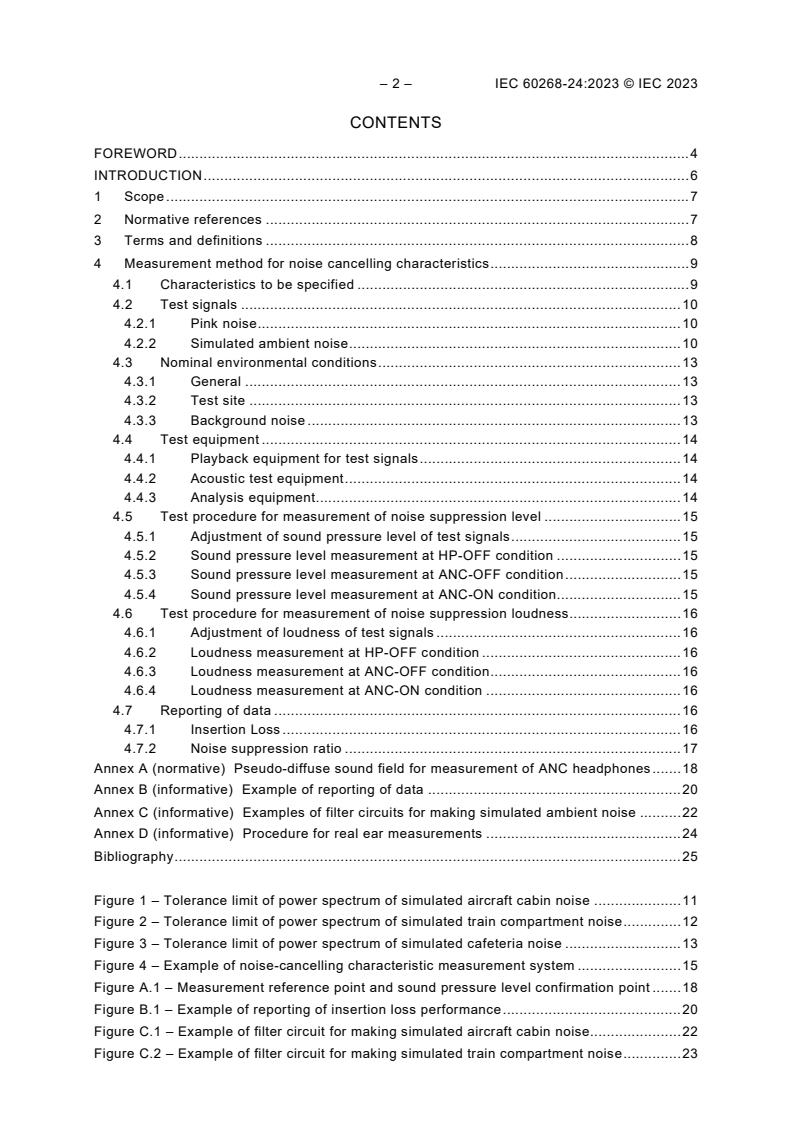
CONTENTS
FOREWORD . 4
INTRODUCTION . 6
1 Scope . 7
2 Normative references . 7
3 Terms and definitions . 8
4 Measurement method for noise cancelling characteristics . 9
4.1 Characteristics to be specified . 9
4.2 Test signals . 10
4.2.1 Pink noise . 10
4.2.2 Simulated ambient noise . 10
4.3 Nominal environmental conditions . 13
4.3.1 General . 13
4.3.2 Test site . 13
4.3.3 Background noise . 13
4.4 Test equipment . 14
4.4.1 Playback equipment for test signals . 14
4.4.2 Acoustic test equipment . 14
4.4.3 Analysis equipment. 14
4.5 Test procedure for measurement of noise suppression level . 15
4.5.1 Adjustment of sound pressure level of test signals . 15
4.5.2 Sound pressure level measurement at HP-OFF condition . 15
4.5.3 Sound pressure level measurement at ANC-OFF condition . 15
4.5.4 Sound pressure level measurement at ANC-ON condition. 15
4.6 Test procedure for measurement of noise suppression loudness. 16
4.6.1 Adjustment of loudness of test signals . 16
4.6.2 Loudness measurement at HP-OFF condition . 16
4.6.3 Loudness measurement at ANC-OFF condition . 16
4.6.4 Loudness measurement at ANC-ON condition . 16
4.7 Reporting of data . 16
4.7.1 Insertion Loss . 16
4.7.2 Noise suppression ratio . 17
Annex A (normative) Pseudo-diffuse sound field for measurement of ANC headphones . 18
Annex B (informative) Example of reporting of data . 20
Annex C (informative) Examples of filter circuits for making simulated ambient noise . 22
Annex D (informative) Procedure for real ear measurements . 24
Bibliography . 25
Figure 1 – Tolerance limit of power spectrum of simulated aircraft cabin noise . 11
Figure 2 – Tolerance limit of power spectrum of simulated train compartment noise . 12
Figure 3 – Tolerance limit of power spectrum of simulated cafeteria noise . 13
Figure 4 – Example of noise-cancelling characteristic measurement system . 15
Figure A.1 – Measurement reference point and sound pressure level confirmation point . 18
Figure B.1 – Example of reporting of insertion loss performance . 20
Figure C.1 – Example of filter circuit for making simulated aircraft cabin noise. 22
Figure C.2 – Example of filter circuit for making simulated train compartment noise . 23
Table 1 – Power spectrum of simulated aircraft cabin noise . 10
Table 2 – Power spectrum of simulated train compartment noise . 11
Table 3 – Power spectrum of simulated cafeteria noise . 12
Table B.1 – Example of reporting of insertion loss performance . 21
Table B.2 – Example of reporting of noise suppression ratio performance . 21
– 4 – IEC 60268-24:2023 © IEC 2023
INTERNATIONAL ELECTROTECHNICAL COMMISSION
____________
SOUND SYSTEM EQUIPMENT –
Part 24: Headphones and earphones –
Active acoustic noise cancelling characteristics
FOREWORD
1) The International Electrotechnical Commission (IEC) is a worldwide organization for standardization comprising
all national electrotechnical committees (IEC National Committees). The object of IEC is to promote international
co-operation on all questions concerning standardization in the electrical and electronic fields. To this end and
in addition to other activities, IEC publishes International Standards, Technical Specifications, Technical Reports,
Publicly Available Specifications (PAS) and Guides (hereafter referred to as “IEC Publication(s)”). Their
preparation is entrusted to technical committees; any IEC National Committee interested in the subject dealt with
may participate in this preparatory work. International, governmental and non-governmental organizations liaising
with the IEC also participate in this preparation. IEC collaborates closely with the International Organization for
Standardization (ISO) in accordance with conditions determined by agreement between the two organizations.
2) The formal decisions or agreements of IEC on technical matters express, as nearly as possible, an international
consensus of opinion on the relevant subjects since each technical committee has representation from all
interested IEC National Committees.
3) IEC Publications have the form of recommendations for international use and are accepted by IEC National
Committees in that sense. While all reasonable efforts are made to ensure that the technical content of IEC
Publications is accurate, IEC cannot be held responsible for the way in which they are used or for any
misinterpretation by any end user.
4) In order to promote international uniformity, IEC National Committees undertake to apply IEC Publications
transparently to the maximum extent possible in their national and regional publications. Any divergence between
any IEC Publication and the corresponding national or regional publication shall be clearly indicated in the latter.
5) IEC itself does not provide any attestation of conformity. Independent certification bodies provide conformity
assessment services and, in some areas, access to IEC marks of conformity. IEC is not responsible for any
services carried out by independent certification bodies.
6) All users should ensure that they have the latest edition of this publication.
7) No liability shall attach to IEC or its directors, employees, servants or agents including individual experts and
members of its technical committees and IEC National Committees for any personal injury, property damage or
other damage of any nature whatsoever, whether direct or indirect, or for costs (including legal fees) and
expenses arising out of the publication, use of, or reliance upon, this IEC Publication or any other IEC
Publications.
8) Attention is drawn to the Normative references cited in this publication. Use of the referenced publications is
indispensable for the correct application of this publication.
9) IEC draws attention to the possibility that the implementation of this document may involve the use of (a)
patent(s). IEC takes no position concerning the evidence, validity or applicability of any claimed patent rights in
respect thereof. As of the date of publication of this document, IEC had not received notice of (a) patent(s), which
may be required to implement this document. However, implementers are cautioned that this may not represent
the latest information, which may be obtained from the patent database available at https://patents.iec.ch. IEC
shall not be held responsible for identifying any or all such patent rights.
IEC 60268-24 has been prepared by Technical Area 20 Analogue and digital audio, of IEC
technical committee 100: Audio, video and multimedia systems and equipment. It is an
International Standard.
The text of this International Standard is based on the following documents:
Draft Report on voting
100/3880/CDV 100/3981/RVC
Full information on the voting for its approval can be found in the report on voting indicated in
the above table.
The language used for the development of this International Standard is English.
This document was drafted in accordance with ISO/IEC Directives, Part 2, and developed in
accordance with ISO/IEC Directives, Part 1 and ISO/IEC Directives, IEC Supplement, available
at www.iec.ch/members_experts/refdocs. The main document types developed by IEC are
described in greater detail at www.iec.ch/publications.
A list of all parts in the IEC 60268 series, published under the general title Sound system
equipment, can be found on the IEC website.
The committee has decided that the contents of this document will remain unchanged until the
stability date indicated on the IEC website under webstore.iec.ch in the data related to the
specific document. At this date, the document will be
• reconfirmed,
• withdrawn, or
• revised.
IMPORTANT – The "colour inside" logo on the cover page of this document indicates
that it contains colours which are considered to be useful for the correct understanding
of its contents. Users should therefore print this document using a colour printer.
– 6 – IEC 60268-24:2023 © IEC 2023
INTRODUCTION
This document specifies both methods of measurement and reporting of data for noise
cancelling characteristics on active acoustic noise cancelling headphones and earphones.
Active acoustic noise cancelling headphones and earphones are commonly used to reduce the
ambient acoustic noise to which the ear is exposed.
However, to date, there is no International Standard for evaluating the noise cancelling
performance of active acoustic noise cancelling headphones and earphones. Manufacturers
currently measuring noise cancelling performance only use proprietary methods, and the
resulting metrics are neither uniform nor comparable.
This document provides measurement methods and metrics for the noise cancelling
performance of active acoustic noise cancelling headphones and earphones. The resulting
measured and calculated values enable comparison of performance data obtained in different
locations.
SOUND SYSTEM EQUIPMENT –
Part 24: Headphones and earphones –
Active acoustic noise cancelling characteristics
1 Scope
This document is applicable to active acoustic noise-cancelling headphones and earphones
which have the function of reducing the noise heard by the user by the output sound from the
transducer generated by the environment noise detection microphone and the noise reduction
signal processing circuit.
This document specifies the terms and definitions of this type of headphones or earphones, the
characteristics to be specified, and the measurement and evaluation methods.
The noise detection microphone or microphones are mounted in the body, on the surface, or on
an accessory of the headphones or earphones. Signal processing circuits are analogue and
digital electronic circuits.
This document does not deal with equipment intended for hearing protection.
The noise cancelling characteristic measurement methods can be applied to headphones and
earphones having no active noise cancelling function.
2 Normative references
The following documents are referred to in the text in such a way that some or all of their content
constitutes requirements of this document. For dated references, only the edition cited applies.
For undated references, the latest edition of the referenced document (including any
amendments) applies.
IEC 60268-7, Sound system equipment – Part 7: Headphones and earphones IEC 61260-
1:2014, Electroacoustics – Octave-band and fractional-octave-band filters – Part 1:
Specifications
IEC 60318-4, Electroacoustics – Simulators of human head and ear – Part4: Occluded-ear
simulator for the measurement of earphones coupled to the ear by means of ear inserts
IEC 60318-7, Electroacoustics – Simulators of human head and ear – Part 7: Head and torso
simulator for the measurement of air-conduction hearing aids
IEC 61260-1, Electroacoustics – Octave-band and fractional-octave-band filters – Part 1:
Specifications
IEC 61672-1, Electroacoustics – Sound level meters – Part 1: Specifications
ISO 532-1:2017, Acoustics – Method for calculating loudness – Part 1: Zwicker method
ISO 3741:2010, Acoustics – Determination of sound power levels and sound energy levels of
noise sources using sound pressure – Precision methods for reverberation test rooms
– 8 – IEC 60268-24:2023 © IEC 2023
ANSI/ASA S12.42:2010, Methods for the Measurement of Insertion Loss of Hearing Protection
Devices in Continuous or Impulsive Noise Using Microphone-in-Real-Ear or Acoustic Test
Fixture Procedures
ITU-T Recommendation P.58, Head and torso simulator for telephonometry
3 Terms and definitions
For the purposes of this document, the terms and definitions given in IEC 60268-7, in
IEC 60318-4, in IEC 60318-7 and the following apply.
ISO and IEC maintain terminology databases for use in standardization at the following
addresses:
• IEC Electropedia: available at https://www.electropedia.org/
• ISO Online browsing platform: available at https://www.iso.org/obp
3.1
active noise cancellation
ANC
characteristic of reducing the noise level in the user’s ear canal by the output sound from the
driver, which is generated by the noise detection microphone and the signal processing circuit
3.2
noise cancelling headphones
ANC headphones
headphones or earphones that have the characteristics of active noise cancelling
3.3
head and torso simulator
HATS
simulator of a median adult human head and part of the torso extending in total from the top of
the head to the waist and designed to simulate the sound pick-up characteristics and acoustic
diffraction
Note 1 to entry: The head simulator includes two pinna simulators, and at least one occluded-ear simulator.
[SOURCE: IEC 60318-7:2022, 3.1, modified – The abbreviated term "HATS" has been added.]
3.4
acoustic test fixture
ATF
inanimate device that approximates certain physical characteristics and dimensions of a
representative human head, pinnae, and ear canal and is used for measuring the insertion loss
of ambient noise by a headphone
[SOURCE: ANSI/ASA S12.42, modified – "of a hearing protection device" replaced with "of
ambient noise by a headphone"]
3.5
passive insertion loss
insertion loss determined from the difference between the sound pressure levels with and
without the ANC headphones attached to the HATS or ATF, measured in the condition of the
ANC function turned off
Note 1 to entry: Passive insertion loss is measured in dB.
3.6
active insertion loss
insertion loss determined from the difference between the sound pressure levels with and
without the ANC function on, where the ANC headphones are attached to the HATS or ATF
Note 1 to entry: Active insertion loss is measured in dB.
3.7
total insertion loss
insertion loss determined from the difference between the sound pressure levels with and
without the ANC headphones attached to the HATS or ATF, measured in the condition of the
ANC function turned on
Note 1 to entry: Total insertion loss is measured in dB.
3.8
perceptual passive noise attenuation ratio
single ratio value of loudness with the ANC headphones attached to the HATS or ATF, to that
without the ANC headphones attached to the HATS or ATF, measured in the condition of the
ANC function turned off
3.9
perceptual active noise cancellation ratio
single ratio value of loudness when the ANC function is on to that when the ANC function is off,
where the ANC headphones are attached to the HATS or ATF
3.10
perceptual total noise suppression ratio
single ratio value of loudness with the ANC headphones attached to the HATS or ATF to that
without the ANC headphones attached to the HATS or ATF, measured in the condition of the
ANC function turned on
4 Measurement method for noise cancelling characteristics
4.1 Characteristics to be specified
The noise cancelling characteristics are specified by measuring:
• the sound pressure level for the open ear of the HATS or ATF, without the headphones
fitted, L (f) (dB);
OPEN
• the sound pressure level of the HATS or ATF ear simulator with the headphones fitted to
the HATS or ATF, but with the ANC turned OFF, L (f) (dB); and
ANC-OFF
• the sound pressure level of the HATS or ATF ear simulator with the headphones fitted to
the HATS or ATF, but with the ANC turned ON, L (f) (dB).
ANC-ON
All three quantities are measured in the same sound field at the same specified sound pressure
level.
The noise cancelling characteristics are also specified by measuring:
• the loudness for the open ear of the HATS or ATF, without the headphones fitted, N
OPEN
(sone);
• the loudness of the HATS or ATF ear simulator with the headphones fitted to the HATS or
ATF, but with the ANC turned OFF, N (sone); and
ANC-OFF
• the loudness of the HATS or ATF ear simulator with the headphones fitted to the HATS or
ATF, but with the ANC turned ON, N (sone).
ANC-ON
– 10 – IEC 60268-24:2023 © IEC 2023
The loudness of each of the three aforementioned quantities is calculated using the method
described in ISO 532-1.
4.2 Test signals
4.2.1 Pink noise
Noise whose power spectral density is inversely proportional to frequency (see
IEC 60050-801:1994, 801-21-11).
The noise is used to measure L (f), L (f), and L (f).
OPEN ANC-OFF ANC-ON
4.2.2 Simulated ambient noise
a) simulated aircraft cabin noise
b) simulated train compartment noise
c) simulated cafeteria noise
The power spectra of these signals shall comply with Table 1, Table 2, Table 3, Figure 1,
Figure 2 and Figure 3 when measured using 1/3 octave band analyser specified in IEC 61260-1.
Either of the above simulated ambient noises or the pink noise shall be used to measure N ,
OPEN
N and N .
ANC-OFF ANC-ON
Annex C gives examples of how the simulated aircraft cabin noise and the simulated train
compartment noise are obtained from filtered pink noise sources by the filter circuits shown in
Figure C.1 and Figure C.2, respectively.
Table 1 – Power spectrum of simulated aircraft cabin noise
Tolerance limit Tolerance limit
Frequency Relative level Frequency Relative level
(dB) (dB)
Hz dB + − Hz dB + −
20 0,0 0,5 0,5 800 −15,3 1,0 1,0
25 −0,1 0,5 0,5 1 000 −17,1 1,0 1,0
31,5 −0,1 0,5 0,5 1 250 −19,1 1,0 1,0
40 −0,2 0,5 0,5 1 600 −21,1 1,0 1,0
50 −0,4 1,0 1,0 2 000 −23,1 1,0 1,0
63 −0,7 1,0 1,0 2 500 −25,1 1,0 1,0
80 −1,1 1,0 1,0 3 150 −27,1 1,0 1,0
100 −1,7 1,0 1,0 4 000 −29,1 1,0 1,0
125 −2,5 1,0 1,0 5 000 −31,1 1,0 1,0
160 −3,6 1,0 1,0 6 300 −33,1 1,0 1,0
200 −4,8 1,0 1,0 8 000 −35,1 1,0 1,0
250 −6,2 1,0 1,0 10 000 −37,1 1,0 1,0
315 −7,8 1,0 1,0 12 500 −39,1 1,5 1,5
400 −9,6 1,0 1,0 16 000 −41,1 2,0 2,0
500 −11,4 1,0 1,0 20 000 −43,1 3,0 3,0
630 −13,3 1,0 1,0
Figure 1 – Tolerance limit of power spectrum of simulated aircraft cabin noise
Table 2 – Power spectrum of simulated train compartment noise
Tolerance limit Tolerance limit
Frequency Relative level Frequency Relative level
(dB) (dB)
Hz dB + − Hz dB + −
20 −1,0 2,0 2,0 800 −11,6 2,0 2,0
25 −0,4 1,0 1,0 1 000 −13,3 1,0 1,0
31,5 0,0 0,5 0,5 1 250 −16,4 1,0 1,0
40 −0,8 1,0 1,0 1 600 −19,8 1,0 1,0
50 −2,2 1,0 1,0 2 000 −23,3 1,0 1,0
63 −4,1 1,0 1,0 2 500 −26,9 1,0 1,0
80 −5,4 1,0 1,0 3 150 −30,3 1,0 1,0
100 −7,4 1,0 1,0 4 000 −33,5 1,0 1,0
125 −9,9 1,0 1,0 5 000 −36,5 1,0 1,0
160 −12,2 1,0 1,0 6 300 −39,4 1,0 1,0
200 −14,6 1,0 1,0 8 000 −42,1 1,0 1,0
250 −17,2 2,0 2,0 10 000 −44,6 1,0 1,0
315 −17,3 2,0 2,0 12 500 −46,9 1,5 1,5
400 −15,5 1,0 1,0 16 000 −49,2 2,0 2,0
500 −13,1 1,0 1,0 20 000 −51,3 3,0 3,0
630 −11,5 2,0 2,0
– 12 – IEC 60268-24:2023 © IEC 2023
Figure 2 – Tolerance limit of power spectrum of simulated train compartment noise
Table 3 – Power spectrum of simulated cafeteria noise
Tolerance limit Tolerance limit
Frequency Relative level Frequency Relative level
(dB) (dB)
Hz dB + − Hz dB + −
20 −28,1 1,0 1,0 800 −1,3 1,0 1,0
25 −26,4 1,0 1,0 1 000 −2,6 1,0 1,0
31,5 −24,3 1,0 1,0 1 250 −3,9 1,0 1,0
40 −21,9 1,0 1,0 1 600 −5,2 1,0 1,0
50 −19,1 1,0 1,0 2 000 −6,5 1,0 1,0
63 −16,0 1,0 1,0 2 500 −7,8 1,0 1,0
80 −12,8 1,0 1,0 3 150 −9,1 1,0 1,0
100 −9,5 1,0 1,0 4 000 −11,0 1,0 1,0
125 −6,3 1,0 1,0 5 000 −14,0 1,0 1,0
160 −3,7 1,0 1,0 6 300 −17,5 1,0 1,0
200 −1,8 1,0 1,0 8 000 −20,3 1,0 1,0
250 −0,8 1,0 1,0 10 000 −23,4 1,0 1,0
315 −0,5 1,0 1,0 12 500 −27,0 1,0 1,0
400 0,0 1,0 1,0 16 000 −31,0 1,0 1,0
500 0,0 1,0 1,0 20 000 −34,0 1,0 1,0
630 0,0 1,0 1,0
Figure 3 – Tolerance limit of power spectrum of simulated cafeteria noise
4.3 Nominal environmental conditions
4.3.1 General
a) Temperature of 15 to 35 °C
b) Relative humidity of 25 to 75 %
c) Atmospheric pressure of 86 to 106 kPa
If the environmental conditions are outside these ranges, this shall be stated and the actual
conditions shall be stated (see IEC 60068-1:2013, 4.3).
4.3.2 Test site
The reference sound field shall be a diffuse sound field specified in the description in ISO 3741
(it may be a pseudo-diffuse sound field in accordance with Annex A). The acoustic signal is
adjusted to satisfy the specified bandwidth and sound pressure level at the reference point
without the test fixture (manikin) present (see ISO 4869-1).
The measurement is started after the reproduced sound pressure in the sound field for
measurements stabilizes.
NOTE Dimensions of the test space of 3 m (L) × 2,7 m (W) × 2,4 m (H), equivalent to a volume of roughly 25 m or
greater, are generally sufficient to provide a diffuse field fulfilling these requirements.
4.3.3 Background noise
The background noise in the sound field for measurements shall be at least 10 dB below the
measured level in each band.
– 14 – IEC 60268-24:2023 © IEC 2023
4.4 Test equipment
4.4.1 Playback equipment for test signals
a) The following equipment is required:
1) a source of noise signal;
2) either an amplitude-limited signal or an amplitude-limiting circuit shall be used;
3) a speaker-frequency characteristic correction device;
4) a power amplifier;
5) sound source(s).
b) The ratio between the peak value and the effective value of the noise signal output from the
amplifier (crest factor) is between 1,8 and 2,2.
c) A power amplifier with total harmonic distortion of 1 % or less that can supply the required
reproduced sound pressure without saturating is required.
4.4.2 Acoustic test equipment
4.4.2.1 HATS
The HATS specified in IEC 60318-7 or equivalent (see ITU Rec. P.58) shall be used. The pinna
simulator specified in IEC 60268-7 is recommended. The types of the HATS and the pinna
simulator which are used shall be stated.
4.4.2.2 ATF
ATF (acoustic test fixtures) are specified in ANSI/ASA S12.42.
4.4.2.3 Measurement method
The headphones under test shall be mounted on the HATS or ATF in the same manner as in
the actual use conditions.
If the measurement headphones have a headband, it is worn so that the left and right sides are
balanced.
The following three mount conditions are used.
– HP-OFF condition: condition where ANC headphones are not attached to the HATS or ATF.
– ANC-OFF condition: condition of ANC function turned off where ANC headphones are
attached to the HATS or ATF.
– ANC-ON condition: condition of ANC function turned on where ANC headphones are
attached to the HATS or ATF.
For the purpose of testing the variations in noise cancelling performance due to pinna size and
shape or other fit conditions, it is useful to use a procedure for real ear measurements, in
accordance with Annex D.
4.4.3 Analysis equipment
The following equipment shall be used:
– noise sound pressure relative level: 1/3 octave band analyzer specified by IEC 61260-1;
– noise suppression in loudness: loudness measurement equipment that can calculate the
loudness value (sone) specified in ISO 532-1.
An example of a noise cancelling characteristic measurement system is shown in Figure 4.
Figure 4 – Example of noise-cancelling characteristic measurement system
4.5 Test procedure for measurement of noise suppression level
4.5.1 Adjustment of sound pressure level of test signals
The output of the measurement signal generator is adjusted so that the pink noise sound
pressure level at the HATS or ATF reference point is 94 ± 2 dB (reference 20 µPa, Z weighting).
Additionally, the frequency characteristics of the output signal are also adjusted so that the 1/3
octave band analysis value at the HATS or ATF installation point is ± 2 dB in each of the
frequency bands from 100 Hz to 10 kHz.
To measure the sound pressure level, equipment that satisfies the characteristics of Class I of
IEC 61672-1 and has the function of obtaining the time average sound pressure level is used,
and the measurement time is at least 20 seconds. Also, the HATS or ATF is not installed at the
measurement point when adjusting the output sound pressure level.
4.5.2 Sound pressure level measurement at HP-OFF condition
The HATS or ATF is installed in the adjusted sound field for measurements and the sound
pressure level L (f) is measured. The measurement time is at least 20 seconds.
OPEN
4.5.3 Sound pressure level measurement at ANC-OFF condition
The ANC headphones are attached to the HATS or ATF with the ANC function OFF, and the
sound pressure level L (f) is measured. The measurement time is at least 20 seconds.
ANC-OFF
4.5.4 Sound pressure level measurement at ANC-ON condition
After the measurement of ANC-OFF sound pressure level, the ANC function is turned on and
the sound pressure level L (f) is measured. The measurement time is at least 20 seconds.
ANC-ON
The series of three measurements in 4.5.2, 4.5.3 and 4.5.4 shall be repeated five times. The
headphones under test shall be removed and reattached to the HATS or ATF between each set
of three measurements described in 4.5.2, 4.5.3 and 4.5.4. If the test setup and environment
are stable (have not changed), the open ear measurement in 4.5.2 may be re-used for all
measurements.
– 16 – IEC 60268-24:2023 © IEC 2023
4.6 Test procedure for measurement of noise suppression loudness
4.6.1 Adjustment of loudness of test signals
The output of the measurement signal generator is adjusted so that the pink noise sound
pressure level at the HATS or ATF reference point is 94 dB ± 2 dB (ref. 20 µPa, Z weighting).
The frequency characteristics of the output signal are also adjusted so that the 1/3 octave band
analysis value at the HATS or ATF installation point is ±2 dB in the frequency bands from 20 Hz
to 16 kHz.
When the simulated aircraft cabin noise, the simulated train compartment noise or the pink
noise is used, the gain of the power amplifier is adjusted so that the loudness at the HATS or
ATF installation point is 40 ± 2 sone. When the simulated cafeteria noise is used, the gain of
the power amplifier is adjusted so that the loudness at the HATS or ATF installation point is
34 ± 2 sone.
When it is difficult to obtain the specified characteristic, the band of 20 Hz to 31,5 Hz allows
attenuation within −18 dB/octave.
The measurement time is at least 20 seconds. Also, the HATS or ATF is not installed at the
measurement point when adjusting the output loudness.
4.6.2 Loudness measurement at HP-OFF condition
The HATS or ATF is installed in the adjusted sound field for measurements and the HP-OFF
loudness N is measured. The measurement time is at least 20 seconds.
OPEN
4.6.3 Loudness measurement at ANC-OFF condition
The ANC Headphones are attached to the HATS or ATF with the ANC function OFF, and the
ANC-OFF loudness N is measured. The measurement time is at least 20 seconds.
OFF
4.6.4 Loudness measurement at ANC-ON condition
After the measurement of ANC-OFF sound pressure level, the ANC function is turned on and
the ANC-ON loudness N is measured. The measurement time is at least 20 seconds. The
ON
series of measurements in 4.6.2, 4.6.3 and 4.6.4 shall be repeated five times. ANC headphones
shall be removed and reattached to the HATS or ATF for each test. If the test setup and
environment has not changed, measurement at HP-OFF condition may be re-used from
previous measurements.
4.7 Reporting of data
4.7.1 Insertion Loss
The HATS or ATF output is analysed in 1/3 octave bands, and the sound pressure level (dB) in
each 1/3 octave band is obtained. The decibel average of the 5 repeated measurements is used
for calculation of insertion loss. The following quantities can then be calculated as a function of
each 1/3 octave centre frequency, f:
The passive insertion loss L (f) (dB) is calculated as:
Passive
L (f) = L (f) – L (f)
Passive OPEN ANC-OFF
The active insertion loss L (f) (dB) is calculated as:
Active
L (f) = L (f) – L (f)
Active ANC-OFF ANC-ON
The total insertion loss L (f) (dB) is calculated as:
Total
L (f) = L (f) – L (f)
Total OPEN ANC-ON
An example of the reported data is shown in Annex B (see Figure B.1 and Table B.1). Optionally,
a graph of the active insertion loss may be provided.
The frequency range of the graph is 20 Hz to 16 kHz.
4.7.2 Noise suppression ratio
The perceptual passive noise attenuation ratio R is calculated as:
Passive
R = 1 – (N / N )
Passive ANC-OFF OPEN
and the perceptual active noise cancellation ratio R is calculated as:
Active
= 1 – (N / N )
R
Active ANC-ON ANC-OFF
and the perceptual total noise suppression ratio R is calculated as:
Total
R = 1 – (N / N )
Total ANC-ON OPEN
and described together with the type of ambient noise used for measurement. Reported data is
written as the average of 5 measurements. A reporting example is shown in Table B.2. If
necessary, the perceptual active noise cancellation ratio may be described.
– 18 – IEC 60268-24:2023 © IEC 2023
Annex A
(normative)
Pseudo-diffuse sound field for measurement of ANC headphones
The reference sound field for noise cancellation characteristics measurement is defined as a
diffuse sound field in 4.3.2, but measurement in a listening room is also possible on condition
that the following terms are satisfied.
a) In order to avoid the interference effect of sound waves, use two or more loudspeakers with
measurement signals that are as uncorrelated as possible.
b) The sound pressure level measured using an omni-directional microphone has a deviation
within ±3 dB at a frequency from 40 Hz to 16 kHz of 1/3 octave band noise, at a point
150 mm from the measurement reference point in 6 directions (front, rear, left, right, top,
and bottom). However, deviations up to ±5 dB below 100 Hz and deviations up to ±4 dB
from 125 Hz to 16 kHz are allowed on condition that the number of the centre frequency that
exceeds ±3 dB is within 5 frequency bands in each direction and within 10 frequency bands
in all directions. The microphone axis is fixed in one direction when measuring the sound
pressure level. The overall sound pressure level difference between the two points 75 mm
left and right from the reference point (AB in Figure A.1) is within 3 dB. The front direction
of the HATS or the ATF is used as the measurement reference axis. The measurement
reference point is approximately the point where the centres of the ears of the HATS or the
ATF are located.
Figure A.1 – Measurement reference point and sound pressure level confirmation point
c) The difference between the maximum value and the minimum value of the sound pressure
level in the 6 directions (front, rear, left, right, top, and bottom) at the measurement
reference point measured by a unidirectional microphone in which the difference between
the front sensitivity and the random incidence sensitivity is at least 5 dB, is within 5 dB in
any 1/3 octave band with a centre frequency of 500 Hz to 12.5 kHz.
– 20 – IEC 60268-24:2023 © IEC 2023
Annex B
(informative)
Example of reporting of data
This annex comprises examples of reporting of data that are measured and calculated following
the methods in this document.
a) A reporting example of the passive insertion loss, the total insertion loss and the active
insertion loss (optional) that are calculated in 4.7.1 is shown in Figure B.1 and Table B.1.
When displayed as a graph, the vertical axis may be inverted.
b) A reporting example of the perceptual passive noise attenuation ratio and perceptual total
noise suppression ratio that are calculated in 4.7.2 is shown in Table B.2. The type of
ambient noise used for measurement is described together.
Figure B.1 – Example of reporting of insertion loss performance
Table B.1 – Example of reporting of insertion loss performance
Frequency Passive insertion loss Total insertion loss Active insertion loss
[Hz] [dB] [dB] [dB] (optional)
20 0 0 0
25 0 0 0
31,5 0,2 0,2 0
40 0 2,8 2,8
50 0 5,8 5,8
63 0 10,2 10,2
80 0 12,2 12,2
100 1,1 14,7 13,6
125 1,1 17,7 16,6
160 1,6 18 16,4
200 1,1 18,3 17,2
250 1,6 18,7 17,1
315 1,8 18,3 16,5
400 4,2 18,7 14,5
500 6,2 19,4 13,2
630 6,6 17,6 11
800 7,9 16,9 9
1 000 11,6 17,6 6
1 250 14,7 18,7 4
1 600 18,8 20,8 2
2 000 23,5 24 0.5
2 500 27 27 0
3 150 30 30 0
4 000 34 34 0
5 000 36 36 0
6 300 37 37 0
8 000 38 38 0
10 000 38,5 38,5 0
12 500 39 39 0
16 000 39,5 39,5 0
Table B.2 – Example of reporting of noise suppression ratio performance
Reporting item Reporting data
Perceptual passive noise attenuation ratio 0,39
Perceptual total noise suppression ratio 0,71
Type of ambient noise used Simulated aircraft cabin noise
– 22 – IEC 60268-24:2023 © IEC 2023
Annex C
(informative)
Examples of filter circuits for making simulated ambient noise
For example, the simulated aircraft cabin noise and the simulated train compartment noise can
be obtained from filtered pink noise sources by the filter circuits shown in Figure C.1 and
Figure C.2, respectively. The load impedance of these circuits is 10 kΩ or more and the signal
source impedance is 50 Ω or less.
Key
Components
C1 capacitor C = 0,039 µF
R1 resistor R = 30 kΩ ± 1 %
R2 resistor R = 30 kΩ ± 1 %
Figure C.1 – Example of filter circuit for making simulated aircraft cabin noise
Key
Components
C1 capacitor C = 0,22 µF R1 resistor R = 680 kΩ
C2 capacitor C = 0,022 µF R2 resistor R = 130 kΩ
C3 capacitor C = 0,022 µF R3 resistor R = 33 kΩ
C4 capacitor C = 0,022 µF R4 resistor R = 47 kΩ
C5 capacitor C = 6 800 pF R5 resistor R = 82 kΩ
C6 capacitor C = 4 300 pF R6 resistor R = 100 kΩ
C7 capacitor C = 68 pF R7 resistor R = 24 kΩ ± 1 %
C8 capacitor C = 6 800 pF R8 resistor R = 1 kΩ
C9 capacitor C = 1 500 pF R9 resistor R = 100 kΩ
C10 capacitor C = 10 µF R10 resistor R = 120 kΩ ± 1 %
R11 resistor R = 24 kΩ
R12 resistor R = 22 kΩ ± 1 %
R13 resistor R = 1,5 kΩ
Figure C.2 – Example of filter circuit for making simulated train compartment noise
– 24 – IEC 60268-24:2023 © IEC 2023
Annex D
(informative)
Procedure for real ear measurements
For the purpose of testing the variations in noise-cancelling performance due to pinna size and
shape or other fit conditions, it is useful to use a procedure for real ear measurements following
the "Measurement In Real Ear" (MIRE) method (ISO 11904-1). This rea
...