


IEC 60728-2:2010
(Main)Cable networks for television signals, sound signals and interactive services - Part 2: Electromagnetic compatibility for equipment
General Information
- Abstract
IEC 60728-2:2010(E) applies to the radiation characteristics and immunity to electromagnetic disturbance of EM active equipment (active and passive equipment) for the reception, processing and distribution of television, sound and interactive multimedia signals as dealt with in the IEC 60728 series. It specifies requirements for maximum allowed radiation, minimum immunity and minimum screening effectiveness and describes test methods for conformance testing. It cancels and replaces the first edition published in 2002, of which it constitutes a technical revision and includes the following significant technical changes with respect to the previous edition:
- updated scope, added some new terms and definitions;
- added methods of measurement and performance requirements for telecom signal ports of multimedia network equipment;
- updated methods of measurement for immunity and emissions;
- applicability of EMC performance requirements and methods of measurement to different types of equipment.
- Status
- Published
- Publication Date
- 20-Jan-2010
- Technical Committee
- TC 100 - Audio, video and multimedia systems and equipment
- Current Stage
- DELPUB - Deleted Publication
- Start Date
- 10-Jan-2018
- Completion Date
- 28-Aug-2026
Overview - IEC 60728-2:2010 (Electromagnetic Compatibility for Cable‑network Equipment)
IEC 60728-2:2010 is the international EMC (electromagnetic compatibility) standard for equipment used in cable networks for television signals, sound signals and interactive multimedia services. It applies to both active and passive equipment used for reception, processing and distribution, and defines requirements and test methods for radiation, immunity and screening effectiveness. The standard sets maximum allowed radiation, minimum immunity levels and minimum screening performance, and describes conformance test procedures.
Key topics and technical requirements
- Scope and definitions: Updated scope and added terminology relevant to cable-network multimedia equipment and telecom signal ports.
- Emission requirements: Specifies limits and measurement methods for disturbance voltages and radiated disturbance power from equipment (covers mains and input terminals).
- Immunity requirements: Defines external field immunity, internal immunity (immunity to unwanted signals), and performance criteria for maintaining correct operation under interference.
- Screening effectiveness: Minimum shielding/screening performance requirements for passive components and enclosures.
- Test methods: Practical measurement techniques included - e.g., coupling unit method (low‑frequency radiation), absorbing clamp method (VHF/UHF range), substitution radiation method, ESD tests, and fast transient/burst tests on AC power ports.
- Telecom signal ports: New in this edition - measurement methods and performance requirements for telecom/network ports on multimedia equipment.
- Applicability: Guidance on how EMC requirements and test methods apply to different equipment types within the IEC 60728 series.
Practical applications and who uses this standard
IEC 60728-2 is intended for:
- Manufacturers and design engineers developing set‑top boxes, RF amplifiers, tuners, headend and distribution equipment, outdoor units and passive network components - to design for EMC compliance and reduce field interference.
- Test laboratories and certification bodies performing conformance testing and issuing compliance reports.
- System integrators and cable operators specifying equipment procurement and ensuring network interoperability and regulatory compliance.
- Regulatory authorities referencing harmonized EMC requirements for cable broadcasting and multimedia distribution services.
Practical uses include EMC design validation, pre‑compliance testing, production verification, and problem diagnosis in deployed networks.
Related standards
- Part of the IEC 60728 series (cable networks).
- Works alongside general EMC standards and measurement practices (e.g., IEC 61000 series and CISPR publications) when broader electromagnetic compatibility context or national regulations are required.
Keywords: IEC 60728-2:2010, electromagnetic compatibility, EMC, cable networks, television signals, sound signals, interactive services, emissions, immunity, screening effectiveness, telecom signal ports, test methods.
Relations
- Effective Date
- 15-Sep-2026
- Effective Date
- 10-Feb-2026
- Effective Date
- 10-Feb-2026
- Effective Date
- 10-Feb-2026
- Effective Date
- 10-Feb-2026
- Effective Date
- 10-Feb-2026
- Effective Date
- 10-Feb-2026
- Effective Date
- 10-Feb-2026
- Effective Date
- 05-Sep-2023
- Effective Date
- 05-Sep-2023
Get Certified
Connect with accredited certification bodies for this standard

ANCE
Mexican certification and testing association.

Intertek Slovenia
Intertek testing, inspection, and certification services in Slovenia.

LNE (Laboratoire National de Métrologie et d'Essais)
French national laboratory for metrology and testing.
Sponsored listings
Frequently Asked Questions
IEC 60728-2:2010 is a standard published by the International Electrotechnical Commission (IEC). Its full title is "Cable networks for television signals, sound signals and interactive services - Part 2: Electromagnetic compatibility for equipment". This standard covers: IEC 60728-2:2010(E) applies to the radiation characteristics and immunity to electromagnetic disturbance of EM active equipment (active and passive equipment) for the reception, processing and distribution of television, sound and interactive multimedia signals as dealt with in the IEC 60728 series. It specifies requirements for maximum allowed radiation, minimum immunity and minimum screening effectiveness and describes test methods for conformance testing. It cancels and replaces the first edition published in 2002, of which it constitutes a technical revision and includes the following significant technical changes with respect to the previous edition: - updated scope, added some new terms and definitions; - added methods of measurement and performance requirements for telecom signal ports of multimedia network equipment; - updated methods of measurement for immunity and emissions; - applicability of EMC performance requirements and methods of measurement to different types of equipment.
IEC 60728-2:2010(E) applies to the radiation characteristics and immunity to electromagnetic disturbance of EM active equipment (active and passive equipment) for the reception, processing and distribution of television, sound and interactive multimedia signals as dealt with in the IEC 60728 series. It specifies requirements for maximum allowed radiation, minimum immunity and minimum screening effectiveness and describes test methods for conformance testing. It cancels and replaces the first edition published in 2002, of which it constitutes a technical revision and includes the following significant technical changes with respect to the previous edition: - updated scope, added some new terms and definitions; - added methods of measurement and performance requirements for telecom signal ports of multimedia network equipment; - updated methods of measurement for immunity and emissions; - applicability of EMC performance requirements and methods of measurement to different types of equipment.
IEC 60728-2:2010 is classified under the following ICS (International Classification for Standards) categories: 33.160.99 - Other audio, video and audiovisual equipment. The ICS classification helps identify the subject area and facilitates finding related standards.
IEC 60728-2:2010 has the following relationships with other standards: It is inter standard links to EN IEC 60728-114:2026, EN 60728-14:2014, EN 60728-11:2017, EN 60728-101:2017, EN 60728-10:2014, EN 60728-5:2016, EN IEC 60728-3:2018, EN 60728-1:2014, IEC 60728-2:2002, IEC 60728-2:2018. Understanding these relationships helps ensure you are using the most current and applicable version of the standard.
IEC 60728-2:2010 is available in PDF format for immediate download after purchase. The document can be added to your cart and obtained through the secure checkout process. Digital delivery ensures instant access to the complete standard document.
Standards Content (Sample)
IEC 60728-2 ®
Edition 2.0 2010-01
INTERNATIONAL
STANDARD
Cable networks for television signals, sound signals and interactive services –
Part 2: Electromagnetic compatibility for equipment
All rights reserved. Unless otherwise specified, no part of this publication may be reproduced or utilized in any form
or by any means, electronic or mechanical, including photocopying and microfilm, without permission in writing from
either IEC or IEC's member National Committee in the country of the requester.
If you have any questions about IEC copyright or have an enquiry about obtaining additional rights to this publication,
please contact the address below or your local IEC member National Committee for further information.
IEC Central Office
3, rue de Varembé
CH-1211 Geneva 20
Switzerland
Email: inmail@iec.ch
Web: www.iec.ch
About the IEC
The International Electrotechnical Commission (IEC) is the leading global organization that prepares and publishes
International Standards for all electrical, electronic and related technologies.
About IEC publications
The technical content of IEC publications is kept under constant review by the IEC. Please make sure that you have the
latest edition, a corrigenda or an amendment might have been published.
ƒ Catalogue of IEC publications: www.iec.ch/searchpub
The IEC on-line Catalogue enables you to search by a variety of criteria (reference number, text, technical committee,…).
It also gives information on projects, withdrawn and replaced publications.
ƒ IEC Just Published: www.iec.ch/online_news/justpub
Stay up to date on all new IEC publications. Just Published details twice a month all new publications released. Available
on-line and also by email.
ƒ Electropedia: www.electropedia.org
The world's leading online dictionary of electronic and electrical terms containing more than 20 000 terms and definitions
in English and French, with equivalent terms in additional languages. Also known as the International Electrotechnical
Vocabulary online.
ƒ Customer Service Centre: www.iec.ch/webstore/custserv
If you wish to give us your feedback on this publication or need further assistance, please visit the Customer Service
Centre FAQ or contact us:
Email: csc@iec.ch
Tel.: +41 22 919 02 11
Fax: +41 22 919 03 00
IEC 60728-2 ®
Edition 2.0 2010-01
INTERNATIONAL
STANDARD
Cable networks for television signals, sound signals and interactive services –
Part 2: Electromagnetic compatibility for equipment
INTERNATIONAL
ELECTROTECHNICAL
COMMISSION
PRICE CODE
XA
ICS 33.060.40, 33.100 ISBN 978-2-88910-262-4
– 2 – 60728-2 © IEC:2010(E)
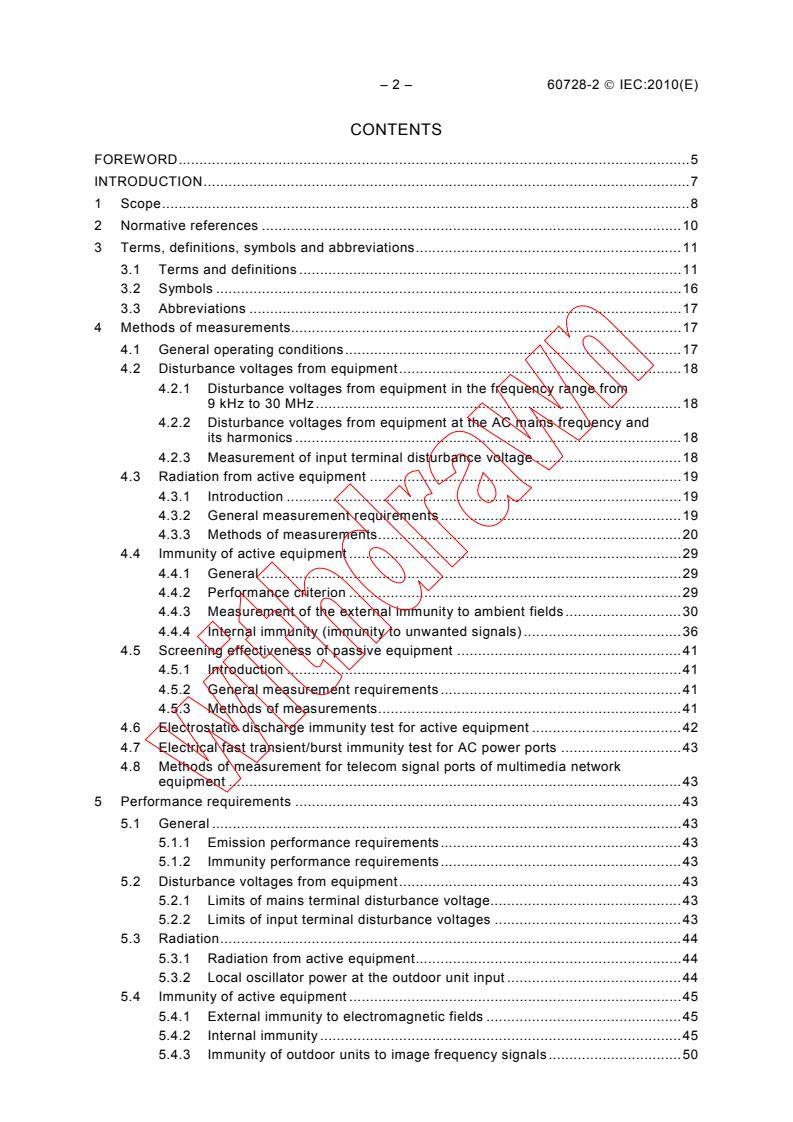
CONTENTS
FOREWORD.5
INTRODUCTION.7
1 Scope.8
2 Normative references .10
3 Terms, definitions, symbols and abbreviations.11
3.1 Terms and definitions .11
3.2 Symbols .16
3.3 Abbreviations .17
4 Methods of measurements.17
4.1 General operating conditions.17
4.2 Disturbance voltages from equipment.18
4.2.1 Disturbance voltages from equipment in the frequency range from
9 kHz to 30 MHz.18
4.2.2 Disturbance voltages from equipment at the AC mains frequency and
its harmonics .18
4.2.3 Measurement of input terminal disturbance voltage .18
4.3 Radiation from active equipment .19
4.3.1 Introduction .19
4.3.2 General measurement requirements .19
4.3.3 Methods of measurements.20
4.4 Immunity of active equipment .29
4.4.1 General .29
4.4.2 Performance criterion .29
4.4.3 Measurement of the external immunity to ambient fields.30
4.4.4 Internal immunity (immunity to unwanted signals) .36
4.5 Screening effectiveness of passive equipment .41
4.5.1 Introduction .41
4.5.2 General measurement requirements .41
4.5.3 Methods of measurements.41
4.6 Electrostatic discharge immunity test for active equipment .42
4.7 Electrical fast transient/burst immunity test for AC power ports .43
4.8 Methods of measurement for telecom signal ports of multimedia network
equipment .43
5 Performance requirements .43
5.1 General .43
5.1.1 Emission performance requirements.43
5.1.2 Immunity performance requirements.43
5.2 Disturbance voltages from equipment.43
5.2.1 Limits of mains terminal disturbance voltage.43
5.2.2 Limits of input terminal disturbance voltages .43
5.3 Radiation.44
5.3.1 Radiation from active equipment.44
5.3.2 Local oscillator power at the outdoor unit input .44
5.4 Immunity of active equipment .45
5.4.1 External immunity to electromagnetic fields .45
5.4.2 Internal immunity.45
5.4.3 Immunity of outdoor units to image frequency signals.50
60728-2 © IEC:2010(E) – 3 –
5.5 Screening effectiveness of passive equipment .50
5.6 Electrostatic discharge immunity test for active equipment .50
5.7 Electrical fast transient/burst immunity test for AC power ports .50
5.8 Performance requirements for telecom signal ports of multimedia network
equipment .51
5.9 Applicability of EMC performance requirements and methods of
measurement to different types of equipment .51
Bibliography.53
Figure 1 – Measurement set-up for radiation measurements in the frequency range
5 MHz to 30 MHz using the coupling unit method.21
Figure 2 – Absorbing clamp method (30 MHz to 950 MHz) .23
Figure 3 – Example of general measurement set-up .24
Figure 4 – Example of measurement set-up for measurements on the input port of
active equipment.24
Figure 5 – Measurement set-up for the "substitution" radiation method – First
measurement step .26
Figure 6 – Measurement set-up for the substitution radiation method – Second
measurement step .27
Figure 7 – Frequency allocation for out-of-band immunity measurement of active
equipment with nominal frequency range below 950 MHz for AM applications
(Example: VHF broadband amplifier; bandwidth 40 MHz to 450 MHz) .30
Figure 8 – Frequency allocation for out-of-band immunity measurement of active
equipment with nominal frequency range above 950 MHz for FM applications
(Example: IF amplifier; bandwidth 950 MHz to 1750 MHz) .31
Figure 9 – Frequency allocation for in-band immunity measurement of active
equipment with nominal frequency range below 950 MHz for AM applications
(Example: broadband amplifier; bandwidth 40 MHz to 862 MHz) .34
Figure 10 – Frequency allocation for in-band immunity measurement of active
equipment with nominal frequency range above 950 MHz for FM applications
(Example: IF amplifier; bandwidth 950 MHz to 3000 MHz) .34
Figure 11 – Measurement set-up for internal immunity test .36
Figure 12 – Levels of wanted and unwanted signals for the internal immunity of FSS
receiving outdoor units.39
Figure 13 – Levels of wanted and unwanted signals for the internal immunity of BSS
receiving outdoor units.40
Figure 14 – Levels of unwanted signals for the internal immunity of active equipment
in Band I (47 MHz to 68 MHz) .46
Figure 15 – Levels of unwanted signals for the internal immunity of active equipment
in Band II (87,5 MHz to 108 MHz) .47
Figure 16 – Levels of unwanted signals for the internal immunity of active equipment
in Band III (174 MHz to 230 MHz) .48
Figure 17 – Levels of unwanted signals for the internal immunity of active equipment
in Band IV/V (470 MHz to 862 MHz).49
Table 1 – Port structure of different network equipment .9
Table 2 – Limits of mains terminal disturbance voltage .43
Table 3 – Limits of input terminal disturbance voltages .44
Table 4 – Limits of radiated disturbance power .44
Table 5 – Limits of local oscillator terminal power .44
– 4 – 60728-2 © IEC:2010(E)
Table 6 – Limits of out-of-band immunity (lowest level/field strength for compliance
with performance criterion, given in 4.4.2) .45
Table 7 – Limits of in-band immunity (lowest level/field strength for compliance with
performance criterion, given in 4.4.2).45
Table 8 – Test specification for internal immunity.46
Table 9 – Limits of immunity to image frequency signals in terms of image
suppression ratio .50
Table 10 – Limits of screening effectiveness of passive equipment within the nominal
frequency ranges .50
Table 11 – Test specifications for electrostatic discharge immunity test for active
equipment.50
Table 12 – Test specifications for electrical fast transient/burst immunity test .51
Table 13 – Port types and environmental conditions for EMC performance
requirements and methods of measurement.51
Table 14 – Emission parameters.51
Table 15 – Immunity and screening effectiveness parameters.52
60728-2 © IEC:2010(E) – 5 –
INTERNATIONAL ELECTROTECHNICAL COMMISSION
____________
CABLE NETWORKS FOR TELEVISION SIGNALS,
SOUND SIGNALS AND INTERACTIVE SERVICES –
Part 2: Electromagnetic compatibility for equipment
FOREWORD
1) The International Electrotechnical Commission (IEC) is a worldwide organization for standardization comprising
all national electrotechnical committees (IEC National Committees). The object of IEC is to promote
international co-operation on all questions concerning standardization in the electrical and electronic fields. To
this end and in addition to other activities, IEC publishes International Standards, Technical Specifications,
Technical Reports, Publicly Available Specifications (PAS) and Guides (hereafter referred to as “IEC
Publication(s)”). Their preparation is entrusted to technical committees; any IEC National Committee interested
in the subject dealt with may participate in this preparatory work. International, governmental and non-
governmental organizations liaising with the IEC also participate in this preparation. IEC collaborates closely
with the International Organization for Standardization (ISO) in accordance with conditions determined by
agreement between the two organizations.
2) The formal decisions or agreements of IEC on technical matters express, as nearly as possible, an international
consensus of opinion on the relevant subjects since each technical committee has representation from all
interested IEC National Committees.
3) IEC Publications have the form of recommendations for international use and are accepted by IEC National
Committees in that sense. While all reasonable efforts are made to ensure that the technical content of IEC
Publications is accurate, IEC cannot be held responsible for the way in which they are used or for any
misinterpretation by any end user.
4) In order to promote international uniformity, IEC National Committees undertake to apply IEC Publications
transparently to the maximum extent possible in their national and regional publications. Any divergence
between any IEC Publication and the corresponding national or regional publication shall be clearly indicated in
the latter.
5) IEC itself does not provide any attestation of conformity. Independent certification bodies provide conformity
assessment services and, in some areas, access to IEC marks of conformity. IEC is not responsible for any
services carried out by independent certification bodies.
6) All users should ensure that they have the latest edition of this publication.
7) No liability shall attach to IEC or its directors, employees, servants or agents including individual experts and
members of its technical committees and IEC National Committees for any personal injury, property damage or
other damage of any nature whatsoever, whether direct or indirect, or for costs (including legal fees) and
expenses arising out of the publication, use of, or reliance upon, this IEC Publication or any other IEC
Publications.
8) Attention is drawn to the Normative references cited in this publication. Use of the referenced publications is
indispensable for the correct application of this publication.
9) Attention is drawn to the possibility that some of the elements of this IEC Publication may be the subject of
patent rights. IEC shall not be held responsible for identifying any or all such patent rights.
International Standard IEC 60728-2 has been prepared by technical area 5: Cable networks
for television signals, sound signals and interactive services, of IEC technical committee 100:
Audio, video and multimedia systems and equipment.
This second edition cancels and replaces the first edition published in 2002, of which it
constitutes a technical revision.
This edition includes the following significant technical changes with respect to the previous
edition:
– updated scope, added some new terms and definitions;
– added methods of measurement and performance requirements for telecom signal ports of
multimedia network equipment;
– updated methods of measurement for immunity and emissions;
– 6 – 60728-2 © IEC:2010(E)
– applicability of EMC performance requirements and methods of measurement to different
types of equipment.
The text of this standard is based on the following documents:
FDIS Report on voting
100/1620/FDIS 100/1640/RVD
Full information on the voting for the approval of this standard can be found in the report on
voting indicated in the above table.
This publication has been drafted in accordance with the ISO/IEC Directives, Part 2.
The list of all the parts of the IEC 60728 series, under the general title Cable networks for
television signals, sound signals and interactive services, can be found on the IEC website.
The committee has decided that the contents of this publication will remain unchanged until
the maintenance result date indicated on the IEC web site under "http://webstore.iec.ch" in
the data related to the specific publication. At this date, the publication will be
• reconfirmed,
• withdrawn,
• replaced by a revised edition, or
• amended.
A bilingual version of this publication may be issued at a later date.
60728-2 © IEC:2010(E) – 7 –
INTRODUCTION
Standards of the IEC 60728 series deal with cable networks including equipment and
associated methods of measurement for headend reception, processing and distribution of
television signals, sound signals, interactive services signals, interfaces and their associated
data signals, using all applicable transmission media.
This includes
• CATV -networks,
• MATV-networks and SMATV-networks,
• individual receiving networks,
and all kinds of equipment, systems and installations installed in such networks.
The extent of this standardization work is from the antennas, special signal source inputs to
the headend or other interface points to the network up to the terminal input.
The standardization of any user terminals (i.e. tuners, receivers, decoders, terminals, etc.) as
well as of any coaxial, balanced and optical cables and accessories thereof is excluded.
___________
This word encompasses the HFC networks used nowadays to provide telecommunications services, voice,
data, audio and video both broadcast and narrowcast.
– 8 – 60728-2 © IEC:2010(E)
CABLE NETWORKS FOR TELEVISION SIGNALS,
SOUND SIGNALS AND INTERACTIVE SERVICES –
Part 2: Electromagnetic compatibility for equipment
1 Scope
This part of IEC 60728 applies to the radiation characteristics and immunity to
electromagnetic disturbance of EM-active equipment (active and passive equipment) for the
reception, processing and distribution of television, sound and interactive multimedia signals
as dealt with in the following parts of the IEC 60728 series:
– IEC 60728-3 Active wideband equipment for coaxial cable networks
– IEC 60728-4 Passive wideband equipment for coaxial cable networks
– IEC 60728-5 Headend equipment
– IEC 60728-6 Optical equipment
It covers the following frequency ranges:
– Disturbance voltage injected into the mains 9 kHz to 30 MHz
– Radiation from active equipment 5 MHz to 25 GHz
– Immunity of active equipment 150 kHz to 25 GHz
– Screening effectiveness of passive
5 MHz to 3 GHz (25 GHz)
equipment
This standard specifies requirements for maximum allowed radiation, minimum immunity and
minimum screening effectiveness and describes test methods for conformance testing.
Due to the fact that cable networks, the former cabled distribution systems for television and
sound signals, are more and more used for interactive services, these networks may
incorporate also equipment, which carry besides the cable network equipment ports also one
or more telecom signal port(s) as well as one Ethernet (IP) port. This equipment should be
named as multimedia network equipment.
The EMC behaviour of cable network equipment, telecommunication network equipment and
multimedia network equipment may be described by the following port structure (see Table 1).
___________
For screening effectiveness of passive equipment no requirements apply at present for the frequency range
3 GHz to 25 GHz. Methods of measurement and limits are investigated for inclusion in a future amendment or
revised edition.
60728-2 © IEC:2010(E) – 9 –
Table 1 – Port structure of different network equipment
Cable network Telecommunication Multimedia network
Port name
equipment network equipment equipment
Enclosure X X X
Earth X X X
AC/DC power supply X X X
Control (e.g. alarm) X X X
Antenna input port X X
RF network port X X
Telecom signal port X X
Ethernet (IP) port X
Table 1 shows that cable network equipment and telecommunication network equipment have
four common ports and one respectively two individual port each. Multimedia network
equipment carries besides the common ports an antenna input port and/or a RF network port
as well as a telecom signal port.
The electromagnetic compatibility requirements for telecommunication network equipment
only are standardized in EN 300 386 (mainly) and in EN 301 489-4, those for cable network
equipment only are given in this IEC 60728-2.
Equipment for multimedia networks of the above mentioned type has to work under the same
EMC conditions as equipment, which is falling under the cable network and the
telecommunication network EMC-standards. Due to the fact, that this equipment has to work
in close proximity, e.g. in the same operating room, the EMC environmental conditions for all
three types of equipment are the same.
This means that multimedia network equipment has to fulfil the EMC requirements of one of
the above mentioned standards and in addition the EMC requirements, laid down in the other
EMC standard, for the additional port, by which it is connected to the other network.
By this procedure it is ensured that multimedia network equipment fulfils the EMC conditions
of one of the above mentioned networks and will neither disturb the respective other system
nor will be disturbed by the respective other system via the connecting port.
Coaxial cables for cable networks do not fall under the scope of this standard. Reference is
made to the European Standard series EN 50117.
This standard also covers active indoor antennas for which the requirements and the
applicable methods of measurement are limited to the radiation and the electrostatic
discharge phenomena.
Standardisation in the field of electromagnetic compatibility for any broadcast terminals (e.g.
tuners, receivers, decoders, etc.) is covered by the International Standards CISPR 13 and
CISPR 20 and for multimedia terminals by CISPR 22 and CISPR 24.
Requirements for the electromagnetic compatibility of receiver leads are laid down in
IEC 60966-2-4, IEC 60966-2-5 and IEC 60966-2-6.
– 10 – 60728-2 © IEC:2010(E)
2 Normative references
The following referenced documents are indispensable for the application of this document.
For dated references, only the edition cited applies. For undated references, the latest edition
of the referenced document (including any amendments) applies.
CISPR 13, Sound and television broadcast receivers and associated equipment – Radio
disturbance characteristics – Limits and methods of measurement
CISPR 16-1-1, Specification for radio disturbance and immunity measuring apparatus and
methods – Part 1-1: Radio disturbance and immunity measuring apparatus – Measuring
apparatus
CISPR 20, Sound and television broadcast receivers and associated equipment – Immunity
characteristics – Limits and methods of measurement
CISPR 22, Information technology equipment – Radio disturbance characteristics – Limits and
methods of measurement
CISPR 24, Information technology equipment – Immunity characteristics – Limits and methods
of measurement
IEC 60050-161, International Electrotechnical Vocabulary – Chapter 161: Electromagnetic
compatibility
IEC 60617, Graphical symbols for diagrams
IEC 60728 (all parts), Cable networks for television signals, sound signals and interactive
services
IEC 60728-3:2005, Cable networks for television signals, sound signals and interactive
services – Part 3: Active wideband equipment for coaxial cable networks
IEC 60966-2-4, Radio frequency and coaxial cable assemblies – Part 2-4: Detail specification
for cable assemblies for radio and TV receivers – Frequency range 0 MHz to 3 000 MHz,
IEC 61169-2 connectors
IEC 60966-2-5, Radio frequency and coaxial cable assemblies – Part 2-5: Detail specification
for cable assemblies for radio and TV receivers – Frequency range 0 MHz to 1 000 MHz,
IEC 61169-2 connectors
IEC 60966-2-6, Radio frequency and coaxial cable assemblies – Part 2-6: Detail specification
for cable assemblies for radio and TV receivers – Frequency range 0 MHz to 3 000 MHz,
IEC 61169-24 connectors
IEC 61000-3-2, Electromagnetic compatibility (EMC) – Part 3-2: Limits – Limits for harmonic
current emissions (equipment input current ≤16 A per phase)
IEC 61000-4-3, Electromagnetic compatibility (EMC) – Part 4-3: Testing and measurement
techniques – Radiated, radio-frequency, electromagnetic field immunity test
IEC 61000-4-4, Electromagnetic compatibility (EMC) – Part 4-4: Testing and measurement
techniques – Electrical fast transient/burst immunity test
IEC 61000-4-6, Electromagnetic compatibility (EMC) – Part 4-6: Testing and measurement
techniques – Immunity to conducted disturbances, induced by radio-frequency fields
60728-2 © IEC:2010(E) – 11 –
IEC 61000-6-1:2005, Electromagnetic compatibility (EMC) – Part 6-1: Generic standards –
Immunity for residential, commercial and light-industrial environments
IEC 61079-1:1992, Methods of measurement on receivers for satellite broadcast
transmissions in the 12 GHz band – Part 1: Radio-frequency measurements on outdoor units
EN 300 386 V1.3.3 (2005), Electromagnetic compatibility and Radio spectrum Matters (ERM);
Telecommunication network equipment; ElectroMagnetic Compatibility (EMC) requirements
EN 301 489-4 V1.3.1 (2002) Electromagnetic compatibility and Radio spectrum Matters
(ERM); ElectroMagnetic Compatibility (EMC) standard for radio equipment and services; Part
4: Specific conditions for fixed radio links and ancillary equipment and services
EN 50117 (all parts), Coaxial cables used in cabled distribution networks
3 Terms, definitions, symbols and abbreviations
3.1 Terms and definitions
For the purposes of this document, the definitions contained in IEC 60050(161) apply. The
most important definitions of IEC 60050(161) are repeated hereafter with the IEC-numbering
given in brackets. In addition, some more specific definitions, used in this standard, are listed.
3.1.1
AC power port
point at which a cable for the AC power supply is connected to the equipment
3.1.2
active equipment
equipment (e.g. amplifiers, converters, etc.), performing signal processing by means of
external or internal power supply in a certain frequency range
3.1.3
antenna input port
point at which the equipment under test is directly connected to the receiving antenna(s)
3.1.4
band
nominal operating frequency range of the equipment
3.1.5
burst
sequence of a limited number of distinct pulses or an oscillation of limited duration
[IEV 161-02-07]
3.1.6
cable network equipment
equipment from which cable networks for television signals, sound signals and interactive
services are built
NOTE Examples of typical cable network equipment could be found in Part 3, Part 4, Part 5, Part 6 and Part 10 of
the IEC 60728 series.
3.1.7
carrier-to-interference ratio
minimum level difference measured at the output of an active equipment between the wanted
signal and
– 12 – 60728-2 © IEC:2010(E)
– intermodulation products of the wanted signal and/or unwanted signals generated due to
non-linearities,
– harmonics generated by an unwanted signal,
– unwanted signals that have penetrated into the operating frequency range,
– unwanted signals that have been converted to the frequency range to be protected
(operating frequency range).
3.1.8
control port
point at which a cable for the control signal is connected to the equipment
3.1.9
DC power port
point at which a cable for the DC power supply is connected to the equipment
3.1.10
electromagnetic disturbance
any electromagnetic phenomenon which may degrade the performance of a device,
equipment or system, or adversely affect living or inert matter
[IEV 161-01-05]
NOTE An electromagnetic disturbance may be an electromagnetic noise, an unwanted signal or a change in the
propagation medium itself.
3.1.11
electromagnetic interference
EMI
degradation of the performance of an equipment, transmission channel or system caused by
an electromagnetic disturbance
[IEV 161-01-06]
NOTE In English, the terms electromagnetic disturbance and electromagnetic interference designate respectively
the cause and the effect, but they are often used indiscriminately.
3.1.12
electromagnetic-active equipment
all passive and active equipment carrying RF signals are considered as electromagnetic-
active equipment because they are liable to cause electromagnetic disturbances or the
performance of them is liable to be affected by such disturbances
3.1.13
electrostatic discharge
ESD
transfer of electric charge between bodies of different electrostatic potential in proximity or
through direct contact
[IEV 161-01-22]
3.1.14
enclosure port
physical boundary of the equipment through which electromagnetic fields may be transmitted
3.1.15
ethernet (IP) port
point at which a cable for the wanted IP signal is connected to the equipment
60728-2 © IEC:2010(E) – 13 –
3.1.16
Euro-DOCSIS
the European Data Over Cable Service Interface Specification Standard (Euro-DOCSIS)
defines interface specifications for cable modems and cable modem termination systems for
high-speed data communication over cable networks
3.1.17
external immunity
ability of a device, equipment or system to perform without degradation in the presence of
electromagnetic disturbances entering other than via its normal input terminals or antennas
[IEV 161-03-07]
3.1.18
first satellite intermediate frequency range
output frequency range of the outdoor unit which is comprised of the frequency band between
950 MHz and at least 3 GHz or parts thereof
3.1.19
immunity (to a disturbance)
ability of a device, equipment or system to perform without degradation in the presence of an
electromagnetic disturbance
[IEV 161-01-20
3.1.20
immunity level
maximum level of a given electromagnetic disturbance incident on a particular device,
equipment or system for which it remains capable of operating at a required degree of
performance
[IEV 161-03-14]
3.1.21
immunity limit
specified minimum immunity level
[IEV 161-03-15]
3.1.22
immunity margin
ratio of the immunity limit to the electromagnetic compatibility level
[IEV 161-03-16, modified]
3.1.23
in-band immunity
immunity against disturbance at any frequency of the wanted signals carried at the interfaces
and used internally within the equipment under test (e.g. input/output frequencies, IF, video
band, etc.)
3.1.24
individual receiving system
system designed to provide television and sound signals to an individual household
3.1.25
indoor signal lines
lines which do not leave the building and which are protected by other equipment against
outdoor interference (e.g. connections from switching to transmission equipment in the same
building)
– 14 – 60728-2 © IEC:2010(E)
3.1.26
internal immunity
ability of a device, equipment or system to perform without degradation in the presence of
electromagnetic disturbances appearing at its normal input terminals or antenna
[IEV 161-03-06]
3.1.27
mains immunity
immunity to mains-borne disturbance
[IEV 161-03-03]
3.1.28
mains powered equipment
active equipment directly connected to the mains via a separate mains line and fed with the
mains voltage
3.1.29
multimedia network equipment
equipment containing broadcast and telecommunication functions
3.1.30
operating frequency range
the passband for the wanted signals for which the equipment has been designed
3.1.31
outdoor signal lines
lines leaving the building and being subjected to outdoor interference
3.1.32
out-of-band immunity
immunity against disturbance from signals outside the frequency band(s) of the wanted signal
carried at the interfaces and used internally within the equipment under test (e.g. input/output
frequencies, IF, video band, etc.)
3.1.33
passive equipment
equipment (e.g. splitters, tap-offs, system outlets, etc.) not requiring a power supply in order
to operate and/or not carrying out signal processing in a certain frequency range
3.1.34
port
particular interface of the specific equipment with the external electromagnetic environment:
Enclosure port
AC/DC power supply port ⎯⎯⎯⎯⎯ EQUIPMENT ⎯⎯⎯⎯⎯ RF network port
UNDER
Antenna input port ⎯⎯⎯⎯⎯ ⎯⎯⎯⎯⎯ Telecom signal port
⎯⎯⎯⎯⎯ Ethernet (IP) port
Earth port ⎯⎯⎯⎯⎯ TEST ⎯⎯⎯⎯⎯ Control port
60728-2 © IEC:2010(E) – 15 –
3.1.35
radiation (electromagnetic)
a) the phenomenon by which energy in the form of electromagnetic waves emanates from a
source into space
b) energy transferred through space in the form of electromagnetic waves
NOTE By extension, the term electromagnetic radiation sometimes also covers induction phenomena.
[IEV 161-01-10]
3.1.36
RF network port
point at which a coaxial cable for the wanted RF signal is connected to the equipment but
excluding direct connection to the antenna
3.1.37
RF signal port
antenna input port or RF network port
3.1.38
screening effectiveness
ability of an equipment or system to attenuate the influence of electromagnetic fields from
outside the equipment or system or to suppress the radiation of electromagnetic fields from
inside the equipment or system
3.1.39
signal port
point at which a cable for the wanted signal is connected to the equipment
3.1.40
spurious signals
all unwanted signals in the frequency range of interest
3.1.41
telecom network equipment
equipment from which telecom networks are built
NOTE Telecommunication network equipment are operated under a licence granted by a national
telecommunications authority and provides telecommunications between network termination points (NTPs) (i.e.
excluding terminal equipment beyond the NTPs). This covers equipment such as switching equipment (e.g.: local
telephone exchanges, remote switching concentrators, international switches, telex switches, network packet
switches), non-radio transmission equipment and ancillary equipment [e.g.: multiplexers, line equipment and
repeaters (Synchronous Digital Hierarchy (SDH), Plesiochronous Digital Hierarchy (PDH), Asynchronous Transfer
Mode (ATM)), Digital Cross Connect systems, network terminations, transmission equipment used in the access
network (like XDSL and IP routers)], power supply equipment (central power plant, end of suite power supplies,
uninterruptible power supplies, stabilised AC power supplies and other dedicated telecommunication network
power supplies, but excludes equipment which is uniquely associated with or integrated in other equipment),
supervisory equipment (network management equipment, operator access maintenance equipment, traffic
measurement systems, line test units, functional test units).
3.1.42
telecom signal port
point at which a cable for the wanted telecom signal is connected to the equipment
3.1.43
test levels
preferential range of test level for ESD or fast transient test
– 16 – 60728-2 © IEC:2010(E)
3.1.44
transient, adjective and noun
pertaining to or designating a phenomenon or a quantity which varies between two
consecutive steady states during a time interval short compared with the time-scale of interest
[IEV 161-02-01]
3.1.45
unwanted signal
signals inside and outside of the operating frequency range that are not considered as wanted
signals
NOTE When measuring immunity (to unwanted signals), the unwanted signal is simulated using two sine-wave
test signals.
3.1.46
wanted signal
during measurements, the wanted signal shall be simulated using a sinewave test signal
having the frequency within the operating frequency range and the appropriate level
3.1.47
well-matched
matching condition in which the return loss of the equipment complies with the requirements
of IEC 60728-3, Table 1
3.1.48
well-screened
a test set-up can be considered well-screened if its radiation level, when terminated with a
matched load, is at least 20 dB below the expected radiation level of the equipment under
test, the test set-up and the equipment being supplied with the same input signal level
3.2 Symbols
The following graphical symbols are used in the figures of this standard. These symbols are
either listed in IEC 60617 or based on symbols defined in IEC 60617.
Reference number Reference number
Symbol Symbol
and title and title
Level meter
[IEC 60617-S00059(2001:07)] Receiving antenna
[IEC 60617-S00913(2001:07]
Low pass filter Variable attenuator
[IEC 60617-S01248(2001:07)] [IEC 60617-S01245(2001:07)]
A
Signal generator
Coupling unit
[IEC 60617-SO1226(2001:07)]
Transmitting antenna Equipment under test
60728-2 © IEC:2010(E) – 17 –
3.3 Abbreviations
AC alternating current ALC automatic level control
AM amplitude modulation ATM Asynchronous Transfer Mode
BSS broadcast satellite services CATV Community Antenna
Television (system)
COFDM Coded Orthogonal Frequency CW continuous wave
Division Multiplex
DBS direct broadcast satellite DOCSIS Data Over Cable Service
Interface Specification
DSR digital satellite radio EMC electromagnetic compatibility
emf electromotive force EMI electromagnetic interference
Euro- European specific version of EUT equipment under test
DOCSIS Data Over Cable Service
Interface Specification
FM frequency modulation FSS fixed satellite services
IF intermediate frequency IP internet protocol
LNB low noise broadband- MATV Master Antenna Television
converter (system)
NTP Network Termination Point PDH Plesiochronous Digital
Hierarchy
QAM quadrature amplitude QPSK quadrature phase shift keying
modulation
RF radio frequency SAT satellite
S-channel special channel SDH Synchronous Digital
Hierarchy
SMATV Satellite Master Antenna TV television
Television (system)
VHF very high frequency VSB vestigial side band
xDSL x Digital Subscriber Line ("x"
stands for different versions)
4 Methods of measurements
4.1 General operating conditions
Measurements shall be, unless otherwise specified, carried out with the rated performance of
the equipment under test and at a standard room temperature. If required, additional
measurements shall be carried out at the highest and lowest rated ambient temperatures.
The equipment shall be tested including all those sub-assemblies with which it would normally
be used.
All operating conditions and configurations, which are only temporarily present while
adjustment or service is being made, shall not be tested.
– 18 – 60728-2 © IEC:2010(E)
4.2 Disturbance voltages from equipment
4.2.1 Disturbance voltages from equipment in the frequency range from
9 kHz to 30 MHz
4.2.1.1 Introduction
The method described is applicable to the measurement of disturbance voltages from
equipment in the frequency range of 9 kHz to 30 MHz on the mains line.
The measured voltage includes narrowband interference and broadband interference such as
that produced by semiconductor rectifiers.
4.2.1.2 General measurement requirements
Disturbance voltage measurements should be carried out in a screened room according to the
method described in CISPR 13, with the exception that the wanted signal is a sinusoidal
carrier. At all frequencies in the range of interest the disturbance voltage injected into the
mains by the equipment under test shall be measured by means of a specified artificial mains
network with a measuring receiver having a quasi-peak detector for broadband measurements
and an average detector for narrowband measurements.
4.2.1.3 Measurement of mains terminal disturbance voltages
Equipment required: According to CISPR 13
Equipment layout and connections: According to CISPR 13
Operating conditions
The equipment under test shall be operated in accordance with the manufacturers
rec
...