


IEC 60728-2:2002
(Main)Cabled distribution systems for television and sound signals - Part 2: Electromagnetic compatibility for equipment
General Information
- Abstract
applies to the radiation characteristics and immunity to electromagnetic disturbances of active and passive equipment for the reception, processing and distribution of television, sound and interactive services signals, as dealt with in different parts of IEC 60728 series.specifies requirements for maximum allowed radiation, minimum immunity and minimum screening effectiveness. describes test methods for conformance testing.
- Status
- Published
- Publication Date
- 21-Oct-2002
- Technical Committee
- TC 100 - Audio, video and multimedia systems and equipment
- Current Stage
- DELPUB - Deleted Publication
- Start Date
- 21-Jan-2010
- Completion Date
- 28-Aug-2026
Overview
IEC 60728-2:2002 is the IEC electromagnetic compatibility (EMC) standard for equipment used in cabled distribution systems for television and sound signals. It applies to both active and passive equipment involved in reception, processing and distribution of TV, sound and interactive services. The standard defines allowable radiation, immunity and screening effectiveness levels and describes test methods used for conformance verification.
Key scope points:
- Applies to equipment covered by IEC 60728 parts 3–6 (active coaxial, passive coaxial, headend and optical equipment).
- Specifies measurement and test methods for disturbance voltages, radiated emissions, immunity and screening.
- Frequency coverage (selected): disturbance on mains 9 kHz–30 MHz; radiation 5 MHz–25 GHz; immunity 150 kHz–25 GHz; screening 5 MHz–3 GHz (investigations above 3 GHz noted).
Key topics and requirements
- Radiation characteristics: Limits on radiated disturbance power from active equipment across MHz–GHz bands and test procedures for measuring emissions.
- Immunity: Minimum immunity requirements to ensure equipment tolerates electromagnetic disturbances (in-band and out-of-band) and defined performance criteria for conformance.
- Screening effectiveness: Minimum shielding/screening performance for passive components to limit coupling and leakage within cable networks.
- Conducted disturbances: Measurement of disturbance voltages injected into mains and input terminals (9 kHz–30 MHz).
- Test methods: Describes standardized test procedures including radiated and conducted immunity tests, electrostatic discharge (ESD) and electrical fast transient/burst (EFT) tests.
- Performance verification: Defines test set-ups, measurement methods and criteria for compliance rather than specifying user terminal behavior.
Applications and who should use it
IEC 60728-2 is intended for:
- Manufacturers of active coaxial amplifiers, headend equipment, optical transmitters/receivers and passive distribution components who need to design for EMC compliance.
- Test laboratories and certification bodies performing EMC conformance testing for cable-TV and MATV/SMATV systems.
- System integrators and operators (CATV, MATV, SMATV) ensuring distribution networks meet emission and immunity requirements.
- Design engineers specifying shielding, grounding and filtering to meet limits and maintain reliable signal distribution in multi-service networks.
Practical benefits include reduced interference, robust reception of TV/sound/interactive services and predictable performance in electrically noisy environments.
Related standards (selected)
- IEC 60728-3, -4, -5, -6 (equipment-specific parts)
- IEC 61000 series (EMC test methods: 4-2 ESD, 4-3 radiated immunity, 4-4 EFT, 4-6 conducted immunity)
- CISPR 13 (broadcast receiver disturbance)
- IEC 60966 series (receiver lead assemblies)
- EN 50117 (coaxial cable specifications)
Keywords: IEC 60728-2, electromagnetic compatibility, EMC, cabled distribution systems, radiated emissions, immunity testing, screening effectiveness, CATV, MATV, SMATV, headend equipment, test methods.
Relations
- Effective Date
- 10-Feb-2026
- Effective Date
- 10-Feb-2026
- Effective Date
- 10-Feb-2026
- Effective Date
- 10-Feb-2026
- Effective Date
- 10-Feb-2026
- Effective Date
- 10-Feb-2026
- Effective Date
- 10-Feb-2026
- Effective Date
- 10-Feb-2026
- Effective Date
- 05-Sep-2023
Get Certified
Connect with accredited certification bodies for this standard

ANCE
Mexican certification and testing association.

Intertek Slovenia
Intertek testing, inspection, and certification services in Slovenia.

LNE (Laboratoire National de Métrologie et d'Essais)
French national laboratory for metrology and testing.
Sponsored listings
Frequently Asked Questions
IEC 60728-2:2002 is a standard published by the International Electrotechnical Commission (IEC). Its full title is "Cabled distribution systems for television and sound signals - Part 2: Electromagnetic compatibility for equipment". This standard covers: applies to the radiation characteristics and immunity to electromagnetic disturbances of active and passive equipment for the reception, processing and distribution of television, sound and interactive services signals, as dealt with in different parts of IEC 60728 series.specifies requirements for maximum allowed radiation, minimum immunity and minimum screening effectiveness. describes test methods for conformance testing.
applies to the radiation characteristics and immunity to electromagnetic disturbances of active and passive equipment for the reception, processing and distribution of television, sound and interactive services signals, as dealt with in different parts of IEC 60728 series.specifies requirements for maximum allowed radiation, minimum immunity and minimum screening effectiveness. describes test methods for conformance testing.
IEC 60728-2:2002 is classified under the following ICS (International Classification for Standards) categories: 33.160.99 - Other audio, video and audiovisual equipment. The ICS classification helps identify the subject area and facilitates finding related standards.
IEC 60728-2:2002 has the following relationships with other standards: It is inter standard links to EN 55013:2013, EN 60728-3:2011, EN 60728-6:2011, EN 60728-5:2008, EN 55013:2001, EN 60728-6:2003, EN 55020:2002, EN 60728-1:2008, IEC 60728-2:2010. Understanding these relationships helps ensure you are using the most current and applicable version of the standard.
IEC 60728-2:2002 is available in PDF format for immediate download after purchase. The document can be added to your cart and obtained through the secure checkout process. Digital delivery ensures instant access to the complete standard document.
Standards Content (Sample)
INTERNATIONAL IEC
STANDARD
60728-2
First edition
2002-10
Cabled distribution systems for television
and sound signals –
Part 2:
Electromagnetic compatibility
for equipment
Reference number
Publication numbering
As from 1 January 1997 all IEC publications are issued with a designation in the
60000 series. For example, IEC 34-1 is now referred to as IEC 60034-1.
Consolidated editions
The IEC is now publishing consolidated versions of its publications. For example,
edition numbers 1.0, 1.1 and 1.2 refer, respectively, to the base publication, the
base publication incorporating amendment 1 and the base publication incorporating
amendments 1 and 2.
Further information on IEC publications
The technical content of IEC publications is kept under constant review by the IEC,
thus ensuring that the content reflects current technology. Information relating to
this publication, including its validity, is available in the IEC Catalogue of
publications (see below) in addition to new editions, amendments and corrigenda.
Information on the subjects under consideration and work in progress undertaken
by the technical committee which has prepared this publication, as well as the list
of publications issued, is also available from the following:
• IEC Web Site (www.iec.ch)
• Catalogue of IEC publications
The on-line catalogue on the IEC web site (http://www.iec.ch/searchpub/cur_fut.htm)
enables you to search by a variety of criteria including text searches, technical
committees and date of publication. On-line information is also available on
recently issued publications, withdrawn and replaced publications, as well as
corrigenda.
• IEC Just Published
This summary of recently issued publications (http://www.iec.ch/online_news/
justpub/jp_entry.htm) is also available by email. Please contact the Customer
Service Centre (see below) for further information.
• Customer Service Centre
If you have any questions regarding this publication or need further assistance,
please contact the Customer Service Centre:
Email: custserv@iec.ch
Tel: +41 22 919 02 11
Fax: +41 22 919 03 00
INTERNATIONAL IEC
STANDARD
60728-2
First edition
2002-10
Cabled distribution systems for television
and sound signals –
Part 2:
Electromagnetic compatibility
for equipment
IEC 2002 Copyright - all rights reserved
No part of this publication may be reproduced or utilized in any form or by any means, electronic or
mechanical, including photocopying and microfilm, without permission in writing from the publisher.
International Electrotechnical Commission, 3, rue de Varembé, PO Box 131, CH-1211 Geneva 20, Switzerland
Telephone: +41 22 919 02 11 Telefax: +41 22 919 03 00 E-mail: inmail@iec.ch Web: www.iec.ch
PRICE CODE
Commission Electrotechnique Internationale
X
International Electrotechnical Commission
Международная Электротехническая Комиссия
For price, see current catalogue
– 2 – 60728-2 © IEC:2002(E)
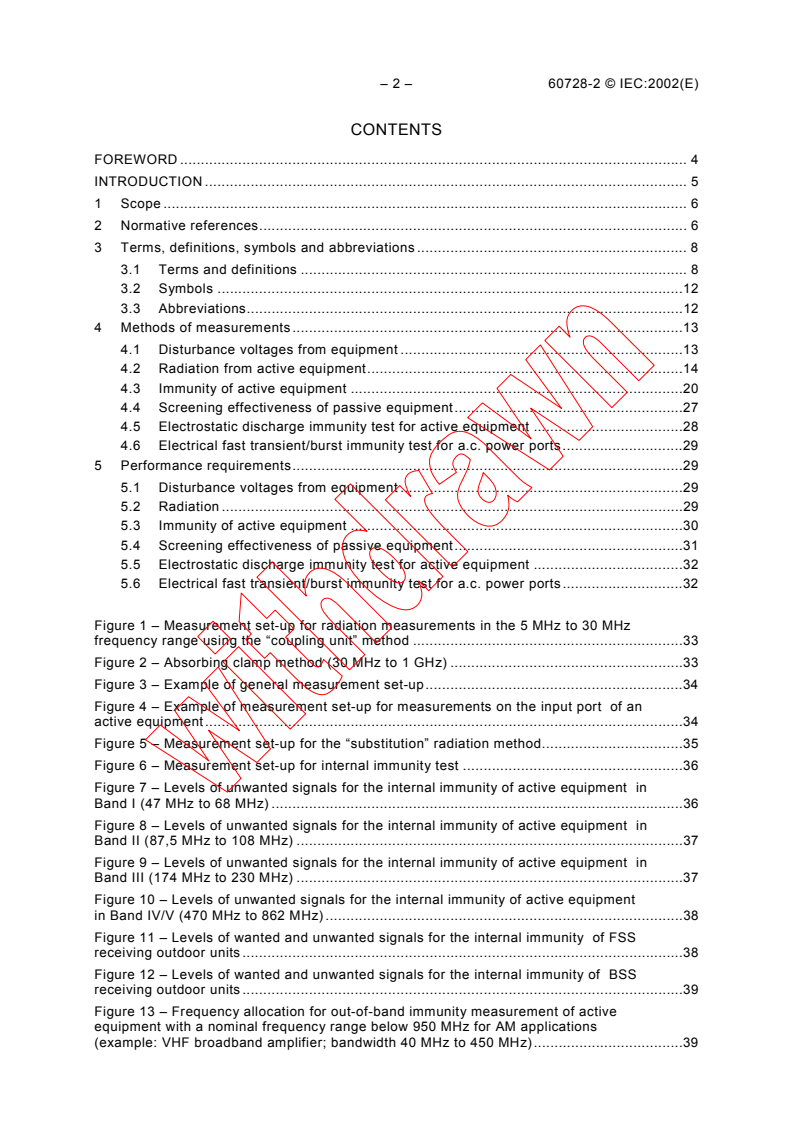
CONTENTS
FOREWORD . 4
INTRODUCTION .5
1 Scope . 6
2 Normative references. 6
3 Terms, definitions, symbols and abbreviations . 8
3.1 Terms and definitions . 8
3.2 Symbols .12
3.3 Abbreviations.12
4 Methods of measurements.13
4.1 Disturbance voltages from equipment .13
4.2 Radiation from active equipment.14
4.3 Immunity of active equipment .20
4.4 Screening effectiveness of passive equipment.27
4.5 Electrostatic discharge immunity test for active equipment .28
4.6 Electrical fast transient/burst immunity test for a.c. power ports.29
5 Performance requirements.29
5.1 Disturbance voltages from equipment .29
5.2 Radiation .29
5.3 Immunity of active equipment .30
5.4 Screening effectiveness of passive equipment.31
5.5 Electrostatic discharge immunity test for active equipment .32
5.6 Electrical fast transient/burst immunity test for a.c. power ports.32
Figure 1 – Measurement set-up for radiation measurements in the 5 MHz to 30 MHz
frequency range using the “coupling unit” method .33
Figure 2 – Absorbing clamp method (30 MHz to 1 GHz) .33
Figure 3 – Example of general measurement set-up.34
Figure 4 – Example of measurement set-up for measurements on the input port of an
active equipment.34
Figure 5 – Measurement set-up for the “substitution” radiation method.35
Figure 6 – Measurement set-up for internal immunity test .36
Figure 7 – Levels of unwanted signals for the internal immunity of active equipment in
Band I (47 MHz to 68 MHz) .36
Figure 8 – Levels of unwanted signals for the internal immunity of active equipment in
Band II (87,5 MHz to 108 MHz) .37
Figure 9 – Levels of unwanted signals for the internal immunity of active equipment in
Band III (174 MHz to 230 MHz) .37
Figure 10 – Levels of unwanted signals for the internal immunity of active equipment
in Band IV/V (470 MHz to 862 MHz) .38
Figure 11 – Levels of wanted and unwanted signals for the internal immunity of FSS
receiving outdoor units .38
Figure 12 – Levels of wanted and unwanted signals for the internal immunity of BSS
receiving outdoor units .39
Figure 13 – Frequency allocation for out-of-band immunity measurement of active
equipment with a nominal frequency range below 950 MHz for AM applications
(example: VHF broadband amplifier; bandwidth 40 MHz to 450 MHz).39
60728-2 © IEC:2002(E) – 3 –
Figure 14 – Frequency allocation for out-of-band immunity measurement of active
equipment with a nominal frequency range above 950 MHz for FM applications
(example: IF amplifier; bandwidth 950 MHz to 1750 MHz) .40
Figure 15 – Frequency allocation for in-band immunity measurement of active
equipment with nominal frequency range below 950 MHz for AM applications
(example: broadband amplifier; bandwidth 40 MHz to 862 MHz).40
Figure 16 – Frequency allocation for in-band immunity measurement of active
equipment with a nominal frequency range above 950 MHz for FM applications
(example: IF amplifier; bandwidth 950 MHz to 2 050 MHz) .41
Table 1 – Limits of mains terminal disturbance voltage.29
Table 2 – Limits of input terminal disturbance voltages .29
Table 3 – Limits of radiated disturbance power .30
Table 4 – Limits of local oscillator terminal power .30
Table 5 – Limits of out-of-band immunity (lowest level/field strength for compliance
with the performance criterion, given in 4.3).30
Table 6 – Limits of in-band immunity (lowest level/field strength for compliance with the
performance criterion, given in 4.3) .31
Table 7 – Test specification for internal immunity.31
Table 8 – Limits of immunity to image frequency signals in terms of image
suppression ratio.31
Table 9 – Limits of screening effectiveness of passive equipment within the nominal
frequency ranges .32
Table 10 – Test specifications for electrostatic discharge immunity test for active
equipment .32
Table 11 – Test specifications for electrical fast transient/burst immunity test .32
– 4 – 60728-2 © IEC:2002(E)
INTERNATIONAL ELECTROTECHNICAL COMMISSION
____________
CABLED DISTRIBUTION SYSTEMS
FOR TELEVISION AND SOUND SIGNALS –
Part 2: Electromagnetic compatibility for equipment
FOREWORD
1) The IEC (International Electrotechnical Commission) is a worldwide organization for standardization comprising
all national electrotechnical committees (IEC National Committees). The object of the IEC is to promote
international co-operation on all questions concerning standardization in the electrical and electronic fields. To
this end and in addition to other activities, the IEC publishes International Standards. Their preparation is
entrusted to technical committees; any IEC National Committee interested in the subject dealt with may
participate in this preparatory work. International, governmental and non-governmental organizations liaising
with the IEC also participate in this preparation. The IEC collaborates closely with the International
Organization for Standardization (ISO) in accordance with conditions determined by agreement between the
two organizations.
2) The formal decisions or agreements of the IEC on technical matters express, as nearly as possible, an
international consensus of opinion on the relevant subjects since each technical committee has representation
from all interested National Committees.
3) The documents produced have the form of recommendations for international use and are published in the form
of standards, technical specifications, technical reports or guides and they are accepted by the National
Committees in that sense.
4) In order to promote international unification, IEC National Committees undertake to apply IEC International
Standards transparently to the maximum extent possible in their national and regional standards. Any
divergence between the IEC Standard and the corresponding national or regional standard shall be clearly
indicated in the latter.
5) The IEC provides no marking procedure to indicate its approval and cannot be rendered responsible for any
equipment declared to be in conformity with one of its standards.
6) Attention is drawn to the possibility that some of the elements of this International Standard may be the subject
of patent rights. The IEC shall not be held responsible for identifying any or all such patent rights.
International Standard IEC 60728-2 has been prepared by technical area 5: Cable networks
for television signals, sound signals and interactive services, of IEC technical committee 100:
Audio, video and multimedia systems and equipment.
The text of this standard is based on the following documents:
FDIS Report on voting
100/535/FDIS 100/570/RVD
Full information on the voting for the approval of this standard can be found in the report on
voting indicated in the above table.
This publication has been drafted in accordance with the ISO/IEC Directives, Part 2.
The committee has decided that this publication remains valid until 2005. At this date, in
accordance with the committee’s decision, the publication will be
• reconfirmed;
• withdrawn;
• replaced by a revised edition, or
• amended.
60728-2 © IEC:2002(E) – 5 –
INTRODUCTION
Standards of the IEC 60728 series deal with cabled distribution systems for television, sound
and interactive multimedia signals including equipment, systems and installations
• for headend-reception, processing and distribution of sound and television signals and
their associated data signals and
• for processing, interfacing and transmitting all kinds of interactive signals
using all applicable transmission media.
They cover all kinds of systems such as
• CATV-systems,
• MATV- and SMATV-systems,
• individual receiving systems
and all kinds of equipment installed in such systems.
The extent of these standards is from the antennas, special signal source inputs to the
headend or other interface points to the system up to the system outlet or the terminal input,
where no system outlet exists.
The standardisation of any user terminals (i.e. tuners, receivers, decoders, multimedia
terminals, etc.) is excluded.
– 6 – 60728-2 © IEC:2002(E)
CABLED DISTRIBUTION SYSTEMS
FOR TELEVISION AND SOUND SIGNALS –
Part 2: Electromagnetic compatibility for equipment
1 Scope
This standard
– applies to the radiation characteristics and immunity to electromagnetic disturbances of
active and passive equipment for the reception, processing and distribution of television,
sound and interactive services signals, as dealt with in the following parts of IEC 60728
series:
IEC 60728-3 – “Active coaxial wideband distribution equipment”
IEC 60728-4 – “Passive coaxial wideband distribution equipment”
IEC 60728-5 – “Headend equipment”
IEC 60728-6 – “Optical equipment”
– covers the following frequency ranges:
Disturbance voltage injected into the mains 9 kHz to 30 MHz
Radiation from active equipment 5 MHz to 25 GHz
Immunity of active equipment 150 kHz to 25 GHz
Screening effectiveness of passive equipment 5 MHz to 3 GHz (25 GHz)
– specifies requirements for maximum allowed radiation, minimum immunity and minimum
screening effectiveness.
– describes test methods for conformance testing.
Coaxial cables for cabled distribution systems do not fall under the scope of this standard.
Reference is made to the EN 50117 series.
Standardisation in the field of electromagnetic compatibility for any user terminals (for
example tuners, receivers, decoders, multimedia terminals etc.) is covered by the IEC
CISPR 13 and CISPR 20.
Requirements for the electromagnetic compatibility of receiver leads are laid down in
IEC 60966-2-4, IEC 60966-2-5 and IEC 60966-2-6.
2 Normative references
The following referenced documents are indispensable for the application of this document.
For dated references, only the edition cited applies. For undated references, the latest edition
of the referenced document (including any amendments) applies.
IEC 60050(161):1990, International Electrotechnical Vocabulary (IEV) – Chapter 161: Electro-
magnetic compatibility
Amendment 1 (1997)
Amendment 2 (1998)
___________
For the frequency range 3 GHz to 25 GHz for "Screening effectiveness of passive equipment" no requirements
apply at present. Methods of measurement and limits are under investigation for inclusion in a future
amendment or revised edition.
60728-2 © IEC:2002(E) – 7 –
IEC 60728-3:2000, Cabled distribution systems for television and sound signals – Part 3: Active
coaxial wideband distribution equipment
IEC 60728-4:2000, Cabled distribution systems for television and sound signals – Part 4:
Passive coaxial wideband distribution equipment
IEC 60728-5:2001, Cabled distribution systems for television and sound signals – Part 5:
Headend equipment
IEC 60728-6:2001, Cabled distribution systems for television and sound signals – Part 6:
Optical equipment
IEC 60966-2-4:1997, Radio frequency and coaxial cable assemblies – Part 2-4: Detail
specification for cable assemblies for radio and TV receivers (Frequency range 0 to
3 000 MHz, IEC 60169-2 connectors)
IEC 60966-2-5:1998, Radio frequency and coaxial cable assemblies – Part 2-5: Detail speci-
fication for cable assemblies for radio and TV receivers – Frequency range 0 to 1 000 MHz,
IEC 60169-2 connectors
IEC 60966-2-6:1998, Radio frequency and coaxial cable assemblies – Part 2-6: Detail speci-
fication for cable assemblies for radio and TV receivers – Frequency range 0 to 3 000 MHz,
IEC 60169-24 connectors
IEC 61000-3-2:2000, Electromagnetic compatibility (EMC) – Part 3-2: Limits – Limits for
harmonic current emissions (equipment input current ≤ 16 A per phase)
Amendment 1 (2001)
IEC 61000-4-2:1995, Electromagnetic compatibility (EMC) – Part 4-2: Testing and measure-
ment techniques – Electrostatic discharge immunity test
Amendment 1 (1998)
Amendment 2 (2000)
IEC 61000-4-3 2002, Electromagnetic compatibility (EMC – Part 4-3: Testing and
measurement techniques – Radiated, radio-frequency, electromagnetic field immunity test
IEC 61000-4-4:1995, Electromagnetic compatibility (EMC) – Part 4: Testing and measurement
techniques – Section 4: Electrical fast transient/burst immunity test. Basic EMC Publication
Amendment 1 (2000)
Amendment 2 (2001)
IEC 61000-4-6:1996, Electromagnetic compatibility (EMC) – Part 4-6: Testing and measure-
ment techniques – Immunity to conducted disturbances, induced by radio-frequency fields
Amendment 1 (2000)
IEC 61000-6-1:1997, Electromagnetic compatibility (EMC) – Part 6: Generic standards –
Section 1: Immunity for residential, commercial and light-industrial environments
IEC 61079-1:1992, Methods of measurement on receivers for satellite broadcast
transmissions in the 12 GHz band – Part 1: Radio-frequency measurements on outdoor units
CISPR 13:2001, Sound and television broadcast receivers and associated equipment – Radio
disturbance characteristics – Limits and methods of measurement
– 8 – 60728-2 © IEC:2002(E)
CISPR 16-1:1999, Specification for radio disturbance and immunity measuring apparatus and
methods – Part 1: Radio disturbance and immunity measuring apparatus
CISPR 20:2002, Sound and television broadcast receivers and associated equipment –
Immunity characteristics – Limits and methods of measurement
3 Terms, definitions, symbols and abbreviations
3.1 Terms and definitions
For the purposes of this standard, the definitions given in IEC 60050-161 as well as the
following, apply.
3.1.1
radiation (electromagnetic)
1) phenomenon by which energy in the form of electromagnetic waves emanates from a
source into space
2) energy transferred through space in the form of electromagnetic waves
[IEV 161-01-10]
NOTE By extension, the term “electromagnetic radiation” sometimes also covers induction phenomena.
3.1.2
immunity (to a disturbance)
ability of a device, equipment or system to perform without degradation in the presence of an
electromagnetic disturbance
[IEV 161-01-20]
3.1.3
internal immunity
ability of a device, equipment or system to perform without degradation in the presence of
electromagnetic disturbances appearing at its normal input terminals or antenna
[IEV 161-03-06]
3.1.4
external immunity
ability of a device, equipment or system to perform without degradation in the presence of
electromagnetic disturbances entering other than via its normal input terminals or antenna
[IEV 161-03-07]
3.1.5
mains immunity
immunity to mains-borne disturbance
[IEV 161-03-03]
3.1.6
immunity level
maximum level of a given electromagnetic disturbance incident on a particular device, equip-
ment or system for which it remains capable of operating at a required level of performance
[IEV 161-03-14, modified]
60728-2 © IEC:2002(E) – 9 –
3.1.7
immunity limit
specified minimum immunity level
[IEV 161-03-15]
3.1.8
immunity margin
difference between the immunity limit of a device, equipment or system and the electro-
magnetic compatibility level
[IEV 161-03-16]
3.1.9
electromagnetic disturbance
any electromagnetic phenomenon which may degrade the performance of a device,
equipment or system, or adversely affect living or inert matter
[IEV 161-01-05]
NOTE An electromagnetic disturbance may be an electromagnetic noise, an unwanted signal or a change in the
propagation medium itself.
3.1.10
screening effectiveness
ability of an equipment or system to attenuate the influence of electromagnetic fields from out-
side the equipment or system or to suppress the radiation of electromagnetic fields from
inside the equipment or system
3.1.11
well-matched
matching condition when the return loss of the equipment complies with the requirements of
IEC 60728-3, Table 1
3.1.12
well-screened
test set-up can be considered “well-screened” if its radiation level, when terminated with a
matched load, is at least 20 dB below the expected radiation level of the equipment under
test, the test set-up and the equipment being supplied with the same input signal level
3.1.13
electromagnetic interference
EMI
degradation of the performance of an equipment, transmission channel or system caused by
an electromagnetic disturbance
3.1.14
operating frequency range
passband for the wanted signals for which the equipment has been designed
3.1.15
wanted signal
during measurements, the wanted signal shall be simulated using a sinewave test signal
having the frequency within the operating frequency range and the appropriate level
3.1.16
unwanted signal
signals inside and outside of the operating frequency range that are not considered as wanted
signals
NOTE When measuring immunity (to unwanted signals), the unwanted signal shall be simulated using two sine-
wave test signals.
– 10 – 60728-2 © IEC:2002(E)
3.1.17
first satellite intermediate frequency range
output frequency range of the outdoor unit which is comprised of the frequency band between
950 MHz and at least 3 GHz or parts thereof
3.1.18
carrier-to-interference ratio
minimum level difference measured at the output of an active equipment between the wanted
signal and
– intermodulation products of the wanted signal and/or unwanted signals generated due to
non-linearities;
– harmonics generated by an unwanted signal;
– unwanted signals that have penetrated into the operating frequency range;
– unwanted signals that have been converted to the frequency range to be protected
(operating frequency range).
3.1.19
individual receiving system
system designed to provide television and sound signals to an individual household
3.1.20
spurious signals
all unwanted signals in the frequency range of interest
3.1.21
band
nominal operating frequency range of the equipment
3.1.22
electrostatic discharge (ESD)
transfer of electric charge between bodies of different electrostatic potential in proximity or
through direct contact
[IEV 161-01-22]
3.1.23
transient (adjective and noun)
pertaining to or designating a phenomenon or a quantity which varies between two
consecutive steady states during a time interval short compared with the time-scale of interest
[IEV 161-02-01]
3.1.24
burst
sequence of a limited number of distinct pulses or an oscillation of limited duration
[IEV 161-02-07]
3.1.25
test levels
the preferential range of test level for ESD or fast transient test
3.1.26
port
particular interface of the specific equipment with the external electromagnetic environment
60728-2 © IEC:2002(E) – 11 –
Enclosure port
AC power port Signal port
EQUIPMENT
DC power port Control port
IEC 2450/02
3.1.27
enclosure port
physical boundary of the equipment through which electromagnetic fields may be transmitted
3.1.28
signal port
point at which a cable for the wanted signal is connected to the equipment
3.1.29
control port
point at which a cable for the control signal is connected to the equipment
3.1.30
a.c. power port
point at which a cable for the a.c. power supply is connected to the equipment
3.1.31
d.c. power port
point at which a cable for the d.c. power supply is connected to the equipment
3.1.32
in-band immunity
immunity against disturbance at any frequency of the wanted signals carried at the interfaces
and used internally within the equipment under test (for example input/output frequencies, IF,
video band, etc.)
3.1.33
out-of-band immunity
immunity against disturbance from signals outside the frequency band(s) of the wanted signal
carried at the interfaces and used internally within the equipment under test (for example
input/output frequencies, IF, video band, etc.)
3.1.34
RF signal port
antenna input port or RF network port
3.1.35
antenna input port
input terminal of the equipment (for example channel converter, DBS tuner,.) under test
3.1.36
RF network port
point at which a coaxial cable for the wanted RF signals is connected to the equipment but
excluding direct connection to the antenna
– 12 – 60728-2 © IEC:2002(E)
3.2 Symbols
The following graphical symbols are used in the figures of this standard. These symbols are
either listed in IEC 60617 or based on symbols defined in IEC 60617.
Sine-wave generator Variable attenuator
G
(10-13-02) (10-16-02)
A
Low-pass filter Signal combiner
ΣΣΣΣ
(10-16-05) (02-01-01)
Spectrum analyser Power meter
P(f)
P
(02-01-01, 08-01-01) (02-01-01, 08-01-01)
Equipment under test Coupler
EUT
(02-01-01) (10-09-09)
3.3 Abbreviations
The following abbreviations are used in this standard:
AC or a.c. Alternating Current
AM Amplitude Modulation
BSS Broadcast Satellite Services
CATV Community Antenna Television (system)
COFDM Coherent Orthogonal Frequency Division Multiplex
CW Continuous Wave
DBS Direct Broadcast Satellite
DC or d.c. Direct current
DSR Digital Satellite Radio
EMC Electromagnetic Compatibility
emf Electromotive force
EMI Electromagnetic interference
EUT Equipment Under Test
FM Frequency Modulation
FSS Fixed Satellite Services
IF Intermediate Frequency
MATV Master Antenna Television (system)
QAM Quadrature Amplitude Modulation
QPSK Quadrature Phase Shift Keying
RF Radio Frequency
SAT Satellite
S-channel Special channel
SMATV Satellite Master Antenna Television (system)
TV Television
VHF Very High Frequency
VSB Vestigial Side Band
60728-2 © IEC:2002(E) – 13 –
4 Methods of measurements
Measurements shall be, unless otherwise specified, carried out with the rated performance of
the equipment under test and at a standard room temperature. If required, additional
measurements shall be carried out at the highest and lowest rated ambient temperatures.
The equipment shall be tested including all those sub-assemblies with which it would normally
be used.
4.1 Disturbance voltages from equipment
4.1.1 Disturbance voltages from equipment in the 9 kHz to 30 MHz frequency range
The method described is applicable to the measurement of disturbance voltages from equip-
ment in the 9 kHz to 30 MHz frequency range on the mains line.
The measured voltage includes narrow-band interference and broadband interference such as
that produced by semiconductor rectifiers.
4.1.1.1 General measurement requirements
Disturbance voltage measurements should be carried out in a screened room according to the
method described in CISPR 13, with the exception that the wanted signal is a sinusoidal
carrier. At all frequencies in the range of interest, the disturbance voltage injected into the
mains by the equipment under test shall be measured by means of a specified artificial mains
network with a measuring receiver having a quasi-peak detector for broadband measurements
and an average detector for narrow-band measurements.
4.1.1.2 Measurement of mains terminal disturbance voltages
• Equipment required: according to CISPR 13.
• Equipment layout and connections: according to CISPR 13.
• Operating conditions:
The equipment under test shall be operated in accordance with the manufacturer’s
recommendations and tested under conditions which maximise the disturbance voltages.
All RF-ports shall be terminated with non-radiating loads of their nominal impedance. The
supply voltage shall be set to a value within the specified rating.
• Measuring procedure: according to CISPR 13.
• Presentation of results: according to CISPR 13.
The results shall be expressed in terms of dB(µV) and shall comply with the limits given
in Table 1.
4.1.2 Disturbance voltages from equipment at the a.c. mains
frequency and its harmonics
If the input current rating is within the scope of IEC 61000-3-2, the limits and test methods of
this standard shall apply.
4.1.3 Measurement of input terminal disturbance voltage
4.1.3.1 Method of measurement
The measurement shall be performed according to the method described in CISPR 13 where
“antenna terminal” should be intended as “input terminal” of the equipment (for example
channel converter, DBS tuner, etc.) under test.
– 14 – 60728-2 © IEC:2002(E)
4.1.3.2 Presentation of the results
The disturbance voltage level of the equipment under test at the local oscillator frequency and
its harmonics shall be expressed in terms of input terminal disturbance voltage in dB(µV)
and shall comply with the relevant limits given in Table 2.
4.2 Radiation from active equipment
The methods described are applicable to the measurement of radiation from active equipment
at the signal frequencies, at the local oscillator frequencies and their harmonics and at other
relevant frequencies.
In the 5 MHz to 30 MHz frequency range the “coupling unit” method is used.
In the 30 MHz to 950 MHz frequency range the “absorbing clamp” method of CISPR 13 is
used.
In the 950 MHz to 25 GHz frequency range the “substitution” method is used.
4.2.1 General measurement requirements
The measurement cables, coupling devices and terminations shall all be well-matched and
well-screened. If these conditions cannot be achieved, appropriate corrections shall be made
for the results. Test equipment shall have an impedance of 75 Ω or be provided with
appropriate matching pads.
An indoor, or outdoor, site may be used. When indoors, a room of sufficient size must be
chosen, so that any reflecting and absorbing objects may be so positioned or sufficiently
removed from the measuring set-up that they do not influence the results.
Measurements shall be made at the following ports:
• all RF-ports;
• the mains lead (if any);
• all single or multiple wire connections (if any).
Measurements shall be made at the following frequencies:
a) Single channel equipment
• at the vision and sound carrier frequencies;
• at any other frequency where disturbance can occur.
b) Wideband equipment
• at the highest and lowest vision carrier frequencies in each used band and at a
selection of intervening frequencies chosen to give a realistic representation of the
radiation pattern throughout the operating frequency range.
• at any other frequency where disturbance can occur.
c) Frequency converters
Output ports and mains lead (if any):
• at the input and output vision and sound carrier frequencies;
• at all local oscillator fundamental frequencies;
• at any local oscillator harmonic, and any other frequencies where disturbance can
occur.
60728-2 © IEC:2002(E) – 15 –
Input ports:
• at all local oscillator fundamental frequencies;
• at selected local oscillator harmonics, or other frequencies (as above).
4.2.2 Methods of measurements
4.2.2.1 Measurement of radiation in the 5 MHz to 30 MHz frequency range
For the measurement of radiation in the 5 MHz to 30 MHz frequency range the coupling unit
method suitable for coaxial cables with a characteristic impedance of 75 Ω shall be used to
measure the conducted emissions from the equipment under test.
NOTE The use of the absorbing clamp method in this frequency range is also possible. This clamp has similar
properties as the 150 Ω coupling units and can be used whenever the coupling units cannot be realised or applied
(either due to the number of conductors in one cable or due to the size of the installation or for other reasons). The
measurement set-up and the calibration factors are shown in the manual of the injection clamp.
4.2.2.1.1 Equipment required
The following equipment is required:
• One or more signal generators for the wanted signals.
• A RF measuring receiver or spectrum analyser covering the frequency range of interest.
• Combiners (for pilot signals).
• Appropriate coupling units (see CISPR 20).
• Well screened terminating loads and cables.
NOTE 1 All equipment used for the measurement set-up must be well screened to avoid inaccurate measuring
results. Especially the coaxial coupling units have to be designed for a screening effectiveness greater than
100 dB.
NOTE 2 It should be ascertained that the level of background interfering signals (ingress) is at least 10 dB below
the relevant limit, otherwise the result may be significantly affected.
4.2.2.1.2 Equipment layout and connections
The layout of the test equipment is shown in Figure 1. The equipment under test is placed
10 cm above a metallic ground plane of dimension 1 m × 2 m. The coupling units are inserted
into the cables. The wanted signal generator is connected to the coupling unit which is
connected to the input of the equipment under test. The RF measuring receiver shall be
connected to the measuring output of each coupling unit successively. The cables connecting
the coupling units to the equipment under test shall be as short as possible.
The cables to the input and output of the equipment should be no longer than 30 cm and
the mains lead (if any) should be bundled to give a length of 30 cm. The distance between the
leads or cables and the ground plane shall be not less than 3 cm.
The mains lead (if any) is not connected to a coupling unit but shall be provided with
absorbing devices to avoid the influence of disturbance voltages on the mains lead.
4.2.2.1.3 Operating conditions
The equipment under test shall operate in accordance with the manufacturers recommend-
ations and under conditions which maximise the radiation. The maximum rated output level
shall be used for the test and stated on the equipment or accompanying data sheet by the
manufacturer.
– 16 – 60728-2 © IEC:2002(E)
4.2.2.1.4 Measurement procedure
The generator for the wanted signal is adjusted to the required test frequency and its level is
set to the maximum specified operating level at the output of the equipment.
The measuring receiver is successively connected to all coupling units. All unused ports shall
be terminated.
For each measuring frequency, the maximum reading is noted.
4.2.2.1.5 Presentation of the results
The readings on the measuring set have to be corrected according to the coupling attenuation
of the used coupling units.
For coupling units with R = 75 Ω, the coupling attenuation is 3 dB.
In this case, a measuring receiver of 75 Ω impedance has to be used.
NOTE Alternatively coupling units with R = 100 Ω can be used for measuring receivers with 50 Ω input
impedance. In this case, the coupling attenuation is about 5 dB (4,77 dB).
The radiation level of the equipment under test shall be expressed in terms of power
in dB(pW) and shall comply with the limits given in Table 3.
4.2.2.2 Measurement of radiation in the 30 MHz to 950 MHz frequency range
using the “absorbing clamp” method
4.2.2.2.1 Equipment required
The equipment required for the “absorbing clamp” method is listed below.
• A signal generator covering the frequency range of interest and of sufficient output power.
• An absorbing clamp conforming to CISPR 16-1.
• A measuring set of appropriate impedance covering the frequency range of interest.
• A measurement cable of length at least λ/2 (at the lowest frequency of interest) plus 0,6 m
and of appropriate impedance.
• Screened terminating loads of appropriate impedance and design.
• All necessary coupling devices of an appropriate design.
• A mains filter able to remove extraneous noise from the mains supply in the frequency
range of interest.
• Absorbing devices such as ferrite rings sufficient to suppress signals from the equipment
under test on its input and mains leads.
• A suitable coaxial changeover switch.
4.2.2.2.2 Equipment layout and connections
The measurement set-up and equipment layout for the “absorbing clamp” method (30 MHz to
950 MHz) is shown in Figures 2, 3 and 4.
The equipment under test shall be placed at a height of approximately 1 m above the ground
on a non-metallic support on which the absorbing clamp can be accommodated and moved.
If no input signal is required (for example for measurements of local oscillator radiated
power), the input shall be terminated by means of a well screened load. For measurements of
local oscillator power at the input of the outdoor unit, see 4.2.2.4
60728-2 © IEC:2002(E) – 17 –
The output of the equipment under test shall be connected to a measurement cable of the
same characteristic impedance and the cable shall be terminated with the nominal impedance
of the output via the coaxial switch.
Well-screened cables shall be connected to the terminals of the equipment under test as
specified by the manufacturer. When a direct connection cannot be made due to the
dimension of the well-screened cable, an adaptor shall be used.
The unused outputs, if any, of the equipment under test shall be terminated with their nominal
impedance by means of non-radiating loads directly connected without any cabling.
The mains lead, if any, shall be placed vertically and be connected to the mains outlet through
a suitable mains filter. Any excess length of the mains lead shall be coiled up neatly at the
filter end.
The mains lead and the signal generator coaxial cable shall be provided with suitable
absorbing devices (for example ferrite rings), placed close to the equipment under test, to
avoid measurement errors.
4.2.2.2.3 Operating conditions
The equipment under test shall be operated in accordance with the manufacturer's
recommendations.
The equipment under test shall be tested under conditions which maximise the radiation. The
maximum rated output level shall be used for the test and stated on the equipment or
accompanying data sheet by the manufacturer.
The supply voltage shall be set to a value within the specified rating.
Adjustable controls accessible to the user or installer shall be set so as to maximise radiation.
The signal generator at the input shall be adjusted so that the maximum rated output level,
within the operating range of the equipment under test, is used.
For sensibly consistent results, the dispositions of the signal generator cable preceding the
absorbing device, the mains lead, the measurement cable beyond the absorbing clamp and
their proximity to other items shall not influence the readings on the measuring set by more
than ± 1 dB. This can be checked by moving the cables and by running the hand along their
length after setting up the equipment in accordance with Figures 2 and either 3 or 4.
NOTE 1 At frequencies below about 100 MHz, it may be necessary to add a second absorbing clamp at the far
end of the measurement cable as shown in Figure 2. This is to compensate for the reduced absorption of the clamp
at these frequencies.
NOTE 2 The absorbing clamp can be calibrated in accordance with the relevant Clauses of CISPR 16-1.
4.2.2.2.4 Measurement procedure
With the equipment set-up as shown in Figures 2 and 3, and the measurement cable coupled
to an output port of the equipment under test, the absorbing clamp is positioned at the
equipment end of the measurement cable and the coaxial switch placed in the “check level”
position. Adjust the signal generator to the test frequency and to an input level that will give
the maximum rated output level from the equipment under test.
Tune the measuring set. Turn the coaxial switch to the “measure radiation” mode. Move the
absorbing clamp along the cable away from the equipment until a maximum reading is
obtained on the measuring set (at a spacing of about λ/2).
– 18 – 60728-2 © IEC:2002(E)
This procedure is repeated for each of the test frequencies and for each of the measurement
ports.
For radiation measurements on a frequency converter output port, note that the input signal
generator shall be set in turn to the input frequencies used and the measuring set tuned to
each of the particular output frequencies.
For radiation measurements on the mains lead of active equipment, the equipment shall be
connected as shown in Figure 3, except that the mains lead without absorbing devices,
extended if necessary, shall pass through the absorbing clamp in place of the measurement
cable. Measurements shall be carried out as described above except that the “check-level”
position of the coaxial switch is inoperative with this arrangement. Set the signal generator
output level to that used when measuring the output port.
4.2.2.2.5 Presentation of results
The readings on the measurement set have to be corrected according to the calibration curve
of the absorbing clamp to obtain the radiated power.
The radiation level of the equipment under test shall be expressed in terms of substituted
power in dB(pW) and shall comply with the limits given in Table 3.
4.2.2.3 Measurement of radiation in the 950 MHz to 25 GHz frequency range
using the “substitution” method
4.2.2.3.1 Equipment required
The equipment required for the “substitution” method is listed below:
• A signal and/or pilot frequency generator covering the frequency range of interest and of
sufficient output power.
• Suitable receiving antennas covering the frequency range(s) of interest.
• Suitable calibrated transmitting antennas covering the frequency range(s) of interest.
• A spectrum analyser of appropriate impedance covering the frequency range of interest.
• High quality connecting coaxial cables of appropriate impedance.
• Screened terminating loads of appropriate impedance and design.
• A mains filter able to remove extraneous noise from the mains supply in the frequency
range of interest.
• A low-noise preamplifier (if needed).
4.2.2.3.2 Equipment layout and connections
The equipment under test shall be placed
...