


IEC 62637-1:2011
(Main)Battery charging interface for small handheld multimedia devices - Part 1: 2 mm barrel interface
Battery charging interface for small handheld multimedia devices - Part 1: 2 mm barrel interface
IEC 62637-1:2011 defines a charging interface between small handheld multimedia devices and power-supply accessories, specifically chargers. Devices, which could be based on this standard may vary over time, but have to comply with the limited power available. The interface is a 2 mm barrel type charging interface. The French version of this standard has not been voted upon. This bilingual version (2011-07) replaces the English version.
Interface de charge de batterie pour petits appareils multimédia portables - Partie 1: Spécification de l'interface cylindrique 2 mm
La CEI 62637-1:2011 définit une interface de charge entre de petits appareils multimédia portables et des accessoires d'alimentation, en particulier des chargeurs. Les appareils selon la présente norme peuvent varier dans le temps, mais ils doivent rester dans la limite de la puissance disponible. L'interface est une interface de charge de type cylindrique 2 mm. La version française de cette norme n'a pas été soumise au vote. La présente version bilingue,publiée en 2011-07, correspond à la version anglaise.
General Information
- Status
- Published
- Publication Date
- 29-Mar-2011
- Technical Committee
- TC 100 - Audio, video and multimedia systems and equipment
- Current Stage
- PPUB - Publication issued
- Start Date
- 30-Mar-2011
- Completion Date
- 31-Mar-2011
Overview - IEC 62637-1:2011 (2 mm barrel interface)
IEC 62637-1:2011 specifies a standardized battery charging interface between small handheld multimedia devices and power‑supply accessories (chargers). The physical interface is a 2 mm barrel connector and the standard defines the electrical and mechanical interfaces, charger identification, and accessory connection rules. It does not cover full charger internals or device internal functions; chargers and devices must still meet applicable EMC and safety standards.
Key topics and technical requirements
The standard focuses on practical electrical limits and connector details to ensure interoperability and device protection:
- Connector type: 2 mm barrel charging plug/receptacle with defined mechanical details.
- Charger output capacitance: maximum 1000 µF (+20%) for output voltages below 7 V; linearly reduced to 700 µF (+20%) at 9.3 V.
- Transient limits:
- Maximum charger output overshoot: 16 V.
- Maximum reverse voltage at charger output: 1 V.
- Maximum settling time after load change: 10 ms (to within ±10%).
- Maximum duration of charging current overshoot (>1.1 A): 5 ms.
- Maximum output voltage undershoot for load currents ≤100 mA: 4.1 V.
- Ripple and noise:
- Maximum output ripple 300 mV RMS for output voltages between 2.5 V and 5.5 V.
- Total peak‑to‑peak ripple across 0 Hz–1 MHz limited to 800 mV p‑p.
- Charging window & current behavior: defined charging voltage/current window and requirements for current linearity and control (see clause 5.6).
- Accessory interfaces: electrical specifications for accessories placed between charger and device, plus rules for device booting when connected to accessories.
- Charger identification: defined method for identifying charger capabilities via the interface.
Applications and who uses this standard
IEC 62637-1 is intended for organizations designing and manufacturing:
- Mobile phones, MP3 players, digital cameras, portable GPS and gaming devices.
- Charger and power‑supply accessory manufacturers.
- OEMs and contract manufacturers who need a consistent 2 mm barrel charging interface to ensure cross‑compatibility and safe charging behavior.
- Test labs and compliance engineers evaluating charger‑to‑device interoperability and transient/noise performance.
Practical benefits include simplified accessory ecosystems, reduced risk of damage from wrong chargers, and predictable performance across devices using limited power budgets.
Related standards
- IEC 62637-2 - Part 2: conformance testing for the 2 mm barrel type interface (normative reference in Part 1).
- Devices and chargers must still comply with applicable national/international EMC and safety standards referenced in product dossiers.
Keywords: IEC 62637-1, 2 mm barrel interface, battery charging interface, charger specifications, output capacitance, ripple voltage, charger identification, small handheld multimedia devices.
Buy Documents
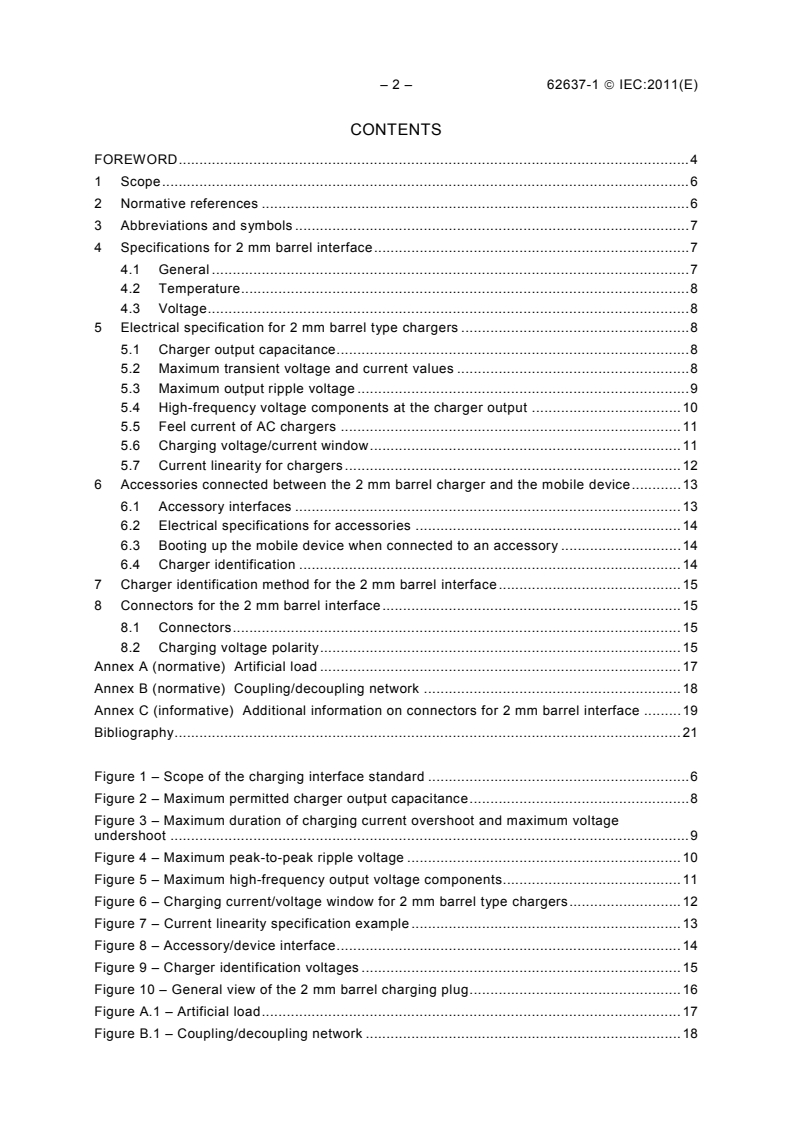
IEC 62637-1:2011 - Battery charging interface for small handheld multimedia devices - Part 1: 2 mm barrel interface Released:3/30/2011 Isbn:9782889123988
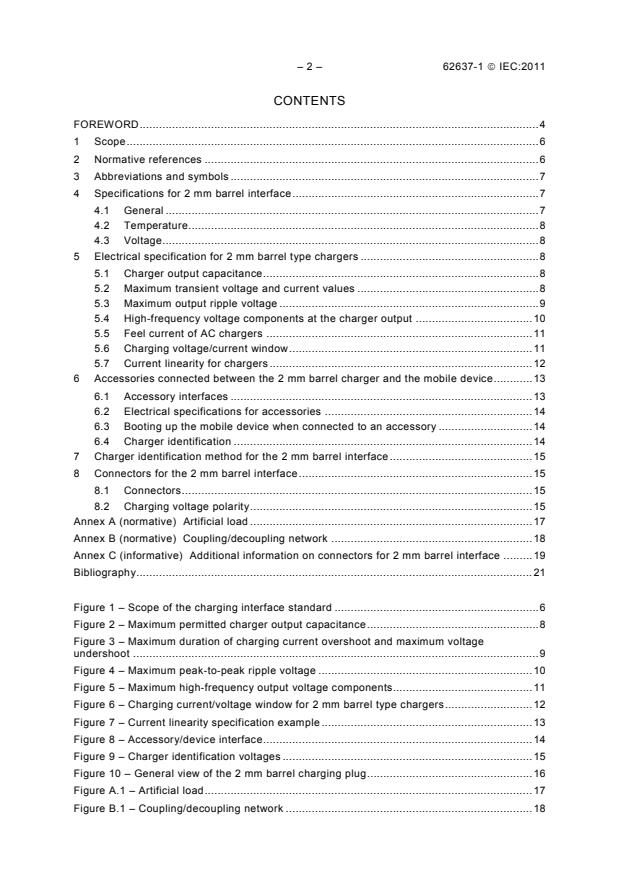
IEC 62637-1:2011 - Battery charging interface for small handheld multimedia devices - Part 1: 2 mm barrel interface
Get Certified
Connect with accredited certification bodies for this standard

TL 9000 QuEST Forum
Telecommunications quality management system.

ANCE
Mexican certification and testing association.

Intertek Slovenia
Intertek testing, inspection, and certification services in Slovenia.
Sponsored listings
Frequently Asked Questions
IEC 62637-1:2011 is a standard published by the International Electrotechnical Commission (IEC). Its full title is "Battery charging interface for small handheld multimedia devices - Part 1: 2 mm barrel interface". This standard covers: IEC 62637-1:2011 defines a charging interface between small handheld multimedia devices and power-supply accessories, specifically chargers. Devices, which could be based on this standard may vary over time, but have to comply with the limited power available. The interface is a 2 mm barrel type charging interface. The French version of this standard has not been voted upon. This bilingual version (2011-07) replaces the English version.
IEC 62637-1:2011 defines a charging interface between small handheld multimedia devices and power-supply accessories, specifically chargers. Devices, which could be based on this standard may vary over time, but have to comply with the limited power available. The interface is a 2 mm barrel type charging interface. The French version of this standard has not been voted upon. This bilingual version (2011-07) replaces the English version.
IEC 62637-1:2011 is classified under the following ICS (International Classification for Standards) categories: 33.160.99 - Other audio, video and audiovisual equipment; 97.180 - Miscellaneous domestic and commercial equipment. The ICS classification helps identify the subject area and facilitates finding related standards.
IEC 62637-1:2011 is available in PDF format for immediate download after purchase. The document can be added to your cart and obtained through the secure checkout process. Digital delivery ensures instant access to the complete standard document.
Standards Content (Sample)
IEC 62637-1 ®
Edition 1.0 2011-03
INTERNATIONAL
STANDARD
Battery charging interface for small handheld multimedia devices –
Part 1: 2 mm barrel interface
All rights reserved. Unless otherwise specified, no part of this publication may be reproduced or utilized in any form
or by any means, electronic or mechanical, including photocopying and microfilm, without permission in writing from
either IEC or IEC's member National Committee in the country of the requester.
If you have any questions about IEC copyright or have an enquiry about obtaining additional rights to this publication,
please contact the address below or your local IEC member National Committee for further information.
IEC Central Office
3, rue de Varembé
CH-1211 Geneva 20
Switzerland
Email: inmail@iec.ch
Web: www.iec.ch
About the IEC
The International Electrotechnical Commission (IEC) is the leading global organization that prepares and publishes
International Standards for all electrical, electronic and related technologies.
About IEC publications
The technical content of IEC publications is kept under constant review by the IEC. Please make sure that you have the
latest edition, a corrigenda or an amendment might have been published.
Catalogue of IEC publications: www.iec.ch/searchpub
The IEC on-line Catalogue enables you to search by a variety of criteria (reference number, text, technical committee,…).
It also gives information on projects, withdrawn and replaced publications.
IEC Just Published: www.iec.ch/online_news/justpub
Stay up to date on all new IEC publications. Just Published details twice a month all new publications released. Available
on-line and also by email.
Electropedia: www.electropedia.org
The world's leading online dictionary of electronic and electrical terms containing more than 20 000 terms and definitions
in English and French, with equivalent terms in additional languages. Also known as the International Electrotechnical
Vocabulary online.
Customer Service Centre: www.iec.ch/webstore/custserv
If you wish to give us your feedback on this publication or need further assistance, please visit the Customer Service
Centre FAQ or contact us:
Email: csc@iec.ch
Tel.: +41 22 919 02 11
Fax: +41 22 919 03 00
IEC 62637-1 ®
Edition 1.0 2011-03
INTERNATIONAL
STANDARD
Battery charging interface for small handheld multimedia devices –
Part 1: 2 mm barrel interface
INTERNATIONAL
ELECTROTECHNICAL
COMMISSION
PRICE CODE
S
ICS 33.160.99; 97.180 ISBN 978-2-88912-398-8
– 2 – 62637-1 IEC:2011(E)
CONTENTS
FOREWORD . 4
1 Scope . 6
2 Normative references . 6
3 Abbreviations and symbols . 7
4 Specifications for 2 mm barrel interface . 7
4.1 General . 7
4.2 Temperature . 8
4.3 Voltage . 8
5 Electrical specification for 2 mm barrel type chargers . 8
5.1 Charger output capacitance . 8
5.2 Maximum transient voltage and current values . 8
5.3 Maximum output ripple voltage . 9
5.4 High-frequency voltage components at the charger output . 10
5.5 Feel current of AC chargers . 11
5.6 Charging voltage/current window . 11
5.7 Current linearity for chargers . 12
6 Accessories connected between the 2 mm barrel charger and the mobile device . 13
6.1 Accessory interfaces . 13
6.2 Electrical specifications for accessories . 14
6.3 Booting up the mobile device when connected to an accessory . 14
6.4 Charger identification . 14
7 Charger identification method for the 2 mm barrel interface . 15
8 Connectors for the 2 mm barrel interface . 15
8.1 Connectors . 15
8.2 Charging voltage polarity . 15
Annex A (normative) Artificial load . 17
Annex B (normative) Coupling/decoupling network . 18
Annex C (informative) Additional information on connectors for 2 mm barrel interface . 19
Bibliography . 21
Figure 1 – Scope of the charging interface standard . 6
Figure 2 – Maximum permitted charger output capacitance . 8
Figure 3 – Maximum duration of charging current overshoot and maximum voltage
undershoot . 9
Figure 4 – Maximum peak-to-peak ripple voltage . 10
Figure 5 – Maximum high-frequency output voltage components. 11
Figure 6 – Charging current/voltage window for 2 mm barrel type chargers . 12
Figure 7 – Current linearity specification example . 13
Figure 8 – Accessory/device interface . 14
Figure 9 – Charger identification voltages . 15
Figure 10 – General view of the 2 mm barrel charging plug . 16
Figure A.1 – Artificial load . 17
Figure B.1 – Coupling/decoupling network . 18
62637-1 IEC:2011(E) – 3 –
Figure C.1 – 2 mm barrel charging plug – Details. 19
Figure C.2 – 2 mm barrel charging receptacle – Details . 19
Figure C.3 – Bending durability . 20
Table 1 – Limits for maximum voltage and settling time . 9
Table 2 – Maximum ripple voltage in different frequency ranges . 10
Table 3 – Maximum conducted interference . 10
Table 4 – Electrical specification for accessory contacts . 14
– 4 – 62637-1 IEC:2011(E)
INTERNATIONAL ELECTROTECHNICAL COMMISSION
____________
BATTERY CHARGING INTERFACE FOR SMALL HANDHELD
MULTIMEDIA DEVICES –
Part 1: 2 mm barrel interface
FOREWORD
1) The International Electrotechnical Commission (IEC) is a worldwide organization for standardization comprising
all national electrotechnical committees (IEC National Committees). The object of IEC is to promote
international co-operation on all questions concerning standardization in the electrical and electronic fields. To
this end and in addition to other activities, IEC publishes International Standards, Technical Specifications,
Technical Reports, Publicly Available Specifications (PAS) and Guides (hereafter referred to as “IEC
Publication(s)”). Their preparation is entrusted to technical committees; any IEC National Committee interested
in the subject dealt with may participate in this preparatory work. International, governmental and non-
governmental organizations liaising with the IEC also participate in this preparation. IEC collaborates closely
with the International Organization for Standardization (ISO) in accordance with conditions determined by
agreement between the two organizations.
2) The formal decisions or agreements of IEC on technical matters express, as nearly as possible, an international
consensus of opinion on the relevant subjects since each technical committee has representation from all
interested IEC National Committees.
3) IEC Publications have the form of recommendations for international use and are accepted by IEC National
Committees in that sense. While all reasonable efforts are made to ensure that the technical content of IEC
Publications is accurate, IEC cannot be held responsible for the way in which they are used or for any
misinterpretation by any end user.
4) In order to promote international uniformity, IEC National Committees undertake to apply IEC Publications
transparently to the maximum extent possible in their national and regional publications. Any divergence
between any IEC Publication and the corresponding national or regional publication shall be clearly indicated in
the latter.
5) IEC itself does not provide any attestation of conformity. Independent certification bodies provide conformity
assessment services and, in some areas, access to IEC marks of conformity. IEC is not responsible for any
services carried out by independent certification bodies.
6) All users should ensure that they have the latest edition of this publication.
7) No liability shall attach to IEC or its directors, employees, servants or agents including individual experts and
members of its technical committees and IEC National Committees for any personal injury, property damage or
other damage of any nature whatsoever, whether direct or indirect, or for costs (including legal fees) and
expenses arising out of the publication, use of, or reliance upon, this IEC Publication or any other IEC
Publications.
8) Attention is drawn to the Normative references cited in this publication. Use of the referenced publications is
indispensable for the correct application of this publication.
9) Attention is drawn to the possibility that some of the elements of this IEC Publication may be the subject of
patent rights. IEC shall not be held responsible for identifying any or all such patent rights.
International Standard IEC 62637-1 has been prepared by technical area 1: Terminals for
audio, video and data services and content, of IEC technical committee 100: Audio, video and
multimedia systems and equipment.
The text of this standard is based on the following documents:
CDV Report on voting
100/1673/CDV 100/1749/RVC
Full information on the voting for the approval of this standard can be found in the report on
voting indicated in the above table.
This publication has been drafted in accordance with the ISO/IEC Directives, Part 2.
62637-1 IEC:2011(E) – 5 –
A list of all parts of the IEC 62637 series, under the general title Battery charging interface for
small handheld multimedia devices, can be found on the IEC website.
The committee has decided that the contents of this publication will remain unchanged until
the stability date indicated on the IEC web site under "http://webstore.iec.ch" in the data
related to the specific publication. At this date, the publication will be
• reconfirmed,
• withdrawn,
• replaced by a revised edition, or
• amended.
A bilingual version of this publication may be issued at a later date.
– 6 – 62637-1 IEC:2011(E)
BATTERY CHARGING INTERFACE FOR SMALL HANDHELD
MULTIMEDIA DEVICES –
Part 1: 2 mm barrel interface
1 Scope
This part of IEC 62637 defines a charging interface between small handheld multimedia
devices and power-supply accessories, specifically chargers. Devices, which could be based
on this standard may vary over time, but have to comply with the limited power available .
The interface is a 2 mm barrel type charging interface. This standard does not include the
whole charger nor does it include the internal functions of the device. Chargers and devices
shall follow the applicable EMC and safety standards. The scope of this part of IEC 62637 is
illustrated in Figure 1.
Charger Battery
Mobile device
Operational, safety and
Operational, safety, Operational, safety and reliability
reliability standards
reliability standards standards,
National / International
National / International National / International Standards
Standards
Standards
EM SW
Charger HW component
Battery specifications
specifications specification EM IC
including protection circuitry
Protection Protection / safety Battery
Protection Charging
Energy
elements cell
elements
elements solution
Charger interface specification
- Electrical parameters
- Mechanical parameters
IEC 481/11
Figure 1 – Scope of the charging interface standard
2 Normative references
The following referenced documents are indispensable for the application of this document.
For dated references, only the edition cited applies. For undated references, the latest edition
of the referenced document (including any amendments) applies.
IEC 62637-2, Battery charging interface for small handheld multimedia devices – Part 2:
2 mm barrel type interface conformance testing
———————
Devices like mobile phones, MP-3 players, portable radio receivers, small handheld TV receivers, GPS-
navigators, gaming devices, digital cameras may use this interface if the delivered power is adequate.
62637-1 IEC:2011(E) – 7 –
3 Abbreviations and symbols
For the purposes of this document, the following abbreviations apply.
AC Alternating Current
C Capacitance F
CDN Coupling/Decoupling Network
Crest factor Current peak value/current RMS value
dB Decibel
dB(mW) Power in dB referring to 1 mW
DC Direct Current
EM Energy Management
EMC Electromagnetic Compatibility
ESR Effective Series Resistance Ω
f Frequency in Hz
f Charging current change frequency Hz
Ichar
GND Ground
HW HardWare
I Current A
I Charging current A
char
I Maximum current A
max
I Peak current A
peak
IC Integrated C
...
IEC 62637-1 ®
Edition 1.0 2011-03
INTERNATIONAL
STANDARD
NORME
INTERNATIONALE
Battery charging interface for small handheld multimedia devices –
Part 1: 2 mm barrel interface
Interface de charge de batterie pour petits appareils multimédia portables –
Partie 1: Spécification de l'interface cylindrique 2 mm
All rights reserved. Unless otherwise specified, no part of this publication may be reproduced or utilized in any form or by
any means, electronic or mechanical, including photocopying and microfilm, without permission in writing from either IEC or
IEC's member National Committee in the country of the requester.
If you have any questions about IEC copyright or have an enquiry about obtaining additional rights to this publication,
please contact the address below or your local IEC member National Committee for further information.
Droits de reproduction réservés. Sauf indication contraire, aucune partie de cette publication ne peut être reproduite
ni utilisée sous quelque forme que ce soit et par aucun procédé, électronique ou mécanique, y compris la photocopie
et les microfilms, sans l'accord écrit de la CEI ou du Comité national de la CEI du pays du demandeur.
Si vous avez des questions sur le copyright de la CEI ou si vous désirez obtenir des droits supplémentaires sur cette
publication, utilisez les coordonnées ci-après ou contactez le Comité national de la CEI de votre pays de résidence.
IEC Central Office
3, rue de Varembé
CH-1211 Geneva 20
Switzerland
Email: inmail@iec.ch
Web: www.iec.ch
About the IEC
The International Electrotechnical Commission (IEC) is the leading global organization that prepares and publishes
International Standards for all electrical, electronic and related technologies.
About IEC publications
The technical content of IEC publications is kept under constant review by the IEC. Please make sure that you have the
latest edition, a corrigenda or an amendment might have been published.
Catalogue of IEC publications: www.iec.ch/searchpub
The IEC on-line Catalogue enables you to search by a variety of criteria (reference number, text, technical committee,…).
It also gives information on projects, withdrawn and replaced publications.
IEC Just Published: www.iec.ch/online_news/justpub
Stay up to date on all new IEC publications. Just Published details twice a month all new publications released. Available
on-line and also by email.
Electropedia: www.electropedia.org
The world's leading online dictionary of electronic and electrical terms containing more than 20 000 terms and definitions
in English and French, with equivalent terms in additional languages. Also known as the International Electrotechnical
Vocabulary online.
Customer Service Centre: www.iec.ch/webstore/custserv
If you wish to give us your feedback on this publication or need further assistance, please visit the Customer Service
Centre FAQ or contact us:
Email: csc@iec.ch
Tel.: +41 22 919 02 11
Fax: +41 22 919 03 00
A propos de la CEI
La Commission Electrotechnique Internationale (CEI) est la première organisation mondiale qui élabore et publie des
normes internationales pour tout ce qui a trait à l'électricité, à l'électronique et aux technologies apparentées.
A propos des publications CEI
Le contenu technique des publications de la CEI est constamment revu. Veuillez vous assurer que vous possédez
l’édition la plus récente, un corrigendum ou amendement peut avoir été publié.
Catalogue des publications de la CEI: www.iec.ch/searchpub/cur_fut-f.htm
Le Catalogue en-ligne de la CEI vous permet d’effectuer des recherches en utilisant différents critères (numéro de référence,
texte, comité d’études,…). Il donne aussi des informations sur les projets et les publications retirées ou remplacées.
Just Published CEI: www.iec.ch/online_news/justpub
Restez informé sur les nouvelles publications de la CEI. Just Published détaille deux fois par mois les nouvelles
publications parues. Disponible en-ligne et aussi par email.
Electropedia: www.electropedia.org
Le premier dictionnaire en ligne au monde de termes électroniques et électriques. Il contient plus de 20 000 termes et
définitions en anglais et en français, ainsi que les termes équivalents dans les langues additionnelles. Egalement appelé
Vocabulaire Electrotechnique International en ligne.
Service Clients: www.iec.ch/webstore/custserv/custserv_entry-f.htm
Si vous désirez nous donner des commentaires sur cette publication ou si vous avez des questions, visitez le FAQ du
Service clients ou contactez-nous:
Email: csc@iec.ch
Tél.: +41 22 919 02 11
Fax: +41 22 919 03 00
IEC 62637-1 ®
Edition 1.0 2011-03
INTERNATIONAL
STANDARD
NORME
INTERNATIONALE
Battery charging interface for small handheld multimedia devices –
Part 1: 2 mm barrel interface
Interface de charge de batterie pour petits appareils multimédia portables –
Partie 1: Spécification de l'interface cylindrique 2 mm
INTERNATIONAL
ELECTROTECHNICAL
COMMISSION
COMMISSION
ELECTROTECHNIQUE
PRICE CODE
INTERNATIONALE
CODE PRIX S
ICS 33.160.99; 97.18 ISBN 978-2-88912-597-5
– 2 – 62637-1 IEC:2011
CONTENTS
FOREWORD . 4
1 Scope . 6
2 Normative references . 6
3 Abbreviations and symbols . 7
4 Specifications for 2 mm barrel interface . 7
4.1 General . 7
4.2 Temperature . 8
4.3 Voltage . 8
5 Electrical specification for 2 mm barrel type chargers . 8
5.1 Charger output capacitance . 8
5.2 Maximum transient voltage and current values . 8
5.3 Maximum output ripple voltage . 9
5.4 High-frequency voltage components at the charger output . 10
5.5 Feel current of AC chargers . 11
5.6 Charging voltage/current window . 11
5.7 Current linearity for chargers . 12
6 Accessories connected between the 2 mm barrel charger and the mobile device . 13
6.1 Accessory interfaces . 13
6.2 Electrical specifications for accessories . 14
6.3 Booting up the mobile device when connected to an accessory . 14
6.4 Charger identification . 14
7 Charger identification method for the 2 mm barrel interface . 15
8 Connectors for the 2 mm barrel interface . 15
8.1 Connectors . 15
8.2 Charging voltage polarity . 15
Annex A (normative) Artificial load . 17
Annex B (normative) Coupling/decoupling network . 18
Annex C (informative) Additional information on connectors for 2 mm barrel interface . 19
Bibliography . 21
Figure 1 – Scope of the charging interface standard . 6
Figure 2 – Maximum permitted charger output capacitance . 8
Figure 3 – Maximum duration of charging current overshoot and maximum voltage
undershoot . 9
Figure 4 – Maximum peak-to-peak ripple voltage . 10
Figure 5 – Maximum high-frequency output voltage components. 11
Figure 6 – Charging current/voltage window for 2 mm barrel type chargers . 12
Figure 7 – Current linearity specification example . 13
Figure 8 – Accessory/device interface . 14
Figure 9 – Charger identification voltages . 15
Figure 10 – General view of the 2 mm barrel charging plug . 16
Figure A.1 – Artificial load . 17
Figure B.1 – Coupling/decoupling network . 18
62637-1 IEC:2011 – 3 –
Figure C.1 – 2 mm barrel charging plug – Details. 19
Figure C.2 – 2 mm barrel charging receptacle – Details . 19
Figure C.3 – Bending durability . 20
Table 1 – Limits for maximum voltage and settling time . 9
Table 2 – Maximum ripple voltage in different frequency ranges . 10
Table 3 – Maximum conducted interference . 10
Table 4 – Electrical specification for accessory contacts . 14
– 4 – 62637-1 IEC:2011
INTERNATIONAL ELECTROTECHNICAL COMMISSION
____________
BATTERY CHARGING INTERFACE FOR SMALL HANDHELD
MULTIMEDIA DEVICES –
Part 1: 2 mm barrel interface
FOREWORD
1) The International Electrotechnical Commission (IEC) is a worldwide organization for standardization comprising
all national electrotechnical committees (IEC National Committees). The object of IEC is to promote
international co-operation on all questions concerning standardization in the electrical and electronic fields. To
this end and in addition to other activities, IEC publishes International Standards, Technical Specifications,
Technical Reports, Publicly Available Specifications (PAS) and Guides (hereafter referred to as “IEC
Publication(s)”). Their preparation is entrusted to technical committees; any IEC National Committee interested
in the subject dealt with may participate in this preparatory work. International, governmental and non-
governmental organizations liaising with the IEC also participate in this preparation. IEC collaborates closely
with the International Organization for Standardization (ISO) in accordance with conditions determined by
agreement between the two organizations.
2) The formal decisions or agreements of IEC on technical matters express, as nearly as possible, an international
consensus of opinion on the relevant subjects since each technical committee has representation from all
interested IEC National Committees.
3) IEC Publications have the form of recommendations for international use and are accepted by IEC National
Committees in that sense. While all reasonable efforts are made to ensure that the technical content of IEC
Publications is accurate, IEC cannot be held responsible for the way in which they are used or for any
misinterpretation by any end user.
4) In order to promote international uniformity, IEC National Committees undertake to apply IEC Publications
transparently to the maximum extent possible in their national and regional publications. Any divergence
between any IEC Publication and the corresponding national or regional publication shall be clearly indicated in
the latter.
5) IEC itself does not provide any attestation of conformity. Independent certification bodies provide conformity
assessment services and, in some areas, access to IEC marks of conformity. IEC is not responsible for any
services carried out by independent certification bodies.
6) All users should ensure that they have the latest edition of this publication.
7) No liability shall attach to IEC or its directors, employees, servants or agents including individual experts and
members of its technical committees and IEC National Committees for any personal injury, property damage or
other damage of any nature whatsoever, whether direct or indirect, or for costs (including legal fees) and
expenses arising out of the publication, use of, or reliance upon, this IEC Publication or any other IEC
Publications.
8) Attention is drawn to the Normative references cited in this publication. Use of the referenced publications is
indispensable for the correct application of this publication.
9) Attention is drawn to the possibility that some of the elements of this IEC Publication may be the subject of
patent rights. IEC shall not be held responsible for identifying any or all such patent rights.
International Standard IEC 62637-1 has been prepared by technical area 1: Terminals for
audio, video and data services and content, of IEC technical committee 100: Audio, video and
multimedia systems and equipment.
This bilingual version (2011-07) replaces the English version.
The text of this standard is based on the following documents:
CDV Report on voting
100/1673/CDV 100/1749/RVC
Full information on the voting for the approval of this standard can be found in the report on
voting indicated in the above table.
The French version of this standard has not been voted upon.
62637-1 IEC:2011 – 5 –
This publication has been drafted in accordance with the ISO/IEC Directives, Part 2.
A list of all parts of the IEC 62637 series, under the general title Battery charging interface for
small handheld multimedia devices, can be found on the IEC website.
The committee has decided that the contents of this publication will remain unchanged until
the stability date indicated on the IEC web site under "http://webstore.iec.ch" in the data
related to the specific publication. At this date, the publication will be
• reconfirmed,
• withdrawn,
• replaced by a revised edition, or
• amended.
– 6 – 62637-1 IEC:2011
BATTERY CHARGING INTERFACE FOR SMALL HANDHELD
MULTIMEDIA DEVICES –
Part 1: 2 mm barrel interface
1 Scope
This part of IEC 62637 defines a charging interface between small handheld multimedia
devices and power-supply accessories, specifically chargers. Devices, which could be based
on this standard may vary over time, but have to comply with the limited power available .
The interface is a 2 mm barrel type charging interface. This standard does not include the
whole charger nor does it include the internal functions of the device. Chargers and devices
shall follow the applicable EMC and safety standards. The scope of this part of IEC 62637 is
illustrated in Figure 1.
Charger Battery
Mobile device
Operational, safety and
Operational, safety, Operational, safety and reliability
reliability standards
reliability standards standards,
National / International
National / International National / International Standards
Standards
Standards
EM SW
Charger HW component
Battery specifications
specifications specification EM IC
including protection circuitry
Protection Protection / safety Battery
Protection Charging
Energy
elements cell
elements
elements solution
Charger interface specification
- Electrical parameters
- Mechanical parameters
IEC 481/11
Figure 1 – Scope of the charging interface standard
2 Normative references
The following referenced documents are indispensable for the application of this document.
For dated references, only the edition cited applies. For undated references, the latest edition
of the referenced document (including any amendments) applies.
IEC 62637-2, Battery charging interface for small handheld multimedia devices – Part 2:
2 mm barrel type interface conformance testing
———————
Devices like mobile phones, MP-3 players, portable radio receivers, small handheld TV receivers, GPS-
navigators, gaming devices, digital cameras may use this interface if the delivered power is adequate.
62637-1 IEC:2011 – 7 –
3 Abbreviations and symbols
For the purposes of this document, the following abbreviations apply.
AC Alternating Current
C Capacitance F
CDN Coupling/Decoupling Network
Crest factor Current peak value/current RMS value
dB Decibel
dB(mW) Power in dB referring to 1 mW
DC Direct Current
EM Energy Management
EMC Electromagnetic Compatibility
ESR Effective Series Resistance Ω
f Frequency in Hz
f Charging current change frequency Hz
Ichar
GND Ground
HW HardWare
I Current A
I Charging current A
char
I Maximum current A
max
I Peak current A
peak
IC Integrated Circuit
L Inductance H
R
Resistance Ω
RMS Root mean square
SW SoftWare
V Voltage V
V
Charging voltage
char
V Maximum output voltage
max-out
V Output voltage
out
V Ripple voltage
ripple
4 Specifications for 2 mm barrel interface
4.1 General
Clauses 4 to 8 specify the 2 mm barrel type electrical and mechanical charging interface
between devices and power-supply accessories, specifically chargers. Clause 7 defines the
charger-identification process of these devices.
The 2 mm barrel interface may have a wide output current range and the current may change
with other parameters, but shall stay within the charging current/voltage window specified in
5.6. The recommended minimum current is specified in 5.6.
– 8 – 62637-1 © IEC:2011
4.2 Temperature
All specifications apply at normal room temperature 18 °C to 25 °C, unless some other
temperature is specified.
4.3 Voltage
All specifications are valid under nominal operating voltage as defined by the manufacturer.
5 Electrical specification for 2 mm barrel type chargers
5.1 Charger output capacitance
The capacitance at the charger output causes charging current spikes when the charger's
load is changing. Low-capacitance values are recommended if possible. The maximum
charger output filter capacitor size shall be 1 000 µF with + 20 % tolerance if the charger
V is less than 7 V. For output voltages of 7,0 V to 9,3 V, the maximum capacitance
max-out
value decreases linearly so that for a 9,3 V charger, the maximum output capacitance shall be
700 µF with + 20 % tolerance. The maximum capacitance value is illustrated in Figure 2.
V
9,3
±20% tolerance
500 700
μF
Maximum permitted nominal
IEC 482/11
output capacitance
Figure 2 – Maximum permitted charger output capacitance
5.2 Maximum transient voltage and current values
Table 1 gives the maximum limits for voltage values and settling times. These limits apply to
all conditions.
Charger maximum output voltage
62637-1 © IEC:2011 – 9 –
Table 1 – Limits for maximum voltage and settling time
Parameter Limit
Maximum charger output overshoot 16 V
Maximum reverse voltage at charger output 1 V
Maximum time for charger to achieve steady state value (V and I) ± 10 % after load change 10 ms
Maximum duration of charging current overshoot peak value greater than 1,1 A 5 ms
Maximum output voltage undershoot for load currents up to 100 mA 4,1 V
Limits are also valid for a damaged (single fault) charger and these voltage and current limits
shall be doubly ensured, meaning that if the general charging voltage control system fails,
there shall be a backup limiter inside the charger. The maximum charging current overshoot
and maximum voltage undershoot are shown in Figure 3.
Current I Voltage V
Device current limit
1100 mA max. 5ms
Max. 10ms
10%
Nominal output
Nominal output
voltage at 100 mA
current
load current
10%
4,1V
Maximum output
voltage undershoot at
load current ≤ 100 mA
0 mA
Time t
IEC 473/11
Figure 3 – Maximum duration of charging current overshoot
and maximum voltage undershoot
5.3 Maximum output ripple voltage
The maximum allowed output ripple voltage with maximum output current of the charger is
300 mV RMS for output voltages V between 2,5 V and 5,5 V.
out
The maximum acceptable output peak-to-peak ripple voltage is separated to four frequency
ranges. A sum of ripple voltages over the full frequency range 0 MHz to 1 MHz is 800 mV .
p-p
Ripple voltage shall be measured using 0 kΩ to 6 kΩ resistive load. During the test all the
measured V and I values shall be within the voltage / current window of the charger interface.
Note that charging voltage, including ripple, shall not have peak values outside the V/I window
(see 5.6) for charger output.
– 10 – 62637-1 IEC:2011
Maximum ripple voltages V for different frequency ranges are given in Table 2. Maximum
ripple
peak-to-peak ripple voltage is shown in Figure 4.
Table 2 – Maximum ripple voltage in different frequency ranges
Frequency range Maximum ripple voltage (peak-to-peak)
f < 20 Hz 200 mV
20 Hz ≤ f < 200 Hz 200 mV
200 mV
200 Hz ≤ f < 20 kHz
20 kHz ≤ f < 1 MHz 400 mV
Frequency 200 Hz to 20 kHz
max. V p-p 200 mV
ripple
Frequency 0 Hz to 20 Hz
All frequencies together
max. V p-p 200 mV
ripple
max. V p-p 800 mV
ripple IEC 474/11
Figure 4 – Maximum peak-to-peak ripple voltage
5.4 High-frequency voltage components at the charger output
The purpose of this part of the specification is concerned with intra-system EMC, to guarantee
that the charger connected to the device via the interface does not cause interference with the
possible radio receiver reception in the device.
The charger shall not cause more high-frequency voltage components at the charger output
than specified in Table 3 and Figure 5 when connected to the artificial load specified in
Annex A and measured with the coupling-decoupling network specified in Annex B.
Table 3 – Maximum conducted interference
Frequency range Maximum high frequency voltage components
MHz dB(mW)
1 to 80 −40 to −65 linear slope
80 to 150 −65
62637-1 IEC:2011 – 11 –
High frequency
output voltage
components
dB(mW)
-30
-40
-50
-60
-70
-80
-90
1 150
80 Frequency
f MHz IEC 475/11
Figure 5 – Maximum high-frequency output voltage components
5.5 Feel current of AC chargers
The purpose of the feel current specification is not electrical safety but to guarantee a
minimum physical sensation felt by the user when connecting the devices to chargers using
the 2 mm barrel charger interface.
The maximum feel current from AC mains to the mobile device through the charger shall be
5 µA when measured as specified in IEC 62637-2.
5.6 Charging voltage/current window
The minimum charging current is 300 mA when the voltage is between 2,0 V and 4,65 V.
During charging, the current and voltage values at the interface shall not exceed the charging
window shown in Figure 6. This means that the charger shall operate inside the window and
the devices shall accept all chargers which operate inside the window. The maximum voltage
is 9,30 V and maximum current 950 mA. Below 1 V it is allowed that the current may raise to
1,2 A as shown in Figure 6. Below 2 V the minimum current is 100 mA, reducing to 0 mA
when the voltage drops to 0 V.
The only case when the charging voltage is allowed to exceed the charging current/voltage
window is in a load change situation (see 5.2).
– 12 – 62637-1 IEC:2011
9,30
Operating area for
chargers
4,65
1,00 V
100 200 300 400 500 600 700 800 900 1000 1100 1200
Current I (mA)
Current I in mA
IEC 478/11
Figure 6 – Charging current/voltage window for 2 mm barrel type chargers
5.7 Current linearity for chargers
The current linearity requirement is specified in a way that the allowed current change is
given for narrow voltage range from the middle of the total voltage range, but is sufficient to
guarantee adequate linearity also for output voltages below or above the specified range. The
maximum current fluctuation shall be 30 % of the current at 3,5 V when the charger output
voltage varies from 3,5 V to 4,6 V (for example 500 mA − 0,3 × 500 mA = 350 mA) when input
voltage and ambient temperature stay constant. An example of the current linearity
specification is shown in Figure 7.
Voltage V (V)
Voltage V [V]
62637-1 © IEC:2011 – 13 –
4,6V
3,5V
100 200 300 400 500 600 700 800
Current I (mA)
Current I mA
IEC 479/11
Figure 7 – Current linearity specification example
6 Accessories connected between the 2 mm barrel charger and the mobile
device
6.1 Accessory interfaces
An accessory (for example a desk stand) connected between the charger and the device
shares energy with that device while taking energy for its own needs. The sharing policy
varies based on the type of accessory and the operating conditions. The accessory shall
provide an interface to the device that meets this 2 mm barrel interface specification, but a
current allowance of 100 mA is given for the accessory, lowering the recommended minimum
current to the device from 300 mA to 200 mA. The interface is indicated with dashed lines in
Figure 8.
Voltage V (V)
Voltage V
– 14 – 62637-1 IEC:2011
Accessory
Charger Device
V V
char char
Voltage in
GND
GND
Accessory
functionalities
IEC 483/11
Figure 8 – Accessory/device interface
6.2 Electrical specifications for accessories
Accessories connected between the charger and the mobile device and having direct contact
with charging lines (for example a desk stand), shall not disturb the charging or charger
identification. Minimum, maximum and typical values for accessory contacts are given in
Table 4.
Table 4 – Electrical specification for accessory contacts
Description Minimum Typical Maximum Unit
Ground lead resistance with contacts 0 0,05
Ω
Positive lead resistance 0 0,2 0,40
Ω
Capacitance between charging lines 0 4,0
µF
The accessory does not need to fulfill the current linearity specification.
6.3 Booting up the mobile device when connected to an accessory
While the device is booting up, the accessory connected between the charger and the device
shall not limit the charging current between the two. Also, it shall be possible to boot up the
device when there is an accessory connected between the charger and the device and the
battery of the device is fully discharged.
For example an accessory may have current consumption I = 10 mA as long as the
max
charging voltage V is below 3,5 V and when the device is booting up.
char
6.4 Charger identification
An accessory connected between the charger and the device shall not prevent the device
from identifying the charger type correctly. For example if the accessory is connected to the
charger and the device, which is powered on, is later connected to the accessory, the power
consumption of the accessory may result in the wrong charger identification. The accessory
shall limit its power consumption (or use some other method) so that there is a minimum
4,65 V charging voltage available in the charging interface for the mobile device during the
first 300 ms after the mobile device is connected to the accessory.
62637-1 IEC:2011 – 15 –
7 Charger identification method for the 2 mm barrel interface
When a charger is connected to the device, the device shall start the charger recognition
procedure by checking the charger voltage with 1 mA to 5 mA current. Identification is based
on measured average voltage and waveform: voltage from 4,65 V to 9,3 V is identified as a
2 mm barrel interface charger. The charger should fulfill the voltage window specified here
and shown in Figure 9 for the charger identification process.
Charger
voltage [V]
V
Over 9,3V
iIlegal voltage
4,65V to 9,3V
2 mm barrel charger
Below 4,65V is
illegal voltage
IEC 484/11
Figure 9 – Charger identification voltages
8 Connectors for the 2 mm barrel interface
8.1 Connectors
Information of the plug and jack used in the 2 mm barrel charging interface is given in
Annex C. A general view of the 2 mm barrel charging plug is shown in Figure 10.
NOTE It is recognized that tolerance variations allow the plug connector as described in this standard to be mated
to the receptacle described in IEC 61076-2-102 . The user is recommended to consider this possibility when
designing these connectors into their equipment and provide appropriate electronic protection.
8.2 Charging voltage polarity
The charging voltage positive terminal is connected to the center pin and the ground is
connected to the outer surface of the plug.
———————
See Bibliography.
– 16 – 62637-1 IEC:2011
6,3 ± 0,2
Isometric view
IEC 485/11
Figure 10 – General view of the 2 mm barrel charging plug
∅2,00 ± 0,05
∅4,2 ± 0,2
62637-1 IEC:2011 – 17 –
Annex A
(normative)
Artificial load
The artificial load, which is used in measuring the conducted interference, is shown in
Figure A.1.
+
+
R
C C
2 1
–
IEC 486/11
Figure A.1 – Artificial load
The component values in the artificial load circuit are the following:
• R value is selected so that charger output is 4,50 V;
• C = 1 nF, ceramic capacitor;
• C = 4 400 µF to 6 000 µF, low ESR(<0,5 Ω).
– 18 – 62637-1 IEC:2011
Annex B
(normative)
Coupling/decoupling network
Figure B.1 shows a coupling/decoupling network.
Spectrum
analyzer
R R
L
C C
1 1
Charger
Artificial load
L
C C
2 2
IEC 487/11
Figure B.1 – Coupling/decoupling network
The component values in the coupling decoupling circuit are the following:
• R = 200 Ω;
• C = 10 nF;
• C = 47 nF;
• L ≥ 280 µH at 150 kHz.
62637-1 IEC:2011 – 19 –
Annex C
(informative)
Additional information on connectors for 2 mm barrel interface
C.1 Mechanical dimensions
Detailed dimensions of the 2 mm barrel charging plug are shown in Figure C.1
∅2,00 ± 0,05
+0,1
∅1,8
0,0
R 0,2
C 0,25
∅1,9
+0,1
∅0,6
0,0
Position of contact point
IEC 488/11
Figure C.1 – 2 mm barrel charging plug – Details
Detailed dimensions of the 2 mm barrel charging receptacle are shown in Figure C.2.
MAX. 4,4 mm
Allowed ground contact point
positioning area
MIN. 2,4 mm
3,00 ± 0,15
5,4 ± 0,1
Circuit diagram
– Ground spring
Center pin
+
IEC 489/11
Figure C.2 – 2 mm barrel charging receptacle – Details
0,0,55 ±± 0,0,11
∅2,10 ± 0,05
∅0,50 ± 0,05
+0,10
0,85
0,00
+0,10
0,15
0,00
0,65 ± 0,05
0,5 ± 0,1
2,00 ± 0,35
– 20 – 62637-1 IEC:2011
C.2 Other mechanical specifications
C.2.1 Durability
Durability should be 6 000 cycles. The 2 mm barrel interface plug and receptacle have to fulfil
all the electrical and mechanical specifications after 6 000 insertion/extraction cycles, unless
otherwise specified.
C.2.2 Insertion force
Maximum insertion force after 6 000 insertion/extraction cycles is 15 N.
C.2.3 Extraction force
Extraction force should be from 5 N to 15 N between 0 and 3 000 insertion/extraction cycles.
Extraction force should be from 3 N to 15 N between 3 000 and 6 000 insertion/extraction
cycles.
C.2.4 Insertion/extraction forces with measurement gauge
The purpose of the test gauge measurements is to ensure proper working of the plug’s inner
terminal. Test gauge diameter shall be 0,5 mm + 0,005/−0,0.
Insertion force: 0 N to 10 N after 2 insertion/extraction cycles.
Extraction force: Over 1,5 N after 2 insertion/extraction cycles.
Over 0,5 N after 6 000 insertion/extraction cycles.
C.2.5 Mechanical strength of the plug
The 2 mm barrel charging plug should break with 30 N to 70 N force when bending is applied,
as shown in Figure C.3.
F = 30 N to 70 N
Bending of
DC-plug
Jig
IEC 490/11
Figure C.3 – Bending durability
62637-1 IEC:2011 – 21 –
Bibliography
IEC 61076-2-102:2002, Connectors for electronic equipment – Part 2-102: Circular
connectors with assessed quality – Detail specification for plugs and jacks for external low
voltage power supply
___________
– 22 – 62637-1 CEI:2011
SOMMAIRE
AVANT-PROPOS . 24
1 Domaine d'application . 26
2 Références normatives . 26
3 Abréviations et symboles . 27
4 Spécifications de l'interface cylindrique 2 mm . 27
4.1 Généralités. 27
4.2 Température . 28
4.3 Tension . 28
5 Spécification électrique pour les chargeurs de type cylindrique 2 mm . 28
5.1 Capacité de la sortie du chargeur . 28
5.2 Valeurs maximales de la tension et du courant transitoires . 28
5.3 Ondulation maximale de la tension de sortie . 29
5.4 Composantes haute fréquence de la tension de sortie du chargeur . 30
5.5 Courant ressenti des chargeurs en courant alternatif . 31
5.6 Plage de tension/courant de charge . 31
5.7 Linéarité en courant pour les chargeurs . 32
6 Accessoires connectés entre le chargeur cylindrique 2 mm et l'appareil mobile . 33
6.1 Interfaces des accessoires . 33
6.2 Spécifications électriques des accessoires . 34
6.3 Démarrage de la charge du mobile lorsqu'il est connecté à un accessoire . 34
6.4 Identification du chargeur . 34
7 Méthode d'identification du chargeur pour l'interface cylindrique 2 mm . 35
8 Connecteurs pour l'interface cylindrique 2 mm . 35
8.1 Connecteurs . 35
8.2 Polarité de la tension de charge . 36
Annexe A (normative) Charge artificielle . 37
Annexe B (normative) Réseau de couplage et de découplage . 38
Annexe C (informative) Information complémentaire pour les connecteurs cylindrique
de 2 mm . 39
Bibliographie . 42
Figure 1 – Domaine d'application de la norme d'interface de charge . 26
Figure 2 – Capacité de sortie du chargeur maximale autorisée . 28
Figure 3 – Durée maximale d'une transitoire du courant de charge et limite inférieure
de la tension lors d'une transitoire (maximum undershoot) . 29
Figure 4 – Ondulation maximale crête à crête de la tension . 30
Figure 5 – Maximum des composantes haute fréquence de la tension de sortie . 31
Figure 6 – Plage de courant/tension de charge pour des chargeurs de type cylindrique
2 mm . 32
Figure 7 – Exemple de spécification de linéarité en courant . 33
Figure 8 – Interface accessoire/appareil . 34
Figure 9 – Tensions d'identification du chargeur . 35
Figure 10 – Vue générale du connecteur mâle cylindrique 2 mm pour chargeur . 36
Figure A.1 – Charge artificielle . 37
62637-1 CEI:2011 – 23 –
Figure B.1 – Réseau de couplage et de découplage . 38
Figure C.1 – Connecteur mâle cylindrique de 2 mm pour chargeur – Détails . 39
Figure C.2 – Embase cylindrique de 2 mm pour chargeur – Détails . 40
Figure C.3 – Durabilité de courbure . 41
Tableau 1 – Limites de la tension maximale et du temps d’établissement . 29
Tableau 2 – Ondulation maximale de la tension dans différentes gammes de
fréquences . 30
Tableau 3 – Perturbation conduite maximale. 30
Tableau 4 – Spécification électrique pour les contacts des accessoires . 34
– 24 – 62637-1 CEI:2011
COMMISSION ÉLECTROTECHNIQUE INTERNATIONALE
____________
INTERFACE DE CHARGE DE BATTERIE
POUR PETITS APPAREILS MULTIMÉDIA PORTABLES –
Partie 1: Spécification de l'interface cylindrique 2 mm
AVANT-PROPOS
1) La Commission Electrotechnique Internationale (CEI) est une organisation mondiale de normalisation
composée de l'ensemble des comités électrotechniques nationaux (Comités nationaux de la CEI). La CEI a
pour objet de favoriser la coopération internationale pour toutes les questions de normalisation dans les
domaines de l'électricité et de l'électronique. A cet effet, la CEI – entre autres activités – publie des Normes
internationales, des Spécifications techniques, des Rapports techniques, des Spécifications accessibles au
public (PAS) et des Guides (ci-après dénommés "Publication(s) de la CEI"). Leur élaboration est confiée à des
comités d'études, aux travaux desquels tout Comité national intéressé par le sujet traité peut participer. Les
organisations internationales, gouvernementales et non gouvernementales, en liaison avec la CEI, participent
également aux travaux. La CEI collabore étroitement avec l'Organisation Internationale de Normalisation (ISO),
selon des conditions fixées par accord entre les deux organisations.
2) Les décisions ou accords officiels de la CEI concernant les questions techniques représentent, dans la mesure
du possible, un accord international sur les sujets étudiés, étant donné que les Comités nationaux de la CEI
intéressés sont représentés dans chaque comité d’études.
3) Les Publications de la CEI se présentent sous la forme de recommandations internationales et sont agréées
comme telles par les Comités nationaux de la CEI. Tous les efforts raisonnables sont entrepris afin que la CEI
s'assure de l'exactitude du contenu technique de ses publications; la CEI ne peut pas être tenue responsable
de l'éventuelle mauvaise utilisation ou interprétation qui en est faite par un quelconque utilisateur final.
4) Dans le but d'encourager l'uniformité internationale, les Comités nationaux de la CEI s'engagent, dans toute la
mesure possible, à appliquer de façon transparente les Publications de la CEI dans leurs publications
nationales et régionales. Toutes divergences entre toutes Publications de la CEI et toutes publications
nationales ou régionales correspondantes doivent être indiquées en termes clairs dans ces dernières.
5) La CEI elle-même ne fournit aucune attestation de conformité. Des organismes de certification indépendants
fournissent des services d'évaluation de conformité et, dans certains secteurs, accèdent aux marques de
conformité de la CEI. La CEI n'est responsable d'aucun des services effectués par les organismes de
certification indépendants.
6) Tous les utilisateurs doivent s'assurer qu'ils sont en possession de la dernière édition de cette publication.
7) Aucune responsabilité ne doit être imputée à la CEI, à ses administrateurs, employés, auxiliaires ou
mandataires, y compris ses experts particuliers et les membres de ses comités d'études et des Comités
nationaux de la CEI, pour tout préjudice causé en cas de dommages corporels et matériels, ou de tout autre
dommage de quelque nature que ce soit, directe ou indirecte, ou pour supporter les coûts (y compris les frais
de justice) et les dépenses découlant de la publication ou de l'utilisation de cette Publication de la CEI ou de
toute autre Publication de la CEI, ou au crédit qui lui est accordé.
8) L'attention est attirée sur les références normatives citées dans cette publication. L'utilisation de publications
référencées est obligatoire pour une application correcte de la présente pub
...
Questions, Comments and Discussion
Ask us and Technical Secretary will try to provide an answer. You can facilitate discussion about the standard in here.
Loading comments...