


IEC 62637-2:2011
(Main)Battery charging interface for small handheld multimedia devices - Part 2: 2 mm barrel type interface conformance testing
General Information
- Abstract
IEC 62637-2:2011 provides the conformance testing rules and guidelines for equipment built to meet the 2 mm barrel type charging interface specified in the 62637-1. This bilingual version (2011-07) replaces the English version.
- Status
- Published
- Publication Date
- 29-Mar-2011
- Technical Committee
- TC 100 - Audio, video and multimedia systems and equipment
- Current Stage
- PPUB - Publication issued
- Start Date
- 30-Mar-2011
- Completion Date
- 31-Mar-2011
Buy Documents
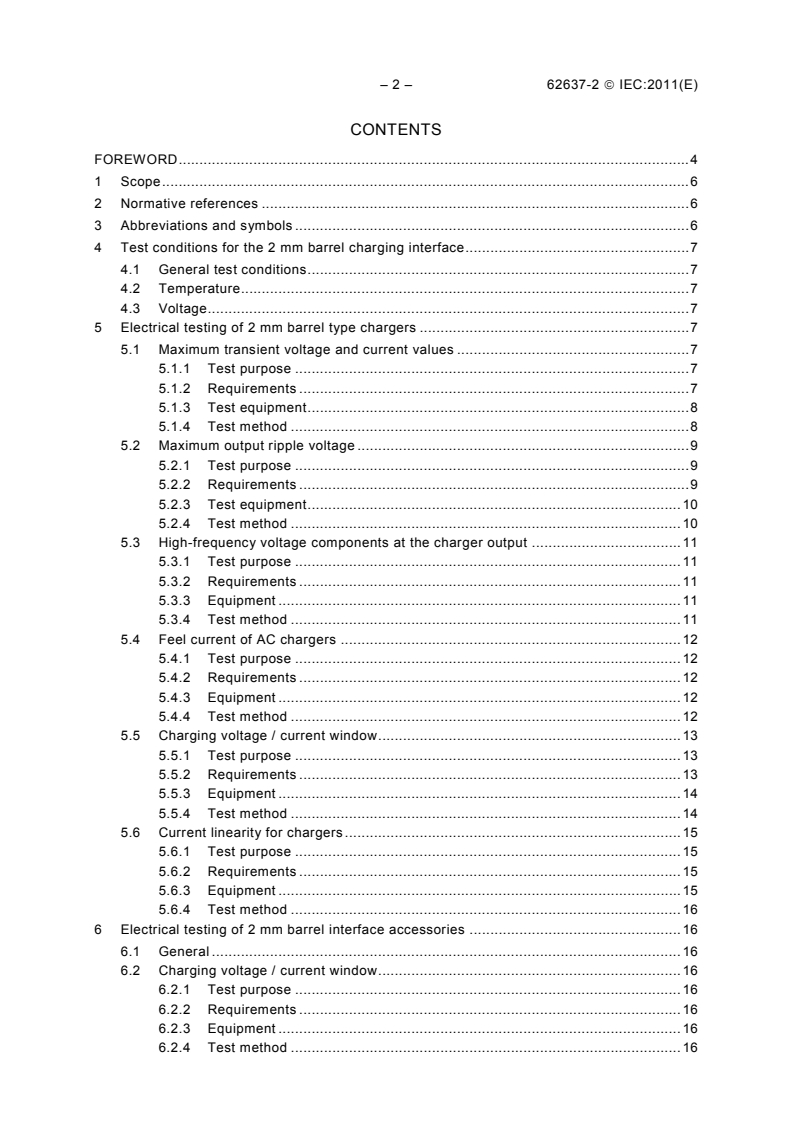
IEC 62637-2:2011 - Battery charging interface for small handheld multimedia devices - Part 2: 2 mm barrel type interface conformance testing Released:3/30/2011
IEC 62637-2:2011 - Battery charging interface for small handheld multimedia devices - Part 2: 2 mm barrel type interface conformance testing Released:3/30/2011
Overview
IEC 62637-2:2011 - "Battery charging interface for small handheld multimedia devices - Part 2: 2 mm barrel type interface conformance testing" defines conformance testing rules and guidelines for equipment using the 2 mm barrel charging interface specified in IEC 62637-1. The standard focuses on electrical performance and interoperability of chargers and accessories, describing test conditions, required test equipment and pass/fail criteria to ensure reliable charging behavior across devices and chargers.
Key topics and technical requirements
Scope & test conditions
- Tests performed at normal room temperature 18 °C to 25 °C and under the manufacturer’s nominal operating voltage (AC chargers are recommended to be tested at nominal ±20% supply variation).
- Conformance testing supplements but does not replace EMC, ESD, safety or type-approval testing.
Transient voltage and current
- Maximum charger output overshoot: ≤ 16 V.
- Maximum reverse voltage at output: ≤ 1 V.
- Time to steady state after load change (±10% tolerance): ≤ 10 ms.
- Maximum duration of charging current overshoot above 1.1 A: ≤ 5 ms.
- Output voltage undershoot with ≤100 mA load: 4.1 V maximum.
- Test method uses fast electronic switching (switching time < 100 µs) between defined loads and oscilloscope measurements.
Output quality and spectral components
- Maximum allowable output ripple and high-frequency voltage components are specified in frequency bands (tables and figures in the standard) to limit interference and ensure stable charging.
- Tests require appropriate instruments such as oscilloscopes, ripple measurement setups and RF/spectrum analysis arrangements (e.g., coupling/decoupling networks).
Other electrical tests
- Feel current for AC chargers (safety-related leakage/feel current checks).
- Charging voltage/current window verification to ensure chargers operate within the specified voltage/current envelope.
- Current linearity tests to validate output regulation across load range.
- Accessory tests, including accessory power consumption during device boot-up.
Practical applications - who uses this standard
- Charger and power-adapter manufacturers validating 2 mm barrel connectors for interoperability.
- Mobile device OEMs and accessory makers ensuring devices accept standardized chargers.
- Test laboratories and conformity assessment bodies performing conformance checks.
- Product compliance and quality teams integrating charger compatibility into product release cycles.
Related standards
- IEC 62637-1:2011 - Defines the 2 mm barrel interface itself (normative reference for Part 2).
- Other applicable IEC standards for EMC, ESD and electrical safety should be used in conjunction with IEC 62637-2:2011.
Keywords: IEC 62637-2:2011, 2 mm barrel charging interface, conformance testing, charger testing, output ripple, transient voltage, current linearity, accessory boot-up power.
Buy Documents
IEC 62637-2:2011 - Battery charging interface for small handheld multimedia devices - Part 2: 2 mm barrel type interface conformance testing Released:3/30/2011
IEC 62637-2:2011 - Battery charging interface for small handheld multimedia devices - Part 2: 2 mm barrel type interface conformance testing Released:3/30/2011
Get Certified
Connect with accredited certification bodies for this standard

ANCE
Mexican certification and testing association.

Intertek Slovenia
Intertek testing, inspection, and certification services in Slovenia.

LNE (Laboratoire National de Métrologie et d'Essais)
French national laboratory for metrology and testing.
Sponsored listings
Frequently Asked Questions
IEC 62637-2:2011 is a standard published by the International Electrotechnical Commission (IEC). Its full title is "Battery charging interface for small handheld multimedia devices - Part 2: 2 mm barrel type interface conformance testing". This standard covers: IEC 62637-2:2011 provides the conformance testing rules and guidelines for equipment built to meet the 2 mm barrel type charging interface specified in the 62637-1. This bilingual version (2011-07) replaces the English version.
IEC 62637-2:2011 provides the conformance testing rules and guidelines for equipment built to meet the 2 mm barrel type charging interface specified in the 62637-1. This bilingual version (2011-07) replaces the English version.
IEC 62637-2:2011 is classified under the following ICS (International Classification for Standards) categories: 01 - GENERALITIES. TERMINOLOGY. STANDARDIZATION. DOCUMENTATION; 33.160.99 - Other audio, video and audiovisual equipment; 97.180 - Miscellaneous domestic and commercial equipment. The ICS classification helps identify the subject area and facilitates finding related standards.
IEC 62637-2:2011 is available in PDF format for immediate download after purchase. The document can be added to your cart and obtained through the secure checkout process. Digital delivery ensures instant access to the complete standard document.
Standards Content (Sample)
IEC 62637-2 ®
Edition 1.0 2011-03
INTERNATIONAL
STANDARD
Battery charging interface for small handheld multimedia devices –
Part 2: 2 mm barrel type interface conformance testing
All rights reserved. Unless otherwise specified, no part of this publication may be reproduced or utilized in any form
or by any means, electronic or mechanical, including photocopying and microfilm, without permission in writing from
either IEC or IEC's member National Committee in the country of the requester.
If you have any questions about IEC copyright or have an enquiry about obtaining additional rights to this publication,
please contact the address below or your local IEC member National Committee for further information.
IEC Central Office
3, rue de Varembé
CH-1211 Geneva 20
Switzerland
Email: inmail@iec.ch
Web: www.iec.ch
About the IEC
The International Electrotechnical Commission (IEC) is the leading global organization that prepares and publishes
International Standards for all electrical, electronic and related technologies.
About IEC publications
The technical content of IEC publications is kept under constant review by the IEC. Please make sure that you have the
latest edition, a corrigenda or an amendment might have been published.
Catalogue of IEC publications: www.iec.ch/searchpub
The IEC on-line Catalogue enables you to search by a variety of criteria (reference number, text, technical committee,…).
It also gives information on projects, withdrawn and replaced publications.
IEC Just Published: www.iec.ch/online_news/justpub
Stay up to date on all new IEC publications. Just Published details twice a month all new publications released. Available
on-line and also by email.
Electropedia: www.electropedia.org
The world's leading online dictionary of electronic and electrical terms containing more than 20 000 terms and definitions
in English and French, with equivalent terms in additional languages. Also known as the International Electrotechnical
Vocabulary online.
Customer Service Centre: www.iec.ch/webstore/custserv
If you wish to give us your feedback on this publication or need further assistance, please visit the Customer Service
Centre FAQ or contact us:
Email: csc@iec.ch
Tel.: +41 22 919 02 11
Fax: +41 22 919 03 00
IEC 62637-2 ®
Edition 1.0 2011-03
INTERNATIONAL
STANDARD
Battery charging interface for small handheld multimedia devices –
Part 2: 2 mm barrel type interface conformance testing
INTERNATIONAL
ELECTROTECHNICAL
COMMISSION
PRICE CODE
R
ICS 33.160.99; 97.180 ISBN 978-2-88912-396-4
– 2 – 62637-2 IEC:2011(E)
CONTENTS
FOREWORD . 4
1 Scope . 6
2 Normative references . 6
3 Abbreviations and symbols . 6
4 Test conditions for the 2 mm barrel charging interface . 7
4.1 General test conditions . 7
4.2 Temperature . 7
4.3 Voltage . 7
5 Electrical testing of 2 mm barrel type chargers . 7
5.1 Maximum transient voltage and current values . 7
5.1.1 Test purpose . 7
5.1.2 Requirements . 7
5.1.3 Test equipment . 8
5.1.4 Test method . 8
5.2 Maximum output ripple voltage . 9
5.2.1 Test purpose . 9
5.2.2 Requirements . 9
5.2.3 Test equipment . 10
5.2.4 Test method . 10
5.3 High-frequency voltage components at the charger output . 11
5.3.1 Test purpose . 11
5.3.2 Requirements . 11
5.3.3 Equipment . 11
5.3.4 Test method . 11
5.4 Feel current of AC chargers . 12
5.4.1 Test purpose . 12
5.4.2 Requirements . 12
5.4.3 Equipment . 12
5.4.4 Test method . 12
5.5 Charging voltage / current window . 13
5.5.1 Test purpose . 13
5.5.2 Requirements . 13
5.5.3 Equipment . 14
5.5.4 Test method . 14
5.6 Current linearity for chargers . 15
5.6.1 Test purpose . 15
5.6.2 Requirements . 15
5.6.3 Equipment . 15
5.6.4 Test method . 16
6 Electrical testing of 2 mm barrel interface accessories . 16
6.1 General . 16
6.2 Charging voltage / current window . 16
6.2.1 Test purpose . 16
6.2.2 Requirements . 16
6.2.3 Equipment . 16
6.2.4 Test method . 16
62637-2 IEC:2011(E) – 3 –
6.3 Accessory power consumption during device booting . 17
6.3.1 Test purpose . 17
6.3.2 Requirements . 17
6.3.3 Equipment . 17
6.3.4 Test method . 17
Figure 1 – Maximum duration of charging current overshoot and output voltage
undershoot . 9
Figure 2 – Maximum peak-to-peak ripple voltage . 10
Figure 3 – Maximum high frequency output voltage components . 11
Figure 4 – Test set up for high frequency voltage components . 12
Figure 5 – Test set up . 13
Figure 6 – Charging current/voltage window for 2 mm barrel chargers . 14
Figure 7 – Current linearity specification . 15
Figure 8 – Maximum current consumption in accessory during boot-up . 17
Table 1 – Maximum ripple voltage in different frequency ranges . 9
Table 2 – Maximum high-frequency voltage components at the charger output . 11
– 4 – 62637-2 IEC:2011(E)
INTERNATIONAL ELECTROTECHNICAL COMMISSION
____________
BATTERY CHARGING INTERFACE FOR SMALL HANDHELD
MULTIMEDIA DEVICES –
Part 2: 2 mm barrel type interface conformance testing
FOREWORD
1) The International Electrotechnical Commission (IEC) is a worldwide organization for standardization comprising
all national electrotechnical committees (IEC National Committees). The object of IEC is to promote
international co-operation on all questions concerning standardization in the electrical and electronic fields. To
this end and in addition to other activities, IEC publishes International Standards, Technical Specifications,
Technical Reports, Publicly Available Specifications (PAS) and Guides (hereafter referred to as “IEC
Publication(s)”). Their preparation is entrusted to technical committees; any IEC National Committee interested
in the subject dealt with may participate in this preparatory work. International, governmental and non-
governmental organizations liaising with the IEC also participate in this preparation. IEC collaborates closely
with the International Organization for Standardization (ISO) in accordance with conditions determined by
agreement between the two organizations.
2) The formal decisions or agreements of IEC on technical matters express, as nearly as possible, an international
consensus of opinion on the relevant subjects since each technical committee has representation from all
interested IEC National Committees.
3) IEC Publications have the form of recommendations for international use and are accepted by IEC National
Committees in that sense. While all reasonable efforts are made to ensure that the technical content of IEC
Publications is accurate, IEC cannot be held responsible for the way in which they are used or for any
misinterpretation by any end user.
4) In order to promote international uniformity, IEC National Committees undertake to apply IEC Publications
transparently to the maximum extent possible in their national and regional publications. Any divergence
between any IEC Publication and the corresponding national or regional publication shall be clearly indicated in
the latter.
5) IEC itself does not provide any attestation of conformity. Independent certification bodies provide conformity
assessment services and, in some areas, access to IEC marks of conformity. IEC is not responsible for any
services carried out by independent certification bodies.
6) All users should ensure that they have the latest edition of this publication.
7) No liability shall attach to IEC or its directors, employees, servants or agents including individual experts and
members of its technical committees and IEC National Committees for any personal injury, property damage or
other damage of any nature whatsoever, whether direct or indirect, or for costs (including legal fees) and
expenses arising out of the publication, use of, or reliance upon, this IEC Publication or any other IEC
Publications.
8) Attention is drawn to the Normative references cited in this publication. Use of the referenced publications is
indispensable for the correct application of this publication.
9) Attention is drawn to the possibility that some of the elements of this IEC Publication may be the subject of
patent rights. IEC shall not be held responsible for identifying any or all such patent rights.
International Standard IEC 62637-2 has been prepared by technical area 1: Terminals for
audio, video and data services and content, of IEC technical committee 100: Audio, video and
multimedia systems and equipment.
The text of this standard is based on the following documents:
CDV Report on voting
100/1674/CDV 100/1750/RVC
Full information on the voting for the approval of this standard can be found in the report on
voting indicated in the above table.
This publication has been drafted in accordance with the ISO/IEC Directives, Part 2.
A list of all parts of the IEC 62637 series, under the general title Battery charging interface for
small handheld multimedia devices, can be found on the IEC website.
62637-2 IEC:2011(E) – 5 –
The committee has decided that the contents of this publication will remain unchanged until
the stability date indicated on the IEC web site under "http://webstore.iec.ch" in the data
related to the specific publication. At this date, the publication will be
• reconfirmed,
• withdrawn,
• replaced by a revised edition, or
• amended.
A bilingual version of this publication may be issued at a later date.
– 6 – 62637-2 IEC:2011(E)
BATTERY CHARGING INTERFACE FOR SMALL HANDHELD
MULTIMEDIA DEVICES –
Part 2: 2 mm barrel type interface conformance testing
1 Scope
This part of the IEC 62637 provides the conformance testing rules and guidelines for
equipment built to meet the 2 mm barrel type charging interface specified in the 62637-1.
2 Normative references
The following referenced documents are indispensable for the application of this document.
For dated references, only the edition cited applies. For undated references, the latest edition
of the referenced document (including any amendments) applies.
IEC 62637-1:2011, Battery charging interface for small handheld multimedia devices – Part 1:
2 mm barrel interface
3 Abbreviations and symbols
For the purposes of this document, the following abbreviations apply.
AC Alternating Current
ATT ATTenuator
C Capacitance F
CDN Coupling/Decoupling Network
Crest factor Current peak value/current RMS value
dB Decibel
dB(mW) Power in dB referring to 1 mW
DC Direct Current
DUT Device Under Test
EMC Electromagnetic Compatibility
ESD ElectroStatic Discharge
ESR
Effective Series Resistance Ω
f Frequency in Hz
f
Charging current change frequency Hz
Ichar
GND GrouND
I
Current A
I Charging current A
char
I
Maximum current A
max
I Peak current A
peak
L
Inductance H
62637-2 IEC:2011(E) – 7 –
N Newton
R
Resistance Ω
RBW Resolution BandWidth
RMS Root mean square
V
Voltage V
V Charging voltage
char
V
Maximum output voltage
max-out
V Output voltage
out
V
Ripple voltage
ripple
VBW Video BandWidth
SWP SWeeP time
4 Test conditions for the 2 mm barrel charging interface
4.1 General test conditions
The general test conditions are set out below. Manufacturers should note that the actual
conditions of use could be more stringent.
Tests conducted using this conformance document do not replace EMC, ESD, safety, type
approval, or any tests set by legislation in the chargers or devices using the charging
interface specified in IEC 62637-1. The purpose of the conformance testing is to achieve good
interoperability between different chargers and devices.
4.2 Temperature
All measurements shall be made at normal room temperature 18 °C to 2
...
IEC 62637-2 ®
Edition 1.0 2011-03
INTERNATIONAL
STANDARD
NORME
INTERNATIONALE
Battery charging interface for small handheld multimedia devices –
Part 2: 2 mm barrel type interface conformance testing
Interface de charge de batterie pour petits appareils multimédia portables –
Partie 2: Essai de conformité de l'interface de type cylindrique 2 mm
All rights reserved. Unless otherwise specified, no part of this publication may be reproduced or utilized in any form or by
any means, electronic or mechanical, including photocopying and microfilm, without permission in writing from either IEC or
IEC's member National Committee in the country of the requester.
If you have any questions about IEC copyright or have an enquiry about obtaining additional rights to this publication,
please contact the address below or your local IEC member National Committee for further information.
Droits de reproduction réservés. Sauf indication contraire, aucune partie de cette publication ne peut être reproduite
ni utilisée sous quelque forme que ce soit et par aucun procédé, électronique ou mécanique, y compris la photocopie
et les microfilms, sans l'accord écrit de la CEI ou du Comité national de la CEI du pays du demandeur.
Si vous avez des questions sur le copyright de la CEI ou si vous désirez obtenir des droits supplémentaires sur cette
publication, utilisez les coordonnées ci-après ou contactez le Comité national de la CEI de votre pays de résidence.
IEC Central Office
3, rue de Varembé
CH-1211 Geneva 20
Switzerland
Email: inmail@iec.ch
Web: www.iec.ch
About the IEC
The International Electrotechnical Commission (IEC) is the leading global organization that prepares and publishes
International Standards for all electrical, electronic and related technologies.
About IEC publications
The technical content of IEC publications is kept under constant review by the IEC. Please make sure that you have the
latest edition, a corrigenda or an amendment might have been published.
Catalogue of IEC publications: www.iec.ch/searchpub
The IEC on-line Catalogue enables you to search by a variety of criteria (reference number, text, technical committee,…).
It also gives information on projects, withdrawn and replaced publications.
IEC Just Published: www.iec.ch/online_news/justpub
Stay up to date on all new IEC publications. Just Published details twice a month all new publications released. Available
on-line and also by email.
Electropedia: www.electropedia.org
The world's leading online dictionary of electronic and electrical terms containing more than 20 000 terms and definitions
in English and French, with equivalent terms in additional languages. Also known as the International Electrotechnical
Vocabulary online.
Customer Service Centre: www.iec.ch/webstore/custserv
If you wish to give us your feedback on this publication or need further assistance, please visit the Customer Service
Centre FAQ or contact us:
Email: csc@iec.ch
Tel.: +41 22 919 02 11
Fax: +41 22 919 03 00
A propos de la CEI
La Commission Electrotechnique Internationale (CEI) est la première organisation mondiale qui élabore et publie des
normes internationales pour tout ce qui a trait à l'électricité, à l'électronique et aux technologies apparentées.
A propos des publications CEI
Le contenu technique des publications de la CEI est constamment revu. Veuillez vous assurer que vous possédez
l’édition la plus récente, un corrigendum ou amendement peut avoir été publié.
Catalogue des publications de la CEI: www.iec.ch/searchpub/cur_fut-f.htm
Le Catalogue en-ligne de la CEI vous permet d’effectuer des recherches en utilisant différents critères (numéro de référence,
texte, comité d’études,…). Il donne aussi des informations sur les projets et les publications retirées ou remplacées.
Just Published CEI: www.iec.ch/online_news/justpub
Restez informé sur les nouvelles publications de la CEI. Just Published détaille deux fois par mois les nouvelles
publications parues. Disponible en-ligne et aussi par email.
Electropedia: www.electropedia.org
Le premier dictionnaire en ligne au monde de termes électroniques et électriques. Il contient plus de 20 000 termes et
définitions en anglais et en français, ainsi que les termes équivalents dans les langues additionnelles. Egalement appelé
Vocabulaire Electrotechnique International en ligne.
Service Clients: www.iec.ch/webstore/custserv/custserv_entry-f.htm
Si vous désirez nous donner des commentaires sur cette publication ou si vous avez des questions, visitez le FAQ du
Service clients ou contactez-nous:
Email: csc@iec.ch
Tél.: +41 22 919 02 11
Fax: +41 22 919 03 00
IEC 62637-2 ®
Edition 1.0 2011-03
INTERNATIONAL
STANDARD
NORME
INTERNATIONALE
Battery charging interface for small handheld multimedia devices –
Part 2: 2 mm barrel type interface conformance testing
Interface de charge de batterie pour petits appareils multimédia portables –
Partie 2: Essai de conformité de l'interface de type cylindrique 2 mm
INTERNATIONAL
ELECTROTECHNICAL
COMMISSION
COMMISSION
ELECTROTECHNIQUE
PRICE CODE
INTERNATIONALE
CODE PRIX R
ICS 33.160.99; 97.180 ISBN 978-2-88912-598-2
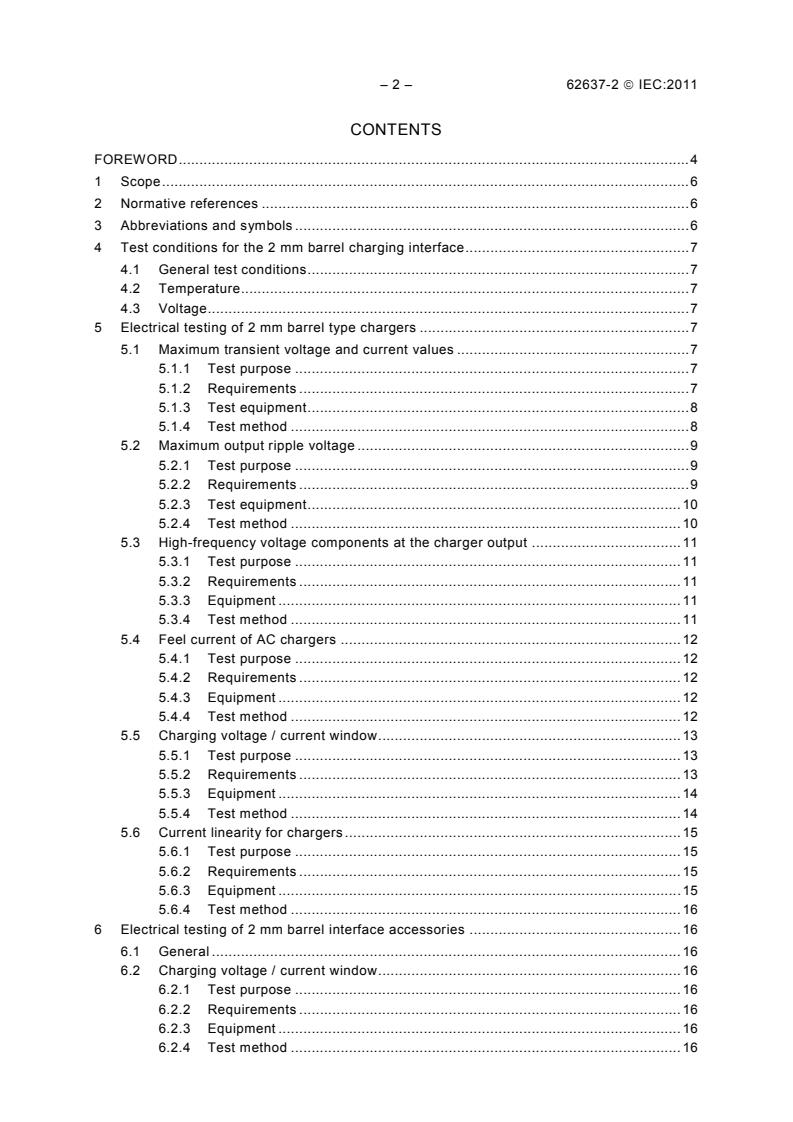
– 2 – 62637-2 IEC:2011
CONTENTS
FOREWORD . 4
1 Scope . 6
2 Normative references . 6
3 Abbreviations and symbols . 6
4 Test conditions for the 2 mm barrel charging interface . 7
4.1 General test conditions . 7
4.2 Temperature . 7
4.3 Voltage . 7
5 Electrical testing of 2 mm barrel type chargers . 7
5.1 Maximum transient voltage and current values . 7
5.1.1 Test purpose . 7
5.1.2 Requirements . 7
5.1.3 Test equipment . 8
5.1.4 Test method . 8
5.2 Maximum output ripple voltage . 9
5.2.1 Test purpose . 9
5.2.2 Requirements . 9
5.2.3 Test equipment . 10
5.2.4 Test method . 10
5.3 High-frequency voltage components at the charger output . 11
5.3.1 Test purpose . 11
5.3.2 Requirements . 11
5.3.3 Equipment . 11
5.3.4 Test method . 11
5.4 Feel current of AC chargers . 12
5.4.1 Test purpose . 12
5.4.2 Requirements . 12
5.4.3 Equipment . 12
5.4.4 Test method . 12
5.5 Charging voltage / current window . 13
5.5.1 Test purpose . 13
5.5.2 Requirements . 13
5.5.3 Equipment . 14
5.5.4 Test method . 14
5.6 Current linearity for chargers . 15
5.6.1 Test purpose . 15
5.6.2 Requirements . 15
5.6.3 Equipment . 15
5.6.4 Test method . 16
6 Electrical testing of 2 mm barrel interface accessories . 16
6.1 General . 16
6.2 Charging voltage / current window . 16
6.2.1 Test purpose . 16
6.2.2 Requirements . 16
6.2.3 Equipment . 16
6.2.4 Test method . 16
62637-2 IEC:2011 – 3 –
6.3 Accessory power consumption during device booting . 17
6.3.1 Test purpose . 17
6.3.2 Requirements . 17
6.3.3 Equipment . 17
6.3.4 Test method . 17
Figure 1 – Maximum duration of charging current overshoot and output voltage
undershoot . 9
Figure 2 – Maximum peak-to-peak ripple voltage . 10
Figure 3 – Maximum high frequency output voltage components . 11
Figure 4 – Test set up for high frequency voltage components . 12
Figure 5 – Test set up . 13
Figure 6 – Charging current/voltage window for 2 mm barrel chargers . 14
Figure 7 – Current linearity specification . 15
Figure 8 – Maximum current consumption in accessory during boot-up . 17
Table 1 – Maximum ripple voltage in different frequency ranges . 9
Table 2 – Maximum high-frequency voltage components at the charger output . 11
– 4 – 62637-2 IEC:2011
INTERNATIONAL ELECTROTECHNICAL COMMISSION
____________
BATTERY CHARGING INTERFACE FOR SMALL HANDHELD
MULTIMEDIA DEVICES –
Part 2: 2 mm barrel type interface conformance testing
FOREWORD
1) The International Electrotechnical Commission (IEC) is a worldwide organization for standardization comprising
all national electrotechnical committees (IEC National Committees). The object of IEC is to promote
international co-operation on all questions concerning standardization in the electrical and electronic fields. To
this end and in addition to other activities, IEC publishes International Standards, Technical Specifications,
Technical Reports, Publicly Available Specifications (PAS) and Guides (hereafter referred to as “IEC
Publication(s)”). Their preparation is entrusted to technical committees; any IEC National Committee interested
in the subject dealt with may participate in this preparatory work. International, governmental and non-
governmental organizations liaising with the IEC also participate in this preparation. IEC collaborates closely
with the International Organization for Standardization (ISO) in accordance with conditions determined by
agreement between the two organizations.
2) The formal decisions or agreements of IEC on technical matters express, as nearly as possible, an international
consensus of opinion on the relevant subjects since each technical committee has representation from all
interested IEC National Committees.
3) IEC Publications have the form of recommendations for international use and are accepted by IEC National
Committees in that sense. While all reasonable efforts are made to ensure that the technical content of IEC
Publications is accurate, IEC cannot be held responsible for the way in which they are used or for any
misinterpretation by any end user.
4) In order to promote international uniformity, IEC National Committees undertake to apply IEC Publications
transparently to the maximum extent possible in their national and regional publications. Any divergence
between any IEC Publication and the corresponding national or regional publication shall be clearly indicated in
the latter.
5) IEC itself does not provide any attestation of conformity. Independent certification bodies provide conformity
assessment services and, in some areas, access to IEC marks of conformity. IEC is not responsible for any
services carried out by independent certification bodies.
6) All users should ensure that they have the latest edition of this publication.
7) No liability shall attach to IEC or its directors, employees, servants or agents including individual experts and
members of its technical committees and IEC National Committees for any personal injury, property damage or
other damage of any nature whatsoever, whether direct or indirect, or for costs (including legal fees) and
expenses arising out of the publication, use of, or reliance upon, this IEC Publication or any other IEC
Publications.
8) Attention is drawn to the Normative references cited in this publication. Use of the referenced publications is
indispensable for the correct application of this publication.
9) Attention is drawn to the possibility that some of the elements of this IEC Publication may be the subject of
patent rights. IEC shall not be held responsible for identifying any or all such patent rights.
International Standard IEC 62637-2 has been prepared by technical area 1: Terminals for
audio, video and data services and content, of IEC technical committee 100: Audio, video and
multimedia systems and equipment.
This bilingual version (2011-07) replaces the English version.
The text of this standard is based on the following documents:
CDV Report on voting
100/1674/CDV 100/1750/RVC
Full information on the voting for the approval of this standard can be found in the report on
voting indicated in the above table.
The French version of this standard has not been voted upon.
62637-2 IEC:2011 – 5 –
This publication has been drafted in accordance with the ISO/IEC Directives, Part 2.
A list of all parts of the IEC 62637 series, under the general title Battery charging interface for
small handheld multimedia devices, can be found on the IEC website.
The committee has decided that the contents of this publication will remain unchanged until
the stability date indicated on the IEC web site under "http://webstore.iec.ch" in the data
related to the specific publication. At this date, the publication will be
• reconfirmed,
• withdrawn,
• replaced by a revised edition, or
• amended.
– 6 – 62637-2 IEC:2011
BATTERY CHARGING INTERFACE FOR SMALL HANDHELD
MULTIMEDIA DEVICES –
Part 2: 2 mm barrel type interface conformance testing
1 Scope
This part of the IEC 62637 provides the conformance testing rules and guidelines for
equipment built to meet the 2 mm barrel type charging interface specified in the 62637-1.
2 Normative references
The following referenced documents are indispensable for the application of this document.
For dated references, only the edition cited applies. For undated references, the latest edition
of the referenced document (including any amendments) applies.
IEC 62637-1:2011, Battery charging interface for small handheld multimedia devices – Part 1:
2 mm barrel interface
3 Abbreviations and symbols
For the purposes of this document, the following abbreviations apply.
AC Alternating Current
ATT ATTenuator
C Capacitance F
CDN Coupling/Decoupling Network
Crest factor Current peak value/current RMS value
dB Decibel
dB(mW) Power in dB referring to 1 mW
DC Direct Current
DUT Device Under Test
EMC Electromagnetic Compatibility
ESD ElectroStatic Discharge
ESR
Effective Series Resistance Ω
f Frequency in Hz
f
Charging current change frequency Hz
Ichar
GND GrouND
I
Current A
I Charging current A
char
I
Maximum current A
max
I Peak current A
peak
L
Inductance H
62637-2 IEC:2011 – 7 –
N Newton
R
Resistance Ω
RBW Resolution BandWidth
RMS Root mean square
V
Voltage V
V Charging voltage
char
V
Maximum output voltage
max-out
V Output voltage
out
V
Ripple voltage
ripple
VBW Video BandWidth
SWP SWeeP time
4 Test conditions for the 2 mm barrel charging interface
4.1 General test conditions
The general test conditions are set out below. Manufacturers should note that the actual
conditions of use could be more stringent.
Tests conducted using this conformance document do not replace EMC, ESD, safety, type
approval, or any tests set by legislation in the chargers or devices using the charging
interface specified in IEC 62637-1. The purpose of the conformance testing is to achieve good
interoperability between different chargers and devices.
4.2 Temperature
All measurements shall be made at normal room temperature 18 °C to 25 °C, unless some
other temperature is specified.
4.3 Voltage
All tests are performed under nominal operating voltage as defined by the manufacturer.
5 Electrical testing of 2 mm barrel type chargers
5.1 Maximum transient voltage and current values
5.1.1 Test purpose
The purpose of this test is to verify that the charger complies with the requirements of settling
time, minimum voltage and maximum voltage limits specified in IEC 62637-1, 5.2.
5.1.2 Requirements
The following requirements apply.
• Maximum charger output overshoot shall be less than or equal to 16 V.
• Maximum reverse voltage at charger output shall be less than or equal to 1 V.
• Maximum time to achieve steady state value for voltage and current (± 10 % tolerance)
after load change ("no load"/"normal load") shall be less than or equal to 10 ms.
• Maximum duration of charging current overshoot peak value greater than 1,1 A shall be
less than or equal to 5 ms.
– 8 – 62637-2 IEC:2011
• Maximum output voltage undershoot with a load current less or equal than 100 mA shall
be 4,1 V.
Maximum duration of charging current overshoot is shown in Figure 1.
5.1.3 Test equipment
The following equipment is required to perform the test:
• oscilloscope;
• 6 kΩ load as “no load”;
• a suitable resistor to draw a 100 mA load current at the nominal output voltage;
• 3,0 V current sink type of load with 1,1 A current limit as “normal load”;
• AC power source (if charger is AC powered);
• DC power source (if charger is made for car environment).
5.1.4 Test method
Proceed as follows.
a) Set the oscilloscope to measure voltage and current from the charger output.
b) Set the output of AC or DC power source to nominal value.
c) Measure the voltage and current values when the 6 kΩ load and 3,0 V load (a load, which
results 3,0 V charging voltage) are interchanged with a fast electronic switch (switching
time less than 100 µs) at the charger output.
d) Measure the voltage undershoot when in 100 mA resistive load (a load, which draws
100 mA at nominal output voltage).
Repeat the test using minimum and maximum supply voltages specified to the charger
(recommendation for AC powered chargers is nominal voltage ± 20 %).
62637-2 © IEC:2011 – 9 –
Voltage V
Current I
Device current limit
1100 mA max. 5ms
Max. 10ms
10%
Nominal output
Nominal output
voltage at 100 mA
current
load current
10%
4,1V
Maximum output
voltage undershoot at
load current ≤ 100 mA
0 mA
Time t
IEC 473/11
Figure 1 – Maximum duration of charging current overshoot
and output voltage undershoot
5.2 Maximum output ripple voltage
5.2.1 Test purpose
The purpose of this test is to verify that the charger complies with the requirements of the
ripple voltage specified in 5.3 of IEC 62637-1.
5.2.2 Requirements
Maximum ripple voltages for different frequency ranges are given in Table 1.
Table 1 – Maximum ripple voltage in different frequency ranges
Frequency range Maximum ripple voltage (peak-to-peak)
f < 20 Hz 200 mV
20 Hz ≤ f < 200 Hz 200 mV
200 Hz ≤ f < 20 kHz 200 mV
20 kHz ≤ f < 1 MHz
400 mV
The maximum allowed output ripple voltage with maximum output current in constant current
mode is 300 mV RMS for output voltages V between 2,5 V and 5,5 V.
out
A sum of ripple voltages over the full frequency range 0 MHz to 1 MHz is 800 mV (peak-to-
peak)
.
During the test all the measured V and I values shall be within the voltage / current window of
the charger interface.
– 10 – 62637-2 IEC:2011
Maximum peak-to-peak ripple voltage is shown in Figure 2.
5.2.3 Test equipment
The following equipment is required to perform the test:
• oscilloscope which offers the possibility of selecting a measured frequency band;
• variable resistive load 0 kΩ to 6 kΩ. Maximum stray capacitance of ripple test load (e.g.
on-line testing) is 2 µF;
• AC power source (if charger is AC powered);
• DC power source (if charger is designed for car environment).
5.2.4 Test method
Proceed as follows.
a) Set the output of AC or DC power source to nominal value. Connect charger to power
supply and to variable load.
b) Set the oscilloscope to measure voltage from charger's output. Connect charger to
variable load and set the load as 6 kΩ.
c) Set the oscilloscope to measure ripple voltage peak-to-peak value from frequency band
0 Hz to 20 Hz. Reduce resistance slowly until the output voltage is 1,5 V. Find the highest
peak-to-peak value between maximum voltage and 1,5 V.
d) Set the oscilloscope to measure ripple voltage peak-to-peak value from frequency band
20 Hz to 200 Hz. Reduce resistance slowly until the output voltage is 1,5 V. Find the
highest peak-to-peak value between maximum voltage and 1,5 V.
e) Set the oscilloscope to measure ripple voltage peak-to-peak value from frequency band
200 Hz to 20 kHz. Reduce resistance slowly until the output voltage is 1,5 V. Find the
highest peak-to-peak value between maximum voltage and 1,5 V.
f) Set the oscilloscope to measure ripple voltage peak-to-peak value from frequency band
20 kHz to 1 MHz. Reduce resistance slowly until the output voltage is 1,5 V. Find the
highest peak-to-peak value between maximum voltage and 1,5 V.
g) Set the variable resistance so that the output voltage is 5,5 V. Remove frequency band
limitations from the oscilloscope. Set the oscilloscope to measure the root mean square
(RMS) value of ripple voltage. Decrease resistance slowly so that the output voltage is
2,5 V. Find the largest RMS value between 5,5 V and 2,5 V.
Repeat tests c) to g) using minimum and maximum supply voltages specified for charger
(recommendation for AC-powered chargers is the nominal voltage ± 20 %). Repeat tests in
minimum and maximum temperatures specified for charger.
Frequency 200 Hz to 20 kHz
max. V p-p 200 mV
ripple
Frequency 0 Hz to 20 Hz
All frequencies together
max. V p-p 200 mV
ripple
max. V p-p 800 mV
ripple
IEC 474/11
Figure 2 – Maximum peak-to-peak ripple voltage
62637-2 IEC:2011 – 11 –
5.3 High-frequency voltage components at the charger output
5.3.1 Test purpose
The purpose of this test is to verify that the charger complies with the requirements for high-
frequency voltage components at the charger output specified in IEC 62637-1, 5.4.
5.3.2 Requirements
The charger shall not cause more high frequency voltage components at the charger output
than specified in Table 2 and Figure 3 when connected to an artificial load specified in
Annex A of IEC 62637-1 and measured with a coupling/decoupling network as specified in
Annex B of IEC 62637-1.
Table 2 – Maximum high-frequency voltage components at the charger output
Frequency range Maximum high frequency voltage components
MHz dB(mW)
1 to 80 −40 to −65 linear slope
80 to 150 −65
High frequency
output voltage
components
dB(mW)
-30
-40
-50
-60
-70
-80
-90
1 150
80 Frequency
f MHz
IEC 475/11
Figure 3 – Maximum high frequency output voltage components
5.3.3 Equipment
The following equipment is required to perform the test:
• shielded room to avoid any external interference;
• spectrum analyzer;
• coupling/decoupling network (CDN) specified in Annex B of IEC 62637-1;
• artificial load working as standard device charging interface. The artificial load is specified
in Annex A of IEC 62637-1.
5.3.4 Test method
The test set up is shown in Figure 4.
– 12 – 62637-2 IEC:2011
DC- Spectrum
block analyzer
Nominal
power in
AC or DC
Charger Artificial
CDN
(DUT) load
IEC 476/11
Figure 4 – Test set up for high frequency voltage components
Proceed as follows:
a) connect supply power for charger, power in AC or DC nominal operating voltage as
defined by the manufacturer;
b) connect the charger to artificial load via coupling/decoupling network (CDN) and connect
spectrum analyzer via DC block to CDN;
c) set output voltage to 5,0 V by artificial load control;
d) Measure high frequency components from 1 MHz to 150 MHz using the following spectrum
analyzer settings:
• input attenuator: 0 dB (ATT);
• video resolution band filter: 100 kHz (VBW);
• resolution band filter: 100 kHz (RBW);
• sweep time: 30 ms (SWP);
• detector: maximum peak;
• average measurement.
5.4 Feel current of AC chargers
5.4.1 Test purpose
The purpose of this test is to verify that the charger complies with the requirements of feel
current specified in 5.5 of IEC 62637-1.
5.4.2 Requirements
Maximum feel current from AC mains to the mobile device through the charger is 5 µA
measured according to the method specified in 5.4.4.
5.4.3 Equipment
The following equipment is required to perform the test:
• test network and mains power supply according Figure 5;
• oscilloscope or voltmeter to measure the voltage V of Figure 5.
5.4.4 Test method
The test set up is shown in Figure 5.
62637-2 IEC:2011 – 13 –
T
Supply
EUT
V
Charger output is
short circuited
S
R C
s s
R
R
B
C V
V V
1 2
IEC 477/11
Figure 5 – Test set up
The component values of the test set up of Figure 5 are the following.
R = 1 500 Ω
s
C = 0,22 µF
s
R = 500 Ω
B
R = 10 000 Ω
C = 0,022 µF
Proceed as follows.
a) Connect the charger (EUT) to the test set up shown in the Figure 5.
b) Make sure that the charger output is short circuited.
c) Set the mains supply voltage to a nominal value according the charger specification.
d) Measure the voltage V with both positions of the switch S1.
e) Calculate the feel current by I = V /R by using the higher value of the two measured
feel 2 B
V voltages.
5.5 Charging voltage / current window
5.5.1 Test purpose
The purpose of this test is to verify that the charger complies with voltage / current window
specified in 5.6 of IEC 62637-1.
5.5.2 Requirements
The minimum charging current is 300 mA between 2,0 V and 4,65 V. During charging, the
current and voltage values shall not exceed the charging window shown in Figure 6.
– 14 – 62637-2 IEC:2011
9,30
Operating area for
chargers
4,65
1,00 V
100 200 300 400 500 600 700 800 900 1000 1100 1200
Current I (mA)
Current I in mA
IEC 478/11
Figure 6 – Charging current/voltage window for 2 mm barrel chargers
5.5.3 Equipment
The following equipment is required to perform the test:
• variable resistive load 0 kΩ to 6 kΩ;
• voltage meter or oscilloscope;
• current meter;
• AC power source (if charger is AC powered);
• DC power source (if charger is designed for car environment).
5.5.4 Test method
Proceed as follows.
a) Connect the charger to variable load and set variable load to maximum resistance (6 kΩ).
b) Set power source output to nominal value and connect charger to power source.
c) Measure output voltage from charging interface.
d) Increase the load step by step to a short circuit. Measure the voltage and the current at
each step. Use at least 30 steps covering entire resistance area from 6 kΩ to short circuit.
Repeat the test using minimum and maximum supply voltages specified to the charger
(recommendation for AC-powered chargers is nominal voltage ± 20 %). Repeat tests in
minimum and maximum temperatures specified to charger.
Voltage V (V)
Voltage V [V]
62637-2 © IEC:2011 – 15 –
5.6 Current linearity for chargers
5.6.1 Test purpose
The purpose of this test is to verify that the charger complies with the current linearity
requirements of IEC 62637-1, 5.7. The current linearity requirement is specified in a way that
the allowed current change is given for narrow voltage range from the middle of the total
voltage range, but is sufficient to guarantee adequate linearity also for output voltages below
or above the specified range.
5.6.2 Requirements
The maximum current fluctuation is 30 % when the charger output voltage varies from 3,5 V to
4,6 V (for example 500 mA – 0,3 × 500 mA = 350 mA) when input voltage and ambient
temperature stay constant. The current linearity specification is shown in Figure 7.
4,6V
3,5V
100 200 300 400 500 600 700 800
Current I (mA)
Current I mA
IEC 479/11
Figure 7 – Current linearity specification
5.6.3 Equipment
The following equipment is required to perform the test:
variable resistive load 0 Ω to 5 kΩ;
voltage meter or oscilloscope;
current meter;
AC power source (if charger is AC powered);
DC power source (if charger is designed for car environment).
Voltage V (V)
Voltage V
– 16 – 62637-2 IEC:2011
5.6.4 Test method
Proceed as follows.
a) Connect charger output to variable load via current meter.
b) Set power source output to nominal value and connect charger to power source.
c) Set voltage meter to measure output voltage and adjust the variable load so that the
output voltage is 3,5 V. Measure the current.
d) Adjust variable load so that the output voltage is 5,0 V and measure the current again.
6 Electrical testing of 2 mm barrel interface accessories
6.1 General
These tests are designed to be used for accessories that are connected between a charger
and a device both using the 2 mm barrel charging interface.
6.2 Charging voltage / current window
6.2.1 Test purpose
The purpose of this test is to verify that the accessory’s charging interface complies with the
requirements specified in 6.1 of IEC 62637-1.
6.2.2 Requirements
During charging, the current and voltage values shall not exceed the charging window shown
in Figure 6. For operation, it is allowed that the recommended minimum current of 300 mA is
reduced to 200 mA.
6.2.3 Equipment
The following equipment is required to perform the test:
• DC power source;
• variable resistive load 0 kΩ to 6 kΩ;
• voltage meter or oscilloscope;
• current meter.
6.2.4 Test method
Proceed as follows.
a) Set the DC power source output to 6,0 V, current limit to 500 mA, and connect it to the
accessory's 2 mm barrel charging input connector.
b) Connect the accessory's charging interface (output) to a variable load. Set the variable
load to maximum resistance value of 6 kΩ.
c) Measure the output voltage from the accessory's charging interface. Increase the load
value step by step to short circuit. Use at least 30 steps covering the entire resistance
area from 6 kΩ to short circuit.
Set DC power source output to 5,7 V and current limit to 300 mA, and repeat the test in
minimum and maximum temperatures specified for the accessory.
Set DC power source output to 9,3 V and current limit to 950 mA, and repeat the test in
minimum and maximum temperatures specified for the accessory.
62637-2 IEC:2011 – 17 –
6.3 Accessory power consumption during device booting
6.3.1 Test purpose
The purpose of this test is to verify that an enhancement does not disturb the booting up of
the device. When a device is booting up with an empty battery, the accessory can only use a
very small amount of power. See IEC 62637-1, 6.3.
This test does not apply for accessories designed for the car environment.
6.3.2 Requirements
The recommended maximum current difference (current consumption in accessory) is 10 mA
when the voltage in the accessory's charging interface is less than or equal to 3,5 V.
The maximum current consumption in the accessory during boot-up is shown in Figure 8.
Current from
accessory to load
Current I Voltage V
Current from charger
to accessory
Maximum current
350 mA
difference 10 mA
Voltage at accessory’s
charging output
3,5 V
300 mA 3,0 V
2,0 V
1,0 V
Time t
IEC 480/11
Figure 8 – Maximum current consumption in accessory during boot-up
6.3.3 Equipment
The following equipment is required to perform the test:
• 2 current meters (oscilloscope can be used);
• voltage meter (oscilloscope can be used);
• variable load, maximum load 10 kΩ;
• DC power supply.
6.3.4 Test method
Proceed as follows.
a) Set the output of a DC power supply to 5,7 V and the current limit to 300 mA.
b) Connect the DC power supply to the accessory and the accessory's charging interface
(output) to variable load.
c) Set one current meter to measure the current from the DC power supply to the accessory
and another current meter to measure the current from the accessory to the load.
– 18 – 62637-2 IEC:2011
d) Set a voltage meter to measure the voltage from the accessory's charging interface
(output).
e) Set load so that the voltage is 2,0 V. Decrease the load so that voltage rises, and
measure both currents all the time. The test is completed when the voltage has risen to
4,0 V.
___________
– 20 – 62637-2 CEI:2011
SOMMAIRE
AVANT-PROPOS . 22
1 Domaine d'application . 24
2 Références normatives . 24
3 Abréviations et symboles . 24
4 Conditions d'essai pour l'interface cylindrique 2 mm servant à la charge des
batteries . 25
4.1 Conditions générales d'essai . 25
4.2 Température . 25
4.3 Tension . 25
5 Essai électrique sur des chargeurs de type cylindrique 2 mm . 25
5.1 Valeurs maximales de la tension et du courant transitoires . 25
5.1.1 Objet de l'essai . 25
5.1.2 Exigences . 25
5.1.3 Matériel d'essai . 26
5.1.4 Méthode d'essai . 26
5.2 Ondulation maximale de la tension en sortie . 27
5.2.1 Objet de l'essai . 27
5.2.2 Exigences . 27
5.2.3 Matériel d'essai . 28
5.2.4 Méthode d'essai . 28
5.3 Composantes haute fréquence de la tension en sortie du chargeur . 29
5.3.1 Objet de l'essai . 29
5.3.2 Exigences . 29
5.3.3 Matériel . 30
5.3.4 Méthode d'essai . 30
5.4 Courant ressenti des chargeurs en courant alternatif . 30
5.4.1 Objet de l'essai . 30
5.4.2 Exigences . 30
5.4.3 Matériel . 31
5.4.4 Méthode d'essai . 31
5.5 Plage de tension/courant de charge . 31
5.5.1 Objet de l'essai . 31
5.5.2 Exigences . 32
5.5.3 Matériel . 32
5.5.4 Méthode d'essai . 32
5.6 Linéarité en courant pour les chargeurs . 33
5.6.1 Objet de l'essai . 33
5.6.2 Exigences . 33
5.6.3 Matériel . 34
5.6.4 Méthode d'essai . 34
6 Essai électrique des accessoires à interface cylindrique 2 mm . 34
6.1 Généralités. 34
6.2 Tension de charge/Plage de courant . 34
6.2.1 Objet de l'essai . 34
6.2.2 Exigences . 34
6.2.3 Matériel . 34
62637-2 CEI:2011 – 21 –
6.2.4 Méthode d'essai . 34
6.3 Consommation d'énergie de l'accessoire durant le démarrage de la charge
de l'appareil . 35
6.3.1 Objet de l'essai . 35
6.3.2 Exigences . 35
6.3.3 Matériel . 36
6.3.4 Méthode d'essai . 36
Figure 1 – Durée maximale d'une transitoire du courant de charge et limite inférieure
de la tension lors d'une transitoire (maximum undershoot) . 27
Figure 2 – Ondulation maximale crête à crête de la tension . 29
Figure 3 – Maximum des composantes haute fréquence de la tension de sortie . 29
Figure 4 – Montage d'essai des composantes haute fréquence de la tension de sortie . 30
Figure 5 – Montage d'essai . 31
Figure 6 – Plage de courant/tension de charge pour des chargeurs cylindriques 2 mm . 32
Figure 7 – Spécification de linéarité en courant . 33
Figure 8 – Consommation de courant maximale dans l'accessoire durant le démarrage
de la charge . 36
Tableau 1 – Ondulation maximale de la tension dans différentes gammes de
fréquences .
...