


IEC 63119-1:2025
(Main)Information exchange for electric vehicle charging roaming service - Part 1: General
General Information
- Abstract
IEC 63119-1:2025 establishes a basis for the other parts of IEC 63119, specifying the terms and definitions, general description of the system model, classification, information exchange and security mechanisms for roaming between EV charging service providers (CSPs), charging station operators (CSOs) and clearing house platforms through roaming endpoints. It provides an overview and describes the general requirements of the EV roaming service system. The IEC 63119 series is applicable to high-level communication involved in information exchange/interaction between different CSPs, as well as between a CSP and a CSO with or without a clearing house platform through the roaming endpoint. The IEC 63119 series does not specify the information exchange, either between the charging station (CS) and the charging station operator (CSO), or between the EV and the CS. This second edition cancels and replaces the first edition published in 2019.
This edition includes the following significant technical changes with respect to the previous edition:
a) the scope is expanded to include differentiation between home and visited service provider roles and adds an explicit definition of roaming entity;
b) adds definitions for "home charging service provider (home-CSP)", "visited charging station operator (visited-CSO)", and "charging detail record (CDR)", and expands related terms such as "service" and "roaming entity";
c) introduces abbreviation variants for "home-CSP" and "visited-CSO" in the terminology, aligning with North American and European conventions;
d) updates the communication protocol stack by adopting a newer TLS version (upgraded from 1.2 to 1.3);
e) system architecture and communication interfaces include detailed interactions between home-CSP and visited-CSO;
f) adds a definition for "service" to cover a broader range of applications such as parking and reservation management;
g) adds a distinction between "charging detail record (CDR)" and "service detail record (SDR)" and clarifies their relationship in the terminology;
h) enhances the description of user credential transfer methods in communication interfaces with greater diversity;
i) enhances the description of the mixed mode in the classification of roaming service models, emphasizing improved user experience through faster response times.
- Status
- Published
- Publication Date
- 07-Jul-2025
- Technical Committee
- TC 69 - Electrical power/energy transfer systems for electrically propelled road vehicles and industrial trucks
- Drafting Committee
- WG 9 - TC 69/WG 9
- Current Stage
- PPUB - Publication issued
- Start Date
- 08-Jul-2025
- Completion Date
- 25-Jul-2025
Buy Documents
IEC 63119-1:2025 - Information exchange for electric vehicle charging roaming service - Part 1: General/8/2025
IEC 63119-1:2025 RLV - Information exchange for electric vehicle charging roaming service - Part 1: General Released:7/8/2025
IEC 63119-1:2025 - Échange d'informations pour le service d'itinérance de la recharge des véhicules électriques - Partie 1: Généralités/8/2025
IEC 63119-1:2025 - Information exchange for electric vehicle charging roaming service - Part 1: General/8/2025
Overview
IEC 63119-1:2025 - "Information exchange for electric vehicle charging roaming service - Part 1: General" defines the foundational concepts, architecture and requirements for EV charging roaming between Charging Service Providers (CSPs), Charging Station Operators (CSOs) and optional clearing house platforms via roaming endpoints. This second edition (2025) replaces the 2019 edition and expands terminology, clarifies roles (for example home‑CSP and visited‑CSO), and sets the baseline for interoperability, security and privacy in high‑level information exchange required for roaming.
Key Topics
- Terms & definitions: Standardizes key concepts such as roaming entity, credential, service, service detail record (SDR) and charging detail record (CDR) to ensure consistent interpretation across regions.
- System model & architecture: Describes the overall roaming system, roles (home‑CSP, visited‑CSO), and interactions across roaming endpoints and optional clearing house platforms.
- Classification of roaming models: Defines roaming modes including mixed mode variants that prioritize improved user experience and faster response times.
- Communication interfaces & protocol stack: Specifies high‑level communication interfaces between CSPs, CSOs and clearing houses. Notably, the protocol stack is updated to adopt TLS 1.3 for transport security.
- Authentication, authorization & credential transfer: Outlines approaches for user credential transfer (static/dynamic tokens, plug‑and‑charge concepts) and the authentication/authorization flows required for roaming.
- Security & privacy: Establishes general security and privacy requirements for data transfer, user credentials and billing records to protect users and operators.
- Records & billing: Differentiates CDR (energy transfer billing) from SDR (broader service billing such as parking or reservations) and explains their relationship for clearing and settlement.
Applications
IEC 63119-1:2025 is intended for stakeholders implementing or operating EV roaming ecosystems:
- CSPs / EMSPs and software providers developing roaming services and customer credential management.
- CSOs / CPOs integrating roaming endpoints at charging infrastructure.
- Clearing house and roaming platform operators handling authorization, billing and settlement.
- OEMs, integrators and platform vendors building interoperable back‑end systems and mobile apps.
- Regulators and project owners specifying interoperability, privacy and security requirements in tenders.
Using this standard improves interoperability, simplifies cross‑network access for EV drivers, and supports secure, auditable billing and settlement across multiple service providers.
Related standards
- IEC 63119 series (other parts addressing specific message sets and protocols)
- Referenced normative material for EV terminology (e.g., IEC 61851 for EV definitions)
Keywords: IEC 63119-1:2025, EV charging roaming, CSP, CSO, clearing house, roaming endpoints, CDR, SDR, TLS 1.3, interoperability, security, privacy.
Relations
- Effective Date
- 05-Sep-2023
Buy Documents
IEC 63119-1:2025 - Information exchange for electric vehicle charging roaming service - Part 1: General/8/2025
IEC 63119-1:2025 RLV - Information exchange for electric vehicle charging roaming service - Part 1: General Released:7/8/2025
IEC 63119-1:2025 - Échange d'informations pour le service d'itinérance de la recharge des véhicules électriques - Partie 1: Généralités/8/2025
IEC 63119-1:2025 - Information exchange for electric vehicle charging roaming service - Part 1: General/8/2025
Get Certified
Connect with accredited certification bodies for this standard

BSI Group
BSI (British Standards Institution) is the business standards company that helps organizations make excellence a habit.

TÜV Rheinland
TÜV Rheinland is a leading international provider of technical services.

TÜV SÜD
TÜV SÜD is a trusted partner of choice for safety, security and sustainability solutions.
Sponsored listings
Frequently Asked Questions
IEC 63119-1:2025 is a standard published by the International Electrotechnical Commission (IEC). Its full title is "Information exchange for electric vehicle charging roaming service - Part 1: General". This standard covers: IEC 63119-1:2025 establishes a basis for the other parts of IEC 63119, specifying the terms and definitions, general description of the system model, classification, information exchange and security mechanisms for roaming between EV charging service providers (CSPs), charging station operators (CSOs) and clearing house platforms through roaming endpoints. It provides an overview and describes the general requirements of the EV roaming service system. The IEC 63119 series is applicable to high-level communication involved in information exchange/interaction between different CSPs, as well as between a CSP and a CSO with or without a clearing house platform through the roaming endpoint. The IEC 63119 series does not specify the information exchange, either between the charging station (CS) and the charging station operator (CSO), or between the EV and the CS. This second edition cancels and replaces the first edition published in 2019. This edition includes the following significant technical changes with respect to the previous edition: a) the scope is expanded to include differentiation between home and visited service provider roles and adds an explicit definition of roaming entity; b) adds definitions for "home charging service provider (home-CSP)", "visited charging station operator (visited-CSO)", and "charging detail record (CDR)", and expands related terms such as "service" and "roaming entity"; c) introduces abbreviation variants for "home-CSP" and "visited-CSO" in the terminology, aligning with North American and European conventions; d) updates the communication protocol stack by adopting a newer TLS version (upgraded from 1.2 to 1.3); e) system architecture and communication interfaces include detailed interactions between home-CSP and visited-CSO; f) adds a definition for "service" to cover a broader range of applications such as parking and reservation management; g) adds a distinction between "charging detail record (CDR)" and "service detail record (SDR)" and clarifies their relationship in the terminology; h) enhances the description of user credential transfer methods in communication interfaces with greater diversity; i) enhances the description of the mixed mode in the classification of roaming service models, emphasizing improved user experience through faster response times.
IEC 63119-1:2025 establishes a basis for the other parts of IEC 63119, specifying the terms and definitions, general description of the system model, classification, information exchange and security mechanisms for roaming between EV charging service providers (CSPs), charging station operators (CSOs) and clearing house platforms through roaming endpoints. It provides an overview and describes the general requirements of the EV roaming service system. The IEC 63119 series is applicable to high-level communication involved in information exchange/interaction between different CSPs, as well as between a CSP and a CSO with or without a clearing house platform through the roaming endpoint. The IEC 63119 series does not specify the information exchange, either between the charging station (CS) and the charging station operator (CSO), or between the EV and the CS. This second edition cancels and replaces the first edition published in 2019. This edition includes the following significant technical changes with respect to the previous edition: a) the scope is expanded to include differentiation between home and visited service provider roles and adds an explicit definition of roaming entity; b) adds definitions for "home charging service provider (home-CSP)", "visited charging station operator (visited-CSO)", and "charging detail record (CDR)", and expands related terms such as "service" and "roaming entity"; c) introduces abbreviation variants for "home-CSP" and "visited-CSO" in the terminology, aligning with North American and European conventions; d) updates the communication protocol stack by adopting a newer TLS version (upgraded from 1.2 to 1.3); e) system architecture and communication interfaces include detailed interactions between home-CSP and visited-CSO; f) adds a definition for "service" to cover a broader range of applications such as parking and reservation management; g) adds a distinction between "charging detail record (CDR)" and "service detail record (SDR)" and clarifies their relationship in the terminology; h) enhances the description of user credential transfer methods in communication interfaces with greater diversity; i) enhances the description of the mixed mode in the classification of roaming service models, emphasizing improved user experience through faster response times.
IEC 63119-1:2025 is classified under the following ICS (International Classification for Standards) categories: 29.130.20 - Low voltage switchgear and controlgear; 35.240.01 - Application of information technology in general; 43.120 - Electric road vehicles. The ICS classification helps identify the subject area and facilitates finding related standards.
IEC 63119-1:2025 has the following relationships with other standards: It is inter standard links to IEC 63119-1:2019. Understanding these relationships helps ensure you are using the most current and applicable version of the standard.
IEC 63119-1:2025 is available in PDF format for immediate download after purchase. The document can be added to your cart and obtained through the secure checkout process. Digital delivery ensures instant access to the complete standard document.
Standards Content (Sample)
IEC 63119-1 ®
Edition 2.0 2025-07
INTERNATIONAL
STANDARD
Information exchange for electric vehicle charging roaming service –
Part 1: General
ICS 43.120; 29.130.20; 35.240.01 ISBN 978-2-8327-0532-2
All rights reserved. Unless otherwise specified, no part of this publication may be reproduced or utilized in any form or
by any means, electronic or mechanical, including photocopying and microfilm, without permission in writing from either
IEC or IEC's member National Committee in the country of the requester. If you have any questions about IEC copyright
or have an enquiry about obtaining additional rights to this publication, please contact the address below or your local
IEC member National Committee for further information.
IEC Secretariat Tel.: +41 22 919 02 11
3, rue de Varembé info@iec.ch
CH-1211 Geneva 20 www.iec.ch
Switzerland
About the IEC
The International Electrotechnical Commission (IEC) is the leading global organization that prepares and publishes
International Standards for all electrical, electronic and related technologies.
About IEC publications
The technical content of IEC publications is kept under constant review by the IEC. Please make sure that you have the
latest edition, a corrigendum or an amendment might have been published.
IEC publications search - IEC Products & Services Portal - products.iec.ch
webstore.iec.ch/advsearchform Discover our powerful search engine and read freely all the
The advanced search enables to find IEC publications by a publications previews, graphical symbols and the glossary.
variety of criteria (reference number, text, technical With a subscription you will always have access to up to date
committee, …). It also gives information on projects, content tailored to your needs.
replaced and withdrawn publications.
Electropedia - www.electropedia.org
The world's leading online dictionary on electrotechnology,
IEC Just Published - webstore.iec.ch/justpublished
Stay up to date on all new IEC publications. Just Published containing more than 22 500 terminological entries in English
details all new publications released. Available online and and French, with equivalent terms in 25 additional languages.
once a month by email. Also known as the International Electrotechnical Vocabulary
(IEV) online.
IEC Customer Service Centre - webstore.iec.ch/csc
If you wish to give us your feedback on this publication or
need further assistance, please contact the Customer
Service Centre: sales@iec.ch.
CONTENTS
FOREWORD . 2
1 Scope . 4
2 Normative references . 4
3 Terms and definitions . 4
4 General description for roaming service models . 7
4.1 General . 7
4.2 System architecture . 8
4.3 Communication interfaces . 9
5 Classification of roaming service models – Roaming modes . 10
6 Communication – Protocol stack . 11
7 Security and privacy . 11
7.1 General requirements . 11
7.2 Authentication and authorization . 11
7.3 Data transfer security . 12
8 Privacy mechanisms . 12
Bibliography . 13
Figure 1 – Overview of roaming and relevant technologies . 8
Figure 2 – Overview of system architecture . 9
Figure 3 – Overview of EV services and communication interfaces . 10
Figure 4 – Overview of EV roaming classification . 11
Table 1 – Network communication protocols . 11
INTERNATIONAL ELECTROTECHNICAL COMMISSION
____________
Information exchange for electric vehicle charging roaming service -
Part 1: General
FOREWORD
1) The International Electrotechnical Commission (IEC) is a worldwide organization for standardization comprising
all national electrotechnical committees (IEC National Committees). The object of IEC is to promote international
co-operation on all questions concerning standardization in the electrical and electronic fields. To this end and
in addition to other activities, IEC publishes International Standards, Technical Specifications, Technical Reports,
Publicly Available Specifications (PAS) and Guides (hereafter referred to as “IEC Publication(s)”). Their
preparation is entrusted to technical committees; any IEC National Committee interested in the subject dealt with
may participate in this preparatory work. International, governmental and non-governmental organizations liaising
with the IEC also participate in this preparation. IEC collaborates closely with the International Organization for
Standardization (ISO) in accordance with conditions determined by agreement between the two organizations.
2) The formal decisions or agreements of IEC on technical matters express, as nearly as possible, an international
consensus of opinion on the relevant subjects since each technical committee has representation from all
interested IEC National Committees.
3) IEC Publications have the form of recommendations for international use and are accepted by IEC National
Committees in that sense. While all reasonable efforts are made to ensure that the technical content of IEC
Publications is accurate, IEC cannot be held responsible for the way in which they are used or for any
misinterpretation by any end user.
4) In order to promote international uniformity, IEC National Committees undertake to apply IEC Publications
transparently to the maximum extent possible in their national and regional publications. Any divergence between
any IEC Publication and the corresponding national or regional publication shall be clearly indicated in the latter.
5) IEC itself does not provide any attestation of conformity. Independent certification bodies provide conformity
assessment services and, in some areas, access to IEC marks of conformity. IEC is not responsible for any
services carried out by independent certification bodies.
6) All users should ensure that they have the latest edition of this publication.
7) No liability shall attach to IEC or its directors, employees, servants or agents including individual experts and
members of its technical committees and IEC National Committees for any personal injury, property damage or
other damage of any nature whatsoever, whether direct or indirect, or for costs (including legal fees) and
expenses arising out of the publication, use of, or reliance upon, this IEC Publication or any other IEC
Publications.
8) Attention is drawn to the Normative references cited in this publication. Use of the referenced publications is
indispensable for the correct application of this publication.
9) IEC draws attention to the possibility that the implementation of this document may involve the use of (a)
patent(s). IEC takes no position concerning the evidence, validity or applicability of any claimed patent rights in
respect thereof. As of the date of publication of this document, IEC had not received notice of (a) patent(s), which
may be required to implement this document. However, implementers are cautioned that this may not represent
the latest information, which may be obtained from the patent database available at https://patents.iec.ch. IEC
shall not be held responsible for identifying any or all such patent rights.
IEC 63119-1 has been prepared by IEC technical committee 69: Electrical power/energy
systems for electrically propelled road vehicles and industrial trucks. It is an International
Standard.
This second edition cancels and replaces the first edition published in 2019.
This edition includes the following significant technical changes with respect to the previous
edition:
a) the scope is expanded to include differentiation between home and visited service provider
roles and adds an explicit definition of roaming entity;
b) adds definitions for "home charging service provider (home-CSP)", "visited charging station
operator (visited-CSO)", and "charging detail record (CDR)", and expands related terms
such as "service" and "roaming entity";
c) introduces abbreviation variants for "home-CSP" and "visited-CSO" in the terminology,
aligning with North American and European conventions;
d) updates the communication protocol stack by adopting a newer TLS version (upgraded from
1.2 to 1.3);
e) system architecture and communication interfaces include detailed interactions between
home-CSP and visited-CSO;
f) adds a definition for "service" to cover a broader range of applications such as parking and
reservation management;
g) adds a distinction between "charging detail record (CDR)" and "service detail record (SDR)"
and clarifies their relationship in the terminology;
h) enhances the description of user credential transfer methods in communication interfaces
with greater diversity;
i) enhances the description of the mixed mode in the classification of roaming service models,
emphasizing improved user experience through faster response times.
The text of this International Standard is based on the following documents:
Draft Report on voting
69/1050/FDIS 69/1063/RVD
Full information on the voting for its approval can be found in the report on voting indicated in
the above table.
The language used for the development of this International Standard is English.
This document was drafted in accordance with ISO/IEC Directives, Part 2, and developed in
accordance with ISO/IEC Directives, Part 1 and ISO/IEC Directives, IEC Supplement, available
at www.iec.ch/members_experts/refdocs. The main document types developed by IEC are
described in greater detail at www.iec.ch/publications.
A list of all parts in the IEC 63119 series, published under the general title Information exchange
for electric vehicle charging roaming service, can be found on the IEC website.
The committee has decided that the contents of this document will remain unchanged until the
stability date indicated on the IEC website under webstore.iec.ch in the data related to the
specific document. At this date, the document will be
• reconfirmed,
• withdrawn, or
• revised.
1 Scope
This part of IEC 63119 establishes a basis for the other parts of IEC 63119, specifying the terms
and definitions, general description of the system model, classification, information exchange
and security mechanisms for roaming between EV charging service providers (CSPs), charging
station operators (CSOs) and clearing house platforms through roaming endpoints. It provides
an overview and describes the general requirements of the EV roaming service system.
The IEC 63119 series is applicable to high-level communication involved in information
exchange/interaction between different CSPs, as well as between a CSP and a CSO with or
without a clearing house platform through the roaming endpoint.
The IEC 63119 series does not specify the information exchange, either between the charging
station (CS) and the charging station operator (CSO), or between the EV and the CS.
2 Normative references
There are no normative references in this document.
3 Terms and definitions
For the purposes of this document, the following terms and definitions apply.
ISO and IEC maintain terminology databases for use in standardization at the following
addresses:
• IEC Electropedia: available at https://www.electropedia.org/
• ISO Online browsing platform: available at https://www.iso.org/obp
3.1
electric vehicle
EV
electric road vehicle
vehicle propelled by an electric motor drawing current from a rechargeable storage battery or
from other portable energy storage devices (rechargeable, using energy from a source of the
vehicle such as a residential or public electric service), which is manufactured primarily for use
on public streets, roads or highways
[SOURCE: IEC 61851-1:2017, 3.4.1, modified – The definition has been expanded and the note
to entry has been deleted.]
3.2
service
suite of functions provided by the service provider to the EV users, such as energy transfer,
reservation management, parking, etc.
3.3
electric vehicle user
EV user
person or legal entity using the vehicle and providing information about its needs
[SOURCE: IEC SRD 62913-2-4:2019, Table 3]
3.4
electric vehicle supply equipment
EV supply equipment
equipment or a combination of equipment that provides specific functions to supply electric
energy from a fixed electrical installation or supply network to an EV for the purpose of charging
and discharging
3.5
charging service provider
CSP
role that
...
IEC 63119-1 ®
Edition 2.0 2025-07
INTERNATIONAL
STANDARD
REDLINE VERSION
Information exchange for electric vehicle charging roaming service –
Part 1: General
ICS 43.120; 29.130.20; 35.240.01 ISBN 978-2-8327-0576-6
All rights reserved. Unless otherwise specified, no part of this publication may be reproduced or utilized in any form or
by any means, electronic or mechanical, including photocopying and microfilm, without permission in writing from either
IEC or IEC's member National Committee in the country of the requester. If you have any questions about IEC copyright
or have an enquiry about obtaining additional rights to this publication, please contact the address below or your local
IEC member National Committee for further information.
IEC Secretariat Tel.: +41 22 919 02 11
3, rue de Varembé info@iec.ch
CH-1211 Geneva 20 www.iec.ch
Switzerland
About the IEC
The International Electrotechnical Commission (IEC) is the leading global organization that prepares and publishes
International Standards for all electrical, electronic and related technologies.
About IEC publications
The technical content of IEC publications is kept under constant review by the IEC. Please make sure that you have the
latest edition, a corrigendum or an amendment might have been published.
IEC publications search - IEC Products & Services Portal - products.iec.ch
webstore.iec.ch/advsearchform Discover our powerful search engine and read freely all the
The advanced search enables to find IEC publications by a publications previews, graphical symbols and the glossary.
variety of criteria (reference number, text, technical With a subscription you will always have access to up to date
committee, …). It also gives information on projects, content tailored to your needs.
replaced and withdrawn publications.
Electropedia - www.electropedia.org
The world's leading online dictionary on electrotechnology,
IEC Just Published - webstore.iec.ch/justpublished
Stay up to date on all new IEC publications. Just Published containing more than 22 500 terminological entries in English
details all new publications released. Available online and and French, with equivalent terms in 25 additional languages.
once a month by email. Also known as the International Electrotechnical Vocabulary
(IEV) online.
IEC Customer Service Centre - webstore.iec.ch/csc
If you wish to give us your feedback on this publication or
need further assistance, please contact the Customer
Service Centre: sales@iec.ch.
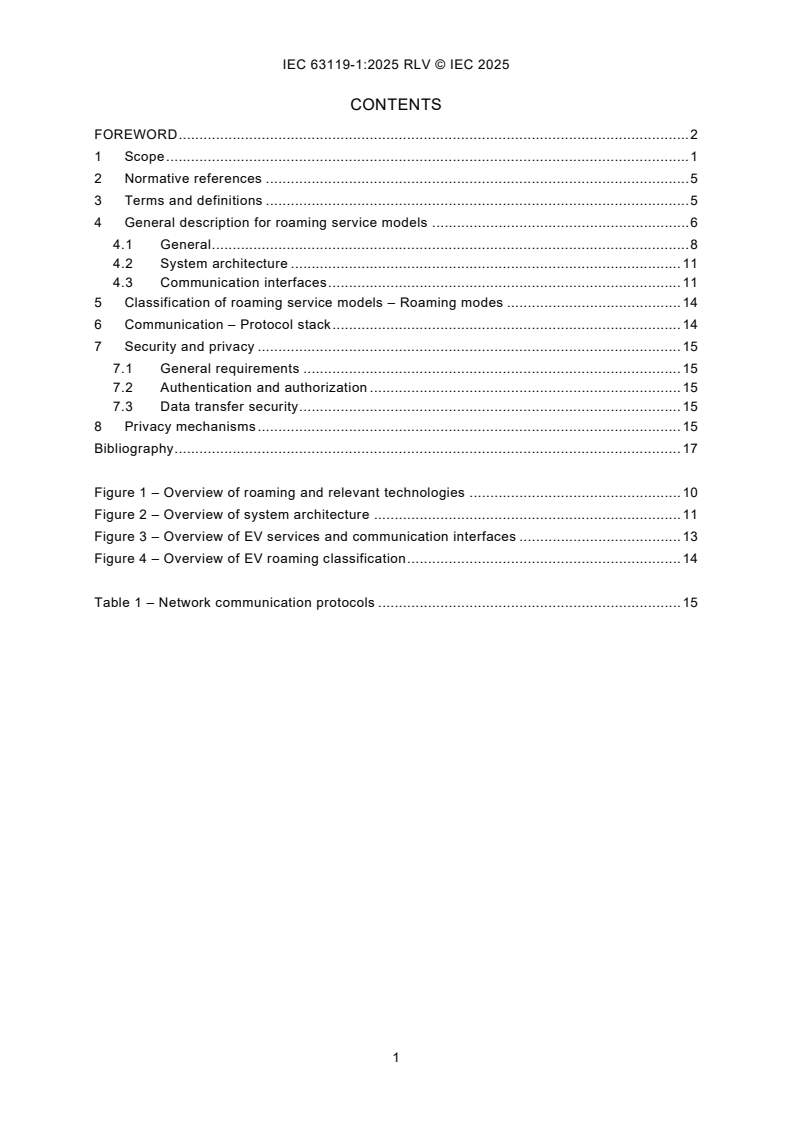
CONTENTS
FOREWORD . 2
1 Scope . 1
2 Normative references . 5
3 Terms and definitions . 5
4 General description for roaming service models . 6
4.1 General . 8
4.2 System architecture . 11
4.3 Communication interfaces . 11
5 Classification of roaming service models – Roaming modes . 14
6 Communication – Protocol stack . 14
7 Security and privacy . 15
7.1 General requirements . 15
7.2 Authentication and authorization . 15
7.3 Data transfer security . 15
8 Privacy mechanisms . 15
Bibliography . 17
Figure 1 – Overview of roaming and relevant technologies . 10
Figure 2 – Overview of system architecture . 11
Figure 3 – Overview of EV services and communication interfaces . 13
Figure 4 – Overview of EV roaming classification . 14
Table 1 – Network communication protocols . 15
INTERNATIONAL ELECTROTECHNICAL COMMISSION
____________
Information exchange for electric vehicle charging roaming service -
Part 1: General
FOREWORD
1) The International Electrotechnical Commission (IEC) is a worldwide organization for standardization comprising
all national electrotechnical committees (IEC National Committees). The object of IEC is to promote international
co-operation on all questions concerning standardization in the electrical and electronic fields. To this end and
in addition to other activities, IEC publishes International Standards, Technical Specifications, Technical Reports,
Publicly Available Specifications (PAS) and Guides (hereafter referred to as “IEC Publication(s)”). Their
preparation is entrusted to technical committees; any IEC National Committee interested in the subject dealt with
may participate in this preparatory work. International, governmental and non-governmental organizations liaising
with the IEC also participate in this preparation. IEC collaborates closely with the International Organization for
Standardization (ISO) in accordance with conditions determined by agreement between the two organizations.
2) The formal decisions or agreements of IEC on technical matters express, as nearly as possible, an international
consensus of opinion on the relevant subjects since each technical committee has representation from all
interested IEC National Committees.
3) IEC Publications have the form of recommendations for international use and are accepted by IEC National
Committees in that sense. While all reasonable efforts are made to ensure that the technical content of IEC
Publications is accurate, IEC cannot be held responsible for the way in which they are used or for any
misinterpretation by any end user.
4) In order to promote international uniformity, IEC National Committees undertake to apply IEC Publications
transparently to the maximum extent possible in their national and regional publications. Any divergence between
any IEC Publication and the corresponding national or regional publication shall be clearly indicated in the latter.
5) IEC itself does not provide any attestation of conformity. Independent certification bodies provide conformity
assessment services and, in some areas, access to IEC marks of conformity. IEC is not responsible for any
services carried out by independent certification bodies.
6) All users should ensure that they have the latest edition of this publication.
7) No liability shall attach to IEC or its directors, employees, servants or agents including individual experts and
members of its technical committees and IEC National Committees for any personal injury, property damage or
other damage of any nature whatsoever, whether direct or indirect, or for costs (including legal fees) and
expenses arising out of the publication, use of, or reliance upon, this IEC Publication or any other IEC
Publications.
8) Attention is drawn to the Normative references cited in this publication. Use of the referenced publications is
indispensable for the correct application of this publication.
9) IEC draws attention to the possibility that the implementation of this document may involve the use of (a)
patent(s). IEC takes no position concerning the evidence, validity or applicability of any claimed patent rights in
respect thereof. As of the date of publication of this document, IEC had not received notice of (a) patent(s), which
may be required to implement this document. However, implementers are cautioned that this may not represent
the latest information, which may be obtained from the patent database available at https://patents.iec.ch. IEC
shall not be held responsible for identifying any or all such patent rights.
This redline version of the official IEC Standard allows the user to identify the changes made
to the previous edition IEC 63119-1:2019. A vertical bar appears in the margin wherever a
change has been made. Additions are in green text, deletions are in strikethrough red text.
IEC 63119-1 has been prepared by IEC technical committee 69: Electrical power/energy
systems for electrically propelled road vehicles and industrial trucks. It is an International
Standard.
This second edition cancels and replaces the first edition published in 2019.
This edition includes the following significant technical changes with respect to the previous
edition:
a) the scope is expanded to include differentiation between home and visited service provider
roles and adds an explicit definition of roaming entity;
b) adds definitions for "home charging service provider (home-CSP)", "visited charging station
operator (visited-CSO)", and "charging detail record (CDR)", and expands related terms
such as "service" and "roaming entity";
c) introduces abbreviation variants for "home-CSP" and "visited-CSO" in the terminology,
aligning with North American and European conventions;
d) updates the communication protocol stack by adopting a newer TLS version (upgraded from
1.2 to 1.3);
e) system architecture and communication interfaces include detailed interactions between
home-CSP and visited-CSO;
f) adds a definition for "service" to cover a broader range of applications such as parking and
reservation management;
g) adds a distinction between "charging detail record (CDR)" and "service detail record (SDR)"
and clarifies their relationship in the terminology;
h) enhances the description of user credential transfer methods in communication interfaces
with greater diversity;
i) enhances the description of the mixed mode in the classification of roaming service models,
emphasizing improved user experience through faster response times.
The text of this International Standard is based on the following documents:
Draft Report on voting
69/1050/FDIS 69/1063/RVD
Full information on the voting for its approval can be found in the report on voting indicated in
the above table.
The language used for the development of this International Standard is English.
This document was drafted in accordance with ISO/IEC Directives, Part 2, and developed in
accordance with ISO/IEC Directives, Part 1 and ISO/IEC Directives, IEC Supplement, available
at www.iec.ch/members_experts/refdocs. The main document types developed by IEC are
described in greater detail at www.iec.ch/publications.
A list of all parts in the IEC 63119 series, published under the general title Information exchange
for electric vehicle charging roaming service, can be found on the IEC website.
The committee has decided that the contents of this document will remain unchanged until the
stability date indicated on the IEC website under webstore.iec.ch in the data related to the
specific document. At this date, the document will be
• reconfirmed,
• withdrawn, or
• revised.
1 Scope
This part of IEC 63119 establishes a basis for the other parts of IEC 63119, specifying the terms
and definitions, general description of the system model, classification, information exchange
and security mechanisms for roaming between EV charge charging service providers (CSPs),
charging station operators (CSOs) and clearing house platforms through roaming endpoints. It
provides an overview and describes the general requirements of the EV roaming service system.
The IEC 63119 series is applicable to high-level communication involved in information
exchange/interaction between different CSPs, as well as between a CSP and a CSO with or
without a clearing house platform through the roaming endpoint.
The IEC 63119 series does not specify the information exchange, either between the charging
station (CS) and the charging station operator (CSO), or between the EV and the CS.
2 Normative references
The following documents are referred to in the text in such a way that some or all of their content
constitutes requirements of this document. For dated references, only the edition cited applies.
For undated references, the latest edition of the referenced document (including any
amendments) applies.
RFC 5246, The Transport Layer Security (TLS) Protocol Version 1.2
There are no normative references in this document.
3 Terms and definitions
For the purposes of this document, the following terms and definitions apply.
ISO and IEC maintain terminology databases for use in standardization at the following
addresses:
• IEC Electropedia: available at https://www.electropedia.org/
• ISO Online browsing platform: available at https://www.iso.org/obp
3.1
electric vehicle
EV
electric road vehicle
vehicle propelled by an electric motor drawing current from a rechargeable storage battery or
from other portable energy storage devices (rechargeable, using energy from a source of the
vehicle such as a residential or public electric service), which is manufactured primarily for use
on public streets, roads or highways
[SOURCE: IEC 61851-1:2017, 3.4.1, modified – The definition has been expanded and the note
to entry has been deleted.]
3.2
service
suite of functions provided by the service provider to the EV users, such as energy transfer,
reservation management, parking, etc.
3.3
electric vehicle user
EV user
person or legal entity using the vehicle and providing information about its needs
[SOURCE: IEC TS SRD 62913-2-4:2019, Table 3]
3.4
electric vehicle supply equipment
EVSE
EV supply equipment
equipment or a combination of equipment that provides dedicated specific functions to supply
electric energy from a fixed electrical installation or supply network to an EV for the purpose of
charging and discharging
Note 1 to entry: This note applies to the French language only.
3.5
charge charging service provider
CSP
role that manages and authenticates EV user’s credentials and provides the billing and other
value-added services to the customer
Note 1 to entry: A CSP is a specialized type of EMSP.
Note 1 to entry: CSP is also abbreviated as EMSP in EU and NA.
Note 2 to entry: This note applies to the French language only.
3.6
charging station operator
CSO
charging point operator
CPO
party responsible for the provisioning and operation of the charging infrastructure (including
charging sites), and managing electricity to provide requested energy transfer services
Note 1 to entry: The party CSO shall operate a roaming endpoint to achieve a roaming service.
Note 2 to entry: This note applies to the French language only.
3.7
e-mobility service provider
EMSP
party responsible for providing high-value services related to the use of an EV (renting an EV,
reservation of parking service, navigation services, energy services which include charging
station provider in relation with CSO…)
Note 1 to entry: This note applies to the French language only.
Note 1 to entry: Examples of high-value services include renting an EV, reservation of parking service, navigation
services and energy services which include charging station provider in relation with CSO.
[SOURCE: IEC TS SRD 62913-2-4:2019, Table 3]
3.8
home charging service provider
home-CSP
entity which has a contract with the EV user and can authorize an energy transfer session to
another CSP/CSO
3.9
visited charging station operator
visited-CSO
visited charging point operator
visited-CPO
CSO/CPO that the EV user visits for getting energy transfer service, which is not the EV user’s
home-CSP
3.10
roaming
information exchanges and related provisions between CSPs, which allow EV users to use a
single credential and contract to access services on multiple e-mobility networks and contract
to access the charging services provided by multiple CSPs or CSOs through roaming endpoints
3.11
roaming entity
entity which provides roaming service to EV user, including home-CSP, visited-CSO and
cleaning house (CH)
3.12
clearing house
CH
mobility clearing house
MCH
roaming platform
e-mobility clearing house
E_MOCH
optional intermediate actor that facilitates authorization, billing and settling procedure for EV
charging service roaming, between two clearing partners
Note 1 to entry: The terms "MCH" (mobility clearing house), "roaming platform" and "E_MOCH" (e-mobility clearing
house) in different regions can be found depending on the region.
Note 2 to entry: This note applies to the French language only.
3.13
credential
physical or digital asset that carries the roaming service user's identity or contract ID, which is
used for authentication and security purposes
EXAMPLES
• static or dynamic QR code;
• username/password;
• RFID card;
• digital certificate transferred through the plug and charge process.
3.14
service detail record
SDR
data package containing all necessary information within one unique identification which is
needed for billing or informing of/about a service session of a specific customer
Note 1 to entry: This note applies to the French language only.
3.15
charging detail record
CDR
data package containing all necessary information within one unique identification which is
needed for billing or informing of/about an energy transfer session
3.16
charging session
collection of charging transactions at a charge point related only to the charging of an electric
car EV assigned to a specific customer in a specific time frame with a unique identifier
Note 1 to entry: The charging session is a subset of the service session.
3.17
service session
collection of services around a charge point mainly related to the charging of an electric car EV
assigned to a specific customer in a specific time frame with a unique identifier
3.18
charging transaction
smallest billable part of a charging session representing the transfer of energy in a specific time
frame
3.19
roaming endpoint
RE
entity containing all the related roaming functions
Note 1 to entry: This note applies to the French language only.
3.20
charging station
CS
physical equipment, consisting of one or more EVSEs managing the energy transfer to and from
Evs EV supply equipment, which manages the energy transfer to and from electric vehicles
Note 1 to entry: This note applies to the French language only.
3.21
energy transfer service
unit of continuous energy transfer between EVSE EV supply equipment and EV battery
3.22
distribution system operator
DSO
party operating a distribution system
Note 1 to entry: This note applies to the French language only.
[SOURCE: IEC 60050-617:2009, 617-02-10, modified – The terms "distribution network
operator" and "distributor" have been deleted, and Note 1 to entry has been added.]
4 General description for roaming service models
4.1 General
The IEC 63119 series covers roaming-related communication exchange. Clause 4 specifies the
general relationship of roaming with the relevant technologies.
Figure 1 shows an overview of roaming, grid and transportation technology. There could be
other related technologies which are not presented in this figure; not all interface reference
points are plotted.
The information exchange of roaming focuses on actors between different home-CSPs, as well
as between a home-CSP and a visited-CSO with or without clearing house platform through the
roaming endpoint. The clearing house is an optional actor to complete the roaming functions,
which can be completely or partially executed directly between different service providers.
For connections between grid and roaming technologies, there is a connection between the
visited-CSO and the charging station. To implement the smart grid function, there could be
other optional communication connections. For example, the distribution system operator may
can send the smart charging profile directly to the home-CSP.
For connections between roaming, grid and transportation technologies, it is also possible to
have information exchange between the intelligent transportation system (ITS) and the roaming
systems.
Figure 1 – Overview of roaming and relevant technologies
4.2 System architecture
Figure 2 shows an overview of the system architecture for EV roaming services. The basic
actors and their related controllers and systems are as follows.
• Electric vehicle (EV): this normally includes a controller for external information flow, which
negotiates and manages energy transfer between the EV and EVSE EV supply equipment,
exchanges EV and EVSE EV supply equipment ID info, etc.
• EV supply equipment (EVSE EV supply equipment): for networked EVSE EV supply
equipment, this normally includes a controller for charging communication, which negotiates
and manages energy transfer between the EV and EVSE EV supply equipment, exchanges
EV and EVSE EV supply equipment ID info, etc.
• Charging station operator (CSO) Visited charging service provider (visited-CSO): the
visited-CSO system manages the charging process of the EVSE and forwards charging
session information to the charge service provider or roaming endpoint. A single entity can
have both visited-CSO and home-CSP roles.
• Charge Home charging service provider (home-CSP): for roaming services, both home-CSP
and visited-CSO may can be involved through a roaming endpoint. For roaming between
home-CSPs, the visited home-CSP collects metering data and charging session information
from visited visited-CSO, then creates a service detail record (SDR), and forwards the SDR
to a home home-CSP through either a clearing house or directly.
• Clearing house (CH): the intermediate actor to facilitate EV charge roaming services. This
role is not required but can provide centralized hub service efficiency when there are many
service providers. Each clearing house may have its own system for facilitating information
exchange, billing and settlements.
NOTE I3 and I4 are defined in 4.3.
Figure 2 – Overview of system architecture
4.3 Communication interfaces
Figure 3 shows the primary actors, systems and communication interface reference points
involved in the EV service.
• I1: Interface between EVSE EV supply equipment and EV. The main functions include power
supply management and charging session management.
V supply equipment and visited-CSO. The functions supported
• I2: Interface between EVSE E
by this interface can include credential authentication, EVSE EV supply equipment charging
status exchange, and charging session management.
• I3: Interface between roaming endpoint and clearing house. It specifies the EV roaming
process through a centralized clearing house mode. The roaming functions can include
credential authentication, EVSE EV supply equipment charging status exchange, charging
session remote control and management, and charging transaction billing and settlement.
• I4: Interface between two roaming endpoints. It specifies the EV roaming process through
peer-to-peer direct mode. The roaming functions can include credential authentication,
EVSE EV supply equipment charging status exchange, charging session remote control and
management, and charging transaction billing and settlement.
• I5: Interface for the transfer of user credentials through EVSE EV supply equipment.
Example credentials include RFID cards, credit cards or user/password inputs from station
displays or a QR code displayed on a user device.
• I6: Interface for user credentials sent through a mobile app or other method to the home-
CSP. Supported credentials include static or dynamic QR code, and username/password.
• I7: Interface between CSP and CSO. This can be an internal interface within one entity or
an external interface between two entities.
Figure 3 – Overview of EV services and communication interfaces
5 Classification of roaming service models – Roaming modes
In Figure 4, roaming types are classified according to three basic modes: peer-to-peer or direct
mode, clearing house mode, and mixed mode, depending on whether there is an intermediary
to facilitate the roaming process as regards different types of roaming functions.
The difference between the clearing house mode and the mixed mode is determined by the
charging service module. To allow for a quicker response and an improved enhance user
experience and facilitate faster response times, the mixed mode allows for enables direct
communication between different various roaming endpoints to initiate and control manage
charging sessions. Similarly, other service modules are processed handled in a similar manner.
Both clearing house mode and mixed mode are divided into two sub-types based on the
authorization mechanism. The user credentials to authorize EV charging services can be issued
either by the clearing house, or by individual home-CSPs.
The choice of the mode can be determined based on business and technical considerations.
Figure 4 – Overview of EV roaming classification
6 Communication – Protocol stack
Recommendations for communication protocols used in I3, I4 include, but are not restricted to,
those in Table 1.
Table 1 – Network communication protocols
OSI model Protocol Function
Application (layer 7) I3/I4 interface (HTTP) Define the service interfaces involved.
Presentation (layer 6) Protocol Define the message structure and encoding rules.
SOAP/XML JSON
buffer
Session (layer 5) Provide communications' securityEnsure secure
TLS
communication over the network.
Transport (layer 4) Enable Internet connectivity and process data from
TCP
applications.
7 Security and privacy
7.1 General requirements
All servers offering roaming service functions shall provide secure interfaces, as described in
Clause 6. The servers shall be protected by security software with anti-virus detection, attack
detection, network firewall, and other functions.
The information system shall have employ authentication mechanisms to identify the source of
messages (e.g. HMAC), in order to determine if the message is from a trustworthy source, such
as HMAC, to verify the origin of messages and ensure that they come from a trusted source.
Recommendations for specific security mechanisms in HTTP/HTTPS will often be taken from
existing works, including
– RFC 5246 8446, The Transport Layer Security (TLS) Protocol Version 1.2;3,
– AES, Advanced Encryption Standard, and
– DES, Data Encryption Standard.
7.2 Authentication and authorization
The combination of a username and password is adopted in identity authentication. Secure,
reliable and general cryptographic algorithms shall be applied to provide encryption of the
password sent over the network.
After successful identity authentication, an authorized session is created to transmit data.
A token shall be generated for the session in progress, and users can access data within the
scope of their authorizations using the token.
A certain validity period (e.g. 20 min) is ass
...
IEC 63119-1 ®
Edition 2.0 2025-07
NORME
INTERNATIONALE
Échange d'informations pour le service d'itinérance de la recharge des véhicules
électriques –
Partie 1: Généralités
ICS 43.120; 29.130.20; 35.240.01 ISBN 978-2-8327-0532-2
Droits de reproduction réservés. Sauf indication contraire, aucune partie de cette publication ne peut être reproduite ni
utilisée sous quelque forme que ce soit et par aucun procédé, électronique ou mécanique, y compris la photocopie et
les microfilms, sans l'accord écrit de l'IEC ou du Comité national de l'IEC du pays du demandeur. Si vous avez des
questions sur le copyright de l'IEC ou si vous désirez obtenir des droits supplémentaires sur cette publication, utilisez
les coordonnées ci-après ou contactez le Comité national de l'IEC de votre pays de résidence.
IEC Secretariat Tel.: +41 22 919 02 11
3, rue de Varembé info@iec.ch
CH-1211 Geneva 20 www.iec.ch
Switzerland
A propos de l'IEC
La Commission Electrotechnique Internationale (IEC) est la première organisation mondiale qui élabore et publie des
Normes internationales pour tout ce qui a trait à l'électricité, à l'électronique et aux technologies apparentées.
A propos des publications IEC
Le contenu technique des publications IEC est constamment revu. Veuillez vous assurer que vous possédez l’édition la
plus récente, un corrigendum ou amendement peut avoir été publié.
Recherche de publications IEC - IEC Products & Services Portal - products.iec.ch
webstore.iec.ch/advsearchform Découvrez notre puissant moteur de recherche et consultez
La recherche avancée permet de trouver des publications gratuitement tous les aperçus des publications, symboles
IEC en utilisant différents critères (numéro de référence, graphiques et le glossaire. Avec un abonnement, vous aurez
texte, comité d’études, …). Elle donne aussi des toujours accès à un contenu à jour adapté à vos besoins.
informations sur les projets et les publications remplacées
ou retirées. Electropedia - www.electropedia.org
Le premier dictionnaire d'électrotechnologie en ligne au
IEC Just Published - webstore.iec.ch/justpublished monde, avec plus de 22 500 articles terminologiques en
Restez informé sur les nouvelles publications IEC. Just anglais et en français, ainsi que les termes équivalents
dans 25 langues additionnelles. Egalement appelé
Published détaille les nouvelles publications parues.
Disponible en ligne et une fois par mois par email. Vocabulaire Electrotechnique International (IEV) en ligne.
Service Clients - webstore.iec.ch/csc
Si vous désirez nous donner des commentaires sur cette
publication ou si vous avez des questions contactez-
nous: sales@iec.ch.
SOMMAIRE
AVANT-PROPOS . 2
1 Domaine d’application . 4
2 Références normatives . 4
3 Termes et définitions . 4
4 Description générale pour les modèles de service d’itinérance . 7
4.1 Généralités . 7
4.2 Architecture du système. 8
4.3 Interfaces de communication . 9
5 Classification des modèles de service d’itinérance – Modes d’itinérance . 10
6 Communication – Pile de protocoles . 11
7 Sécurité et confidentialité . 11
7.1 Exigences générales . 11
7.2 Authentification et autorisation . 11
7.3 Sécurité de transfert des données. 12
8 Mécanismes de confidentialité . 12
Bibliographie . 13
Figure 1 – Interaction entre les technologies d’itinérance et les technologies
pertinentes. 8
Figure 2 – Présentation de l’architecture du système . 9
Figure 3 – Présentation des services VE et des interfaces de communication . 10
Figure 4 – Classification de l’itinérance des VE . 11
Tableau 1 – Protocoles de communication réseau . 11
COMMISSION ÉLECTROTECHNIQUE INTERNATIONALE
____________
Échange d’informations pour le service d’itinérance
de la recharge des véhicules électriques -
Partie 1: Généralités
AVANT-PROPOS
1) La Commission Électrotechnique Internationale (IEC) est une organisation mondiale de normalisation composée
de l’ensemble des comités électrotechniques nationaux (Comités nationaux de l’IEC). L’IEC a pour objet de
favoriser la coopération internationale pour toutes les questions de normalisation dans les domaines de
l’électricité et de l’électronique. À cet effet, l’IEC – entre autres activités – publie des Normes internationales,
des Spécifications techniques, des Rapports techniques, des Spécifications accessibles au public (PAS) et des
Guides (ci-après dénommés "Publication(s) de l’IEC"). Leur élaboration est confiée à des comités d’études,
aux travaux desquels tout Comité national intéressé par le sujet traité peut participer. Les organisations
internationales, gouvernementales et non gouvernementales, en liaison avec l’IEC, participent également aux
travaux. L’IEC collabore étroitement avec l’Organisation Internationale de Normalisation (ISO), selon des
conditions fixées par accord entre les deux organisations.
2) Les décisions ou accords officiels de l’IEC concernant les questions techniques représentent, dans la mesure du
possible, un accord international sur les sujets étudiés, étant donné que les Comités nationaux de l’IEC intéressés
sont représentés dans chaque comité d’études.
3) Les Publications de l’IEC se présentent sous la forme de recommandations internationales et sont agréées
comme telles par les Comités nationaux de l’IEC. Tous les efforts raisonnables sont entrepris afin que l’IEC
s’assure de l’exactitude du contenu technique de ses publications; l’IEC ne peut pas être tenue responsable de
l’éventuelle mauvaise utilisation ou interprétation qui en est faite par un quelconque utilisateur final.
4) Dans le but d’encourager l’uniformité internationale, les Comités nationaux de l’IEC s’engagent, dans toute la
mesure possible, à appliquer de façon transparente les Publications de l’IEC dans leurs publications nationales
et régionales. Toutes divergences entre toutes Publications de l’IEC et toutes publications nationales ou
régionales correspondantes doivent être indiquées en termes clairs dans ces dernières.
5) L’IEC elle-même ne fournit aucune attestation de conformité. Des organismes de certification indépendants
fournissent des services d’évaluation de conformité et, dans certains secteurs, accèdent aux marques de
conformité de l’IEC. L’IEC n’est responsable d’aucun des services effectués par les organismes de certification
indépendants.
6) Tous les utilisateurs doivent s’assurer qu’ils sont en possession de la dernière édition de cette publication.
7) Aucune responsabilité ne doit être imputée à l’IEC, à ses administrateurs, employés, auxiliaires ou mandataires,
y compris ses experts particuliers et les membres de ses comités d’études et des Comités nationaux de l’IEC,
pour tout préjudice causé en cas de dommages corporels et matériels, ou de tout autre dommage de quelque
nature que ce soit, directe ou indirecte, ou pour supporter les coûts (y compris les frais de justice) et les dépenses
découlant de la publication ou de l’utilisation de cette Publication de l’IEC ou de toute autre Publication de l’IEC,
ou au crédit qui lui est accordé.
8) L’attention est attirée sur les références normatives citées dans cette publication. L’utilisation de publications
référencées est obligatoire pour une application correcte de la présente publication.
9) L’IEC attire l’attention sur le fait que la mise en application du présent document peut entraîner l’utilisation d’un
ou de plusieurs brevets. L’IEC ne prend pas position quant à la preuve, à la validité et à l’applicabilité de tout
droit de brevet revendiqué à cet égard. À la date de publication du présent document, l’IEC n’avait pas reçu
notification qu’un ou plusieurs brevets pouvaient être nécessaires à sa mise en application. Toutefois, il y a lieu
d’avertir les responsables de la mise en application du présent document que des informations plus récentes
sont susceptibles de figurer dans la base de données de brevets, disponible à l’adresse https://patents.iec.ch.
L’IEC ne saurait être tenue pour responsable de ne pas avoir identifié de tels droits de brevet.
L’IEC 63119-1 a été établie par le comité d’études 69 de l’IEC: Système d’alimentation/énergie
électrique pour les véhicules routiers électriques et chariots industriels de manutention. Il s’agit
d’une Norme internationale.
Cette deuxième édition annule et remplace la première édition parue en 2019.
Cette édition inclut les modifications techniques majeures suivantes par rapport à l’édition
précédente:
a) le domaine d’application est étendu pour faire la distinction entre les rôles de prestataire de
services domestiques et sollicités et ajoute une définition explicite de l’entité d’itinérance;
b) ajoute des définitions pour "prestataire de services de recharge domestique
(CSP domestique)", "opérateur de bornes de charge sollicité (CSO sollicité)" et
"enregistrement des détails de la charge (CDR)" et développe les termes connexes tels que
"service" et "entité d’itinérance";
c) introduit des variantes d’abréviation pour "CSP domestique" et "CSO sollicité" dans la
terminologie pour respecter les conventions nord-américaines et européennes;
d) met à jour la pile de protocoles de communication en adoptant une nouvelle version TLS
(mise à niveau de la version 1.2 à la version 1.3);
e) l’architecture du système et les interfaces de communication incluent des interactions
détaillées entre le CSP domestique et le CSO sollicité;
f) ajoute une définition de "service" pour couvrir une éventail plus large d’applications telles
que la gestion du parking et des réservations;
g) ajoute une distinction entre "enregistrement des détails de la charge (CDR)" et
"enregistrement des détails du service (SDR)" et précise leurs relations dans la
terminologie;
h) améliore la description des méthodes de transfert des identifiants de l’utilisateur dans les
interfaces de communication avec une plus grande diversité;
i) améliore la description du mode mixte dans la classification des modèles de service
d’itinérance, en mettant l’accent sur l’expérience de l’utilisateur améliorée par des temps de
réponse plus rapides.
Le texte de cette Norme internationale est issu des documents suivants:
Projet Rapport de vote
69/1050/FDIS 69/1063/RVD
Le rapport de vote indiqué dans le tableau ci-dessus donne toute information sur le vote ayant
abouti à son approbation.
La langue employée pour l’élaboration de cette Norme internationale est l’anglais.
Ce document a été rédigé selon les Directives ISO/IEC, Partie 2, il a été développé selon les
Directives ISO/IEC, Partie 1 et les Directives ISO/IEC, Supplément IEC, disponibles sous
www.iec.ch/members_experts/refdocs. Les principaux types de documents développés par
l’IEC sont décrits plus en détail sous www.iec.ch/publications.
Une liste de toutes les parties de la série IEC 63119, publiées sous le titre général
Échange d’informations pour le service d’itinérance de la recharge des véhicules électriques,
se trouve sur le site Web de l’IEC.
Le comité a décidé que le contenu de ce document ne sera pas modifié avant la date de stabilité
indiquée sur le site web de l’IEC sous webstore.iec.ch dans les données relatives au document
recherché. À cette date, le document sera
• reconduit,
• supprimé, ou
• révisé.
1 Domaine d’application
La présente partie de l’IEC 63119 constitue la base des autres parties de la série IEC 63119.
Elle spécifie les termes et définitions, la description générale du modèle de système,
la classification, l’échange d’informations et les mécanismes de sécurité pour l’itinérance entre
les prestataires de services de recharge de véhicules électriques (CSP), les opérateurs de
bornes de charge (CSO) et les plateformes d’échange de données par le biais d’un nœud final
d’itinérance. Elle fournit une vue d’ensemble et décrit les exigences générales du système du
service d’itinérance des VE.
La série IEC 63119 s’applique aux communications de haut niveau dans le cadre des échanges
d’informations/interactions entre les différents CSP, mais aussi entre un CSP et un CSO avec
ou sans plateforme d’échange de données par le biais du nœud final d’itinérance.
La série IEC 63119 ne spécifie pas l’échange d’informations entre la borne de charge (CS) et
l’opérateur de bornes de charge (CSO) ni entre le VE et la CS.
2 Références normatives
Le présent document ne contient aucune référence normative.
3 Termes et définitions
Pour les besoins du présent document, les termes et définitions suivants s’appliquent.
L’ISO et l’IEC tiennent à jour des bases de données terminologiques destinées à être utilisées
en normalisation, consultables aux adresses suivantes :
• IEC Electropedia: disponible à l’adresse https://www.electropedia.org/
• ISO Online browsing platform : disponible à l’adresse https://www.iso.org/obp
3.1
véhicule électrique
VE
véhicule électrique routier
véhicule propulsé par un moteur électrique dont le courant provient d’une batterie
d’accumulateurs rechargeable ou d’un autre dispositif portable de stockage d’énergie
(rechargeable à partir d’une source d’alimentation située à l’extérieur du véhicule, telle qu’une
source d’énergie électrique résidentielle ou publique) et principalement destiné à être utilisé
sur les voies, routes ou autoroutes publiques
[SOURCE: IEC 61851-1:2017, 3.4.1, modifiée – La définition a été étoffée et la note à l’article
a été supprimée.]
3.2
service
série de processus que le prestataire de services propose à l’utilisateur du VE, y compris le
transfert d’énergie, la gestion des réservations, le parking, etc.
3.3
utilisateur du véhicule électrique
utilisateur du VE
personne ou entité juridique qui utilise le véhicule et fournit des informations concernant ses
besoins
[SOURCE: IEC SRD 62913-2-4:2019, Tableau 3]
3.4
système d’alimentation pour véhicule électrique
système d’alimentation pour VE
équipement ou ensemble d’équipements assurant des fonctions spécifiques à l’alimentation en
énergie électrique à partir d’une installation électrique fixe ou d’un réseau d’alimentation
jusqu’au VE pour les besoins de recharge et de décharge
3.5
prestataire de services de recharge
CSP
rôle qui gère et authentifie les identifiants de l’utilisateur du VE et qui propose au client le
service de facturation et d’autres services à valeur ajoutée
Note 1 à l’article: Le CSP est également abrégé en EMSP dans l’UE et NA.
3.6
opérateur de bornes de charge
CSO
opérateur de point de charge
CPO
partie responsable de l’approvisionnement et de l’exploitation de l’infrastructure de recharge
(y compris des sites de recharge), ainsi que de la gestion de l’électricité dans le but de fournir
les services de transfert d’énergie demandés
Note 1 à l’article: Le CSO doit exploiter un nœud final d’itinérance pour assurer le service d’itinérance.
3.7
prestataire de services d’e-mobilité
EMSP
partie responsable de la fourniture de services à valeur élevée liés à l’utilisation d’un VE
Note 1 à l’article: Les services à valeur éle
...
IEC 63119-1 ®
Edition 2.0 2025-07
INTERNATIONAL
STANDARD
NORME
INTERNATIONALE
Information exchange for electric vehicle charging roaming service –
Part 1: General
Échange d'informations pour le service d'itinérance de la recharge des véhicules
électriques –
Partie 1: Généralités
ICS 43.120; 29.130.20; 35.240.01 ISBN 978-2-8327-0532-2
All rights reserved. Unless otherwise specified, no part of this publication may be reproduced or utilized in any form or
by any means, electronic or mechanical, including photocopying and microfilm, without permission in writing from either
IEC or IEC's member National Committee in the country of the requester. If you have any questions about IEC copyright
or have an enquiry about obtaining additional rights to this publication, please contact the address below or your local
IEC member National Committee for further information.
Droits de reproduction réservés. Sauf indication contraire, aucune partie de cette publication ne peut être reproduite ni
utilisée sous quelque forme que ce soit et par aucun procédé, électronique ou mécanique, y compris la photocopie et
les microfilms, sans l'accord écrit de l'IEC ou du Comité national de l'IEC du pays du demandeur. Si vous avez des
questions sur le copyright de l'IEC ou si vous désirez obtenir des droits supplémentaires sur cette publication, utilisez
les coordonnées ci-après ou contactez le Comité national de l'IEC de votre pays de résidence.
IEC Secretariat Tel.: +41 22 919 02 11
3, rue de Varembé info@iec.ch
CH-1211 Geneva 20 www.iec.ch
Switzerland
About the IEC
The International Electrotechnical Commission (IEC) is the leading global organization that prepares and publishes
International Standards for all electrical, electronic and related technologies.
About IEC publications
The technical content of IEC publications is kept under constant review by the IEC. Please make sure that you have the
latest edition, a corrigendum or an amendment might have been published.
IEC publications search - IEC Products & Services Portal - products.iec.ch
webstore.iec.ch/advsearchform Discover our powerful search engine and read freely all the
The advanced search enables to find IEC publications by a publications previews, graphical symbols and the glossary.
variety of criteria (reference number, text, technical With a subscription you will always have access to up to date
committee, …). It also gives information on projects, content tailored to your needs.
replaced and withdrawn publications.
Electropedia - www.electropedia.org
IEC Just Published - webstore.iec.ch/justpublished The world's leading online dictionary on electrotechnology,
Stay up to date on all new IEC publications. Just Published containing more than 22 500 terminological entries in English
details all new publications released. Available online and and French, with equivalent terms in 25 additional languages.
Also known as the International Electrotechnical Vocabulary
once a month by email.
(IEV) online.
IEC Customer Service Centre - webstore.iec.ch/csc
If you wish to give us your feedback on this publication or
need further assistance, please contact the Customer
Service Centre: sales@iec.ch.
A propos de l'IEC
La Commission Electrotechnique Internationale (IEC) est la première organisation mondiale qui élabore et publie des
Normes internationales pour tout ce qui a trait à l'électricité, à l'électronique et aux technologies apparentées.
A propos des publications IEC
Le contenu technique des publications IEC est constamment revu. Veuillez vous assurer que vous possédez l’édition la
plus récente, un corrigendum ou amendement peut avoir été publié.
Recherche de publications IEC - IEC Products & Services Portal - products.iec.ch
webstore.iec.ch/advsearchform Découvrez notre puissant moteur de recherche et consultez
La recherche avancée permet de trouver des publications gratuitement tous les aperçus des publications, symboles
IEC en utilisant différents critères (numéro de référence, graphiques et le glossaire. Avec un abonnement, vous aurez
texte, comité d’études, …). Elle donne aussi des toujours accès à un contenu à jour adapté à vos besoins.
informations sur les projets et les publications remplacées
ou retirées. Electropedia - www.electropedia.org
Le premier dictionnaire d'électrotechnologie en ligne au
IEC Just Published - webstore.iec.ch/justpublished monde, avec plus de 22 500 articles terminologiques en
Restez informé sur les nouvelles publications IEC. Just anglais et en français, ainsi que les termes équivalents
Published détaille les nouvelles publications parues. dans 25 langues additionnelles. Egalement appelé
Disponible en ligne et une fois par mois par email. Vocabulaire Electrotechnique International (IEV) en ligne.
Service Clients - webstore.iec.ch/csc
Si vous désirez nous donner des commentaires sur cette
publication ou si vous avez des questions contactez-
nous: sales@iec.ch.
CONTENTS
FOREWORD . 2
1 Scope . 4
2 Normative references . 4
3 Terms and definitions . 4
4 General description for roaming service models . 7
4.1 General . 7
4.2 System architecture . 8
4.3 Communication interfaces . 9
5 Classification of roaming service models – Roaming modes . 10
6 Communication – Protocol stack . 11
7 Security and privacy . 11
7.1 General requirements . 11
7.2 Authentication and authorization . 11
7.3 Data transfer security . 12
8 Privacy mechanisms . 12
Bibliography . 13
Figure 1 – Overview of roaming and relevant technologies . 8
Figure 2 – Overview of system architecture . 9
Figure 3 – Overview of EV services and communication interfaces . 10
Figure 4 – Overview of EV roaming classification . 11
Table 1 – Network communication protocols . 11
INTERNATIONAL ELECTROTECHNICAL COMMISSION
____________
Information exchange for electric vehicle charging roaming service -
Part 1: General
FOREWORD
1) The International Electrotechnical Commission (IEC) is a worldwide organization for standardization comprising
all national electrotechnical committees (IEC National Committees). The object of IEC is to promote international
co-operation on all questions concerning standardization in the electrical and electronic fields. To this end and
in addition to other activities, IEC publishes International Standards, Technical Specifications, Technical Reports,
Publicly Available Specifications (PAS) and Guides (hereafter referred to as “IEC Publication(s)”). Their
preparation is entrusted to technical committees; any IEC National Committee interested in the subject dealt with
may participate in this preparatory work. International, governmental and non-governmental organizations liaising
with the IEC also participate in this preparation. IEC collaborates closely with the International Organization for
Standardization (ISO) in accordance with conditions determined by agreement between the two organizations.
2) The formal decisions or agreements of IEC on technical matters express, as nearly as possible, an international
consensus of opinion on the relevant subjects since each technical committee has representation from all
interested IEC National Committees.
3) IEC Publications have the form of recommendations for international use and are accepted by IEC National
Committees in that sense. While all reasonable efforts are made to ensure that the technical content of IEC
Publications is accurate, IEC cannot be held responsible for the way in which they are used or for any
misinterpretation by any end user.
4) In order to promote international uniformity, IEC National Committees undertake to apply IEC Publications
transparently to the maximum extent possible in their national and regional publications. Any divergence between
any IEC Publication and the corresponding national or regional publication shall be clearly indicated in the latter.
5) IEC itself does not provide any attestation of conformity. Independent certification bodies provide conformity
assessment services and, in some areas, access to IEC marks of conformity. IEC is not responsible for any
services carried out by independent certification bodies.
6) All users should ensure that they have the latest edition of this publication.
7) No liability shall attach to IEC or its directors, employees, servants or agents including individual experts and
members of its technical committees and IEC National Committees for any personal injury, property damage or
other damage of any nature whatsoever, whether direct or indirect, or for costs (including legal fees) and
expenses arising out of the publication, use of, or reliance upon, this IEC Publication or any other IEC
Publications.
8) Attention is drawn to the Normative references cited in this publication. Use of the referenced publications is
indispensable for the correct application of this publication.
9) IEC draws attention to the possibility that the implementation of this document may involve the use of (a)
patent(s). IEC takes no position concerning the evidence, validity or applicability of any claimed patent rights in
respect thereof. As of the date of publication of this document, IEC had not received notice of (a) patent(s), which
may be required to implement this document. However, implementers are cautioned that this may not represent
the latest information, which may be obtained from the patent database available at https://patents.iec.ch. IEC
shall not be held responsible for identifying any or all such patent rights.
IEC 63119-1 has been prepared by IEC technical committee 69: Electrical power/energy
systems for electrically propelled road vehicles and industrial trucks. It is an International
Standard.
This second edition cancels and replaces the first edition published in 2019.
This edition includes the following significant technical changes with respect to the previous
edition:
a) the scope is expanded to include differentiation between home and visited service provider
roles and adds an explicit definition of roaming entity;
b) adds definitions for "home charging service provider (home-CSP)", "visited charging station
operator (visited-CSO)", and "charging detail record (CDR)", and expands related terms
such as "service" and "roaming entity";
c) introduces abbreviation variants for "home-CSP" and "visited-CSO" in the terminology,
aligning with North American and European conventions;
d) updates the communication protocol stack by adopting a newer TLS version (upgraded from
1.2 to 1.3);
e) system architecture and communication interfaces include detailed interactions between
home-CSP and visited-CSO;
f) adds a definition for "service" to cover a broader range of applications such as parking and
reservation management;
g) adds a distinction between "charging detail record (CDR)" and "service detail record (SDR)"
and clarifies their relationship in the terminology;
h) enhances the description of user credential transfer methods in communication interfaces
with greater diversity;
i) enhances the description of the mixed mode in the classification of roaming service models,
emphasizing improved user experience through faster response times.
The text of this International Standard is based on the following documents:
Draft Report on voting
69/1050/FDIS 69/1063/RVD
Full information on the voting for its approval can be found in the report on voting indicated in
the above table.
The language used for the development of this International Standard is English.
This document was drafted in accordance with ISO/IEC Directives, Part 2, and developed in
accordance with ISO/IEC Directives, Part 1 and ISO/IEC Directives, IEC Supplement, available
at www.iec.ch/members_experts/refdocs. The main document types developed by IEC are
described in greater detail at www.iec.ch/publications.
A list of all parts in the IEC 63119 series, published under the general title Information exchange
for electric vehicle charging roaming service, can be found on the IEC website.
The committee has decided that the contents of this document will remain unchanged until the
stability date indicated on the IEC website under webstore.iec.ch in the data related to the
specific document. At this date, the document will be
• reconfirmed,
• withdrawn, or
• revised.
1 Scope
This part of IEC 63119 establishes a basis for the other parts of IEC 63119, specifying the terms
and definitions, general description of the system model, classification, information exchange
and security mechanisms for roaming between EV charging service providers (CSPs), charging
station operators (CSOs) and clearing house platforms through roaming endpoints. It provides
an overview and describes the general requirements of the EV roaming service system.
The IEC 63119 series is applicable to high-level communication involved in information
exchange/interaction between different CSPs, as well as between a CSP and a CSO with or
without a clearing house platform through the roaming endpoint.
The IEC 63119 series does not specify the information exchange, either between the charging
station (CS) and the charging station operator (CSO), or between the EV and the CS.
2 Normative references
There are no normative references in this document.
3 Terms and definitions
For the purposes of this document, the following terms and definitions apply.
ISO and IEC maintain terminology databases for use in standardization at the following
addresses:
• IEC Electropedia: available at https://www.electropedia.org/
• ISO Online browsing platform: available at https://www.iso.org/obp
3.1
electric vehicle
EV
electric road vehicle
vehicle propelled by an electric motor drawing current from a rechargeable storage battery or
from other portable energy storage devices (rechargeable, using energy from a source of the
vehicle such as a residential or public electric service), which is manufactured primarily for use
on public streets, roads or highways
[SOURCE: IEC 61851-1:2017, 3.4.1, modified – The definition has been expanded and the note
to entry has been deleted.]
3.2
service
suite of functions provided by the service provider to the EV users, such as energy transfer,
reservation management, parking, etc.
3.3
electric vehicle user
EV user
person or legal entity using the vehicle and providing information about its needs
[SOURCE: IEC SRD 62913-2-4:2019, Table 3]
3.4
electric vehicle supply equipment
EV supply equipment
equipment or a combination of equipment that provides specific functions to supply electric
energy from a fixed electrical installation or supply network to an EV for the purpose of charging
and discharging
3.5
charging service provider
CSP
role that manages and authenticates EV user’s credentials and provides the billing and other
value-added services to the customer
Note 1 to entry: CSP is also abbreviated as EMSP in EU and NA.
3.6
charging station operator
CSO
charging point operator
CPO
party responsible for the provisioning and operation of the charging infrastructure (including
charging sites), and managing electricity to provide requested energy transfer services
Note 1 to entry: The CSO shall operate a roaming endpoint to achieve a roaming service.
3.7
e-mobility service provider
EMSP
party responsible for providing high-value services related to the use of an EV
Note 1 to entry: Examples of high-value services include renting an EV, reservation of parking service, navigation
services and energy services which include charging station provider in relation with CSO.
[SOURCE: IEC SRD 62913-2-4:2019, Table 3]
3.8
home charging service provider
home-CSP
entity which has a contract with the EV user and can authorize an energy transfer session to
another CSP/CSO
3.9
visited charging station operator
visited-CSO
visited charging point operator
visited-CPO
CSO/CPO that the EV user visits for getting energy transfer service, which is not the EV user’s
home-CSP
3.10
roaming
information exchanges and related provisions between CSPs, which allow EV users to use a
single credential and contract to access services on multiple e-mobility networks and contract
to access the charging services provided by multiple CSPs or CSOs through roaming endpoints
3.11
roaming entity
entity which provides roaming service to EV user, including home-CSP, visited-CSO and
cleaning house (CH)
3.12
clearing house
CH
mobility clearing house
MCH
roaming platform
e-mobility clearing house
E_MOCH
optional intermediate actor that facilitates authorization, billing and settling procedure for EV
charging service roaming, between two clearing partners
Note 1 to entry: The terms "MCH" (mobility clearing house), "roaming platform" and "E_MOCH" (e-mobility clearing
house) can be found depending on the region.
3.13
credential
physical or digital asset that carries the roaming service user's identity or contract ID, which is
used for authentication and security purposes
EXAMPLES
• static or dynamic QR code;
• username/password;
• RFID card;
• digital certificate transferred through the plug and charge process.
3.14
service detail record
SDR
data package containing all necessary information within one unique identification which is
needed for billing or informing of/about a service session of a specific customer
3.15
charging detail record
CDR
data package containing all necessary information within one unique identification which is
needed for billing or informing of/about an energy transfer session
3.16
charging session
collection of charging transactions at a charge point related only to the charging of an EV
assigned to a specific customer in a specific time frame with a unique identifier
Note 1 to entry: The charging session is a subset of the service session.
3.17
service session
collection of services around a charge point mainly related to the charging of an EV assigned
to a specific customer in a specific time frame with a unique identifier
3.18
charging transaction
smallest billable part of a charging session representing the transfer of energy in a specific time
frame
3.19
roaming endpoint
RE
entity containing all the related roaming functions
3.20
charging station
CS
physical equipment, consisting of one or more EV supply equipment, which manages the energy
transfer to and from electric vehicles
3.21
energy transfer service
unit of continuous energy transfer between EV supply equipment and EV battery
3.22
distribution system operator
DSO
party operating a distribution system
[SOURCE: IEC 60050-617:2009, 617-02-10, modified – The terms "distribution network
operator" and "distributor" have been deleted.]
4 General description for roaming service models
4.1 General
The IEC 63119 series covers roaming-related communication exchange. Clause 4 specifies the
general relationship of roaming with the relevant technologies.
Figure 1 shows an overview of roaming, grid and transportation technology. There could be
other related technologies which are not presented in this figure; not all interface reference
points are plotted.
The information exchange of roaming focuses on actors between different home-CSPs, as well
as between a home-CSP and a visited-CSO with or without clearing house platform through the
roaming endpoint. The clearing house is an optional actor to complete the roaming functions,
which can be completely or partially executed directly between different service providers.
For connections between grid and roaming technologies, there is a connection between the
visited-CSO and the charging station. To implement the smart grid function, there could be
other optional communication connections. For example, the distribution system operator can
send the smart charging profile directly to the home-CSP.
For connections between roaming, grid and transportation technologies, it is also possible to
have information exchange between the intelligent transportation system (ITS) and the roaming
systems.
Figure 1 – Overview of roaming and relevant technologies
4.2 System architecture
Figure 2 shows an overview of the system architecture for EV roaming services. The basic
actors and their related controllers and systems are as follows.
• Electric vehicle (EV): this normally includes a controller for external information flow, which
negotiates and manages energy transfer between the EV and EV supply equipment,
exchanges EV and EV supply equipment ID info, etc.
• EV supply equipment (EV supply equipment): for networked EV supply equipment, this
normally includes a controller for charging communication, which negotiates and manages
energy transfer between the EV and EV supply equipment, exchanges EV and EV supply
equipment ID info, etc.
• Visited charging service provider (visited-CSO): the visited-CSO system manages the
charging process and forwards charging session information to the charge service provider
or roaming endpoint. A single entity can have both visited-CSO and home-CSP roles.
• Home charging service provider (home-CSP): for roaming services, both home-CSP and
visited-CSO can be involved through a roaming endpoint. For roaming between home-CSPs,
the visited home-CSP collects metering data and charging session information from visited
visited-CSO, then creates a service detail record (SDR), and forwards the SDR to a home
home-CSP through either a clearing house or directly.
• Clearing house (CH): the intermediate actor to facilitate EV charge roaming services. This
role is not required but can provide hub service efficiency when there are many service
providers.
NOTE I3 and I4 are defined in 4.3.
Figure 2 – Overview of system architecture
4.3 Communication interfaces
Figure 3 shows the primary actors, systems and communication interface reference points
involved in the EV service.
• I1: Interface between EV supply equipment and EV. The main functions include power
supply management and charging session management.
• I2: Interface between EV supply equipment and visited-CSO. The functions supported by
this interface can include credential authentication, EV supply equipment charging status
exchange, and charging session management.
• I3: Interface between roaming endpoint and clearing house. It specifies the EV roaming
process through a centralized clearing house mode. The roaming functions can include
credential authentication, EV supply equipment charging status exchange, charging session
remote control and management, and charging transaction billing and settlement.
• I4: Interface between two roaming endpoints. It specifies the EV roaming process through
peer-to-peer direct mode. The roaming functions can include credential authentication, EV
supply equipment charging status exchange, charging session remote control and
management, and charging transaction billing and settlement.
• I5: Interface for the transfer of user credentials through EV supply equipment. Example
credentials include RFID cards, credit cards or user/password inputs from station displays
or a QR code displayed on a user device.
• I6: Interface for user credentials sent through a mobile app or other method to the home-
CSP. Supported credentials include static or dynamic QR code, and username/password.
Figure 3 – Overview of EV services and communication interfaces
5 Classification of roaming service models – Roaming modes
In Figure 4, roaming types are classified according to three basic modes: peer-to-peer or direct
mode, clearing house mode, and mixed mode, depending on whether there is an intermediary
to facilitate the roaming process as regards different types of roaming functions.
The difference between the clearing house mode and the mixed mode is determined by the
charging service module. To enhance user experience and facilitate faster response times, the
mixed mode enables direct communication between various roaming endpoints to initiate and
manage charging sessions. Similarly, other service modules are handled in a similar manner.
Both clearing house mode and mixed mode are divided into two sub-types based on the
authorization mechanism. The user credentials to authorize EV charging services can be issued
either by the clearing house, or by individual home-CSPs.
The choice of the mode can be determined based on business and technical considerations.
Figure 4 – Overview of EV roaming classification
6 Communication – Protocol stack
Recommendations for communication protocols used in I3, I4 include, but are not restricted to,
those in Table 1.
Table 1 – Network communication protocols
OSI model Protocol Function
Application (layer 7) I3/I4 interface (HTTP) Define the service interfaces involved.
Presentation (layer 6) Protocol Define the message structure and encoding rules.
SOAP/XML JSON
buffer
Session (layer 5) TLS Ensure secure communication over the network.
Transport (layer 4) Enable Internet connectivity and process data from
TCP
applications.
7 Security and privacy
7.1 General requirements
All servers offering roaming service functions shall provide secure interfaces, as described in
Clause 6. The servers shall be protected by security software with anti-virus detection, attack
detection, network firewall, and other functions.
The information system shall employ authentication mechanisms, such as HMAC, to verify the
origin of messages and ensure that they come from a trusted source. Recommendations for
specific security mechanisms in HTTP/HTTPS will often be taken from existing works, including
– RFC 8446, The Transport Layer Security (TLS) Protocol Version 1.3,
– AES, Advanced Encryption Standard, and
– DES, Data Encryption Standard.
7.2 Authentication and authorization
The combination of a username and password is adopted in identity authentication. Secure,
reliable and general cryptographic algorithms shall be applied to provide encryption of the
password sent over the network.
After successful identity authentication, an authorized session is created to transmit data.
A token shall be generated for the session in progress, and users can access data within the
scope of their authorizations using the token.
A certain validity period (e.g. 20 min) is assigned to tokens. Authorizations are valid within that
period, after which a re-delegation of authority is required.
7.3 Data transfer security
Secure, reliable and general cryptographic algorithms shall be applied to provide for the
encryption of data sent over the network. Recommendations for cryptographic algorithms
include but are not restricted to the following: RSA, MD5, AES128, 3DES.
8 Privacy mechanisms
The protection of personal or personal-related data is a crucial principle in setting up reliable
business in a connected world, where different parties are involved. Therefore, data privacy is
regulated in many countries worldwide. As a basic principle, privacy by design should be used.
Privacy by design means you collect and process only the data which you need directly for
fulfilling the needed use cases or which is mandatory through regulations. Data should also be
stored only as long as needed and not longer. Another principle which needs to be followed is
transparency to the user; the user should be informed as to which data is collected and for
which purposes, and how long the data is kept. Also, an important factor is that the systems
should be built such that all user-relevant data can be deleted permanently on the request of
the user, because the user has the right to be forgotten. Additionally, a strong separation of
concerns should be followed.
The following principles are recommended by this document:
• privacy by design;
• transparency to the user;
• the right to be forgotten;
• separation of concerns;
• anonymization, wherever possible.
Bibliography
IEC 61851-1:2017, Electric vehicle conductive charging system – Part 1: General requirements
IEC SRD 62913-2-4:2019, Generic smart grid requirements – Part 2-4: Electric transportation
related domain
IEC 63110-1:2022, Protocol for management of electric vehicles charging and discharging
infrastructures – Part 1: Basic definitions, use cases and architectures
ISO/IEC 15118-1, Road vehicles – Vehicle to grid communication interface – Part 1: General
information and use-case definition
AES, Advanced Encryption Standard
DES, Data Encryption Standard
RFC 8446, The Transport Layer Security (TLS) Pro
...