


IEC TS 61850-80-6:2026
(Main)Communication networks and systems for power utility automation - Part 80-6: Using IEC 61850 for communication between power system automation equipment and control or maintenance centres
General Information
- Abstract
IEC 61850-80-6:2026, which is a technical specification, provides a comprehensive overview of the various aspects that need to be considered while using IEC 61850 for information exchange between power system automation equipment and control or maintenance centres or other system level applications. This document:
defines use cases and communication requirements that require an information exchange between power system automation equipment and control or maintenance centres;
describes the usage of the configuration language of IEC 61850‑6;
gives guidelines for the selection of communication services and architectures compatible with IEC 61850;
describes the engineering workflow;
introduces the use of a Proxy/Gateway concept;
describes the links regarding the Specific Communication Service Mapping (SCSM);
defines the abstract conformance test cases that build the basis for the conformance test procedures elaborated by the UCAIug Testing Sub Committee.
This document does not define constraints or limitations for specific device implementations. There is no specific clause for cyber security, which is tackled when it is necessary. The model for IEC TS 61850-80-6 provides security functions based upon the security threats and security functions found in IEC TS 62351-1 and IEC TS 62351-2. This document touches on several security aspects with the following basic assumptions:
Information authentication and integrity (e.g., the ability to provide tamper detection) is needed.
In case of operational issues, encryption (to achieve confidentiality) is optional. This typically applies for GOOSE and SV messages in the power utility automation system LAN.
End-to-end information authentication and integrity methods, regardless of information hierarchies, need to be provided. The typical method to provide this security function is through some type of information/message authentication code. IEC 62351-4 and IEC 62351-9 describe how authentication and integrity is achieved for IEC 61850-8-1. IEC 62351-4 provides means to ensure end-to-end data integrity through Proxy/Gateways.
Beneath information authentication and integrity, information availability is an important aspect for telecontrol. This document provides redundancy architectures to enhance the availability of information in control and maintenance centres
- Status
- Published
- Publication Date
- 17-Sep-2026
- Technical Committee
- TC 57 - Power systems management and associated information exchange
- Drafting Committee
- WG 10 - TC 57/WG 10
- Current Stage
- PPUB - Publication issued
- Start Date
- 18-Sep-2026
- Completion Date
- 11-Sep-2026
Buy Documents
iects61850-80-6{ed1.0}en - IEC TS 61850-80-6:2026 - Communication networks and systems for power utility automation - Part 80-6: Using IEC 61850 for communication between power system automation equipment and control or maintenance centres
Buy Documents
iects61850-80-6{ed1.0}en - IEC TS 61850-80-6:2026 - Communication networks and systems for power utility automation - Part 80-6: Using IEC 61850 for communication between power system automation equipment and control or maintenance centres
Get Certified
Connect with accredited certification bodies for this standard

ANCE
Mexican certification and testing association.

Intertek Slovenia
Intertek testing, inspection, and certification services in Slovenia.

LNE (Laboratoire National de Métrologie et d'Essais)
French national laboratory for metrology and testing.
Sponsored listings
Frequently Asked Questions
IEC TS 61850-80-6:2026 is a technical specification published by the International Electrotechnical Commission (IEC). Its full title is "Communication networks and systems for power utility automation - Part 80-6: Using IEC 61850 for communication between power system automation equipment and control or maintenance centres". This standard covers: IEC 61850-80-6:2026, which is a technical specification, provides a comprehensive overview of the various aspects that need to be considered while using IEC 61850 for information exchange between power system automation equipment and control or maintenance centres or other system level applications. This document: defines use cases and communication requirements that require an information exchange between power system automation equipment and control or maintenance centres; describes the usage of the configuration language of IEC 61850‑6; gives guidelines for the selection of communication services and architectures compatible with IEC 61850; describes the engineering workflow; introduces the use of a Proxy/Gateway concept; describes the links regarding the Specific Communication Service Mapping (SCSM); defines the abstract conformance test cases that build the basis for the conformance test procedures elaborated by the UCAIug Testing Sub Committee. This document does not define constraints or limitations for specific device implementations. There is no specific clause for cyber security, which is tackled when it is necessary. The model for IEC TS 61850-80-6 provides security functions based upon the security threats and security functions found in IEC TS 62351-1 and IEC TS 62351-2. This document touches on several security aspects with the following basic assumptions: Information authentication and integrity (e.g., the ability to provide tamper detection) is needed. In case of operational issues, encryption (to achieve confidentiality) is optional. This typically applies for GOOSE and SV messages in the power utility automation system LAN. End-to-end information authentication and integrity methods, regardless of information hierarchies, need to be provided. The typical method to provide this security function is through some type of information/message authentication code. IEC 62351-4 and IEC 62351-9 describe how authentication and integrity is achieved for IEC 61850-8-1. IEC 62351-4 provides means to ensure end-to-end data integrity through Proxy/Gateways. Beneath information authentication and integrity, information availability is an important aspect for telecontrol. This document provides redundancy architectures to enhance the availability of information in control and maintenance centres
IEC 61850-80-6:2026, which is a technical specification, provides a comprehensive overview of the various aspects that need to be considered while using IEC 61850 for information exchange between power system automation equipment and control or maintenance centres or other system level applications. This document: defines use cases and communication requirements that require an information exchange between power system automation equipment and control or maintenance centres; describes the usage of the configuration language of IEC 61850‑6; gives guidelines for the selection of communication services and architectures compatible with IEC 61850; describes the engineering workflow; introduces the use of a Proxy/Gateway concept; describes the links regarding the Specific Communication Service Mapping (SCSM); defines the abstract conformance test cases that build the basis for the conformance test procedures elaborated by the UCAIug Testing Sub Committee. This document does not define constraints or limitations for specific device implementations. There is no specific clause for cyber security, which is tackled when it is necessary. The model for IEC TS 61850-80-6 provides security functions based upon the security threats and security functions found in IEC TS 62351-1 and IEC TS 62351-2. This document touches on several security aspects with the following basic assumptions: Information authentication and integrity (e.g., the ability to provide tamper detection) is needed. In case of operational issues, encryption (to achieve confidentiality) is optional. This typically applies for GOOSE and SV messages in the power utility automation system LAN. End-to-end information authentication and integrity methods, regardless of information hierarchies, need to be provided. The typical method to provide this security function is through some type of information/message authentication code. IEC 62351-4 and IEC 62351-9 describe how authentication and integrity is achieved for IEC 61850-8-1. IEC 62351-4 provides means to ensure end-to-end data integrity through Proxy/Gateways. Beneath information authentication and integrity, information availability is an important aspect for telecontrol. This document provides redundancy architectures to enhance the availability of information in control and maintenance centres
IEC TS 61850-80-6:2026 is classified under the following ICS (International Classification for Standards) categories: 33.200 - Telecontrol. Telemetering. The ICS classification helps identify the subject area and facilitates finding related standards.
IEC TS 61850-80-6:2026 is available in PDF format for immediate download after purchase. The document can be added to your cart and obtained through the secure checkout process. Digital delivery ensures instant access to the complete standard document.
Standards Content (Sample)
IEC TS 61850-80-6 ®
Edition 1.0 2026-09
TECHNICAL
SPECIFICATION
Communication networks and systems for power utility automation -
Part 80-6: Using IEC 61850 for communication between power system
automation equipment and control or maintenance centres
ICS 33.200 ISBN 978-2-8327-1492-8
All rights reserved. Unless otherwise specified, no part of this publication may be reproduced or utilized in any form or
by any means, electronic or mechanical, including photocopying and microfilm, without permission in writing from either
IEC or IEC's member National Committee in the country of the requester. If you have any questions about IEC copyright
or have an enquiry about obtaining additional rights to this publication, please contact the address below or your local
IEC member National Committee for further information.
IEC Secretariat Tel.: +41 22 919 02 11
3, rue de Varembé info@iec.ch
CH-1211 Geneva 20 www.iec.ch
Switzerland
About the IEC
The International Electrotechnical Commission (IEC) is the leading global organization that prepares and publishes
International Standards for all electrical, electronic and related technologies.
About IEC publications
The technical content of IEC publications is kept under constant review by the IEC. Please make sure that you have the
latest edition, a corrigendum or an amendment might have been published.
IEC publications search - IEC Products & Services Portal - products.iec.ch
webstore.iec.ch/advsearchform Discover our powerful search engine and read freely all the
publications previews, graphical symbols and the glossary.
The advanced search enables to find IEC publications by a
variety of criteria (reference number, text, technical With a subscription you will always have access to up to date
committee, …). It also gives information on projects, content tailored to your needs.
replaced and withdrawn publications.
Electropedia - www.electropedia.org
The world's leading online dictionary on electrotechnology,
IEC Just Published - webstore.iec.ch/justpublished
Stay up to date on all new IEC publications. Just Published containing more than 22 500 terminological entries in English
details all new publications released. Available online and and French, with equivalent terms in 25 additional languages.
once a month by email. Also known as the International Electrotechnical Vocabulary
(IEV) online.
IEC Customer Service Centre - webstore.iec.ch/csc
If you wish to give us your feedback on this publication or
need further assistance, please contact the Customer
Service Centre: sales@iec.ch.
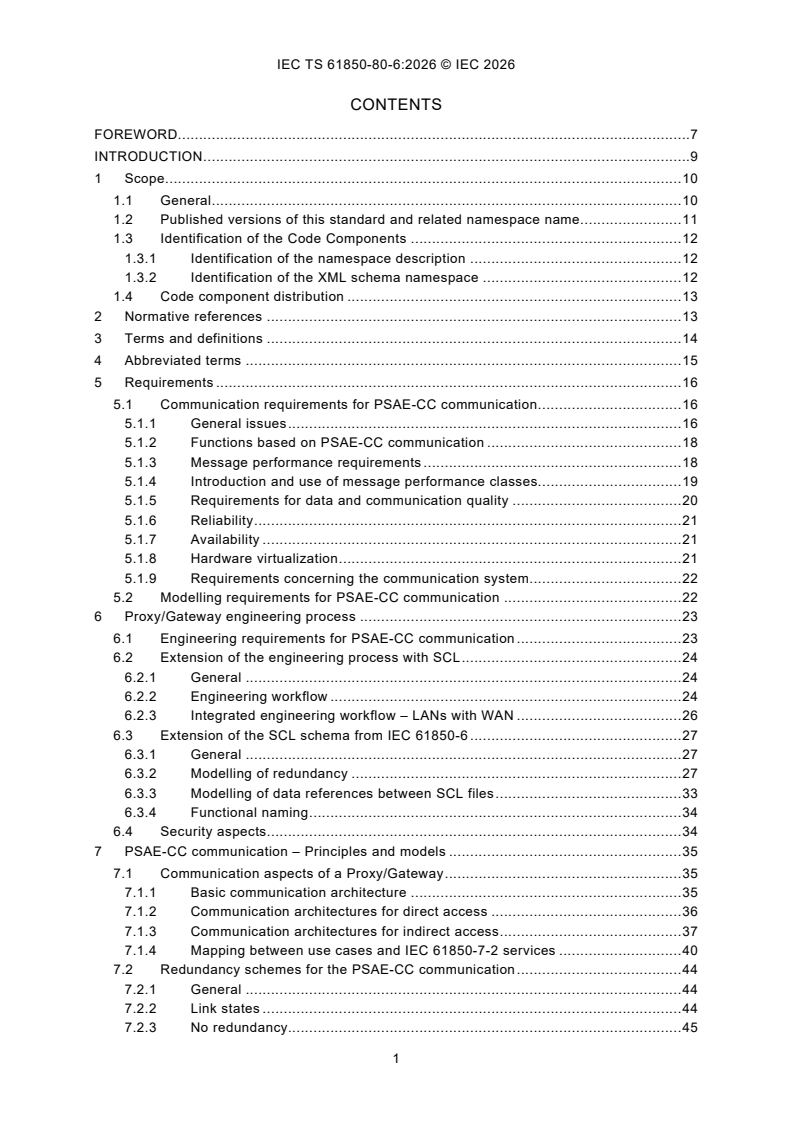
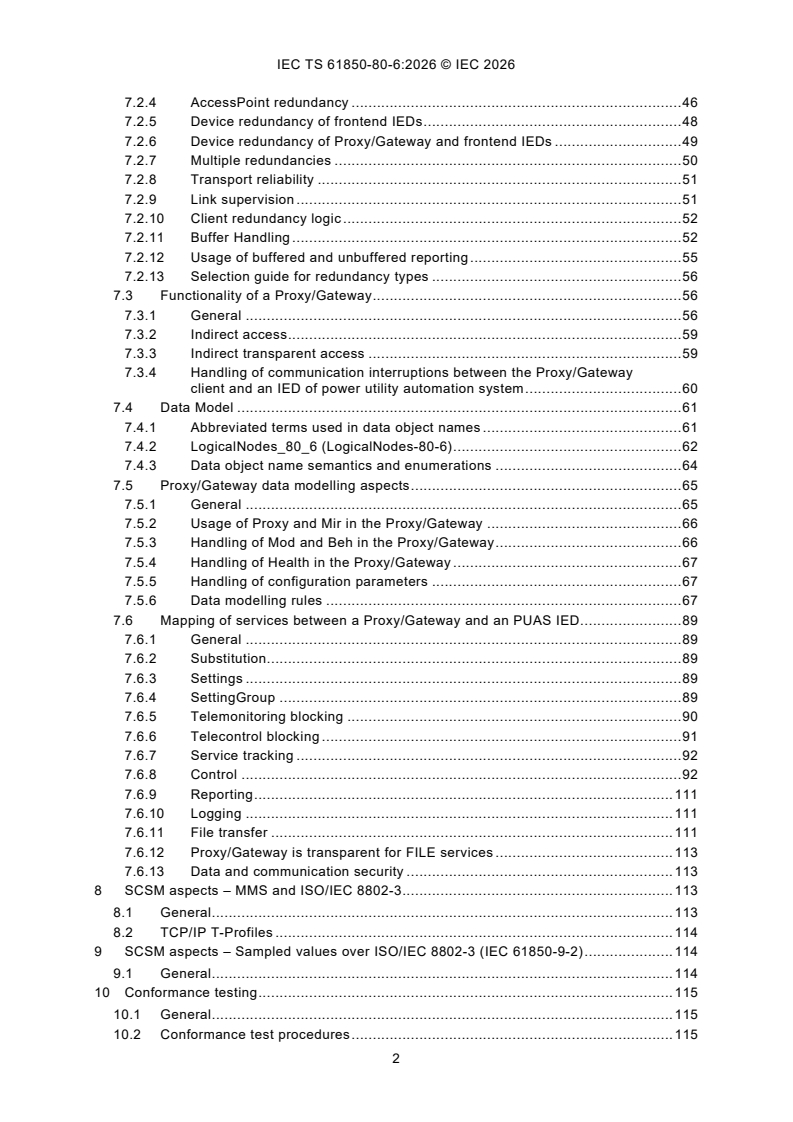
CONTENTS
FOREWORD. 7
INTRODUCTION . 9
1 Scope . 10
1.1 General . 10
1.2 Published versions of this standard and related namespace name . 11
1.3 Identification of the Code Components . 12
1.3.1 Identification of the namespace description . 12
1.3.2 Identification of the XML schema namespace . 12
1.4 Code component distribution . 13
2 Normative references . 13
3 Terms and definitions . 14
4 Abbreviated terms . 15
5 Requirements . 16
5.1 Communication requirements for PSAE-CC communication . 16
5.1.1 General issues . 16
5.1.2 Functions based on PSAE-CC communication . 18
5.1.3 Message performance requirements . 18
5.1.4 Introduction and use of message performance classes . 19
5.1.5 Requirements for data and communication quality . 20
5.1.6 Reliability . 21
5.1.7 Availability . 21
5.1.8 Hardware virtualization . 21
5.1.9 Requirements concerning the communication system. 22
5.2 Modelling requirements for PSAE-CC communication . 22
6 Proxy/Gateway engineering process . 23
6.1 Engineering requirements for PSAE-CC communication . 23
6.2 Extension of the engineering process with SCL . 24
6.2.1 General . 24
6.2.2 Engineering workflow . 24
6.2.3 Integrated engineering workflow – LANs with WAN . 26
6.3 Extension of the SCL schema from IEC 61850-6 . 27
6.3.1 General . 27
6.3.2 Modelling of redundancy . 27
6.3.3 Modelling of data references between SCL files . 33
6.3.4 Functional naming . 34
6.4 Security aspects . 34
7 PSAE-CC communication – Principles and models . 35
7.1 Communication aspects of a Proxy/Gateway . 35
7.1.1 Basic communication architecture . 35
7.1.2 Communication architectures for direct access . 36
7.1.3 Communication architectures for indirect access . 37
7.1.4 Mapping between use cases and IEC 61850-7-2 services . 40
7.2 Redundancy schemes for the PSAE-CC communication . 44
7.2.1 General . 44
7.2.2 Link states . 44
7.2.3 No redundancy. 45
7.2.4 AccessPoint redundancy . 46
7.2.5 Device redundancy of frontend IEDs . 48
7.2.6 Device redundancy of Proxy/Gateway and frontend IEDs . 49
7.2.7 Multiple redundancies . 50
7.2.8 Transport reliability . 51
7.2.9 Link supervision . 51
7.2.10 Client redundancy logic . 52
7.2.11 Buffer Handling . 52
7.2.12 Usage of buffered and unbuffered reporting . 55
7.2.13 Selection guide for redundancy types . 56
7.3 Functionality of a Proxy/Gateway . 56
7.3.1 General . 56
7.3.2 Indirect access . 59
7.3.3 Indirect transparent access . 59
7.3.4 Handling of communication interruptions between the Proxy/Gateway
client and an IED of power utility automation system . 60
7.4 Data Model . 61
7.4.1 Abbreviated terms used in data object names . 61
7.4.2 LogicalNodes_80_6 (LogicalNodes-80-6) . 62
7.4.3 Data object name semantics and enumerations . 64
7.5 Proxy/Gateway data modelling aspects . 65
7.5.1 General . 65
7.5.2 Usage of Proxy and Mir in the Proxy/Gateway . 66
7.5.3 Handling of Mod and Beh in the Proxy/Gateway . 66
7.5.4 Handling of Health in the Proxy/Gateway . 67
7.5.5 Handling of configuration parameters . 67
7.5.6 Data modelling rules . 67
7.6 Mapping of services between a Proxy/Gateway and an PUAS IED . 89
7.6.1 General . 89
7.6.2 Substitution . 89
7.6.3 Settings . 89
7.6.4 SettingGroup . 89
7.6.5 Telemonitoring blocking . 90
7.6.6 Telecontrol blocking . 91
7.6.7 Service tracking . 92
7.6.8 Control . 92
7.6.9 Reporting . 111
7.6.10 Logging . 111
7.6.11 File transfer . 111
7.6.12 Proxy/Gateway is transparent for FILE services . 113
7.6.13 Data and communication security . 113
8 SCSM aspects – MMS and ISO/IEC 8802-3 . 113
8.1 General . 113
8.2 TCP/IP T-Profiles . 114
9 SCSM aspects – Sampled values over ISO/IEC 8802-3 (IEC 61850-9-2) . 114
9.1 General . 114
10 Conformance testing . 115
10.1 General . 115
10.2 Conformance test procedures . 115
10.2.1 General . 115
10.2.2 Test procedure requirements . 115
10.2.3 Test structure . 116
10.2.4 Test system for Proxy/Gateway devices . 116
10.2.5 Test system for control/maintenance centre clients . 117
10.2.6 Test cases to test a Proxy/Gateway device . 118
10.2.7 Test cases to test a control/maintenance centre client device . 122
Annex A (normative) Protocol Implementation Conformance Statement (PICS) . 123
A.1 General . 123
A.2 Transparent access . 123
A.3 Redundancy support statement . 124
A.4 Transformation function support statement . 125
A.5 Proxy/Gateway model support statement . 125
A.6 Instruction and comments on using this template . 126
A.6.1 Comments . 126
A.6.2 Instructions . 126
A.6.3 Revision history . 126
Annex B (informative) Extension of the ControlServiceStatusKind enumeration for
multi-level control . 127
Annex C (informative) PSAE-CC communication use cases . 128
C.1 Overview . 128
C.1.1 General . 128
C.1.2 Actors . 128
C.1.3 Use case diagram . 128
C.1.4 Use cases . 130
C.2 Telecontrol . 131
C.2.1 General . 131
C.2.2 Constraints / Assumptions / Design Considerations . 131
C.2.3 Actors . 131
C.2.4 Use cases diagram . 131
C.2.5 Use case description . 133
C.2.6 Sequence diagrams . 133
C.3 Synchrophasors and State Estimation . 139
C.3.1 General . 139
C.3.2 Constraints / assumptions / design considerations . 140
C.3.3 Actors . 140
C.3.4 Use cases diagram . 140
C.3.5 Use cases description . 141
C.3.6 Sequence diagrams . 141
C.4 Disturbance . 142
C.4.1 General . 142
C.4.2 Constraints / Assumptions / Design considerations . 142
C.4.3 Actors . 142
C.4.4 Use case diagram . 142
C.4.5 Uses cases description . 144
C.4.6 Sequence diagrams . 144
C.5 Counting . 145
C.5.1 General . 145
C.5.2 Constraints / Assumptions / Design considerations . 145
C.5.3 Actors . 145
C.5.4 Use cases diagram . 145
C.5.5 Use cases description . 146
C.5.6 Sequence diagrams . 146
C.6 Power quality . 147
C.6.1 General . 147
C.6.2 Constraints / Assumptions / Design considerations . 147
C.6.3 Actors . 147
C.6.4 Use cases diagram . 147
C.6.5 Use cases description . 148
C.6.6 Sequence diagrams . 148
C.7 Asset . 149
C.7.1 General . 149
C.7.2 Constraints / Assumptions / Design considerations . 149
C.7.3 Actors . 150
C.7.4 Use cases diagram . 150
C.7.5 Use cases description . 150
C.7.6 Sequence diagram . 150
C.8 Parameter configuration . 150
C.8.1 General . 150
C.8.2 Constraints / Assumptions / Design considerations . 151
C.8.3 Actors . 151
C.8.4 Use cases diagram . 151
C.8.5 Use cases description . 152
C.8.6 Sequence diagrams . 152
Bibliography . 153
Figure 1 – Connectivity and communication paths of power system automation
equipment . 11
Figure 2 – Levels and logical interfaces in power utility automation systems. 17
Figure 3 – Definition of transfer time t . 19
Figure 4 – Scope of separated engineering workflow . 24
Figure 5 – Engineering workflow . 26
Figure 6 – Scope of integrated workflow . 27
Figure 7 – Communication concept . 35
Figure 8 – PSAE-CC communication with direct access . 37
Figure 9 – Basic configuration for indirect access . 39
Figure 10 – Configuration without redundancy . 46
Figure 11 – AccessPoint redundancy . 47
Figure 12 – Device redundancy of frontend IEDs . 48
Figure 13 – Device redundancy of Proxy/Gateway and frontend IEDs . 49
Figure 14 – Multiple redundancies . 50
Figure 15 – Usage of buffers and duplicate filter . 54
Figure 16 – Usage of the DOs Proxy and Mir in the Proxy Gateway context . 58
Figure 17 – Comparison of indirect, indirect transparent and direct access . 59
Figure 18 – Class diagram LogicalNodes-80-6::LogicalNodes-80-6 . 62
Figure 19 – Class diagram LNGroupL-80-6::LNGroupL-80-6 . 62
Figure 20 – Class diagram DOEnums-80-6::DOEnums-80-6 . 65
Figure 21 – Product related naming Proxy/Gateway . 69
Figure 22 – Function related naming Proxy/Gateway . 71
Figure 23 – Modelling a Proxy/Gateway IED – Preserving the logical devices . 73
Figure 24 – Modelling a Proxy/Gateway IED – Renaming of logical devices . 74
Figure 25 – Modelling a Proxy/Gateway IED – Rearranging logical nodes . 76
Figure 26 – Modelling a Proxy/Gateway IED – Merging of logical nodes . 78
Figure 27 – Modelling a Proxy/Gateway IED – Splitting of logical nodes . 80
Figure 28 – Modelling a Proxy/Gateway IED – Transform to semantically defined LN . 82
Figure 29 – Modelling a Proxy/Gateway IED – Convert semantically defined LNs . 84
Figure 30 – Modelling a Proxy/Gateway IED - Create an array subset . 86
Figure 31 – Principle of the Proxy/Gateway control model . 92
Figure 32 – State machine of direct control with normal security . 98
Figure 33 – Direct control with normal security – positive case . 99
Figure 34 – Direct control with normal security – negative case . 100
Figure 35 – State machine of SBO control with normal security . 101
Figure 36 – SBO control with normal security – positive case . 102
Figure 37 – SBO control with normal security – negative case . 103
Figure 38 – State machine of direct control with enhanced security . 104
Figure 39 – Direct control with enhanced security – positive case . 105
Figure 40 – Direct control with enhanced security – negative case . 106
Figure 41 – State machine of SBO control with enhanced security . 107
Figure 42 – SBO control with enhanced security – positive case . 108
Figure 43 – SBO control with enhanced security – negative case . 110
Figure 44 – Overview of functionality and services . 113
Figure 45 – Routable sampled values – Overview of used services . 114
Figure 46 – Test system architecture to test a Proxy/Gateway device. 117
Figure 47 – Test system architecture to test a redundant control/maintenance centre
client device . 118
Figure C.1 – Use case diagram for PSAE to control centre communication . 129
Figure C.2 –Telecontrol use case diagram . 132
Figure C.3 – Principle of data forwarding, depending on the operation mode . 139
Figure C.4 – State estimation using synchrophasors . 140
Figure C.5 – Disturbance use cases diagram . 143
Figure C.6 – Counting use cases diagram . 146
Figure C.7 – Power quality use cases diagram . 148
Figure C.8 – Core electric utility processes involving asset management . 149
Figure C.9 – Asset supervision use case diagram . 150
Figure C.10 – Parameter configuration use cases diagram . 151
Table 1 – Tracking information of IEC 61850-80-6:2022A namespace building-up . 8
Table 2 – Reference between published versions of the standard and related
namespace names . 11
Table 3 – Attributes of IEC 61850-80-6:2022A namespace . 12
Table 4 – Attributes of the IEC TS 61850-80-6 XML namespace . 12
Table 5 – Typical Transfer time requirements for control and monitoring data . 20
Table 6 – Attributes of the eIEC61850-80-6:RedundancyModes element . 28
Table 7 – Attributes of the eIEC61850-80-6:LinkModes element . 29
Table 8 – Elements of the eIEC61850-80-6:ClientRedundancyServices element . 30
Table 9 – Attributes of the eIEC61850-80-6:RedundantServerTo element . 31
Table 10 – Attributes of the eIEC61850-80-6:RedundantClientTo element . 32
Table 11 – Values of the eIEC61850-80-6:tLinkModeEnum . 33
Table 12 – Attributes of the eIEC61850-80-6:ProxyOf element . 34
Table 13 – Mapping use cases to IEC 61850-7-2 services . 41
Table 14 – Link states of an association . 44
Table 15 – Usage of buffered / unbuffered reporting for the redundancy type . 55
Table 16 – Requirements versus redundancy type . 56
Table 17 – Data objects of LTPA . 63
Table 18 – Name and description of data objects defined in classes of LogicalNodes-
80-6 package . 64
Table 19 – Generic behaviour and negative responses . 93
Table 20 – Mapping of Comtrade folder names in the Proxy/Gateway . 112
Table 21 – Data model mapping positive test cases . 118
Table 22 – Server positive test cases . 119
Table 23 – Substitution positive test cases . 119
Table 24 – Setting group control positive test cases . 120
Table 25 – Setting group control negative test cases . 120
Table 26 – Control positive test cases . 120
Table 27 – File transfer positive test cases . 121
Table 28 – Telemonitoring blocking positive test cases . 121
Table 29 – Telecontrol blocking positive test cases . 121
Table 30 – Redundancy positive test cases . 122
Table 31 – Telemonitoring blocking positive test cases . 122
Table 32 – Redundancy positive test cases . 122
Table A.1 – Transparent access conformance statement . 123
Table A.2 – Redundancy mechanism support statement . 124
Table A.3 – Proxy/Gateway transformation function support statement . 125
Table A.4 – Proxy/Gateway model support statement . 125
Table B.1 – Literals of ControlServiceStatusKind extension . 127
Table C.1 – Constraints for acquisition of status . 134
Table C.2 – Constraints for acquisition of alarms . 135
Table C.3 – Constraints for remote control . 135
Table C.4 – Forwarding of information depending on the operation mode . 138
INTERNATIONAL ELECTROTECHNICAL COMMISSION
____________
Communication networks and systems for power utility automation -
Part 80-6: Using IEC 61850 for communication between power system
automation equipment and control or maintenance centres
FOREWORD
1) The International Electrotechnical Commission (IEC) is a worldwide organization for standardization comprising
all national electrotechnical committees (IEC National Committees). The object of IEC is to promote international
co-operation on all questions concerning standardization in the electrical and electronic fields. To this end and
in addition to other activities, IEC publishes International Standards, Technical Specifications, Technical Reports,
Publicly Available Specifications (PAS) and Guides (hereafter referred to as "IEC Publication(s)"). Their
preparation is entrusted to technical committees; any IEC National Committee interested in the subject dealt with
may participate in this preparatory work. International, governmental and non-governmental organizations liaising
with the IEC also participate in this preparation. IEC collaborates closely with the International Organization for
Standardization (ISO) in accordance with conditions determined by agreement between the two organizations.
2) The formal decisions or agreements of IEC on technical matters express, as nearly as possible, an international
consensus of opinion on the relevant subjects since each technical committee has representation from all
interested IEC National Committees.
3) IEC Publications have the form of recommendations for international use and are accepted by IEC National
Committees in that sense. While all reasonable efforts are made to ensure that the technical content of
IEC Publications is accurate, IEC cannot be held responsible for the way in which they are used or for any
misinterpretation by any end user.
4) In order to promote international uniformity, IEC National Committees undertake to apply IEC Publications
transparently to the maximum extent possible in their national and regional publications. Any divergence between
any IEC Publication and the corresponding national or regional publication shall be clearly indicated in the latter.
5) IEC itself does not provide any attestation of conformity. Independent certification bodies provide conformity
assessment services and, in some areas, access to IEC marks of conformity. IEC is not responsible for any
services carried out by independent certification bodies.
6) All users should ensure that they have the latest edition of this publication.
7) No liability shall attach to IEC or its directors, employees, servants or agents including individual experts and
members of its technical committees and IEC National Committees for any personal injury, property damage or
other damage of any nature whatsoever, whether direct or indirect, or for costs (including legal fees) and
expenses arising out of the publication, use of, or reliance upon, this IEC Publication or any other
IEC Publications.
8) Attention is drawn to the Normative references cited in this publication. Use of the referenced publications is
indispensable for the correct application of this publication.
9) IEC draws attention to the possibility that the implementation of this document may involve the use of (a)
patent(s). IEC takes no position concerning the evidence, validity or applicability of any claimed patent rights in
respect thereof. As of the date of publication of this document, IEC had not received notice of (a) patent(s), which
may be required to implement this document. However, implementers are cautioned that this may not represent
the latest information, which may be obtained from the patent database available at https://patents.iec.ch.
IEC shall not be held responsible for identifying any or all such patent rights.
IEC TS 61850-80-6 has been prepared by IEC technical committee 57: Power systems
management and associated information exchange. It is a Technical Specification.
The text of this Technical Specification is based on the following documents:
Draft Report on voting
57/2922/DTS 57/2962/RVDTS
Full information on the voting for its approval can be found in the report on voting indicated in
the above table.
The language used for the development of this Technical Specification is English.
This document was drafted in accordance with ISO/IEC Directives, Part 2, and developed in
accordance with ISO/IEC Directives, Part 1 and ISO/IEC Directives, IEC Supplement, available
at www.iec.ch/members_experts/refdocs. The main document types developed by IEC are
described in greater detail at www.iec.ch/publications.
A list of all parts in the IEC 61850 series, published under the general title Communication
networks and systems for power utility automation, can be found on the IEC website.
This IEC publication includes Code Components i.e. components that are intended to be directly
processed by a computer. Such content is any text found between the markers
BEGINS> and or otherwise is clearly labelled in this standard as a Code
Component.
The purchase of this IEC publication carries a copyright license for the purchaser to sell
software containing Code Components from this standard to end users either directly or via
distributors, subject to IEC software licensing conditions, which can be found at:
http://www.iec.ch/CCv1.
Table 1 shows all tracking information of IEC 61850-80-6:2022A namespace building-up:
Table 1 – Tracking information of IEC 61850-80-6:2022A namespace building-up
Attribute Content
Namespace IEC specific information
Version of the UML model used for WG10build25
generating the document (informative)
Date of the UML model used for generating 2026-07-28
the document (informative)
Autogeneration software name and j61850DocBuilder 02.06beta based on jCleanCim beta9.4 (derived
version(informative) from jCleanCim 02-02)
The committee has decided that the contents of this document will remain unchanged until the
stability date indicated on the IEC website under webstore.iec.ch in the data related to the
specific document. At this date, the document will be
– reconfirmed,
– withdrawn, or
– revised.
INTRODUCTION
Following the publication of IEC 61850, substations using IEC 61850 technologies have been
implemented. The concepts of IEC 61850 are also used in applications outside of the substation
such as distributed energy resources, hydro power plants and wind power plants. Therefore,
IEC 61850 forms the foundation for a globally standardized utility communication network. In
the context of this technical specification IEDs in substations or those used in other, above-
mentioned applications, will be referred to as 'power system automation equipment' (PSAE).
The term 'power utility automation systems' is used for substation automation and other
automation systems in the power utility domain.
IEC 62357-1 describes the reference architecture for power systems management and
associated information exchange. The communication between power system automation
equipment and a control centre relate to the information exchange between the station and
operation zone in the SGAM model. Beneath other classic telecontrol protocols IEC 62357-1
proposes the use of IEC 61850 for this purpose.
IEC 61850 was initially prepared for information exchange between the devices of a substation
automation system. The concepts are now also used in other power system application
domains.
The object models and configuration language introduced by IEC 61850 provide new
possibilities for the management of the automation system. A direct and seamless access from
the control and maintenance centres to the IEDs of the power utility automation system allows
efficient data management of the overall control system.
This technical specification provides a comprehensive overview of the matters that need to be
considered to use IEC 61850 for information exchange between power system automation
equipment and control or maintenance systems.
A similar report discussing the use of IEC 61850 for communication between substations has
been issued as IEC TR 61850-90-1. This document was developed as a TS version of
IEC TR 61850-90-2.
Currently, power system automation equipment configuration information is available in the
SCL. Control centre configuration information is available in the CIM model. The models have
been harmonized, so that an automatic transfer of the information from one model to the other
is possible. New work will describe how that configuration information can be transferred
between CIM and SCL. However, this document does not address the overall topic of
CIM/IEC 61850 harmonisation. That is addressed separately in IEC TR 62361-102.
1 Scope
1.1 General
This part of IEC 61850, which is a technical specification, provides a comprehensive overview
of the various aspects that need to be considered while using IEC 61850 for information
exchange between power system automation equipment and control or maintenance centres or
other system level applications. This document:
– defines use cases and communication requirements that require an information exchange
between power system automation equipment and control or maintenance centres;
– describes the usage of the configuration language of IEC 61850-6;
– gives guidelines for the selection of communication services and architectures compatible
with IEC 61850;
– describes the engineering workflow;
– introduces the use of a Proxy/Gateway concept;
– describes the links regarding the Specific Communication Service Mapping (SCSM);
– defines the abstract conformance test cases that build the basis for the conformance test
procedures elaborated by the UCAIug Testing Sub Committee.
This document does not define constraints or limitations for specific device implementations.
There is no specific clause for cyber security, which is tackled when it is necessary. The model
for IEC TS 61850-80-6 provides security functions based upon the security threats and security
functions found in IEC TS 62351-1 and IEC TS 62351-2. This document touches on several
security aspects with the following basic assumptions:
– Information authentication and integrity (e.g., the ability to provide tamper detection) is
needed.
– In case of operational issues, e
...