


IEC 60695-2-13:2010
(Main)Fire hazard testing - Part 2-13: Glowing/hot-wire based test methods - Glow-wire ignition temperature (GWIT) test method for materials
General Information
- Abstract
IEC 60695-2-13:2010 specifies the details of the glow-wire test to be applied to test specimens of solid electrical insulating materials or other solid materials for ignitability testing to determine the glow-wire ignition temperature (GWIT). The GWIT is the temperature which is 25 K (or 30 K) higher than the maximum test temperature, determined during this standardized procedure, at which the tested material does not ignite, or if sustained and continuous flaming combustion does not occur for a time longer than 5 s for any single flame event and the specimen is not totally consumed. This second edition of IEC 60695-2-13 cancels and replaces the first edition published in 2000. It also constitutes a technical revision. The main changes with respect to the previous edition are:
- modified title;
- addition of an Introduction;
- clarification of Scope;
- expansion of Clause 2: Normative references;
- expansion of Clause 3;
- revision of Clause 4 to alignment with the IEC 60695-11 series to introduce guidance on test programs for material variations;
- clarification of Clause 8: Conditioning (now Clause 7);
- deletion of Clause 9: Initial measurement;
- expansion of Clause 10: Test procedures (now Clause 8);
- expansion of Clause 11: Observation and measurement (now Clause 9);
- clarification of Clause 12: Evaluation of test results (now Clause 10);
- expansion of Clause 13: Test report (now Clause 11).
This publication is to be read in conjunction with IEC 60695-2-10:2000. The contents of the corrigendum of February 2012 have been included in this copy.
- Status
- Published
- Publication Date
- 11-Feb-2014
- Technical Committee
- TC 89 - Fire hazard testing
- Drafting Committee
- WG 12 - TC 89/WG 12
- Current Stage
- DELPUB - Deleted Publication
- Start Date
- 24-Aug-2021
- Completion Date
- 19-Mar-2018
Buy Documents
IEC 60695-2-13:2010 - Fire hazard testing - Part 2-13: Glowing/hot-wire based test methods - Glow-wire ignition temperature (GWIT) test method for materials Released:10/11/2010

IEC 60695-2-13:2010+AMD1:2014 CSV - Fire hazard testing - Part 2-13: Glowing/hot-wire based test methods- Glow-wire ignition temperature (GWIT) test method for materials Released:2/12/2014
Overview
IEC 60695-2-13:2010 is an international standard developed by the International Electrotechnical Commission (IEC) relating to fire hazard testing. Specifically, it defines the Glow-wire Ignition Temperature (GWIT) test method used to assess the ignitability of solid electrical insulating materials and other solid materials when exposed to a heated wire mimicking overheated metal components. The standard is part of the IEC 60695 series focused on glowing/hot-wire-based fire hazard tests.
The GWIT is the critical temperature at which a material either does not ignite or withstands short flames without sustained combustion, ensuring fire safety in electrical and electronic equipment during normal and foreseeable abnormal operating conditions. The 2010 edition (and its 2014 amendment) updates and clarifies previous test procedures, conditioning, evaluation, and reporting requirements, aligning more closely with contemporary fire safety assessments.
Key Topics
Test Specimens and Preparation
Detailed guidelines on specimen dimensions, preparation methods, and variant formulations like density, melt flow, filler content, and color to ensure consistent and reproducible testing.Test Apparatus and Temperature Measurement
The glow-wire test apparatus simulates overheated components by applying an electrically heated wire to material surfaces. Accurate temperature measuring systems and their verification ensure reliable GWIT determination.Conditioning and Testing Conditions
Standards for specimen treatment before testing, including environmental conditioning and test parameters, maintain consistent test conditions crucial for valid results.Test Procedure and Observations
Step-by-step conduct of the glow-wire ignition temperature test including setting initial test temperatures, temperature increments, and detailed observation protocols to detect ignition or flaming events.Evaluation and Reporting
Clear criteria for evaluating results based on ignition behavior and flaming duration, culminating in comprehensive test reports standardized for accurate communication and certification needs.Alignment with Other IEC Standards
Designed to be used alongside IEC 60695-2-10 (glow-wire apparatus and common test procedures) and complements other parts of IEC 60695 series such as GWFI (Glow-wire Flammability Index) and product-level glow-wire flammability tests.
Applications
IEC 60695-2-13 is essential for:
Material Manufacturers
To characterize and certify electrical insulating materials or other solid materials for fire hazard resistance, supporting product compliance.Electrical and Electronic Product Designers
To select materials with known ignition thresholds, reducing fire risks caused by overheating within components.Product Safety Testing Laboratories
For standardized testing and reporting of glow-wire ignition temperatures, ensuring alignment with international fire safety regulations.Certification Bodies and Regulators
To verify if materials meet required fire safety standards, facilitating safer product approvals and market access.Research and Development Teams
To innovate and improve material formulations with enhanced glow-wire ignition resistance, crucial in advancing fire-safe technologies.
Related Standards
- IEC 60695-2-10:2000 - Glow-wire apparatus and common testing procedures foundational for glow-wire test methods.
- IEC 60695-2-11 - Glow-wire flammability test method for end products focusing on complete assemblies.
- IEC 60695-2-12 - Glow-wire flammability index (GWFI) test method providing supplementary material flammability data.
- IEC 60695-1-10 and IEC 60695-1-11 - General fire hazard testing guidance focusing on ignition prevention and fire confinement.
- IEC 60695 Series - A comprehensive set of standards addressing various aspects of fire hazard testing for materials and products in electrotechnical applications.
By adopting IEC 60695-2-13, manufacturers and testers ensure internationally recognized fire safety assessment consistent with modern electrical safety requirements. Correct implementation of the GWIT test method contributes to safer electrical products, reducing fire-related incidents and improving consumer protection globally.
Relations
- Effective Date
- 05-Sep-2023
- Effective Date
- 05-Sep-2023
- Effective Date
- 05-Sep-2023
- Effective Date
- 05-Sep-2023
Buy Documents
IEC 60695-2-13:2010 - Fire hazard testing - Part 2-13: Glowing/hot-wire based test methods - Glow-wire ignition temperature (GWIT) test method for materials Released:10/11/2010
IEC 60695-2-13:2010+AMD1:2014 CSV - Fire hazard testing - Part 2-13: Glowing/hot-wire based test methods- Glow-wire ignition temperature (GWIT) test method for materials Released:2/12/2014
Get Certified
Connect with accredited certification bodies for this standard

IMQ S.p.A. (Certification)
Italian electrical product certification.

SLG Prüf- und Zertifizierungs GmbH
German testing and certification body.

UL Solutions
Global safety science company with testing, inspection and certification.
Sponsored listings
Frequently Asked Questions
IEC 60695-2-13:2010 is a standard published by the International Electrotechnical Commission (IEC). Its full title is "Fire hazard testing - Part 2-13: Glowing/hot-wire based test methods - Glow-wire ignition temperature (GWIT) test method for materials". This standard covers: IEC 60695-2-13:2010 specifies the details of the glow-wire test to be applied to test specimens of solid electrical insulating materials or other solid materials for ignitability testing to determine the glow-wire ignition temperature (GWIT). The GWIT is the temperature which is 25 K (or 30 K) higher than the maximum test temperature, determined during this standardized procedure, at which the tested material does not ignite, or if sustained and continuous flaming combustion does not occur for a time longer than 5 s for any single flame event and the specimen is not totally consumed. This second edition of IEC 60695-2-13 cancels and replaces the first edition published in 2000. It also constitutes a technical revision. The main changes with respect to the previous edition are: - modified title; - addition of an Introduction; - clarification of Scope; - expansion of Clause 2: Normative references; - expansion of Clause 3; - revision of Clause 4 to alignment with the IEC 60695-11 series to introduce guidance on test programs for material variations; - clarification of Clause 8: Conditioning (now Clause 7); - deletion of Clause 9: Initial measurement; - expansion of Clause 10: Test procedures (now Clause 8); - expansion of Clause 11: Observation and measurement (now Clause 9); - clarification of Clause 12: Evaluation of test results (now Clause 10); - expansion of Clause 13: Test report (now Clause 11). This publication is to be read in conjunction with IEC 60695-2-10:2000. The contents of the corrigendum of February 2012 have been included in this copy.
IEC 60695-2-13:2010 specifies the details of the glow-wire test to be applied to test specimens of solid electrical insulating materials or other solid materials for ignitability testing to determine the glow-wire ignition temperature (GWIT). The GWIT is the temperature which is 25 K (or 30 K) higher than the maximum test temperature, determined during this standardized procedure, at which the tested material does not ignite, or if sustained and continuous flaming combustion does not occur for a time longer than 5 s for any single flame event and the specimen is not totally consumed. This second edition of IEC 60695-2-13 cancels and replaces the first edition published in 2000. It also constitutes a technical revision. The main changes with respect to the previous edition are: - modified title; - addition of an Introduction; - clarification of Scope; - expansion of Clause 2: Normative references; - expansion of Clause 3; - revision of Clause 4 to alignment with the IEC 60695-11 series to introduce guidance on test programs for material variations; - clarification of Clause 8: Conditioning (now Clause 7); - deletion of Clause 9: Initial measurement; - expansion of Clause 10: Test procedures (now Clause 8); - expansion of Clause 11: Observation and measurement (now Clause 9); - clarification of Clause 12: Evaluation of test results (now Clause 10); - expansion of Clause 13: Test report (now Clause 11). This publication is to be read in conjunction with IEC 60695-2-10:2000. The contents of the corrigendum of February 2012 have been included in this copy.
IEC 60695-2-13:2010 is classified under the following ICS (International Classification for Standards) categories: 13.220.40 - Ignitability and burning behaviour of materials and products; 29.020 - Electrical engineering in general. The ICS classification helps identify the subject area and facilitates finding related standards.
IEC 60695-2-13:2010 has the following relationships with other standards: It is inter standard links to IEC 60695-2-13:2010/AMD1:2014, IEC 60695-2-13:2010/COR1:2012, IEC 60695-2-13:2000, IEC 60695-2-13:2021. Understanding these relationships helps ensure you are using the most current and applicable version of the standard.
IEC 60695-2-13:2010 is available in PDF format for immediate download after purchase. The document can be added to your cart and obtained through the secure checkout process. Digital delivery ensures instant access to the complete standard document.
Standards Content (Sample)
IEC 60695-2-13 ®
Edition 2.0 2010-10
INTERNATIONAL
STANDARD
NORME
INTERNATIONALE
BASIC SAFETY PUBLICATION
PUBLICATION FONDAMENTALE DE SÉCURITÉ
Fire hazard testing –
Part 2-13: Glowing/hot-wire based test methods – Glow-wire ignition
temperature (GWIT) test method for materials
Essais relatifs aux risques du feu –
Partie 2-13: Essais au fil incandescent/chauffant – Méthode d’essai de
température d’allumabilité au fil incandescent (GWIT) pour matériaux
All rights reserved. Unless otherwise specified, no part of this publication may be reproduced or utilized in any form or by
any means, electronic or mechanical, including photocopying and microfilm, without permission in writing from either IEC or
IEC's member National Committee in the country of the requester.
If you have any questions about IEC copyright or have an enquiry about obtaining additional rights to this publication,
please contact the address below or your local IEC member National Committee for further information.
Droits de reproduction réservés. Sauf indication contraire, aucune partie de cette publication ne peut être reproduite
ni utilisée sous quelque forme que ce soit et par aucun procédé, électronique ou mécanique, y compris la photocopie
et les microfilms, sans l'accord écrit de la CEI ou du Comité national de la CEI du pays du demandeur.
Si vous avez des questions sur le copyright de la CEI ou si vous désirez obtenir des droits supplémentaires sur cette
publication, utilisez les coordonnées ci-après ou contactez le Comité national de la CEI de votre pays de résidence.
IEC Central Office
3, rue de Varembé
CH-1211 Geneva 20
Switzerland
Email: inmail@iec.ch
Web: www.iec.ch
About the IEC
The International Electrotechnical Commission (IEC) is the leading global organization that prepares and publishes
International Standards for all electrical, electronic and related technologies.
About IEC publications
The technical content of IEC publications is kept under constant review by the IEC. Please make sure that you have the
latest edition, a corrigenda or an amendment might have been published.
ƒ Catalogue of IEC publications: www.iec.ch/searchpub
The IEC on-line Catalogue enables you to search by a variety of criteria (reference number, text, technical committee,…).
It also gives information on projects, withdrawn and replaced publications.
ƒ IEC Just Published: www.iec.ch/online_news/justpub
Stay up to date on all new IEC publications. Just Published details twice a month all new publications released. Available
on-line and also by email.
ƒ Electropedia: www.electropedia.org
The world's leading online dictionary of electronic and electrical terms containing more than 20 000 terms and definitions
in English and French, with equivalent terms in additional languages. Also known as the International Electrotechnical
Vocabulary online.
ƒ Customer Service Centre: www.iec.ch/webstore/custserv
If you wish to give us your feedback on this publication or need further assistance, please visit the Customer Service
Centre FAQ or contact us:
Email: csc@iec.ch
Tel.: +41 22 919 02 11
Fax: +41 22 919 03 00
A propos de la CEI
La Commission Electrotechnique Internationale (CEI) est la première organisation mondiale qui élabore et publie des
normes internationales pour tout ce qui a trait à l'électricité, à l'électronique et aux technologies apparentées.
A propos des publications CEI
Le contenu technique des publications de la CEI est constamment revu. Veuillez vous assurer que vous possédez
l’édition la plus récente, un corrigendum ou amendement peut avoir été publié.
ƒ Catalogue des publications de la CEI: www.iec.ch/searchpub/cur_fut-f.htm
Le Catalogue en-ligne de la CEI vous permet d’effectuer des recherches en utilisant différents critères (numéro de référence,
texte, comité d’études,…). Il donne aussi des informations sur les projets et les publications retirées ou remplacées.
ƒ Just Published CEI: www.iec.ch/online_news/justpub
Restez informé sur les nouvelles publications de la CEI. Just Published détaille deux fois par mois les nouvelles
publications parues. Disponible en-ligne et aussi par email.
ƒ Electropedia: www.electropedia.org
Le premier dictionnaire en ligne au monde de termes électroniques et électriques. Il contient plus de 20 000 termes et
définitions en anglais et en français, ainsi que les termes équivalents dans les langues additionnelles. Egalement appelé
Vocabulaire Electrotechnique International en ligne.
ƒ Service Clients: www.iec.ch/webstore/custserv/custserv_entry-f.htm
Si vous désirez nous donner des commentaires sur cette publication ou si vous avez des questions, visitez le FAQ du
Service clients ou contactez-nous:
Email: csc@iec.ch
Tél.: +41 22 919 02 11
Fax: +41 22 919 03 00
IEC 60695-2-13 ®
Edition 2.0 2010-10
INTERNATIONAL
STANDARD
NORME
INTERNATIONALE
BASIC SAFETY PUBLICATION
PUBLICATION FONDAMENTALE DE SÉCURITÉ
Fire hazard testing –
Part 2-13: Glowing/hot-wire based test methods – Glow-wire ignition
temperature (GWIT) test method for materials
Essais relatifs aux risques du feu –
Partie 2-13: Essais au fil incandescent/chauffant – Méthode d’essai de
température d’allumabilité au fil incandescent (GWIT) pour matériaux
INTERNATIONAL
ELECTROTECHNICAL
COMMISSION
COMMISSION
ELECTROTECHNIQUE
PRICE CODE
INTERNATIONALE
M
CODE PRIX
ICS 13.220.40; 29.020 ISBN 978-2-88912-216-5
– 2 – 60695-2-13 © IEC:2010
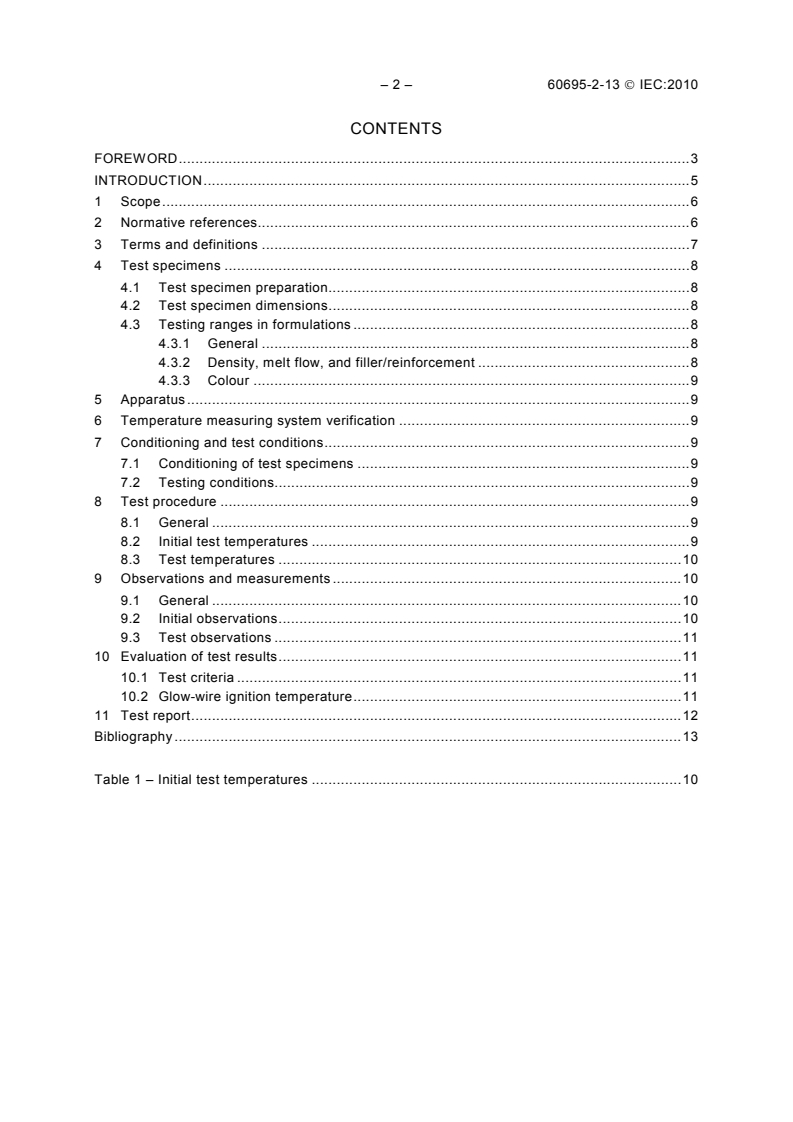
CONTENTS
FOREWORD.3
INTRODUCTION.5
1 Scope.6
2 Normative references.6
3 Terms and definitions .7
4 Test specimens .8
4.1 Test specimen preparation.8
4.2 Test specimen dimensions.8
4.3 Testing ranges in formulations .8
4.3.1 General .8
4.3.2 Density, melt flow, and filler/reinforcement .8
4.3.3 Colour .9
5 Apparatus.9
6 Temperature measuring system verification .9
7 Conditioning and test conditions.9
7.1 Conditioning of test specimens .9
7.2 Testing conditions.9
8 Test procedure .9
8.1 General .9
8.2 Initial test temperatures .9
8.3 Test temperatures .10
9 Observations and measurements .10
9.1 General .10
9.2 Initial observations.10
9.3 Test observations .11
10 Evaluation of test results.11
10.1 Test criteria .11
10.2 Glow-wire ignition temperature.11
11 Test report.12
Bibliography .13
Table 1 – Initial test temperatures .10
60695-2-13 © IEC:2010 – 3 –
INTERNATIONAL ELECTROTECHNICAL COMMISSION
____________
FIRE HAZARD TESTING –
Part 2-13: Glowing/hot-wire based test methods –
Glow-wire ignition temperature (GWIT) test method for materials
FOREWORD
1) The International Electrotechnical Commission (IEC) is a worldwide organization for standardization comprising
all national electrotechnical committees (IEC National Committees). The object of IEC is to promote
international co-operation on all questions concerning standardization in the electrical and electronic fields. To
this end and in addition to other activities, IEC publishes International Standards, Technical Specifications,
Technical Reports, Publicly Available Specifications (PAS) and Guides (hereafter referred to as “IEC
Publication(s)”). Their preparation is entrusted to technical committees; any IEC National Committee interested
in the subject dealt with may participate in this preparatory work. International, governmental and non-
governmental organizations liaising with the IEC also participate in this preparation. IEC collaborates closely
with the International Organization for Standardization (ISO) in accordance with conditions determined by
agreement between the two organizations.
2) The formal decisions or agreements of IEC on technical matters express, as nearly as possible, an international
consensus of opinion on the relevant subjects since each technical committee has representation from all
interested IEC National Committees.
3) IEC Publications have the form of recommendations for international use and are accepted by IEC National
Committees in that sense. While all reasonable efforts are made to ensure that the technical content of IEC
Publications is accurate, IEC cannot be held responsible for the way in which they are used or for any
misinterpretation by any end user.
4) In order to promote international uniformity, IEC National Committees undertake to apply IEC Publications
transparently to the maximum extent possible in their national and regional publications. Any divergence
between any IEC Publication and the corresponding national or regional publication shall be clearly indicated in
the latter.
5) IEC itself does not provide any attestation of conformity. Independent certification bodies provide conformity
assessment services and, in some areas, access to IEC marks of conformity. IEC is not responsible for any
services carried out by independent certification bodies.
6) All users should ensure that they have the latest edition of this publication.
7) No liability shall attach to IEC or its directors, employees, servants or agents including individual experts and
members of its technical committees and IEC National Committees for any personal injury, property damage or
other damage of any nature whatsoever, whether direct or indirect, or for costs (including legal fees) and
expenses arising out of the publication, use of, or reliance upon, this IEC Publication or any other IEC
Publications.
8) Attention is drawn to the Normative references cited in this publication. Use of the referenced publications is
indispensable for the correct application of this publication.
9) Attention is drawn to the possibility that some of the elements of this IEC Publication may be the subject of
patent rights. IEC shall not be held responsible for identifying any or all such patent rights.
International Standard IEC 60695-2-13 has been prepared by technical committee 89: Fire
hazard testing.
This second edition of IEC 60695-2-13 cancels and replaces the first edition published in 2000.
It also constitutes a technical revision.
It has the status of a basic safety publication in accordance with IEC Guide 104 and ISO/IEC
Guide 51.
This standard is to be used in conjunction with IEC 60695-2-10.
The main changes with respect to the previous edition are listed below:
– modified title;
– addition of an Introduction;
– clarification of Scope;
– 4 – 60695-2-13 IEC:2010
– expansion of Clause 2: Normative references;
– expansion of Clause 3;
– revision of Clause 4 to alignment with the IEC 60695-11 series to introduce guidance on
test programs for material variations;
– clarification of Clause 8: Conditioning (now Clause 7);
– deletion of Clause 9: Initial measurement;
– expansion of Clause 10: Test procedures (now Clause 8);
– expansion of Clause 11: Observation and measurement (now Clause 9);
– clarification of Clause 12: Evaluation of test results (now Clause 10);
– expansion of Clause 13: Test report (now Clause 11).
The text of this standard is based on the following documents:
FDIS Report on voting
89/1018/FDIS 89/1035/RVD
Full information on the voting for the approval of this standard can be found in the report on
voting indicated in the above table.
This publication has been drafted in accordance with the ISO/IEC Directives, Part 2.
A list of all the parts in the IEC 60695 series, under the general title Fire hazard testing can
be found on the IEC web site.
Part 2 consists of the following parts:
Part 2-10: Glowing/hot-wire based test methods – Glow-wire apparatus and common test
procedure
Part 2-11: Glowing/hot-wire based test methods – Glow-wire flammability test method for
end-products
Part 2-12: Glowing/hot-wire based test methods – Glow-wire flammability index (GWFI) test
method for materials
Part 2-13: Glowing/hot-wire based test methods – Glow-wire ignition temperature (GWIT)
test method for materials
The committee has decided that the contents of this publication will remain unchanged until
the stability date indicated on the IEC web site under "http://webstore.iec.ch" in the data
related to the specific publication. At this date, the publication will be
• reconfirmed,
• withdrawn,
• replaced by a revised edition, or
• amended.
The contents of the corrigendum of February 2012 have been included in this copy.
60695-2-13 © IEC:2010 – 5 –
INTRODUCTION
In electrotechnical equipment, overheated metal parts can act as ignition sources. In glow-wire
tests an electrically heated wire is used to simulate such an ignition source.
IEC 60695-2-10 describes a glow-wire test apparatus and common test procedure, IEC 60695-
2-11 describes a glow-wire flammability test for end products, and IEC 60695-2-12 describes a
glow-wire flammability index test method for materials.
In the design of any electrotechnical product, the risk of fire and the potential hazards
associated with fire need to be considered. In this respect the objective of component, circuit,
and product design, as well as the choice of materials, is to reduce to acceptable levels the
potential risks of fire during normal operating conditions, reasonable foreseeable abnormal
use, malfunction and/or failure. IEC/TC 89 has developed IEC 60695-1-10, together with its
companion, IEC 60695-1-11, to provide guidance on how this is to be accomplished.
The primary aims of IEC 60695-1-10 and IEC 60695-1-11 are to provide guidance on how:
a) to prevent ignition caused by an electrically energized component part, and
b) to confine any resulting fire within the bounds of the enclosure of the electrotechnical
product in the event of ignition.
Secondary aims of IEC 60695-1-10 and IEC 60695-1-11 include the minimization of any flame
spread beyond the product’s enclosure and the minimization of the harmful effects of fire
effluents such as heat, smoke, toxicity and/or corrosivity.
Fires involving electrotechnical products can also be initiated from external non-electrical
sources. Considerations of this nature should be dealt with in the overall fire risk assessment.
This part of IEC 60695 describes a glow-wire ignition temperature test method for materials. It
should be used to measure, describe, and rank the properties of materials in response to heat
caused by contact with an electrically heated wire under controlled laboratory conditions. This
may be useful for the evaluation of materials for use in products that may be exposed to
excess thermal stress such as a fault current flowing through a wire, overloading of components,
and/or bad connections. It should not be used to solely describe or appraise the fire hazard or
fire risk of materials, products, or assemblies under actual fire conditions. However, results of
this test may be used as elements of a fire risk assessment which takes into account all of the
factors pertinent to a fire hazard assessment of a particular end use.
This International Standard may involve hazardous materials, operations, and equipment. It
does not purport to address all of the safety problems associated with its use. It is the
responsibility of the user of this standard to establish appropriate safety and health practices
and determine the applicability of regulatory limitations prior to use.
– 6 – 60695-2-13 © IEC:2010
FIRE HAZARD TESTING –
Part 2-13: Glowing/hot-wire based test methods –
Glow-wire ignition temperature (GWIT) test method for materials
1 Scope
This part of IEC 60695 specifies the details of the glow-wire test to be applied to test
specimens of solid electrical insulating materials or other solid materials for ignitability testing
to determine the glow-wire ignition temperature (GWIT).
The GWIT is the temperature which is 25 K (or 30 K) higher than the maximum test
temperature, determined during this standardized procedure, at which the tested material
a) does not ignite, or
b) if sustained and continuous flaming combustion does not occur for a time longer than 5 s
for any single flame event and the specimen is not totally consumed.
This test is a materials test carried out on a series of standard test specimens. The data
obtained, along with data from the glow-wire flammability index (GWFI) test method for
materials, IEC 60695-2-12, can then be used in a preselection process in accordance with
IEC 60695-1-30 to judge the ability of materials to meet the requirements of IEC 60695-2-11.
NOTE As an outcome of conducting a fire hazard assessment, an appropriate series of preselection flammability
and ignition tests may allow a reduction of end product testing.
This basic safety publication is intended for use by technical committees in the preparation of
standards in accordance with the principles laid down in IEC Guide 104 and ISO/IEC Guide 51.
One of the responsibilities of a technical committee is, wherever applicable, to make use of
basic safety publications in the preparation of its publications. The requirements, test methods
or test conditions of this basic safety publication will not apply unless specifically referred to or
included in the relevant publications.
2 Normative references
The following referenced documents are indispensable for the application of this document. For
dated references, only the edition cited applies. For undated references, the latest edition of
the referenced document (including any amendments) applies.
IEC 60695-1-30:2008, Fire hazard testing – Part 1.30: Guidance for assessing the fire hazard
of electrotechnical products – Preselection testing process – General guidelines
IEC 60695-2-10:2000, Fire hazard testing – Part 2-10: Glowing/hot-wire based test methods –
Glow-wire apparatus and common test procedure
IEC 60695-2-11:2000, Fire hazard testing – Part 2-11: Glowing/hot-wire based test methods –
Glow-wire flammability test method for end-products
IEC 60695-2-12, Fire hazard testing – Part 2-12: Glowing/hot-wire based test methods – Glow-
wire flammability index (GWFI) test method for materials
IEC Guide 104:1997, The preparation of safety publications and the use of basic safety
publications and group safety publications
60695-2-13 © IEC:2010 – 7 –
ISO/IEC Guide 51:1999, Safety aspects – Guidelines for inclusion in standards
ISO/IEC 13943:2008, Fire safety – Vocabulary
ISO 291:2008, Plastics – Standard atmospheres for conditioning and testing
ISO 293:2004, Plastics – Compression moulding of test specimens of thermoplastic materials
ISO 294 (all parts), Plastics – Injection moulding of test specimens of thermoplastic materials
ISO 295:2004, Plastics – Compression moulding of test specimens of thermosetting materials
3 Terms and definitions
For the purposes of this document, the terms and definitions given in ISO/IEC 13943, some of
which are reproduced below for the user’s convenience, as well as the following apply.
3.1
combustion
exothermic reaction of a substance with an oxidizing agent
NOTE Combustion generally emits fire effluent accompanied by flames and/or glowing.
[ISO/IEC 13943: 2008, definition 4.46]
3.2
flame, noun
rapid, self-sustaining, sub-sonic propagation of combustion in a gaseous medium, usually with
emission of light
[ISO/IEC 13943: 2008, definition 4.133]
3.3
flammability
ability of a material or product to burn with a flame under specified conditions
[ISO/IEC 13943: 2008, definition 4.151]
3.4
glowing, noun
luminosity caused by heat
[ISO/IEC 13943:2008, definition 4.168]
3.5
glowing combustion
combustion of a material in the solid phase without flame but with emission of light from the
combustion zone
[ISO/IEC 13943:2008, definition 4.169]
3.6
ignitability
ease of ignition
measure of the ease with which a test specimen can be ignited under specified conditions
[ISO/IEC 13943:2008, definition 4.182]
– 8 – 60695-2-13 © IEC:2010
3.7
ignition
sustained ignition (deprecated)
initiation of combustion
[ISO/IEC 13943:2008, definition 4.187]
3.8
ignition
sustained ignition (deprecated)
initiation of sustained flame
[ISO/IEC 13943:2008, definition 4.188]
3.9
preselection
process of assessing and choosing candidate materials, components or sub-assemblies for
making an end-product
[IEC 60695-1-30:2008, definition 3.2]
4 Test specimens
4.1 Test specimen preparation
Test specimens shall be fabricated using the appropriate ISO method, e.g. casting and
injection moulding in accordance with the ISO 294 series, compression moulding in accordance
with ISO 293 or ISO 295, or transfer moulding to the necessary shape. Where this is not
possible, the test specimen shall be cut and/or sliced from a representative sample of the
material (for example, produced using the same fabrication process as would be used to mould
a part of a product).
After any fabrication or cutting operation, care shall be taken to remove all dust and any
particles from the surface; cut edges shall be fine sanded to a smooth finish.
4.2 Test specimen dimensions
The dimensions of the planar sections of the test specimens shall be at least 60 mm in length
and 60 mm in width (measured inside the clamping areas) and shall be provided in all
thicknesses under consideration. The preferred values include 0,1 mm ± 0,02 mm, 0,2 mm ±
0,02 mm, 0,4 mm ± 0,05 mm, 0,75 mm ± 0,1 mm, 1,5 mm ± 0,15 mm, 3,0 mm ± 0,2 mm, or
6,0 mm ± 0,4 mm.
NOTE A set of 15 test specimens per thickness will, in general, be adequate to concurrently establish the GWIT
and the GWFI (See IEC 60695-2-12).
4.3 Testing ranges in formulations
4.3.1 General
The results of tests carried out on test specimen sets of different colour, thickness, density,
molecular mass, anisotropic type/direction, additives, fillers, and/or reinforcements can vary.
When agreed between involved parties, the test programs outlined in 4.3.2 and 4.3.3 may be
employed in order to evaluate these variations.
4.3.2 Density, melt flow, and filler/reinforcement
Test specimens covering all combinations of minimum and maximum levels of density, melt
flows and filler/reinforcement content may be provided and considered representative of the
range if the test results yield the same GWIT. If the test results do not yield the same GWIT for
all test specimens representing the range, evaluation shall be limited to the materials with the
60695-2-13 © IEC:2010 – 9 –
specific levels of density, melt flows and filler/reinforcement tested. In addition, test specimens
with intermediate density, melt flows, and filler/reinforcement content shall be tested to
determine the representative range for each GWIT determination. However, as an alternative,
the least favourable performance of the specific levels of density, melt flows and
filler/reinforcement tested may be considered representative of intermediate levels without
additional testing.
4.3.3 Colour
When evaluating a range of colours, test specimens that
a) contain no colouring,
b) contain the highest level of organic pigments/colorants/dyes and/or carbon black,
c) contain the highest level of inorganic pigments, and
d) contain pigments/colorants/dyes which are known to adversely affect flammability
characteristics
are considered representative of the colour range if the test results yield the same GWIT.
5 Apparatus
The description of the test apparatus is specified in Clause 5 of IEC 60695-2-10. The reference
to a specified layer does not apply.
6 Temperature measuring system verification
The method of verification of the temperature measuring system is specified in 6.2 of
IEC 60695-2-10.
7 Conditioning and test conditions
7.1 Conditioning of test specimens
The test specimens shall be conditioned for a minimum of 48 h at 23 °C ± 2 °C and at a
relative humidity between 40 % and 60 %. Once removed from the conditioning atmosphere,
the test specimens shall be tested within 4 h (see ISO 291, Clause 6, Table 2, Class 2).
7.2 Testing conditions
The test specimens shall be tested in a laboratory atmosphere having a temperature of 25 °C ±
10 °C and at a relative humidity between 45 % and 75 %.
8 Test procedure
8.1 General
The test specimens shall be identified and examined visually.
The general test procedure shall be as specified in Clause 8 of IEC 60695-2-10.
8.2 Initial test temperatures
The glow-wire is heated to one of the initial test temperatures specified in Table 1, which is
considered to be just high enough to cause ignition. If unknown, the initial test temperature
shall not exceed 650 °C.
– 10 – 60695-2-13 IEC:2010
Table 1 – Initial test temperatures
Initial test Tolerances
temperature
K
°C
10
10
10
10
10
10
15
15
15
15
8.3 Test temperatures
A set of three test specimens shall be prepared for testing at a chosen test temperature.
If one of the three test specimens fails to withstand the test criteria as defined in 10.1, the
test shall be repeated with three new test specimens at a test temperature preferably 50 K
(60 K for 960 C) lower.
If the three test specimens withstands the test criteria as defined in 10.1, the test shall be
repeated with three new test specimens at a test temperature preferably 50 K (60 K for
900 C) higher.
Repeat the tests with three new test specimens each time and reduce the interval of test
temperatures to 25 K (30 K for 960 °C) in the final approach to determine the maximum test
temperature at which all three test specimen withstand the test criteria as defined in 10.1.
However, there is no need to go to the higher temperature if it has already been determined
that at least one of the three test specimen will not withstand the test criteria as defined in
10.1.
NOTE 1 The minimum test temperature is 500 °C and the maximum test temperature is 960 °C.
NOTE 2 It is recommended to start with a temperature of 650 °C.
9 Observations and measurements
9.1 General
The following observations and measurements shall be recorded.
9.2 Initial observations
After identifying and visually inspecting the test specimens, the following items shall be
recorded:
60695-2-13 © IEC:2010 – 11 –
a) a description of the tested material, including thickness, colour, type and manufacturer,
b) a description of the method for the preparation of the test specimens, if available,
c) the direction of any anisotropy, if known, relative to the dimensions of the test specimen,
and
d) the pre-test conditioning of the test specimens.
9.3 Test observations
During the time of application of the glow-wire, and during a further period of 5 s, the test
specimen shall be observed and the following shall be recorded:
, of the longest sustained and continuous flaming and/or glowing combustion
a) the time, t
E
observed (to the nearest 0,5 s);
b) the test temperatures from Clause 8,
c) whether or not the glow-wire penetrated through the test specimen;
d) total consumption of the test specimen, if this occurs; and
e) additional observations that may be agreed to by both parties.
10 Evaluation of test results
10.1 Test criteria
The test specimen is considered to have withstood this test
a) if there is no ignition, or
b) if sustained and continuous flaming combustion does not occur for a time longer than 5 s
for any single flame event and the specimen is not totally consumed.
NOTE If the measured value is 5,2 s, this should be recorded as 5,0 s. If the measured value is 5,3 s, this should
be recorded as 5,5 s.
10.2 Glow-wire ignition temperature
The GWIT is the temperature which is 25 K (30 K for 900 °C and 930 °C) higher than the
maximum test temperature at which three test specimens at the relevant thickness withstand
the test criteria as defined in 10.1.
The GWIT shall be reported in the following manner:
for example, for a test specimen of 3,0 mm thickness and a maximum test temperature which
does not cause ignition at 825 °C:
GWIT: 850 / 3,0
In case of different GWITs per thickness, these GWITs shall be reported per thickness.
In case the same result is achieved at minimum and maximum thickness the GWIT shall be
reported as follows:
GWIT: 775 / 0,75 - 3,00
In case the test series results in no ignition using the test temperature of 960 ºC, the GWIT
shall be reported as follows:
GWIT: > 960 / thickness
In those cases where the GWIT is to be utilized over a range of thicknesses, it may be
appropriate to consider the
...
IEC 60695-2-13 ®
Edition 2.1 2014-02
CONSOLIDATED
VERSION
VERSION
CONSOLIDÉE
colour
inside
BASIC SAFETY PUBLICATION
PUBLICATION FONDAMENTALE DE SÉCURITÉ
Fire hazard testing –
Part 2-13: Glowing/hot-wire based test methods – Glow-wire ignition
temperature (GWIT) test method for materials
Essais relatifs aux risques du feu –
Partie 2-13: Essais au fil incandescent/chauffant – Méthode d’essai de
température d’allumabilité au fil incandescent (GWIT) pour matériaux
All rights reserved. Unless otherwise specified, no part of this publication may be reproduced or utilized in any form
or by any means, electronic or mechanical, including photocopying and microfilm, without permission in writing from
either IEC or IEC's member National Committee in the country of the requester. If you have any questions about IEC
copyright or have an enquiry about obtaining additional rights to this publication, please contact the address below or
your local IEC member National Committee for further information.
Droits de reproduction réservés. Sauf indication contraire, aucune partie de cette publication ne peut être reproduite
ni utilisée sous quelque forme que ce soit et par aucun procédé, électronique ou mécanique, y compris la photocopie
et les microfilms, sans l'accord écrit de l'IEC ou du Comité national de l'IEC du pays du demandeur. Si vous avez des
questions sur le copyright de l'IEC ou si vous désirez obtenir des droits supplémentaires sur cette publication, utilisez
les coordonnées ci-après ou contactez le Comité national de l'IEC de votre pays de résidence.
IEC Central Office Tel.: +41 22 919 02 11
3, rue de Varembé Fax: +41 22 919 03 00
CH-1211 Geneva 20 info@iec.ch
Switzerland www.iec.ch
About the IEC
The International Electrotechnical Commission (IEC) is the leading global organization that prepares and publishes
International Standards for all electrical, electronic and related technologies.
About IEC publications
The technical content of IEC publications is kept under constant review by the IEC. Please make sure that you have the
latest edition, a corrigenda or an amendment might have been published.
IEC Catalogue - webstore.iec.ch/catalogue Electropedia - www.electropedia.org
The stand-alone application for consulting the entire The world's leading online dictionary of electronic and
bibliographical information on IEC International Standards, electrical terms containing more than 30 000 terms and
Technical Specifications, Technical Reports and other definitions in English and French, with equivalent terms in 14
documents. Available for PC, Mac OS, Android Tablets and additional languages. Also known as the International
iPad. Electrotechnical Vocabulary (IEV) online.
IEC publications search - www.iec.ch/searchpub IEC Glossary - std.iec.ch/glossary
The advanced search enables to find IEC publications by a More than 55 000 electrotechnical terminology entries in
variety of criteria (reference number, text, technical English and French extracted from the Terms and Definitions
committee,…). It also gives information on projects, replaced clause of IEC publications issued since 2002. Some entries
and withdrawn publications. have been collected from earlier publications of IEC TC 37,
77, 86 and CISPR.
IEC Just Published - webstore.iec.ch/justpublished
Stay up to date on all new IEC publications. Just Published IEC Customer Service Centre - webstore.iec.ch/csc
details all new publications released. Available online and If you wish to give us your feedback on this publication or
also once a month by email. need further assistance, please contact the Customer Service
Centre: csc@iec.ch.
A propos de l'IEC
La Commission Electrotechnique Internationale (IEC) est la première organisation mondiale qui élabore et publie des
Normes internationales pour tout ce qui a trait à l'électricité, à l'électronique et aux technologies apparentées.
A propos des publications IEC
Le contenu technique des publications IEC est constamment revu. Veuillez vous assurer que vous possédez l’édition la
plus récente, un corrigendum ou amendement peut avoir été publié.
Catalogue IEC - webstore.iec.ch/catalogue Electropedia - www.electropedia.org
Application autonome pour consulter tous les renseignements
Le premier dictionnaire en ligne de termes électroniques et
bibliographiques sur les Normes internationales,
électriques. Il contient plus de 30 000 termes et définitions en
Spécifications techniques, Rapports techniques et autres
anglais et en français, ainsi que les termes équivalents dans
documents de l'IEC. Disponible pour PC, Mac OS, tablettes
14 langues additionnelles. Egalement appelé Vocabulaire
Android et iPad.
Electrotechnique International (IEV) en ligne.
Recherche de publications IEC - www.iec.ch/searchpub
Glossaire IEC - std.iec.ch/glossary
Plus de 55 000 entrées terminologiques électrotechniques, en
La recherche avancée permet de trouver des publications IEC
en utilisant différents critères (numéro de référence, texte, anglais et en français, extraites des articles Termes et
comité d’études,…). Elle donne aussi des informations sur les Définitions des publications IEC parues depuis 2002. Plus
projets et les publications remplacées ou retirées. certaines entrées antérieures extraites des publications des
CE 37, 77, 86 et CISPR de l'IEC.
IEC Just Published - webstore.iec.ch/justpublished
Service Clients - webstore.iec.ch/csc
Restez informé sur les nouvelles publications IEC. Just
Published détaille les nouvelles publications parues. Si vous désirez nous donner des commentaires sur cette
Disponible en ligne et aussi une fois par mois par email. publication ou si vous avez des questions contactez-nous:
csc@iec.ch.
IEC 60695-2-13 ®
Edition 2.1 2014-02
CONSOLIDATED
VERSION
VERSION
CONSOLIDÉE
colour
inside
BASIC SAFETY PUBLICATION
PUBLICATION FONDAMENTALE DE SÉCURITÉ
Fire hazard testing –
Part 2-13: Glowing/hot-wire based test methods – Glow-wire ignition
temperature (GWIT) test method for materials
Essais relatifs aux risques du feu –
Partie 2-13: Essais au fil incandescent/chauffant – Méthode d’essai de
température d’allumabilité au fil incandescent (GWIT) pour matériaux
INTERNATIONAL
ELECTROTECHNICAL
COMMISSION
COMMISSION
ELECTROTECHNIQUE
INTERNATIONALE
ICS 13.220.40, 29.020 ISBN 978-2-8322-1397-1
IEC 60695-2-13 ®
Edition 2.1 2014-02
REDLINE VERSION
VERSION REDLINE
colour
inside
BASIC SAFETY PUBLICATION
PUBLICATION FONDAMENTALE DE SÉCURITÉ
Fire hazard testing –
Part 2-13: Glowing/hot-wire based test methods – Glow-wire ignition
temperature (GWIT) test method for materials
Essais relatifs aux risques du feu –
Partie 2-13: Essais au fil incandescent/chauffant – Méthode d’essai de
température d’allumabilité au fil incandescent (GWIT) pour matériaux
– 2 – IEC 60695-2-13:2010
+AMD1:2014 CSV IEC 2014
CONTENTS
FOREWORD . 3
INTRODUCTION . 5
1 Scope . 6
2 Normative references. 6
3 Terms and definitions . 7
4 Test specimens . 8
4.1 Test specimen preparation . 8
4.2 Test specimen dimensions . 8
4.3 Testing ranges in formulations . 8
4.3.1 General . 8
4.3.2 Density, melt flow, and filler/reinforcement . 8
4.3.3 Colour . 9
5 Apparatus . 9
6 Temperature measuring system verification . 9
7 Conditioning and test conditions . 9
7.1 Conditioning of test specimens . 9
7.2 Testing conditions. 9
8 Test procedure . 9
8.1 General . 9
8.2 Initial test temperatures . 9
8.3 Test temperatures . 10
9 Observations and measurements . 10
9.1 General . 10
9.2 Initial observations . 10
9.3 Test observations . 11
10 Evaluation of test results . 11
10.1 Test criteria . 11
10.2 Glow-wire ignition temperature . 11
11 Test report . 12
Bibliography . 13
Table 1 – Initial test temperatures . 10
+AMD1:2014 CSV IEC 2014
INTERNATIONAL ELECTROTECHNICAL COMMISSION
____________
FIRE HAZARD TESTING –
Part 2-13: Glowing/hot-wire based test methods –
Glow-wire ignition temperature (GWIT) test method for materials
FOREWORD
1) The International Electrotechnical Commission (IEC) is a worldwide organization for standardization comprising
all national electrotechnical committees (IEC National Committees). The object of IEC is to promote
international co-operation on all questions concerning standardization in the electrical and electronic fields. To
this end and in addition to other activities, IEC publishes International Standards, Technical Specifications,
Technical Reports, Publicly Available Specifications (PAS) and Guides (hereafter referred to as “IEC
Publication(s)”). Their preparation is entrusted to technical committees; any IEC National Committee interested
in the subject dealt with may participate in this preparatory work. International, governmental and non-
governmental organizations liaising with the IEC also participate in this preparation. IEC collaborates closely
with the International Organization for Standardization (ISO) in accordance with conditions determined by
agreement between the two organizations.
2) The formal decisions or agreements of IEC on technical matters express, as nearly as possible, an international
consensus of opinion on the relevant subjects since each technical committee has representation from all
interested IEC National Committees.
3) IEC Publications have the form of recommendations for international use and are accepted by IEC National
Committees in that sense. While all reasonable efforts are made to ensure that the technical content of IEC
Publications is accurate, IEC cannot be held responsible for the way in which they are used or for any
misinterpretation by any end user.
4) In order to promote international uniformity, IEC National Committees undertake to apply IEC Publications
transparently to the maximum extent possible in their national and regional publications. Any divergence
between any IEC Publication and the corresponding national or regional publication shall be clearly indicated in
the latter.
5) IEC itself does not provide any attestation of conformity. Independent certification bodies provide conformity
assessment services and, in some areas, access to IEC marks of conformity. IEC is not responsible for any
services carried out by independent certification bodies.
6) All users should ensure that they have the latest edition of this publication.
7) No liability shall attach to IEC or its directors, employees, servants or agents including individual experts and
members of its technical committees and IEC National Committees for any personal injury, property damage or
other damage of any nature whatsoever, whether direct or indirect, or for costs (including legal fees) and
expenses arising out of the publication, use of, or reliance upon, this IEC Publication or any other IEC
Publications.
8) Attention is drawn to the Normative references cited in this publication. Use of the referenced publications is
indispensable for the correct application of this publication.
9) Attention is drawn to the possibility that some of the elements of this IEC Publication may be the subject of
patent rights. IEC shall not be held responsible for identifying any or all such patent rights.
This Consolidated version of IEC 60695-2-13 bears the edition number 2.1. It consists of
the second edition (2010-10) [documents 89/1018/FDIS and 89/1035/RVD] and its
amendment 1 (2014-02) [documents 89/1199/FDIS and 89/1208/RVD]. The technical
content is identical to the base edition and its amendment.
In this Redline version, a vertical line in the margin shows where the technical content is
modified by amendment 1. Additions and deletions are displayed in red, with deletions
being struck through. A separate Final version with all changes accepted is available in
this publication.
This publication has been prepared for user convenience.
– 4 – IEC 60695-2-13:2010
+AMD1:2014 CSV IEC 2014
International Standard IEC 60695-2-13 has been prepared by technical committee 89: Fire
hazard testing.
It has the status of a basic safety publication in accordance with IEC Guide 104 and ISO/IEC
Guide 51. This standard is to be used in conjunction with IEC 60695-2-10.
The main changes with respect to the previous edition are listed below:
– modified title;
– addition of an Introduction;
– clarification of Scope;
– expansion of Clause 2: Normative references;
– expansion of Clause 3;
– revision of Clause 4 to alignment with the IEC 60695-11 series to introduce guidance on
test programs for material variations;
– clarification of Clause 8: Conditioning (now Clause 7);
– deletion of Clause 9: Initial measurement;
– expansion of Clause 10: Test procedures (now Clause 8);
– expansion of Clause 11: Observation and measurement (now Clause 9);
– clarification of Clause 12: Evaluation of test results (now Clause 10);
– expansion of Clause 13: Test report (now Clause 11).
This publication has been drafted in accordance with the ISO/IEC Directives, Part 2.
A list of all the parts in the IEC 60695 series, under the general title Fire hazard testing can be
found on the IEC web site.
Part 2 consists of the following parts:
Part 2-10: Glowing/hot-wire based test methods – Glow-wire apparatus and common test
procedure
Part 2-11: Glowing/hot-wire based test methods – Glow-wire flammability test method for end-
products
Part 2-12: Glowing/hot-wire based test methods – Glow-wire flammability index (GWFI) test
method for materials
Part 2-13: Glowing/hot-wire based test methods – Glow-wire ignition temperature (GWIT) test
method for materials
The committee has decided that the contents of the base publication and its amendment will
remain unchanged until the stability date indicated on the IEC web site under
"http://webstore.iec.ch" in the data related to the specific publication. At this date, the
publication will be
• reconfirmed,
• withdrawn,
• replaced by a revised edition, or
• amended.
The contents of the corrigendum of February 2012 have been included in this copy.
IMPORTANT – The “colour inside” logo on the cover page of this publication indicates
that it contains colours which are considered to be useful for the correct understanding
of its contents. Users should therefore print this publication using a colour printer.
+AMD1:2014 CSV IEC 2014
INTRODUCTION
In electrotechnical equipment, overheated metal parts can act as ignition sources. In glow-wire
tests an electrically heated wire is used to simulate such an ignition source.
IEC 60695-2-10 describes a glow-wire test apparatus and common test procedure, IEC 60695-
2-11 describes a glow-wire flammability test for end products, and IEC 60695-2-12 describes a
glow-wire flammability index test method for materials.
In the design of any electrotechnical product, the risk of fire and the potential hazards
associated with fire need to be considered. In this respect the objective of component, circuit,
and product design, as well as the choice of materials, is to reduce to acceptable levels the
potential risks of fire during normal operating conditions, reasonable foreseeable abnormal
use, malfunction and/or failure. IEC/TC 89 has developed IEC 60695-1-10, together with its
companion, IEC 60695-1-11, to provide guidance on how this is to be accomplished.
The primary aims of IEC 60695-1-10 and IEC 60695-1-11 are to provide guidance on how:
a) to prevent ignition caused by an electrically energized component part, and
b) to confine any resulting fire within the bounds of the enclosure of the electrotechnical
product in the event of ignition.
Secondary aims of IEC 60695-1-10 and IEC 60695-1-11 include the minimization of any flame
spread beyond the product’s enclosure and the minimization of the harmful effects of fire
effluents such as heat, smoke, toxicity and/or corrosivity.
Fires involving electrotechnical products can also be initiated from external non-electrical
sources. Considerations of this nature should be dealt with in the overall fire risk hazard
assessment.
This part of IEC 60695 describes a glow-wire ignition temperature test method for materials. It
should be used to measure, describe, and rank the properties of materials in response to heat
caused by contact with an electrically heated wire under controlled laboratory conditions. This
may be useful for the evaluation of materials for use in products that may be exposed to
excess thermal stress such as a fault current flowing through a wire, overloading of components,
and/or bad connections. It should not be used to solely describe or appraise the fire hazard or
fire risk of materials, products, or assemblies under actual fire conditions. However, results of
this test may be used as elements of a fire risk hazard assessment which takes into account all
of the factors which are pertinent to a fire hazard assessment of a particular end use.
This International Standard may involve hazardous materials, operations, and equipment. It
does not purport to address all of the safety problems associated with its use. It is the
responsibility of the user of this standard to establish appropriate safety and health practices
and determine the applicability of regulatory limitations prior to use.
– 6 – IEC 60695-2-13:2010
+AMD1:2014 CSV IEC 2014
FIRE HAZARD TESTING –
Part 2-13: Glowing/hot-wire based test methods –
Glow-wire ignition temperature (GWIT) test method for materials
1 Scope
This part of IEC 60695 specifies the details of the glow-wire test to be applied to test
specimens of solid electrical insulating materials or other solid materials for ignitability testing
to determine the glow-wire ignition temperature (GWIT).
The GWIT is the temperature which is 25 K (or 30 K) higher than the maximum test
temperature, determined during this standardized procedure, at which the tested material
a) does not ignite, or
b) if sustained and continuous flaming combustion does not occur for a time longer than 5 s
for any single flame event and the specimen is not totally consumed.
This test is a materials test carried out on a series of standard test specimens. The data
obtained, along with data from the glow-wire flammability index (GWFI) test method for
materials, IEC 60695-2-12, can then be used in a preselection process in accordance with
IEC 60695-1-30 to judge the ability of materials to meet the requirements of IEC 60695-2-11.
NOTE As an outcome of conducting a fire hazard assessment, an appropriate series of preselection flammability
and ignition tests may allow a reduction of end product testing.
This basic safety publication is intended for use by technical committees in the preparation of
standards in accordance with the principles laid down in IEC Guide 104 and ISO/IEC Guide 51.
One of the responsibilities of a technical committee is, wherever applicable, to make use of
basic safety publications in the preparation of its publications. The requirements, test methods
or test conditions of this basic safety publication will not apply unless specifically referred to or
included in the relevant publications.
2 Normative references
The following referenced documents are indispensable for the application of this document. For
dated references, only the edition cited applies. For undated references, the latest edition of
the referenced document (including any amendments) applies.
IEC 60695-1-30:2008, Fire hazard testing – Part 1.30: Guidance for assessing the fire hazard
of electrotechnical products – Preselection testing process – General guidelines
IEC 60695-2-10:2000, Fire hazard testing – Part 2-10: Glowing/hot-wire based test methods –
Glow-wire apparatus and common test procedure
IEC 60695-2-11:2000, Fire hazard testing – Part 2-11: Glowing/hot-wire based test methods –
Glow-wire flammability test method for end-products
IEC 60695-2-12, Fire hazard testing – Part 2-12: Glowing/hot-wire based test methods – Glow-
wire flammability index (GWFI) test method for materials
IEC Guide 104:1997, The preparation of safety publications and the use of basic safety
publications and group safety publications
+AMD1:2014 CSV IEC 2014
ISO/IEC Guide 51:1999, Safety aspects – Guidelines for inclusion in standards
ISO/IEC 13943:2008, Fire safety – Vocabulary
ISO 291:2008, Plastics – Standard atmospheres for conditioning and testing
ISO 293:2004, Plastics – Compression moulding of test specimens of thermoplastic materials
ISO 294 (all parts), Plastics – Injection moulding of test specimens of thermoplastic materials
ISO 295:2004, Plastics – Compression moulding of test specimens of thermosetting materials
3 Terms and definitions
For the purposes of this document, the terms and definitions given in ISO/IEC 13943, some of
which are reproduced below for the user’s convenience, as well as the following apply.
3.1
combustion
exothermic reaction of a substance with an oxidizing agent
NOTE Combustion generally emits fire effluent accompanied by flames and/or glowing.
[ISO/IEC 13943: 2008, definition 4.46]
3.2
flame, noun
rapid, self-sustaining, sub-sonic propagation of combustion in a gaseous medium, usually with
emission of light
[ISO/IEC 13943: 2008, definition 4.133]
3.3
flammability
ability of a material or product to burn with a flame under specified conditions
[ISO/IEC 13943: 2008, definition 4.151]
3.4
glowing, noun
luminosity caused by heat
[ISO/IEC 13943:2008, definition 4.168]
3.5
glowing combustion
combustion of a material in the solid phase without flame but with emission of light from the
combustion zone
[ISO/IEC 13943:2008, definition 4.169]
3.6
ignitability
ease of ignition
measure of the ease with which a test specimen can be ignited under specified conditions
[ISO/IEC 13943:2008, definition 4.182]
– 8 – IEC 60695-2-13:2010
+AMD1:2014 CSV IEC 2014
3.7
ignition
sustained ignition (deprecated)
initiation of combustion
[ISO/IEC 13943:2008, definition 4.187]
3.8
ignition
sustained ignition (deprecated)
initiation of sustained flame
[ISO/IEC 13943:2008, definition 4.188]
3.9
preselection
process of assessing and choosing candidate materials, components or sub-assemblies for
making an end-product
[IEC 60695-1-30:2008, definition 3.2]
4 Test specimens
4.1 Test specimen preparation
Test specimens shall be fabricated using the appropriate ISO method, e.g. casting and
injection moulding in accordance with the ISO 294 series, compression moulding in accordance
with ISO 293 or ISO 295, or transfer moulding to the necessary shape. Where this is not
possible, the test specimen shall be cut and/or sliced from a representative sample of the
material (for example, produced using the same fabrication process as would be used to mould
a part of a product).
After any fabrication or cutting operation, care shall be taken to remove all dust and any
particles from the surface; cut edges shall be fine sanded to a smooth finish.
4.2 Test specimen dimensions
The dimensions of the planar sections of the test specimens shall be at least 60 mm in length
and 60 mm in width (measured inside the clamping areas) and shall be provided in all
thicknesses under consideration. The preferred values include 0,1 mm ± 0,02 mm, 0,2 mm ±
0,02 mm, 0,4 mm ± 0,05 mm, 0,75 mm ± 0,1 mm, 1,5 mm ± 0,15 mm, 3,0 mm ± 0,2 mm, or
6,0 mm ± 0,4 mm.
NOTE A set of 15 30 test specimens per thickness will, in general, be adequate to concurrently establish the
GWIT and the glow-wire flammability index, GWFI (See IEC 60695-2-12).
4.3 Testing ranges in formulations
4.3.1 General
The results of tests carried out on test specimen sets of different colour, thickness, density,
molecular mass, anisotropic type/direction, additives, fillers, and/or reinforcements can vary.
When agreed between involved parties, the test programs outlined in 4.3.2 and 4.3.3 may be
employed in order to evaluate these variations.
4.3.2 Density, melt flow, and filler/reinforcement
Test specimens covering all combinations of minimum and maximum levels of density, melt
flows and filler/reinforcement content may be provided and considered representative of the
range if the test results yield the same GWIT. If the test results do not yield the same GWIT for
all test specimens representing the range, evaluation shall be limited to the materials with the
+AMD1:2014 CSV IEC 2014
specific levels of density, melt flows and filler/reinforcement tested. In addition, test specimens
with intermediate density, melt flows, and filler/reinforcement content shall be tested to
determine the representative range for each GWIT determination. However, as an alternative,
the least favourable performance of the specific levels of density, melt flows and
filler/reinforcement tested may be considered representative of intermediate levels without
additional testing.
4.3.3 Colour
When evaluating a range of colours, test specimens that
a) contain no colouring,
b) contain the highest level of organic pigments/colorants/dyes and/or carbon black,
c) contain the highest level of inorganic pigments, and
d) contain pigments/colorants/dyes which are known to adversely affect flammability
characteristics
are considered representative of the colour range if the test results yield the same GWIT.
5 Apparatus
The description of the test apparatus is specified in Clause 5 of IEC 60695-2-10. The reference
to a specified layer does not apply.
6 Temperature measuring system verification
The method of verification of the temperature measuring system is specified in 6.2 of
IEC 60695-2-10.
7 Conditioning and test conditions
7.1 Conditioning of test specimens
The test specimens shall be conditioned for a minimum of 48 h at 23 °C ± 2 °C and at a
relative humidity between 40 % and 60 %. Once removed from the conditioning atmosphere,
the test specimens shall be tested within 4 h (see ISO 291, Clause 6, Table 2, Class 2).
7.2 Testing conditions
The test specimens shall be tested in a laboratory atmosphere having a temperature of 25 °C ±
10 °C between 15 °C and 35 °C and at a relative humidity between 45 % and less than or
equal 75 %.
8 Test procedure
8.1 General
The test specimens shall be identified and examined visually.
The general test procedure shall be as specified in Clause 8 of IEC 60695-2-10.
8.2 Initial test temperatures
The glow-wire is heated to one of the initial test temperatures specified in Table 1, which is
considered to be just high enough to cause ignition. If unknown, the initial test temperature
shall not exceed 650 °C.
– 10 – IEC 60695-2-13:2010
+AMD1:2014 CSV IEC 2014
Table 1 – Initial test temperatures
Initial test Tolerances
temperature
K
°C
±10
±10
600 ±10
±10
±10
±10
±15
±15
±15
±15
8.3 Test temperatures
A set of three test specimens shall be prepared for testing at a chosen test temperature.
If one of the three test specimens fails to withstand the test criteria as defined in 10.1, the test
shall be repeated with three new test specimens at a test temperature preferably 50 K (60 K for
960 °C) lower.
If the three test specimens withstands the test criteria as defined in 10.1, the test shall be
repeated with three new test specimens at a test temperature preferably 50 K (60 K for 900 °C)
higher.
Repeat the tests with three new test specimens each time and reduce the interval of test
temperatures to 25 K (30 K for 960 °C) in the final approach to determine the maximum test
temperature at which all three test specimen withstand the test criteria as defined in 10.1.
However, there is no need to go to the higher temperature if it has already been determined
that at least one of the three test specimen will not withstand the test criteria as defined in
10.1.
NOTE 1 The minimum test temperature is 500 °C and the maximum test temperature is 960 °C.
NOTE 2 It is recommended to start with a temperature of 650 °C.
9 Observations and measurements
9.1 General
The following observations and measurements shall be recorded.
9.2 Initial observations
After identifying and visually inspecting the test specimens, the following items shall be
recorded:
+AMD1:2014 CSV IEC 2014
a) a description of the tested material, including thickness, colour, type and manufacturer,
b) a description of the method for the preparation of the test specimens, if available,
c) the direction of any anisotropy, if known, relative to the dimensions of the test specimen,
and
d) the pre-test conditioning of the test specimens.
9.3 Test observations
During the time of application of the glow-wire, and during a further period of 5 s, the test
specimen shall be observed and the following shall be recorded:
a) the time, t t , of the longest sustained and continuous flaming and/or glowing combustion
E
E
observed (to the nearest 0,5 s);
b) the test temperatures from Clause 8,
c) whether or not the glow-wire penetrated through the test specimen;
d) total consumption of the test specimen, if this occurs; and
e) additional observations that may be agreed to by both parties.
10 Evaluation of test results
10.1 Test criteria
The test specimen is considered to have withstood this test
a) if there is no ignition, or
b) if sustained and continuous flaming combustion does not occur for a time longer than 5 s
for any single flame event and the specimen is not totally consumed.
NOTE If the measured value is 5,2 s, this should be recorded as 5,0 s. If the measured value is 5,3 s, this should
be recorded as 5,5 s.
10.2 Glow-wire ignition temperature
The GWIT is the temperature which is 25 K (30 K for 900 °C and 930 °C) higher than the
maximum test temperature at which three test specimens at the relevant thickness withstand
the test criteria as defined in 10.1.
The GWIT shall be reported in the following manner:
for example, for a test specimen of 3,0 mm thickness and a maximum test temperature which
does not cause ignition at 825 °C:
GWIT: 850 / 3,0
In case of different GWITs per thickness, these GWITs shall be reported per thickness.
In case the same result is achieved at minimum and maximum thickness the GWIT shall be
reported as follows:
GWIT: 775 / 0,75 - 3,00
In case the test series results in no ignition using the test temperature of 960 ºC, the GWIT
shall be reported as follows:
GWIT: > 960 / thickness
In those cases where the GWIT is to be utilized over a range of thicknesses, it may be
appropriate to consider the GWIT at the minimum and maximum thickness and the other
preferred thicknesses in the range.
– 12 – IEC 60695-2-13:2010
+AMD1:2014 CSV IEC 2014
The GWIT representative for a range of thicknesses shall be reported in the following manner:
for example, for a range of thicknesses of 0,75 mm up to 3,0 mm and a maximum test
temperature which does not cause ignition at 750 °C:
GWIT: 775 / 0,75 – 3,0
11 Test report
The test report shall include the following information:
a) a reference to this International Standard;
b) the test temperatures from Clause 8;
c) the observations and measurements from Clause 9; and
d) the GWIT from 10.2.
+AMD1:2014 CSV IEC 2014
Bibliography
IEC 60695-1-10, Fire hazard testing – Part 1-10: Guidance for assessing the fire hazard of
electrotechnical products – General guidelines
IEC 60695-1-11, Fire hazard testing – Part 1-11: Guidance for assessing the fire hazard of
electrotechnical products – Fire hazard assessment
IEC 60695-2-11, Fire hazard testing – Part 2-11: Glowing/hot-wire based test methods – Glow-
wire flammability test method for end-products
IEC 60695-11 (all parts), Fire hazard testing – Part 11:Test flames
ISO/IEC 13943:2008, Fire safety – Vocabulary
___________
– 14 – IEC 60695-2-13:2010
+AMD1:2014 CSV IEC 2014
SOMMAIRE
AVANT-PROPOS . 15
INTRODUCTION . 17
1 Domaine d’application . 18
2 Références normatives . 18
3 Termes et définitions . 19
4 Eprouvettes . 20
4.1 Préparation des éprouvettes d’essai . 20
4.2 Dimensions de l'éprouvette d’essai . 20
4.3 Plages d’essai dans les formules . 21
4.3.1 Généralités . 21
4.3.2 Densité, indice de fluidité et charge/renfort . 21
4.3.3 Couleur . 21
5 Appareillage . 21
6 Vérification du système de mesure de température . 21
7 Conditionnement et conditions d'essai . 21
7.1 Conditionnement des éprouvettes d’essai . 21
7.2 Conditions d'essai . 22
8 Mode opératoire. 22
8.1 Généralités . 22
8.2 Températures d'essai initiales . 22
8.3 Températures d’essai . 22
9 Observations et mesures . 23
9.1 Généralités . 23
9.2 Observations initiales. 23
9.3 Observations d'essai . 23
10 Evaluation des résultats de l’essai . 23
10.1 Critères d'essai . 23
10.2 Température d’allumage au fil incandescent . 23
11 Rapport d’essai . 24
Bibliographie . 25
Tableau 1 – Températures d'essai initiales . 22
+AMD1:2014 CSV IEC 2014
COMMISSION ÉLECTROTECHNIQUE INTERNATIONALE
____________
ESSAIS RELATIFS AUX RISQUES DU FEU –
Partie 2-13: Essais au fil incandescent/chauffant –
Méthode d’essai de température d’allumabilité
au fil incandescent (GWIT) pour matériaux
AVANT-PROPOS
1) La Commission Electrotechnique Internationale (CEI) est une organisation mondiale de normalisation composée
de l'ensemble des comités électrotechniques nationaux (Comités nationaux de la CEI). La CEI a pour objet de
favoriser la coopération internationale pour toutes les questions de normalisation dans les domaines de
l'électricité et de l'électronique. A cet effet, la CEI – entre autres activités – publie des Normes internationales,
des Spécifications techniques, des Rapports techniques, des Spécifications accessibles au public (PAS) et des
Guides (ci-après dénommés "Publication(s) de la CEI"). Leur élaboration est confiée à des comités d'études,
aux travaux desquels tout Comité national intéressé par le sujet traité peut participer. Les organisations
internationales, gouvernementales et non gouvernementales, en liaison avec la CEI, participent également aux
travaux. La CEI collabore étroitement avec l'Organisation Internationale de Normalisation (ISO), selon des
conditions fixées par accord entre les deux organisations.
2) Les décisions ou accords officiels de la CEI concernant les questions techniques représentent, dans la mesure
du possible, un accord international sur les sujets étudiés, étant donné que les Comités nationaux de la CEI
intéressés sont représentés dans chaque comité d’études.
3) Les Publications de la CEI se présentent sous la forme de recommandations internationales et sont agréées
comme telles par les Comités nationaux de la CEI. Tous les efforts raisonnables sont entrepris afin que la CEI
s'assure de l'exactitude du contenu technique de ses publications; la CEI ne peut pas être tenue responsable de
l'éventuelle mauvaise utilisation ou interprétation qui en est faite par un quelconque utilisateur final.
4) Dans le but d'encourager l'uniformité internationale, les Comités nationaux de la CEI s'engagent, dans toute la
mesure possible, à appliquer de façon transparente les Publications de la CEI dans leurs publications
nationales et régionales. Toutes divergences entre toutes Publications de la CEI et toutes publications
nationales ou régionales correspondantes doivent être indiquées en termes clairs dans ces dernières.
5) La CEI elle-même ne fournit aucune attestation de conformité. Des organismes de certification indépendants
fournissent des services d'évaluation de conformité et, dans certains secteurs, accèdent aux marques de
conformité de la CEI. La CEI n'est responsable d'aucun des services effectués par les organismes de
certification indépendants.
6) Tous les utilisateurs doivent s'assurer qu'ils sont en possession de la dernière édition de cette publication.
7) Aucune responsabilité ne doit être imputée à la CEI, à ses administrateurs, employés, auxiliaires ou
mandataires, y compris ses experts particuliers et les membres de ses comités d'études et des Comités
nationaux de la CEI, pour tout préjudice causé en cas de dommages corporels et matériels, ou de tout autre
dommage de quelque nature que ce soit, directe ou indirecte, ou pour supporter les coûts (y compris les frais
de justice) et les dépenses découlant de la publication ou de l'utilisation de cette Publication de la CEI ou de
toute autre Publication de la CEI, ou au crédit qui lui est accordé.
8) L'attention est attirée sur les références normatives citées dans cette publication. L'utilisation de publications
référencées est obligatoire pour une applicatio
...