


IEC TR 60695-2-16:2025
(Main)Fire hazard testing - Part 2-16: Glowing/hot-wire based test methods - Summary of the round robin tests related to the use of pyrometer for glow-wire temperature measurements according to IEC 60695-2-10
General Information
- Abstract
IEC TR 60695-2-16:2025 specifies the results of the round robin tests related to the use of the pyrometer, for the measurement of the glow-wire temperature, according to IEC 60695-2-10.
This Technical Report summarize the objectives and the results of a pre-round robin test and two round robin tests, performed by the IEC: "Glow-wire testing: Optimization of the temperature measuring system".
The outcome of the work conducted by the IEC resulted in a proposal for a new Annex in IEC 60695-2-10, describing the minimum technical characteristics and usage conditions for the pyrometer, as an alternative temperature measurement instrument to the thermocouple.
- Status
- Published
- Publication Date
- 03-Sep-2025
- Technical Committee
- TC 89 - Fire hazard testing
- Current Stage
- PPUB - Publication issued
- Start Date
- 04-Sep-2025
- Completion Date
- 12-Sep-2025
Buy Documents
IEC TR 60695-2-16:2025 - Fire hazard testing - Part 2-16: Glowing/hot-wire based test methods - Summary of the round robin tests related to the use of pyrometer for glow-wire temperature measurements according to IEC 60695-2-10 Released:9/4/2025
Overview - IEC TR 60695-2-16:2025 (Glow‑wire / pyrometer round robin summary)
IEC TR 60695-2-16:2025 is a Technical Report from the IEC that documents the results of a pre‑round robin and two round robin tests on the use of pyrometers for glow‑wire temperature measurements performed according to IEC 60695-2-10. The report summarizes objectives, test plans, participant data and measurement comparisons (pyrometer vs thermocouple), and supports a proposal for a new Annex in IEC 60695-2-10 that defines minimum technical characteristics and usage conditions for pyrometers as an alternative temperature‑measurement method.
Key technical topics and requirements
- Measurement verification: Comparative evaluation of pyrometer measurements against conventional thermocouple readings under glow‑wire test conditions.
- Instrument characteristics and usage conditions: Proposed minimum technical specifications for pyrometers (field of view, emissivity considerations, response time, positioning) and recommended usage practices as an alternative to thermocouples.
- Calibration and traceability: Requirements and procedures for pyrometer calibration documented in the second round robin.
- Test plans and repeatability: Pre‑round robin and two round robin test plans that address measurement reproducibility across multiple laboratories.
- Physical and geometric factors: Analysis of glow‑wire pocket‑hole dimensions, thermocouple air gap, and their influence on temperature readings (including X‑ray CT scan investigations).
- Material verification tests: Use of melting‑point samples (e.g., silver and potassium bromide) to compare pyrometer and thermocouple performance.
- Data quality and uncertainty: Assessment of inter‑laboratory data consistency, heating‑current verification and criteria for acceptable measurement uncertainty.
Practical applications
- Ensures consistent, repeatable glow‑wire testing in fire hazard evaluations for electrical and electronic components and insulating materials.
- Enables laboratories to adopt non‑contact temperature measurement (pyrometer) where appropriate - reducing probe intrusion and potential perturbation of the test sample.
- Supports manufacturers, test houses and certification bodies seeking harmonized procedures for temperature measurement during fire hazard testing and component safety certification.
- Informs instrument manufacturers and calibration labs about minimum technical and calibration requirements for pyrometers used in standardized glow‑wire tests.
Who should use this Technical Report
- Test laboratories performing IEC 60695 glow‑wire testing
- Product safety and compliance engineers in electronics, appliances and automotive sectors
- Standards committees and accreditation bodies
- Pyrometer and thermocouple manufacturers, and calibration laboratories
Related standards
- IEC 60695-2-10 (glow‑wire test method - temperature measurement fundamentals) - primary normative reference.
- Other parts of the IEC 60695 series on fire hazard testing.
Keywords: IEC TR 60695-2-16:2025, glow‑wire testing, pyrometer, thermocouple, IEC 60695-2-10, fire hazard testing, round robin, temperature measurement, calibration, measurement uncertainty.
Buy Documents
IEC TR 60695-2-16:2025 - Fire hazard testing - Part 2-16: Glowing/hot-wire based test methods - Summary of the round robin tests related to the use of pyrometer for glow-wire temperature measurements according to IEC 60695-2-10 Released:9/4/2025
Get Certified
Connect with accredited certification bodies for this standard

IMQ S.p.A. (Certification)
Italian electrical product certification.

SLG Prüf- und Zertifizierungs GmbH
German testing and certification body.

UL Solutions
Global safety science company with testing, inspection and certification.
Sponsored listings
Frequently Asked Questions
IEC TR 60695-2-16:2025 is a technical report published by the International Electrotechnical Commission (IEC). Its full title is "Fire hazard testing - Part 2-16: Glowing/hot-wire based test methods - Summary of the round robin tests related to the use of pyrometer for glow-wire temperature measurements according to IEC 60695-2-10". This standard covers: IEC TR 60695-2-16:2025 specifies the results of the round robin tests related to the use of the pyrometer, for the measurement of the glow-wire temperature, according to IEC 60695-2-10. This Technical Report summarize the objectives and the results of a pre-round robin test and two round robin tests, performed by the IEC: "Glow-wire testing: Optimization of the temperature measuring system". The outcome of the work conducted by the IEC resulted in a proposal for a new Annex in IEC 60695-2-10, describing the minimum technical characteristics and usage conditions for the pyrometer, as an alternative temperature measurement instrument to the thermocouple.
IEC TR 60695-2-16:2025 specifies the results of the round robin tests related to the use of the pyrometer, for the measurement of the glow-wire temperature, according to IEC 60695-2-10. This Technical Report summarize the objectives and the results of a pre-round robin test and two round robin tests, performed by the IEC: "Glow-wire testing: Optimization of the temperature measuring system". The outcome of the work conducted by the IEC resulted in a proposal for a new Annex in IEC 60695-2-10, describing the minimum technical characteristics and usage conditions for the pyrometer, as an alternative temperature measurement instrument to the thermocouple.
IEC TR 60695-2-16:2025 is classified under the following ICS (International Classification for Standards) categories: 13.220.40 - Ignitability and burning behaviour of materials and products; 29.020 - Electrical engineering in general. The ICS classification helps identify the subject area and facilitates finding related standards.
IEC TR 60695-2-16:2025 is available in PDF format for immediate download after purchase. The document can be added to your cart and obtained through the secure checkout process. Digital delivery ensures instant access to the complete standard document.
Standards Content (Sample)
IEC TR 60695-2-16 ®
Edition 1.0 2025-09
TECHNICAL
REPORT
Fire hazard testing -
Part 2-16: Glowing/hot-wire based test methods - Summary of the round robin
tests related to the use of pyrometer for glow-wire temperature measurements
according to IEC 60695-2-10
ICS 13.220.40; 29.020 ISBN 978-2-8327-0672-5
All rights reserved. Unless otherwise specified, no part of this publication may be reproduced or utilized in any form or
by any means, electronic or mechanical, including photocopying and microfilm, without permission in writing from either
IEC or IEC's member National Committee in the country of the requester. If you have any questions about IEC copyright
or have an enquiry about obtaining additional rights to this publication, please contact the address below or your local
IEC member National Committee for further information.
IEC Secretariat Tel.: +41 22 919 02 11
3, rue de Varembé info@iec.ch
CH-1211 Geneva 20 www.iec.ch
Switzerland
About the IEC
The International Electrotechnical Commission (IEC) is the leading global organization that prepares and publishes
International Standards for all electrical, electronic and related technologies.
About IEC publications
The technical content of IEC publications is kept under constant review by the IEC. Please make sure that you have the
latest edition, a corrigendum or an amendment might have been published.
IEC publications search - IEC Products & Services Portal - products.iec.ch
webstore.iec.ch/advsearchform Discover our powerful search engine and read freely all the
publications previews, graphical symbols and the glossary.
The advanced search enables to find IEC publications by a
variety of criteria (reference number, text, technical With a subscription you will always have access to up to date
committee, …). It also gives information on projects, content tailored to your needs.
replaced and withdrawn publications.
Electropedia - www.electropedia.org
The world's leading online dictionary on electrotechnology,
IEC Just Published - webstore.iec.ch/justpublished
Stay up to date on all new IEC publications. Just Published containing more than 22 500 terminological entries in English
details all new publications released. Available online and and French, with equivalent terms in 25 additional languages.
once a month by email. Also known as the International Electrotechnical Vocabulary
(IEV) online.
IEC Customer Service Centre - webstore.iec.ch/csc
If you wish to give us your feedback on this publication or
need further assistance, please contact the Customer
Service Centre: sales@iec.ch.
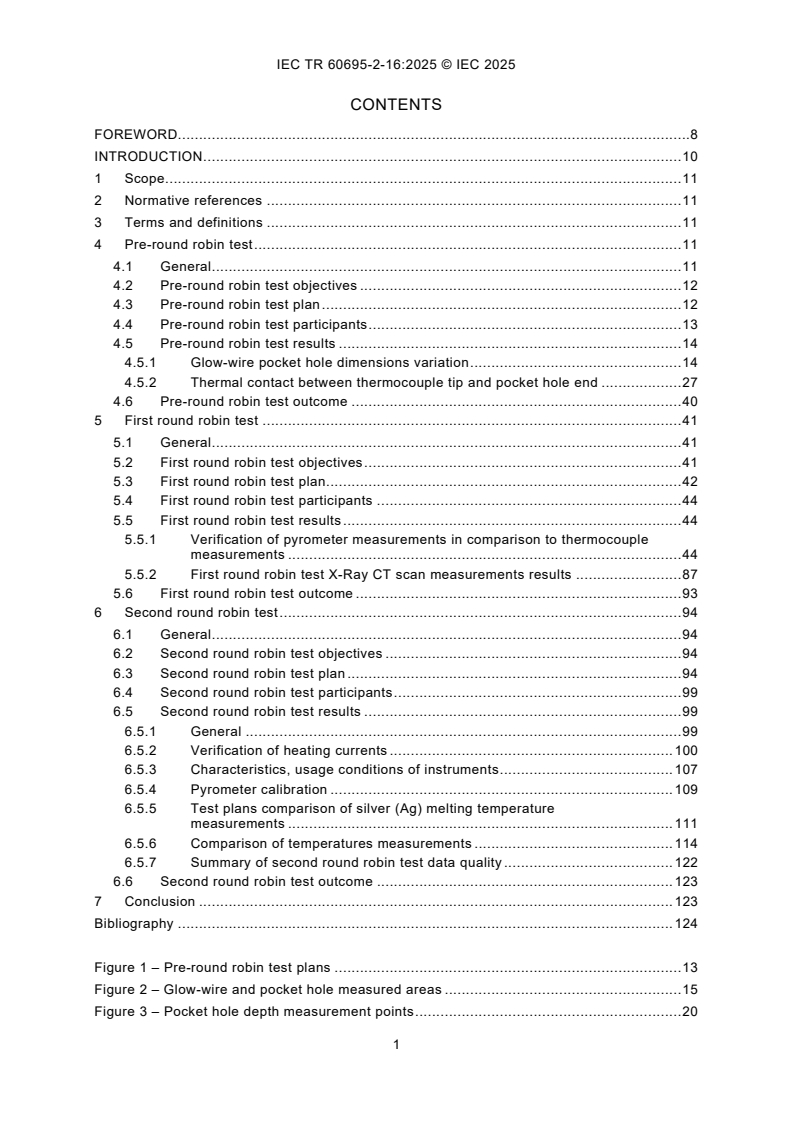
CONTENTS
FOREWORD. 8
INTRODUCTION . 10
1 Scope . 11
2 Normative references . 11
3 Terms and definitions . 11
4 Pre-round robin test . 11
4.1 General . 11
4.2 Pre-round robin test objectives . 12
4.3 Pre-round robin test plan . 12
4.4 Pre-round robin test participants . 13
4.5 Pre-round robin test results . 14
4.5.1 Glow-wire pocket hole dimensions variation . 14
4.5.2 Thermal contact between thermocouple tip and pocket hole end . 27
4.6 Pre-round robin test outcome . 40
5 First round robin test . 41
5.1 General . 41
5.2 First round robin test objectives . 41
5.3 First round robin test plan . 42
5.4 First round robin test participants . 44
5.5 First round robin test results . 44
5.5.1 Verification of pyrometer measurements in comparison to thermocouple
measurements . 44
5.5.2 First round robin test X-Ray CT scan measurements results . 87
5.6 First round robin test outcome . 93
6 Second round robin test . 94
6.1 General . 94
6.2 Second round robin test objectives . 94
6.3 Second round robin test plan . 94
6.4 Second round robin test participants . 99
6.5 Second round robin test results . 99
6.5.1 General . 99
6.5.2 Verification of heating currents . 100
6.5.3 Characteristics, usage conditions of instruments . 107
6.5.4 Pyrometer calibration . 109
6.5.5 Test plans comparison of silver (Ag) melting temperature
measurements . 111
6.5.6 Comparison of temperatures measurements . 114
6.5.7 Summary of second round robin test data quality . 122
6.6 Second round robin test outcome . 123
7 Conclusion . 123
Bibliography . 124
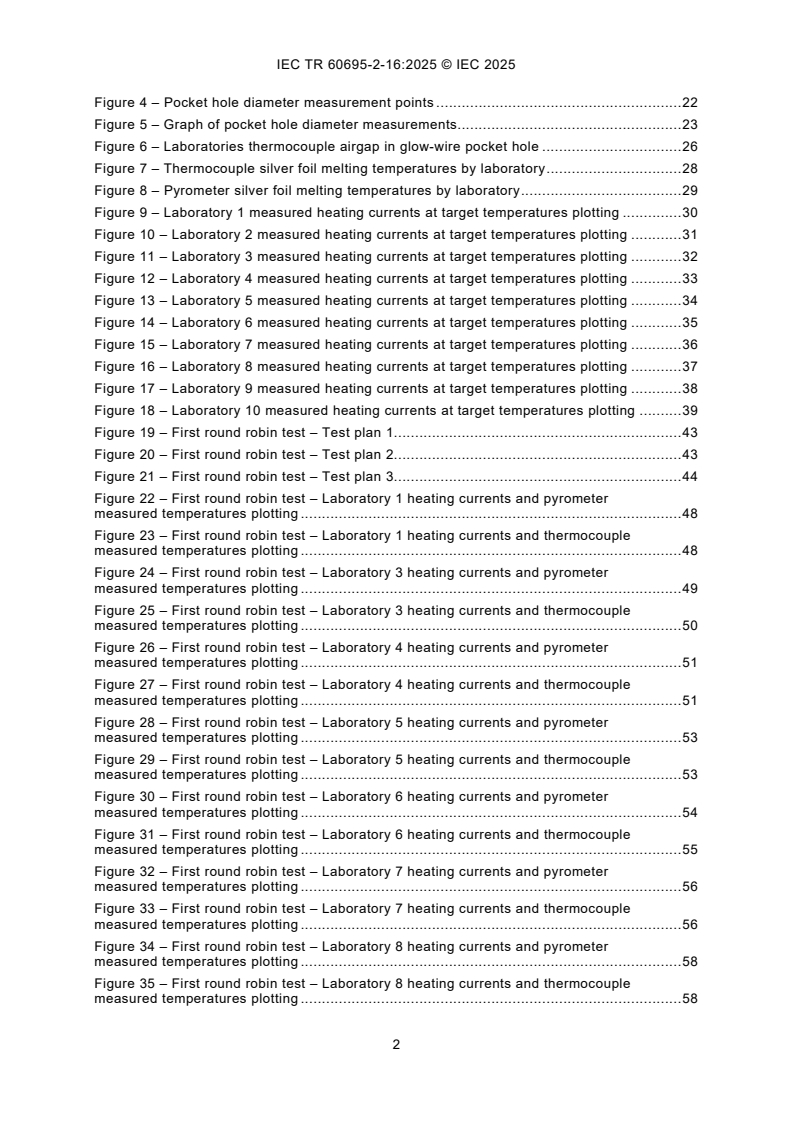
Figure 1 – Pre-round robin test plans . 13
Figure 2 – Glow-wire and pocket hole measured areas . 15
Figure 3 – Pocket hole depth measurement points . 20
Figure 4 – Pocket hole diameter measurement points . 22
Figure 5 – Graph of pocket hole diameter measurements . 23
Figure 6 – Laboratories thermocouple airgap in glow-wire pocket hole . 26
Figure 7 – Thermocouple silver foil melting temperatures by laboratory . 28
Figure 8 – Pyrometer silver foil melting temperatures by laboratory . 29
Figure 9 – Laboratory 1 measured heating currents at target temperatures plotting . 30
Figure 10 – Laboratory 2 measured heating currents at target temperatures plotting . 31
Figure 11 – Laboratory 3 measured heating currents at target temperatures plotting . 32
Figure 12 – Laboratory 4 measured heating currents at target temperatures plotting . 33
Figure 13 – Laboratory 5 measured heating currents at target temperatures plotting . 34
Figure 14 – Laboratory 6 measured heating currents at target temperatures plotting . 35
Figure 15 – Laboratory 7 measured heating currents at target temperatures plotting . 36
Figure 16 – Laboratory 8 measured heating currents at target temperatures plotting . 37
Figure 17 – Laboratory 9 measured heating currents at target temperatures plotting . 38
Figure 18 – Laboratory 10 measured heating currents at target temperatures plotting . 39
Figure 19 – First round robin test – Test plan 1. 43
Figure 20 – First round robin test – Test plan 2. 43
Figure 21 – First round robin test – Test plan 3. 44
Figure 22 – First round robin test – Laboratory 1 heating currents and pyrometer
measured temperatures plotting . 48
Figure 23 – First round robin test – Laboratory 1 heating currents and thermocouple
measured temperatures plotting . 48
Figure 24 – First round robin test – Laboratory 3 heating currents and pyrometer
measured temperatures plotting . 49
Figure 25 – First round robin test – Laboratory 3 heating currents and thermocouple
measured temperatures plotting . 50
Figure 26 – First round robin test – Laboratory 4 heating currents and pyrometer
measured temperatures plotting . 51
Figure 27 – First round robin test – Laboratory 4 heating currents and thermocouple
measured temperatures plotting . 51
Figure 28 – First round robin test – Laboratory 5 heating currents and pyrometer
measured temperatures plotting . 53
Figure 29 – First round robin test – Laboratory 5 heating currents and thermocouple
measured temperatures plotting . 53
Figure 30 – First round robin test – Laboratory 6 heating currents and pyrometer
measured temperatures plotting . 54
Figure 31 – First round robin test – Laboratory 6 heating currents and thermocouple
measured temperatures plotting . 55
Figure 32 – First round robin test – Laboratory 7 heating currents and pyrometer
measured temperatures plotting . 56
Figure 33 – First round robin test – Laboratory 7 heating currents and thermocouple
measured temperatures plotting . 56
Figure 34 – First round robin test – Laboratory 8 heating currents and pyrometer
measured temperatures plotting . 58
Figure 35 – First round robin test – Laboratory 8 heating currents and thermocouple
measured temperatures plotting . 58
Figure 36 – First round robin test – Laboratory 9 heating currents and pyrometer
measured temperatures plotting . 59
Figure 37 – First round robin test – Laboratory 9 heating currents and thermocouple
measured temperatures plotting . 60
Figure 38 – First round robin test – Laboratory 10 heating currents and pyrometer
measured temperatures plotting . 61
Figure 39 – Figure 38 – First round robin test – Laboratory 10 heating currents and
thermocouple measured temperatures plotting . 61
Figure 40 – First round robin test – Laboratory 1 Measured silver (Ag) melting
temperatures . 64
Figure 41 – First round robin test – Laboratory 3 Measured silver (Ag) melting
temperatures . 65
Figure 42 – First round robin test – Laboratory 4 Measured silver (Ag) melting
temperatures . 66
Figure 43 – First round robin test – Laboratory 5 Measured silver (Ag) melting
temperatures . 68
Figure 44 – First round robin test – Laboratory 6 Measured silver (Ag) melting
temperatures . 69
Figure 45 – First round robin test – Laboratory 7 Measured silver (Ag) melting
temperatures . 70
Figure 46 – First round robin test – Laboratory 8 Measured silver (Ag) melting
temperatures . 72
Figure 47 – First round robin test – Laboratory 9 Measured silver (Ag) melting
temperatures . 73
Figure 48 – First round robin test – Laboratory 10 Measured silver (Ag) melting
temperatures . 74
Figure 49 – First round robin test – Laboratory 1 Measured potassium bromide (KBr)
melting temperatures . 76
Figure 50 – First round robin test – Laboratory 3 Measured potassium bromide (KBr)
melting temperatures . 78
Figure 51 – First round robin test – Laboratory 4 Measured potassium bromide (KBr)
melting temperatures . 79
Figure 52 – First round robin test – Laboratory 5 Measured potassium bromide (KBr)
melting temperatures . 80
Figure 53 – First round robin test – Laboratory 6 Measured potassium bromide (KBr)
melting temperatures . 81
Figure 54 – First round robin test – Laboratory 7 Measured potassium bromide (KBr)
melting temperatures . 83
Figure 55 – First round robin test – Laboratory 8 Measured potassium bromide (KBr)
melting temperatures . 84
Figure 56 – First round robin test – Laboratory 9 Measured potassium bromide (KBr)
melting temperatures . 85
Figure 57 – First round robin test – Laboratory 10 Measured potassium bromide (KBr)
melting temperatures . 86
Figure 58 – First round robin test – Glow-wire and pocket hole measured areas . 88
Figure 59 – First round robin test plot of pocket hole diameter measurements . 92
Figure 60 – First round robin test – Laboratories thermocouple airgap in glow-wire
pocket hole . 93
Figure 61 – Second round robin test – Test plan 1 . 95
Figure 62 – Second round robin test – Test plan 1 Example of pyrometer
measurement area . 96
Figure 63 – Second round robin test – Test plan 2 . 97
Figure 64 – Second round robin test – Test plan 2 Example of pyrometer
measurement areas . 97
Figure 65 – Second round robin test – Test plan 3 . 98
Figure 66 – Second round robin test – Test plan 3 Example of pyrometer measurement
areas . 99
Figure 67 – Second round robin test – Test plan 1 – Laboratory 1 heating currents at
target temperatures plotting . 100
Figure 68 – Second round robin test – Test plan 1 – Laboratory 7 heating currents at
target temperatures plotting . 101
Figure 69 – Second round robin test – Test plan 1 – Laboratory 9 heating currents at
target temperatures plotting . 102
Figure 70 – Second round robin test – Test plan 2 – Laboratory 1 heating currents at
target temperatures plotting . 103
Figure 71 – Second round robin test – Test plan 2 – Laboratory 5 heating currents at
target temperatures plotting . 104
Figure 72 – Second round robin test – Test plan 2 – Laboratory 7 heating currents at
target temperatures plotting . 105
Figure 73 – Second round robin test – Test plan 2 – Laboratory 9 heating currents at
target temperatures plotting . 106
Figure 74 – Second round robin test – Test plan 3 – Laboratory 1 heating currents at
target temperatures plotting . 107
Figure 75 – Second round robin test – Laboratories measured emissivity values . 111
Figure 76 – Second round robin test – Test plan 1 Silver (Ag) foil measured melting
temperatures by pyrometer and thermocouple . 112
Figure 77 – Second round robin test – Test plan 2 Silver (Ag) foil measured melting
temperatures by pyrometer and thermocouple . 113
Figure 78 – Second round robin test – Test plan 3 Silver (Ag) foil measured melting
temperatures by pyrometer and thermocouple . 114
Figure 79 – Second round robin test – Laboratories' measurements for target
temperature 950 °C . 116
Figure 80 – Second round robin test – Laboratories' measurements for target
temperature 850 °C . 117
Figure 81 – Second round robin test – Laboratories' measurements for target
temperature 750 °C . 118
Figure 82 – Second round robin test – Laboratories' measurements for target
temperature 650 °C . 119
Figure 83 – Second round robin test – Laboratories' measurements for target
temperature 550 °C . 120
Figure 84 – Laboratories' variation per target temperature for pyrometer and
thermocouple measurements . 121
Figure 85 – Laboratories' standard deviation per target temperature for pyrometer and
thermocouple measurements . 122
Table 1 – Pre-round robin test objectives . 12
Table 2 – Pre-round robin test participants and test conditions . 14
Table 3 – Glow-wire and pocket hole measured areas descriptions . 15
Table 4 – X-Ray CT scan images measurements results . 16
Table 5 – Glow-wire and pocket hole alignment measurements (beginning of test plan) . 17
Table 6 – Glow-wire and pocket hole alignment results comparison . 18
Table 7 – Glow-wire and pocket hole alignment analysis results (beginning of test plan) . 19
Table 8 – Pocket hole depth measurements results (beginning test plan) . 21
Table 9 – Pocket hole depth measurements results comparison . 21
Table 10 – Pocket hole diameter measurements results (beginning test plan) . 22
Table 11 – Pocket hole diameter measurements results comparison . 23
Table 12 – Glow-wire tip diameter and thickness measurements results (beginning of
test plan) . 24
Table 13 – Pocket hole depth measurements results comparison . 24
Table 14 – Thermocouple airgap in glow-wire pocket hole measurements results
(beginning of test plan) . 25
Table 15 – Thermocouple airgap in glow-wire pocket hole results comparison . 26
Table 16 – One-point temperature measurement verification results by thermocouple . 27
Table 17 – One-point temperature measurement verification results by pyrometer . 28
Table 18 – Silver foil melting temperature comparison thermocouple and pyrometer . 29
Table 19 – Laboratory 1 measured heating currents at target temperatures results . 30
Table 20 – Laboratory 2 measured heating currents at target temperatures results . 30
Table 21 – Laboratory 3 measured heating currents at target temperatures results . 31
Table 22 – Laboratory 4 measured heating currents at target temperatures results . 32
Table 23 – Laboratory 5 measured heating currents at target temperatures results . 33
Table 24 – Laboratory 6 measured heating currents at target temperatures results . 34
Table 25 – Laboratory 7 measured heating currents at target temperatures results . 35
Table 26 – Laboratory 8 measured heating currents at target temperatures results . 36
Table 27 – Laboratory 9 measured heating currents at target temperatures results . 37
Table 28 – Laboratory 10 measured heating currents at target temperatures results . 38
Table 29 – Heating current variation at target temperatures and laboratories . 39
Table 30 – Pyrometer temperature measurements at target temperatures . 40
Table 31 – Pre-round robin test outcomes . 40
Table 32 – First round robin test objectives . 42
Table 33 – First round robin test participants and test conditions . 44
Table 34 – First round robin test pyrometers characteristics . 45
Table 35 – First round robin test pyrometers installation conditions . 45
Table 36 – First round robin test pyrometers emissivity calibration results . 46
Table 37 – Laboratory 1 heating currents and measured temperatures . 47
Table 38 – Laboratory 3 Heating currents and measured temperatures . 48
Table 39 – Laboratory 4 Heating currents and measured temperatures . 50
Table 40 – Laboratory 5 Heating currents and measured temperatures . 52
Table 41 – Laboratory 6 Heating currents and measured temperatures . 53
Table 42 – Laboratory 7 Heating currents and measured temperatures . 55
Table 43 – Laboratory 8 Heating currents and measured temperatures . 57
Table 44 – Laboratory 9 Heating currents and measured temperatures . 58
Table 45 – Laboratory 10 Heating currents and measured temperatures . 60
Table 46 – Laboratories results exceeding Annex B tolerance . 62
Table 47 – Laboratory 1 – Measured silver (Ag) melting temperatures . 63
Table 48 – Laboratory 3 – Measured silver (Ag) melting temperatures . 64
Table 49 – Laboratory 4 – Measured silver (Ag) melting temperatures . 65
Table 50 – Laboratory 5 – Measured silver (Ag) melting temperatures . 67
Table 51 – Laboratory 6 – Measured silver (Ag) melting temperatures . 68
Table 52 – Laboratory 7 – Measured silver (Ag) melting temperatures . 69
Table 53 – Laboratory 8 – Measured silver (Ag) melting temperatures . 71
Table 54 – Laboratory 9 – Measured silver (Ag) melting temperatures . 72
Table 55 – Laboratory 10 – Measured silver (Ag) melting temperatures . 73
Table 56 – First round robin test – Summary of silver (Ag) melting temperature
measurements variation . 75
Table 57 – Laboratory 1 – Measured potassium bromide (KBr) melting temperatures . 75
Table 58 – Laboratory 3 – Measured potassium bromide (KBr) melting temperatures . 77
Table 59 – Laboratory 4 – Measured potassium bromide (KBr) melting temperatures . 78
Table 60 – Laboratory 5 – Measured potassium bromide (KBr) melting temperatures . 79
Table 61 – Laboratory 6 – Measured potassium bromide (KBr) melting temperatures . 80
Table 62 – Laboratory 7 – Measured potassium bromide (KBr) melting temperatures . 82
Table 63 – Laboratory 8 – Measured potassium bromide (KBr) melting temperatures . 83
Table 64 – Laboratory 9 – Measured potassium bromide (KBr) melting temperatures . 84
Table 65 – Laboratory 10 – Measured potassium bromide (KBr) melting temperatures . 85
Table 66 – First round robin test – Summary of potassium bromide (KBr) melting
temperature measurements variation . 86
Table 67 – First round robin test – Glow-wire and pocket hole measured areas
descriptions . 89
Table 68 – First round robin test – X-Ray CT scan images measurements results . 89
Table 69 – First round robin test – Glow-wire pocket hole alignment measurements . 90
Table 70 – First round robin test pocket hole depth measurements results . 91
Table 71 – First round robin test pocket hole diameter measurements results . 91
Table 72 – First round robin test glow-wire tip diameter and thickness measurements
results . 92
Table 73 – First round robin test thermocouple airgap in glow-wire pocket hole
measurements results . 93
Table 74 – Second round robin test objectives . 94
Table 75 – Second round robin test participants and test conditions . 99
Table 76 – Test plan 1 – Laboratory 1 heating currents at target temperatures . 100
Table 77 – Test plan 1 – Laboratory 7 heating currents at target temperatures . 101
Table 78 – Test plan 1 – Laboratory 9 heating currents at target temperatures . 101
Table 79 – Test plan 2 – Laboratory 1 heating currents at target temperatures . 102
Table 80 – Test plan 2 – Laboratory 5 heating currents at target temperatures . 103
Table 81 – Test plan 2 – Laboratory 7 heating currents at target temperatures . 104
Table 82 – Test plan 2 – Laboratory 9 heating currents at target temperatures . 105
Table 83 – Test plan 3 – Laboratory 1 heating currents at target temperatures . 106
Table 84 – Second round robin test – Laboratories results exceeding
IEC 60695-2-10:2021, Annex B limit . 107
Table 85 – Second round robin test pyrometers characteristics . 108
Table 86 – Second round robin test pyrometers installation conditions . 108
Table 87 – Second round robin test thermocouples characteristics . 109
Table 88 – Second round robin test pyrometers emissivity calibration results . 109
Table 89 – Second round robin test – Test plan 1 silver (Ag) foil measured melting
temperatures . 111
Table 90 – Second round robin test – Test plan 2 silver (Ag) foil measured melting
temperatures . 112
Table 91 – Second round robin test – Test plan 3 silver (Ag) foil measured melting
temperatures . 113
Table 92 – Second round robin test – Summary of measurements variation and
standard deviation . 114
Table 93 – Second round robin test – Summary of measurements of target temperature
950 °C . 115
Table 94 – Second round robin test – Summary of measurements of target temperature
850 °C . 116
Table 95 – Second round robin test – Summary of measurements of target temperature
750 °C . 117
Table 96 – Second round robin test – Summary of measurements of target temperature
650 °C . 118
Table 97 – Second round robin test – Summary of measurements of target temperature
550 °C . 119
Table 98 – Summary of the measurements that exceeded the ± 10 °C tolerance . 120
Table 99 – Summary of the laboratory standard deviations and variations . 121
Table 100 – Second round robin test – Summary of data quality for test plan1 and test
plan 2 . 122
Table 101 – Second round robin test – Summary of data quality for the participant
laboratories . 123
INTERNATIONAL ELECTROTECHNICAL COMMISSION
____________
Fire hazard testing -
Part 2-16: Glowing/hot-wire test methods -
Summary of the round robin tests related to the use of pyrometer for
glow-wire temperature measurements according to IEC 60695-2-10
FOREWORD
1) The International Electrotechnical Commission (IEC) is a worldwide organization for standardization comprising
all national electrotechnical committees (IEC National Committees). The object of IEC is to promote international
co-operation on all questions concerning standardization in the electrical and electronic fields. To this end and
in addition to other activities, IEC publishes International Standards, Technical Specifications, Technical Reports,
Publicly Available Specifications (PAS) and Guides (hereafter referred to as "IEC Publication(s)"). Their
preparation is entrusted to technical committees; any IEC National Committee interested in the subject dealt with
may participate in this preparatory work. International, governmental and non-governmental organizations liaising
with the IEC also participate in this preparation. IEC collaborates closely with the International Organization for
Standardization (ISO) in accordance with conditions determined by agreement between the two organizations.
2) The formal decisions or agreements of IEC on technical matters express, as nearly as possible, an international
consensus of opinion on the relevant subjects since each technical committee has representation from all
interested IEC National Committees.
3) IEC Publications have the form of recommendations for international use and are accepted by IEC National
Committees in that sense. While all reasonable efforts are made to ensure that the technical content of IEC
Publications is accurate, IEC cannot be held responsible for the way in which they are used or for any
misinterpretation by any end user.
4) In order to promote international uniformity, IEC National Committees undertake to apply IEC Publications
transparently to the maximum extent possible in their national and regional publications. Any divergence between
any IEC Publication and the corresponding national or regional publication shall be clearly indicated in the latter.
5) IEC itself does not provide any attestation of conformity. Independent certification bodies provide conformity
assessment services and, in some areas, access to IEC marks of conformity. IEC is not responsible for any
services carried out by independent certification bodies.
6) All users should ensure that they have the latest edition of this publication.
7) No liability shall attach to IEC or its directors, employees, servants or agents including individual experts and
members of its technical committees and IEC National Committees for any personal injury, property damage or
other damage of any nature whatsoever, whether direct or indirect, or for costs (including legal fees) and
expenses arising out of the publication, use of, or reliance upon, this IEC Publication or any other IEC
Publications.
8) Attention is drawn to the Normative references cited in this publication. Use of the referenced publications is
indispensable for the correct application of this publication.
9) IEC draws attention to the possibility that the implementation of this document may involve the use of (a)
patent(s). IEC takes no position concerning the evidence, validity or applicability of any claimed patent rights in
respect thereof. As of the date of publication of this document, IEC had not received notice of (a) patent(s), which
may be required to implement this document. However, implementers are cautioned that this may not represent
the latest information, which may be obtained from the patent database available at https://patents.iec.ch. IEC
shall not be held responsible for identifying any or all such patent rights.
IEC TR 60695-2-16 has been prepared by IEC technical committee 89: Fire hazard testing. It
is a Technical Report.
The text of this Technical Report is based on the following documents:
Draft Report on voting
89/1611/DTR 89/1621/RVDTR
Full information on the voting for its approval can be found in the report on voting indicated in
the above table.
The language used for the development of this Technical Report is English.
A list of all parts in the IEC 60695 series, published under the general title Fire hazard testing,
can be found on the IEC website.
This document was drafted in accordance with ISO/IEC Directives, Part 2, and developed in
accordance with ISO/IEC Directives, Part 1 and ISO/IEC Directives, IEC Supplement, available
at www.iec.ch/members_experts/refdocs. The main document types developed by IEC are
described in greater detail at www.iec.ch/publications.
The committee has decided that the contents of this document will remain unchanged until the
stability date indicated on the IEC website under webstore.iec.ch in the data related to the
specific document. At this date, the document will be
– reconfirmed,
– withdrawn, or
– revised.
INTRODUCTION
Since over the recent years new technologies related to the measurement of temperature are
increasing on the market, IEC Technical Committee 89 "Fire hazard testing" has decided to
investigate the possibility to improve the temperature measurement system described in the
IEC 60695-2-10.
Therefore, during its 2019 plenary meeting, the IEC TC 89 created the Ad-Hoc Group 14 "Glow-
wire testing; Optimization of the temperature measuring system" with the task to investigate
possible variation factors affecting the current temperature measurement system described in
IEC 60695-2-10 and consequentially to possibly develop a proposal for improvement of
IEC 60695-2-10.
Between 2019 and 2023 the Ad-Hoc Group activities focused on:
– Evaluation of the possible displacement of the thermocouple within the glow-wire pocket
hole;
– Evaluation of the comparability of temperature measurements between the thermocouple
and the pyrometer
During the investigation of the above-mentioned items, the Ad-Hoc Group 14 performed a pre-
round robin test, where the participation was limited to the Ad-Hoc Group 14 members, and two
round robin tests, where the participation was open to all National Committee experts.
The outcome of the work of the Ad-Hoc Group resulted in a proposal for a new Annex to
IEC 60695-2-10, describing the minimum technical characteristics and usage conditions for the
pyrometer, as alternative temperature measurement system to the thermocouple.
The IEC has decided to develop this Technical Report for knowledge retention purposes as well
as to create a reference for future activities either related to the improvement of IEC 60695-2-10
or for other projects involving the execution of round robin activities.
1 Scope
This part of IEC 60695-2 specifies the results of the round robin tests related to the use of the
pyrometer, for the measurement of the glow-wire temperature, according to IEC 60695-2-10.
This Technical Report summarize the objectives and the results of a pre-round robin test and
two round robin tests, performed by the IEC: "Glow-wire testing: Optimization of the temperature
measuring system".
The outcome of the work conducted by the IEC resulted in a proposal for a new Annex in
IEC 60695-2-10, describing the minimum technical characteristics and usage conditions for the
pyrometer, as an alternative temperature measurement instrument to the thermocouple.
2 Normative references
The following documents are referred to in the text in such a way that some or all of their content
constitutes requirements of this document. For dated references, only the edition cited applies.
For undated references, the latest edition of the referenced document (including any
amendments) applies.
ISO 13943:2023, Fire safety – Vocabulary
3 Terms and definitions
For the purposes of this document, the terms and definitions given in ISO 13943:2023 as well
as the following apply.
ISO and IEC maintain terminology databases for use in standardization at the following
addresses:
– IEC Electropedia: available at https://www.electropedia.org/
– ISO Online browsing platform: available at https://www.iso.org/obp
3.1
pyrometer
device for non-contact temperature measurement which It measures the electromagnetic
radiat
...