


IEC 61326-2-3:2020
(Main)Electrical equipment for measurement, control and laboratory use - EMC requirements - Part 2-3: Particular requirements - Test configuration, operational conditions and performance criteria for transducers with integrated or remote signal conditioning
General Information
- Abstract
IEC 61326-2-3:2020 specifies more detailed test configurations, operational conditions and performance criteria for transducers with integrated or remote signal conditioning. This document applies only to transducers characterized by their ability to transform, with the aid of an auxiliary energy source, a non-electric quantity to a process-relevant electrical signal, and to output the signal at one or more PORTS. This document includes transducers for electrochemical and biological measured quantities. The transducers covered by this document can be powered by AC or DC voltage and/or by battery or with internal power supply.
- Status
- Published
- Publication Date
- 25-Oct-2020
- Technical Committee
- SC 65A - System aspects
- Drafting Committee
- WG 4 - TC 65/SC 65A/WG 4
- Current Stage
- PPUB - Publication issued
- Start Date
- 26-Oct-2020
- Completion Date
- 27-Nov-2020
Buy Documents
IEC 61326-2-3:2020 RLV - Electrical equipment for measurement, control and laboratory use - EMC requirements - Part 2-3: Particular requirements - Test configuration, operational conditions and performance criteria for transducers with integrated or remote signal conditioning Released:10/26/2020
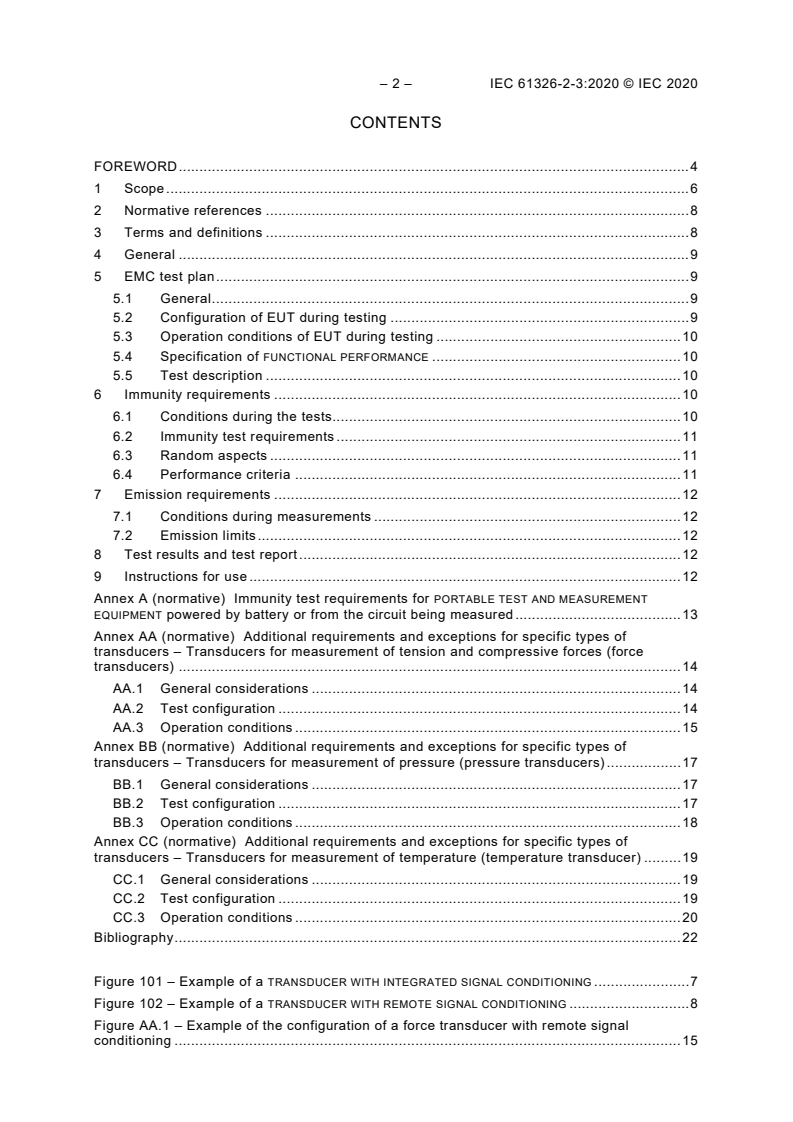
IEC 61326-2-3:2020 - Electrical equipment for measurement, control and laboratory use - EMC requirements - Part 2-3: Particular requirements - Test configuration, operational conditions and performance criteria for transducers with integrated or remote signal conditioning Released:10/26/2020
Overview
IEC 61326-2-3:2020 is a Part 2 standard in the IEC 61326 series that defines EMC requirements specifically for transducers with integrated or remote signal conditioning. It complements IEC 61326-1:2020 by specifying detailed test configurations, operational conditions and performance criteria for devices that convert a non‑electrical quantity (mechanical, chemical, biological, thermal, etc.) into a process‑relevant electrical signal and output it at one or more PORTS. The standard covers transducers powered by AC, DC, battery or internal supplies and explicitly includes electrochemical and biological measured quantities.
Key topics & technical requirements
- Scope of application: Transducers that transform non‑electrical inputs into electrical outputs and include transmission links and signal‑conditioning units (integrated or remote).
- EMC test plan: Guidance on test configuration of the Equipment Under Test (EUT), required operational states during testing, and documentation.
- Immunity requirements: Conditions during immunity tests, required immunity test types and performance criteria (see Table 101 in the standard).
- Emission requirements: Measurement conditions and applicable emission limits for transducers and associated signal conditioning.
- Functional performance: Definition and specification of functional performance levels to judge acceptable behavior during and after EMC events.
- Test reporting: Required content for test results and the formal test report.
- Instructions for use: Information manufacturers should provide to users to ensure intended operating environment and EMC behavior.
- Annexes for specific transducer types: Additional requirements and exceptions for force (Annex AA), pressure (Annex BB) and temperature (Annex CC) transducers and normative guidance for portable test and measurement equipment (Annex A).
Practical applications & who uses it
- Manufacturers of sensors, transducers and smart probes that include or interface with signal conditioning.
- EMC and compliance engineers preparing test plans, conducting immunity/emission testing and creating compliance documentation.
- Test laboratories and certification bodies verifying conformance to EMC standards for measurement, control and laboratory equipment.
- System integrators, OEMs and R&D teams designing instrumentation for industrial process control, laboratory analysis, environmental monitoring, biotech and electrochemical sensing.
- Regulatory and QA teams that require traceable EMC conformance for equipment placed in specified industrial or laboratory environments.
Related standards
- IEC 61326-1:2020 - General EMC requirements for measurement, control and laboratory equipment (this Part 2-3 is to be used in conjunction with IEC 61326-1).
- Other referenced IEC normative documents listed in Clause 2 of IEC 61326-2-3 for specific test methods and definitions.
Keywords: IEC 61326-2-3, EMC requirements, transducers, signal conditioning, test configuration, immunity testing, emission limits, performance criteria, pressure transducer, temperature transducer, force sensor, electrochemical sensor.
Relations
- Effective Date
- 05-Sep-2023
Buy Documents
IEC 61326-2-3:2020 RLV - Electrical equipment for measurement, control and laboratory use - EMC requirements - Part 2-3: Particular requirements - Test configuration, operational conditions and performance criteria for transducers with integrated or remote signal conditioning Released:10/26/2020
IEC 61326-2-3:2020 - Electrical equipment for measurement, control and laboratory use - EMC requirements - Part 2-3: Particular requirements - Test configuration, operational conditions and performance criteria for transducers with integrated or remote signal conditioning Released:10/26/2020
Get Certified
Connect with accredited certification bodies for this standard

DVS-ZERT GmbH
German welding certification society.

ANCE
Mexican certification and testing association.
BSMI (Bureau of Standards, Metrology and Inspection)
Taiwan's standards and inspection authority.
Sponsored listings
Frequently Asked Questions
IEC 61326-2-3:2020 is a standard published by the International Electrotechnical Commission (IEC). Its full title is "Electrical equipment for measurement, control and laboratory use - EMC requirements - Part 2-3: Particular requirements - Test configuration, operational conditions and performance criteria for transducers with integrated or remote signal conditioning". This standard covers: IEC 61326-2-3:2020 specifies more detailed test configurations, operational conditions and performance criteria for transducers with integrated or remote signal conditioning. This document applies only to transducers characterized by their ability to transform, with the aid of an auxiliary energy source, a non-electric quantity to a process-relevant electrical signal, and to output the signal at one or more PORTS. This document includes transducers for electrochemical and biological measured quantities. The transducers covered by this document can be powered by AC or DC voltage and/or by battery or with internal power supply.
IEC 61326-2-3:2020 specifies more detailed test configurations, operational conditions and performance criteria for transducers with integrated or remote signal conditioning. This document applies only to transducers characterized by their ability to transform, with the aid of an auxiliary energy source, a non-electric quantity to a process-relevant electrical signal, and to output the signal at one or more PORTS. This document includes transducers for electrochemical and biological measured quantities. The transducers covered by this document can be powered by AC or DC voltage and/or by battery or with internal power supply.
IEC 61326-2-3:2020 is classified under the following ICS (International Classification for Standards) categories: 17.220.20 - Measurement of electrical and magnetic quantities; 25.040.40 - Industrial process measurement and control; 33.100.20 - Immunity. The ICS classification helps identify the subject area and facilitates finding related standards.
IEC 61326-2-3:2020 has the following relationships with other standards: It is inter standard links to IEC 61326-2-3:2012. Understanding these relationships helps ensure you are using the most current and applicable version of the standard.
IEC 61326-2-3:2020 is available in PDF format for immediate download after purchase. The document can be added to your cart and obtained through the secure checkout process. Digital delivery ensures instant access to the complete standard document.
Standards Content (Sample)
IEC 61326-2-3 ®
Edition 3.0 2020-10
REDLINE VERSION
INTERNATIONAL
STANDARD
colour
inside
Electrical equipment for measurement, control and laboratory use –
EMC requirements –
Part 2-3: Particular requirements – Test configuration, operational conditions
and performance criteria for transducers with integrated or remote signal
conditioning
All rights reserved. Unless otherwise specified, no part of this publication may be reproduced or utilized in any form
or by any means, electronic or mechanical, including photocopying and microfilm, without permission in writing from
either IEC or IEC's member National Committee in the country of the requester. If you have any questions about IEC
copyright or have an enquiry about obtaining additional rights to this publication, please contact the address below or
your local IEC member National Committee for further information.
IEC Central Office Tel.: +41 22 919 02 11
3, rue de Varembé info@iec.ch
CH-1211 Geneva 20 www.iec.ch
Switzerland
About the IEC
The International Electrotechnical Commission (IEC) is the leading global organization that prepares and publishes
International Standards for all electrical, electronic and related technologies.
About IEC publications
The technical content of IEC publications is kept under constant review by the IEC. Please make sure that you have the
latest edition, a corrigendum or an amendment might have been published.
IEC publications search - webstore.iec.ch/advsearchform Electropedia - www.electropedia.org
The advanced search enables to find IEC publications by a The world's leading online dictionary on electrotechnology,
variety of criteria (reference number, text, technical containing more than 22 000 terminological entries in English
committee,…). It also gives information on projects, replaced and French, with equivalent terms in 16 additional languages.
and withdrawn publications. Also known as the International Electrotechnical Vocabulary
(IEV) online.
IEC Just Published - webstore.iec.ch/justpublished
Stay up to date on all new IEC publications. Just Published IEC Glossary - std.iec.ch/glossary
details all new publications released. Available online and 67 000 electrotechnical terminology entries in English and
once a month by email. French extracted from the Terms and Definitions clause of
IEC publications issued since 2002. Some entries have been
IEC Customer Service Centre - webstore.iec.ch/csc collected from earlier publications of IEC TC 37, 77, 86 and
If you wish to give us your feedback on this publication or CISPR.
need further assistance, please contact the Customer Service
Centre: sales@iec.ch.
IEC 61326-2-3 ®
Edition 3.0 2020-10
REDLINE VERSION
INTERNATIONAL
STANDARD
colour
inside
Electrical equipment for measurement, control and laboratory use –
EMC requirements –
Part 2-3: Particular requirements – Test configuration, operational conditions
and performance criteria for transducers with integrated or remote signal
conditioning
INTERNATIONAL
ELECTROTECHNICAL
COMMISSION
ICS 17.220.20; 25.040.40; 33.100.20 ISBN 978-2-8322-9006-4
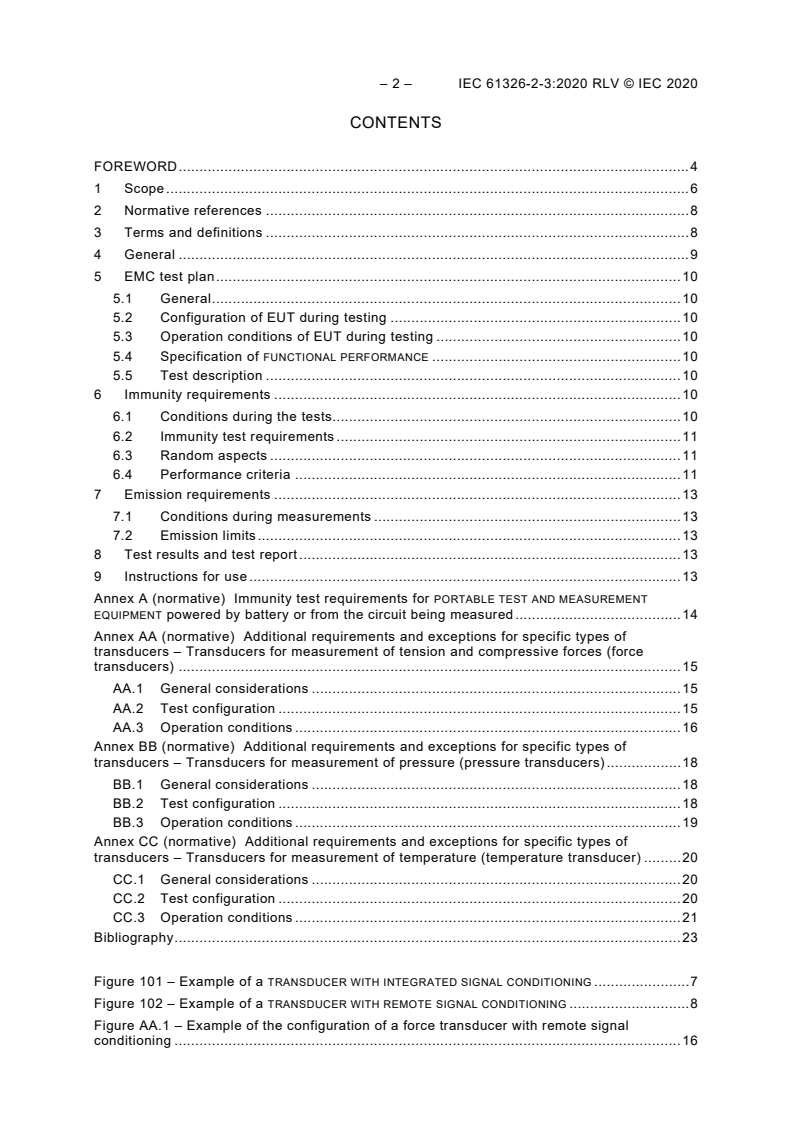
– 2 – IEC 61326-2-3:2020 RLV © IEC 2020
CONTENTS
FOREWORD . 4
1 Scope . 6
2 Normative references . 8
3 Terms and definitions . 8
4 General . 9
5 EMC test plan . 10
5.1 General . 10
5.2 Configuration of EUT during testing . 10
5.3 Operation conditions of EUT during testing . 10
5.4 Specification of FUNCTIONAL PERFORMANCE . 10
5.5 Test description . 10
6 Immunity requirements . 10
6.1 Conditions during the tests. 10
6.2 Immunity test requirements . 11
6.3 Random aspects . 11
6.4 Performance criteria . 11
7 Emission requirements . 13
7.1 Conditions during measurements . 13
7.2 Emission limits . 13
8 Test results and test report . 13
9 Instructions for use . 13
Annex A (normative) Immunity test requirements for PORTABLE TEST AND MEASUREMENT
EQUIPMENT powered by battery or from the circuit being measured . 14
Annex AA (normative) Additional requirements and exceptions for specific types of
transducers – Transducers for measurement of tension and compressive forces (force
transducers) . 15
AA.1 General considerations . 15
AA.2 Test configuration . 15
AA.3 Operation conditions . 16
Annex BB (normative) Additional requirements and exceptions for specific types of
transducers – Transducers for measurement of pressure (pressure transducers) . 18
BB.1 General considerations . 18
BB.2 Test configuration . 18
BB.3 Operation conditions . 19
Annex CC (normative) Additional requirements and exceptions for specific types of
transducers – Transducers for measurement of temperature (temperature transducer) . 20
CC.1 General considerations . 20
CC.2 Test configuration . 20
CC.3 Operation conditions . 21
Bibliography . 23
Figure 101 – Example of a TRANSDUCER WITH INTEGRATED SIGNAL CONDITIONING . 7
Figure 102 – Example of a TRANSDUCER WITH REMOTE SIGNAL CONDITIONING . 8
Figure AA.1 – Example of the configuration of a force transducer with remote signal
conditioning . 16
Figure BB.1 – Example of the configuration of a pressure transducer . 19
Figure CC.1 – Example of the configuration of a temperature transducer with sensor
and signal conditioning in the same housing . 21
Figure CC.2 – Example of the configuration of a temperature transducer with remote
signal conditioning . 21
Table 101 – Performance criteria for the different functions . 12
Table AA.1 – Circuitry actions for generating an output signal for simulation of a
mechanical load on the transducer . 17
– 4 – IEC 61326-2-3:2020 RLV © IEC 2020
INTERNATIONAL ELECTROTECHNICAL COMMISSION
____________
ELECTRICAL EQUIPMENT FOR MEASUREMENT,
CONTROL AND LABORATORY USE –
EMC REQUIREMENTS –
Part 2-3: Particular requirements –
Test configuration, operational conditions and performance
criteria for transducers with integrated or remote signal conditioning
FOREWORD
1) The International Electrotechnical Commission (IEC) is a worldwide organization for standardization comprising
all national electrotechnical committees (IEC National Committees). The object of IEC is to promote international
co-operation on all questions concerning standardization in the electrical and electronic fields. To this end and
in addition to other activities, IEC publishes International Standards, Technical Specifications, Technical Reports,
Publicly Available Specifications (PAS) and Guides (hereafter referred to as “IEC Publication(s)”). Their
preparation is entrusted to technical committees; any IEC National Committee interested in the subject dealt with
may participate in this preparatory work. International, governmental and non-governmental organizations liaising
with the IEC also participate in this preparation. IEC collaborates closely with the International Organization for
Standardization (ISO) in accordance with conditions determined by agreement between the two organizations.
2) The formal decisions or agreements of IEC on technical matters express, as nearly as possible, an international
consensus of opinion on the relevant subjects since each technical committee has representation from all
interested IEC National Committees.
3) IEC Publications have the form of recommendations for international use and are accepted by IEC National
Committees in that sense. While all reasonable efforts are made to ensure that the technical content of IEC
Publications is accurate, IEC cannot be held responsible for the way in which they are used or for any
misinterpretation by any end user.
4) In order to promote international uniformity, IEC National Committees undertake to apply IEC Publications
transparently to the maximum extent possible in their national and regional publications. Any divergence between
any IEC Publication and the corresponding national or regional publication shall be clearly indicated in the latter.
5) IEC itself does not provide any attestation of conformity. Independent certification bodies provide conformity
assessment services and, in some areas, access to IEC marks of conformity. IEC is not responsible for any
services carried out by independent certification bodies.
6) All users should ensure that they have the latest edition of this publication.
7) No liability shall attach to IEC or its directors, employees, servants or agents including individual experts and
members of its technical committees and IEC National Committees for any personal injury, property damage or
other damage of any nature whatsoever, whether direct or indirect, or for costs (including legal fees) and
expenses arising out of the publication, use of, or reliance upon, this IEC Publication or any other IEC
Publications.
8) Attention is drawn to the Normative references cited in this publication. Use of the referenced publications is
indispensable for the correct application of this publication.
9) Attention is drawn to the possibility that some of the elements of this IEC Publication may be the subject of patent
rights. IEC shall not be held responsible for identifying any or all such patent rights.
This redline version of the official IEC Standard allows the user to identify the changes
made to the previous edition. A vertical bar appears in the margin wherever a change has
been made. Additions are in green text, deletions are in strikethrough red text.
This International Standard IEC 61326-2-3 has been prepared by subcommittee 65A: System
aspects, of IEC technical committee 65: Industrial-process measurement, control and
automation.
This third edition cancels and replaces the second edition published in 2012. This edition
constitutes a technical revision.
This edition includes the following significant technical changes with respect to the previous
edition:
– update of the document with respect to IEC 61326-1:2020.
The text of this International Standard is based on the following documents:
FDIS Report on voting
65A/980/FDIS 65A/991/RVD
Full information on the voting for the approval of this International Standard can be found in the
report on voting indicated in the above table.
This document has been drafted in accordance with the ISO/IEC Directives, Part 2.
In this document the following print types are used:
– Terms used throughout this document which have been defined in Clause 3 of this document
and of IEC 61326-1:2020: SMALL CAPITALS.
This part of the IEC 61326 series is to be used in conjunction with IEC 61326-1:2020 and follows
the same numbering of clauses, subclauses, tables and figures.
When a particular subclause of IEC 61326-1 is not mentioned in this part, that subclause applies
as far as is reasonable. When this standard states “addition”, “modification” or “replacement”,
the relevant text in IEC 61326-1 is to be adapted accordingly.
NOTE The following numbering system is used:
– subclauses, tables and figures that are numbered starting from 101 are additional to those in
IEC 61326-1;
– unless notes are in a new subclause or involve notes in IEC 61326-1, they are numbered starting from 101
including those in a replaced clause or subclause;
– additional annexes are lettered AA, BB, etc.
A list of all parts of the IEC 61326 series, under the general title Electrical equipment for
measurement, control and laboratory use – EMC requirements, can be found on the IEC
website.
The committee has decided that the contents of this document will remain unchanged until the
stability date indicated on the IEC website under "http://webstore.iec.ch" in the data related to
the specific document. At this date, the document will be
• reconfirmed,
• withdrawn,
• replaced by a revised edition, or
• amended.
IMPORTANT – The 'colour inside' logo on the cover page of this publication indicates
that it contains colours which are considered to be useful for the correct understanding
of its contents. Users should therefore print this document using a colour printer.
– 6 – IEC 61326-2-3:2020 RLV © IEC 2020
ELECTRICAL EQUIPMENT FOR MEASUREMENT,
CONTROL AND LABORATORY USE –
EMC REQUIREMENTS –
Part 2-3: Particular requirements –
Test configuration, operational conditions and performance
criteria for transducers with integrated or remote signal conditioning
1 Scope
In addition to the requirements of IEC 61326-1, this part of IEC 61326 specifies more detailed
test configurations, operational conditions and performance criteria for transducers with
integrated or remote signal conditioning.
This document applies only to transducers characterized by their ability to transform, with the
aid of an auxiliary energy source, a non-electric quantity to a process-relevant electrical signal,
and to output the signal at one or more PORTS. This document includes transducers for electro-
chemical and biological measured quantities.
The transducers covered by this document may can be powered by AC or DC voltage and/or by
battery or with internal power supply.
Transducers referred to by this document comprise at least the following items (see Figure 101
and Figure 102):
– one or more elements for transforming a non-electrical input quantity to an electrical
quantity;
– a TRANSMISSION LINK for transferral of the electrical quantity to a component for signal
conditioning;
– a unit for signal conditioning that converts the electrical quantity to a process-relevant
electrical signal;
– an enclosure for enclosing the above-stated components fully or in parts.
Transducers referred to by this document may can also have the following items (see Figure
101 and Figure 102):
– a communication and control unit;
– a display unit;
– control elements such as keys, buttons, switches, etc.;
– transducer output signals (for example, switch outputs, alarm outputs) which are clearly
assigned to the input signal(s);
– transducers with signal conditioning which may be integrated or remote.
The manufacturer specifies the environment for which the product is intended to be used and
utilizes the corresponding test levels of IEC 61326-1.
Additional requirements and exceptions for specific types of transducers are given in the
annexes Annex AA, Annex BB and Annex CC to this document.
Key
1 non-electrical quantity
2 electrical quantity
3 TRANSMISSION LINK
4 signal conditioning
5 communication and control unit
6 input/output PORTS
7 power supply
8 signal PORT
9 AC/DC POWER PORT
10 enclosure
Figure 101 – Example of a TRANSDUCER WITH INTEGRATED SIGNAL CONDITIONING
– 8 – IEC 61326-2-3:2020 RLV © IEC 2020
Key
1 non-electrical quantity
2 electrical quantity
3 TRANSMISSION LINK
4 signal conditioning
5 communication and control unit
6 input/output PORTS
7 power supply
8 signal PORT
9 AC/DC POWER PORT
10 enclosure
Figure 102 – Example of a TRANSDUCER WITH REMOTE SIGNAL CONDITIONING
2 Normative references
The following documents are referred to in the text in such a way that some or all of their content
constitutes requirements of this document. For dated references, only the edition cited applies.
For undated references, the latest edition of the referenced document (including any
amendments) applies.
Clause 2 of IEC 61326-1:20122020 applies, except as follows:
Addition:
IEC 61326-1:20122020, Electrical equipment for measurement, control and laboratory use –
EMC requirements – Part 1: General requirements
3 Terms and definitions
For the purposes of this document, the terms and definitions of IEC 61326-1:2020 apply, except
as follows.
ISO and IEC maintain terminological databases for use in standardization at the following
addresses:
• IEC Electropedia: available at http://www.electropedia.org/
• ISO Online browsing platform: available at http://www.iso.org/obp
Addition:
3.101
transducer with integrated signal conditioning
transducer in which all components for signal conditioning are integrated in the enclosure
Note 1 to entry: See Figure 101.
3.102
transducer with remote signal conditioning
transducer whose components for signal conditioning are installed in separate enclosures
Note 1 to entry: See Figure 102.
3.104
transmission link
connection between the individual components of a TRANSDUCER WITH REMOTE SIGNAL
CONDITIONING
3.105
(nominal) range
range of indications obtainable with a particular setting of the controls of a measuring instrument
Note 1 to entry: The (nominal) RANGE is normally stated in terms of its lower and upper limits. Where the lower limit
is zero, the (nominal) RANGE is commonly stated solely in terms of its upper limit.
[SOURCE: IEC 60050-300:2001, 311-03-14]
3.106
measuring range (of a transducer)
range defined by two values of the measured quantity within which the relationship between the
output and input signals complies with the accuracy requirements
Note 1 to entry: For a 4 mA to 20 mA system, the output current 4 mA represents the lower limit for the measured
quantity and 20 mA represent the upper limit.
[SOURCE: IEC 60050-300:2001, 314-04-04, modified – "output signal" has been changed to
"measured quantity" and the note to entry has been added]
3.107
span
algebraic difference between the values of the upper and lower limits of the MEASURING RANGE
[SOURCE: IEC 60050-300:2001, 311-03-13]
3.108
intrinsic uncertainty
uncertainty of a measuring instrument when used under reference conditions
Note 1 to entry: This term is used in the “uncertainty” approach
[SOURCE: IEC 60050-300:2001, 311-03-09]
4 General
Clause 4 of IEC 61326-1:20122020 applies.
– 10 – IEC 61326-2-3:2020 RLV © IEC 2020
5 EMC test plan
5.1 General
Subclause 5.1 of IEC 61326-1:20122020 applies.
5.2 Configuration of EUT during testing
Subclause 5.2 of IEC 61326-1:20122020 applies, except as follows.
5.2.1 General
Subclause 5.2.1 of IEC 61326-1:20122020 applies, except as follows:
Addition:
A system for monitoring the behaviour of the EUT and for registering the output values shall be
designed in such a way that the electromagnetic compatibility characteristics of the EUT are
not impaired. The monitoring system shall also be designed such that its response is not
affected by the immunity tests. The input impedance of the monitoring system shall correspond
to the terminating impedance of the transducer, specified by the manufacturer. The distance
between the monitoring system and the EUT should be at least 1,5 m.
The measurement uncertainty and the bandwidth of the monitoring system shall be adapted to
the characteristics of the transducer.
TRANSMISSION LINKS are considered as separate input and output lines.
The tests shall be conducted in compliance with the environmental conditions for the transducer
specified by the manufacturer and using the specified supply voltage.
In the case of battery-operated transducers that can also be used when connected with a power
supply, both operating modes (stand-alone and externally supplied) shall be tested.
In cases in which the manufacturer's installation instructions stipulate the use of external
protective equipment or particular protective measures that are explicitly stated in the operating
manual, the test requirements given in this part of the document shall be applied for use
together with the external protective equipment or measures.
5.3 Operation conditions of EUT during testing
Subclause 5.3 of IEC 61326-1:20122020 applies.
5.4 Specification of FUNCTIONAL PERFORMANCE
Subclause 5.4 of IEC 61326-1:20122020 applies.
5.5 Test description
Subclause 5.5 of IEC 61326-1:20122020 applies.
6 Immunity requirements
6.1 Conditions during the tests
Subclause 6.1 of IEC 61326-1:20122020 applies except as follows:
Addition:
Transducers shall be operated during the test with all lines connected, provided the PORTS do
not have functions that contravene the definition of a transducer's function disable the
transducer's normal operation.
Configurations with alternative PORTS shall be tested separately.
Transducers shall be set to the most sensitive ranges or combination of ranges unless other
ranges are known to provide worst-case immunity results within normal application.
Only operational functions compliant with the specified use under the nominal conditions are
permitted. Defined functions that cannot be set under electromagnetic compatibility test
conditions shall be simulated by appropriate measures. This shall be done in such a way that
the electromagnetic compatibility behaviour of the transducer is not affected.
Measurement and supply circuits shall be grounded in accordance with the manufacturer's
specifications. If no such specifications are given, the tests shall be carried out with the circuits
grounded and with the circuits ungrounded.
6.2 Immunity test requirements
Subclause 6.2 of IEC 61326-1:20122020 applies except as follows:
Addition:
After or during each test, the function of the transducer shall be tested.
Power inputs for voltages up to 75 V DC or voltages up to 50 V AC that are fed in a single cable
PORTS are tested as input and output PORTS.
together with the input and output
Power inputs for voltages up to 75 V DC or voltages up to 50 V AC with superimposed output
signals (for example, 4 mA to 20 mA current loop with two-wire technology) are also tested as
input/output PORTS.
The TRANSMISSION LINK of a TRANSDUCER WITH REMOTE SIGNAL CONDITIONING is tested as an
input/output PORT.
If there are any manufacturer's specifications present to the insulation resistance then these
shall be checked once again after ESD, fast transient (burst) and surge tests.
If insulation resistance is specified, it shall be verified after ESD, fast transient and surge
immunity tests.
If the manufacturer's insulation's specifications are not satisfied, the transducer is deemed to
have failed the EMC tests.
6.3 Random aspects
Subclause 6.3 of IEC 61326-1:20122020 applies.
6.4 Performance criteria
Subclause 6.4 of IEC 61326-1:20122020 applies except as follows:
Addition:
– 12 – IEC 61326-2-3:2020 RLV © IEC 2020
The performance criteria are used to assess the defined functions of a transducer under the
effects of external electromagnetic disturbances. Since a transducer is often part of a chain of
functions in a large process, effects on the overall process due to malfunctions of a transducer
caused by external interference factors cannot be predicted without great difficulty. For this
reason, it is particularly important that the behaviour of transducers under the influence of
electromagnetic disturbances is described with performance criteria by the manufacturer.
Table 101 describes the permissible effects of a disturbance on the different functions of a
transducer with regard to the required performance criteria.
Table 101 – Performance criteria for the different functions
Function Additional particular performance criteria
for performance criterion A for performance criterion B for performance criterion C
a
Main function The deviations during the The deviations during the The deviations during the
test are within the limit test are within the limit test may be outside the
values for intrinsic values for additional limit values specified and
uncertainty specified and deviations specified and documented by the
documented by the documented by the manufacturer. After the
test, the measured values
manufacturer manufacturer
are within the specified
range.
The manufacturer shall
specify the time that is
required to regain normal
function after the end of the
test.
Process communication Communication as Temporary interference of Interference of the
intended the communication is communication is permitted
permitted during the test. during the test.
The manufacturer shall
specify the time that is
required to regain normal
function after the end of the
test.
Alarm function No malfunctions permitted Temporary interference of Malfunctions are permitted.
the communication is
The manufacturer shall
permitted during the test.
specify the time that is
required to regain normal
function after the end of the
test.
a
The main function of a measuring transducer is to transform a non-electrical quantity into a process-relevant
signal as shown in Figures 101 and 102.
Function Additional particular performance criteria
for performance criterion A for performance criterion B for performance criterion C
a
See 6.4.2 of IEC 61326- See 6.4.3 of IEC 61326- The deviations during the
Main function
1:2020 1:2020 test may be outside the limit
values specified and
documented. After the test,
the measured values are
within the specified range.
The time needed for the
device to return to ready
state is given in the
documentation.
Process Communication works as Temporary interference of Interference of the
communication intended the communication is communication is permitted
permitted during the test during the test.
The time needed for the
device to return to ready
state is given in the
documentation.
Alarm function No malfunctions are Temporary malfunctions are Malfunctions are permitted.
permitted permitted during the test
The time needed for the
device to return to ready
state is given in the
documentation.
a
The main function of a measuring transducer is to transform a non-electrical quantity into a process-relevant
signal as shown in Figure 101 and Figure 102.
7 Emission requirements
7.1 Conditions during measurements
Subclause 7.1 of IEC 61326-1:20122020 applies except as follows:
Addition:
The additions made in Clauses 5 and 6 shall be taken into account.
7.2 Emission limits
Subclause 7.2 of IEC 61326-1:20122020 applies.
8 Test results and test report
Clause 8 of IEC 61326-1:20122020 applies.
9 Instructions for use
Clause 9 of IEC 61326-1:20122020 applies.
– 14 – IEC 61326-2-3:2020 RLV © IEC 2020
Annex A
(normative)
Immunity test requirements for PORTABLE TEST AND MEASUREMENT
EQUIPMENT powered by battery or from the circuit being measured
Annex A of IEC 61326-1:20122020 does not apply.
Additional annexes:
Annex AA
(normative)
Additional requirements and exceptions
for specific types of transducers –
Transducers for measurement of tension
and compressive forces (force transducers)
AA.1 General considerations
In addition to the requirements of the main part of this document, this Annex AA describes
particular EMC requirements for force transducers that permit static measurement quantities.
Force transducers comprise at least the following components:
• a deflection unit that records mechanical forces as input quantities;
• one or more converting elements for generating electrical signals proportional to the
mechanical input quantities;
• a measurement signal amplifier for processing the electrical signals into process-relevant
signals.
AA.2 Test configuration
The force transducer shall be tested in the position specified by the manufacturer (see
Figure AA.1).
If no installation position is specified by the manufacturer, the transducer shall be positioned in
such a way that the force is applied vertically.
The grounding of the power supply and force transducer shall comply with the manufacturer's
specifications. If none are given, the power supply for voltages less than 70 V DC shall be
grounded and the transducer shall be tested both grounded and insulated from ground.
Connections to functional earth shall be made only at terminals of the force transducer intended
for that purpose.
If the PORTS are implemented in the form of plug-in connectors and if they have a terminal for a
cable shield, then the shield shall be connected to the functional earth PORT. Preinstalled cable
connectors with shielding shall be connected accordingly.
The mounting parts for securing the transducer in a fixed position and the mounting plate shall
not be made of conductive material unless specified otherwise by the manufacturer. The outer
distance A between the components should not be greater than 1 m.
– 16 – IEC 61326-2-3:2020 RLV © IEC 2020
Key
1 deflection unit
2 remote signal conditioning
3 TRANSMISSION LINK
4 AC/DC mains PORT
5 input/output PORT
6 measurement output PORT
7 mounting part
8 load button
9 mounting plate
F tension/compressive force
A outer distance between deflection unit and remote signal conditioning (max. 1 m)
Figure AA.1 – Example of the configuration of a force transducer
with remote signal conditioning
AA.3 Operation conditions
The EUT shall be operated with the specified rated supply voltage. If the maximum rated supply
voltage differs from the minimum rated supply voltage by more than a factor of 2, the EMC tests
conducted on the power input lines shall be performed at both the minimum and the maximum
rated supply voltages.
Force transducers are tested under static, mechanical load.
If a mechanical load cannot be applied to the force transducer in the test environment, an output
signal may be generated using suitable circuitry connected to the transducer elements. This
circuitry shall be connected directly to the transducer elements in the transducer housing. The
application of each circuitry action shall be described and justified in the test report.
Examples for possible circuitry actions are listed in Table AA.1.
Table AA.1 – Circuitry actions for generating an output signal
for simulation of a mechanical load on the transducer
Transducer technology Circuitry actions used for simulation
Strain gauge Detune the measuring bridge with fixed-value resistors
Capacitive elements Detune the measuring bridge with capacitors and/or fixed-value
resistors in the case of half-bridges
The force shall be between 30 % and 70 % of the nominal force range. In the case of an
expanded measurement range, the main function output signal should also be within 30 % and
70 % of the output signal operating range. In the case of a ± range, zero values – for example
0,0 mA or 0,0 V – should not be chosen.
In case that measures according to the examples given in Table AA.1 are not possible, it may
be acceptable to gain an offset via software or to do measurements outside the 30 % to 70 %
force range. The reason for this action shall be described and justified in the test report.
An alarm function shall be configured in such a way that the difference between the actual
measuring value and the adjusted alarm value corresponds to twice of the specified accuracy
allowed for the tested measurement SPAN.
Two situations shall be tested:
a) the adjusted alarm value is above the actual measuring value;
b) the adjusted alarm value is below the actual measuring value.
If the initiation threshold value of the alarm function is within 30 % to 70 % of the rated test
value range, it can be tested together with the other outputs.
– 18 – IEC 61326-2-3:2020 RLV © IEC 2020
Annex BB
(normative)
Additional requirements and exceptions
for specific types of transducers –
Transducers for measurement of pressure
(pressure transducers)
BB.1 General considerations
In addition to the requirements of the main part of this document, this Annex BB describes
particular EMC requirements for pressure transducers.
Pressure transducers consist of at least the following:
• a process connection for pressure-sealed connection to the process;
• a sensor element for conversion of pressure to a quantity that can be electrically processed;
• a signal conditioning unit for formatting, linearizing, amplifying and converting the electrical
quantity to a process-compliant signal.
This annex does not apply to pressure measurement equipment operating purely on a
mechanical basis – for example, spring-tube manometers with limit switches.
BB.2 Test configuration
All tests shall be carried out in the pressure transducer position specified by the manufacturer
(see Figure BB.1).
If no position is specified, the tests shall be performed in the position considered to be the least
favourable and noted in the test report.
Components for pressure measurement to a test object should affect the test configuration as
little as possible. For this reason, the dimensions of metallic pressure adapters should not be
more than twice the size of the EUT. Pipes to pressure connection, pressure controllers and
the used media should be electrically insulated if conductive pipes or media may influence the
test result.
The tests shall be carried out with all the electrical connection elements specified by the
manufacturer fully assembled and connected.
The grounding of the transducer and the power supply shall be in accordance with the
manufacturer's specifications.
If not specified by the manufacturer, the EUT shall be prepared in the following way:
• if the process connection is made of metal, it shall be grounded. Sealants are not allowed
to impair the resistance to the grounding terminal;
• if a terminal is provided for functional grounding, it shall be grounded;
• if terminals have an option for a cable shield connection, the option shall be used for
connecting the shield;
• the power supply shall be insulated from the ground.
Key
1 process medium
2 pipe
3 pressure adapter
4 pressure transducer
5 ground connection
6 insulated spacer support
NOTE See relevant basic standards for the height of the insulated spacer support.
7 reference ground
8 connecting n line(s)
Figure BB.1 – Example of the configuration of a pressure transducer
BB.3 Operation conditions
The EUT shall be operated with the specified rated supply voltage. If the maximum rated supply
voltage differs from the minimum rated supply voltage by more than a factor of 2, the conducted
EMC tests on the power input lines shall be performed at both the minimum and the maximum
rated supply voltages.
The pressure shall be between 30 % and 70 % of the nominal pressure range. In the case of
an expanded measurement range, the main function output signal should also be within 30 %
and 70 % of the output signal operating range. In the case of a ± range, zero values – for
example, 0,0 mA or 0,0 V – should not be chosen.
In case it is not possible or practical to set the pressure between 30 % and 70 % of the nominal
pressure range (e.g. safety reasons), it may be acceptable to gain an offset via software or to
do measurements outside the 30 % to 70 % pressure range. The reason for this action shall be
described and justified in the test report. Adjustable pressure transducers shall be set in
accordance with the manufacturer’s specifications. If no manufacturer specifications are given,
use the following settings:
• most sensitive measurement range;
• minimum time constant/response time;
• highest data transfer rate.
– 20 – IEC 61326-2-3:2020 RLV © IEC 2020
Annex CC
(normative)
Additional requirements and exceptions
for specific types of transducers –
Transducers for measurement of temperature
(temperature transducer)
CC.1 General considerations
In addition to the requirements of the main part of this document, this Annex CC describes
particular EMC requirements for temperature transducers.
Temperature transducers comprise at least the following components:
• one or more temperature sensors (for example, thermocouple, PT-100);
• a signal conditioning unit for formatting, linearizing, amplifying and converting the electrical
input signal to a process-compliant signal;
• a signal PORT with attached cable for signal transfer (for example, two-wire 4 mA to 20 mA
link).
The temperature transducer may also have the following components:
• one or more TRANSMISSION LINKs between temperature sensor and processing unit;
• PORT for separate power supply.
CC.2 Test configuration
The test setup shall be as close as possible to real installations. Deviations from the test set-
up described in the basic standards cited that might be necessary due to special demands of
temperature transducers shall be described and justified in the test report. The cable types shall
be chosen according to the manufacturers’ installation guides. If no special cables are
prescribed, common unshielded and untwisted cables shall be used in the test setup.
For analogue output signals, a load within the specification of the manufacturer shall be
connected, for which the EUT is expected to be most susceptible to EMC phenomena.
If the temperature transducer is used and delivered only as a single unit (sensor and processing
unit within the same housing), it shall be tested in this configuration (see test setup in
Figure CC.1). In all other cases, the test setup in Figure CC.2 shall be used. The length of the
cables shall be in accordance with the basic standards. The tests shall be carried out with all
electrical connection elements fully assembled and connected as specified by the manufacturer.
The temperature transducer and power supply shall be connected to ground in accordance with
the specifications of the manufacturer.
The room temperature should be used as the reference measurement quantity. Care shall be
taken that the temperature is constant within an appropriate temperature interval to evaluate
the performance of the transducer. If this is not possible (for example, due to the MEASURING
RANGE of the transducer), the sensor of the transducer shall be mounted on a suitable medium
representing the process temperature or the room temperature shall be taken into account via
a separate temperature measurement. Simulations (networks of resistors and/or other passive
components or batteries) can be used instead of a passive sensor or thermocouple, if
equivalence of the high-frequency characteristics can be proved so as to ensure a similar
electromagnetic behaviour.
Key
1 temperature transducer (orientation of transducer only as an example)
2 AUXILIARY EQUIPMENT (for example, power supply, signal evaluation, or system for transmission of the signal)
3 link cable, unshielded, untwisted, if not specified otherwise
4 insulated spacer support (dimension according to the relevant basic standard)
5 reference ground
Figure CC.1 – Example of the configuration of a temperature transducer
with sensor and signal conditioning in the same housing
Key
1 temperature sensor
2 AUXILIARY EQUIPMENT (for example, power supply, signal evaluation)
3 link cable, unshielded, untwisted, if not specified otherwise
4 insulated spacer support (dimension according to the relevant basic standard)
5 reference ground
6 signal conditioning unit of the transducer
7 link cable, unshielded, untwisted, if not specified otherwise
Figure CC.2 – Example of the configuration of a temperature transducer
with remote signal conditioning
CC.3 Operation conditions
The EUT shall be operated with the specified rated supply voltage. If the maximum rated supply
voltage differs from the minimum rated supply voltage by more than a factor of 2, the EMC tests
conducted on the power input lines shall be performed at both the minimum and the maximum
rated supply voltages.
...
IEC 61326-2-3 ®
Edition 3.0 2020-10
INTERNATIONAL
STANDARD
NORME
INTERNATIONALE
Electrical equipment for measurement, control and laboratory use –
EMC requirements –
Part 2-3: Particular requirements – Test configuration, operational conditions
and performance criteria for transducers with integrated or remote signal
conditioning
Matériel électrique de mesure, de commande et de laboratoire –
Exigences relatives à la CEM –
Partie 2-3: Exigences particulières – Configurations d’essai, conditions de
fonctionnement et critères de performance des transducteurs avec un système
de conditionnement du signal intégré ou à distance
All rights reserved. Unless otherwise specified, no part of this publication may be reproduced or utilized in any form
or by any means, electronic or mechanical, including photocopying and microfilm, without permission in writing from
either IEC or IEC's member National Committee in the country of the requester. If you have any questions about IEC
copyright or have an enquiry about obtaining additional rights to this publication, please contact the address below or
your local IEC member National Committee for further information.
Droits de reproduction réservés. Sauf indication contraire, aucune partie de cette publication ne peut être reproduite
ni utilisée sous quelque forme que ce soit et par aucun procédé, électronique ou mécanique, y compris la photocopie
et les microfilms, sans l'accord écrit de l'IEC ou du Comité national de l'IEC du pays du demandeur. Si vous avez des
questions sur le copyright de l'IEC ou si vous désirez obtenir des droits supplémentaires sur cette publication, utilisez
les coordonnées ci-après ou contactez le Comité national de l'IEC de votre pays de résidence.
IEC Central Office Tel.: +41 22 919 02 11
3, rue de Varembé info@iec.ch
CH-1211 Geneva 20 www.iec.ch
Switzerland
About the IEC
The International Electrotechnical Commission (IEC) is the leading global organization that prepares and publishes
International Standards for all electrical, electronic and related technologies.
About IEC publications
The technical content of IEC publications is kept under constant review by the IEC. Please make sure that you have the
latest edition, a corrigendum or an amendment might have been published.
IEC publications search - webstore.iec.ch/advsearchform Electropedia - www.electropedia.org
The advanced search enables to find IEC publications by a The world's leading online dictionary on electrotechnology,
variety of criteria (reference number, text, technical containing more than 22 000 terminological entries in English
committee,…). It also gives information on projects, replaced and French, with equivalent terms in 16 additional languages.
and withdrawn publications. Also known as the International Electrotechnical Vocabulary
(IEV) online.
IEC Just Published - webstore.iec.ch/justpublished
Stay up to date on all new IEC publications. Just Published IEC Glossary - std.iec.ch/glossary
details all new publications released. Available online and 67 000 electrotechnical terminology entries in English and
once a month by email. French extracted from the Terms and Definitions clause of
IEC publications issued since 2002. Some entries have been
IEC Customer Service Centre - webstore.iec.ch/csc collected from earlier publications of IEC TC 37, 77, 86 and
If you wish to give us your feedback on this publication or CISPR.
need further assistance, please contact the Customer Service
Centre: sales@iec.ch.
A propos de l'IEC
La Commission Electrotechnique Internationale (IEC) est la première organisation mondiale qui élabore et publie des
Normes internationales pour tout ce qui a trait à l'électricité, à l'électronique et aux technologies apparentées.
A propos des publications IEC
Le contenu technique des publications IEC est constamment revu. Veuillez vous assurer que vous possédez l’édition la
plus récente, un corrigendum ou amendement peut avoir été publié.
Recherche de publications IEC - Electropedia - www.electropedia.org
webstore.iec.ch/advsearchform Le premier dictionnaire d'électrotechnologie en ligne au
La recherche avancée permet de trouver des publications IEC monde, avec plus de 22 000 articles terminologiques en
en utilisant différents critères (numéro de référence, texte, anglais et en français, ainsi que les termes équivalents dans
comité d’études,…). Elle donne aussi des informations sur les 16 langues additionnelles. Egalement appelé Vocabulaire
projets et les publications remplacées ou retirées. Electrotechnique International (IEV) en ligne.
IEC Just Published - webstore.iec.ch/justpublished Glossaire IEC - std.iec.ch/glossary
Restez informé sur les nouvelles publications IEC. Just 67 000 entrées terminologiques électrotechniques, en anglais
Published détaille les nouvelles publications parues. et en français, extraites des articles Termes et Définitions des
Disponible en ligne et une fois par mois par email. publications IEC parues depuis 2002. Plus certaines entrées
antérieures extraites des publications des CE 37, 77, 86 et
Service Clients - webstore.iec.ch/csc CISPR de l'IEC.
Si vous désirez nous donner des commentaires sur cette
publication ou si vous avez des questions contactez-nous:
sales@iec.ch.
IEC 61326-2-3 ®
Edition 3.0 2020-10
INTERNATIONAL
STANDARD
NORME
INTERNATIONALE
Electrical equipment for measurement, control and laboratory use –
EMC requirements –
Part 2-3: Particular requirements – Test configuration, operational conditions
and performance criteria for transducers with integrated or remote signal
conditioning
Matériel électrique de mesure, de commande et de laboratoire –
Exigences relatives à la CEM –
Partie 2-3: Exigences particulières – Configurations d’essai, conditions de
fonctionnement et critères de performance des transducteurs avec un système
de conditionnement du signal intégré ou à distance
INTERNATIONAL
ELECTROTECHNICAL
COMMISSION
COMMISSION
ELECTROTECHNIQUE
INTERNATIONALE
ICS 17.220.20; 25.040.40; 33.100.20 ISBN 978-2-8322-8980-8
– 2 – IEC 61326-2-3:2020 © IEC 2020
CONTENTS
FOREWORD . 4
1 Scope . 6
2 Normative references . 8
3 Terms and definitions . 8
4 General . 9
5 EMC test plan . 9
5.1 General . 9
5.2 Configuration of EUT during testing . 9
5.3 Operation conditions of EUT during testing . 10
5.4 Specification of FUNCTIONAL PERFORMANCE . 10
5.5 Test description . 10
6 Immunity requirements . 10
6.1 Conditions during the tests. 10
6.2 Immunity test requirements . 11
6.3 Random aspects . 11
6.4 Performance criteria . 11
7 Emission requirements . 12
7.1 Conditions during measurements . 12
7.2 Emission limits . 12
8 Test results and test report . 12
9 Instructions for use . 12
Annex A (normative) Immunity test requirements for PORTABLE TEST AND MEASUREMENT
EQUIPMENT powered by battery or from the circuit being measured . 13
Annex AA (normative) Additional requirements and exceptions for specific types of
transducers – Transducers for measurement of tension and compressive forces (force
transducers) . 14
AA.1 General considerations . 14
AA.2 Test configuration . 14
AA.3 Operation conditions . 15
Annex BB (normative) Additional requirements and exceptions for specific types of
transducers – Transducers for measurement of pressure (pressure transducers) . 17
BB.1 General considerations . 17
BB.2 Test configuration . 17
BB.3 Operation conditions . 18
Annex CC (normative) Additional requirements and exceptions for specific types of
transducers – Transducers for measurement of temperature (temperature transducer) . 19
CC.1 General considerations . 19
CC.2 Test configuration . 19
CC.3 Operation conditions . 20
Bibliography . 22
Figure 101 – Example of a TRANSDUCER WITH INTEGRATED SIGNAL CONDITIONING . 7
Figure 102 – Example of a TRANSDUCER WITH REMOTE SIGNAL CONDITIONING . 8
Figure AA.1 – Example of the configuration of a force transducer with remote signal
conditioning . 15
Figure BB.1 – Example of the configuration of a pressure transducer . 18
Figure CC.1 – Example of the configuration of a temperature transducer with sensor
and signal conditioning in the same housing . 20
Figure CC.2 – Example of the configuration of a temperature transducer with remote
signal conditioning . 20
Table 101 – Performance criteria for the different functions . 12
Table AA.1 – Circuitry actions for generating an output signal for simulation of a
mechanical load on the transducer . 16
– 4 – IEC 61326-2-3:2020 © IEC 2020
INTERNATIONAL ELECTROTECHNICAL COMMISSION
____________
ELECTRICAL EQUIPMENT FOR MEASUREMENT,
CONTROL AND LABORATORY USE –
EMC REQUIREMENTS –
Part 2-3: Particular requirements –
Test configuration, operational conditions and performance
criteria for transducers with integrated or remote signal conditioning
FOREWORD
1) The International Electrotechnical Commission (IEC) is a worldwide organization for standardization comprising
all national electrotechnical committees (IEC National Committees). The object of IEC is to promote international
co-operation on all questions concerning standardization in the electrical and electronic fields. To this end and
in addition to other activities, IEC publishes International Standards, Technical Specifications, Technical Reports,
Publicly Available Specifications (PAS) and Guides (hereafter referred to as “IEC Publication(s)”). Their
preparation is entrusted to technical committees; any IEC National Committee interested in the subject dealt with
may participate in this preparatory work. International, governmental and non-governmental organizations liaising
with the IEC also participate in this preparation. IEC collaborates closely with the International Organization for
Standardization (ISO) in accordance with conditions determined by agreement between the two organizations.
2) The formal decisions or agreements of IEC on technical matters express, as nearly as possible, an international
consensus of opinion on the relevant subjects since each technical committee has representation from all
interested IEC National Committees.
3) IEC Publications have the form of recommendations for international use and are accepted by IEC National
Committees in that sense. While all reasonable efforts are made to ensure that the technical content of IEC
Publications is accurate, IEC cannot be held responsible for the way in which they are used or for any
misinterpretation by any end user.
4) In order to promote international uniformity, IEC National Committees undertake to apply IEC Publications
transparently to the maximum extent possible in their national and regional publications. Any divergence between
any IEC Publication and the corresponding national or regional publication shall be clearly indicated in the latter.
5) IEC itself does not provide any attestation of conformity. Independent certification bodies provide conformity
assessment services and, in some areas, access to IEC marks of conformity. IEC is not responsible for any
services carried out by independent certification bodies.
6) All users should ensure that they have the latest edition of this publication.
7) No liability shall attach to IEC or its directors, employees, servants or agents including individual experts and
members of its technical committees and IEC National Committees for any personal injury, property damage or
other damage of any nature whatsoever, whether direct or indirect, or for costs (including legal fees) and
expenses arising out of the publication, use of, or reliance upon, this IEC Publication or any other IEC
Publications.
8) Attention is drawn to the Normative references cited in this publication. Use of the referenced publications is
indispensable for the correct application of this publication.
9) Attention is drawn to the possibility that some of the elements of this IEC Publication may be the subject of patent
rights. IEC shall not be held responsible for identifying any or all such patent rights.
This International Standard IEC 61326-2-3 has been prepared by subcommittee 65A: System
aspects, of IEC technical committee 65: Industrial-process measurement, control and
automation.
This third edition cancels and replaces the second edition published in 2012. This edition
constitutes a technical revision.
This edition includes the following significant technical changes with respect to the previous
edition:
– update of the document with respect to IEC 61326-1:2020.
The text of this International Standard is based on the following documents:
FDIS Report on voting
65A/980/FDIS 65A/991/RVD
Full information on the voting for the approval of this International Standard can be found in the
report on voting indicated in the above table.
This document has been drafted in accordance with the ISO/IEC Directives, Part 2.
In this document the following print types are used:
– Terms used throughout this document which have been defined in Clause 3 of this document
and of IEC 61326-1:2020: SMALL CAPITALS.
This part of the IEC 61326 series is to be used in conjunction with IEC 61326-1:2020 and follows
the same numbering of clauses, subclauses, tables and figures.
When a particular subclause of IEC 61326-1 is not mentioned in this part, that subclause applies
as far as is reasonable. When this standard states “addition”, “modification” or “replacement”,
the relevant text in IEC 61326-1 is to be adapted accordingly.
NOTE The following numbering system is used:
– subclauses, tables and figures that are numbered starting from 101 are additional to those in
IEC 61326-1;
– unless notes are in a new subclause or involve notes in IEC 61326-1, they are numbered starting from 101
including those in a replaced clause or subclause;
– additional annexes are lettered AA, BB, etc.
A list of all parts of the IEC 61326 series, under the general title Electrical equipment for
measurement, control and laboratory use – EMC requirements, can be found on the IEC
website.
The committee has decided that the contents of this document will remain unchanged until the
stability date indicated on the IEC website under "http://webstore.iec.ch" in the data related to
the specific document. At this date, the document will be
• reconfirmed,
• withdrawn,
• replaced by a revised edition, or
• amended.
– 6 – IEC 61326-2-3:2020 © IEC 2020
ELECTRICAL EQUIPMENT FOR MEASUREMENT,
CONTROL AND LABORATORY USE –
EMC REQUIREMENTS –
Part 2-3: Particular requirements –
Test configuration, operational conditions and performance
criteria for transducers with integrated or remote signal conditioning
1 Scope
In addition to the requirements of IEC 61326-1, this part of IEC 61326 specifies more detailed
test configurations, operational conditions and performance criteria for transducers with
integrated or remote signal conditioning.
This document applies only to transducers characterized by their ability to transform, with the
aid of an auxiliary energy source, a non-electric quantity to a process-relevant electrical signal,
and to output the signal at one or more PORTS. This document includes transducers for electro-
chemical and biological measured quantities.
The transducers covered by this document can be powered by AC or DC voltage and/or by
battery or with internal power supply.
Transducers referred to by this document comprise at least the following items (see Figure 101
and Figure 102):
– one or more elements for transforming a non-electrical input quantity to an electrical
quantity;
– a TRANSMISSION LINK for transferral of the electrical quantity to a component for signal
conditioning;
– a unit for signal conditioning that converts the electrical quantity to a process-relevant
electrical signal;
– an enclosure for enclosing the above-stated components fully or in parts.
Transducers referred to by this document can also have the following items (see Figure 101
and Figure 102):
– a communication and control unit;
– a display unit;
– control elements such as keys, buttons, switches, etc.;
– transducer output signals (for example, switch outputs, alarm outputs) which are clearly
assigned to the input signal(s);
– transducers with signal conditioning which may be integrated or remote.
The manufacturer specifies the environment for which the product is intended to be used and
utilizes the corresponding test levels of IEC 61326-1.
Additional requirements and exceptions for specific types of transducers are given in Annex AA,
Annex BB and Annex CC to this document.
Key
1 non-electrical quantity
2 electrical quantity
3 TRANSMISSION LINK
4 signal conditioning
5 communication and control unit
6 input/output PORTS
7 power supply
8 signal PORT
9 AC/DC POWER PORT
10 enclosure
Figure 101 – Example of a TRANSDUCER WITH INTEGRATED SIGNAL CONDITIONING
– 8 – IEC 61326-2-3:2020 © IEC 2020
Key
1 non-electrical quantity
2 electrical quantity
3 TRANSMISSION LINK
4 signal conditioning
5 communication and control unit
6 input/output PORTS
7 power supply
8 signal PORT
9 AC/DC POWER PORT
10 enclosure
Figure 102 – Example of a TRANSDUCER WITH REMOTE SIGNAL CONDITIONING
2 Normative references
The following documents are referred to in the text in such a way that some or all of their content
constitutes requirements of this document. For dated references, only the edition cited applies.
For undated references, the latest edition of the referenced document (including any
amendments) applies.
Clause 2 of IEC 61326-1:2020 applies, except as follows:
Addition:
IEC 61326-1:2020, Electrical equipment for measurement, control and laboratory use – EMC
requirements – Part 1: General requirements
3 Terms and definitions
For the purposes of this document, the terms and definitions of IEC 61326-1:2020 apply, except
as follows.
ISO and IEC maintain terminological databases for use in standardization at the following
addresses:
• IEC Electropedia: available at http://www.electropedia.org/
• ISO Online browsing platform: available at http://www.iso.org/obp
Addition:
3.101
transducer with integrated signal conditioning
transducer in which all components for signal conditioning are integrated in the enclosure
Note 1 to entry: See Figure 101.
3.102
transducer with remote signal conditioning
transducer whose components for signal conditioning are installed in separate enclosures
Note 1 to entry: See Figure 102.
3.104
transmission link
connection between the individual components of a TRANSDUCER WITH REMOTE SIGNAL
CONDITIONING
3.105
range
range of indications obtainable with a particular setting of the controls of a measuring instrument
Note 1 to entry: The (nominal) RANGE is normally stated in terms of its lower and upper limits. Where the lower limit
is zero, the (nominal) RANGE is commonly stated solely in terms of its upper limit.
[SOURCE: IEC 60050-300:2001, 311-03-14]
3.106
measuring range (of a transducer)
range defined by two values of the measured quantity within which the relationship between the
output and input signals complies with the accuracy requirements
Note 1 to entry: For a 4 mA to 20 mA system, the output current 4 mA represents the lower limit for the measured
quantity and 20 mA represent the upper limit.
[SOURCE: IEC 60050-300:2001, 314-04-04, modified – "output signal" has been changed to
"measured quantity" and the note to entry has been added]
3.107
span
algebraic difference between the values of the upper and lower limits of the MEASURING RANGE
[SOURCE: IEC 60050-300:2001, 311-03-13]
4 General
Clause 4 of IEC 61326-1:2020 applies.
5 EMC test plan
5.1 General
Subclause 5.1 of IEC 61326-1:2020 applies.
5.2 Configuration of EUT during testing
Subclause 5.2 of IEC 61326-1:2020 applies, except as follows.
– 10 – IEC 61326-2-3:2020 © IEC 2020
5.2.1 General
Subclause 5.2.1 of IEC 61326-1:2020 applies, except as follows:
Addition:
A system for monitoring the behaviour of the EUT and for registering the output values shall be
designed in such a way that the electromagnetic compatibility characteristics of the EUT are
not impaired. The monitoring system shall also be designed such that its response is not
affected by the immunity tests. The input impedance of the monitoring system shall correspond
to the terminating impedance of the transducer, specified by the manufacturer. The distance
between the monitoring system and the EUT should be at least 1,5 m.
The measurement uncertainty and the bandwidth of the monitoring system shall be adapted to
the characteristics of the transducer.
TRANSMISSION LINKS are considered as separate input and output lines.
The tests shall be conducted in compliance with the environmental conditions for the transducer
specified by the manufacturer and using the specified supply voltage.
In the case of battery-operated transducers that can also be used when connected with a power
supply, both operating modes (stand-alone and externally supplied) shall be tested.
In cases in which the manufacturer's installation instructions stipulate the use of external
protective equipment or particular protective measures that are explicitly stated in the operating
manual, the test requirements given in this part of the document shall be applied for use
together with the external protective equipment or measures.
5.3 Operation conditions of EUT during testing
Subclause 5.3 of IEC 61326-1:2020 applies.
5.4 Specification of FUNCTIONAL PERFORMANCE
Subclause 5.4 of IEC 61326-1:2020 applies.
5.5 Test description
Subclause 5.5 of IEC 61326-1:2020 applies.
6 Immunity requirements
6.1 Conditions during the tests
Subclause 6.1 of IEC 61326-1:2020 applies except as follows:
Addition:
Transducers shall be operated during the test with all lines connected, provided the PORTS do
not have functions that disable the transducer's normal operation.
Configurations with alternative PORTS shall be tested separately.
Transducers shall be set to the most sensitive ranges or combination of ranges unless other
ranges are known to provide worst-case immunity results within normal application.
Only operational functions compliant with the specified use under the nominal conditions are
permitted. Defined functions that cannot be set under electromagnetic compatibility test
conditions shall be simulated by appropriate measures. This shall be done in such a way that
the electromagnetic compatibility behaviour of the transducer is not affected.
Measurement and supply circuits shall be grounded in accordance with the manufacturer's
specifications. If no such specifications are given, the tests shall be carried out with the circuits
grounded and with the circuits ungrounded.
6.2 Immunity test requirements
Subclause 6.2 of IEC 61326-1:2020 applies except as follows:
Addition:
After or during each test, the function of the transducer shall be tested.
Power inputs for voltages up to 75 V DC or voltages up to 50 V AC that are fed in a single cable
together with the input and output PORTS are tested as input and output PORTS.
Power inputs for voltages up to 75 V DC or voltages up to 50 V AC with superimposed output
signals (for example, 4 mA to 20 mA current loop with two-wire technology) are also tested as
input/output PORTS.
The TRANSMISSION LINK of a TRANSDUCER WITH REMOTE SIGNAL CONDITIONING is tested as an
input/output PORT.
If insulation resistance is specified, it shall be verified after ESD, fast transient and surge
immunity tests.
If the insulation's specifications are not satisfied, the transducer is deemed to have failed the
EMC tests.
6.3 Random aspects
Subclause 6.3 of IEC 61326-1:2020 applies.
6.4 Performance criteria
Subclause 6.4 of IEC 61326-1:2020 applies except as follows:
Addition:
The performance criteria are used to assess the defined functions of a transducer under the
effects of external electromagnetic disturbances. Since a transducer is often part of a chain of
functions in a large process, effects on the overall process due to malfunctions of a transducer
caused by external interference factors cannot be predicted without great difficulty. For this
reason, it is particularly important that the behaviour of transducers under the influence of
electromagnetic disturbances is described with performance criteria.
Table 101 describes the permissible effects of a disturbance on the different functions of a
transducer with regard to the required performance criteria.
– 12 – IEC 61326-2-3:2020 © IEC 2020
Table 101 – Performance criteria for the different functions
Function Additional particular performance criteria
for performance criterion A for performance criterion B for performance criterion C
a
See 6.4.2 of IEC 61326- See 6.4.3 of IEC 61326- The deviations during the
Main function
1:2020 1:2020 test may be outside the limit
values specified and
documented. After the test,
the measured values are
within the specified range.
The time needed for the
device to return to ready
state is given in the
documentation.
Process Communication works as Temporary interference of Interference of the
communication intended the communication is communication is permitted
permitted during the test during the test.
The time needed for the
device to return to ready
state is given in the
documentation.
Alarm function No malfunctions are Temporary malfunctions are Malfunctions are permitted.
permitted permitted during the test
The time needed for the
device to return to ready
state is given in the
documentation.
a
The main function of a measuring transducer is to transform a non-electrical quantity into a process-relevant
signal as shown in Figure 101 and Figure 102.
7 Emission requirements
7.1 Conditions during measurements
Subclause 7.1 of IEC 61326-1:2020 applies except as follows:
Addition:
The additions made in Clauses 5 and 6 shall be taken into account.
7.2 Emission limits
Subclause 7.2 of IEC 61326-1:2020 applies.
8 Test results and test report
Clause 8 of IEC 61326-1:2020 applies.
9 Instructions for use
Clause 9 of IEC 61326-1:2020 applies.
Annex A
(normative)
Immunity test requirements for PORTABLE TEST AND MEASUREMENT
EQUIPMENT powered by battery or from the circuit being measured
Annex A of IEC 61326-1:2020 does not apply.
Additional annexes:
– 14 – IEC 61326-2-3:2020 © IEC 2020
Annex AA
(normative)
Additional requirements and exceptions
for specific types of transducers –
Transducers for measurement of tension
and compressive forces (force transducers)
AA.1 General considerations
In addition to the requirements of the main part of this document, this Annex AA describes
particular EMC requirements for force transducers that permit static measurement quantities.
Force transducers comprise at least the following components:
• a deflection unit that records mechanical forces as input quantities;
• one or more converting elements for generating electrical signals proportional to the
mechanical input quantities;
• a measurement signal amplifier for processing the electrical signals into process-relevant
signals.
AA.2 Test configuration
The force transducer shall be tested in the position specified by the manufacturer (see
Figure AA.1).
If no installation position is specified by the manufacturer, the transducer shall be positioned in
such a way that the force is applied vertically.
The grounding of the power supply and force transducer shall comply with the manufacturer's
specifications. If none are given, the power supply for voltages less than 70 V DC shall be
grounded and the transducer shall be tested both grounded and insulated from ground.
Connections to functional earth shall be made only at terminals of the force transducer intended
for that purpose.
If the PORTS are implemented in the form of plug-in connectors and if they have a terminal for a
cable shield, then the shield shall be connected to the functional earth PORT. Preinstalled cable
connectors with shielding shall be connected accordingly.
The mounting parts for securing the transducer in a fixed position and the mounting plate shall
not be made of conductive material unless specified otherwise by the manufacturer. The outer
distance A between the components should not be greater than 1 m.
Key
1 deflection unit
2 remote signal conditioning
3 TRANSMISSION LINK
4 AC/DC mains PORT
5 input/output PORT
6 measurement output PORT
7 mounting
8 load button
9 mounting plate
F tension/compressive force
A outer distance between deflection unit and remote signal conditioning (max. 1 m)
Figure AA.1 – Example of the configuration of a force transducer
with remote signal conditioning
AA.3 Operation conditions
The EUT shall be operated with the specified rated supply voltage. If the maximum rated supply
voltage differs from the minimum rated supply voltage by more than a factor of 2, the EMC tests
conducted on the power input lines shall be performed at both the minimum and the maximum
rated supply voltages.
Force transducers are tested under static, mechanical load.
If a mechanical load cannot be applied to the force transducer in the test environment, an output
signal may be generated using suitable circuitry connected to the transducer elements. This
circuitry shall be connected directly to the transducer elements in the transducer housing. The
application of each circuitry action shall be described and justified in the test report.
Examples for possible circuitry actions are listed in Table AA.1.
– 16 – IEC 61326-2-3:2020 © IEC 2020
Table AA.1 – Circuitry actions for generating an output signal
for simulation of a mechanical load on the transducer
Transducer technology Circuitry actions used for simulation
Strain gauge Detune the measuring bridge with fixed-value resistors
Capacitive elements Detune the measuring bridge with capacitors and/or fixed-value
resistors in the case of half-bridges
The force shall be between 30 % and 70 % of the nominal force range. In the case of an
expanded measurement range, the main function output signal should also be within 30 % and
70 % of the output signal operating range. In the case of a ± range, zero values – for example
0,0 mA or 0,0 V – should not be chosen.
In case that measures according to the examples given in Table AA.1 are not possible, it may
be acceptable to gain an offset via software or to do measurements outside the 30 % to 70 %
force range. The reason for this action shall be described and justified in the test report.
An alarm function shall be configured in such a way that the difference between the actual
measuring value and the adjusted alarm value corresponds to twice of the specified accuracy
allowed for the tested measurement SPAN.
Two situations shall be tested:
a) the adjusted alarm value is above the actual measuring value;
b) the adjusted alarm value is below the actual measuring value.
If the initiation threshold value of the alarm function is within 30 % to 70 % of the rated test
value range, it can be tested together with the other outputs.
Annex BB
(normative)
Additional requirements and exceptions
for specific types of transducers –
Transducers for measurement of pressure
(pressure transducers)
BB.1 General considerations
In addition to the requirements of the main part of this document, this Annex BB describes
particular EMC requirements for pressure transducers.
Pressure transducers consist of at least the following:
• a process connection for pressure-sealed connection to the process;
• a sensor element for conversion of pressure to a quantity that can be electrically processed;
• a signal conditioning unit for formatting, linearizing, amplifying and converting the electrical
quantity to a process-compliant signal.
This annex does not apply to pressure measurement equipment operating purely on a
mechanical basis – for example, spring-tube manometers with limit switches.
BB.2 Test configuration
All tests shall be carried out in the pressure transducer position specified by the manufacturer
(see Figure BB.1).
If no position is specified, the tests shall be performed in the position considered to be the least
favourable and noted in the test report.
Components for pressure measurement to a test object should affect the test configuration as
little as possible. For this reason, the dimensions of metallic pressure adapters should not be
more than twice the size of the EUT. Pipes to pressure connection, pressure controllers and
the used media should be electrically insulated if conductive pipes or media may influence the
test result.
The tests shall be carried out with all the electrical connection elements specified by the
manufacturer fully assembled and connected.
The grounding of the transducer and the power supply shall be in accordance with the
manufacturer's specifications.
If not specified by the manufacturer, the EUT shall be prepared in the following way:
• if the process connection is made of metal, it shall be grounded. Sealants are not allowed
to impair the resistance to the grounding terminal;
• if a terminal is provided for functional grounding, it shall be grounded;
• if terminals have an option for a cable shield connection, the option shall be used for
connecting the shield;
• the power supply shall be insulated from the ground.
– 18 – IEC 61326-2-3:2020 © IEC 2020
Key
1 process medium
2 pipe
3 pressure adapter
4 pressure transducer
5 ground connection
6 insulated support
NOTE See relevant basic standards for the height of the insulated support.
7 reference ground
8 connecting n line(s)
Figure BB.1 – Example of the configuration of a pressure transducer
BB.3 Operation conditions
The EUT shall be operated with the specified rated supply voltage. If the maximum rated supply
voltage differs from the minimum rated supply voltage by more than a factor of 2, the conducted
EMC tests on the power input lines shall be performed at both the minimum and the maximum
rated supply voltages.
The pressure shall be between 30 % and 70 % of the nominal pressure range. In the case of
an expanded measurement range, the main function output signal should also be within 30 %
and 70 % of the output signal operating range. In the case of a ± range, zero values – for
example, 0,0 mA or 0,0 V – should not be chosen.
In case it is not possible or practical to set the pressure between 30 % and 70 % of the nominal
pressure range (e.g. safety reasons), it may be acceptable to gain an offset via software or to
do measurements outside the 30 % to 70 % pressure range. The reason for this action shall be
described and justified in the test report. Adjustable pressure transducers shall be set in
accordance with the manufacturer’s specifications. If no manufacturer specifications are given,
use the following settings:
• most sensitive measurement range;
• minimum time constant/response time;
• highest data transfer rate.
Annex CC
(normative)
Additional requirements and exceptions
for specific types of transducers –
Transducers for measurement of temperature
(temperature transducer)
CC.1 General considerations
In addition to the requirements of the main part of this document, this Annex CC describes
particular EMC requirements for temperature transducers.
Temperature transducers comprise at least the following components:
• one or more temperature sensors (for example, thermocouple, PT-100);
• a signal conditioning unit for formatting, linearizing, amplifying and converting the electrical
input signal to a process-compliant signal;
• a signal PORT with attached cable for signal transfer (for example, two-wire 4 mA to 20 mA
link).
The temperature transducer may also have the following components:
• one or more TRANSMISSION LINKs between temperature sensor and processing unit;
• PORT for separate power supply.
CC.2 Test configuration
The test setup shall be as close as possible to real installations. Deviations from the test set-
up described in the basic standards cited that might be necessary due to special demands of
temperature transducers shall be described and justified in the test report. The cable types shall
be chosen according to the manufacturers’ installation guides. If no special cables are
prescribed, common unshielded and untwisted cables shall be used in the test setup.
For analogue output signals, a load within the specification of the manufacturer shall be
connected, for which the EUT is expected to be most susceptible to EMC phenomena.
If the temperature transducer is used and delivered only as a single unit (sensor and processing
unit within the same housing), it shall be tested in this configuration (see test setup in
Figure CC.1). In all other cases, the test setup in Figure CC.2 shall be used. The length of the
cables shall be in accordance with the basic standards. The tests shall be carried out with all
electrical connection elements fully assembled and connected as specified by the manufacturer.
The temperature transducer and power supply shall be connected to ground in accordance with
the specifications of the manufacturer.
The room temperature should be used as the reference measurement quantity. Care shall be
taken that the temperature is constant within an appropriate temperature interval to evaluate
the performance of the transducer. If this is not possible (for example, due to the MEASURING
RANGE of the transducer), the sensor of the transducer shall be mounted on a suitable medium
representing the process temperature or the room temperature shall be taken into account via
a separate temperature measurement. Simulations (networks of resistors and/or other passive
components or batteries) can be used instead of a passive sensor or thermocouple, if
equivalence of the high-frequency characteristics can be proved so as to ensure a similar
electromagnetic behaviour.
– 20 – IEC 61326-2-3:2020 © IEC 2020
Key
1 temperature transducer (orientation of transducer only as an example)
2 AUXILIARY EQUIPMENT (for example, power supply, signal evaluation, or system for transmission of the signal)
3 link cable, unshielded, untwisted, if not specified otherwise
4 insulated support (dimension according to the relevant basic standard)
5 reference ground
Figure CC.1 – Example of the configuration of a temperature transducer
with sensor and signal conditioning in the same housing
Key
1 temperature sensor
2 AUXILIARY EQUIPMENT (for example, power supply, signal evaluation)
3 link cable, unshielded, untwisted, if not specified otherwise
4 insulated support (dimension according to the relevant basic standard)
5 reference ground
6 signal conditioning unit of the transducer
7 link cable, unshielded, untwisted, if not specified otherwise
Figure CC.2 – Example of the configurati
...