


IEC 60708:2005
(Main)Low-frequency cables with polyolefin insulation and moisture barrier polyolefin sheath
General Information
- Abstract
IEC 60708:2005 is intended to define polyolefin insulated cables for insertion into local outdoor networks. Is applicable to polyolefin insulated and moisture barrier polyolefin sheathed telephone cables, filled or unfilled with copper conductors, includes general design details and requirements for dimensions and other constructional details as well as mechanical, electrical and environmental characteristics for all types of low-frequency cables with polyolefin insulation (solid or cellular), filled or unfilled, and moisture barrier polyolefin sheath (with integral suspension strand). The contents of the corrigendum of August 2016 have been included in this copy.
- Status
- Published
- Publication Date
- 23-Jun-2005
- Technical Committee
- SC 46C - Wires and symmetric cables
- Drafting Committee
- MT 1 - TC 46/SC 46C/MT 1
- Current Stage
- PPUB - Publication issued
- Start Date
- 24-Jun-2005
- Completion Date
- 15-Aug-2005
Buy Documents
IEC 60708:2005 - Low-frequency cables with polyolefin insulation and moisture barrier polyolefin sheath Released:6/24/2005
IEC 60708:2005 - Low-frequency cables with polyolefin insulation and moisture barrier polyolefin sheath Released:6/24/2005
Overview - IEC 60708:2005 (Low‑frequency cables with polyolefin insulation)
IEC 60708:2005 defines requirements for low‑frequency telephone cables that use polyolefin insulation and a moisture barrier polyolefin sheath. The standard covers cables with copper conductors (filled or unfilled), with options for duct installation, direct burial or aerial use (including integral suspension strand). This edition is a technical revision and includes the August 2016 corrigendum.
Key SEO phrases: IEC 60708, polyolefin insulation, moisture barrier polyolefin sheath, low‑frequency cables, telephone cables, outdoor networks.
Key topics and technical requirements
IEC 60708 addresses general design, construction and performance requirements, including:
- Conductor: material, type, finish and continuity requirements (copper conductors).
- Insulation: polyolefin material options (solid or cellular), specified thicknesses and colour coding.
- Sheath and moisture barrier: polyolefin sheath materials, application, sheath marking and sealing of ends.
- Core construction: cabling elements, stranding, filling, spare pairs/quads, and core protection.
- Mechanical requirements: tensile strength, elongation, sheath integrity, adhesion tests and resistance to water penetration.
- Thermal & environmental: thermal oxidative stability (OIT), shrinkage, ageing, low‑temperature bending and weathering resistance.
- Electrical requirements: conductor resistance, insulation resistance, dielectric strength, mutual capacitance and unbalance.
- Transmission characteristics: added Subclause 7.8 for digital communication performance (applicable up to ~2 Mbit/s / 1 MHz).
- Colour codes and identification: normative annexes provide colour‑coding schemes for pairs, quads, units and sub‑units.
(Note: refer to the published standard for full test methods, limits and detailed clauses.)
Applications and practical use
IEC 60708 is intended for specification and assessment of local outdoor telephone networks and other low‑frequency copper cabling where moisture resistance and robust outdoor performance are required. Typical applications:
- Telephone and voice access cables for ducts, direct burial and aerial installations
- Local loop and last‑mile copper networks
- Cables used for low‑speed digital links (up to ~2 Mbit/s)
Benefits: standardized construction, consistent mechanical/electrical performance, moisture protection and simplified interoperability between manufacturers and network operators.
Who uses this standard
- Cable manufacturers (product design and quality control)
- Network operators and telecom planners (procurement and specification)
- Test laboratories and conformity assessors (type and routine testing)
- Installation contractors and asset owners (selection for specific environments)
Related standards
Normative references included in IEC 60708:2005 (examples)
- IEC 60028 (resistance for copper)
- IEC 60304 (standard colours for insulation)
- IEC 60811 series (common test methods for insulating and sheathing materials)
- IEC 60189‑1 (PVC insulated cables - test/method references)
- IEC 60794‑1‑2 (basic test procedures for optical fibre cables - referenced for some methods)
For full requirements, tests and limits, obtain the official IEC 60708:2005 publication (including corrigendum).
Relations
- Effective Date
- 05-Sep-2023
Buy Documents
IEC 60708:2005 - Low-frequency cables with polyolefin insulation and moisture barrier polyolefin sheath Released:6/24/2005
IEC 60708:2005 - Low-frequency cables with polyolefin insulation and moisture barrier polyolefin sheath Released:6/24/2005
Get Certified
Connect with accredited certification bodies for this standard

IMQ S.p.A. (Certification)
Italian electrical product certification.

SLG Prüf- und Zertifizierungs GmbH
German testing and certification body.

UL Solutions
Global safety science company with testing, inspection and certification.
Sponsored listings
Frequently Asked Questions
IEC 60708:2005 is a standard published by the International Electrotechnical Commission (IEC). Its full title is "Low-frequency cables with polyolefin insulation and moisture barrier polyolefin sheath". This standard covers: IEC 60708:2005 is intended to define polyolefin insulated cables for insertion into local outdoor networks. Is applicable to polyolefin insulated and moisture barrier polyolefin sheathed telephone cables, filled or unfilled with copper conductors, includes general design details and requirements for dimensions and other constructional details as well as mechanical, electrical and environmental characteristics for all types of low-frequency cables with polyolefin insulation (solid or cellular), filled or unfilled, and moisture barrier polyolefin sheath (with integral suspension strand). The contents of the corrigendum of August 2016 have been included in this copy.
IEC 60708:2005 is intended to define polyolefin insulated cables for insertion into local outdoor networks. Is applicable to polyolefin insulated and moisture barrier polyolefin sheathed telephone cables, filled or unfilled with copper conductors, includes general design details and requirements for dimensions and other constructional details as well as mechanical, electrical and environmental characteristics for all types of low-frequency cables with polyolefin insulation (solid or cellular), filled or unfilled, and moisture barrier polyolefin sheath (with integral suspension strand). The contents of the corrigendum of August 2016 have been included in this copy.
IEC 60708:2005 is classified under the following ICS (International Classification for Standards) categories: 29.060.20 - Cables. The ICS classification helps identify the subject area and facilitates finding related standards.
IEC 60708:2005 has the following relationships with other standards: It is inter standard links to IEC 60708:2005/COR1:2016. Understanding these relationships helps ensure you are using the most current and applicable version of the standard.
IEC 60708:2005 is available in PDF format for immediate download after purchase. The document can be added to your cart and obtained through the secure checkout process. Digital delivery ensures instant access to the complete standard document.
Standards Content (Sample)
INTERNATIONAL IEC
STANDARD 60708
First edition
2005-06
Low-frequency cables with polyolefin insulation
and moisture barrier polyolefin sheath
Reference number
Publication numbering
As from 1 January 1997 all IEC publications are issued with a designation in the
60000 series. For example, IEC 34-1 is now referred to as IEC 60034-1.
Consolidated editions
The IEC is now publishing consolidated versions of its publications. For example,
edition numbers 1.0, 1.1 and 1.2 refer, respectively, to the base publication, the
base publication incorporating amendment 1 and the base publication incorporating
amendments 1 and 2.
Further information on IEC publications
The technical content of IEC publications is kept under constant review by the IEC,
thus ensuring that the content reflects current technology. Information relating to
this publication, including its validity, is available in the IEC Catalogue of
publications (see below) in addition to new editions, amendments and corrigenda.
Information on the subjects under consideration and work in progress undertaken
by the technical committee which has prepared this publication, as well as the list
of publications issued, is also available from the following:
• IEC Web Site (www.iec.ch)
• Catalogue of IEC publications
The on-line catalogue on the IEC web site (www.iec.ch/searchpub) enables you to
search by a variety of criteria including text searches, technical committees
and date of publication. On-line information is also available on recently issued
publications, withdrawn and replaced publications, as well as corrigenda.
• IEC Just Published
This summary of recently issued publications (www.iec.ch/online_news/ justpub)
is also available by email. Please contact the Customer Service Centre (see
below) for further information.
• Customer Service Centre
If you have any questions regarding this publication or need further assistance,
please contact the Customer Service Centre:
Email: custserv@iec.ch
Tel: +41 22 919 02 11
Fax: +41 22 919 03 00
INTERNATIONAL IEC
STANDARD 60708
First edition
2005-06
Low-frequency cables with polyolefin insulation
and moisture barrier polyolefin sheath
IEC 2005 Copyright - all rights reserved
No part of this publication may be reproduced or utilized in any form or by any means, electronic or
mechanical, including photocopying and microfilm, without permission in writing from the publisher.
International Electrotechnical Commission, 3, rue de Varembé, PO Box 131, CH-1211 Geneva 20, Switzerland
Telephone: +41 22 919 02 11 Telefax: +41 22 919 03 00 E-mail: inmail@iec.ch Web: www.iec.ch
PRICE CODE
Commission Electrotechnique Internationale U
International Electrotechnical Commission
МеждународнаяЭлектротехническаяКомиссия
For price, see current catalogue
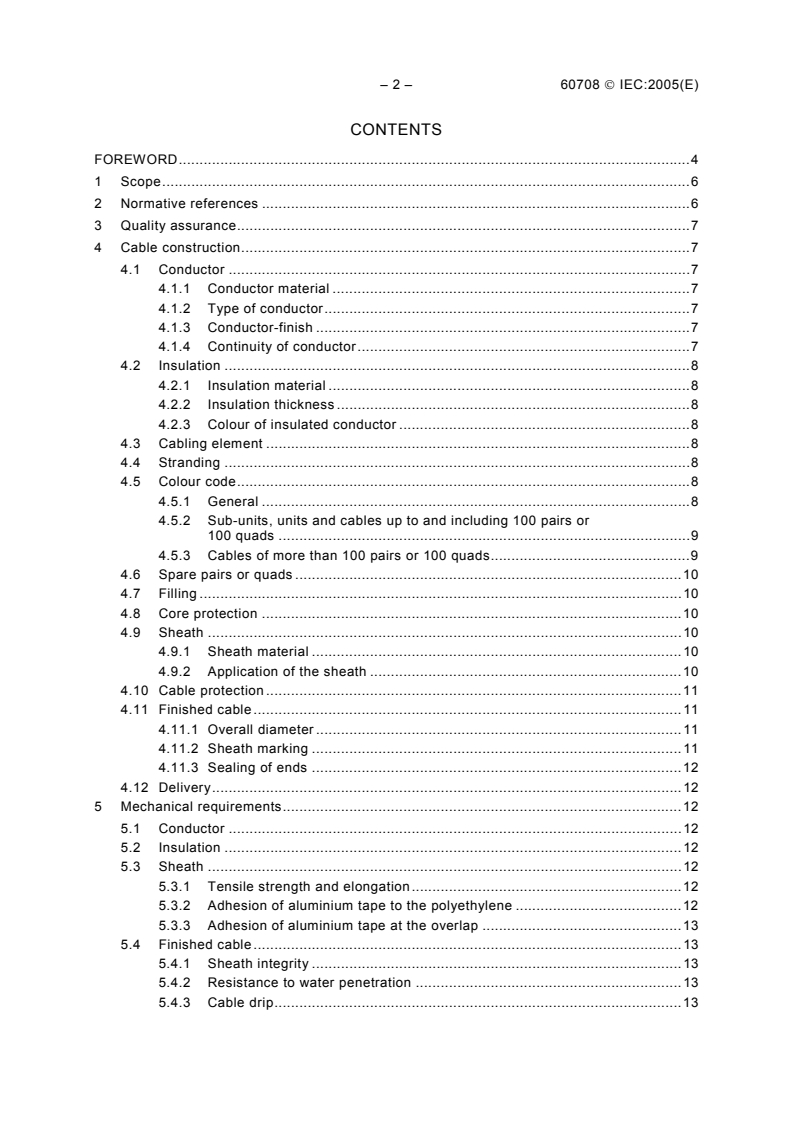
– 2 – 60708 IEC:2005(E)
CONTENTS
FOREWORD.4
1 Scope.6
2 Normative references .6
3 Quality assurance.7
4 Cable construction.7
4.1 Conductor .7
4.1.1 Conductor material .7
4.1.2 Type of conductor.7
4.1.3 Conductor-finish .7
4.1.4 Continuity of conductor.7
4.2 Insulation .8
4.2.1 Insulation material .8
4.2.2 Insulation thickness .8
4.2.3 Colour of insulated conductor .8
4.3 Cabling element .8
4.4 Stranding .8
4.5 Colour code.8
4.5.1 General .8
4.5.2 Sub-units, units and cables up to and including 100 pairs or
100 quads .9
4.5.3 Cables of more than 100 pairs or 100 quads.9
4.6 Spare pairs or quads .10
4.7 Filling .10
4.8 Core protection .10
4.9 Sheath .10
4.9.1 Sheath material .10
4.9.2 Application of the sheath .10
4.10 Cable protection .11
4.11 Finished cable.11
4.11.1 Overall diameter .11
4.11.2 Sheath marking .11
4.11.3 Sealing of ends .12
4.12 Delivery.12
5 Mechanical requirements.12
5.1 Conductor .12
5.2 Insulation .12
5.3 Sheath .12
5.3.1 Tensile strength and elongation.12
5.3.2 Adhesion of aluminium tape to the polyethylene .12
5.3.3 Adhesion of aluminium tape at the overlap .13
5.4 Finished cable.13
5.4.1 Sheath integrity .13
5.4.2 Resistance to water penetration .13
5.4.3 Cable drip.13
60708 IEC:2005(E) – 3 –
6 Thermal stability and environmental requirements .13
6.1 Insulation .13
6.1.1 Thermal oxidative stability (OIT-test) .13
6.1.2 Shrinkage .14
6.1.3 Wrapping test of insulation after thermal aging .14
6.1.4 Bending test at low temperature .14
6.2 Sheath .14
6.2.1 Elongation at break after ageing .14
6.2.2 Resistance to weathering .14
6.2.3 Resistance to environmental stress cracking .14
7 Electrical requirements .14
7.1 General .14
7.2 Electrical resistance of conductor .14
7.3 Electrical resistance unbalance .15
7.4 Dielectric strength .15
7.5 Insulation resistance .15
7.6 Mutual capacitance .15
7.7 Capacitance unbalance .16
7.8 Transmission characteristics (when used for digital communication).17
7.8.1 Attenuation .17
7.8.2 Near End Crosstalk (NEXT) .17
7.8.3 Equal Level Far-end Crosstalk (ELFEXT) .17
7.8.4 Power sum (PS) of crosstalk loss .17
7.8.5 Characteristic impedance .17
7.8.6 Velocity of propagation .17
Annex A (normative) Colour code: 10 pair or 5 quad count.19
Annex B (normative) Colour code: sub-unit identification for 50 pair (25 quad) and
100 pair (50 quad) cables or units, using 10 pair or 5 quad count .20
Annex C (normative) Colour code: 25 pair count .21
Annex D (normative) Colour code: unit identification for 50 pair or quad and 100 pair
or quad cables or units, using 25 pair or quad count .22
Annex E (normative) Colour code: 25 quad count .23
Annex F (normative) Colour code: unit identification for cables with more than
100 pairs, 25 pair count .24
Annex G (normative) Colour code: unit identification for cables with more than
100 pairs or 50 quads, using 10 pair or 5 quad count or 25 quad count.26
– 4 – 60708 IEC:2005(E)
INTERNATIONAL ELECTROTECHNICAL COMMISSION
____________
LOW-FREQUENCY CABLES WITH POLYOLEFIN INSULATION
AND MOISTURE BARRIER POLYOLEFIN SHEATH
FOREWORD
1) The International Electrotechnical Commission (IEC) is a worldwide organization for standardization comprising
all national electrotechnical committees (IEC National Committees). The object of IEC is to promote
international co-operation on all questions concerning standardization in the electrical and electronic fields. To
this end and in addition to other activities, IEC publishes International Standards, Technical Specifications,
Technical Reports, Publicly Available Specifications (PAS) and Guides (hereafter referred to as “IEC
Publication(s)”). Their preparation is entrusted to technical committees; any IEC National Committee interested
in the subject dealt with may participate in this preparatory work. International, governmental and non-
governmental organizations liaising with the IEC also participate in this preparation. IEC collaborates closely
with the International Organization for Standardization (ISO) in accordance with conditions determined by
agreement between the two organizations.
2) The formal decisions or agreements of IEC on technical matters express, as nearly as possible, an international
consensus of opinion on the relevant subjects since each technical committee has representation from all
interested IEC National Committees.
3) IEC Publications have the form of recommendations for international use and are accepted by IEC National
Committees in that sense. While all reasonable efforts are made to ensure that the technical content of IEC
Publications is accurate, IEC cannot be held responsible for the way in which they are used or for any
misinterpretation by any end user.
4) In order to promote international uniformity, IEC National Committees undertake to apply IEC Publications
transparently to the maximum extent possible in their national and regional publications. Any divergence
between any IEC Publication and the corresponding national or regional publication shall be clearly indicated in
the latter.
5) IEC provides no marking procedure to indicate its approval and cannot be rendered responsible for any
equipment declared to be in conformity with an IEC Publication.
6) All users should ensure that they have the latest edition of this publication.
7) No liability shall attach to IEC or its directors, employees, servants or agents including individual experts and
members of its technical committees and IEC National Committees for any personal injury, property damage or
other damage of any nature whatsoever, whether direct or indirect, or for costs (including legal fees) and
expenses arising out of the publication, use of, or reliance upon, this IEC Publication or any other IEC
Publications.
8) Attention is drawn to the Normative references cited in this publication. Use of the referenced publications is
indispensable for the correct application of this publication.
9) Attention is drawn to the possibility that some of the elements of this IEC Publication may be the subject of
patent rights. IEC shall not be held responsible for identifying any or all such patent rights.
International Standard IEC 60708 has been prepared by subcommittee 46C: Wires and
symmetric cables, of IEC technical committee 46: Cables, wires, waveguides, r.f. connectors,
r.f. and microwave passive components and accessories.
IEC 60708 cancels and replaces IEC 60708-1 published in 1981 and amendment 3(1988).
This edition constitutes a technical revision.
IEC 60708 has been completely revised technically and structurally. IEC 60708 now
comprises only one single standard dealing with general design details and requirements. The
old IEC 60708-2(1981), IEC 60708-3(1981) and IEC 60708-4(1983) have already been
withdrawn because they are not used anymore. Although IEC 60708 addresses low frequency
cables, these cables are often used for digital communications up to 2 Mbit/s or 1 MHz.
Therefore a Subclause 7.8 has been added, which provides transmission characteristics for
the cable when used for digital communication. Furthermore, Annex H of IEC 60708-1(1981)
was deleted: The requirements for filling compounds are not needed anymore since they are
covered by the cable performance requirements.
60708 © IEC:2005(E) – 5 –
The text of this standard is based on the following documents:
FDIS Report on voting
46C/713/FDIS 46C/728/RVD
Full information on the voting for the approval of this standard can be found in the report on
voting indicated in the above Table.
This publication has been drafted in accordance with the ISO/IEC Directives, Part 2.
The committee has decided that the contents of this publication will remain unchanged until
the maintenance result date indicated on the IEC web site under "http://webstore.iec.ch" in
the data related to the specific publication. At this date, the publication will be
• reconfirmed;
• withdrawn;
• replaced by a revised edition, or
• amended.
A bilingual version of this standard may be issued at a later date.
The contents of the corrigendum of August 2016 have been included in this copy.
– 6 – 60708 IEC:2005(E)
LOW-FREQUENCY CABLES WITH POLYOLEFIN INSULATION
AND MOISTURE BARRIER POLYOLEFIN SHEATH
1 Scope
This standard is intended to define polyolefin-insulated cables for insertion into local outdoor
networks.
This standard is applicable to polyolefin insulated and moisture barrier polyolefin sheathed
telephone cables, filled or unfilled with copper conductors, and used as:
a) Cables suitable for installation in ducts.
b) Cables suitable for direct burial in the ground.
c) Cables with integral suspension strand for aerial installations.
This standard is in accordance with ITU-T Recommendations.
This standard includes general design details and requirements for dimensions and other
constructional details as well as mechanical, electrical and environmental characteristics for
all types of low-frequency cables with polyolefin insulation (solid or cellular), filled or unfilled,
and moisture barrier polyolefin sheath (with integral suspension strand).
2 Normative references
The following referenced documents are indispensable for the application of this document.
For dated references, only the edition cited applies. For undated references, the latest edition
of the referenced document (including any amendments) applies.
IEC 60028, International Standard of Resistance for Copper
IEC 60189-1, Low-frequency cables and wires with PVC Insulation and PVC sheath – Part 1:
General test and measuring methods
IEC 60304, Standard colours for insulation for low-frequency cables and wires
IEC 60794-1-2, Optical fibre cables – Part 1-2: Generic specification – Basic optical cable test
procedures
IEC 60811-1-1, Common test methods for insulating and sheathing materials of electric
cables – Part 1: Methods for general application – Section 1: Measurement of thickness and
overall dimensions – Tests for determining the mechanical properties
IEC 60811-1-2, Common test methods for insulating and sheathing materials of electric
cables – Part 1: Methods for general application – Section Two: Thermal ageing methods
IEC 60811-1-3, Insulating and sheathing materials of electric cables – Part 1: General
application – Section 3: Methods for determining the density – Water absorption tests –
Shrinkage test
IEC 60811-1-4, Common test methods for insulating and sheathing materials of electric
cables – Part 1: Methods for general application – Section Four – Test at low temperature
60708 IEC:2005(E) – 7 –
IEC 60811-4-1, Insulating and sheathing materials of electric and optical cables – Common
test methods – Part 4-1: Methods specific to polyethylene and polypropylene compounds –
Resistance to environmental stress cracking – Measurement of the melt flow index – Carbon
black and/or mineral filler content measurement in polyethylene by direct combustion –
Measurement of carbon black content by thermogravimetric analysis (TGA) – Assessment of
carbon black dispersion in polyethylene using a microscope
IEC 60811-4-2, Insulating and sheathing materials of electric and optical cables – Common
test methods – Part 4-2: Methods specific to polyethylene and polypropylene compounds –
Tensile strength and elongation at break after conditioning at elevated temperature –
Wrapping test after conditioning at elevated temperature – Wrapping test after thermal ageing
in air – Measurement of mass increase – Long-term stability test – Test method for copper-
catalyzed oxidative degradation
IEC 60811-5-1, Common test methods for insulating and sheathing materials of electric
cables – Part 5-1: Methods specific to filling compounds – Drop point – Separation of oil –
Lower temperature brittleness – Total acid number – Absence of corrosive components –
Permittivity at 23 °C – DC resistivity at 23 °C and 100 °C
IEC 61156-1, Multicore and symmetrical pair/quad cables for digital communications – Part 1:
Generic specification
ITU-T L.3, Armouring of cables
3 Quality assurance
It is the responsibility of the manufacturer to establish quality assurance by quality control
procedures which will ensure that the product will meet the requirements of this standard.
It is not intended that a complete testing programme shall be carried out on every length of
conductor and cable. When the purchaser wishes to specify acceptance tests or other quality
procedures, it is essential that agreement be reached between the purchaser and the
manufacturer by the time of ordering.
4 Cable construction
4.1 Conductor
4.1.1 Conductor material
The conductor shall consist of annealed copper, uniform in quality and free from defects. The
properties of the copper shall be in accordance with IEC 60028.
4.1.2 Type of conductor
The conductor shall consist of a single strand circular in section. The nominal diameter shall
be at least 0,4 mm.
4.1.3 Conductor-finish
The conductor shall be plain.
4.1.4 Continuity of conductor
Joints in the conductor are permitted provided that the tensile strength of a joint is not less
than 90 % of the tensile strength of the unjointed conductor.
– 8 – 60708 IEC:2005(E)
4.2 Insulation
4.2.1 Insulation material
The conductor shall be covered with solid or cellular polyolefin insulation or any combination
thereof.
For cellular insulation, the cells produced by the expanding process shall be uniformly
distributed circumferentially and should be substantially non-intercommunicating.
The material for the insulation shall be a virgin thermoplastic compound suitably stabilized.
Examples of suitable materials are:
– Polyethylene.
– Polypropylene.
4.2.2 Insulation thickness
The insulation shall be continuous and shall have a thickness such that the completed cable
will meet the electrical requirements specified.
4.2.3 Colour of insulated conductor
The insulated conductors shall be coloured. Colours shall be readily identifiable and shall
correspond reasonably with the standard colours shown in IEC 60304.
4.3 Cabling element
A cabling element (Figure 1) shall be:
- a pair of two insulated conductors twisted together and designated wire a and b
respectively,
or
- a quad of four insulated conductors twisted together and designated wire a, wire c, wire b,
and wire d respectively.
The ma
...
IEC 60708 ®
Edition 1.0 2005-06
INTERNATIONAL
STANDARD
NORME
INTERNATIONALE
Low-frequency cables with polyolefin insulation and moisture barrier polyolefin
sheath
Câbles pour basses fréquences à isolation polyoléfine et gaine polyoléfine à
barrière d'étanchéité
All rights reserved. Unless otherwise specified, no part of this publication may be reproduced or utilized in any form
or by any means, electronic or mechanical, including photocopying and microfilm, without permission in writing from
either IEC or IEC's member National Committee in the country of the requester. If you have any questions about IEC
copyright or have an enquiry about obtaining additional rights to this publication, please contact the address below or
your local IEC member National Committee for further information.
Droits de reproduction réservés. Sauf indication contraire, aucune partie de cette publication ne peut être reproduite
ni utilisée sous quelque forme que ce soit et par aucun procédé, électronique ou mécanique, y compris la photocopie
et les microfilms, sans l'accord écrit de l'IEC ou du Comité national de l'IEC du pays du demandeur. Si vous avez des
questions sur le copyright de l'IEC ou si vous désirez obtenir des droits supplémentaires sur cette publication, utilisez
les coordonnées ci-après ou contactez le Comité national de l'IEC de votre pays de résidence.
IEC Central Office Tel.: +41 22 919 02 11
3, rue de Varembé Fax: +41 22 919 03 00
CH-1211 Geneva 20 info@iec.ch
Switzerland www.iec.ch
About the IEC
The International Electrotechnical Commission (IEC) is the leading global organization that prepares and publishes
International Standards for all electrical, electronic and related technologies.
About IEC publications
The technical content of IEC publications is kept under constant review by the IEC. Please make sure that you have the
latest edition, a corrigenda or an amendment might have been published.
IEC Catalogue - webstore.iec.ch/catalogue Electropedia - www.electropedia.org
The stand-alone application for consulting the entire The world's leading online dictionary of electronic and
bibliographical information on IEC International Standards, electrical terms containing more than 30 000 terms and
Technical Specifications, Technical Reports and other definitions in English and French, with equivalent terms in 14
documents. Available for PC, Mac OS, Android Tablets and additional languages. Also known as the International
iPad. Electrotechnical Vocabulary (IEV) online.
IEC publications search - www.iec.ch/searchpub IEC Glossary - std.iec.ch/glossary
The advanced search enables to find IEC publications by a More than 55 000 electrotechnical terminology entries in
variety of criteria (reference number, text, technical English and French extracted from the Terms and Definitions
committee,…). It also gives information on projects, replaced clause of IEC publications issued since 2002. Some entries
and withdrawn publications. have been collected from earlier publications of IEC TC 37,
77, 86 and CISPR.
IEC Just Published - webstore.iec.ch/justpublished
Stay up to date on all new IEC publications. Just Published IEC Customer Service Centre - webstore.iec.ch/csc
details all new publications released. Available online and If you wish to give us your feedback on this publication or
also once a month by email. need further assistance, please contact the Customer Service
Centre: csc@iec.ch.
A propos de l'IEC
La Commission Electrotechnique Internationale (IEC) est la première organisation mondiale qui élabore et publie des
Normes internationales pour tout ce qui a trait à l'électricité, à l'électronique et aux technologies apparentées.
A propos des publications IEC
Le contenu technique des publications IEC est constamment revu. Veuillez vous assurer que vous possédez l’édition la
plus récente, un corrigendum ou amendement peut avoir été publié.
Catalogue IEC - webstore.iec.ch/catalogue Electropedia - www.electropedia.org
Application autonome pour consulter tous les renseignements
Le premier dictionnaire en ligne de termes électroniques et
bibliographiques sur les Normes internationales,
électriques. Il contient plus de 30 000 termes et définitions en
Spécifications techniques, Rapports techniques et autres
anglais et en français, ainsi que les termes équivalents dans
documents de l'IEC. Disponible pour PC, Mac OS, tablettes
14 langues additionnelles. Egalement appelé Vocabulaire
Android et iPad.
Electrotechnique International (IEV) en ligne.
Recherche de publications IEC - www.iec.ch/searchpub
Glossaire IEC - std.iec.ch/glossary
Plus de 55 000 entrées terminologiques électrotechniques, en
La recherche avancée permet de trouver des publications IEC
en utilisant différents critères (numéro de référence, texte, anglais et en français, extraites des articles Termes et
comité d’études,…). Elle donne aussi des informations sur les Définitions des publications IEC parues depuis 2002. Plus
projets et les publications remplacées ou retirées. certaines entrées antérieures extraites des publications des
CE 37, 77, 86 et CISPR de l'IEC.
IEC Just Published - webstore.iec.ch/justpublished
Service Clients - webstore.iec.ch/csc
Restez informé sur les nouvelles publications IEC. Just
Published détaille les nouvelles publications parues. Si vous désirez nous donner des commentaires sur cette
Disponible en ligne et aussi une fois par mois par email. publication ou si vous avez des questions contactez-nous:
csc@iec.ch.
IEC 60708 ®
Edition 1.0 2005-06
INTERNATIONAL
STANDARD
NORME
INTERNATIONALE
Low-frequency cables with polyolefin insulationand moisture barrier polyolefin
sheath
Câbles pour basses fréquences à isolation polyoléfine et gaine polyoléfine à
barrière d'étanchéité
INTERNATIONAL
ELECTROTECHNICAL
COMMISSION
COMMISSION
ELECTROTECHNIQUE
PRICE CODE
INTERNATIONALE
CODE PRIX U
ICS 29.060.20 ISBN 978-2-8322-1510-4
– 2 – IEC 60708:2005 © IEC 2005
CONTENTS
FOREWORD . 4
1 Scope . 6
2 Normative references . 6
3 Quality assurance . 7
4 Cable construction . 7
4.1 Conductor . 7
4.1.1 Conductor material . 7
4.1.2 Type of conductor . 7
4.1.3 Conductor-finish . 7
4.1.4 Continuity of conductor . 7
4.2 Insulation . 8
4.2.1 Insulation material . 8
4.2.2 Insulation thickness . 8
4.2.3 Colour of insulated conductor . 8
4.3 Cabling element . 8
4.4 Stranding . 8
4.5 Colour code . 8
4.5.1 General . 8
4.5.2 Sub-units, units and cables up to and including 100 pairs or
100 quads . 9
4.5.3 Cables of more than 100 pairs or 100 quads . 9
4.6 Spare pairs or quads . 10
4.7 Filling . 10
4.8 Core protection . 10
4.9 Sheath . 10
4.9.1 General . 10
4.9.2 Sheath material . 10
4.9.3 Application of the sheath . 10
4.10 Cable protection . 11
4.11 Finished cable . 11
4.11.1 Overall diameter . 11
4.11.2 Sheath marking . 11
4.11.3 Sealing of ends . 12
4.12 Delivery . 12
5 Mechanical requirements . 12
5.1 Conductor . 12
5.2 Insulation . 12
5.3 Sheath . 12
5.3.1 Tensile strength and elongation . 12
5.3.2 Adhesion of aluminium tape to the polyethylene . 12
5.3.3 Adhesion of aluminium tape at the overlap . 13
5.4 Finished cable . 13
5.4.1 Sheath integrity . 13
5.4.2 Resistance to water penetration . 13
5.4.3 Cable drip . 13
6 Thermal stability and environmental requirements . 13
6.1 Insulation . 13
6.1.1 Thermal oxidative stability (OIT-test) . 13
6.1.2 Shrinkage . 14
6.1.3 Wrapping test of insulation after thermal aging . 14
6.1.4 Bending test at low temperature . 14
6.2 Sheath . 14
6.2.1 Elongation at break after ageing . 14
6.2.2 Resistance to weathering . 14
6.2.3 Resistance to environmental stress cracking . 14
7 Electrical requirements . 14
7.1 General . 14
7.2 Electrical resistance of conductor . 14
7.3 Electrical resistance unbalance . 15
7.4 Dielectric strength . 15
7.5 Insulation resistance . 15
7.6 Mutual capacitance . 15
7.7 Capacitance unbalance . 16
7.8 Transmission characteristics (when used for digital communication) . 17
7.8.1 Attenuation . 17
7.8.2 Near End Crosstalk (NEXT) . 17
7.8.3 Equal Level Far-end Crosstalk (ELFEXT) . 17
7.8.4 Power sum (PS) of crosstalk loss . 17
7.8.5 Characteristic impedance . 17
7.8.6 Velocity of propagation . 17
Annex A (normative) Colour code: 10 pair or 5 quad count. 19
Annex B (normative) Colour code: sub-unit identification for 50 pair (25 quad) and
100 pair (50 quad) cables or units, using 10 pair or 5 quad count . 20
Annex C (normative) Colour code: 25 pair count . 21
Annex D (normative) Colour code: unit identification for 50 pair or quad and 100 pair
or quad cables or units, using 25 pair or quad count . 22
Annex E (normative) Colour code: 25 quad count . 23
Annex F (normative) Colour code: unit identification for cables with more than
100 pairs, 25 pair count . 24
Annex G (normative) Colour code: unit identification for cables with more than
100 pairs or 50 quads, using 10 pair or 5 quad count or 25 quad count . 26
– 4 – IEC 60708:2005 © IEC 2005
INTERNATIONAL ELECTROTECHNICAL COMMISSION
____________
LOW-FREQUENCY CABLES WITH POLYOLEFIN INSULATION
AND MOISTURE BARRIER POLYOLEFIN SHEATH
FOREWORD
1) The International Electrotechnical Commission (IEC) is a worldwide organization for standardization comprising
all national electrotechnical committees (IEC National Committees). The object of IEC is to promote
international co-operation on all questions concerning standardization in the electrical and electronic fields. To
this end and in addition to other activities, IEC publishes International Standards, Technical Specifications,
Technical Reports, Publicly Available Specifications (PAS) and Guides (hereafter referred to as “IEC
Publication(s)”). Their preparation is entrusted to technical committees; any IEC National Committee interested
in the subject dealt with may participate in this preparatory work. International, governmental and non-
governmental organizations liaising with the IEC also participate in this preparation. IEC collaborates closely
with the International Organization for Standardization (ISO) in accordance with conditions determined by
agreement between the two organizations.
2) The formal decisions or agreements of IEC on technical matters express, as nearly as possible, an international
consensus of opinion on the relevant subjects since each technical committee has representation from all
interested IEC National Committees.
3) IEC Publications have the form of recommendations for international use and are accepted by IEC National
Committees in that sense. While all reasonable efforts are made to ensure that the technical content of IEC
Publications is accurate, IEC cannot be held responsible for the way in which they are used or for any
misinterpretation by any end user.
4) In order to promote international uniformity, IEC National Committees undertake to apply IEC Publications
transparently to the maximum extent possible in their national and regional publications. Any divergence
between any IEC Publication and the corresponding national or regional publication shall be clearly indicated in
the latter.
5) IEC provides no marking procedure to indicate its approval and cannot be rendered responsible for any
equipment declared to be in conformity with an IEC Publication.
6) All users should ensure that they have the latest edition of this publication.
7) No liability shall attach to IEC or its directors, employees, servants or agents including individual experts and
members of its technical committees and IEC National Committees for any personal injury, property damage or
other damage of any nature whatsoever, whether direct or indirect, or for costs (including legal fees) and
expenses arising out of the publication, use of, or reliance upon, this IEC Publication or any other IEC
Publications.
8) Attention is drawn to the Normative references cited in this publication. Use of the referenced publications is
indispensable for the correct application of this publication.
9) Attention is drawn to the possibility that some of the elements of this IEC Publication may be the subject of
patent rights. IEC shall not be held responsible for identifying any or all such patent rights.
International Standard IEC 60708 has been prepared by subcommittee 46C: Wires and
symmetric cables, of IEC technical committee 46: Cables, wires, waveguides, r.f. connectors,
r.f. and microwave passive components and accessories.
This bilingual version (2014-04) corresponds to the English version, published in 2005-06.
IEC 60708 cancels and replaces IEC 60708-1 published in 1981 and amendment 3(1988).
This edition constitutes a technical revision.
IEC 60708 has been completely revised technically and structurally. IEC 60708 now
comprises only one single standard dealing with general design details and requirements. The
old IEC 60708-2(1981), IEC 60708-3(1981) and IEC 60708-4(1983) have already been
withdrawn because they are not used anymore. Although IEC 60708 addresses low frequency
cables, these cables are often used for digital communications up to 2 Mbit/s or 1 MHz.
Therefore a Subclause 7.8 has been added, which provides transmission characteristics for
the cable when used for digital communication. Furthermore, Annex H of IEC 60708-1(1981)
was deleted: The requirements for filling compounds are not needed anymore since they are
covered by the cable performance requirements.
The text of this standard is based on the following documents:
FDIS Report on voting
46C/713/FDIS 46C/728/RVD
Full information on the voting for the approval of this standard can be found in the report on
voting indicated in the above Table.
The French version has not been voted upon.
This publication has been drafted in accordance with the ISO/IEC Directives, Part 2.
The committee has decided that the contents of this publication will remain unchanged until
the maintenance result date indicated on the IEC web site under "http://webstore.iec.ch" in
the data related to the specific publication. At this date, the publication will be
• reconfirmed;
• withdrawn;
• replaced by a revised edition, or
• amended.
The contents of the corrigendum of August 2016 have been included in this copy.
– 6 – IEC 60708:2005 © IEC 2005
LOW-FREQUENCY CABLES WITH POLYOLEFIN INSULATION
AND MOISTURE BARRIER POLYOLEFIN SHEATH
1 Scope
This standard is intended to define polyolefin-insulated cables for insertion into local outdoor
networks.
This standard is applicable to polyolefin insulated and moisture barrier polyolefin sheathed
telephone cables, filled or unfilled with copper conductors, and used as:
a) Cables suitable for installation in ducts.
b) Cables suitable for direct burial in the ground.
c) Cables with integral suspension strand for aerial installations.
This standard is in accordance with ITU-T Recommendations.
This standard includes general design details and requirements for dimensions and other
constructional details as well as mechanical, electrical and environmental characteristics for
all types of low-frequency cables with polyolefin insulation (solid or cellular), filled or unfilled,
and moisture barrier polyolefin sheath (with integral suspension strand).
2 Normative references
The following referenced documents are indispensable for the application of this document.
For dated references, only the edition cited applies. For undated references, the latest edition
of the referenced document (including any amendments) applies.
IEC 60028, International Standard of Resistance for Copper
IEC 60189-1, Low-frequency cables and wires with PVC Insulation and PVC sheath – Part 1:
General test and measuring methods
IEC 60304, Standard colours for insulation for low-frequency cables and wires
IEC 60794-1-2, Optical fibre cables – Part 1-2: Generic specification – Basic optical cable test
procedures
IEC 60811-1-1, Common test methods for insulating and sheathing materials of electric
cables – Part 1: Methods for general application – Section 1: Measurement of thickness and
overall dimensions – Tests for determining the mechanical properties
IEC 60811-1-2, Common test methods for insulating and sheathing materials of electric
cables – Part 1: Methods for general application – Section Two: Thermal ageing methods
IEC 60811-1-3, Insulating and sheathing materials of electric cables – Part 1: General
application – Section 3: Methods for determining the density – Water absorption tests –
Shrinkage test
IEC 60811-1-4, Common test methods for insulating and sheathing materials of electric
cables – Part 1: Methods for general application – Section Four – Test at low temperature
IEC 60811-4-1, Insulating and sheathing materials of electric and optical cables – Common
test methods – Part 4-1: Methods specific to polyethylene and polypropylene compounds –
Resistance to environmental stress cracking – Measurement of the melt flow index – Carbon
black and/or mineral filler content measurement in polyethylene by direct combustion –
Measurement of carbon black content by thermogravimetric analysis (TGA) – Assessment of
carbon black dispersion in polyethylene using a microscope
IEC 60811-4-2, Insulating and sheathing materials of electric and optical cables – Common
test methods – Part 4-2: Methods specific to polyethylene and polypropylene compounds –
Tensile strength and elongation at break after conditioning at elevated temperature –
Wrapping test after conditioning at elevated temperature – Wrapping test after thermal ageing
in air – Measurement of mass increase – Long-term stability test – Test method for copper-
catalyzed oxidative degradation
IEC 60811-5-1, Common test methods for insulating and sheathing materials of electric
cables – Part 5-1: Methods specific to filling compounds – Drop point – Separation of oil –
Lower temperature brittleness – Total acid number – Absence of corrosive components –
Permittivity at 23 °C – DC resistivity at 23 °C and 100 °C
IEC 61156-1, Multicore and symmetrical pair/quad cables for digital communications – Part 1:
Generic specification
ITU-T L.3, Armouring of cables
3 Quality assurance
It is the responsibility of the manufacturer to establish quality assurance by quality control
procedures which will ensure that the product will meet the requirements of this standard.
It is not intended that a complete testing programme shall be carried out on every length of
conductor and cable. When the purchaser wishes to specify acceptance tests or other quality
procedures, it is essential that agreement be reached between the purchaser and the
manufacturer by the time of ordering.
4 Cable construction
4.1 Conductor
4.1.1 Conductor material
The conductor shall consist of annealed copper, uniform in quality and free from defects. The
properties of the copper shall be in accordance with IEC 60028.
4.1.2 Type of conductor
The conductor shall consist of a single strand circular in section. The nominal diameter shall
be at least 0,4 mm.
4.1.3 Conductor-finish
The conductor shall be plain.
4.1.4 Continuity of conductor
Joints in the conductor are permitted provided that the tensile strength of a joint is not less
than 90 % of the tensile strength of the unjointed conductor.
– 8 – IEC 60708:2005 © IEC 2005
4.2 Insulation
4.2.1 Insulation material
The conductor shall be covered with solid or cellular polyolefin insulation or any combination
thereof.
For cellular insulation, the cells produced by the expanding process shall be uniformly
distributed circumferentially and should be substantially non-intercommunicating.
The material for the insulation shall be a virgin thermoplastic compound suitably stabilized.
Examples of suitable materials are:
– Polyethylene.
– Polypropylene.
4.2.2 Insulation thickness
The insulation shall be continuous and shall have a thickness such that the completed cable
will meet the electrical requirements specified.
4.2.3 Colour of insulated conductor
The insulated conductors shall be coloured. Colours shall be readily identifiable and shall
correspond reasonably with the standard colours shown in IEC 60304.
4.3 Cabling element
A cabling element (Figure 1) shall be:
- a pair of two insulated conductors twisted together and designated wire a and b
respectively,
or
- a quad of four insulated conductors twisted together and designated wire a, wire c, wire b,
and wire d respectively.
The maximum length of lay in the finished cable shall not exceed 150 mm.
NOTE Forming the element with a variable lay can lead to the infrequent but acceptable occurrence of the
maximum lay being longer than specified.
4.4 Stranding
The cable elements shall be formed into a number of sub-units or units which can be stranded
into a regular make up to produce the required number of pairs.
4.5 Colour code
4.5.1 General
Three different colour schemes for identifying pair or quad counts are defined. One with
10 pair or 5 quad sub-units, one for 25 pair colour groups and a third for 25 quad colour
groups.
4.5.2 Sub-units, units and cables up to and including 100 pairs or 100 quads
4.5.2.1 10 pair or 5 quad count
The pairs or quads shall be identified by each insulated conductor having a single colour in
accordance with the colour scheme given in Annex A.
Sub-units of 10 pairs or 5 quads shall be identified by coloured bindings of tape or threads
according to the colour scheme given in Annex B for assembly into units of 50 pairs
(25 quads) or 100 pairs (50 quads).
4.5.2.2 25 pair count
The pairs shall be identified by each insulated conductor having a single colour in accordance
with the colour scheme given in Annex C.
Sub-units shall be identified by coloured bindings of tape or threads. Each group of sub-units
making up a 25 pair count shall be identified by a common colour of bindings. For 50 and
100 pair cables the colours of the bindings are given in Annex D.
4.5.2.3 25 quad count
The quads shall be identified by each insulated conductor having a single colour in accord-
ance with the colour scheme given in Annex E.
Sub-units shall be identified by coloured bindings of tape or threads. Each group of sub-units
making up a 25 quad count shall be identified by a common colour of bindings. For 50 quad
(100 pair) and 100 quad (200 pair) cables the colours of the bindings are given in Annex D.
4.5.3 Cables of more than 100 pairs or 100 quads
Cables shall be assembled in concentric layers of units. The units shall be identified by
coloured bindings of tape or threads.
4.5.3.1 Marker / reference identification system
In each layer, the marker unit shall be identified by red coloured bindings, the reference unit
shall be identified by green coloured bindings and the other units shall be identified by bind-
ings of a contrasting or natural colour.
The marker and reference units shall be adjacent and the counting of units in each layer of
the cable shall be in the same direction.
4.5.3.2 Marker identification system
In each layer, the marker unit shall be identified by red coloured bindings and the other units
shall be identified by bindings of a contrasting or natural colour.
4.5.3.3 Full colour code system for 25 pair count
Each 25 pair count group shall be identified by bindings coloured in accordance with Annex F.
4.5.3.4 Full colour code system for 10 pair or 5 quad count or 25 quad count
Each group of sub-units making up a 100 pair (50 quad) count group shall be identified by a
common colour of bindings in accordance with Annex G.
– 10 – IEC 60708:2005 © IEC 2005
4.6 Spare pairs or quads
Spare pairs or quads may be provided individually or as a spare pair unit and shall be placed
in the interstices of the cable core.
4.7 Filling
For filled cables, the interstices of the cable core shall be filled continuously with a compound
suitable to prevent water penetration within the cable.
The filling compound shall be compatible with the other relevant cable elements. The
suitability shall be tested by the use of the following test methods:
– the amount of oil separation from the filling compound shall meet the requirements of
Clause 5 of IEC 60811-5-1.
– The drop point shall be higher than 70 °C. The determination of the drop point shall be in
accordance with Clause 4 of IEC 60811-5-1.
– The filling compound shall be tested for the presence of corrosive components in
accordance with Clause 8 of IEC 60811-5-1.
4.8 Core protection
The core of the cable may have a protective layer (e.g. a helical or longitudinal lapping of one
or more tapes).
4.9 Sheath
4.9.1 General
A moisture barrier aluminium laminated polyethylene sheath construction is specified for both
underground and aerial cables. This type of sheath will also provide screening.
For aerial cables a figure "8" construction is specified.
Circular sheath cables can also be used as aerial cables.
4.9.2 Sheath material
4.9.2.1 Polyethylene
The polyethylene shall have a minimum carbon black content of 2,0 %.
4.9.2.2 Aluminium tape
The aluminium tape shall be coated on at least one side with a polymer film. The aluminium
tape without the polymer layer shall have a nominal thickness of at least 0,15 mm.
4.9.3 Application of the sheath
4.9.3.1 Sheath
The aluminium tape shall be applied longitudinally with a minimum overlap of not less than
6 mm or 20 % of the circumference of the core protection, whichever is the smaller.
The polyethylene part of the sheath shall adhere to the polymer coating of the aluminium tape
and the sheath shall be applied to fit closely to the protected core of the cable.
4.9.3.2 Sheath with an integral suspension strand
The polyethylene part of the sheath, complying with 4.9.3.1, shall cover the suspension strand
and cable core to form a figure "8" construction in which the suspension strand is parallel with
but separate from the cable core.
NOTE The web dimensions should be compatible with the clamping hardware.
The minimum tensile strength of strand is specified in Table 1.
Table 1 –Tensile strength of strand
Maximum overall diameter Minimum tensile strength of strand
of the sheathed cable core
kN
D
max
mm
D <10 6,0
max
12,5
10 ≤ D <20
max
16,0
20 ≤ Dmax <30
22,5
30 ≤ D <40
max
4.10 Cable protection
According to ITU-T Recommendation L.3, armouring can be applied over the sheath to
improve the strength of the cable against mechanical damage, rodents and insect attack
and/or to improve the screening efficiency against electromagnetic interference and lightning
discharges. The armouring may be made by metallic tape (or tapes) or wires with a protective
layer.
4.11 Finished cable
4.11.1 Overall diameter
To obtain nominal values, the user may ask the supplier to quote his values.
The overall diameter of the cable shall be measured in accordance with the method specified
in 2.2.2 of IEC 60189-1.
4.11.2 Sheath marking
The sheath may be marked. Common methods of marking are embossing, sintering,
imprinting, hot foil and surface printing.
Marking may be provided as a single or double line of marking. A single line of marking shall
be provided by marking longitudinally along the length of the cable. A double line of marking
shall be provided with the two lines diametrically opposite each other, longitudinally along the
length of the cable.
The abrasion resistance of the sheath markings shall be demonstrated in accordance with
IEC 60794-1-2, method E2B.
For a double line of marking, the abrasion resistance test needs only be carried out on one
line of marking.
– 12 – IEC 60708:2005 © IEC 2005
4.11.3 Sealing of ends
The ends of the finished cable shall be adequately sealed to prevent the ingress of moisture.
4.12 Delivery
Delivery shall be made on drums with suitable protection.
5 Mechanical requirements
5.1 Conductor
Elongation at break of the bare conductor shall be not less than:
10 % for conductor of 0,4 mm diameter;
15 % for conductor over 0,4 mm diameter.
Compliance shall be checked by measuring the elongation at break in accordance with the
method specified in 3.3 of IEC 60189-1.
5.2 Insulation
The elongation at break shall be measured on tubular samples in accordance with the method
specified in 9.1 of IEC 60811-1-1.
The measured values of elongation at break shall be not less than 300 %.
5.3 Sheath
5.3.1 Tensile strength and elongation
Compliance shall be checked on samples of sheath after removing the aluminium tape by
measuring the tensile strength and elongation at break in accordance with the method speci-
fied in 9.2 of IEC 60811-1-1.
The measured values of tensile strength shall be not less than:
10 MPa for low or medium density polyethylene;
16,5 MPa for high density polyethylene.
The median of the measured values of elongation at break shall be not less than 300 %.
5.3.2 Adhesion of aluminium tape to the polyethylene
The force required to peel the aluminium tape from the polyethylene shall be not less than
0,8 N per millimetre width when tested as follows:
Rectangular test pieces about 150 mm long and 15 mm wide shall be cut longitudinally from
the cable sheath in one operation using a sharp punch. The test piece shall not include the
overlap of the aluminium tape.
About 50 mm of the aluminium tape shall be separated from one end of the test piece. The
aluminium tape shall be inserted in the upper grip of a suitable tensile testing machine and
the separated end of sheath of the test piece in the lower grip.
The grips of the tensile machine shall be separated at a rate of 100 ± 50 mm/min and the
average force required to separate the aluminium tape and the polyethylene sheath shall be
noted.
The mean of three determinations shall be recorded as the force required to peel the alumi-
nium tape from the cable sheath.
5.3.3 Adhesion of aluminium tape at the overlap
The force required to peel the aluminium tape at the overlap shall be not less than 0,8 N per
millimeter.
5.4 Finished cable
5.4.1 Sheath integrity
5.4.1.1 The sheath shall withstand a spark test voltage of at least 8 kV r.m.s. or 12 kV d.c.
5.4.1.2 For unfilled cables, the sheath shall withstand without leakage an internal gas
pressure of 50 kPa to 100 kPa for 2 h after equalization of pressure throughout the cable
length.
NOTE It is not necessary to carry out this test if the sheath is tested in accordance with 5.4.1.1.
5.4.2 Resistance to water penetration
For filled cables, the interstices of the cable core shall be filled continuously with compound to
prevent the water penetration within the cable.
Compliance shall be checked on samples of filled cable according to IEC 60794-1-2, method
F5B.
5.4.3 Cable drip
The cable shall pass the compound flow test of IEC 60794-1-2, method E14. The test
temperature shall be 70 °C.
6 Thermal stability and environmental requirements
6.1 Insulation
6.1.1 Thermal oxidative stability (OIT-test)
A 30 cm length of cable, with its ends sealed, shall be conditioned in an oven for 14 days at
70 °C. At the end of the conditioning period, one sample of each colour of insulation shall be
removed from the cable, any filling compound present removed by wiping with a dry towel,
and the measurement of OIT of the insulation carried out at 200 °C in accordance with Annex
B of IEC 60811-4-2.
The insulation shall be removed from the conductor prior to testing.
The minimum oxidative induction time of any pair/quad in the finished cable shall not be less
than 40 min for solid insulation and 60 min for cellular insulation.
– 14 – IEC 60708:2005 © IEC 2005
6.1.2 Shrinkage
The shrinkage of the insulation shall be not more than 5 % when measured on a 200 mm long
sample (L) in accordance with Clause 10 of IEC 60811-1-3.
The heating time shall be 1 h and the test temperature shall be 115 ± 1 °C.
6.1.3 Wrapping test of insulation after thermal aging
The insulation of filled cables after thermal ageing shall comply with the wrapping test
specified in Clause 9 of IEC 60811-4-2.
6.1.4 Bending test at low temperature
The insulation shall comply with the bending test at –40 °C specified in 8.1 of IEC 60811-1-4.
6.2 Sheath
6.2.1 Elongation at break after ageing
The mechanical characteristics of the sheath shall remain sufficiently constant during normal
use. This is checked by determining the elongation at break according to 9.2 of
IEC 60811-1-1 after an ageing test at 100 ± 2 °C for 10 × 24 h according to 8.1 of
IEC 60811-1-2. The median of the values of elongation at break shall be not less than 300 %.
6.2.2 Resistance to weathering
The polyethylene sheath shall contain 2,5 ± 0,5 % carbon black, well dispersed. The carbon
black content of the polyethylene sheath shall be measured in accordance with the method
specified in Clause 11 of IEC 60811-4-1.
6.2.3 Resistance to environmental stress cracking
The resistance to environmental stress cracking shall comply with the requirements specified
in Clause 8 of IEC 60811-4-1. Procedure B shall be applied.
7 Electrical requirements
7.1 General
Values of statistical requirements of the parameters specified below shall relate to a
significant distribution of measurements carried out on cable lengths considered for
inspection.
7.2 Electrical resistance of conductor
The electrical resistance of the conductor at a temperature of 20 °C shall not exceed the
values given in Table 2.
Table 2 – Conductor resistance
Conductor nominal diameter Individual value Average
mm
Ω/km Ω/km
0,4 150 144
0,5 96,0 92,1
0,6 66,6 63,9
0,8 36,8 35,3
The resistance shall be measured in accordance with the method specified in 5.1 of
IEC 60189-1.
NOTE The maximum individual values are in accordance with IEC 60344, using k4 value for a cabling lay factor
greater than 16. The maximum average values are 96 % of the maximum individual values.
7.3 Electrical resistance unbalance
The electrical resistance unbalance between conductors in the same pair shall not exceed
2 %.
It is defined as:
R − R
max min
×100
R + R
max min
where
R = resistance, in ohms, for the conductor with the higher resistance value
max
R = resistance, in ohms, for the conductor with the lower resistance value
min
The measurement shall be carried out on the finished cable by means of a device capable of
measuring to within 0,5 % of the value of the conductor resistance.
7.4 Dielectric strength
The dielectric strength of the insulation shall be checked on the finished cable. The insulation
shall withstand the application of a d.c. test voltage. The test voltages for alternative
durations are given in Table 3.
Table 3 – Dielectric strength
Type of insulation Conductor to conductor Conductor to screen
Duration of test Duration of test
3 s 60 s 3 s 60 s
Solid 2 kV 1 kV 6 kV 3 kV
Cellular 1 kV 0,5 kV 2 kV 1 kV
NOTE An a.c. test voltage of V /√2 may be used.
d.c.
7.5 Insulation resistance
The insulation resistance at a temperature of 20 °C shall be not less than:
.
- for filled cables 1 500 MΩ km
.
- or unfilled cables 5 000 MΩ km
The insulation resistance shall be measured in accordance with the method specified in 5.3 of
IEC 60189-1.
7.6 Mutual capacitance
The mutual capacitance shall not exceed the values given in Table 4.
– 16 – IEC 60708:2005 © IEC 2005
Table 4 – Mutual capacitance
Capacitance level of cables and number Maximum average Maximum individual
of pairs or quads in cable nF/km nF/km
High capacitance level:
1) 20 pairs or 10 quads or more 55 64
2) less than 20 pairs or 10 quads - 64
Low capacitance level:
1) 20 pairs or 10 quads or more 42 49
2) less than 20 pairs or 10 quads - 49
The capacitance shall be measured in accordance with the method specified in 5.4 of
IEC 60189- 1.
7.7 Capacitance unbalance
The capacitance unbalance shall not exceed the values given in Table 5 per 500 m length of
cable:
Table 5 – Capacitance unbalance
Individual value 95 % values
pF pF
0,4, 0,5 and 0,6 mm 0,8 mm 0,4, 0,5 and 0,6 mm 0,8 mm
Pair-to-pair 250 160 150 100
Side-to-side 800 500 500 300
Pair-to-earth 1 700 1 000
Side-to-earth 1 700 1 000
The capacitance unbalance shall be measured in accordance with the method specified in 5.5
of IEC 60189-1. If the tested cable has a length L other than 500 m the measured value shall
be corrected as follows:
– for pair-to-pair and side-to-side: the measured value shall be divided by:
0,5 x (L/500 + √ L/500 )
– for pair-to-earth and side-to earth- the measur
...