

IEC/IEEE 60880:2026
(Main)Nuclear power plants - Instrumentation and control systems important to safety - Software aspects for computer-based systems performing category A functions
- Abstract
IEC/IEEE 60880:2026 provides requirements for the software of computer-based systems of nuclear power plants performing functions of safety category A as defined by IEC 61226. As an IEC/IEEE standard developed according to the Dual Logo Agreement, when used within the context of IEEE, this document is considered to provide an acceptable set of requirements for achieving the quality and dependability objectives for the software used in IEEE Class 1E safety systems, subsystems and components.
According to the definition in IEC 61513, I&C systems of safety class 1 are intended to support category A functions, but can also support functions of lower categories. However the system requirements are always determined by the functions of the highest category implemented.
For software of I&C system performing only category B and C functions in NPP as defined by IEC 61226, the requirements and guidance of IEC 62138 are applicable.
This document provides requirements for the purpose of achieving highly dependable software. It addresses each stage of software generation and documentation, including requirements specification, design, implementation, verification and validation testing.
This is the first edition developed according to the IEC/IEEE Dual Logo Agreement. This edition cancels and replaces the second IEC edition published in 2006. It constitutes a technical revision.
The revision of the standard is intended to accomplish the following:
- To take into account the fact that software engineering techniques advanced significantly in the intervening years.
- To align the standard with the new IAEA document SSG-39.
- To align as far as possible the definitions in the standard with the International Atomic Energy Agency, IAEA Nuclear Safety and Security Glossary, 2022 (Interim) Edition, IAEA, Vienna (2022).
- To adapt the requirements associated with standards published or revised since the second edition of IEC 60880, especially IEC 61513, IEC 61226, IEC 62138, IEC 60987, IEC 62340, IEC 62645 and IEC 62671.
- To review the existing requirements.
- Status
- Published
- Publication Date
- 27-Oct-2026
- Technical Committee
- SC 45A - Instrumentation, control and electrical power systems of nuclear facilities
- Drafting Committee
- WG 3 - TC 45/SC 45A/WG 3
- Current Stage
- PPUB - Publication issued
- Start Date
- 28-Oct-2026
- Completion Date
- 25-Sep-2026
Buy Documents
IEC/IEEE 60880:2026 - Nuclear power plants - Instrumentation and control systems important to safety - Software aspects for computer-based systems performing category A functions
IEC/IEEE 60880:2026 is an International Standard from IEC and IEEE for the software of computer-based systems in nuclear power plants that perform safety category A functions. It specifies requirements for highly dependable software used in instrumentation and control (I&C) systems, covering the full lifecycle from requirements specification and design through implementation, verification, validation, installation, modification, tools, and pre-developed software.
What does IEC/IEEE 60880:2026 specify?
IEC/IEEE 60880:2026 specifies software requirements for computer-based systems in nuclear power plants that perform functions of safety category A as defined by IEC 61226. In IEEE use, it is presented as an acceptable set of requirements for software in IEEE Class 1E safety systems, subsystems, and components.
The document is organized into 14 clauses and Annexes A to G. The core clauses cover project management, requirements definition, design and implementation, verification, integration, validation, installation, modification, common cause failure, software tools, and pre-developed software.
| Annex | What it covers |
|---|---|
| Annex A | Detailed requirements and recommendations for design and implementation of software |
| Annex B | Example application of the requirements to application-oriented software engineering |
| Annex C | Verification and testing activities, including systematic and statistical approaches |
| Annex D | Typical list of software documentation |
| Annex E | Tools for production and checking of specification, design, and implementation |
| Annex F | Correspondence between this document and IEC 61513:2026 |
| Annex G | Correspondence between this document and IEC 61508-3:2010 |
IEC/IEEE 60880:2026 applies to software that supports safety-important I&C functions. It also states that software for systems performing only category B and C functions is covered by IEC 62138, and it does not explicitly address cybersecurity, which is covered by IEC 62645.
What are the key requirements of IEC/IEEE 60880:2026?
IEC/IEEE 60880:2026 is built around a disciplined software lifecycle. The most important requirements are the use of a phased development process, traceable requirements, controlled configuration, independent verification, thorough validation, and controlled modification.
Project structure, quality planning, and configuration control
Clause 4 requires software work to be split into formal phases and based on the traditional V model. Each phase needs defined inputs and outputs, documentation, verification of outputs, and a review before closure.
The software quality assurance plan has to exist early and cover roles, technical procedures, methods, tools, records, and deviation handling. In practice, this means the project needs written rules for who does what, what evidence is produced, and how nonconformities are handled.
Clause 4 also requires software configuration management from early in the lifecycle. Versions of software entities, associated documents, and the target system software must be uniquely identifiable and traceable, and access to controlled items must be restricted. This matters because nuclear software changes must always be reproducible and auditable.
Requirements definition, self-supervision, and periodic testing
Clause 5 requires software requirements to be derived from system-level requirements and written as what the software must do, not how it will be built. The requirements specification must be clear, testable or verifiable, complete, consistent, and up to date.
The clause also requires self-supervision of software and hardware during operation, including monitoring of code and invariant data memory. If a failure is detected, the software must take defined action. For a reader, this means diagnostic and protective behavior has to be planned into the software, not added later.
Periodic testing is required for hardware elements whose failure modes are not fully covered by self-supervision. The clause also requires analysis of whether test equipment can disturb normal operation, and if it can, dedicated software or an equivalent justified solution is needed.
Design, implementation, and language choices
Clause 6 requires deterministic behaviour, modular structure, sufficient resources, and documentation that supports understanding and verification. Recursion and code compaction are to be avoided, and communication design has to protect response time and resilience against failure.
The clause distinguishes general-purpose languages, application-oriented languages, configuration of pre-developed software, and management of configuration data. That matters in practice because the standard treats these as different development paths with different controls.
For language selection, Clause 6 prefers standardized, well-defined, high-level languages and restricts assembly language use to justified cases. For application-oriented languages, the document expects low-complexity formalisms, readable representations, and code generation that preserves the specified structure. Annex A gives the detailed design and coding recommendations behind these rules.
Verification, integration, and validation
Clause 7 requires independent verification by people who are not involved in production. The verification team must have clear responsibilities, authority, and resources, and every development phase output must be verified.
The verification plan must define criteria and techniques in enough detail for execution. For software written in general-purpose languages, the clause requires MC/DC (Modified Condition/Decision Coverage) structural coverage criteria. Annex C explains additional verification and testing methods, including code inspection, static analysis, dynamic analysis, and statistical testing.
Clauses 8 and 9 cover software aspects of system integration and system validation testing. Software is integrated with verified hardware modules, loaded into target hardware, and checked for interface correctness, compatibility, and correct operation in the intended environment. Validation testing is normally done with the software integrated in the target I&C system, although a representative test platform may be used if justified.
Installation, modification, common cause failure, tools, and pre-developed software
Clause 10 points to the system-level installation requirements in IEC 61513:2026. Clause 11 controls software modification, including modification requests, independent evaluation, regression-based execution where needed, updated documentation, and anomaly reporting after delivery.
Clause 12 addresses defences against common cause failure due to software by reducing the chance of systematic faults. It highlights proven reusable modules, dynamic analysis, static analysis, bottom-up testing, and software behaviour that does not depend on uncontrolled conditions such as calendar dates or resource shortages.
Clause 13 sets requirements for software tools that can introduce faults or fail to detect them. Clause 14 then sets a qualification process for pre-developed software, including evaluation of functional and performance features, quality, operating experience, comprehensive assessment, and maintenance under configuration control.
What terms does IEC/IEEE 60880:2026 define?
- Application software - The part of an I&C system software that performs plant functions, distinct from operational system software.
- Operational system software - The system software that runs on the target processor during operation, such as operating system functions, drivers, and communication software.
- Configuration data - Data used to define parameters and instantiate application and service functions in the system.
- Pre-developed software - Software that already exists as commercial, proprietary, or open-source software and is considered for use in an I&C system.
- Common cause failure (CCF) - Failure of two or more structures, systems, or components due to one specific cause or event.
- Deterministic software - Software whose execution path, expected outputs, and resource use can be known for each envisaged situation.
- MC/DC - Modified Condition/Decision Coverage, the structural coverage criterion named in Clause 7 for software written in general-purpose languages.
Who uses IEC/IEEE 60880:2026?
IEC/IEEE 60880:2026 is used by nuclear I&C engineers, software engineers, verification teams, safety assessors, quality managers, and plant operators responsible for safety-important computer-based systems. It is also relevant to suppliers of software tools and pre-developed software used in those systems.
In practice, these roles use the document to define software requirements, choose languages and tools, plan verification and validation, control configuration and modifications, qualify pre-developed software, and support documentation for project reviews and assessment.
What changed in IEC/IEEE 60880:2026 from the previous edition?
IEC/IEEE 60880:2026 cancels and replaces the second edition of IEC 60880 published in 2006 and is described as a technical revision. The revision is intended to reflect advances in software engineering techniques, align with the IAEA document SSG-39, align definitions with the IAEA Nuclear Safety and Security Glossary, and adapt requirements to standards revised or published since the second edition, including IEC 61513, IEC 61226, IEC 62138, IEC 60987, IEC 62340, IEC 62645, and IEC 62671. The standard also states that it is the first edition developed under the IEC/IEEE Dual Logo Agreement.
Which standards are used with IEC/IEEE 60880:2026?
- IEC 61513:2026 - The main system-level reference for I&C systems important to safety; IEC/IEEE 60880:2026 builds on it for software-specific requirements.
- IEC 61226 - Provides the categorization of functions and classification of systems used to define category A, B, and C functions.
- IEC 62138:2018 - Applies to software of I&C systems performing only category B and C functions.
- IEC 60671 - Supports periodic surveillance testing for hardware elements not fully covered by self-supervision.
- IEC 62645 - Covers cybersecurity requirements, which IEC/IEEE 60880:2026 explicitly leaves to that standard.
- IEC 62671 - Provides an alternative for digital devices of limited functionality.
- IEC 62340 - Covers requirements for coping with common cause failure.
- IAEA SSG-39 - A referenced design document that the revision aligns with.
- IAEA Nuclear Safety and Security Glossary, 2022 (Interim) Edition - Used to align terminology as far as possible.
What does the IEC/IEEE 60880:2026 document contain?
IEC/IEEE 60880:2026 contains a full software lifecycle framework for nuclear safety-related computer-based systems, supported by figures, tables, annexes, and cross-references to system-level requirements. Figure 3 shows the software development activities in the lifecycle, and Figure 4 shows the qualification process for PDS.
Annex A contains 27 tables of detailed requirements and recommendations, covering topics such as top-down design, modularity, execution time, interrupts, plausibility checks, memory contents, coding rules, and automated code generation. Annex C provides verification and testing methods, including a formula for estimating probability of failure on demand from statistical testing and a checklist of test methods.
Annex D gives a typical list of software documentation, including quality assurance plans, configuration management plans, requirements specifications, verification reports, integration and validation plans, modification records, tool qualification reports, and PDS qualification reports. Annex E lists constructive and analytical tools such as code generators, proof obligation generators, syntax checkers, animators, and compliance analysers. Annexes F and G map this document to IEC 61513:2026 and IEC 61508-3:2010, which helps users relate the software requirements to system-level and functional safety standards.
Relations
- Effective Date
- 05-Sep-2023
Buy Documents
IEC/IEEE 60880:2026 - Nuclear power plants - Instrumentation and control systems important to safety - Software aspects for computer-based systems performing category A functions
Get Certified
Connect with accredited certification bodies for this standard

DNV
DNV is an independent assurance and risk management provider.

Lloyd's Register
Lloyd's Register is a global professional services organisation specialising in engineering and technology.
DNV Energy Systems
Energy and renewable energy certification.
Sponsored listings
Frequently Asked Questions
IEC/IEEE 60880:2026 is a standard published by the International Electrotechnical Commission (IEC). Its full title is "Nuclear power plants - Instrumentation and control systems important to safety - Software aspects for computer-based systems performing category A functions". This standard covers: IEC/IEEE 60880:2026 provides requirements for the software of computer-based systems of nuclear power plants performing functions of safety category A as defined by IEC 61226. As an IEC/IEEE standard developed according to the Dual Logo Agreement, when used within the context of IEEE, this document is considered to provide an acceptable set of requirements for achieving the quality and dependability objectives for the software used in IEEE Class 1E safety systems, subsystems and components. According to the definition in IEC 61513, I&C systems of safety class 1 are intended to support category A functions, but can also support functions of lower categories. However the system requirements are always determined by the functions of the highest category implemented. For software of I&C system performing only category B and C functions in NPP as defined by IEC 61226, the requirements and guidance of IEC 62138 are applicable. This document provides requirements for the purpose of achieving highly dependable software. It addresses each stage of software generation and documentation, including requirements specification, design, implementation, verification and validation testing. This is the first edition developed according to the IEC/IEEE Dual Logo Agreement. This edition cancels and replaces the second IEC edition published in 2006. It constitutes a technical revision. The revision of the standard is intended to accomplish the following: - To take into account the fact that software engineering techniques advanced significantly in the intervening years. - To align the standard with the new IAEA document SSG-39. - To align as far as possible the definitions in the standard with the International Atomic Energy Agency, IAEA Nuclear Safety and Security Glossary, 2022 (Interim) Edition, IAEA, Vienna (2022). - To adapt the requirements associated with standards published or revised since the second edition of IEC 60880, especially IEC 61513, IEC 61226, IEC 62138, IEC 60987, IEC 62340, IEC 62645 and IEC 62671. - To review the existing requirements.
IEC/IEEE 60880:2026 provides requirements for the software of computer-based systems of nuclear power plants performing functions of safety category A as defined by IEC 61226. As an IEC/IEEE standard developed according to the Dual Logo Agreement, when used within the context of IEEE, this document is considered to provide an acceptable set of requirements for achieving the quality and dependability objectives for the software used in IEEE Class 1E safety systems, subsystems and components. According to the definition in IEC 61513, I&C systems of safety class 1 are intended to support category A functions, but can also support functions of lower categories. However the system requirements are always determined by the functions of the highest category implemented. For software of I&C system performing only category B and C functions in NPP as defined by IEC 61226, the requirements and guidance of IEC 62138 are applicable. This document provides requirements for the purpose of achieving highly dependable software. It addresses each stage of software generation and documentation, including requirements specification, design, implementation, verification and validation testing. This is the first edition developed according to the IEC/IEEE Dual Logo Agreement. This edition cancels and replaces the second IEC edition published in 2006. It constitutes a technical revision. The revision of the standard is intended to accomplish the following: - To take into account the fact that software engineering techniques advanced significantly in the intervening years. - To align the standard with the new IAEA document SSG-39. - To align as far as possible the definitions in the standard with the International Atomic Energy Agency, IAEA Nuclear Safety and Security Glossary, 2022 (Interim) Edition, IAEA, Vienna (2022). - To adapt the requirements associated with standards published or revised since the second edition of IEC 60880, especially IEC 61513, IEC 61226, IEC 62138, IEC 60987, IEC 62340, IEC 62645 and IEC 62671. - To review the existing requirements.
IEC/IEEE 60880:2026 is classified under the following ICS (International Classification for Standards) categories: 27.120.20 - Nuclear power plants. Safety. The ICS classification helps identify the subject area and facilitates finding related standards.
IEC/IEEE 60880:2026 has the following relationships with other standards: It is inter standard links to IEC 60880:2006. Understanding these relationships helps ensure you are using the most current and applicable version of the standard.
IEC/IEEE 60880:2026 is available in PDF format for immediate download after purchase. The document can be added to your cart and obtained through the secure checkout process. Digital delivery ensures instant access to the complete standard document.
Standards Content (Sample)
IEC/IEEE 60880 ®
Edition 1.0 2026-10
INTERNATIONAL
STANDARD
Nuclear power plants - Instrumentation and control systems important to safety -
Software aspects for computer-based systems performing category A functions
ICS 27.120.20 ISBN 978-2-8327-1464-5
All rights reserved. Unless otherwise specified, no part of this publication may be reproduced or utilized in any form or
by any means, electronic or mechanical, including photocopying and microfilm, without permission in writing being
secured. Requests for permission to reproduce should be addressed to either IEC at the address below or IEC’s
member Natio nal Committee in the country of the requester or from IEEE.
IEC Secretariat Institute of Electrical and Electronics Engineers, Inc.
3, rue de Varembé 3 Park Avenue
CH-1211 Geneva 20 New York, NY 10016-5997
Switzerland United States of America
Tel.: +41 22 919 02 11 stds.ipr@ieee.org
info@iec.ch www.ieee.org
www.iec.ch
About the IEC
The International Electrotechnical Commission (IEC) is the leading global organization that prepares and publishes
International Standards for all electrical, electronic and related technologies.
About the IEEE
IEEE is the world’s largest professional association dedicated to advancing technological innovation and excellence for the
benefit of humanity. IEEE and its members inspire a global community through its highly cited publications, conferences,
technology standards, and professional and educational activities.
About IEC/IEEE publications
The technical content of IEC/IEEE publications is kept under constant review by the IEC and IEEE. Please make sure that
you have the latest edition, a corrigendum or an amendment might have been published.
IEC publications search - webstore.iec.ch/advsearchform IEC Products & Services Portal - products.iec.ch
The advanced search enables to find IEC publications by a Discover our powerful search engine and read freely all the
variety of criteria (reference number, text, technical publications previews, graphical symbols and the glossary. With a
committee, …). It also gives information on projects, replaced subscription you will always have access to up to date content
and withdrawn publications. tailored to your needs.
IEC Just Published - webstore.iec.ch/justpublished
Electropedia - www.electropedia.org
Stay up to date on all new IEC publications. Just Published
The world's leading online dictionary on electrotechnology,
details all new publications released. Available online and
containing more than 22 500 terminological entries in English and
once a month by email.
French, with equivalent terms in 25 additional languages. Also
known as the International Electrotechnical Vocabulary (IEV)
IEC Customer Service Centre - webstore.iec.ch/csc
online.
If you wish to give us your feedback on this publication or need
further assistance, please contact the Customer Service
Centre: sales@iec.ch.
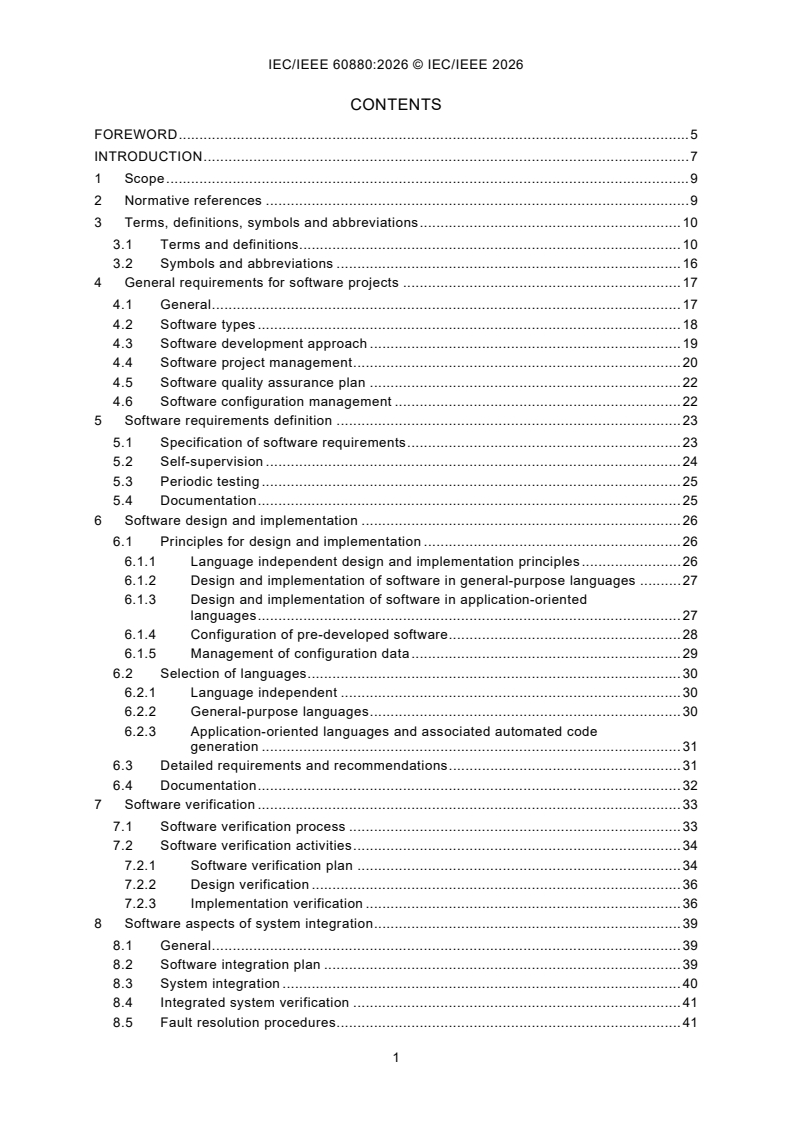
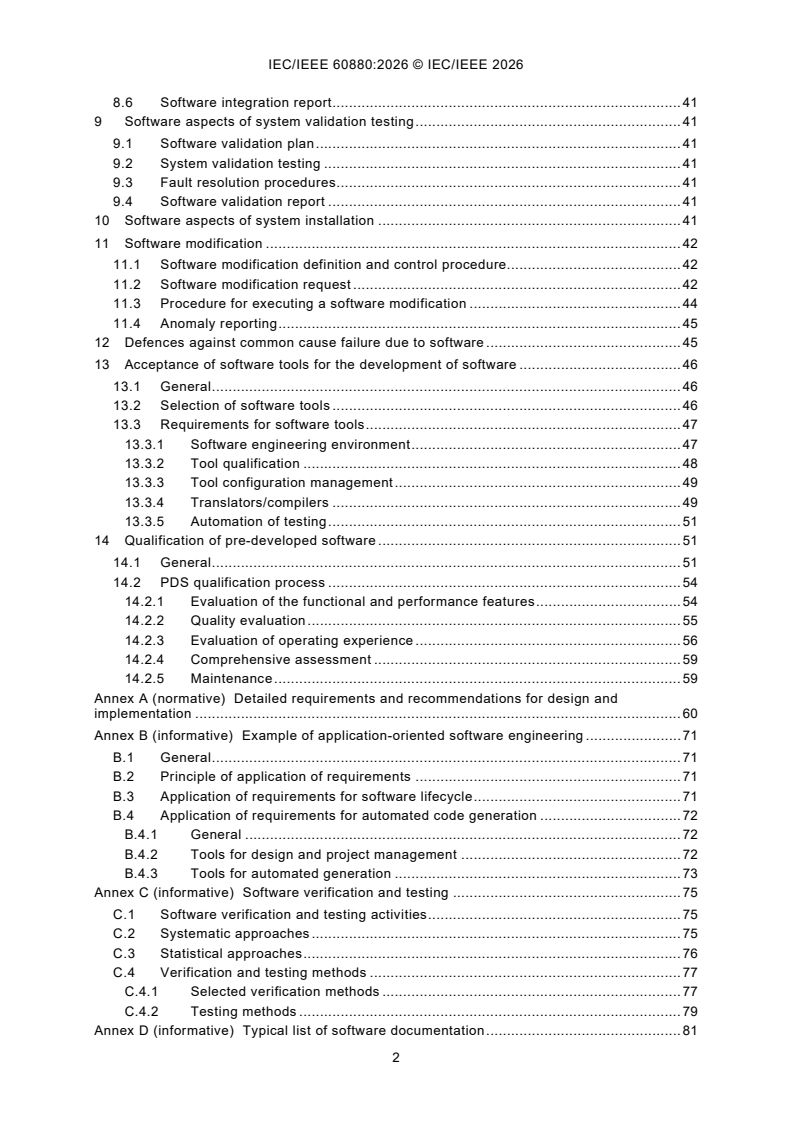
CONTENTS
FOREWORD . 5
INTRODUCTION . 7
1 Scope . 9
2 Normative references . 9
3 Terms, definitions, symbols and abbreviations . 10
3.1 Terms and definitions. 10
3.2 Symbols and abbreviations . 16
4 General requirements for software projects . 17
4.1 General . 17
4.2 Software types . 18
4.3 Software development approach . 19
4.4 Software project management . 20
4.5 Software quality assurance plan . 22
4.6 Software configuration management . 22
5 Software requirements definition . 23
5.1 Specification of software requirements . 23
5.2 Self-supervision . 24
5.3 Periodic testing . 25
5.4 Documentation . 25
6 Software design and implementation . 26
6.1 Principles for design and implementation . 26
6.1.1 Language independent design and implementation principles . 26
6.1.2 Design and implementation of software in general-purpose languages . 27
6.1.3 Design and implementation of software in application-oriented
languages . 27
6.1.4 Configuration of pre-developed software . 28
6.1.5 Management of configuration data . 29
6.2 Selection of languages . 30
6.2.1 Language independent . 30
6.2.2 General-purpose languages . 30
6.2.3 Application-oriented languages and associated automated code
generation . 31
6.3 Detailed requirements and recommendations . 31
6.4 Documentation . 32
7 Software verification . 33
7.1 Software verification process . 33
7.2 Software verification activities . 34
7.2.1 Software verification plan . 34
7.2.2 Design verification . 36
7.2.3 Implementation verification . 36
8 Software aspects of system integration . 39
8.1 General . 39
8.2 Software integration plan . 39
8.3 System integration . 40
8.4 Integrated system verification . 41
8.5 Fault resolution procedures . 41
8.6 Software integration report . 41
9 Software aspects of system validation testing . 41
9.1 Software validation plan . 41
9.2 System validation testing . 41
9.3 Fault resolution procedures . 41
9.4 Software validation report . 41
10 Software aspects of system installation . 41
11 Software modification . 42
11.1 Software modification definition and control procedure. 42
11.2 Software modification request . 42
11.3 Procedure for executing a software modification . 44
11.4 Anomaly reporting . 45
12 Defences against common cause failure due to software . 45
13 Acceptance of software tools for the development of software . 46
13.1 General . 46
13.2 Selection of software tools . 46
13.3 Requirements for software tools . 47
13.3.1 Software engineering environment . 47
13.3.2 Tool qualification . 48
13.3.3 Tool configuration management . 49
13.3.4 Translators/compilers . 49
13.3.5 Automation of testing . 51
14 Qualification of pre-developed software . 51
14.1 General . 51
14.2 PDS qualification process . 54
14.2.1 Evaluation of the functional and performance features . 54
14.2.2 Quality evaluation . 55
14.2.3 Evaluation of operating experience . 56
14.2.4 Comprehensive assessment . 59
14.2.5 Maintenance . 59
Annex A (normative) Detailed requirements and recommendations for design and
implementation . 60
Annex B (informative) Example of application-oriented software engineering . 71
B.1 General . 71
B.2 Principle of application of requirements . 71
B.3 Application of requirements for software lifecycle . 71
B.4 Application of requirements for automated code generation . 72
B.4.1 General . 72
B.4.2 Tools for design and project management . 72
B.4.3 Tools for automated generation . 73
Annex C (informative) Software verification and testing . 75
C.1 Software verification and testing activities . 75
C.2 Systematic approaches . 75
C.3 Statistical approaches . 76
C.4 Verification and testing methods . 77
C.4.1 Selected verification methods . 77
C.4.2 Testing methods . 79
Annex D (informative) Typical list of software documentation . 81
Annex E (informative) Tools for production and checking of specification, design and
implementation . 82
E.1 General . 82
E.2 Constructive tools . 82
E.2.1 Text editor . 82
E.2.2 Graphical interface . 82
E.2.3 Automated code generator . 82
E.2.4 Proof obligation generator . 82
E.3 Analytical tools . 83
E.3.1 Syntax checker . 83
E.3.2 Semantic checker . 83
E.3.3 Formal proof generator . 83
E.3.4 Animator . 83
E.3.5 Compliance analyser . 83
Annex F (informative) Correspondence between IEC 61513 and this document . 84
Annex G (informative) Relationship with IEC 61508 . 85
G.1 General . 85
G.2 Comparison of scope and concepts. 85
G.3 Correspondence between this document and IEC 61508-3:2010 . 86
Bibliography . 87
Figure 1 – Activities of the system safety lifecycle (as defined by IEC 61513) . 17
Figure 2 – Software related activities in the system safety lifecycle . 18
Figure 3 – Development activities of the IEC/IEEE 60880 software safety lifecycle . 20
Figure 4 – Outline of the qualification process of PDS. 53
Figure B.1 – Lifecycle for application-oriented software engineering . 74
Table 1 – Process and product aspects of design and implementation . 32
Table A.1 – Design process: modifiability . 60
Table A.2 – Design process: top-down approach . 60
Table A.3 – Design process: verification of intermediate design products . 61
Table A.4 – Design process: modification control during the development. 61
Table A.5 – Software structure: control and access structures . 62
Table A.6 – Software structure: modules . 62
Table A.7 – Software structure: operational system software . 63
Table A.8 – Software structure: execution time . 63
Table A.9 – Software structure: interrupts . 64
Table A.10 – Software structure: arithmetic expressions . 64
Table A.11 – Self-supervision: plausibility checks . 64
Table A.12 – Self-supervision: safe output . 65
Table A.13 – Self-supervision: memory contents . 65
Table A.14 – Self-supervision: error checking . 65
Table A.15 – Detailed design and coding: branches and loops . 66
Table A.16 – Detailed design and coding: subroutines . 66
Table A.17 – Detailed design and coding: nested structures . 66
Table A.18 – Detailed design and coding: addressing and arrays . 67
Table A.19 – Detailed design and coding: data structures . 67
Table A.20 – Detailed design and coding: dynamic changes . 67
Table A.21 – Detailed design and coding: unit and integration tests . 68
Table A.22 – Language dependent: sequences and arrangements . 68
Table A.23 – Language dependent: comments . 68
Table A.24 – Language dependent: assembler . 69
Table A.25 – Language dependent: coding rules . 69
Table A.26 – Language dependent: application-oriented languages . 69
Table A.27 – Language dependent: automated code generation . 70
Table D.1 – Typical list of software documentation . 81
Table F.1 – Correspondence between subclauses of IEC 61513:2026 and this
document . 84
Table G.1 – Correspondence between this document and IEC 61508-3:2010 . 86
Nuclear power plants -
Instrumentation and control systems important to safety -
Software aspects for computer-based systems performing
category a functions
FOREWORD
1) The International Electrotechnical Commission (IEC) is a worldwide organization for standardization comprising
all national electrotechnical committees (IEC National Committees). The object of IEC is to promote international
co-operation on all questions concerning standardization in the electrical and electronic fields. To this end and
in addition to other activities, IEC publishes International Standards, Technical Specifications, Technical Reports,
Publicly Available Specifications (PAS) and Guides (hereafter referred to as "IEC document(s)"). Their
preparation is entrusted to technical committees; any IEC National Committee interested in the subject dealt with
may participate in this preparatory work. International, governmental and non-governmental organizations liaising
with the IEC also participate in this preparation.
IEEE Standards documents are developed within IEEE Societies and Standards Coordinating Committees of the
IEEE Standards Association (IEEE SA) Standards Board. IEEE develops its standards through a consensus
development process, approved by the American National Standards Institute, which brings together volunteers
representing varied viewpoints and interests to achieve the final product. Volunteers are not necessarily members
of IEEE and serve without compensation. While IEEE administers the process and establishes rules to promote
fairness in the consensus development process, IEEE does not independently evaluate, test, or verify the
accuracy of any of the information contained in its standards. Use of IEEE Standards documents is wholly
voluntary. IEEE documents are made available for use subject to important notices and legal disclaimers (see
https://standards.ieee.org/ipr/disclaimers.html for more information).
IEC collaborates closely with IEEE in accordance with conditions determined by agreement between the two
organizations. This Dual Logo International Standard was jointly developed by the IEC and IEEE under the terms
of that agreement.
2) The formal decisions of IEC on technical matters express, as nearly as possible, an international consensus of
opinion on the relevant subjects since each technical committee has representation from all interested IEC
National Committees. The formal decisions of IEEE on technical matters, once consensus within IEEE Societies
and Standards Coordinating Committees has been reached, is determined by a balanced ballot of materially
interested parties who indicate interest in reviewing the proposed standard. Final approval of the IEEE standards
document is given by the IEEE Standards Association (IEEE SA) Standards Board.
3) IEC/IEEE Publications have the form of recommendations for international use and are accepted by IEC National
Committees/IEEE Societies in that sense. While all reasonable efforts are made to ensure that the technical
content of IEC/IEEE Publications is accurate, IEC or IEEE cannot be held responsible for the way in which they
are used or for any misinterpretation by any end user.
4) In order to promote international uniformity, IEC National Committees undertake to apply IEC Publications
(including IEC/IEEE Publications) transparently to the maximum extent possible in their national and regional
publications. Any divergence between any IEC/IEEE Publication and the corresponding national or regional
publication shall be clearly indicated in the latter.
5) IEC and IEEE do not provide any attestation of conformity. Independent certification bodies provide conformity
assessment services and, in some areas, access to IEC marks of conformity. IEC and IEEE are not responsible
for any services carried out by independent certification bodies.
6) All users should ensure that they have the latest edition of this publication.
7) No liability shall attach to IEC or IEEE or their directors, employees, servants or agents including individual
experts and members of technical committees and IEC National Committees, or volunteers of IEEE Societies and
the Standards Coordinating Committees of the IEEE Standards Association (IEEE SA) Standards Board, for any
personal injury, property damage or other damage of any nature whatsoever, whether direct or indirect, or for
costs (including legal fees) and expenses arising out of the publication, use of, or reliance upon, this IEC/IEEE
Publication or any other IEC or IEEE Publications.
8) Attention is drawn to the normative references cited in this publication. Use of the referenced publications is
indispensable for the correct application of this publication.
9) Attention is drawn to the possibility that implementation of this IEC/IEEE Publication may require use of material
covered by patent rights. By publication of this standard, no position is taken with respect to the existence or
validity of any patent rights in connection therewith. IEC or IEEE shall not be held responsible for identifying
Essential Patent Claims for which a license may be required, for conducting inquiries into the legal validity or
scope of Patent Claims or determining whether any licensing terms or conditions provided in connection with
submission of a Letter of Assurance, if any, or in any licensing agreements are reasonable or non-discriminatory.
Users of this standard are expressly advised that determination of the validity of any patent rights, and the risk
of infringement of such rights, is entirely their own responsibility.
IEC/IEEE 60880 has been prepared by subcommittee 45A: Instrumentation, control and
electrical power systems of nuclear facilities, of IEC technical committee 45: Nuclear
instrumentation in cooperation with Nuclear Power Engineering Committee of the IEEE, under
the IEC/IEEE Dual Logo Agreement between IEC and IEEE. It is an International Standard.
This is the first edition developed according to the IEC/IEEE Dual Logo Agreement. This edition
cancels and replaces the second edition IEC 60880 published in 2006. It constitutes a technical
revision.
The revision of the standard is intended to accomplish the following:
a) To take into account the fact that software engineering techniques advanced significantly in
the intervening years.
b) To align the standard with the new IAEA document SSG-39.
c) To align as far as possible the definitions in the standard with the International Atomic
Energy Agency, IAEA Nuclear Safety and Security Glossary, 2022 (Interim) Edition, IAEA,
Vienna (2022).
d) To adapt the requirements associated with standards published or revised since the second
edition of IEC 60880, especially IEC 61513, IEC 61226, IEC 62138, IEC 60987, IEC 62340,
IEC 62645 and IEC 62671.
e) To review the existing requirements.
The text of this International Standard is based on the following IEC documents:
Draft Report on voting
45A/1661/FDIS 45A/1668/RVD
Full information on the voting for its approval can be found in the report on voting indicated in
the above table.
The language used for the development of this International Standard is English.
This document was drafted in accordance with the rules given in the ISO/IEC Directives, Part 2,
available at www.iec.ch/members_experts/refdocs. The main document types developed by IEC
are described in greater detail at www.iec.ch/publications/.
The IEC Technical Committee and IEEE Technical Committee have decided that the contents
of this document will remain unchanged until the stability date indicated on the IEC website
under webstore.iec.ch in the data related to the specific document. At this date, the document
will be
– reconfirmed,
– withdrawn, or
– revised.
INTRODUCTION
a) Technical background and main issues
Engineering of computer-based instrumentation and control (I&C) systems to be used for
nuclear safety purposes is a challenge due to the safety requirements to be fulfilled. The safety
software used in nuclear power plants (NPP) which is often required only in emergency cases,
is fully validated and qualified before use in operation. In order to achieve the high dependability
required, special care is taken throughout the entire lifecycle, including the basic requirements,
the various design phases, the verification and validation testing procedures for operation and
maintenance. This document addresses the related safety aspects and provides requirements
for achieving the high software quality necessary.
b) Situation of the current standard in the structure of the SC 45A standard series
This document is directly referenced by IEC 61513 which deals with the system aspects of I&C
systems and equipment that are used to perform functions important to safety in NPPs.
This document is the second level SC 45A document tackling the issue of software aspects for
I&C systems performing category A functions.
Software for categories B and C functions is dealt with in IEC 62138.
This document and IEC 62138 together cover the domain of the software aspects of computer-
based systems used in nuclear power plants to perform functions important to safety.
IEC 62566 and IEC 62566-2 together cover the domain of the programmable logic used in
nuclear power plants to perform functions important to safety.
IEC 62340 covers the domain of requirements for coping with common cause failure (CCF).
This document is to be read in conjunction with IEC 61513, the appropriate SC 45A standard
on system aspects of I&C systems and equipment that are used to perform functions important
to safety.
For more details on the structure of the SC 45A standard series see item d) of this introduction.
c) Recommendation and limitation regarding the application of this document
This document establishes no additional functional requirements for systems important to
safety.
Aspects for which special requirements and recommendations have been produced, are:
a) a general approach to software development to assure the production of the highly reliable
software required including hardware and software interdependencies;
b) a general approach to software verification and to the software aspects of the computer-
based system validation;
c) procedures for software modification and configuration control;
d) requirements for use of tools;
e) procedures for qualification of pre-developed software.
It is recognised that software technology is continuing to develop at a rapid pace and that it is
not possible for this document to include references to all modern design technologies and
techniques.
To ensure that this document continues to be relevant in future years the emphasis has been
placed on issues of principle, rather than specific software technologies.
If new techniques are developed then it is deemed possible to assess the suitability of such
techniques by applying the safety principles contained within this document.
d) Description of the structure of the SC 45A standard series and relationships with
other IEC documents and other bodies documents (IAEA, ISO)
The IEC SC 45A standard series comprises a consistent set of documents organised in a
hierarchy of four levels. The top-level documents of the IEC SC 45A standard series are
IEC 61513 and IEC 63046, covering respectively general requirements for I&C systems and
general requirements for electrical power systems of NPPs. IEC 61513 and IEC 63046 adopt
an overall system lifecycle framework and constitute, along with the relevant second-level
standards, the nuclear implementation of the basic safety series IEC 61508. IEC 61513 and
IEC 63046 refer to ISO 9001 as well as to IAEA GSR part 2 and IAEA GS-G-3.1 and IAEA GS-
G-3.5 for topics related to quality assurance (QA).
IEC 61513 and IEC 63046 refer directly to second-level IEC SC 45A standards for general
requirements for specific topics, such as categorization of functions and classification of
systems (IEC 61226), qualification (IEC/IEEE 60780-323), separation (IEC 60709), control
room design (IEC 60964), electromagnetic compatibility (IEC 62003), human factors
engineering (IEC 63351), programmable digital item and hardware aspects for programmable
digital systems (in particular this document and IEC 62566) and management of ageing
(IEC 62342). For cybersecurity, IEC 62645 builds upon the valid high-level principles and main
concepts of the generic security standards, in particular ISO/IEC 27001 and ISO/IEC 27002; it
adapts them and completes them to fit the nuclear context and coordinates with the IEC 62443
series.
At a third level, standards relate to specific requirements for specific equipment, technical
methods, or activities. Usually, these documents refer to second-level documents for general
requirements and can be used on their own.
A fourth level extending the IEC SC 45A standard series, corresponds to Technical Reports
which are not normative.
The IEC SC 45A standards series consistently implements the safety and cybersecurity
principles and terminology of relevant IAEA safety standards and documents of the IAEA
Nuclear Security Series (NSS). In particular, this includes IAEA Safety Requirements SSR-2/1,
establishing safety requirements related to the design of NPPs; IAEA Safety Guide SSG-30,
addressing the safety classification of structures, systems and components in NPPs; IAEA
Safety Guide SSG-39, addressing the design of I&C systems for NPPs; IAEA Safety Guide
SSG-34, addressing the design of electrical power systems for NPPs; IAEA Safety Guide
SSG-51, addressing human factors engineering in the design of NPPs; and Nuclear Security
Series Implementing Guide NSS 42-G and Technical Guidance NSS 17-T for computer security
at nuclear facilities.
NOTE IEC TR 63400 provides a more comprehensive description of the overall structure of the IEC SC 45A
standards series and of its relationship with other standards bodies and standards.
1 Scope
This document provides requirements for the software of computer-based systems of nuclear
power plants performing functions of safety category A as defined by IEC 61226. As an
IEC/IEEE standard developed according to the Dual Logo Agreement, when used within the
context of IEEE, this document is considered to provide an acceptable set of requirements for
achieving the quality and dependability objectives for the software used in IEEE Class 1E safety
systems, subsystems and components.
According to the definition in IEC 61513, I&C systems of safety class 1 are intended to support
category A functions, but can also support functions of lower categories. However the system
requirements are always determined by the functions of the highest category implemented.
For software of I&C system performing only category B and C functions in NPP as defined by
IEC 61226, the requirements and guidance of IEC 62138 are applicable.
This document provides requirements for the purpose of achieving highly dependable software.
It addresses each stage of software generation and documentation, including requirements
specification, design, implementation, verification and validation testing.
The principles applied in developing these requirements include:
– best available practices;
– top-down design methods;
– modularity;
– verification of each phase;
– clear documentation;
– auditable documents;
– validation testing.
Annex A provides detailed requirements and recommendations for design and implementation
of software.
Additional informative guidance is given in Annex B to Annex G.
This document does not explicitly address the protection of software against threats arising
from malicious attacks, that is, cybersecurity, for computer-based systems. IEC 62645 provides
cybersecurity requirements.
IEC 62671 can be used as an alternative to this document for digital devices of limited
functionality. IEC 62671 contains precise criteria to determine if it is applicable to a particular
device.
2 Normative references
The following documents are referred to in the text in such a way that some or all of their content
constitutes requirements of this document. For dated references, only the edition cited applies.
For undated references, the latest edition of the referenced document (including any
amendments) applies.
IEC 61513:2026, Nuclear power plants - Instrumentation and control important to safety -
General requirements for systems
3 Terms, definitions, symbols and abbreviations
3.1 Terms and definitions
For the purposes of this document, the following terms and definitions apply.
ISO, IEC, and IEEE maintain terminology databases for use in standardization at the following
addresses:
– IEC Electropedia: available at https://www.electropedia.org/
– ISO Online browsing platform: available at https://www.iso.org/obp
– IEEE Standards Dictionary Online: available at http://dictionary.ieee.org
3.1.1
animation
process by which the behaviour defined by a specification is displayed with actual values
derived from the stated behaviour expressions and from some input values
3.1.2
application function
function of an I&C system that performs a task related to the process being controlled rather
than to the functioning of the system itself
[SOURCE: IEC 61513:2026, 3.1, modified – notes removed.]
3.1.3
application-oriented language
computer language specifically designed to address a certain type of application and to be used
by persons who are specialists of this type of application
Note 1 to entry: Application-oriented languages may be used to specify the functional requirements of an I&C
system, or to specify or design application software. They may be based on texts, on graphics, or on both.
Note 2 to entry: Examples: Instruction List (IL), Structured Text (ST), Ladder Diagram (LD), Function Block Diagram
(FBD).
Note 3 to entry: See 3.1.18.
3.1.4
application software
software part of an I&C system which is distinct from the operational system software
Note 1 to entry: The distinction between system software (generic, re-usable) and application software (typically
plant-specific) is generally made to minimize re-development of code and to optimize the allocation of the qualification
activities. It is an especially useful distinction when using an I&C platform.
Note 2 to entry: See 3.1.2, 3.1.28, and 3.1.37.
[SOURCE: IEC 61513:2026, 3.2]
3.1.5
automated code generation
function of automated tools allowing transformation of the application-oriented language into a
form suitable for compilation or execution
3.1.6
code compaction
purposeful reduction in memory size required for a program by the elimination of redundant or
extraneous instructions
3.1.7
common cause failure
CCF
failures of two or more structures, systems or components due to a single specific event or
cause
Note 1 to entry: For example consider software dependent on calendar date or similar time counters used in several
systems and comprising a design fault leading to its failure on a specific date. The single initiator leads to the
simultaneous common cause failure of several components (all components containing the offending software).
[SOURCE: IAEA Nuclear Safety and Security Glossary, 2022 (Interim) Edition, modified – note
added]
3.1.8
computer-based item
item that relies on software instructions running on microprocessors or microcontrollers
Note 1 to entry: In this term and its definition, the term item can be replaced by the terms: system or equipment or
device.
Note 2 to entry: Computer-based item is a kind of programmable digital item.
Note 3 to entry: This term is equivalent to software-based item.
Note 4 to entry: The IEC definition differs from the IAEA definition for “computer-based systems” because it is more
specific regarding the kind of digital technology covered.
[SOURCE: IEC 62138:2018, 3.8, modified – Note 4 has been added.]
3.1.9
data
representation of information or instructions in a manner suitable for communication,
interpretation, or processing by digital equipment
Note 1 to entry: Data which are required to define parameters and to instantiate application and service functions
in the system are called “configuration data”.
[SOURCE: IEC 61513:2026, 3.15, modified – note added]
3.1.10
defence in depth
hierarchical deployment of different levels of diverse equipment and procedures to prevent the
escalation of anticipated operational occurrences and to maintain the effectiveness of physical
barriers placed between a radiation source or radioactive material and workers, members of
the public or the environment, in operational states and, for some barriers, in accident
conditions
[SOURCE: IAEA Nuclear Safety and Security Glossary, 2022 (Interim) Edition]
3.1.11
dependability
overall trustworthiness of a system; that is, the extent to which reliance can justifiably be placed
on this system. Reliability, availability and safety are attributes of dependability
[SOURCE: IAEA Nuclear Safety and Security Glossary, 2022 (Interim) Edition]
3.1.12
deterministic software
software that allows to know, the execution path for each situation envisaged for the software,
the corresponding expected outputs of the software and the use of the resources for each of
these paths
3.1.13
diversity
presence of two or more independent (redundant) systems or components to perform an
identified function, where the different systems or components have different attributes so as
to reduce the possibility of common cause failure, including common mode failure
Note 1 to entry: When the term “diversity” is used with an additional attribute, the term diversity indicates the general
meaning “existence of two or more different ways or means of achieving a specified objective”, while the attribute
indicates the characteristics of the different ways applied, for example, functional diversity, equipment diversity,
signal diversity.
[SOURCE: IAEA Nuclear Safety and Security Glossary, 2022 (Interim) Edition]
3.1.14
dynamic analysis
process of evaluating a system or component based on its behaviour during execution
Note 1 to entry: In contrast to static analysis (see 3.1.36).
3.1.15
failure
loss of the ability of a structure, system or component to function within acceptance criteria
Note 1 to entry: The structure, system or component is considered to fail when it becomes incapable of functioning,
whether or not this is necessary at that time.
Note 2 to entry: A failure in, for example, a backup system is not necessarily manifest until the system is called
upon to function, either during testing or on failure of the system it is backing up.
Note 3 to entry: A failure can be the result of, for example, a hardware fault, a software fault, a system fault, an
operator error or a maintenance err
...