


IEC 62605:2011
(Main)Multimedia systems and equipment - Multimedia e-publishing and e-books - Interchange format for e-dictionaries
General Information
- Abstract
IEC 62605:2011 specifies the interchange format for e-dictionaries among publishers, content creators and manufacturers. It does not address the following aspects:
- data formats for reading devices;
- elements necessary for final print reproduction only;
- rendering issues related to physical devices;
- security issues such as DRM for document.
- Status
- Published
- Publication Date
- 10-Jul-2011
- Technical Committee
- TC 100 - Audio, video and multimedia systems and equipment
- Current Stage
- DELPUB - Deleted Publication
- Start Date
- 10-Feb-2016
- Completion Date
- 28-Aug-2026
Overview
IEC 62605:2011 is a pivotal international standard developed by the International Electrotechnical Commission (IEC) that defines the interchange format for electronic dictionaries (e-dictionaries). This standard specifically targets multimedia systems and equipment in the context of multimedia e-publishing and e-books. By standardizing how e-dictionaries are exchanged among publishers, content creators, and manufacturers, IEC 62605:2011 facilitates consistent, interoperable dictionary content distribution within the digital publishing ecosystem.
This standard focuses exclusively on the format used for data interchange and does not address device-specific data formats, print reproduction elements, rendering techniques on physical devices, or document security matters such as Digital Rights Management (DRM). IEC 62605 provides a structured and detailed framework addressing e-dictionary content semantics, file structure, and key elements essential for multimedia e-publishing.
Key Topics
Interchange Format Definition
IEC 62605:2011 specifies the structure and elements of an XML-based interchange format tailored for e-dictionaries. This enables seamless content creation, editing, and distribution workflows for dictionary publishers and electronic content producers.Semantic and Structural Specifications
The standard details semantic components such as dictionary entries, readings, external characters, coordinates, and multimedia objects (e.g., text, sound, movie objects). It includes precise definitions of elements and attributes to maintain consistent dictionary data representation.Content Management Modules
The standard presents modular components including book information, content body, event information, and parts data. Each module supports different content types and dynamic dictionary features like search pages, animations, and interactive data objects.File and Description Format Details
IEC 62605 sets out file format requirements, including XML tree structures and attribute usage. It defines norms for color names, date/time metadata, personal and organization names, permissions, keywords, and contact information. These conventions ensure rich and fully descriptive e-dictionary content.Multimedia Integration
Beyond textual data, the standard supports integration of multimedia elements such as animations, sounds, and movies to enhance dictionary entries, enabling advanced e-publishing capabilities aligned with modern e-book features.
Applications
E-Publishing and Digital Libraries
IEC 62605 is essential for publishers aiming to produce and distribute standardized e-dictionaries alongside e-books, ensuring compatibility across platforms and devices.Content Creation and Distribution
Content developers and software manufacturers utilize this standard to support dictionary data workflows, enabling efficient interchange and reuse of dictionary assets in various multimedia contexts.Educational and Reference Tools
Developers of digital learning tools and reference applications leverage IEC 62605 to embed and exchange dictionary resources in multimedia e-learning environments.Multimedia Device Integration
Although device-specific rendering is excluded, manufacturers of reading devices and multimedia equipment can adopt this standardized format to better support dictionary content interoperability.
Related Standards
IEC 62605:2011 complements other international standards governing e-books and multimedia publishing systems, including:
IEC standards for multimedia systems and electronic equipment – Broad standards defining electrical and electronic systems interoperability within multimedia e-publishing.
ISO/IEC standards for e-publishing – Standards covering e-book formats and metadata, which often intersect with multimedia dictionary requirements.
Digital Rights Management (DRM) standards – While not addressed in IEC 62605, DRM standards may be used in combination to secure e-dictionary content.
XML and data interchange standards – The foundational markup languages standardize structure, enabling compliance with IEC 62605.
Utilizing IEC 62605:2011 ensures dictionary content follows internationally recognized guidelines, facilitating global interoperability and enhancing the user experience in multilingual digital reading and reference environments.
Keywords: IEC 62605, e-dictionary interchange format, multimedia e-publishing, electronic dictionaries, e-books standard, dictionary content format, digital publishing standards, e-dictionary XML structure, multimedia systems, IEC standards.
Relations
- Effective Date
- 05-Sep-2023
Get Certified
Connect with accredited certification bodies for this standard

BSI Group
BSI (British Standards Institution) is the business standards company that helps organizations make excellence a habit.

NYCE
Mexican standards and certification body.

ANCE
Mexican certification and testing association.
Sponsored listings
Frequently Asked Questions
IEC 62605:2011 is a standard published by the International Electrotechnical Commission (IEC). Its full title is "Multimedia systems and equipment - Multimedia e-publishing and e-books - Interchange format for e-dictionaries". This standard covers: IEC 62605:2011 specifies the interchange format for e-dictionaries among publishers, content creators and manufacturers. It does not address the following aspects: - data formats for reading devices; - elements necessary for final print reproduction only; - rendering issues related to physical devices; - security issues such as DRM for document.
IEC 62605:2011 specifies the interchange format for e-dictionaries among publishers, content creators and manufacturers. It does not address the following aspects: - data formats for reading devices; - elements necessary for final print reproduction only; - rendering issues related to physical devices; - security issues such as DRM for document.
IEC 62605:2011 is classified under the following ICS (International Classification for Standards) categories: 33.160.60 - Multimedia systems and teleconferencing equipment; 35.240.20 - IT applications in office work; 35.240.30 - IT applications in information, documentation and publishing. The ICS classification helps identify the subject area and facilitates finding related standards.
IEC 62605:2011 has the following relationships with other standards: It is inter standard links to IEC 62605:2016. Understanding these relationships helps ensure you are using the most current and applicable version of the standard.
IEC 62605:2011 is available in PDF format for immediate download after purchase. The document can be added to your cart and obtained through the secure checkout process. Digital delivery ensures instant access to the complete standard document.
Standards Content (Sample)
IEC 62605 ®
Edition 1.0 2011-07
INTERNATIONAL
STANDARD
NORME
INTERNATIONALE
Multimedia systems and equipment – Multimedia e-publishing and e-books –
Interchange format for e-dictionaries
Systèmes et équipements multimédia – Publication et livres électroniques
multimédia – Format d’échange pour les dictionnaires électroniques
All rights reserved. Unless otherwise specified, no part of this publication may be reproduced or utilized in any form or by
any means, electronic or mechanical, including photocopying and microfilm, without permission in writing from either IEC or
IEC's member National Committee in the country of the requester.
If you have any questions about IEC copyright or have an enquiry about obtaining additional rights to this publication,
please contact the address below or your local IEC member National Committee for further information.
Droits de reproduction réservés. Sauf indication contraire, aucune partie de cette publication ne peut être reproduite
ni utilisée sous quelque forme que ce soit et par aucun procédé, électronique ou mécanique, y compris la photocopie
et les microfilms, sans l'accord écrit de la CEI ou du Comité national de la CEI du pays du demandeur.
Si vous avez des questions sur le copyright de la CEI ou si vous désirez obtenir des droits supplémentaires sur cette
publication, utilisez les coordonnées ci-après ou contactez le Comité national de la CEI de votre pays de résidence.
IEC Central Office
3, rue de Varembé
CH-1211 Geneva 20
Switzerland
Email: inmail@iec.ch
Web: www.iec.ch
About the IEC
The International Electrotechnical Commission (IEC) is the leading global organization that prepares and publishes
International Standards for all electrical, electronic and related technologies.
About IEC publications
The technical content of IEC publications is kept under constant review by the IEC. Please make sure that you have the
latest edition, a corrigenda or an amendment might have been published.
Catalogue of IEC publications: www.iec.ch/searchpub
The IEC on-line Catalogue enables you to search by a variety of criteria (reference number, text, technical committee,…).
It also gives information on projects, withdrawn and replaced publications.
IEC Just Published: www.iec.ch/online_news/justpub
Stay up to date on all new IEC publications. Just Published details twice a month all new publications released. Available
on-line and also by email.
Electropedia: www.electropedia.org
The world's leading online dictionary of electronic and electrical terms containing more than 20 000 terms and definitions
in English and French, with equivalent terms in additional languages. Also known as the International Electrotechnical
Vocabulary online.
Customer Service Centre: www.iec.ch/webstore/custserv
If you wish to give us your feedback on this publication or need further assistance, please visit the Customer Service
Centre FAQ or contact us:
Email: csc@iec.ch
Tel.: +41 22 919 02 11
Fax: +41 22 919 03 00
A propos de la CEI
La Commission Electrotechnique Internationale (CEI) est la première organisation mondiale qui élabore et publie des
normes internationales pour tout ce qui a trait à l'électricité, à l'électronique et aux technologies apparentées.
A propos des publications CEI
Le contenu technique des publications de la CEI est constamment revu. Veuillez vous assurer que vous possédez
l’édition la plus récente, un corrigendum ou amendement peut avoir été publié.
Catalogue des publications de la CEI: www.iec.ch/searchpub/cur_fut-f.htm
Le Catalogue en-ligne de la CEI vous permet d’effectuer des recherches en utilisant différents critères (numéro de référence,
texte, comité d’études,…). Il donne aussi des informations sur les projets et les publications retirées ou remplacées.
Just Published CEI: www.iec.ch/online_news/justpub
Restez informé sur les nouvelles publications de la CEI. Just Published détaille deux fois par mois les nouvelles
publications parues. Disponible en-ligne et aussi par email.
Electropedia: www.electropedia.org
Le premier dictionnaire en ligne au monde de termes électroniques et électriques. Il contient plus de 20 000 termes et
définitions en anglais et en français, ainsi que les termes équivalents dans les langues additionnelles. Egalement appelé
Vocabulaire Electrotechnique International en ligne.
Service Clients: www.iec.ch/webstore/custserv/custserv_entry-f.htm
Si vous désirez nous donner des commentaires sur cette publication ou si vous avez des questions, visitez le FAQ du
Service clients ou contactez-nous:
Email: csc@iec.ch
Tél.: +41 22 919 02 11
Fax: +41 22 919 03 00
IEC 62605 ®
Edition 1.0 2011-07
INTERNATIONAL
STANDARD
NORME
INTERNATIONALE
Multimedia systems and equipment – Multimedia e-publishing and e-books –
Interchange format for e-dictionaries
Systèmes et équipements multimédia – Publication et livres électroniques
multimédia – Format d’échange pour les dictionnaires électroniques
INTERNATIONAL
ELECTROTECHNICAL
COMMISSION
COMMISSION
ELECTROTECHNIQUE
PRICE CODE
INTERNATIONALE
CODE PRIX XF
ICS 33.160.60; 35.240.20; 35.240.30 ISBN 978-2-88912-552-4
– 2 – 62605 IEC:2011
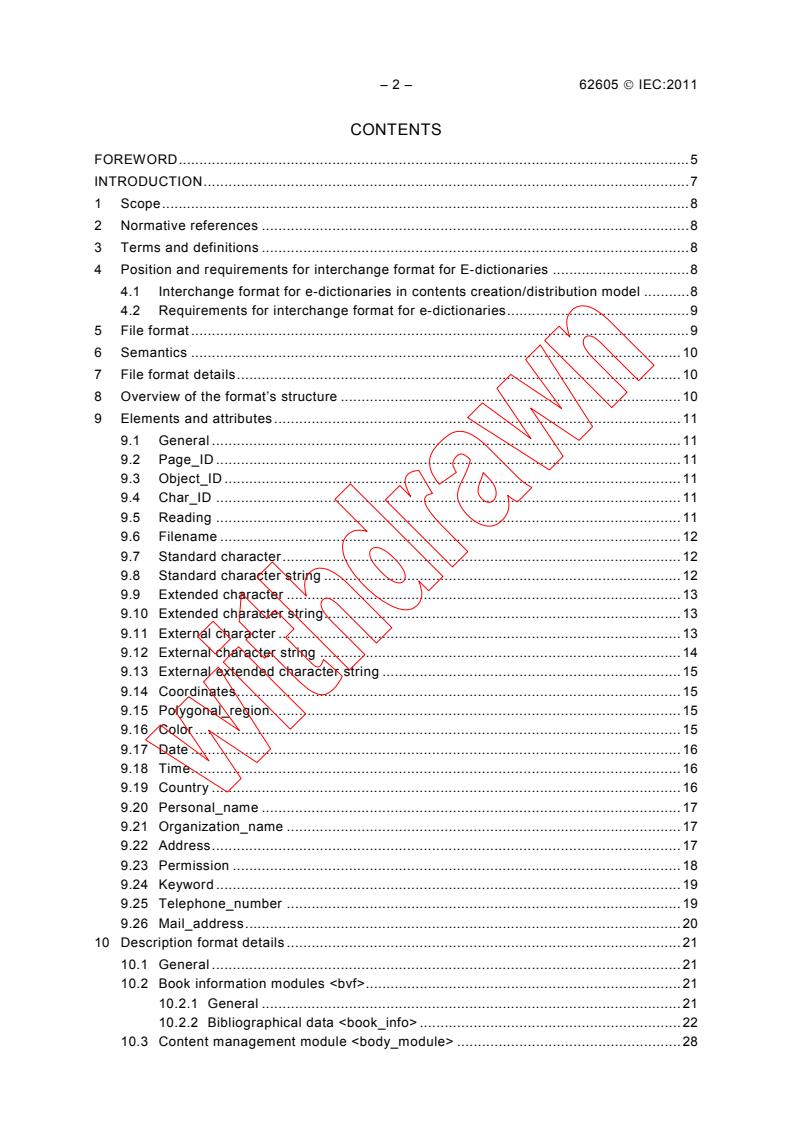
CONTENTS
FOREWORD . 5
INTRODUCTION . 7
1 Scope . 8
2 Normative references . 8
3 Terms and definitions . 8
4 Position and requirements for interchange format for E-dictionaries . 8
4.1 Interchange format for e-dictionaries in contents creation/distribution model . 8
4.2 Requirements for interchange format for e-dictionaries . 9
5 File format . 9
6 Semantics . 10
7 File format details . 10
8 Overview of the format’s structure . 10
9 Elements and attributes . 11
9.1 General . 11
9.2 Page_ID . 11
9.3 Object_ID . 11
9.4 Char_ID . 11
9.5 Reading . 11
9.6 Filename . 12
9.7 Standard character . 12
9.8 Standard character string . 12
9.9 Extended character . 13
9.10 Extended character string . 13
9.11 External character . 13
9.12 External character string . 14
9.13 External extended character string . 15
9.14 Coordinates . 15
9.15 Polygonal_region. 15
9.16 Color . 15
9.17 Date . 16
9.18 Time . 16
9.19 Country . 16
9.20 Personal_name . 17
9.21 Organization_name . 17
9.22 Address . 17
9.23 Permission . 18
9.24 Keyword . 19
9.25 Telephone_number . 19
9.26 Mail_address . 20
10 Description format details . 21
10.1 General . 21
10.2 Book information modules . 21
10.2.1 General . 21
10.2.2 Bibliographical data . 22
10.3 Content management module . 28
62605 IEC:2011 – 3 –
10.3.1 General . 28
10.3.2 Flowing content data . 28
10.4 Event info module . 41
10.4.1 Events . 41
10.4.2 Event data . 41
10.4.3 Trigger (pointer) . 42
10.4.4 Action information . 43
10.5 Parts data module . 45
10.5.1 Storage and management . 45
10.5.2 Dynamic text object . 46
10.5.3 Sound object . 47
10.5.4 Search page object . 47
10.5.5 Movie object . 48
10.5.6 Dictionary data object . 48
10.6 Object instances . 49
10.6.1 General . 49
10.6.2 Text object instance . 49
10.6.3 Dictionary data object instance . 71
10.6.4 Image object instance . 77
10.6.5 Sound object instance . 77
10.6.6 Animation object instance . 77
10.6.7 Search page object instance . 78
10.6.8 Movie object instance . 83
Annex A (normative) Color names. 84
Bibliography . 126
Figure 1 – Contents creation/distribution model . 8
Figure 2 – Contents creation/distribution model (modified) . 9
Figure 3 – Relationship between concepts . 9
Figure 4 – XML tree structure . 10
Figure 5 – Example of valign=”middle” . 50
Figure 6 – Example of dropped capital . 54
Figure 7 – Left and right margin of a paragraph . 55
Figure 8 – Horizontal writing in vertical text. 60
Figure 9 – Ruby . 61
Figure 10 – Example of search page object instance rendering . 80
Table 1 – Base characters for reading . 12
Table 2 – Standard character set . 12
Table 3 – Usable characters for a telephone number . 20
Table 4 – Characters usable for email addresses . 20
Table 5 – Characters usable for the lookup key . 40
Table A.1 – Color names . 84
Table A.2 – Examples of additional standard character sets . 85
Table A.3 – Example of additional characters usable for readings . 85
Table A.4 – Example of additional sorting rules . 87
– 4 – 62605 IEC:2011
Table A.5 – Example of additional language specific attributes for . 88
62605 IEC:2011 – 5 –
INTERNATIONAL ELECTROTECHNICAL COMMISSION
____________
MULTIMEDIA SYSTEMS AND EQUIPMENT –
MULTIMEDIA E-PUBLISHING AND E-BOOKS –
INTERCHANGE FORMAT FOR E-DICTIONARIES
FOREWORD
1) The International Electrotechnical Commission (IEC) is a worldwide organization for standardization comprising
all national electrotechnical committees (IEC National Committees). The object of IEC is to promote
international co-operation on all questions concerning standardization in the electrical and electronic fields. To
this end and in addition to other activities, IEC publishes International Standards, Technical Specifications,
Technical Reports, Publicly Available Specifications (PAS) and Guides (hereafter referred to as “IEC
Publication(s)”). Their preparation is entrusted to technical committees; any IEC National Committee interested
in the subject dealt with may participate in this preparatory work. International, governmental and non-
governmental organizations liaising with the IEC also participate in this preparation. IEC collaborates closely
with the International Organization for Standardization (ISO) in accordance with conditions determined by
agreement between the two organizations.
2) The formal decisions or agreements of IEC on technical matters express, as nearly as possible, an international
consensus of opinion on the relevant subjects since each technical committee has representation from all
interested IEC National Committees.
3) IEC Publications have the form of recommendations for international use and are accepted by IEC National
Committees in that sense. While all reasonable efforts are made to ensure that the technical content of IEC
Publications is accurate, IEC cannot be held responsible for the way in which they are used or for any
misinterpretation by any end user.
4) In order to promote international uniformity, IEC National Committees undertake to apply IEC Publications
transparently to the maximum extent possible in their national and regional publications. Any divergence
between any IEC Publication and the corresponding national or regional publication shall be clearly indicated in
the latter.
5) IEC itself does not provide any attestation of conformity. Independent certification bodies provide conformity
assessment services and, in some areas, access to IEC marks of conformity. IEC is not responsible for any
services carried out by independent certification bodies.
6) All users should ensure that they have the latest edition of this publication.
7) No liability shall attach to IEC or its directors, employees, servants or agents including individual experts and
members of its technical committees and IEC National Committees for any personal injury, property damage or
other damage of any nature whatsoever, whether direct or indirect, or for costs (including legal fees) and
expenses arising out of the publication, use of, or reliance upon, this IEC Publication or any other IEC
Publications.
8) Attention is drawn to the Normative references cited in this publication. Use of the referenced publications is
indispensable for the correct application of this publication.
International Standard IEC 62605 has been prepared by technical area 10: Multimedia e-
publishing and e-book, of IEC technical committee 100: Audio, video and multimedia systems
and equipment.
The text of this standard is based on the following documents:
FDIS Report on voting
100/1829/FDIS 100/1863/RVD
Full information on the voting for the approval of this standard can be found in the report on
voting indicated in the above table.
This publication has been drafted in accordance with the ISO/IEC Directives, Part 2.
– 6 – 62605 IEC:2011
The committee has decided that the contents of this publication will remain unchanged until
stability date indicated on the IEC web site under "http://webstore.iec.ch" in the data related
to the specific publication. At this date, the publication will be
• reconfirmed,
• withdrawn,
• replaced by a revised edition, or
• amended.
62605 IEC:2011 – 7 –
INTRODUCTION
Markets for multimedia e-book and e-publishing require standardization of formats for e-book
data interchange among associated people; authors, data preparers, publishers and readers.
The formats are classified into submission format, interchange format and reader’s format.
The submission format supports an interaction between authors and data preparers. The
reader’s format depends on e-publishing equipment. The interchange format provides an
interchange format for data preparers and publishers and therefore should be e-publishing
equipment independent.
The International Electrotechnical Commission (IEC) draws attention to the fact that it is
claimed that compliance with this document may involve the use of patents.
Sharp Corporation has informed IEC that it has patent applications or granted patents.
The IEC takes no position concerning the evidence, validity and scope of this patent right.
The holder of this patent right has assured the IEC that he/she is willing to negotiate licences
under reasonable and non-discriminatory terms and conditions with applicants throughout the
world. In this respect, the statement of the holder of this patent right is registered with the IEC.
Information may be obtained from:
Sharp Corporation
Platform Technology Development Center
2613-1, Ichinomoto-cho, Tenri, Nara
632-8587 JAPAN
Attention is drawn to the possibility that some of the elements of this document may be the
subject of patent rights other than those identified above. The IEC shall not be held
responsible for identifying any or all such patent rights.
ISO (www.iso.org/patents) and IEC (http://patents.iec.ch/) maintain on-line data bases of
patents relevant to their standards. Users are encouraged to consult the data bases for the
most up to date information concerning patents.
– 8 – 62605 IEC:2011
MULTIMEDIA SYSTEMS AND EQUIPMENT –
MULTIMEDIA E-PUBLISHING AND E-BOOKS –
INTERCHANGE FORMAT FOR E-DICTIONARIES
1 Scope
This International Standard specifies the interchange format for e-dictionaries among
publishers, content creators and manufacturers.
This International Standard does not address the following aspects:
• data formats for reading devices;
• elements necessary for final print reproduction only;
• rendering issues related to physical devices;
• security issues such as DRM for document.
2 Normative references
The following referenced documents are indispensable for the application of this document.
For dated references, only the edition cited applies. For undated references, the latest edition
of the referenced document (including any amendments) applies.
IEC/TS 62229:2006, Multimedia systems and equipment – Multimedia e-publishing and e-
book – Conceptual model for multimedia e-publishing
3 Terms and definitions
For the purposes of this document, the following terms and definitions apply.
3.1
manufacturer
organization or person that manufactures hardware and/or software of the e-book
4 Position and requirements for interchange format for E-dictionaries
4.1 Interchange format for e-dictionaries in contents creation/distribution model
The conceptual model for multimedia e-publishing (IEC/TS 62229) defines a contents
creation/distribution model shown in Figure 1.
Author <--(1)--> Data preparer <--(2)--> Publisher --(3)--> Reader
IEC 1383/11
Key
(1) content data in submission format
(2) content data in interchange format
(3) content data in reader’s format
Figure 1 – Contents creation/distribution model
62605 IEC:2011 – 9 –
It should be noted that the role of manufacturers of e-dictionary hardware and software
overlaps that of the publisher in Figure 1. Therefore, a slightly modified model will be
assumed for this International Standard, as shown in Figure 2.
Author <--(1)--> Data preparer <--(2)--> Publisher (manufacturer) --(3)--> Reader
IEC 1384/11
Figure 2 – Contents creation/distribution model (modified)
This International Standard specifies the interchange format between data preparers and
publishers, i.e. a format for (2) in Figure 2 though it may be used as a reader's format.
4.2 Requirements for interchange format for e-dictionaries
An interchange format for e-dictionaries needs to address the following.
• Description of keywords, links from the keywords to entries (link data) and the order of the
entries.
• Description of articles for each entry (entry data). This includes text, image, and other
multimedia functionalities generally required for e-books.
• Description of bibliographical data and other data. This should include the name of the
author and the publisher, the title of the content and the explanatory note. The relationship
between these concepts is visually represented in Figure 3.
• Description of contents written in various languages.
Entry 1
keyword 1
title
keyword 2
author name
keyword 3 and
publisher name
:
explanatory note
keyword n
Entry n
:
Entries and
Keywords Link data
Bibliographical data etc.
their order
IEC 1385/11
Figure 3 – Relationship between concepts
5 File format
This International Standard is based on XMDF (as described in IEC 62448:2009, Annex B)
and LeXML. The standard format is represented in XML and hereafter called XMDF-LeXML
format.
NOTE LeXML is proposed by Digital ASSIST Ltd. Its original specifications are found at
http://www.d-assist.com/index.html.
– 10 – 62605 IEC:2011
6 Semantics
Elements of the XMDF-LeXML format can be rendered in accordance with appropriate style
specifications, which are outside the scope of this International Standard.
7 File format details
This Clause specifies the XMDF-LeXML format mentioned in Clause 5.
The XMDF-LeXML format is an interchange format for e-dictionaries multimedia e-book data
interchange, targeted at data preparers and publishers rather than the reader, with an
emphasis on mobile devices as a target platform. Much like HTML, this format does not split
the document in fixed pages, but determines the layout according to the viewer device’s
display size, the font in use, and so on. In this standard, such contents will be referred to as
flowing content, as opposed to paged content.
8 Overview of the format’s structure
Flowing contents are usually composed of several concatenated flows. This standard makes
no particular requirement concerning the way the flowing content should be split into
individual flows. This decision is left to the data preparer, to accommodate the various type of
contents. For instance, a newspaper may have one flow per article, a novel one per chapter,
and so on. It is also possible not to split the content, and to have only one flow. However, it
should be noted that particularly large flows, or an extremely large number of flows, may
impact on runtime performance, depending on the specific version of the viewer in use, the
available memory, and so on.
The XML tree structure of the format is shown in Figure 4.
Content
management
data
There may be
Root
several of flow data
Points to a file name
Object instance
Parts data
Object instance
Object entry can
be repeated
several times
IEC 1386/11
Figure 4 – XML tree structure
62605 IEC:2011 – 11 –
The actual contents of each flow, in other words, what will be displayed by the viewer, is
recorded in the object instance. The object instance is registered in object_entry, and
associated with an ID number and other auxiliary data, turning it into playable / displayable
data. Flow_data determines its content by pointing at such registered objects. In addition,
information on functionalities such as page link is recorded in event_info.
The main part of this standard is generic, and may be used for any country and language.
However, some parts may have language specific behavior. To keep the main part of the
specification reasonably light and focused, those localization-related issues are detailed in
Clause A.2. The main text will refer to them, when appropriate.
9 Elements and attributes
9.1 General
The different types of values that may be used in the various tags or attributes are explained
below. The elements and attributes detailed below will be valid throughout this standard, and
will be referenced by other constructs. In the following explanations, alphanumeric characters
refer to numerals from 0 to 9 and alphabetic letters from a to z and A to Z.
9.2 Page_ID
Page_ID specifies a unique identification number for the flow data of the flowing contents. It is
a string starting by the "PG" characters, followed by alphanumeric characters.
Example:
9.3 Object_ID
Object_ID specifies a unique identification number for objects used in the flowing contents. It
is a string starting by the "OB" characters, followed by alphanumeric characters.
Example:
9.4 Char_ID
Char_ID specifies an identification number for positions (character strings, etc.) within text
and dictionary data objects. It is an alphanumeric string which is to be given uniquely in the
text (see 10.6.2) and dictionary data object instance (see 10.6.3).Char IDs with the same
value in different object instances are regarded as separate and don't affect each other.
Example:
Clickherefor details.
9.5 Reading
For sorting purposes, reading may be useful to specify the reading of each word. Restricting
the characters allowed for this purpose to a limited set makes it easier to define the sorting
method. Such characters should be determined on a per language basis. All languages can
– 12 – 62605 IEC:2011
use the characters listed in Table 1 as a common base, while the localization (see
Clause A.2) will describe the language specific extensions to it.
Table 1 – Base characters for reading
a)
Name Corresponding characters
Basic alphabet A to Z (0x0041 to 0x005A)
A to z (0x0061 to 0x007A)
Numerals 0 to 9 (0x0030 to 0x0039)
Others space (0x0020), ((0x0028), ) (0x0029)
a)
All values are in Unicode.
Example:
π
9.6 Filename
Filenames should be written using the following convention. The path is relative to the file in
which this reference is made. Network paths should not be used. For portability concerns, it is
recommended that only ACSII characters be used. Both the slash and backslash characters
are acceptable as directory separators. It is also recommended not to use excessively long
filenames, as those might not be supported by the host operating system.
Example:
9.7 Standard character
The standard character set of the document, as set by the default_ccs attribute of the
tag (see 10.2), is to be chosen from a well defined list, so as to ease the development of
viewing software. However, this list may change for different localized versions of the XMDF-
LeXML format. Any e-book data has to define its standard character set as one of or a
combination of character set(s) listed in Table 2 and those defined for a specific localization
(see A.2.2).
Table 2 – Standard character set
Character set name Description
"ISO 646-IRV" Characters in the range of US-ASCII
9.8 Standard character string
A string composed of Standard characters is called a Standard character string. Unless
specified otherwise, the spacing characters (space (0x0020), linefeed (0x000D, 0x000A,
0x0D0A), tabulation (0x0009)) are to be handled as follows:
Space (0x0020) to be displayed as is.
Linefeed (0x000D, 0x000a, 0x0D0A) not to be displayed, but simply ignored.
Tabulation (0x0009) to be displayed as if it were a single space.
Furthermore, because of restriction in the XML format, linefeeds (0x000D, 0x000A, 0x0D0A)
and tabulations (0x0009) in attribute values should be replaced by spaces when converting to
the distribution format.
62605 IEC:2011 – 13 –
9.9 Extended character
Characters which have Unicode code points while not being among those listed below are
referred to as Extended characters.
Standard characters
Surrogate pair range (0xD800 to 0xDFFF)
BOM (Byte Order Mark) (0xFFFE,0xFEFF)
NON CHARACTER (0xFFFF)
Control characters (characters between 0x0000 and 0x001F except tabulation (0x0009) and
linefeed (0x000A, 0x000D), as well as DEL (0x007F)).
If an e-book indeed uses any Extended character in its data, the name of a charset covering
those Extended characters should be appended to the default_ccs attribute of the tag.
Note that all Extended characters used in the document do not need to be covered by the
same character set, as it is possible to specify several ones.
9.10 Extended character string
A string composed of Standard characters and Extended characters is called an Extended
character string. Unless specified otherwise, the spacing characters (space (0x0020), linefeed
(0x000D, 0x000A, 0x0D0A), tabulation (0x0009)) are to be handled the same way as in
Standard character strings.
9.11 External character
To display a character which is neither a Standard character nor an Extended character, it is
possible to use the tag described below.
inserts an External character. The viewer may display it according to the
following methods.
a) Display the character set by the alt_set and alt_code attributes.
b) Display the image set by the alt_img or alt_vimg attributes.
c) Display the alternative letter set by the alt attribute.
It has the following attributes.
[Attributes]
alt_set: Together with the alt_code attribute, it allows designating the External
character to be used. This alt_set attribute indicates the font name, while
the alt_code attribute indicates the character code point within the font. The
alt_set attribute is written in the following way:
alt_set = "font1,font2, ."
The alt_set attribute may hold several font names, separated by ","
(0x002C). In that case, the viewer should use the first font of the list that is
available (either from the platform, or included in the contents data itself) to
display the character.
alt_code: Selects a character code point in the font specified by the alt_set attribute.
It may be written both as a decimal number, or a hexadecimal number,
prefixed by "0x". In case several fonts have been defined in the alt_set
attribute, the character code shall represent the same character in all of
them. This attribute can be omitted.
alt_img: Defines an alternative character image. Written as a Filename. Before
opening the file indicated by this attribute, the img_type attribute should be
checked for authorized file types. Note that it may be used only when
– 14 – 62605 IEC:2011
is used in a text object instance. When both alt_img and
alt_vimg are used, the file types shall match. This can be omitted. When
this attribute is set, display should be done according to the following
methods:
a) Monochrome images
Black pixels represent the letter, and white pixels, the background.
The font color and background color are to be displayed according to
the color attribute of the tag.
b) Images with levels of gray
Black pixels represent the letter, and white pixels, the background.
The font color and background color are to be displayed according to
the color attribute of the tag. The color of "gray" pixels shall be
computed as an intermediate value between the font color and the
background color.
c) Color images
Displayed as is.
alt_vimg: Defines an alternative character image to be used when the text is
displayed vertically (as can be the case in some languages, such as
Japanese). Written as a Filename. When omitted, the image defined in the
alt_img attribute should be used both for horizontal and vertical layout.
Before opening the file indicated by this attribute, the img_type attribute
should be checked for authorized file types. Note that it may be used only
when is used in a text object instance. When both alt_img
and alt_vimg are used, the file types shall match. This can be omitted.
When this attribute is set, the display should be done according to the same
methods as with alt_img.
img_type: Defines the mime type of the images files set in the alt_img and alt_vimg
attributes. Currently, only PNG and JPEG are supported, and should be
written as:
"image/png"
"image/jpeg"
When either alt_img, alt_vimg or both are set, this attribute is required. As
these two, it can only be used in an tag inside a text object
instance.
alt: Alternative character string. Written as a Standard character string. May be
omitted.
Example:
alt_vimg="ou_v.img" img_type="image/jpeg" alt="鴎"/>
9.12 External character string
An External character string is a string composed of Standard characters, External
characters, or both. Unless specified otherwise, spacing characters (space (0x0020), linefeed
(0x000D, 0x000A), tabulation (0x0009)) should be handled the same way as they are handled
in Standard character strings.
62605 IEC:2011 – 15 –
Example:
森外
内田百
9.13 External extended character string
An External extended character string is a string of Standard characters, Extended characters,
External characters, or a combination of any of the above. Unless specified otherwise,
spacing characters (space (0x0020), linefeed (0x000D, 0x000A), tabulation (0x0009)) should
be handled the same way as they are handled in Standard character strings.
9.14 Coordinates
Data type to be used to store coordinates, dimension and other similar information composed
of an x and a y value. It is written as "(x, y)". The name of the attribute which uses this type of
data depends on the tag.
The coordinate system explained below will be used in this standard. The origin is at the top
left corner, the x axis oriented rightwards, and the y axis downwards. As the system of
coordinates used by the viewer to map things on the screen is implementation-dependent, it
will not be discussed here.
Local coordinate system:
The coordinate system local to an object takes its origin in the upper left
corner of the circumscribed rectangle, and has the same orientation as the
general coordinate system. Positions within an object should be expressed in
the local coordinate system.
Example:
9.15 Polygonal_region
Data format to store the apexes of a polygon, or any other ordered sequence of vertexes.
Each vertex is stored in a tag. When defining the shape of a polygon, the edges
shall not cross. If they do, the viewer’s behavior is unspecified. The tag has the
following attribute.
[Attribute]
position: the position of the apex, expressed as Coordinates. This attribute Shall not
be omitted.
Example:
9.16 Color
Data type to define colors. The following attributes are defined.
– 16 – 62605 IEC:2011
[Attributes]
color_space: Specifies the color space to be used. Currently, only RGB is accepted. If
this attribute is omitted, the viewer should act as if RGB was set.
color: Specifies the color name. Color names or numerical values may be used.
Acceptable color names are listed in Table A.1. The default value depends
on the actual tag and context. Numerical values are to be written in the
following syntax.
In RGB: written as #RRGGBB. With RR, GG, BB being
hexadecimal numbers, ranging from 00 to FF. Grayscale
pixel values are represented by setting RR, GG and BB to
the same value.
opacity: level of opacity. Ranging from 0 (transparent) to 100 (opaque). Presently,
the only admitted value is 100, and in case the attribute is omitted, it
defaults to 100.
Example:
9.17 Date
Data format to store dates. It uses the same representation as ISO 8601. For instance, 1994-
11-05T08:15:30-05:00 corresponds to November 5, 1994, 8:15:30 am, US Eastern Standard
Time. Abbreviated forms are also accepted. Please refer to http://www.w3.org/TR/NOTE-
datetime for details.
Example:
1994
9.18 Time
Data format to specify durations. Written as "XXdXXhXXmXXsXXXms", where X stands for a
digit between 0 and 9. For instance, "10d5h30m10s015ms" would mean 10 days, 5 hours,
30 minutes, 10 seconds and 15 milliseconds. Abbreviated forms such as "5m30ms" or "1s"
are possible. There is no upper bound to the number of days.
Example:
9.19 Country
Data format to specify a country name. Written according to the ISO 3166-1 alpha 3 standard,
in lower case.
Example:
jpn
62605 IEC:2011 – 17 –
9.20 Personal_name
Data format to store people’s names, such as the document author. It is stored under the
tag. Several child elements are used to define the various parts of the
name: first name, middle name and last name. This information shall be entered via the tags
defined below. At least one of , , and shall be
specified.
[Child elements]
Sets the first name. Written as an External character string. May be omitted.
Accepts the following attribute.
[Attribute]
reading: Pronunciation of the first name, written as a Reading. May
be omitted.
Sets the middle name. Written as an External character string. May be
omitted. Accepts the following attribute.
[Attribute]
reading: Pronunciation of the middle name, written as a Reading.
May be omitted.
Sets the last name. Written as an External character string. May be omitted.
Accepts the following attribute.
[Attribute]
reading: Pronunciation of the last name, written as a Reading. May
be omitted.
Example:
Smith
John
9.21 Organization_name
Data format to define company’s name, such as publishers. It is stored in the
tag. Written as an External character string. The following attribute may
be specified.
[Attribute]
reading: Pronunciation of the company’s name, written as a Reading. May be
omitted.
Example:
ABCD Corporation
9.22 Address
Data format used to define an addre
...