


IEC 62840-2:2025
(Main)Electric vehicle battery swap system - Part 2: Safety requirements
General Information
- Abstract
IEC 62840-2:2025 provides the safety requirements for a battery swap system, for the purposes of swapping swappable battery system (SBS)/handheld-swappable battery system (HBS) of electric vehicles. The battery swap system is intended to be connected to the supply network. The power supply is up to 1 000 V AC or up to 1 500 V DC in accordance with IEC 60038. This document also applies to battery swap systems supplied from on-site storage systems (e.g. buffer batteries).
Aspects covered in this document:
• safety requirements of the battery swap system and its systems;
• security requirements for communication;
• electromagnetic compatibility (EMC);
• marking and instructions;
• protection against electric shock and other hazards.
This document is applicable to battery swap systems for EV equipped with one or more SBS/HBS.
This document is not applicable to
• aspects related to maintenance and service of the battery swap station (BSS),
• trolley buses, rail vehicles and vehicles designed primarily for use off-road, and
• maintenance and service of EVs.
Requirements for bidirectional energy transfer are under consideration
This second edition cancels and replaces the first edition published in 2016. This edition constitutes a technical revision.
This edition includes the following significant technical changes with respect to the previous edition:
a) expands the scope to encompass both swappable battery systems (SBS) and handheld swappable battery systems (HBS);
b) introduces stricter interoperability requirements through detailed system interface specifications and defined state transition protocols;
c) enhances data security by defining safety message transmission protocols and integrating telecom network requirements;
d) increases electrical safety protection levels for battery swap stations (BSS) with specified capacitor discharge time limits to mitigate electric shock risks;
e) introduces enhanced mechanical safety requirements for automated battery handling systems, with technical alignment to ISO 10218-1 and ISO 10218-2;
f) strengthens overload and short-circuit protection for BSS through standardized testing methods and overcurrent protection specifications;
g) defines upgraded electromagnetic compatibility (EMC) standards to ensure system resilience against external interference, supplemented with EMC-related functional safety measures.
This document is to be read in conjunction with IEC 62840-1:2025.
- Status
- Published
- Publication Date
- 06-Jul-2025
- Technical Committee
- TC 69 - Electrical power/energy transfer systems for electrically propelled road vehicles and industrial trucks
- Drafting Committee
- WG 13 - TC 69/WG 13
- Current Stage
- PPUB - Publication issued
- Start Date
- 07-Jul-2025
- Completion Date
- 25-Jul-2025
Buy Documents
IEC 62840-2:2025 - Electric vehicle battery swap system - Part 2: Safety requirements/7/2025
REDLINE IEC 62840-2:2025 CMV - Electric vehicle battery swap system - Part 2: Safety requirements Released:7/7/2025
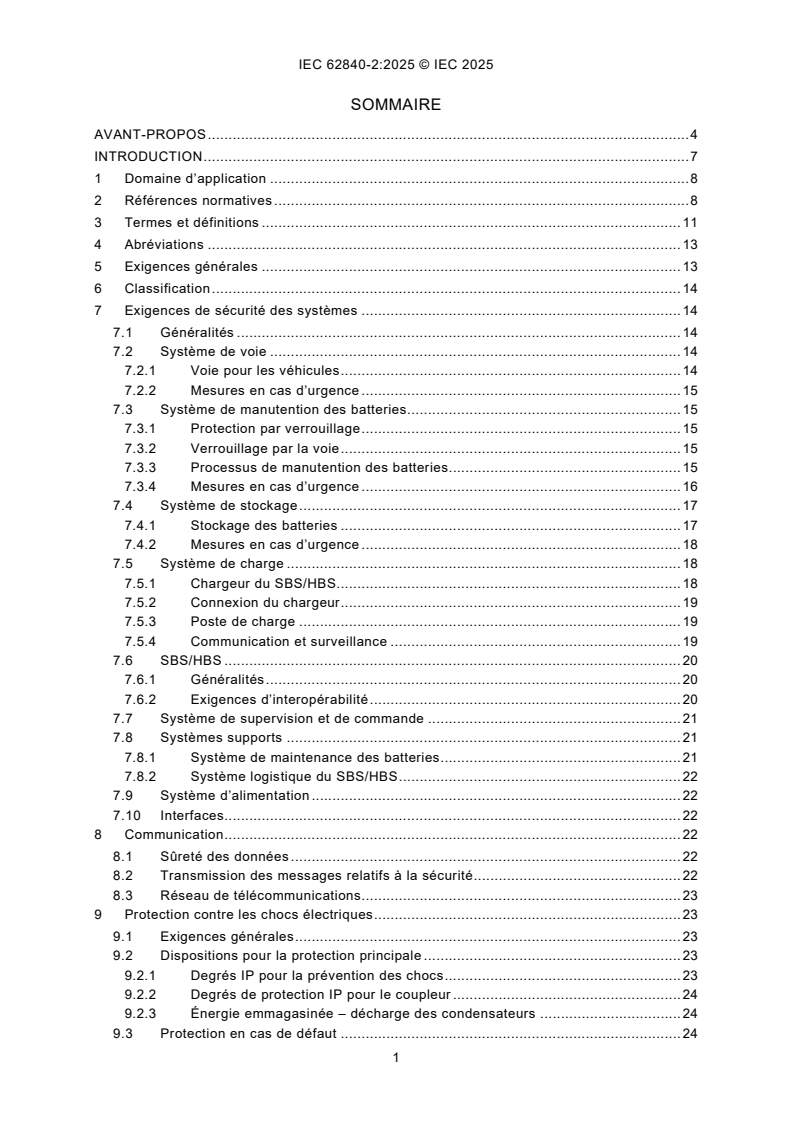
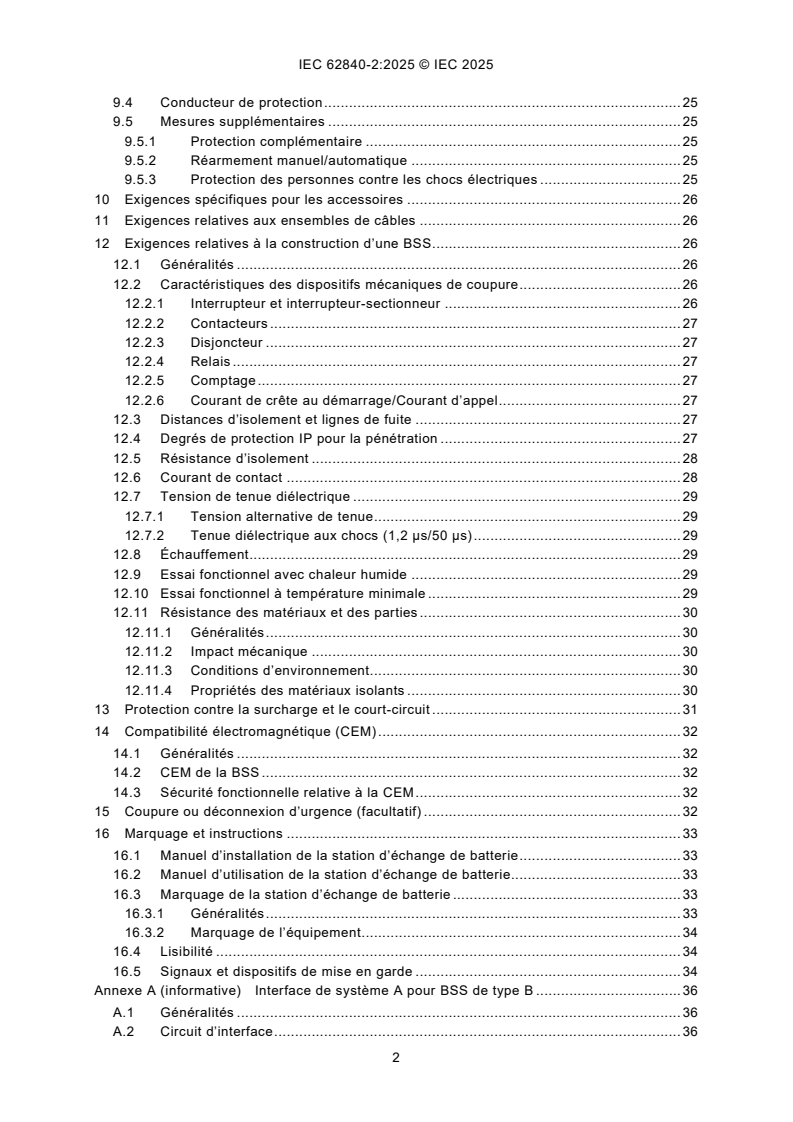
IEC 62840-2:2025 - Système d'échange de batterie de véhicule électrique - Partie 2: Exigences de sécurité/7/2025
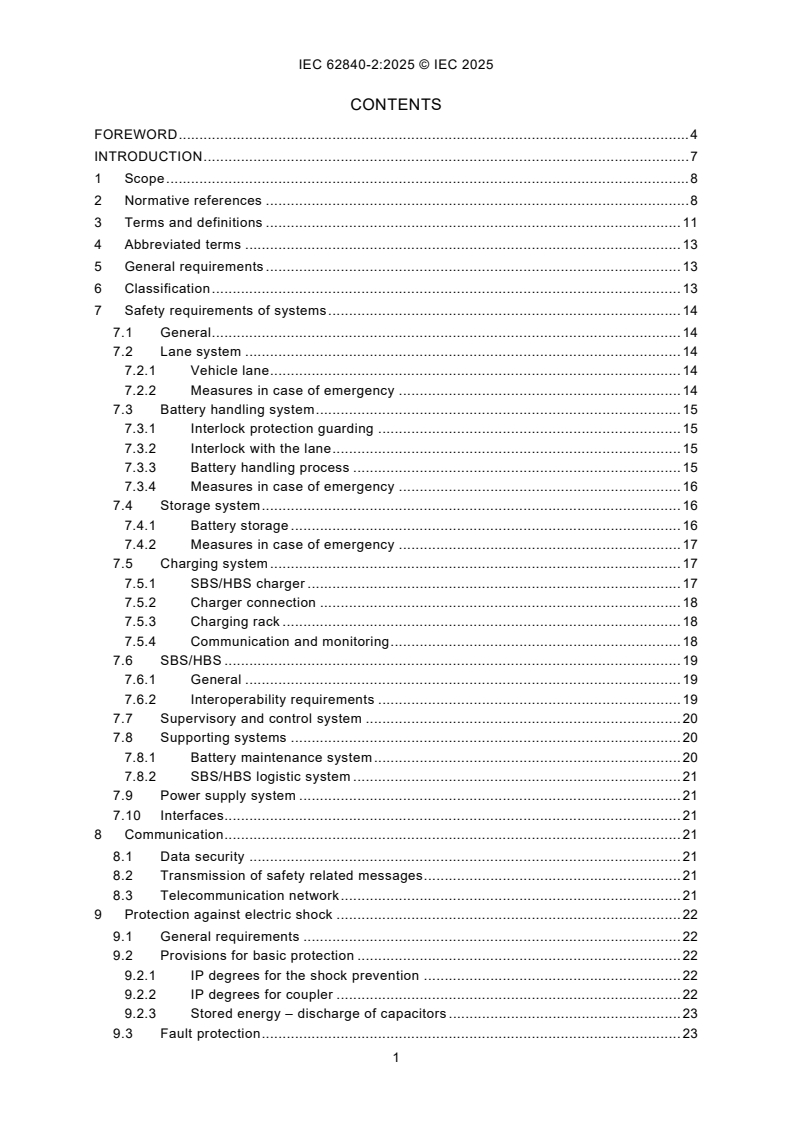
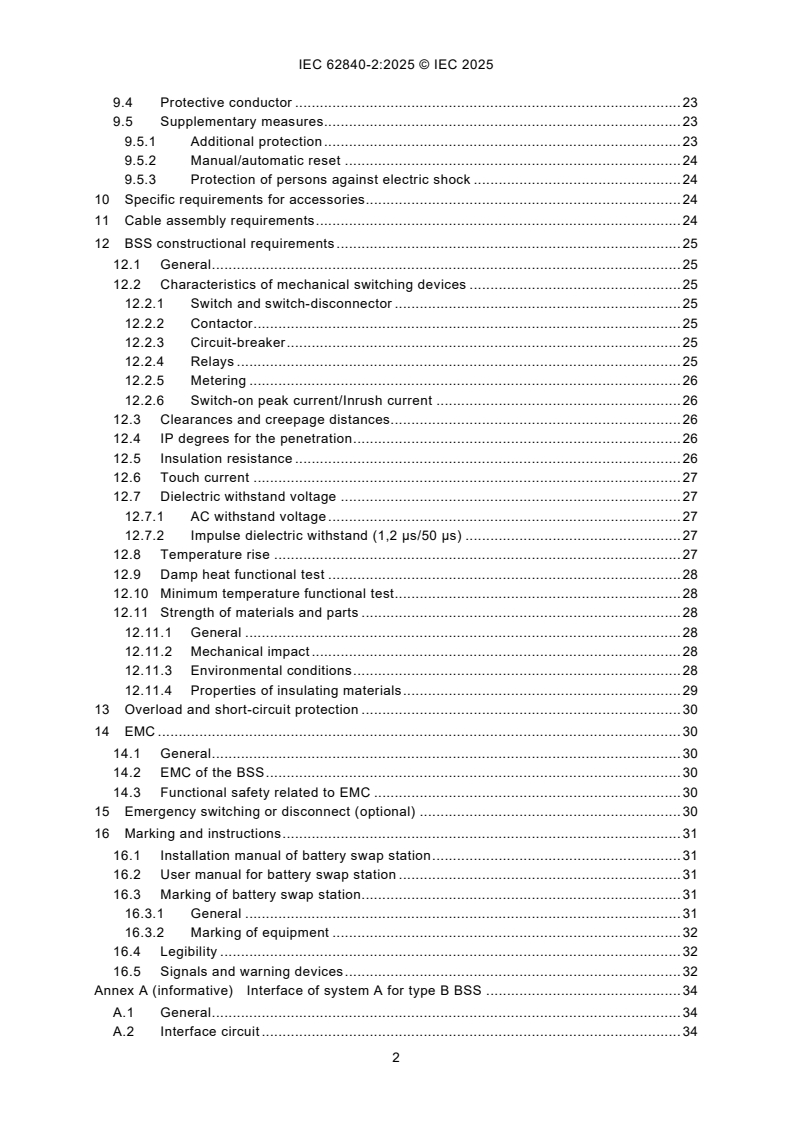
IEC 62840-2:2025 - Electric vehicle battery swap system - Part 2: Safety requirements/7/2025
Overview
IEC 62840-2:2025 - "Electric vehicle battery swap system - Part 2: Safety requirements" - defines safety, security and EMC requirements for battery swap systems used with swappable battery systems (SBS) and handheld-swappable battery systems (HBS) for electric vehicles (EVs). Applicable to battery swap stations (BSS) connected to the supply network (up to 1 000 V AC or 1 500 V DC, per IEC 60038) or supplied from on-site storage (e.g., buffer batteries). This second edition (2025) is a technical revision expanding scope and tightening requirements for interoperability, electrical/mechanical safety, data security and EMC.
Key topics and technical requirements
- Scope & applicability
- Safety requirements for BSS handling one or more SBS/HBS
- Excludes BSS/EV maintenance aspects, trolley buses, rail vehicles and primary off‑road vehicles
- Bidirectional energy transfer requirements are under consideration
- System safety: lane systems, automated battery handling, storage, charging racks, supervisory/control and supporting systems with emergency measures and interlocks
- Interoperability: stricter interface specifications and defined state transition protocols to ensure multi-vendor SBS/HBS compatibility
- Electrical safety & shock protection: enhanced protection levels for BSS, specified capacitor discharge time limits and measures against direct/indirect contact
- Overload & short-circuit protection: strengthened testing methods and overcurrent protection specifications
- Mechanical safety: enhanced requirements for automated handling systems aligned with ISO 10218-1 / ISO 10218-2
- Communication & cybersecurity: data security, safety message transmission protocols and integration of telecommunication network requirements
- Electromagnetic compatibility (EMC): upgraded EMC resilience and EMC-related functional safety measures
- Marking & instructions: installation and user manuals, legible markings, signals and warnings for safe operation
Practical applications and users
Who uses IEC 62840-2:2025:
- BSS designers and manufacturers ensuring compliant hardware and mechanical designs
- EV OEMs and battery system suppliers validating SBS/HBS interoperability with swap stations
- System integrators and automation engineers implementing control, safety interlocks and telecommunication links
- Certification and testing laboratories performing safety, EMC and overload/short‑circuit testing
- Infrastructure owners, utilities and regulators for procurement, installation and regulatory compliance Practical uses include design validation, safety risk assessment, interoperability testing, commissioning checklists and compliance documentation.
Related standards
- IEC 62840-1:2025 - to be read in conjunction with this document (system definitions and general requirements)
- IEC 60038 - voltage classifications referenced for supply limits
- ISO 10218-1 / ISO 10218-2 - referenced for mechanical safety of automated handling
Keywords: IEC 62840-2:2025, battery swap system, electric vehicle, battery swap station (BSS), swappable battery system (SBS), handheld-swappable battery system (HBS), safety requirements, interoperability, EMC, electric shock protection, data security.
Relations
- Effective Date
- 05-Sep-2023
Buy Documents
IEC 62840-2:2025 - Electric vehicle battery swap system - Part 2: Safety requirements/7/2025
REDLINE IEC 62840-2:2025 CMV - Electric vehicle battery swap system - Part 2: Safety requirements Released:7/7/2025
IEC 62840-2:2025 - Système d'échange de batterie de véhicule électrique - Partie 2: Exigences de sécurité/7/2025
IEC 62840-2:2025 - Electric vehicle battery swap system - Part 2: Safety requirements/7/2025
Get Certified
Connect with accredited certification bodies for this standard

TÜV Rheinland
TÜV Rheinland is a leading international provider of technical services.

TÜV SÜD
TÜV SÜD is a trusted partner of choice for safety, security and sustainability solutions.

DEKRA Certification Inc.
DEKRA US certification services.
Sponsored listings
Frequently Asked Questions
IEC 62840-2:2025 is a standard published by the International Electrotechnical Commission (IEC). Its full title is "Electric vehicle battery swap system - Part 2: Safety requirements". This standard covers: IEC 62840-2:2025 provides the safety requirements for a battery swap system, for the purposes of swapping swappable battery system (SBS)/handheld-swappable battery system (HBS) of electric vehicles. The battery swap system is intended to be connected to the supply network. The power supply is up to 1 000 V AC or up to 1 500 V DC in accordance with IEC 60038. This document also applies to battery swap systems supplied from on-site storage systems (e.g. buffer batteries). Aspects covered in this document: • safety requirements of the battery swap system and its systems; • security requirements for communication; • electromagnetic compatibility (EMC); • marking and instructions; • protection against electric shock and other hazards. This document is applicable to battery swap systems for EV equipped with one or more SBS/HBS. This document is not applicable to • aspects related to maintenance and service of the battery swap station (BSS), • trolley buses, rail vehicles and vehicles designed primarily for use off-road, and • maintenance and service of EVs. Requirements for bidirectional energy transfer are under consideration This second edition cancels and replaces the first edition published in 2016. This edition constitutes a technical revision. This edition includes the following significant technical changes with respect to the previous edition: a) expands the scope to encompass both swappable battery systems (SBS) and handheld swappable battery systems (HBS); b) introduces stricter interoperability requirements through detailed system interface specifications and defined state transition protocols; c) enhances data security by defining safety message transmission protocols and integrating telecom network requirements; d) increases electrical safety protection levels for battery swap stations (BSS) with specified capacitor discharge time limits to mitigate electric shock risks; e) introduces enhanced mechanical safety requirements for automated battery handling systems, with technical alignment to ISO 10218-1 and ISO 10218-2; f) strengthens overload and short-circuit protection for BSS through standardized testing methods and overcurrent protection specifications; g) defines upgraded electromagnetic compatibility (EMC) standards to ensure system resilience against external interference, supplemented with EMC-related functional safety measures. This document is to be read in conjunction with IEC 62840-1:2025.
IEC 62840-2:2025 provides the safety requirements for a battery swap system, for the purposes of swapping swappable battery system (SBS)/handheld-swappable battery system (HBS) of electric vehicles. The battery swap system is intended to be connected to the supply network. The power supply is up to 1 000 V AC or up to 1 500 V DC in accordance with IEC 60038. This document also applies to battery swap systems supplied from on-site storage systems (e.g. buffer batteries). Aspects covered in this document: • safety requirements of the battery swap system and its systems; • security requirements for communication; • electromagnetic compatibility (EMC); • marking and instructions; • protection against electric shock and other hazards. This document is applicable to battery swap systems for EV equipped with one or more SBS/HBS. This document is not applicable to • aspects related to maintenance and service of the battery swap station (BSS), • trolley buses, rail vehicles and vehicles designed primarily for use off-road, and • maintenance and service of EVs. Requirements for bidirectional energy transfer are under consideration This second edition cancels and replaces the first edition published in 2016. This edition constitutes a technical revision. This edition includes the following significant technical changes with respect to the previous edition: a) expands the scope to encompass both swappable battery systems (SBS) and handheld swappable battery systems (HBS); b) introduces stricter interoperability requirements through detailed system interface specifications and defined state transition protocols; c) enhances data security by defining safety message transmission protocols and integrating telecom network requirements; d) increases electrical safety protection levels for battery swap stations (BSS) with specified capacitor discharge time limits to mitigate electric shock risks; e) introduces enhanced mechanical safety requirements for automated battery handling systems, with technical alignment to ISO 10218-1 and ISO 10218-2; f) strengthens overload and short-circuit protection for BSS through standardized testing methods and overcurrent protection specifications; g) defines upgraded electromagnetic compatibility (EMC) standards to ensure system resilience against external interference, supplemented with EMC-related functional safety measures. This document is to be read in conjunction with IEC 62840-1:2025.
IEC 62840-2:2025 is classified under the following ICS (International Classification for Standards) categories: 43.120 - Electric road vehicles. The ICS classification helps identify the subject area and facilitates finding related standards.
IEC 62840-2:2025 has the following relationships with other standards: It is inter standard links to IEC 62840-2:2016. Understanding these relationships helps ensure you are using the most current and applicable version of the standard.
IEC 62840-2:2025 is available in PDF format for immediate download after purchase. The document can be added to your cart and obtained through the secure checkout process. Digital delivery ensures instant access to the complete standard document.
Standards Content (Sample)
IEC 62840-2 ®
Edition 2.0 2025-07
INTERNATIONAL
STANDARD
Electric vehicle battery swap system -
Part 2: Safety requirements
ICS 43.120 ISBN 978-2-8327-0531-5
All rights reserved. Unless otherwise specified, no part of this publication may be reproduced or utilized in any form or
by any means, electronic or mechanical, including photocopying and microfilm, without permission in writing from either
IEC or IEC's member National Committee in the country of the requester. If you have any questions about IEC copyright
or have an enquiry about obtaining additional rights to this publication, please contact the address below or your local
IEC member National Committee for further information.
IEC Secretariat Tel.: +41 22 919 02 11
3, rue de Varembé info@iec.ch
CH-1211 Geneva 20 www.iec.ch
Switzerland
About the IEC
The International Electrotechnical Commission (IEC) is the leading global organization that prepares and publishes
International Standards for all electrical, electronic and related technologies.
About IEC publications
The technical content of IEC publications is kept under constant review by the IEC. Please make sure that you have the
latest edition, a corrigendum or an amendment might have been published.
IEC publications search - IEC Products & Services Portal - products.iec.ch
webstore.iec.ch/advsearchform Discover our powerful search engine and read freely all the
The advanced search enables to find IEC publications by a publications previews, graphical symbols and the glossary.
variety of criteria (reference number, text, technical With a subscription you will always have access to up to date
committee, …). It also gives information on projects, content tailored to your needs.
replaced and withdrawn publications.
Electropedia - www.electropedia.org
The world's leading online dictionary on electrotechnology,
IEC Just Published - webstore.iec.ch/justpublished
Stay up to date on all new IEC publications. Just Published containing more than 22 500 terminological entries in English
details all new publications released. Available online and and French, with equivalent terms in 25 additional languages.
once a month by email. Also known as the International Electrotechnical Vocabulary
(IEV) online.
IEC Customer Service Centre - webstore.iec.ch/csc
If you wish to give us your feedback on this publication or
need further assistance, please contact the Customer
Service Centre: sales@iec.ch.
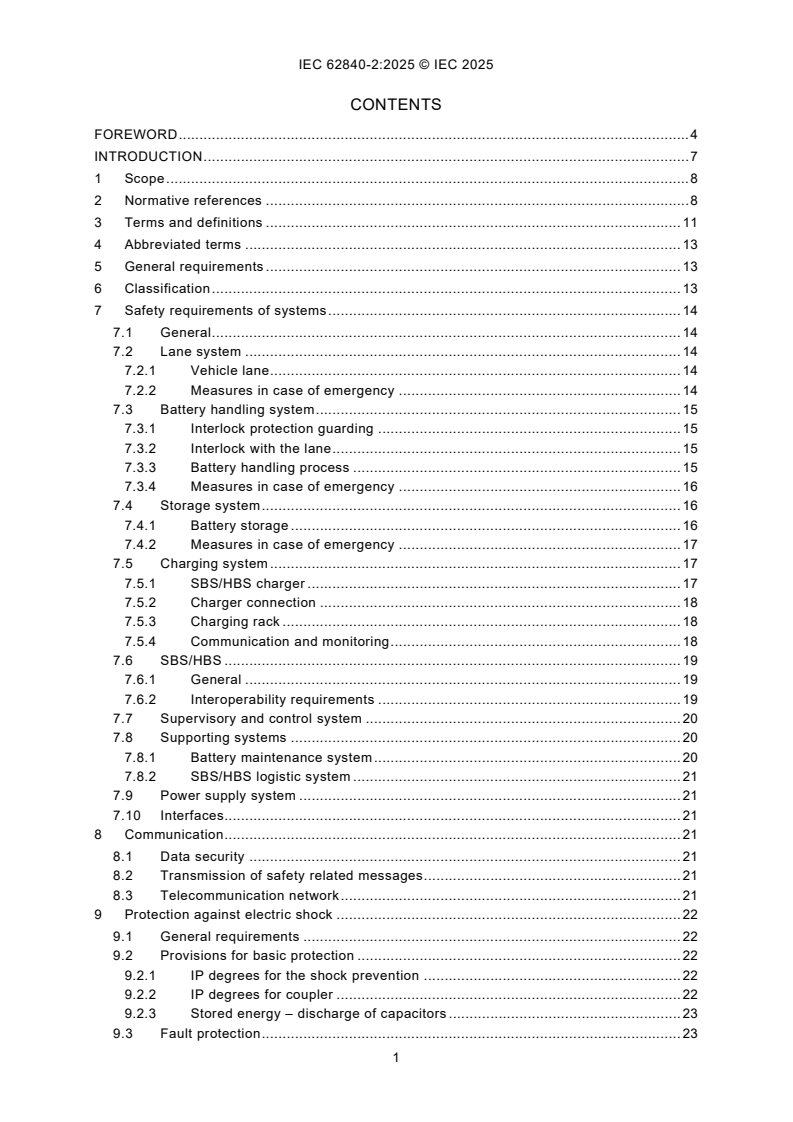
CONTENTS
FOREWORD . 4
INTRODUCTION . 7
1 Scope . 8
2 Normative references . 8
3 Terms and definitions . 11
4 Abbreviated terms . 13
5 General requirements . 13
6 Classification . 13
7 Safety requirements of systems . 14
7.1 General . 14
7.2 Lane system . 14
7.2.1 Vehicle lane . 14
7.2.2 Measures in case of emergency . 14
7.3 Battery handling system . 15
7.3.1 Interlock protection guarding . 15
7.3.2 Interlock with the lane . 15
7.3.3 Battery handling process . 15
7.3.4 Measures in case of emergency . 16
7.4 Storage system . 16
7.4.1 Battery storage . 16
7.4.2 Measures in case of emergency . 17
7.5 Charging system . 17
7.5.1 SBS/HBS charger . 17
7.5.2 Charger connection . 18
7.5.3 Charging rack . 18
7.5.4 Communication and monitoring . 18
7.6 SBS/HBS . 19
7.6.1 General . 19
7.6.2 Interoperability requirements . 19
7.7 Supervisory and control system . 20
7.8 Supporting systems . 20
7.8.1 Battery maintenance system . 20
7.8.2 SBS/HBS logistic system . 21
7.9 Power supply system . 21
7.10 Interfaces. 21
8 Communication . 21
8.1 Data security . 21
8.2 Transmission of safety related messages . 21
8.3 Telecommunication network . 21
9 Protection against electric shock . 22
9.1 General requirements . 22
9.2 Provisions for basic protection . 22
9.2.1 IP degrees for the shock prevention . 22
9.2.2 IP degrees for coupler . 22
9.2.3 Stored energy – discharge of capacitors . 23
9.3 Fault protection . 23
9.4 Protective conductor . 23
9.5 Supplementary measures. 23
9.5.1 Additional protection . 23
9.5.2 Manual/automatic reset . 24
9.5.3 Protection of persons against electric shock . 24
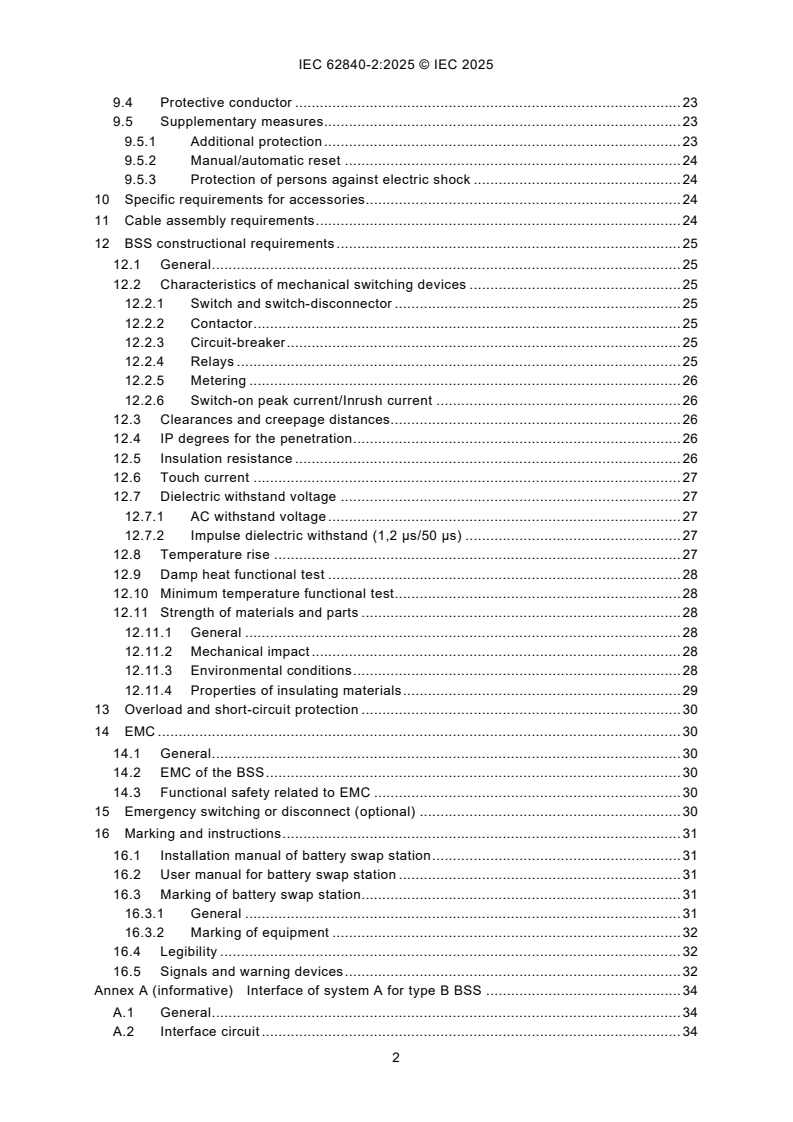
10 Specific requirements for accessories. 24
11 Cable assembly requirements . 24
12 BSS constructional requirements . 25
12.1 General . 25
12.2 Characteristics of mechanical switching devices . 25
12.2.1 Switch and switch-disconnector . 25
12.2.2 Contactor . 25
12.2.3 Circuit-breaker . 25
12.2.4 Relays . 25
12.2.5 Metering . 26
12.2.6 Switch-on peak current/Inrush current . 26
12.3 Clearances and creepage distances. 26
12.4 IP degrees for the penetration . 26
12.5 Insulation resistance . 26
12.6 Touch current . 27
12.7 Dielectric withstand voltage . 27
12.7.1 AC withstand voltage . 27
12.7.2 Impulse dielectric withstand (1,2 µs/50 µs) . 27
12.8 Temperature rise . 27
12.9 Damp heat functional test . 28
12.10 Minimum temperature functional test . 28
12.11 Strength of materials and parts . 28
12.11.1 General . 28
12.11.2 Mechanical impact . 28
12.11.3 Environmental conditions . 28
12.11.4 Properties of insulating materials . 29
13 Overload and short-circuit protection . 30
14 EMC . 30
14.1 General . 30
14.2 EMC of the BSS . 30
14.3 Functional safety related to EMC . 30
15 Emergency switching or disconnect (optional) . 30
16 Marking and instructions . 31
16.1 Installation manual of battery swap station . 31
16.2 User manual for battery swap station . 31
16.3 Marking of battery swap station. 31
16.3.1 General . 31
16.3.2 Marking of equipment . 32
16.4 Legibility . 32
16.5 Signals and warning devices . 32
Annex A (informative) Interface of system A for type B BSS . 34
A.1 General . 34
A.2 Interface circuit . 34
A.2.1 Interface circuit diagram . 34
A.2.2 Control pilot circuit . 35
A.3 State transition of charging control process . 36
Annex B (informative) Interface of system B for type B BSS . 38
B.1 General . 38
B.2 Interface circuit . 38
B.3 State transition of charging control process . 39
Bibliography . 41
Figure A.1 – Example of Interface circuit for charging control of system A station . 35
Figure A.2 – State transition diagram of charging process for system A station . 37
Figure B.1 – Example of interface circuit for charging control of system B station . 39
Figure B.2 – State transition diagram of charging process for system B station . 40
Table 1 – Interoperability requirements . 19
Table 2 – Touch current limits . 27
Table A.1 – Voltage of control pilot circuit . 36
INTERNATIONAL ELECTROTECHNICAL COMMISSION
____________
Electric vehicle battery swap system -
Part 2: Safety requirements
FOREWORD
1) The International Electrotechnical Commission (IEC) is a worldwide organization for standardization comprising
all national electrotechnical committees (IEC National Committees). The object of IEC is to promote international
co-operation on all questions concerning standardization in the electrical and electronic fields. To this end and
in addition to other activities, IEC publishes International Standards, Technical Specifications, Technical Reports,
Publicly Available Specifications (PAS) and Guides (hereafter referred to as "IEC Publication(s)"). Their
preparation is entrusted to technical committees; any IEC National Committee interested in the subject dealt with
may participate in this preparatory work. International, governmental and non-governmental organizations liaising
with the IEC also participate in this preparation. IEC collaborates closely with the International Organization for
Standardization (ISO) in accordance with conditions determined by agreement between the two organizations.
2) The formal decisions or agreements of IEC on technical matters express, as nearly as possible, an international
consensus of opinion on the relevant subjects since each technical committee has representation from all
interested IEC National Committees.
3) IEC Publications have the form of recommendations for international use and are accepted by IEC National
Committees in that sense. While all reasonable efforts are made to ensure that the technical content of IEC
Publications is accurate, IEC cannot be held responsible for the way in which they are used or for any
misinterpretation by any end user.
4) In order to promote international uniformity, IEC National Committees undertake to apply IEC Publications
transparently to the maximum extent possible in their national and regional publications. Any divergence between
any IEC Publication and the corresponding national or regional publication shall be clearly indicated in the latter.
5) IEC itself does not provide any attestation of conformity. Independent certification bodies provide conformity
assessment services and, in some areas, access to IEC marks of conformity. IEC is not responsible for any
services carried out by independent certification bodies.
6) All users should ensure that they have the latest edition of this publication.
7) No liability shall attach to IEC or its directors, employees, servants or agents including individual experts and
members of its technical committees and IEC National Committees for any personal injury, property damage or
other damage of any nature whatsoever, whether direct or indirect, or for costs (including legal fees) and
expenses arising out of the publication, use of, or reliance upon, this IEC Publication or any other IEC
Publications.
8) Attention is drawn to the Normative references cited in this publication. Use of the referenced publications is
indispensable for the correct application of this publication.
9) IEC draws attention to the possibility that the implementation of this document may involve the use of (a)
patent(s). IEC takes no position concerning the evidence, validity or applicability of any claimed patent rights in
respect thereof. As of the date of publication of this document, IEC had not received notice of (a) patent(s), which
may be required to implement this document. However, implementers are cautioned that this may not represent
the latest information, which may be obtained from the patent database available at https://patents.iec.ch. IEC
shall not be held responsible for identifying any or all such patent rights.
IEC 62840-2 has been prepared by IEC technical committee 69: Electrical power/energy
transfer systems for electrically propelled road vehicles and industrial trucks. It is an
International Standard.
This second edition cancels and replaces the first edition published in 2016. This edition
constitutes a technical revision.
This edition includes the following significant technical changes with respect to the previous
edition:
a) expands the scope to encompass both swappable battery systems (SBS) and handheld
swappable battery systems (HBS);
b) introduces stricter interoperability requirements through detailed system interface
specifications and defined state transition protocols;
c) enhances data security by defining safety message transmission protocols and integrating
telecom network requirements;
d) increases electrical safety protection levels for battery swap stations (BSS) with specified
capacitor discharge time limits to mitigate electric shock risks;
e) introduces enhanced mechanical safety requirements for automated battery handling
systems, with technical alignment to ISO 10218-1 and ISO 10218-2;
f) strengthens overload and short-circuit protection for BSS through standardized testing
methods and overcurrent protection specifications;
g) defines upgraded electromagnetic compatibility (EMC) standards to ensure system
resilience against external interference, supplemented with EMC-related functional safety
measures.
The text of this International Standard is based on the following documents:
Draft Report on voting
69/1046/FDIS 69/1062/RVD
Full information on the voting for its approval can be found in the report on voting indicated in
the above table.
The language used for the development of this International Standard is English.
This document was drafted in accordance with ISO/IEC Directives, Part 2, and developed in
accordance with ISO/IEC Directives, Part 1 and ISO/IEC Directives, IEC Supplement, available
at www.iec.ch/members_experts/refdocs. The main document types developed by IEC are
described in greater detail at www.iec.ch/publications.
This document is to be read in conjunction with IEC 62840-1:2025.
In this document, the following print types are used:
– test specifications: in italic type;
The following differing practices of a less permanent nature exist in the countries indicated
below:
– 7.5.4: the battery passport defines the necessary data to be transmitted (EU).
– 7.6.1: RCDs of type AC may be used (JP).
– 7.6.1: a device which measures leakage current over a range of frequencies and trips at
pre-defined levels of leakage current, based upon the frequency, is required (US).
– 9.4: the size and rating of the protective conductor is determined by national codes and
regulations (CA, US, JP).
– 9.5.1: RCDs of type AC may be used (JP).
– 9.5.1: a device which measures leakage current over a range of frequencies and trips at
pre-defined levels of leakage current, based upon the frequency, is required (US).
– 12.2.1: national standards or regulations provide the different requirements (JP).
– 12.2.2: national standards or regulations provide the different requirements (JP).
– Clause 13: the methods of protection against overcurrent and overvoltage are in accordance
with national codes (US, JP, CA).
– Clause 13: the branch circuit overcurrent protection is based upon 125 % of the equipment
rating (US, CA).
– Clause 13: EV charging is considered a continuous load and is limited to 80 % of the branch
circuit fuse or circuit breaker rating by national rules (US, CA).
– Clause 13: the equipment earthing path complies with the test requirement in national
standard (JP).
– 16.5: three-part cautionary statements are required (US).
– 16.5: the use of specific language(s) is covered by legal requirements (CN).
A list of all parts in the IEC 62840 series, published under the general title Electric vehicle
battery swap system, can be found on the IEC website.
The committee has decided that the contents of this document will remain unchanged until the
stability date indicated on the IEC website under webstore.iec.ch in the data related to the
specific document. At this date, the document will be
• reconfirmed,
• withdrawn, or
• revised.
INTRODUCTION
The purpose of the battery swap system is to provide energy partly or in total to electric vehicles
(EV) through fast replacement of their swappable battery systems (SBS) or handheld-
swappable battery systems (HBS). The battery swap system aims to provide energy to electric
road vehicles by quickly replacing their swappable battery system or handheld-swappable
battery system. This may help alleviate range anxiety and make longer distance travel more
convenient.
As there is a possibility to charge the batteries after their removal from the vehicle in various
ways, the impact of this process on the critical infrastructure of the electrical grid is minimized.
Battery swap stations mainly include one or more of the following functions:
• swap of EV SBS or HBS;
• storage of EV SBS or HBS;
• charging and cooling of EV SBS or HBS;
• testing, maintenance and safety management of EV SBS or HBS.
This document serves as a generic approach for safety during the lifecycle of battery swap
systems and stations for electric vehicles.
This document contains the general safety requirements for battery swap system of SBS/HBS.
The specific safety requirements for dedicated system are described in other parts of the
IEC 62840 series.
1 Scope
This part of IEC 62840 provides the safety requirements for a battery swap system, for the
purposes of swapping swappable battery system (SBS)/handheld-swappable battery system
(HBS) of electric vehicles. The battery swap system is intended to be connected to the supply
network. The power supply is up to 1 000 V AC or up to 1 500 V DC in accordance with
IEC 60038.
This document also applies to battery swap systems supplied from on-site storage systems (e.g.
buffer batteries).
Aspects covered in this document:
• safety requirements of the battery swap system and its subsystems;
• security requirements for communication;
• electromagnetic compatibility (EMC);
• marking and instructions;
• protection against electric shock and other hazards.
This document is applicable to battery swap systems for EV equipped with one or more
SBS/HBS.
This document is not applicable to
• aspects related to maintenance and service of the battery swap station (BSS),
• trolley buses, rail vehicles and vehicles designed primarily for use off-road, and
• maintenance and service of EVs.
Requirements for bidirectional energy transfer are under consideration.
2 Normative references
The following documents are referred to in the text in such a way that some or all of their content
constitutes requirements of this document. For dated references, only the edition cited applies.
For undated references, the latest edition of the referenced document (including any
amendments) applies.
IEC 60038, IEC standard voltages
IEC 60068-2-1, Environmental testing – Part 2-1: Tests – Test A: Cold
IEC 60068-2-78, Environmental testing – Part 2-78: Tests – Test Cab: Damp heat, steady state
IEC 60112, Method for the determination of the proof and the comparative tracking indices of
solid insulating materials
IEC 60127 (all parts), Miniature fuses
IEC 60204-1, Safety of machinery – Electrical equipment of machines – General requirements
IEC 60269 (all parts), Low-voltage fuses
IEC 60364 (all parts), Low-voltage electrical installations
IEC 60364-4-41:2005, Low-voltage electrical installations – Part 4-41: Protection for safety –
Protection against electric shock
IEC 60364-4-41:2005/AMD1:2017
IEC 60364-5-54, Low-voltage electrical installations – Part 5-54: Selection and erection of
electrical equipment – Earthing arrangements and protective conductors
IEC 60479 (all parts), Effects of current on human beings and livestock
IEC 60529, Degrees of protection provided by enclosures (IP Code)
IEC 60664-1:2020, Insulation coordination for equipment within low-voltage systems – Part 1:
Principles, requirements and tests
IEC 60695-2-11, Fire hazard testing – Part 2-11: Glowing/hot-wire based test methods – Glow-
wire flammability test method for end-products (GWEPT)
IEC 60695-10-2, Fire hazard testing – Part 10-2: Abnormal heat – Ball pressure test method
IEC 60755, General safety requirements for residual current operated protective devices
IEC 60898 (all parts), Electrical accessories – Circuit-breakers for overcurrent protection for
household and similar installations
IEC 60898-1, Electrical accessories – Circuit-breakers for overcurrent protection for household
and similar installations – Part 1: Circuit-breakers for a.c. operation
IEC 60947-2, Low-voltage switchgear and control gear – Part 2: Circuit-breakers
IEC 60947-3, Low-voltage switchgear and controlgear – Part 3: Switches, disconnectors,
switch-disconnectors and fuse-combination units
IEC 60947-4-1, Low-voltage switchgear and controlgear – Part 4-1: Contactors and motor-
starters – Electromechanical contactors and motor-starters
IEC 60947-6-2, Low-voltage switchgear and controlgear – Part 6-2: Multiple function equipment
– Control and protective switching devices (or equipment) (CPS)
IEC 60990, Methods of measurement of touch current and protective conductor current
IEC 61000-6-7, Electromagnetic compatibility (EMC) – Part 6-7: Generic standards – Immunity
requirements equipment intended to perform functions in a safety-related system (functional
safety) in industrial locations
IEC 61008 (all parts), Residual current operated circuit-breakers without integral overcurrent
protection for household and similar uses (RCCBs)
IEC 61008-1, Residual current operated circuit-breakers without integral overcurrent protection
for household and similar uses (RCCBs) – Part 1: General rules
IEC 61009 (all parts), Residual current operated circuit-breakers with integral overcurrent
protection for household and similar uses (RCBOs)
IEC 61009-1, Residual current operated circuit-breakers with integral overcurrent protection for
household and similar uses (RCBOs) – Part 1: General rules
IEC 61140, Protection against electric shock – Common aspects for installation and equipment
IEC 61439-1:2020, Low-voltage switchgear and controlgear assemblies – Part 1: General rules
IEC 61439-7:2022, Low-voltage switchgear and controlgear assemblies – Part 7: Assemblies
for specific applications such as marinas, camping sites, market squares, electric vehicle
charging stations
IEC 61508-1, Functional safety of electrical/electronic/programmable electronic safety-related
systems – Part 1: General requirements
IEC 61511-1, Functional safety – Safety instrumented systems for the process industry sector
– Part 1: Framework, definitions, system, hardware and application programming requirements
IEC 61784-3, Industrial communication networks – Profiles – Part 3: Functional safety
fieldbuses – General rules and profile definitions
IEC 61810-1, Electromechanical elementary relays – Part 1: General and safety requirements
IEC 61851-1:2017, Electric vehicle conductive charging system – Part 1: General requirements
IEC 61851-21-2, Electric vehicle conductive charging system – Part 21-2: Electric vehicle
requirements for conductive connection to an AC/DC supply – EMC requirements for off board
electric vehicle charging systems
IEC 61851-23:2023, Electric vehicle conductive charging system – Part 23: DC electric vehicle
supply equipment
IEC 62052-11, Electricity metering equipment – General requirements, tests and test conditions
– Part 11: Metering equipment
IEC 62262, Degrees of protection provided by enclosures for electrical equipment against
external mechanical impacts (IK code)
IEC 62368-1:2023, Audio/video, information and communication technology equipment – Part 1:
Safety requirements
IEC 62423, Type F and type B residual current operated circuit-breakers with and without
integral overcurrent protection for household and similar uses
IEC 62477-1:2022, Safety requirements for power electronic converter systems and equipment
– Part 1: General
IEC 62840-1:2025, Electric vehicle battery swap system – Part 1: General and guidance
IEC 63066: — , Low-voltage docking connectors for removable energy storage units
ISO 10218-1:2011, Robots and robotic devices – Safety requirements for industrial robots –
Part 1: Robots
ISO 10218-2:2011, Robots and robotic devices – Safety requirements for industrial robots –
Part 2: Robot systems and integration
___________
Under preparation. Stage at the time of publication: IEC CCDV 63066:2024
ISO 13849-1, Safety of machinery –Safety-related parts of control systems – Part 1: General
principles for design
ISO 14119, Safety of machinery – Interlocking devices associated with guards – Principles for
design and selection
ISO 19353:2019, Safety of machinery – Fire prevention and fire protection
3 Terms and definitions
For the purposes of this document, the terms and definitions given in IEC 62840-1 and the
following apply.
ISO and IEC maintain terminology databases for use in standardization at the following
addresses:
• IEC Electropedia: available at https://www.electropedia.org/
• ISO Online browsing platform: available at https://www.iso.org/obp
3.1
hazard
potential source of injury or death
3.2
operator
trained personnel who installs, operates, adjusts, maintains, cleans, repairs or works in the
battery swap station premises
3.3
direct contact
electric contact of persons or animals with live parts
[SOURCE: IEC 60050-195:2021, 195-06-03, modified – The words "human beings or livestock"
have been replaced with "persons or animals".]
3.4
indirect contact
electric contact of persons or animals with exposed-conductive-parts which have become live
under fault conditions
[SOURCE: IEC 60050-195:2021, 195-06-04, modified – The words "human beings or livestock"
have been replaced with "persons or animals".]
3.5
live part
conductor or conductive part intended to be energized in normal operation, including a neutral
conductor, but by convention not a PEN conductor or PEM conductor or PEL conductor
[SOURCE: IEC 60050-195:2021, 195-02-19, modified – The domain has been deleted. The
words "conductor or" have been added in the definition, "mid-point conductor" has been
removed.]
3.6
risk
combination of the probability of occurrence of harm and the severity of that harm
Note 1 to entry: In French, the term "risque" also denotes the potential source of harm, in English "hazard" (see
903-01-02). See also ISO/IEC Guide 51:2014, 3.2.
[SOURCE: IEC 60050-903:2013, 903-01-07, modified – The reference to ISO/IEC Guide 51 has
been updated in the note to entry.]
3.7
real time
pertaining to the processing of data by a computer in connection with another process outside
the computer according to time requirements imposed by the outside process
[SOURCE: IEC 60050-171:2019,171-05-53]
3.8
alternating current
AC
electric current that is a periodic function of time with a zero direct component or, by extension,
a negligible direct component
[SOURCE: IEC 60050-131:2002, 131-11-24, modified – The abbreviated term "AC" has been
added. The note to entry has been deleted.]
3.9
direct current
DC
electric current that is time-independent or, by extension, periodic current, the direct component
of which is of primary importance
[SOURCE: IEC 60050-131:2002, 131-11-22, modified – The abbreviated term "DC" has been
added. The note to entry has been deleted.]
3.10
residual current device
RCD
mechanical switching device designed to make, carry and break currents under normal service
conditions and to cause the opening of the contacts when the residual current attains a given
value under specified conditions
[SOURCE: IEC 60050-442:2019, 442-05-02, modified – The words "or association of devices"
have been deleted.]
3.11
basic protection
protection against electric shock under fault-free conditions
[SOURCE: IEC 60050-195:2021, 195-06-01, modified – The word "normal" has been replaced
with "fault-free".]
3.12
fault protection
protection against electric shock under single fault conditions
[SOURCE: IEC 60050-195:2021, 195-06-02]
4 Abbreviated terms
IEC 62840-1:2025, Clause 4, applies.
5 General requirements
The battery swap system shall be rated for one, or a range of, standard nominal voltages
according to IEC 60038. The safe operation of a battery swap system will be achieved by
fulfilling the relevant requirements specified in this document, and compliance is checked by
carrying out all relevant tests.
The battery swap system shall be so designed and constructed that, in normal use, its
performance is reliable and minimizes the risk of danger to the human individuals, equipment
and surroundings.
The battery swap system shall be designed to consider the environmental impact (dust, water,
ice, etc.) to the equipment or human safety. In general, this principle is achieved by fulfilling
the relevant requirements specified by this document and IEC 62840-1, together with
IEC 61851-21-2.
Compliance is checked by carrying out the relevant tests.
For robots and robotic devices and their integration into the BSS, a hazard identification and
risk assessment shall be provided according to ISO 10218-1:2011, Clause 4, or
ISO 10218-2:2011, Clause 4, and under consideration of ISO 10218-1:2011, Annex A and
Annex F, or ISO 10218-2:2011, Annex A and Annex G, depending on the application.
NOTE For BSS with more than one robot systems implemented in the same application, ISO 10218-2 is applicable.
Additional attention regarding hazards of fire shall be given by the risk assessment according
to ISO 19353:2019.
The hazards of fire tests may be conducted on separate samples at the discretion of the
manufacturer.
Unless otherwise specified, all other tests shall be carried out in the order of the clauses and
subclauses in this document.
The electrical interface and communication interface of a specific battery swap system shall be
defined in terms of safety and compatibility.
For additional informative details regarding type B BSS, refer to Annex A and Annex B.
6 Classification
IEC 62840-1:2025, Clause 6, applies.
7 Safety requirements of systems
7.1 General
For type A BSS, the battery swap system for electrical vehicles shall be in accordance with
IEC 60204-1, IEC 61511-1 and ISO 13849-1. Specific requirements are the subject of this
document.
For type B BSS, the battery swap system for electrical vehicles shall be in accordance with
IEC 62477-1. Specific requirements are the subject of this document.
7.2 Lane system
7.2.1 Vehicle lane
At the entrance to the lane, the EV information shall be identified and fed into the supervisor
and control system in order to use the right parameters and components for this vehicle. The
lane may include a cleaning station for the purposes of cleaning EV/battery parts before the
swap process starts. All safety and function relevant components shall be able to resist the
effect of automotive solvents and fluids.
Drivers and passengers may be allowed to stay on-board during the battery swap process. The
lane system shall be built in such a manner that humans and EVs are not at risk as a result of
movement of mechanical parts or as a result of open underground cavities. To protect the driver
and passengers, at least one of the following requirements shall be applied.
a) If the driver or passengers intend to get off the vehicle, a warning message or symbols shall
be displayed or a protection obstacle to prevent opening the vehicle doors shall be provided.
b) If the driver or passengers are getting off the vehicle, an emergency shutdown of the
swapping process shall be performed.
For the battery swap system which does not allow drivers and passengers to stay on-board
during the battery swap process, the safety measures shall be provided to pause/stop the
process when the drivers and passengers are still inside the vehicle.
7.2.2 Measures in case of emergency
During the movement of the vehicle within the lane system, an emergency stop measure shall
be provided to stop the movement in case of emergency.
The lane shall be equipped with suitable escape routes and emergency exits allowing people
(if on board), including disabled persons, children and infants, to evacuate from the lane area
in case of fire or another emergency. National or local regulations can apply.
Marking, routing and geometry of escape routes and exits can be subject to local regulations.
To ensure the fire protection purpose, one of the following measures, but not limited to, shall
be adopted in the system design of BSS:
– detection of the thermal changing (thermal detection, smoke detection, etc);
– separation of the original fire;
– fire extinguish system;
– insulated compartment of the batteries.
Local regulations can be applied to ensure fire protection.
7.3 Battery handling system
7.3.1 Interlock protection guarding
In semi-automatic or automatic mode, a door or a sensor shall be installed to prevent an
unauthorized person gaining access to the battery swap zone:
• if a door or access is opened, the system shall stop;
• the system shall only operate if all accesses are closed;
• a door should be opened from outside only if the system stops;
• a door, if one exists, shall be able to open from inside in any case;
• a restart should only be performed if all accesses are closed and no person is inside the
zone.
ISO 14119 applies.
7.3.2 Interlock with the lane
The battery handling system shall only be enabled to operate when the vehicle is immobilized
and the vehicle powertrain is turned off.
During the battery handling process, the vehicle on the lane shall be immobilized by specific
measures (e.g. chocking and blocking the wheels, hand braking, turning off the powertrain).
7.3.3 Battery handling process
The swapping shall only be initiated when confirmation is obtained that the SBS/HBS (and the
EV, if applicable) is ready for swapping.
Compliance is tested by design review or relying on the test of specific system.
The handling system shall ensure that the SBS/HBS is correctly placed and latched or unlatched,
if applicable, at each phase of the transport or movement. This includes placement in the EV
or in the storage system.
Compliance is tested by design review or relying on the test of specific system.
Battery handling systems shall have an emergency procedure when the SBS/HBS being
removed from vehicle is suffering from a contact welding malfunction.
Compliance is tested by design review.
Battery handling system shall have the function of detecting presence of objects on the passage
of the movement of the SBS/HBS that will hinder the operation (e.g., another HBS). In addition,
ISO 10218-2:2011, 5.10, shall be taken into consideration by establishing the risk assessment
as mentioned in Clause 7.
NOTE This function prevents a battery system from being loaded into a compartment, which is already occupied by
another HBS.
Compliance is checked by inspection.
In automatic mode and semi-automatic mode, the battery handling system shall communicate
with the supervisory and control system. The operator should control the battery handling
system remotely through the human machine interface (HMI) or a remote control device which
allows the operator to be located a safe distance away from any moving parts.
The battery handling system shall be able to detect if the SBS/HBS has been unlocked
successfully before it moves th
...
IEC 62840-2 ®
Edition 2.0 2025-07
INTERNATIONAL
STANDARD
COMMENTED VERSION
Electric vehicle battery swap system -
Part 2: Safety requirements
ICS 43.120 ISBN 978-2-8327-0567-4
All rights reserved. Unless otherwise specified, no part of this publication may be reproduced or utilized in any form or
by any means, electronic or mechanical, including photocopying and microfilm, without permission in writing from either
IEC or IEC's member National Committee in the country of the requester. If you have any questions about IEC copyright
or have an enquiry about obtaining additional rights to this publication, please contact the address below or your local
IEC member National Committee for further information.
IEC Secretariat Tel.: +41 22 919 02 11
3, rue de Varembé info@iec.ch
CH-1211 Geneva 20 www.iec.ch
Switzerland
About the IEC
The International Electrotechnical Commission (IEC) is the leading global organization that prepares and publishes
International Standards for all electrical, electronic and related technologies.
About IEC publications
The technical content of IEC publications is kept under constant review by the IEC. Please make sure that you have the
latest edition, a corrigendum or an amendment might have been published.
IEC publications search - IEC Products & Services Portal - products.iec.ch
webstore.iec.ch/advsearchform Discover our powerful search engine and read freely all the
The advanced search enables to find IEC publications by a publications previews, graphical symbols and the glossary.
variety of criteria (reference number, text, technical With a subscription you will always have access to up to date
committee, …). It also gives information on projects, content tailored to your needs.
replaced and withdrawn publications.
Electropedia - www.electropedia.org
The world's leading online dictionary on electrotechnology,
IEC Just Published - webstore.iec.ch/justpublished
Stay up to date on all new IEC publications. Just Published containing more than 22 500 terminological entries in English
details all new publications released. Available online and and French, with equivalent terms in 25 additional languages.
once a month by email. Also known as the International Electrotechnical Vocabulary
(IEV) online.
IEC Customer Service Centre - webstore.iec.ch/csc
If you wish to give us your feedback on this publication or
need further assistance, please contact the Customer
Service Centre: sales@iec.ch.
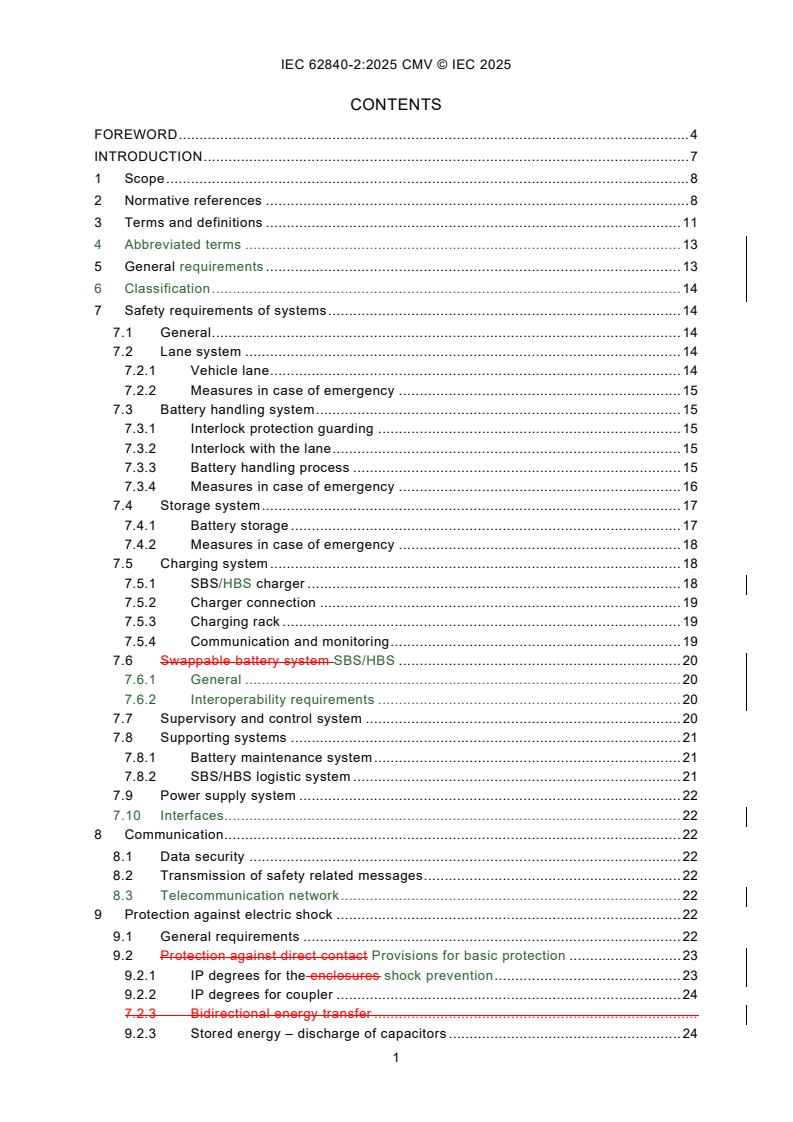
CONTENTS
FOREWORD . 4
INTRODUCTION . 7
1 Scope . 8
2 Normative references . 8
3 Terms and definitions . 11
4 Abbreviated terms . 13
5 General requirements . 13
6 Classification . 14
7 Safety requirements of systems . 14
7.1 General . 14
7.2 Lane system . 14
7.2.1 Vehicle lane . 14
7.2.2 Measures in case of emergency . 15
7.3 Battery handling system . 15
7.3.1 Interlock protection guarding . 15
7.3.2 Interlock with the lane . 15
7.3.3 Battery handling process . 15
7.3.4 Measures in case of emergency . 16
7.4 Storage system . 17
7.4.1 Battery storage . 17
7.4.2 Measures in case of emergency . 18
7.5 Charging system . 18
7.5.1 SBS/HBS charger . 18
7.5.2 Charger connection . 19
7.5.3 Charging rack . 19
7.5.4 Communication and monitoring . 19
7.6 Swappable battery system SBS/HBS . 20
7.6.1 General . 20
7.6.2 Interoperability requirements . 20
7.7 Supervisory and control system . 20
7.8 Supporting systems . 21
7.8.1 Battery maintenance system . 21
7.8.2 SBS/HBS logistic system . 21
7.9 Power supply system . 22
7.10 Interfaces. 22
8 Communication . 22
8.1 Data security . 22
8.2 Transmission of safety related messages . 22
8.3 Telecommunication network . 22
9 Protection against electric shock . 22
9.1 General requirements . 22
9.2 Protection against direct contact Provisions for basic protection . 23
9.2.1 IP degrees for the enclosures shock prevention . 23
9.2.2 IP degrees for coupler . 24
7.2.3 Bidirectional energy transfer .
9.2.3 Stored energy – discharge of capacitors . 24
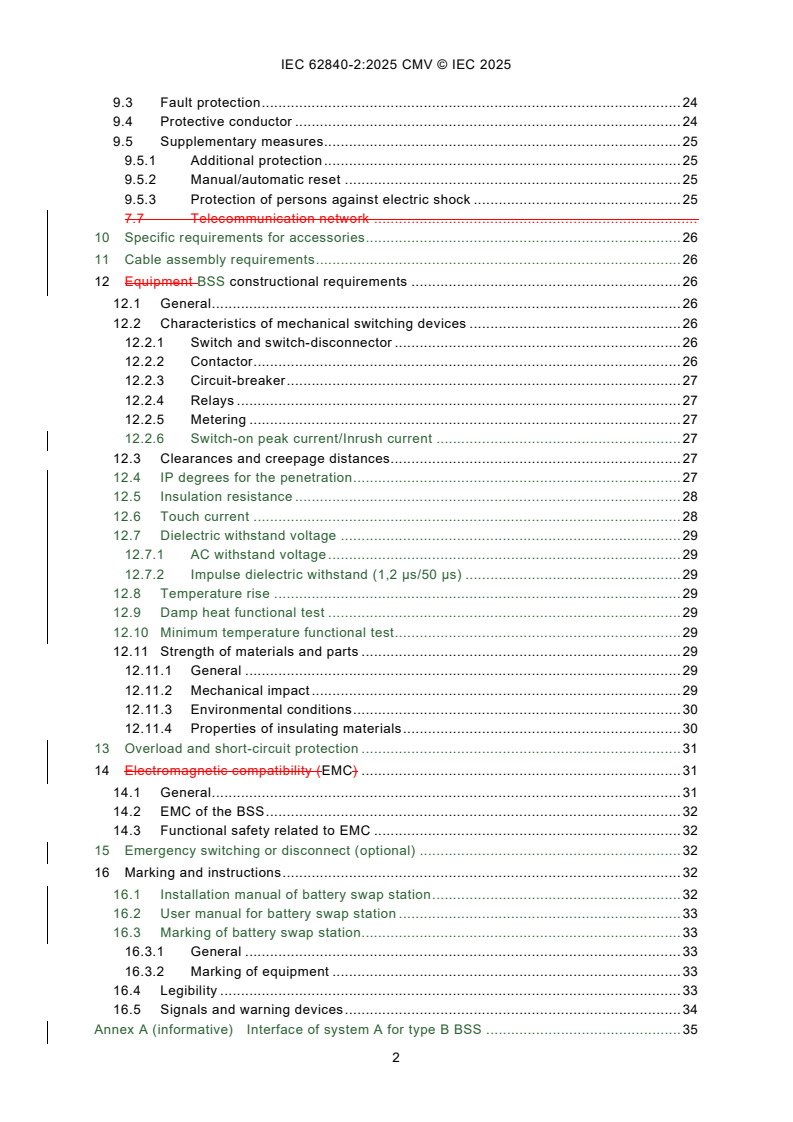
9.3 Fault protection . 24
9.4 Protective conductor . 24
9.5 Supplementary measures. 25
9.5.1 Additional protection . 25
9.5.2 Manual/automatic reset . 25
9.5.3 Protection of persons against electric shock . 25
7.7 Telecommunication network .
10 Specific requirements for accessories. 26
11 Cable assembly requirements . 26
12 Equipment BSS constructional requirements . 26
12.1 General . 26
12.2 Characteristics of mechanical switching devices . 26
12.2.1 Switch and switch-disconnector . 26
12.2.2 Contactor . 26
12.2.3 Circuit-breaker . 27
12.2.4 Relays . 27
12.2.5 Metering . 27
12.2.6 Switch-on peak current/Inrush current . 27
12.3 Clearances and creepage distances. 27
12.4 IP degrees for the penetration . 27
12.5 Insulation resistance . 28
12.6 Touch current . 28
12.7 Dielectric withstand voltage . 29
12.7.1 AC withstand voltage . 29
12.7.2 Impulse dielectric withstand (1,2 µs/50 µs) . 29
12.8 Temperature rise . 29
12.9 Damp heat functional test . 29
12.10 Minimum temperature functional test . 29
12.11 Strength of materials and parts . 29
12.11.1 General . 29
12.11.2 Mechanical impact . 29
12.11.3 Environmental conditions . 30
12.11.4 Properties of insulating materials . 30
13 Overload and short-circuit protection . 31
14 Electromagnetic compatibility (EMC) . 31
14.1 General . 31
14.2 EMC of the BSS . 32
14.3 Functional safety related to EMC . 32
15 Emergency switching or disconnect (optional) . 32
16 Marking and instructions . 32
16.1 Installation manual of battery swap station . 32
16.2 User manual for battery swap station . 33
16.3 Marking of battery swap station. 33
16.3.1 General . 33
16.3.2 Marking of equipment . 33
16.4 Legibility . 33
16.5 Signals and warning devices . 34
Annex A (informative) Interface of system A for type B BSS . 35
A.1 General . 35
A.2 Interface circuit . 35
A.2.1 Interface circuit diagram . 35
A.2.2 Control pilot circuit . 36
A.3 State transition of charging control process . 37
Annex B (informative) Interface of system B for type B BSS . 39
B.1 General . 39
B.2 Interface circuit . 39
B.3 State transition of charging control process . 40
Bibliography . 42
List of comments. 44
Figure A.1 – Example of Interface circuit for charging control of system A station . 36
Figure A.2 – State transition diagram of charging process for system A station . 38
Figure B.1 – Example of interface circuit for charging control of system B station . 40
Figure B.2 – State transition diagram of charging process for system B station . 41
Table 1 – Interoperability requirements . 20
Table 2 – Touch current limits . 28
Table A.1 – Voltage of control pilot circuit . 37
INTERNATIONAL ELECTROTECHNICAL COMMISSION
____________
Electric vehicle battery swap system -
Part 2: Safety requirements
FOREWORD
1) The International Electrotechnical Commission (IEC) is a worldwide organization for standardization comprising
all national electrotechnical committees (IEC National Committees). The object of IEC is to promote international
co-operation on all questions concerning standardization in the electrical and electronic fields. To this end and
in addition to other activities, IEC publishes International Standards, Technical Specifications, Technical Reports,
Publicly Available Specifications (PAS) and Guides (hereafter referred to as "IEC Publication(s)"). Their
preparation is entrusted to technical committees; any IEC National Committee interested in the subject dealt with
may participate in this preparatory work. International, governmental and non-governmental organizations liaising
with the IEC also participate in this preparation. IEC collaborates closely with the International Organization for
Standardization (ISO) in accordance with conditions determined by agreement between the two organizations.
2) The formal decisions or agreements of IEC on technical matters express, as nearly as possible, an international
consensus of opinion on the relevant subjects since each technical committee has representation from all
interested IEC National Committees.
3) IEC Publications have the form of recommendations for international use and are accepted by IEC National
Committees in that sense. While all reasonable efforts are made to ensure that the technical content of IEC
Publications is accurate, IEC cannot be held responsible for the way in which they are used or for any
misinterpretation by any end user.
4) In order to promote international uniformity, IEC National Committees undertake to apply IEC Publications
transparently to the maximum extent possible in their national and regional publications. Any divergence between
any IEC Publication and the corresponding national or regional publication shall be clearly indicated in the latter.
5) IEC itself does not provide any attestation of conformity. Independent certification bodies provide conformity
assessment services and, in some areas, access to IEC marks of conformity. IEC is not responsible for any
services carried out by independent certification bodies.
6) All users should ensure that they have the latest edition of this publication.
7) No liability shall attach to IEC or its directors, employees, servants or agents including individual experts and
members of its technical committees and IEC National Committees for any personal injury, property damage or
other damage of any nature whatsoever, whether direct or indirect, or for costs (including legal fees) and
expenses arising out of the publication, use of, or reliance upon, this IEC Publication or any other IEC
Publications.
8) Attention is drawn to the Normative references cited in this publication. Use of the referenced publications is
indispensable for the correct application of this publication.
9) IEC draws attention to the possibility that the implementation of this document may involve the use of (a)
patent(s). IEC takes no position concerning the evidence, validity or applicability of any claimed patent rights in
respect thereof. As of the date of publication of this document, IEC had not received notice of (a) patent(s), which
may be required to implement this document. However, implementers are cautioned that this may not represent
the latest information, which may be obtained from the patent database available at https://patents.iec.ch. IEC
shall not be held responsible for identifying any or all such patent rights.
This commented version (CMV) of the official standard IEC 62840-2:2025 edition 2.0 allows the
user to identify the changes made to the previous IEC 62840-2:2016 edition 1.0. Furthermore,
comments from IEC TC 69 experts are provided to explain the reasons of the most relevant
changes, or to clarify any part of the content.
A vertical bar appears in the margin wherever a change has been made. Additions are in green
text, deletions are in strikethrough red text. Experts' comments are identified by a blue-
background number. Mouse over a number to display a pop-up note with the comment.
This publication contains the CMV and the official standard. The full list of comments is available
at the end of the CMV.
IEC 62840-2 has been prepared by IEC technical committee 69: Electrical power/energy
transfer systems for electrically propelled road vehicles and industrial trucks. It is an
International Standard.
This second edition cancels and replaces the first edition published in 2016. This edition
constitutes a technical revision.
This edition includes the following significant technical changes with respect to the previous
edition:
a) expands the scope to encompass both swappable battery systems (SBS) and handheld
swappable battery systems (HBS);
b) introduces stricter interoperability requirements through detailed system interface
specifications and defined state transition protocols;
c) enhances data security by defining safety message transmission protocols and integrating
telecom network requirements;
d) increases electrical safety protection levels for battery swap stations (BSS) with specified
capacitor discharge time limits to mitigate electric shock risks;
e) introduces enhanced mechanical safety requirements for automated battery handling
systems, with technical alignment to ISO 10218-1 and ISO 10218-2;
f) strengthens overload and short-circuit protection for BSS through standardized testing
methods and overcurrent protection specifications;
g) defines upgraded electromagnetic compatibility (EMC) standards to ensure system
resilience against external interference, supplemented with EMC-related functional safety
measures.
The text of this International Standard is based on the following documents:
Draft Report on voting
69/1046/FDIS 69/1062/RVD
Full information on the voting for its approval can be found in the report on voting indicated in
the above table.
The language used for the development of this International Standard is English.
This document was drafted in accordance with ISO/IEC Directives, Part 2, and developed in
accordance with ISO/IEC Directives, Part 1 and ISO/IEC Directives, IEC Supplement, available
at www.iec.ch/members_experts/refdocs. The main document types developed by IEC are
described in greater detail at www.iec.ch/publications.
This document is to be read in conjunction with IEC 62840-1:2025.
In this document, the following print types are used:
– test specifications: in italic type;
The following differing practices of a less permanent nature exist in the countries indicated
below:
– 7.5.4: the battery passport defines the necessary data to be transmitted (EU).
– 7.6.1: RCDs of type AC may be used (JP).
– 7.6.1: a device which measures leakage current over a range of frequencies and trips at
pre-defined levels of leakage current, based upon the frequency, is required (US).
– 9.4: the size and rating of the protective conductor is determined by national codes and
regulations (CA, US, JP).
– 9.5.1: RCDs of type AC may be used (JP).
– 9.5.1: a device which measures leakage current over a range of frequencies and trips at
pre-defined levels of leakage current, based upon the frequency, is required (US).
– 12.2.1: national standards or regulations provide the different requirements (JP).
– 12.2.2: national standards or regulations provide the different requirements (JP).
– Clause 13: the methods of protection against overcurrent and overvoltage are in accordance
with national codes (US, JP, CA).
– Clause 13: the branch circuit overcurrent protection is based upon 125 % of the equipment
rating (US, CA).
– Clause 13: EV charging is considered a continuous load and is limited to 80 % of the branch
circuit fuse or circuit breaker rating by national rules (US, CA).
– Clause 13: the equipment earthing path complies with the test requirement in national
standard (JP).
– 16.5: three-part cautionary statements are required (US).
– 16.5: the use of specific language(s) is covered by legal requirements (CN).
A list of all parts in the IEC 62840 series, published under the general title Electric vehicle
battery swap system, can be found on the IEC website.
The committee has decided that the contents of this document will remain unchanged until the
stability date indicated on the IEC website under webstore.iec.ch in the data related to the
specific document. At this date, the document will be
• reconfirmed,
• withdrawn, or
• revised.
INTRODUCTION
The purpose of the battery swap system is to provide energy partly or in total to electric vehicles
(EV) through fast replacement of their swappable battery systems (SBS) or handheld-
swappable battery systems (HBS). While charging, the EV typically takes a relatively long time,
whereas The battery swap process takes only a few minutes to complete. Thus it will reduce
the range anxiety and will facilitate travel for longer distances. 1 The battery swap system
aims to provide energy to electric road vehicles by quickly replacing their swappable battery
system or handheld-swappable battery system. This may help alleviate range anxiety and make
longer distance travel more convenient.
As there is a possibility to charge the batteries after their removal from the vehicle in various
ways, the impact of this process on the critical infrastructure of the electrical grid can be is
minimized.
Battery swap stations mainly include one or more of the following functions:
• swap of EV swappable battery system (SBS) SBS or HBS;
• storage of EV SBS or HBS;
• charging and cooling of EV SBS or HBS;
• testing, maintenance and safety management of EV SBS or HBS.
This document serves as a generic approach for safety during the lifecycle of battery swap
systems and stations for electric vehicles.
This document contains the general safety requirements for battery swap system of SBS/HBS.
The specific safety requirements for dedicated system are described in other parts of the
IEC 62840 series.
1 Scope
This part of IEC 62840 provides the safety requirements for a battery swap system, for the
purposes of swapping swappable battery system (SBS)/handheld-swappable battery system
(HBS) of electric vehicles. The battery swap system is intended to be connected to the supply
network. The power supply is up to 1 000 V AC or up to 1 500 V DC in accordance with
IEC 60038.
This document also applies to battery swap systems supplied from on-site storage systems (e.g.
buffer batteries).
Aspects covered in this document:
• safety requirements of the battery swap system and/or its subsystems;
• security requirements for communication;
• electromagnetic compatibility (EMC);
• signs marking and instructions;
• protection against electric shock and other hazards.
This document is applicable to battery swap systems for EV equipped with one or more
SBS/HBS.
NOTE Battery swap systems for light EVs according to the IEC 61851-3 series are under consideration.
This document is not applicable to
• aspects related to maintenance and service of the battery swap station (BSS),
• trolley buses, rail vehicles and vehicles designed primarily for use off-road, and
• maintenance and service of EVs.
Requirements for bidirectional energy transfer are under consideration.
2 Normative references
The following documents are referred to in the text in such a way that some or all of their content
constitutes requirements of this document. For dated references, only the edition cited applies.
For undated references, the latest edition of the referenced document (including any
amendments) applies.
IEC 60038, IEC standard voltages
IEC 60068-2-1, Environmental testing – Part 2-1: Tests – Test A: Cold
IEC 60068-2-78, Environmental testing – Part 2-78: Tests – Test Cab: Damp heat, steady state
IEC 60112, Method for the determination of the proof and the comparative tracking indices of
solid insulating materials
IEC 60127 (all parts), Miniature fuses
IEC 60204-1, Safety of machinery – Electrical equipment of machines – General requirements
___________
Under consideration.
IEC 60269 (all parts), Low-voltage fuses
IEC 60364 (all parts), Low-voltage electrical installations
IEC 60364-4-41:2005, Low-voltage electrical installations – Part 4-41: Protection for safety –
Protection against electric shock
IEC 60364-4-41:2005/AMD1:2017
IEC 60364-5-54, Low-voltage electrical installations – Part 5-54: Selection and erection of
electrical equipment – Earthing arrangements and protective conductors
IEC 60364-7-722, Low-voltage electrical installations – Part 7-722: Requirements for special
installations or locations – Supply of electric vehicle
IEC 60479 (all parts), Effects of current on human beings and livestock
IEC 60529, Degrees of protection provided by enclosures (IP Code)
IEC 60664-1:20072020, Insulation coordination for equipment within low-voltage systems –
Part 1: Principles, requirements and tests
IEC 60695-2-11, Fire hazard testing – Part 2-11: Glowing/hot-wire based test methods – Glow-
wire flammability test method for end-products (GWEPT)
IEC 60695-10-2, Fire hazard testing – Part 10-2: Abnormal heat – Ball pressure test method
IEC TR 60755, General safety requirements for residual current operated protective devices
IEC 60898 (all parts), Electrical accessories – Circuit-breakers for overcurrent protection for
household and similar installations
IEC 60898-1, Electrical accessories – Circuit-breakers for overcurrent protection for household
and similar installations – Part 1: Circuit-breakers for a.c. operation
IEC 60947-2, Low-voltage switchgear and control gear – Part 2: Circuit-breakers
IEC 60947-3, Low-voltage switchgear and controlgear – Part 3: Switches, disconnectors,
switch-disconnectors and fuse-combination units
IEC 60947-4-1, Low-voltage switchgear and controlgear – Part 4-1: Contactors and motor-
starters – Electromechanical contactors and motor-starters
IEC 60947-6-2, Low-voltage switchgear and controlgear – Part 6-2: Multiple function equipment
– Control and protective switching devices (or equipment) (CPS)
IEC 60950-1:2005, Information technology equipment – Safety – Part 1: General requirements
IEC 60950-1:2005/AMD1:2009
IEC 60950-1:2005/AMD2:2013
IEC 60990, Methods of measurement of touch current and protective conductor current
IEC 61000-6-7, Electromagnetic compatibility (EMC) – Part 6-7: Generic standards – Immunity
requirements equipment intended to perform functions in a safety-related system (functional
safety) in industrial environments locations
IEC 61008 (all parts), Residual current operated circuit-breakers without integral overcurrent
protection for household and similar uses (RCCBs)
IEC 61008-1, Residual current operated circuit-breakers without integral overcurrent protection
for household and similar uses (RCCBs) – Part 1: General rules
IEC 61009 (all parts), Residual current operated circuit-breakers with integral overcurrent
protection for household and similar uses (RCBOs)
IEC 61009-1, Residual current operated circuit-breakers with integral overcurrent protection for
household and similar uses (RCBOs) – Part 1: General rules
IEC 61140, Protection against electric shock – Common aspects for installation and equipment
IEC 61439-1:20112020, Low-voltage switchgear and controlgear assemblies – Part 1: General
rules
IEC 61439-7:2022, Low-voltage switchgear and controlgear assemblies – Part 7: Assemblies
for specific applications such as marinas, camping sites, market squares, electric vehicle
charging stations
IEC 61508-1, Functional safety of electrical/electronic/programmable electronic safety-related
systems – Part 1: General requirements
IEC 61511-1, Functional safety – Safety instrumented systems for the process industry sector
– Part 1: Framework, definitions, system, hardware and application programming requirements
IEC 61784-3, Industrial communication networks – Profiles – Part 3: Functional safety
fieldbuses – General rules and profile definitions
IEC 61810-1, Electromechanical elementary relays – Part 1: General and safety requirements
IEC 61851-1:2017, Electric vehicle conductive charging system – Part 1: General requirements
IEC 61851-21-2, Electric vehicle conductive charging system – Part 21-2: Electric vehicle
requirements for conductive connection to an AC/DC supply – EMC requirements for off board
electric vehicle charging systems
IEC 61851-23:20142023, Electric vehicle conductive charging system – Part 23: DC electric
vehicle charging station supply equipment
IEC 62052-11, Electricity metering equipment (AC) – General requirements, tests and test
conditions – Part 11: Metering equipment
IEC 62262, Degrees of protection provided by enclosures for electrical equipment against
external mechanical impacts (IK code)
IEC 62368-1:2023, Audio/video, information and communication technology equipment – Part 1:
Safety requirements
IEC 62423, Type F and type B residual current operated circuit-breakers with and without
integral overcurrent protection for household and similar uses
IEC 62477-1:2022, Safety requirements for power electronic converter systems and equipment
– Part 1: General
IEC 62840-1:20162025, Electric vehicle battery swap system – Part 1: General and guidance
IEC 63066: — , Low-voltage docking connectors for removable energy storage units
ISO 2972, Numerical control of machines – Symbols
ISO 7000, Graphical symbols for use on equipment – Registered symbols
ISO 10218-1:2011, Robots and robotic devices – Safety requirements for industrial robots –
Part 1: Robots
ISO 10218-2:2011, Robots and robotic devices – Safety requirements for industrial robots –
Part 2: Robot systems and integration
ISO 12405-1, Electrically propelled road vehicles – Test specification for lithium-ion traction
battery packs and systems – Part 1: High-power applications
ISO 13849-1, Safety of machinery –Safety-related parts of control systems – Part 1: General
principles for design
ISO 14119, Safety of machinery – Interlocking devices associated with guards – Principles for
design and selection
ISO 19353:2019, Safety of machinery – Fire prevention and fire protection
3 Terms and definitions
For the purposes of this document, the terms and definitions given in IEC 62840-1 and the
following apply.
ISO and IEC maintain terminology databases for use in standardization at the following
addresses:
• IEC Electropedia: available at https://www.electropedia.org/
• ISO Online browsing platform: available at https://www.iso.org/obp
3.1
hazard
potential source of injury or death
3.2
operator
trained personnel who installs, operates, adjusts, maintains, cleans, repairs or works in the
battery swap station premises
3.3
direct contact
electric contact of persons or animals with live parts
, 195-06-03, modified – The words "human beings or
[SOURCE: IEC 60050-195:19982021
livestock" have been replaced with "persons or animals".] 2
___________
Under preparation. Stage at the time of publication: IEC CCDV 63066:2024
3.4
indirect contact
electric contact of persons or animals with exposed-conductive-parts which have become live
under fault conditions
[SOURCE: IEC 60050-195:19982021, 195-06-04, modified – The words "human beings or
livestock" have been replaced with "persons or animals".] 2
3.5
live part
conductor or conductive part intended to be energized in normal operation, including a neutral
conductor, but by convention not a PEN conductor or PEM conductor or PEL conductor
[SOURCE: IEC 60050-195:19982021, 195-02-19, modified – The note to entry has been
deleted. The domain has been deleted. The words "conductor or" have been added in the
definition, "mid-point conductor" has been removed.] 2
3.6
risk
combination of the probability of occurrence of harm and the severity of that harm
Note 1 to entry: In French, the term "risque" also denotes the potential source of harm, in English "hazard" (see
903-01-02). See also ISO/IEC Guide 51:19992014, 3.2.
[SOURCE: IEC 60050-903:19982013, 903-01-07, modified – The reference to ISO/IEC Guide
51 has been updated in the note to entry.] 2
3.7
real time
pertaining to the processing of data by a computer in connection with another process outside
the computer according to time requirements imposed by the outside process
[SOURCE: IEC 60050-714:1992, 714-21-03 IEC 60050-171:2019,171-05-53] 3
3.8
alternating current
AC
electric current that is a periodic function of time with a zero direct component or, by extension,
a negligible direct component
Note 1 to entry: This note only applies to the French language.
[SOURCE: IEC 60050-131:2002, 131-11-24, modified – The note to entry has been replaced by
another one. The abbreviated term "AC" has been added. The note to entry has been deleted.]
3.9
direct current
DC
electric current that is time-independent or, by extension, periodic current, the direct component
of which is of primary importance
Note 1 to entry: This note only applies to th French language.
[SOURCE: IEC 60050-131:2002, 131-11-22, modified – The note to entry has been replaced by
another one. The abbreviated term "DC" has been added. The note to entry has been deleted.]
3.10
residual current device
RCD
mechanical switching device designed to make, carry and break currents under normal service
conditions and to cause the opening of the contacts when the residual current attains a given
value under specified conditions
[SOURCE: IEC 60050-442:19982019, 442-05-02, modified – The note to entry has been
deleted. The words "or association of devices" have been deleted.]
3.11
basic protection 4
protection against electric shock under fault-free conditions
[SOURCE: IEC 60050-195:2021, 195-06-01, modified – The word "normal" has been replaced
with "fault-free".]
3.12
fault protection
protection against electric shock under single fault conditions
[SOURCE: IEC 60050-195:2021, 195-06-02]
4 Abbreviated terms
IEC 62840-1:2025, Clause 4, applies.
5 General requirements 5
The battery swap system shall be rated for one, or a range of, standard nominal voltages
according to IEC 60038. The safe operation of a battery swap system will be achieved by
fulfilling the relevant requirements specified in this document, and compliance is checked by
carrying out all relevant tests.
The battery swap system shall be so designed and constructed that, in normal use, its
performance is reliable and minimizes the risk of danger to the human individuals, equipment
and surroundings.
The battery swap system shall be designed to consider the environmental impact (dust, water,
ice, etc.) to the equipment or human safety. In general, this principle is achieved by fulfilling
the relevant requirements specified by this document and IEC 62840-1, together with
IEC 61851-21-2 .
Compliance is checked by carrying out the relevant tests.
For robots and robotic devices and their integration into the BSS, a hazard identification and
risk assessment shall be provided according to ISO 10218-1:2011, Clause 4, or
ISO 10218-2:2011, Clause 4, and under consideration of ISO 10218-1:2011, Annex A and
Annex F, or ISO 10218-2:2011, Annex A and Annex G, depending on the application.
NOTE For BSS with more than one robot systems implemented in the same application, ISO 10218-2 is applicable.
___________
Under consideration.
Additional attention regarding hazards of fire shall be given by the risk assessment according
to ISO 19353:2019.
Unless otherwise stated, The hazards of fire tests may be conducted on separate samples at
the discretion of the manufacturer.
Unless otherwise specified, all other tests shall be carried out in the order of the clauses and
subclauses in this document.
The electrical interface and communication interface characteristics of a specific battery swap
system will be specified in another part of the IEC 62840 series shall be defined in terms of
safety and compatibility.
For additional informative details regarding type B BSS, refer to Annex A and Annex B.
6 Classification
IEC 62840-1:2025, Clause 6, applies.
7 Safety requirements of systems
7.1 General
For type A BSS, the battery swap system for electrical vehicles shall be in accordance with
IEC 60204-1, IEC 61511-1 and ISO 13849-1. Specific requirements are the subject of this
document.
For type B BSS, the battery swap system for electrical vehicles shall be in accordance with
IEC 62477-1. Specific requirements are the subject of this document. 6
7.2 Lane system
7.2.1 Vehicle lane
At the entrance to the lane, the EV information shall be identified and fed into the supervisor
and control system in order to use the right parameters and components for this vehicle. The
lane may include a cleaning station for the purposes of cleaning EV/battery parts before the
swap process starts. All lane system safety and function relevant components shall be able to
resist the effect of automotive solvents and fluids.
Drivers and passengers may be allowed to stay on-board during the battery swap process. The
lane system shall be built in such a manner that humans and EVs are not at risk as a result of
movement of mechanical parts or as a result of open underground cavities. To protect the driver
and passengers, at least one of the following requirements shall be applied.
a) If the driver or passengers intend to get off the vehicle, a warning message or symbols shall
be displayed or a protection obstacle to prevent opening the vehicle doors shall be provided.
b) If the driver or passengers are getting off the vehicle, an emergency shutdown of the
swapping process shall be performed.
For the battery swap system which does not allow drivers and passengers to stay on-board
during the battery swap process, the safety measures shall be provided to pause/stop the
process when the drivers and passengers are still inside the vehicle. 7
7.2.2 Measures in case of emergency
During each phase of the battery swap process, the driver (if on board) and system operators
should have immediate access to emergency stop buttons to stop all automation motions in
case of emergency.
During the movement of the vehicle within the lane system, an emergency stop measure shall
be provided to stop the movement in case of emergency.
The lane shall be equipped with suitable escape routes and emergency exits allowing people
(if on board), including disabled persons, children and infants, to evacuate from the lane area
in case of fire or another emergency. National or local regulations can apply. 8
All Marking, routing and geometry of escape routes and exits should can be done according
subject to local regulations.
To ensure the fire protection purpose, one of the following measures, but not limited to, shall
be adopted in the system design of BSS:
– detection of the thermal changing (thermal detection, smoke d
...
IEC 62840-2 ®
Edition 2.0 2025-07
NORME
INTERNATIONALE
Système d'échange de batterie de véhicule électrique -
Partie 2: Exigences de sécurité
ICS 43.120 ISBN 978-2-8327-0531-5
Droits de reproduction réservés. Sauf indication contraire, aucune partie de cette publication ne peut être reproduite ni
utilisée sous quelque forme que ce soit et par aucun procédé, électronique ou mécanique, y compris la photocopie et
les microfilms, sans l'accord écrit de l'IEC ou du Comité national de l'IEC du pays du demandeur. Si vous avez des
questions sur le copyright de l'IEC ou si vous désirez obtenir des droits supplémentaires sur cette publication, utilisez
les coordonnées ci-après ou contactez le Comité national de l'IEC de votre pays de résidence.
IEC Secretariat Tel.: +41 22 919 02 11
3, rue de Varembé info@iec.ch
CH-1211 Geneva 20 www.iec.ch
Switzerland
A propos de l'IEC
La Commission Electrotechnique Internationale (IEC) est la première organisation mondiale qui élabore et publie des
Normes internationales pour tout ce qui a trait à l'électricité, à l'électronique et aux technologies apparentées.
A propos des publications IEC
Le contenu technique des publications IEC est constamment revu. Veuillez vous assurer que vous possédez l’édition la
plus récente, un corrigendum ou amendement peut avoir été publié.
Recherche de publications IEC - IEC Products & Services Portal - products.iec.ch
webstore.iec.ch/advsearchform Découvrez notre puissant moteur de recherche et consultez
La recherche avancée permet de trouver des publications gratuitement tous les aperçus des publications, symboles
IEC en utilisant différents critères (numéro de référence, graphiques et le glossaire. Avec un abonnement, vous aurez
texte, comité d’études, …). Elle donne aussi des toujours accès à un contenu à jour adapté à vos besoins.
informations sur les projets et les publications remplacées
ou retirées. Electropedia - www.electropedia.org
Le premier dictionnaire d'électrotechnologie en ligne au
IEC Just Published - webstore.iec.ch/justpublished monde, avec plus de 22 500 articles terminologiques en
Restez informé sur les nouvelles publications IEC. Just anglais et en français, ainsi que les termes équivalents
dans 25 langues additionnelles. Egalement appelé
Published détaille les nouvelles publications parues.
Disponible en ligne et une fois par mois par email. Vocabulaire Electrotechnique International (IEV) en ligne.
Service Clients - webstore.iec.ch/csc
Si vous désirez nous donner des commentaires sur cette
publication ou si vous avez des questions contactez-
nous: sales@iec.ch.
SOMMAIRE
AVANT-PROPOS . 4
INTRODUCTION . 7
1 Domaine d’application . 8
2 Références normatives . 8
3 Termes et définitions . 11
4 Abréviations . 13
5 Exigences générales . 13
6 Classification . 14
7 Exigences de sécurité des systèmes . 14
7.1 Généralités . 14
7.2 Système de voie . 14
7.2.1 Voie pour les véhicules . 14
7.2.2 Mesures en cas d’urgence . 15
7.3 Système de manutention des batteries . 15
7.3.1 Protection par verrouillage . 15
7.3.2 Verrouillage par la voie . 15
7.3.3 Processus de manutention des batteries. 15
7.3.4 Mesures en cas d’urgence . 16
7.4 Système de stockage . 17
7.4.1 Stockage des batteries . 17
7.4.2 Mesures en cas d’urgence . 18
7.5 Système de charge . 18
7.5.1 Chargeur du SBS/HBS . 18
7.5.2 Connexion du chargeur . 19
7.5.3 Poste de charge . 19
7.5.4 Communication et surveillance . 19
7.6 SBS/HBS . 20
7.6.1 Généralités . 20
7.6.2 Exigences d’interopérabilité . 20
7.7 Système de supervision et de commande . 21
7.8 Systèmes supports . 21
7.8.1 Système de maintenance des batteries . 21
7.8.2 Système logistique du SBS/HBS . 22
7.9 Système d’alimentation . 22
7.10 Interfaces. 22
8 Communication . 22
8.1 Sûreté des données . 22
8.2 Transmission des messages relatifs à la sécurité . 22
8.3 Réseau de télécommunications . 23
9 Protection contre les chocs électriques . 23
9.1 Exigences générales . 23
9.2 Dispositions pour la protection principale . 23
9.2.1 Degrés IP pour la prévention des chocs . 23
9.2.2 Degrés de protection IP pour le coupleur . 24
9.2.3 Énergie emmagasinée – décharge des condensateurs . 24
9.3 Protection en cas de défaut . 24
9.4 Conducteur de protection . 25
9.5 Mesures supplémentaires . 25
9.5.1 Protection complémentaire . 25
9.5.2 Réarmement manuel/automatique . 25
9.5.3 Protection des personnes contre les chocs électriques . 25
10 Exigences spécifiques pour les accessoires . 26
11 Exigences relatives aux ensembles de câbles . 26
12 Exigences relatives à la construction d’une BSS . 26
12.1 Généralités . 26
12.2 Caractéristiques des dispositifs mécaniques de coupure . 26
12.2.1 Interrupteur et interrupteur-sectionneur . 26
12.2.2 Contacteurs . 27
12.2.3 Disjoncteur . 27
12.2.4 Relais . 27
12.2.5 Comptage . 27
12.2.6 Courant de crête au démarrage/Courant d’appel . 27
12.3 Distances d’isolement et lignes de fuite . 27
12.4 Degrés de protection IP pour la pénétration . 27
12.5 Résistance d’isolement . 28
12.6 Courant de contact . 28
12.7 Tension de tenue diélectrique . 29
12.7.1 Tension alternative de tenue . 29
12.7.2 Tenue diélectrique aux chocs (1,2 µs/50 µs) . 29
12.8 Échauffement . 29
12.9 Essai fonctionnel avec chaleur humide . 29
12.10 Essai fonctionnel à température minimale . 29
12.11 Résistance des matériaux et des parties . 30
12.11.1 Généralités . 30
12.11.2 Impact mécanique . 30
12.11.3 Conditions d’environnement. 30
12.11.4 Propriétés des matériaux isolants . 30
13 Protection contre la surcharge et le court-circuit . 31
14 Compatibilité électromagnétique (CEM) . 32
14.1 Généralités . 32
14.2 CEM de la BSS . 32
14.3 Sécurité fonctionnelle relative à la CEM . 32
15 Coupure ou déconnexion d’urgence (facultatif) . 32
16 Marquage et instructions . 33
16.1 Manuel d’installation de la station d’échange de batterie . 33
16.2 Manuel d’utilisation de la station d’échange de batterie. 33
16.3 Marquage de la station d’échange de batterie . 33
16.3.1 Généralités . 33
16.3.2 Marquage de l’équipement . 34
16.4 Lisibilité . 34
16.5 Signaux et dispositifs de mise en garde . 34
Annexe A (informative) Interface de système A pour BSS de type B . 36
A.1 Généralités . 36
A.2 Circuit d’interface . 36
A.2.1 Schéma du circuit d’interface . 36
A.2.2 Circuit du pilote de commande . 38
A.3 Passage entre les différents états lors du processus de régulation de charge . 38
Annexe B (informative) Interface de système B pour BSS de type B . 40
B.1 Généralités . 40
B.2 Circuit d’interface . 40
B.3 Passage entre les différents états lors du processus de régulation de charge . 41
Bibliographie . 43
Figure A.1 – Exemple de circuit d’interface pour la régulation de charge d’une station
de système A . 37
Figure A.2 – Schéma du passage entre les différents états lors du processus de
charge pour la station de système A . 39
Figure B.1 – Exemple de circuit d’interface pour la régulation de charge d’une station
de système B . 41
Figure B.2 – Schéma du passage entre les différents états lors du processus de
charge pour la station de système B . 42
Tableau 1 – Exigences d’interopérabilité . 20
Tableau 2 – Limites du courant de contact . 28
Tableau A.1 – Tension du circuit du pilote de commande . 38
COMMISSION ÉLECTROTECHNIQUE INTERNATIONALE
____________
Système d’échange de batterie de véhicule électrique -
Partie 2: Exigences de sécurité
AVANT-PROPOS
1) La Commission Électrotechnique Internationale (IEC) est une organisation mondiale de normalisation composée
de l’ensemble des comités électrotechniques nationaux (Comités nationaux de l’IEC). L’IEC a pour objet de
favoriser la coopération internationale pour toutes les questions de normalisation dans les domaines de
l’électricité et de l’électronique. À cet effet, l’IEC – entre autres activités – publie des Normes internationales,
des Spécifications techniques, des Rapports techniques, des Spécifications accessibles au public (PAS) et des
Guides (ci-après dénommés "Publication(s) de l’IEC"). Leur élaboration est confiée à des comités d’études, aux
travaux desquels tout Comité national intéressé par le sujet traité peut participer. Les organisations
internationales, gouvernementales et non gouvernementales, en liaison avec l’IEC, participent également aux
travaux. L’IEC collabore étroitement avec l’Organisation Internationale de Normalisation (ISO), selon des
conditions fixées par accord entre les deux organisations.
2) Les décisions ou accords officiels de l’IEC concernant les questions techniques représentent, dans la mesure du
possible, un accord international sur les sujets étudiés, étant donné que les Comités nationaux de l’IEC intéressés
sont représentés dans chaque comité d’études.
3) Les Publications de l’IEC se présentent sous la forme de recommandations internationales et sont agréées
comme telles par les Comités nationaux de l’IEC. Tous les efforts raisonnables sont entrepris afin que l’IEC
s’assure de l’exactitude du contenu technique de ses publications; l’IEC ne peut pas être tenue responsable de
l’éventuelle mauvaise utilisation ou interprétation qui en est faite par un quelconque utilisateur final.
4) Dans le but d’encourager l’uniformité internationale, les Comités nationaux de l’IEC s’engagent, dans toute la
mesure possible, à appliquer de façon transparente les Publications de l’IEC dans leurs publications nationales
et régionales. Toutes divergences entre toutes Publications de l’IEC et toutes publications nationales ou
régionales correspondantes doivent être indiquées en termes clairs dans ces dernières.
5) L’IEC elle-même ne fournit aucune attestation de conformité. Des organismes de certification indépendants
fournissent des services d’évaluation de conformité et, dans certains secteurs, accèdent aux marques de
conformité de l’IEC. L’IEC n’est responsable d’aucun des services effectués par les organismes de certification
indépendants.
6) Tous les utilisateurs doivent s’assurer qu’ils sont en possession de la dernière édition de cette publication.
7) Aucune responsabilité ne doit être imputée à l’IEC, à ses administrateurs, employés, auxiliaires ou mandataires,
y compris ses experts particuliers et les membres de ses comités d’études et des Comités nationaux de l’IEC,
pour tout préjudice causé en cas de dommages corporels et matériels, ou de tout autre dommage de quelque
nature que ce soit, directe ou indirecte, ou pour supporter les coûts (y compris les frais de justice) et les dépenses
découlant de la publication ou de l’utilisation de cette Publication de l’IEC ou de toute autre Publication de l’IEC,
ou au crédit qui lui est accordé.
8) L’attention est attirée sur les références normatives citées dans cette publication. L’utilisation de publications
référencées est obligatoire pour une application correcte de la présente publication.
9) L’IEC attire l’attention sur le fait que la mise en application du présent document peut entraîner l’utilisation d’un
ou de plusieurs brevets. L’IEC ne prend pas position quant à la preuve, à la validité et à l’applicabilité de tout
droit de brevet revendiqué à cet égard. À la date de publication du présent document, l’IEC n’avait pas reçu
notification qu’un ou plusieurs brevets pouvaient être nécessaires à sa mise en application. Toutefois, il y a lieu
d’avertir les responsables de la mise en application du présent document que des informations plus récentes
sont susceptibles de figurer dans la base de données de brevets, disponible à l’adresse https://patents.iec.ch.
L’IEC ne saurait être tenue pour responsable de ne pas avoir identifié de tels droits de brevet.
L’IEC 62840-2 a été établie par le comité d’études 69 de l’IEC: Systèmes de transfert de
puissance ou d’énergie électrique destinés aux véhicules routiers électriques ou chariots
industriels de manutention. Il s’agit d’une Norme internationale.
Cette deuxième édition annule et remplace la première édition parue en 2016. Cette édition
constitue une révision technique.
Cette édition inclut les modifications techniques majeures suivantes par rapport à l’édition
précédente:
a) extension du domaine d’application pour englober à la fois les systèmes de batteries
échangeables (SBS, Swappable Battery System) et les systèmes de batteries échangeables
portatives (HBS, Handheld swappable Battery System);
b) introduction d’exigences d’interopérabilité plus strictes par le biais de spécifications
d’interface système détaillées et de protocoles définis pour le passage entre les différents
états;
c) renforcement de la sûreté des données en définissant des protocoles de transmission des
messages de sécurité et en intégrant les exigences des réseaux de télécommunications;
d) augmentation des niveaux de protection de sécurité électrique pour les stations d’échange
de batteries (BSS, Battery Swap Station), par le biais de limites spécifiées de temps de
décharge des condensateurs, afin d’atténuer les risques de choc électrique;
e) introduction d’exigences de sécurité mécanique renforcées pour les systèmes automatisés
de manutention des batteries, avec un alignement technique sur l’ISO 10218-1 et
l’ISO 10218-2;
f) renforcement de la protection des BSS contre les surcharges et les courts-circuits, au
moyen de méthodes d’essai normalisées et de spécifications de protection contre les
surintensités;
g) définition de normes de compatibilité électromagnétique (CEM) améliorées pour assurer la
résilience du système aux perturbations externes, complétées par des mesures de sécurité
fonctionnelle liées à la CEM.
Le texte de cette Norme internationale est issu des documents suivants:
Projet Rapport de vote
69/1046/FDIS 69/1062/RVD
Le rapport de vote indiqué dans le tableau ci-dessus donne toute information sur le vote ayant
abouti à son approbation.
La langue employée pour l’élaboration de cette Norme internationale est l’anglais.
Ce document a été rédigé selon les Directives ISO/IEC, Partie 2, il a été développé selon les
Directives ISO/IEC, Partie 1 et les Directives ISO/IEC, Supplément IEC, disponibles sous
www.iec.ch/members_experts/refdocs. Les principaux types de documents développés par
l’IEC sont décrits plus en détail sous www.iec.ch/publications.
Le présent document doit être lu conjointement avec l’IEC 62840-1:2025.
Dans le présent document, les caractères d’imprimerie suivants sont utilisés:
– spécifications d’essai: caractères italiques;
Les différentes pratiques suivantes, à caractère moins permanent, existent dans les pays
indiqués ci-après.
– 7.5.4: le passeport de la batterie définit les données nécessaires à transmettre (Union
européenne).
– 7.6.1: des DDR de type à courant alternatif peuvent être utilisés (Japon);
– 7.6.1: un dispositif qui mesure le courant de fuite sur une plage de fréquences et se
déclenche à des niveaux prédéfinis de courant de fuite, en fonction de la fréquence, est
exigé (États-Unis).
– 9.4: les dimensions et les caractéristiques assignées du conducteur de protection sont
déterminées par les codes et règlements nationaux (Canada, États-Unis, Japon).
– 9.5.1: des DDR de type à courant alternatif peuvent être utilisés (Japon).
– 9.5.1: un dispositif qui mesure le courant de fuite sur une plage de fréquences et se
déclenche à des niveaux prédéfinis de courant de fuite, en fonction de la fréquence, est
exigé (États-Unis).
– 12.2.1: les normes ou règlements nationaux fournissent les différentes exigences (Japon).
– 12.2.2: les normes ou règlements nationaux fournissent les différentes exigences (Japon).
– Article 13: les méthodes de protection contre les surintensités et les surtensions sont
conformes aux codes nationaux (États-Unis, Japon, Canada).
– Article 13: la protection contre les surintensités du circuit de dérivation est basée sur 125 %
du courant assigné de l’équipement (États-Unis, Canada).
– Article 13: la charge du véhicule électrique (VE) est considérée comme une charge continue
et est limitée par les règles nationales à 80 % du calibre des fusibles ou disjoncteurs du
circuit de dérivation (États-Unis, Canada).
– Article 13: le chemin de mise à la terre de l’équipement est conforme à l’exigence d’essai
de la norme nationale (Japon).
– 16.5: des mises en garde en trois parties sont exigées (États-Unis).
– 16.5: l’utilisation d’une ou de plusieurs langues spécifiques est couverte par des exigences
légales (Chine).
Une liste de toutes les parties de la série IEC 62840, publiées sous le titre général Système
d’échange de batterie de véhicule électrique, se trouve sur le site Web de l’IEC.
Le comité a décidé que le contenu de ce document ne sera pas modifié avant la date de stabilité
indiquée sur le site web de l’IEC sous webstore.iec.ch dans les données relatives au document
recherché. À cette date, le document sera
• reconduit,
• supprimé, ou
• révisé.
INTRODUCTION
Le système d’échange de batterie a pour objet de fournir de l’énergie, en partie ou en totalité,
à des véhicules électriques (VE), par le remplacement rapide de leur système de batterie
échangeable (SBS) ou de leur système de batterie échangeable portative (HBS). Le système
d’échange de batterie vise à fournir de l’énergie aux véhicules électriques routiers en
permettant le remplacement rapide de leur système de batterie échangeable ou de leur système
de batterie échangeable portative. Cela peut aider à soulager l’anxiété liée à l’autonomie et à
améliorer la praticité sur les trajets longues distances.
Compte tenu de la possibilité de charger les batteries de différentes manières après leur dépose
du véhicule, cela réduit grandement l’impact de ce processus sur l’infrastructure critique du
réseau électrique.
Les stations d’échange de batterie incluent principalement une ou plusieurs des fonctions
suivantes:
• échange du SBS ou du HBS du VE;
• stockage du SBS ou du HBS du VE;
• charge et refroidissement du SBS ou du HBS du VE;
• essai, maintenance et gestion de la sécurité du SBS ou du HBS du VE.
Le présent document donne une approche générique de la sécurité pendant le cycle de vie des
systèmes et des stations d’échange de batterie de véhicules électriques.
Le présent document contient les exigences de sécurité générales relatives au système
d’échange de batterie des SBS/HBS. Les exigences de sécurité spécifiques à un système sont
données dans les autres parties de la série IEC 62840.
1 Domaine d’application
La présente partie de l’IEC 62840 spécifie les exigences de sécurité relatives à un système
d’échange de batterie, afin de remplacer le système de batterie échangeable (SBS)/le système
de batterie échangeable portative (HBS) des véhicules électriques. Le système d’échange de
batterie est destiné à être connecté au réseau électrique. L’alimentation atteint 1 000 V en
courant alternatif ou 1 500 V en courant continu, conformément à l’IEC 60038.
Le présent document s’applique également aux systèmes d’échange de batterie alimentés par
des systèmes de stockage sur site (par exemple, des batteries tampons).
Le présent document traite des aspects suivants:
• les exigences de sécurité du système d’échange de batterie et de ses sous-systèmes;
• les exigences de sûreté de la communication;
• la compatibilité électromagnétique (CEM);
• le marquage et les indications;
• la protection contre les chocs électriques et autres phénomènes dangereux.
Le présent document s’applique aux systèmes d’échange de batterie pour les VE équipés d’un
ou de plusieurs SBS/HBS.
Le présent document ne concerne pas:
• les aspects liés à la maintenance et à l’entretien de la station d’échange de batterie (BSS);
• les trolleys bus, véhicules ferroviaires et véhicules destinés principalement à une utilisation
tout terrain; et
• la maintenance et l’entretien des VE.
Les exigences relatives au transfert d’énergie bidirectionnel sont à l’étude.
2 Références normatives
Les documents suivants sont cités dans le texte de sorte qu’ils constituent, pour tout ou partie
de leur contenu, des exigences du présent document. Pour les références datées, seule
l’édition citée s’applique. Pour les références non datées, la dernière édition du document de
référence s’applique (y compris les éventuels amendements).
IEC 60038, Tensions normales de l’IEC
IEC 60068-2-1, Essais d’environnement – Partie 2-1: Essais – Essai A: Froid
IEC 60068-2-78, Essais d’environnement – Partie 2-78: Essais – Essai Cab: Chaleur humide,
essai continu
IEC 60112, Méthode de détermination des indices de résistance et de tenue au cheminement
des matériaux isolants solides
IEC 60127 (toutes les parties), Coupe-circuits miniatures
IEC 60204-1, Sécurité des machines – Équipement électrique des machines – Exigences
générales
IEC 60269 (toutes les parties), Fusibles basse tension
IEC 60364 (toutes les parties), Installations électriques à basse tension
IEC 60364-4-41:2005, Installations électriques à basse tension – Partie 4-41: Protection pour
assurer la sécurité – Protection contre les chocs électriques
IEC 60364-4-41:2005/AMD1:2017
IEC 60364-5-54, Installations électriques basse tension – Partie 5-54: Choix et mise en œuvre
des matériels électriques – Installations de mise à la terre et conducteurs de protection
IEC 60479 (toutes les parties), Effets du courant sur l’homme et les animaux domestiques
IEC 60529, Degrés de protection procurés par les enveloppes (Code IP)
IEC 60664-1:2020, Coordination de l’isolement des matériels dans les réseaux d’énergie
électrique à basse tension – Partie 1: Principes, exigences et essais
IEC 60695-2-11, Essais relatifs aux risques du feu – Partie 2-11: Essais au fil
incandescent/chauffant – Méthode d’essai d’inflammabilité pour produits finis (GWEPT)
IEC 60695-10-2, Essais relatifs aux risques du feu – Partie 10-2: Chaleurs anormales – Essai
à la bille
IEC 60755, General safety requirements for residual current operated protective devices
(disponible en anglais seulement)
IEC 60898 (toutes les parties), Petit appareillage électrique – Disjoncteurs pour la protection
contre les surintensités pour installations domestiques et analogues
IEC 60898-1, Petit appareillage électrique – Disjoncteurs pour la protection contre les
surintensités pour installations domestiques et analogues – Partie 1: Disjoncteurs pour le
fonctionnement en courant alternatif
IEC 60947-2, Appareillage à basse tension – Partie 2: Disjoncteurs
IEC 60947-3, Appareillage à basse tension – Partie 3: Interrupteurs, sectionneurs,
interrupteurs-sectionneurs et combinés-fusibles
IEC 60947-4-1, Appareillage à basse tension – Partie 4-1: Contacteurs et démarreurs de
moteurs – Contacteurs et démarreurs électromécaniques
IEC 60947-6-2, Appareillage à basse tension – Partie 6-2: Matériels à fonctions multiples –
Appareils (ou matériel) de connexion de commande de protection (ACP)
IEC 60990, Méthodes de mesure du courant de contact et du courant dans le conducteur de
protection
IEC 61000-6-7, Compatibilité électromagnétique (CEM) – Partie 6-7: Normes génériques –
Exigences d’immunité pour les équipements visant à exercer des fonctions dans un système
lié à la sécurité (sécurité fonctionnelle) dans des sites industriels
IEC 61008 (toutes les parties), Interrupteurs automatiques à courant différentiel résiduel sans
dispositif de protection contre les surintensités incorporé pour usages domestiques et
analogues (ID)
IEC 61008-1, Interrupteurs automatiques à courant différentiel résiduel sans dispositif de
protection contre les surintensités incorporé pour usages domestiques et analogues (ID) –
Partie 1: Règles générales
IEC 61009 (toutes les parties), Interrupteurs automatiques à courant différentiel résiduel avec
dispositif de protection contre les surintensités incorporé pour usages domestiques et
analogues (DD)
IEC 61009-1, Interrupteurs automatiques à courant différentiel résiduel avec dispositif de
protection contre les surintensités incorporé pour usages domestiques et analogues (DD) –
Partie 1: Règles générales
IEC 61140, Protection contre les chocs électriques – Aspects communs aux installations et aux
matériels
IEC 61439-1:2020, Ensembles d’appareillage à basse tension – Partie 1: Règles générales
IEC 61439-7:2022, Ensembles d’appareillage à basse tension – Partie 7: Ensembles pour les
applications spécifiques comme les marinas, les terrains de camping, les marchés et pour les
bornes de charge de véhicules électriques
IEC 61508-1, Sécurité fonctionnelle des systèmes électriques/électroniques/électroniques
programmables relatifs à la sécurité – Partie 1: Exigences générales
IEC 61511-1, Sécurité fonctionnelle – Systèmes instrumentés de sécurité pour le secteur des
industries de transformation – Partie 1: Cadre, définitions, exigences pour le système, le
matériel et la programmation d’application
IEC 61784-3, Réseaux de communication industriels – Profils – Partie 3: Bus de terrain de
sécurité fonctionnelle – Règles générales et définitions de profils
IEC 61810-1, Relais électromécaniques élémentaires – Partie 1: Exigences générales et de
sécurité
IEC 61851-1:2017, Système de charge conductive pour véhicules électriques –
Partie 1: Exigences générales
IEC 61851-21-2, Système de charge par conduction pour véhicules électriques –
Partie 21-2: Exigences applicables aux véhicules électriques pour connexion par conduction à
une alimentation en courant alternatif ou courant continu – Exigences CEM concernant les
systèmes de charge non embarqués pour véhicules électriques
IEC 61851-23:2023, Système de charge par conduction pour véhicules électriques –
Partie 23: Système d’alimentation en courant continu pour véhicules électriques
IEC 62052-11, Équipement de comptage de l’électricité – Exigences générales, essais et
conditions d’essai – Partie 11: Équipement de comptage
IEC 62262, Degrés de protection procurés par les enveloppes de matériels électriques contre
les impacts mécaniques externes (code IK)
IEC 62368-1:2023, Équipements des technologies de l’audio/vidéo, de l’information et de la
communication – Partie 1: Exigences de sécurité
IEC 62423, Interrupteurs automatiques à courant différentiel résiduel de type B et de type F
avec et sans protection contre les surintensités incorporée pour usages domestiques et
analogues
IEC 62477-1:2022, Exigences de sécurité applicables aux systèmes et matériels électroniques
de conversion de puissance – Partie 1: Généralités
IEC 62840-1:2025, Système d’échange de batterie de véhicule électrique –
Partie 1: Généralités et recommandations
IEC 63066: — , Raccordement basse tension pour les unités de stockage d’énergie mobiles
ISO 10218-1:2011, Robots et dispositifs robotiques – Exigences de sécurité pour les robots
industriels – Partie 1: Robots
ISO 10218-2:2011, Robots et dispositifs robotiques – Exigences de sécurité pour les robots
industriels – Partie 2: Systèmes robots et intégration
ISO 13849-1, Sécurité des machines – Parties des systèmes de commande relatives à la
sécurité – Partie 1: Principes généraux de conception
ISO 14119, Sécurité des machines – Dispositifs de verrouillage associés à des protecteurs –
Principes de conception et de choix
ISO 19353:2019, Sécurité des machines – Prévention et protection contre l’incendie
3 Termes et définitions
Pour les besoins du présent document, les termes et les définitions de l’IEC 62840-1 ainsi que
les suivants s’appliquent.
L’ISO et l’IEC tiennent à jour des bases de données terminologiques destinées à être utilisées
en normalisation, consultables aux adresses suivantes:
• IEC Electropedia: disponible à l’adresse https://www.electropedia.org/
• ISO Online browsing platform: disponible à l’adresse https://www.iso.org/obp
3.1
phénomène dangereux
source potentielle de blessure ou de mort
3.2
opérateur
personne formée qui installe, utilise, règle, entretient, nettoie, répare ou travaille dans les
locaux de la station d’échange de batterie
3.3
contact direct
contact électrique de personnes ou d’animaux avec des parties actives
[SOURCE: IEC 60050-195:2021, 195-06-03, modifié – L’expression "d’êtres humains ou
d’animaux" a été remplacée par "de personnes ou d’animaux".]
___________
En cours d’élaboration. Stade au moment de la publication: IEC CCDV 63066:2024
3.4
contact indirect
contact électrique de personnes ou d’animaux avec des parties conductrices accessibles mises
sous tension à la suite d’un défaut
[SOURCE: IEC 60050-195:2021, 195-06-04, modifié – L’expression "d’êtres humains ou
d’animaux" a été remplacée par "de personnes ou d’animaux".]
3.5
partie active
conducteur ou partie conductrice destiné à être sous tension en service normal, y compris le
conducteur de neutre, à l’exception toutefois, par convention, du conducteur PEN, du
conducteur PEM ou du conducteur PEL
[SOURCE: IEC 60050-195:2021, 195-02-19, modifié – Le domaine a été supprimé.
L’expression "conducteur ou" a été ajoutée au début de la définition, l’expression "dans des
conditions normales de fonctionnement" a été remplacée par "en service normal", l’expression
"et le conducteur de point milieu" a été supprimée, l’expression "par convention" a été ajoutée.]
3.6
risque
combinaison de la probabilité d’un dommage et de sa gravité
Note 1 à l’article: En français, le terme "risque" désigne aussi l’origine du phénomène dangereux ou la nature du
dommage attendu, en anglais "hazard" (voir 903-01-02). Voir aussi le Guide ISO/IEC 51:2014, 3.2.
[SOURCE: IEC 60050-903:2013, 903-01-07, modifié – La référence au Guide ISO/IEC 51 a été
actualisée dans la note à l’article.]
3.7
en temps réel
relatif au traitement de données effectué par un ordinateur en relation avec un processus
extérieur, ce traitement devant respecter des contraintes de temps imposées par le processus
extérieur
[SOURCE: IEC 60050-171:2019,171-05-53]
3.8
courant alternatif
c.a.
courant électrique qui est une fonction périodique du temps à composante continue nulle ou,
par extension, à composante continue négligeable
[SOURCE: IEC 60050-131:2002, 131-11-24, modifié – L’abréviation "c.a." a été ajoutée. La
note à l’article a été supprimée.]
3.9
courant continu
c.c.
courant électrique indépendant du temps ou, par extension, courant périodique dont la
composante continue est d’importance primordiale
[SOURCE: IEC 60050-131:2002, 131-11-22, modifié – L’abréviation "c.c." a été ajoutée. La
note à l’article a été supprimée.]
3.10
dispositif à courant différentiel résiduel
DDR
dispositif mécanique de coupure destiné à établir, supporter et couper des courants dans les
conditions de service normales et à provoquer l’ouverture des contacts quand le courant
différentiel atteint, dans des conditions spécifiées, une valeur donnée
[SOURCE: IEC 60050-442:2019, 442-05-02, modifié – La note à l’article a été supprimée.]
3.11
protection principale
protection contre les chocs électriques en l’absence de défaut
[SOURCE: IEC 60050-195:2021, 195-06-01, modifié – L’expression "dans des conditions
normales" a été remplacée par "en l’absence de défaut".]
3.12
protection en cas de défaut
protection contre les chocs électriques dans des conditions de premier défaut
[SOURCE: IEC 60050-195:2021, 195-06-02]
4 Abréviations
L’Article 4 de l’IEC 62840-1:2025 s’applique.
5 Exigences générales
Le système d’échange de batterie doit être assigné pour une tension nominale normale (ou une
plage de tensions nominales normales) conformément à l’IEC 60038. Le fonctionnement en
toute sécurité d’un système d’échange de batterie est possible en satisfaisant aux exigences
correspondantes spécifiées dans le présent document, la conformité étant vérifiée en effectuant
tous les essais appropriés.
Le système d’échange de batterie doit être conçu et construit de sorte que, dans le cadre d’une
utilisation normale, ses performances soient fiables et réduisent le plus possible le risque de
danger pour les personnes, les équipements et l’environnement.
Le système d’échange de batterie doit être conçu pour tenir compte de l’impact de
l’environnement (poussière, eau, glace, etc.) sur l’équipement ou la sécurité humaine. En règle
générale, ce principe est respecté en satisfaisant aux exigences correspondantes spécifiées
dans le présent document et dans l’IEC 62840-1, ainsi que dans l’IEC 61851-21-2.
La conformité est vérifiée en effectuant les essais appropriés.
Pour les robots et les dispositifs robotiques, et leur intégration dans la BSS, une identification
des phénomènes dangereux et une appréciation du risque doivent être fournies, conformément
à l’Article 4 de l’ISO 10218-1:2011 ou à l’Article 4 de l’ISO 10218-2:2011, et en tenant compte
de l’Annexe A et de l’Annexe F de l’ISO 10218-1:2011 ou de l’Annexe A et de l’Annexe G de
l’ISO 10218-2:2011, selon l’application.
NOTE Pour une BSS comportant plus d’un système robot mis en œuvre dans la même application, l’ISO 10218-2
s’applique.
Une attention supplémentaire concernant les phénomènes dangereux d’incendie doit être
apportée par l’appréciation du risque, conformément à l’ISO 19353:2019.
Les essais relatifs aux phénomènes dangereux d’incendie peuvent être réalisés sur des
échantillons distincts au choix du fabricant.
Sauf spécification contraire, tous les autres essais doivent être réalisés dans l’ordre des articles
et des paragraphes du présent document.
L’interface électrique et l’interface de communication d’un système d’échange de batterie
spécifique doivent être définies sur les plans de la sécurité et de la compatibilité.
Pour plus d’informations concernant les BSS de type B, se reporter à l’Annexe A et à l’Annexe B.
6 Classification
L’Article 6 de l’IEC 62840-1:2025 s’applique.
7 Exigences de sécurité des systèmes
7.1 Généralités
Pour les BSS de type A, le système d’échange de batterie pour véhicules électriques doit être
conforme à l’IEC 60204-1, à l’IEC 61511-1 et à l’ISO 13849-1. Le présent document en couvre
les exigences spécifiques.
Pour les BSS de type B, le système d’échange de batterie pour véhicules électriques doit être
conforme à l’IEC 62477-1. Le présent document en couvre les exigences spécifiques.
7.2 Système de voie
7.2.1 Voie pour les véhicules
À l’entrée de la voie, les informations concernant le VE doivent être identifiées et introduites
dans le système de supervision et de commande afin d’utiliser les bons paramètres et
composants pour ce véhicule. La voie peut inclure un poste de nettoyage, afin de nettoyer des
parties du VE/de la batterie avant de démarrer le processus d’échange. Tous les composants
relatifs à la sécurité et aux fonctionnalités doivent être capables de résister aux effets des
solvants et fluides automobiles.
...
IEC 62840-2 ®
Edition 2.0 2025-07
INTERNATIONAL
STANDARD
NORME
INTERNATIONALE
Electric vehicle battery swap system -
Part 2: Safety requirements
Système d'échange de batterie de véhicule électrique -
Partie 2: Exigences de sécurité
ICS 43.120 ISBN 978-2-8327-0531-5
All rights reserved. Unless otherwise specified, no part of this publication may be reproduced or utilized in any form or
by any means, electronic or mechanical, including photocopying and microfilm, without permission in writing from either
IEC or IEC's member National Committee in the country of the requester. If you have any questions about IEC copyright
or have an enquiry about obtaining additional rights to this publication, please contact the address below or your local
IEC member National Committee for further information.
Droits de reproduction réservés. Sauf indication contraire, aucune partie de cette publication ne peut être reproduite ni
utilisée sous quelque forme que ce soit et par aucun procédé, électronique ou mécanique, y compris la photocopie et
les microfilms, sans l'accord écrit de l'IEC ou du Comité national de l'IEC du pays du demandeur. Si vous avez des
questions sur le copyright de l'IEC ou si vous désirez obtenir des droits supplémentaires sur cette publication, utilisez
les coordonnées ci-après ou contactez le Comité national de l'IEC de votre pays de résidence.
IEC Secretariat Tel.: +41 22 919 02 11
3, rue de Varembé info@iec.ch
CH-1211 Geneva 20 www.iec.ch
Switzerland
About the IEC
The International Electrotechnical Commission (IEC) is the leading global organization that prepares and publishes
International Standards for all electrical, electronic and related technologies.
About IEC publications
The technical content of IEC publications is kept under constant review by the IEC. Please make sure that you have the
latest edition, a corrigendum or an amendment might have been published.
IEC publications search - IEC Products & Services Portal - products.iec.ch
webstore.iec.ch/advsearchform Discover our powerful search engine and read freely all the
The advanced search enables to find IEC publications by a publications previews, graphical symbols and the glossary.
variety of criteria (reference number, text, technical With a subscription you will always have access to up to date
committee, …). It also gives information on projects, content tailored to your needs.
replaced and withdrawn publications.
Electropedia - www.electropedia.org
IEC Just Published - webstore.iec.ch/justpublished The world's leading online dictionary on electrotechnology,
Stay up to date on all new IEC publications. Just Published containing more than 22 500 terminological entries in English
details all new publications released. Available online and and French, with equivalent terms in 25 additional languages.
Also known as the International Electrotechnical Vocabulary
once a month by email.
(IEV) online.
IEC Customer Service Centre - webstore.iec.ch/csc
If you wish to give us your feedback on this publication or
need further assistance, please contact the Customer
Service Centre: sales@iec.ch.
A propos de l'IEC
La Commission Electrotechnique Internationale (IEC) est la première organisation mondiale qui élabore et publie des
Normes internationales pour tout ce qui a trait à l'électricité, à l'électronique et aux technologies apparentées.
A propos des publications IEC
Le contenu technique des publications IEC est constamment revu. Veuillez vous assurer que vous possédez l’édition la
plus récente, un corrigendum ou amendement peut avoir été publié.
Recherche de publications IEC - IEC Products & Services Portal - products.iec.ch
webstore.iec.ch/advsearchform Découvrez notre puissant moteur de recherche et consultez
La recherche avancée permet de trouver des publications gratuitement tous les aperçus des publications, symboles
IEC en utilisant différents critères (numéro de référence, graphiques et le glossaire. Avec un abonnement, vous aurez
texte, comité d’études, …). Elle donne aussi des toujours accès à un contenu à jour adapté à vos besoins.
informations sur les projets et les publications remplacées
ou retirées. Electropedia - www.electropedia.org
Le premier dictionnaire d'électrotechnologie en ligne au
IEC Just Published - webstore.iec.ch/justpublished monde, avec plus de 22 500 articles terminologiques en
Restez informé sur les nouvelles publications IEC. Just anglais et en français, ainsi que les termes équivalents
Published détaille les nouvelles publications parues. dans 25 langues additionnelles. Egalement appelé
Disponible en ligne et une fois par mois par email. Vocabulaire Electrotechnique International (IEV) en ligne.
Service Clients - webstore.iec.ch/csc
Si vous désirez nous donner des commentaires sur cette
publication ou si vous avez des questions contactez-
nous: sales@iec.ch.
CONTENTS
FOREWORD . 4
INTRODUCTION . 7
1 Scope . 8
2 Normative references . 8
3 Terms and definitions . 11
4 Abbreviated terms . 13
5 General requirements . 13
6 Classification . 13
7 Safety requirements of systems . 14
7.1 General . 14
7.2 Lane system . 14
7.2.1 Vehicle lane . 14
7.2.2 Measures in case of emergency . 14
7.3 Battery handling system . 15
7.3.1 Interlock protection guarding . 15
7.3.2 Interlock with the lane . 15
7.3.3 Battery handling process . 15
7.3.4 Measures in case of emergency . 16
7.4 Storage system . 16
7.4.1 Battery storage . 16
7.4.2 Measures in case of emergency . 17
7.5 Charging system . 17
7.5.1 SBS/HBS charger . 17
7.5.2 Charger connection . 18
7.5.3 Charging rack . 18
7.5.4 Communication and monitoring . 18
7.6 SBS/HBS . 19
7.6.1 General . 19
7.6.2 Interoperability requirements . 19
7.7 Supervisory and control system . 20
7.8 Supporting systems . 20
7.8.1 Battery maintenance system . 20
7.8.2 SBS/HBS logistic system . 21
7.9 Power supply system . 21
7.10 Interfaces. 21
8 Communication . 21
8.1 Data security . 21
8.2 Transmission of safety related messages . 21
8.3 Telecommunication network . 21
9 Protection against electric shock . 22
9.1 General requirements . 22
9.2 Provisions for basic protection . 22
9.2.1 IP degrees for the shock prevention . 22
9.2.2 IP degrees for coupler . 22
9.2.3 Stored energy – discharge of capacitors . 23
9.3 Fault protection . 23
9.4 Protective conductor . 23
9.5 Supplementary measures. 23
9.5.1 Additional protection . 23
9.5.2 Manual/automatic reset . 24
9.5.3 Protection of persons against electric shock . 24
10 Specific requirements for accessories. 24
11 Cable assembly requirements . 24
12 BSS constructional requirements . 25
12.1 General . 25
12.2 Characteristics of mechanical switching devices . 25
12.2.1 Switch and switch-disconnector . 25
12.2.2 Contactor . 25
12.2.3 Circuit-breaker . 25
12.2.4 Relays . 25
12.2.5 Metering . 26
12.2.6 Switch-on peak current/Inrush current . 26
12.3 Clearances and creepage distances. 26
12.4 IP degrees for the penetration . 26
12.5 Insulation resistance . 26
12.6 Touch current . 27
12.7 Dielectric withstand voltage . 27
12.7.1 AC withstand voltage . 27
12.7.2 Impulse dielectric withstand (1,2 µs/50 µs) . 27
12.8 Temperature rise . 27
12.9 Damp heat functional test . 28
12.10 Minimum temperature functional test . 28
12.11 Strength of materials and parts . 28
12.11.1 General . 28
12.11.2 Mechanical impact . 28
12.11.3 Environmental conditions . 28
12.11.4 Properties of insulating materials . 29
13 Overload and short-circuit protection . 30
14 EMC . 30
14.1 General . 30
14.2 EMC of the BSS . 30
14.3 Functional safety related to EMC . 30
15 Emergency switching or disconnect (optional) . 30
16 Marking and instructions . 31
16.1 Installation manual of battery swap station . 31
16.2 User manual for battery swap station . 31
16.3 Marking of battery swap station. 31
16.3.1 General . 31
16.3.2 Marking of equipment . 32
16.4 Legibility . 32
16.5 Signals and warning devices . 32
Annex A (informative) Interface of system A for type B BSS . 34
A.1 General . 34
A.2 Interface circuit . 34
A.2.1 Interface circuit diagram . 34
A.2.2 Control pilot circuit . 35
A.3 State transition of charging control process . 36
Annex B (informative) Interface of system B for type B BSS . 38
B.1 General . 38
B.2 Interface circuit . 38
B.3 State transition of charging control process . 39
Bibliography . 41
Figure A.1 – Example of Interface circuit for charging control of system A station . 35
Figure A.2 – State transition diagram of charging process for system A station . 37
Figure B.1 – Example of interface circuit for charging control of system B station . 39
Figure B.2 – State transition diagram of charging process for system B station . 40
Table 1 – Interoperability requirements . 19
Table 2 – Touch current limits . 27
Table A.1 – Voltage of control pilot circuit . 36
INTERNATIONAL ELECTROTECHNICAL COMMISSION
____________
Electric vehicle battery swap system -
Part 2: Safety requirements
FOREWORD
1) The International Electrotechnical Commission (IEC) is a worldwide organization for standardization comprising
all national electrotechnical committees (IEC National Committees). The object of IEC is to promote international
co-operation on all questions concerning standardization in the electrical and electronic fields. To this end and
in addition to other activities, IEC publishes International Standards, Technical Specifications, Technical Reports,
Publicly Available Specifications (PAS) and Guides (hereafter referred to as "IEC Publication(s)"). Their
preparation is entrusted to technical committees; any IEC National Committee interested in the subject dealt with
may participate in this preparatory work. International, governmental and non-governmental organizations liaising
with the IEC also participate in this preparation. IEC collaborates closely with the International Organization for
Standardization (ISO) in accordance with conditions determined by agreement between the two organizations.
2) The formal decisions or agreements of IEC on technical matters express, as nearly as possible, an international
consensus of opinion on the relevant subjects since each technical committee has representation from all
interested IEC National Committees.
3) IEC Publications have the form of recommendations for international use and are accepted by IEC National
Committees in that sense. While all reasonable efforts are made to ensure that the technical content of IEC
Publications is accurate, IEC cannot be held responsible for the way in which they are used or for any
misinterpretation by any end user.
4) In order to promote international uniformity, IEC National Committees undertake to apply IEC Publications
transparently to the maximum extent possible in their national and regional publications. Any divergence between
any IEC Publication and the corresponding national or regional publication shall be clearly indicated in the latter.
5) IEC itself does not provide any attestation of conformity. Independent certification bodies provide conformity
assessment services and, in some areas, access to IEC marks of conformity. IEC is not responsible for any
services carried out by independent certification bodies.
6) All users should ensure that they have the latest edition of this publication.
7) No liability shall attach to IEC or its directors, employees, servants or agents including individual experts and
members of its technical committees and IEC National Committees for any personal injury, property damage or
other damage of any nature whatsoever, whether direct or indirect, or for costs (including legal fees) and
expenses arising out of the publication, use of, or reliance upon, this IEC Publication or any other IEC
Publications.
8) Attention is drawn to the Normative references cited in this publication. Use of the referenced publications is
indispensable for the correct application of this publication.
9) IEC draws attention to the possibility that the implementation of this document may involve the use of (a)
patent(s). IEC takes no position concerning the evidence, validity or applicability of any claimed patent rights in
respect thereof. As of the date of publication of this document, IEC had not received notice of (a) patent(s), which
may be required to implement this document. However, implementers are cautioned that this may not represent
the latest information, which may be obtained from the patent database available at https://patents.iec.ch. IEC
shall not be held responsible for identifying any or all such patent rights.
IEC 62840-2 has been prepared by IEC technical committee 69: Electrical power/energy
transfer systems for electrically propelled road vehicles and industrial trucks. It is an
International Standard.
This second edition cancels and replaces the first edition published in 2016. This edition
constitutes a technical revision.
This edition includes the following significant technical changes with respect to the previous
edition:
a) expands the scope to encompass both swappable battery systems (SBS) and handheld
swappable battery systems (HBS);
b) introduces stricter interoperability requirements through detailed system interface
specifications and defined state transition protocols;
c) enhances data security by defining safety message transmission protocols and integrating
telecom network requirements;
d) increases electrical safety protection levels for battery swap stations (BSS) with specified
capacitor discharge time limits to mitigate electric shock risks;
e) introduces enhanced mechanical safety requirements for automated battery handling
systems, with technical alignment to ISO 10218-1 and ISO 10218-2;
f) strengthens overload and short-circuit protection for BSS through standardized testing
methods and overcurrent protection specifications;
g) defines upgraded electromagnetic compatibility (EMC) standards to ensure system
resilience against external interference, supplemented with EMC-related functional safety
measures.
The text of this International Standard is based on the following documents:
Draft Report on voting
69/1046/FDIS 69/1062/RVD
Full information on the voting for its approval can be found in the report on voting indicated in
the above table.
The language used for the development of this International Standard is English.
This document was drafted in accordance with ISO/IEC Directives, Part 2, and developed in
accordance with ISO/IEC Directives, Part 1 and ISO/IEC Directives, IEC Supplement, available
at www.iec.ch/members_experts/refdocs. The main document types developed by IEC are
described in greater detail at www.iec.ch/publications.
This document is to be read in conjunction with IEC 62840-1:2025.
In this document, the following print types are used:
– test specifications: in italic type;
The following differing practices of a less permanent nature exist in the countries indicated
below:
– 7.5.4: the battery passport defines the necessary data to be transmitted (EU).
– 7.6.1: RCDs of type AC may be used (JP).
– 7.6.1: a device which measures leakage current over a range of frequencies and trips at
pre-defined levels of leakage current, based upon the frequency, is required (US).
– 9.4: the size and rating of the protective conductor is determined by national codes and
regulations (CA, US, JP).
– 9.5.1: RCDs of type AC may be used (JP).
– 9.5.1: a device which measures leakage current over a range of frequencies and trips at
pre-defined levels of leakage current, based upon the frequency, is required (US).
– 12.2.1: national standards or regulations provide the different requirements (JP).
– 12.2.2: national standards or regulations provide the different requirements (JP).
– Clause 13: the methods of protection against overcurrent and overvoltage are in accordance
with national codes (US, JP, CA).
– Clause 13: the branch circuit overcurrent protection is based upon 125 % of the equipment
rating (US, CA).
– Clause 13: EV charging is considered a continuous load and is limited to 80 % of the branch
circuit fuse or circuit breaker rating by national rules (US, CA).
– Clause 13: the equipment earthing path complies with the test requirement in national
standard (JP).
– 16.5: three-part cautionary statements are required (US).
– 16.5: the use of specific language(s) is covered by legal requirements (CN).
A list of all parts in the IEC 62840 series, published under the general title Electric vehicle
battery swap system, can be found on the IEC website.
The committee has decided that the contents of this document will remain unchanged until the
stability date indicated on the IEC website under webstore.iec.ch in the data related to the
specific document. At this date, the document will be
• reconfirmed,
• withdrawn, or
• revised.
INTRODUCTION
The purpose of the battery swap system is to provide energy partly or in total to electric vehicles
(EV) through fast replacement of their swappable battery systems (SBS) or handheld-
swappable battery systems (HBS). The battery swap system aims to provide energy to electric
road vehicles by quickly replacing their swappable battery system or handheld-swappable
battery system. This may help alleviate range anxiety and make longer distance travel more
convenient.
As there is a possibility to charge the batteries after their removal from the vehicle in various
ways, the impact of this process on the critical infrastructure of the electrical grid is minimized.
Battery swap stations mainly include one or more of the following functions:
• swap of EV SBS or HBS;
• storage of EV SBS or HBS;
• charging and cooling of EV SBS or HBS;
• testing, maintenance and safety management of EV SBS or HBS.
This document serves as a generic approach for safety during the lifecycle of battery swap
systems and stations for electric vehicles.
This document contains the general safety requirements for battery swap system of SBS/HBS.
The specific safety requirements for dedicated system are described in other parts of the
IEC 62840 series.
1 Scope
This part of IEC 62840 provides the safety requirements for a battery swap system, for the
purposes of swapping swappable battery system (SBS)/handheld-swappable battery system
(HBS) of electric vehicles. The battery swap system is intended to be connected to the supply
network. The power supply is up to 1 000 V AC or up to 1 500 V DC in accordance with
IEC 60038.
This document also applies to battery swap systems supplied from on-site storage systems (e.g.
buffer batteries).
Aspects covered in this document:
• safety requirements of the battery swap system and its subsystems;
• security requirements for communication;
• electromagnetic compatibility (EMC);
• marking and instructions;
• protection against electric shock and other hazards.
This document is applicable to battery swap systems for EV equipped with one or more
SBS/HBS.
This document is not applicable to
• aspects related to maintenance and service of the battery swap station (BSS),
• trolley buses, rail vehicles and vehicles designed primarily for use off-road, and
• maintenance and service of EVs.
Requirements for bidirectional energy transfer are under consideration.
2 Normative references
The following documents are referred to in the text in such a way that some or all of their content
constitutes requirements of this document. For dated references, only the edition cited applies.
For undated references, the latest edition of the referenced document (including any
amendments) applies.
IEC 60038, IEC standard voltages
IEC 60068-2-1, Environmental testing – Part 2-1: Tests – Test A: Cold
IEC 60068-2-78, Environmental testing – Part 2-78: Tests – Test Cab: Damp heat, steady state
IEC 60112, Method for the determination of the proof and the comparative tracking indices of
solid insulating materials
IEC 60127 (all parts), Miniature fuses
IEC 60204-1, Safety of machinery – Electrical equipment of machines – General requirements
IEC 60269 (all parts), Low-voltage fuses
IEC 60364 (all parts), Low-voltage electrical installations
IEC 60364-4-41:2005, Low-voltage electrical installations – Part 4-41: Protection for safety –
Protection against electric shock
IEC 60364-4-41:2005/AMD1:2017
IEC 60364-5-54, Low-voltage electrical installations – Part 5-54: Selection and erection of
electrical equipment – Earthing arrangements and protective conductors
IEC 60479 (all parts), Effects of current on human beings and livestock
IEC 60529, Degrees of protection provided by enclosures (IP Code)
IEC 60664-1:2020, Insulation coordination for equipment within low-voltage systems – Part 1:
Principles, requirements and tests
IEC 60695-2-11, Fire hazard testing – Part 2-11: Glowing/hot-wire based test methods – Glow-
wire flammability test method for end-products (GWEPT)
IEC 60695-10-2, Fire hazard testing – Part 10-2: Abnormal heat – Ball pressure test method
IEC 60755, General safety requirements for residual current operated protective devices
IEC 60898 (all parts), Electrical accessories – Circuit-breakers for overcurrent protection for
household and similar installations
IEC 60898-1, Electrical accessories – Circuit-breakers for overcurrent protection for household
and similar installations – Part 1: Circuit-breakers for a.c. operation
IEC 60947-2, Low-voltage switchgear and control gear – Part 2: Circuit-breakers
IEC 60947-3, Low-voltage switchgear and controlgear – Part 3: Switches, disconnectors,
switch-disconnectors and fuse-combination units
IEC 60947-4-1, Low-voltage switchgear and controlgear – Part 4-1: Contactors and motor-
starters – Electromechanical contactors and motor-starters
IEC 60947-6-2, Low-voltage switchgear and controlgear – Part 6-2: Multiple function equipment
– Control and protective switching devices (or equipment) (CPS)
IEC 60990, Methods of measurement of touch current and protective conductor current
IEC 61000-6-7, Electromagnetic compatibility (EMC) – Part 6-7: Generic standards – Immunity
requirements equipment intended to perform functions in a safety-related system (functional
safety) in industrial locations
IEC 61008 (all parts), Residual current operated circuit-breakers without integral overcurrent
protection for household and similar uses (RCCBs)
IEC 61008-1, Residual current operated circuit-breakers without integral overcurrent protection
for household and similar uses (RCCBs) – Part 1: General rules
IEC 61009 (all parts), Residual current operated circuit-breakers with integral overcurrent
protection for household and similar uses (RCBOs)
IEC 61009-1, Residual current operated circuit-breakers with integral overcurrent protection for
household and similar uses (RCBOs) – Part 1: General rules
IEC 61140, Protection against electric shock – Common aspects for installation and equipment
IEC 61439-1:2020, Low-voltage switchgear and controlgear assemblies – Part 1: General rules
IEC 61439-7:2022, Low-voltage switchgear and controlgear assemblies – Part 7: Assemblies
for specific applications such as marinas, camping sites, market squares, electric vehicle
charging stations
IEC 61508-1, Functional safety of electrical/electronic/programmable electronic safety-related
systems – Part 1: General requirements
IEC 61511-1, Functional safety – Safety instrumented systems for the process industry sector
– Part 1: Framework, definitions, system, hardware and application programming requirements
IEC 61784-3, Industrial communication networks – Profiles – Part 3: Functional safety
fieldbuses – General rules and profile definitions
IEC 61810-1, Electromechanical elementary relays – Part 1: General and safety requirements
IEC 61851-1:2017, Electric vehicle conductive charging system – Part 1: General requirements
IEC 61851-21-2, Electric vehicle conductive charging system – Part 21-2: Electric vehicle
requirements for conductive connection to an AC/DC supply – EMC requirements for off board
electric vehicle charging systems
IEC 61851-23:2023, Electric vehicle conductive charging system – Part 23: DC electric vehicle
supply equipment
IEC 62052-11, Electricity metering equipment – General requirements, tests and test conditions
– Part 11: Metering equipment
IEC 62262, Degrees of protection provided by enclosures for electrical equipment against
external mechanical impacts (IK code)
IEC 62368-1:2023, Audio/video, information and communication technology equipment – Part 1:
Safety requirements
IEC 62423, Type F and type B residual current operated circuit-breakers with and without
integral overcurrent protection for household and similar uses
IEC 62477-1:2022, Safety requirements for power electronic converter systems and equipment
– Part 1: General
IEC 62840-1:2025, Electric vehicle battery swap system – Part 1: General and guidance
IEC 63066: — , Low-voltage docking connectors for removable energy storage units
ISO 10218-1:2011, Robots and robotic devices – Safety requirements for industrial robots –
Part 1: Robots
ISO 10218-2:2011, Robots and robotic devices – Safety requirements for industrial robots –
Part 2: Robot systems and integration
___________
Under preparation. Stage at the time of publication: IEC CCDV 63066:2024
ISO 13849-1, Safety of machinery –Safety-related parts of control systems – Part 1: General
principles for design
ISO 14119, Safety of machinery – Interlocking devices associated with guards – Principles for
design and selection
ISO 19353:2019, Safety of machinery – Fire prevention and fire protection
3 Terms and definitions
For the purposes of this document, the terms and definitions given in IEC 62840-1 and the
following apply.
ISO and IEC maintain terminology databases for use in standardization at the following
addresses:
• IEC Electropedia: available at https://www.electropedia.org/
• ISO Online browsing platform: available at https://www.iso.org/obp
3.1
hazard
potential source of injury or death
3.2
operator
trained personnel who installs, operates, adjusts, maintains, cleans, repairs or works in the
battery swap station premises
3.3
direct contact
electric contact of persons or animals with live parts
[SOURCE: IEC 60050-195:2021, 195-06-03, modified – The words "human beings or livestock"
have been replaced with "persons or animals".]
3.4
indirect contact
electric contact of persons or animals with exposed-conductive-parts which have become live
under fault conditions
[SOURCE: IEC 60050-195:2021, 195-06-04, modified – The words "human beings or livestock"
have been replaced with "persons or animals".]
3.5
live part
conductor or conductive part intended to be energized in normal operation, including a neutral
conductor, but by convention not a PEN conductor or PEM conductor or PEL conductor
[SOURCE: IEC 60050-195:2021, 195-02-19, modified – The domain has been deleted. The
words "conductor or" have been added in the definition, "mid-point conductor" has been
removed.]
3.6
risk
combination of the probability of occurrence of harm and the severity of that harm
Note 1 to entry: In French, the term "risque" also denotes the potential source of harm, in English "hazard" (see
903-01-02). See also ISO/IEC Guide 51:2014, 3.2.
[SOURCE: IEC 60050-903:2013, 903-01-07, modified – The reference to ISO/IEC Guide 51 has
been updated in the note to entry.]
3.7
real time
pertaining to the processing of data by a computer in connection with another process outside
the computer according to time requirements imposed by the outside process
[SOURCE: IEC 60050-171:2019,171-05-53]
3.8
alternating current
AC
electric current that is a periodic function of time with a zero direct component or, by extension,
a negligible direct component
[SOURCE: IEC 60050-131:2002, 131-11-24, modified – The abbreviated term "AC" has been
added. The note to entry has been deleted.]
3.9
direct current
DC
electric current that is time-independent or, by extension, periodic current, the direct component
of which is of primary importance
[SOURCE: IEC 60050-131:2002, 131-11-22, modified – The abbreviated term "DC" has been
added. The note to entry has been deleted.]
3.10
residual current device
RCD
mechanical switching device designed to make, carry and break currents under normal service
conditions and to cause the opening of the contacts when the residual current attains a given
value under specified conditions
[SOURCE: IEC 60050-442:2019, 442-05-02, modified – The words "or association of devices"
have been deleted.]
3.11
basic protection
protection against electric shock under fault-free conditions
[SOURCE: IEC 60050-195:2021, 195-06-01, modified – The word "normal" has been replaced
with "fault-free".]
3.12
fault protection
protection against electric shock under single fault conditions
[SOURCE: IEC 60050-195:2021, 195-06-02]
4 Abbreviated terms
IEC 62840-1:2025, Clause 4, applies.
5 General requirements
The battery swap system shall be rated for one, or a range of, standard nominal voltages
according to IEC 60038. The safe operation of a battery swap system will be achieved by
fulfilling the relevant requirements specified in this document, and compliance is checked by
carrying out all relevant tests.
The battery swap system shall be so designed and constructed that, in normal use, its
performance is reliable and minimizes the risk of danger to the human individuals, equipment
and surroundings.
The battery swap system shall be designed to consider the environmental impact (dust, water,
ice, etc.) to the equipment or human safety. In general, this principle is achieved by fulfilling
the relevant requirements specified by this document and IEC 62840-1, together with
IEC 61851-21-2.
Compliance is checked by carrying out the relevant tests.
For robots and robotic devices and their integration into the BSS, a hazard identification and
risk assessment shall be provided according to ISO 10218-1:2011, Clause 4, or
ISO 10218-2:2011, Clause 4, and under consideration of ISO 10218-1:2011, Annex A and
Annex F, or ISO 10218-2:2011, Annex A and Annex G, depending on the application.
NOTE For BSS with more than one robot systems implemented in the same application, ISO 10218-2 is applicable.
Additional attention regarding hazards of fire shall be given by the risk assessment according
to ISO 19353:2019.
The hazards of fire tests may be conducted on separate samples at the discretion of the
manufacturer.
Unless otherwise specified, all other tests shall be carried out in the order of the clauses and
subclauses in this document.
The electrical interface and communication interface of a specific battery swap system shall be
defined in terms of safety and compatibility.
For additional informative details regarding type B BSS, refer to Annex A and Annex B.
6 Classification
IEC 62840-1:2025, Clause 6, applies.
7 Safety requirements of systems
7.1 General
For type A BSS, the battery swap system for electrical vehicles shall be in accordance with
IEC 60204-1, IEC 61511-1 and ISO 13849-1. Specific requirements are the subject of this
document.
For type B BSS, the battery swap system for electrical vehicles shall be in accordance with
IEC 62477-1. Specific requirements are the subject of this document.
7.2 Lane system
7.2.1 Vehicle lane
At the entrance to the lane, the EV information shall be identified and fed into the supervisor
and control system in order to use the right parameters and components for this vehicle. The
lane may include a cleaning station for the purposes of cleaning EV/battery parts before the
swap process starts. All safety and function relevant components shall be able to resist the
effect of automotive solvents and fluids.
Drivers and passengers may be allowed to stay on-board during the battery swap process. The
lane system shall be built in such a manner that humans and EVs are not at risk as a result of
movement of mechanical parts or as a result of open underground cavities. To protect the driver
and passengers, at least one of the following requirements shall be applied.
a) If the driver or passengers intend to get off the vehicle, a warning message or symbols shall
be displayed or a protection obstacle to prevent opening the vehicle doors shall be provided.
b) If the driver or passengers are getting off the vehicle, an emergency shutdown of the
swapping process shall be performed.
For the battery swap system which does not allow drivers and passengers to stay on-board
during the battery swap process, the safety measures shall be provided to pause/stop the
process when the drivers and passengers are still inside the vehicle.
7.2.2 Measures in case of emergency
During the movement of the vehicle within the lane system, an emergency stop measure shall
be provided to stop the movement in case of emergency.
The lane shall be equipped with suitable escape routes and emergency exits allowing people
(if on board), including disabled persons, children and infants, to evacuate from the lane area
in case of fire or another emergency. National or local regulations can apply.
Marking, routing and geometry of escape routes and exits can be subject to local regulations.
To ensure the fire protection purpose, one of the following measures, but not limited to, shall
be adopted in the system design of BSS:
– detection of the thermal changing (thermal detection, smoke detection, etc);
– separation of the original fire;
– fire extinguish system;
– insulated compartment of the batteries.
Local regulations can be applied to ensure fire protection.
7.3 Battery handling system
7.3.1 Interlock protection guarding
In semi-automatic or automatic mode, a door or a sensor shall be installed to prevent an
unauthorized person g
...