


IEC 60112:2003+AMD1:2009 CSV
(Main)Method for the determination of the proof and the comparative tracking indices of solid insulating materials
Method for the determination of the proof and the comparative tracking indices of solid insulating materials
IEC 60112:2003+A1:2009 Specifies the method of test for the determination of the proof and comparative tracking indices of solidinsulating materials on pieces taken from parts of equipment and on plaques of material using alternating voltages. The standard provides for the determination of erosion when required. Test results cannot be used directly for the evaluation of safe creepage distances when designing electrical apparatus. Has the status of a basic safety publication in accordance with IEC Guide 104. Major changes since the previous edition are the following: The selection of a material for a specific application frequently involves compromises in the levels of the individual properties and test criteria. In the previous edition of IEC 60112 the test criteria required "no burning of the specimen", but this gave rise to two issues:
- difficulties in the identification of burning which includes all types of combustion, e.g. flaming, and smouldering in the situation where scintillations had occurred giving rise in many cases to carbon on the surface of the specimen, and
- a situation in which some product committees had found it necessary to dispense with the "no burning" criterion in the tracking tests which they replaced by flame tests on the final product, thereby giving rise to two types of CTI/PTI with different criteria.
The contents of the corrigenda of June 2003 and October 2003 have been included in this copy. This consolidated version consists of the fourth edition (2003) and its amendment 1 (2009). Therefore, no need to order amendment in addition to this publication.
Méthode de détermination des indices de résistance et de tenue au cheminement des matériaux isolants solides
La CEI 60112:2003+A1:2009 Spécifie la méthode d'essai pour déterminer les indices de résistance et de tenue au cheminement des matériaux isolants solides sur des échantillons prélevés sur des parties d'équipement et des plaques de matériau en utilisant des tensions alternatives. Cette norme détermine la valeur de l'érosion quand cela est demandé. Les résultats d'essai ne peuvent pas être utilisés directement tels quels pour évaluer les lignes de fuite de sécurité lors de la conception des appareils électriques. A le statut de publication fondamentale de sécurité, conformément au Guide CEI 104. Les modifications majeures par rapport à l'édition précédente sont celles qui suivent: Le choix d'un matériau pour une application spécifique implique fréquemment des compromis au niveau des propriétés individuelles et des critères d'essai. Dans la précédente édition de la CEI 60112, les critères d'essai requéraient «aucun brûlage de l'éprouvette» mais cela a induit deux problèmes:
- des difficultés pour différencier le brûlage qui comprend tous les types de combustion, par exemple flammes, et la combustion lente dans une situation où des étincelages se produisent, entraînant une carbonisation à la surface de l'éprouvette, et
- une situation dans laquelle certains comités de produit ont trouvé nécessaire de se dispenser du critère «aucun brûlage», pour les essais de cheminement, critère qu'ils ont remplacé par les essais de flamme sur le produit final, faisant ainsi apparaître deux types de IRC/ITC avec des critères différents. Le contenu des corrigenda de juin 2003 et octobre 2003 a été pris en considération dans cet exemplaire. Cette version consolidée comprend la quatrième édition (2003) et son amendement 1 (2009). Il n'est donc pas nécessaire de commander l'amendement avec cette publication.
General Information
- Status
- Published
- Publication Date
- 12-Oct-2009
- Current Stage
- DELPUB - Deleted Publication
- Completion Date
- 28-Oct-2020
Overview
IEC 60112:2003+AMD1:2009 CSV is a consolidated International Standard published by the International Electrotechnical Commission (IEC). This standard specifies a reliable test method for the determination of the proof and comparative tracking indices (PTI and CTI) of solid insulating materials. These indices evaluate a material’s resistance to tracking and electrical erosion when exposed to high voltage under moist or contaminated conditions. The standard applies to test pieces taken from equipment parts or plaques of material and employs alternating voltages for assessment.
IEC 60112 serves as a basic safety publication according to IEC Guide 104, helping manufacturers and testing laboratories assess and compare electrical insulation materials for their suitability in electrical and electronic equipment.
Key Topics
- Proof Tracking Index (PTI): Defines the highest voltage at which five test specimens withstand 50 applied drops of electrolyte without experiencing tracking failure or persistent flame.
- Comparative Tracking Index (CTI): Indicates the maximum voltage sustaining the same conditions as PTI, but is geared toward characterization and direct comparison between materials.
- Test Procedure: Describes the use of electrodes, controlled application of sinusoidal alternating voltage, precise delivery of contaminant solution droplets, and criteria for evaluating material tracking, erosion, and failure.
- Specimen Preparation & Conditioning: Outlines requirements for sample size, thickness (minimum 3 mm), surface condition, pre-conditioning (24 hours at 23°C ± 5K, 50% ± 10% RH), and cleaning protocols.
- Apparatus & Test Environment: Specifies electrode materials and geometry, voltage and current parameters, dropping device precision, support platforms, and draught-free enclosure requirements.
- Limits & Interpretations: Clarifies that test results cannot be used directly for the evaluation of safe creepage distances used in apparatus design, and highlights how outcomes may vary depending on surface features and production processes.
Applications
IEC 60112 is crucial in assessing the electrical insulation performance of materials across a range of industries, especially where materials are exposed to moisture or contamination:
- Electrical and Electronic Equipment: Selecting insulating materials for printed circuit boards, connectors, switchgear, and appliance components.
- Quality Control: Manufacturers use PTI as an acceptance and quality control parameter for material batches or finished parts.
- Material Development: R&D teams employ CTI values to compare and develop new or improved insulation materials, supporting product innovation and safety design.
- Regulatory Compliance: Ensures products meet international safety and reliability requirements for insulation used in power distribution, consumer electronics, industrial automation, and automotive systems.
- Product Standards Alignment: Results support product-specific requirements within broader electrical safety standards.
Related Standards
- IEC 60587: Methods for testing resistance to tracking and erosion of insulating materials using the inclined plane method-applicable for stronger outdoor conditions.
- ISO 293, ISO 294-1, ISO 294-3, ISO 295: Outline general methods for molding test specimens of thermoplastic and thermosetting plastics.
- IEC Guide 104: Addresses the preparation and use of basic safety publications for harmonization across IEC safety-related standards.
- Other IEC Standards: Application-specific standards for electrical apparatus may reference IEC 60112 for insulation qualification.
Keywords: comparative tracking index, proof tracking index, IEC 60112, electrical insulation, tracking resistance, insulation materials, electrical safety, erosion, test method, CTI, PTI, basic safety standard.
By following IEC 60112, organizations gain a standardized, globally recognized approach to evaluating and comparing the resistance of solid insulating materials, supporting safer and more reliable electrical and electronic products.
Get Certified
Connect with accredited certification bodies for this standard

IMQ S.p.A. (Certification)
Italian electrical product certification.

SLG Prüf- und Zertifizierungs GmbH
German testing and certification body.

UL Solutions
Global safety science company with testing, inspection and certification.
Sponsored listings
Frequently Asked Questions
IEC 60112:2003+AMD1:2009 CSV is a standard published by the International Electrotechnical Commission (IEC). Its full title is "Method for the determination of the proof and the comparative tracking indices of solid insulating materials". This standard covers: IEC 60112:2003+A1:2009 Specifies the method of test for the determination of the proof and comparative tracking indices of solidinsulating materials on pieces taken from parts of equipment and on plaques of material using alternating voltages. The standard provides for the determination of erosion when required. Test results cannot be used directly for the evaluation of safe creepage distances when designing electrical apparatus. Has the status of a basic safety publication in accordance with IEC Guide 104. Major changes since the previous edition are the following: The selection of a material for a specific application frequently involves compromises in the levels of the individual properties and test criteria. In the previous edition of IEC 60112 the test criteria required "no burning of the specimen", but this gave rise to two issues: - difficulties in the identification of burning which includes all types of combustion, e.g. flaming, and smouldering in the situation where scintillations had occurred giving rise in many cases to carbon on the surface of the specimen, and - a situation in which some product committees had found it necessary to dispense with the "no burning" criterion in the tracking tests which they replaced by flame tests on the final product, thereby giving rise to two types of CTI/PTI with different criteria. The contents of the corrigenda of June 2003 and October 2003 have been included in this copy. This consolidated version consists of the fourth edition (2003) and its amendment 1 (2009). Therefore, no need to order amendment in addition to this publication.
IEC 60112:2003+A1:2009 Specifies the method of test for the determination of the proof and comparative tracking indices of solidinsulating materials on pieces taken from parts of equipment and on plaques of material using alternating voltages. The standard provides for the determination of erosion when required. Test results cannot be used directly for the evaluation of safe creepage distances when designing electrical apparatus. Has the status of a basic safety publication in accordance with IEC Guide 104. Major changes since the previous edition are the following: The selection of a material for a specific application frequently involves compromises in the levels of the individual properties and test criteria. In the previous edition of IEC 60112 the test criteria required "no burning of the specimen", but this gave rise to two issues: - difficulties in the identification of burning which includes all types of combustion, e.g. flaming, and smouldering in the situation where scintillations had occurred giving rise in many cases to carbon on the surface of the specimen, and - a situation in which some product committees had found it necessary to dispense with the "no burning" criterion in the tracking tests which they replaced by flame tests on the final product, thereby giving rise to two types of CTI/PTI with different criteria. The contents of the corrigenda of June 2003 and October 2003 have been included in this copy. This consolidated version consists of the fourth edition (2003) and its amendment 1 (2009). Therefore, no need to order amendment in addition to this publication.
IEC 60112:2003+AMD1:2009 CSV is classified under the following ICS (International Classification for Standards) categories: 19.080 - Electrical and electronic testing; 29.035.01 - Insulating materials in general. The ICS classification helps identify the subject area and facilitates finding related standards.
IEC 60112:2003+AMD1:2009 CSV is available in PDF format for immediate download after purchase. The document can be added to your cart and obtained through the secure checkout process. Digital delivery ensures instant access to the complete standard document.
Standards Content (Sample)
IEC 60112 ®
Edition 4.1 2009-10
INTERNATIONAL
STANDARD
NORME
INTERNATIONALE
BASIC SAFETY PUBLICATION
PUBLICATION FONDAMENTALE DE SÉCURITÉ
Method for the determination of the proof and the comparative tracking indices
of solid insulating materials
Méthode de détermination des indices de résistance et de tenue au
cheminement des matériaux isolants solides
IEC 60112:2003+A1:2009
All rights reserved. Unless otherwise specified, no part of this publication may be reproduced or utilized in any form or by
any means, electronic or mechanical, including photocopying and microfilm, without permission in writing from either IEC or
IEC's member National Committee in the country of the requester.
If you have any questions about IEC copyright or have an enquiry about obtaining additional rights to this publication,
please contact the address below or your local IEC member National Committee for further information.
Droits de reproduction réservés. Sauf indication contraire, aucune partie de cette publication ne peut être reproduite
ni utilisée sous quelque forme que ce soit et par aucun procédé, électronique ou mécanique, y compris la photocopie
et les microfilms, sans l'accord écrit de la CEI ou du Comité national de la CEI du pays du demandeur.
Si vous avez des questions sur le copyright de la CEI ou si vous désirez obtenir des droits supplémentaires sur cette
publication, utilisez les coordonnées ci-après ou contactez le Comité national de la CEI de votre pays de résidence.
IEC Central Office
3, rue de Varembé
CH-1211 Geneva 20
Switzerland
Email: inmail@iec.ch
Web: www.iec.ch
About the IEC
The International Electrotechnical Commission (IEC) is the leading global organization that prepares and publishes
International Standards for all electrical, electronic and related technologies.
About IEC publications
The technical content of IEC publications is kept under constant review by the IEC. Please make sure that you have the
latest edition, a corrigenda or an amendment might have been published.
ƒ Catalogue of IEC publications: www.iec.ch/searchpub
The IEC on-line Catalogue enables you to search by a variety of criteria (reference number, text, technical committee,…).
It also gives information on projects, withdrawn and replaced publications.
ƒ IEC Just Published: www.iec.ch/online_news/justpub
Stay up to date on all new IEC publications. Just Published details twice a month all new publications released. Available
on-line and also by email.
ƒ Electropedia: www.electropedia.org
The world's leading online dictionary of electronic and electrical terms containing more than 20 000 terms and definitions
in English and French, with equivalent terms in additional languages. Also known as the International Electrotechnical
Vocabulary online.
ƒ Customer Service Centre: www.iec.ch/webstore/custserv
If you wish to give us your feedback on this publication or need further assistance, please visit the Customer Service
Centre FAQ or contact us:
Email: csc@iec.ch
Tel.: +41 22 919 02 11
Fax: +41 22 919 03 00
A propos de la CEI
La Commission Electrotechnique Internationale (CEI) est la première organisation mondiale qui élabore et publie des
normes internationales pour tout ce qui a trait à l'électricité, à l'électronique et aux technologies apparentées.
A propos des publications CEI
Le contenu technique des publications de la CEI est constamment revu. Veuillez vous assurer que vous possédez
l’édition la plus récente, un corrigendum ou amendement peut avoir été publié.
ƒ Catalogue des publications de la CEI: www.iec.ch/searchpub/cur_fut-f.htm
Le Catalogue en-ligne de la CEI vous permet d’effectuer des recherches en utilisant différents critères (numéro de référence,
texte, comité d’études,…). Il donne aussi des informations sur les projets et les publications retirées ou remplacées.
ƒ Just Published CEI: www.iec.ch/online_news/justpub
Restez informé sur les nouvelles publications de la CEI. Just Published détaille deux fois par mois les nouvelles
publications parues. Disponible en-ligne et aussi par email.
ƒ Electropedia: www.electropedia.org
Le premier dictionnaire en ligne au monde de termes électroniques et électriques. Il contient plus de 20 000 termes et
définitions en anglais et en français, ainsi que les termes équivalents dans les langues additionnelles. Egalement appelé
Vocabulaire Electrotechnique International en ligne.
ƒ Service Clients: www.iec.ch/webstore/custserv/custserv_entry-f.htm
Si vous désirez nous donner des commentaires sur cette publication ou si vous avez des questions, visitez le FAQ du
Service clients ou contactez-nous:
Email: csc@iec.ch
Tél.: +41 22 919 02 11
Fax: +41 22 919 03 00
IEC 60112 ®
Edition 4.1 2009-10
INTERNATIONAL
STANDARD
NORME
INTERNATIONALE
BASIC SAFETY PUBLICATION
PUBLICATION FONDAMENTALE DE SÉCURITÉ
Method for the determination of the proof and the comparative tracking indices
of solid insulating materials
Méthode de détermination des indices de résistance et de tenue au
cheminement des matériaux isolants solides
INTERNATIONAL
ELECTROTECHNICAL
COMMISSION
COMMISSION
ELECTROTECHNIQUE
PRICE CODE
INTERNATIONALE
CF
CODE PRIX
ICS 19.080; 29.035.01 ISBN 978-2-88910-059-0
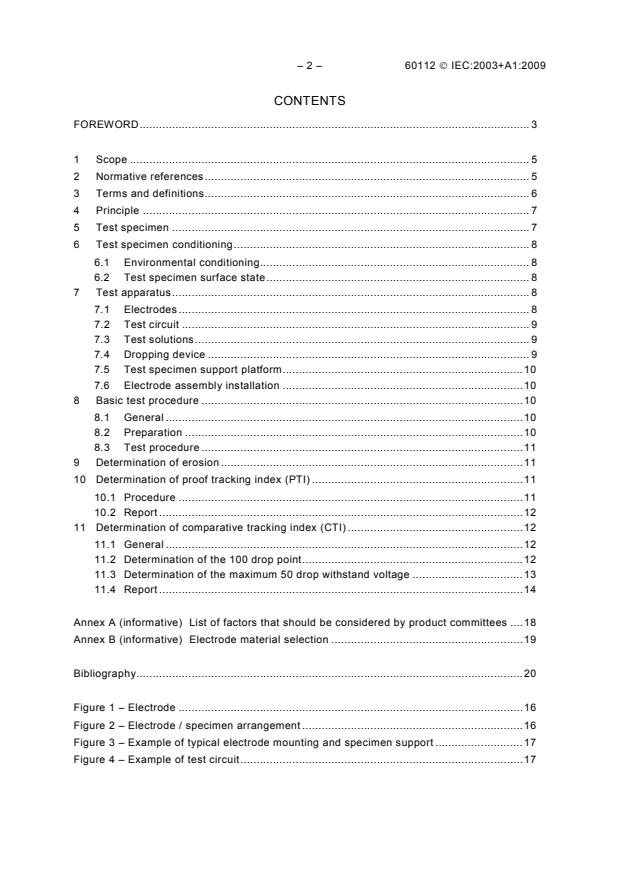
– 2 – 60112 © IEC:2003+A1:2009
CONTENTS
FOREWORD. 3
1 Scope. 5
2 Normative references. 5
3 Terms and definitions. 6
4 Principle. 7
5 Test specimen. 7
6 Test specimen conditioning. 8
6.1 Environmental conditioning. 8
6.2 Test specimen surface state. 8
7 Test apparatus. 8
7.1 Electrodes. 8
7.2 Test circuit. 9
7.3 Test solutions. 9
7.4 Dropping device. 9
7.5 Test specimen support platform.10
7.6 Electrode assembly installation.10
8 Basic test procedure.10
8.1 General.10
8.2 Preparation.10
8.3 Test procedure.11
9 Determination of erosion.11
10 Determination of proof tracking index (PTI) .11
10.1 Procedure.11
10.2 Report.12
11 Determination of comparative tracking index (CTI) .12
11.1 General.12
11.2 Determination of the 100 drop point.12
11.3 Determination of the maximum 50 drop withstand voltage .13
11.4 Report.14
Annex A (informative) List of factors that should be considered by product committees .18
Annex B (informative) Electrode material selection .19
Bibliography.20
Figure 1 – Electrode .16
Figure 2 – Electrode / specimen arrangement .16
Figure 3 – Example of typical electrode mounting and specimen support .17
Figure 4 – Example of test circuit.17
60112 © IEC:2003+A1:2009 – 3 –
INTERNATIONAL ELECTROTECHNICAL COMMISSION
____________
METHOD FOR THE DETERMINATION OF THE PROOF
AND THE COMPARATIVE TRACKING INDICES
OF SOLID INSULATING MATERIALS
FOREWORD
1) The International Electrotechnical Commission (IEC) is a worldwide organization for standardization comprising
all national electrotechnical committees (IEC National Committees). The object of IEC is to promote
international co-operation on all questions concerning standardization in the electrical and electronic fields. To
this end and in addition to other activities, IEC publishes International Standards, Technical Specifications,
Technical Reports, Publicly Available Specifications (PAS) and Guides (hereafter referred to as “IEC
Publication(s)”). Their preparation is entrusted to technical committees; any IEC National Committee interested
in the subject dealt with may participate in this preparatory work. International, governmental and non-
governmental organizations liaising with the IEC also participate in this preparation. IEC collaborates closely
with the International Organization for Standardization (ISO) in accordance with conditions determined by
agreement between the two organizations.
2) The formal decisions or agreements of IEC on technical matters express, as nearly as possible, an international
consensus of opinion on the relevant subjects since each technical committee has representation from all
interested IEC National Committees.
3) IEC Publications have the form of recommendations for international use and are accepted by IEC National
Committees in that sense. While all reasonable efforts are made to ensure that the technical content of IEC
Publications is accurate, IEC cannot be held responsible for the way in which they are used or for any
misinterpretation by any end user.
4) In order to promote international uniformity, IEC National Committees undertake to apply IEC Publications
transparently to the maximum extent possible in their national and regional publications. Any divergence
between any IEC Publication and the corresponding national or regional publication shall be clearly indicated in
the latter.
5) IEC itself does not provide any attestation of conformity. Independent certification bodies provide conformity
assessment services and, in some areas, access to IEC marks of conformity. IEC is not responsible for any
services carried out by independent certification bodies.
6) All users should ensure that they have the latest edition of this publication.
7) No liability shall attach to IEC or its directors, employees, servants or agents including individual experts and
members of its technical committees and IEC National Committees for any personal injury, property damage or
other damage of any nature whatsoever, whether direct or indirect, or for costs (including legal fees) and
expenses arising out of the publication, use of, or reliance upon, this IEC Publication or any other IEC
Publications.
8) Attention is drawn to the Normative references cited in this publication. Use of the referenced publications is
indispensable for the correct application of this publication.
9) Attention is drawn to the possibility that some of the elements of this IEC Publication may be the subject of
patent rights. IEC shall not be held responsible for identifying any or all such patent rights.
International Standard IEC 60112 has been prepared by subcommittee 15E: Methods of test,
of IEC technical committee 15: Insulating materials.
This consolidated version of IEC 60112 consists of the fourth edition (2003) [documents
15E/209/FDIS and 15E/213/RVD], its amendment 1 (2009) [documents 112/116/CDV and
112/130/RVC] and its corrigenda of June 2003 and October 2003.
The technical content is therefore identical to the base edition and its amendment and has
been prepared for user convenience.
It bears the edition number 4.1.
A vertical line in the margin shows where the base publication has been modified by
amendment 1.
– 4 – 60112 © IEC:2003+A1:2009
Major changes since the previous edition are the following:
The selection of a material for a specific application frequently involves compromises in the
levels of the individual properties and test criteria. In the previous edition of IEC 60112 the
test criteria required "no burning of the specimen", but this gave rise to two issues:
– difficulties in the identification of burning which includes all types of combustion, e.g.
flaming, and smouldering in the situation where scintillations had occurred giving rise in
many cases to carbon on the surface of the specimen, and
– a situation in which some product committees had found it necessary to dispense with the
"no burning" criterion in the tracking tests which they replaced by flame tests on the final
product, thereby giving rise to two types of CTI/PTI with different criteria.
This standard attempts to regularize this situation.
It has the status of a basic safety publication in accordance with IEC Guide 104.
This publication has been drafted in accordance with the ISO/IEC Directives, Part 2.
The committee has decided that the contents of the base publication and its amendments will
remain unchanged until the maintenance result date indicated on the IEC web site under
"http://webstore.iec.ch" in the data related to the specific publication. At this date,
the publication will be
• reconfirmed,
• withdrawn,
• replaced by a revised edition, or
• amended.
60112 © IEC:2003+A1:2009 – 5 –
METHOD FOR THE DETERMINATION OF THE PROOF
AND THE COMPARATIVE TRACKING INDICES
OF SOLID INSULATING MATERIALS
1 Scope
This International standard specifies the method of test for the determination of the proof and
comparative tracking indices of solid insulating materials on pieces taken from parts of
equipment and on plaques of material using alternating voltages.
The standard provides for the determination of erosion when required.
NOTE 1 The proof tracking index is used as an acceptance criterion as well as a means for the quality control of
materials and fabricated parts. The comparative tracking index is mainly used for the basic characterization and
comparison of the properties of materials.
Test results cannot be used directly for the evaluation of safe creepage distances when
designing electrical apparatus.
NOTE 2 This test discriminates between materials with relatively poor resistance to tracking, and those with
moderate or good resistance, for use in equipment which can be used under moist conditions. More severe tests,
of longer duration are required for the assessment of performance of materials for outdoor use, utilizing higher
voltages and larger test specimens (see the inclined plane test of IEC 60587). Other test methods such as the
inclined method may rank materials in a different order from the drop test given in this standard.
2 Normative references
The following referenced documents are indispensable for the application of this document.
For dated references, only the edition cited applies. For undated references, the latest edition
of the referenced document (including any amendments) applies.
IEC Guide 104:1997, The preparation of safety publications and the use of basic safety
publications and group safety publications
ISO 293:1986, Plastics – Compression moulding test specimens of thermoplastic materials
ISO 294-1:1996, Plastics – Injection moulding of test specimens of thermoplastic materials –
Part 1: General principles, and moulding of multi-purpose and bar test specimens
ISO 294-3:2002, Plastics – Injection moulding of test specimens of thermoplastic materials –
Part 3: Small plates
ISO 295:1991, Plastics – Compression moulding of test specimens of thermosetting materials
– 6 – 60112 © IEC:2003+A1:2009
3 Terms and definitions
For the purposes of this International Standard, the following definitions apply:
3.1
tracking
progressive formation of conducting paths, which are produced on the surface and/or within
a solid insulating material, due to the combined effects of electric stress and electrolytic
contamination
3.2
tracking failure
failure of insulation due to tracking between conducting parts
NOTE In the present test, tracking is indicated by operation of an over-current device due to the passage of
a current of at least 0,5 A for at least 2 s across the test surface and/or within the specimen.
3.3
electrical erosion
wearing away of insulating material by the action of electrical discharges
3.4
air arc
arc between the electrodes above the surface of the specimen
3.5
comparative tracking index
CTI
numerical value of the maximum voltage at which five test specimens withstand the test
period for 50 drops without tracking failure and without a persistent flame occurring and
including also a statement relating to the behaviour of the material when tested using
100 drops (see 11.4)
NOTE 1 The criteria for CTI may also require a statement concerning the degree of erosion.
NOTE 2 Although a non-persistent flame is allowed in the test without constituting failure, materials which
generate no flame at all are preferred unless other factors are considered to be more important. See also Annex A.
3.6
persistent flame
in case of dispute – one which burns for more than 2 s
3.7
proof tracking index
PTI
numerical value of the proof voltage in volts at which five test specimens withstand the test
period for 50 drops without tracking failure and without a persistent flame occurring
NOTE Although a non-persistent flame is allowed in the test without constituting failure, materials which generate
no flame at all are preferred unless other factors are considered to be more important. See also Annex A.
60112 © IEC:2003+A1:2009 – 7 –
4 Principle
The upper surface of the test specimen is supported in an approximately horizontal plane and
subjected to an electrical stress via two electrodes. The surface between the electrodes is
subjected to a succession of drops of electrolyte either until the over-current device operates,
or until a persistent flame occurs, or until the test period has elapsed.
The individual tests are of short duration (less than 1 h) with up to 50 or 100 drops of about
20 mg of electrolyte falling at 30 s intervals between platinum electrodes, 4 mm apart on the
test specimen surface.
An a.c. voltage between 100 V and 600 V is applied to the electrodes during the test.
During the test, specimens may also erode or soften, thereby allowing the electrodes to
penetrate them. The formation of a hole through the test specimen during a test is to be
reported together with the hole depth (test specimen thickness). Retests may be made using
thicker test specimens, up to a maximum of 10 mm.
NOTE The number of drops needed to cause failure by tracking usually increases with decreasing applied voltage
and, below a critical value, tracking ceases to occur.
5 Test specimen
Any approximately flat surface may be used, provided that the area is sufficient to ensure that
during the test no liquid flows over the edges of the test specimen.
NOTE 1 Flat surfaces of not less than 20 mm × 20 mm are recommended to reduce the probability of electrolyte
loss over the specimen edge although smaller sizes may be used, subject to no electrolyte loss, e.g. ISO 3167,
15 mm × 15 mm multi-purpose test specimens.
NOTE 2 It is preferable to use separate test specimens for each test. If several tests are to be made on the same
test piece, care should be taken to ensure that the testing points are sufficiently far from each other so that
splashes or fumes from the testing point will not contaminate the other areas to be tested.
The thickness of the test specimen shall be 3 mm or more. Individual pieces of material may
be stacked to obtain the required thickness of at least 3 mm.
NOTE 3 The values of the CTI obtained on specimens with a thickness below 3 mm may not be comparable with
those obtained on thicker specimens because of greater heat transmission to the glass support through thinner test
specimens. For this reason, stacked specimens are allowed.
Test specimens shall have nominally smooth and untextured surfaces which are free from
surface imperfections such as scratches, blemishes, impurities, etc, unless otherwise stated
in the product standard. If this is impossible, the results shall be reported together with a
statement describing the surface of the specimen because certain characteristics on the
surface of the specimen could add to the dispersion of the results.
For tests on parts of products, where it is impossible to cut a suitable test specimen from a
part of a product, specimens cut from moulded plaques of the same insulating material may
be used. In these cases care should be taken to ensure that both the part and the plaque are
produced by the same fabrication process wherever possible. Where the details of the final
fabrication process are unknown, methods given in ISO 293, ISO 294-1 and ISO 294-3 and
ISO 295 may be appropriate.
NOTE 4 The use of different fabrication conditions/processes may lead to different levels of performance in
the PTI and CTI test.
NOTE 5 Parts moulded using different flow directions may also exhibit different levels of performance in the PTI
and CTI test.
In special cases, the test specimen may be ground to obtain a flat surface.
– 8 – 60112 © IEC:2003+A1:2009
Where the direction of the electrodes relative to any feature of the material is significant,
measurements shall be made in the direction of the feature and orthogonal to it. The direction
giving the lower CTI shall be reported, unless otherwise specified.
6 Test specimen conditioning
6.1 Environmental conditioning
Unless otherwise specified, the test specimens shall be conditioned for a minimum of 24 h at
23 °C ± 5 K, with (50 ± 10) % RH.
6.2 Test specimen surface state
Unless otherwise specified,
a) tests shall be made on clean surfaces;
b) any cleaning procedure used shall be reported. Wherever possible, the details shall be
agreed between supplier and customer.
NOTE Dust, dirt, fingerprints, grease, oil, mould release or other contaminants may influence the results. Care
should be taken when cleaning the test specimen to avoid swelling, softening, abrasion or other damage to the
material.
7 Test apparatus
7.1 Electrodes
Two electrodes of platinum with a minimum purity of 99 % shall be used (see Annex B). The
two electrodes shall have a rectangular cross-section of (5 ± 0,1) mm × (2 ± 0,1) mm, with
one end chisel-edged with an angle of 30° ± 2° (see Figure 1). The sharp edge shall be
removed to produce an approximately flat surface, 0,01 mm to 0,1 mm wide.
NOTE 1 A microscope with a calibrated eyepiece has been found suitable for checking the size of the end
surface.
NOTE 2 It is recommended that mechanical means are used to re-furbish the electrode shape after a test to
ensure that the electrodes maintain the required tolerances, especially with respect to the edges and corners.
At the start of the test, the electrodes shall be symmetrically arranged in a vertical plane, the
total angle between them being 60° ± 5° and with opposing electrode faces approximately
vertical on a flat horizontal surface of the test specimen (see Figure 2 ). Their separation
along the surface of the test specimen at the start of the test shall be 4,0 mm ± 0,1 mm.
A thin metal rectangular slip gauge shall be used to check the electrode separation. The
electrodes shall move freely and the force exerted by each electrode on the surface of the
test specimen at the start of the test shall be 1,00 N ± 0,05 N. The design shall be such that
the force can be expected to remain at the initial level during the test.
One typical type of arrangement for applying the electrodes to the test specimen is shown in
Figure 3. The force shall be verified at appropriate intervals.
Where tests are made solely on those materials where the degree of electrode penetration is
small, the electrode force may be generated by the use of springs. However, gravity should be
used to generate the force on general purpose equipment (see Figure 3).
NOTE 3 With most, but not all designs of apparatus, if the electrodes move during a test due to softening or
erosion of the specimen, their tips will prescribe an arc and the electrode gap will change. The magnitude and
direction of the gap change will depend on the relative positions of the electrode pivots and the electrode/specimen
contact points. The significance of these changes will probably be material dependent and has not been
determined. Differences in design could give rise to differences in inter-apparatus results.
60112 © IEC:2003+A1:2009 – 9 –
7.2 Test circuit
The electrodes shall be supplied with a substantially sinusoidal voltage, variable between
100 V and 600 V at a frequency of 48 Hz to 62 Hz. The voltage measuring device shall
indicate a true r.m.s. value and shall have a maximum error of 1,5 %. The power of the source
shall be not less than 0,6 kVA. An example of a suitable test circuit is shown in Figure 4.
A variable resistor shall be capable of adjusting the current between the short-circuited
electrodes to (1,0 ± 0,1) A and the voltage indicated by the voltmeter shall not decrease by
more than 10 % when this current flows (see Figure 4). The instrument used to measure the
value of the short-circuit current shall have a maximum error of ±3 %.
The input supply voltage to the apparatus shall be adequately stable.
The over-current device shall operate when a current with an r.m.s. value of 0,50 A with
a relative tolerance of ±10 %, has persisted for 2,00 s with a relative tolerance of ±10 %.
7.3 Test solutions
Solution A:
Dissolve approximately 0,1 % by mass of analytical reagent grade anhydrous ammonium
chloride (NH Cl), of a purity of not less than 99,8 %, in de-ionized water, having a conductivity
of not greater than 1 mS/m to give a resistivity of (3,95 ± 0,05) Ωm at (23 ± 1) °C.
NOTE 1 Select the quantity of ammonium chloride to give a solution in the required range of resistivity.
Solution B:
Dissolve approximately 0,1 % by mass of analytical reagent grade anhydrous ammonium
chloride, of a purity of not less than 99,8 %, and 0,5 % ± 0,002 % by mass of sodium-di-butyl
naphthalene sulfonate in de-ionized water, having a conductivity of not greater than 1 mS/m,
to give a resistivity of (1,98 ± 0,05) Ωm at (23 ± 1) °C.
NOTE 2 Select the quantity of ammonium chloride to give a solution in the required range of resistivity.
Solution A is normally used, but where a more aggressive contaminant is required, Solution B
is recommended. To indicate that Solution B was used, the CTI or PTI value shall be followed
by the letter "M".
7.4 Dropping device
Drops of the test solution shall fall on to the specimen surface at intervals of 30 s ± 5 s. The
drops shall fall more or less centrally between the electrodes from a height of 35 mm ± 5 mm.
The time for 50 drops to fall on to the specimen shall be (24,5 ± 2) min.
The mass of a sequence of 50 drops shall lie between 0,997 g and 1,147 g. The mass of a
sequence of 20 drops shall lie between 0,380 g and 0,480 g.
NOTE 1 The mass of the drops may be determined by weighing with the appropriate laboratory balance.
The mass of the drops shall be checked at appropriate time intervals.
NOTE 2 For Solution A, a length of thin walled stainless steel tubing (e.g. hypodermic needle tubing), having an
outer diameter of between 0,9 mm and 1,2 mm, dependent upon the dropping system, has been found to be
suitable for the tip of the dropping device. For Solution B, tubes having outer diameters over the range 0,9 mm to
3,45 mm have been found to be necessary with the different dropping systems in use.
NOTE 3 The use of a drop detector/counter is recommended to ascertain whether there are any double drops or
whether drops are missing.
– 10 – 60112 © IEC:2003+A1:2009
7.5 Test specimen support platform
A glass plate or plates, having a total thickness of not less than 4 mm and of a suitable size
shall be used to support the test specimen during the test.
NOTE 1 In order to avoid the problem of cleaning the specimen support table, it is recommended that a
disposable glass microscope slide be placed on the specimen support table immediately under the test specimen.
NOTE 2 The use of thin metal foil conductors around the edge of the glass plate to detect electrolyte loss has
been found useful.
7.6 Electrode assembly installation
The specimen and its immediate electrodes shall be mounted in an essentially draught-free
space in an enclosure.
NOTE To keep the chamber reasonably free of fumes, it may be necessary, for certain classes of materials, to
have a small air flow across the surface of the test specimen and between the electrodes. An air velocity of the
order of 0,2 m/s before the start of the test and as far as possible during the test has been found suitable. The air
velocity in other areas of the enclosure may be substantially higher to assist in fume removal. The air velocity may
be measured with an appropriately scaled hot wire anemometer.
A suitable fume extraction system shall be provided to allow safe venting of the enclosure
after the test.
8 Basic test procedure
8.1 General
Where the material is substantially anisotropic, tests shall be made in the direction of the
features and orthogonal to them. Results from the direction giving the lower values shall be
used, unless otherwise specified.
Test shall be made at an ambient temperature of (23 ± 5) °C.
Tests shall be made on uncontaminated test specimens, unless otherwise specified.
The result of a test where a hole is formed is considered to be valid, irrespective of the test
specimen thickness, but the formation of the hole shall be reported together with the depth of
the hole (the thickness of the test specimen or stack).
8.2 Preparation
After each test, clean the electrodes with an appropriate solvent and then rinse them with de-
ionized water. If necessary, restore their shape and give a final rinse before the next test.
Immediately before the test ensure, if necessary by cooling the electrodes, that their
temperature is sufficiently low so that they have no adverse effect on the specimen
properties.
Ensure freedom from visual contamination and ensure that the solution to be used conforms
to the conductivity requirements either by regular testing, or by measurement immediately
before the test.
NOTE 1 Residues on the dropping device from an earlier test will probably contaminate the solution and
evaporation of the solution will increase its concentration – both of which may result in lower than true values. In
such cases it may be advisable to clean the outside of the dropping device mechanically and/or with a solvent and
the inside by flushing through with conforming solution before each test. Flushing through some 10 to 20 drops
depending upon the delay between tests will normally remove any non-conforming liquid.
In case of dispute, the cleaning procedures used for the electrodes and dropper tube shall be
agreed between purchaser and supplier.
60112 © IEC:2003+A1:2009 – 11 –
Place the test specimen, with the test surface uppermost and horizontal on the specimen
support table. Adjust the relative height of the test specimen and electrode mounting
assembly, such that on lowering the electrodes on to the specimen, the correct orientation is
achieved with a separation of 4,0 mm ± 0,1 mm. Ensure that the chisel edges make contact
with the surface of the specimen with the required force and over their full width.
NOTE 2 It may be helpful to place a light behind the electrodes when making this check visually.
Set the test voltage to the required value which shall be an integer multiple of 25 V, and
adjust the circuit parameters so that the short-circuit current is within the permitted tolerance.
8.3 Test procedure
Start the dropping system so that drops fall on to the test surface and continue the test until
one of the following occurs:
a) the over-current device operates;
b) a persistent flame occurs;
c) at least 25 s have elapsed after the fiftieth (hundredth) drop has fallen without a) or b)
occuring.
NOTE If there is no requirement for the determination of erosion, the 100 drop tests may be made ahead of any
50 drop tests.
After completion of the test, vent the chamber of noxious fumes and remove the test
specimen.
9 Determination of erosion
When required, specimens which have not failed at the 50 drop point shall be cleaned of any
debris or loosely attached degradation products and placed on the platform of a depth gauge.
The maximum depth of erosion of each specimen shall be measured in millimetres to an
accuracy of 0,1 mm, using a 1,0 mm nominal diameter probe having a hemispherical end. The
result is the maximum of the five measured values.
Erosion depths of less than 1 mm are reported as <1 mm.
In the case of tests according to Clause 10, when required the erosion shall be measured on
the specimens which withstood 50 drops at the specified voltage.
In the case of tests according to Clause 11, when required the erosion shall be measured on
the five specimens tested at the maximum 50 drop voltage.
10 Determination of proof tracking index (PTI)
10.1 Procedure
Where, in IEC standards for material or for electrical equipment specifications, or in other
standards, a proof test only is required, 50 drop tests shall be made in accordance with
Clause 8 but at the single voltage specified. The required number of specimens shall
withstand the test period up to at least 25 s after the fiftieth drop has fallen without tracking
failure, and without a persistent flame occurring.
Operation of the over-current device by air arcs does not constitute a tracking failure.
NOTE The recommended number of specimens is five.
The proof voltage shall be an integer multiple of 25 V.
– 12 – 60112 © IEC:2003+A1:2009
10.2 Report
The report shall include the following information:
1. Identification of the material tested and details of any conditioning.
2. Thickness of the specimens and the number of layers used to achieve this thickness.
3. Nature of the test specimen surface where the original surface was not tested:
3.1 details of any cleaning process,
3.2 details of any machining processes, e.g. grinding,
3.3 details of any coating on the tested surface.
4. State of the surface before testing, with regard to surface imperfections, e.g. surface
scratches, blemishes, impurities, etc.
5. The cleaning procedure used for the electrodes and dropper.
6. Where the measurements were not made in an essentially draught free space, report on
the approximate air flow rate.
7. Orientation of the electrodes in relation to any known characteristics of the material.
8. Report on the result of the proof tracking index test where there is no requirement for the
determination of the degree of erosion as follows:
Pass or fail at the specified voltage with an indication of the type of solution if Type B.
EXAMPLE ‘Pass PTI 175’ or ‘Fail PTI 175 M’.
Where there is an erosion requirement the result shall be reported as follows:
Pass or fail at the specified voltage with an indication of the type of solution if Type B,
and the maximum depth of erosion.
EXAMPLE ‘Fail PTI 250 - 3’, or ‘Pass PTI 250 M - 3’.
Where the erosion cannot be reported because the specimen flamed, this shall be
reported.
Where a hole developed through the specimen, its formation shall be reported together
with an indication of its depth (specimen thickness).
Where the tests were invalid due to air arcs, this shall be reported.
11 Determination of comparative tracking index (CTI)
11.1 General
Determination of the comparative tracking index requires the determination of the maximum
voltage at which five specimens withstand the test period for 50 drops without failure and
whether, at a voltage of 25 V lower than the maximum 50 drop figure, the specimen
withstands 100 drops. If this is not the case, the maximum 100 drop withstand voltage has to
be determined.
NOTE 1 The wording of the previous edition of this standard implied that determinations of the maximum 50 drop
withstand voltage had to be made before any 100 drop determinations.
NOTE 2 It is recognized that the cost of testing may be reduced by firstly determining the maximum 100 drop
withstand voltage and therefore this procedure is recommended in this standard.
11.2 Determination of the 100 drop point
Using the basic procedure described in Clause 8, set the voltage at a selected level and make
the test until at least 25 s have elapsed after the one hundredth drop has fallen or until
previous failure occurs.
60112 © IEC:2003+A1:2009 – 13 –
If the behaviour of the material is unknown, it is recommended that the starting voltage
be 350 V.
If the over-current device operated due to the occurrence of an air arc above the test
specimen, the test was invalid. Repeat the test procedure at the same voltage using a new
test specimen or site after cleaning the apparatus and following the procedure in Clause 8.
If the same event occurs, repeat the test at progressively lower and lower voltages until a
valid failure or pass occurs. Report the details of the tests (see 11.4).
NOTE 1 It may be impossible to determine the CTI of some materials because a valid failure cannot be achieved,
the characteristic behaviour moving directly from withstanding the test period at one voltage to exhibiting air arcs
at the next highest test voltage.
If the over-current device operated due to the passage of an excessive current across the
surface of the test specimen, or if a persistent flame occurred, the specimen failed the test at
that voltage. Repeat the test on a new site/specimen using a lower test voltage after cleaning
the apparatus, etc. as described in Clause 8.
If none of the above occurred and at least 25 s elapsed after the one hundredth drop had
fallen without the over-current device operating, the test is valid and the test specimen is
considered to have passed. Repeat the test on new sites/specimens at progressively higher
and higher voltages until the maximum voltage is established at which no failure occurred
during the test period of up to at least 25 s after the one hundredth drop has fallen in the first
five tests at that voltage. Five separate specimens or five sites on one plaque may be used
for the tests after cleaning the apparatus and following the procedure described in Clause 8.
If a hole appeared through the test specimen, record the result noting both that a hole was
formed and the depth of the hole (the thickness of the test specimen or stack), and then
continue the tests as described above.
NOTE 2 Where a hole is generated during a test, the further tests may be made on thicker specimens (up to a
maximum thickness of 10 mm) to gain additional information after cleaning the apparatus, etc., as described in
Clause 8.
Where the properties of the test specimen are unknown, increases in test voltage at voltages
above 400 V shall be limited to 50 V per test.
Record, as the 100 drop result, the maximum voltage at which five specimens withstood the
100 drop period without failure.
Continue by determining the maximum 50 drop withstand voltage.
11.3 Determination of the maximum 50 drop withstand voltage
By inference from the 100 drop data, repeat the test procedure at an appropriate test voltage,
using a new site/specimen and determine whether the specimen withstands the test for the
period up to at least 25 s after the fiftieth drop has fallen.
If the over-current device operated due to the occurrence of an air arc above the test
specimen, the test was invalid. Repeat the test procedure at the same voltage using a new
site/test specimen after cleaning the apparatus and following the procedure as described in
Clause 8. If the same event occurs, repeat the test at progressively lower and lower voltages
until a valid failure or pass occurs. Report the details of the tests (see 11.4).
NOTE 1 It may be impossible to determine the CTI of some materials because a valid failure cannot be achieved,
the characteristic behaviour moving directly from withstanding the test period at one voltage to exhibiting air arcs
at the next highest test voltage.
– 14 – 60112 © IEC:2003+A1:2009
If the over-current device operated due to the passage of an excessive current across the
surface of the test specimen, or if a persistent flame occurred, the specimen failed the test at
that voltage. Repeat the test on a new site/specimen using a lower test voltage after cleaning
the apparatus, etc. as described in Clause 8.
If none of the above occurred and at least 25 s elapsed after the fiftieth drop had fallen
without the over-current device operating, the test was valid and the test specimen is
considered to have passed.
If a hole has not formed through the test specimen during the test, repeat the test on new
sites/specimens, at progressively higher and higher voltages until the maximum voltage is
established at which no failure occurred during the test period of up to at least 25 s after the
fiftieth drop has fallen in the first five tests at that voltage. Five specimens or five sites on one
plaque may be used for the tests after cleaning the apparatus and following the procedure
described in Clause 8.
If a hole appeared through the test specimen, record the result noting both that a hole was
formed, and the depth of the hole (the thickness of the test specimen or stack), and then
continue the tests as described above.
NOTE 2 Where a hole is generated during a test, the further tests may be made on thicker specimens (up to a
maximum thickness of 10 mm) to gain additional information after cleaning the apparatus, etc., as
...
Questions, Comments and Discussion
Ask us and Technical Secretary will try to provide an answer. You can facilitate discussion about the standard in here.
Loading comments...