


prEN IEC 63439-2-1:2026
(Main)Robotics for electricity generation, transmission and distribution systems - Part 2-1: General technical requirements for uas for overhead power lines inspection
General Information
- Abstract
- Status
- Not Published
- Publication Date
- 23-Mar-2028
- Current Stage
- 4020 - Enquiry circulated - Enquiry
- Start Date
- 04-Sep-2026
- Due Date
- 10-May-2024
- Completion Date
- 04-Sep-2026

Overview
prEN IEC 63439-2-1:2026 defines general technical requirements for uncrewed aircraft systems (UAS) designed for the inspection of overhead power lines. Developed by the CLC and IEC, this standard supports the safe, efficient, and effective use of robotics and UAS technology for monitoring assets in electricity generation, transmission, and distribution networks.
Utilizing UAS for overhead line inspection offers improved access, detailed data acquisition, and increased safety compared to manual methods. Standardization ensures interoperability, quality, and confidence for electric utilities, UAS manufacturers, and service providers.
Key Topics
UAS Configuration and Classification
- Supports multiple types: multi-rotor, fixed-wing, composite wing.
- Applicable to inspections of low, medium, and high voltage overhead lines.
- Classifies systems based on weight, endurance, environmental adaptation, and mission.
Mission Payloads and Sensors
- Visual optical cameras for high-resolution imaging.
- Infrared thermography for detecting temperature anomalies and fault conditions.
- LiDAR for accurate 3D modeling and clearance assessment.
- UV and multi-spectral cameras for corona discharge and vegetation analysis.
- Support for modular designs enabling flexible payload integration.
Environmental and Flight Performance
- Requirements for wind resistance, ingress protection (IP54), and operation in temperature extremes.
- Specifies GNSS/RTK navigation, hovering precision, and seamless manual-autopilot mode transfers.
- Emphasizes robust obstacle detection and avoidance.
Communication and Data Transmission
- Reliable command and control (C2) links, including FPV and BVLOS operations.
- Minimum data ranges and latency thresholds in various environments.
- Mandates redundant and failover links for challenging inspection conditions.
Safety and Security
- Addresses flight control precision, electromagnetic immunity, and fail-safe protocols.
- Emphasizes information security, data privacy, and operational safety near energized infrastructure.
Applications
prEN IEC 63439-2-1:2026 is relevant for a variety of stakeholders in the electric power industry and robotics sector:
- Electricity Utilities: Ensures safe and uniform UAS deployment for transmission and distribution inspections, improving asset condition monitoring, reducing downtime, and minimizing manual intervention.
- UAS Manufacturers and Integrators: Provides a harmonized technical reference for product development, testing, and market entry, supporting modular designs and compliance with international benchmarks.
- Inspection Service Providers: Offers guidance on equipment selection, operational procedures, and data quality, boosting efficiency and reliability of inspection services.
- Regulators and Standards Bodies: Facilitates cross-border harmonization, regulatory compliance, and technological advancement in grid operation and maintenance.
By applying this standard, organizations benefit from:
- Consistent, high-quality inspection data for predictive maintenance.
- Reduced risk to personnel by minimizing close-contact inspection tasks.
- Enhanced efficiency through automation, advanced imaging, and real-time data collection.
Related Standards
The requirements and terminology of prEN IEC 63439-2-1:2026 are aligned with other international standards, including:
- ISO 19111: Geographic information referencing by coordinates.
- ISO 21384 Series: Unmanned aircraft systems-components, operational procedures, and vocabulary.
- ISO 24354: General payload interface requirements for civil UAS.
- ISO 5110/ISO 5332: UAS flight stability and low pressure test methods.
- IEC 61000-4 Series: EMC immunity for electrostatic discharge, radiated RF fields, power frequency, and impulse magnetic fields.
In Summary:
This standard establishes a framework to drive interoperability, operational safety, and inspection performance for UAS in overhead power line inspections, building the foundation for robust adoption of robotics in critical electric utility applications.
Frequently Asked Questions
prEN IEC 63439-2-1:2026 is a draft published by CLC. Its full title is "Robotics for electricity generation, transmission and distribution systems - Part 2-1: General technical requirements for uas for overhead power lines inspection". This standard covers: Robotics for electricity generation, transmission and distribution systems - Part 2-1: General technical requirements for uas for overhead power lines inspection
Robotics for electricity generation, transmission and distribution systems - Part 2-1: General technical requirements for uas for overhead power lines inspection
prEN IEC 63439-2-1:2026 is available in PDF format for immediate download after purchase. The document can be added to your cart and obtained through the secure checkout process. Digital delivery ensures instant access to the complete standard document.
Standards Content (Sample)
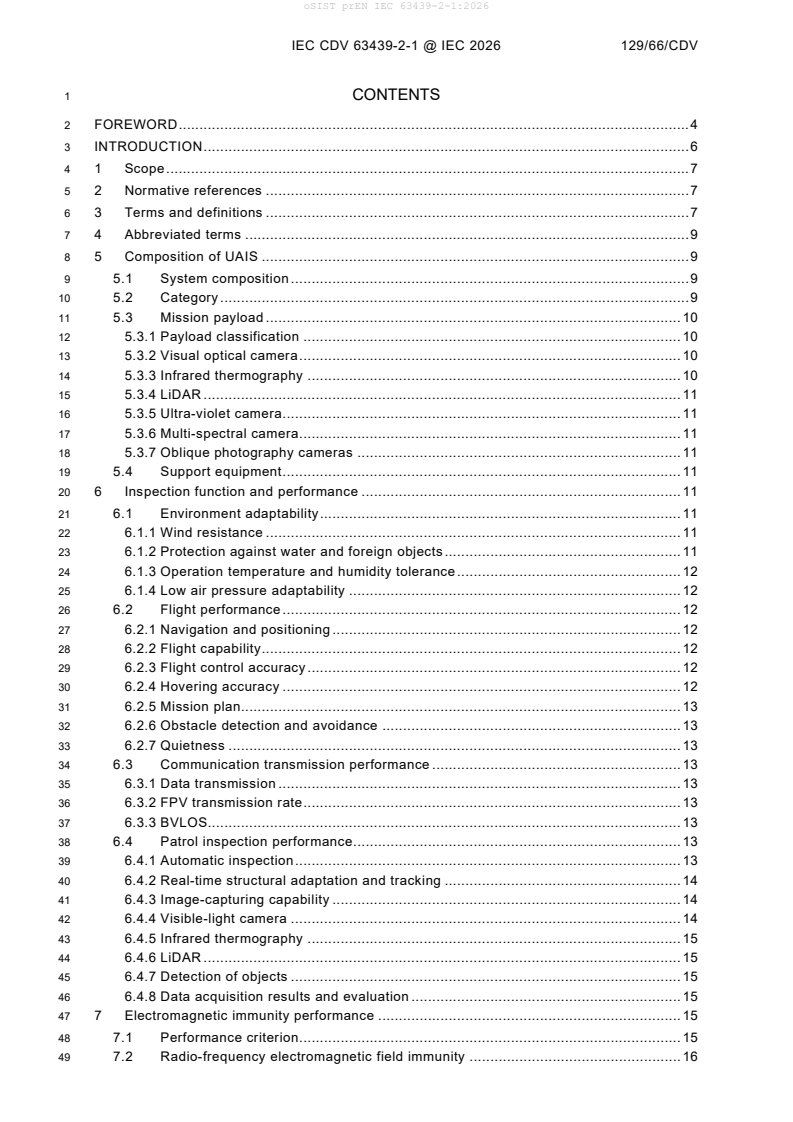
SLOVENSKI STANDARD
01-oktober-2026
Robotika za sisteme proizvodnje, prenosa in distribucije električne energije - 2-1.
del: Splošne tehnične zahteve za UAS za pregled nadzemnih daljnovodov
Robotics for electricity generation, transmission and distribution systems - Part 2-1:
General technical requirements for uas for overhead power lines inspection
Ta slovenski standard je istoveten z: prEN IEC 63439-2-1:2026
ICS:
25.040.30 Industrijski roboti. Industrial robots.
Manipulatorji Manipulators
29.240.20 Daljnovodi Power transmission and
distribution lines
2003-01.Slovenski inštitut za standardizacijo. Razmnoževanje celote ali delov tega standarda ni dovoljeno.
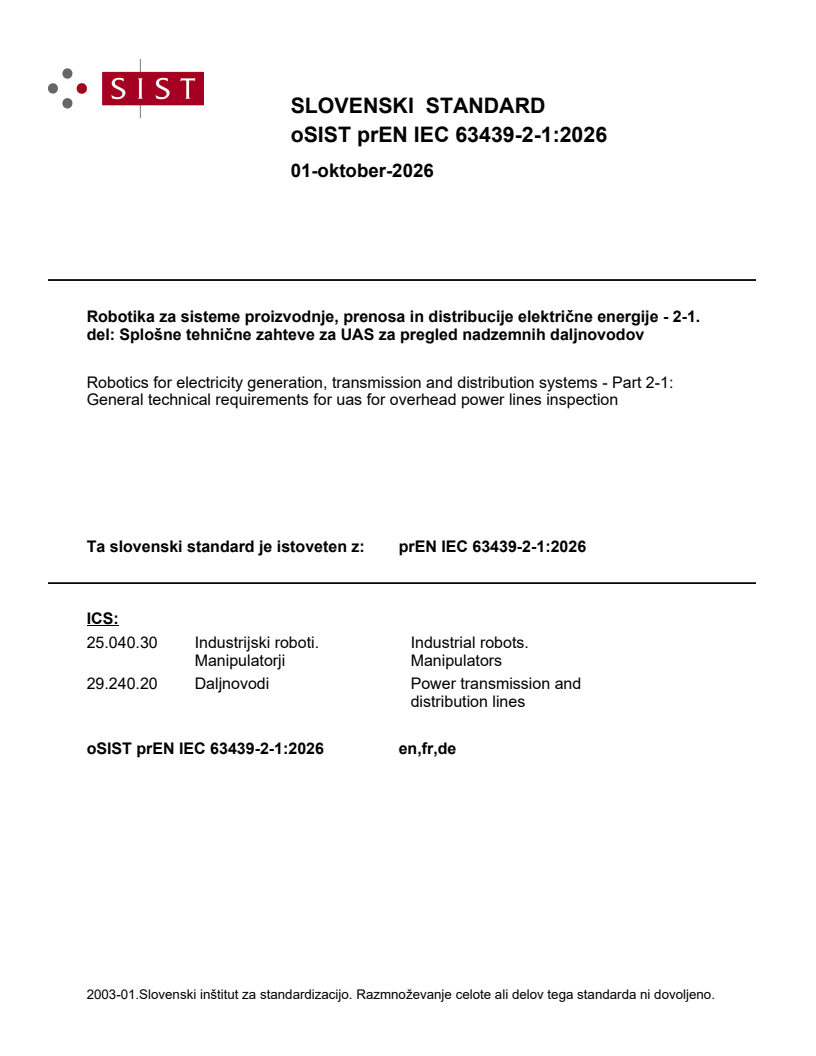
129/66/CDV
COMMITTEE DRAFT FOR VOTE (CDV)
PROJECT NUMBER:
IEC 63439-2-1 ED1
DATE OF CIRCULATION: CLOSING DATE FOR VOTING:
2026-09-04 2026-11-27
SUPERSEDES DOCUMENTS:
129/53/CD, 129/62/CC
IEC TC 129 : ROBOTICS FOR ELECTRICITY GENERATION, TRANSMISSION AND DISTRIBUTION SYSTEMS
SECRETARIAT: SECRETARY:
China Mr Jianbin Fan
OF INTEREST TO THE FOLLOWING COMMITTEES: HORIZONTAL FUNCTION(S):
ASPECTS CONCERNED:
Digital content,Electricity transmission and distribution,Electromagnetic Compatibility,Information security and data
privacy,Safety
SUBMITTED FOR CENELEC PARALLEL VOTING NOT SUBMITTED FOR CENELEC PARALLEL VOTING
Attention IEC-CENELEC parallel voting
The attention of IEC National Committees, members of
CENELEC, is drawn to the fact that this Committee Draft
for Vote (CDV) is submitted for parallel voting.
The CENELEC members are invited to vote through the
CENELEC online voting system.
This document is still under study and subject to change. It should not be used for reference purposes.
Recipients of this document are invited to submit, with their comments, notification of any relevant patent rights of which
they are aware and to provide supporting documentation.
Recipients of this document are invited to submit, with their comments, notification of any relevant “In Some Countries”
clauses to be included should this proposal proceed. Recipients are reminded that the CDV stage is the final stage for
submitting ISC clauses. (SEE AC/22/2007 OR NEW GUIDANCE DOC).
TITLE:
Robotics for electricity generation, transmission and distribution systems - Part 2-1: General
Technical Requirements for UAS for Overhead Power Lines Inspection
PROPOSED STABILITY DATE: 2027
NOTE FROM TC/SC OFFICERS:
electronic file, to make a copy and to print out the content for the sole purpose of preparing National Committee
positions. You may not copy or "mirror" the file or printed version of the document, or any part of it, for any other purpose
without permission in writing from IEC.
IEC CDV 63439-2-1 @ IEC 2026 129/66/CDV
1 CONTENTS
2 FOREWORD . 4
3 INTRODUCTION . 6
4 1 Scope . 7
5 2 Normative references . 7
6 3 Terms and definitions . 7
7 4 Abbreviated terms . 9
8 5 Composition of UAIS . 9
9 5.1 System composition . 9
10 5.2 Category . 9
11 5.3 Mission payload . 10
12 5.3.1 Payload classification . 10
13 5.3.2 Visual optical camera . 10
14 5.3.3 Infrared thermography . 10
15 5.3.4 LiDAR . 11
16 5.3.5 Ultra-violet camera. 11
17 5.3.6 Multi-spectral camera. 11
18 5.3.7 Oblique photography cameras . 11
19 5.4 Support equipment . 11
20 6 Inspection function and performance . 11
21 6.1 Environment adaptability . 11
22 6.1.1 Wind resistance . 11
23 6.1.2 Protection against water and foreign objects . 11
24 6.1.3 Operation temperature and humidity tolerance . 12
25 6.1.4 Low air pressure adaptability . 12
26 6.2 Flight performance . 12
27 6.2.1 Navigation and positioning . 12
28 6.2.2 Flight capability . 12
29 6.2.3 Flight control accuracy . 12
30 6.2.4 Hovering accuracy . 12
31 6.2.5 Mission plan. 13
32 6.2.6 Obstacle detection and avoidance . 13
33 6.2.7 Quietness . 13
34 6.3 Communication transmission performance . 13
35 6.3.1 Data transmission . 13
36 6.3.2 FPV transmission rate . 13
37 6.3.3 BVLOS. 13
38 6.4 Patrol inspection performance . 13
39 6.4.1 Automatic inspection . 13
40 6.4.2 Real-time structural adaptation and tracking . 14
41 6.4.3 Image-capturing capability . 14
42 6.4.4 Visible-light camera . 14
43 6.4.5 Infrared thermography . 15
44 6.4.6 LiDAR . 15
45 6.4.7 Detection of objects . 15
46 6.4.8 Data acquisition results and evaluation . 15
47 7 Electromagnetic immunity performance . 15
48 7.1 Performance criterion. 15
49 7.2 Radio-frequency electromagnetic field immunity . 16
129/66/CDV IEC CDV 63439-2-1 @ IEC 2026
50 7.3 Power frequency magnetic field immunity . 16
51 7.4 Electrostatic discharge immunity . 16
52 7.5 Pulsed magnetic field immunity . 16
53 8 Safety and Security requirements . 16
54 8.1 Safety assurance . 16
55 8.2 Security requirements . 17
56 9 Payload Interface . 17
57 9.1 General . 17
58 9.2 Electrical interface . 17
59 9.3 Communication protocol . 18
60 9.4 Data requirement . 18
61 Annex A (informative) Flight Course Contents . 19
62 Annex B (Informative) Communication protocol data . 21
IEC CDV 63439-2-1 @ IEC 2026 129/66/CDV
64 INTERNATIONAL ELECTROTECHNICAL COMMISSION
65 ____________
67 Robotics for electricity generation, transmission and distribution systems
68 Part 2-1: General Technical Requirements for UAS for Overhead Power
69 Lines Inspection
71 FOREWORD
72 1) The International Electrotechnical Commission (IEC) is a worldwide organization for standardization comprising
73 all national electrotechnical committees (IEC National Committees). The object of IEC is to promote
74 international co-operation on all questions concerning standardization in the electrical and electronic fields. To
75 this end and in addition to other activities, IEC publishes International Standards, Technical Specifications,
76 Technical Reports, Publicly Available Specifications (PAS) and Guides (hereafter referred to as "IEC
77 Publication(s)"). Their preparation is entrusted to technical committees; any IEC National Committee interested
78 in the subject dealt with may participate in this preparatory work. International, governmental and non-
79 governmental organizations liaising with the IEC also participate in this preparation. IEC collaborates closely
80 with the International Organization for Standardization (ISO) in accordance with conditions determined by
81 agreement between the two organizations.
82 2) The formal decisions or agreements of IEC on technical matters express, as nearly as possible, an international
83 consensus of opinion on the relevant subjects since each technical committee has representation from all
84 interested IEC National Committees.
85 3) IEC Publications have the form of recommendations for international use and are accepted by IEC National
86 Committees in that sense. While all reasonable efforts are made to ensure that the technical content of IEC
87 Publications is accurate, IEC cannot be held responsible for the way in which they are used or for any
88 misinterpretation by any end user.
89 4) In order to promote international uniformity, IEC National Committees undertake to apply IEC Publications
90 transparently to the maximum extent possible in their national and regional publications. Any divergence
91 between any IEC Publication and the corresponding national or regional publication shall be clearly indicated in
92 the latter.
93 5) IEC itself does not provide any attestation of conformity. Independent certification bodies provide conformity
94 assessment services and, in some areas, access to IEC marks of conformity. IEC is not responsible for any
95 services carried out by independent certification bodies.
96 6) All users should ensure that they have the latest edition of this publication.
97 7) No liability shall attach to IEC or its directors, employees, servants or agents including individual experts and
98 members of its technical committees and IEC National Committees for any personal injury, property damage or
99 other damage of any nature whatsoever, whether direct or indirect, or for costs (including legal fees) and
100 expenses arising out of the publication, use of, or reliance upon, this IEC Publication or any other IEC
101 Publications.
102 8) Attention is drawn to the Normative references cited in this publication. Use of the referenced publications is
103 indispensable for the correct application of this publication.
104 9) [IEC/IECandISO][draws/draw] attention to the possibility that the implementation of this document may involve
105 the use of (a) patent(s). [IEC/IECandISO][takes/take] no position concerning the evidence, validity or
106 applicability of any claimed patent rights in respect thereof. As of the date of publication of this document,
107 [IEC/IECandISO] [had/had not] received notice of (a) patent(s), which may be required to implement this
108 document. However, implementers are cautioned that this may not represent the latest information, which may
109 be obtained from the patent database available at https://patents.iec.ch
110 [and/or]www.iso.org/patents.[IEC/IECandISO] shall not be held responsible for identifying any or all such patent
111 rights.
112 IEC 63439-2-1 has been prepared by IEC technical committee 129: Robotics for Electricity
113 Generation, Transmission and Distribution Systems. It is an International Standard.
114 This is the first edition.
Draft Report on voting
129/XX/FDIS 129/XX/RVD
116 Full information on the voting for its approval can be found in the report on voting indicated in
117 the above table.
118 The language used for the development of this International Standard is English.
129/66/CDV IEC CDV 63439-2-1 @ IEC 2026
119 This document was drafted in accordance with ISO/IEC Directives, Part 2, and developed in
120 accordance with ISO/IEC Directives, Part 1 and ISO/IEC Directives, IEC Supplement,
121 available at www.iec.ch/members_experts/refdocs. The main document types developed by
122 IEC are described in greater detail at www.iec.ch/publications.
123 The committee has decided that the contents of this document will remain unchanged until the
124 stability date indicated on the IEC website under webstore.iec.ch in the data related to the
125 specific document. At this date, the document will be
126 • reconfirmed,
127 • withdrawn,
128 • replaced by a revised edition, or
129 • amended.
IEC CDV 63439-2-1 @ IEC 2026 129/66/CDV
130 INTRODUCTION
131 Overhead power-line inspection is critical for detecting defects and hidden hazards before
132 they compromise grid stability. UAS-based inspection can provide flexible access and multi-
133 angle data acquisition. As these systems continue to mature, they are rapidly supplanting
134 manual inspections and are poised for widespread market adoption.
135 This document specifies general technical requirements for uncrewed aircraft inspection
136 systems used for the inspection of overhead power lines. This document provides a
137 framework for UAS hardware, safety provisions, and data acquisition for overhead line
138 inspections across both transmission and distribution networks.
139 The purpose of this document is to provide a harmonized technical framework that ensures
140 the safe and reliable operation of UAS near energized power lines, improves the consistency
141 and quality of inspection data, facilitates interoperability and comparability across different
142 systems and operators, and supports utilities and service providers in the effective
143 deployment of UAS for asset condition assessment.
144 This document is intended for use by UAS manufacturers, inspection service providers, and
145 electric power utilities.
129/66/CDV IEC CDV 63439-2-1 @ IEC 2026
147 Robotics for electricity generation, transmission and distribution systems
148 Part 2-1: General Technical Requirements for UAS for Overhead Power
149 Lines Inspection
150 1 Scope
151 This document specifies basic technical requirements for uncrewed aircraft system (UAS)
152 (products) used for overhead power lines inspection, including UAS with multi-rotor, fixed
153 wing, composite wing and other configurations.
154 This document applies to UAS used for patrol inspection of low-voltage, medium-voltage and
155 high-voltage overhead power lines.
156 2 Normative references
157 The following documents are referred to in the text in such a way that some or all of their
158 content constitutes requirements of this document. For dated references, only the edition
159 cited applies. For undated references, the latest edition of the referenced document (including
160 any amendments) applies.
161 ISO 19111, Geographic information — Referencing by coordinates
162 ISO 21384-2, Unmanned aircraft systems — Part 2 Components
163 ISO 21384-3, Unmanned aircraft systems — Part 3 Operational procedures
164 ISO 21384-4, Unmanned aircraft systems — Part 4 Vocabulary
165 ISO 24354, General requirements for the payload interface of civil unmanned aircraft systems
166 ISO 5110, Test method for flight stability of a multi-copter unmanned aircraft system (UAS)
167 under wind and rain conditions
168 ISO 5332, Civil small and light unmanned aircraft systems (UAS) under low pressure
169 conditions — Test methods
170 IEC 61000-4-2, Electromagnetic compatibility (EMC)—Part 4-2: Testing and measurement
171 techniques— Electrostatic discharge immunity test
172 IEC 61000-4-3, Electromagnetic compatibility (EMC)—Part 4-3: Testing and measurement
173 techniques— Radiated, radio-frequency, electromagnetic field immunity test
174 IEC 61000-4-8, Electromagnetic compatibility (EMC)—Part 4-8: Testing and measurement
175 techniques— Power frequency magnetic field immunity test
176 IEC 61000-4-9, Electromagnetic compatibility (EMC)—Part 4-9: Testing and measurement
177 techniques— Impulse magnetic field immunity test
178 3 Terms and definitions
179 For the purposes of this document, the following terms and definitions apply.
180 ISO and IEC maintain terminology databases for use in standardization at the following
181 addresses:
182 • IEC Electropedia: available at https://www.electropedia.org/
183 • ISO Online browsing platform: available at https://www.iso.org/obp
184 3.1
185 mission mode
186 mode in which a UA follows predefined waypoints and performs take-off and landing without
187 manual flight-path control by the remote pilot
IEC CDV 63439-2-1 @ IEC 2026 129/66/CDV
188 3.2
189 manual control mode
190 mode that an uncrewed aircraft is piloted by the operator and the attitude of uncrewed aircraft
191 is not controlled by the closed-loop flight control system
192 3.3
193 mission payload
194 equipment or device mounted on an uncrewed aircraft used for detecting and repairing
195 operations or for collecting and recording information
196 3.4
197 flight resumption after interruption
198 mission function that an uncrewed aircraft can automatically record the waypoint when exiting
199 or terminating the current mission during flight, and automatically return to the exit waypoint
200 position and continue flying along the planned course when the mission restarts
201 3.5
202 manual imaging
203 photographing function taken by the pilot through specific function keys on the ground control
204 station or the remote controller
205 3.6
206 automatic imaging at preset point
207 photographing function taken automatically according to preset location coordinates and other
208 parameters without manual intervention
209 3.7
210 automatic imaging at preset time interval
211 photographing function taken automatically according to preset time intervals and other
212 parameters without manual intervention
213 3.8
214 uncrewed aircraft inspection system
215 an uncrewed system with UAV as the platform and carrying mission payload used to patrol
216 and monitor the status of overhead line facilities, accessories and line corridors
217 3.9
218 manual patrol inspection
219 operation function that an uncrewed aircraft is manually controlled by the pilot to inspection
220 and detection of the overhead line without the navigation and positioning system, not subject
221 to the closed-loop control of the flight control system
222 3.10
223 automatic patrol inspection
224 operation function that an uncrewed aircraft can automatically complete the inspection
225 mission according to preset command without pilot intervention during the entire inspection
226 process of the take-off, operational flight and landing
227 3.11
228 historical inspection course
229 course generated by editing and combining waypoints recorded and stored during the
230 inspection process, making them available for future flight
231 3.12
232 point turn
233 a manoeuvre where a multi-rotor uncrewed aircraft adjusts its heading while hovering before
234 flying towards the next waypoint
235 3.13
236 RADAR
237 sensor system that uses radio waves to detect the presence, distance, direction and/or
238 velocity of objects.
129/66/CDV IEC CDV 63439-2-1 @ IEC 2026
239 4 Abbreviated terms
240 BVLOS beyond the visual line of sight
241 CEP circular error probable
242 FCS flight control system
243 FPV first person view
244 GCS ground control station
245 GNSS global navigation satellite system
246 IMU inertia measurement unit
247 IR infrared radiation
248 IRT infrared radiation thermometer
249 LiDAR light detection and ranging
250 MTOM maximum take off mass
251 RPS remote pilot station
252 RTK real time kinematic
253 UA uncrewed aircraft
254 UAIS uncrewed aircraft inspection system
255 UAS uncrewed aircraft system
256 UV ultra-violet
257 UART universal asynchronous receiver and transmitter
258 PWM pulse width modulation
259 TTL transistor-transistor logic
260 RADAR radio detection and ranging
261 5 Composition of UAIS
262 5.1 System composition
263 UAS for overhead line patrol inspection shall include UA, communication system, mission
264 payload, RPS and support equipment.
265 The energy sources of UAS can be battery or combustible fuels. Where combustible fuels
266 used as energy source of a UAS should conform to the ISO 21384 series.
267 5.2 Category
268 The configuration of UA for overhead line inspection can be multi-copter, fixed-wing,
269 helicopter or others.
270 In accordance with the flight altitude at which overhead lines are located, the UAIS can be
271 classified to two categories as Table 1.
IEC CDV 63439-2-1 @ IEC 2026 129/66/CDV
273 Table 1 – Classified by atmospheric pressure environment adaptation
Categories Level I Level II
Flight altitude
3000 5000
m
Air pressure
70 56.699
kPa
274 Note: 1.Level I : intended for normal operation in plain and hilly areas;
275 2.Level II : intended for operation in plateau and mountainous areas.
276 3. The air pressure conditions shall conform to the requirements of ISO 5332.
277 Based on different configurations of functionality and performance parameters, multi-copter
278 UAIS can be classified to three levels. The main technical specifications for each category are
279 shown in Table 2.
280 Table 2 – Classified by inspection functions
Level I Level II Level III
Categories
MTOM mass≤4 kg 4 kg<mass≤25kg mass>25 kg
Flight
≥25min ≥35min ≥45min
endurance
Wind
≥5 m/s ≥10 m/s ≥10 m/s
Resistance
Clear pin
Clear pin Clear pin
interpretation in image interpretation in image interpretation in image
Image clarity
captured away from captured away from captured away from
10m 10m 20m
281 5.3 Mission payload
282 5.3.1 Payload classification
283 The specific payload used shall be determined by the overhead line inspection mission
284 requirements. The mission payloads mounted in UA-based patrol inspection should include
285 one or more of the following types: visual optical camera, infrared thermography, LiDAR
286 scanner, ultra-violet camera, multi-spectral camera, radar. UAS should support modular
287 integration, allowing for quick and secure mounting and dismounting of different payloads.
288 Payload mounting interface shall comply with ISO 24354 with quick-locking structure.
289 5.3.2 Visual optical camera
290 Visual optical camera should be the most frequently used payloads in UAIS. They shall
291 capture high-resolution, high-definition photographs of overhead lines, line towers and right-
292 of-ways for subsequent analysis of defects and faults.
293 5.3.3 Infrared thermography
294 Infrared thermography camera should detect thermal radiation of overhead line facilities within
295 infrared waveband, convert the signals into distinguishable images, and detect the
296 temperature variations to identify the fault of the facilities.
129/66/CDV IEC CDV 63439-2-1 @ IEC 2026
297 Infrared thermography camera should be integrated with the visual optical camera as a whole,
298 or be separated as two payloads mounted at the same UA. The optical axes of infrared and
299 visible optical camera shall be the same in the integrated camera.
300 5.3.4 LiDAR
301 LiDAR should capture high-accuracy laser point and image data, which could be subsequently
302 processed to produce accurate overhead lines models and ground surface in the corridor. The
303 laser point shall be used to identify trees or buildings encroaching on transmission corridors
304 and assess clearance distance accurately in 3D space.
305 5.3.5 Ultra-violet camera
306 The UA shall support integration of an UV camera for detecting, inspecting, and analyzing
307 corona discharge on overhead lines. The UV camera shall provide imaging capable of locating
308 the position of corona discharges. The system shall allow correlation of UV images with
309 spatial positioning data to geolocate corona discharge events.
310 5.3.6 Multi-spectral camera
311 Multi-spectral camera shall provide data suitable for vegetation identification and analysis
312 along the corridor, detection of temporal changes in vegetation coverage and condition.
313 5.3.7 Oblique photography cameras
314 Oblique photography cameras mounted on UA should capture clear multi-angle imagery,
315 providing accurate object information about power line components from various side
316 perspectives. This enables high-precision 3D reconstruction
...